
18 Living Room Window Treatment Ideas That Frame the View
Window treatments are one of the most consequential decorating decisions in a living room, and one of the most frequently deferred. They’re expensive enough to feel like a commitment, technical enough to require measuring, and varied enough that the choices feel overwhelming before the first curtain panel is ever hung.
The result in most living rooms is a treatment chosen hastily that doesn’t suit the room’s proportions, or no treatment at all — bare windows that let light in freely but read as unfinished and offer no privacy after dark.
These 18 living room window treatment ideas address the full range of decisions: fabric weight and opacity, rod placement and curtain length, layering strategies for light control at different times of day, treatments that suit specific window architectures (large picture windows, bay windows, windows with no space between the frame and the ceiling), and renter-friendly options that require no permanent installation.
The choice is less complicated than it appears once the room’s specific needs are identified: how much natural light is desirable during the day, how much privacy is needed in the evening, what the window’s relationship to the ceiling is, and how formal or casual the room’s overall register should be. Get those four things clear, and most of the treatment options eliminate themselves naturally.
1. Floor-to-Ceiling Linen Panels Mounted at the Ceiling Line

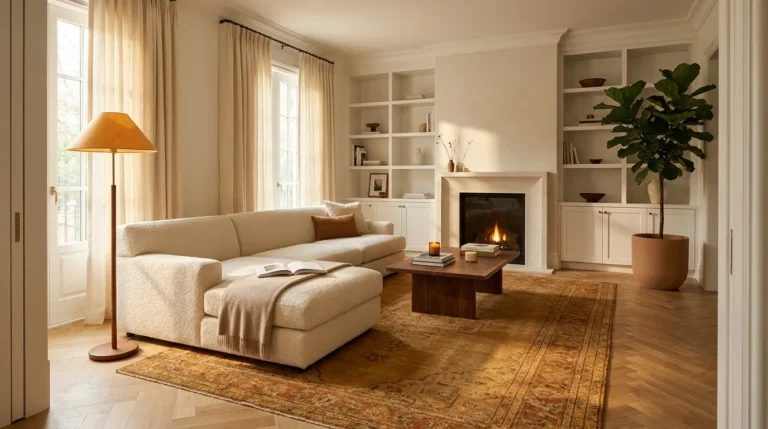
Hanging curtain panels from a rod mounted at or near the ceiling line — rather than just above the window frame — is the single most impactful curtain installation decision available. It extends the apparent height of the window, makes the ceiling read as higher, and creates the proportion that professional window treatments have and off-the-shelf installations typically miss.
The panel length should reach from the rod to within half an inch of the floor, or pool slightly on the floor (1 to 3 inches of pooling for a relaxed, intentional look). A gap between the panel’s hemline and the floor — even a small one — reads as a measuring error rather than a choice. The length is non-negotiable: ceiling-to-floor.
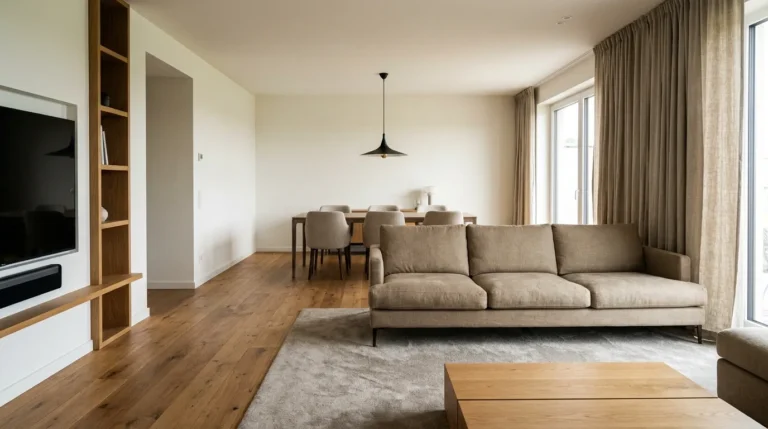
Natural linen in an unlined or interlined weight is the most versatile fabric for living room curtains because it allows some light transmission when backlit by natural light (which creates warmth rather than a blackout quality) while providing genuine visual privacy from outside after dark when the interior lights are on. A linen panel in warm white, oatmeal, or natural undyed tones suits the widest range of living room color palettes.
2. Velvet Panels for Evening Drama and Acoustic Softness
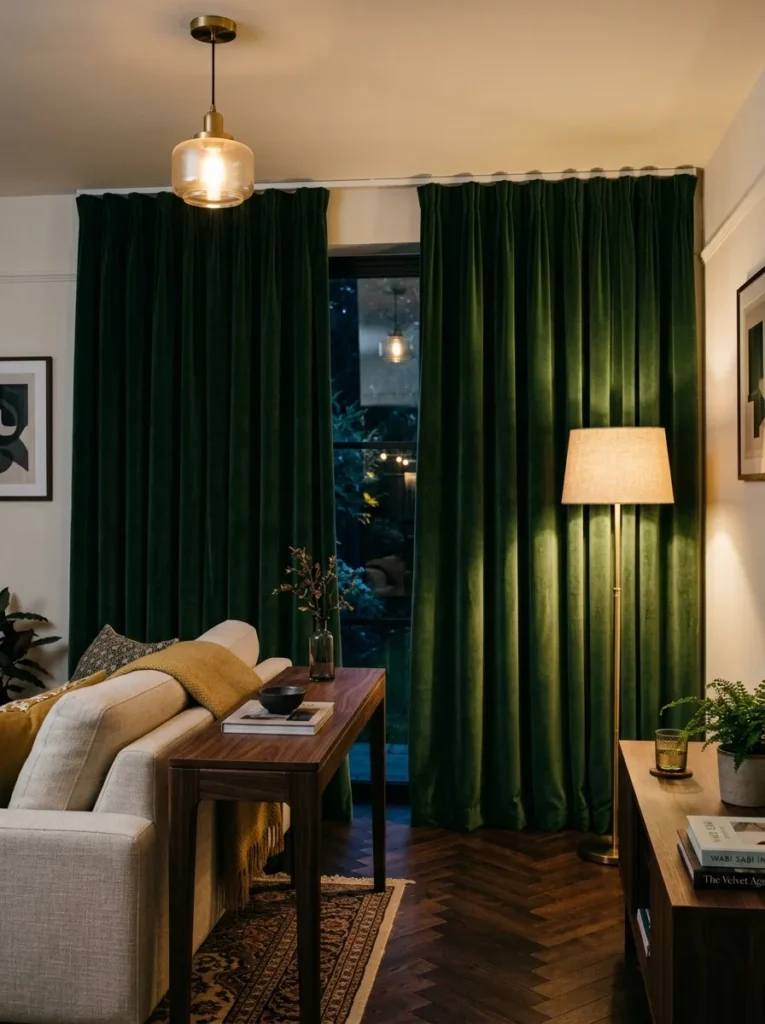
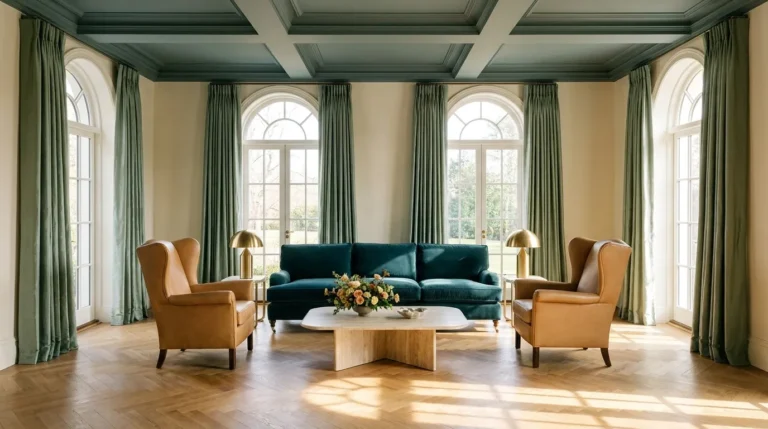
Velvet curtain panels bring a quality to a living room that no other fabric achieves: genuine visual weight, acoustic absorption, and a color depth that shifts dramatically between natural daylight and artificial light. In daylight, velvet reads as rich and textured; in evening lamplight, it deepens and warms in a way that creates atmosphere rather than simply coverage.
The acoustic benefit is practical rather than merely aesthetic. Velvet panels on a living room window reduce echo and sound transmission in ways that lightweight fabrics can’t — the fabric’s pile absorbs sound rather than reflecting it, which makes the room feel quieter and more contained.
Color is the primary decision with velvet panels. Deep jewel tones — forest green, midnight navy, plum, warm copper — develop the most visual interest and suit the fabric’s inherent richness. Lighter velvet (dusty rose, sage, pale grey) works but reads as less distinctly velvet than a saturated tone. The panels should be hung at ceiling height as with all full-length treatments, and the fabric’s weight means they need a strong, properly anchored rod rather than a tension rod.
3. White Linen Panels with a Natural Border or Trim Detail
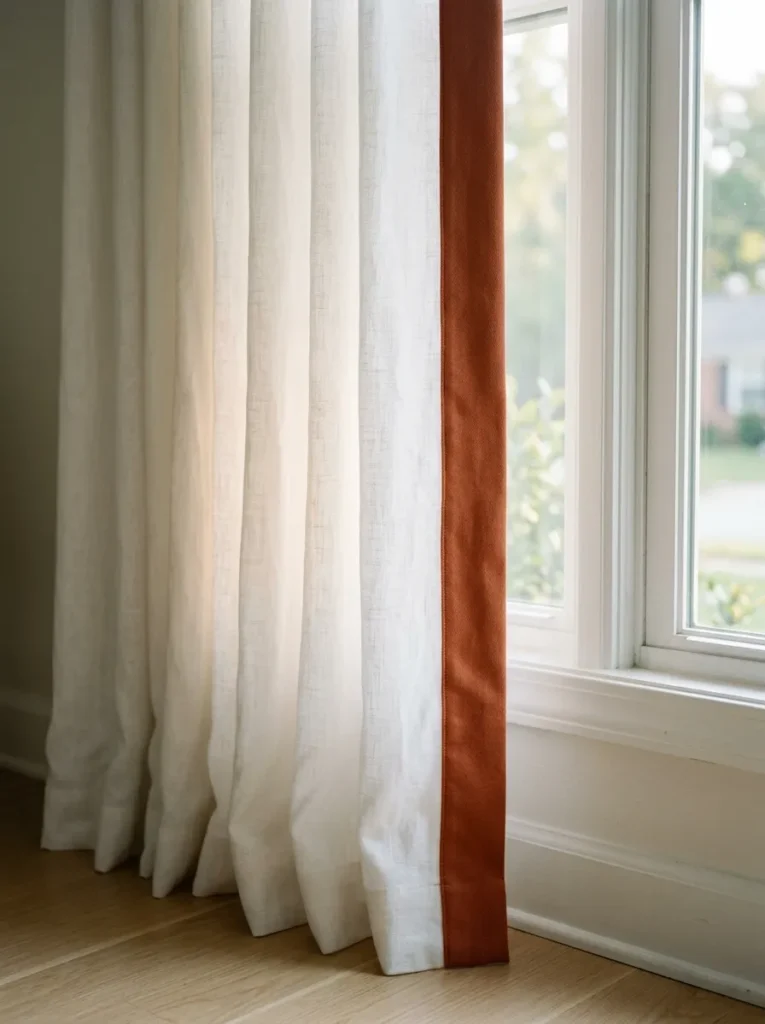
A standard white or off-white linen curtain panel becomes something more considered when it incorporates a deliberate border detail: a 2 to 3-inch band of contrasting fabric along one or both vertical edges, or along the hem. The border reads as a custom detail that elevates what might otherwise be a plain neutral panel.
The border fabric should contrast in color, texture, or both. A natural linen panel with a terracotta or deep sage border adds a color note to a treatment that would otherwise read as completely neutral. A smooth linen panel with a woven textured trim adds material interest without introducing color. A linen panel with a velvet ribbon along the leading edge adds a tactile quality that reads as considered at close range.
This is also an achievable DIY customization: stock linen panels in a neutral can be modified with iron-on or sewn trim tape at minimal cost, creating a custom look from an off-the-shelf starting point. The border width should be proportionate to the panel’s total width — a 2-inch border on a 50-inch panel reads as refined; a 2-inch border on a 96-inch panel reads as underscaled.
4. Sheer Panels That Soften Without Blocking

Sheer curtain panels — lightweight, semi-transparent fabrics that diffuse direct sunlight rather than blocking it — are the right treatment for living rooms where natural light is the room’s primary asset and the goal is to soften the light quality without reducing the room’s brightness. The sheer panel filters the view without eliminating it, creates a gauzy, slightly romantic quality in the room, and can be left drawn across the window during the day without darkening the room.
The sheer works best in a living room when it runs from ceiling to floor as with any full-length panel — sheers cut at sill height read as decorative accents rather than window treatments. A sheer should also be generous in width: a sheer panel that’s exactly the width of the window looks sparse when drawn; a sheer that’s 1.5 to 2 times the window width creates the fullness that reads as properly dressed.
Cotton voile, fine linen gauze, and silk organza are the most beautiful sheers for a living room. Polyester sheers are more affordable and more resistant to UV degradation but can look plasticky rather than fabric-quality at close range. The material choice depends on the window’s sun exposure and the budget available.
5. A Sheer and Blackout Combination on a Double Rod

A double curtain rod — two rods mounted one in front of the other on the same bracket — allows a sheer panel and an opaque panel to operate independently on the same window. The sheer can be drawn during the day to soften direct light while maintaining privacy; the opaque panel can be drawn in the evening for full light blockage and privacy; both can be drawn for maximum privacy; both can be open for unobstructed natural light and view.
This combination is the most functionally versatile living room window treatment because it addresses every light condition the room will encounter across a day and a year. It’s also the most visually layered — the two panels visible when both are partially drawn create depth at the window that a single treatment can’t provide.
The opaque panel should be significantly wider than the window when fully open so it stacks against the wall rather than covering part of the window when drawn back. A blackout or room-darkening panel that, when open, covers 20 percent of the window glass defeats its purpose as a retracted panel. Allow a minimum of 6 inches of wall on each side of the window for panel stacking.
6. A Single Dramatic Curtain Panel on One Side

Rather than symmetrical panels on both sides of a window, a single full-width curtain panel positioned to one side creates an asymmetric, slightly editorial treatment that reads as intentionally unconventional. The single panel allows full window exposure when drawn to one side — no light is blocked — while still providing the texture, color, and decorative presence of a curtain at the window.
This works best in living rooms where the window has a strong architectural context — one wall that’s visually more interesting than the other — and where the single panel can be positioned to frame the window without covering it. A panel on the left side of a window with a view to the left reads as drawing attention toward the view; a panel on the right frames the window with the fabric on the room’s more interesting side.
The single panel approach requires a rod that extends substantially beyond the window on the panel’s side — at least 18 to 24 inches beyond the frame — so the panel clears the glass entirely when drawn. The panel’s width should be at least equal to the window’s full width so that when drawn across the window (in the rare case privacy is needed), it can cover the entire pane.
7. A Roman Shade in a Pattern or Printed Fabric

A Roman shade in a printed fabric — a botanical, geometric, or block-print pattern — introduces color and pattern at the window while maintaining a neat, structured appearance when raised. Unlike curtain panels, which hang in soft folds and move with air currents, a Roman shade is crisp and controlled — its pattern is always fully visible and reads as a framed textile when lowered.
The pattern scale should be calibrated to the window size. A small-repeat pattern on a large picture window reads as texture from across the room rather than pattern — the individual motifs are too small to be legible at distance. A large-repeat pattern on a small window may show only one or two motifs per shade, which can look incomplete. A pattern with a repeat of 8 to 14 inches suits most standard living room windows.
The Roman shade works particularly well as the only pattern in an otherwise neutral room — where the walls, sofa, and rug are all plain and textured rather than patterned, a single printed Roman shade at the window becomes the room’s pattern moment without creating visual competition.
8. A Woven Wood Shade with a Relaxed Casual Quality
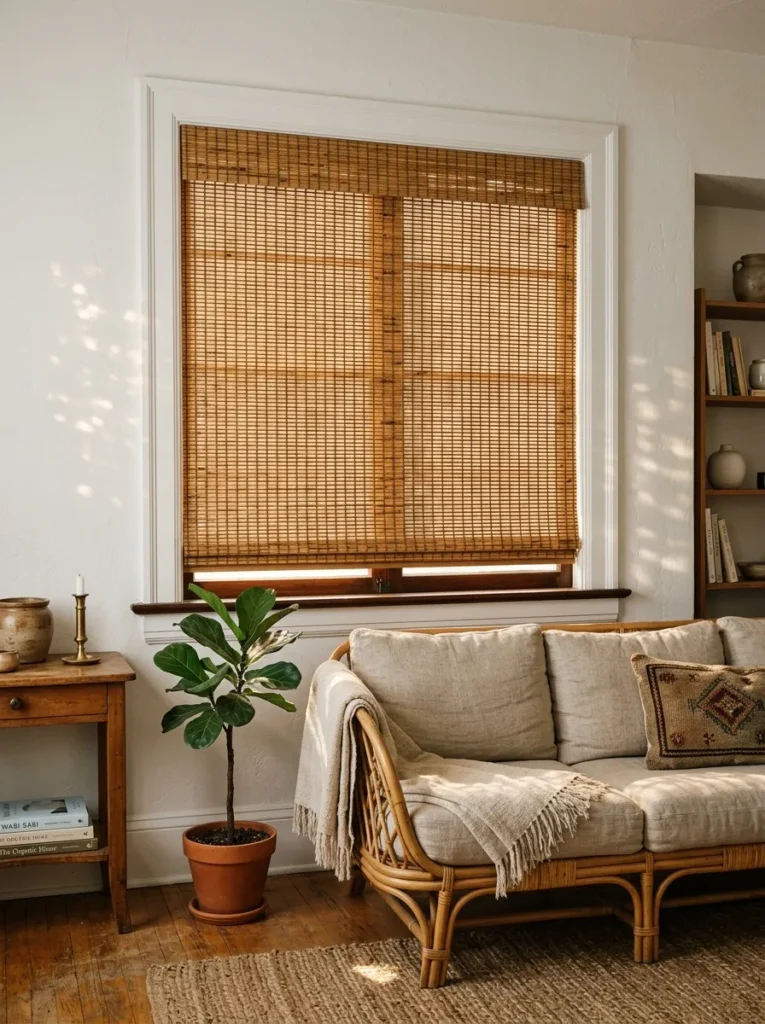
A woven wood shade in a living room provides the same warmth and organic texture as in a kitchen context but at a larger scale — the shade’s natural material and warm honey-to-grey tones suit living rooms decorated in earthy, organic palettes where the window treatment should feel like an extension of the room’s material story rather than a separate decorative decision.
In a living room, a woven wood shade is most effective when it’s large enough to suit the window — a shade that reads as small for the opening it covers looks like it was chosen for a different room. For large living room windows, custom-width woven wood shades or multiple shades hung together (with the fabric seam between them positioned at a natural visual break point) are more effective than a single undersized shade.
The light-filtering quality of woven wood shades varies by weave density. An open weave in a living room facing west or south creates a warm, dappled afternoon light effect that changes the room’s atmosphere in an interesting way. A tight weave provides more privacy and less light filtration. Choosing based on the window’s sun orientation rather than purely on appearance is the practical approach.
9. Motorized Blinds for Large Windows or Hard-to-Reach Installations
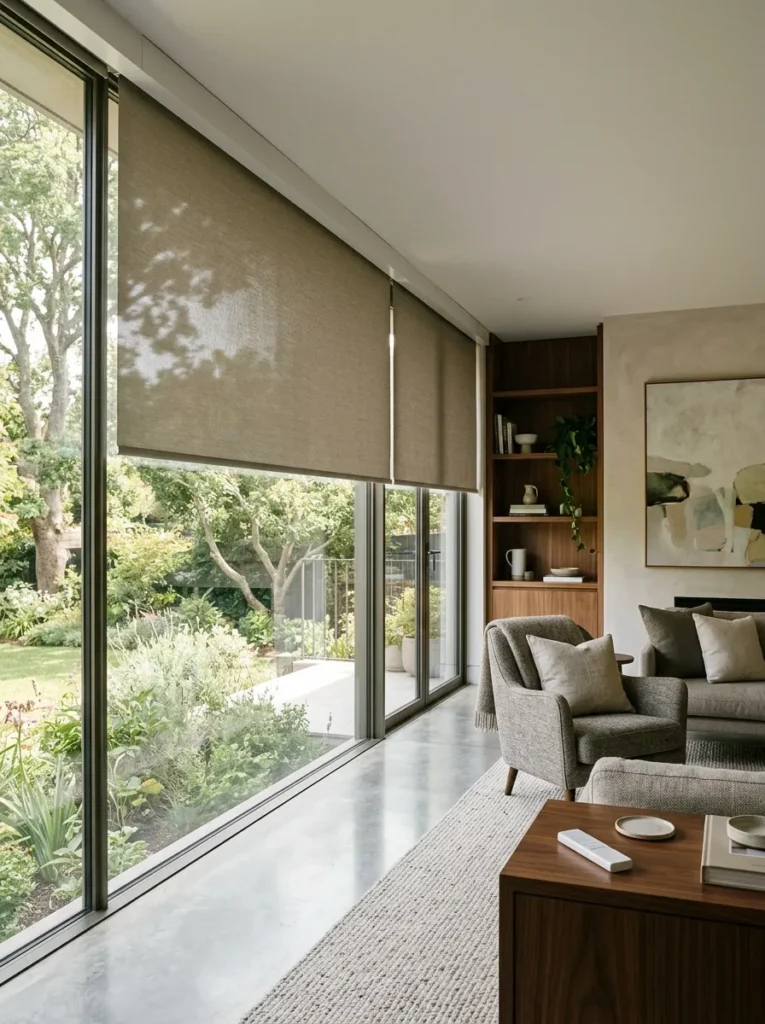
For very large living room windows — floor-to-ceiling glazing, windows above a sofa, or windows in vaulted ceiling rooms where the top of the treatment is unreachable — motorized blinds or shades provide the only practical light-control solution. Manual cords or wands are insufficient for large installations and unsafe in households with children.
The motorized blind category includes roller shades, cellular shades, and Roman shades in motorized formats — all controlled by a remote, a smartphone app, or a smart home system. The visual result is identical to a manual version of the same product; the motorization is entirely functional.
For a living room where the window treatment is a significant visual element, the visible housing or headrail of a motorized shade should be as minimal as possible — a slim fascia that covers the motor mechanism without adding visual bulk at the top of the window. Recessed pockets (where the shade rolls into a built-in ceiling or wall recess) are the cleanest solution for motorized treatments in high-end renovations.
10. Bamboo or Grasscloth Roller Shades

A roller shade in a natural fiber material — bamboo, grasscloth, or jute woven onto a backing — provides a clean, minimal window treatment that reads as organic and considered rather than functional and forgettable. When raised, the shade rolls neatly at the window’s top and is nearly invisible; when lowered, the natural material texture creates warmth without the pattern complexity of a woven wood shade.
The roller format suits contemporary and minimal living rooms where visual simplicity is the priority and any treatment with gathered fabric, visible folds, or decorative hardware would feel excessive. The clean roll-up mechanism and flat lowered surface are the most visually restrained window treatment available while still being a genuine material choice rather than no treatment at all.
The shade’s opacity should match the room’s actual needs. A solar shade (which reduces glare and UV while maintaining the view) suits a living room with a desirable view that the occupants want to preserve. A privacy roller shade (which blocks the view from outside in daylight) suits a living room with a street-facing window. A blackout roller shade suits a living room that doubles as a media room where complete light control is needed for daytime viewing.
11. Interior Plantation Shutters for a Timeless Look

Interior plantation shutters — full-height louvered panels on hinges that fit inside or outside the window frame — are the most architecturally integrated window treatment possible short of frosted glass. When the louvres are open, light enters freely; when angled, light is filtered; when closed, privacy is complete. The hardware is fixed rather than hanging, which means no panels to adjust, no rods to dust, and no fabric to clean.
For a living room with architectural window details — wide casings, traditional profiles, or deep window recesses — shutters follow and enhance the existing detail rather than hiding it the way a curtain does. The shutter’s louvres create their own shadow pattern when lit, which adds texture to the window wall without any additional decor.
Plantation shutters represent a significant upfront investment but are one of the few window treatments that add measurable resale value to a home, as they read as a permanent architectural feature rather than applied decor. Custom shutters fitted to the exact window dimension — with a fraction of an inch tolerance — read dramatically better than shutters with visible gaps at the jamb or the sill.
12. Frosted or Privacy Window Film for Street-Facing Windows

In living rooms on ground floors, close to a street, or facing a neighbor’s window, frosted or privacy window film on the lower portion of the glass provides permanent privacy without any fabric treatment. The frosted zone blocks the direct line of sight from outside while allowing diffuse light to pass through; the clear upper zone maintains the view to the sky and upper surroundings.
Decorative frosted film is available in plain frost, subtle etched patterns, geometric designs, and even botanical motifs — the film is a design element in its own right rather than simply a privacy solution. A geometric frosted pattern on the lower third of a large living room window reads as an architectural detail rather than a remedial privacy measure.
Film application is a DIY-achievable project: the window surface is cleaned thoroughly, the film is wetted and applied with a squeegee, and air bubbles are worked out systematically from the center to the edges. Premium films from established manufacturers are more bubble-resistant and UV-stable than budget alternatives. For a permanent installation, professional application produces a more consistently bubble-free result.
13. Layered Curtains with Contrasting Textures

Layering two curtain fabrics on a double rod — a textured outer panel over a lighter inner panel — creates a window treatment with depth and visual complexity that a single fabric can’t achieve. The outer panel (typically in a heavier fabric like linen, velvet, or a woven cotton) provides opacity and drama; the inner panel (a sheer or lightweight linen) provides softer coverage when the outer panel is drawn back.
The texture contrast between the two layers is what makes this read as designed rather than assembled. A heavy linen outer panel over a fine cotton voile sheer creates a contrast of weight and opacity. A velvet outer panel over a silk organza inner panel creates a contrast of material register — the same color in two very different surfaces. The two fabrics should be in the same tonal family so that when both panels are visible (the outer drawn back, the inner drawn forward), they read as related rather than competing.
The layered curtain works best in living rooms that are used in the evening and where the room’s atmosphere at night is as important as its daylight quality. The heavy outer panel draws for evening privacy and warmth; the sheer inner panel maintains a soft, filtered quality during the day.
14. A Curtain and Roman Shade in the Same Treatment Zone

Combining a Roman shade with flanking curtain panels on the same window creates a layered treatment where the shade handles the functional light control (raising and lowering for privacy and glare management) and the curtains handle the decorative framing of the window. The shade lives inside the window frame or just outside it; the curtain panels hang from a rod wider than the window and frame the shade from the room side.
This combination reads as more formal and fully dressed than either element alone. The shade’s clean structure and the curtain’s soft fullness complement each other — the shade provides discipline, the curtains provide warmth. In a transitional or traditional living room, this is the treatment approach that reads as most considered and complete.
The materials should be harmonious rather than matching. A plain Roman shade in a warm natural linen with flanking curtain panels in a textured weave of the same color family creates material interest without pattern competition. Avoid using a patterned shade with a patterned curtain panel — two active pattern sources on the same window creates visual conflict rather than richness.
15. Floor-to-Ceiling Drapery for a Large Picture Window

A large picture window — a single uninterrupted pane of glass spanning much of a living room wall — presents a specific proportion challenge. Standard window treatments look small against a large pane; the treatment needs to be scaled to the window rather than sized like a standard residential curtain.
For a large picture window, floor-to-ceiling drapery panels on a rod that extends 18 to 24 inches beyond the window on each side (so the panels stack entirely off the glass when open) create the most resolved treatment. The panels should be opulent in width — 2 to 2.5 times the window width in total fabric — so they have generous fullness when drawn.
Lining matters more for a large-scale drapery treatment than for smaller panels: an unlined large panel can look flat and thin from inside the room and read as underwhelming against the window’s scale. An interlined or blackout-lined drapery has the weight and body to hang with full, rounded folds that suit the window’s scale and create genuine visual presence.
16. A Bay Window Treated as Three Separate Windows
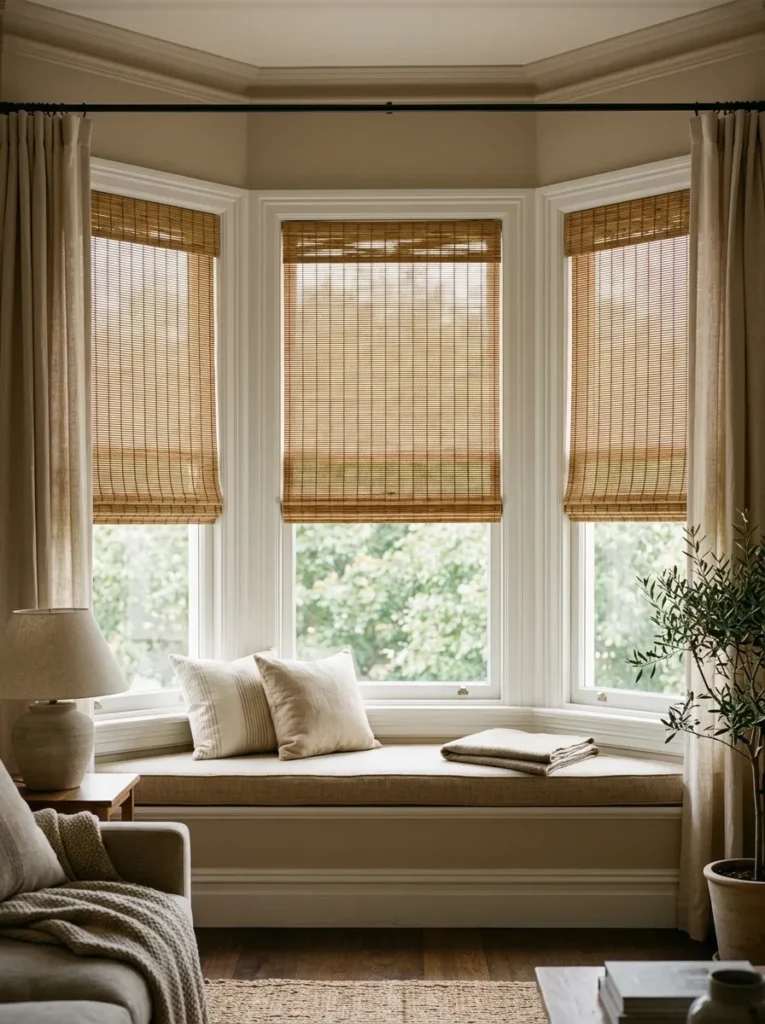
A bay window — a projecting window structure with three or more angled panes — presents a choice: treat the bay as one unified treatment or treat each pane individually. Treating it as three separate windows (a treatment on each individual pane, typically Roman shades or shorter curtain panels that don’t need to clear the bay’s projecting walls) is the more practical and often the more visually resolved approach.
Each shade or panel in the bay should be in the same fabric — uniform treatment across all three panes creates visual cohesion. The hardware (rod or shade cassette) should be continuous or at matching heights across all three panes so the treatment reads as a composed bay treatment rather than three independent decisions.
One approach that particularly suits bay windows: a woven wood shade on each pane, mounted inside the window frame. The three shades at the same height and in the same material create a unified bay treatment that reads as custom and considered, and the material’s warmth suits the cozy, intimate quality that bay window seats often project.
17. A Curtain Rod Mounted Beyond the Window’s Width

Regardless of which window treatment is chosen, the rod width is a foundational decision that shapes the window’s apparent size. A rod that extends only to the edge of the window frame forces the curtain panels to partially cover the glass even when drawn — which reduces the window’s visible size and admits less natural light than the window offers.
A rod that extends 12 to 24 inches beyond the window frame on each side allows curtain panels to stack completely off the glass when drawn open, making the full window visible and maximizing natural light during the day. From across the room, the window appears wider because the panels hang against the wall rather than against the glass.
This is a technical decision rather than an aesthetic one, but it has more impact on the room’s perceived natural light and the window’s apparent scale than almost any fabric or color choice. The additional rod length and extra panel fabric required to clear the window are modest costs relative to the proportion benefit they provide.
18. No Treatment at All — When Leaving Windows Bare Is Right

The most undervalued living room window treatment idea is the deliberate decision to use none. In a room with beautiful architectural window details, an exceptional view, or enough privacy from the window’s position that treatment is functionally unnecessary, bare windows read as confident and architectural rather than unfinished.
A living room on an upper floor with a view to treetops or sky, a room with windows that face only a private garden, or a space where a strong design aesthetic benefits from the clean reading of an untreated window — in each of these cases, adding a treatment reduces rather than improves the room’s quality.
The test for whether bare windows are appropriate: stand in the room’s primary seating position at night with the interior lights on. If the window provides a comfortable privacy level from that position, no treatment is needed. If the window creates a sense of exposure or visibility from outside that reduces the room’s comfort, a treatment is necessary. The test is functional rather than aesthetic — privacy needs, not decorating convention, should determine whether a living room window gets treated at all.
Getting the Technical Decisions Right Before Choosing the Treatment
Three technical decisions determine whether any window treatment reads as professionally installed or simply purchased and hung.
Rod placement. The rod should be mounted as close to the ceiling line as possible — typically 2 to 4 inches below the ceiling, or higher if the ceiling has a cove or cornice. The minimum acceptable rod height is 6 inches above the window frame. A rod mounted directly above the window frame, regardless of the fabric or style chosen, produces a treatment that reads as undersized for the room.
Panel length. The two acceptable panel lengths are floor-length (to within 0.5 inches of the floor) or deliberately pooling (1 to 3 inches on the floor). Anything between — panels that hover 2, 4, or 6 inches above the floor — reads as a measuring error. Check the final measurement from the rod to the floor before ordering or hemming.
Panel width and fullness. A flat panel with no fullness reads as a shade rather than a curtain. A gathered or pleated panel with appropriate fullness — typically 1.5 to 2.5 times the window width in total fabric — hangs in the rounded folds that read as a proper curtain. Pinch pleat, goblet pleat, and ripple fold headers all create this fullness with different visual effects; flat rod-pocket panels hung without fullness read as a temporary solution regardless of the fabric quality.
Final Thoughts
Living room window treatments are worth the effort of getting right because they’re always visible, always affecting the room’s light quality, and — when chosen and installed correctly — one of the most transformative single decisions in the room’s design.
If you’re choosing from scratch with a clear direction, start with Ideas 1 and 17: ceiling-mounted floor-to-ceiling panels and a rod that extends well beyond the window. Those two decisions — rod placement and panel length — are the foundation that every other treatment choice is built on. Get them right first, and the fabric, color, and layering decisions become considerably easier.
For living rooms with specific functional needs — light control, privacy, large windows, or hard-to-reach installations — Ideas 5, 9, and 11 address those challenges specifically with layering, motorization, and shutters.
Save the ideas that match your window’s architecture and your room’s light conditions, and return to the technical section before placing any order. The measurement decisions matter more than the fabric decisions, and they’re easier to get right before installation than after.