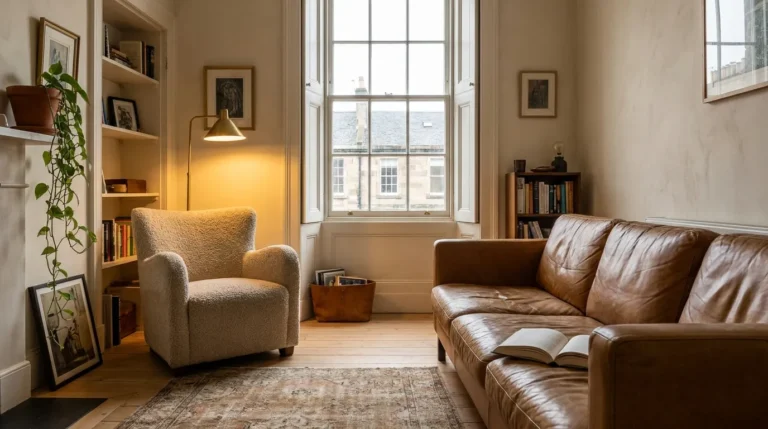

19 Living Room Floor Lamp Ideas That Create Cozy Lighting
The difference between a living room that feels warm and one that feels washed out is usually lighting — specifically, whether the light sources in the room are at the right height, temperature, and position to create atmosphere rather than simply illuminating the space. A single overhead fixture flooding a room from directly above is the least flattering, least atmospheric way to light any interior. A floor lamp positioned beside the sofa, behind a chair, or in a corner operates at a height close to where people actually sit, creating the horizontal pools and soft shadows that make a room feel genuinely inhabited.
Most floor lamp advice stops at style categories — arc lamp, tripod, torchiere — without addressing the decisions that determine whether a lamp actually creates the cozy atmosphere the buyer is imagining. Bulb color temperature matters more than most people realize: a warm white at 2700K produces something amber and flattering; a cool white at 4000K in the same lamp produces something close to office lighting. Shade material determines whether light diffuses softly or spills sharply. Placement height relative to eye level when seated affects whether the light reads as ambient warmth or blinding glare.
These 19 ideas move through every meaningful floor lamp variable — type, placement, shade, finish, height, and layering — with enough specificity that each one genuinely helps you decide what to put where and why.
1. Position a Tall Arc Lamp Over the Sofa to Replace Overhead Lighting

An arc floor lamp — where the arm curves dramatically outward from a weighted base, suspending the shade over the seating area — is the floor lamp most capable of replacing the overhead fixture entirely for evening use. The shade hangs above and slightly in front of the sofa, casting downward diffused light onto the seating zone in a way that reads as architectural rather than supplemental. It creates the impression that the sofa has its own dedicated light source, which is exactly the kind of intentional zone-lighting that distinguishes a considered living room from one lit by default.
The base weight matters practically: a large arc lamp with a lightweight base is unstable and unsafe. The best arc lamps use a heavy marble, concrete, or cast iron base that holds the arm securely regardless of how far it extends. Position the base to one side of the sofa with the arm sweeping across — the shade should sit roughly centered above the seating area rather than off to one side. A shade at approximately 6 to 7 feet from the floor when arcing over the sofa keeps the light above standing head height while placing it close enough to the seated position to be genuinely useful for reading or evening atmosphere.
2. Use a Brass Arc Lamp as the Living Room’s Primary Metal Accent

In a living room built on a warm neutral palette — cream walls, natural wood furniture, linen upholstery — a brass arc floor lamp does two things simultaneously: it provides the arc lamp’s atmospheric overhead-from-the-side lighting effect and it introduces the room’s dominant metallic accent in a scale and visual weight that small accessories can’t achieve. A well-proportioned brass arc lamp becomes the room’s most noticed metal element, particularly in the evening when it’s switched on and the warm light interacts with the golden finish.
The brass finish here should be brushed or aged rather than polished, which reads warmer and more considered than highly reflective lacquered brass that can look shiny in a way that competes with the softness the lamp is creating. A simple drum shade in natural linen or a dome shade in white allows the brass arm and base to be the visual statement while the shade contributes warmth through its fabric rather than through its form.
3. Place a Black Arc Lamp for Contrast in a Light-Toned Room

A matte black arc floor lamp against warm white walls creates a specific visual tension that works particularly well in contemporary, Scandinavian-influenced, or organic modern living rooms: the dark form reads as a sculptural graphic element that anchors the room’s lighter tones without introducing pattern or color. The arm’s curve creates a drawn line across the room that the eye follows, and the matte finish absorbs light rather than reflecting it, which keeps the lamp’s form present without being glary.
The shade choice is critical for a matte black arc lamp. A white or cream drum shade in linen or cotton creates maximum contrast between the dark structure and the lit shade — the shade glows distinctly against the arm. A black shade on a black lamp reads as a single dark object with a lit underside, which is a more dramatic, moody effect suited to rooms with more confident visual weight in their furniture and decor.
4. Add a Tripod Floor Lamp in a Living Room Corner for Sculptural Interest
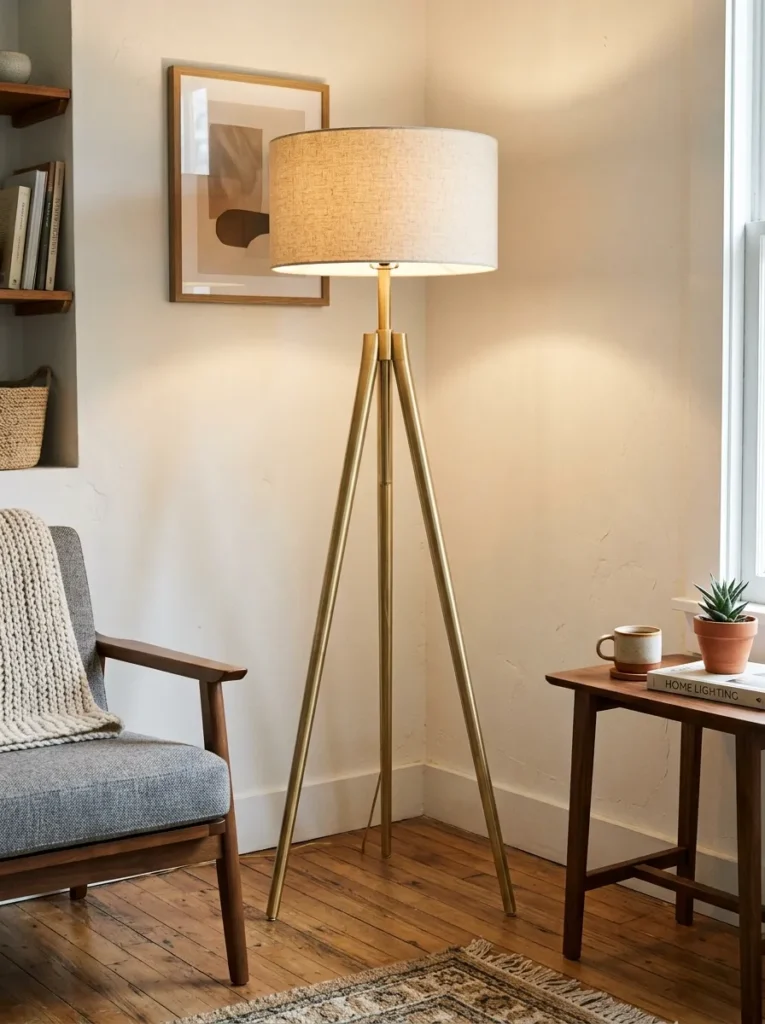
A tripod floor lamp — where three angled legs spread from a central column to form a stable base — provides visual interest at floor level as well as at shade height, making it the floor lamp type with the most architectural presence when switched off. The three-leg spread creates a geometric footprint on the floor that reads as a designed element, not just a lamp placed in a room.
Corner placement suits the tripod specifically: the spread legs can fill a corner angle naturally without any leg sitting awkwardly against a piece of furniture, and the corner position keeps the tripod’s footprint contained. A tripod in brass with a wide linen drum shade suits rooms with warm, layered palettes. In dark walnut with a cone shade, it reads as mid-century modern. The visual quality of a tripod lamp depends heavily on the material of the legs — solid brass or real wood reads as quality; thin powder-coated metal reads as budget regardless of the shade attached to it.
5. Choose a Tripod With a Pendant-Style Shade for an Unexpected Detail

The standard tripod floor lamp positions the shade at the top of the column, with the shade opening downward. An inverted version — where a pendant-style globe or cone shade is suspended from a cable between the three legs, hanging in the center of the tripod structure — creates a more unusual visual arrangement where the shade appears to float within the frame rather than sit atop it.
This style works well in eclectic or curated living rooms where the floor lamp is expected to be a conversation piece rather than a background element. The shade hangs at a lower height than a conventional drum shade at tripod height, which places the light source closer to seated eye level and produces a more intimate pool of light. A frosted glass globe in this position diffuses the light spherically, creating ambient glow in all directions rather than directional downward light.
6. Use a Rattan Tripod Lamp to Reinforce an Organic, Natural Aesthetic
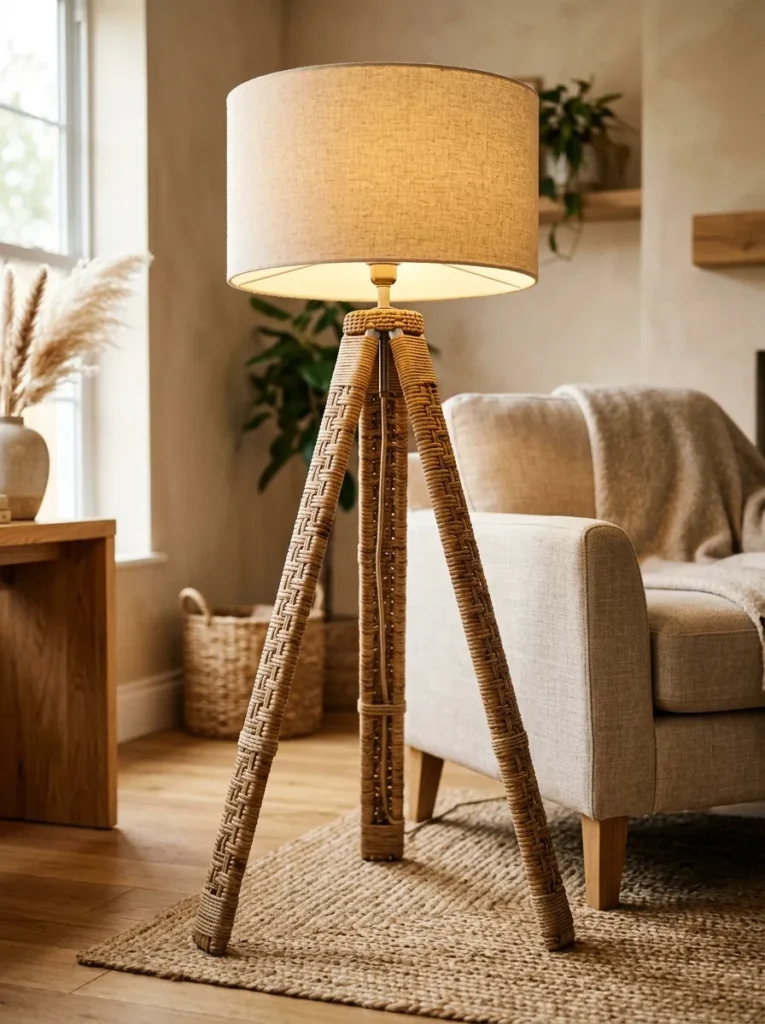
A tripod floor lamp with rattan or bamboo legs — natural materials woven or shaped into the three-leg structure — introduces the organic material quality that wood and metal legs can’t replicate. The woven rattan or shaped bamboo reads as handmade in a way that cast metal doesn’t, and it relates naturally to other organic materials in the room: a jute rug, a woven throw, natural linen upholstery, driftwood or unfinished wood furniture.
Rattan tripod lamps typically pair with fabric drum shades in warm natural tones — oatmeal, warm white, pale sand — which diffuse the light softly and maintain the organic, unhurried quality of the rattan material. This lamp type suits coastal, bohemian, Japandi-influenced, and broadly organic modern living rooms. It doesn’t suit very contemporary or industrial rooms where the natural material reads as inconsistent with the overall design register.
7. Position a Floor Lamp Behind the Sofa at Shoulder Height

Rather than placing a floor lamp beside or in front of seating, positioning one directly behind the sofa — close to the sofa’s back, with the shade at approximately shoulder-to-head height when seated — creates a lighting effect that reads as emanating from the sofa itself rather than from a lamp placed in the room. The light washes forward and slightly downward over the occupants’ shoulders, creating the most flattering and atmospheric light direction available from a floor lamp position.
The shade height for this placement should put the bottom of the shade at roughly 48 to 54 inches from the floor — high enough to be above seated head height, low enough that the light falls usefully onto the seating area rather than projecting upward into the ceiling. This position requires a floor lamp with a relatively slim base profile, since it must fit behind the sofa without pushing the sofa forward from the wall.
8. Fill a Dark Corner With a Torchiere for Upward Ambient Light

A torchiere — a floor lamp with an upward-facing bowl or cone shade that directs all light toward the ceiling — is the floor lamp type that adds the most ambient light to a room from the least visually intrusive position. Placed in a corner, a torchiere bounces its full output off the ceiling and sends diffused indirect light down across the whole room, effectively adding a secondary ambient source that supplements the primary ceiling fixture without any additional ceiling hardware.
Dark corners in living rooms — the corner behind an armchair, the corner beside a bookcase, the far corner away from the primary seating area — benefit most from this treatment. The torchiere’s upward light brightens the ceiling and upper walls of the corner, which eliminates the visual compression that dark corners create and makes the room read as larger. The torchiere’s own form is relatively unassuming since the shade is a simple bowl — the lamp earns its place through light output rather than visual presence.
9. Create a Cozy Reading Corner With a Swing-Arm Floor Lamp

A swing-arm floor lamp — where the arm can be adjusted horizontally and vertically to direct light precisely — is the most functionally useful floor lamp for a dedicated reading position. Unlike a fixed lamp whose shade position is determined by the lamp’s design, a swing-arm can be positioned so the light falls exactly on the page or screen from the optimal angle, without spilling light into the rest of the room or shining into the reader’s eyes.
This lamp type pairs most naturally with a single armchair and a small side table — the reading corner configuration that treats a section of the living room as a contained, purposeful zone. The arm should be set so the light source is at or slightly above the reader’s eye level when seated, directed toward the reading surface rather than upward. Reading positions where the light comes from directly above or behind the reader produce glare on the page; light from the side at a slight downward angle is the most comfortable for extended reading.
10. Layer Two Floor Lamps in a Large Living Room for Balanced Light Distribution

Large living rooms — those over approximately 250 square feet, or open-plan spaces that incorporate both seating and other functional zones — almost always benefit from two floor lamps rather than one. A single floor lamp in a large room creates one well-lit zone and leaves the rest of the room relatively dim, which reads as incomplete rather than atmospheric. Two floor lamps at opposite corners of the seating area — or one beside the primary sofa and one near a secondary chair or reading position — create balanced ambient light across the full seating zone.
The two lamps don’t need to be identical, but they should share at least one visual element — the same metal finish, the same shade material, or the same shade color — to read as a coordinated lighting plan rather than two separately purchased lamps that happen to be in the same room. Matching the bulb color temperature between both lamps is particularly important: if one runs at 2700K and the other at 3500K, the warm-cool difference in their light output will be immediately noticeable.
11. Choose a Linen Shade for the Warmest, Most Diffused Light Quality

The shade material determines the quality of the light that reaches the room — not just the quantity. A plastic or synthetic shade transmits light flatly and evenly, which produces the same commercial-feeling illumination that overhead fixtures create. A natural linen or cotton drum shade absorbs and diffuses the light through the fabric weave, warming it and softening its edges so the pool of light has a gradual rather than sharp boundary.
For living rooms aiming at cozy atmosphere, linen is the single most effective shade material choice. The warm beige or cream tone of natural linen also shifts the light’s apparent color temperature toward amber regardless of the bulb — a 3000K bulb through a white plastic shade reads quite differently from the same 3000K bulb through a warm linen shade. The shade should be thick enough to prevent the bulb from being visible as a bright point source through the fabric, which produces a blinking-sun effect that’s as unflattering as it is uncomfortable.
12. Use a Sculptural Base Floor Lamp as a Room’s Artistic Focal Point

Not every floor lamp needs to disappear into the room. A lamp with a genuinely sculptural base — a hand-formed ceramic column, a cast plaster form, an organically shaped wooden base — contributes to the room as an object of interest when switched off as well as when illuminated. This kind of lamp functions simultaneously as lighting and as a piece of decorative art, which justifies a position where the base is fully visible from the room’s primary seating position.
The shade for a sculptural base lamp should be relatively simple — a plain drum or a small cone — so the base’s form remains the visual subject rather than being competed with by an elaborate shade. The placement should be where the base is most visible: beside a low armchair, at the end of a sofa at coffee table height, or in a position where it can be seen in its entirety from across the room. A sculptural lamp pushed into a corner so only the shade is visible wastes the base’s contribution entirely.
13. Select a Pharmacy or Task Lamp for a Living Room Home Office Zone

An adjustable pharmacy floor lamp — with a focused directional shade on a height-adjustable arm — serves a specific living room function that ambient lamps can’t: providing bright, directed task light for work, reading, or crafting without illuminating the entire room. In living rooms that double as home office spaces, this lamp type creates a defined work zone within the broader ambient scheme.
The pharmacy lamp’s signature adjustable quality is its most important feature: the shade can be directed exactly where the work is happening without fixed positioning, and it can be redirected away from the work area when the work is done and the room returns to its ambient-living function. Brass pharmacy floor lamps have a visual quality that suits a wide range of living room styles, from classic to contemporary; matte black versions suit more modern or industrial rooms. The lamp’s slim profile makes it one of the most space-efficient options in the floor lamp category.
14. Choose a Mushroom or Dome Shade Lamp for 360-Degree Ambient Glow

A lamp with a dome or mushroom-shaped shade — where the shade extends outward and downward in a rounded form — distributes light in multiple directions simultaneously: downward through the shade’s open bottom, upward through any gap between shade and bulb, and outward through the shade’s fabric if it’s semi-translucent. The result is a lamp that contributes ambient light to the room from multiple angles rather than only downward or upward direction.
This light distribution suits living rooms where the floor lamp is intended to be the primary evening light source rather than a supplemental one — the dome shade’s wide distribution covers more of the room than a standard drum shade’s downward cone. The mushroom lamp silhouette also has a specific visual quality — organic, rounded, slightly sculptural — that suits contemporary, Danish modern, and organic modern aesthetics particularly well. Large dome shade lamps from mid-century designers remain reference points for this form.
15. Install a Floor Lamp With an Integrated Side Table

A floor lamp with a built-in shelf or side table at the lamp arm is one of the most practical floor lamp forms for living rooms where the nearest surface to the sofa or chair is too far to be useful. The integrated table provides a resting place for a drink, a phone, a book, or the remote — the items that typically need a surface within arm’s reach of seating — while the lamp provides overhead light from the same footprint. Two problems solved with one piece of furniture occupying one footprint.
The table height should be calibrated to seating height: the table surface of a floor lamp side table should sit at approximately sofa arm height or slightly above, which puts it within comfortable reach from a seated position without requiring full extension. This lamp type is particularly useful in apartments and smaller living rooms where a separate side table and floor lamp would require two separate footprints in a space that benefits from consolidation.
16. Use Warm White Bulbs at 2700K for Maximum Evening Coziness

The bulb choice inside any floor lamp determines the atmosphere more than any other single variable — more than the shade color, more than the base material, more than the lamp’s position in the room. A warm white bulb at 2700K produces an amber, candlelit quality that makes skin tones flattering, warm materials like wood and linen appear richer, and the room read as genuinely inviting for evening use. A daylight or cool white bulb at 4000K or above in the same lamp produces something close to office illumination: bright, accurate, and completely antithetical to the cozy atmosphere most living room lighting is trying to achieve.
The color temperature of all the lamps in a room should match each other for visual coherence. A room with one warm 2700K floor lamp and one cool 4000K table lamp shows the difference between the two as a color inconsistency that reads as an error rather than an intentional design choice. For living rooms where evening atmosphere is the primary goal, 2700K throughout — floor lamp, table lamp, and any dimmed overhead — produces the most consistently warm and flattering result.
17. Use a Floor Lamp With a Dimmer for Full Atmospheric Control

A floor lamp without dimming capability gives two states — on and off — which is inadequate for a room whose lighting requirements change through the day and evening. A floor lamp with an in-line dimmer, a foot switch dimmer, or a smart bulb compatible with a dimmer gives the full range from the lamp’s brightest setting (useful when reading or when the room needs to be seen) to a very low ambient glow (useful at the end of the evening or when the television is on and too much light produces screen glare).
The dimmable range of a lamp depends on both the dimmer and the bulb. LED bulbs specifically labeled as “dimmable” work with most standard dimmers; non-dimmable LED bulbs on a dimmer can flicker or buzz at lower settings. Incandescent bulbs dim smoothly across the full range but use significantly more energy. For the warmest, most atmospheric floor lamp experience in the evening — the equivalent of candlelight at the lowest setting, practical task light at the highest — a dimmable LED at 2700K is the most useful configuration.
18. Pair a Floor Lamp With a Gallery Wall to Create a Lit Vignette

A floor lamp positioned beside or slightly in front of a gallery wall or a large piece of art creates a visual relationship between the light and the wall display that makes both elements more compelling than either alone. The lamp’s light spills upward onto the lower portion of the gallery wall, washing the frames and art from below and creating the kind of accent lighting that dedicated picture lights provide — but without any wall mounting, wiring, or individual lamp installation required.
The lamp should be close enough to the wall that its light actually reaches the art — within 18 to 24 inches of the wall surface at the lamp’s nearest point. A lamp placed 4 feet from the wall provides ambient light to the room without meaningfully illuminating the art. A simple slim floor lamp with an upward-angling shade or an adjustable head works best for this application, since the shade direction can be tilted toward the wall rather than directly downward.
19. Anchor a Reading Nook With a Floor Lamp as the Zone’s Primary Light
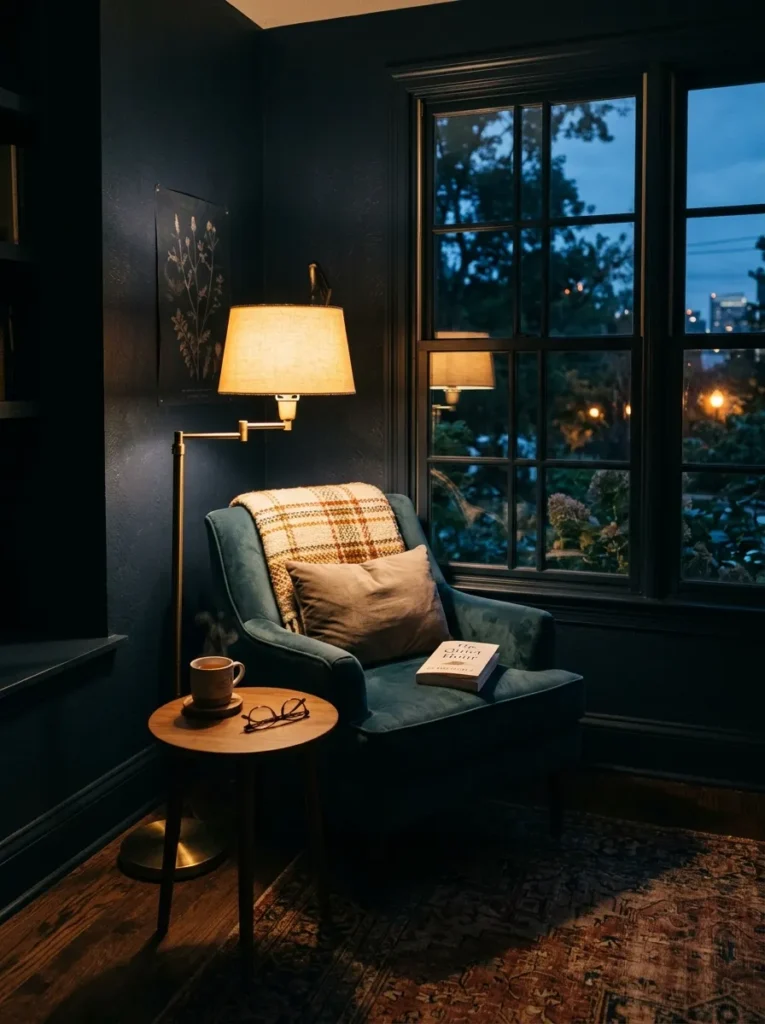
The reading nook — a dedicated corner of the living room with a comfortable chair, a small side table, and enough separation from the main seating area to feel like its own space — works most effectively when it has its own light source that’s independent of the room’s other lighting. A floor lamp positioned at the nook’s corner, with the shade placed at the height and angle that best serves reading at that chair’s specific seat depth and height, defines the nook as a zone rather than just a chair placed near a wall.
The lamp’s placement in a reading nook should prioritize the reading function over the lamp’s visual effect: the light should fall on the reading surface without creating glare on the page, without positioning the shade in the direct line of sight, and without requiring the reader to tilt the shade manually each time. An adjustable arm floor lamp is the most reliable solution for the specific requirements of a reading nook because it can be calibrated to the particular geometry of the chair, the sitter, and the reading position rather than providing a one-size-fits-all fixed light angle.
How Placement, Shade, and Bulb Work Together
Understanding why a specific floor lamp creates atmosphere — and another doesn’t — comes down to three variables working in combination rather than independently.
Placement at seated eye level or slightly above, rather than well above eye level, means the light source is within the same visual field as the people in the room. Light that comes from above head height when standing produces the overhead-fixture effect that floor lamps are supposed to counter; light from shade-to-head or shade-to-shoulder height creates the horizontal glow that reads as warmly atmospheric.
Shade material that diffuses rather than transmits light softens the pool and extends its edges. A translucent fabric shade creates gradual rather than sharp light boundaries, which prevents the spotlight effect that exposed bulbs and hard shades produce.
Bulb temperature at 2700K maintains the warm quality of the room’s materials under artificial light rather than neutralizing them. The light color that feels warmest in a living room is amber, not white — and bulb temperature selection is where most people accidentally introduce white-office light into a space they intended to feel cozy.
Final Thoughts
A floor lamp chosen for its style alone — the right shape, the right metal finish — can still produce the wrong atmosphere if the shade material, bulb temperature, or placement don’t align with the room’s actual needs. The ideas here address all three variables, not just the visual ones.
Start by identifying where the living room most needs a light source: a dark corner, the zone beside the primary sofa, a reading chair, or a specific wall display that deserves illumination. The right position comes first; the right lamp style follows from understanding what kind of light the position requires — ambient and upward, focused and directional, or diffused and downward.
Save the ideas that suit your room’s layout, your existing furniture, and the atmosphere you’re after, and return to this guide when it’s time to address the room’s other light zones.