
21 Living Room Corner Decor Ideas That Use Every Inch
A living room corner is one of the most consistently underused spaces in the home. In most rooms, corners end up as the place where furniture almost fits, where a floor lamp got pushed to make room for something else, or where nothing was ever placed at all. The corner reads as a gap — not a problem exactly, but not a solution either.
The reason corners are hard is that they’re defined by two walls meeting rather than by architectural intention. Unlike a window that suggests curtains, or a fireplace that suggests furniture arrangement, a corner offers no obvious prompt. It requires a decision about purpose before it can receive a decor response.
These 21 living room corner decor ideas address that directly. Each one gives the corner a clear function — a reading zone, a display moment, a storage solution, a plant statement, a lighting anchor — and provides enough practical guidance to understand whether it suits your specific corner: its size, its light, its relationship to the rest of the room’s furniture arrangement, and any architectural features (like a sloped ceiling or an existing outlet) that shape what’s actually possible.
A corner that works adds to the room’s sense of completeness. A corner that’s ignored does the opposite — it reads as unfinished even when everything around it is beautifully done.
1. A Reading Nook with an Accent Chair and Floor Lamp

The most satisfying corner transformation is a reading nook because it converts dead space into a destination — a place with a specific purpose that didn’t exist before. An accent chair positioned diagonally in the corner, angled toward the room rather than pushed flat against either wall, creates a seating zone that reads as distinct from the main sofa arrangement without physically separating it.
The floor lamp is what makes the reading nook legible as a reading nook rather than just a chair in a corner. A lamp positioned at reading height — 50 to 60 inches from the floor to the center of the shade — delivers light over the reader’s shoulder at the right angle. An arc lamp that extends over the chair from behind is the most space-efficient format because the base can sit behind the chair rather than beside it, which recovers floor space.
The chair’s orientation matters: turned 45 degrees to the corner, with its back toward the walls’ junction, means the chair faces into the room — it’s part of the living room, not removed from it. A chair pushed flat against one wall reads as overflow seating; a chair angled into the corner reads as a considered zone.
2. A Window Corner Reading Seat

When the corner includes a window — or sits between two windows meeting at a corner — building or placing a cushioned seat at the window base creates a reading and lounging spot that benefits from natural light in a way no interior corner can replicate. The window reading seat is one of the most desirable corner configurations in a living room, and one that most rooms with corner windows fail to use.
The seat can be built (a simple plywood box with a foam cushion at window sill height) or placed (a daybed pushed into the corner, a long ottoman positioned at the window). The built version reads as more architectural and can incorporate storage in the base. The placed version is more flexible and better for renters.
The seat depth should be usable for sitting and for reclining: 22 to 26 inches from the wall is the minimum for comfortable lying-down reading. Shallower than 22 inches works for sitting but not for the sprawled book-reading posture most window seats invite.
3. A Statement Floor Lamp as a Corner Anchor

A floor lamp in a corner performs two functions: it provides light and it anchors the corner visually. A room where the corners are dark and undefined reads as smaller than it is; a room where each corner has a light source reads as larger, more considered, and more complete.
The lamp style is the decision that most affects the corner’s character. An arc floor lamp with a broad shade suits corners adjacent to sofas where the lamp needs to extend over the seating. A tall torchiere — which directs light upward — suits corners where ambient uplighting is the goal and the ceiling is worth illuminating. A sculptural lamp with an interesting base suits corners where the lamp is as much a decorative object as a functional light source.
Scale matters considerably in a corner. A lamp that’s too slim or too short for the corner it occupies reads as a lamp that was moved there rather than placed there. A lamp at least 60 inches tall, with a shade or head that has genuine visual presence, anchors the corner in the way a piece of furniture would.
4. A Clustered Lamp Trio at Different Heights

Rather than one floor lamp, three light sources clustered in a corner — a tall floor lamp, a medium table lamp on a small side table, and a low LED candle or votive on the floor — create a layered lighting moment that reads as a considered corner installation rather than a lamp placed for lack of a better location.
This approach suits corners that need to be visually active without adding furniture. The three light sources at different heights create visual movement in the corner from low to mid to tall, and the layered light quality changes the corner’s atmosphere significantly between day and evening. During the day, the objects read as a styled corner arrangement; in the evening, the lit cluster becomes the room’s warmest visual zone.
The three elements should share a material or finish family: all in warm brass, all in matte black, or all in ceramic — so they read as a composed group rather than unrelated objects placed in proximity.
5. A Large Indoor Tree or Tall Plant

A single large plant — a fiddle leaf fig, olive tree, majesty palm, bird of paradise, or large rubber plant — positioned in a corner creates the most visually impactful corner statement without adding any furniture. The plant’s height (typically 4 to 6 feet) fills the vertical space of the corner; its organic form contrasts with the room’s architectural right angles; and it introduces genuine life into a space that would otherwise be static.
The plant position within the corner matters: pushed directly into the corner junction reads as a plant that ran out of space; positioned 12 to 18 inches out from the corner walls, slightly offset, reads as a deliberate placement that allows the plant’s form to be seen from multiple angles.
Light requirements are the practical limitation. Most large statement plants need bright indirect light to thrive — within 6 to 8 feet of a window, or in a room with large windows that allow significant natural light. A dark interior corner with no window proximity is not a viable location for most large plants. High-quality artificial plants in this size category have improved significantly and are a practical alternative for corners where light is insufficient.
6. A Tiered Plant Stand with Multiple Specimens

Where a single large plant makes a bold statement, a tiered plant stand — a multi-level structure holding three to five smaller plants at different heights — creates visual variety within a more contained footprint. The tiered stand suits corners where a large floor plant isn’t practical (low light, small footprint, rental situations where a heavy planter isn’t appropriate) but where the organic quality of plants is still the desired corner treatment.
The plant selection for a tiered stand should vary in form and texture: a trailing pothos spilling downward from the top shelf, a compact snake plant with vertical form on the middle shelf, and a small succulent or cactus on the bottom shelf create visual interest across the full height of the stand. All solid-green plants in a tiered stand read as monotonous; a mix of trailing, upright, and compact forms creates movement.
The stand material should suit the room’s direction. A black metal tiered stand reads as contemporary and suits more minimal rooms. A natural bamboo or rattan tiered stand suits organic, boho, and transitional rooms. A white painted metal stand suits soft, Scandinavian, or romantic aesthetics.
7. Floor-to-Ceiling Built-In Corner Shelving

A built-in bookcase or shelving system that runs from floor to ceiling in a corner — spanning both walls in an L-shape, or running along one wall to the corner — is the most architecturally resolved corner solution possible. It transforms an unused corner into the room’s primary storage and display surface, and it reads as an intentional design decision rather than a piece of furniture placed to fill a gap.
The L-shaped configuration (shelves running across both walls) maximizes storage but requires professional carpentry to achieve clean inside corners. A single-wall configuration (shelves running along one wall and stopping at the corner) is more achievable as a DIY project using standard bookcase units positioned end-to-end.
The styling of built-in corner shelves determines whether they read as a library (books as the primary object, organized by size or spine color) or as a display wall (curated objects, plants, and framed prints arranged with generous breathing room). Both are valid; the mistake is a shelf that’s neither — overcrowded with undirected objects that read as storage rather than display.
8. A Freestanding Ladder Shelf in the Corner
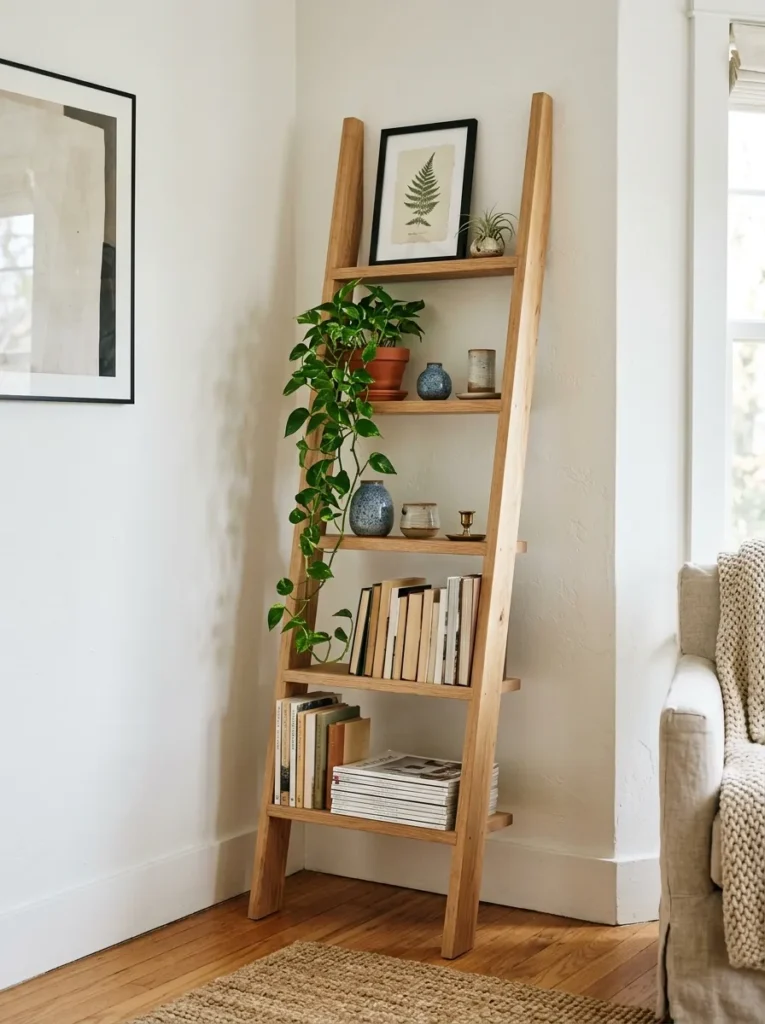
A leaning ladder shelf — narrower at the top than the bottom, leaning at an angle against the wall — suits corners where a floor-to-ceiling installation isn’t possible (rental, smaller corners, rooms where the existing architecture already feels full). The leaning format uses the wall as a structural support rather than a mounting surface, which means no holes and easy relocation.
The ladder shelf works best in a corner when it leans against one wall and the opposite shelf ends rest naturally near the adjacent wall — the corner contains the shelf rather than the shelf floating against a single wall. This positioning gives the shelf a corner-specific quality rather than making it look like a shelf that happened to be placed near a wall junction.
Styling: keep the upper shelves lighter (small objects, trailing plants, a few books) and the lower shelves more substantial (heavier books, ceramic vessels, a basket). This follows the visual gravity principle — heavier elements at the base, lighter at the top — and prevents the leaning shelf from reading as top-heavy.
9. A Corner Floating Shelf Arrangement

Floating shelves installed at the corner junction — running at an angle across the corner itself, or running along both walls meeting at the corner in an L-shape — use the one wall area that’s hardest to furnish (the corner walls) as a display surface. The corner shelf arrangement creates a composition that’s visible from across the room and fills the otherwise unoccupied wall junction.
Diagonal corner shelves (angled at 45 degrees across the corner) create a distinctive geometric moment but require precise installation. L-shaped shelves running along both walls are more straightforward to install and provide more usable surface. Both work; the diagonal version reads as more intentional and design-conscious; the L-shaped version is more practically useful.
The objects on corner floating shelves should be calibrated to the height at which the shelves are installed. Shelves above eye level should hold objects that read clearly from below — a plant trailing downward, a distinctively shaped vessel, a stack of books with visible spines. Shelves at eye level or below suit smaller objects and personal items that reward closer inspection.
10. A Corner Accent Chair with an Ottoman

An accent chair with a separate ottoman in a corner creates a micro-lounge — a secondary seating zone distinct from the main sofa group that reads as a considered destination rather than additional overflow seating. The ottoman gives the chair a social quality (someone in the main seating can rest their feet; someone in the chair can fully recline) and adds visual grounding to a chair that might otherwise float in the corner.
The chair and ottoman relationship matters proportionally. An oversized ottoman beside a small chair reads as a mismatch; a footstool-sized ottoman beside a generous armchair reads as correctly scaled. The ottoman’s height should be approximately equal to or slightly lower than the chair’s seat height — at seat height, it reads as a second seat; below seat height, it reads as a footrest.
The chair’s fabric or finish should relate to the room’s existing sofa — not necessarily matching, but in the same material register or color family so the accent chair reads as belonging in the room rather than borrowed from another space.
11. A Corner Daybed or Chaise Lounge

A chaise lounge or daybed positioned in a corner — particularly a corner with a window — creates the room’s most desirable seating position: fully reclinable, visually distinct from the sofa, and naturally lit. The chaise occupies the corner efficiently because its longer dimension runs along one wall while its shorter dimension extends into the room, using the corner’s angle to anchor the piece rather than fighting it.
The chaise or daybed is particularly effective in living rooms that function as multi-purpose spaces — where reading, working, and casual lounging all happen in the same room. It provides a seating format that a sofa and standard accent chairs don’t: the ability to lie down without lying on the main sofa, which maintains the sofa as a social seating surface.
Scale is the practical concern: a chaise requires at least 60 to 70 inches along one wall and 30 to 35 inches of depth into the room. In a small living room, this can consume too much of the floor plan. In a medium to large living room, the chaise corner is one of the most resolved and comfortable configurations possible.
12. A Corner Desk Nook in a Small Living Room

In living rooms that also serve as home office spaces — a common reality in apartments and smaller homes — a corner desk transforms the room’s least usable space into its most practical zone. The corner desk configuration (an L-shaped desk, or two desk surfaces meeting at a corner) uses the corner’s angle to provide a larger work surface than a wall-mounted desk on a single wall can offer.
The desk placement matters for the living room’s overall character. A corner desk in the room’s least-visible corner — away from the main seating arrangement’s sightline — minimizes its visual presence when not in use. A desk facing the wall rather than the room reduces the visual weight of the monitor or computer equipment from the main seating perspective.
Cable management is the practical detail most people address after the fact rather than during setup. A corner where the outlet is in the corner junction, or where cables can be routed along the baseboard to an outlet, works cleanly; a corner where the nearest outlet is across the room requires a cable solution before the desk is installed.
13. A Small Bar Cart Styled as a Corner Feature

A bar cart positioned in a corner — styled with bottles, glassware, a small plant, and a few decorative objects — creates a purposeful corner moment that suits living rooms used for entertaining. The bar cart is particularly effective in a corner because the corner’s two walls frame the cart visually, giving it a backdrop that a freestanding cart in the middle of a wall doesn’t have.
The bar cart’s styling determines whether it reads as a considered room feature or a functional overflow. A cart with a rattan tray holding three decanters, two types of glasses, a small ceramic ice bucket, and one trailing plant reads as intentional. The same cart with every available surface covered with bottles, mixers, and miscellaneous barware reads as a utilitarian setup that happened to be placed in a corner.
The cart’s finish should participate in the room’s metal or material register. An aged brass bar cart in a room with warm-toned hardware, lamp bases, and picture frames reads as part of the material story; a chrome cart in a room of warm brass reads as a material from a different room.
14. A Gallery Moment on the Corner Walls

Rather than treating the corner as a space for furniture or objects, treating the two walls that form it as a gallery surface — hanging art and frames across both walls in a composition that wraps around the corner — creates a corner that reads as a considered display rather than a furniture problem.
The corner gallery works when the composition has a clear visual center (typically where the two walls meet) and pieces that extend outward along each wall in a balanced but not necessarily symmetrical arrangement. A large central piece at the corner junction, flanked by smaller pieces on each extending wall, anchors the composition at the room’s most visually complex point.
Frame finishes should be consistent across both walls — the same frame color running around the corner ties the composition together visually despite the 90-degree shift in wall direction. Mixing frame finishes around a corner reads as two separate gallery arrangements that happen to be adjacent rather than one composed corner treatment.
15. A Floor Plant Paired with a Sculptural Stool or Side Table

A large floor plant alone in a corner is beautiful but slightly isolated — a single element without context. Pairing the plant with a small sculptural stool, a ceramic garden seat, or a low round side table beside it creates a vignette rather than a specimen: the plant and the object together read as a composed corner moment.
The stool or side table serves a double function: it provides a surface for a small lamp, a ceramic object, or a stack of books that anchors the plant in the room’s material story, and it gives the corner a human scale that a plant alone doesn’t provide. A person sitting in the adjacent sofa can rest a drink on the stool while the plant towers above it — the two elements together define a corner that’s both decorative and usable.
The object beside the plant should be genuinely different in material from the plant’s pot: a ceramic stool beside a terracotta pot, or a rattan stool beside a concrete planter, creates material contrast that reads as intentional composition rather than matching set.
16. A Corner with a Folded or Leaning Artwork

A large-format canvas or framed print leaned against a corner wall — rather than hung — creates a relaxed, slightly unconventional corner moment that reads as considered in a different way than a hung piece. The leaning position signals that the art is valued as an object (it’s resting, not stored) and introduces a slightly impermanent quality that suits transitional and eclectic living rooms.
The scale of a leaning artwork should suit the wall height. A canvas that leans to roughly two-thirds of the wall height reads as a substantial piece that was deliberately placed; one that leans to only one-third of the wall height looks small and accidentally positioned. For a standard 9-foot ceiling, a canvas at 48 to 60 inches tall leans at the right proportion.
Layering a leaning canvas in front of a smaller object — a plant, a ceramic vase, a stack of books — positioned beside or slightly in front of it creates depth and prevents the leaning piece from reading as simply stored against the wall.
17. A Woven Basket Collection as Corner Storage

A grouping of woven baskets — three to five in varying heights and widths, all in the same natural fiber family — positioned in a corner creates a corner storage solution that reads as styled rather than practical. The basket collection works in a corner because the corner contains the grouping visually; the same arrangement in the middle of a wall reads as a pile of storage rather than a composed moment.
The variation in basket size is what makes this read as intentional. Three baskets of identical size look like a store display; three baskets of clearly different dimensions (a tall narrow basket, a wide low basket, and a medium round basket) create visual interest through the height and width variation.
The baskets’ actual storage function should match their position in the arrangement. The largest and most accessible basket is the right location for items in regular rotation — throw blankets, children’s toys, remote controls. The taller or more decorative baskets can hold seasonal items or serve as purely visual elements without needing to be functional.
18. A Corner Mirror to Bounce Light

A large round or arch-top mirror leaned in a corner or mounted on one of the corner walls reflects the room’s light and view, creating the impression of additional depth in a room that ends at a wall. In a corner with limited natural light, a mirror positioned to reflect a window on the opposite wall is particularly effective — it doubles the perceived light in a specific zone of the room without adding any light source.
The mirror’s position within the corner determines what it reflects. A mirror leaned against the back wall of a corner, angled slightly forward, reflects the ceiling and the upper part of the room rather than the window or the most interesting part of the space. A mirror mounted on one of the corner walls, at an angle that reflects across the room toward a window or toward the room’s primary seating, creates a reflection that adds genuine visual depth.
The frame style reads as the corner’s decorative decision. An ornate antique frame leans against a corner wall in an eclectic or maximalist room; a simple round frameless mirror or a thin brass ring mirror suits more contemporary or minimal spaces.
19. A Corner Nook with Built-In Bench Seating

In living rooms adjacent to a window bay or with enough wall space at a corner to accommodate a bench, building a window or corner bench creates a seating nook that distinguishes the corner as the room’s most personal and intimate zone. Unlike an accent chair (which is furniture placed in a corner) a built-in bench belongs to the room architecturally — it reads as part of the room’s structure rather than part of its furnishings.
The bench should be at least 18 inches deep for comfortable sitting and at the standard bench height of 16 to 18 inches from the floor. A cushion at least 3 to 4 inches thick makes the seating genuinely comfortable; thinner cushions look proportionate but feel inadequate for extended sitting.
The space above the bench (the wall section from the bench’s back to the ceiling) is an opportunity for a gallery arrangement, a row of floating shelves, or a large piece of art that anchors the nook visually. Without something on the wall above the bench, the nook reads as a bench against a blank wall rather than a composed seating moment.
20. A Tall Decorative Ladder for Textile Display
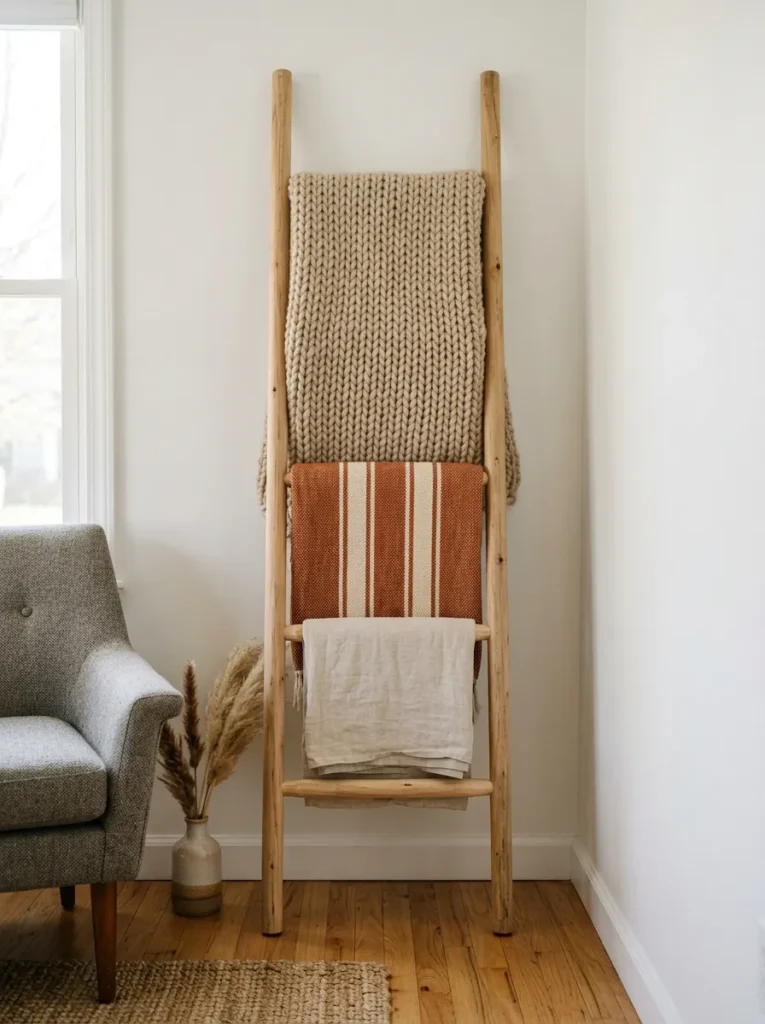
A decorative ladder — a simple A-frame or leaning ladder in natural wood, painted wood, or matte black metal — positioned in a corner and used to display folded throws, blankets, and soft textiles creates a corner that’s functional (the textiles are accessible) and decorative (the materials and textures create visual warmth). The ladder format uses vertical space efficiently in a small corner while adding organic material warmth.
The textiles on the ladder should be genuinely interesting as objects. A loosely folded chunky knit throw in warm oatmeal draped over the top rung, a woven blanket in a warm stripe draped over the middle rung, and a linen throw folded on the lower rung creates a textile gradient from textured to woven to smooth. Matching throws of the same fabric piled on a ladder read as storage rather than display.
The ladder leans against the corner wall rather than being mounted, which makes it completely renter-friendly. The angle of lean should be steep enough that the ladder rests securely against the wall without sliding — this typically means the base is 12 to 18 inches from the wall.
21. A Corner Terrarium or Display Case for a Curated Collection

A glass terrarium — or a glazed display case with an interesting object collection inside — turns a corner into a miniature world that rewards close inspection. The terrarium itself (a geometric glass form housing a small planted ecosystem of succulents, moss, ferns, and stones) is particularly effective in a corner because the glass structure catches light from multiple angles as the light source changes throughout the day.
Large-format geometric terrariums (18 inches or taller) work as floor placements in a corner, sitting directly on the floor and reading as a sculptural object as much as a plant container. Smaller terrariums on a side table or low stool in the corner function similarly at a different scale.
Alternatively, a glass-fronted display case housing a curated collection — shells, minerals, vintage ceramics, small sculptures — creates a museum-quality corner installation for someone whose collection deserves more than shelf display. The case’s glass front protects the collection from dust while allowing it to remain visible and the room to feel less crowded than open-shelf display.
Choosing the Right Corner Solution for Your Room
Not every corner needs the same treatment, and the same idea that transforms one corner can feel wrong in another. Three questions narrow the decision.
What does the corner lack most? A corner that’s visually empty but doesn’t need more furniture benefits from a plant, a floor lamp, or a leaned canvas — something that fills the visual field without adding floor furniture. A corner that genuinely lacks function (no seating, no storage, no light) benefits from a chair, a shelf, or a desk. Decorating a functional problem with a visual solution rarely resolves it.
How much floor space can the corner give up? In a small living room, a corner that surrenders significant floor space to furniture makes the room feel smaller even when the furniture is beautiful. A ladder shelf, a tiered plant stand, a floor lamp, or a leaned canvas use minimal floor area. An accent chair with an ottoman, a chaise lounge, or a built-in bench use considerably more. Know the room’s spatial budget before choosing.
What is the corner’s light situation? Natural light in the corner changes what plants and materials are viable. A dark corner near no windows can support a lamp cluster, a basket collection, a bar cart, or a mirror — none of which depend on natural light. A bright window corner is the best possible location for plants, a reading nook, or a window seat. Forcing a solution designed for a bright corner into a dark one, or ignoring a beautiful window corner by placing non-light-sensitive objects in front of it, wastes the room’s most valuable spatial assets.
Final Thoughts
A living room corner that’s been given a clear purpose — a reading nook, a plant statement, a display moment, a lighting anchor — adds to the room’s sense of completeness in a way that’s disproportionate to the small area it occupies. Corners are visible from across the room; when they’re resolved, the room reads as finished. When they’re not, the eye finds them and registers something unfinished even in an otherwise well-decorated space.
If you’re starting with a single empty corner and limited budget, Ideas 3, 5, and 16 — a statement floor lamp, a large plant, and a leaned canvas — are the three lowest-cost, highest-impact corner solutions available. All three require minimal installation, no professional involvement, and can be changed when the room evolves.
For corners that need to do more — to store, to seat, to work — Ideas 7, 1, and 12 provide the architectural weight and functional depth that decorative solutions alone can’t deliver.
Save the ideas that suit your corner’s size, light, and the room’s purpose, and come back to the practical section when you’re deciding between options that look equally good in photographs but serve different real needs.