
19 Kitchen Window Ideas That Brighten Your Space
The kitchen window is one of the hardest-working surfaces in the home. It delivers the light that makes the room feel alive, provides the view that makes washing dishes bearable, and — when treated well — becomes one of the kitchen’s most characterful design details. When it’s ignored or handled generically, it reads as an afterthought in a room that deserves more.
The kitchen window is also uniquely demanding. Whatever treatment or styling you choose has to handle steam, cooking grease, morning sun, and daily proximity to water. Fabric curtains that work beautifully in a bedroom can attract grease and mildew in a kitchen. Plants that thrive on a sunny windowsill can create problems with condensation. Privacy solutions that work in the evening may block daylight that the room depends on.
These 19 kitchen window ideas address the full range of decisions: treatments that control light and privacy without sacrificing the window’s openness, sill styling that adds personality without creating a maintenance burden, and architectural approaches that make the window itself a feature rather than simply an opening in the wall. Each idea includes enough practical context to understand whether it suits your window’s orientation, size, and the kitchen’s specific needs.
The kitchen window deserves the same care as every other element in the room. Here’s how to give it some.
1. Café Curtains That Cover Only the Lower Half

A café curtain — a panel or pair of panels that covers only the lower half of the window, typically hung from a tension rod or slim curtain rod at the midpoint — is the kitchen’s most practical window treatment. It provides privacy at the sill level where passers-by would have a direct sightline, while leaving the upper half of the window completely open to admit maximum light.
The fabric choice determines the treatment’s tonal register. A natural linen café curtain in undyed cream or warm white reads as relaxed and organic — the fabric of a kitchen that values natural materials and a soft, lived-in aesthetic. A cotton gingham in a classic check reads as farmhouse or country kitchen. A solid cotton in a muted blue, sage, or terracotta reads as more contemporary and color-aware.
The rod position is what makes or breaks the café curtain’s proportion. The rod should sit at exactly the horizontal midpoint of the window — neither higher (which leaves a gap between the curtain’s top and the window’s center that reads as miscalculated) nor lower (which reduces the open light zone to a narrow strip that defeats the purpose). A tension rod requires no installation hardware, which makes this a completely renter-friendly treatment.
2. Floor-Length Curtains for a Kitchen with High Ceilings

In a kitchen with ceiling heights above 9 feet, standard window treatments that stop at sill height or just below can look small against the room’s vertical scale. Floor-length curtains — panels that run from a rod mounted close to the ceiling to within an inch or two of the floor — address this proportion problem and give the kitchen a generous, considered quality that shorter treatments can’t achieve.
The fabric must be kitchen-appropriate. Floor-length linen in a natural, washable weave (100% linen or a linen-cotton blend) handles kitchen humidity and occasional grease splatter better than delicate fabrics. The panels should be washable rather than dry-clean-only in a kitchen context — practical maintenance in a high-use room requires realistic fabric choices.
One practical constraint: floor-length curtains adjacent to a cooktop or oven represent a fire hazard if the panels are close enough to the heat source to contact a burner or hot surface. Kitchen floor-length curtains work safely when the window is positioned away from the cooking zone — over the sink, on a dining-adjacent wall, or on a wall without an appliance directly beneath.
3. A Roman Shade in a Textured Natural Fabric
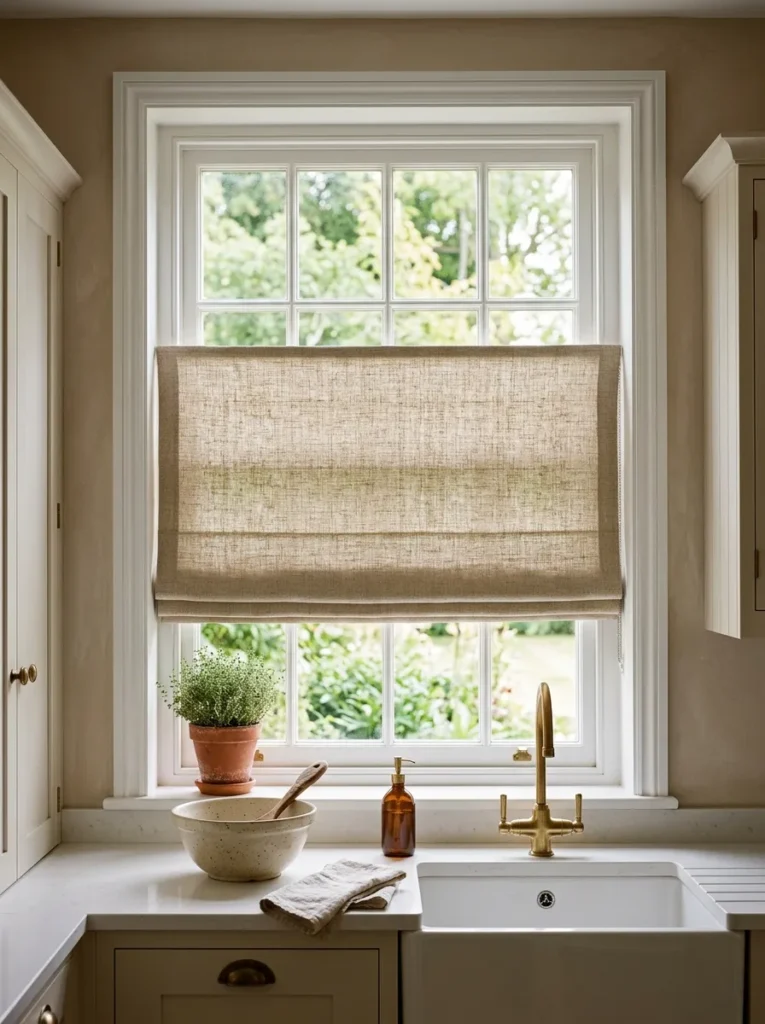
A Roman shade — a flat fabric panel that folds neatly upward when raised rather than gathering to the side like a curtain — is the cleanest treatment for a kitchen window because it takes up minimal visual space when raised (the fabric stacks neatly at the window’s top) and provides full coverage when lowered. There are no loose panels that can brush against a counter or catch a breeze near an open window.
The texture and material of the Roman shade fabric matters in a kitchen. A flat Roman shade in a plain woven cotton or linen reads as clean and graphic. A hobbled or London-style shade with soft folds reads as slightly more traditional. Both work; what matters for kitchen use is that the fabric is washable or at minimum spot-cleanable, because kitchen shades accumulate cooking residue over time regardless of how careful the cooking.
Roman shades on a kitchen window work best when the mounting is inside the window frame (which reads as neater and allows the window’s architectural detail to show) rather than outside the frame (which reads as larger but covers more of the wall than the window).
4. A Woven Wood Shade for Natural Texture

A woven wood shade — made from natural materials including bamboo, reeds, grasses, and jute woven together — provides texture and warmth at the kitchen window that no fabric treatment exactly replicates. The natural material filters light as it passes through the weave rather than blocking it entirely, which creates a warm, dappled light quality in the kitchen when the shade is lowered.
This light-filtering quality means a woven wood shade provides visual privacy (the window appears covered) while still allowing diffuse light to enter — which suits kitchens where natural light is valuable and cannot be sacrificed entirely for privacy. The degree of privacy and light filtration depends on the weave density: open weaves let more light through but provide less privacy; tight weaves provide more privacy but reduce the light filtration effect.
Woven wood shades in a kitchen with significant steam should be chosen with appropriate humidity resistance in mind — some natural fiber products are more susceptible to warping and mildew in high-humidity conditions than others. Look for products with a protective backing or sealed finish if the window is directly above the sink or cooktop.
5. A Frosted or Etched Glass Lower Pane for Privacy Without Treatment

In a kitchen where window treatments feel visually cluttered or where the window architecture is beautiful enough that covering it with fabric is genuinely unfortunate, frosted or etched glass on the lower portion of the window provides permanent privacy without any treatment at all. The frosted zone obscures the view from outside while allowing diffuse light to pass through; the clear upper pane admits full natural light and maintains an open sightline to the sky or upper garden.
Frosted glass film — a self-adhesive product applied directly to the existing glass — achieves this effect without replacing the window pane. The film is available in various patterns (plain frost, subtle etched patterns, geometric designs) and can be applied by a homeowner in an afternoon. It’s also removable, which makes it appropriate for renters as long as the film is applied and removed carefully.
For a more permanent and higher-quality result, acid-etching or sandblasting the lower pane creates a professional frosted finish that doesn’t peel, bubble, or yellow over time the way adhesive film can. This requires professional glazier work but produces a result that reads as architecturally integral to the window rather than applied.
6. Stained Glass Film or Leaded Glass Inserts

A kitchen window over the sink is one of the most-looked-at spots in the home — whoever does the dishes spends a significant amount of time facing it. A stained glass or leaded glass treatment on this window transforms it from a transparent opening into a light-diffracting installation that changes character throughout the day as the light moves.
Traditional leaded glass with colored panes is a permanent architectural modification requiring a glazier and significant investment. For an accessible and renter-appropriate alternative, stained glass film — a self-adhesive translucent film with colored and textured glass effects — applies directly to existing pane glass and can replicate many of the visual qualities of genuine leaded glass at a fraction of the cost.
The design should suit the kitchen’s aesthetic. A simple geometric pattern in warm amber and clear tones suits a contemporary or Arts and Crafts kitchen. A botanical motif in soft greens and warm yellows suits a cottage or farmhouse kitchen. An abstract pattern in deep jewel tones suits a more maximalist or eclectic kitchen where the window treatment is intended as a genuine statement.
7. Interior Shutters for a Clean, Architectural Look

Interior shutters — either full-height louvered panels or café-style half-shutters — provide privacy and light control through a mechanism (adjustable louvres) rather than through fabric movement. Closing the louvres blocks the view from outside while still admitting diffuse light through the angled slats; fully closed shutters provide complete privacy and light blockage; fully open shutters are entirely invisible and unobtrusive.
The material and finish of the shutters determine their stylistic register. White-painted MDF shutters are the most common and suit contemporary, transitional, and farmhouse kitchens where a clean, white treatment suits the cabinetry and wall color. Stained or natural wood shutters suit kitchens with significant wood presence — wood cabinetry, open shelving, or wood floors — where the shutter material participates in the room’s material story.
Kitchen shutters should be specifically rated for high-humidity environments. Standard interior shutters designed for dry rooms can warp in kitchen conditions. Products marketed as moisture-resistant or specifically suitable for kitchens and bathrooms are a more durable choice for above-the-sink or near-cooktop installations.
8. Sheer Linen Panels for Soft Privacy and Diffused Light

A sheer or semi-sheer linen panel at a kitchen window provides a quality of light that no opaque treatment can: it filters sunlight into a soft, warm diffusion that fills the room with light without the harshness of direct sun on the work surface. In a kitchen with a south-facing window, this is practically useful — direct sun on a countertop makes food preparation visually difficult and heats the surface uncomfortably in summer.
The sheer panel should be cut to the full height of the window to allow maximum light filtration across the entire pane. Sheer panels hung shorter than the window height (at sill level, for example) create a half-light zone that reads as proportionally awkward. The panel can be mounted inside or outside the frame; inside mounting is neater; outside mounting makes the window appear larger.
For kitchen use, a sheer should be washable. Natural linen sheers wash well in cool water and typically improve in texture and softness with washing. Synthetic sheers (polyester voile) are more resistant to mildew but can look slightly plastic rather than genuinely fabric. The material choice depends on the kitchen’s aesthetic priorities.
9. A Kitchen Herb Garden on the Windowsill

A row of small potted herbs on the kitchen windowsill — basil, rosemary, thyme, mint, chives — is one of the most practically motivated and visually satisfying kitchen window treatments available. The herbs are genuinely useful (they’re grown for cooking), the plants provide living color and organic form at a scale that suits the windowsill perfectly, and the arrangement creates a connection between the cooking zone and growing things that no purely decorative object achieves.
The success of a windowsill herb garden depends almost entirely on light. Culinary herbs need significant direct light to grow productively — a minimum of 4 to 6 hours of direct sun per day is the threshold for most common varieties. A south or west-facing window in the continental US meets this threshold reliably. A north-facing window or a window shaded by an overhang or neighboring building does not.
The containers matter visually. A row of mismatched nursery pots in plastic reads as practical rather than styled. Small ceramic pots in a consistent color family — all terracotta, all matte white, or all in warm earth tones — reads as an intentional collection. A trough-style planter spanning the full width of the sill reads as more architectural.
10. A Single Dramatic Plant in the Window

Where a herb garden places multiple small specimens across the sill, a single larger plant — one that fills the window frame as a living backdrop — creates a different kind of kitchen window moment. A trailing pothos or heartleaf philodendron allowed to grow and drape along the window frame; a large succulent with an interesting architectural form; a citrus tree in a pot positioned to the side of the window so its canopy reaches into the light zone — each creates a kitchen window with genuine botanical presence.
The plant’s relationship to the window frame matters. A trailing plant that grows beyond its pot and begins to frame the window (rather than simply sitting in front of it) creates a living border that changes with the light and season. This takes time to develop but is one of the most organic and characterful kitchen window treatments available.
Watering management for a large window plant in a kitchen: the sill will inevitably receive drips and water marks. A waterproof saucer sized to the pot, combined with a sill sealed in a wipeable finish (tile, painted wood with a hard-wearing finish, or stone), prevents water damage to the window sill surface over time.
11. A Windowsill Styled as a Mini Vignette
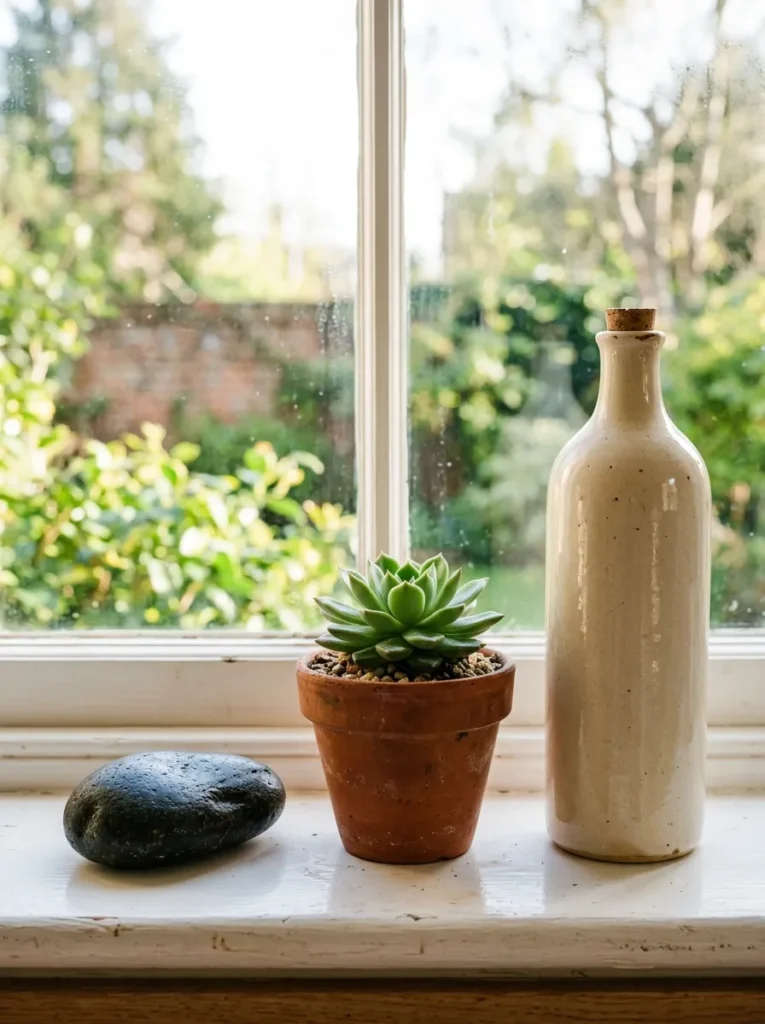
A kitchen windowsill treated as a styled surface — rather than a repository for miscellaneous items — creates a mini composition that reads as considered even in a kitchen where other decorative decisions are minimal. A small ceramic crock holding a wooden spoon and a silicone spatula beside a tiny succulent in a terracotta pot beside a smooth river stone: the arrangement is functional, organic, and visually deliberate.
The rule for windowsill styling: never more than four distinct objects, and never all the same height. Varying heights between objects (a tall ceramic bottle, a medium plant, a low flat stone) creates movement that a row of same-height objects doesn’t provide. The objects should be wipeable or waterproof — the kitchen windowsill is a wet environment, and delicate materials will deteriorate quickly.
In terms of color, the windowsill vignette reads best when it relates to the kitchen’s existing palette. Objects in warm terracotta, natural wood, and cream suit warm, earthy kitchens. Objects in cool grey, white, and brushed metal suit more contemporary spaces.
12. Hanging Planters Above or Beside the Window

Hanging planters suspended from a ceiling hook above the window, or mounted to the window frame itself on small swing-arm hooks, expand the kitchen’s botanical presence beyond the sill into the air above it. A trailing plant (pothos, string of pearls, or tradescantia) in a macramé hanger or a ceramic hanging pot, positioned to one side of the window where it receives the light while leaving the window itself visually open, creates an organic framing element.
The hanging height matters for both light access and daily function. A planter that hangs too low in front of the window blocks the light the plant needs and obstructs the view. A planter positioned at the window’s upper zone — hanging in front of the upper 20 to 30 percent of the window — creates a gentle botanical border without reducing the window’s usable light zone significantly.
For renters, adhesive hooks on the window frame or a tension-mounted curtain rod used as a hanging rail (rather than for curtains) provide zero-damage ways to hang small planters in or around the kitchen window.
13. A Collection of Glass Bottles and Vessels on the Sill

A row of glass vessels on a kitchen windowsill — apothecary bottles in varying heights, vintage glass bottles in warm amber and green tones, clear vases with single stems — creates a window display that works with the light rather than against it. When backlit by natural light, glass vessels glow and cast colored shadows on the counter below, which is a simple visual effect that no opaque object can replicate.
The collection works best when the vessels share something: all in warm amber and green tones (which read as vintage and botanical), all in clear glass of varying forms (which reads as contemporary and graphic), or all bud vases with single stems (which reads as more feminine and deliberate). A random mix of glass objects without a unifying element reads as a collection of things that happened to be left on the windowsill.
This approach suits a window that doesn’t need a privacy treatment — it works with a clear pane, and frosted glass behind the bottles reduces the light-transmission quality that makes glass vessels on a windowsill interesting.
14. A Folding or Accordion Window Shutters for a Small Kitchen Window

Small kitchen windows — particularly those in older homes where windows are narrow and individually framed — benefit from a treatment that’s proportionate to their scale. Full-length curtains on a small window look heavy; Roman shades can look undersized. Bifold or accordion interior shutters that fold back completely against the window jamb when open read as architectural and deliberate at any scale, and their folded-back position on a small window creates an interesting layering detail at the window’s edge.
The key with a small kitchen window is that the treatment, when open, should nearly disappear — the open position should be as visually clean as no treatment at all. Shutters achieve this better than curtains, which remain partially visible even when drawn fully to the side.
For a small window above the sink specifically, a treatment that can be operated with one hand (a tension-mounted half-shutter, a pull-up Roman shade) is more practical than one that requires both hands to adjust — the sink is often in use when the light or privacy need changes.
15. A Window Valance for Decoration Without Coverage
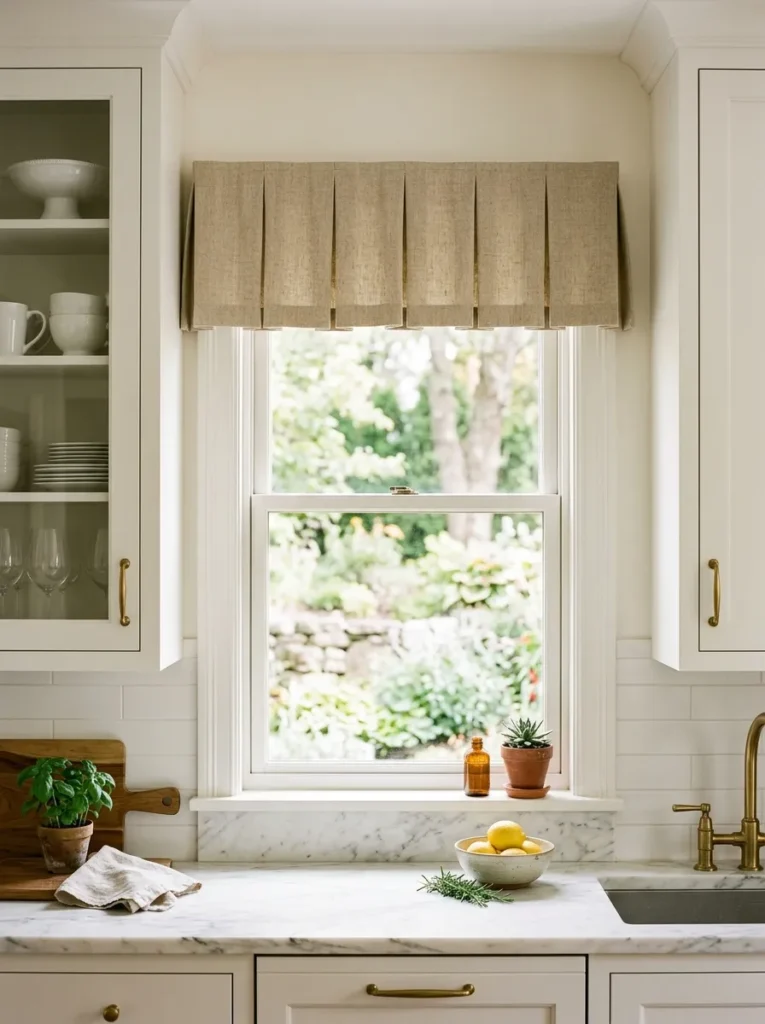
A valance — a short decorative panel mounted at the top of the window, covering only the upper 8 to 12 inches — provides a finished, dressed look at the window without reducing the light or view below it. It hides the curtain rod, the window hardware, and the sometimes-awkward zone between the top of the window frame and the ceiling or cabinet above.
The valance is the right choice when the kitchen needs the look of a dressed window but cannot afford to sacrifice any of the window’s natural light — a small kitchen, a window that serves as the room’s primary daylight source, or a window with an important sightline to a garden or courtyard.
A box-pleated valance in a natural linen reads as the most universally flattering format — the structured pleat creates visual texture without ruffles or swags that would read as overly traditional in a contemporary or transitional kitchen. A simple flat panel with a decorative border reads as more minimal. A ruffled valance reads as specifically country or cottage kitchen.
16. An Open Window Frame Treated with Trim and Paint
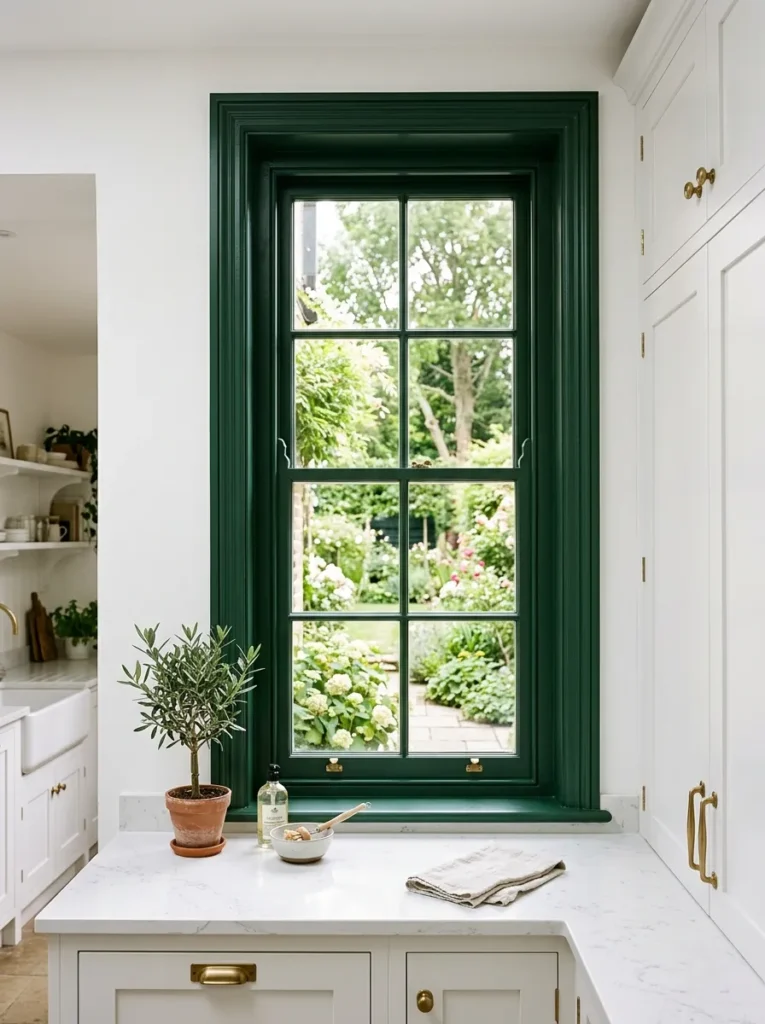
Rather than adding a treatment to the kitchen window, giving the window frame itself a considered paint treatment — painting the frame, sash, and sill in a color that contrasts with the wall, or in a deeper version of the wall’s color — turns the window into an architectural detail rather than simply an opening. A deep forest green painted window frame on a white kitchen wall reads as a deliberately composed moment; a warm terracotta frame on a warm white wall reads as layered and earthy.
The paint on the window frame must be durable. An oil-based or hard-wearing water-based enamel in a semi-gloss or satin finish resists the condensation, steam, and UV exposure that kitchen windows receive. Flat or matte paint on a window frame chips and marks quickly in a kitchen environment.
This approach works best on windows with architectural detail — a wide casing, a traditional profile, or a raised sill — where the paint can follow the three-dimensional form of the trim. On windows with minimal trim (a simple drywall return with no casing), this approach has less to work with and may require adding trim detail before the paint can do its job.
17. A Farmhouse-Style Window with a Wooden Beam Above

In kitchens being designed or renovated from scratch, positioning a wooden beam or a timber lintel directly above the kitchen window — particularly the window over the sink — creates an architectural moment that reads as farmhouse-influenced without requiring the full farmhouse aesthetic throughout the room. The beam frames the window from above and grounds it in the kitchen’s structure rather than letting it float in the wall.
The beam material and finish determines its contribution to the room’s character. A rough-hewn reclaimed timber reads as authentically farmhouse and suits kitchens with shiplap, open shelving, and apron sinks. A more refined box beam in painted wood reads as transitional and suits kitchens with cleaner lines. A slim flat timber strip reads as a contemporary nod to the idea without committing to the full rustic register.
In an existing kitchen where structural modification isn’t possible, a non-structural decorative beam mounted to the wall (using a hollow lightweight form secured with appropriate anchors) achieves a similar visual effect without requiring structural changes.
18. Layered Window Treatments for Light Control at Different Times

A single window treatment is either open or closed — on or off. Layered window treatments — a sheer or woven shade closest to the glass combined with a heavier curtain or blind on the room side — provide adjustable light control that suits the kitchen’s changing needs across the day. In the morning, only the sheer is drawn, filtering the direct sun. In the evening, the heavier layer is drawn for full privacy and darkening.
The most functional layering combination for a kitchen: a woven wood shade or sheer linen Roman shade on the window itself, plus café curtains or panel curtains on a rod in front. The layers operate independently — the shade controls the direct light quality; the curtain controls the privacy level. This is a particularly useful solution for a kitchen window that faces a neighbor’s window or a busy street where evening privacy is important but daytime light is essential.
The layers should be in the same material family — a woven wood shade with a linen curtain reads as coherent; a plastic roller blind with a velvet panel reads as materially inconsistent. The treatment closer to the glass should always be lighter in weight and color than the treatment on the room side.
19. A Window Box Mounted Outside the Kitchen Window

An exterior window box — mounted beneath the kitchen window’s exterior sill and planted with herbs, trailing flowers, or seasonal plants — creates a garden-level feature that’s visible from inside the kitchen and from the street or garden outside. Unlike a windowsill herb garden, a window box doesn’t consume any interior space and doesn’t require the window sill to be kept clear for its use.
From inside the kitchen, the window box creates a planted frame at the window’s lower edge — the plants read as part of the view through the glass rather than objects placed in front of the glass. Trailing plants (trailing rosemary, creeping thyme, lobelia, or nasturtiums) that grow downward over the front of the box create the most visually rich exterior frame when seen from inside.
The practical requirement: the window box must be securely mounted to the exterior wall or window sill with hardware rated for the combined weight of the box, soil, and plants when fully watered. A waterlogged window box can weigh considerably more than expected; under-specified mounting hardware is a safety concern. Verify the wall material and consult the window box manufacturer’s mounting guidance before installation.
What to Consider Before Choosing a Kitchen Window Treatment
Four practical considerations should guide the choice before any aesthetic decision is made.
The window’s orientation and light quality. A south-facing kitchen window receives direct sun for most of the day — a light-filtering or diffusing treatment (sheer linen, woven wood shade, frosted lower pane) is functionally important. A north-facing kitchen window receives no direct sun and benefits from treatments that preserve every available lumen — café curtains covering only the lower half, a valance rather than a shade, or no treatment at all with frosted film for privacy.
The window’s proximity to the cooking zone. Any fabric treatment within 18 to 24 inches of a gas burner or electric element presents a fire risk and accumulates cooking residue significantly faster than a window further from the heat source. For above-the-cooktop windows specifically, hard treatments (shutters, blinds, frosted film) are safer and more practical than fabric. For above-the-sink windows, fabric is generally appropriate.
The maintenance reality of the treatment. Kitchen window treatments accumulate grease and cooking residue over time — this is not a matter of cleanliness but of kitchen physics. Choose treatments that can realistically be cleaned: machine-washable fabric, wipe-clean blinds or shutters, or no-treatment approaches (frosted film, window box, architectural frame treatment) that require no cleaning.
The window’s size and the room’s scale. A small kitchen window in a small kitchen can handle a detailed treatment (a café curtain in a patterned fabric, a layered shade with a valance) because the treatment scale suits the room’s scale. A large window in a generous kitchen benefits from a treatment that reads at scale — floor-length panels, a wide woven shade, or a full-width architectural shutter. The mismatch between treatment scale and room scale is one of the most common kitchen window mistakes.
Final Thoughts
A kitchen window that’s been thoughtfully treated — whether with a café curtain that lets the morning light in, a herb garden that bridges the gap between cooking and growing, or a frosted lower pane that solves the privacy problem permanently — contributes to the room in a way that goes beyond decoration. It shapes the quality of the light, the character of the view, and the mood of the space at the most mundane and most important moments of the day.
If you’re starting with no treatment and an unclear direction, Ideas 1, 9, and 13 — café curtains, a windowsill herb garden, and a collection of glass vessels — are the lowest-commitment, most universally applicable starting points. All three can be implemented by a renter without permanent modification, and all three improve with the kitchen’s existing character rather than imposing something new on it.
For kitchen windows that need to solve a specific problem — privacy without losing light, direct sun on the work surface, an architectural feature that lifts the room — Ideas 5, 8, and 16 address each of those functional challenges with a specific, committed approach.
Save the ideas that suit your window’s orientation and your kitchen’s character, and return to the practical section when you’re ready to choose.