
21 Headboard Ideas That Elevate Every Bedroom
The headboard is the bedroom’s most visible single decision. More than the bedding color, more than the light fixtures, more than the rug — the headboard is what the eye finds first from the doorway and what frames the room’s primary focal point. Get it right and everything else in the bedroom settles naturally into place. Get it wrong — the wrong height, wrong width, wrong material for the room’s existing palette — and no amount of careful styling elsewhere fully compensates.
Most headboard advice covers the visual options without addressing the practical decisions that determine whether any of those options will actually work: how height relates to ceiling height, how width should relate to the bed frame, how the headboard’s visual weight affects the overall balance of the room, and which approaches work for renters who can’t drill into walls. These 21 ideas address both dimensions — the visual inspiration and the practical specifics — across every material, style, scale, and budget available.
1. Choose a Wide Linen Upholstered Headboard for Warmth and Versatility

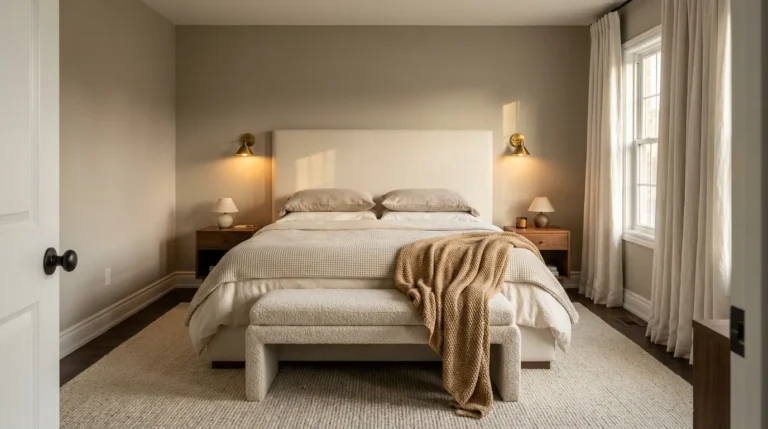
A linen-upholstered headboard in warm ivory, natural flax, or soft greige is the most reliably versatile headboard choice across bedroom styles. It has enough visual presence to anchor the bed wall without demanding a specific surrounding palette, and the slight texture of woven linen adds material warmth that flat-painted or lacquered alternatives can’t replicate. Against warm white walls it reads as settled and considered; against a deeper wall color it provides a light contrast that keeps the bed from disappearing into its background.
The width matters more than most buyers anticipate. The headboard should span at least the full width of the mattress — ideally extending slightly beyond the bed frame on each side — so the bed reads as contained rather than as a mattress with a small panel behind it. A queen mattress (60 inches) suits a headboard in the 62- to 66-inch range; a king (76 inches) benefits from 78 to 84 inches of headboard width. Proportion is what separates a headboard that reads as architecturally considered from one that looks selected by accident.
2. Use a Boucle Headboard for Tactile Richness in a Neutral Bedroom

Boucle — the looped, nubby woven fabric that has become one of the most widely specified upholstery materials in contemporary bedroom design — offers something that smooth linen and tight-woven velvet don’t: visible texture that changes character under different light conditions. Under direct daylight the looped surface creates a subtle shadow pattern; under warm evening lamplight it reads as softly luminous. In a bedroom built on neutral tones, a boucle headboard provides the material richness that prevents the palette from reading flat.
The most resolved boucle headboards for bedrooms use warm ivory or oatmeal tones rather than pure bright white, which can look clinical rather than warm. A wide, moderately tall headboard in warm boucle — one that spans comfortably beyond the mattress width and rises to roughly 48 to 55 inches from the floor — reads as the bedroom’s statement piece while remaining materially appropriate for a room designed for rest rather than display.
3. Select a Curved or Arched Headboard for Organic Softness

A curved headboard — where the top edge follows a gentle arc, a full semicircle, or a smooth wave rather than a straight horizontal line — introduces organic softness into what is typically one of the bedroom’s most angular surfaces. The curve at the headboard’s top edge reads as deliberate rather than incidental, and it creates a visual moment that references the organic shapes of nature — arched doorways, rounded stones, curved branches — rather than the rectilinear logic of most furniture.
The arch shape also works with the bed wall in a way that a rectangular headboard doesn’t. Where a rectangular headboard fills space, an arched headboard frames it — the curve draws the eye upward and creates a sense that the space above the bed is intentional rather than simply the gap between the headboard’s top and the ceiling. A tightly upholstered arch in linen or boucle reads contemporary and architectural; a more generously padded arch reads softer and more romantic.
4. Hang a Deep Velvet Headboard for Evening Atmosphere

Velvet’s case for bedroom use is strong: its pile absorbs light rather than reflecting it, which creates a matte depth that reads as genuinely rich rather than simply dark. Under the warm bedside lamp light that bedrooms rely on in the evening, a velvet headboard develops the directional sheen across its surface — the slight color shift depending on how the pile catches the light — that makes it feel more expensive and more atmospheric than almost any other fabric choice at the same price point.
Deep tones perform best in velvet: forest green, ink navy, dusty plum, warm chocolate, and midnight teal all deepen under evening light in ways that read as deliberately moody. The color should relate to at least one other element in the room — a similar tone in a throw pillow, a paint color used elsewhere — rather than appearing as the room’s sole color commitment. Velvet headboards require hardware rated for their weight; standard lightweight bracket systems can sag under velvet’s density.
5. Install a Full Wall of Vertical Wood Slats Behind the Bed

A slatted wood headboard — where vertical strips of wood in a consistent width and spacing create a rhythmic panel behind the bed — is one of the most architecturally integrated headboard approaches available. Unlike a conventional headboard attached to the bed frame, a floor-to-ceiling or partial-height slatted wall treatment makes the headboard an element of the room’s architecture rather than a piece of furniture resting against it. The bed appears anchored to the wall rather than floating in front of it.
Natural oak slats are the most widely used material because the warm grain of oak relates naturally to linen bedding, brass hardware, and the organic material palette that contemporary bedrooms favor. Spacing between the slats affects the visual character: narrow spacing creates a denser, more formal appearance; wider spacing reads more open and airy. The slats can be painted the same color as the surrounding wall for a seamless tonal effect, or left in natural wood to stand clearly as a feature.
6. Use a Reclaimed or Live-Edge Wood Headboard for Organic Character

A headboard made from a single plank of reclaimed wood, a live-edge slab with the natural bark edge preserved, or a piece of driftwood-finished timber brings an organic irregularity to the bedroom that manufactured furniture rarely achieves. The natural variation in the wood — grain patterns that shift across the surface, color variation from heartwood to sapwood, the preserved edge of a live-edge piece — means the headboard is visually unique and develops character over time rather than wearing down uniformly.
This works best as a single large statement piece mounted directly to the wall rather than attached to a bed frame — a single wide slab positioned at the correct height, with the bed in front rather than physically connected. The scale should be generous enough that the piece reads as architectural rather than decorative: a plank that’s clearly the full width of the bed or wider, and substantial enough in height to command the wall. Against a pale wall, the natural wood creates a warm focal point; against a dark wall, it provides organic contrast.
7. Mount a Simple Plywood Headboard Painted in a Bold Accent Color

A plywood headboard — a flat panel cut to the correct dimensions, painted in a specific bold color, and mounted directly to the wall — is the least expensive route to a custom-looking headboard and one of the most design-forward approaches when the color is right. The smoothness of the painted panel and the precision of its edges create a clean, architectural quality that fabric headboards don’t provide, and the color choice makes the headboard the room’s single most deliberate design statement.
Deep terracotta, warm rust, forest green, and dusty ochre all work well as headboard panel colors because they provide enough color depth to anchor the bed wall while remaining within the earthy palette that suits most bedroom materials. The panel can be cut to any shape — a simple rectangle, an arch, or a shape that extends slightly beyond the bed frame’s width — and mounted with simple hardware at the correct height. For renters, a freestanding version leaned against the wall rather than wall-mounted achieves the same effect.
8. Choose Cane or Rattan for Natural Texture at the Bed Wall

A cane or rattan headboard brings the organic weave texture of natural fiber into the bedroom at its most prominent vertical surface. The diamond or hexagonal cane weave pattern is visually interesting at close range — the individual strands create a regular geometric rhythm — while reading as a single warm, organic mass from across the room. It relates naturally to other rattan or natural fiber elements in the bedroom (a woven pendant light, a jute rug, a rattan nightstand) without requiring an explicitly coastal or bohemian room style.
Cane headboards suit a specific height range better than most materials: their open weave texture works best in headboards that aren’t too tall, where the pattern can be appreciated without overwhelming the wall. A headboard in the 42- to 55-inch height range in natural or smoked cane reads as composed and organic; a floor-to-ceiling cane installation reads as more dramatic and architectural. The frame material matters: a natural bamboo or light oak frame with cane infill reads organic; a painted or lacquered frame with cane infill reads more contemporary.
9. Extend the Headboard to the Ceiling for Architectural Drama

A floor-to-ceiling headboard — whether upholstered, wood-paneled, or built as a continuous slatted wall — treats the headboard as a room-defining architectural element rather than a piece of furniture. When the headboard material extends from the bed height all the way to the ceiling, the entire wall behind the bed becomes the room’s focal point rather than just the portion immediately above the pillows.
This works most effectively in rooms with good ceiling height — eight feet or above — where the vertical extension feels expansive rather than compressed. In rooms with lower ceilings, a floor-to-ceiling headboard can make the room feel like the wall is pressing in. The material determines the visual register: a floor-to-ceiling upholstered panel in a deep tone reads as deeply cocooning and atmospheric; a floor-to-ceiling wood slat installation reads as architectural and Scandinavian in quality.
10. Create a Niche Effect With a Paneled Headboard Alcove

Rather than treating the headboard as a surface mounted to a wall, a paneled headboard alcove creates the impression of a built-in niche around the bed — three surfaces (two side panels and a back panel) that enclose the sleeping area at head height and create a genuinely contained, sheltered quality. This is the headboard approach that most closely replicates the feeling of a traditional bed alcove without structural work.
The three panels can be identical in material and color — all the same upholstered fabric or all the same wood — or differentiated to create tonal depth: side panels in a slightly lighter or more matte material than the central back panel, which carries the visual weight. The side panels should extend at least 18 to 24 inches from the wall to be wide enough to register as genuine enclosure rather than narrow flanking elements. This approach suits bedrooms that are designed for maximum restful quality — the feeling of being sheltered within the room rather than simply lying in it.
11. Install a Curved Upholstered Headboard With a Channel-Stitched Pattern

A channel-stitched headboard — where horizontal or vertical stitched lines create raised channels across the upholstered surface — adds dimensional texture to an upholstered panel that plain stretched fabric doesn’t provide. Combined with a curved top edge, the channel stitching creates a headboard that has visual interest at both the macro level (the curve) and the close range (the stitch pattern) without introducing the more formal quality of buttoned tufting.
Vertical channel stitching suits headboards with more height, creating a columnar rhythm that emphasizes the headboard’s vertical dimension. Horizontal channel stitching suits wider headboards with less height, reinforcing the horizontal sweep of the panel. The depth of the channel — how far the stitched groove indents into the upholstery padding — affects how dramatically the texture reads from across the room. A deeper channel is more visible and suits a larger room where the headboard is viewed from a greater distance; a shallower channel is more refined and suits a smaller bedroom.
12. Use a Low-Profile Padded Headboard for a Modern Platform Bed

A low-slung padded headboard — one that rises 36 to 42 inches from the floor rather than the 48 to 60 inches of a conventional headboard — suits low platform beds where a taller headboard would read as disproportionately heavy. The lower headboard height keeps the room’s visual weight concentrated at floor level, making the ceiling feel higher by comparison and the room more expansive than a taller headboard arrangement produces.
In a contemporary bedroom designed around horizontal lines — a low platform frame, wide nightstands at mattress height, art positioned lower on the wall — a low padded headboard completes the compositional logic rather than interrupting it with unexpected height. The upholstery should be tightly structured rather than deeply padded, since a deeply tufted or generously rounded headboard on a low platform reads as stylistically inconsistent rather than as a deliberate design choice.
13. Add a Bookcase Headboard for Readers and Small Bedrooms

A bookcase headboard — a headboard unit that incorporates shelving on either side of the central padded panel — solves the nightstand problem and the storage problem simultaneously in bedrooms where floor space is constrained. The central padded section provides the reading-in-bed comfort that a bare shelf headboard doesn’t; the flanking shelves provide accessible storage for books, glasses, a glass of water, a lamp, and the small-scale objects that accumulate beside a bed.
The practical consideration that most buyers overlook: the shelving sections extend forward from the wall by the shelf depth, which reduces the effective floor space beside the bed. In a small bedroom where every inch of floor area matters, a bookcase headboard that projects 10 to 12 inches from the wall may eliminate the space for a nightstand entirely — which is the intended outcome. In a larger bedroom, the same projection is barely noticeable. Measure the clearance beside the bed before purchasing rather than discovering the constraint after installation.
14. Lean a Large Artwork or Oversized Mirror Against the Wall as a Renter Headboard

In a rental bedroom where drilling into walls isn’t possible or permitted, a large artwork or oversized mirror leaned against the wall directly behind the bed creates the visual effect of a headboard without requiring any wall attachment. The framed piece provides a vertical element behind the bed that serves the same compositional purpose as a mounted headboard — it anchors the bed within the room and gives the wall behind the bed a clear focal point.
The piece must be genuinely large to work at this scale. A canvas or print that’s at minimum 40 inches wide and 30 inches tall held behind a queen bed reads as intentional; anything smaller reads as a picture that happens to be propped behind the bed. A large foxed mirror in an ornate frame leaned against the wall behind a simple bed creates a deliberately composed contrast — the elaborate frame beside the simple bed — that reads as curated and confident rather than improvised.
15. Create a DIY Macramé Headboard for a Bohemian or Organic Bedroom

A large macramé wall hanging used in place of a traditional headboard brings a handmade, organic texture to the bed wall that purchased headboards rarely replicate. The knotted natural cord creates an irregular, three-dimensional surface that catches light differently from the wall behind it and introduces both visual and tactile interest without the weight or expense of an upholstered or wood headboard.
The scale must be appropriate to work: a macramé piece that spans the full width of the bed or slightly wider and extends 30 to 48 inches above the mattress level reads as a genuine headboard alternative; a smaller piece reads as wall art adjacent to the bed rather than as a headboard. The natural cord color — undyed cotton, jute, or hemp — suits the organic bedroom palette that macramé headboards suit most naturally. Against a warm white wall, the texture variation in the knotted surface creates a subtle shadow play that changes across the day.
16. Mount Fabric Panels in a Grid to Create a Soft, Modular Headboard
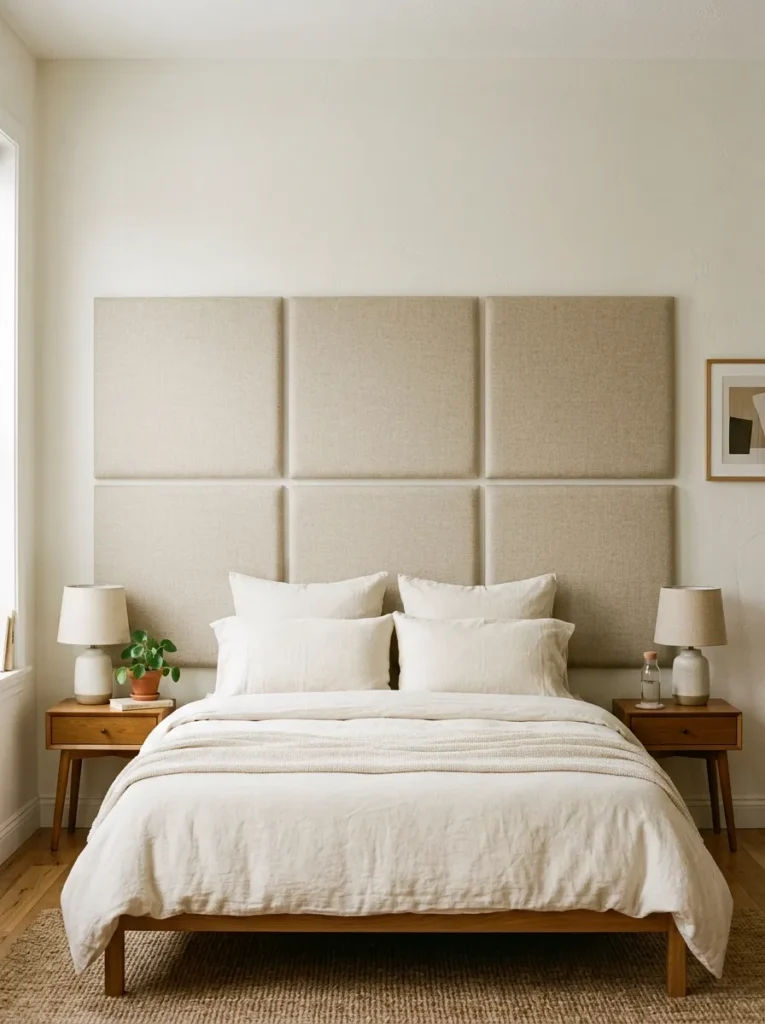
Individual fabric panels — rectangular or square sections of padded, upholstered material mounted in a grid arrangement on the wall behind the bed — create a modular headboard effect that can be customized to any width and height. Unlike a single large headboard piece, a panel grid allows the homeowner to configure the arrangement to the exact wall dimensions, add panels if the bed size changes, or replace individual panels if one is damaged or the design direction evolves.
DIY versions use foam cut to the panel size, wrapped in the chosen fabric, and mounted with Velcro strips or recessed screws. This approach is among the most renter-adaptable of the structured headboard options since Velcro mounting can be removed without wall damage in many lease agreements. The fabric choice should be consistent across all panels — the modular quality reads as designed only when the individual elements share the same material — and the panel arrangement should extend clearly beyond the mattress width on both sides to establish the grid as a headboard rather than as patterned wall art.
17. Use a Metal Bed Frame’s Integrated Headboard as a Minimal Statement

For bedrooms where the design direction is truly minimal — where the headboard should provide structure without visual weight, and where the material palette has no room for additional texture — a metal bed frame with an integrated headboard in matte black, aged brass, or brushed bronze is the most restrained available choice. The thin horizontal or vertical bars of a metal headboard create the visual function of a headboard — defining the top of the sleeping area — without the mass of upholstered or wood alternatives.
The profile of the metal design determines the visual register: fine horizontal bars in brass read as refined and hotel-like; industrial pipe construction reads as urban and raw; an arched iron profile reads as vintage and romantic. The height should be proportional to the room — a very low metal headboard in a high-ceilinged room reads as timid; a taller arched metal design in a room with moderate ceiling height reads as confident and well-scaled.
18. Build a Floating Shelf Headboard for Minimal Storage and Display

A floating shelf mounted at headboard height — wide enough to span the bed width and deep enough (8 to 10 inches) to hold a lamp, a book, and a small plant on each end — creates a functional headboard alternative that provides both the visual anchor of a headboard and a surface for the items that typically live on a nightstand. The shelf reads as architectural detail rather than furniture, which suits contemporary and minimal bedrooms where reducing the number of freestanding pieces is a deliberate design goal.
The material should be chosen for its own visual quality: a solid walnut floating shelf at headboard height reads as warm and material-specific; a white lacquered shelf reads as clean and contemporary; a natural oak shelf reads as organic and light. Lighting beneath the shelf — a small LED strip running its underside — turns the functional shelf into an atmospheric light source that fills the gap between the headboard position and the nightstand lamps, layering the bedroom’s light at a height that table lamps alone don’t reach.
19. Drape Fabric From a Ceiling-Mounted Rod for a Canopy Headboard Effect

A length of fabric suspended from a ceiling-mounted rod or hook directly behind the bed — falling from ceiling height to the floor or to mattress level behind the headboard position — creates a canopy-like quality that encloses the sleeping area in a way that no wall-mounted headboard replicates. The fabric panel isn’t a headboard in the conventional sense but performs the same visual function: it defines the bed wall, creates a sense of shelter around the sleeping area, and gives the room’s primary surface a material layer beyond paint.
Sheer linen or fine cotton gauze in a natural undyed tone creates a soft, diffused effect — the fabric reads as translucent and gently billowing; heavier linen or velvet panels create a more dramatically enclosed quality. The ceiling mount can be a simple curtain rod bracket installed at the ceiling, a decorative hook, or a built-in ceiling rail that allows the panels to be drawn aside during the day. This is one of the most effective renter-friendly approaches since it typically requires only a ceiling hook rather than wall drilling.
20. Apply Limewash or Venetian Plaster to the Headboard Wall as a No-Headboard Alternative

The most unconventional idea in this article isn’t a headboard at all — it’s treating the wall directly behind the bed as a textured surface that performs the headboard’s visual role without any furniture or attachment. A limewash or Venetian plaster finish in a deeper tone than the surrounding walls creates a defined zone behind the bed that reads as intentional and considered. The texture’s tonal variation — lighter in some areas, deeper in others — creates the visual depth and dimensionality that an actual headboard provides, without any physical object.
This approach works best when the plaster or limewash zone is defined at its edges — by a painted boundary, a change in wall material, or architectural detail like a recessed niche — so it reads as a deliberate design element rather than a wall that received different treatment by accident. Combined with simple, high-quality bedding and clean nightstands, the textured wall headboard creates the most architecturally integrated bedroom look available without a separate headboard piece at all.
21. Choose a Wingback or High-Backed Upholstered Headboard for Classic Grandeur

A wingback or high-backed upholstered headboard — where the central panel rises to 60 inches or above and flanking side wings curve or angle forward on each side — brings the visual language of a great chair to the bed wall. The formal quality is deliberate: the headboard makes no attempt at restraint or minimalism. It announces itself as the room’s primary furnishing and organizes everything else in the room around it.
The upholstery choice determines whether the grandeur reads as contemporary or period. Deep buttoned velvet in burgundy or midnight navy reads unambiguously as a traditional choice. The same wingback silhouette in a flat, un-tufted linen or boucle reads as the contemporary version of the same formal intention — acknowledging the history of the form while working it into a current material language. The bed frame and bedding should be simple — the headboard is carrying the room’s visual weight, and anything that competes with it reads as excess rather than richness.
How to Choose the Right Headboard Height and Width
Proportion is the single variable that separates a headboard that looks designed from one that merely exists. Two measurements govern the decision:
Width: The headboard should span at minimum the mattress width — typically the same as or slightly wider than the bed frame. A headboard narrower than the mattress makes the bed look like it might spill over the sides; one that’s slightly wider reads as generous and anchored.
Height: The appropriate height depends on two things — the ceiling height and the style of the bed. Ceiling height of 8 feet or above accommodates headboards from 48 inches upward; rooms under 8 feet are better served by headboards in the 40- to 48-inch range. Low platform beds read better with lower headboards (36 to 44 inches); taller bed frames accommodate and often benefit from taller headboards.
The center of a standard headboard should sit at approximately the visual midpoint between the top of the mattress and the ceiling — a position that balances the wall composition rather than leaving either too much or too little wall visible above the headboard’s top edge.
Final Thoughts
A headboard gives the bedroom its most important visual anchor, and that anchor can be as minimal as a limewash wall treatment or as substantial as a floor-to-ceiling slatted wood installation. The ideas here span that full range — from renter-friendly lean-against-the-wall approaches and simple fabric panels to architectural built-in solutions and statement wingback upholstery.
Start with the room’s scale and the bed’s proportions before choosing a specific material or style. A headboard that’s beautifully made but incorrectly sized for the room — too low, too narrow, or too visually heavy — reads as a missed opportunity rather than a design decision. Get the proportion right first, then choose the material and form that suit the room’s existing palette and your own sense of the bedroom’s character.
Save the ideas here that match your bedroom’s ceiling height, your bed frame’s dimensions, and your appetite for commitment, and come back when you’re ready to transform the room’s most important wall.