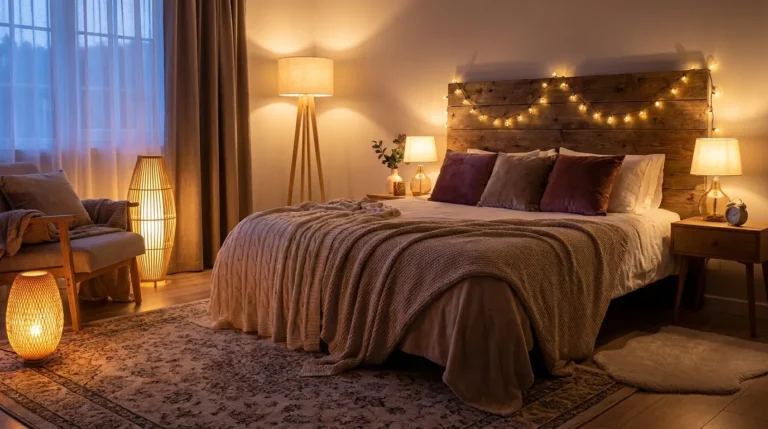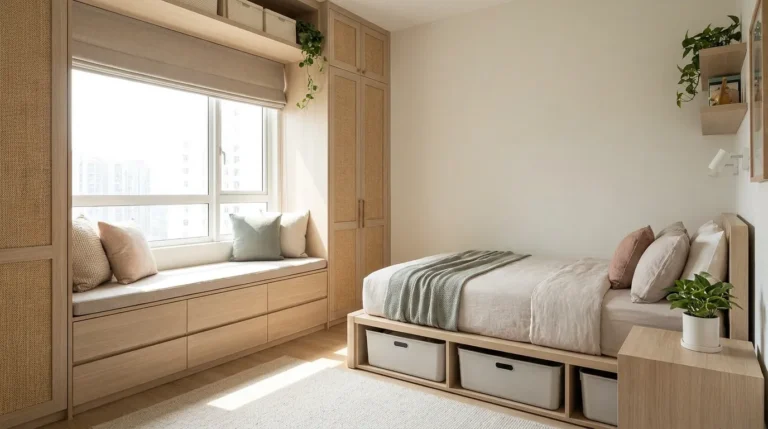
24 Contemporary Bedroom Ideas That Feel Elegant and Relaxed
Contemporary bedroom design is one of those categories that sounds clear until you start looking at it closely, at which point it seems to contain everything. Rooms described as contemporary can be minimal and spare, warmly layered, organic and textural, or cleanly architectural — and all of them are correct. What connects them isn’t a specific material or color palette but a set of underlying qualities: an avoidance of period-specific decoration, a preference for clean silhouettes without rigidity, and an emphasis on how the room feels to be in rather than how it signals a particular historical style.
That breadth is what makes contemporary bedrooms genuinely useful for most homeowners. It accommodates real rooms with real furniture, real light conditions, and real budgets without demanding that everything match or that the space look like a design showroom. What it does demand is some understanding of proportion, material, and restraint — which is where most bedrooms described as “contemporary” go slightly wrong.
These 24 ideas move through the full range: foundational decisions about color and furniture, through lighting, textiles, and architectural detail, to the finishing choices that separate a considered bedroom from one that’s merely modern-adjacent. Read them in order if you’re starting fresh, or jump to the areas where your current room needs the most attention.
1. Build the Palette Around Warm Neutrals Rather Than Cool Greys
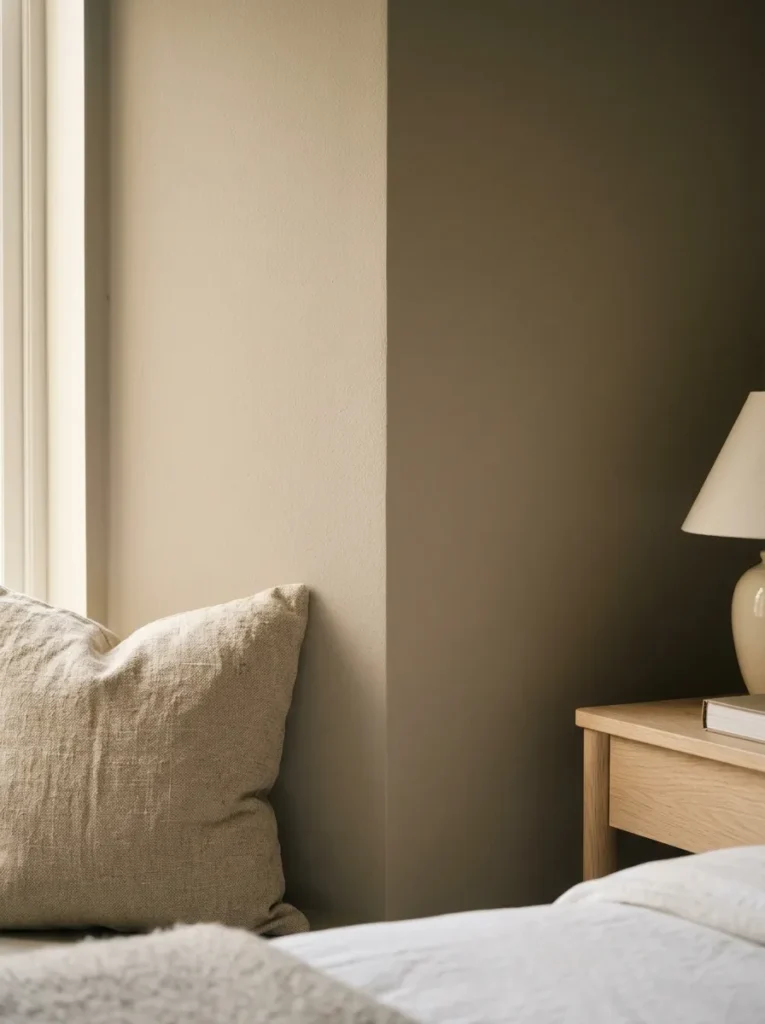
For years, cool grey was the default contemporary bedroom color — it felt clean, modern, and safe. The rooms that resulted were often exactly those things, and not much more. Warm neutrals have largely replaced grey as the more resonant contemporary choice: warm whites with cream or sand undertones, soft greiges, earthy taupes, muted terracottas in pale dilutions, and warm oatmeal tones that reference natural plaster and stone.
The reason warm neutrals produce more satisfying bedrooms than cool ones is physiological as much as aesthetic. Warm tones read as settled and welcoming under the kind of artificial evening light a bedroom relies on most; cool greys can shift toward the blue-green end under incandescent or warm LED light, which rarely looks intentional. Test any neutral at multiple times of day and specifically under the lighting the room uses at night before committing.
2. Treat One Wall to a Deeper, Richer Version of the Room’s Palette
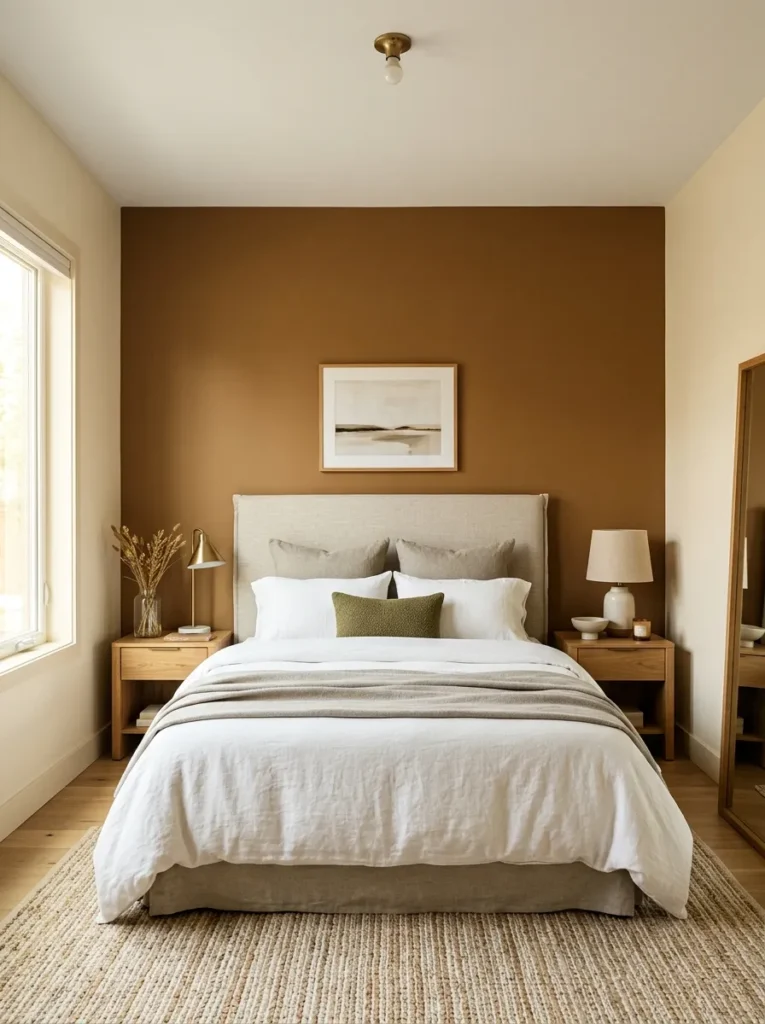
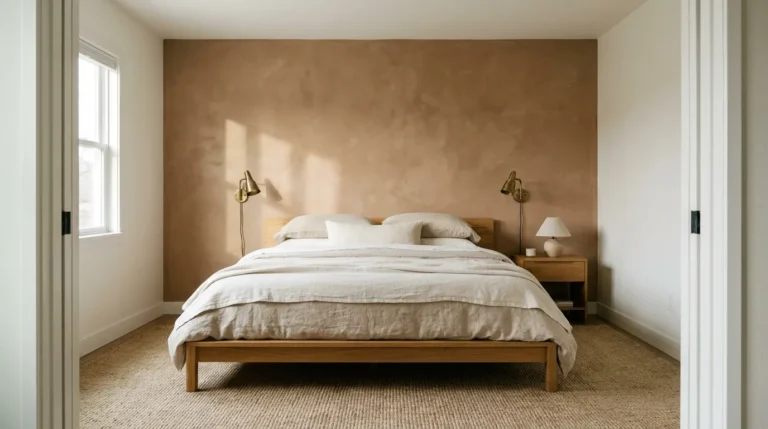
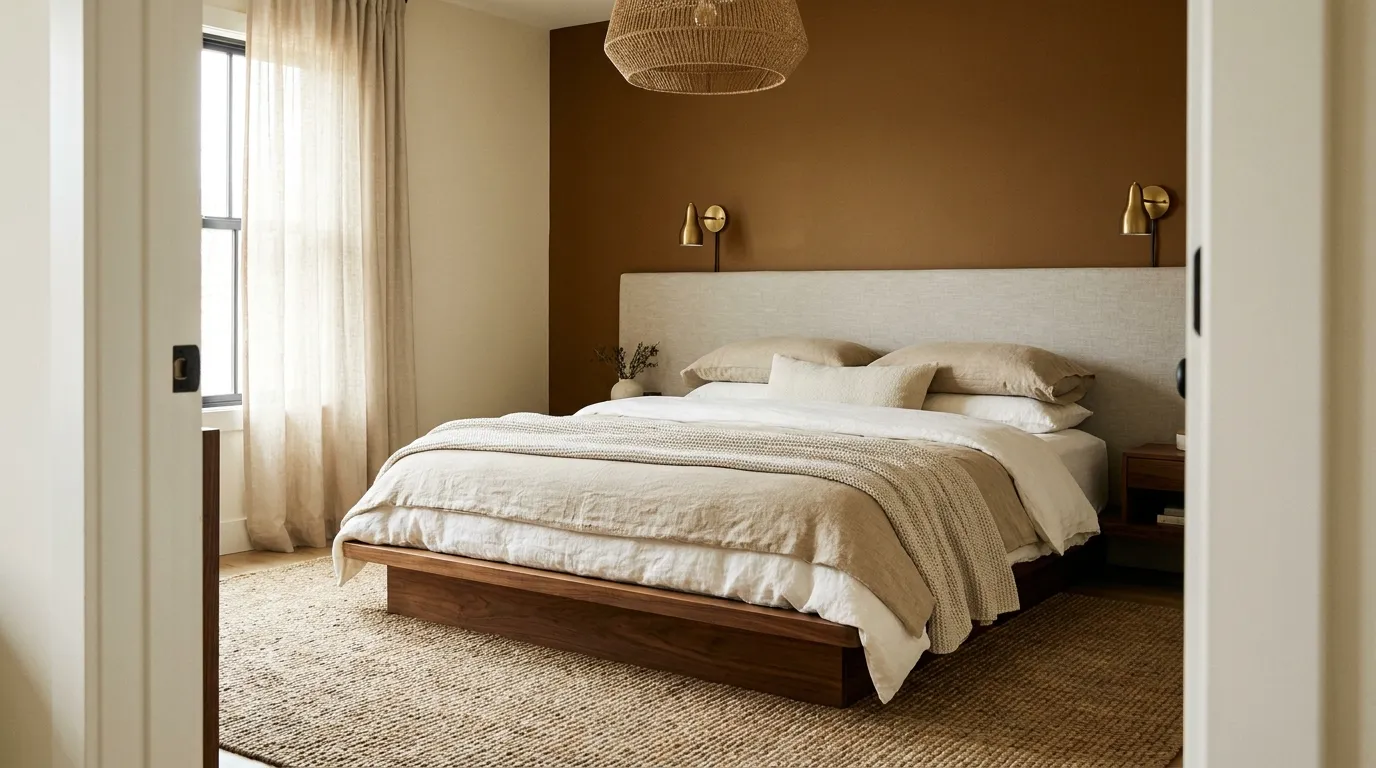
An accent wall in a contemporary bedroom works when the accent reads as an intensified version of the room’s overall palette rather than a contrasting addition imported from somewhere else. If the room is built on warm greige, the accent wall might be a warm chocolate or deep camel. If the walls are soft warm white, the accent could be a muted clay or dusty sage. The relationship between the accent and the surrounding walls should feel like depth rather than contrast.
The wall behind the bed is the natural candidate — it frames the headboard and bedding as a composed scene viewed from across the room. Painting just that wall while keeping the remaining three walls in the lighter base tone is generally enough. Full-room color drenching — painting walls, ceiling, and trim in the same deep tone — is a more committed but equally valid approach that tends to make bedrooms feel more enveloping and resolved.
3. Choose Furniture With Clean Silhouettes and Genuine Material Quality
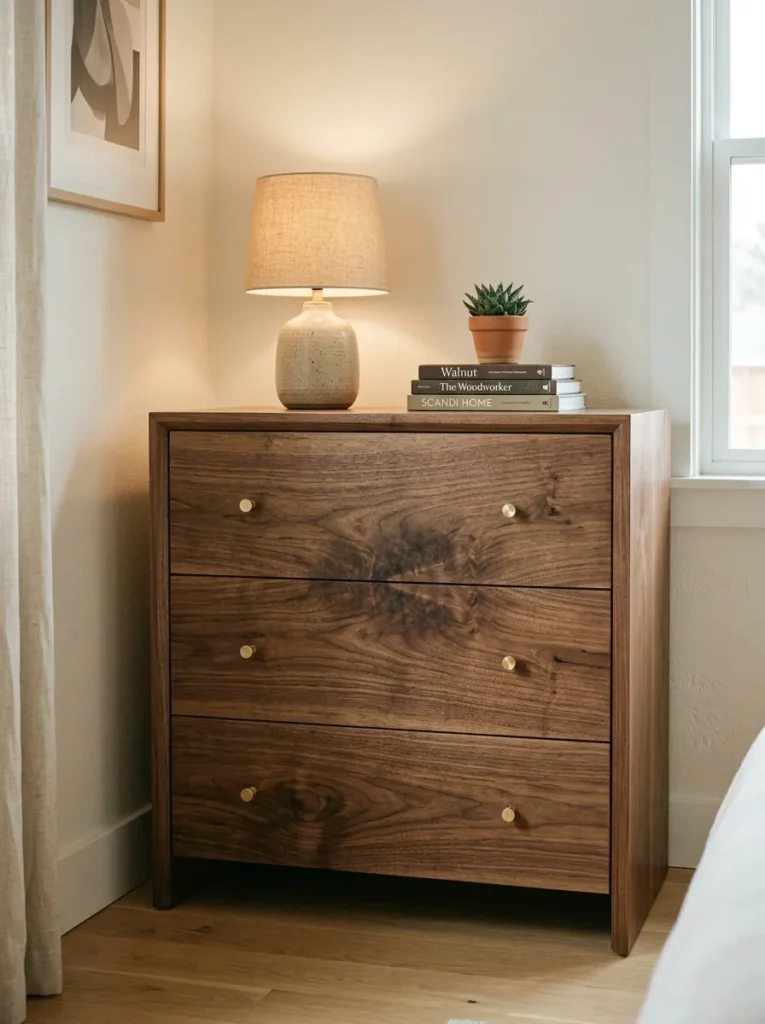
Contemporary bedroom furniture is defined less by specific shapes than by the absence of period ornament: no carved details, no turned legs, no decorative moulding applied for its own sake. The silhouette tends toward clean and rectilinear, though softer, more rounded forms have become equally common in recent years and often read as more approachable than strictly angular pieces.
What matters more than the exact profile is material quality. Contemporary furniture that’s genuinely well-made — in solid oak, walnut, or high-quality veneer with real joinery — reads entirely differently from furniture with similar clean lines in hollow MDF with vinyl wrapping. The materiality is often visible in small details: the weight of a drawer, the finish at the edges, the way wood grain flows across a piece. Investing in fewer pieces of genuine quality typically produces a more considered result than filling a room with matched sets of budget contemporary furniture.
4. Anchor the Bed With an Upholstered Headboard in Linen or Boucle
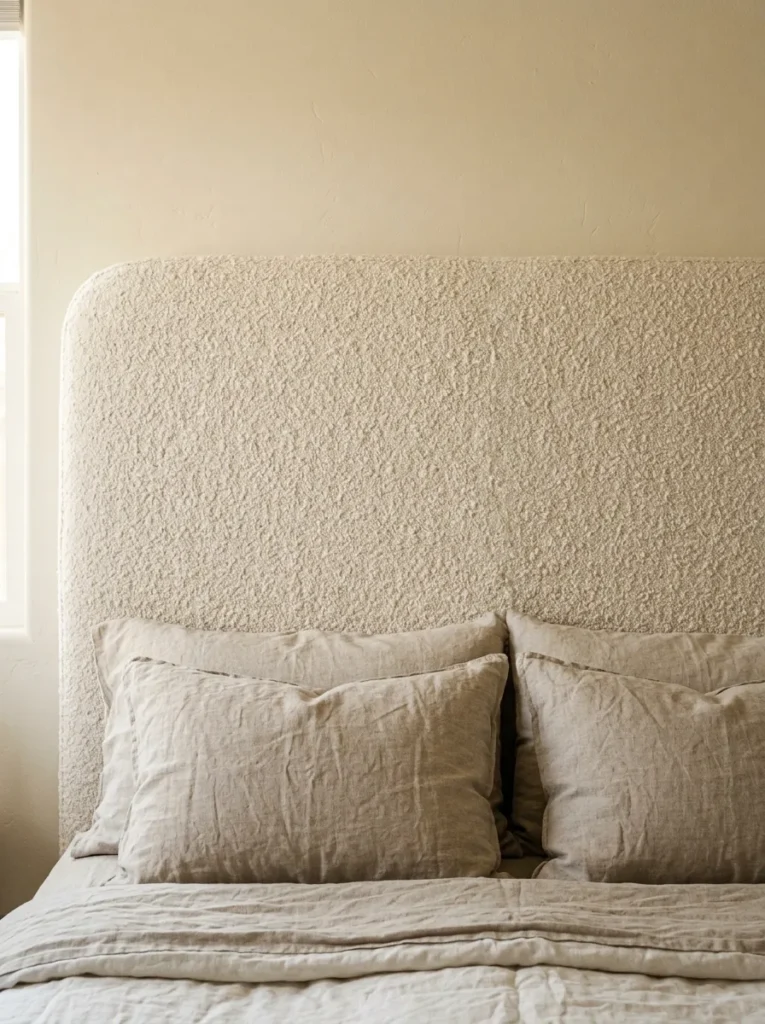
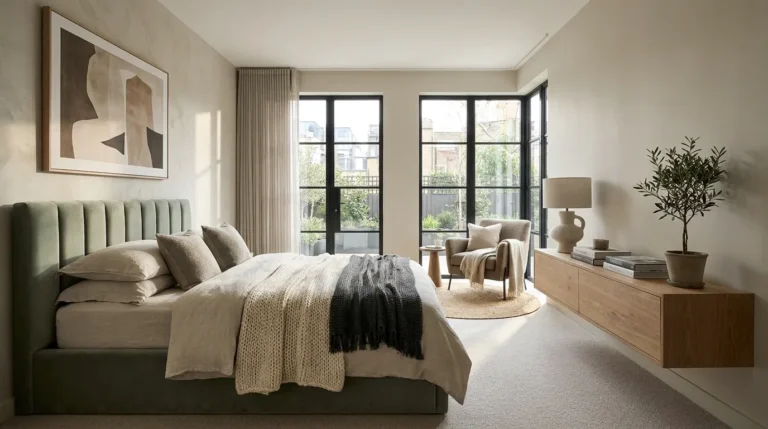
The headboard is where a contemporary bedroom most clearly declares its character, and an upholstered headboard — particularly in a natural textile — does more for the room’s warmth and softness than almost any other single piece. A well-proportioned linen headboard in warm ivory, pale greige, or muted sage turns the bed wall into a composed focal point and introduces fabric texture at the room’s most prominent surface.
Proportion is the critical variable. A headboard that’s too short for the bed frame looks like an accessory rather than a structural piece; too tall in a room with standard eight-foot ceilings becomes overwhelming. A general guide: the headboard’s top should sit comfortably below the ceiling while extending high enough to be visible above pillows when the bed is fully made — usually somewhere between 48 and 60 inches from the floor. Boucle, with its looped, slightly nubby texture, has become particularly popular for contemporary headboards because it adds tactile richness without introducing pattern.
5. Consider a Low Platform Bed for Rooms Where Space Feels Compressed
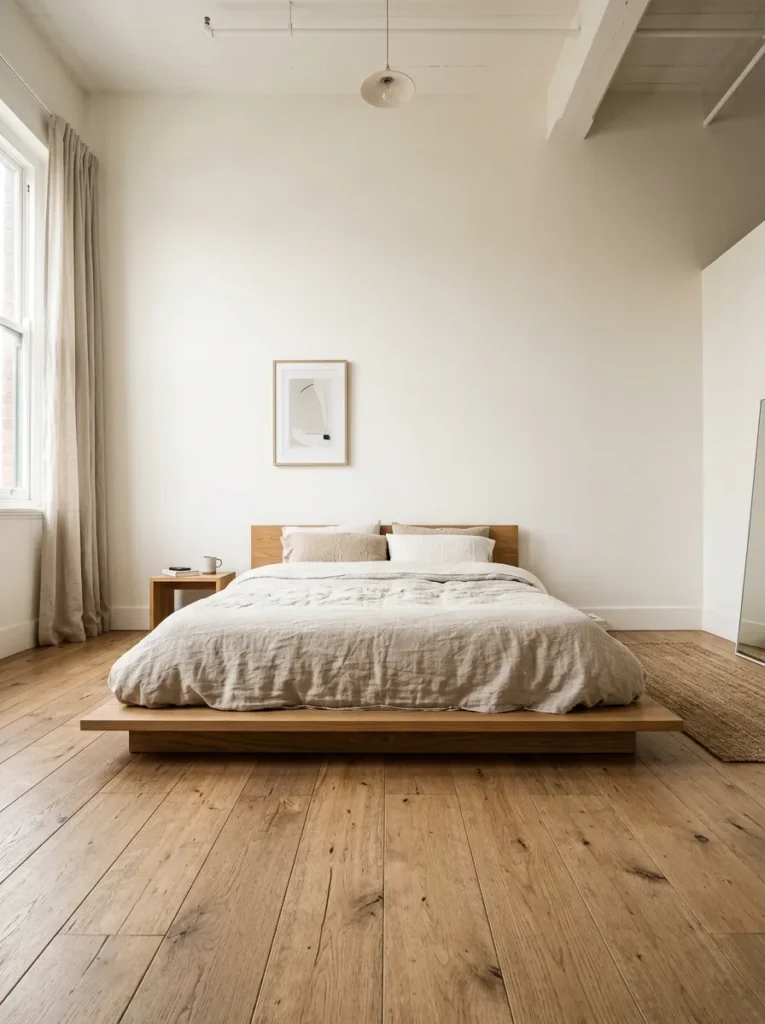
Bed height affects how a room reads before a single piece of decor is added. A tall traditional bed frame with visible box spring and additional mattress height raises the room’s horizontal center of gravity and can make a bedroom feel smaller and heavier. A low platform bed — where the mattress sits close to the floor either on a low base or recessed into a platform frame — frees significant wall space above the bed and makes the ceiling feel higher by comparison.
This is particularly effective in rooms under ten feet of ceiling height, where visual breathing room above the bed is limited. The practical trade-off is that low beds are easier to sit on the edge of than to get in and out of from a standing position, which is a genuine consideration for some users. A platform with a modest height — around 14 to 18 inches from floor to mattress top — splits the difference between the visual benefit of a low profile and the practicality of a bed you can get into without a deliberate step down.
6. Layer Lighting With at Least Three Independent Sources
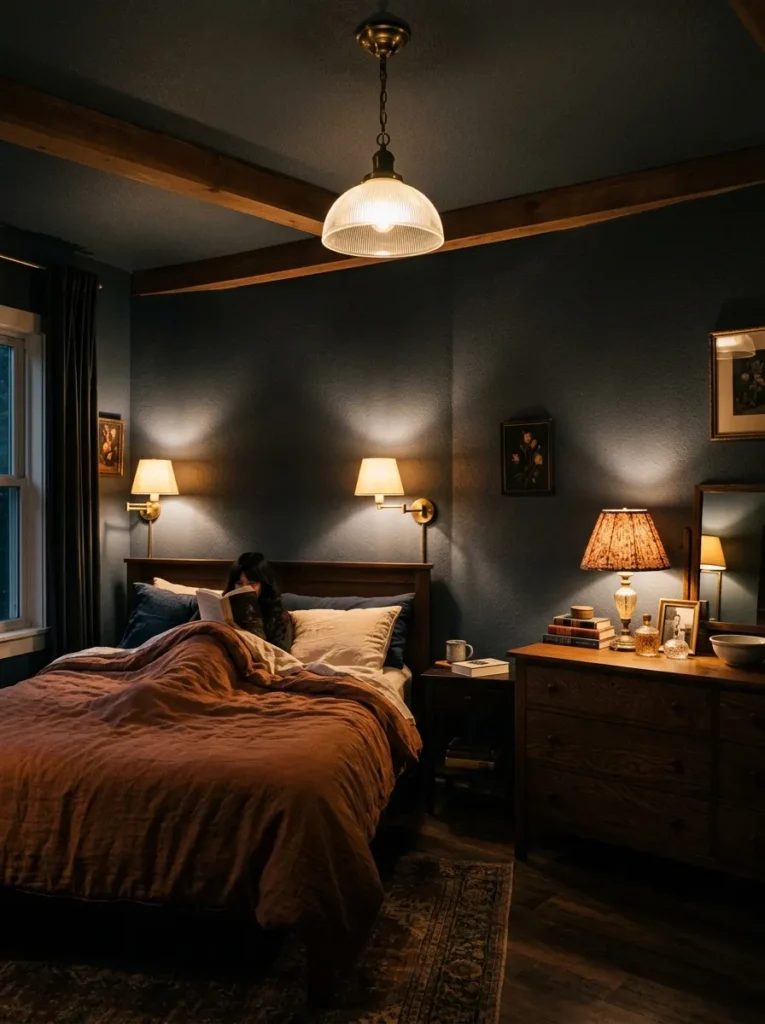
Single overhead lighting is one of the most reliable ways to undermine a bedroom’s atmosphere. A ceiling fixture illuminating the room from one source flattens everything it touches — shadows disappear, textures flatten, and the quality of light becomes institutional regardless of the bulb’s color temperature. Contemporary bedrooms typically layer at least three independent light sources, each doing a different job.
A primary source handles general ambient illumination — a pendant, a ceiling fixture on a dimmer, or a pair of wall sconces at medium height. Bedside task lighting for reading is secondary — table lamps, wall-mounted swing-arm sconces, or hanging pendants that direct light downward rather than flooding the room. Accent lighting — a lamp on a dresser, a low shelf light, or LED strip behind a headboard panel — handles atmosphere and acts as the room’s “mood layer.” The ability to run these independently, or on separate dimmers, is the functional key.
7. Install Wall-Mounted Bedside Sconces to Free Up Nightstand Surfaces
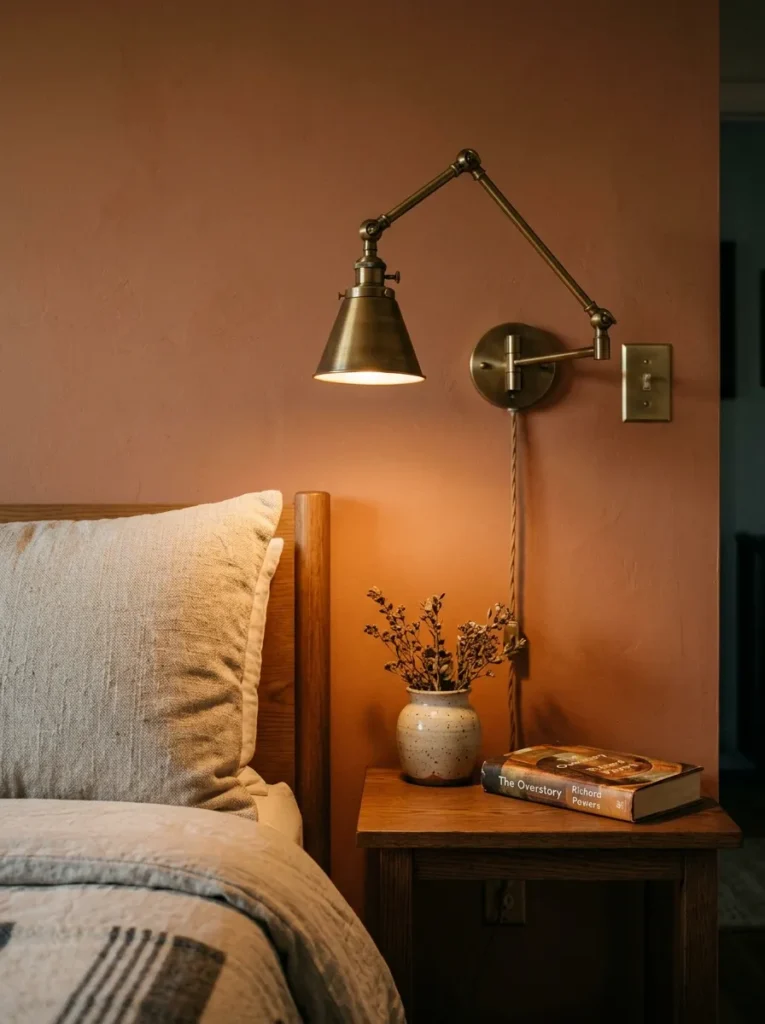
Traditional table lamps on nightstands perform two functions that can be separated: they provide light and they occupy space. In a contemporary bedroom where the nightstand surface is also the resting place for a book, a glass of water, a phone, and perhaps a small plant, a table lamp can dominate a surface that genuinely needs the space for other things.
Wall-mounted sconces positioned at bedside reading height — roughly 24 to 30 inches above the mattress, angled slightly downward — solve this cleanly. They provide directed reading light without using any surface area. The aesthetic benefit is equally significant: bedside walls with sconces rather than lamps have a finished, hotel-like quality that’s harder to achieve with freestanding lighting. Plug-in sconces with cord cover kits are the accessible option for renters or those who don’t want electrical work.
8. Use Curtain Rods Mounted Close to the Ceiling, Not the Window Frame
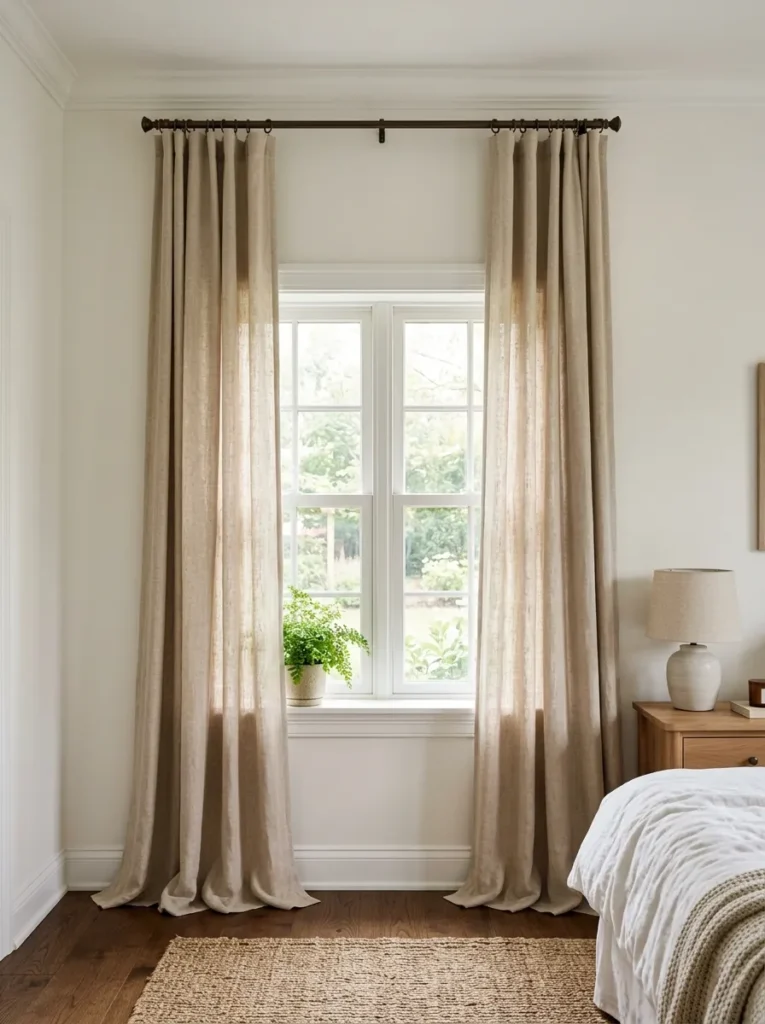
Few changes improve a bedroom’s proportions as quickly as repositioning curtain hardware from just above the window frame to just below the ceiling line. The visual effect is dramatic: windows appear significantly taller, the ceiling reads higher, and the room feels more architecturally considered without any structural change.
The curtain panels need to correspond to the new rod height — panels designed for standard windows will be too short when the rod moves up. Full-length curtains that reach the floor are the right choice here; curtains that stop at the sill or mid-wall look unresolved regardless of where the rod is mounted. In rooms with decorative crown moulding, the rod typically goes just below the moulding’s lower edge. The result is a window treatment that reads as an architectural detail rather than a practical covering.
9. Paint or Panel the Ceiling to Create a Fifth Wall
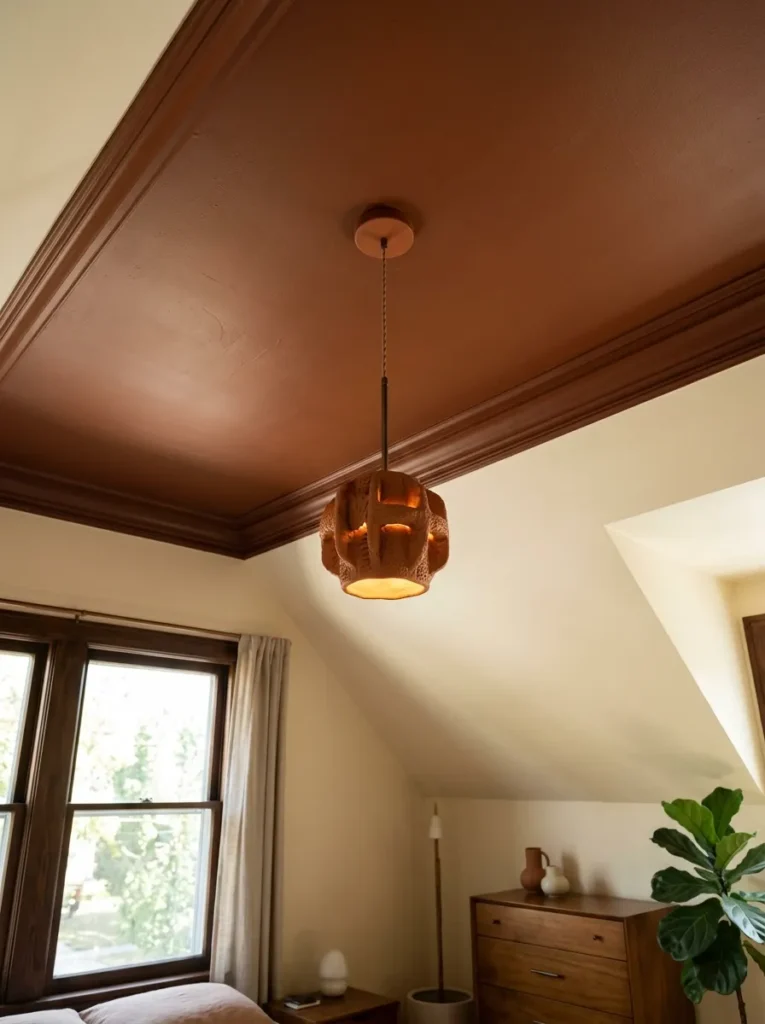
Contemporary bedrooms almost never address the ceiling, and it’s genuinely the room’s most underused surface. A ceiling painted in a tone two to three shades deeper than the walls creates a sense of enclosure that makes a bedroom feel more intentional and immersive without any additional decor. Combined with warm-toned pendant lighting, a painted ceiling becomes the room’s most sophisticated detail.
An alternative to color: thin batten strips in a grid pattern applied to the ceiling and painted the same tone create a coffered ceiling effect at a fraction of the cost of actual architectural coffering. From normal viewing distance the battens read as genuine architectural detail. The visual weight of a treated ceiling pulls the space downward slightly, which works well in contemporary bedrooms aiming for a cocooning quality, but requires genuine ceiling height — at least nine feet — to avoid feeling compressed.
10. Add a Textured Accent Wall With Limewash, Plaster, or Paneling

Beyond paint, several wall treatments add the kind of textural depth that flat-finish paint cannot provide. Limewash creates a shifting, chalky surface with visible tonal variation — two areas of the same wall will catch light differently, which prevents the darkness from reading as flat. Venetian plaster takes this further, producing a smooth but luminous surface with genuine depth. Applied plaster finishes, while more expensive than standard paint, last significantly longer and develop subtle character over time.
More accessible is panel moulding: MDF strips applied to the wall in rectangular frames, then painted in the same tone as the wall surface. In a contemporary bedroom, the frames should be clean and relatively wide-spaced — not the dense Victorian panel proportions that read as traditional, but a modern scale with fewer, larger panels. The shadow lines between panel and wall create just enough dimensional interest to distinguish the wall from a plain painted surface.
11. Choose a Statement Pendant Instead of a Ceiling Fan or Basic Flush Mount
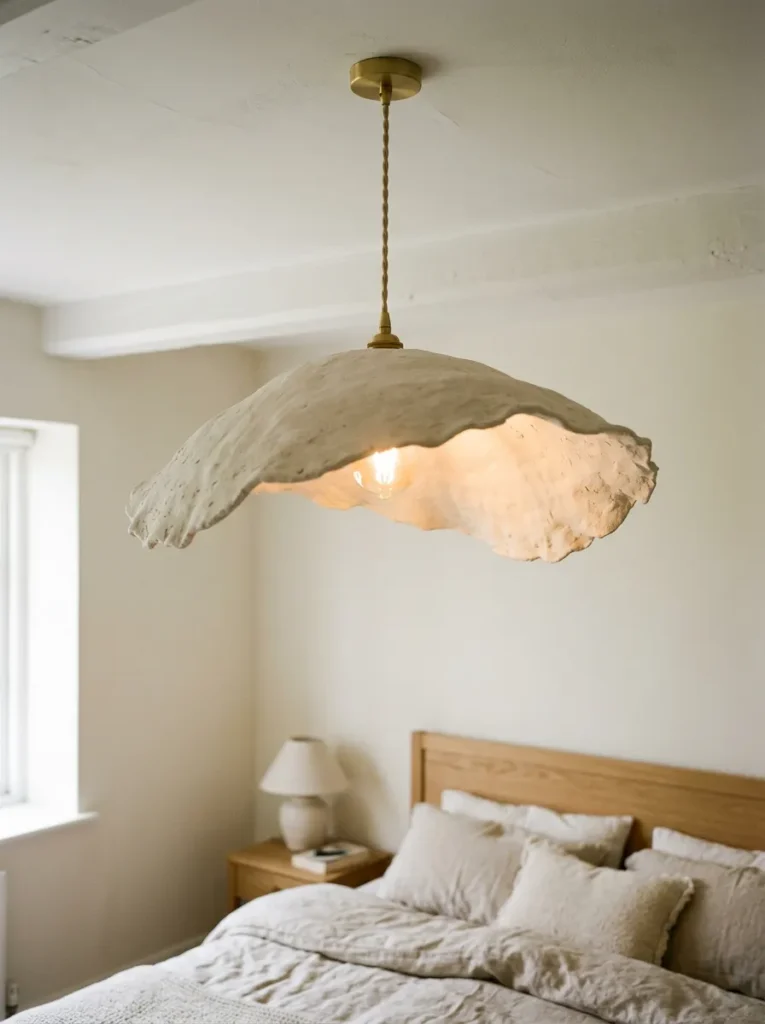
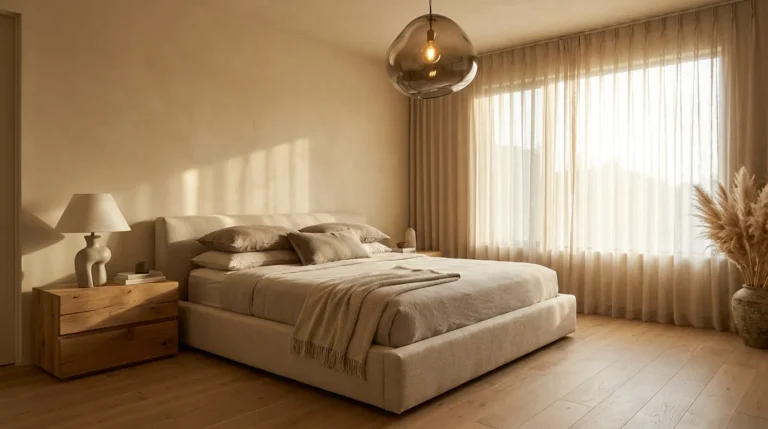
The ceiling fixture decision is one that most contemporary bedrooms make conservatively and regret passively. A standard flush-mount light in the center of the ceiling does its functional job and nothing else. A ceiling fan communicates practicality while actively working against any considered design intention. A statement pendant — a sculptural shade in ceramic, woven rattan, plaster, or spun metal — becomes the room’s overhead focal point and earns its visual weight at every waking moment.
The scale consideration is real: a pendant too small for the room’s footprint looks timid. A rough starting point for pendant diameter is one inch per foot of room width — a 12-foot-wide room calls for a fixture roughly 12 inches in diameter. Larger rooms can support wider fixtures, and rooms with higher ceilings benefit from the vertical drama of a longer cord or chain. Dimmers are non-negotiable for bedroom pendants; flat-on, flat-off is incompatible with the atmospheric range a bedroom needs.
12. Select a Dresser With Simple Hardware and a Real Wood Surface
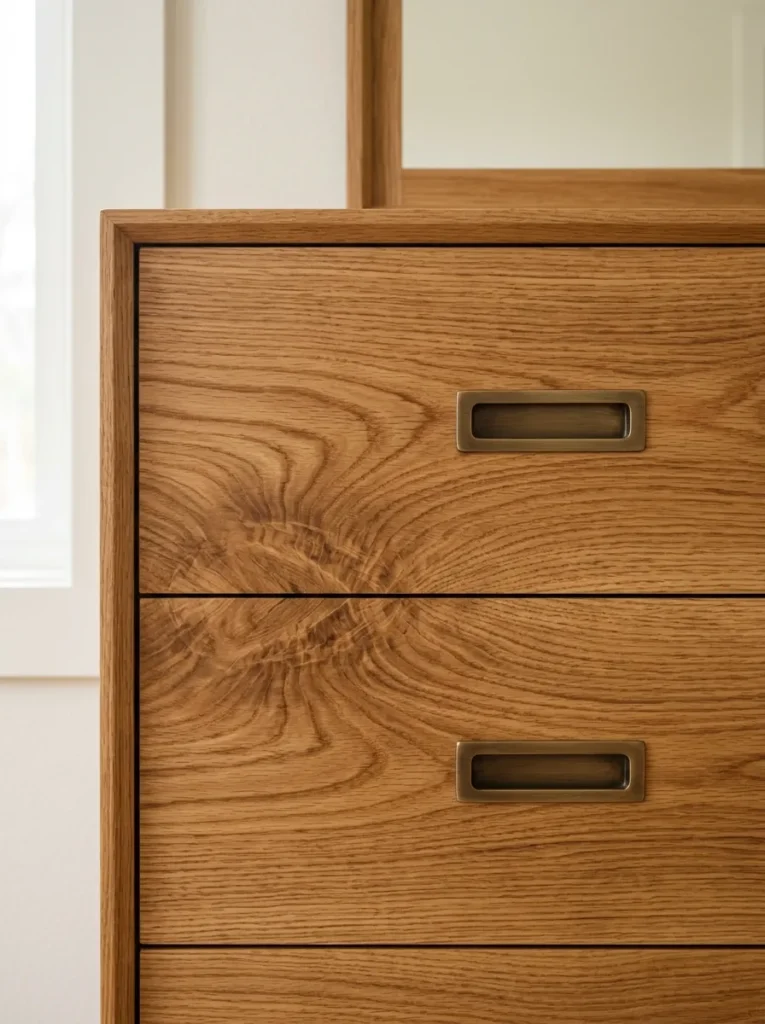
Storage furniture in contemporary bedrooms earns its place aesthetically as well as functionally. A dresser that reads well in the room — with clean lines, appropriate scale, and genuine material quality — doesn’t need to be styled or decorated to justify its presence. A dresser that’s visually awkward needs a mirror, a lamp, and a collection of objects on top just to distract from the piece itself.
Hardware finishes should connect to at least one other metal in the room — bedside sconces, door hardware, or curtain rod — to create the sense that the room’s finishes were considered as a system rather than selected individually. Brushed brass, aged bronze, and matte black are all compatible with warm contemporary palettes. Polished chrome and bright silver read colder and work better against cooler, more minimal rooms.
13. Consider a Bench at the Foot of the Bed for Both Function and Visual Weight
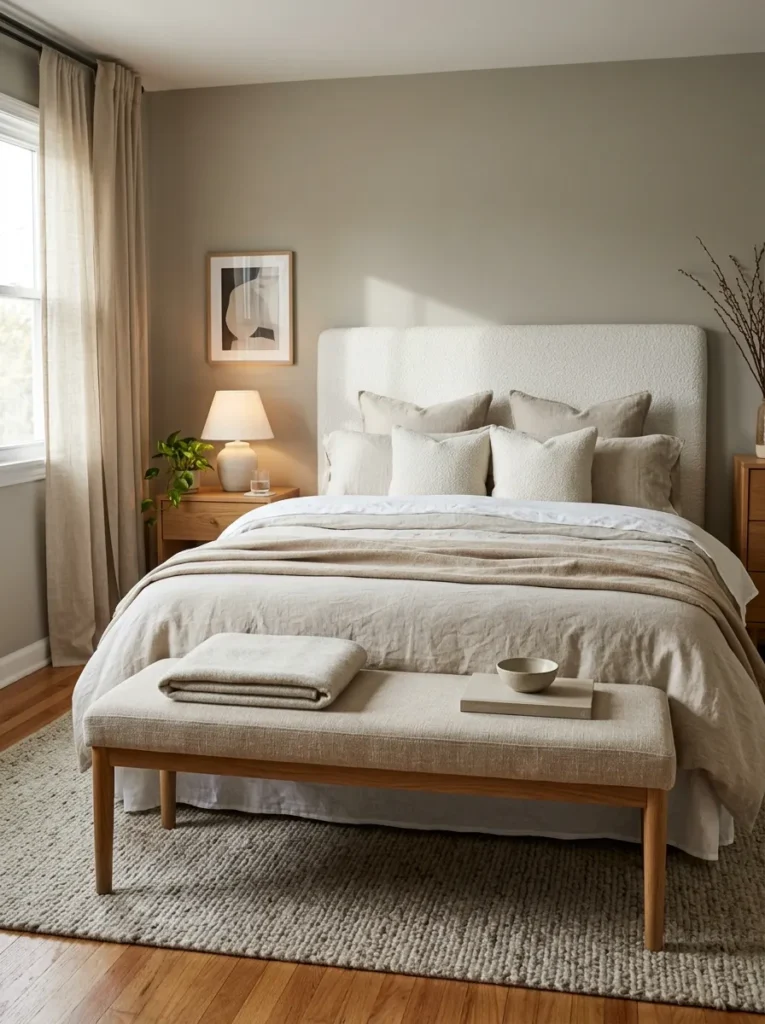
A bench at the foot of the bed is one of those furniture pieces whose practical function is modest — somewhere to sit while putting on shoes, somewhere to lay out tomorrow’s clothes — but whose visual contribution is significant. In a contemporary bedroom, the bed is the dominant piece and the bench creates a transition between the bed and the rest of the room that prevents the space from reading as a mattress floating in open floor.
The bench should relate to the bed’s length without matching it exactly — roughly two-thirds the bed width reads proportionally natural. Upholstered benches in the same fabric family as the headboard produce a resolved, coordinated feel; a bench in a contrasting material — a natural wood bench against an upholstered headboard, or a leather bench against linen bedding — creates a deliberate contrast that reads as more curated.
14. Keep Nightstand Surfaces Edited to Three or Fewer Items
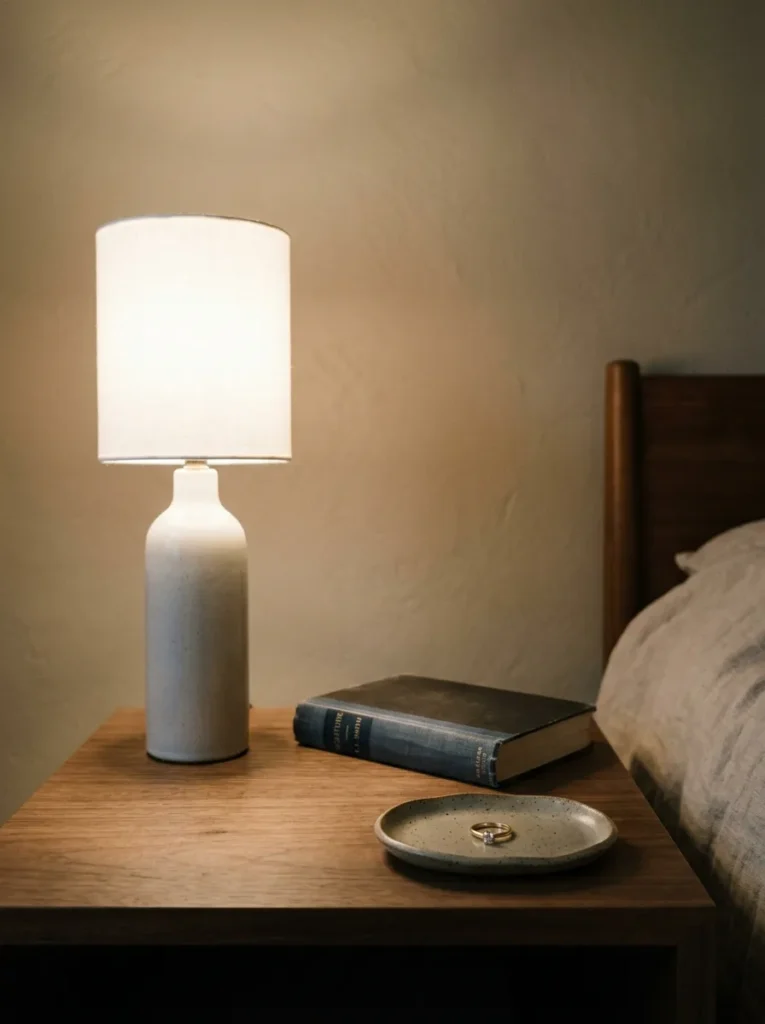
The nightstand is the bedroom surface that most consistently reveals the difference between a considered space and one that’s still being figured out. In a contemporary bedroom, the nightstand surface benefits from the same restraint the rest of the room applies: three things at most, each earning its place. A lamp or sconce handles light. One or two additional items — a small plant, a book, a glass — complete the surface.
The objects’ scale should relate to the nightstand’s dimensions. A nightstand with a small surface area overwhelmed by a large lamp and three competing objects reads as cramped; one with nothing but a glass reads as unoccupied. The nightstand itself should reach approximately the mattress height or within a few inches of it — too low and it’s difficult to reach; too high and it reads as a table placed beside a bed rather than furniture designed for the relationship.
15. Pair Matching Nightstands With an Unexpected Contrast Detail
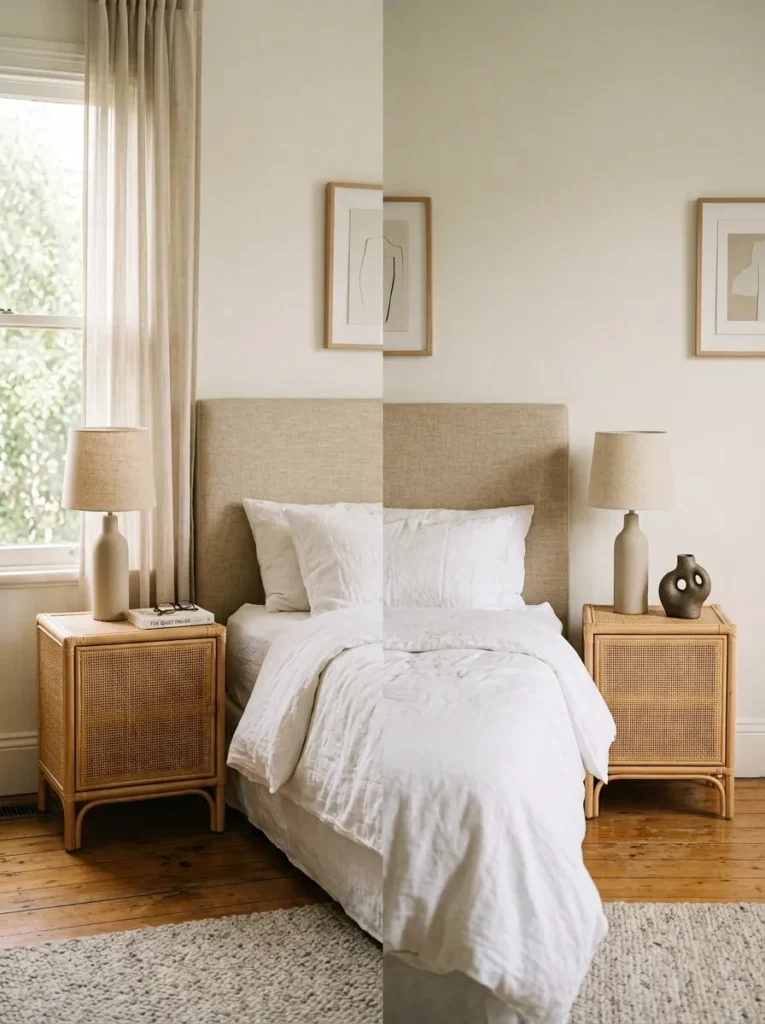
Matching nightstands create the symmetry that makes most bedrooms read as complete and considered. What prevents that symmetry from reading as formulaic is a detail that’s allowed to vary: the same nightstand forms with different lamp types on each side, or the same lamp with different styled objects. More deliberately, a single distinguishing element — one side with a small sculpture, the other with a plant — breaks the exact repetition without undermining the symmetrical structure.
This is distinct from deliberately mismatching nightstands, which works in some eclectic or collected-looking rooms but requires a careful eye for scale and material relationship. In a contemporary bedroom aiming for elegance and ease, matched forms with varied styling tend to produce a more settled result than mismatched pieces trying to feel curated.
16. Bring in Organic Texture Through Materials, Not Just Objects

Contemporary bedrooms can tip toward feeling cold and uninhabited when the finish palette skews too smooth and too consistent. The correction isn’t to add more objects — it’s to introduce materials with inherent textural character: a linen duvet cover with visible slub texture, a handwoven wool throw with an organic weave, natural stone lamp bases, an aged wood side table with visible grain and knots, a ceramic vessel with an uneven matte glaze.
These materials do their work quietly. They don’t require styling — they simply look different under different light conditions, from different viewing distances, and at different times of day. A room with a range of such materials has a visual richness that’s hard to precisely identify but immediately felt. A room where every surface is smooth, consistent, and machine-finished has a corporate quality no amount of decorating fully resolves.
17. Add Greenery in One Sculptural, Thoughtfully Placed Plant
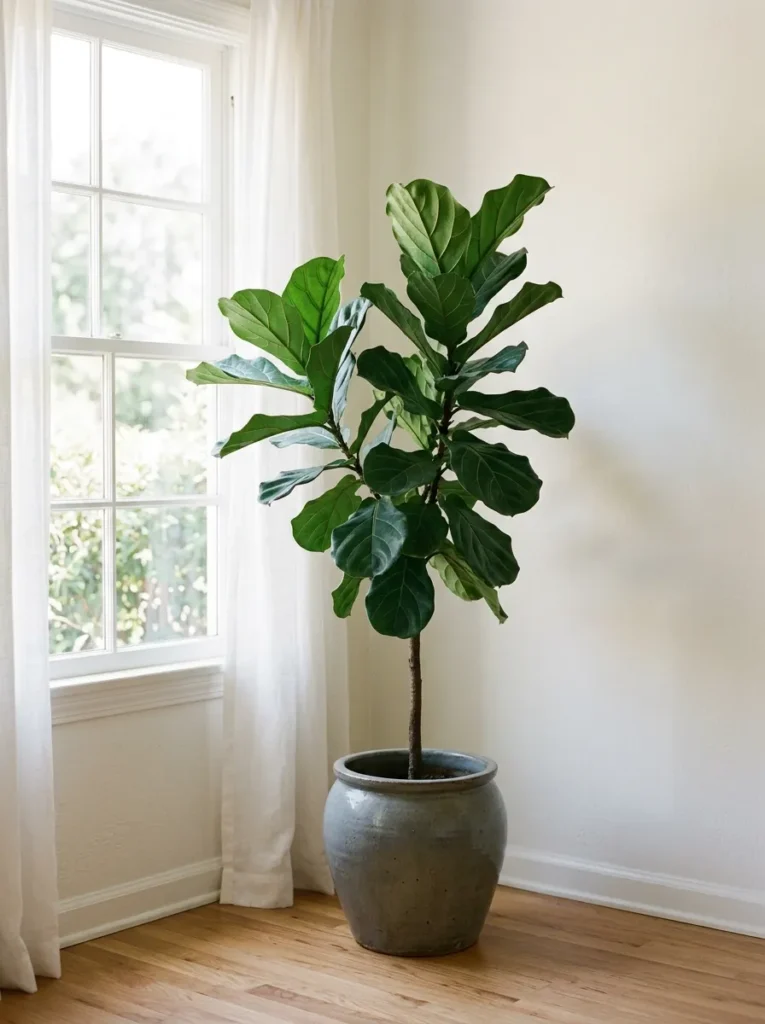
A single well-chosen plant in a contemporary bedroom does more than a collection of small plants scattered around surfaces. The species should have enough form and scale to read as a deliberate compositional element rather than a gesture toward nature: a fiddle-leaf fig in a generous corner with adequate light, an architectural snake plant in a sleek matte pot on the dresser, an olive tree with its silver-green foliage near a sunny window, or a large pothos trailing from a high shelf in a room where the aim is a more organic, relaxed quality.
The pot selection matters as much as the plant. A mass-produced plastic nursery pot sitting inside a ceramic is less resolved than a plant properly potted in something with genuine material quality. A hand-thrown ceramic in a warm sandy or matte charcoal tone — sized so the pot looks proportionally right to the plant rather than either overscaled or too small — completes the piece.
18. Use Art as a Tool for Proportion, Not Just Decoration
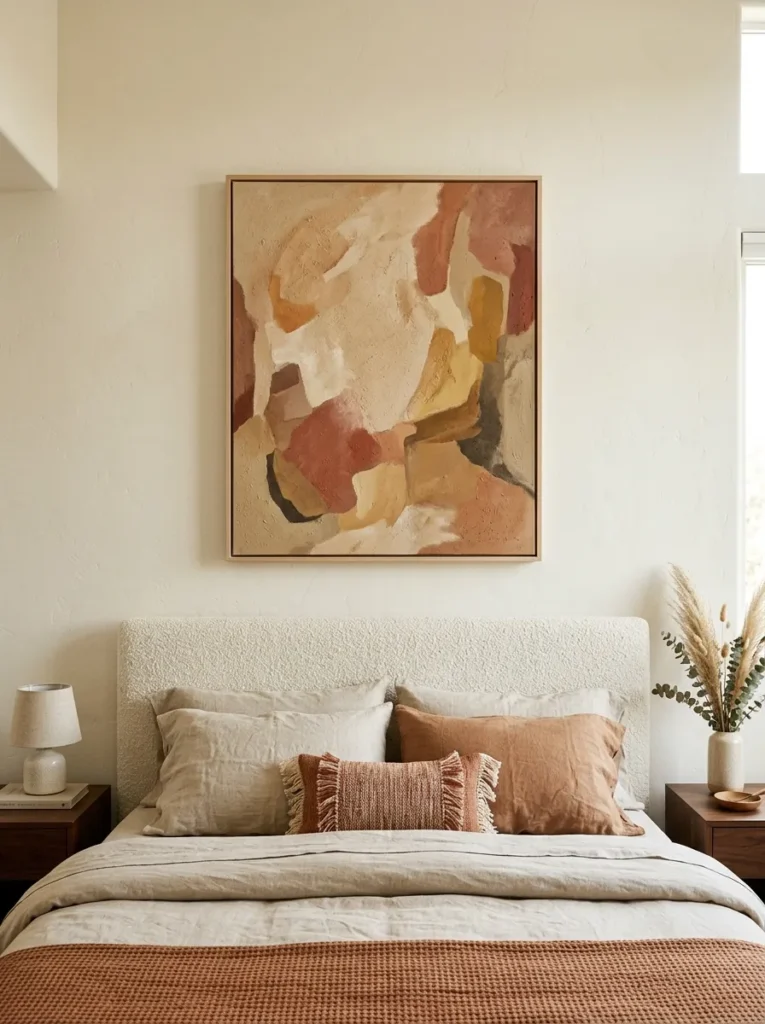
Art in a contemporary bedroom solves a specific spatial problem: how to fill wall space in a way that reads as culturally and personally meaningful rather than decoratively neutral. The scale decision is where most bedrooms go wrong. A piece that’s too small for its wall creates a timid impression regardless of the art’s quality; something genuinely well-sized commands the wall and earns a second look.
The rule of thumb for art above a bed: the piece should span roughly 65 to 75 percent of the headboard’s width. Above a dresser: the art should be roughly the same width as the dresser or slightly narrower. Abstract work with strong color relationships or clear compositional movement tends to read well in bedrooms because it contributes atmosphere without the subject matter becoming intrusive in a sleeping space. A single substantial piece reads more contemporary than a cluttered gallery wall in most bedroom contexts.
19. Define the Floor Zone With a Rug Sized Generously to the Bed
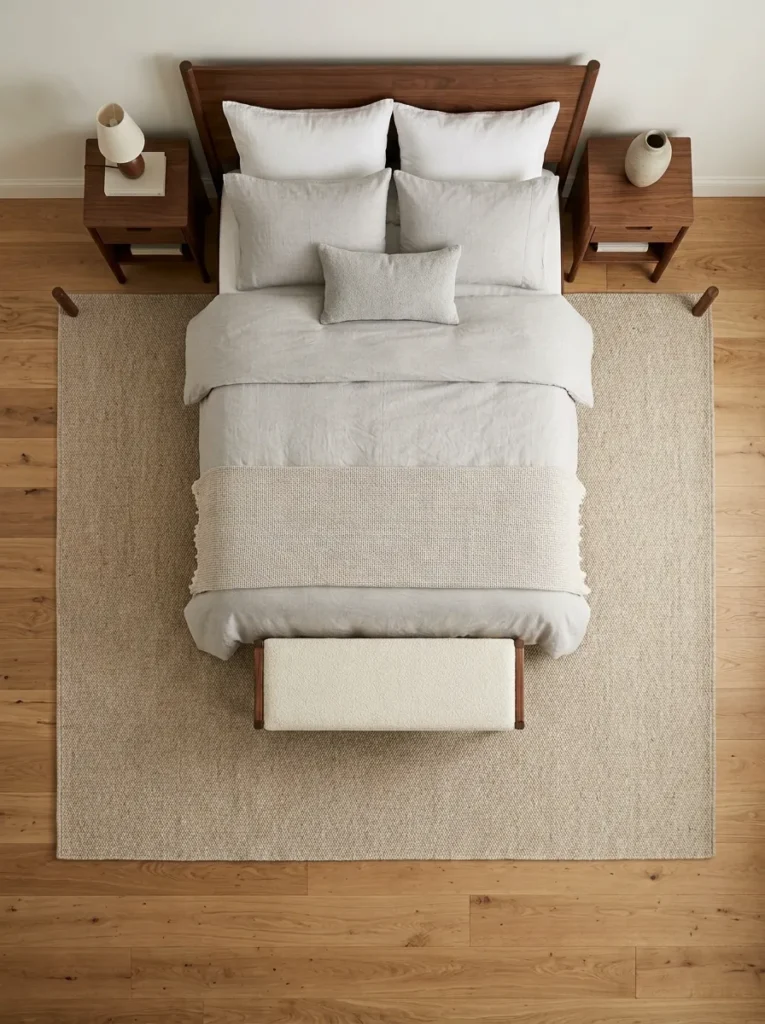
The rug is the bedroom’s forgotten scale decision, and undersizing it is one of the most common mistakes in otherwise well-composed spaces. A rug that sits only beneath the bed’s footprint — or worse, only extends a few inches beyond it — makes the bed look like furniture placed on top of a rug rather than a sleeping area anchored by one. The rug should extend at least 18 to 24 inches beyond the sides and foot of the bed so that the first step out of bed lands on the rug rather than bare floor.
In contemporary bedrooms, low-pile rugs in natural tones — a sisal-texture wool, a woven flatweave, or a plush but short-pile cut in warm oatmeal or earthy grey — tend to read more resolved than high-pile shaggy rugs, which are harder to keep looking clean and can undermine a room’s sense of considered restraint. The rug color should connect to the room’s palette rather than introduce a new element the rest of the room doesn’t reference.
20. Hang Drapery in a Tone Just Off the Wall Color, Not Matching It Exactly
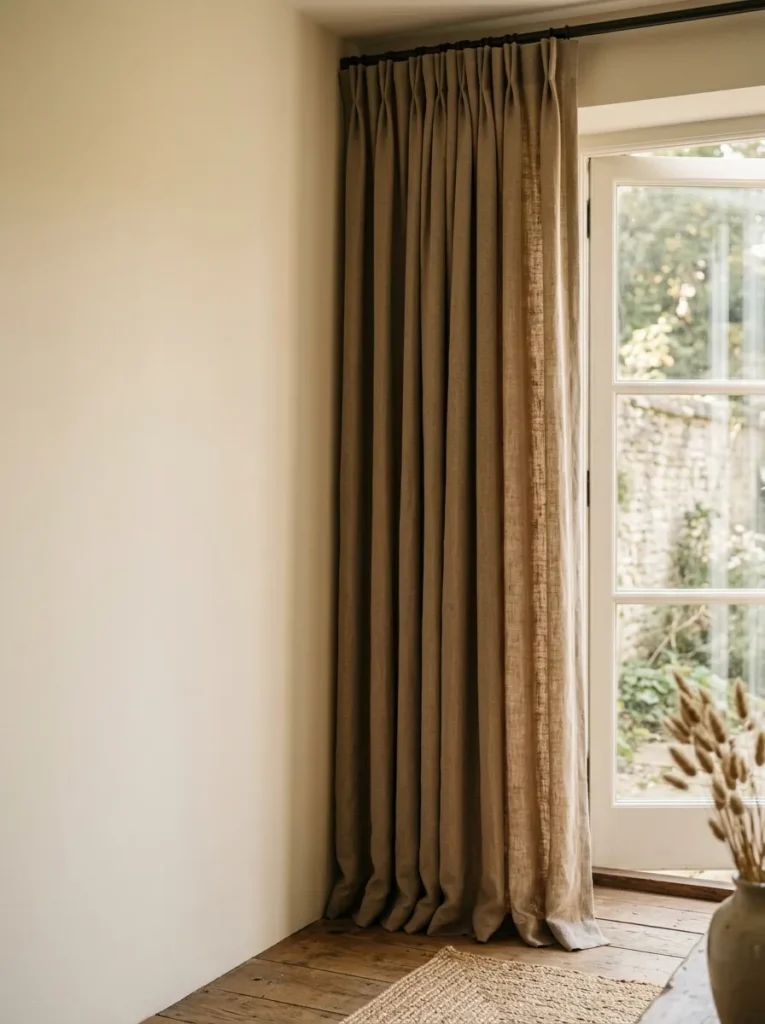
Curtains in a contemporary bedroom that exactly match the wall color can read as an attempt to make the window treatment disappear, which sometimes works and sometimes produces a slightly flat result where the window zone lacks any visual interest. A more engaging approach: curtains in a tone that’s close to the wall color but clearly distinct — a few shades deeper, a slightly warmer undertone, or a different material entirely — so the window has presence without visual competition with the rest of the room.
Linen, cotton velvet, and heavyweight cotton blend are the most useful curtain materials for contemporary bedrooms. Sheer panels behind floor-length drapes allow for both daytime privacy management and the soft light quality that makes a contemporary bedroom feel serene rather than dim. The rod position close to the ceiling remains the most important single variable — good curtains on a low rod consistently produce a worse result than simple curtains mounted correctly.
21. Layer Bedding in Related Tones Rather Than Matching Sets
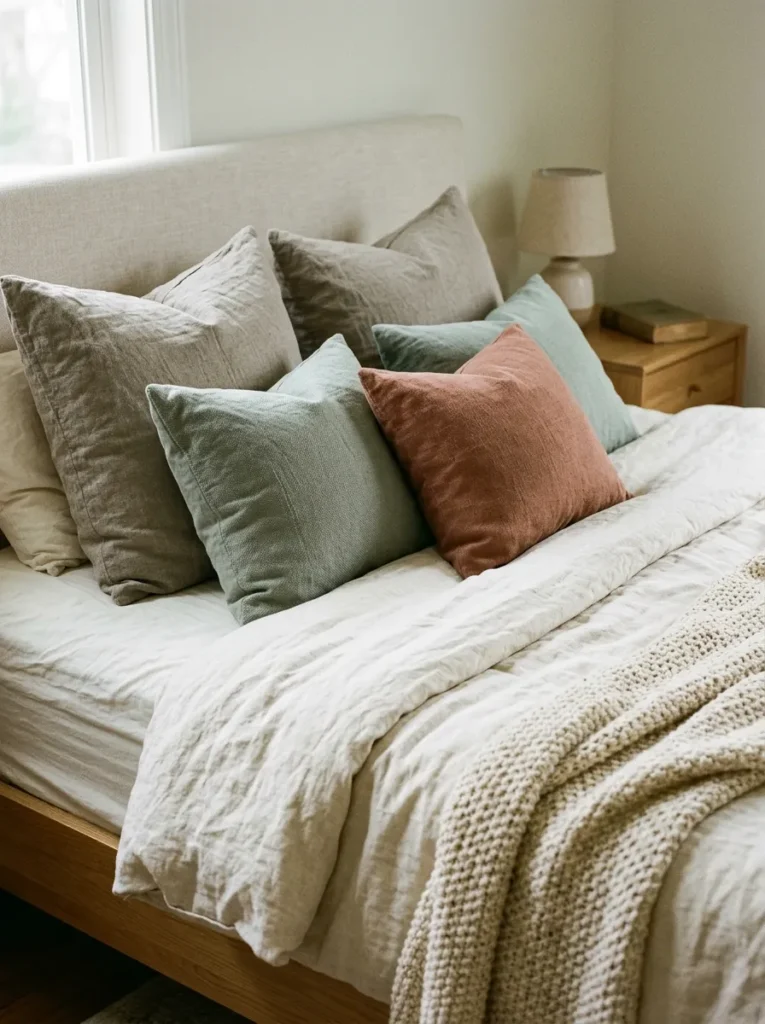
Contemporary bedrooms rarely use matched bedding sets — the coordinated sheets, duvet, and pillow covers that come pre-packaged tend to read as domestic-generic rather than considered. The approach that reads as more curated is assembling bedding from individual pieces in related but not identical tones: warm white fitted sheets, a natural linen duvet in ivory, euro shams in warm greige, throw pillows in dusty sage or muted rust that echo the room’s accent colors, and a casually placed throw in a complementary texture.
The visual result of this assembly method is a bed that looks as though it developed over time rather than arriving as a coordinated unit. The colors don’t match — they relate. The textures vary — cotton, linen, knit, velvet — while the palette stays within a deliberate tonal range. Remove one element and the whole looks pared-back; add one wrong element in too-bright a color and the whole arrangement shows the intrusion immediately.
22. Edit the Dresser Top to Serve the Room, Not the Impulse to Decorate
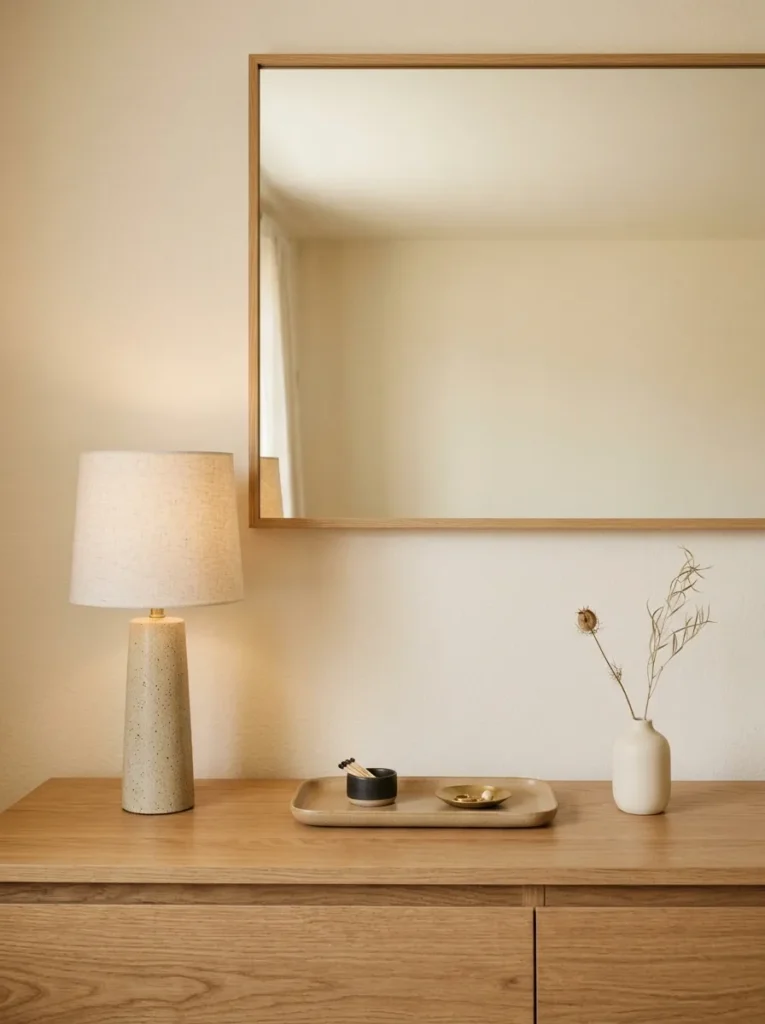
The dresser top in most bedrooms accumulates in a way that few other surfaces do — loose change, jewelry, chargers, receipts, and decorative objects live side by side until the surface reads as overflow rather than intention. In a contemporary bedroom, the dresser top is best treated like a vignette with a function: one lamp or a mirror, one or two objects of different heights, a tray to corral the things that actually need to be there, and nothing else.
The objects on a dresser should relate to each other in material or tone: a ceramic lamp base, a ceramic dish for keys, and a ceramic vase create a quiet material unity. A lamp, a wooden object, and a glass vessel achieve the same coherence through varied materials within a tonal family. The underlying discipline is the same: fewer things, carefully placed, read as a composed surface rather than a landing zone.
23. Introduce One Warm Metal Finish and Use It Consistently
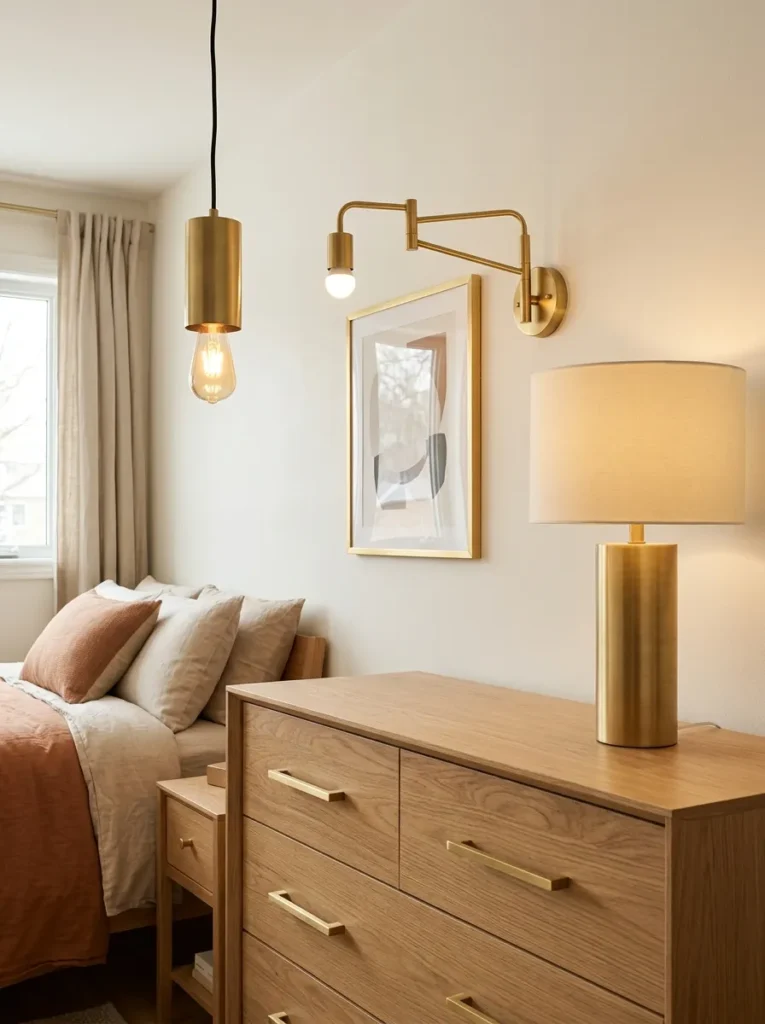
Contemporary bedrooms benefit from a defined metallic register — the finish that appears in light fixtures, hardware, and decorative objects throughout the room. Two competing metal finishes (chrome nightstand pulls beside a brass pendant, for example) create a subtle visual restlessness that’s hard to identify but immediately felt as something slightly off.
Warm metals — aged brass, brushed gold, unlacquered bronze — are more forgiving against warm neutral palettes than cool metals like chrome or polished nickel, which read better against cooler, more minimal rooms. Committing to one finish doesn’t mean every metal object must be identical; aged brass and brushed brass can coexist as variations within the same warm gold register. The visual principle is consistency of warmth rather than exact match.
24. Let the Room Have Breathing Space — Some Walls Should Stay Empty
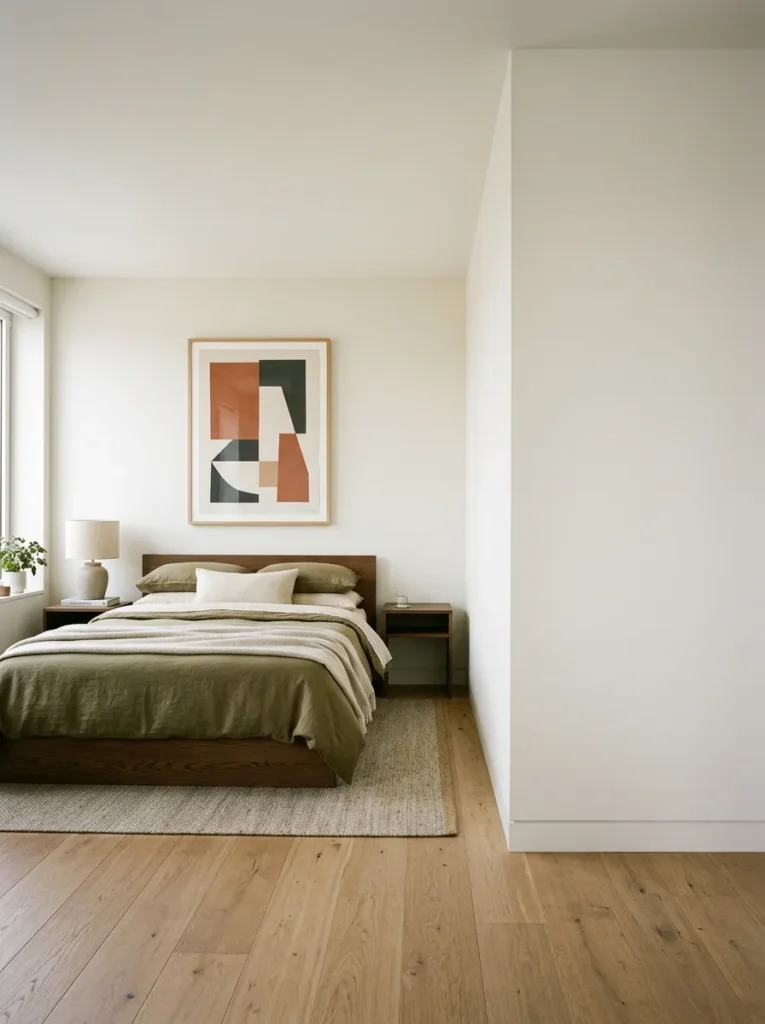
The final idea is about restraint more than action: contemporary bedrooms are consistently over-decorated relative to what produces the most elegant result. Every wall hung with art, every surface topped with objects, every corner filled with furniture creates a room that has left no room for the room itself to breathe. Negative space — empty wall sections, clear floor areas, surfaces left largely bare — is part of the composition, not evidence that decoration is unfinished.
A contemporary bedroom that reads as genuinely elegant typically has one or two strong wall moments and several walls that are either empty or carry only trim and paint. The floor area around the bed should have navigable open space. The ceiling, if not treated, should be allowed to simply be a ceiling. This restraint is a choice, and making it deliberately produces a more satisfying result than filling the room with good things until the room is full.
How to Start a Contemporary Bedroom Refresh Without Redoing Everything
The most useful starting sequence for a contemporary bedroom that needs work: resolve the wall color first, then the bed and bedding, then the lighting. These three decisions account for the majority of what a bedroom looks and feels like at any given moment. Art, objects, a rug, and curtains are all important — but they’re secondary refinements that fall into place more naturally once the foundational three are settled.
Resist the tendency to address things in whichever order they’re cheapest. New curtains on an unresolved wall color rarely look right. New bedding against the wrong headboard creates a partial improvement that exposes what’s still missing. The sequence that builds on itself — wall, bed, light — produces more coherent results than addressing the most accessible items first.
Renters working without the ability to repaint have the most limited toolkit, but the principles shift rather than disappear: a large area rug dramatically changes a floor color that competes with the furniture; full-length curtains on ceiling-height tension rods change window proportions without wall damage; quality bedding and a great headboard do significant work on their own even when the walls aren’t ideal.
Final Thoughts
A contemporary bedroom that genuinely feels elegant and relaxed doesn’t get there through category compliance — through having the right furniture style or the correct color on the walls. It gets there through the relationship between its elements: how the scale of the furniture relates to the room’s dimensions, how the material quality of what’s present rewards close attention, how the lighting creates range and atmosphere rather than flat illumination, how the palette stays composed without becoming austere.
Start with the decisions that are hardest to change — wall color and major furniture — and make them carefully. Let the decorative layers come afterward, and let them accumulate gradually rather than all at once. The most resolved contemporary bedrooms often look like they’ve simply had things removed rather than added, which is a description of the editing process rather than a design statement.
Save the ideas here that suit your room’s actual proportions and your own sense of how the space should feel, and return to the guide when you’re ready to address the next layer.