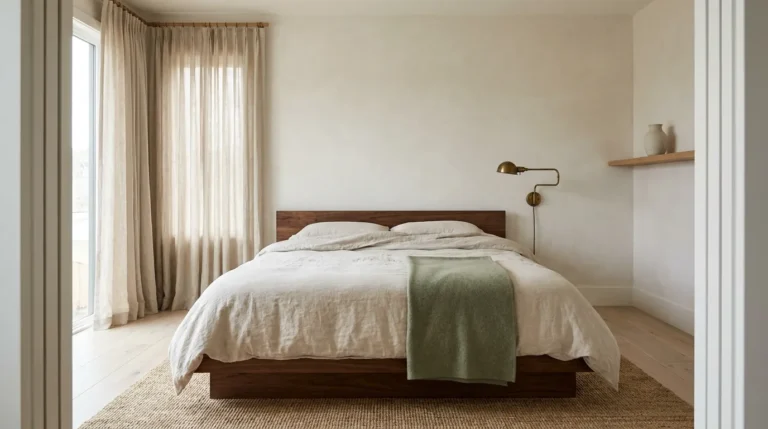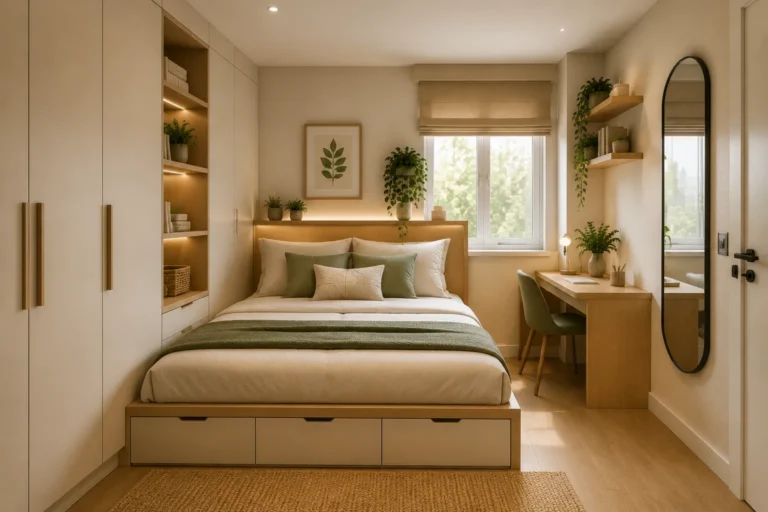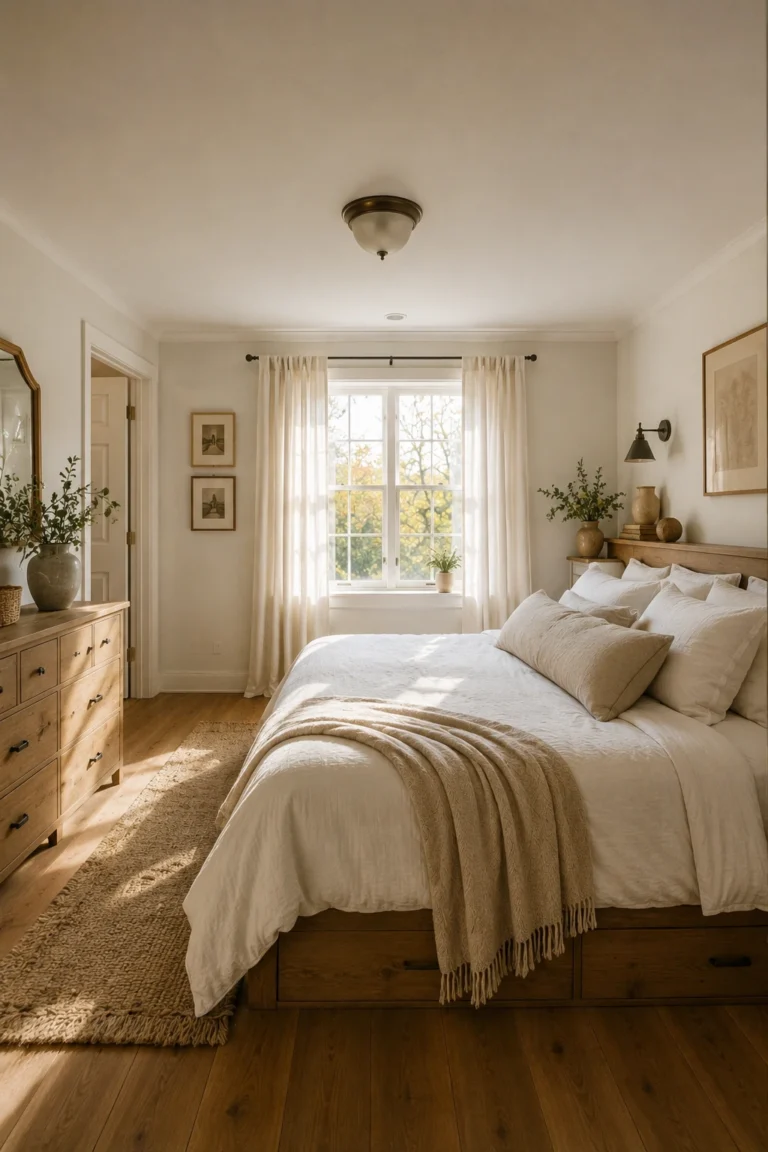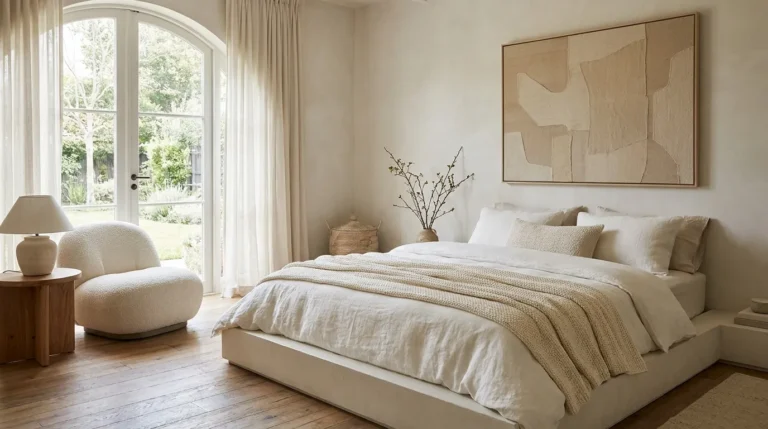
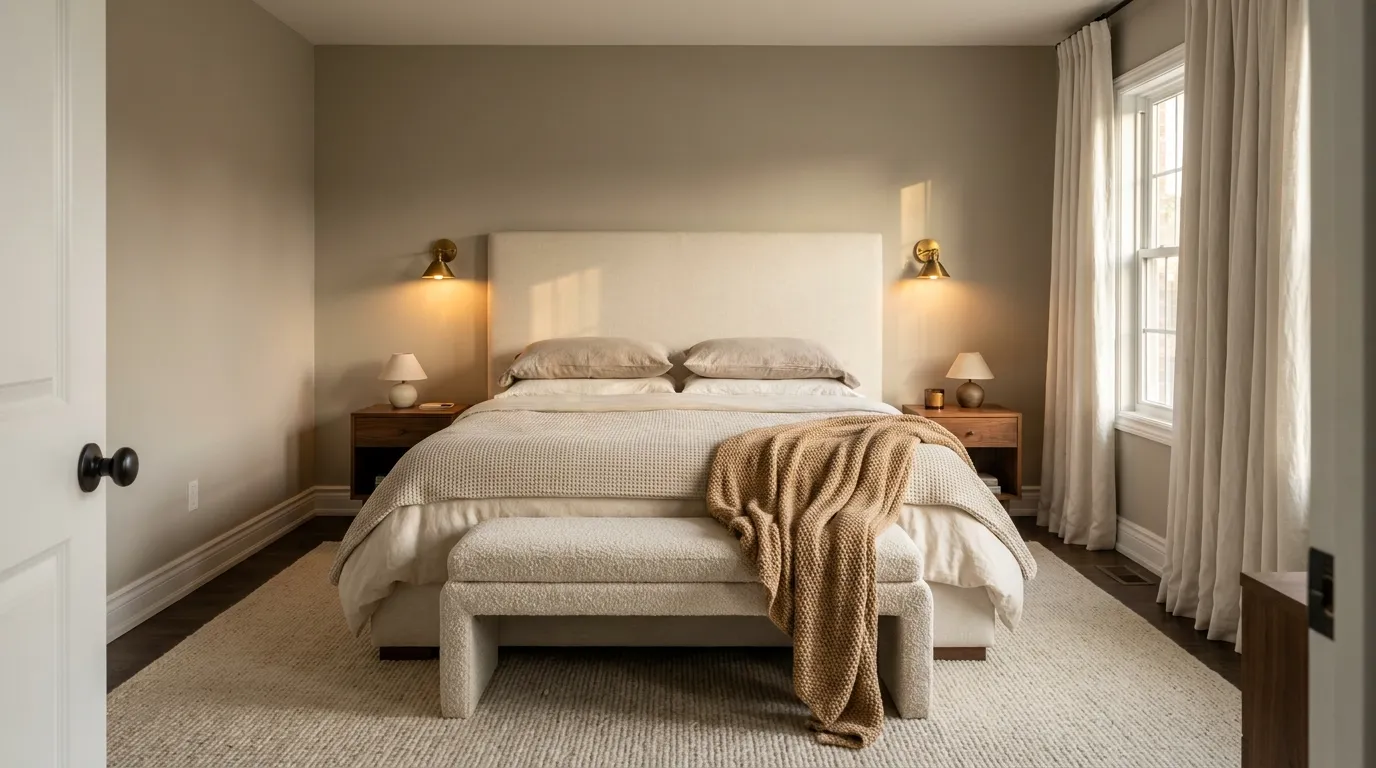
25 Cozy Master Bedroom Ideas That Feel Luxurious
Cozy and luxurious seem like opposite ambitions. Cozy suggests enclosed, soft, a little dim — a room that wraps around you. Luxurious suggests spacious, considered, finished — the kind of bedroom you’d find in a hotel where everything has been thought through. The master bedrooms that actually achieve both understand that these qualities aren’t in conflict. They’re in conversation.
What creates coziness is warmth: in color, in light, in material, in how much of the floor is covered and how many layers are on the bed. What creates a luxurious feel is intention — the sense that every decision was deliberate, that nothing is in the room by accident, and that the details hold up at close range. A bedroom that has both is rare, and it’s the result of specific choices rather than a large budget.
These 25 cozy master bedroom ideas move through color, lighting, furniture, textiles, architecture, and atmosphere. Some are foundational decisions that affect everything else. Others are small, inexpensive changes that shift the feel of the room immediately. Reading in order will help you understand which choices to make first.
1. Choose a Paint Color with a Warm Undertone That Reads Right at Night
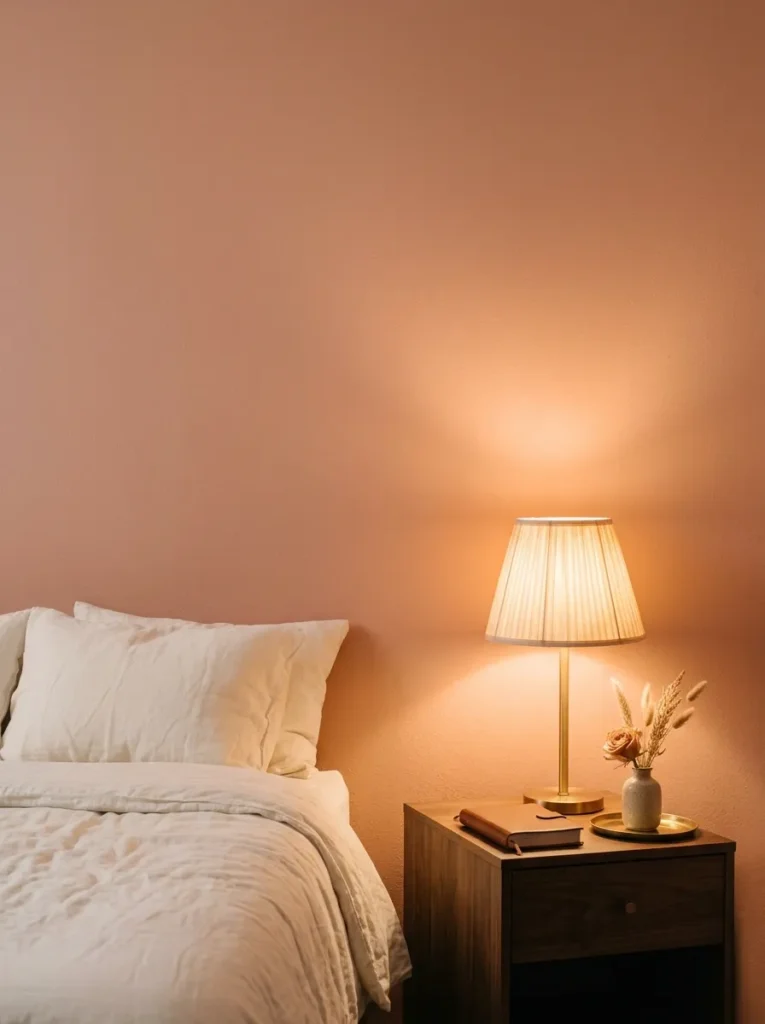
The most important paint decision in a master bedroom isn’t the color family — it’s the undertone. A bedroom that looks beautiful in afternoon light can feel cold and slightly clinical at 9pm if the wall color has a blue, grey, or green undertone that activates under artificial light. Warm undertones — those with yellow, red, or peachy bases — hold their warmth under every light condition and are the reliable foundation of bedrooms that feel genuinely enveloping after dark.
The test worth doing before committing: paint large swatches directly on the wall and observe them at three distinct times — morning natural light, afternoon, and evening under only lamp light. A warm greige that looks nearly identical to a cool grey in a paint chip can reveal very different characters by 9pm. Reliable cozy bedroom palette families include warm white, creamy off-white, dusty blush, warm terracotta, soft caramel, and warm sage — each maintaining its warmth regardless of the hour or the quality of the natural light.
2. Size the Headboard to the Wall, Not Just to the Mattress
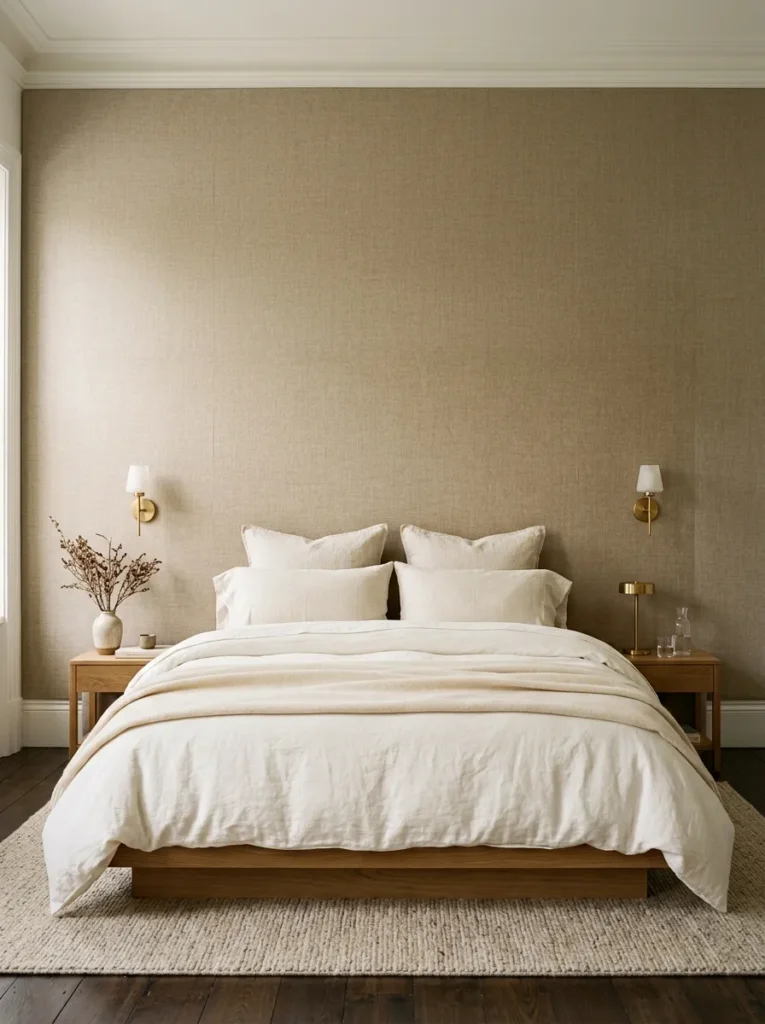
The single most common bedroom styling mistake is a headboard proportionate to the mattress but undersized for the wall behind it. A standard queen headboard placed against a 12-foot wall reads as furniture rather than architecture — the room never quite looks finished no matter how well everything else is styled. For a master bedroom to feel both cozy and considered, the headboard needs to read as a genuine wall element.
The guiding principle: the headboard width should span at minimum the width of the mattress and ideally extend 4 to 6 inches on each side. Height matters even more. A headboard reaching 55 to 65 inches from the floor — or extending to within 12 to 14 inches of the ceiling in rooms with lower ceilings — creates the kind of wall presence that makes the bed feel like an architectural feature. Upholstered headboards in boucle, linen, or velvet add acoustic softness as well as visual weight, slightly muting ambient sound in a way that contributes directly to the enclosed, cozy quality the room is building toward.
3. Layer the Bed with at Least Four Distinct Textile Materials
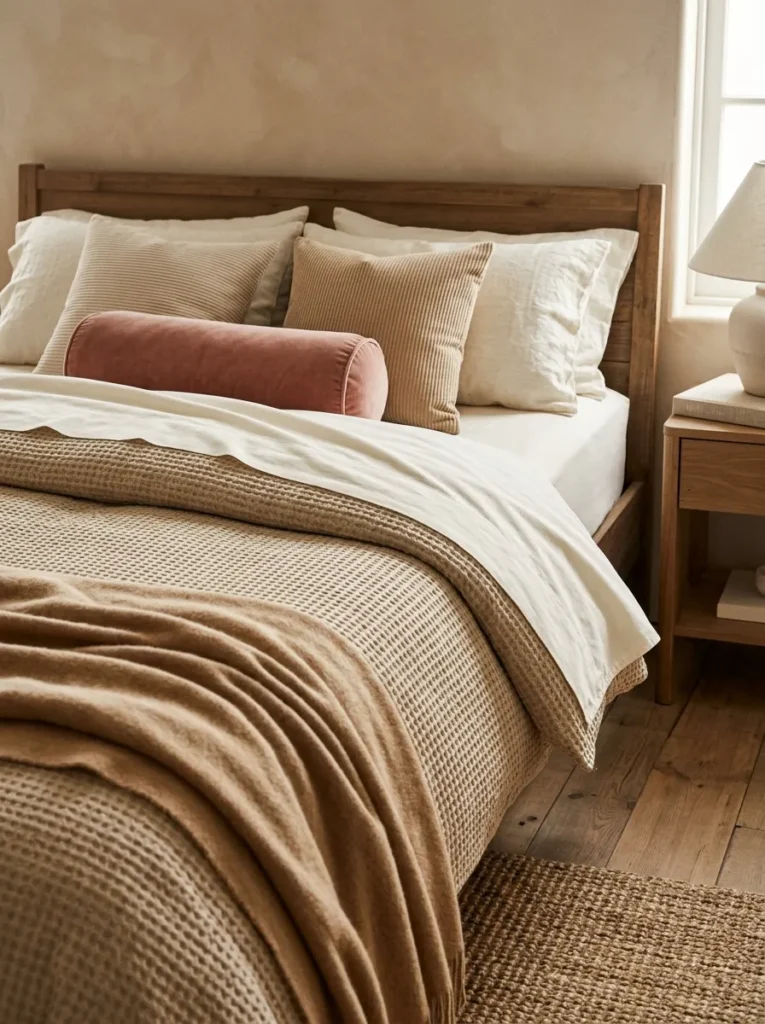
A hotel bed looks the way it does not because of expensive linens but because of deliberate layering. The formula that consistently reads as luxurious requires at minimum four distinct elements: a smooth cotton or linen fitted sheet as the base, a flat sheet folded back over the duvet (the turndown detail that signals intention immediately), a substantial duvet or comforter, and at least one throw placed at the foot. Add sleeping pillows in two different cover fabrics and two or more accent cushions, and the bed becomes a composition rather than just a functional surface.
The material variation across layers matters more than matching everything. A smooth percale fitted sheet under a textured waffle-weave duvet cover, with a chunky-knit or cashmere throw at the foot, creates depth through material contrast — each layer reads distinctly while sharing a color palette. Keep the palette to two or three tones and let texture provide the richness. Studied casualness — the flat sheet folded slightly imperfectly, the throw pulled diagonally — looks far more inviting than a rigidly made bed.
4. Place a Rug That Extends Well Beyond the Bed on Every Exposed Side
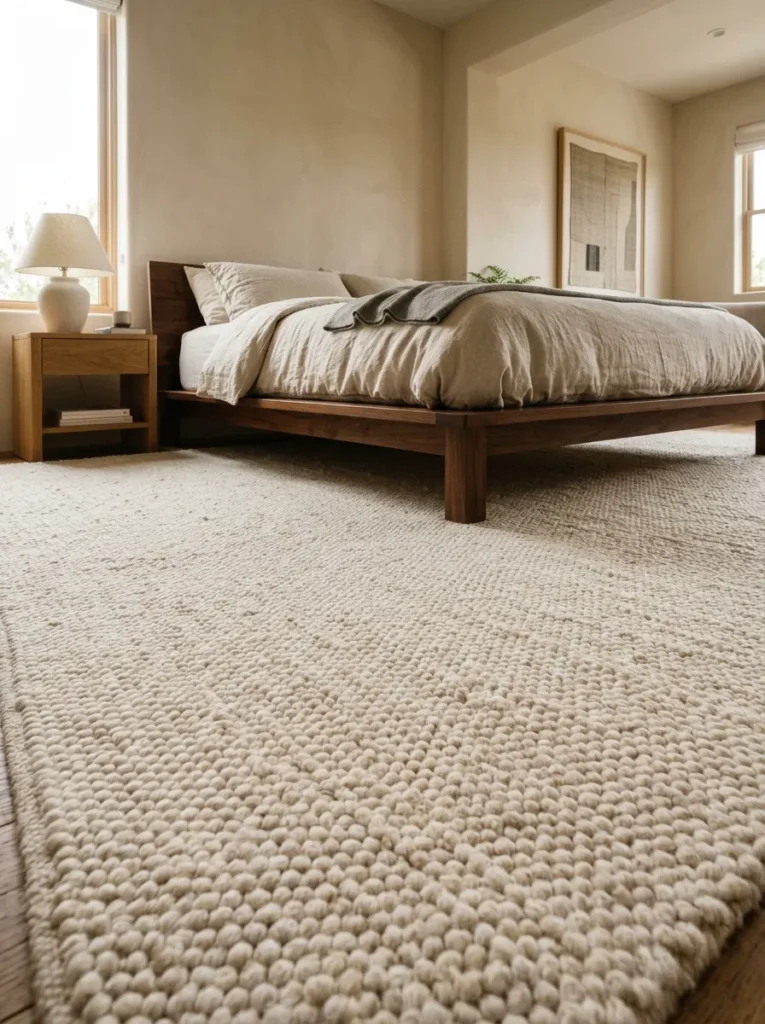
Bedroom rug sizing is where otherwise well-considered rooms most reliably come undone. A rug that only appears from beneath the foot of the bed, or one that extends just a few inches on each side, reads as an afterthought. The floor around the bed becomes a visual void, and the room loses the grounded quality that makes a bedroom feel warm and enveloping rather than sparse.
The practical guideline: in a queen bedroom, an 8×10 rug is the minimum; a 9×12 reads more generously. The rug should extend at least 18 to 24 inches on each side of the bed — enough that your first step out of bed in the morning lands on something soft. In rooms where a single large rug is cost-prohibitive, two matching runners placed on either side of the bed achieve a similar effect. For material, natural wool rugs add acoustic softness, and hand-knotted or flatweave styles in warm neutrals contribute both visual warmth and a sense of material quality underfoot.
5. Hang Curtains from Ceiling Height in a Heavyweight or Lined Fabric
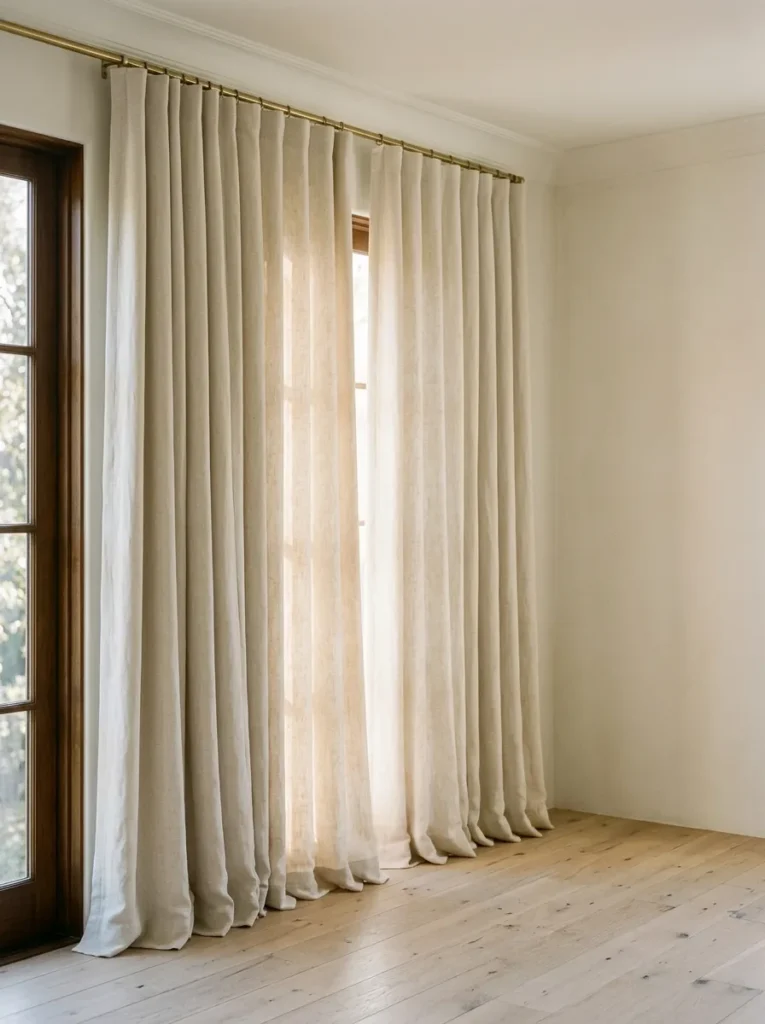
The fastest way to make a master bedroom feel smaller and less considered: hang curtains directly above the window frame and stop them at the sill. The fastest way to make the same room feel larger, warmer, and more deliberate: mount the rod within 6 inches of the ceiling and let the fabric fall in full columns to the floor. The visual column of fabric from ceiling to floor draws the eye upward and makes ceiling heights read taller regardless of what they actually measure.
Fabric weight matters in a bedroom more than in other rooms. Lightweight sheers that shift easily in air-conditioning drafts read as casual in a way that works against a luxurious quality. Lined linen, heavyweight linen-cotton blend, or cotton velvet with an interlining — a fabric layer between the face and lining that adds body and drape — maintains a full, structured column that looks equally deliberate whether the curtain is drawn open or closed. A slight pool of fabric at the floor, one to two inches of extra length, finishes the look.
6. Replace the Single Overhead Fixture with Three Light Sources at Different Heights
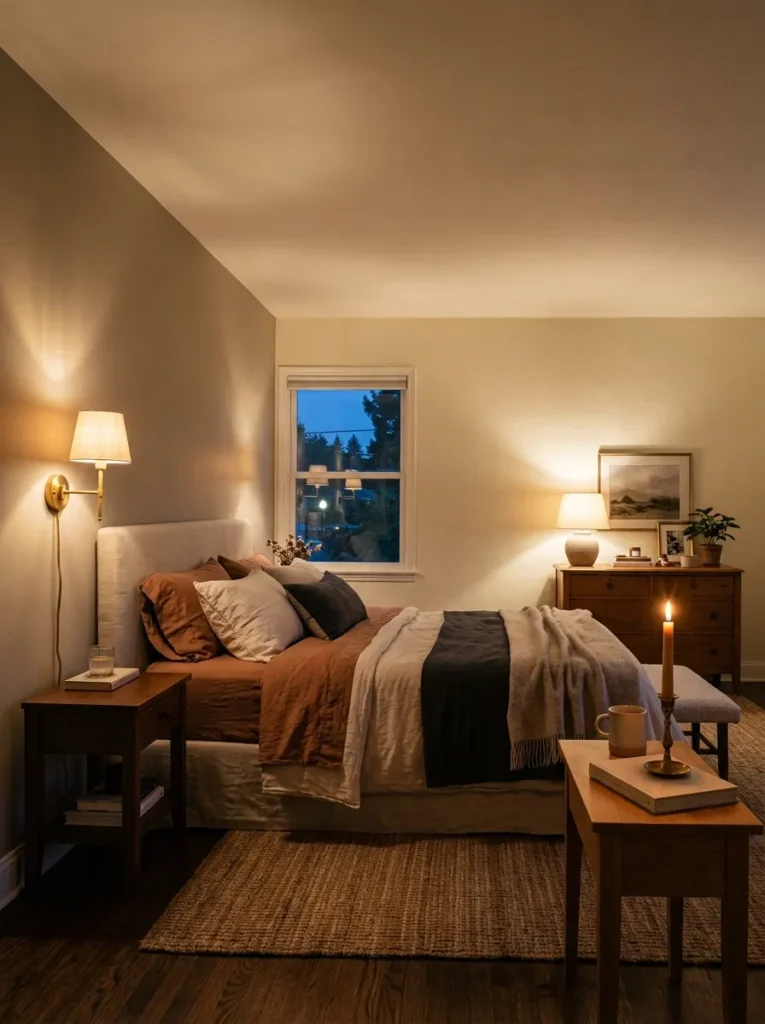
A ceiling fixture that floods a bedroom evenly from above is practically the opposite of cozy. It removes shadows, flattens every surface, and broadcasts the room in a way that works for getting dressed but not for spending an evening in. The alternative is not a dark room — it’s a layered room: multiple light sources at different heights that create pools and gradients of warmth rather than uniform illumination.
The framework: an overhead fixture set low on a dimmer for practical moments, bedside sconces or lamps at reading height for the primary evening zone, one source at low height somewhere in the room (a small lamp on a dresser or a floor lamp in a corner), and at minimum one purely atmospheric source — a candle, a small decorative lamp, or LED strip behind the headboard. With the ceiling light off and only the lower sources on, the room shifts entirely — same furniture, same walls, completely different feeling. This single change is the highest-impact, lowest-cost improvement available in most bedrooms.
7. Switch Every Bulb in the Room to 2700K Warm White or Below
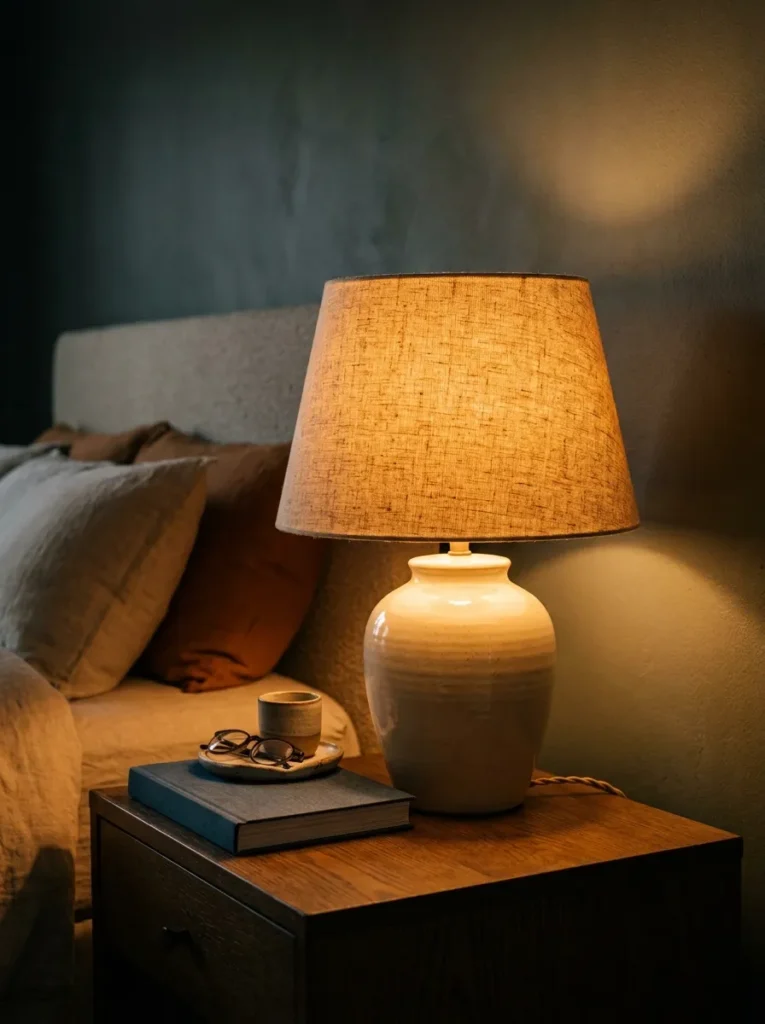
Lighting advice in bedroom articles almost always addresses the fixture — the lamp shade, the sconce style, the pendant choice. What it rarely addresses is the bulb inside. A beautifully chosen lamp with a warm fabric shade filled with a 4000K “natural white” bulb will still produce blue-toned light that works against every other warm decision in the room. Bulb color temperature is as important as the fixture itself.
For bedrooms, 2700K is the warm standard — close to what incandescent bulbs produced and what most people intuitively associate with relaxation and warmth. At 2200K, the light becomes even more amber, creating a candlelike quality that suits rooms aiming for a genuinely intimate atmosphere. Avoid anything above 3000K in a master bedroom. Replace bulbs across every lamp, sconce, and overhead fixture at the same time — the difference between a consistent 2700K room and a mismatched one is immediately visible when you see the room as a whole.
8. Add Bedside Sconces to Lower the Light and Free Up Nightstand Space
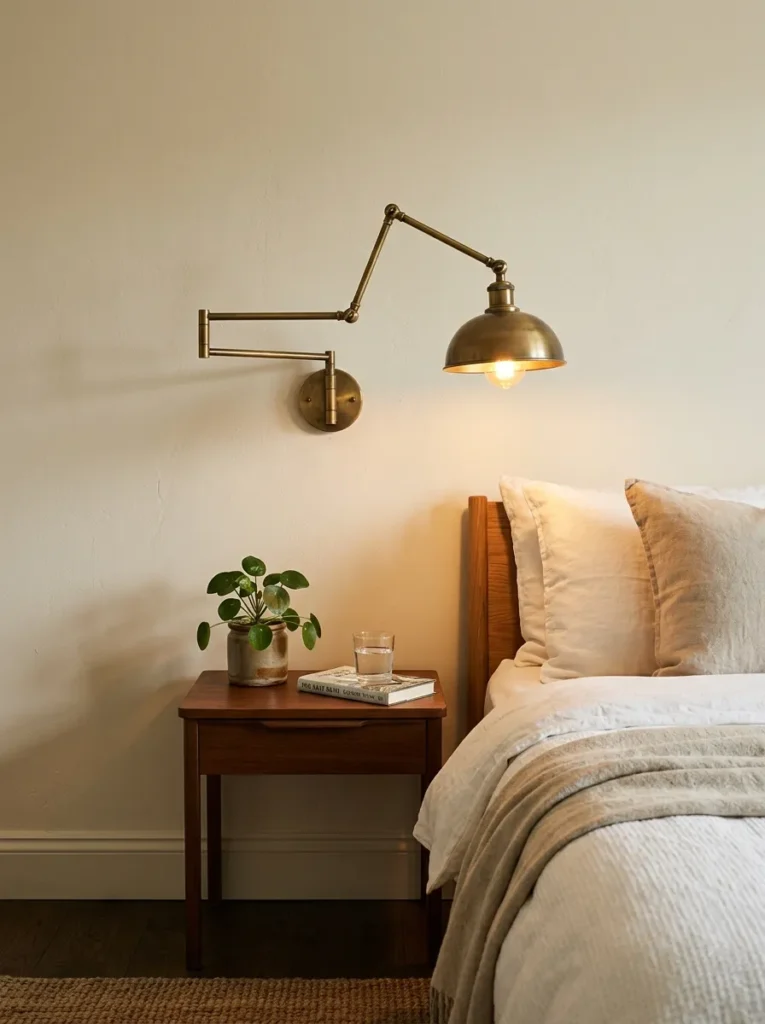
Table lamps on nightstands work, but they compete for the limited surface area that most nightstands provide, and they position the light source at a height that can feel conspicuously bright when lying down reading. Wall-mounted sconces solve both problems: they move the light to the wall, freeing the entire nightstand surface, and they position it at the right angle for reading in bed without shining directly into resting eyes.
The sconce should be mounted so that the center of the shade sits approximately 24 to 28 inches above the mattress surface — this puts the light source just above eye level for a seated reader and avoids glare when lying flat. For renters, plug-in sconces with a flat cord-covering channel painted or treated to match the wall achieve nearly the same visual result without electrical work. When choosing the style, look for a directional shade that angles downward — one that diffuses light directly outward from the wall creates glare rather than warmth.
9. Put Every Light in the Room on a Dimmer
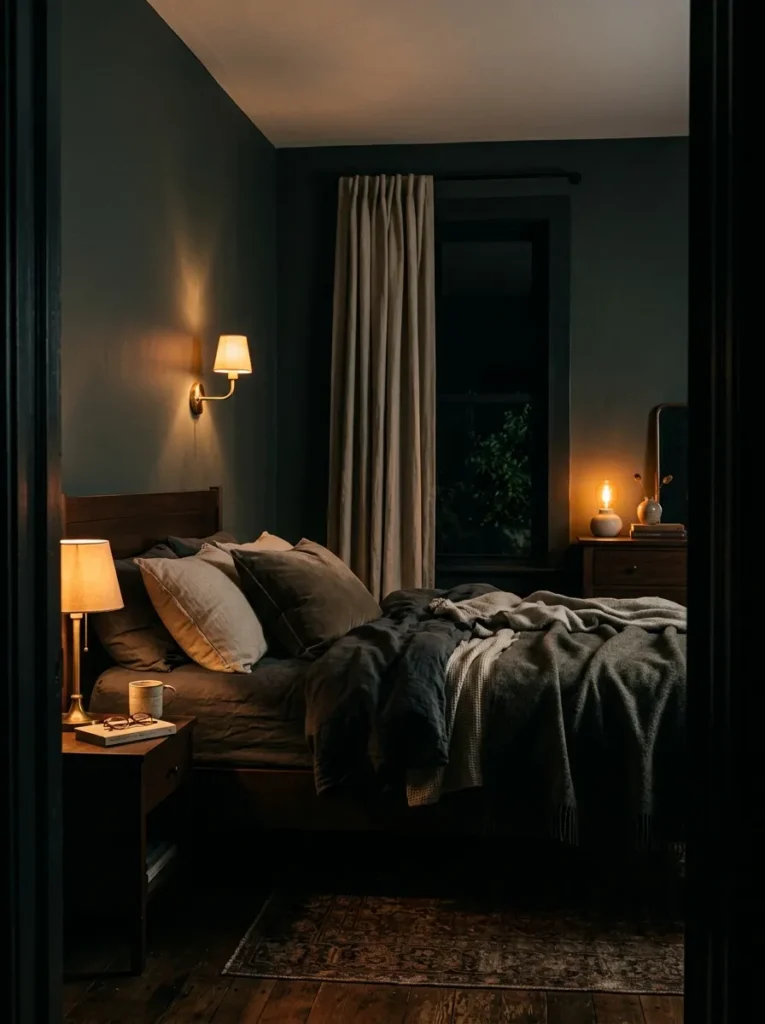
Of everything on this list, this change delivers more atmospheric control for the cost than almost anything else. A bedroom where every light circuit has its own dimmer can be calibrated precisely for every moment of the evening — full brightness for getting dressed, 50% for reading, 20% for winding down, near-off for the brief period before sleep. Without dimmers, you’re choosing between on or off, and the room can’t modulate its atmosphere as the night progresses.
Smart bulbs with app or voice control serve the same purpose without any rewiring, and they allow programmable scenes: a “sleep” setting that gradually dims over 20 minutes, a “morning” setting that brightens slowly at a set time. For new construction or any renovation that opens walls, hardwired dimmers at the switch plate are the cleaner, more reliable long-term solution. This is one of the few changes in a master bedroom that affects how the room feels every single night.
10. Choose Nightstands That Match the Visual Weight of the Bed Frame
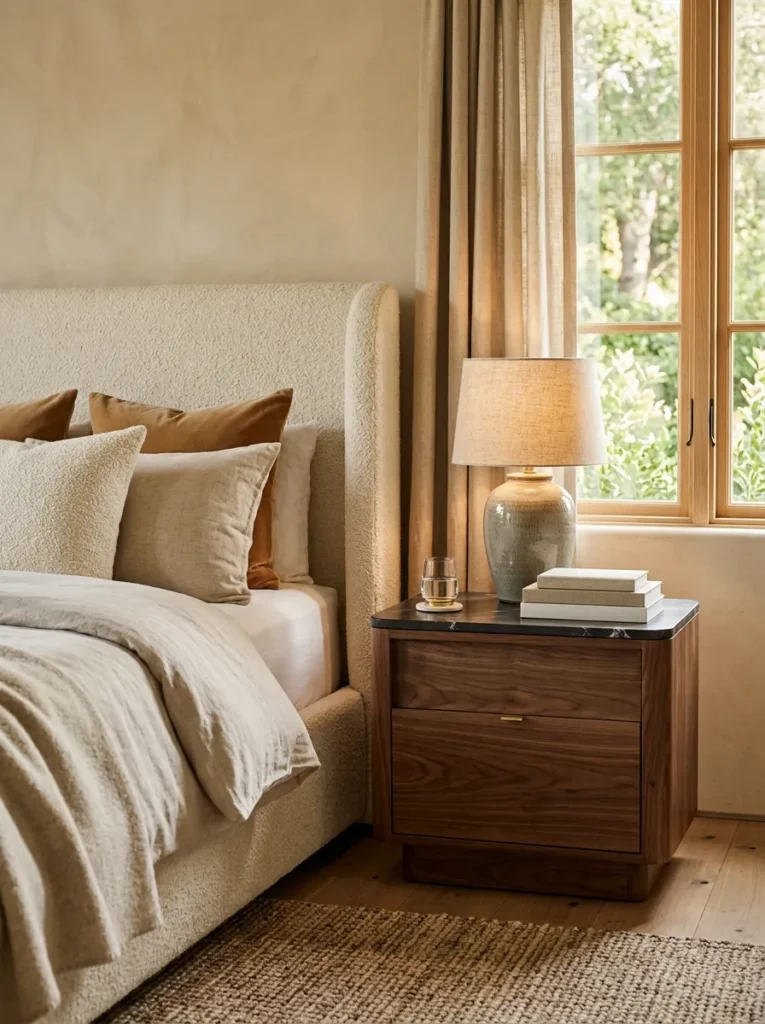
Nightstands are the furniture most often chosen for their dimensions alone — does it fit? — rather than for their visual relationship to the bed frame. A substantial upholstered platform bed with a tall headboard placed beside two slender, minimalist nightstands with thin wire legs creates an imbalance that makes the bed feel anchored to nothing. The reverse — heavy, solid block-form side tables beside a lightweight metal frame — is equally proportionally wrong.
The principle: the visual weight of the nightstand should correspond to the visual weight of the bed. A substantial, upholstered bed calls for nightstands with real presence — solid bases, a meaningful material (walnut, oak, marble top, substantial ceramic lamp), a drawer or two. A lighter frame works with more delicate side tables. Height matters too: the nightstand surface should sit at or within an inch or two of the top of the mattress, so the objects on it — the lamp, the glass of water, the book — are genuinely within reach rather than perched too high or too low for comfort.
11. Place an Upholstered Bench or Ottoman at the Foot of the Bed
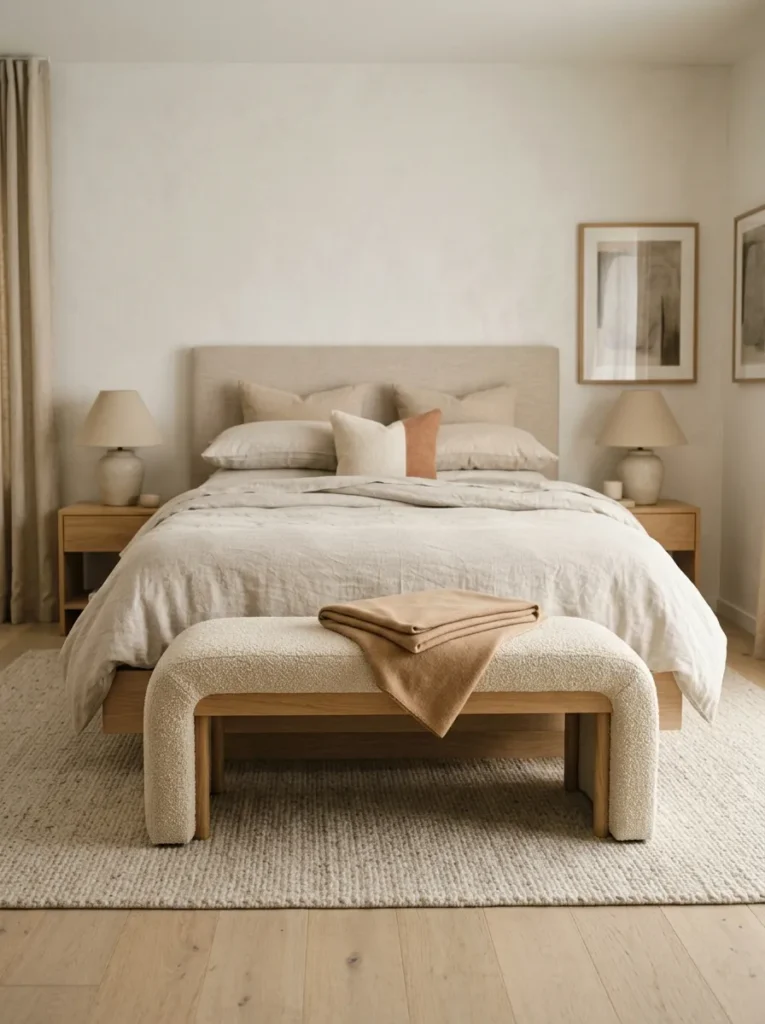
The foot of the bed is the most consistently underused space in a master bedroom. Left empty, it makes the room feel incomplete and eliminates one of the most practical and characterful features of a well-appointed bedroom. A bench at the foot of the bed gets used every single day — for sitting while dressing, for laying out clothes the night before, for resting a throw that would otherwise end up on the floor.
Beyond function, the bench resolves the bed’s visual composition. Without it, the eye reaches the foot of the mattress and stops without a natural landing. With it, there’s a full visual resolution from headboard to bench. Upholstered in the same fabric as the headboard, it creates a deliberate echo. In a contrasting material — a linen headboard with a boucle bench, or an upholstered headboard paired with a walnut bench — it adds the material variation that prevents the room from reading as matchy or finished in one coordinated purchase.
12. Create a Seating Area Near the Window with One Well-Chosen Chair
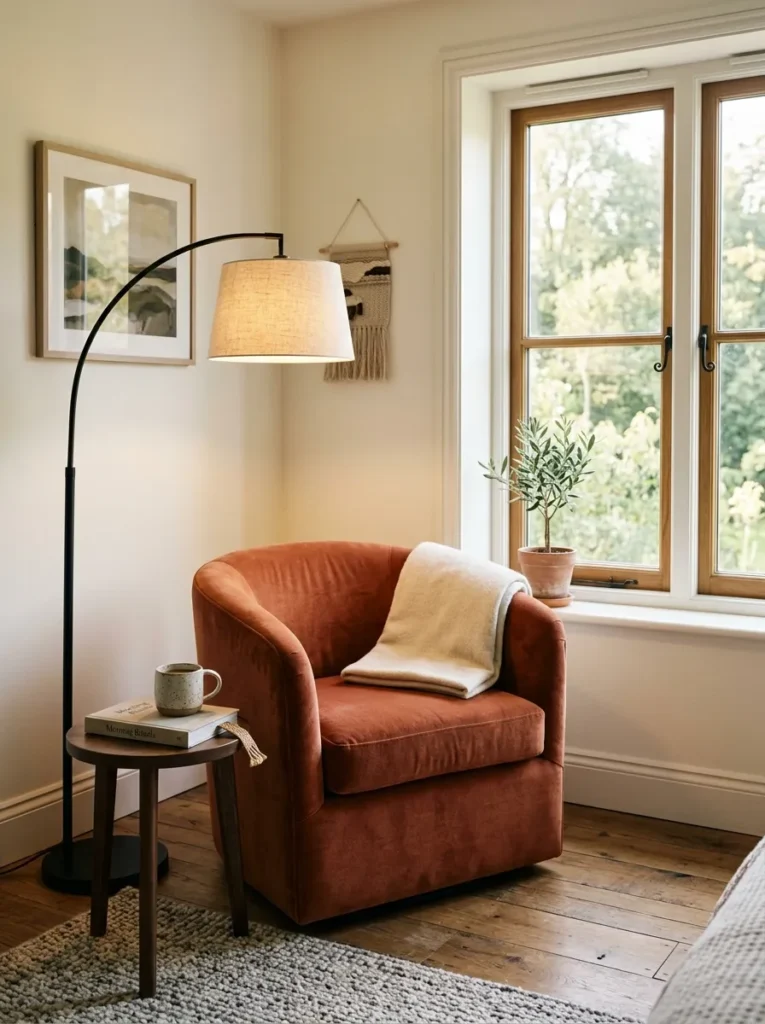
A master bedroom with seating beyond the bed signals something that affects how the room registers more broadly: this is a private room, not only a place to sleep. A single well-chosen chair beside the window — a slipper chair, a barrel chair, or a low lounge chair — with a small side table and a floor lamp positioned slightly behind creates a secondary day-zone that makes the bedroom feel more like a genuine sanctuary.
The scale needs to be deliberate. An armchair that’s too large compromises the circulation that makes a bedroom feel spacious. Too small, and it reads as decorative rather than usable. A generously proportioned chair in the 28 to 30-inch width range, positioned at a slight angle toward the window rather than pushed flat against the wall, is genuinely comfortable and photographs well from every angle. Choose upholstery in a fabric material related to the bedding palette — linen beside linen, velvet beside velvet — to maintain the room’s material consistency without requiring an exact match.
13. Choose a Low-Profile Bed Frame for a Grounded, Enveloping Feel
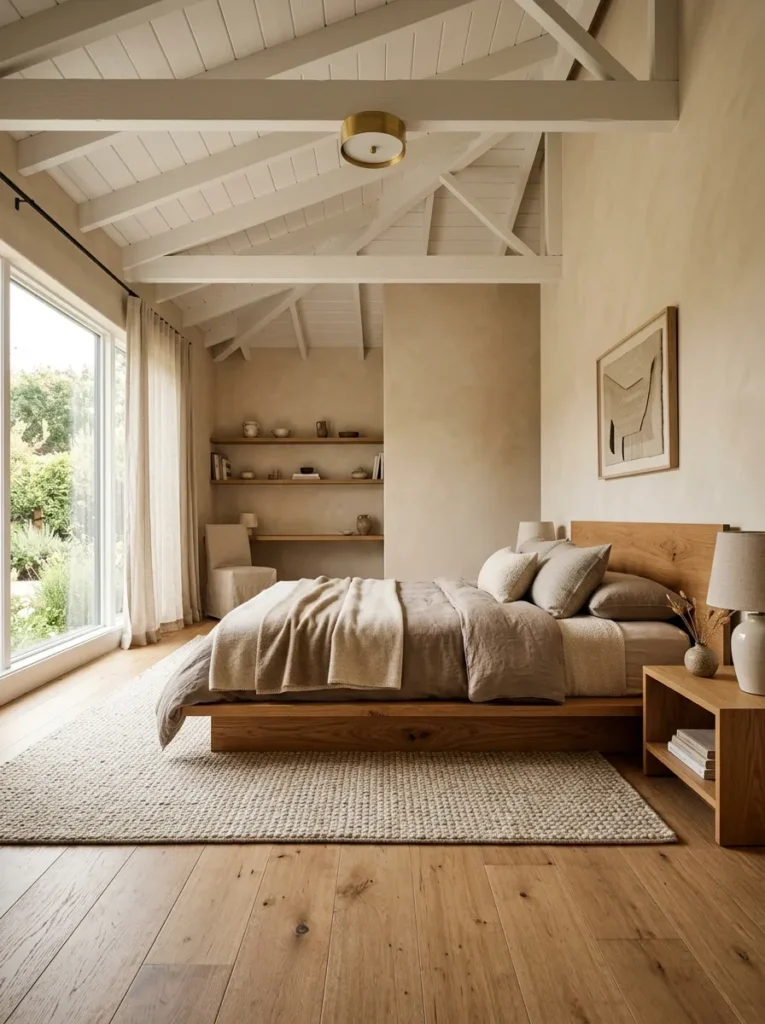
Bed height is a design decision that rarely gets discussed, but it has a significant effect on how a bedroom feels. High beds — those with box springs or substantial bases that place the mattress surface 26 to 30 inches from the floor — create a formal, upright reading. Low-profile beds, where the mattress sits between 18 and 22 inches from the floor, make the room feel more horizontal and grounded, which contributes directly to the sense of enclosure that cozy bedrooms rely on.
Platform beds with low profiles also allow headboards to read more substantially relative to the wall, since the lower starting point gives the headboard more vertical room to work with. In rooms with ceilings below 8.5 feet, a low-profile bed almost always reads better than a high one — a tall bed in a low-ceilinged room creates a visual compression that feels cramped rather than cozy. The visible floor space around a low platform bed also makes the room appear more open, which is a counterintuitive benefit: more visible floor makes the space feel larger even as the lower bed height makes it feel more intimate.
14. Introduce Warm Wood Tones Through Furniture, Flooring, or Frames
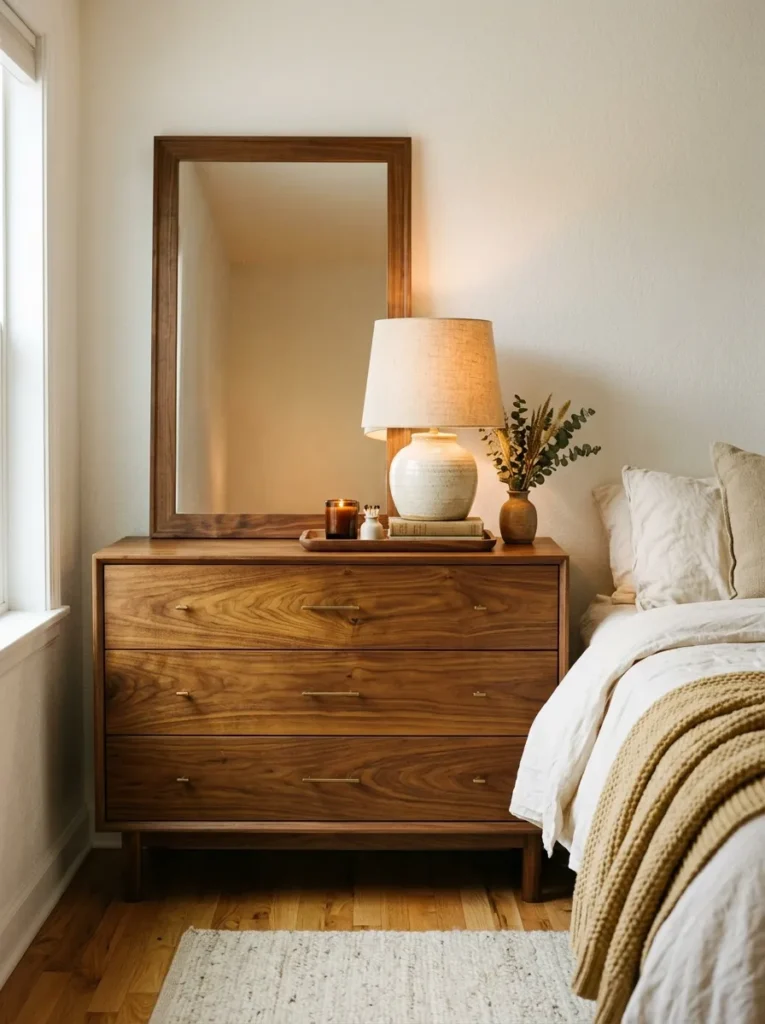
Cool-toned bedrooms — white walls, grey tile or wood-look flooring, chrome or brushed nickel fixtures — can be beautiful but rarely feel genuinely warm. The material that shifts a bedroom toward coziness more reliably than any other single addition is wood in warm tones: honey oak, walnut, teak, or warm pine. A walnut nightstand, an oak bed frame, exposed warm-toned hardwood flooring, or a collection of wood-framed artwork changes the room’s temperature in a way that paint color alone can’t fully achieve.
This is because warm wood is one of the few residential materials that communicates warmth through multiple channels simultaneously. It reads warm visually through its amber and golden grain. It reads warm physically — wood doesn’t feel cold to the touch the way stone or metal does. And it reads warm associatively, referencing the natural materials linked to shelter and comfort. In rooms that already lean cool, a single warm wood element — even just a pair of oak nightstands or a walnut dresser — shifts the balance in a noticeable and lasting way.
15. Paint or Panel the Ceiling in a Warm Tone to Create Enclosure
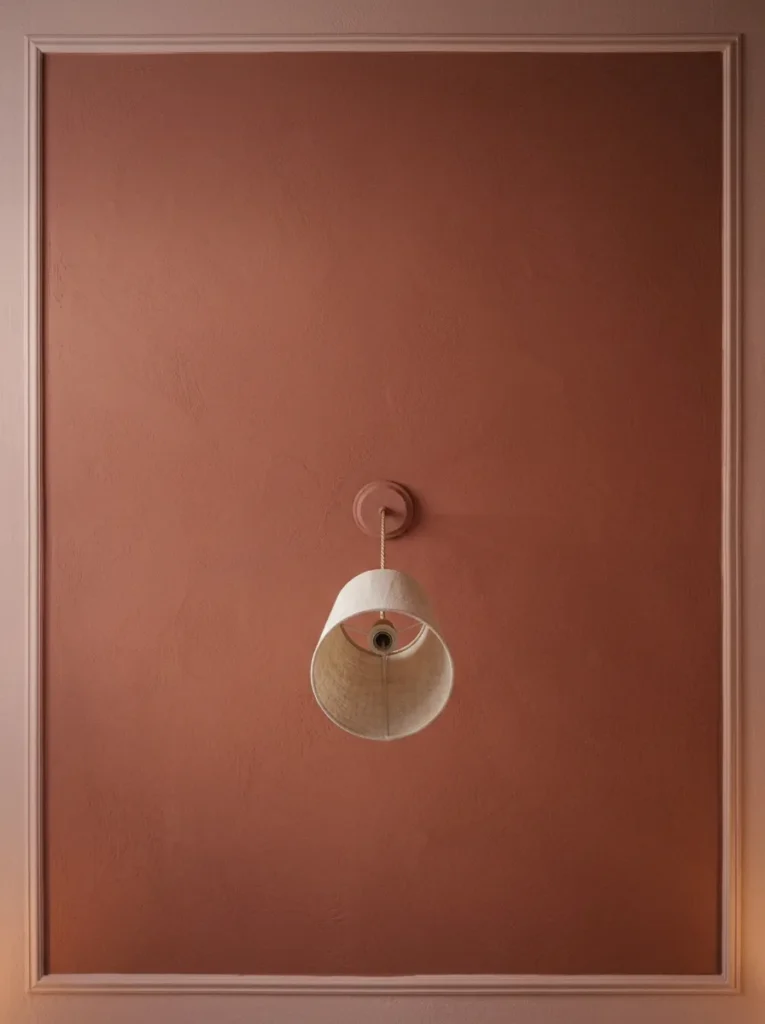
A white ceiling is the default assumption, and for most rooms it’s appropriate. In a master bedroom where the goal is coziness and the feeling of being wrapped in the space, a bright white ceiling can work against the room by creating an airy, open cap above what should feel intimate and contained. Painting the ceiling in a tone one or two shades deeper than the wall color — or continuing the exact wall color up onto the ceiling — changes the room’s character fundamentally.
The shift doesn’t need to be dramatic. A warm cream ceiling in a room with off-white walls reads noticeably warmer and lower without feeling oppressive. A dusty blush or terracotta wall taken up onto the ceiling in the same hue creates a genuinely enveloping quality that four painted walls alone don’t achieve. The simplest test: lie on the bed and look up. The ceiling should feel like a comfortable, warm surface rather than an expanse of empty white. If it feels too distant or too bright, that’s the ceiling telling you it needs attention.
16. Add Architectural Interest with Wall Paneling Behind the Bed
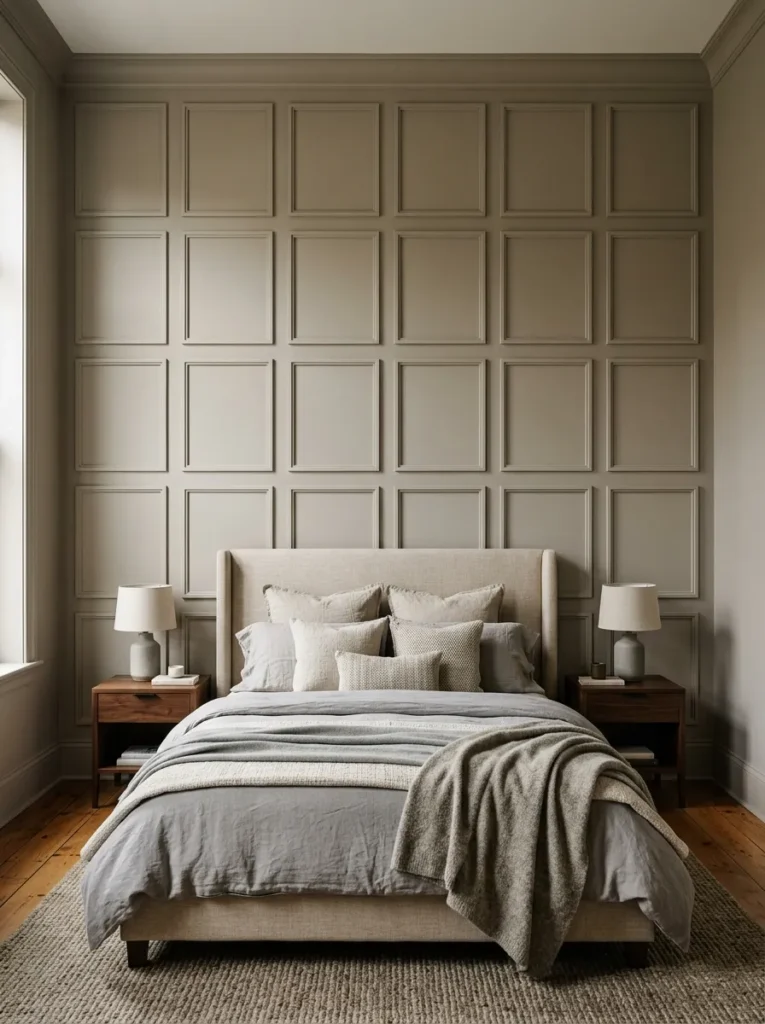
Plain flat walls give even a well-furnished bedroom a sense of incompleteness — the feeling that something structural is missing. Wainscoting, board-and-batten, picture rail molding, or applied wall paneling on the wall behind the bed adds the kind of architectural detail that reads as original to the house rather than added as decoration. When painted the same color as the surrounding walls, the paneling registers through shadow and texture rather than color contrast.
The most immediate application in a master bedroom: a paneled headboard wall — vertical or horizontal planks installed on the bed wall, painted the same warm tone as the rest of the room, creating a framed, defined backdrop. This technique works well in rooms where the headboard alone doesn’t provide enough visual weight for the wall, since the paneling extends the bed’s architectural presence from floor to ceiling without requiring any additional furniture. For renters, removable peel-and-stick panel trim and wainscoting panels offer a version of this effect with no permanent installation.
17. Use a Statement Mirror to Add Depth and Amplify Warm Light
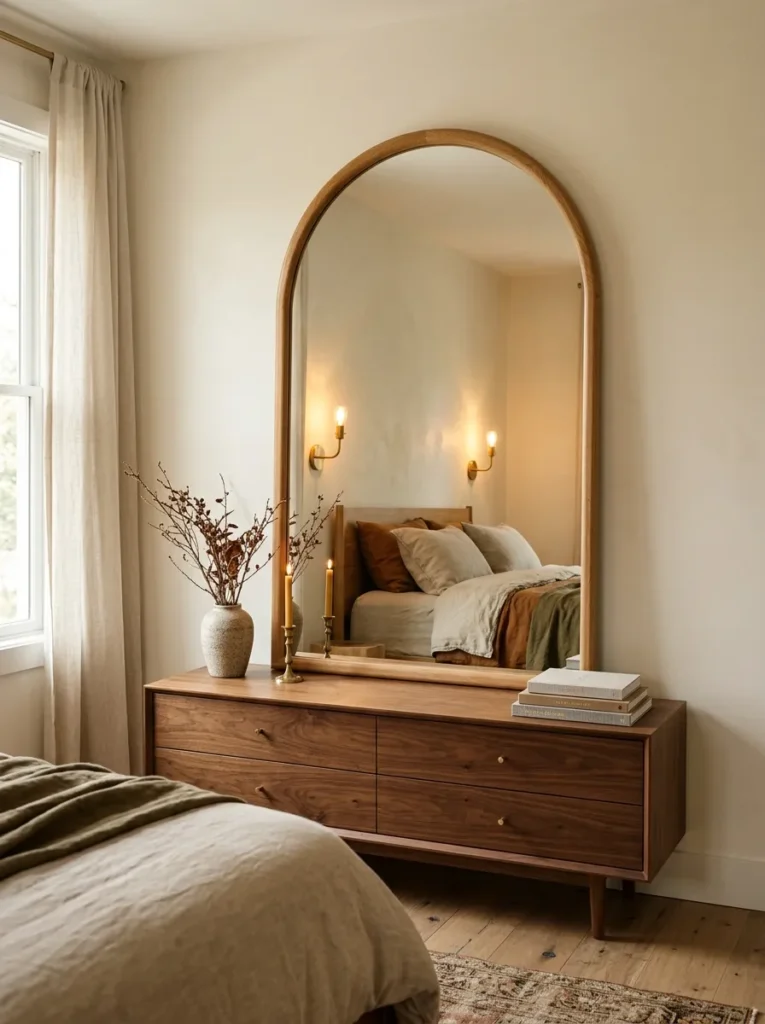
A mirror in a master bedroom serves a different purpose than mirrors in other rooms. It isn’t primarily about making the room appear larger, though that’s a secondary benefit. In a cozy bedroom, a well-positioned mirror doubles the warmth of the nearest light source — a mirror positioned to reflect a lit bedside lamp creates a second glow in that corner, and one catching window light in the morning fills the room with reflected brightness without requiring another window.
The frame defines the room’s character as much as the mirror’s size. A large leaning floor mirror in warm oak or walnut suits transitional and natural material rooms. An arched mirror in rattan suits a boho or organic bedroom. An ornate gilt frame suits a more traditional interior. Whatever the frame finish, the mirror should be substantial enough to read as a considered design decision rather than a functional necessity placed wherever wall space was available. A mirror that reflects the room’s best content — the bed, a lit lamp, a plant — is a mirror that’s doing genuine design work.
18. Invest in Quality Pillow Inserts, Not Just Decorative Pillowcases

This is the detail that most immediately distinguishes a genuinely luxurious bed from one that merely looks like it in a photograph. Pillow inserts that are the right fill (a quality down or a high-density down alternative), the correct weight for their cover size, and one size larger than the cover dimensions — so a 20×20 inch cover receives a 22×22 inch insert — create the full, rounded pillow forms that make a bed look abundantly comfortable and inviting.
Flat, underfilled pillows dressed in expensive fabric still read as flat and underfilled. The insert is the foundation that everything else rests on. A well-filled sleeping pillow in a clean percale case looks more considered than a thin pillow in any decorative cover. This improvement costs relatively little compared to other bedding investments and the visual difference — in person and in photographs — is immediate and obvious. If there’s one bedding change to make first, it’s this one.
19. Layer the Scent of the Room Alongside the Visual — with Restraint
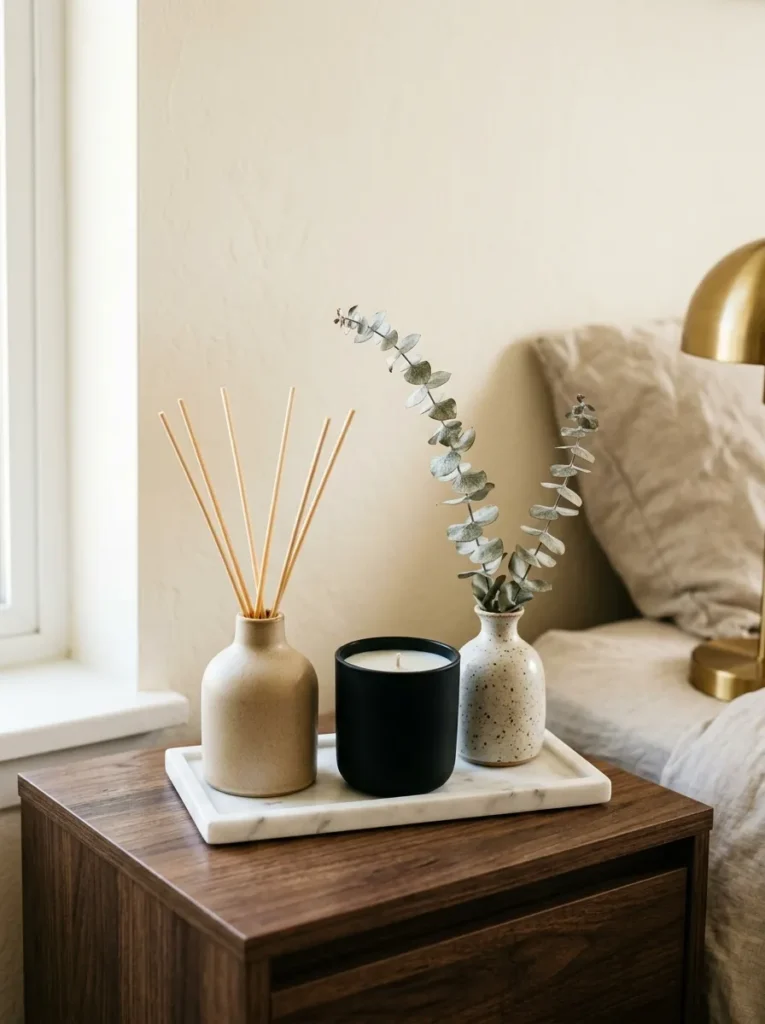
A truly cozy, luxurious bedroom engages more than sight alone. The rooms that feel most like a private sanctuary almost always have a consistent, subtle scent — not perfumed enough to be immediately conspicuous, but distinctive enough to register and associate itself with that specific space. This is one of the few elements of bedroom atmosphere that no photograph conveys, but that affects how the room feels the moment you open the door.
The most reliable approach: a reed diffuser in a single, clean fragrance placed near the door and replenished regularly. For bedrooms, fragrances that suit the space without competing with sleep lean toward cedar, vetiver, sandalwood, light linen, or soft musk. Candles used during waking hours add both scent and warm candlelight simultaneously. A light linen spray misted over freshly changed bedding creates the crisp, clean quality associated with well-maintained hotel rooms. One important constraint: use only one scent source at a time. Two competing fragrances in a single room read as confused rather than layered, and their combined effect is usually less pleasant than either one alone.
20. Replace the Nightstand Surface Clutter with an Intentional Tray Vignette
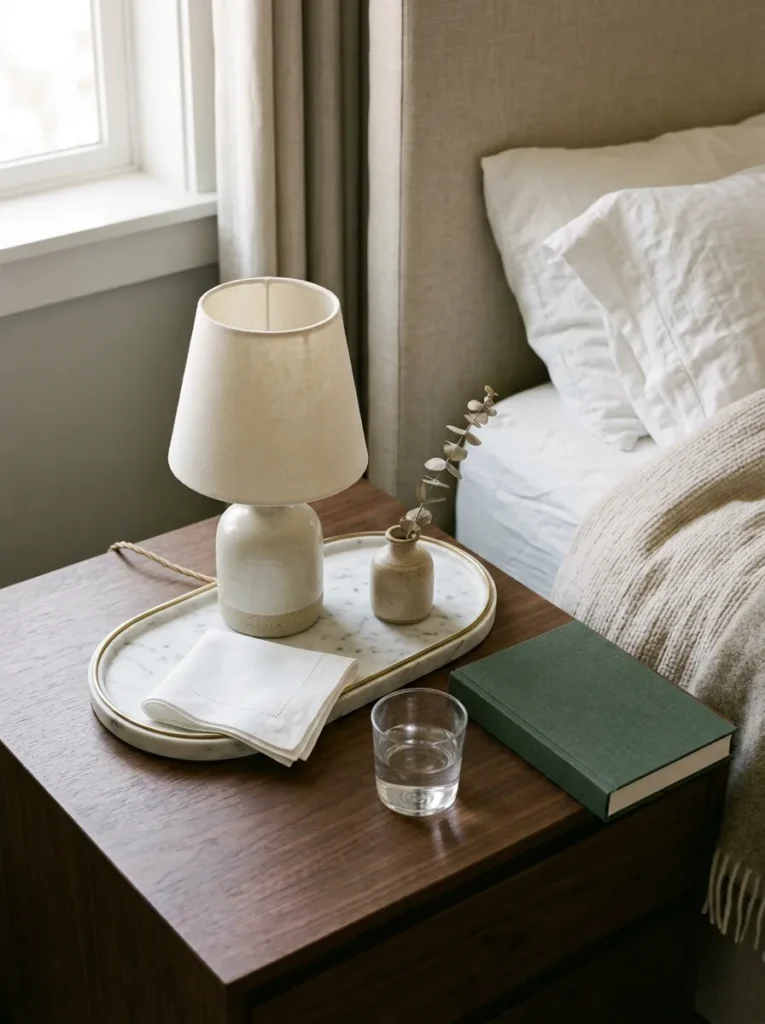
Most nightstand surfaces accumulate whatever gets set down during the evening — a charging cable, a half-finished glass of water, a book, a hand lotion, the previous day’s earrings. Each of these items is individually reasonable. Together, they read as domestic clutter even in a beautifully furnished room. The solution isn’t an empty nightstand (which reads as staged rather than lived-in) but a composed vignette: a small tray to contain the functional items, a single lamp or sconce, one small plant or dried stem in a slim vase, and a book.
The tray is the most critical element. It creates an implied boundary — whatever fits within the tray’s footprint belongs there; whatever doesn’t, goes in the drawer. Even a small ceramic or marble tray holding three objects on a nightstand reads as intentional. The same three objects scattered without the tray reads as things that haven’t been put away. This is the kind of small decision that contributes to the room’s luxury reading without involving any purchase beyond a tray.
21. Bring Natural Materials Into the Room — Wood, Stone, Dried Botanicals, or Plants
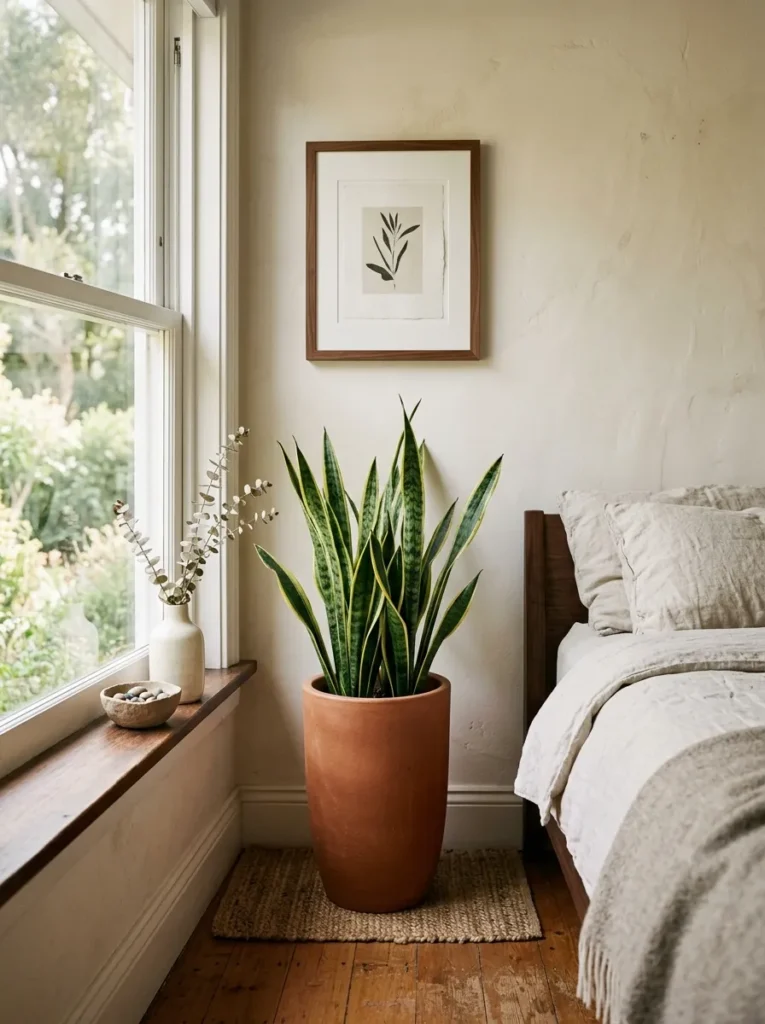
The materials that most consistently read as both cozy and luxurious are those that appear organic rather than manufactured. Raw or honed stone, rough-textured ceramics, natural wood showing its grain rather than a lacquered finish, dried botanical arrangements, and living plants with structural foliage all bring a quality that even carefully chosen synthetic materials can’t replicate. They shift slightly with light and with age, and they connect the room to something outside the world of furniture catalogs.
In a master bedroom, this might be a wooden tray on the nightstand, a ceramic lamp base with visible potter’s marks, a dried eucalyptus arrangement on the dresser, or a single large plant in a matte-finish ceramic pot in the corner near the window. Snake plants, ZZ plants, and rubber plants tolerate bedroom light conditions well and maintain their architectural quality year-round. These elements don’t need to be numerous — one or two organic materials among otherwise manufactured objects shifts the room’s overall reading in a way that’s difficult to achieve through any other means.
22. Control the Walls — Choose Fewer, Larger Pieces Over Many Small Ones
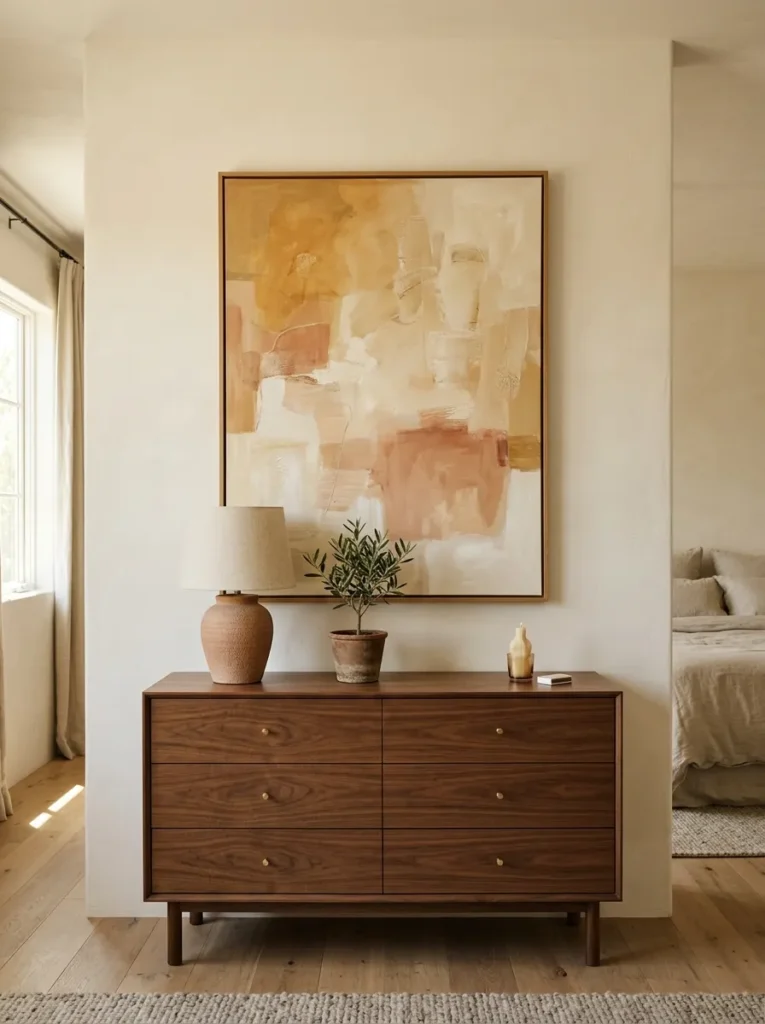
The bedroom wall treatment that most reliably reads as both cozy and considered is not a full gallery wall — which tends toward eclectic and energetic, two qualities that work against restfulness — or blank walls, which read as unfinished. It’s a limited number of meaningful, appropriately scaled pieces in a deliberate arrangement.
Scale is where most decisions go wrong. A 24×36 inch print above a standard dresser often reads timid. A 36×48 inch piece, or a pair of 24×30 inch prints positioned side by side, reads decisively. The frame finish connects the artwork to the room’s existing metal palette — aged brass for transitional warm rooms, dark walnut or oak for natural material bedrooms, slim black for contemporary spaces. Bedroom art should avoid busy patterns and high contrast — the room already has texture and color in the textiles. The art should provide counterbalancing calm, something worth looking at in the quiet before sleep rather than something that competes with the rest of the room for attention.
23. Edit the Room — Remove Everything That Belongs Somewhere Else
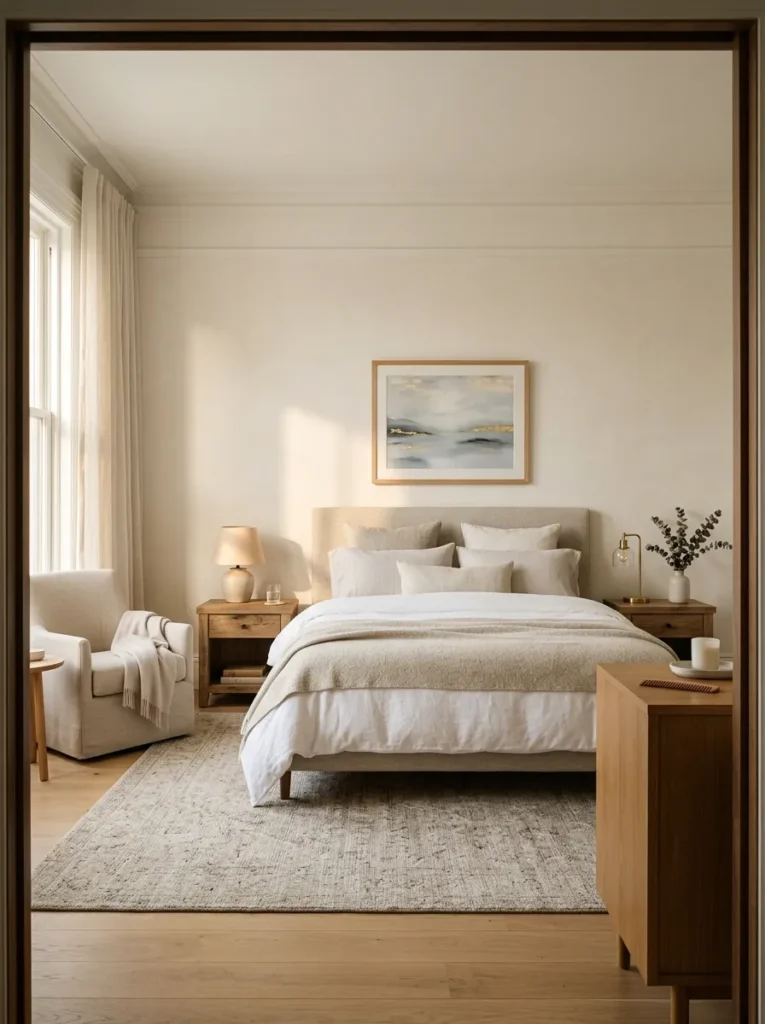
The most luxurious quality a master bedroom can have doesn’t appear on any product list: the sense that the room exists specifically for rest, comfort, and calm. Work equipment, visible exercise gear, laundry baskets sitting in a corner, a television wall-mounted without visual intention — each of these signals that the bedroom is also doing other jobs, and that signal consistently undercuts every warm, considered element you add around it.
This isn’t an argument for minimalism. A bedroom can have substantial furniture, layered textiles, artwork, plants, and a full nightstand vignette and still feel genuinely restful, because every element serves the room’s primary purpose. The practical exercise: stand in the doorway and identify the first three things your eye lands on. If any of them read as belonging to another room in the house, start there. The clarity of purpose that results from editing is what separates a bedroom that feels like a sanctuary from one that feels like a room where the bed happens to live.
24. Add Closed Storage So Every Surface Can Remain Calm
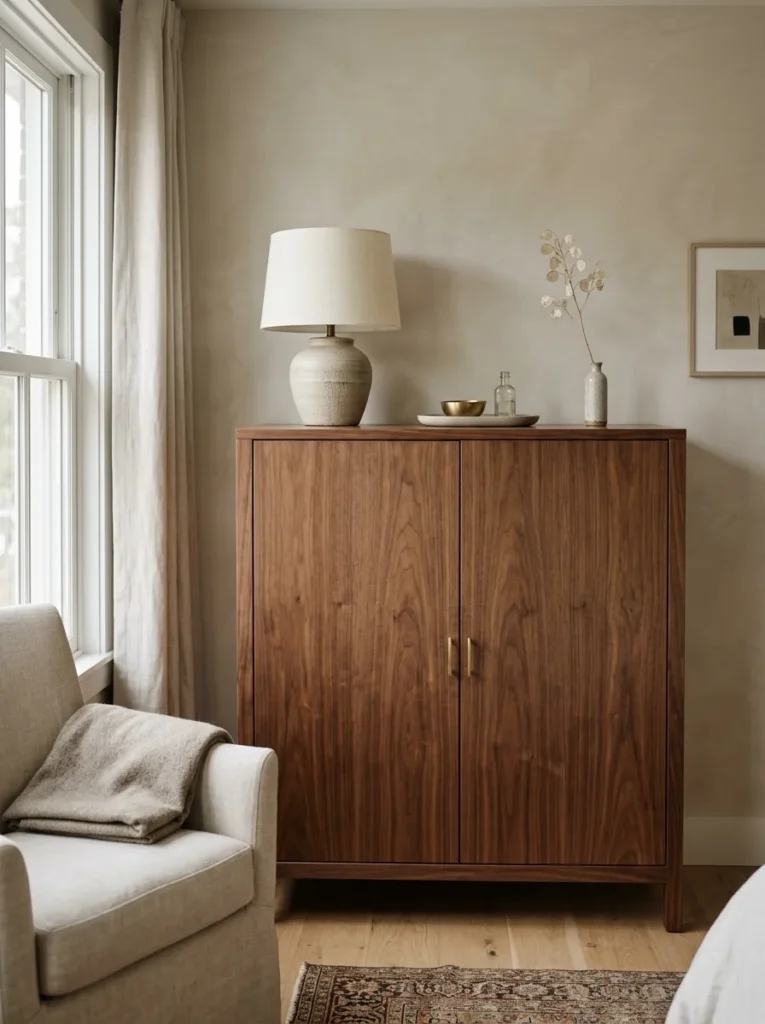
Related to editing is the practical foundation that makes editing sustainable: enough closed storage that everything with no business being on display has somewhere to go. A bedroom that stays visually calm requires more concealed storage than it appears to — drawers in the dresser, a nightstand with a door or a deep drawer, an armoire or wardrobe, under-bed storage boxes, lidded baskets for the floor.
Open shelving in a bedroom, unless deliberately maintained, tends to fill with whatever doesn’t fit elsewhere. The result is visual noise that accumulates gradually and is genuinely difficult to resolve through styling alone. A bedroom with two closed drawers will read more calmly than one with two open display shelves of identical footprint, even when both contain the same quantity of belongings. The goal for every surface — dresser top, nightstands, the bench at the foot of the bed — is a composed vignette, which is only achievable when the non-photogenic items have a dedicated closed location.
25. Upgrade One Layer of the Bedding at a Time, Starting with the Pillowcases

The full luxury bedding aspiration — high-thread-count Egyptian cotton sheets, a quality duvet insert, an embroidered cover — is genuinely worthwhile, but it’s also genuinely expensive all at once. The sequenced approach that delivers the most perceived improvement for a measured investment: start with the pillowcases. They’re what you see most prominently when the bed is made and what your face rests on at night. A set of quality percale or sateen pillowcases — smooth, cool to the touch, with a clean natural drape — changes the bed’s appearance and the sleep experience in a way that upgrading the fitted sheet alone does not.
From there, add a quality duvet insert with enough fill power to fully inflate the duvet cover without visible flat spots or empty corners — a half-empty duvet cover, regardless of its fabric quality, always reads cheap. Finally, a duvet cover in a textured fabric that reads well from across the room completes the foundation. This sequenced investment approach means spending in order of visual and tactile impact rather than completing the ensemble all at once and hoping it works.
Pro Designer Tips: How Any Bedroom Can Read More Luxurious
Apply symmetry to the bed zone. Symmetrical nightstands, matching sconces, and a centered headboard on the bed wall are the most reliable visual signals of an intentional bedroom. Asymmetry works in many design contexts — the master bedroom is not one of them. Even when the nightstand styles differ slightly, maintaining symmetrical placement relative to the bed communicates the same controlled, considered quality that hotel rooms rely on.
Keep the three primary surfaces composed. The three surfaces that define how a bedroom registers at a glance are the bed (top), the nightstands (sides), and the dresser or console (opposite). If all three are visually calm and deliberately styled, the room reads as considered even when the wardrobe inside the closet is completely disorganized. Focus your styling energy on these three surfaces before addressing anything else.
Use the same color on the back of every door that faces the bedroom. Interior bedroom doors painted in the same warm tone as the walls — rather than left in a standard white that contrasts with the room — are a detail that reads as deliberate craftsmanship rather than a purchased improvement. It costs only a few dollars in paint and the result is a room that appears more custom-made.
Fold throws with intention. A throw that has been folded in thirds, then draped with a slight diagonal angle across the lower corner of the bed, reads as deliberately placed. The same throw casually tossed reads as something that didn’t get picked up. The difference between “lived-in” and “messy” in a bedroom is usually this level of small deliberateness rather than any expensive purchase.
Invest in one great lamp before buying two mediocre ones. Lamp pairs are the instinct in a bedroom, and matching lamps have their place. But a single genuinely excellent lamp — one with a distinctive base in ceramic, stone, or quality metal and a shade that diffuses light warmly — does more for the room’s character than two identical standard lamps from a mass retailer. Consider whether matching is actually what the room needs before defaulting to pairs.
Final Thoughts
The master bedrooms that feel both cozy and luxurious almost never arrive there through a single shopping trip. They develop through a series of specific decisions — some structural, some material, some about what gets removed as much as what gets added.
If you’re starting from scratch, begin with the lighting. It’s the single change that affects how the room feels at every hour of the day and costs far less than most furniture decisions. From there, work outward: the bed layers, the rug underfoot, the curtains framing the window. Save the architectural and decorative details — the paneled headboard wall, the mirror, the scent, the artwork — for when the practical foundation is in place.
If you’re working with an existing bedroom that doesn’t quite feel right, stand in the doorway and ask an honest question: what is the first thing your eye lands on, and is it something that belongs in a bedroom designed for rest? The answer will usually tell you where to start. Save the ideas here that match your room’s proportions and your daily habits — a cozy, luxurious bedroom should be easy to live in, not just beautiful to look at.