20 Bedroom Curtain Ideas That Add Privacy and Style
Bedroom curtains carry more responsibility than any other window treatment in the house. They need to block early morning light from an east-facing window, provide complete privacy at street level, look composed when you’re reading in bed at 9pm, and ideally make the room feel taller, warmer, or more finished than it would with bare windows. Managing all of that in one hanging panel — or even two — requires more thought than most people give it before the order is placed.
Most bedroom curtain mistakes happen before a single panel is hung: the rod is too close to the window frame, the panels are too narrow to drape properly, the blackout option chosen blocks all light but looks like a hospital privacy curtain, or the fabric is beautiful but completely see-through after dark when the bedroom light is on. These 20 ideas address every variation — blackout options that still look refined, layering systems that give full control, colors and fabrics that work in morning light and evening lamp light, and practical options for renters and small rooms. Each idea is genuinely distinct; no two solve the same problem.
1. Choose Blackout Linen for Sleep Quality Without Sacrificing Style
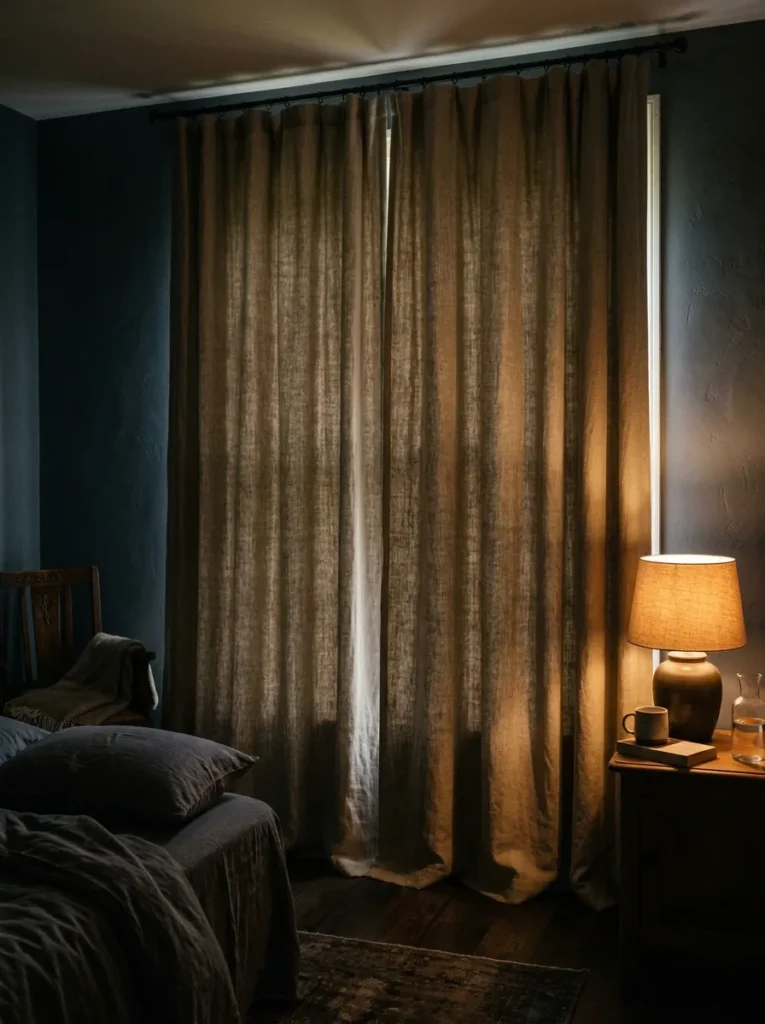
The objection most people have to blackout curtains is visual: the lining is often stiff, the panels hang without movement, and the finished result looks functional rather than designed. Blackout linen — linen fabric with a blackout lining integrated into the weave or sewn as a back layer — combines genuine light-blocking performance with the relaxed, natural drape and texture that linen provides regardless of what’s behind it.
From the bedroom side, these panels read exactly as linen curtains do. They drape in natural folds, show the slight slub texture of the weave, and hang with the relaxed weight that linen is chosen for. The blackout function is invisible from the interior and becomes relevant only when the curtains are closed — at which point the room genuinely darkens rather than merely dims. For shift workers, light sleepers, or anyone in a east-facing bedroom who wakes with the sun, this distinction is significant and immediate.
2. Layer Blackout Panels Behind Sheer Curtains on a Double Rod

A single curtain layer gives two options: open or closed. A double-rod system — sheer panels on the inner rod, blackout panels on the outer rod — gives the bedroom a full spectrum of light and privacy control across the day. Sheers drawn during the day diffuse the light and provide privacy from the street without darkening the room. Blackout panels closed at night provide complete darkness and full privacy simultaneously.
The double-rod system also creates visual depth at the window that a single panel cannot. The sheers introduce a soft inner layer that makes the window zone feel more composed, and when the outer blackout panels are open during the day and stacked at the sides, the sheer layer behind provides a continuous soft backdrop. Both rods should be mounted at the same ceiling-adjacent height, and both panel sets should reach the floor, so the layered arrangement reads as deliberate rather than as two mismatched window treatments.
3. Use a Blackout Roman Shade Under Decorative Drapes for a Tailored Result

For bedrooms where the window treatment needs to look tailored and architectural rather than soft and draped, a blackout Roman shade installed inside the window frame — where it pulls flat against the glass and sits nearly invisible when raised — combined with decorative side panels that frame the window without covering it produces the cleanest possible combination of light control and style.
The decorative panels in this configuration don’t need to close at all. They exist to frame the window architecturally, add fabric softness to the wall, and allow for a more interesting fabric choice — a print, a texture, or a heavier weight that wouldn’t work as a functional blackout panel — without compromising the window’s light control. The Roman shade handles the practical work; the side panels handle the visual.
4. Choose Washed Linen in a Warm Neutral for a Bedroom That Feels Serene

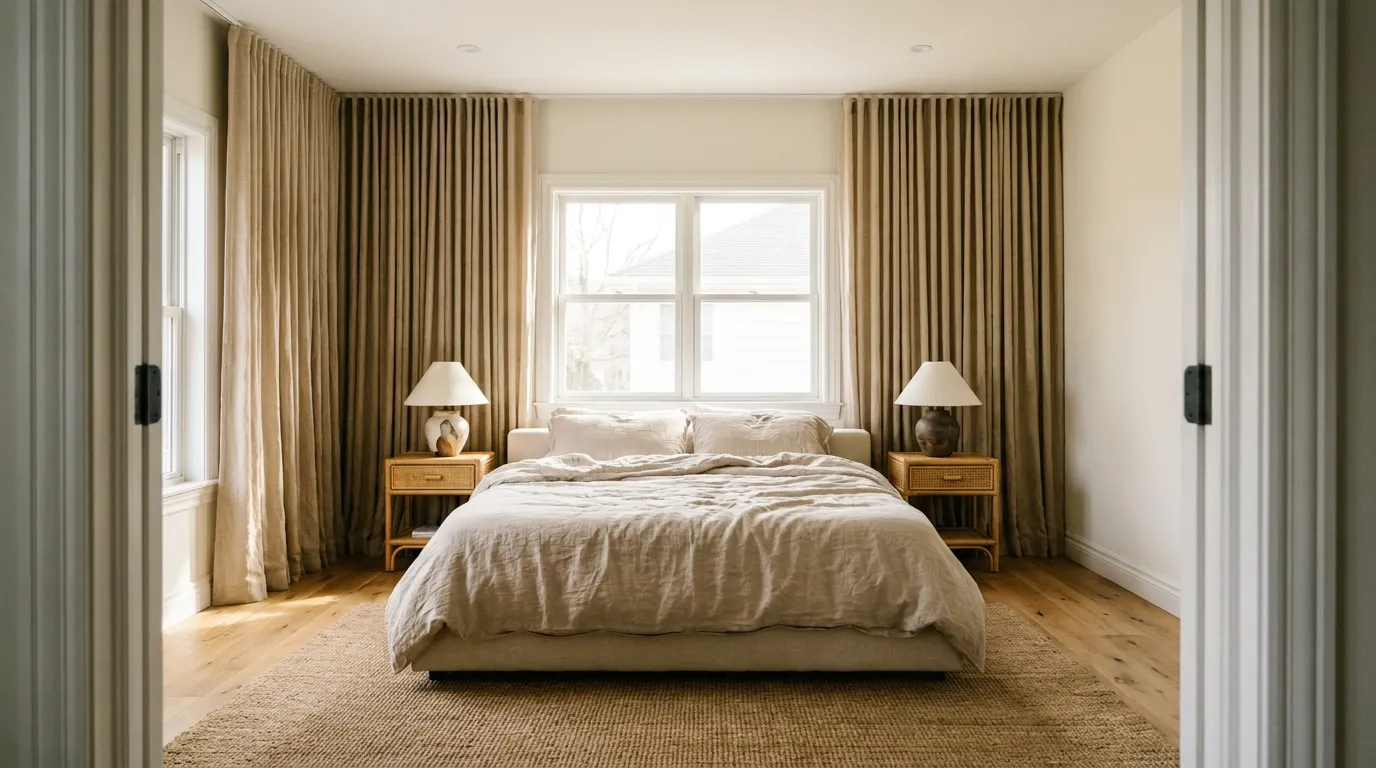
Outside of specific light-blocking requirements, washed linen is the most versatile curtain fabric for bedrooms across a wide range of decorating styles. Its slight texture catches light, its relaxed drape reads as intentional rather than limp, and its color options in the warm neutrals — natural undyed flax, warm ivory, pale greige, and soft oatmeal — work in morning light, afternoon light, and under warm evening lamplight without the fabric reading differently enough in each to be noticeable.
The washed quality is specifically worth choosing over stiff or unwashed linen for bedroom use: washed linen softens immediately upon hanging, develops a slight casual elegance that’s appropriate for a sleeping room, and improves with washing rather than deteriorating. Panels in a warm undyed tone against warm white walls often need no other window treatment — they provide adequate privacy without blackout lining in rooms where full darkness isn’t required and street-level privacy isn’t a concern.
5. Add a Trim Detail to Plain Linen for a Custom Look at Low Cost

Plain linen curtains in a solid neutral color are a practical and visually sound choice for most bedrooms. Adding a contrasting trim — a band of color sewn along the leading edge, the hem, or both — gives them the specificity of custom curtains at a fraction of the cost and a degree of design intention that plain panels rarely achieve.
The trim color should relate to the room’s existing palette: a deep terracotta trim on natural linen panels works in a bedroom with warm earthy tones; a dusty sage trim suits a room with botanical or organic styling; a soft charcoal trim reads cleanly in a more contemporary bedroom. The trim width matters — a narrow one-inch band reads as a detail; a three-inch band reads as a design statement. Adding trim is also a straightforward DIY sewing project, which makes it a genuinely accessible customization rather than a theoretical one.
6. Hang Velvet Curtains for Warmth, Sound Absorption, and Visual Richness

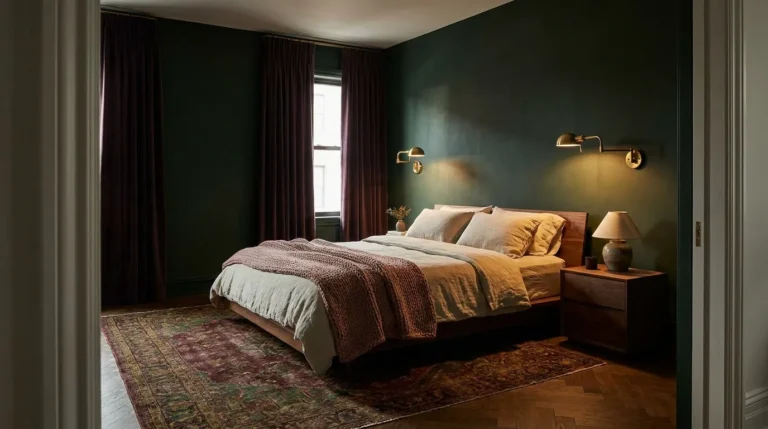
Velvet’s case for bedroom use is stronger than its reputation suggests. The fabric’s pile absorbs sound, which reduces ambient noise from outside and between rooms. It blocks light effectively even without a separate blackout lining, since the dense pile prevents most light penetration. And under warm bedside lamp light, velvet develops the directional sheen and tonal depth that makes it look genuinely rich rather than simply decorative.
Deep colors perform best in velvet: forest green, burgundy, ink navy, warm chocolate, and dusty plum all deepen under evening light in ways that feel atmospheric rather than heavy. Hardware must be rated for velvet’s weight — a rod that sags under the load undermines the entire installation. The practical trade-off: velvet requires careful maintenance to avoid crushing the pile, generally needs dry cleaning, and is less forgiving of installation imprecision than linen. In the right bedroom, these trade-offs are worth making.
7. Choose Sage Green Curtains for a Bedroom That Feels Calm and Organic

Color choice in bedroom curtains affects the room’s atmosphere at every time of day, and sage green has become one of the most successfully deployed colors in contemporary bedroom curtaining for a specific reason: it sits in the cool-warm middle territory that reads as neither a bold color statement nor a neutral, and it relates naturally to the earthy, organic palette that most calm bedrooms are built around.
Sage green linen reads particularly well in bedrooms that combine natural wood furniture, warm white walls, and relaxed textile layering. Under morning daylight it appears fresh and organic; under warm evening lamplight it deepens toward a dusty, muted tone that feels settled and restful. The color doesn’t compete with most bedding palettes — it’s quiet enough to work alongside both neutral bedding and bolder accent colors without disrupting either.
8. Try Deep Navy or Midnight Blue for a Bedroom With Evening Atmosphere

Navy and midnight blue bedroom curtains achieve a different kind of success than most color choices: they look genuinely different at different times of day, and both versions are attractive. During the day with panels open and stacked at the sides, the deep color frames the window as a deliberate design element against lighter walls. In the evening with panels closed, the dark fabric creates an enclosed, almost cinematic quality that makes the bedroom feel like a deliberately designed sleeping room rather than a room with a bed in it.
The pairing matters. Deep blue curtains work best against walls in a neutral or warm tone — warm white, pale greige, or soft cream — where the contrast is deliberate. Against cool grey walls, the same navy can read as simply dark. Bedding in natural linen or warm cream anchors the blue without competing with it. Brass or aged gold hardware relates to the warm undertones in navy without the formality of chrome.
9. Use Off-White Curtains to Brighten a North-Facing Bedroom

North-facing bedrooms receive cool, indirect light throughout the day and no direct sunlight at any time of year. This light quality is particularly unforgiving to cool-toned wall and curtain colors, which read flat and slightly grey rather than fresh. Off-white or warm white curtains — those with a cream, ivory, or very slight warm beige undertone — reflect the available light back into the room and maintain the warm quality that makes the bedroom feel welcoming rather than dim.
The shade of white matters significantly here. A cool brilliant white curtain in a north-facing room reads as slightly blue-white under the cool natural light and looks stark rather than airy. A warm white with even a small amount of cream undertone stays reading as white under the same light without the cool cast. Testing a fabric swatch against the room’s north-facing window before ordering is the most reliable way to confirm the undertone works in that specific light condition.
10. Use Warm Terracotta or Clay Curtains as the Room’s Accent Color
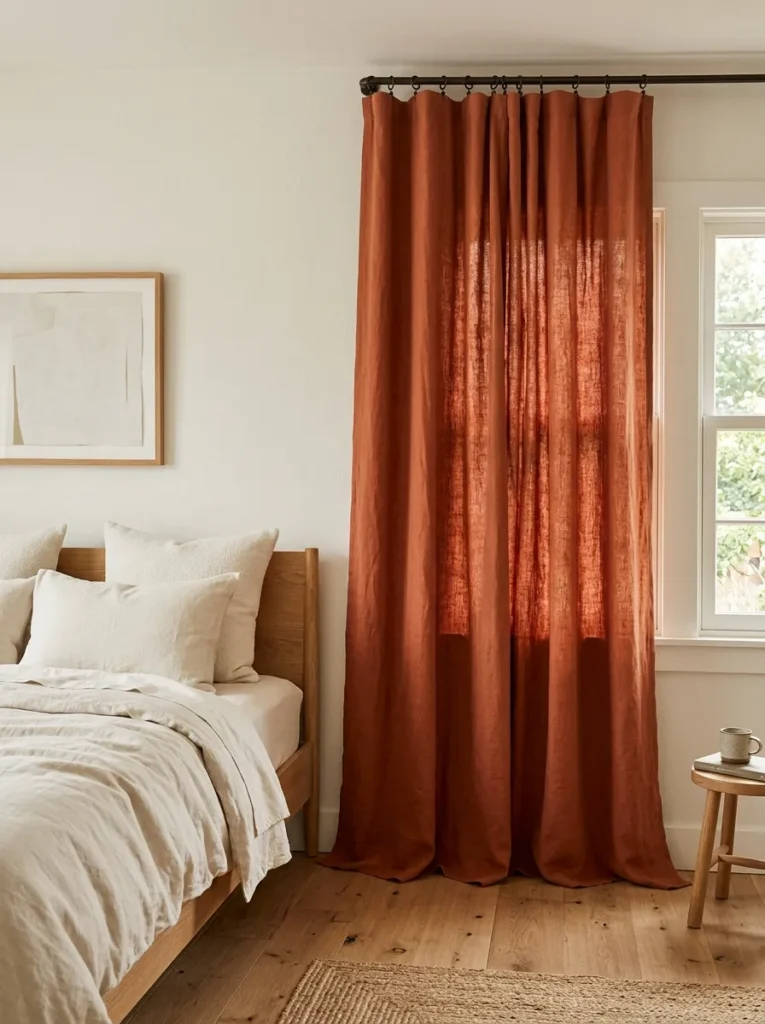
A bedroom built on a warm neutral base — warm white walls, natural wood furniture, linen bedding — can use curtains as the primary accent color without any other strong color element competing in the room. Terracotta, warm clay, and dusty rust all work as curtain accent colors in this context because they share the warm undertone of the surrounding palette while providing enough saturation to register as a deliberate color choice rather than a muted add-on.
These tones perform particularly well in bedrooms that receive warm afternoon and evening light, which deepens the red-orange tones in terracotta and makes them feel even richer. In morning light they appear lighter and more orange-brown; in evening lamplight they warm toward a deep amber. The fabric weight and finish affect the color’s reading: velvet terracotta feels moody and deliberate; linen terracotta feels casual and organic. Both are valid depending on the bedroom’s register.
11. Layer Woven Wood Blinds Under Linen Drapes for Textural Warmth

Natural woven wood blinds — bamboo, rattan, or jute-based shades that roll or fold — provide privacy and diffused light control while adding an organic material layer to the window that fabric alone doesn’t provide. Pairing them with floor-length linen panels on an outer rod creates a window treatment where two natural materials work in combination: the textured shade visible between the panel stacks, the linen framing the window on either side.
During the day with the shade partially lowered and the panels open, the window reads as layered and considered — a composition of materials rather than a covering. At night, shade fully down and linen panels closed, the room has multiple layers of privacy and light control. The textures of woven wood and linen are complementary — both organic, both warm — which is why this pairing works across a wide range of bedroom styles from coastal to contemporary organic.
12. Install Ceiling-Height Rods Regardless of Where the Window Sits

The single highest-impact curtain installation decision in any bedroom is where the rod is mounted. A rod positioned just above the window frame — even a few inches — limits the visual effect of the curtains to the width and height of the actual window. A rod mounted just below the ceiling makes every window appear architecturally taller and the room itself feel more generously proportioned.
This matters in bedrooms specifically because ceiling height affects how restful and expansive the room feels. A bedroom with curtains hung from ceiling-height rods reads as a room where the vertical dimension is being used; the same bedroom with rods just above the window frames reads as a room with windows that have curtains. The fabric length must correspond to the rod position — panels that are the correct length from a ceiling-height rod reach the floor; standard-length panels bought before the rod position is decided may fall short.
13. Extend the Rod Well Beyond the Window to Stack Panels Off the Glass

Curtain panels need somewhere to go when they’re open, and where they stack determines how much window glass is exposed and how much natural light enters the bedroom during the day. A rod that ends at the window frame forces the panels to stack partially in front of the glass, blocking some of the view and light even when the curtains are technically open.
Extending the rod six to twelve inches beyond the window frame on each side — or even further in bedrooms where maximum daylight is a priority — allows the panels to stack completely on the wall beside the window, leaving the full glass exposed. This is a particularly important detail in bedrooms where the window is the primary source of natural light, where views matter, or where the room needs all available daylight to feel properly lit during the day.
14. Try Pattern in Curtains When the Rest of the Bedroom Stays Neutral
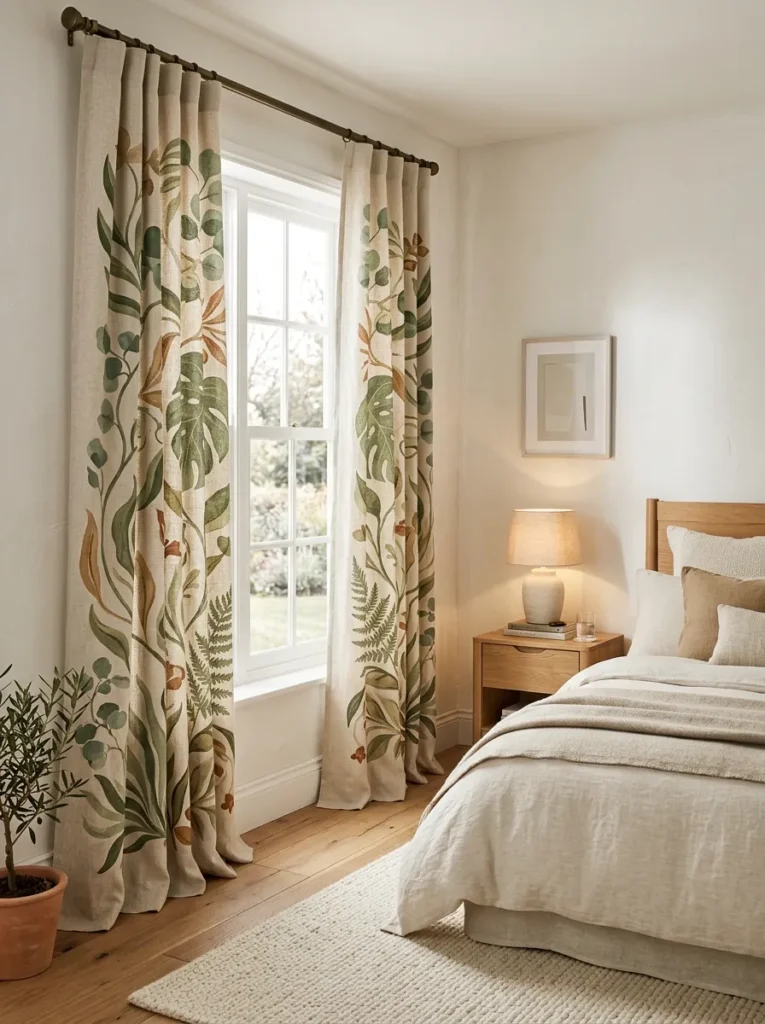
A bedroom built on a restrained neutral palette — warm white walls, natural wood furniture, linen bedding — can absorb a patterned curtain that would feel overwhelming in a more visually busy room. The pattern becomes the room’s primary design element and gives the space character that solid-color everything rarely achieves. This is the lower-risk position for introducing pattern in a bedroom: the curtains are at the room’s perimeter and can be changed without affecting furniture or bedding decisions.
Patterns that work well in bedroom curtains tend to stay within the room’s existing tonal range rather than introducing strong contrasting colors. A tone-on-tone stripe in a warm neutral, a botanical print in earthy green and tan, a subtle geometric in cream and oatmeal — these add visual interest without the visual energy that would make a sleeping room feel stimulating rather than restful. The scale of the pattern matters relative to the curtain length: a small-repeat pattern looks busy when repeated across 96 inches of floor-length panel; a larger scale repeat reads as more composed.
15. Use Floor-Length Panels That Break Slightly at the Floor
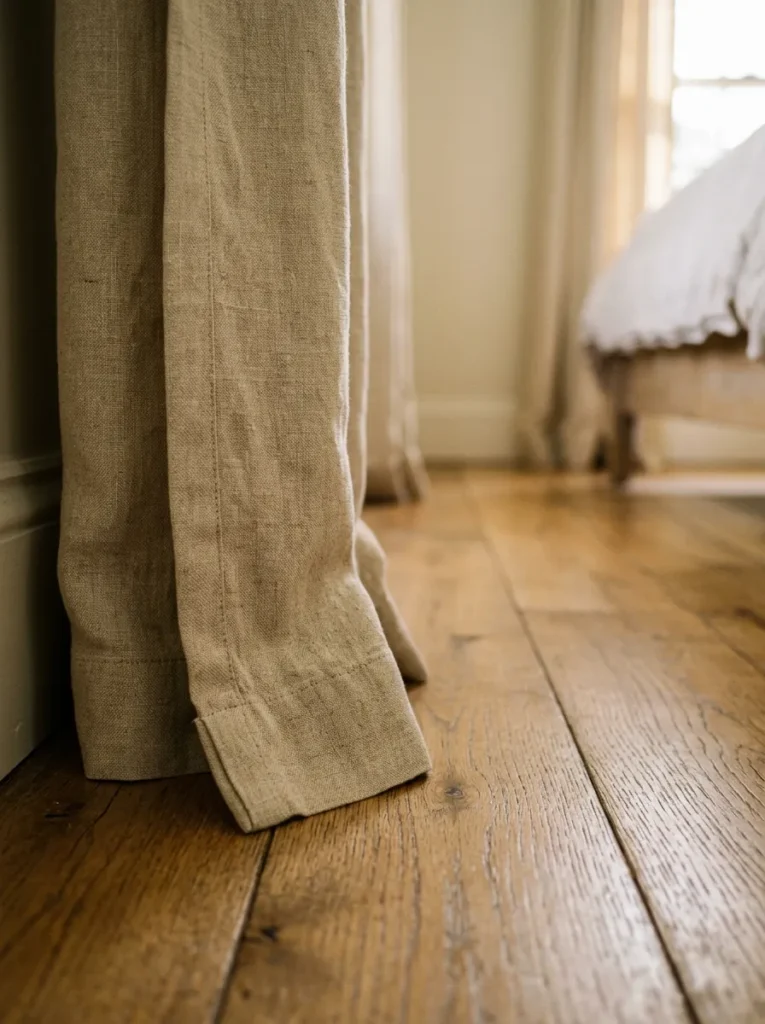
The hem length of a bedroom curtain affects both the visual result and the practical experience of using the room daily. Short curtains that stop at the sill or mid-wall create a horizontal break that compresses the visual height of the room; they also tend to look provisional rather than considered. Floor-length panels that reach the floor — with a small break of half an inch to an inch where the fabric just touches — look finished and proportionally right in most bedrooms.
The break hem is more practical than a puddle for bedroom use: a puddle (where fabric gathers on the floor by several inches) looks deliberately dramatic but requires curtains to be stepped around and collects dust and debris at the floor. A slight break achieves the finished, floor-touching quality without requiring careful movement around the fabric. For bedrooms where the curtains are opened and closed daily, the break or near-break hem is the most practical choice.
16. Create a Canopy Effect With Curtains Hung From a Ceiling-Mounted Track
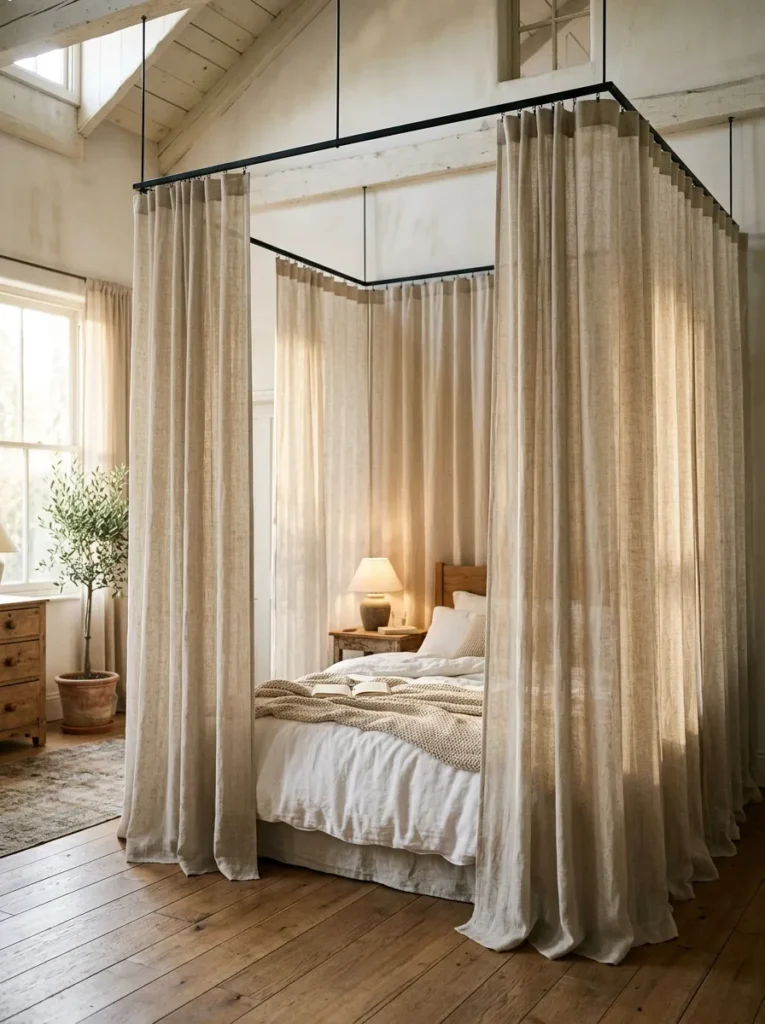
For bedrooms without a four-poster bed frame but with a desire for the enclosed, cocoon-like quality a canopy provides, curtain panels hung from a ceiling-mounted track positioned around the bed — rather than at the windows — create the same architectural enclosure using fabric rather than a bed frame. The panels frame the sleeping area as a distinct zone within the room.
This approach works particularly well in high-ceilinged bedrooms where the vertical space above the bed feels disconnected from the rest of the room’s warmth. Sheer panels provide a gauzy enclosure without blocking views or creating a fully enclosed space; heavier linen or velvet panels, when closed, genuinely separate the bed from the rest of the room. The track should be a simple recessed or surface-mounted ceiling track rather than a visible rod, which reads as architectural rather than theatrical.
17. Select Hardware in a Finish That Connects to the Room’s Other Metals

The curtain rod, brackets, rings, and finials are visible every morning and evening, and their finish either integrates with the bedroom’s existing metallic register or introduces a competing one. A bedroom with brushed brass bedside lamps, aged brass door hardware, and chrome curtain rods reads as assembled from separate decisions rather than composed as a whole.
Choosing hardware in a finish that matches or closely relates to the dominant metal in the bedroom produces finish cohesion that reads as considered without requiring any other change. Brushed brass and warm gold hardware suit bedrooms with warm, organic, or slightly traditional registers. Matte black works across a wide range of contemporary bedrooms and is particularly versatile against dark or deep-toned curtain fabrics. Brushed nickel and polished chrome suit cooler, more minimal bedrooms. Finials should be chosen with restraint — simple disc or sphere finials suit most bedrooms better than decorative shapes that read as period-specific.
18. Use Two Separate Panels Per Window in Small Bedrooms

In a small bedroom, the scale of the curtain treatment needs to relate to the scale of the room. One very wide panel covering a single window works in a larger room where the sweep of the fabric has space to read as generous; in a small bedroom, the same wide panel can feel like it’s trying to dominate a room that doesn’t have room for dominance. Two properly sized panels, each proportioned to half the rod width, create a more scaled and legible treatment.
The panels in a small bedroom also benefit from a fabric that doesn’t add visual weight: sheer or lightweight linen in a color close to the wall reads as architectural framing rather than added material. Heavy velvet or deep-colored drapes in a small bedroom pull the room toward a more dramatic register that works only if the room has enough space to absorb the statement. When in doubt, lighter fabric in a tone close to the wall color is the treatment most likely to make a small bedroom feel larger rather than smaller.
19. Use Matching Curtains and Walls in One Tone for a Seamless Effect

Curtains in the same color as the walls — or within one shade of it — create a visual continuity at the window that makes the room feel more spacious because the window zone doesn’t register as a separate element from the surrounding walls. The eye reads the entire perimeter of the room as one unified plane rather than stopping at the window. This effect is particularly useful in small bedrooms, but it also produces a genuinely sophisticated result in larger ones where visual calm is the goal.
The curtain fabric doesn’t need to be the same material as the wall finish — a wall in warm white paint with curtains in a warm white linen reads as tonal and unified because the color is consistent even though the surface isn’t. The slight texture variation between paint and woven fabric adds enough interest to prevent the treatment from reading as simply undifferentiated. This approach is easier to execute when the wall color is a warm neutral; matching a specific paint color in curtain fabric is harder and rarely exact.
20. Mount a Tension Rod With Clip Rings for a Renter-Friendly Curtain Solution

Renters who can’t drill into walls or install permanent brackets have workable options that don’t require compromising on curtain style or quality. A tension rod — a spring-loaded rod that holds itself in place between two surfaces — can be mounted inside the window frame rather than on the wall, which requires no screws, no anchors, and no landlord conversation. Inside-mount tension rods support lighter-weight curtain panels in sheer or lightweight linen attached with clip rings rather than rod pockets.
The practical limitation is weight: tension rods can’t support the load of heavy velvet or fully lined blackout panels without losing tension and falling. Lighter-weight options — unlined linen, cotton voile, or lightweight cotton-linen blends — work well and look entirely intentional when hung with matching clip rings in a coordinated finish. For heavier panels, command hook-based curtain rods rated for the load provide a surface-mount alternative that removes cleanly without wall damage.
Five Things to Decide Before Buying Bedroom Curtains
Getting these in the right order prevents the most common regrets.
Rod placement first, fabric second. Decide where the rod will be mounted — ceiling height, how far it extends beyond the window — before measuring panel length or ordering fabric. Standard panel lengths rarely correspond to the actual measurement from a ceiling-height rod to the floor.
Confirm the light-blocking requirement. An east-facing bedroom, a streetlit city bedroom, or any room where a light-sensitive sleeper needs to sleep past sunrise genuinely needs blackout lining. A bedroom with good natural light but no direct morning sun exposure may not. The fabric choice follows from this, not the other way around.
Calculate fullness. Panels should total 1.5 to 2 times the rod width in fabric. Panels that cover the exact rod width when closed look flat and insufficient; 2x fullness produces the gathered, full-drape quality that reads as generous and properly sized.
Measure at the actual rod position. Once the rod height is set, measure from the rod to the floor. Add a half to one inch for a slight break hem. This number — not any standard panel length — is the length you need.
Test the fabric in the room’s light. A fabric swatch held against the actual window in the actual bedroom at different times of day — morning, afternoon, evening — reveals undertones and weight that can’t be assessed from a product photo. This step prevents the most common fabric-color disappointments.
Final Thoughts
Bedroom curtains are among the most visible and most functional elements in the room, and the decisions made before they’re hung determine most of what you’ll feel about them for years. Rod placement, panel fullness, hem length, and the light-blocking choice matter more than the color or fabric, as beautiful as those decisions are. Solve the structure first, and the style choices fall into place with more confidence.
Start with the question of light: does the bedroom need genuine darkness to support sleep, or does it need privacy without necessarily being a dark room? The answer to that shapes the fabric and layering options immediately, and everything else — color, length, texture, hardware — layers onto that functional foundation.
Browse these bedroom curtain ideas for the approaches that suit your room’s light conditions, your window proportions, and the visual register you’re after. Save the ones worth revisiting, and return when you’re ready to measure and order.