18 Bathroom Plant Ideas That Add Freshness to Any Bathroom
A plant in the right bathroom position does something that candles, artwork, and even expensive tile can’t fully replicate: it brings the quality of being alive into a room that’s otherwise entirely hard surfaces and manufactured materials. The steam from a shower, the brief humidity spike when the water runs, the diffused light through a frosted window — bathrooms create conditions that a surprising number of plants actively prefer.
The challenge most people run into isn’t choosing between good plants and bad ones. It’s placing the right species in the wrong light condition, choosing a pot material that deteriorates in humidity, or treating the bathroom as a display opportunity without accounting for the plant’s actual survival requirements. A pothos in a dim corner with no light source will last a few weeks before declining; the same pothos beside a bright north-facing window in the same bathroom can trail for years with minimal care.
These 18 ideas address the full picture — species, placement, pot selection, grouping, display height, and the specific conditions of different bathroom types. The result should be plants that genuinely thrive rather than plants that survive long enough to be photographed.
1. Place a Bird of Paradise in a Bright Corner for Architectural Impact

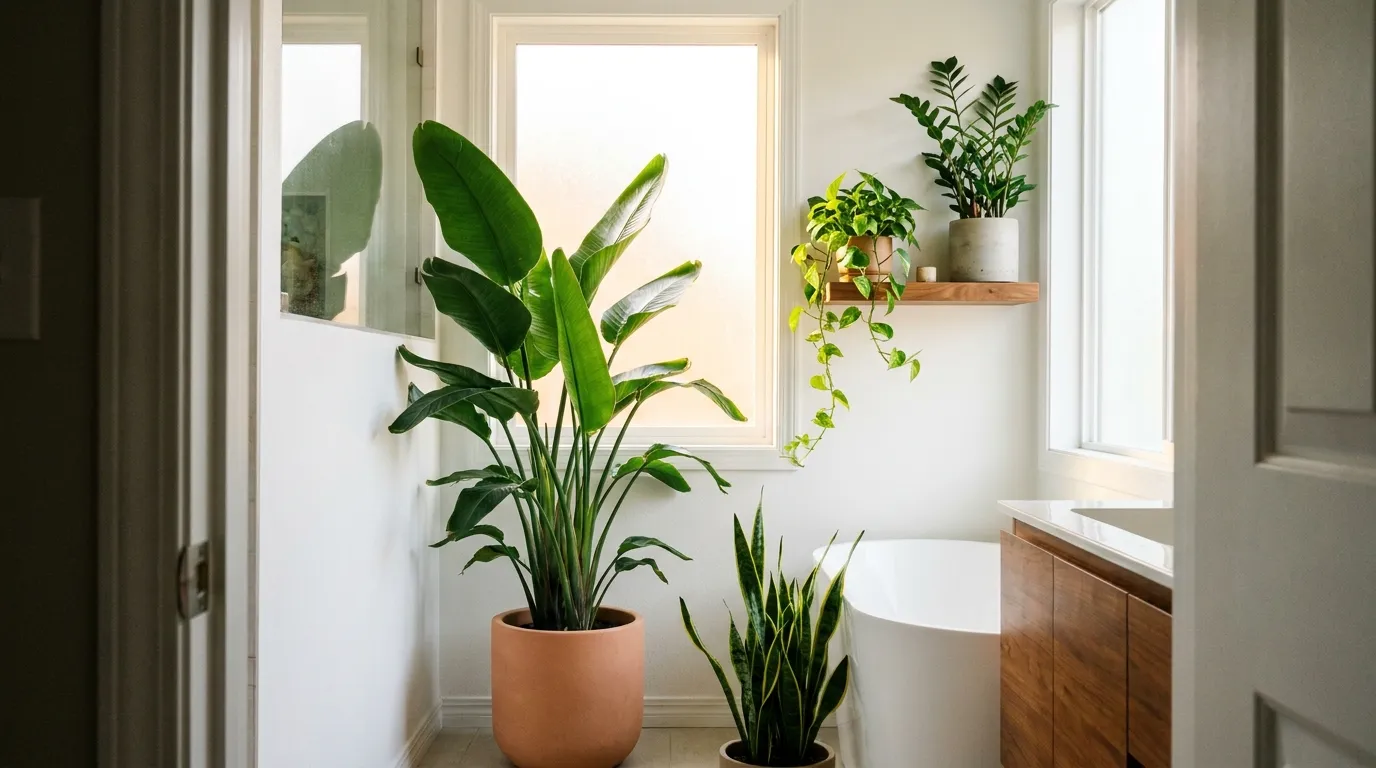
In a bathroom with large windows, strong natural light, and enough floor space for a generous pot, the bird of paradise (Strelitzia reginae or S. nicolai) is one of the most architecturally impressive choices available. Its large, paddle-shaped leaves create the kind of bold silhouette that reads as a design element rather than a plant placed in a room, and its tropical origins make it genuinely comfortable in the warm, humid conditions that bathrooms provide.
The practical requirement is light: the bird of paradise needs bright indirect light for several hours per day to maintain its health. A floor-to-ceiling window, a large south-facing window with filtered light, or placement within a few feet of a bright unobscured window will support it. Without adequate light it declines slowly — the lower leaves yellow first, then the stems become weak. In the right bathroom, it’s one of the most rewarding plant choices available.
2. Grow Boston Fern for Luxurious Fullness in Humid Conditions

The Boston fern (Nephrolepis exaltata) is one of the few plants that genuinely benefits from bathroom steam rather than merely tolerating it. Native to tropical and subtropical regions where humidity is consistently high, it produces the soft, arching, densely layered frond quality that makes it one of the most visually lush plants for interior use. In a bathroom that generates genuine humidity from daily showers, a Boston fern can reach a fullness that most indoor plant conditions can’t sustain.
Placement matters significantly. Boston ferns want consistent indirect light — a bright bathroom without direct sun is ideal — and the humidity that accumulates near the shower area rather than in the room’s driest corner. Allowing the fern to receive steam from the shower indirectly, while positioned near a frosted or clear window, gives it both requirements simultaneously. The care trade-off is real: ferns require consistent moisture in their soil and don’t tolerate dry-out periods as gracefully as more drought-tolerant species.
3. Hang Eucalyptus Bundles From the Showerhead for a Spa Atmosphere

Dried or fresh eucalyptus bundles hung from the showerhead or shower arm aren’t a potted plant, but they’re one of the most effective ways to introduce organic material and genuine fragrance into a bathroom without any maintenance requirements beyond occasional replacement. When hot water hits the steam, it activates the eucalyptus oils, releasing a scent that genuinely transforms the shower experience.
Fresh eucalyptus from a florist or grocery store lasts two to four weeks in this position before drying and fading. Dried bundles last considerably longer — several months — though the fragrance diminishes over time. The visual effect of a full bundle of silvery-green eucalyptus stems against a white tile background is strong and photographically compelling. The bundle should be positioned so the showerhead spray doesn’t hit it directly; indirect steam is what activates the fragrance without causing the bundle to decompose prematurely.
4. Position an Aloe Vera on the Windowsill for Both Beauty and Utility

Aloe vera occupies a specific category among bathroom plants: it’s both decorative and genuinely useful as a household plant with topical applications for minor burns, skin irritation, and dryness — conditions that arise in a bathroom context more than anywhere else. Its architectural form, with upright succulent leaves radiating from a central rosette, reads well on a bathroom windowsill without requiring a pot larger than the space typically allows.
The light requirement is the decisive variable. Aloe vera needs bright indirect light at minimum — a windowsill with consistent daylight (not necessarily direct sun) sustains it well. Without adequate light, aloe becomes leggy and pale, losing the compact rosette form that makes it visually distinctive. In a dark bathroom, aloe is not the right choice. In a bright one, it suits the windowsill as naturally as anything that grows in a container.
5. Let a Trailing Pothos Cascade From a High Shelf

Pothos (Epipremnum aureum) has earned its reputation as the most forgiving indoor plant available: it tolerates low light, irregular watering, and the humidity fluctuations of a bathroom environment with a resilience that genuinely sets it apart from most houseplants. For a bathroom, its specific advantage is directional — the long trailing stems cascade naturally downward from a high shelf, a towel hook, or a wall-mounted plant holder, filling vertical space that would otherwise remain decorative dead zone.
In a small bathroom where floor space is at a premium, a high-shelf pothos provides significant visual presence without occupying any counter or floor area. The trailing stems can be directed — trained along a shelf edge, guided toward a hook, or left to fall freely — which gives the display some flexibility as the plant grows. Even in bathrooms with limited natural light, pothos survives adequately; with moderate indirect light, it grows actively and the stems lengthen visibly over weeks.
6. Grow a Peace Lily for Low-Light Elegance and Air Purification

The peace lily (Spathiphyllum) is one of the most effective low-light flowering plants available for indoor use, producing white hooded blooms (spathes) above glossy dark green foliage when conditions are adequate, and tolerating significantly lower light than most flowering plants. In bathroom environments, it thrives because it prefers consistent warmth and higher air moisture — conditions the bathroom provides naturally with regular use.
The peace lily’s visual quality is genuinely elegant: the contrast between the dark waxy leaves and the white flowers creates a sophisticated effect that suits darker, more designed bathroom aesthetics as naturally as it suits bright spa-style spaces. The practical note worth making: peace lily is toxic if ingested, which matters in households with pets or young children. It should be positioned out of reach of both in those situations. In pet-free and child-free homes, it’s one of the most reliable and visually distinctive low-light bathroom plants available.
7. Place a Snake Plant in a Dramatic Upright Position

The snake plant (Sansevieria trifasciata, now reclassified as Dracaena trifasciata) is the bathroom plant that tolerates the widest range of light conditions with consistent good form — from low indirect light near the door of a windowless bathroom to bright indirect light beside a window. Its upright, sword-like leaves in dark green with light banding create a clearly architectural silhouette that reads as a deliberate design choice rather than an incidental plant placement.
For a bathroom, the snake plant suits tall, narrow positions that would otherwise be hard to fill: a slim corner between the vanity and the wall, beside a freestanding tub, or in the corner opposite the door where a single vertical form creates a visual anchor. The pot choice affects the overall impression significantly: a snake plant in a mass-produced plastic nursery pot looks like a plant that arrived somewhere temporarily; the same plant in a matte stone, concrete, or quality ceramic pot looks like a considered design element.
8. Display a ZZ Plant Where Nothing Else Will Grow

The ZZ plant (Zamioculcas zamiifolia) occupies the low-light extreme of the bathroom plant spectrum. Its glossy, waxy leaflets on arching stems store moisture in underground rhizomes, allowing it to survive weeks without water and tolerate light conditions that would cause most plants to decline within days. For a truly dark bathroom — one with only a small frosted window or no natural light at all — the ZZ plant is one of the few species that remains genuinely healthy rather than simply declining slowly.
The waxy leaf surface also has a visual quality that suits bathrooms specifically: it reflects bathroom light sources and appears clean and composed even without regular attention. The ZZ plant is slow-growing, which means it maintains whatever size it’s purchased at for a considerable period — useful in a space where a specific scale is needed without the plant outgrowing its position quickly. The practical caution: ZZ plants are mildly toxic to pets and humans if ingested.
9. Create a Small Grouped Arrangement of Three Plants in Varied Heights

A single plant on a bathroom vanity or shelf reads as an accent; three plants grouped at different heights read as an intentional display. The grouping principle works in bathrooms as well as anywhere else — a tall trailing pothos, a mid-height peace lily, and a low compact succulent or ZZ plant arranged together with intentional spacing between them creates a vignette that transforms a bathroom surface into a designed composition.
The practical requirement for grouping is that all three plants in the arrangement tolerate the same light conditions. Mixing a sun-loving succulent with a shade-preferring fern in the same group will produce one healthy plant and one struggling one within weeks. Within the low-to-medium indirect light range that most bathrooms provide, pothos, peace lily, ZZ plant, and philodendron varieties can be grouped without significant compatibility issues.
10. Choose a Heartleaf Philodendron for a Windowless Bathroom With Artificial Light

In a genuinely windowless bathroom — a powder room, an interior bathroom in an apartment, or a second bathroom without exterior walls — the plant selection is constrained to species that can survive under artificial light sources rather than natural light. The heartleaf philodendron (Philodendron hederaceum) is one of the most adaptable species for this specific condition. Its heart-shaped leaves on trailing stems produce new growth under warm-white fluorescent or LED light, unlike most plants that require full-spectrum or natural sources.
The bathroom’s existing light fixtures should ideally run on a consistent schedule — most plant growth is triggered by consistent light duration rather than intensity alone — and the bathroom should be used frequently enough that the humidity from regular use provides moisture through the air as well as the soil. In a bathroom that’s rarely used and therefore dry and dark, even the most tolerant species struggle; in a regularly used bathroom with consistent warm light, the heartleaf philodendron grows steadily.
11. Use a Bromeliad for Color in a Bathroom With Bright Indirect Light

Bromeliads bring something to a bathroom that the standard foliage plants don’t: genuine color in the form of their central rosette, which produces striking flower spikes in red, orange, pink, yellow, or purple depending on the variety. In a bathroom that’s designed around neutral tile, white fixtures, and a controlled material palette, a single bromeliad with a vivid flower spike introduces color without any repainting or decor change.
The care difference from most bathroom plants is worth noting: bromeliads are typically monocarpic — they flower once, then the main rosette slowly dies while producing offshoots called pups that can be separated and grown on. The flowering period lasts several months, which is the period during which the bromeliad provides its most distinctive visual impact. After the flower spike fades, the offshoot pups can be potted individually and will eventually produce new flower spikes after a year or more.
12. Install a Wall-Mounted Planter for a Bathroom Without Counter Space
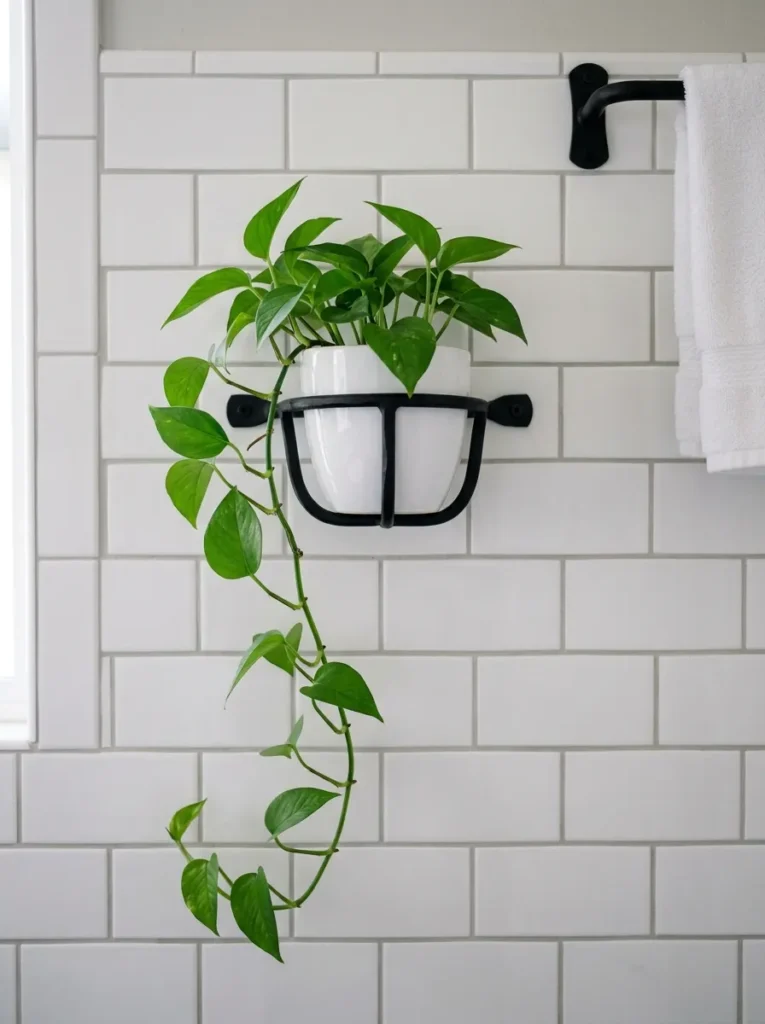
Bathrooms where every horizontal surface is occupied — the vanity edge, the toilet tank top, the windowsill — have a vertical solution that most plant styling advice overlooks: wall-mounted planters. A ceramic or metal planter bracket attached to the wall at the appropriate height holds a small plant without claiming any surface area, and the wall position can be chosen for the available light rather than the available counter space.
The wall-mounted planter works particularly well for trailing plants that benefit from height — a small pothos or a heartleaf philodendron produces its best visual effect when the trailing stems have vertical distance to fall. The mounting height should place the pot base at approximately eye level or slightly above so the trailing stems fill the visual space below the pot. The bracket and pot should be considered as one object aesthetically: a simple ceramic pot in a simple iron bracket reads more refined than either element in isolation.
13. Hang a Spider Plant in a Macramé Holder for Casual Organic Texture
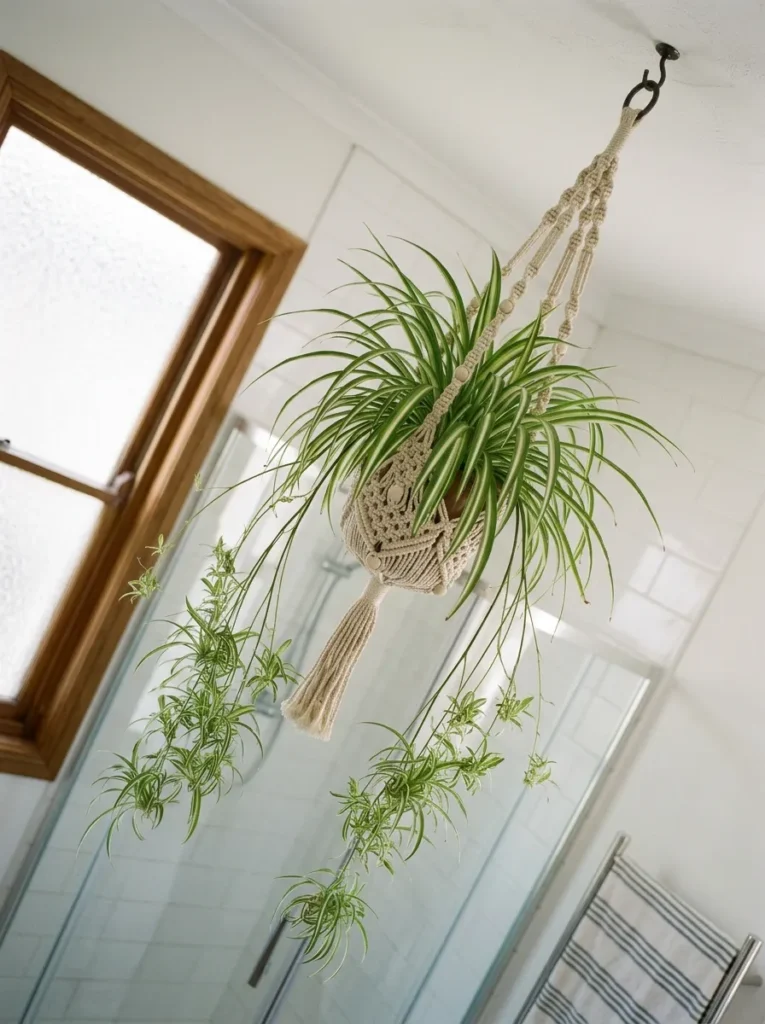
The spider plant (Chlorophytum comosum) produces arching green-and-white striped leaves and, as it matures, long hanging stems tipped with small plantlets (called spiders or pups) that dangle freely from the main plant. In a hanging position — particularly in a macramé holder suspended from a ceiling hook or a high wall bracket — both the striped leaves and the hanging pups create a layered visual effect that reads as organically abundant rather than planted and positioned.
The macramé holder adds its own material character: the woven natural cord suits the organic quality of the spider plant and relates naturally to other natural fiber materials (jute bath mats, cotton rope towel holders, woven baskets) that appear in modern bathroom styling. Spider plants prefer bright indirect light and regular watering, and they genuinely thrive in bathroom humidity — making them one of the most naturally suited choices for the environment rather than merely tolerant of it.
14. Position a Fern on the Shower Shelf for Genuine Spa Character

A small fern positioned on a shower shelf — inside or adjacent to the shower — receives the most direct humidity exposure of any placement in the bathroom, which suits the fern’s fundamental preference for consistent moisture in both soil and air. The visual effect of a fern on or beside the shower, particularly against a tile background, is the most genuinely spa-like of any bathroom plant placement: the delicate fronds, the deep green color, and the contrast against clean tile creates the visual language of a high-end wellness space.
The species selection for a shower-adjacent position should lean toward the more moisture-tolerant ferns. The bird’s nest fern (Asplenium nidus) — with its broad, simple fronds rather than the feathery divided fronds of a Boston fern — tolerates lower light and more direct humidity than most ferns and is one of the most suitable species for interior shower placement. It doesn’t require any spray or misting because the shower environment provides that naturally.
15. Place a Small Succulent Collection on the Vanity in a Bright Bathroom
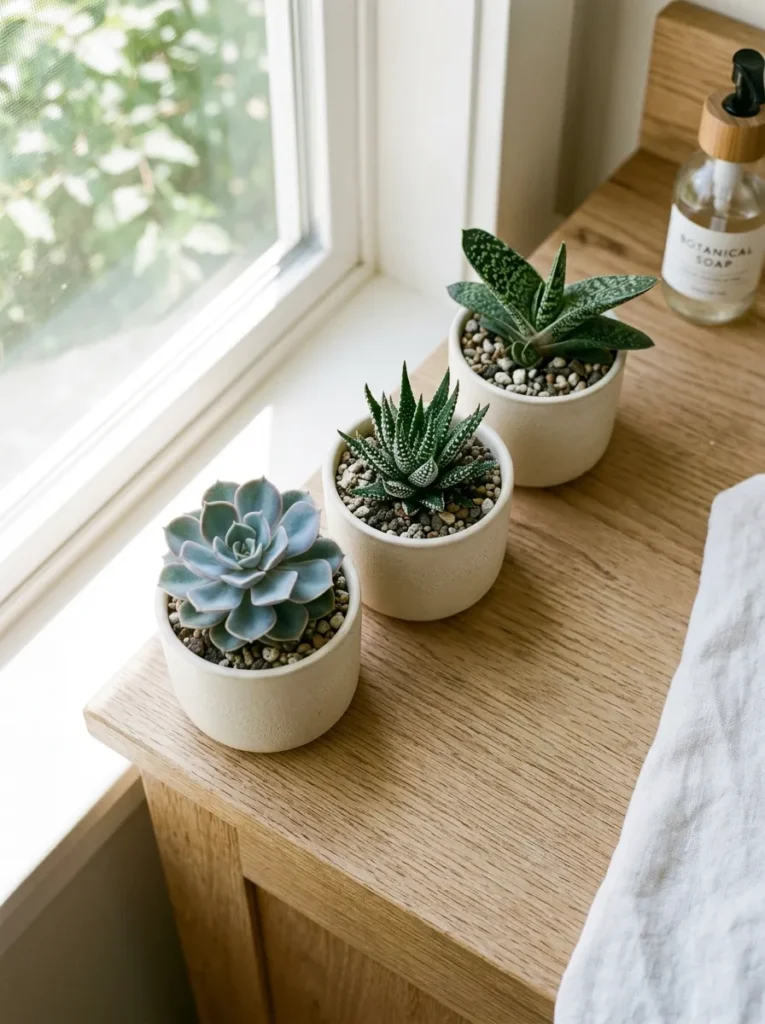
In a bathroom with strong natural light — south or west-facing windows that admit several hours of daylight — succulents become a viable bathroom plant category that’s completely impractical in darker bathrooms. Their architectural forms (rosettes, columns, trailing types) and color range (blue-green, silver, burgundy, variegated cream) provide visual variety in a small footprint, and their minimal watering needs suit a vanity position where overwatering is more likely than underwatering.
A collection of three to five small succulents in related pot types — all ceramic, all the same color family though not identical — reads as a curated display rather than a random accumulation. The variety of forms within the succulent family provides enough visual variation that identical pot colors or materials don’t create monotony. Echeveria, haworthia, and gasteria are the most reliably low-maintenance succulent genera for indoor bright conditions, and all three tolerate the temperature fluctuations of bathroom use.
16. Use a Calathea for Pattern, Color, and Humidity Preference

Calatheas (Calathea species, many recently reclassified under Goeppertia) are the bathroom plant choice that delivers the most leaf pattern and color variation of any humidity-loving genus. Species range from the prayer plant movement of Calathea orbifolia — which opens and folds its broad striped leaves on a daily cycle — to the deep purple undersides and dark green patterning of Calathea ornata. In a bathroom that provides consistent warmth and indirect light, calatheas develop the full leaf color and pattern their natural tropical understory habitat produces.
The care requirement is specific: calatheas need consistently moist but not waterlogged soil, indirect light (never direct sun which bleaches their markings), and the warm humidity that bathrooms naturally provide. They’re sensitive to fluoride and chlorine in tap water, which can produce brown leaf tip margins — allowing tap water to sit out for 24 hours before use, or using filtered water, prevents this. Despite the reputation for being demanding, calatheas in the right bathroom environment are often easier to maintain than in a typically dry living room.
17. Style Plants in Pots That Relate to the Bathroom’s Material Palette

The plant is only half of the bathroom plant display — the pot determines how the plant integrates with the bathroom’s existing aesthetic. A snake plant in a white plastic nursery pot reads as unresolved; the same snake plant in a matte sandy terracotta or a smooth concrete-look ceramic reads as a deliberate design decision. The pot material should connect to at least one other material or color already present in the bathroom.
In bathrooms with warm neutral tile, sandy or earthy terracotta pots extend the palette naturally. In bathrooms with white fixtures and matte black hardware, matte black or dark ceramic pots create material coherence without introducing a new color. In bathrooms with natural wood vanities or bamboo accessories, wooden pot sleeves or woven seagrass pot covers relate to the existing material story. The pot drainage situation matters practically: most bathroom plant positions don’t have floor drains, which means pots should either have no drainage hole and be watered carefully, or have drainage holes and sit inside a saucer or decorative outer pot that catches water.
18. Create a Living Plant Shelf by Dedicating One Floating Shelf Entirely to Plants

Rather than placing individual plants on various surfaces throughout the bathroom, a single floating shelf dedicated entirely to bathroom plants — three to five species in related pots at staggered heights — creates a composed living display that reads as the bathroom’s most designed feature. The dedicated plant shelf is particularly effective when positioned on the wall that faces the primary viewing position from the bath or shower, since that wall receives sustained attention.
The shelf’s position relative to the light source determines which species succeed on it. A shelf near a window supports most of the species covered in this article; a shelf in a darker position requires selecting specifically from the low-light tolerant group — ZZ plant, pothos, heartleaf philodendron, peace lily. The shelf material should be naturally water-resistant or sealed, since bathroom humidity and the occasional watering overflow will reach it over time. Natural teak, sealed oak, and powder-coated iron all hold up well in bathroom environments; untreated wood and standard MDF do not.
Matching Plants to Bathroom Light Conditions
The most common reason bathroom plants fail is a mismatch between the plant’s light requirements and the bathroom’s actual light conditions — not overwatering, not humidity, but light.
Bright bathrooms — those with large windows, east or south-facing exposure, or frosted glass that still admits significant daylight — can support almost any species discussed here including succulents, aloe, bird of paradise, and calathea.
Medium-light bathrooms — those with a standard window receiving indirect light for several hours daily — suit pothos, peace lily, spider plant, Boston fern, snake plant, heartleaf philodendron, and bromeliad.
Low-light bathrooms — those with only a small window, a high frosted window, or north-facing exposure — should focus on ZZ plant, pothos, heartleaf philodendron, and peace lily, all of which survive in lower light conditions than most species.
Windowless bathrooms require either a grow light positioned near the plant or selection of the hardiest low-light species — ZZ plant and heartleaf philodendron — with realistic expectations that growth will be slow and the plant will maintain rather than thrive.
Final Thoughts
Bathroom plants work best when the light condition comes first and the visual preference comes second. The most beautiful fern on the wrong shelf in the wrong bathroom will decline within a month; a modest pothos in the right position will trail with minimal attention for years.
Start by assessing your bathroom’s actual light — stand near the intended plant position and note how much natural light reaches it at different times of day. Then work through the ideas here from that starting point: bright bathroom ideas, medium-light ideas, or low-light and windowless ideas as your conditions require. The pot choice, the placement height, and the display approach all come after the light decision is made.
Save the ideas that match your bathroom’s light conditions and your own maintenance preferences, and return to this guide when your plant collection grows to include a second or third species.