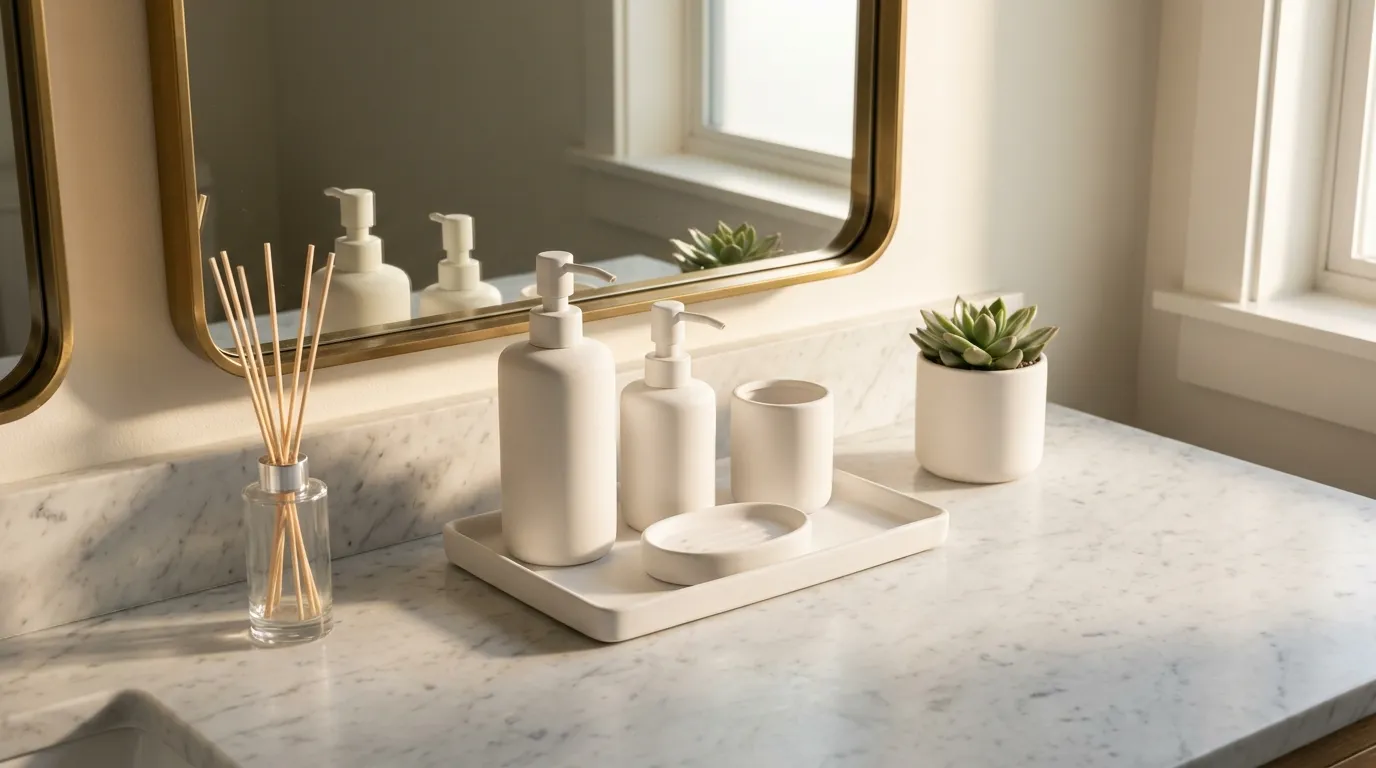
21 Bathroom Counter Organization Ideas That Reduce Clutter
A bathroom counter is the space where clutter feels most immediate — because you’re standing directly in front of it every morning while trying to get ready, and what’s on the surface directly affects how that experience feels. A clear, organized counter makes the morning routine feel manageable. A cluttered one makes even a familiar routine feel like an obstacle course.
The problem most bathroom counter organization articles don’t address: the majority of items on the average bathroom counter don’t belong there. They belong in a drawer, under the sink, in a medicine cabinet, or somewhere else in the bathroom entirely. The counter’s only legitimate residents are the items used every single morning, plus one or two deliberate decor choices. Everything else is clutter with a storage problem disguised as a display problem.
These 21 ideas begin with that clarification and build from there — from the foundational edit through specific storage tools, wall and vertical solutions, shared bathroom approaches, and the maintenance habits that determine whether any system actually lasts.
1. Identify What Actually Belongs on a Bathroom Counter Before Buying Any Organizer
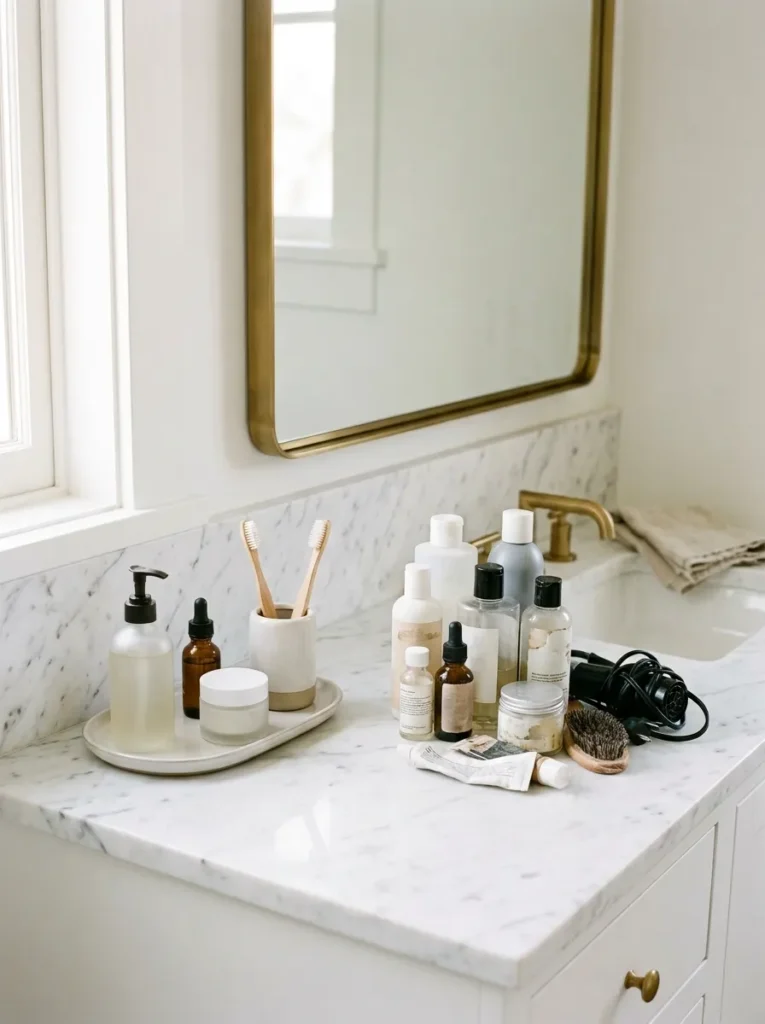
The most productive thing you can do for a bathroom counter before purchasing any organizer is to remove every item from the surface and assess each one honestly. What belongs on a bathroom counter: items used in the morning routine on every single weekday without exception. What doesn’t belong: products used a few times a week, backup items waiting to be needed, duplicates, products that didn’t make it back to a drawer after the last use, and items that migrated from another room and found a temporary home that became permanent.
The average bathroom counter, when emptied and honestly assessed, contains roughly twice as many items as the routine actually requires. That second half — the items that drift to the counter but aren’t part of the daily routine — is the primary cause of counter clutter. No organizer addresses this problem because organizers manage items; they don’t reduce them. The edit does. Returning only daily-use items to the counter after this assessment often solves the problem without any purchased product.
2. Apply the Daily-Use Rule: Only Items Used Every Morning Earn Counter Space
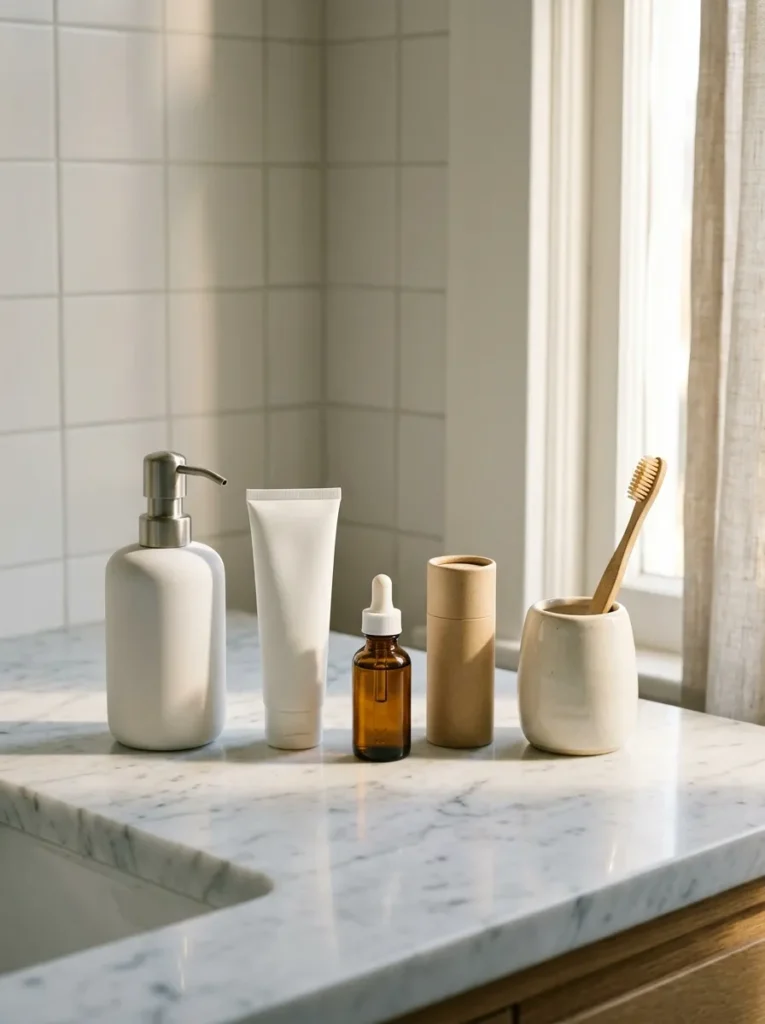
The daily-use rule is the habit that keeps the counter from re-cluttering after the initial edit. Its principle is simple: only items used in every morning routine earn permanent counter space. Items used several times a week but not daily go in a drawer. Items used weekly go under the sink. Items used monthly or occasionally go in a cabinet or closet.
The specific items that legitimately earn counter space vary by person and routine, but the category is always smaller than it initially feels. Most morning routines can be reduced to five to seven items at most: toothbrush and toothpaste, face wash, a daily moisturizer, a deodorant, and perhaps one hair product used every day. Each person’s list will differ, but it should be a deliberate list — arrived at by applying the daily-use test honestly — not a default accumulation of everything that was convenient to leave out. Anything that can’t make a clear case for daily use belongs somewhere with a door between it and the counter.
3. Use a Tray to Define the Counter’s Organized Zone
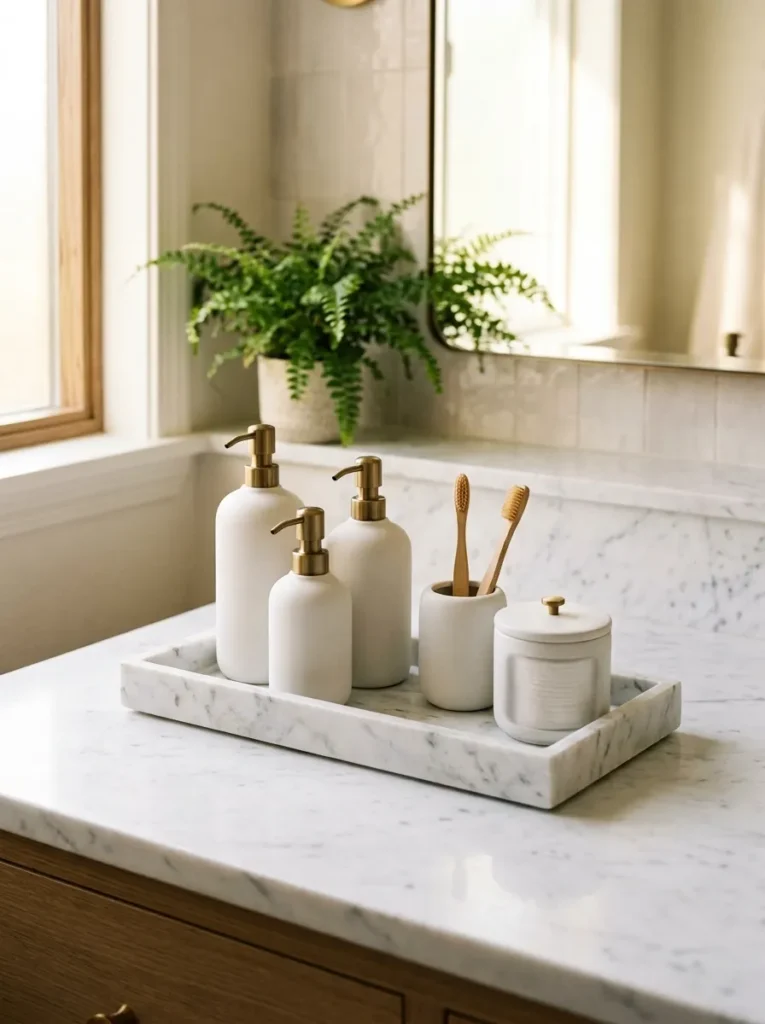
A tray on a bathroom counter does more visual work than the objects placed on top of it: it defines a zone. Items inside the tray read as a composed, contained arrangement. The same items placed directly on the counter surface without a boundary read as scattered, regardless of how neatly they’ve been positioned.
The tray should be slightly smaller than the area of the counter it occupies, so a visible margin of counter surface remains around it. That margin communicates that the tray was placed deliberately rather than pressed against everything in all directions because the counter was already full. Material choices for a bathroom counter: ceramic, lacquered wood, resin, marble slab, stone, or concrete. The tray material should coordinate with the bathroom’s existing hardware finish and fixtures — warmer tones with brass or warm nickel hardware, cooler tones with chrome or matte black. A tray that fights the room’s existing finishes draws attention to itself rather than to the composed arrangement it contains.
4. Limit the Counter to One Functional Zone and One Deliberate Decor Element
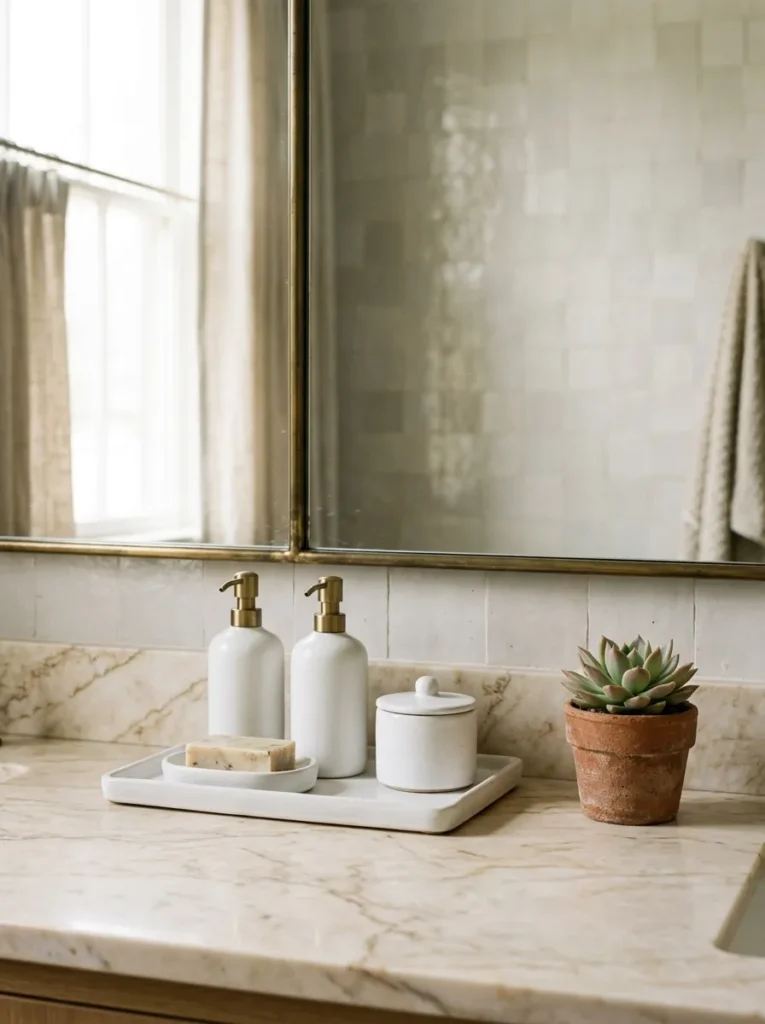
The bathroom counter that looks deliberately styled — rather than merely organized — typically holds two types of things: the functional items from the daily routine grouped in a tray, and one considered decor element that completes the visual composition without competing with the function.
That one element might be a small potted plant, a single sprig of eucalyptus in a slim bud vase, a rolled linen hand towel placed beside the sink, a scented candle in a ceramic container, or a small stone or ceramic object of some personal significance. What it should not be is accumulated from multiple sources. A bathroom counter can hold one decor element without it reading as additional clutter because one item is a focal point. Two or three items of aspirational decorative intent collectively read as more clutter. Choose the single element that does the most visual work for the counter’s composition and restrain the impulse to add a second.
5. Add a Small Riser to Create Two Levels on a Narrow Counter
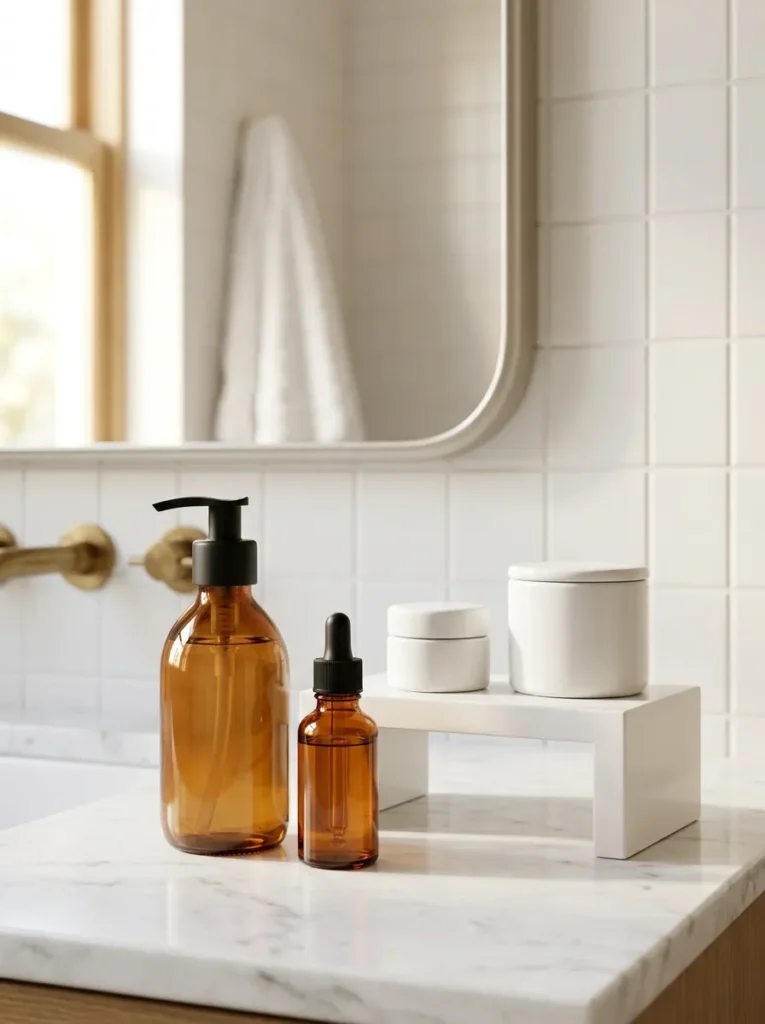
On a narrow bathroom counter where every inch of flat surface matters, a small riser — a stepped platform that lifts a back row of items above a front row — recovers significant usable surface by using vertical space rather than horizontal. The front row of items remains at counter level and accessible immediately. The back row sits elevated and visible behind the first, making both rows simultaneously accessible without one hiding the other.
Risers work well on bathroom counters when both rows hold items of consistent height within each level. Front row: taller items like a face wash pump or a serum bottle. Back row: shorter items like a cotton round container or a lip balm that would disappear behind the taller front items without elevation. Marble, ceramic, and acrylic risers contribute a visual element to the counter composition in addition to their functional role — they don’t read as office infrastructure the way a plastic riser does, which matters when the counter’s appearance is part of the outcome.
6. Decant Daily Products into Matching Pump Dispensers and Containers
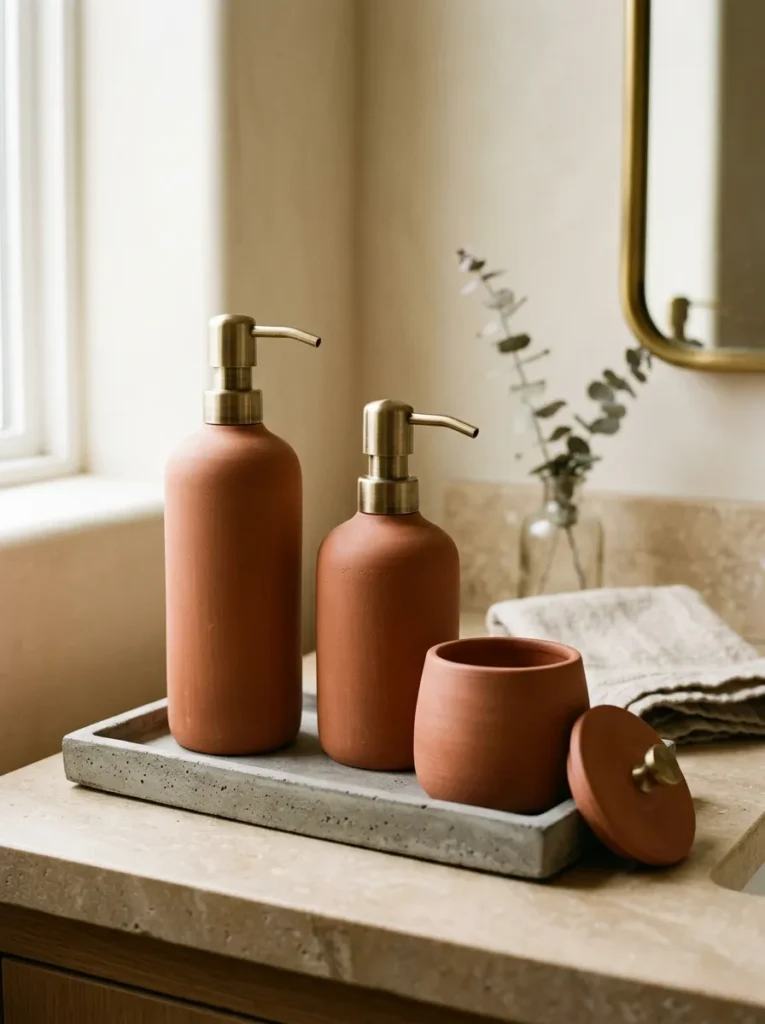
Original product packaging on a bathroom counter is visually argumentative. Different brands use different bottle heights, label typography, cap designs, and color palettes — and the result of three or four products in their original containers sitting together is a competition for visual attention rather than a composed arrangement. No amount of arrangement resolves the underlying incompatibility of mismatched packaging.
Decanting daily-use liquid products — face wash, hand soap, body lotion, and any other liquid used at the counter — into a matching set of pump dispensers eliminates this visual competition. All items now share a material, a height range, and a cap type. The counter reads as a composed set rather than an accumulation. Matte white ceramic, warm terracotta, frosted glass, and brushed metal pump dispensers each work well; the material choice should coordinate with the tray and the bathroom’s hardware finish to maintain visual continuity across the counter’s elements.
7. Use a Small Divided Organizer for Cotton Rounds, Hair Ties, and Small Daily Items
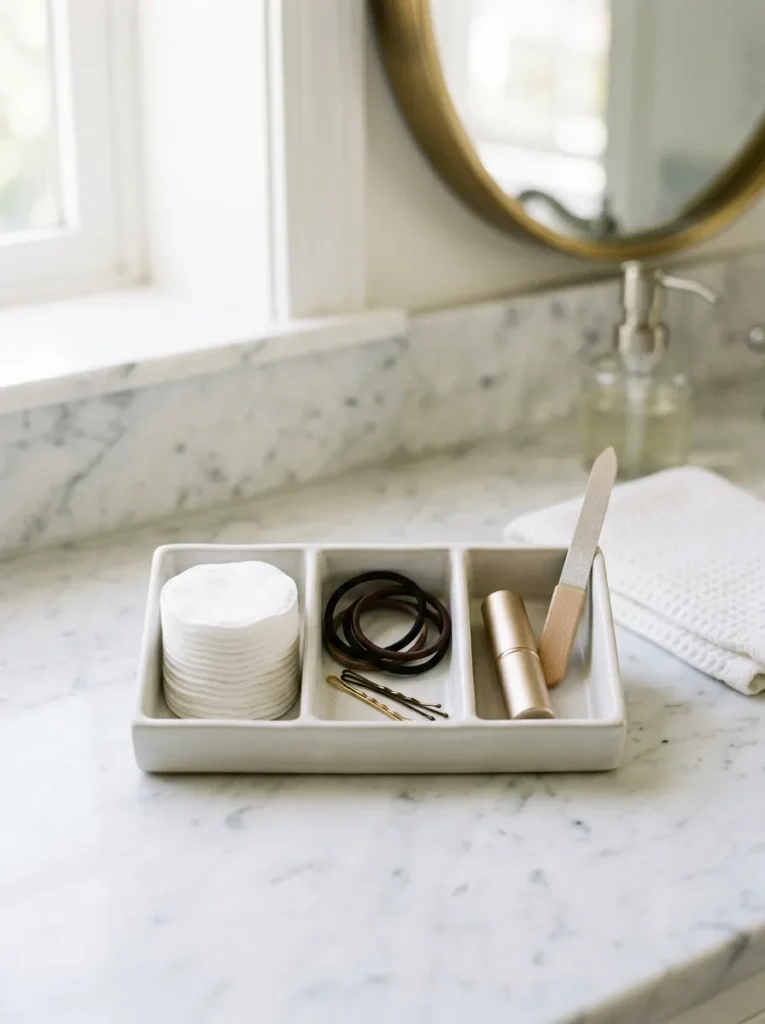
Small daily-use items — cotton rounds, hair ties, bobby pins, lip balm, a face roller, nail care items — are among the most persistent sources of bathroom counter scatter. They’re individually small enough that they seem like they don’t warrant specific storage, so they’re set down wherever there’s space during the morning routine and not returned to any designated location because no designated location exists.
A small divided ceramic organizer or a compact caddy with sectioned compartments — positioned within the tray’s zone or directly beside it — gives these small items a specific shared home without requiring a separate container for each one. Each section holds one category: cotton rounds, hair accessories, small beauty tools. The division matters: a single undivided container for small items produces the same searching-by-feel problem that an unorganized counter does. A divided organizer makes every small item individually accessible in under two seconds.
8. Add a Mini Drawer Unit Beside the Sink for Closed Daily Storage
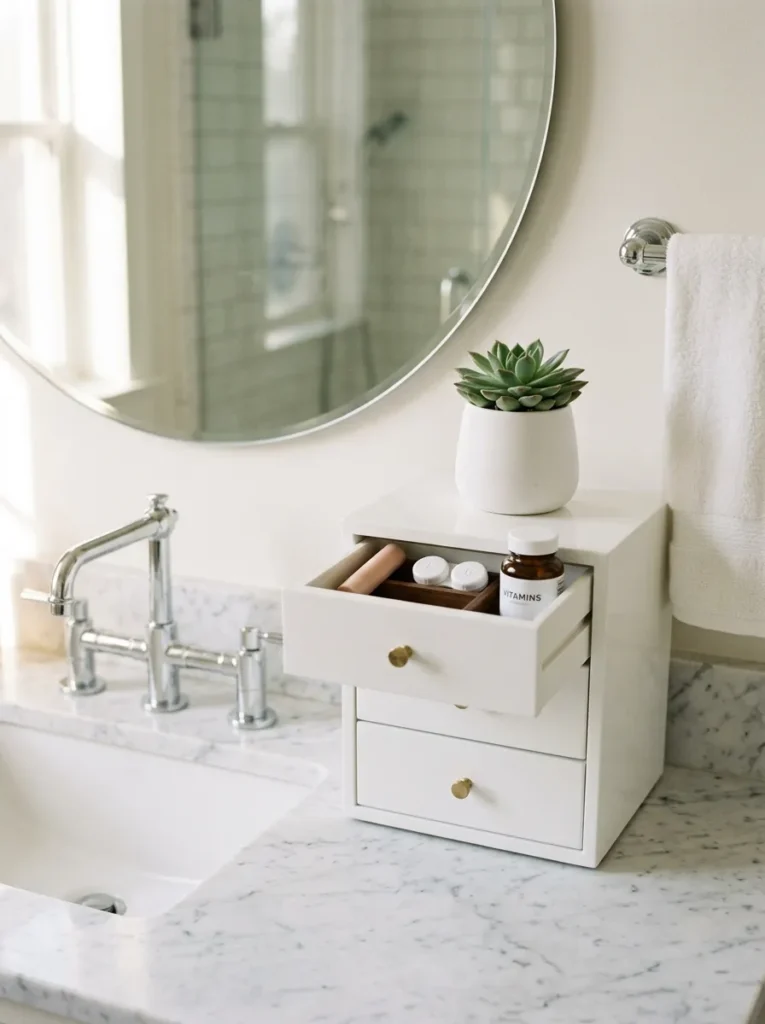
A compact mini drawer unit — two or three shallow drawers stacked, designed for vanity or desktop use — positioned on the counter beside the sink creates dedicated closed storage at counter height for the items used every morning, without requiring those items to be visible on the counter surface. The top of the unit becomes a small additional surface area; the drawers contain a full morning routine in organized, out-of-sight compartments.
This approach works well on a wide bathroom counter where there is surface space to spare but items feel scattered without containment. Top drawer: most frequently accessed small items — lip balm, contact case, one or two daily supplements. Middle drawer: second-tier daily items like small beauty tools, tweezers, a nail file. The closed drawer face keeps the counter reading as composed regardless of what the drawers contain, which means a full and complex morning routine can live at the counter without the counter showing it.
9. Replace Individual Product Bottles with a Coordinating Soap Dispenser Set
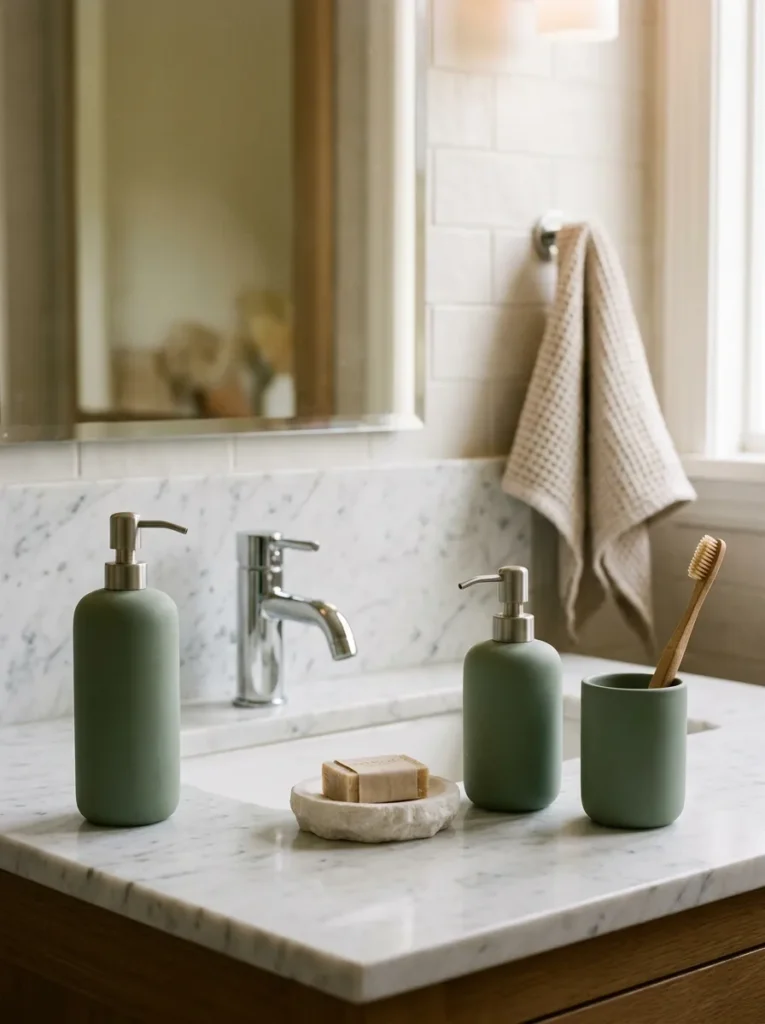
The hand soap bottle, lotion bottle, and any other liquid product at the bathroom sink represent the highest-visibility items on the counter — they sit at direct eye level beside the sink and are handled multiple times a day. They’re also the most visually inconsistent: each product arrives in different packaging with different heights, cap styles, and label colors, and together they read as a default arrangement rather than a considered one.
Replacing them with a two or three-piece coordinating dispenser set in a single material — all ceramic, all resin, all matte glass — eliminates the visual competition at the sink’s most prominent location. A soap dispenser, hand lotion pump, and a coordinating toothbrush cup in the same material constitute the counter’s most-used items and collectively create a composed, edited look at the sink. This single swap changes the sink area’s appearance more than any organizer placed elsewhere on the counter.
10. Mount a Magnetic Strip Inside a Cabinet for Metal Grooming Tools
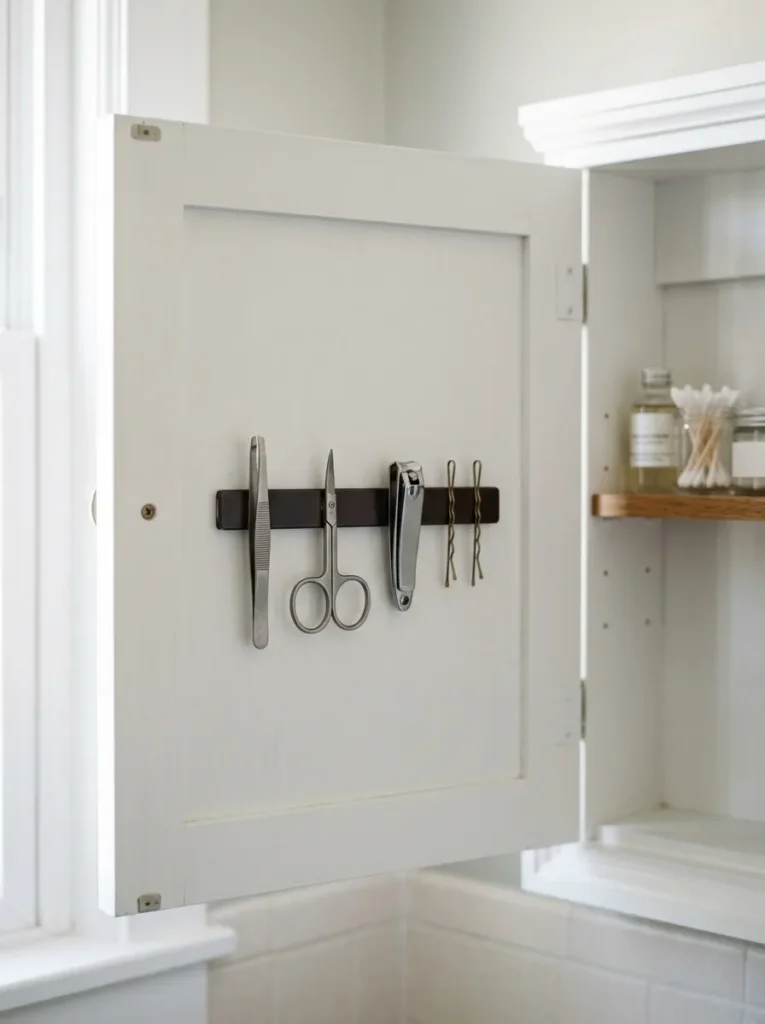
Metal grooming tools — tweezers, nail scissors, a small cuticle tool, nail clippers, a metal bobby pin set — are small enough to get lost in a drawer and visible enough to create scatter when left on the counter. A magnetic strip mounted inside the bathroom cabinet door or medicine cabinet door holds these items in a row off the counter surface and accessible without searching through a drawer.
The magnetic strip’s most effective position is inside a cabinet that is opened as part of the morning routine — the medicine cabinet, the cabinet below the sink if it’s opened daily. When the cabinet is closed, the strip is hidden; when it’s open, the tools are fully visible and individually accessible. No drilling is required for the door interior position — adhesive-mounted magnetic strips hold metal grooming tools without significant weight load. This clears a category of small, scatter-prone items from the counter with one installation.
11. Add a Small Floating Shelf Above the Counter to Lift Products Off the Surface
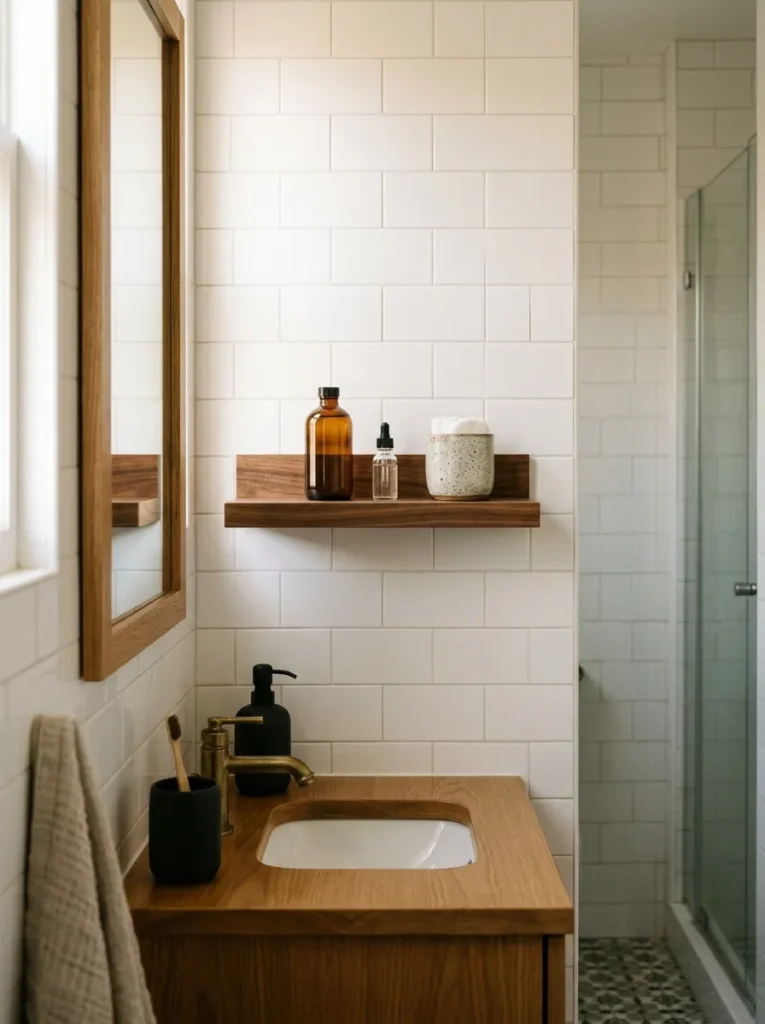
In a bathroom where the counter itself is genuinely limited — a narrow vanity, a pedestal sink with little to no surrounding surface — a floating shelf positioned on the wall above the counter moves storage into vertical space without requiring a furniture change or any modification to the sink itself.
A shelf at approximately 24 to 30 inches above the counter surface — high enough to clear items and the morning routine below, low enough to remain easily reachable — can hold a full set of daily products that would otherwise compete for counter space. Two or three products on a shelf above the counter free the counter surface for use and the routine below it. The shelf material should coordinate with the bathroom’s existing surfaces: warm wood tones for a wooden vanity, white for a painted bathroom, stone or marble for a marble counter. For renters, floating shelves with removable adhesive mounting hardware are widely available and install without drilling.
12. Use the Inside of the Medicine Cabinet Door for Lightweight Flat Items
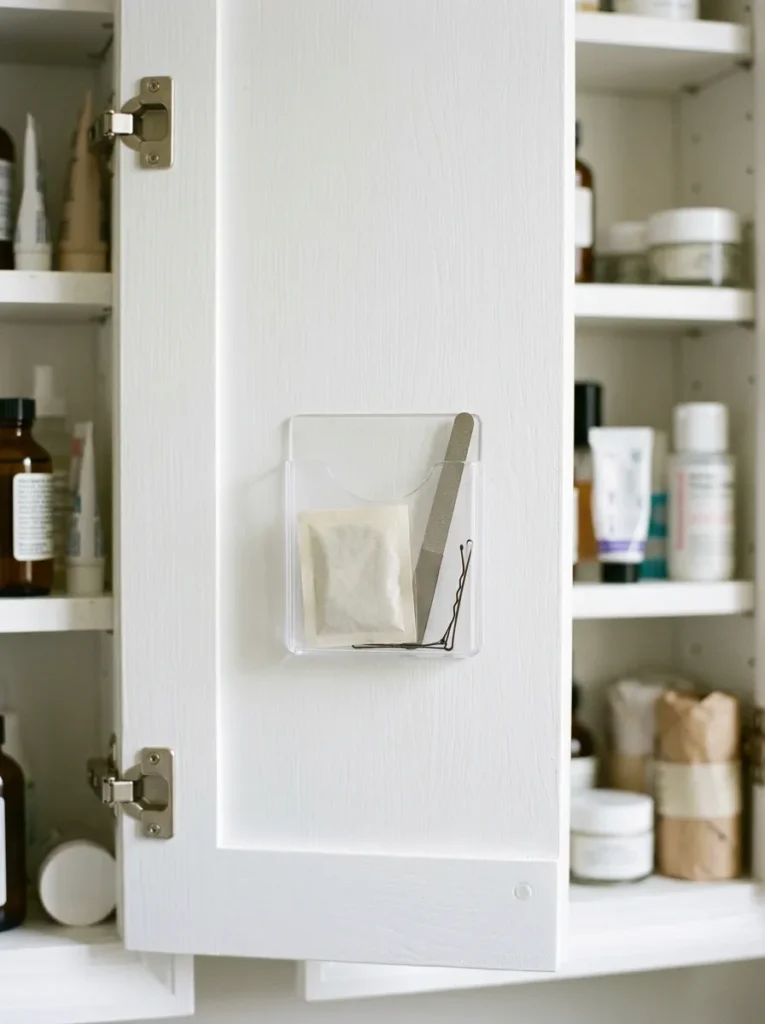
The interior surface of most medicine cabinet doors is a flat, painted panel with no storage capacity — a consistently wasted surface that’s opened and closed multiple times a day. A small adhesive-mounted rack, an acrylic pocket organizer, or a thin magnetic strip on the door interior can hold lightweight, flat daily items: a nail file, a pair of tweezers, a small folded packet, a travel-sized product — and eliminate that category of scatter from the counter entirely.
The critical measurement before purchasing: the item must fit within the door clearance when the cabinet is closed — typically 1 to 1.5 inches between the door’s interior surface and the nearest shelf. Everything mounted on the door must be thinner than this clearance, or the door won’t close. For renters, all adhesive-mounted solutions apply without tools and remove without damage. The medicine cabinet door’s storage is hidden when closed and fully accessible when the cabinet is opened as part of the routine.
13. Install a Wall-Mounted Toothbrush Holder to Remove It from the Counter
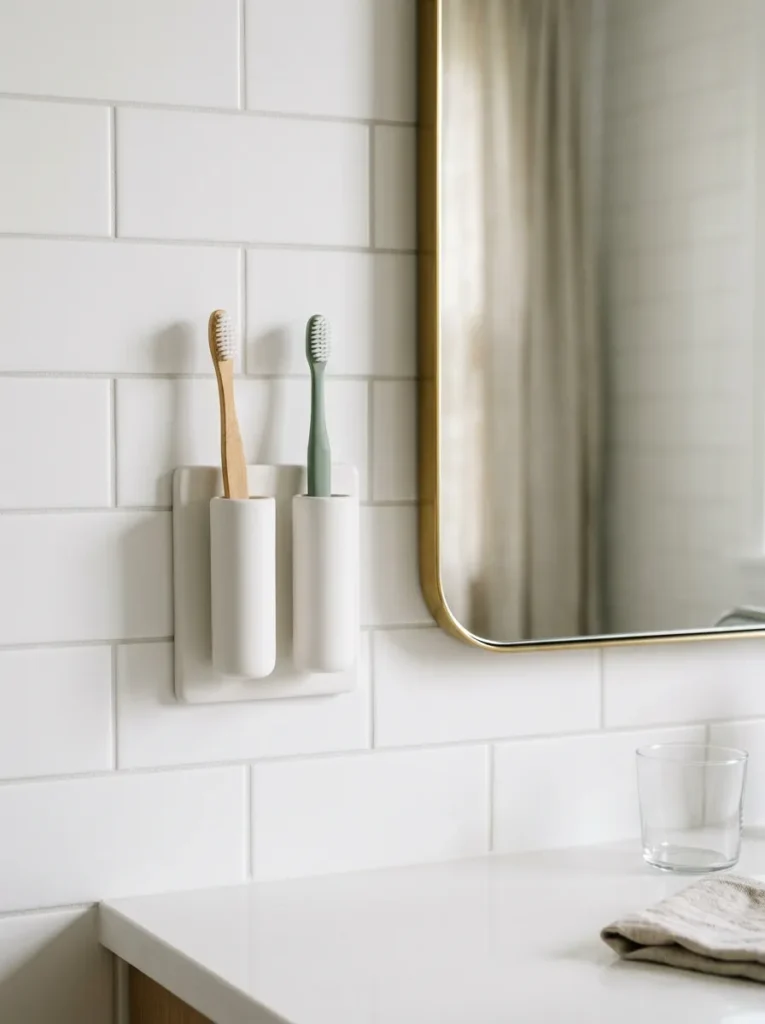
A toothbrush holder is one of the most legitimate counter occupants in a daily bathroom routine — toothbrushes need to be accessible, upright, and not stored in a drawer for hygiene reasons. But on a small counter, a toothbrush holder occupies a disproportionate footprint relative to what it holds, and it crowds out other necessary items at the counter’s most-used location beside the sink.
A wall-mounted toothbrush holder — suction-cup mounted on the tile beside or below the mirror, adhesive-mounted on the wall above the counter, or positioned on the side panel of the medicine cabinet — removes this footprint from the counter entirely while maintaining full accessibility. For two-person bathrooms, a holder with two or four individual slots mounted beside the mirror keeps all toothbrushes accessible and hygienically separated without counter occupation. This single change frees more usable counter space than most organizers placed on the counter surface, because it removes an item that’s genuinely in the way rather than rearranging items that are already there.
14. Give Each Person in a Shared Bathroom Their Own Designated Caddy
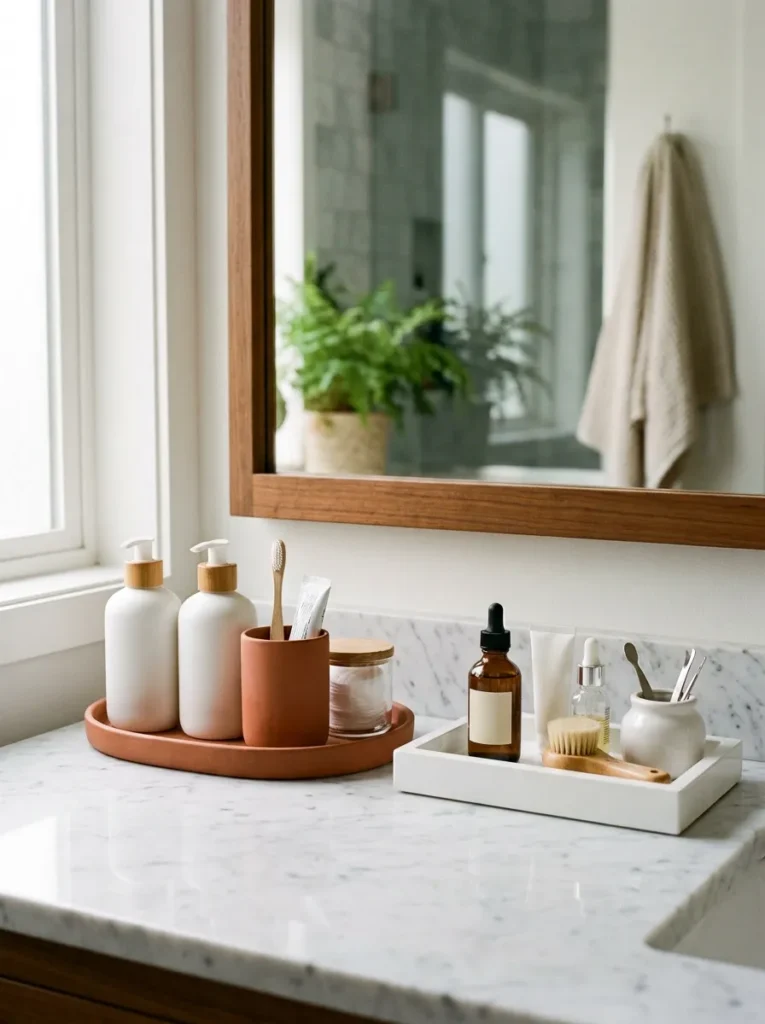
Shared bathroom counters have a specific problem that single-occupancy counters don’t face: two people’s morning routines share a single surface, and without clear delineation, the items blur together into a combined accumulation that serves neither routine efficiently. The counter fills with products from both sets, and finding any specific item requires sorting through both people’s things.
The practical solution for a shared counter: assign each person a distinct caddy, container, or defined section of the tray as their morning zone. Person one’s daily items live in their container; person two’s items live in theirs. The containers should be visually distinct from each other — different colors, or the same color in different materials — but coordinating in style, so they read as a system that was designed rather than two unrelated objects that happened to end up on the same counter. A caddy per person also makes the morning reset straightforward: each person is responsible for returning their own caddy to order, rather than managing a shared surface where accountability is unclear.
15. Use Portable Under-Sink Caddies That Clear the Counter Between Uses
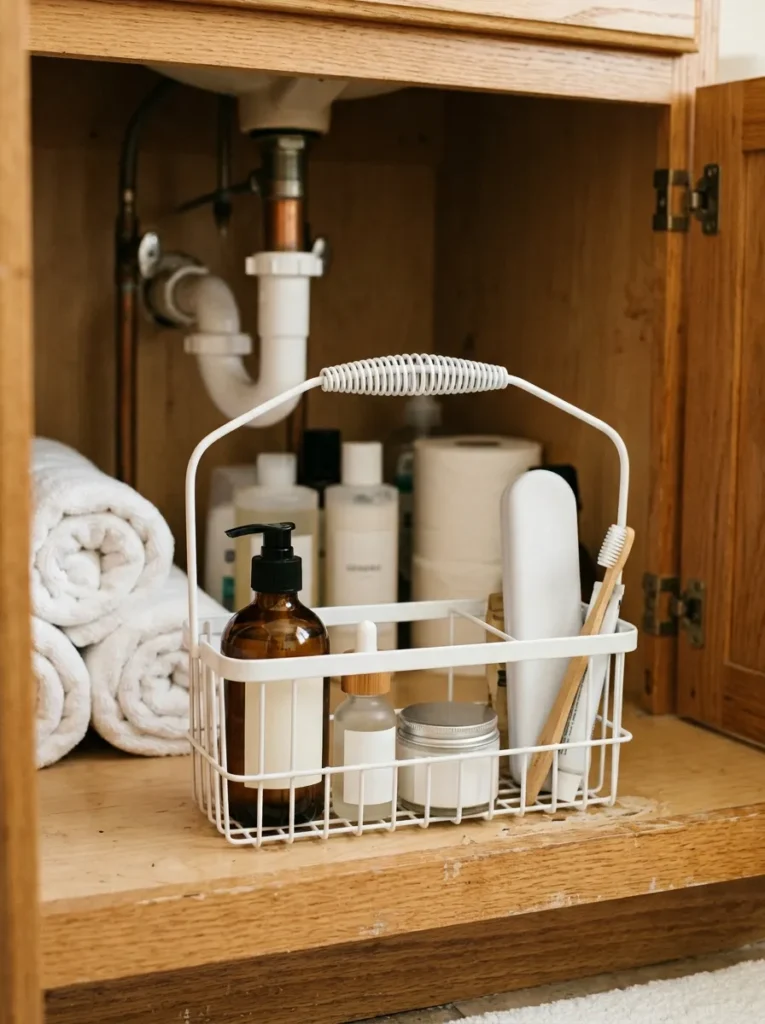
For bathrooms where the counter is shared between people with significantly different routine schedules — one person’s morning routine ending before the other’s begins — or where a full two-person routine genuinely cannot coexist on a small counter at the same time, a portable under-sink caddy provides a flexible alternative to a permanent counter arrangement.
Each routine has its own caddy stored under the sink when not in use. The caddy travels to the counter during the morning routine and returns to the cabinet when the routine is finished, leaving the counter clear for the next use. This eliminates the “second person’s products crowding the counter during the first person’s routine” problem in shared bathrooms without requiring a larger counter or a bathroom reorganization. A caddy with a handle makes the travel motion one action rather than several; a lightweight caddy stays under the sink without requiring a dedicated shelf.
16. Establish a Return-to-Storage Habit After Every Morning Routine
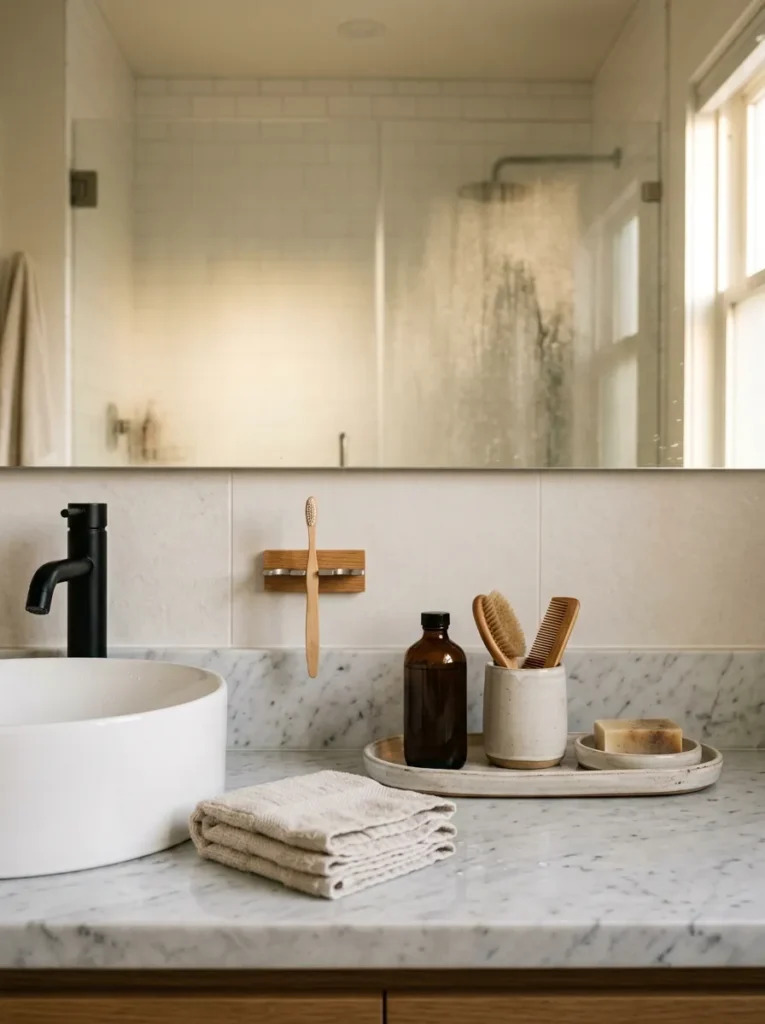
No organization system maintains itself without a supporting habit. For bathroom counters specifically, the habit that determines whether a system holds over time is the return step: after the morning routine is complete, every item that was used goes back to its designated location before leaving the bathroom.
When the system is well-designed — when every item has a specific, close, accessible home and returning it requires a single motion rather than a decision — this step takes approximately 90 seconds. When it takes significantly longer than that, the system needs simplification: either the designated locations are too difficult to access, or too many items lack clear homes and require a decision each time they’re returned. The purpose of the edit (Idea 1), the daily-use rule (Idea 2), and the tray (Idea 3) is to reduce this return step to the minimum number of items and the minimum number of actions. The return habit is the behavior; the organization system is what makes the behavior easy.
17. Separate Skincare and Haircare to Prevent Two Routines From Colliding
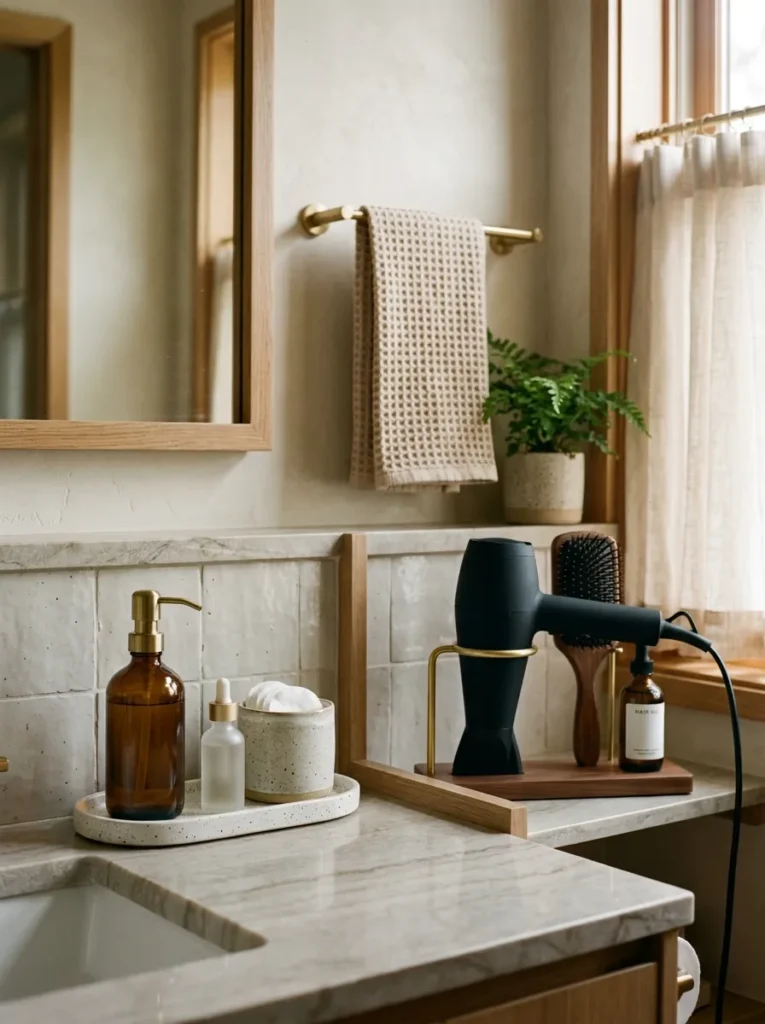
A persistent source of bathroom counter chaos that most organization articles don’t address: two distinct morning routines — skincare and haircare — operating in the same counter zone simultaneously, with products that are incompatible in size, workflow, and footprint.
Skincare products are small: bottles, tubes, and cotton rounds occupy a modest footprint and a consistent height range. Haircare tools are large: a hairdryer, a curling iron or flat iron, a brush, and the cord management problem that comes with them. When both routines share a single tray or counter zone, neither is organized effectively — the small skincare items get crowded by the larger haircare tools, and the haircare tools have no logical place to live between their use and return to storage. The practical separation: skincare stays in the tray at the counter. Haircare tools have a dedicated location away from the skincare zone — a separate counter section, a drawer, or a mounted organizer — and travel to and from that location as part of the routine.
18. Choose Uniform Containers So Counter Items Function as Their Own Decor
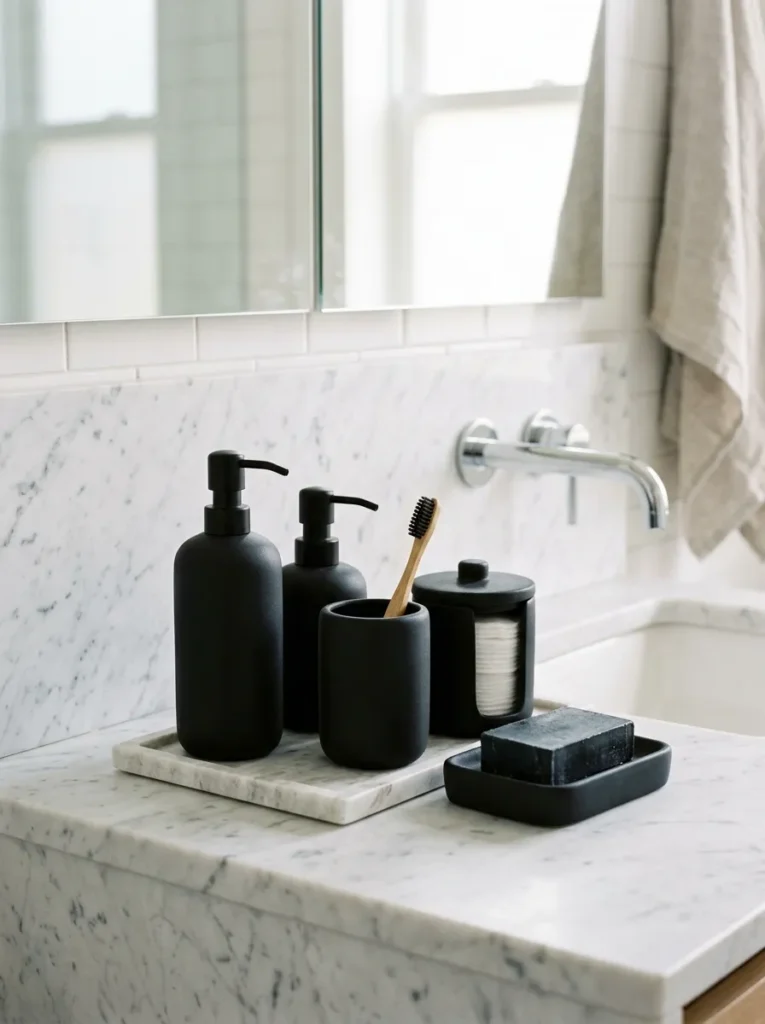
When daily-use items must stay on the counter — in a small bathroom where drawer and cabinet storage is genuinely limited — the containers holding those items determine whether the counter reads as organized or cluttered. A uniform set of pump dispensers, a ceramic soap dish, a matching toothbrush holder, and a coordinated cotton round container in the same material family reads as a considered, curated counter. The same products in their original assorted packaging reads as items that haven’t been put away.
The design decision embedded in uniform containers is this: when the container is beautiful enough to function as decor, the practical item inside it becomes part of the counter’s aesthetic rather than a subtraction from it. Matte white ceramic, warm terracotta, frosted glass, and natural stone containers each achieve this effect. The material should be chosen for longevity — something that will look as appropriate in three years as it does now — rather than for current trend alignment.
19. Leave Deliberate Empty Space on the Counter Surface
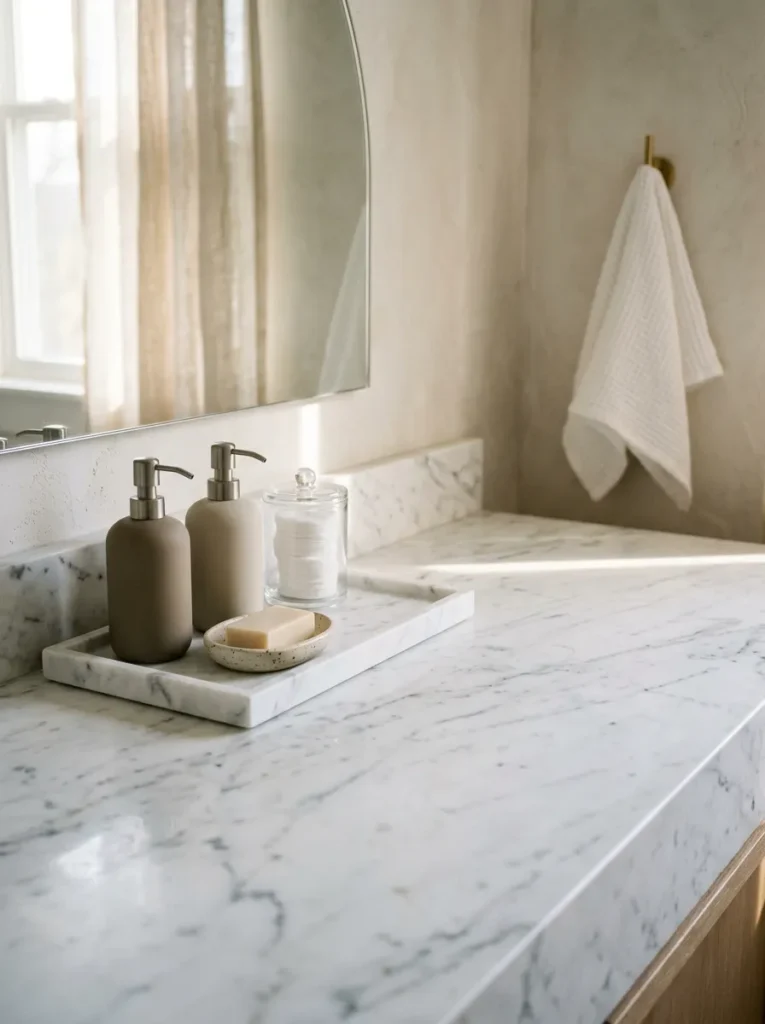
The bathroom counter that reads as calm — the one that makes the bathroom feel larger than it is and the morning routine feel more manageable — almost always has visible empty counter space. Not because it’s been cleared of everything, but because the system was designed to leave clear surface intentionally rather than filling every available inch.
Empty counter space makes the items present read more deliberately and more clearly. A tray with four items and 40 percent of the counter surface around it visibly clear reads as considered. The same four items spread across the full counter surface to fill it reads as scattered. When evaluating whether to add an organizer or container to a bathroom counter, the relevant question is whether it creates visible empty space by consolidating other items, or simply adds another object to the surface. The first justifies the addition; the second does not.
20. Add One Anchor Decor Element to Complete the Counter’s Composition
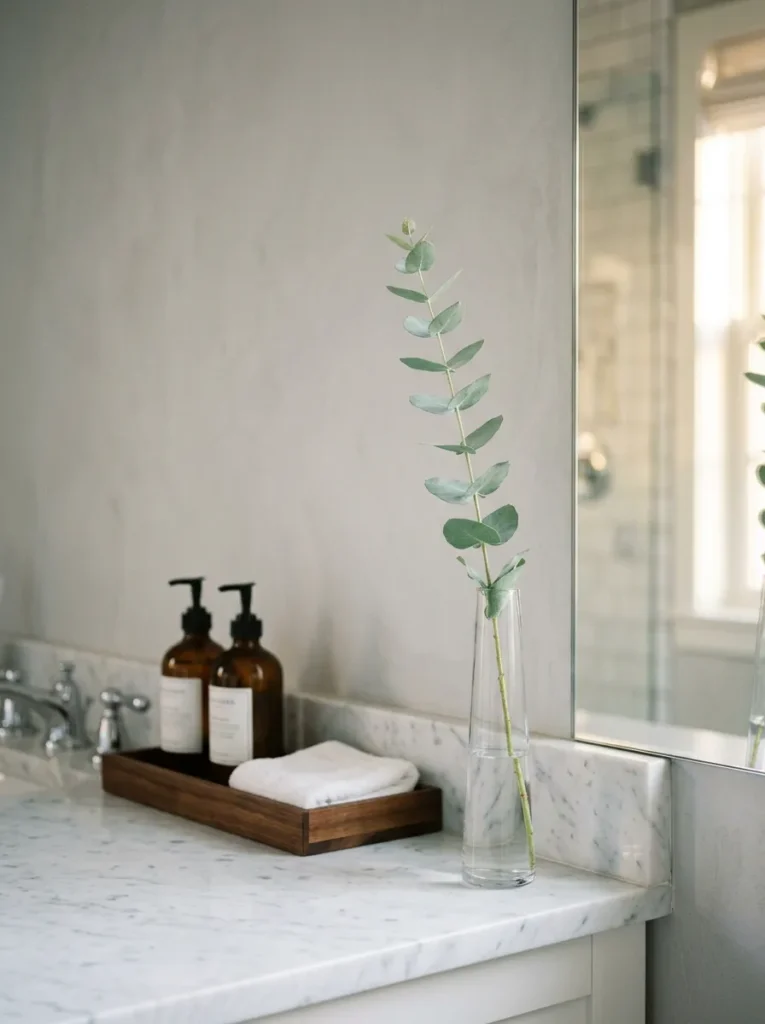
An organized bathroom counter with nothing on it except a soap dispenser and a tray of skincare products is functional. One considered decor element elevates it from functional to finished. The decor element creates the visual anchor that makes the counter feel designed rather than merely organized.
The choices that work without reading as additional clutter: a small potted succulent or trailing plant in a ceramic pot, a single sprig of eucalyptus in a slim glass vase with a few inches of water, a linen-wrapped reed diffuser in a coordinating vessel, a natural stone object of some personal meaning, or a small ceramic candle in a glaze that coordinates with the tray. The element should be singular: one thing, chosen deliberately, that completes the composition without competing with the functional items for the eye’s attention. One plant. One candle. One object. The restraint is the design decision.
21. Do a Monthly Counter Reset to Prevent Gradual Drift
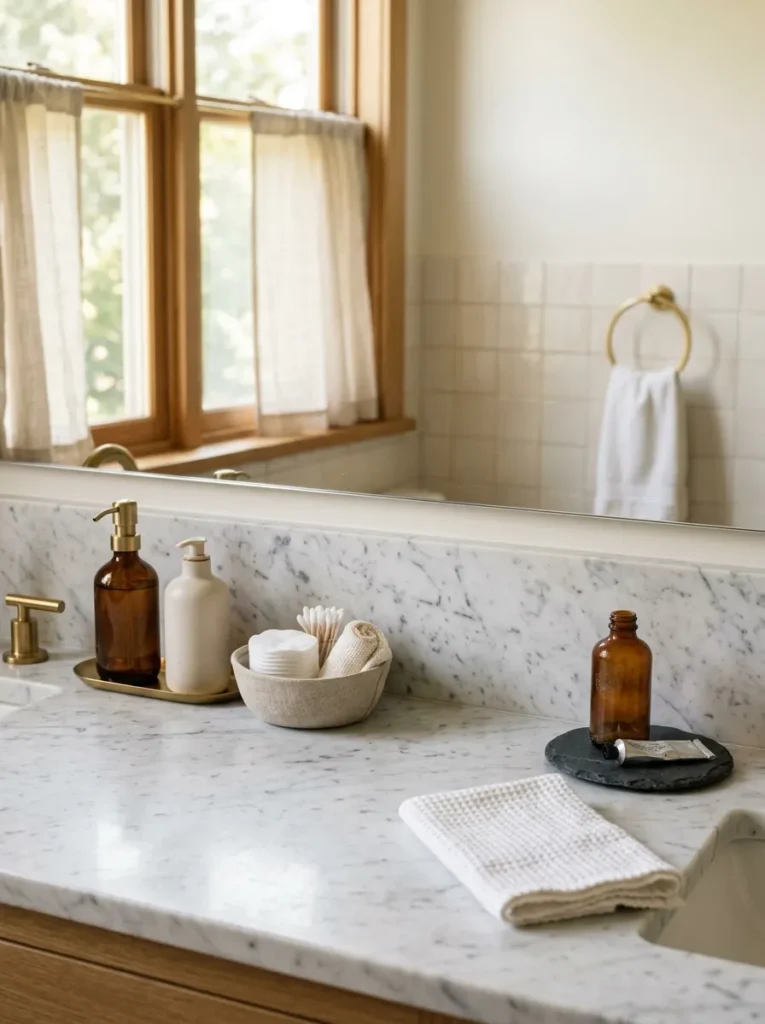
No bathroom counter organization system maintains itself indefinitely. Products accumulate as the daily-use rule becomes selectively applied. New purchases arrive and sit temporarily on the counter before finding a permanent location. Empty containers aren’t discarded promptly. A category that had a designated home six months ago no longer matches current products. Within a few months of any organizing session, a well-designed system can drift back toward the clutter state it was originally organized out of.
A monthly counter reset — fifteen minutes at the end of a weekend morning — catches this drift before it compounds. Remove every item from the counter, wipe the surface clean, discard any finished products, assess whether any recent arrivals have genuinely earned daily-use status or should be stored elsewhere, and return each item to its correct designated position. Monthly is the appropriate interval for a bathroom counter specifically — the surface area is small, the accumulation rate is fast, and the consequences of a missed reset are visible every morning. The reset keeps the system current rather than allowing it to become gradually unrecognizable from the original design.
Common Mistakes to Avoid
Organizing before editing. Adding a tray, a riser, and new containers to a counter that contains 40 percent unnecessary items produces a more elaborately cluttered counter. The edit is the first step, not an optional preliminary.
Buying a large tray on a small counter. A tray that covers most of the counter surface leaves no working space around it. The tray’s function is to define a zone within the counter, not to replace the counter surface. On a small counter, choose the smallest tray that holds the daily essentials — the visible counter margin around the tray is what makes the tray read as intentional.
Storing haircare tools on the counter between uses. A hairdryer and curling iron left coiled on the counter between daily uses occupy significant space and communicate utility rather than calm. Even items used every day should have an off-counter storage location they return to when not in use.
Using mismatched containers throughout the counter. Three different material containers — a plastic holder, a glass dish, a wire caddy, and a ceramic jar — on the same counter create visual chaos even when every item has a designated home. Commit to a single material family within the counter’s organization system.
Relying on the morning rush to motivate the return step. The return-to-storage habit (Idea 16) needs to be built into the end of the routine as a fixed step, not approached as something that happens when there’s time. A system designed for easy return — where every item has a close, accessible home requiring one motion — makes this habit sustainable even on rushed mornings.
Treating the medicine cabinet as general overflow storage. A medicine cabinet that holds expired medication, old products, and items without designated homes is not organized storage — it’s a closed clutter zone. The same edit principle that applies to the counter applies inside the medicine cabinet.
Final Thoughts
A bathroom counter reflects the morning routine that happens in front of it. If the routine is scattered — products from multiple locations, unclear homes for each item, no return habit at the end — the counter will show it. If the routine has been edited to its minimum effective set, each item has a specific accessible home, and the return step is built into the end of every morning, the counter maintains itself with minimal effort.
Start with the honest edit. Apply the daily-use rule. Choose a tray that defines rather than covers the surface. Mount the toothbrush holder on the wall. Separate skincare from haircare. Give each person in a shared bathroom their own container. Choose uniform dispensers that make functional items into decor. Reserve visible empty space.
The bathroom counter that stays organized isn’t the one with the most organizers — it’s the one with the fewest items that genuinely belong there, each with a clear home and a habit to return to it.