17 Teen Bedroom Ideas That Feel Stylish and Functional
Teen bedrooms are asked to do more than adult bedrooms. They need to function as a study space, a place for friends, a personal expression zone, and a sleep environment — all at the same time, usually in the least square footage the house offers. And they need to do this while accommodating someone whose aesthetic preferences can shift significantly from one school year to the next.
The difficulty in designing a teen bedroom is its dual audience. The teen wants ownership — a space that reflects their specific identity and current interests. The parent wants longevity — a design that doesn’t need to be completely rebuilt the moment the current trend passes. Both of these requirements are reasonable. The bedrooms that satisfy both start with a neutral, adaptable foundation and invest their expressive energy in things that can be changed without a renovation: textiles, wall art, and lighting rather than paint colors and permanent furniture.
These 17 teen bedroom ideas work through practical function first and style second — because a room that works well is one a teen will actually want to spend time in.
1. Start with a Neutral Base That Can Support Any Style Over Time
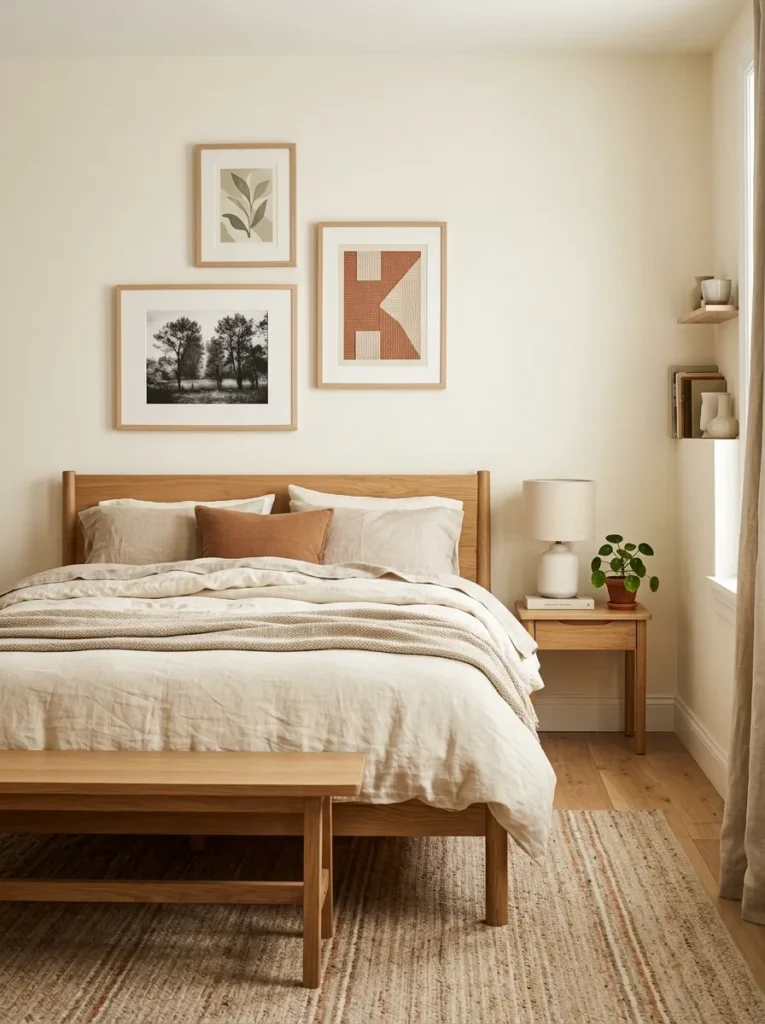
The single decision that protects every other investment in a teen’s bedroom is choosing a wall color and major furniture in a neutral tone. Teens change their aesthetic identities — from minimalist to maximalist, from cottagecore to dark academia — sometimes within the same year. A room built on warm white, soft greige, or warm light grey walls with natural wood or white furniture can absorb every one of those changes without requiring a repaint or furniture replacement.
This isn’t about building a boring room. It’s about understanding where the room’s character should live. A neutral wall is the most generous canvas available — it accepts a gallery wall of band posters, a string of warm lights, a bold bedding swap, or a dramatic rug change without fighting any of them. The neutral base doesn’t define the room’s personality; it defers that to the elements that can be changed inexpensively. Invest in quality for the structure. Save the expressive budget for the parts that will evolve.
2. Define Three Zones Before Choosing a Single Piece of Furniture
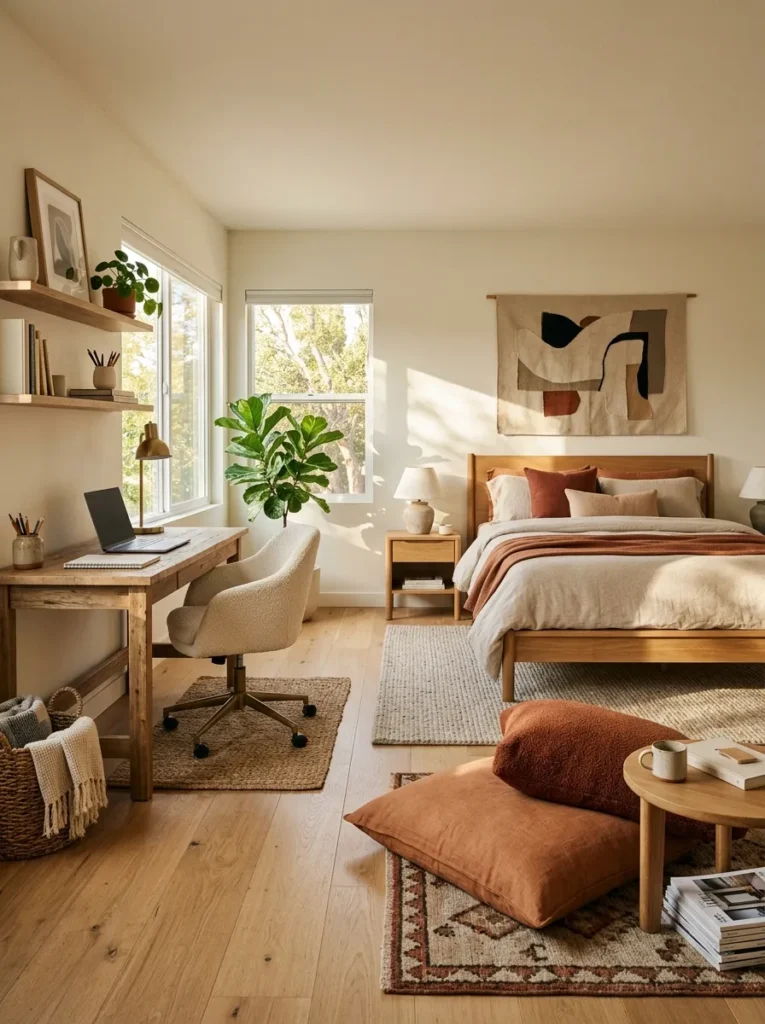
Most teen bedrooms fail functionally before a single item is purchased because the zones — sleep, study, and hangout — were never planned as separate areas. Without defined zones, everything gets placed where it fits rather than where it functions, and the room ends up serving all three needs poorly rather than any one of them well.
The practical starting point: map the room on graph paper and assign each zone a specific footprint before shopping for anything. The sleep zone needs enough space around the bed for morning movement. The study zone needs natural or task light, a surface large enough for a laptop and an open book simultaneously, and storage within arm’s reach for school supplies. The hangout zone — even if it’s only two floor cushions in a corner — needs a location that doesn’t interfere with either of the other zones. Small rooms can use rugs and furniture placement to signal zone boundaries without any physical separation.
3. Design the Study Zone to Actually Support Focused Work
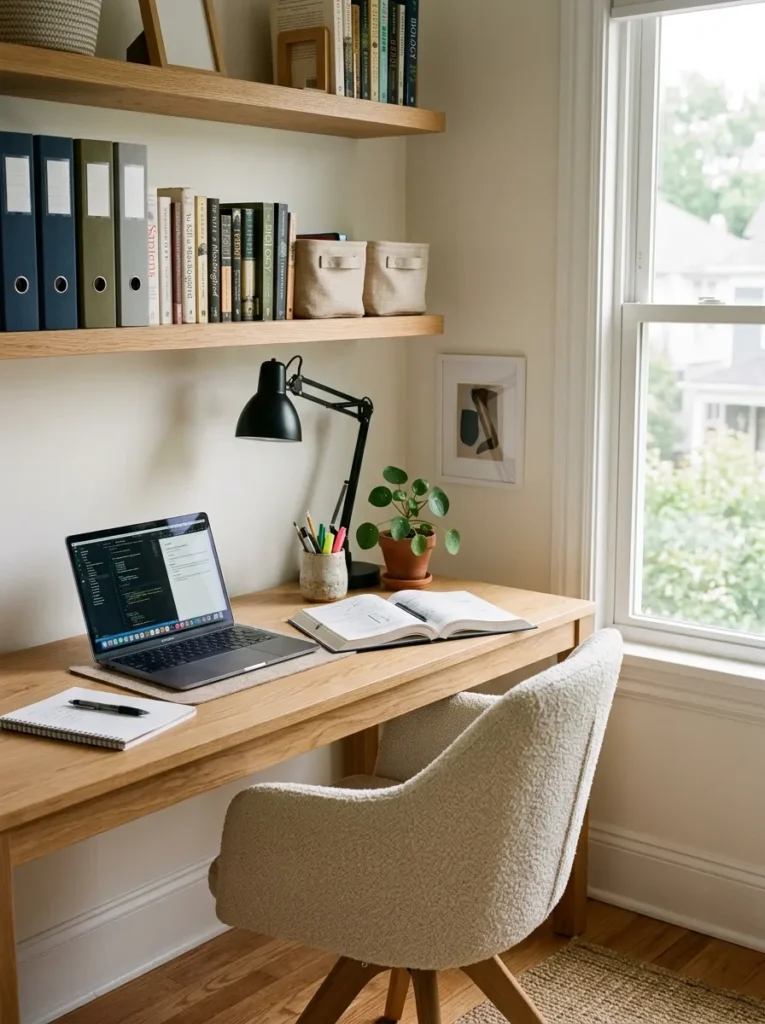
The most commonly executed element in teen bedroom design is also the most commonly failed: the study zone. Adding a desk and calling it a study area is how most bedrooms handle this requirement — but a desk in the wrong location, with inadequate light and no nearby storage, produces a space a teen will consistently choose to avoid in favor of studying on the bed or couch.
A study zone that genuinely works requires three things: a surface wide enough for a laptop plus physical workspace (at minimum 40 to 48 inches wide), a dedicated light source at the desk rather than relying on overhead room lighting, and storage within arm’s reach for the materials used during study sessions. Wall-mounted shelves directly above the desk keep materials accessible without taking desk surface area. Position the desk near the window when possible — natural light during daylight study hours and the mood lift of looking outside during breaks both contribute to how often the space actually gets used.
4. Choose a Bed Frame That Will Still Look Right at Twenty-Two
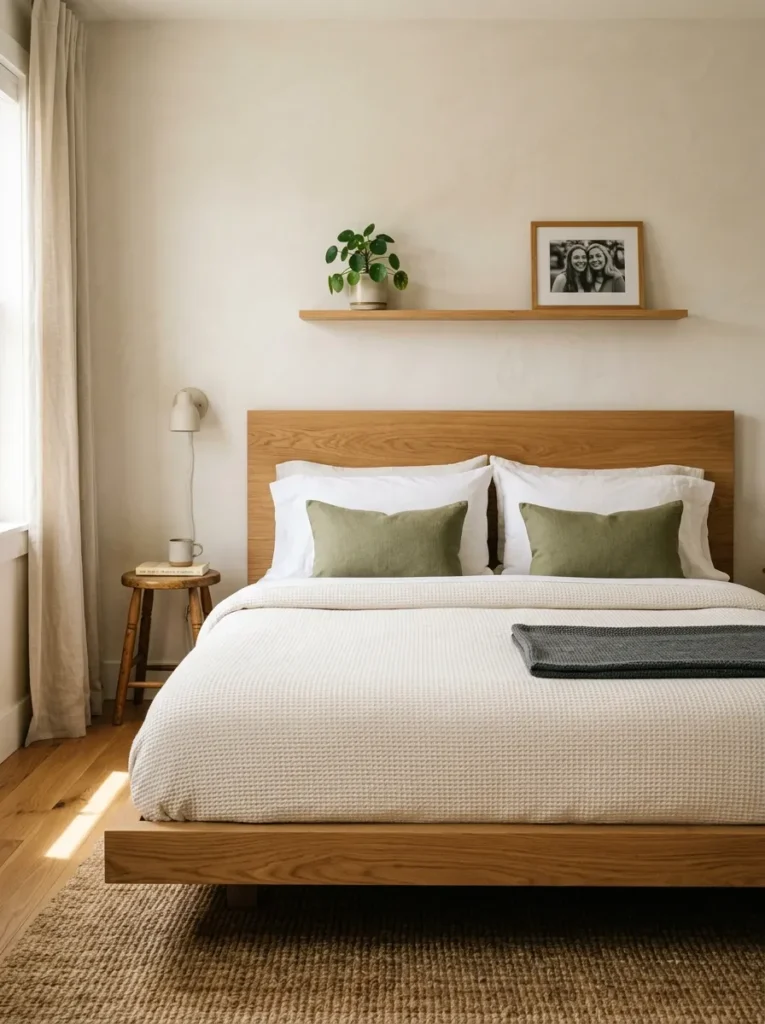
The bed frame is the largest furniture purchase in the room and the hardest to change once it’s in place. It should look good for the full duration of a teen’s time in the room — which, depending on age at purchase, can be anywhere from four to eight years and may continue into young adulthood. Bed frames with strong visual themes — ornate princess headboards, novelty metal frames, highly stylized shapes — tend to have a narrow window of age-appropriateness. A frame that suits a 14-year-old often reads as awkward by 18.
Platform beds with clean lines in natural wood tones (oak, pine, walnut-finished MDF) or simple upholstered frames in a neutral fabric consistently read well across the 14 to 22 range. Storage beds — those with built-in drawers in the base — add function without adding visual complexity and are worth the investment in any teen bedroom where floor storage space is limited. The headboard specifically should be chosen for longevity: simple is always safer than elaborate.
5. Go Vertical with Storage to Recover Floor Space
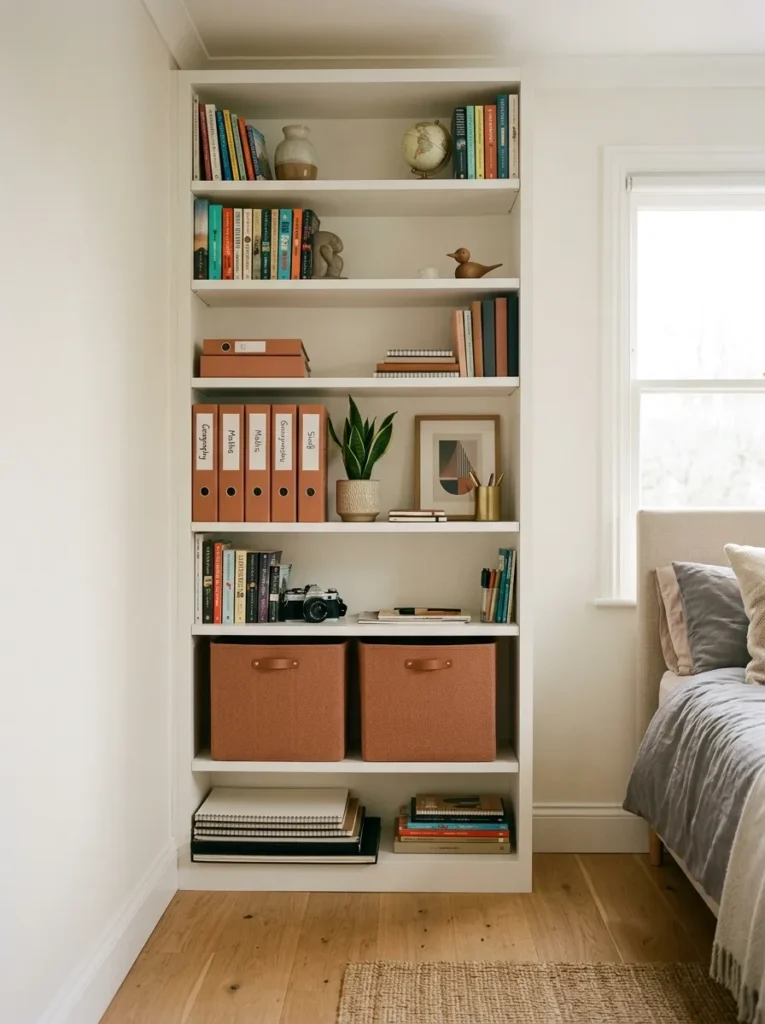
In most teen bedrooms, the floor plan is fixed and limited. The wall space is not. Floor-to-ceiling bookshelves, wall-mounted shelving systems, pegboards above desks, and over-door storage organizers all convert unused vertical wall space into functional storage without reducing the room’s circulation area.
The practical priority in a teen’s room: books and school materials at accessible height (between shoulder and eye level when seated at the desk), display items and less-used objects higher up, and heavier or bulkier storage closer to the floor. A standard KALLAX or BILLY-style unit used as both storage and room divider can visually separate the sleep and study zones in a smaller room while providing substantial shelf space. For teens who use their bedroom as a base for a hobby — music, art, sports, gaming — one wall of dedicated vertical storage for that hobby prevents the hobby from colonizing every flat surface in the room.
6. Solve the Teen Storage Problem with Dedicated Zones for Each Category
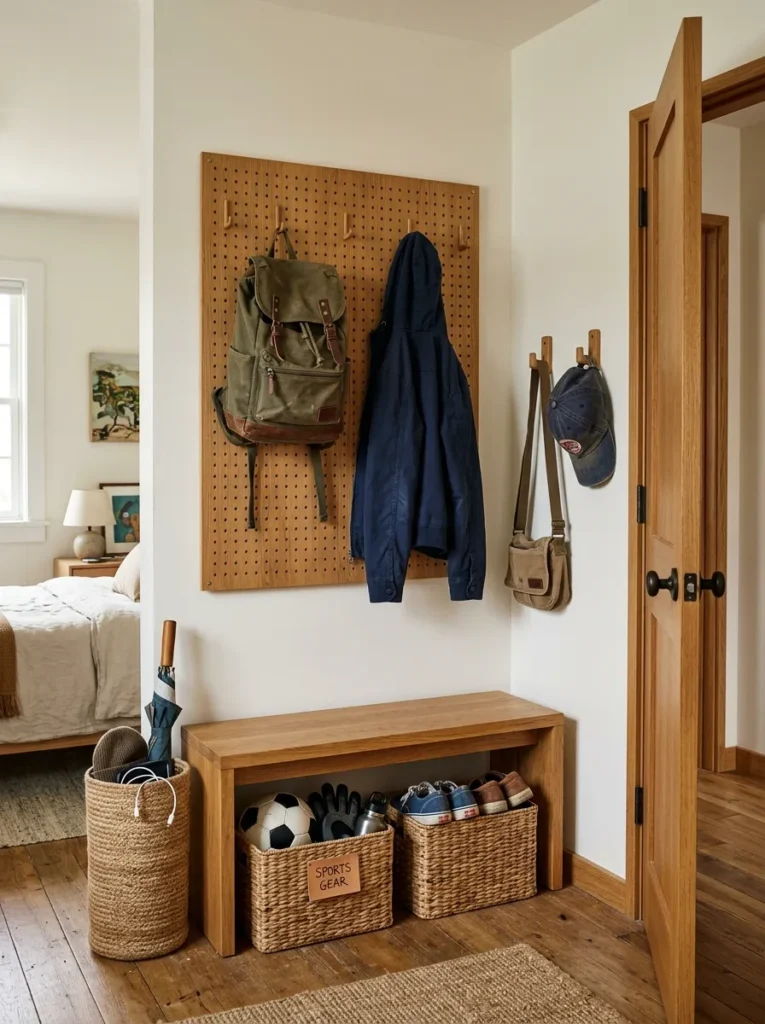
Teens have a specific and often underestimated range of belongings that standard bedroom storage doesn’t accommodate: shoes in large quantities, charging cables and tech accessories, cosmetics and grooming products, sports equipment, art or craft supplies, and a seasonal rotation of clothing that may or may not fit in a standard closet. Providing dedicated storage for each category is the practical difference between a teen’s room that stays organized and one that doesn’t.
The category approach: assign a specific location for every category of belonging before the room is finished, not after. A row of hooks at accessible height near the door for bags and frequently rotated outerwear. A drawer or box specifically for tech cables and accessories. A clear organizer inside the closet door for cosmetics and grooming items. A basket or bin at the room’s entry for sports gear that gets used multiple times a week. When everything has an assigned location, the barrier to tidying is psychological rather than logistical — and that’s a significantly more manageable problem.
7. Use Under-Bed Storage for Seasonal and Infrequently Used Items
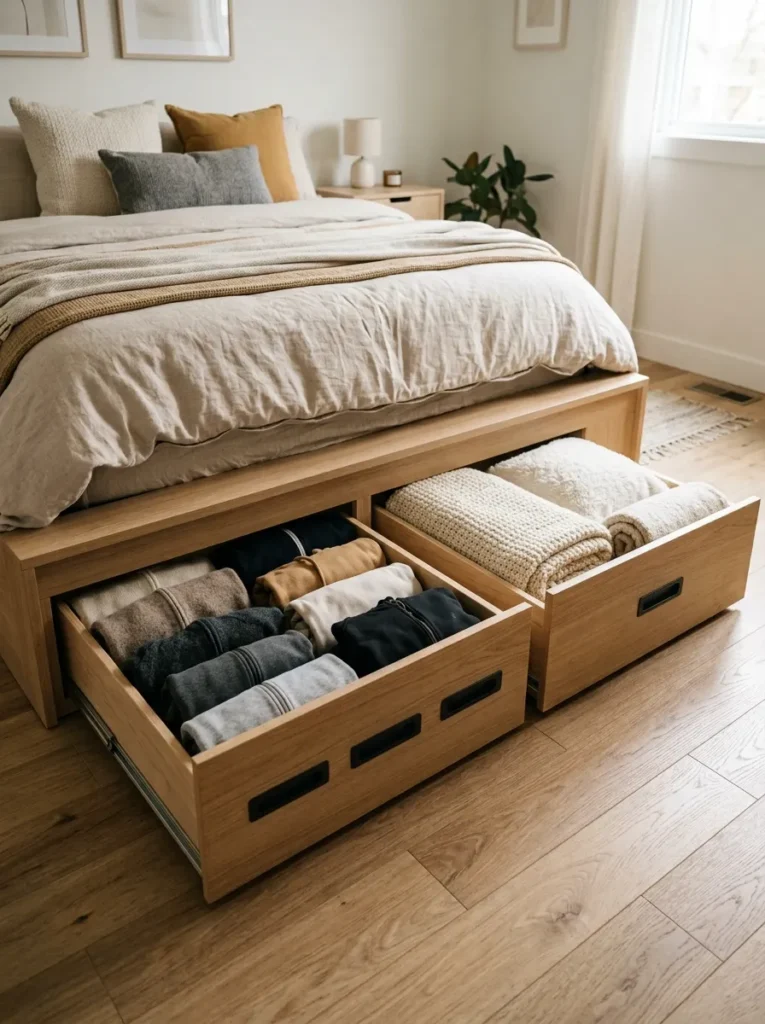
Under-bed storage is one of the most reliable space-recovery strategies in a small teen bedroom, and one of the most underused. A standard queen or full bed frame leaves roughly 7 to 10 inches of vertical clearance under the mattress — enough for flat storage bins, rolling drawers, or a bed with built-in under-bed drawers that extend to fill the entire base perimeter.
The most effective use of under-bed storage in a teen bedroom: seasonal clothing and bedding (summer items stored under the bed during winter and vice versa), spare bedding, extra pillows, and seldom-used sports or hobby gear. Under-bed storage works best when it’s dedicated and organized — not a catchall for everything that doesn’t have another place. Use labels on flat bins or drawers so the teen can find seasonal items without removing everything to search. For beds with no built-in clearance, bed risers create the necessary height at very low cost.
8. Create an Expressive Wall Space with Removable Methods
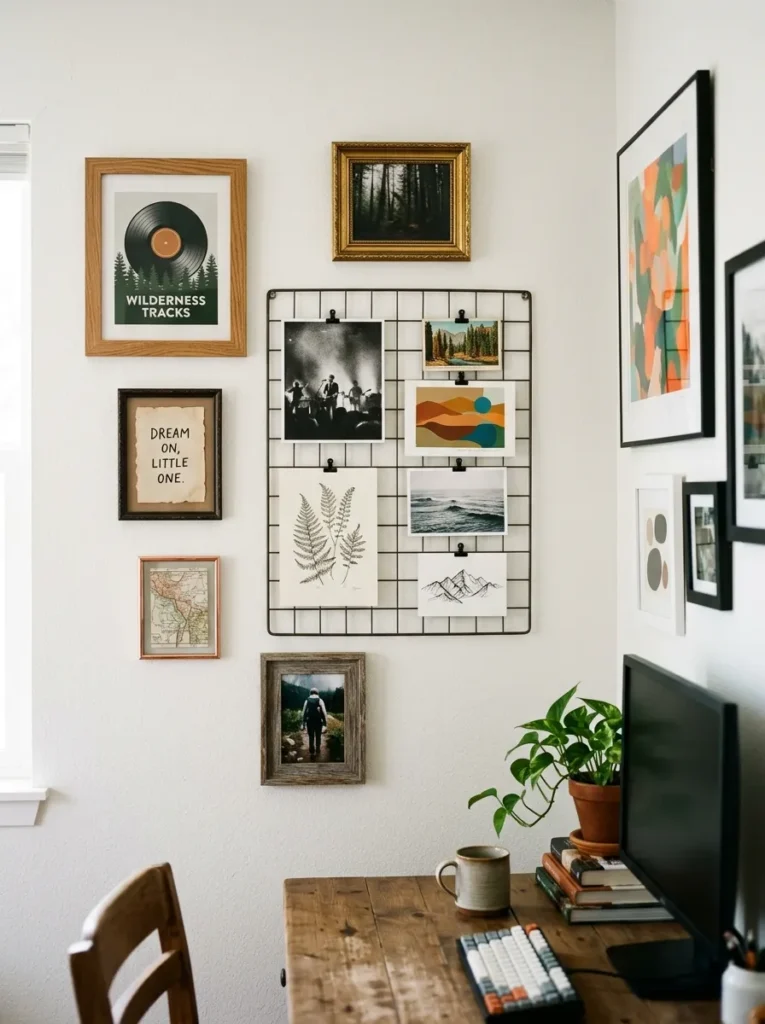
Wall space in a teen’s bedroom is the primary canvas for personal expression, and the temptation is to commit to it permanently — a mural, a bold accent wall in the current favorite color, custom wallpaper. The problem: a 15-year-old’s color choice and a 19-year-old’s taste often don’t overlap, and repainting is a bigger undertaking than a seasonal bedding change.
The alternative that provides the same expressive result without permanence: removable picture hanging strips for art and prints, washi tape or painter’s tape for creating patterns, peel-and-stick frames, and clipboards or wire grid panels for displaying photos and art that gets rotated seasonally. A curated gallery of things the teen actually loves — photos of friends, art they’ve made, prints from bands they listen to, cards received from significant people — reads as more genuinely theirs than a professionally styled feature wall and costs almost nothing to change as taste evolves.
9. Apply One Bold Accent in a Reversible Way
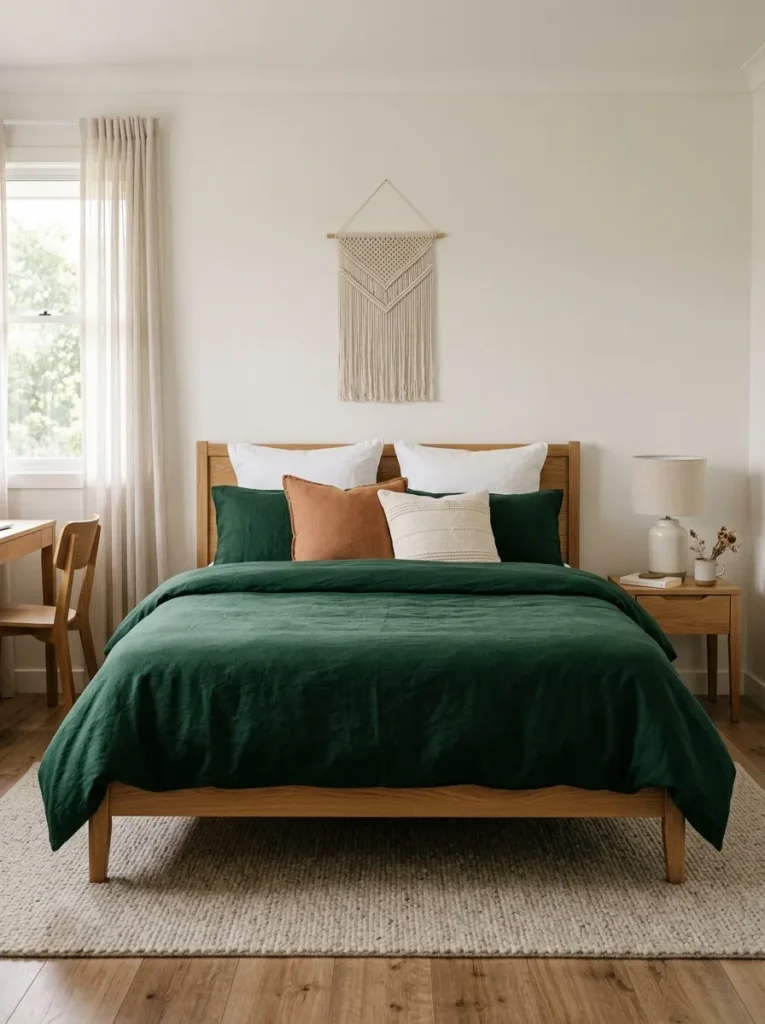
A teen’s bedroom that’s entirely neutral and restrained can feel like a guest room rather than a personal space. The counterbalance: one deliberate, bold design choice that gives the room its character. The principle that keeps this from becoming a problem: make that choice reversible.
Bold bedding is the lowest-stakes, highest-impact option. A deep emerald duvet cover, a color-blocked set in terracotta and cream, a graphic print with personality — any of these completely changes the room’s character and can be swapped out for under forty dollars when taste changes. A bold rug is similarly reversible. Removable wallpaper on a single wall behind the headboard gives a dramatic feature wall effect that peels off cleanly. LED strip lights — currently popular but with a visual shelf-life — can be a fine addition when they’re treated as the changeable element rather than the permanent personality of the room.
10. Layer the Lighting with Three Sources for Study, Ambiance, and Mood
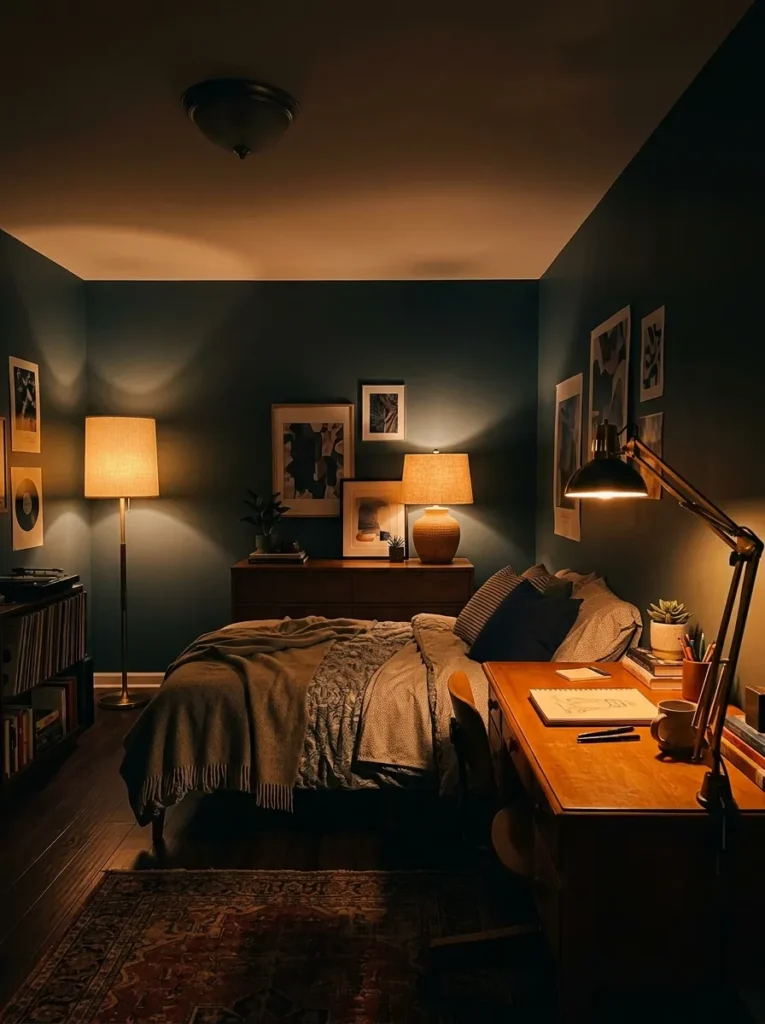
A single overhead light is the default for most teen bedrooms and the thing that makes them feel the most institutional. Teen bedrooms are used late in the evening for studying, socializing, and relaxing — each of those activities needs different light quality and intensity, which a single overhead fixture cannot provide.
The three-layer framework: a task light at the desk (an adjustable arm lamp or a clip-on light that directs brightness precisely at the work surface), a bedside or room lamp for ambient evening use, and a lower-level atmospheric source for relaxed evening time — a floor lamp in the corner, a lamp on a dresser, or a cluster of LED candles. Each layer should have its own switch or be independently controllable. A dimmer on the overhead fixture converts a flat, bright room into a genuinely flexible space for the cost of the dimmer switch alone.
11. Add a Mirror That Works Both Stylistically and Practically
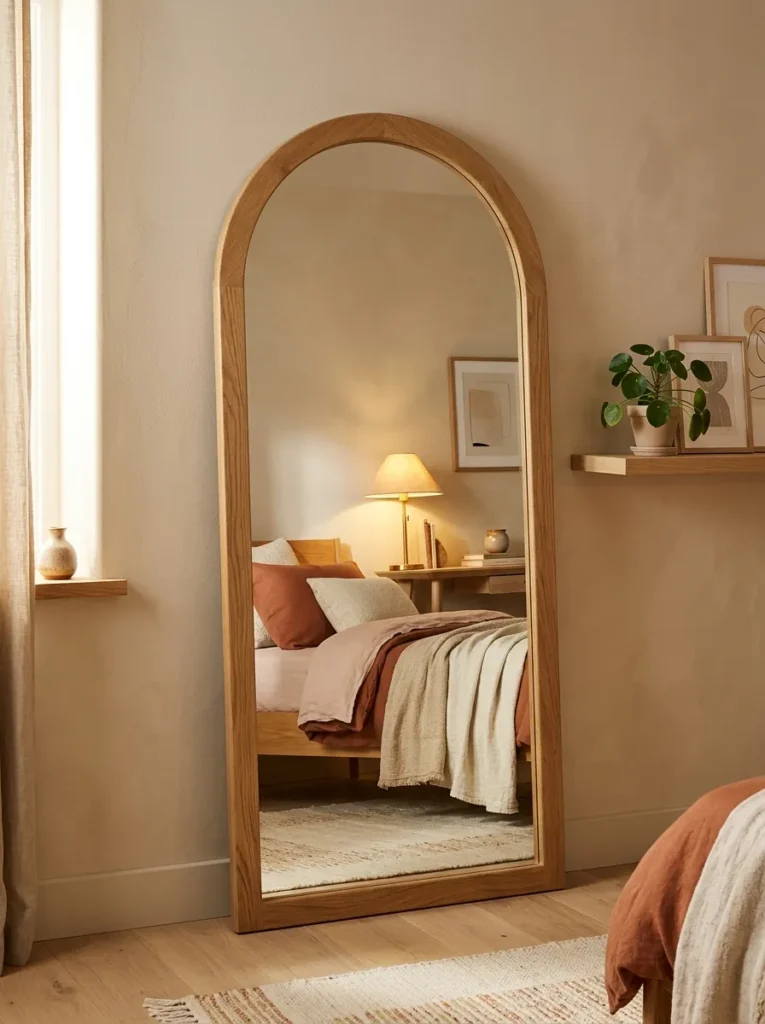
A mirror in a teen’s bedroom is not decorative — it’s used several times a day as a grooming tool. The design mistake is treating it as decorative when a purely functional frameless mirror doesn’t do either job well: it’s not stylish enough to read as design and not positioned or sized correctly for practical morning use.
An arched full-length mirror in a warm wood frame or a simple metal frame serves both purposes well: it’s large enough to be genuinely useful, it contributes a stylistic element to the room, and it amplifies whatever natural light the room receives. Position it on the wall adjacent to the window rather than directly opposite — this bounces light across the room rather than creating a direct window reflection that washes out visibility. For a smaller room, a mirror leaning against the wall takes up no floor footprint while reading as a deliberate design choice.
12. Create a Flexible Hangout Zone for Friends
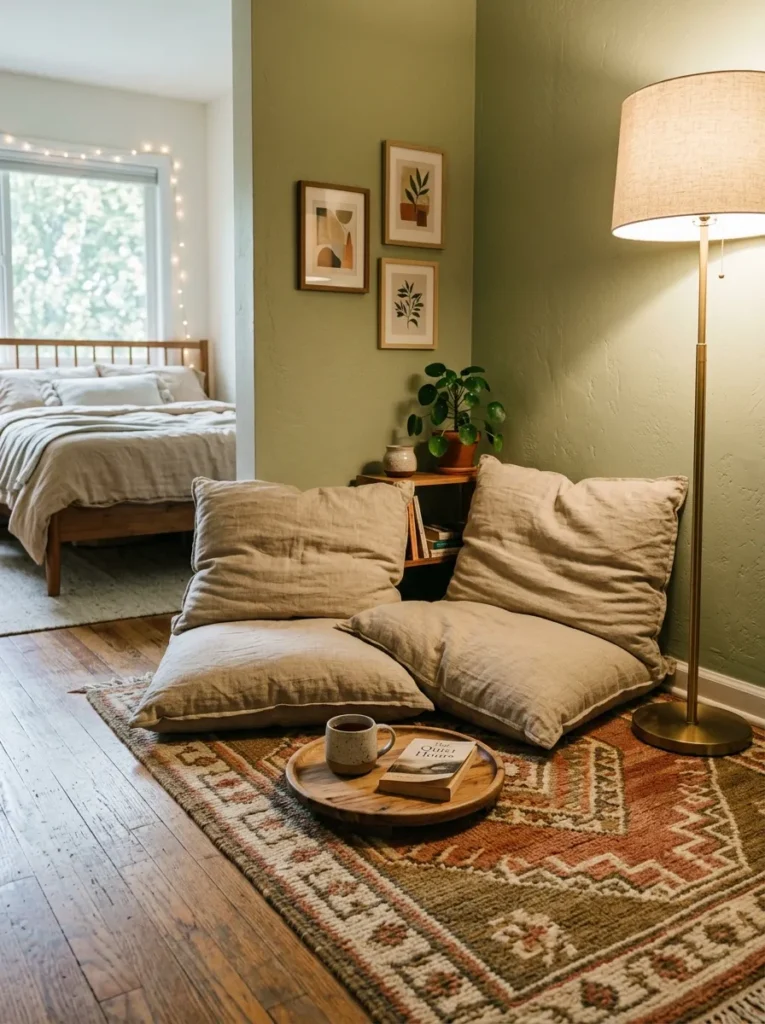
A teen bedroom that has nowhere for a friend to sit — other than the bed — is a bedroom that reads as closed to social use. Creating a hangout zone that works for one or two people visiting doesn’t require a sofa or a large footprint. Two large floor cushions, a bean bag chair, or a reading chair in a corner with a small side table provides enough seating for casual social use without compromising the room’s circulation when no one’s visiting.
The key is that the hangout zone needs to be genuinely comfortable for sitting and talking, not just adequate. A single floor cushion that’s too thin to sit on comfortably is worse than no dedicated seating because it signals that visitors weren’t really planned for. Oversized floor cushions in durable, washable covers — linen, cotton canvas, or a performance velvet — serve the room better than decorative items that look comfortable but aren’t.
13. Use Area Rugs to Define Zones and Warm the Floor
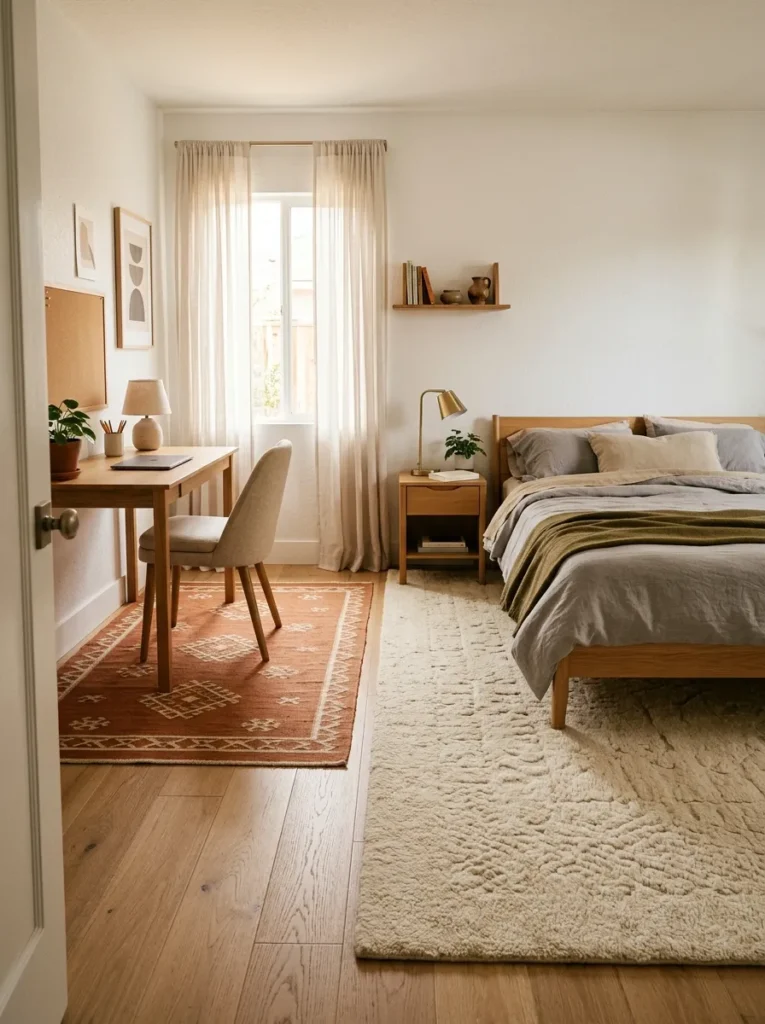
In rooms with hard flooring, an area rug is the most economical zone-defining tool available. A rug beneath the desk and chair that’s distinct from a rug beneath the bed signals visually that these are different zones within the same room — even without any physical separation. In rooms where the budget allows only one rug, placing it beneath the bed so that it extends 18 to 24 inches on each side creates the grounding that makes a teen bedroom feel finished rather than staged.
For teen bedrooms specifically, rug durability matters as much as appearance. High-traffic flat weaves, wool blends, or washable synthetic rugs handle the actual use a teen bedroom generates — sitting on the floor, spilling drinks, sliding across in socks — better than delicate or high-pile materials that show every compressed footprint. A rug with some pattern or color in it can introduce the room’s expressive energy while still reading as a furniture-level design decision rather than a trend.
14. Let the Desk Chair Be a Style Statement
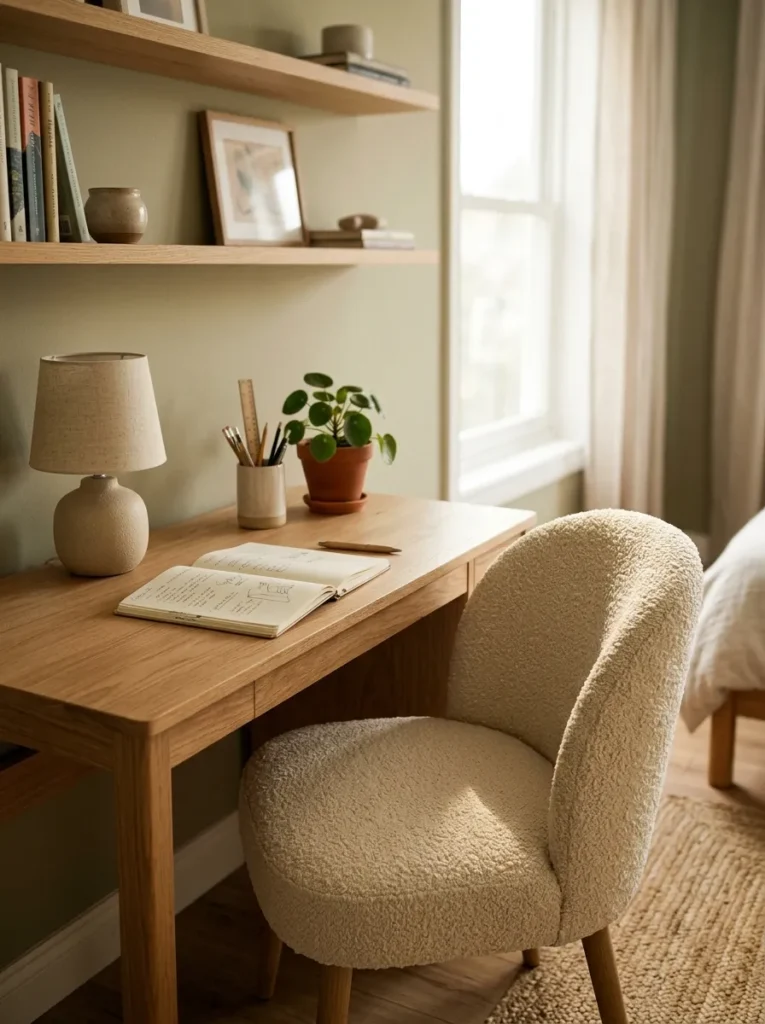
The desk chair is the piece of furniture a teen uses most hours per day in their bedroom, and it’s the piece most often chosen as an afterthought — bought cheaply because the desk took the furniture budget and the chair was the remaining line item. The visual result of this approach is a chair that looks wrong for the room regardless of how well everything else is styled, because a basic black office chair in an otherwise warm and considered bedroom reads as visual noise.
The desk chair is an opportunity to introduce both comfort and character. A boucle or woven accent chair that doubles as desk seating in a less intensive study room. A contemporary task chair in a warm color that coordinates with the room’s palette rather than the generic black of an office supply catalog. A mid-century-inspired wood and cushion chair that reads as furniture rather than equipment. Whichever direction, choosing a chair deliberately — at the same time as the desk — prevents the mismatch that undermines the room’s overall visual coherence.
15. Design a Display System for Trophies, Collections, and Meaningful Objects
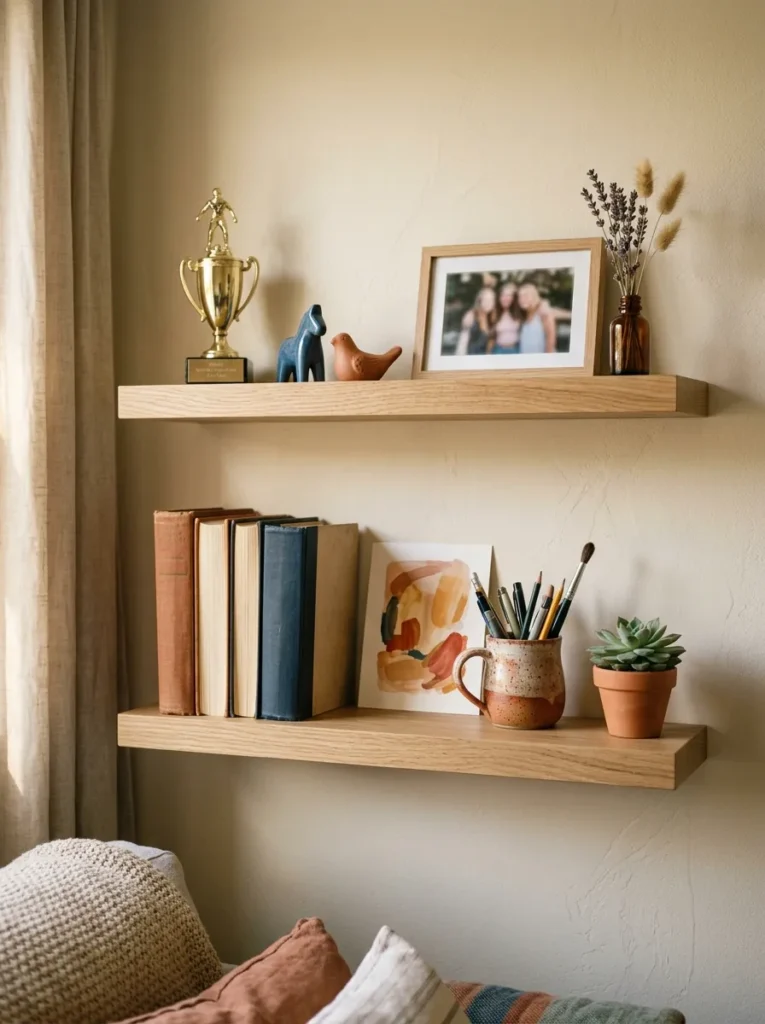
Teen bedrooms accumulate objects: sports trophies, figurines, book collections, vinyl records, camera equipment, gaming peripherals, art projects, and gifts with personal significance. Without a system for displaying these things, they end up covering every flat surface and the room reads as cluttered even when each individual object is meaningful. With a system, the same objects read as a curated collection.
The simplest effective system: dedicate one or two floating shelves specifically to display objects, positioned where they can be seen from the bed and from the desk. Objects on these shelves should be chosen deliberately — the things the teen most wants to look at on a daily basis, not everything they own. Other meaningful objects can be rotated in seasonally or stored in a keepsake box. The display shelves themselves can be styled with a mix of trophy/achievement items and personal objects to prevent the shelves from reading as a trophy case rather than a personal expression zone.
16. Make the Bed the Visual Anchor Without Over-Theming It
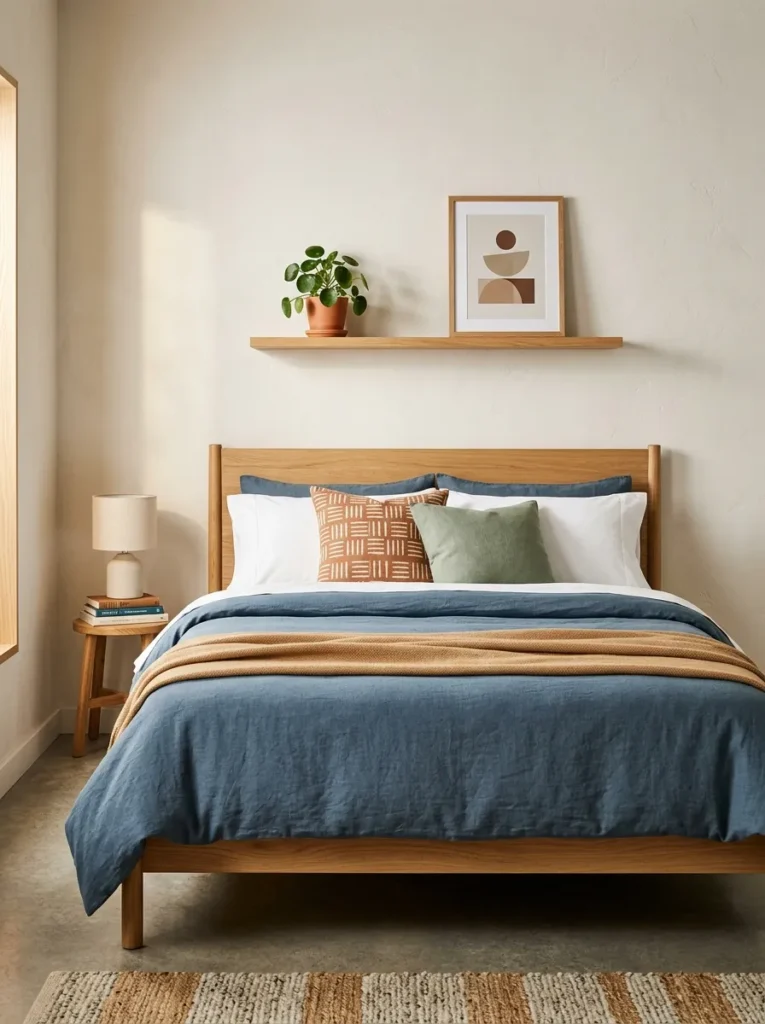
The bed is the largest visual element in most teen bedrooms, which means how it’s styled determines more of the room’s character than any other single decision. The temptation with teen bedrooms is to theme the bedding — sports team colors, character prints, brand logos — which produces a result that looks age-appropriate for approximately two years before reading as either childish or too-loyal to a passing interest.
Bedding that serves as a lasting visual anchor without theming: a solid color duvet cover in a room-coordinating tone, a textured or pattern duvet cover with geometric or abstract print that reads as design rather than branding, or a classic stripe. Add one or two accent cushions with personality (a quote, a graphic print, a contrasting texture) for the expressive element. The base bedding stays neutral enough to survive preference changes; the accent cushions get swapped seasonally. Style the bed daily — even a simple arrangement of two sleeping pillows and the duvet pulled smooth — because a made bed is the fastest way to make the entire room feel composed.
17. Leave Growth Space — Design for the Teen They’re Becoming
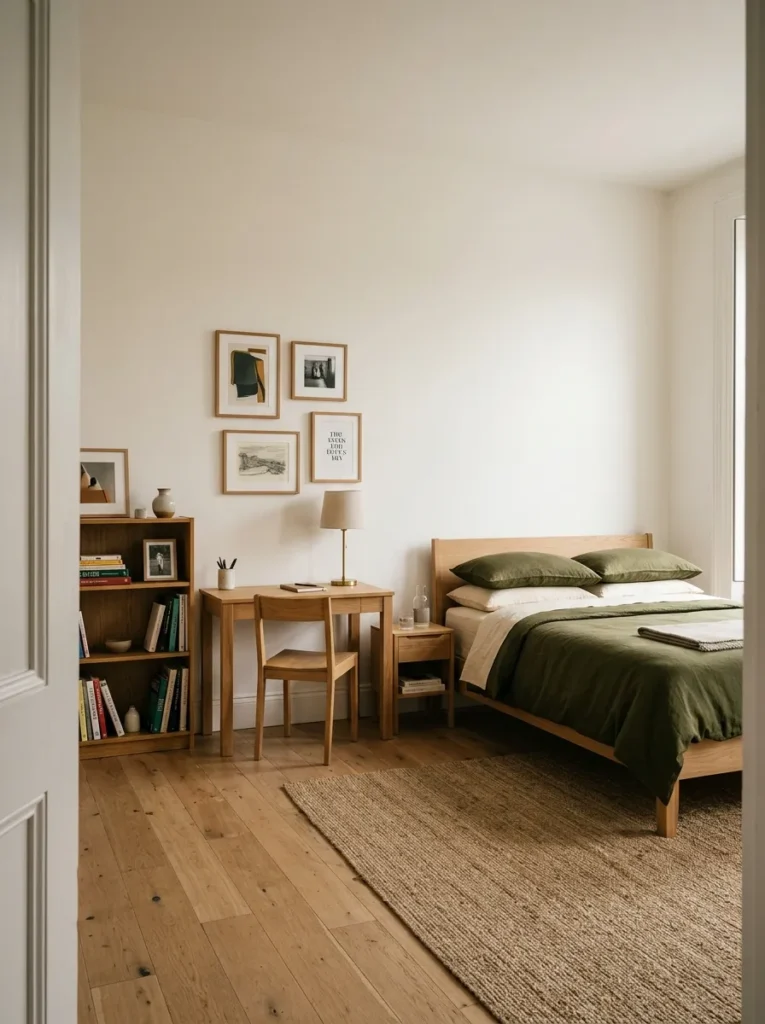
The most honest design principle for a teen bedroom, and the one that separates good design decisions from expensive regrets: a 15-year-old and a 19-year-old are not the same person, and the bedroom should be designed with that trajectory in mind. This doesn’t mean designing a room that looks prematurely adult — it means avoiding design choices that will feel definitively childish within a few years.
The practical application: invest in foundational furniture that reads well across the full 14 to 22 age range (neutral bed frame, quality desk, bookcase with room for evolving collections). Give the room its personality through textiles, art, and lighting that can be swapped as taste matures. Avoid custom themed furniture, elaborate novelty storage systems, or paint colors so specific to a current interest that they’d require full repainting to change. Design in enough unassigned wall space that the room can accommodate new artwork and interests as they emerge. The room that grows with the teen is the room that doesn’t need to be redone in two years.
How to Design a Teen Bedroom Together
The bedrooms that teen kids genuinely love — and actually take care of — are almost always the ones they had meaningful input into. Not unlimited choice, but a structured conversation that gives the teen ownership over specific decisions while parents retain oversight on the foundational ones.
Start with their interests, not a Pinterest aesthetic. Ask what they actually care about before looking at any inspiration images. A teen who is passionate about music, or drawing, or basketball, or anime has specific storage, display, and usage needs that generic teen bedroom inspiration won’t address. The personality of the room should come from those real interests.
Divide the decisions into two columns. Foundation decisions — wall color, major furniture, flooring — belong to the parent column, since these affect resale value, structural commitment, and budget significantly. Expression decisions — bedding, art, rugs, lighting accents, accessories — belong to the teen column, with a budget assigned for each. This structure prevents the negotiation from becoming adversarial.
Invest in quality where it shows up daily. The desk, the desk chair, and the mattress are the three elements that most directly affect how the teen feels during the many hours spent in the room. These are worth real investment. The trend items — the current poster, the LED light color, the themed accessories — are worth minimal investment because they’ll change.
Build in flexibility from the start. Leave open wall space. Leave a shelf or two that isn’t assigned to a specific category. Choose storage systems that can be rearranged. A room that can evolve as the teen evolves is one that never needs a full redo — just periodic refreshes.
Frequently Asked Questions
What is the most important thing to get right in a teen bedroom? The study zone, specifically its lighting and surface area. A teen who doesn’t have a genuinely functional place to study will find somewhere else to do it — the kitchen table, the couch, their phone — or not do it at all. Every other design decision in the room is secondary to whether the study zone actually supports focused work.
How do you make a small teen bedroom feel bigger? Use the walls. Floor-to-ceiling shelving, wall-mounted desk solutions, floating shelves above the bed, and a mirror positioned to bounce natural light across the room all create a perception of more space without changing the room’s physical dimensions. Keep the floor as clear as possible — the more floor visible, the larger the room reads.
How do you future-proof a teen bedroom design? Invest in neutral foundational furniture and wall colors, and express personality through textiles, art, and accessories that can be changed without significant cost. Avoid themed furniture, specialty wall treatments, and novelty items as anchoring design decisions. Leave open wall space for the room to absorb changing interests.
Should a teen bedroom have LED strip lights? LED strip lights are extremely popular right now and can add atmosphere, but they have a visible aesthetic shelf-life and are best treated as a changeable accent item rather than the room’s primary mood-lighting strategy. They work best paired with a layered lighting plan that includes a desk task light and a room lamp — rather than replacing those more functional elements.
Final Thoughts
The teen bedroom that holds up over time isn’t the one designed most boldly. It’s the one designed most honestly — with a clear understanding of what the space needs to do, who will be using it, and how much those things will change before the next design decision.
Start with the three zones. Build the neutral foundation. Invest in the study zone, the bed frame, and the desk chair. Then hand the expressive decisions — the art, the bedding, the lighting accents — to the teen, with a budget and a framework that keeps the room from being locked into a single aesthetic. A bedroom that functions well is one a teen will spend time in. A bedroom they had a hand in designing is one they’ll actually take care of.