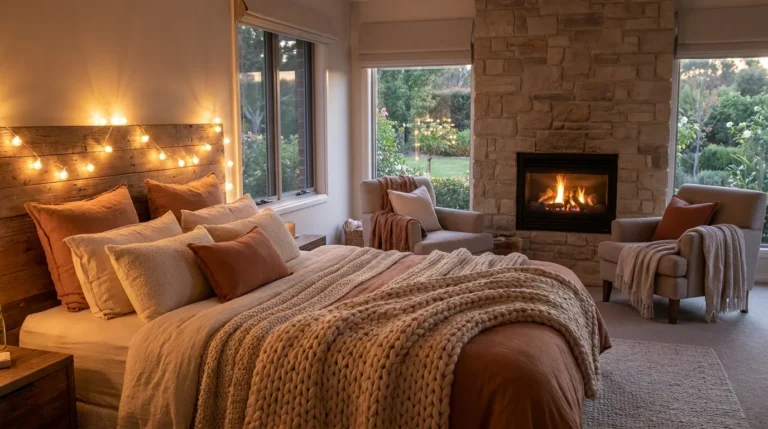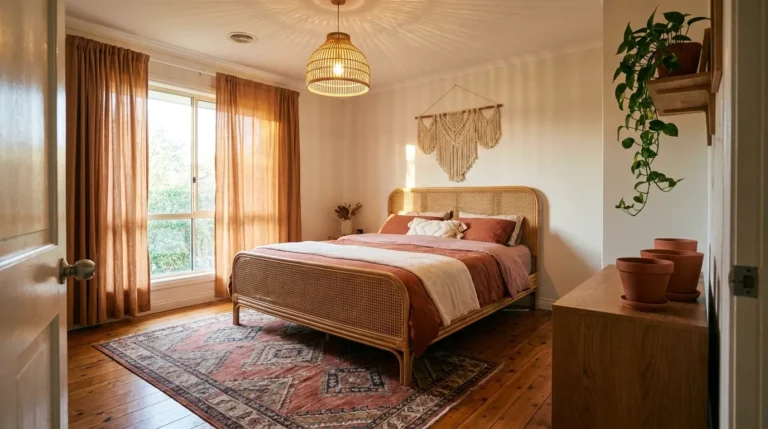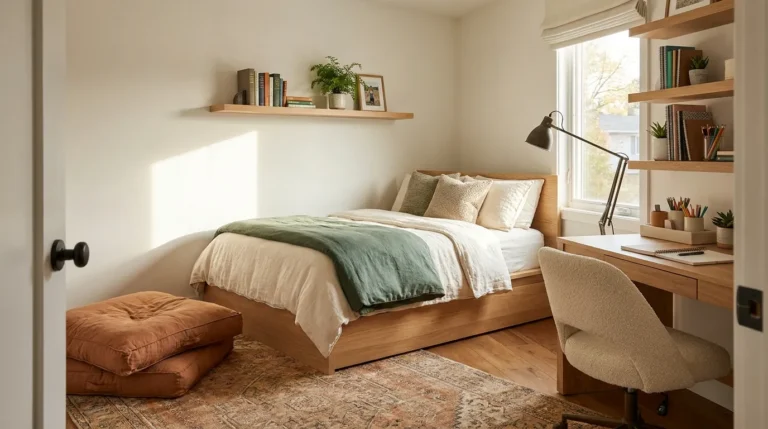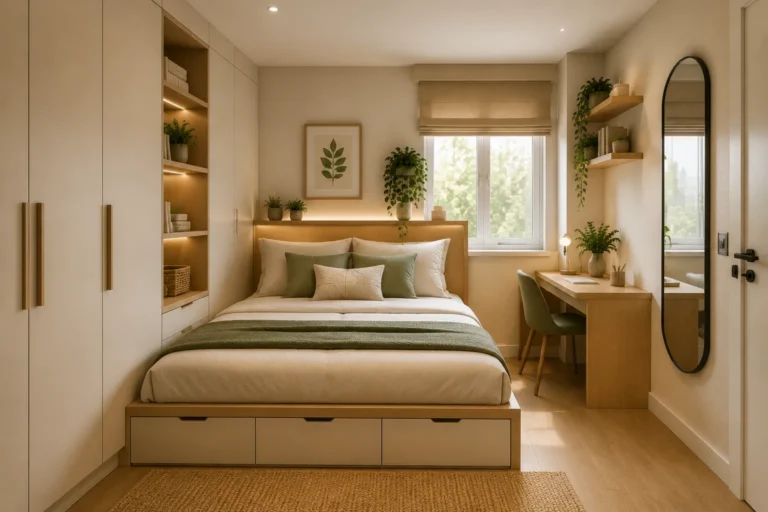
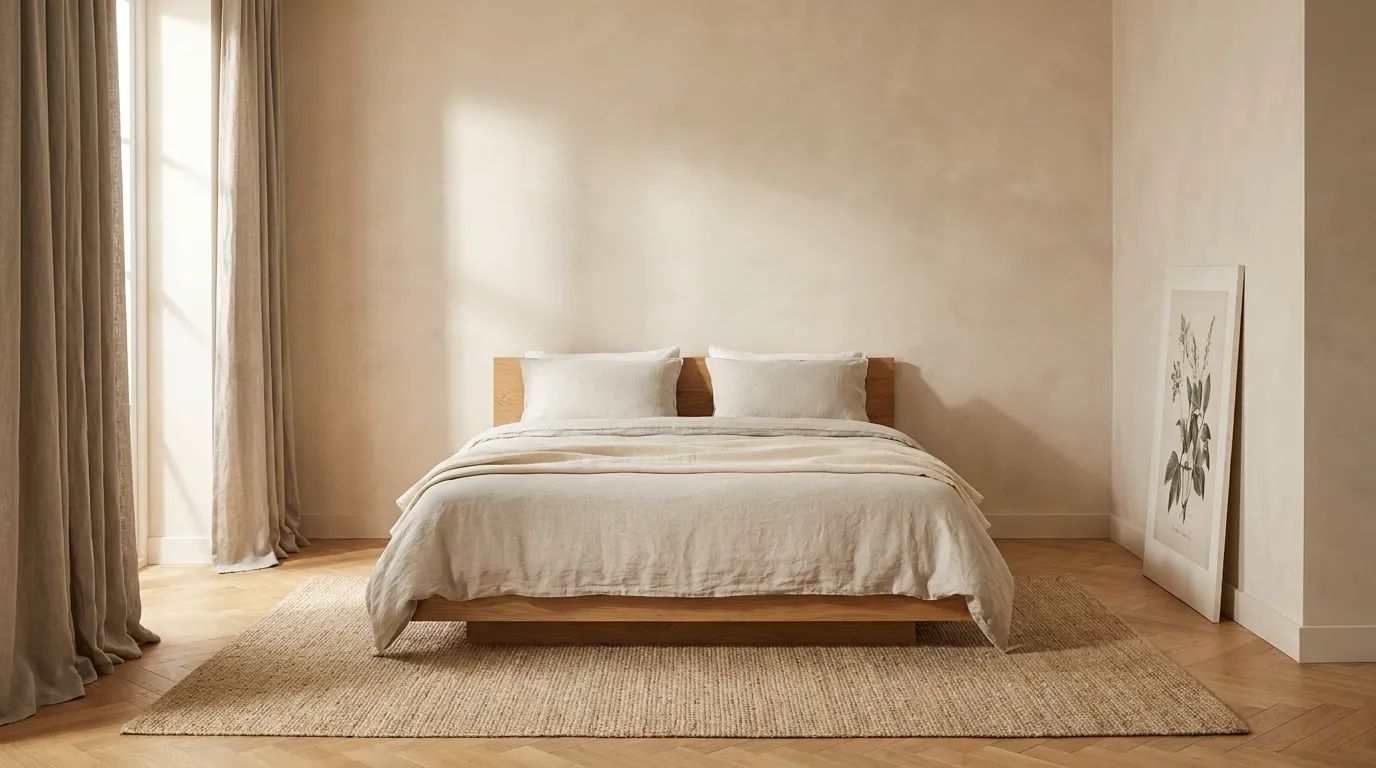
21 Minimal Bedroom Ideas That Feel Calm, Not Cold
There’s a persistent worry about minimalist bedrooms: that stripping back the clutter will strip back the warmth, leaving something that looks more like a showroom than a place to actually sleep. It’s a fair concern — and it’s also exactly where most inspiration-only articles fail readers. A room can be spare and still feel layered. It can have almost nothing on the walls and still feel considered. The difference is usually in material quality, proportion, and a few deliberate choices rather than a long list of things to add.
These 21 ideas cover the decisions that actually matter in a minimal bedroom — from the furniture choices that set the right foundation to the small styling calls that prevent the space from feeling bare. Whether you’re starting from scratch or editing down a room that’s grown cluttered, there’s a useful difference between knowing what to remove and knowing what to keep.
1. Start With a Low Platform Bed as Your Visual Anchor
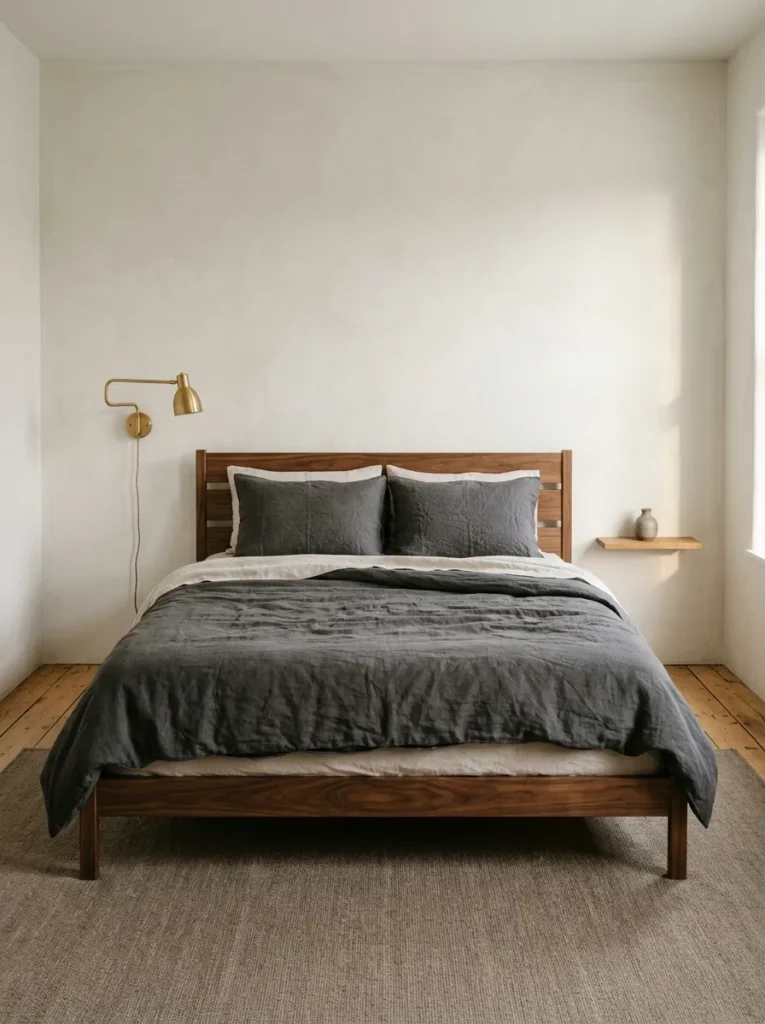
In a minimal bedroom, the bed is almost always the room’s single most important design decision — and a low platform frame changes the entire proportion of the space. Beds that sit closer to the floor visually lower the ceiling (in a good way), creating a sense of settled calm that taller frames rarely achieve. They also tend to read as more deliberate, with less visual noise underneath.
The trade-off is practical: getting in and out is slightly more effort, and under-bed storage disappears unless the platform has built-in drawers. If storage matters, look for platforms with integrated side drawers rather than hollow-frame options that are purely aesthetic. For small rooms, a low bed can actually make the space feel larger by maintaining sightlines across the floor — pair it with a rug that extends well beyond the frame on both sides to anchor it properly.
Solid oak, walnut, or a simple upholstered base in natural linen all work well here. Avoid ornate headboards: in a minimal room, the frame itself should be the statement.
2. Choose Limewash or Matte Paint Over Flat White
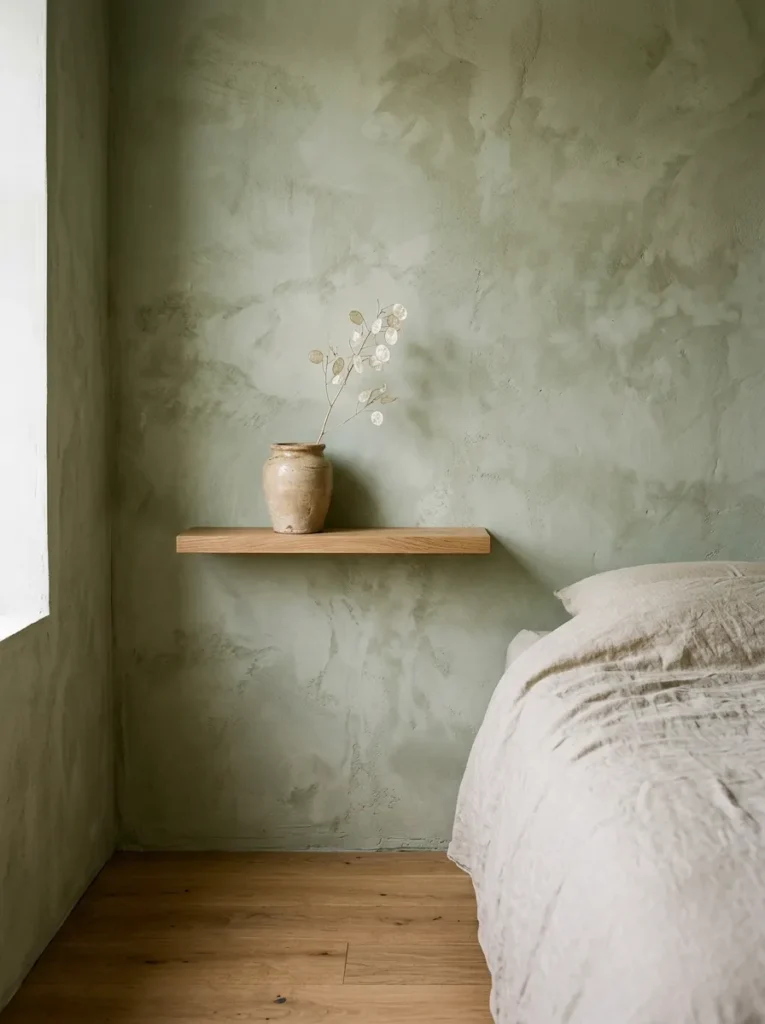
White bedrooms appear in almost every minimal bedroom collection, and many of them feel flat precisely because of it. A limewash finish — or even just a carefully chosen warm white or greige in a dead-matte sheen — adds the kind of subtle depth that flat paint can’t replicate. The texture catches light differently at different times of day, giving walls a quiet visual interest that doesn’t require any art or decoration.
Limewash is applied rather than painted, typically in two or three layered coats that leave slight tonal variation across the wall surface. It’s more forgiving on older walls with imperfections than smooth finishes, which is useful in older homes or rentals where walls aren’t perfectly flat. For renters, a limewash-effect wallpaper achieves a similar look and is removable.
Color-wise, the best minimal bedroom walls tend toward warm rather than cool: pale plaster tones, aged linen, chalky sage, and dusty warm whites outperform stark blue-whites in creating a room that reads as calm rather than clinical.
3. Edit the Bedside Setup Down to One Functional Surface
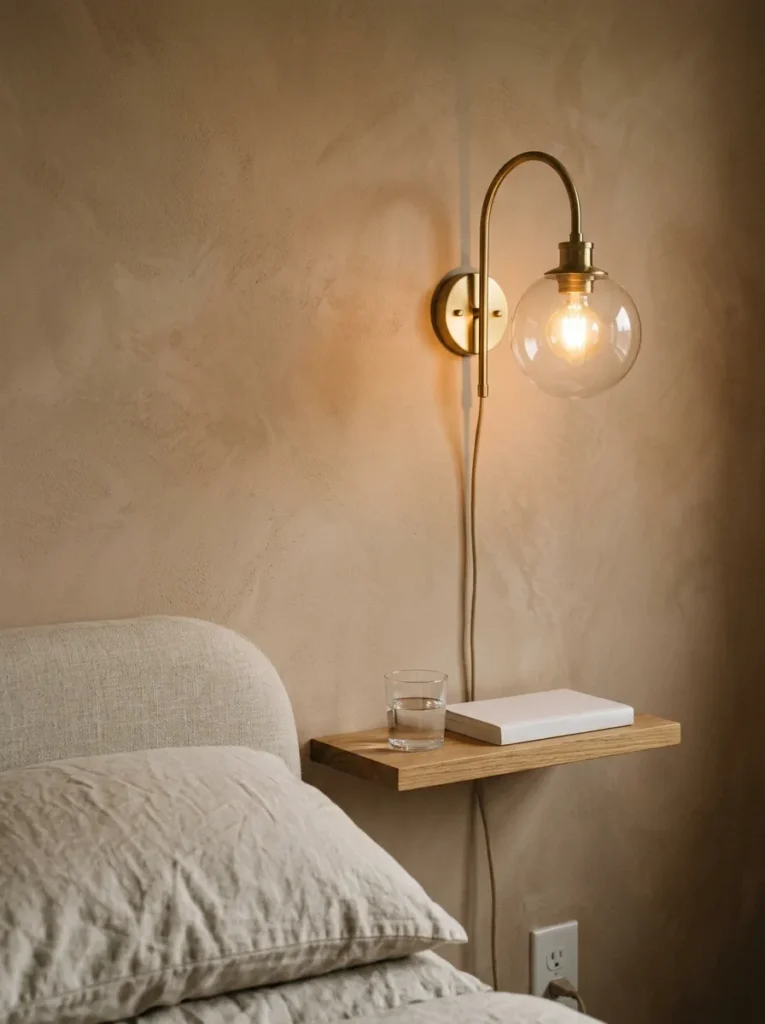
Bedside tables accumulate. A lamp, a book, a phone, a glass of water, hand cream, a charger cable — and suddenly the surface reads as chaotic regardless of how tidy the rest of the room is. In a minimal bedroom, the bedside surface is worth deliberate editing.
Wall-mounted bedside sconces instead of a table lamp remove one bulky item immediately and free up surface space entirely. Pair a sconce with a small floating shelf — just wide enough for a book and a glass — and the visual weight drops dramatically. Alternatively, a narrow bedside table with a single drawer keeps everything accessible but out of sight.
The specific choice depends on the room’s wiring (wall sconces need an electrician unless you use plug-in versions with cord covers) and whether you use the bedside surface for anything that requires depth, like a large water bottle or medication. Be realistic about daily habits before committing to a very minimal setup that you’ll undo within a week.
4. Use Built-In Wardrobes Flush With the Wall
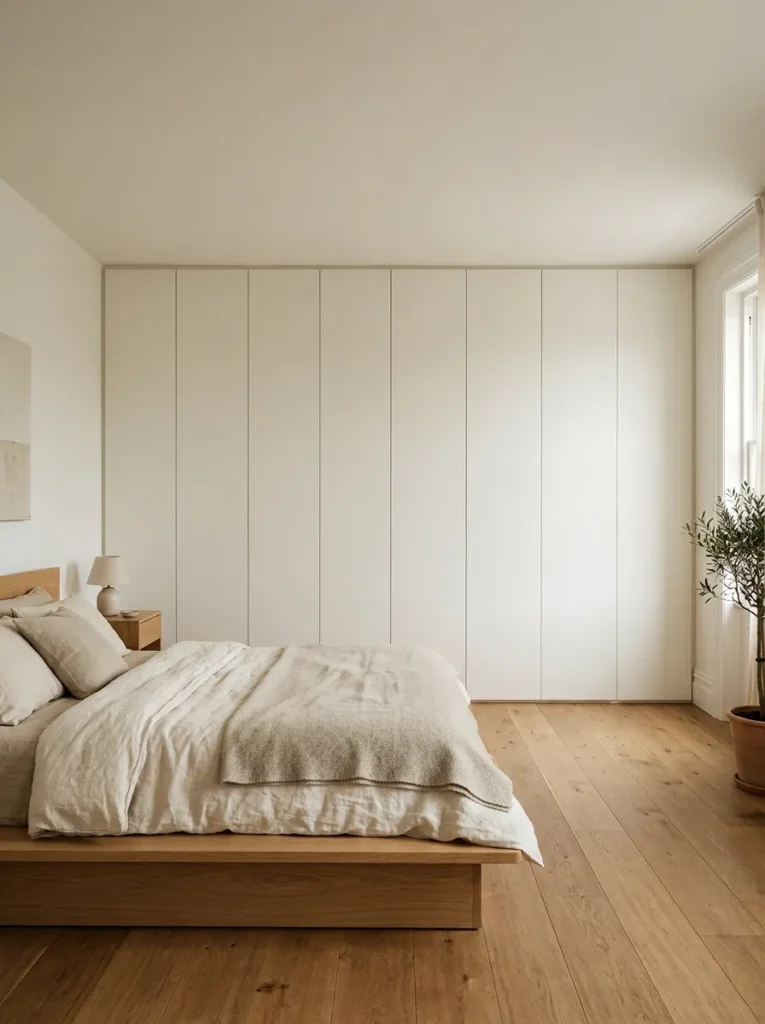
Freestanding wardrobes interrupt a room in a way that built-ins don’t. A built-in wardrobe — especially one with flat-panel doors that sit flush with the surrounding wall and are painted to match — nearly disappears into the architecture. From the right angle, the room simply reads as a large, calm space with a door, not as a room with a furniture problem tucked into the corner.
This is one of the higher-investment ideas in any minimal bedroom, but the result is disproportionately useful: storage capacity typically increases, and the visual clutter of a freestanding wardrobe vanishes entirely. Integrated push-to-open mechanisms remove visible handles, which further cleans up the look.
For renters or lower budgets, IKEA PAX units with floor-to-ceiling panels and custom fronts achieve a close approximation when installed with a pelmet above and base trim below to close the gaps. The goal is to make the wardrobe read as part of the wall rather than a piece of furniture placed against it.
5. Layer Linen Bedding Rather Than Matching Sets

Matching duvet cover and pillowcase sets tend to look fine in the shop and slightly over-designed in actual bedrooms — the uniformity draws attention to itself. Minimal bedrooms often look better with simple natural linen in a single muted tone: dusty sage, warm oatmeal, stone, or pale terracotta. The slight texture of washed linen adds depth without adding color complexity.
The layering approach — a fitted linen sheet, a linen duvet cover, a folded throw at the foot of the bed, and two or three pillows in the same tonal family — creates a bed that reads as considered rather than bare. Keep pillow count low: two sleeping pillows and one or two Europeans in matching linen cases is typically enough. Decorative cushions add visual noise in a minimal room and usually end up on the floor each night anyway.
One practical note: linen bedding wrinkles, and in a minimal bedroom those wrinkles are visible. Some people find this adds to the relaxed feeling; others find it looks messy. If wrinkles bother you, look for linen-cotton blends, which smooth out more easily.
6. Introduce One Natural Material in Depth Rather Than Many Lightly
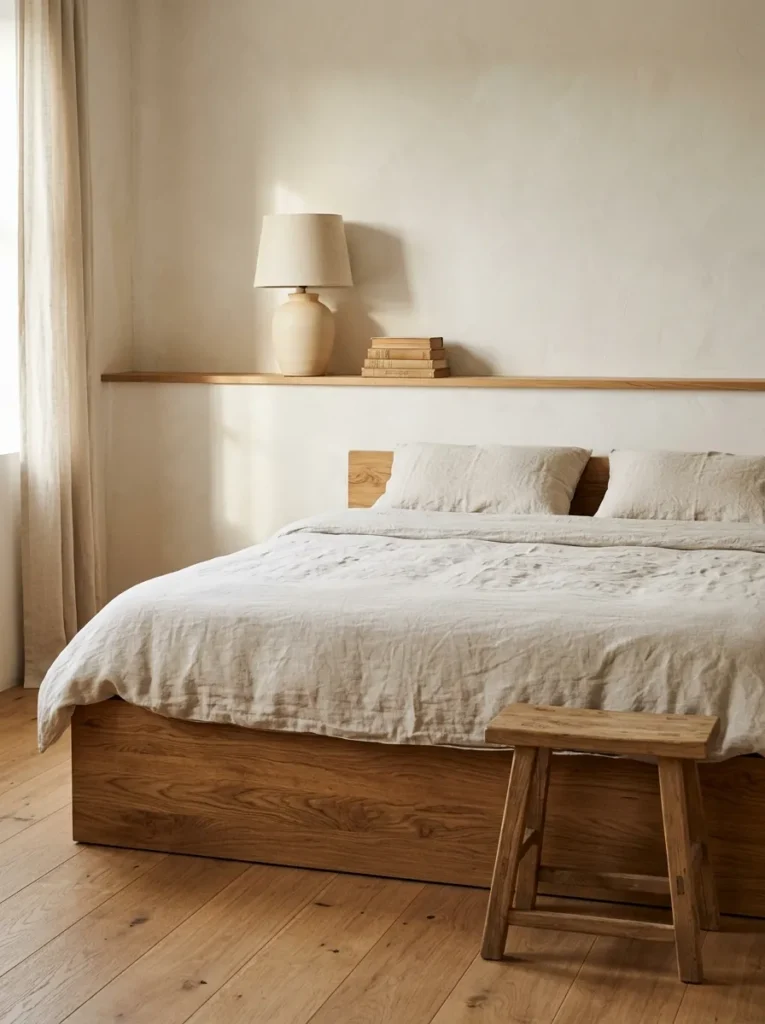
A common mistake in minimal bedroom styling is adding a variety of natural materials — rattan here, wood there, marble on the shelf, concrete on the lamp — in the belief that texture builds warmth. The result is often a room that feels inconsistent rather than curated. A more effective approach is to commit to one or two materials and let them appear in multiple places.
If the bed frame is solid oak, let oak reappear in the shelf, the frame of a small mirror, or the stool at the foot of the bed. The material starts to feel intentional rather than incidental. Similarly, a matte plaster lamp base pairs well with limewash walls; concrete or ceramic accessories work in a more industrial-leaning room; woven natural fiber (jute, seagrass, wool) anchors softer Japandi or Scandinavian directions.
The principle isn’t limitation for its own sake — it’s about creating coherence. When everything in a minimal room connects through a shared material logic, nothing looks out of place.
7. Keep the Floor as Clear as Possible
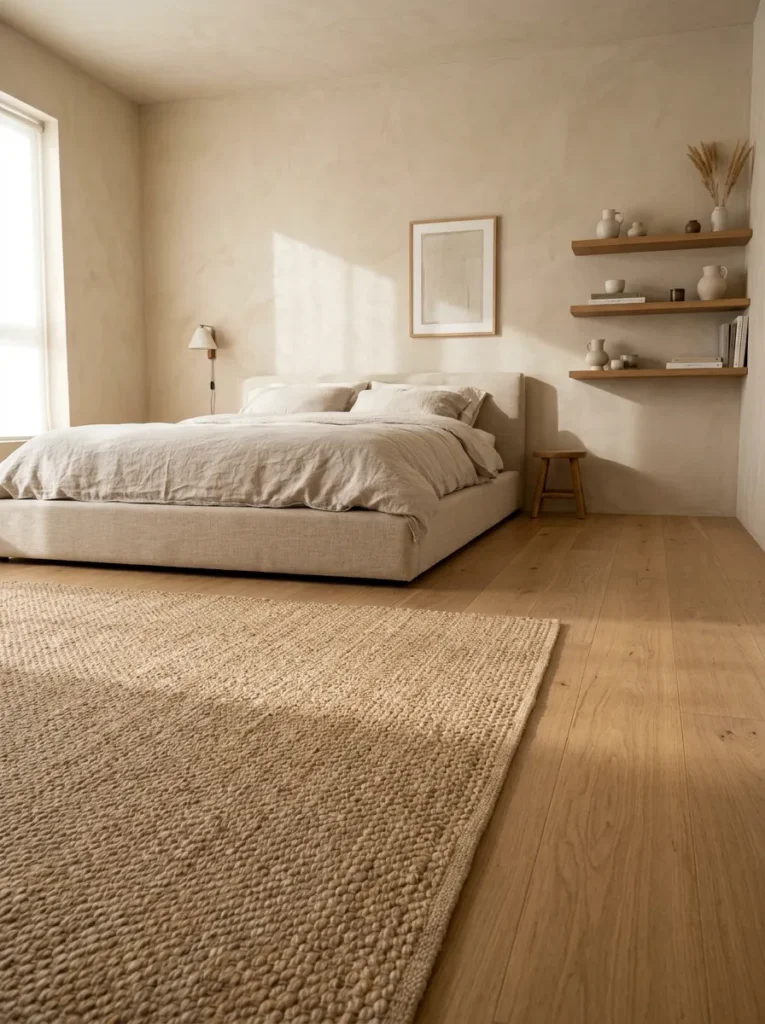
In a minimal bedroom, the visible floor area is not empty space — it’s part of the composition. A clear floor makes a room feel significantly larger and calmer than the same room with objects pushed against the walls. This is partly why low furniture, built-in storage, and wall-mounted elements are such consistent features of minimal bedroom design: they return floor space to the room.
Practically, this means being selective about what lives on the floor. A single rug is typically the only floor-level element that serves the composition well. Beyond that, a small stool or bench at the foot of the bed can work if the room is large enough. Everything else — laundry, shoes, bags, charging cables — needs a dedicated storage solution inside wardrobes or drawers rather than floor space.
For smaller rooms, a rug that extends to within 30–40cm of the walls on at least two sides creates a proportioned look. A rug that’s too small — say, only under the foot of the bed — can feel like an afterthought and actually makes the floor look more fragmented.
8. Use Curtains That Pool Slightly at Floor Level
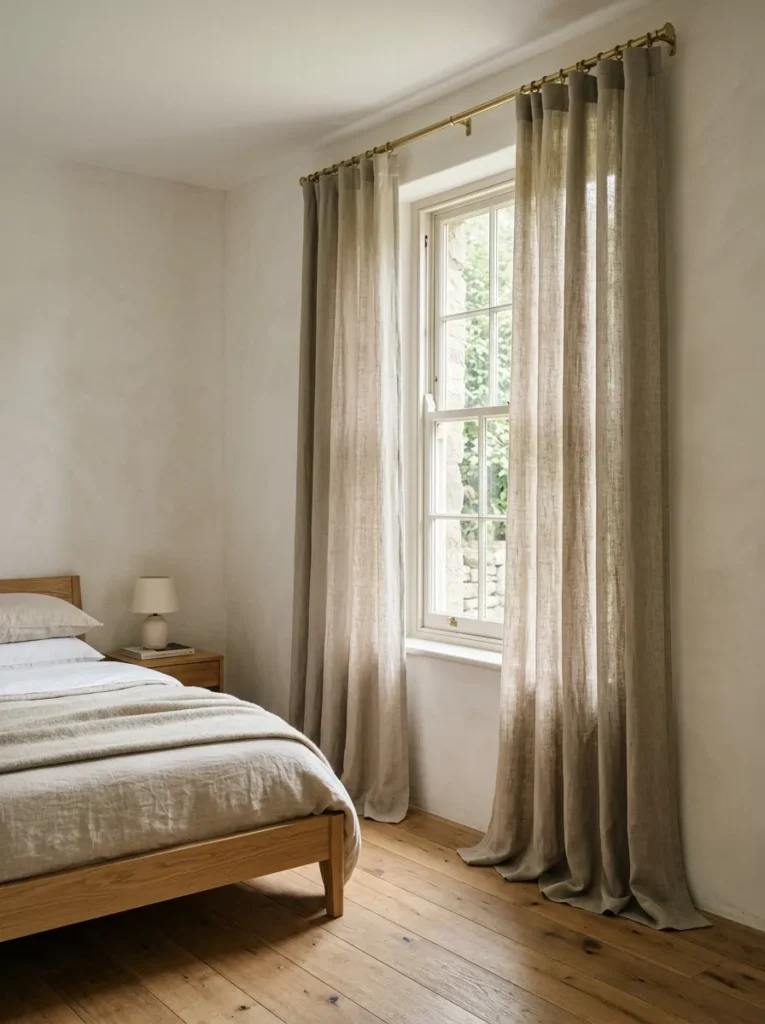
Curtains hung too short look like mistakes. Curtains that break gently at the floor — or even pool slightly — look deliberately considered. In a minimal bedroom, long linen or cotton curtains in a tone close to the wall color (or slightly warmer) frame the window without drawing attention to themselves, while the slight break at the floor adds an intentional, soft detail.
Hanging curtain rods as close to the ceiling as possible — rather than just above the window frame — lengthens the wall visually and makes windows appear larger. This is a small but significant difference. For a room with low or awkward ceiling heights, this trick can meaningfully change how spacious the room feels.
Sheer linen panels work well in minimal bedrooms where privacy isn’t a concern: they diffuse light beautifully and maintain the room’s calm color palette. For rooms that need blackout functionality, a double-track system with sheer and blackout panels keeps options open without adding visual bulk.
9. Lean Art Rather Than Hang It Everywhere
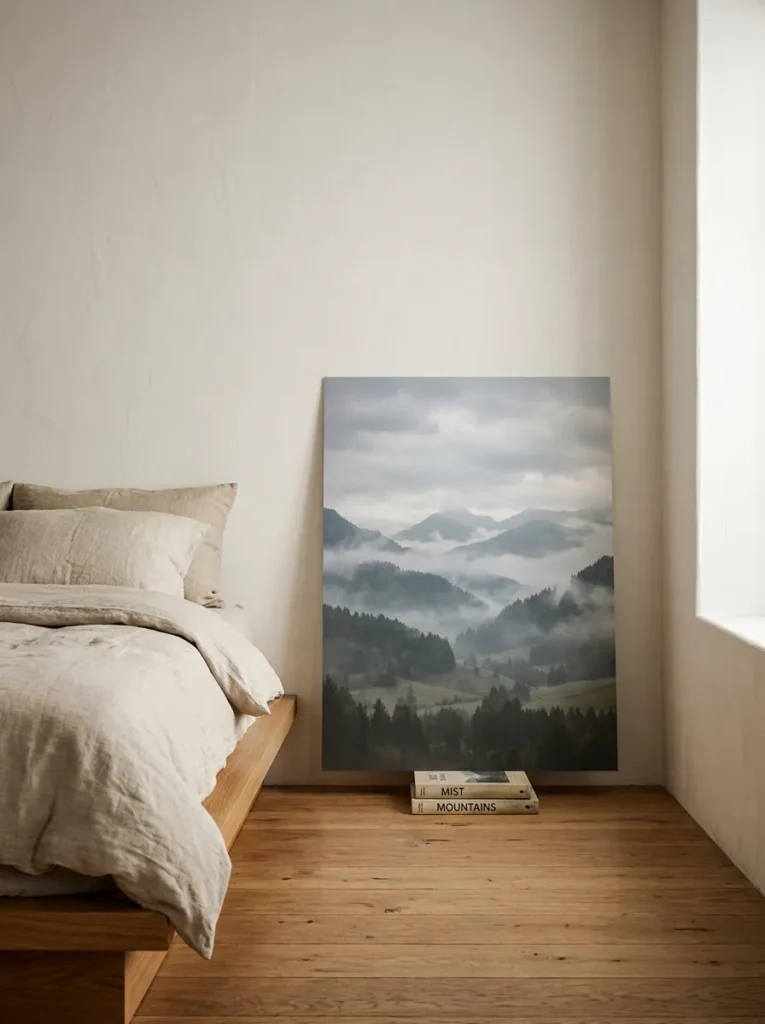
A minimal bedroom doesn’t require bare walls, but it does benefit from restraint in how art is displayed. One deliberate approach is leaning: a large print or canvas leaning against a wall rather than hung reads as more relaxed and intentional than a gallery-style arrangement, and avoids the visual busy-ness of multiple small frames.
A single large work in a simple frame — or even an unframed print — is often more effective than a carefully curated gallery wall. The proportions matter: art that’s too small for the wall looks tentative, while something sized appropriately for the wall becomes a genuine anchor point. As a loose guide, a piece that spans roughly half the width of the furniture beneath it tends to look balanced.
For a minimal bedroom, monochromatic or limited-palette prints — botanical studies, abstract line work, photography in earthy tones — tend to sit more comfortably with a neutral room than anything high-contrast or heavily colored.
10. Build in a Reading Nook if the Room Has a Dead Corner
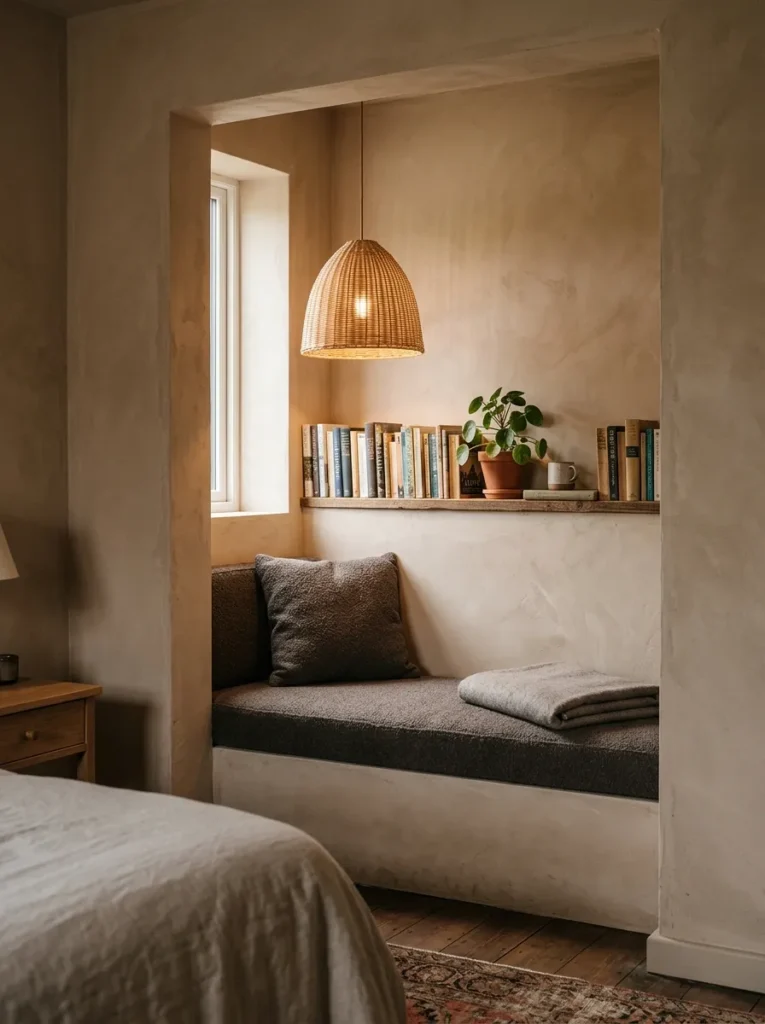
Many bedrooms have a corner that isn’t useful for anything: too narrow for a wardrobe, too awkward for the bed, too far from the door to function as a dressing area. A simple built-in bench with storage underneath, a low-hanging pendant or sconce, and a small cushion can transform that corner into the most purposeful spot in the room.
The key proportional consideration is the ceiling. A reading nook with a pendant that hangs too high feels exposed and uncomfortable; one with a pendant at seated head-height feels contained and private — which is exactly the point. Low-hanging pendants in woven rattan, paper, or ceramic work particularly well here.
For rooms without dead corners, a narrow armchair (an accent chair with a slim profile rather than an overstuffed occasional chair) near the window serves a similar purpose without requiring construction. The function — a dedicated sitting spot that isn’t the bed — is what matters for the room’s practical logic, not the specific form.
11. Choose a Japandi Color Palette: Warm Neutrals With One Muted Accent
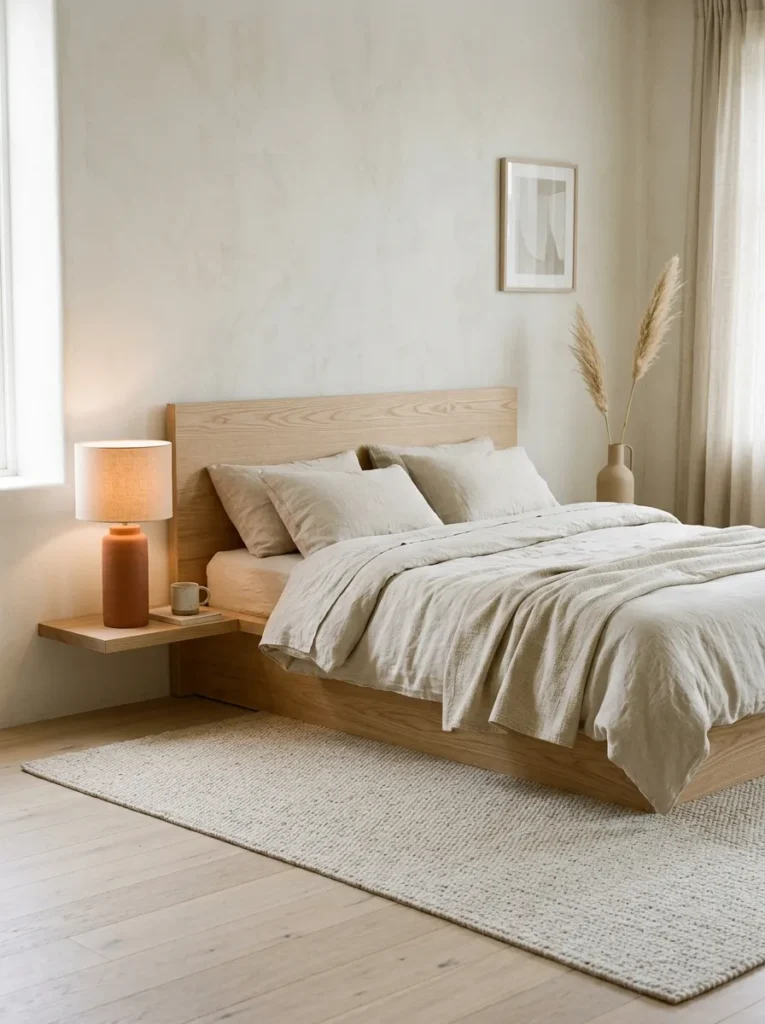
Japandi — the design shorthand for the overlap between Japanese and Scandinavian aesthetics — works well as a framework for minimal bedrooms because it explicitly rejects sterility. The palette runs warm: undyed linen, aged parchment, pale clay, ash, and the occasional soft charcoal or dusty sage as a deeper note. Nothing sharp, nothing cool, nothing that reads as sanitized.
The useful principle borrowed from this aesthetic is limiting the palette to three or four tones at most, but allowing those tones to appear across multiple surfaces. The wall, the bedding, the floor, and the textiles should tell a coherent color story rather than each doing something independent.
One muted accent — a terracotta lamp base, a single sage cushion, a warm amber glass vase — adds just enough difference to prevent the room from feeling monotonous, without introducing the kind of contrast that disturbs the calm. The accent should be organic in origin: earth tones, plant tones, stone tones, rather than anything primary or synthetic-feeling.
12. Replace the Bedside Table Lamp With a Plug-In Wall Sconce
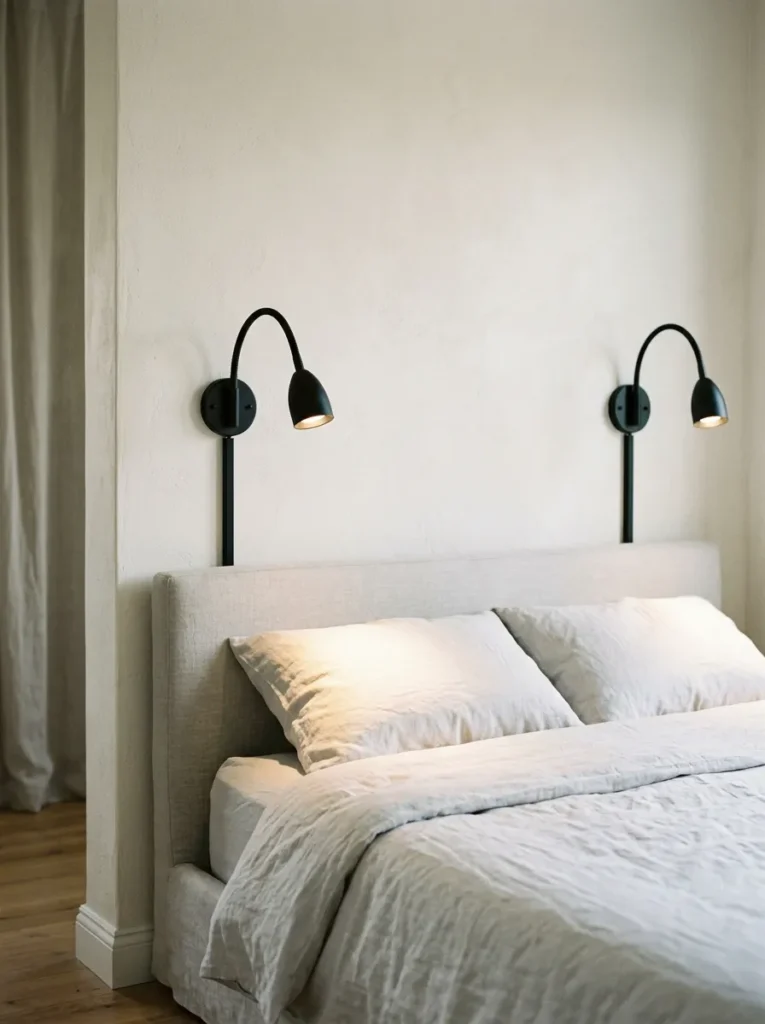
This is a small change with a noticeable effect. A table lamp occupies bedside surface space, creates visual weight at mid-height on either side of the bed, and often has a cord that needs managing. A plug-in wall sconce — mounted at roughly shoulder height when seated in bed — does the same job with far less visual footprint.
Plug-in sconces have a cord that runs down the wall to an outlet, which some people find untidy. Cord covers in a color matching the wall, or a cord hidden behind a slim channel, resolve this. Alternatively, some plug-in sconces are sold with braided textile cords designed to be visible — treating the cord as a design detail rather than something to hide.
The sconce bracket style matters in a minimal bedroom: simple arched or straight arms in brushed brass, matte black, or raw iron tend to work best. Avoid anything decorative or overly ornate — the sconce should function as a practical element with a considered finish, not as jewelry.
13. Use a Single Floating Shelf Instead of Multiple Small Objects
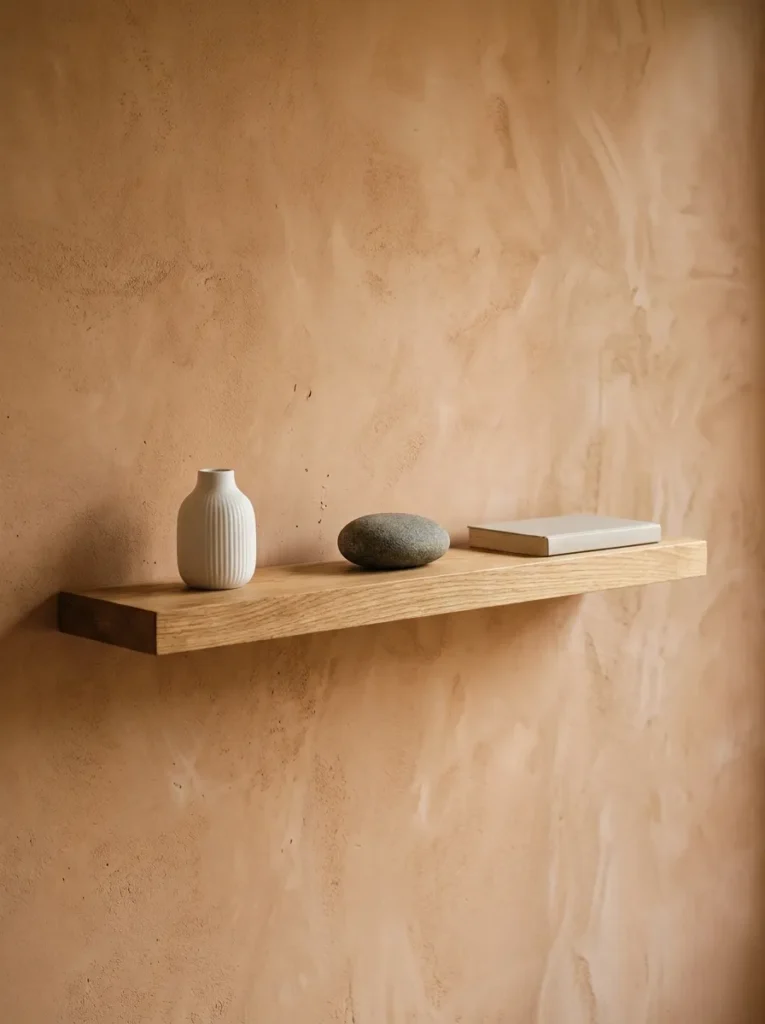
A ledge of small objects — a candle, a crystal, a small plant, a folded cloth, a stack of rings — reads as a collection in any other design style and as clutter in a minimal one. The same impulse to personalize the room works better in a minimal context when those items are fewer and placed with more space between them.
A floating shelf long enough to hold three or four items with clear breathing room between them changes the visual logic entirely. The shelf itself becomes a composition rather than a surface. One small plant, one considered object (a ceramic vessel, an interesting stone, a single book spine-out), and a generous gap between them is usually enough.
Wall-mounted shelves in minimal bedrooms work best in natural wood (oak, ash) or in a painted finish that matches the wall — the latter nearly disappears while still being useful. Avoid glass shelves, which reflect light in ways that can disrupt the room’s calm, and avoid shelves with heavy brackets that add unnecessary visual weight.
14. Choose Blackout Roller Blinds Over Curtains in Very Small Rooms
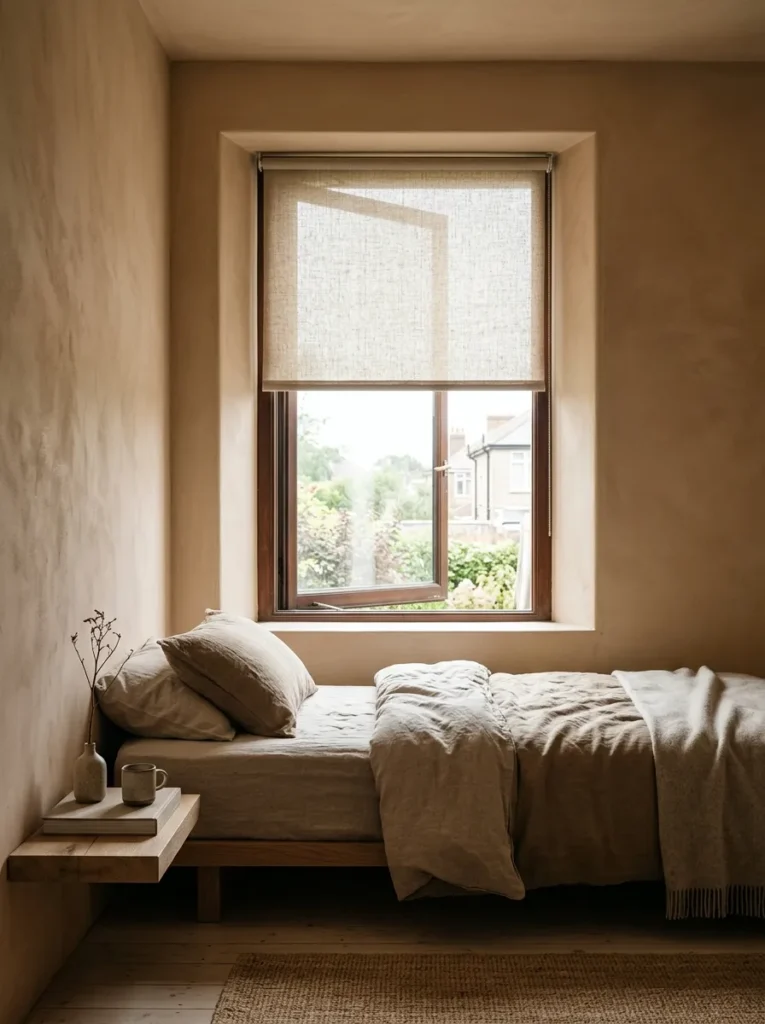
In a small minimal bedroom, curtains — even simple linen panels — can feel like they’re consuming the room. Floor-length curtains require visual depth to read well, and in a room where the window sits close to a corner or above a radiator, they may not hang cleanly at all.
A slim blackout roller blind in a natural fabric tone (oatmeal, warm white, soft grey) sits within the window recess and essentially disappears when open. It fulfills the practical need (light control, privacy) without using any floor clearance or visual space. In combination with a simple Roman blind in natural linen, the result can be slightly softer while remaining tidy.
The limitation is aesthetic warmth: roller blinds tend to look cleaner than romantic, which suits some minimal directions and feels a little sparse in others. If the room has reasonable ceiling height and enough floor space for curtains to hang without bunching, the curtain approach almost always adds more warmth to the finished result.
15. Keep Charging Cables Off Every Visible Surface
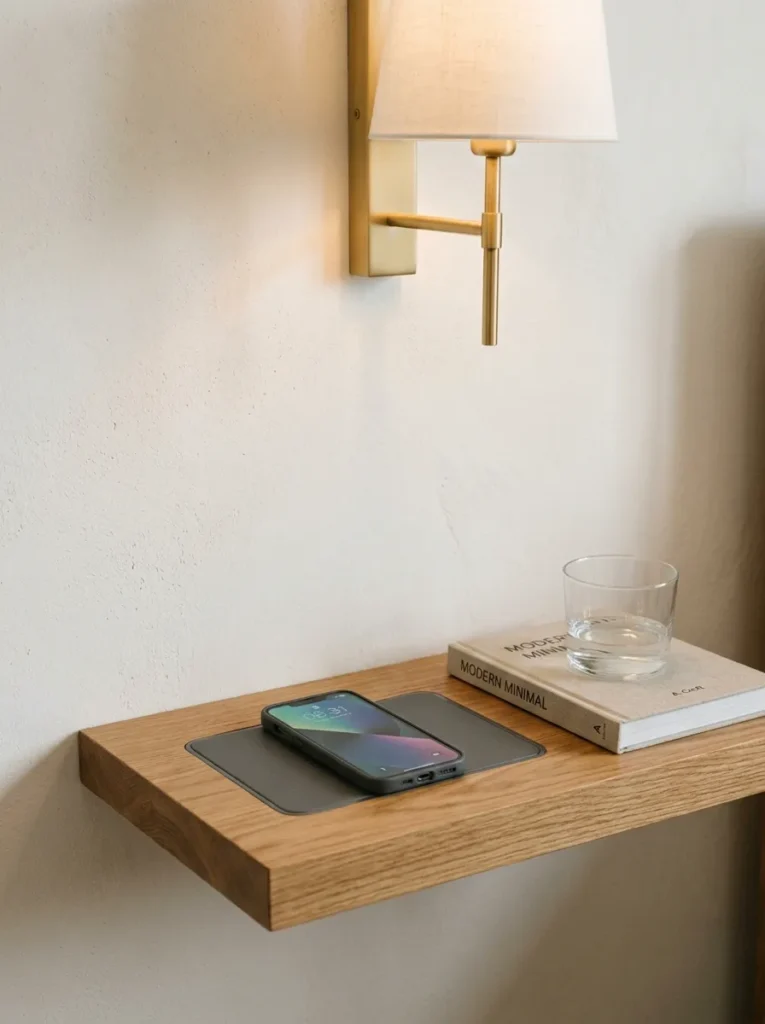
This is one of the less glamorous but most practically relevant ideas in the entire article: visible charging cables undermine the calm of a minimal bedroom more than almost any other single element. A phone cable on the bedside shelf, a watch charger on the dresser, a tablet cable trailing across the floor — each one is minor on its own and cumulatively disruptive.
A few practical approaches that work well: a shallow drawer in the bedside table specifically for overnight charging, with a discreet hole at the back for the cable to thread through; a cable channel mounted behind the bedside shelf; or a wireless charging pad (which eliminates the cable entirely for compatible devices) recessed into the shelf surface.
This sounds like a detail, but getting charging infrastructure right before the room is furnished and decorated is significantly easier than trying to add it afterward. Think about where people actually sit or lie when using devices, and position outlet access accordingly before committing to furniture placement.
16. Use a Long, Low Dresser Instead of a Tall Chest of Drawers
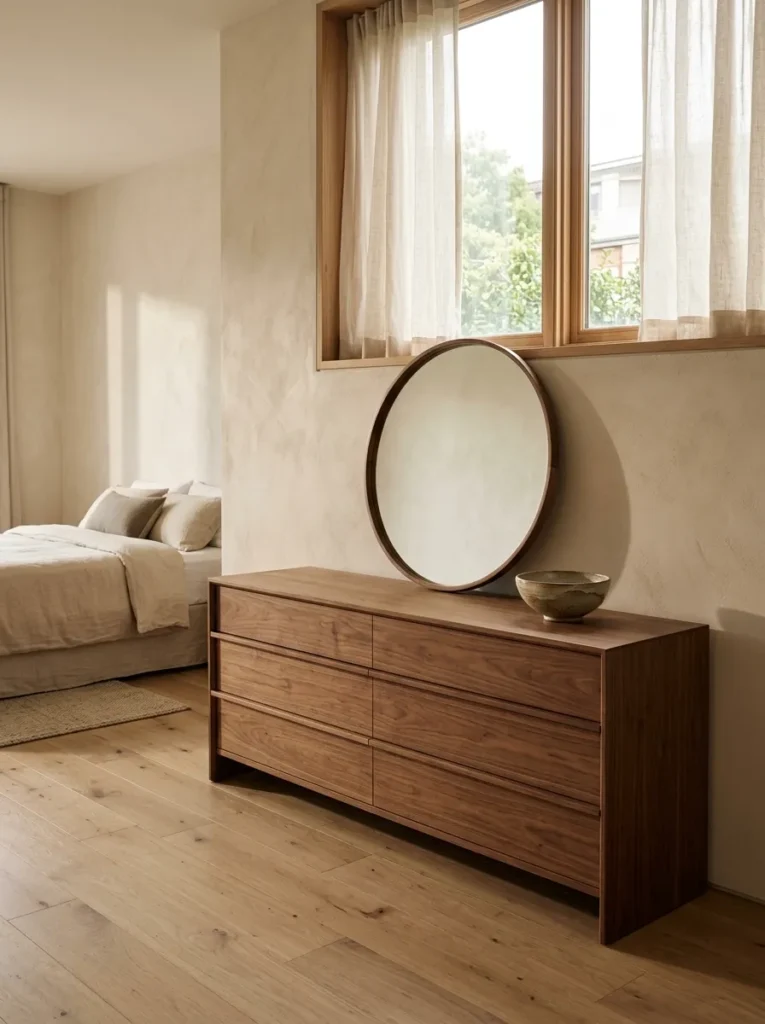
A tall chest of drawers creates vertical visual weight — it draws the eye upward and creates a mass that reads as furniture-heavy in any room, but particularly in a minimal one. A long, low dresser (ideally sitting below window sill height) has roughly the same storage volume but distributes it horizontally, keeping the room’s upper half clear and visually calm.
The top surface of a low dresser also becomes a useful styled moment rather than a crowded afterthought. One large mirror, one considered object, and nothing else — and the surface becomes an intentional element of the room rather than a place where things accumulate.
For small rooms where floor space is genuinely limited, this comparison becomes more complex: a slim tall chest may use less footprint than a wide low dresser. In that case, positioning the chest inside the wardrobe (if depth allows) keeps it entirely out of the room’s visual field.
17. Add a Single Textile Layer Under the Bed With a Generous Rug
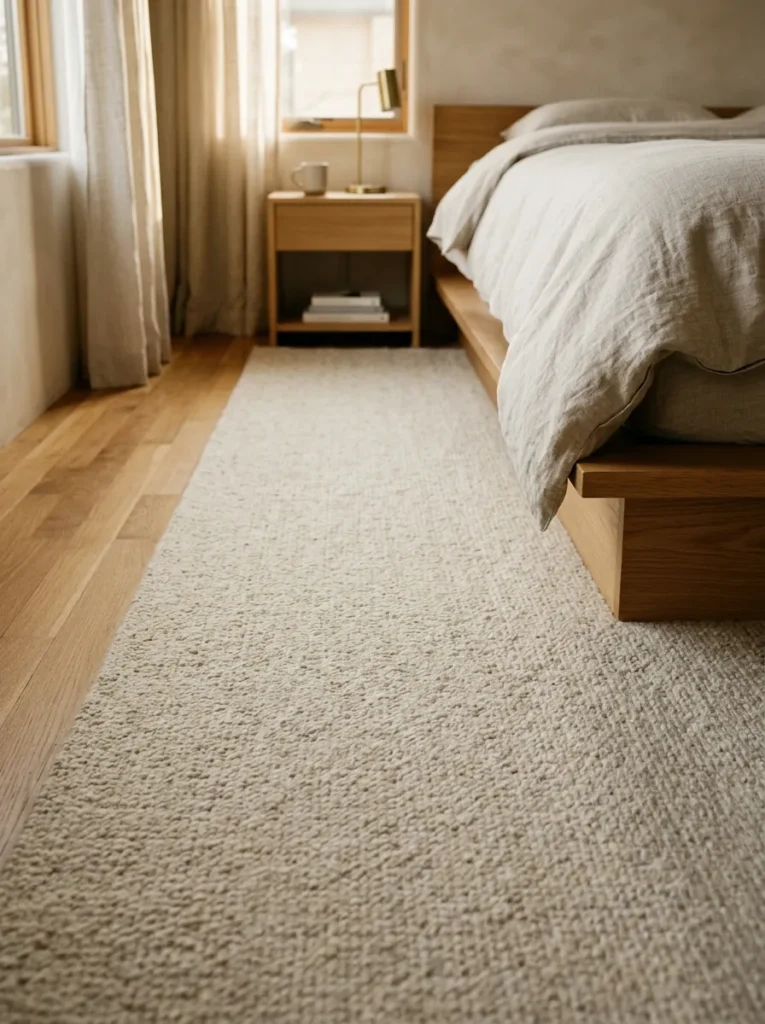
The rug in a minimal bedroom does more compositional work than it might appear to. It defines the sleeping zone, adds warmth underfoot, and — depending on texture — contributes a significant amount of tactile richness to a room that might otherwise feel visually thin.
In most bedrooms, the rug should extend at least 60cm beyond both sides of the bed (so there’s a soft landing when getting out of bed) and at least partially under the foot of the bed frame. A rug that sits entirely in front of the bed, or that’s sized to the center of the room without reaching the sides, tends to look proportionally uncertain.
Texture matters here more than pattern: a low-pile wool or a flat-weave jute in a tone close to the floor (or a shade warmer) maintains the calm of the room while adding warmth and depth. High-pile sheepskin or shaggy rugs introduce a different kind of texture — softer, more sensory — that works well in colder climates but can feel heavy in smaller rooms. One rug is almost always enough; two rugs in one bedroom usually creates visual conflict.
18. Mount a Large Mirror to Reflect the Right Thing
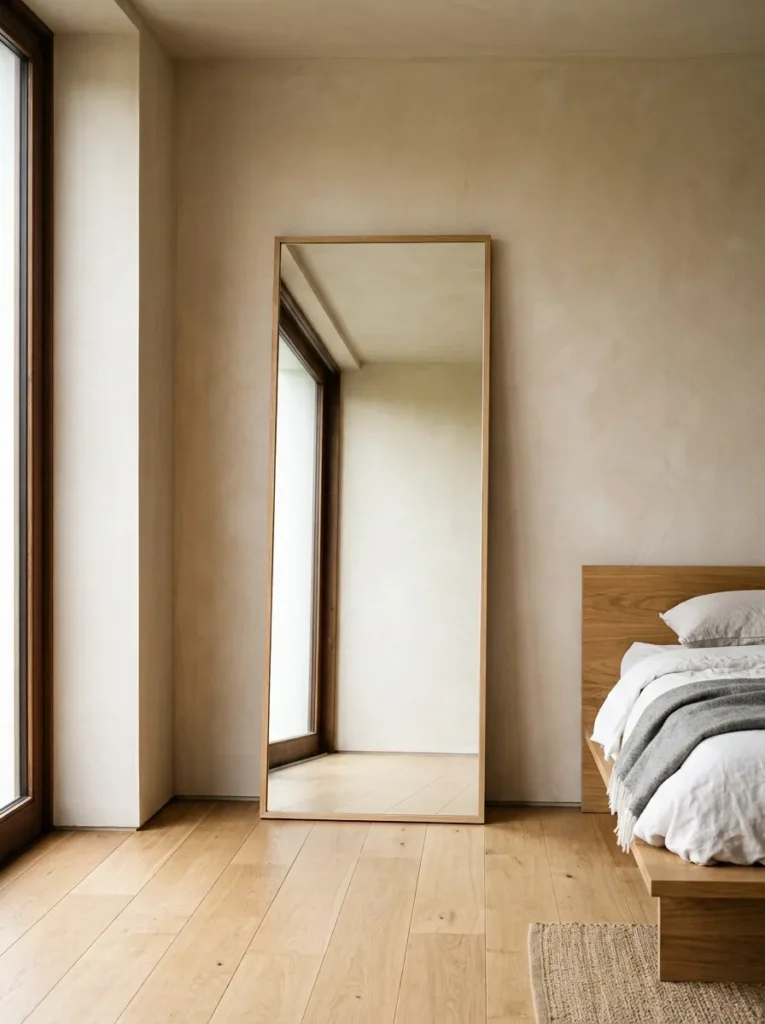
Mirrors are one of the most repeated suggestions in bedroom design, and one of the most frequently misapplied. A mirror reflects whatever is opposite it. Hung facing a window, it reflects light and sky. Hung facing a cluttered wardrobe, it reflects the wardrobe. The position matters more than the presence.
In a minimal bedroom, the most effective mirror placement is typically opposite the largest window or natural light source, where it doubles the sense of space and brightness without simply revealing the room back to itself. A full-length leaner mirror positioned at a slight angle is more forgiving than a fixed wall mirror because the reflection angle can be adjusted.
Frame style affects the character of the room significantly: a heavy ornate frame fights a minimal direction; a frameless mirror can look clinical; a simple thin-profile frame in oak, ash, brass, or matte black reads as considered without drawing attention away from the room. Scale matters too — a mirror sized appropriately for the wall it occupies (wide enough to feel intentional, not so small that it looks lost) is a meaningful anchor element.
19. Use Recessed or Cove Lighting Instead of a Central Pendant
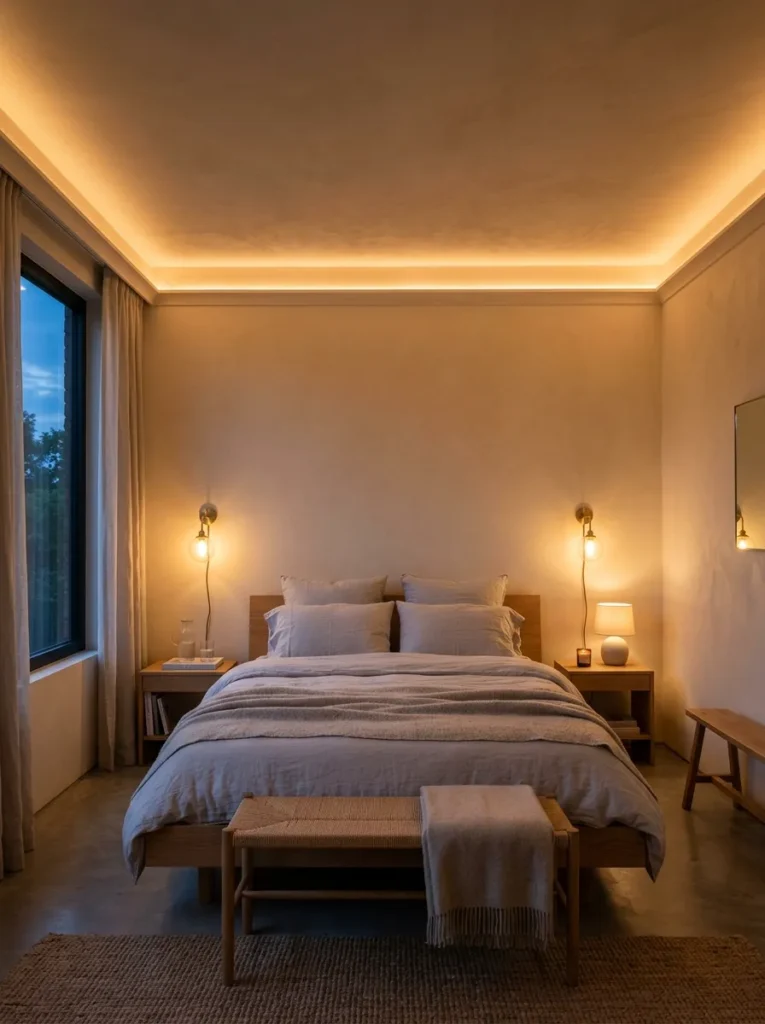
A single overhead pendant in the center of a bedroom creates a type of light that’s usually wrong for the function of the room: too bright, too directional, and impossible to dim down to a restful level without losing the room entirely. In minimal bedrooms, the lighting design often contributes as much to the calm atmosphere as the furniture or materials.
Cove lighting — LED strip lights installed in a ceiling recess or behind a valance — washes the ceiling with soft, diffused light and eliminates the pendant entirely. Recessed spotlights on dimmable circuits, positioned to light the walls rather than pointed straight down, create a similar effect. Both approaches require some construction investment and are more practical in new builds or renovations.
For renters or lower-commitment solutions: a combination of bedside sconces (which handle reading light), a floor lamp in one corner (which provides ambient light at a lower level), and smart bulbs in an existing ceiling fitting on a dimmer switch can achieve a version of the layered effect without structural changes. The goal is to have the option to drop the room to a very low, warm light level in the evenings — a single bright overhead makes this impossible.
20. Declutter the Inside of Open Storage Before Styling the Outside
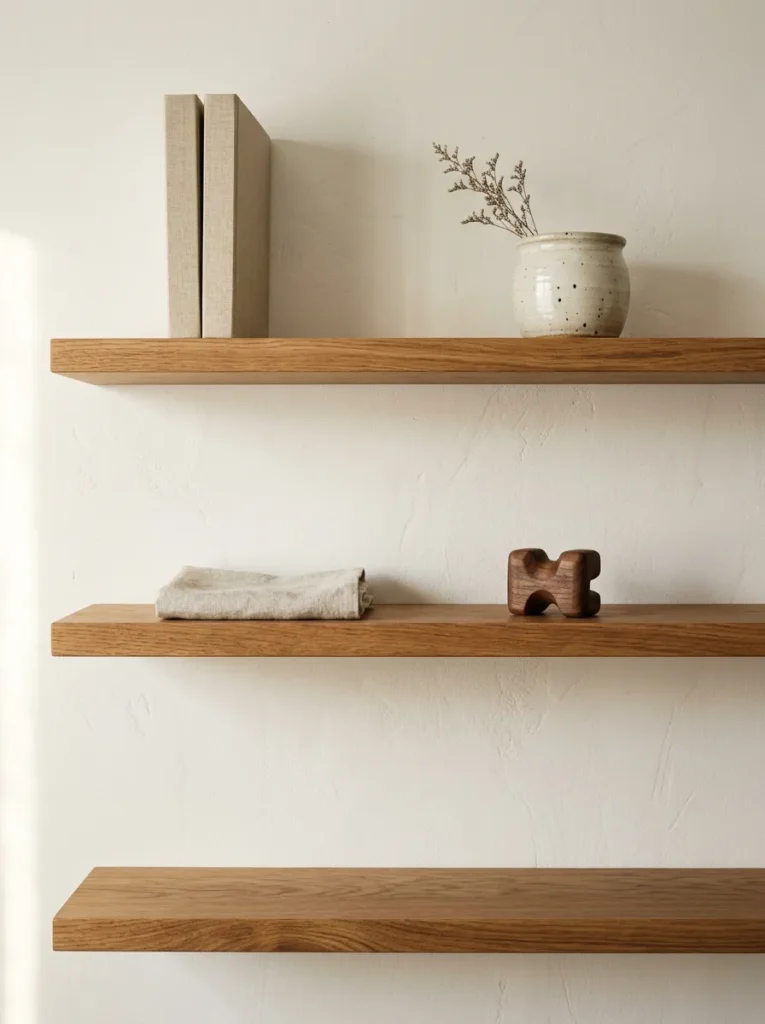
Many minimal bedrooms have one or two shelves that are intended to be styled, and those shelves quickly become the room’s most chaotic surface. The problem is usually that the styling sits on top of an unresolved storage situation: books that don’t have another home, objects that don’t have a category, things that are on the shelf because they don’t have somewhere else to go.
The only approach that actually works long-term is to solve the storage question first — to give every category of object a home that isn’t a visible surface — and then to style only with things that are genuinely there by choice rather than by default. The number of objects on any open shelf in a minimal bedroom should be small enough that you can name each one and explain why it’s there.
Practically, this means auditing the room’s storage capacity honestly before styling. If a minimal look requires hiding three boxes of unsorted cables, seasonal clothing, and an extra duvet, the room needs more hidden storage, not a better shelf arrangement.
21. End With Scent as an Invisible Layer of Calm
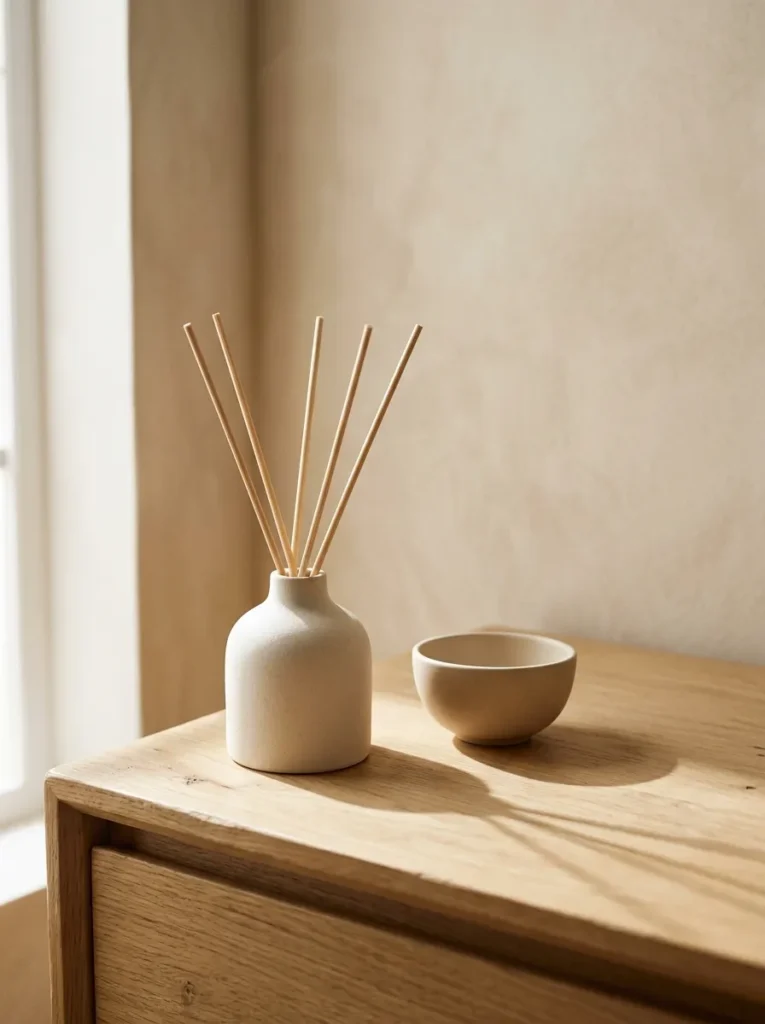
Minimal bedrooms are often described through visual language alone, but scent contributes to the quality of a room’s atmosphere in a way that’s hard to understate. A consistent, simple scent — not multiple competing fragrances from different products and candles — contributes to the sense that the room is settled and intentional rather than random.
This doesn’t require expensive diffusers. A single reed diffuser in a calm, unfussy fragrance (cedar and cashmere, vetiver, hinoki wood, simple linen) placed on a shelf or dresser does the job quietly. The key is consistency: the same scent, always in the same room, eventually becomes a sensory signal that the space is calm — which over time makes the room feel more restful even before anything visual registers.
What to avoid: mixing multiple fragrance products (room spray, candle, body lotion, diffuser) that compete in the same space. In a minimal bedroom, even the invisible layers should be edited.
Before You Begin: Three Decisions to Make First
The sequence of decisions matters more than most articles acknowledge. Decorating before resolving these three questions usually means undoing earlier work.
Storage capacity first. Every item that doesn’t have a concealed home will eventually end up on a visible surface. Map out where everything currently stored in the room will go after the redesign — and if the answer is “somewhere visible,” the redesign needs more hidden storage before anything else.
Lighting infrastructure second. Adding a wall sconce, installing a dimmer switch, or running power to a cove light is far easier before furniture is in position and walls are painted. Decide on the lighting plan before committing to anything else, even if the light fittings themselves come later.
The bed frame third. In a minimal bedroom, the bed is the primary design element — almost every other decision responds to it in some way. The color palette, the rug dimensions, the bedside approach, the scale of the mirror: all of these are easier to resolve once the bed frame is confirmed.
Everything else — bedding, art, styling details — is secondary and can evolve over time without disrupting the room’s logic.
Final Thoughts
A minimal bedroom works because of what it chooses not to include, which makes the editing decisions more important than the decorating ones. The ideas here that have the most impact tend to be structural: built-in wardrobes, low platform beds, layered lighting, clear floors. Start there before moving to the softer decisions about textiles and styling.
Not every idea in this list belongs in the same room. A very small bedroom needs different prioritization than a generously sized one; a renter works with different constraints than a homeowner; someone who genuinely uses their bedside surface needs a different setup than someone who doesn’t. The useful question isn’t “which of these looks best?” but “which of these solves the actual problem in my room?”
If you’re saving ideas for your own bedroom refresh, pin the ones that address your specific pain points first — the surface clutter, the lighting that’s wrong, the storage that isn’t working — rather than the ones that simply look appealing. That’s where a minimal bedroom actually starts.