20 Bathroom Storage Ideas That Reduce Clutter Beautifully
Bathroom clutter is relentless — and the standard solutions (plastic drawer organisers, chrome wire racks, over-the-door shoe pockets) solve the problem while creating a worse one. These 20 bathroom storage ideas prove that organisation and beauty aren’t competing priorities. Every idea here hides what should be hidden, displays what deserves to be seen, and makes the room itself look more considered in the process. Whether your bathroom is a narrow renter’s ensuite with one wall of tile or a generous master bath mid-renovation, these solutions scale to your space and your budget. Some require a drill and an afternoon. Some require only a basket. What they all share is an understanding that visible storage is part of the room’s design — not a concession to practicality. Save this list and come back to it every time you open a cabinet and feel that particular kind of quiet frustration.
Idea 1: Recessed Medicine Cabinet with Fluted Glass Door
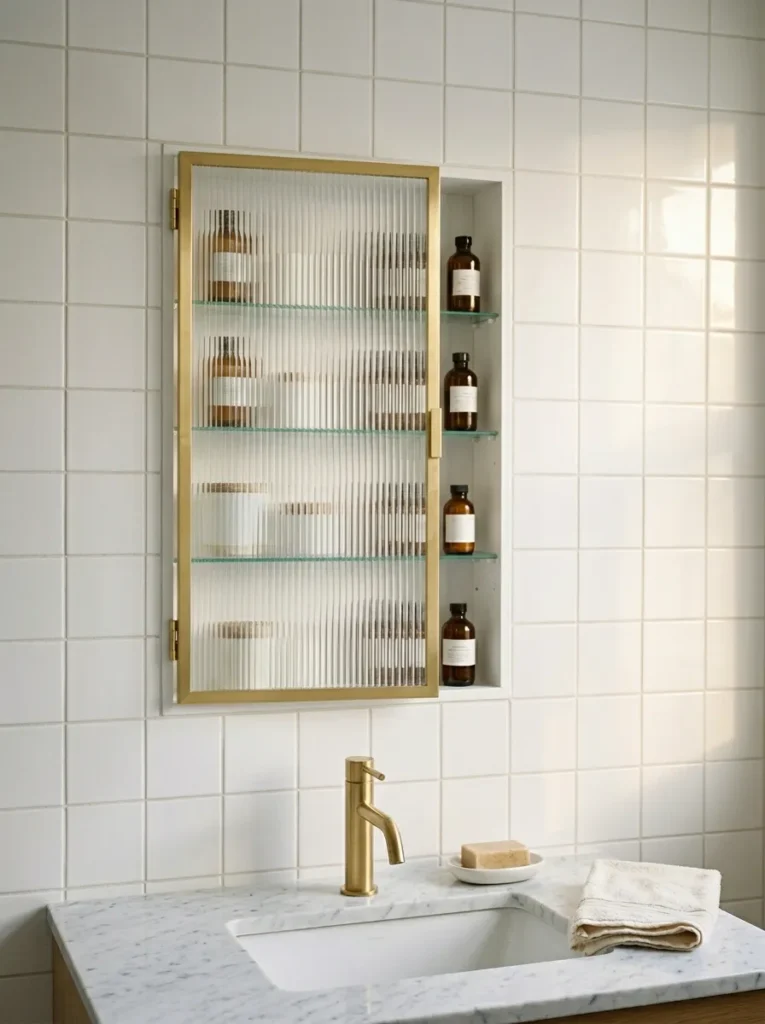
The recessed medicine cabinet is one of the most underused bathroom storage moves available because people assume it requires major renovation. In reality, recessing a cabinet into a non-load-bearing stud wall requires only a cutout between two studs — typically achievable in a weekend with basic tools. The payoff is significant: you recover a full 10–15cm of depth from the wall without consuming any floor space, and the mirrored or glass door performs double storage duty by serving as your vanity mirror. The fluted glass door variant is the detail that elevates this from utility to design feature — the ribbed surface obscures contents without hiding them completely, and the light refraction across the glass creates a visual texture that flat mirror cannot. Brushed gold edge framing keeps it warm and contemporary rather than clinical.
Idea 2: Built-In Floating Shelves Inside a Shower Alcove
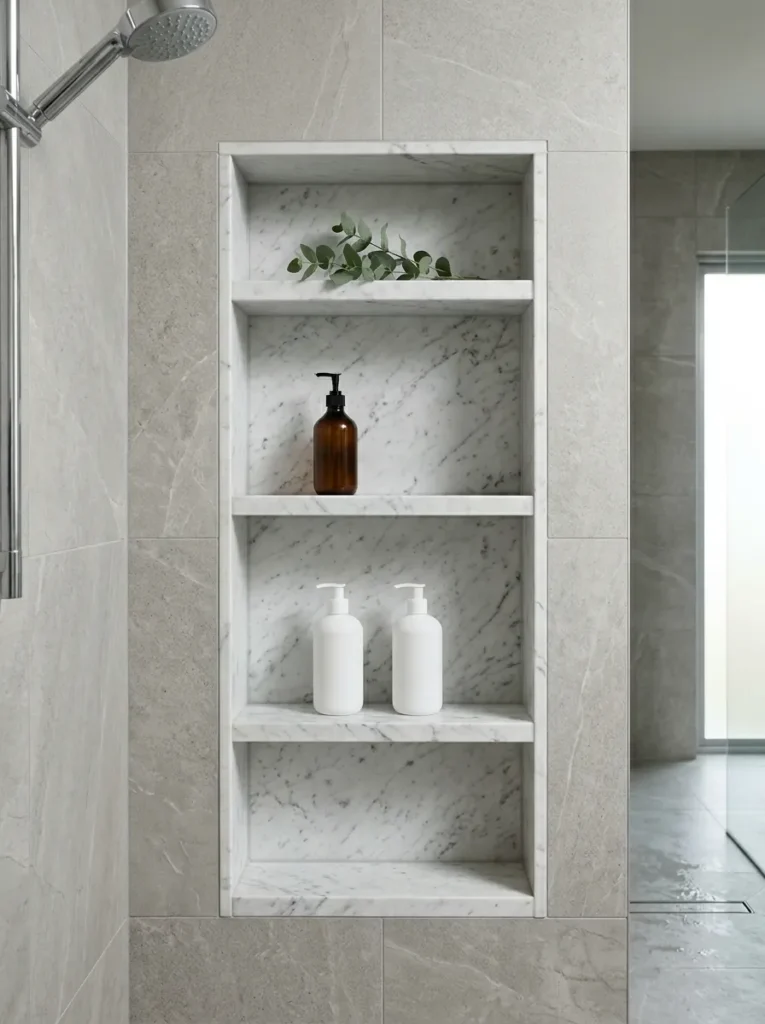
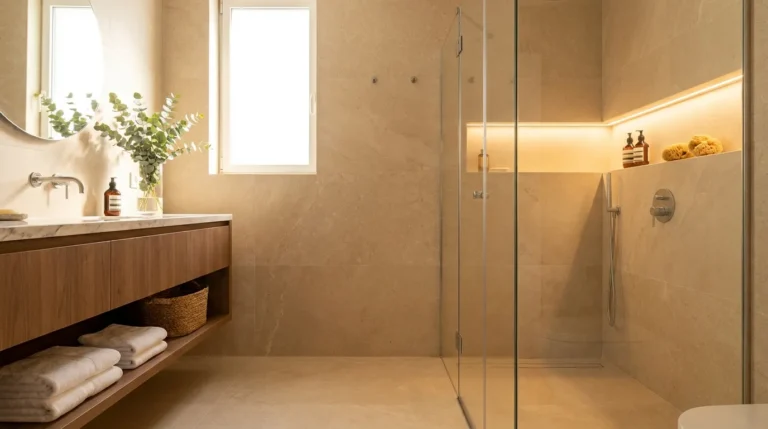
The built-in shower niche — a recessed alcove in the shower wall with shelves — is the storage solution that earns its place specifically because it disappears. No shelf bracket is visible, no product falls off the edge of a wire rack, no suction cup eventually fails and brings a shelf crashing down at 6am. The construction method depends on your wall type: in a new-build or renovation, a stud frame niche is set before tiling; in an existing tiled shower, a surface-mounted slim alcove frame that tiles over can achieve a near-identical effect. Marble shelves rather than tiled ones read as material-considered rather than merely practical. The front lip (even a subtle 1.5–2cm projection) is the critical detail that prevents product bottles from sliding forward onto the floor. Limit styling to three to five items per shelf — the restraint is what makes the niche look intentional rather than stuffed.
Idea 3: An Antique Apothecary Cabinet for Skincare and Toiletries
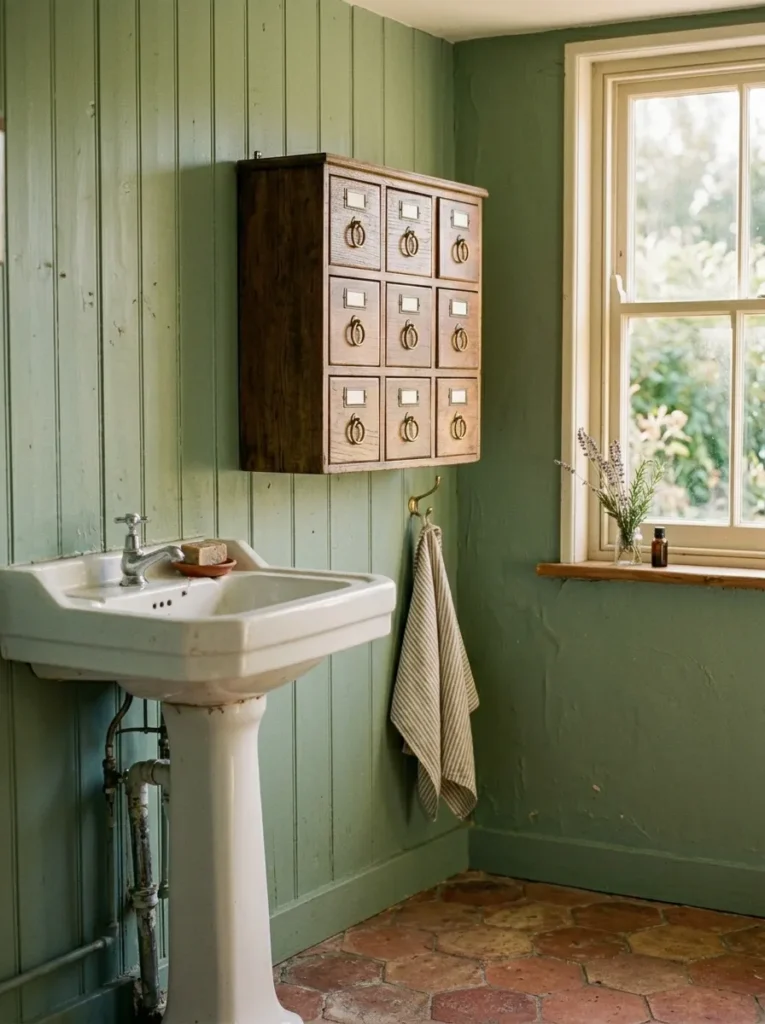
The multi-drawer apothecary cabinet is the organisational solution that looks like a design decision rather than a storage necessity. Original apothecary cabinets — used in pharmacies and herbalists through the nineteenth century — appear regularly at antique markets and online estate sales, and their small drawer format is almost perfectly suited to bathroom storage: one drawer per category (hair clips, nail files, contact lens supplies, cotton pads, travel minis) creates genuine organisation that feels like a filing system rather than a junk drawer. If sourcing an original feels too uncertain, reproduction versions from specialist furniture makers are widely available and often better suited to bathroom humidity conditions. The labelling is both functional and aesthetic — hand-written card labels in the brass slots maintain the apothecary character while actually helping other household members find things without searching. Mount at eye height on a wall that would otherwise be blank.
Idea 4: Vanity Drawers with Custom Drawer Dividers and Velvet Lining
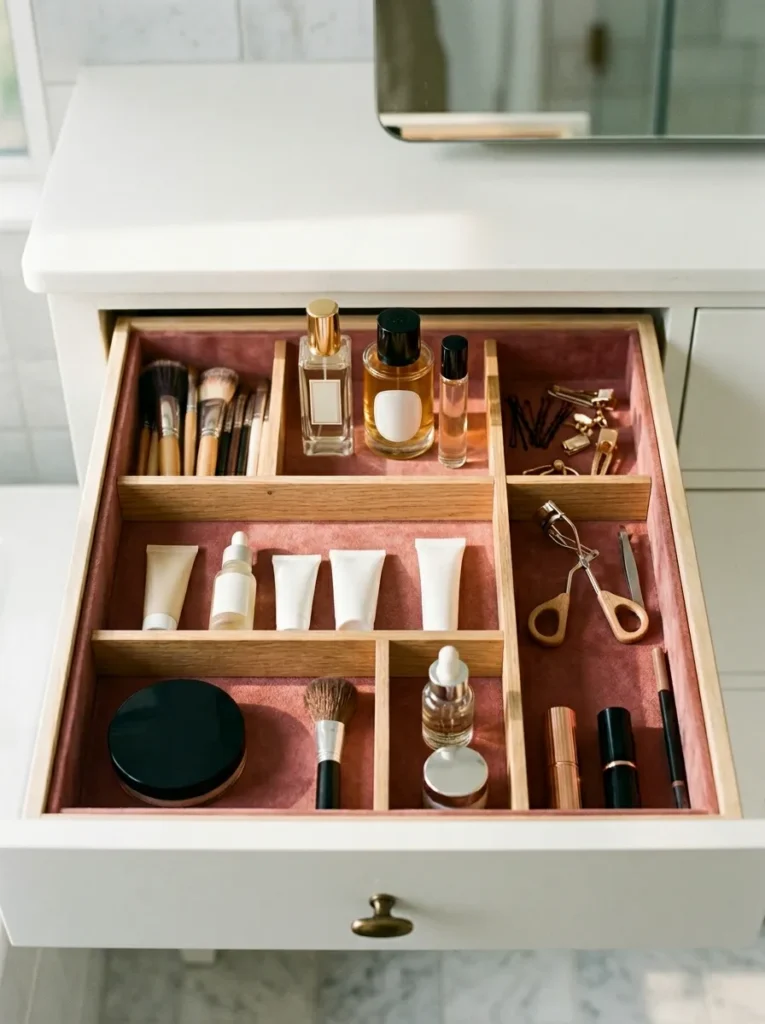
The transformation of a standard bathroom vanity drawer into a properly divided, velvet-lined organiser is the kind of detail that changes how a room feels to use every single morning — not how it looks from the doorway, but how it feels when your hands are in it. Velvet lining serves a practical purpose beyond aesthetics: it prevents glass perfume bottles from sliding and clinking, cushions delicate brushes, and doesn’t absorb product residue the way bare wood does. Custom balsa or thin oak dividers are a Saturday afternoon project: measure your drawer interior, cut strips to the right height, glue them at right angles to create your categories. If custom feels too involved, bamboo drawer dividers from any home storage retailer achieve a similar effect for under £20. The critical discipline is one category per compartment — the moment you allow a compartment to become miscellaneous, the whole system degrades within a week.
Idea 5: A Ladder Rail System for Towels and Basket Storage
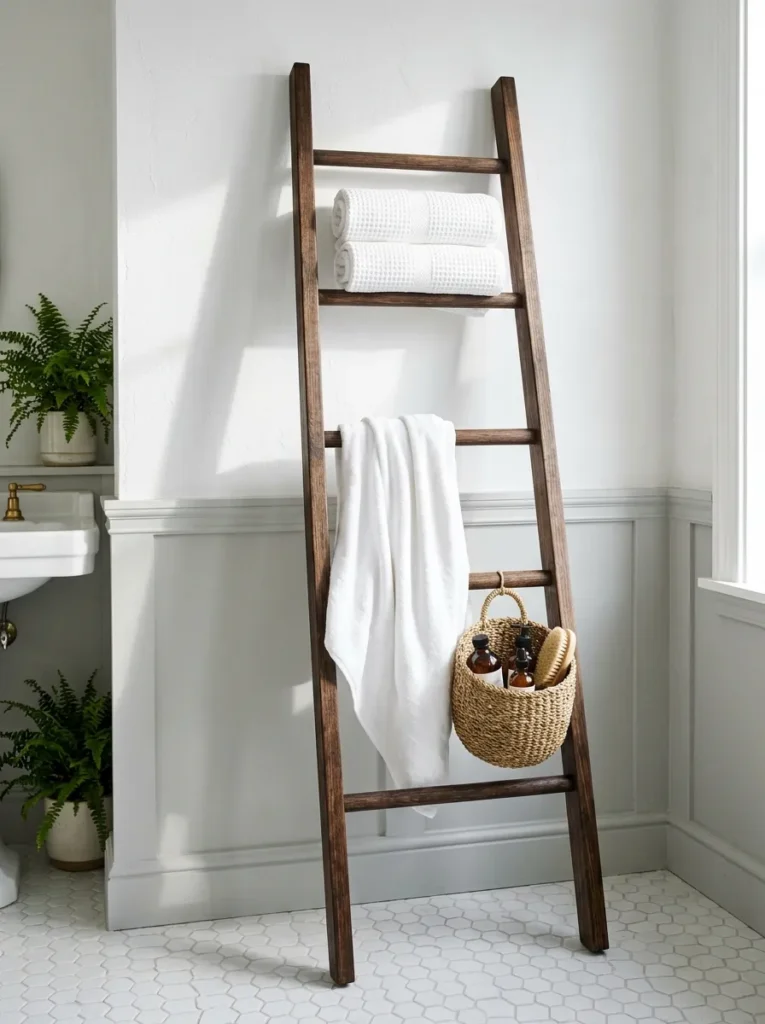
The bathroom ladder is the most compositionally pleasing towel storage solution available specifically because of the diagonal line it introduces into an otherwise rectangular room. Every bathroom wall tends toward horizontal and vertical — a leaning ladder breaks that geometry and photographs exceptionally well, which partially explains why this idea performs consistently on Pinterest. The practical logic is equally strong: towels dry faster on an open rail in a ventilated position than folded on a shelf. The hanging basket on the lower rung adds a category of storage — small toiletries, bath salts, a loofah — that would otherwise require a separate shelf. Dark walnut staining against a white wall creates a visual contrast that elevates the ladder from prop to furniture. Ensure it leans at an angle of around 15 degrees from the wall for stability; any more vertical and it tips, any more angled and it slides.
Idea 6: Under-Sink Curtain with Hidden Modular Storage Bins
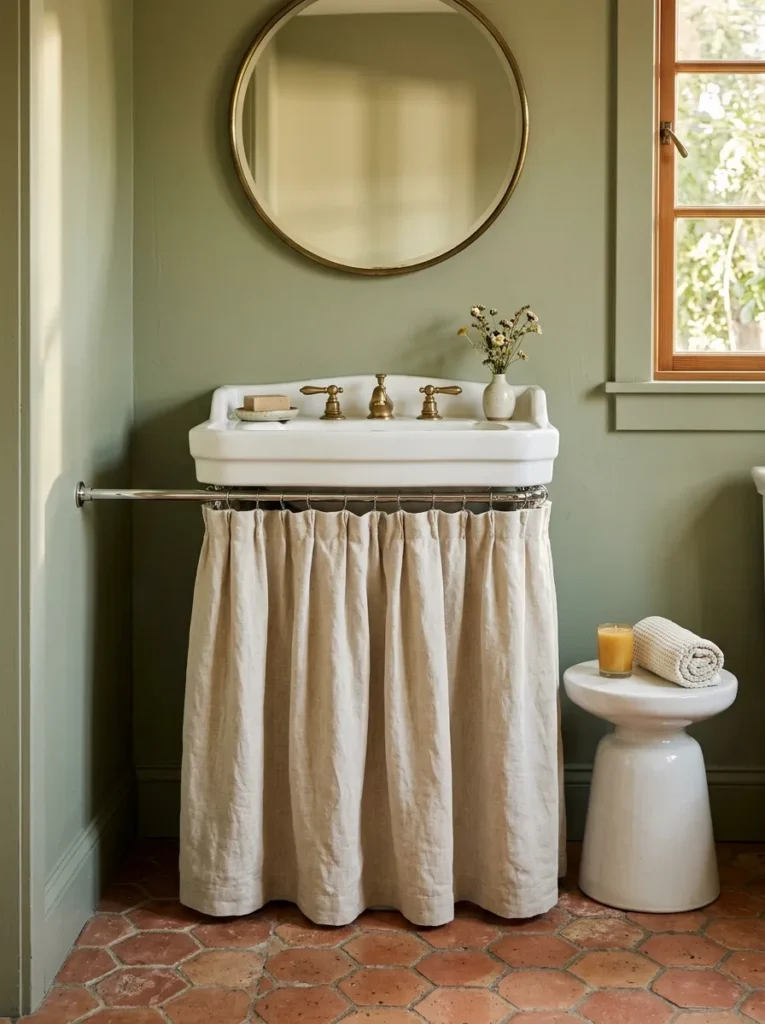
Under-sink space in a pedestal-sink bathroom is dead space by default — exposed plumbing makes it look messy and open shelving gathers dust in the damp environment. The under-sink curtain on a tension rod is a renter’s solution that requires no drilling, costs less than £15 for curtain and rod combined, and conceals a genuinely useful storage zone. Behind the curtain: modular canvas or wicker bins on a low tension-shelf or directly on the floor, each holding a different category (cleaning products, spare toilet rolls, hairdryer, period products). The linen curtain material is the key choice — it reads as intentional and soft rather than the plastic-shimmer alternatives. Natural undyed linen or a chambray in a room-compatible colour both work; avoid patterns, which start to look craft-project rather than designed. The curtain can be re-hung on a completely different rod instantly if moving house.
Idea 7: A Mirrored Tray as a Perfume and Skincare Display Station
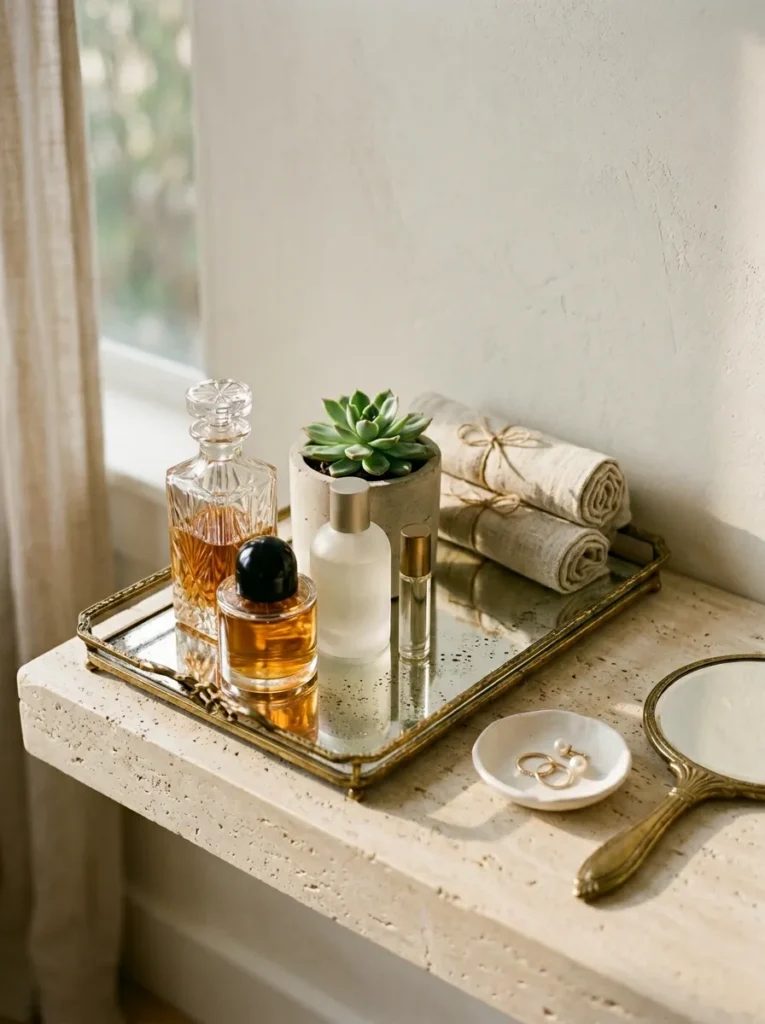
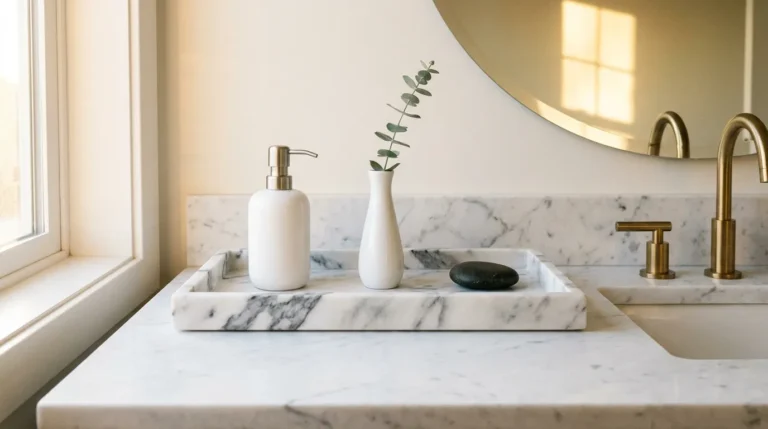
The mirrored tray is functionally a corral — it defines the boundaries of a product display so that “things on the shelf” becomes “a curated arrangement” simply by virtue of having an edge. The psychology here is meaningful: the tray signals that the items within it belong together and have been placed rather than accumulated. From a practical standpoint, it also protects stone or wooden shelves from product spill and makes the entire display liftable for cleaning with one hand. The antiqued gold mirror finish reflects both the products within it and the room behind the camera, creating a sense of depth in the image — which is why this styling approach photographs so strongly for Pinterest. Composition rules: perfume bottles in groups of odd numbers (three or five), one textural element (a small plant or rolled textile), and one reflective object (a small glass or metal dish). Keep the group no taller than 25cm or it begins to feel cluttered.
Idea 8: Magnetic Strip Inside a Cabinet Door for Small Metal Items
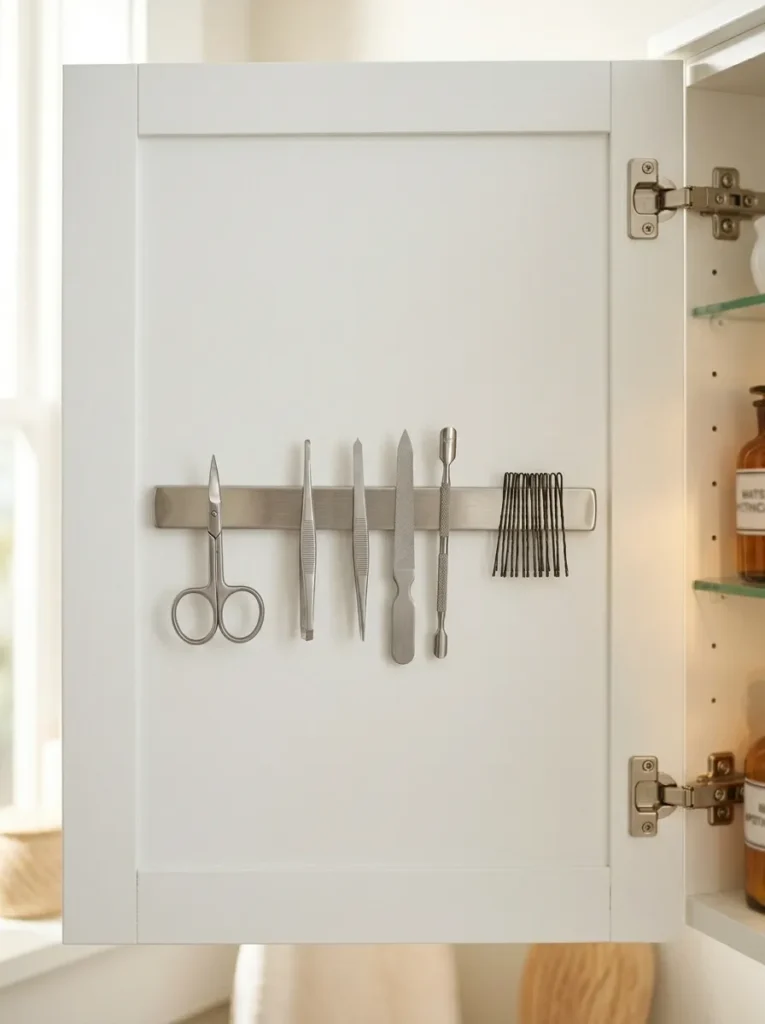
The inside of a cabinet door is the most consistently underused storage surface in the bathroom. A slim stainless steel magnetic strip — the same type sold for knife storage in kitchens — mounted on the inside of a bathroom cabinet door immediately organises every small metal item that currently lives at the bottom of a drawer, shuffling around and becoming unsearchable: tweezers, nail scissors, eyebrow razors, bobby pins, nail files, a cuticle pusher. All of these are metal; all of them become immediately retrievable. Installation requires two screws or a strong double-sided mounting tape appropriate for the door material. The strip should run horizontally rather than vertically so gravity assists the magnetic hold rather than fighting it. The result: a door that has been storing dead air for years suddenly houses an entire category of bathroom tools with zero drawer space consumed.
Idea 9: Ceiling-Height Linen Cupboard Built Into an Alcove
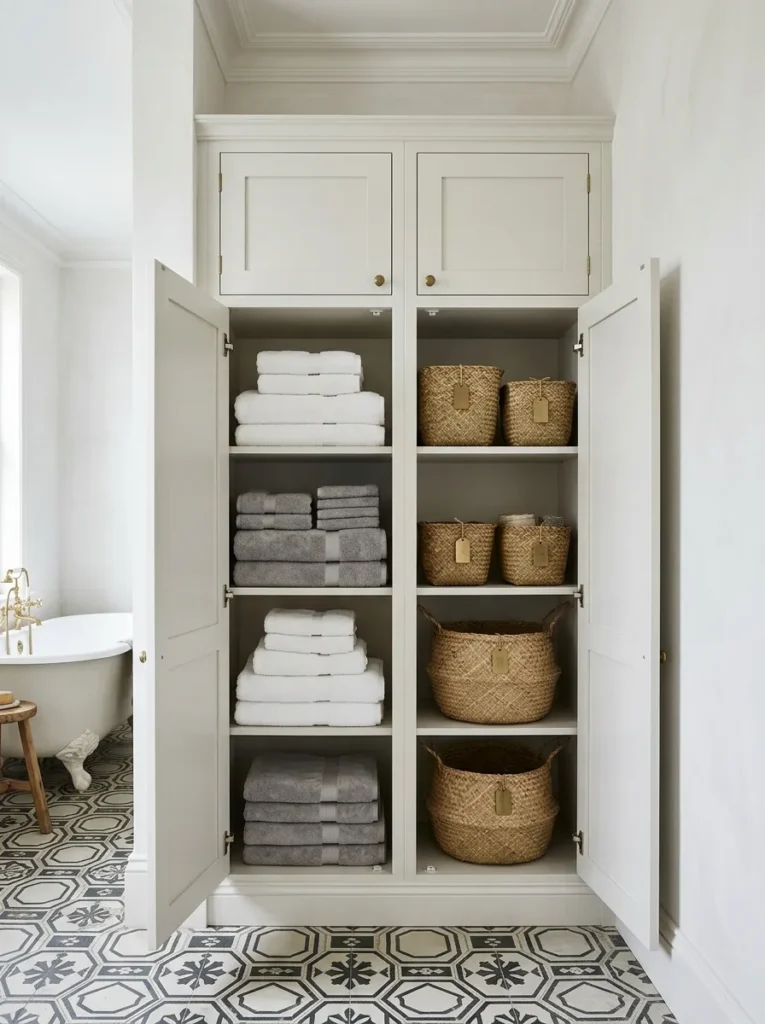
An alcove that runs floor to ceiling in a bathroom is almost always better used as a fitted linen cupboard than as open shelving — and this is the storage argument most bathroom design articles fail to make explicitly. Open shelving accumulates dust and humidity residue on every surface; a closed cupboard protects towels and spare products from both. The shaker-style door front is the right aesthetic choice for this use: simple, unadorned, available from flat-pack cabinet suppliers in any size, and compatible with almost every bathroom style from cottage to contemporary. The key specification decision is shelf depth: 35–40cm is right for folded towels without wasted space; any deeper and the back of the shelf becomes a black hole. Woven baskets with brass-tag labels on the lower shelves organise the less photogenic items (cleaning supplies, first aid, spare toiletries) while remaining easily retrievable.
Idea 10: A Rolling Brass Bar Cart Repurposed as a Towel and Product Station
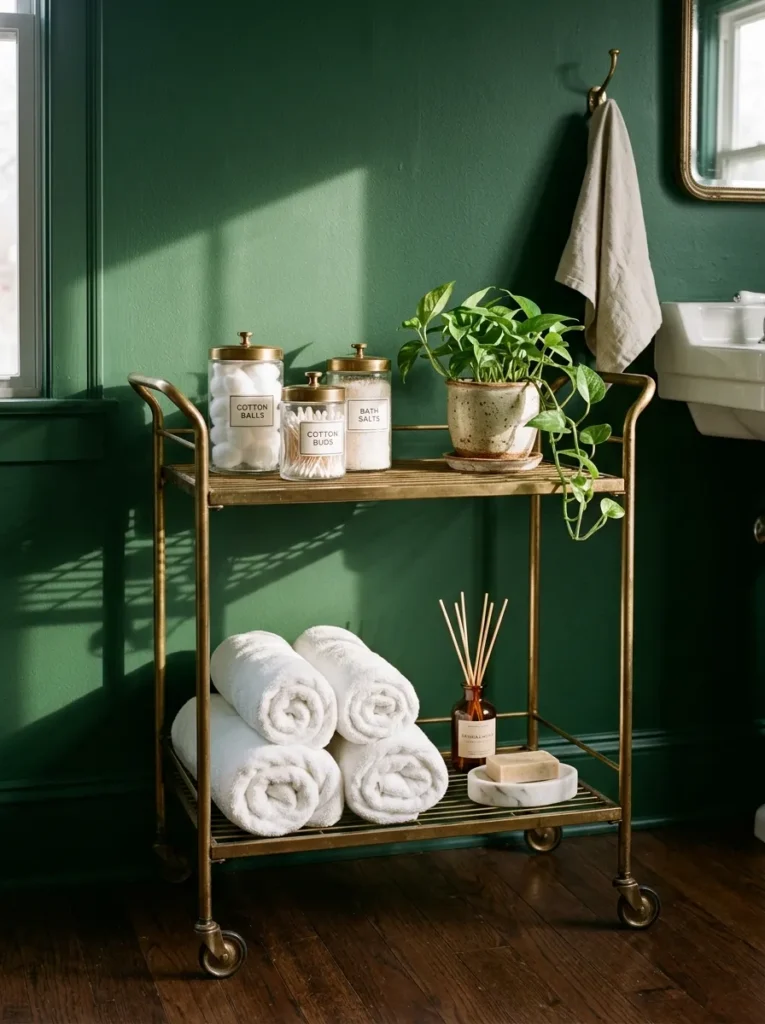
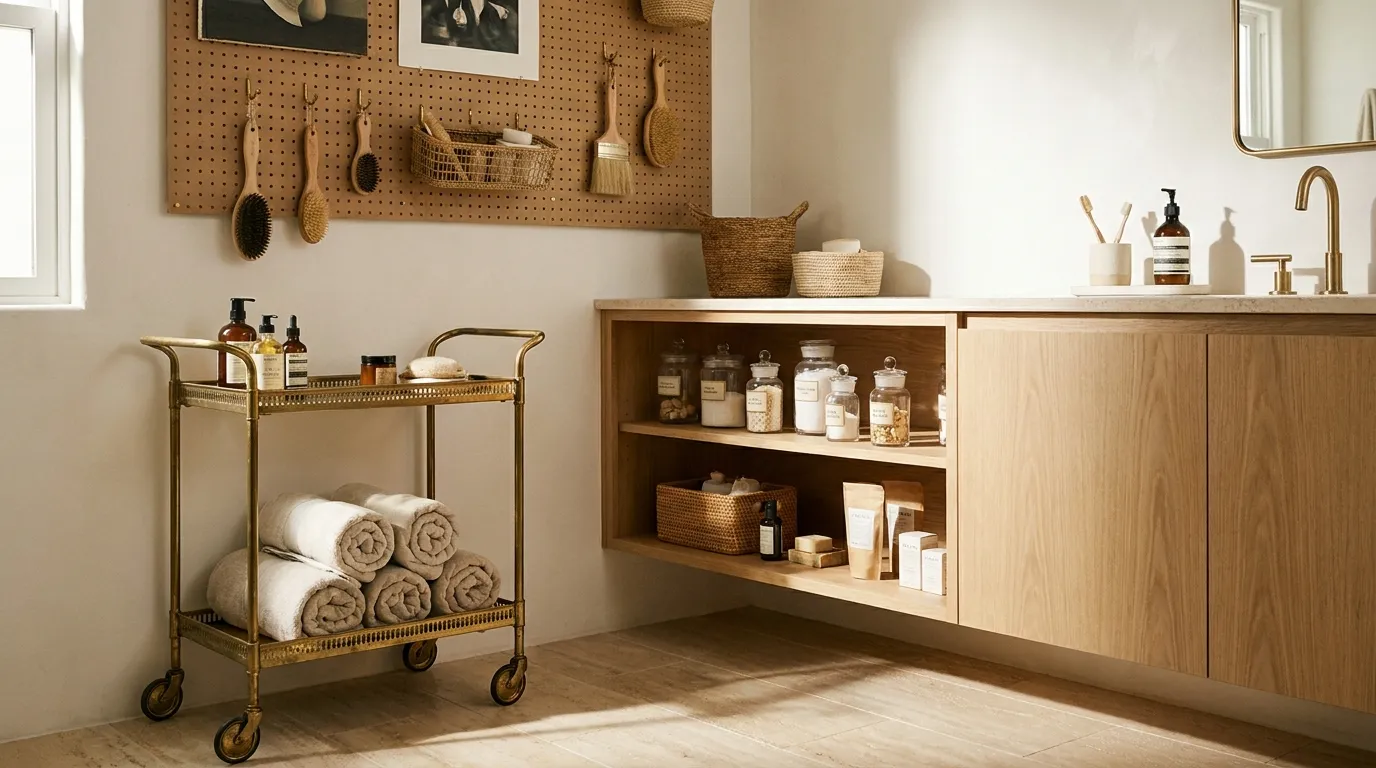
The brass bar cart in a bathroom is the idea that earns consistent disbelief until it’s implemented — at which point it becomes one of those things people find impossible to live without. Its advantages over fixed storage: it moves. When you need to clean the floor, the entire storage unit wheels out of the way in seconds. When a layout change makes more sense, the cart relocates without a single drill hole. The two-tier format solves a bathroom storage problem that single shelves don’t: vertical categorisation. Display items (glass apothecary jars, soap dish, trailing plant) on the upper tier; functional items (towels, products in daily use) on the lower. The brass finish ages warmly in a bathroom environment and reads as antique-curated rather than utilitarian. Forest green or deep navy walls are the best backdrop — the contrast between the warm metal and dark wall is what makes this photograph so well.
Idea 11: Shallow Open Shelves Above the Toilet for Styled Storage
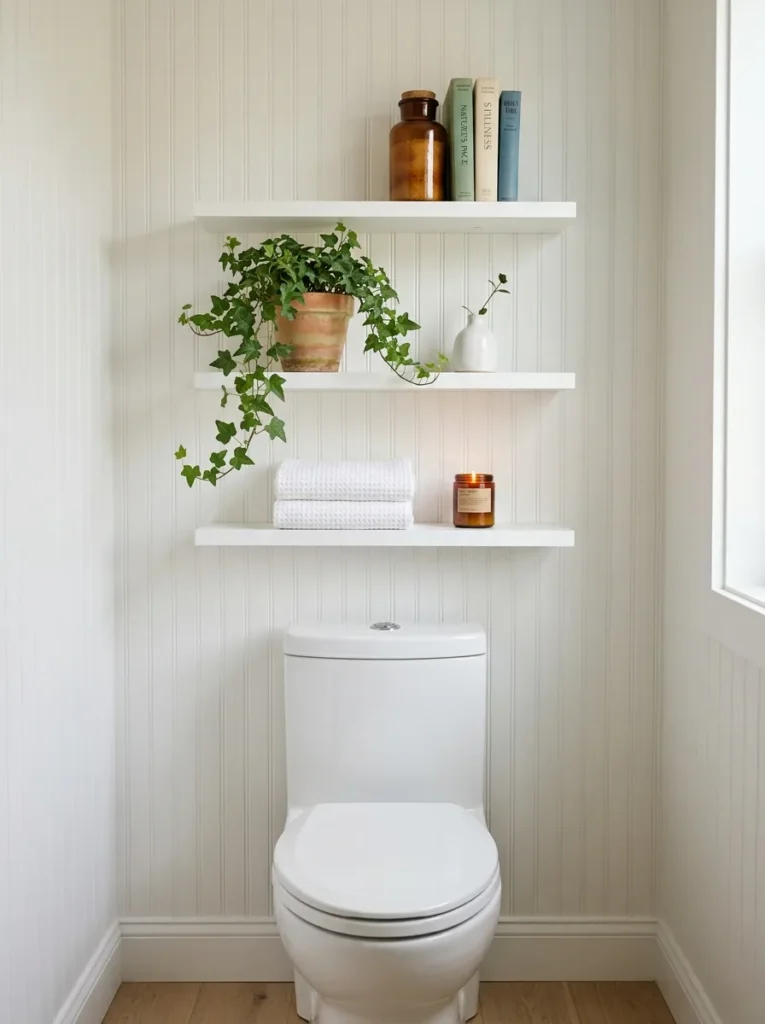
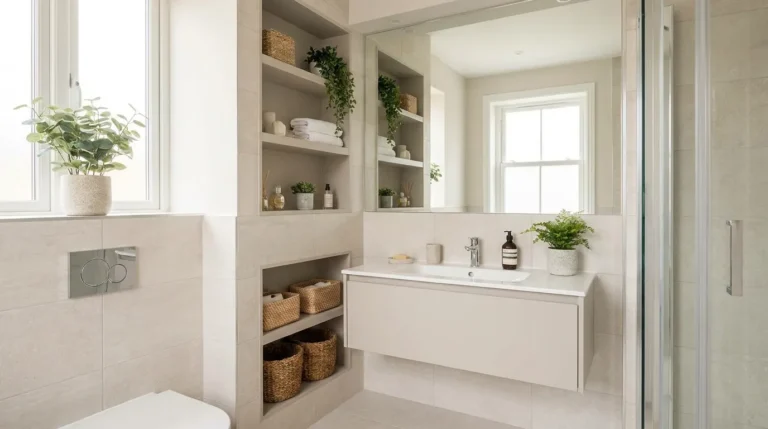
The wall above the toilet is the most reliable unused rectangle in any bathroom — typically 45–60cm wide, starting at around 80cm above the floor and running to the ceiling. Three slim floating shelves fitted here add meaningful storage capacity without touching a single square centimetre of floor space. The depth specification matters: 15–20cm is the correct depth for this location. Deeper shelves risk sitting over the toilet tank in a way that makes the flush mechanism awkward to access; shallower shelves can’t hold much beyond small items. The styling rule for above-toilet shelving is strict vertical hierarchy: practical items (towels, candles in daily use) on the lowest shelf where they’re easily reached; decorative items escalating upward as reach decreases. A trailing plant on the middle shelf adds a living element that photographs well and improves air quality. Avoid heavy items on the top shelf — they create visual weight that makes the room feel top-heavy.
Idea 12: A Fabric-Fronted Cabinet for Concealed Under-Sink Storage
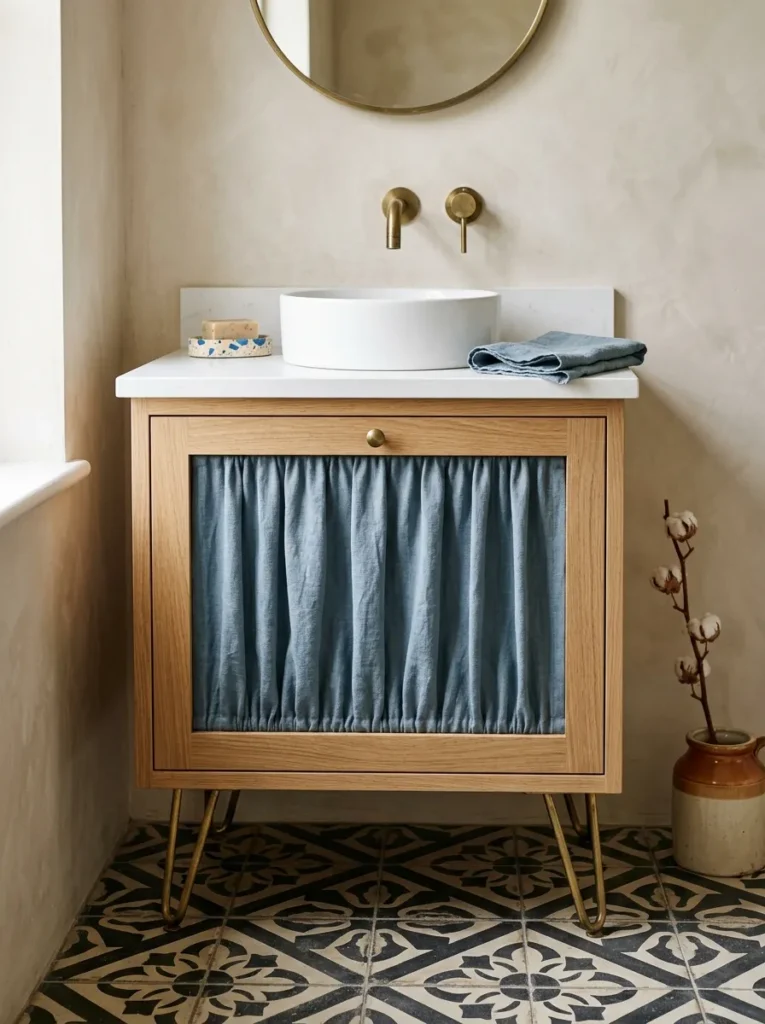
A cabinet door with a fabric insert panel rather than a solid wood or MDF panel is a custom furniture detail that most people associate with high-end bespoke joinery — but it’s achievable as a retrofit on an existing bathroom cabinet using only basic tools. Remove the existing panel insert from the door frame, staple a gathered fabric across the back of the frame opening, and reinstate the door. The result is softer and more textile-rich than a painted cabinet, the fabric hides contents completely while signalling that the storage is curated rather than concealed out of necessity, and the gathered fabric absorbs sound rather than reflecting it. Dusty blue, natural linen, or a soft sage work best in bathroom conditions — avoid very light whites that show humidity marks. Pair with brass hardware: the warm metal reads as intentional against the textile and prevents the look from drifting into craft territory.
Idea 13: A Pegboard Panel Above the Vanity for Customisable Tool Storage
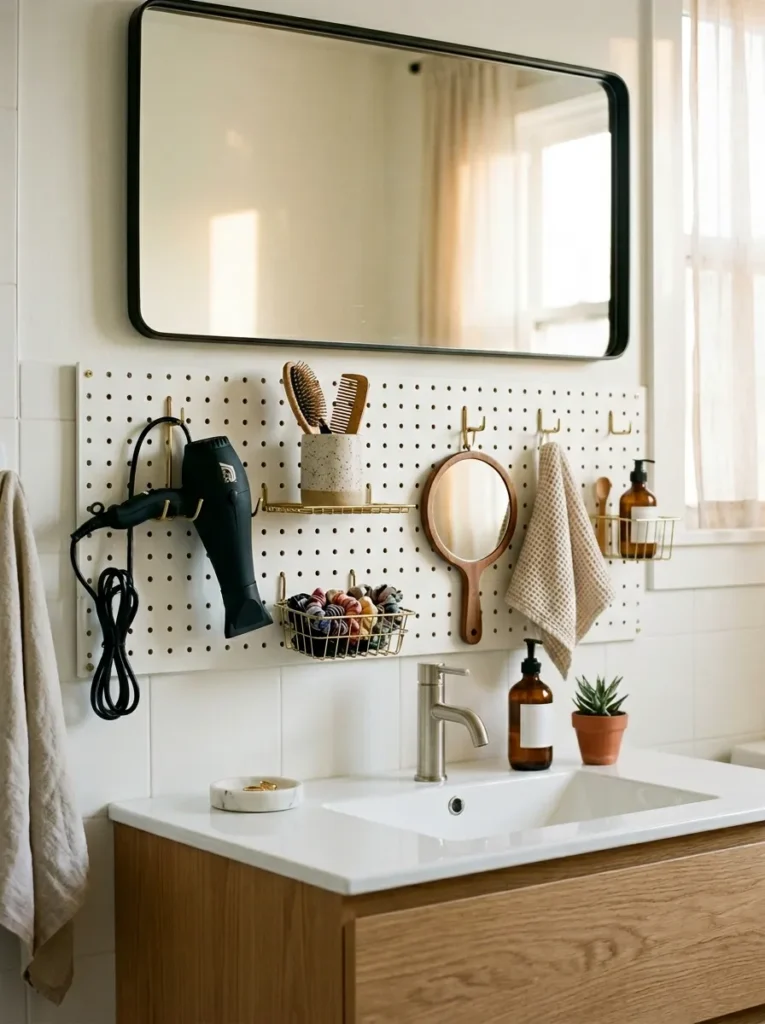
The pegboard panel above a vanity solves a specific problem that no other storage solution addresses: electrical hair tools. A hairdryer, straightener, and curling tong represent three items that most bathrooms have no proper home for — they’re too large for a drawer, the cords tangle on shelves, and hanging them from hooks requires knowing exactly where the hooks should be before installing. Pegboard panels are reconfigurable at any time: hooks can move as your tool collection changes, a new basket can be added without drilling a new hole, and the entire system can be taken down without more than two screws in the wall. The white painted finish is non-negotiable for bathrooms — raw pegboard reads as workshop, painted pegboard reads as considered storage. Brass peg hooks rather than standard chrome transform the system from DIY-looking to designed.
Idea 14: A Recessed Niche Beside the Bathtub for Candles and Bathing Extras
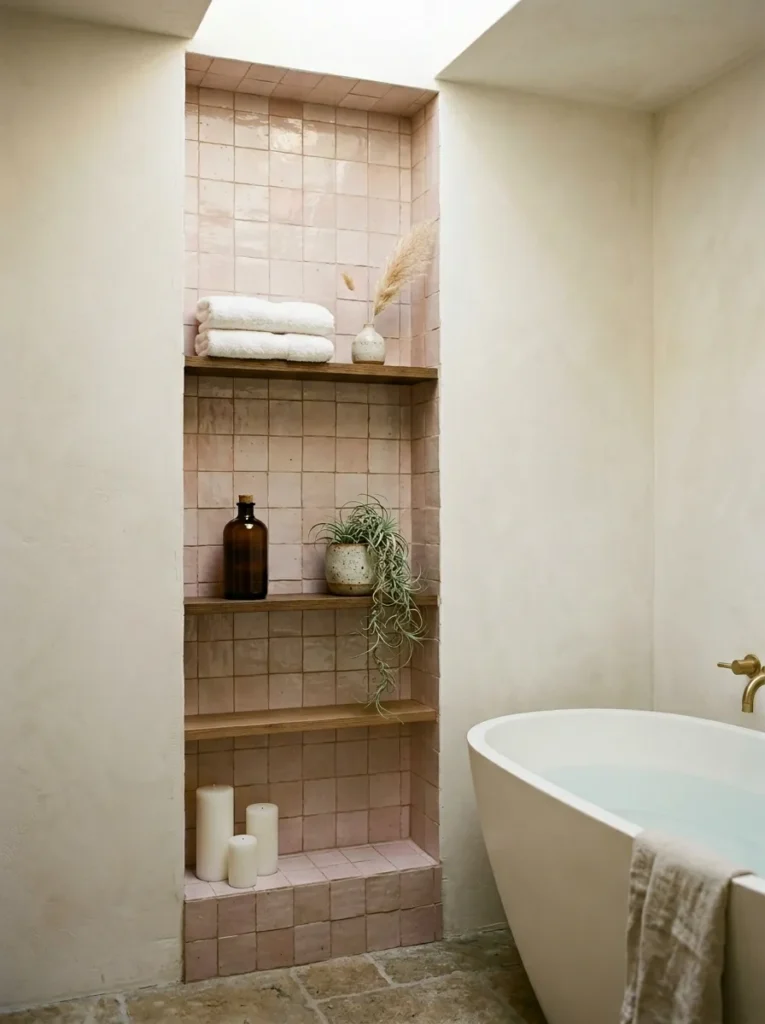
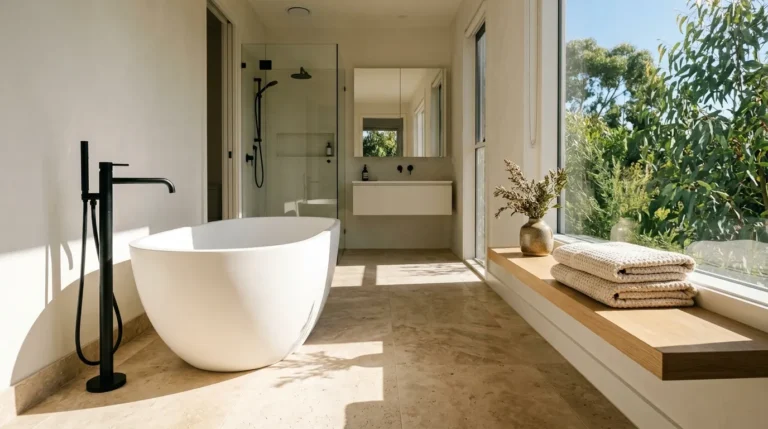
The floor-to-ceiling niche beside a freestanding tub is architecturally elegant in a way that a surface-mounted shelf never achieves: it reads as part of the original structure of the room, not added to it. This distinction matters perceptually — built-in storage signals that the room was designed with intention, which elevates the entire space. A narrow niche of 20–30cm width beside a tub provides the ideal candle staging area (the enclosed walls protect flames from any air movement), a shelf for the bath oil and accessories you reach for during a bath, and additional towel storage close to where towels are actually needed. Zellige tile lining the niche interior adds a visual pop of texture and colour that differentiates the niche from the surrounding wall — a design choice that costs no more than standard tile but reads as considerably more considered.
Idea 15: Stacking Rattan Boxes with Labels on an Open Shelf
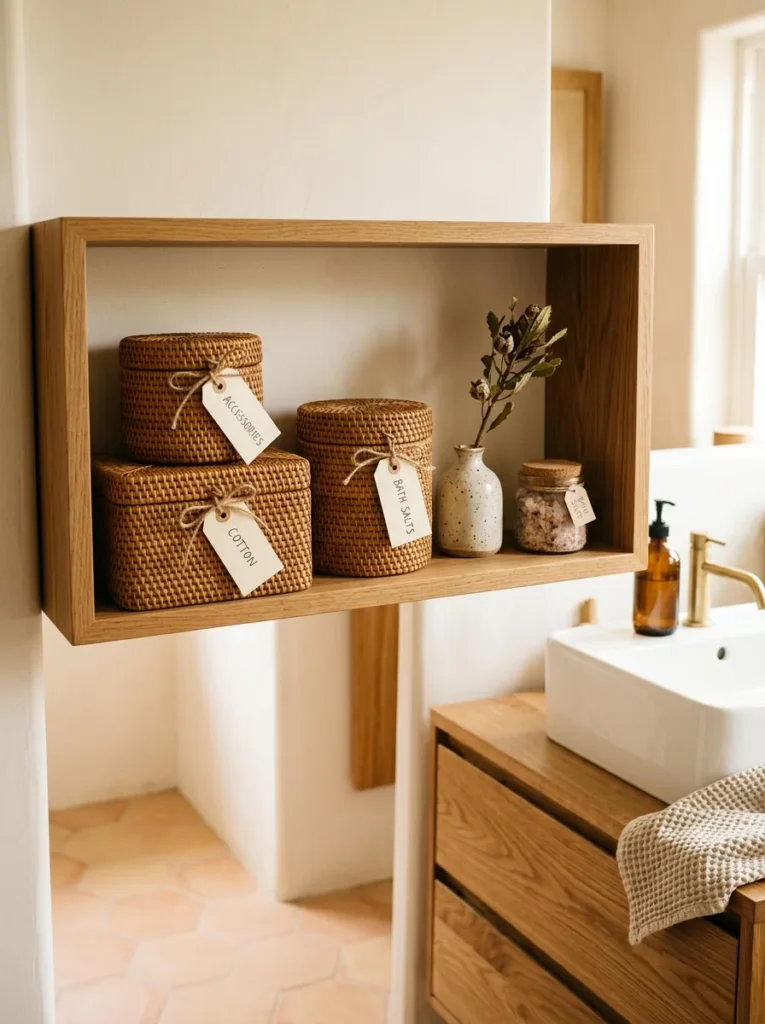
Rattan lidded boxes occupy an interesting category in bathroom storage: they conceal contents completely (unlike open baskets), they stack efficiently (unlike round containers), and they don’t require a closed cabinet to look organised (unlike plastic bins). The natural material also breathes, which prevents the humidity buildup that sealed plastic boxes encourage. The labelling system using small card tags and twine rather than printed adhesive labels is a deliberate texture and warmth choice — it reads as handmade and personalised, which is the opposite emotional register of a plastic drawer organisers system. Category naming suggestion: resist the temptation to label by object (“hair bands”) and instead label by occasion or use (“morning routine,” “first aid,” “guest extras”) — the broader categories stay relevant even as the contents shift over time.
Idea 16: A Wall-Mounted Apothecary-Style Glass Jar Collection
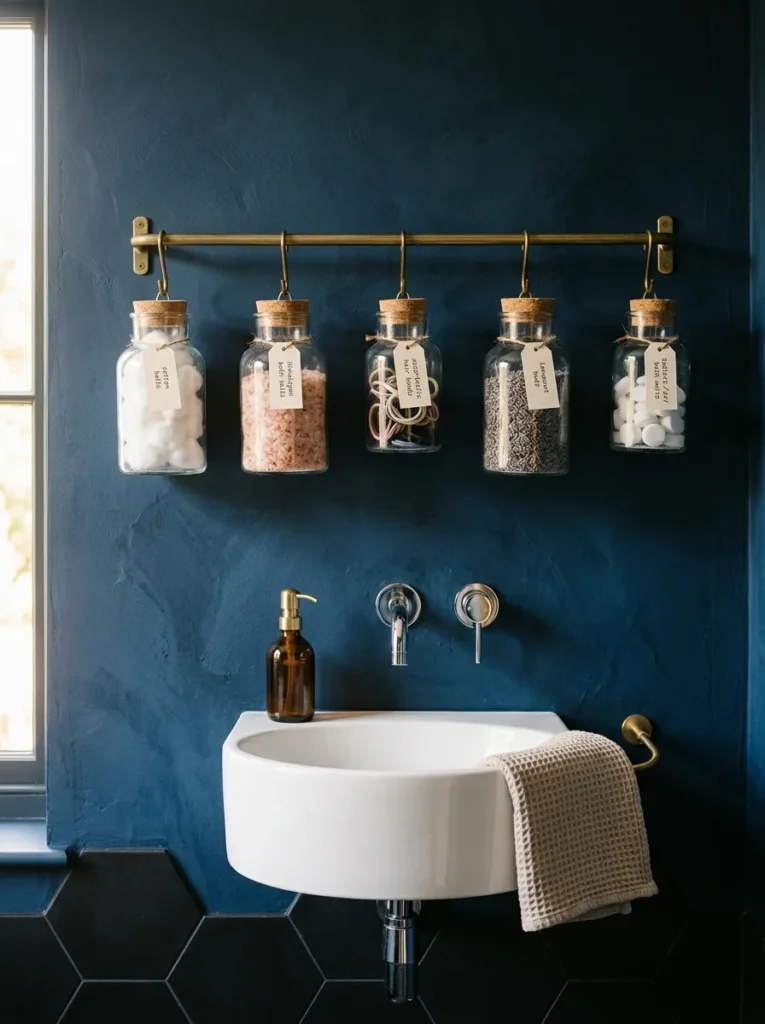
Apothecary glass jars mounted on a rail system convert bathroom consumables — cotton buds, bath salts, hair bands, cotton pads — from items to objects. The distinction matters: items get hidden; objects get displayed. The transparency of glass means the storage is also wayfinding — you can see at a glance which jar needs refilling, and the visual of cotton balls in a glass jar against a dark wall reads as curated boutique rather than functional bathroom. The brass rail bracket allows jar position to be adjusted as your storage needs change; you can add jars or remove them without drilling new holes. Cork lids maintain the apothecary aesthetic and keep contents dust-free in a bathroom humidity environment. This system works particularly well on dark walls — the glass and brass read most dramatically against deep navy, forest green, or charcoal — where a standard white shelf would disappear.
Idea 17: A Built-In Window Seat with Lift-Top Storage Beneath
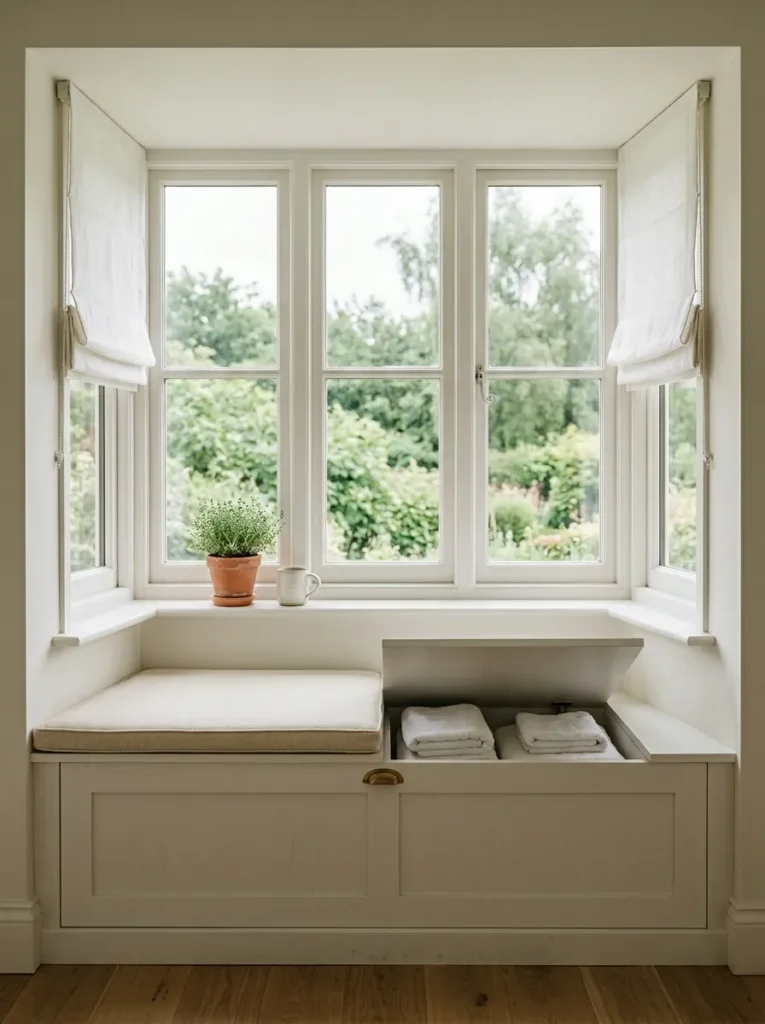
A bathroom with a bay window or a deep window recess has an architectural gift that most people waste on a plant shelf. A built-in window seat with lift-top storage provides 60–100 litres of concealed storage volume — enough for every spare towel, seasonal product, and overflow item in the bathroom — while converting what is often the least-used corner of the room into a functional rest point and a photogenic focal feature. The cabinetry cost is relatively modest because the structure is simple: a box with a hinged lid, finished in the same style as the surrounding bathroom joinery. Lid support hinges (soft-close stay hinges that hold the lid open without requiring you to hold it) are a small specification decision with a large quality-of-life impact. Line the interior with a cedar panel if moth protection for stored textiles is a concern.
Idea 18: A Narrow Pull-Out Pantry-Style Cabinet Between Studs
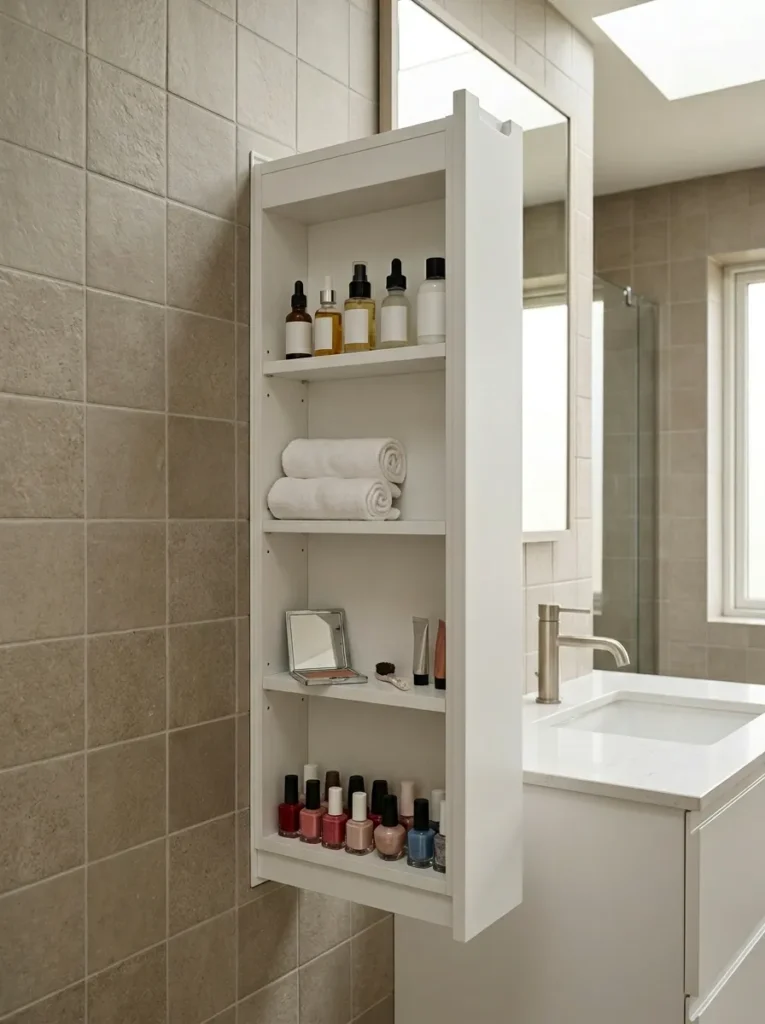
A standard stud wall has 90–100mm of depth between studs — enough for a pull-out slim cabinet that stores a surprising amount when shelves are properly spaced. The hidden pull-out works as true concealed storage: when closed, the cabinet face is flush with the surrounding wall (a finger-pull or magnetic push-to-open catch is the only visible element). When open, it provides four to six shelves of narrow storage perfect for products in depth-limited categories: nail varnish rows, small skincare bottles, travel-sized products, and rolled hand towels. The installation requires a carpenter for the drawer runner mechanism, but the cost is considerably less than a standard fitted cabinet because the wall cavity already exists. This is particularly useful in a bathroom where every square centimetre of floor space is already occupied — the storage comes out of the wall itself.
Idea 19: Hanging Woven Baskets at Different Heights as Wall Storage
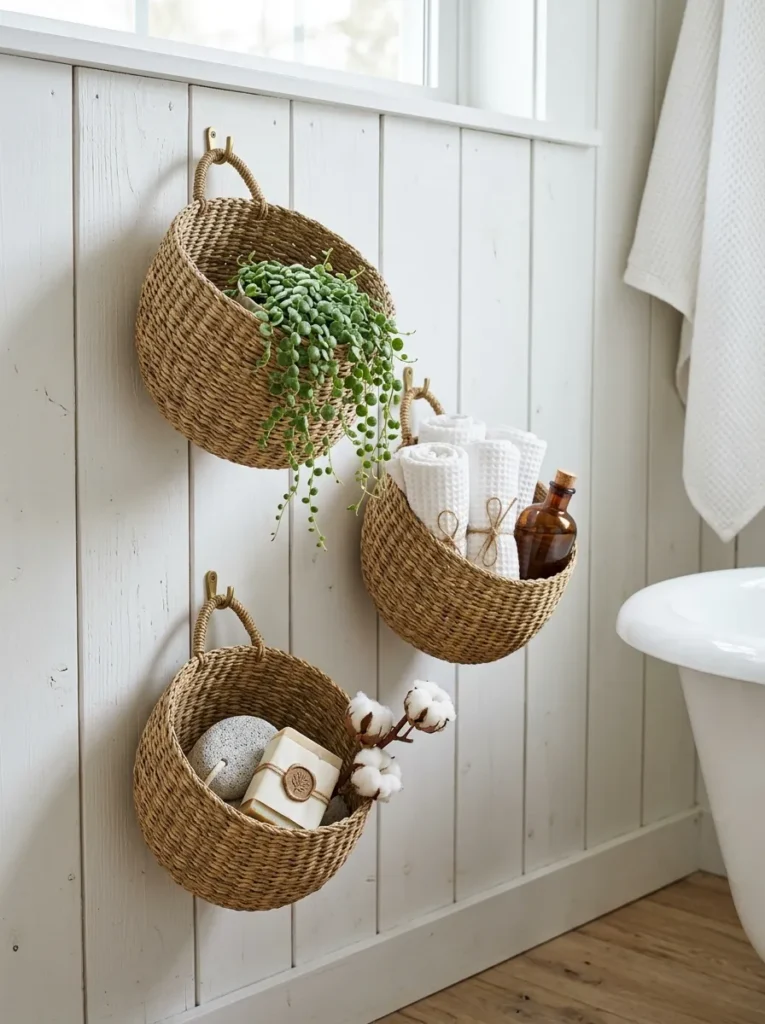
Round woven wall baskets used as bathroom storage are the intersection point between wall art and practical organisation — and the decision to hang them at varied heights rather than in a uniform row is what separates a designed installation from a craft project. The offset arrangement mimics the way objects in nature arrange themselves, which the eye reads as organic rather than artificial. Each basket holding a single category of items (not a miscellaneous collection) maintains the organisation principle while appearing effortless. The low cost and zero-renovation installation (a single picture hook per basket) makes this the highest-return bathroom storage idea available to renters. Seagrass and water hyacinth are the most humidity-tolerant materials; avoid jute in high-steam bathrooms as it breaks down faster in sustained moisture. Sizes work best varied: a large basket at one height, a medium at another, a small at the third.
Idea 20: A Custom Painted Cabinet Interior as Hidden Colour Feature
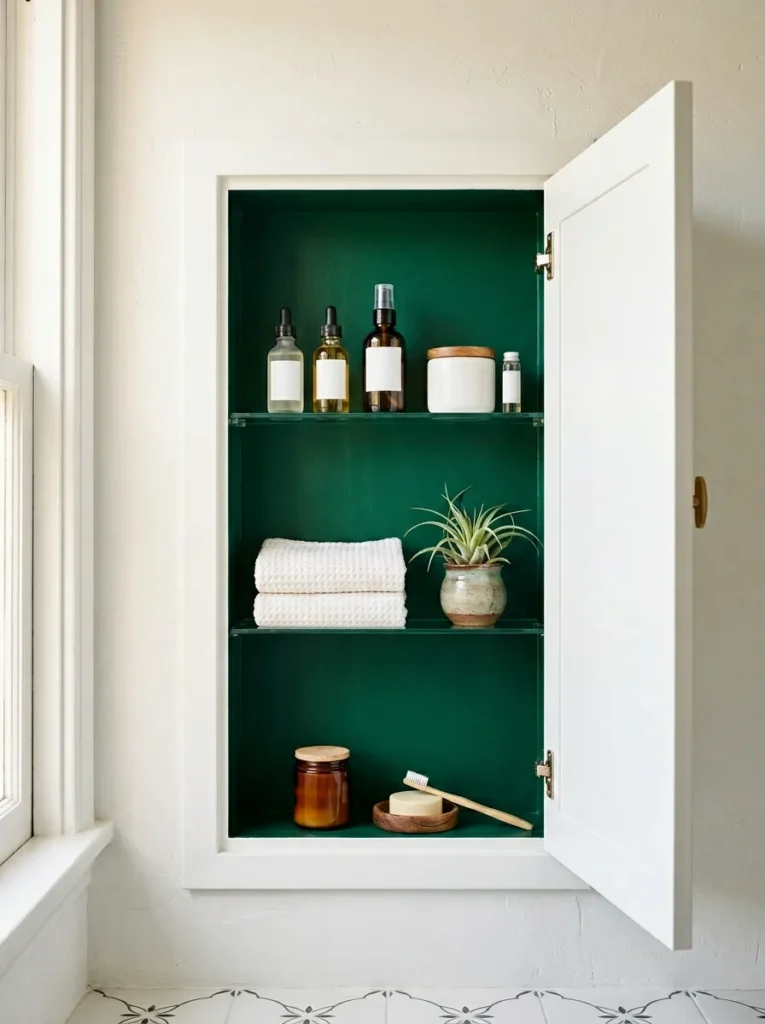
Painting the inside of a bathroom cabinet in a rich, saturated colour while leaving the exterior white is a design secret that costs approximately £10 in paint and creates a moment of genuine delight every time the cabinet is opened. The exterior restraint — plain white — means the room reads as clean from the doorway; the rich interior colour is a private experience, a jewellery-box reveal. Emerald green, deep navy, dusty rose, or terracotta all work exceptionally well against white shelves and white product packaging. This technique also has a practical benefit that isn’t often mentioned: a dark or vivid interior makes it immediately obvious when a shelf has accumulated product residue or dust that needs cleaning. Glass shelves rather than painted wood shelves allow the interior colour to remain visible even when shelves are stocked. A single coat of furniture paint in an eggshell finish is all that’s required.
Conclusion
Bathroom clutter doesn’t resolve itself. But neither does it require a full renovation, a generous budget, or an entirely new set of furniture to address. The ideas in this list range from a weekend afternoon project (painting a cabinet interior, installing a pegboard, adding a magnetic strip to a door) to longer-term investments (the built-in alcove cupboard, the window seat with lift storage) — and the through-line in every one of them is the same: storage that is designed rather than defaulted to looks better, works better, and makes the room itself feel more deliberate. Pick the idea that solves the specific clutter problem your bathroom has first. Do it well. Then come back for the next one.