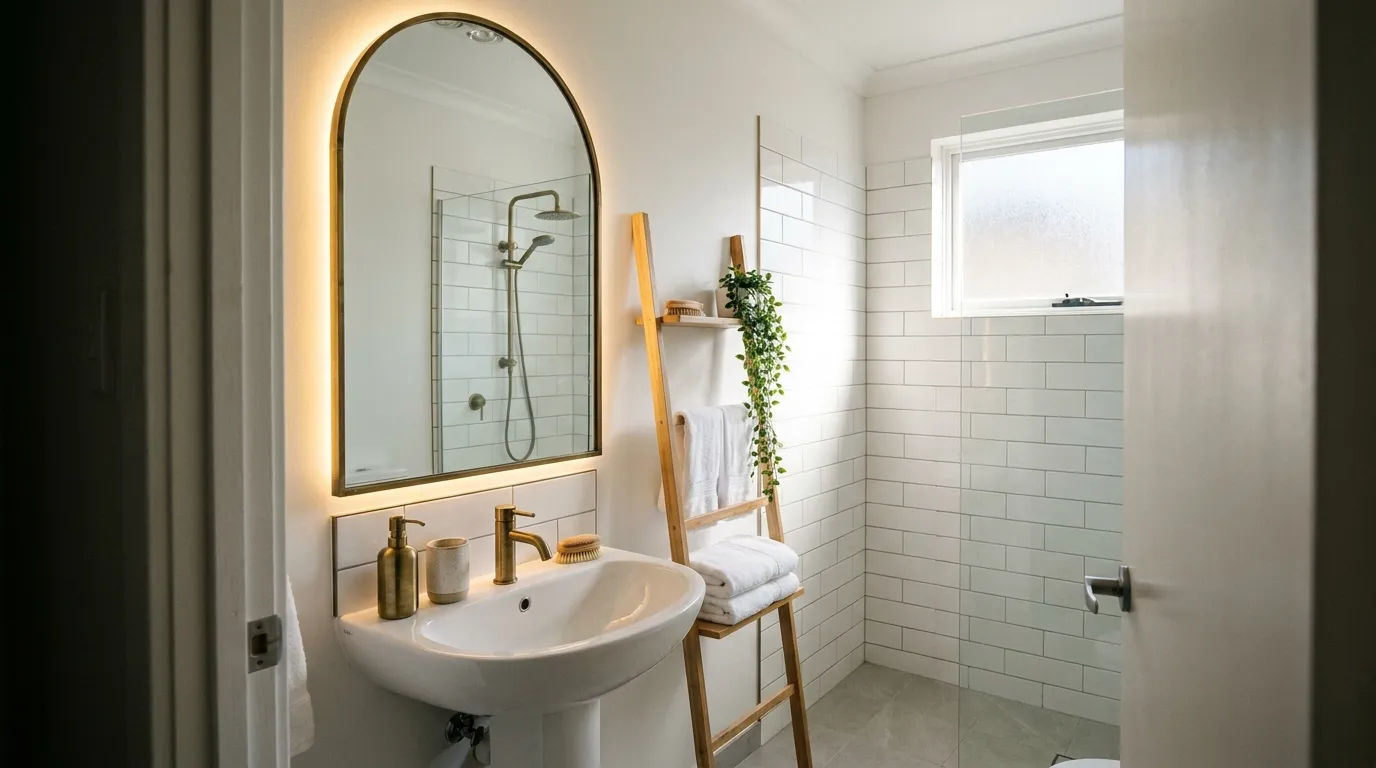
22 Apartment Bathroom Ideas That Feel Stylish and Functional
Apartment bathrooms tend to share three characteristics: they’re small, they have fixtures chosen for durability rather than appearance, and they’re largely off-limits for any renovation that involves tiles, plumbing, or permanent structural change. That’s a genuinely narrow brief, and most bathroom inspiration online ignores it entirely. The marble-tiled walk-in shower and the bespoke vanity unit don’t apply here.
What does apply — and what this article covers — is the surprisingly wide range of changes that are both renter-permissible and visually significant. New hardware, a magnetic mirror swap, command-strip lighting, peel-and-stick tile, storage that uses vertical space rather than floor area, and a few well-chosen objects at eye level can shift a plain bathroom from barely tolerable to somewhere you’d actually want to spend time in the morning. These apartment bathroom ideas are ordered from foundational to finishing detail, because the sequence of changes matters as much as the changes themselves.
1. Replace the Builder-Grade Mirror With a Framed or Leaning Alternative
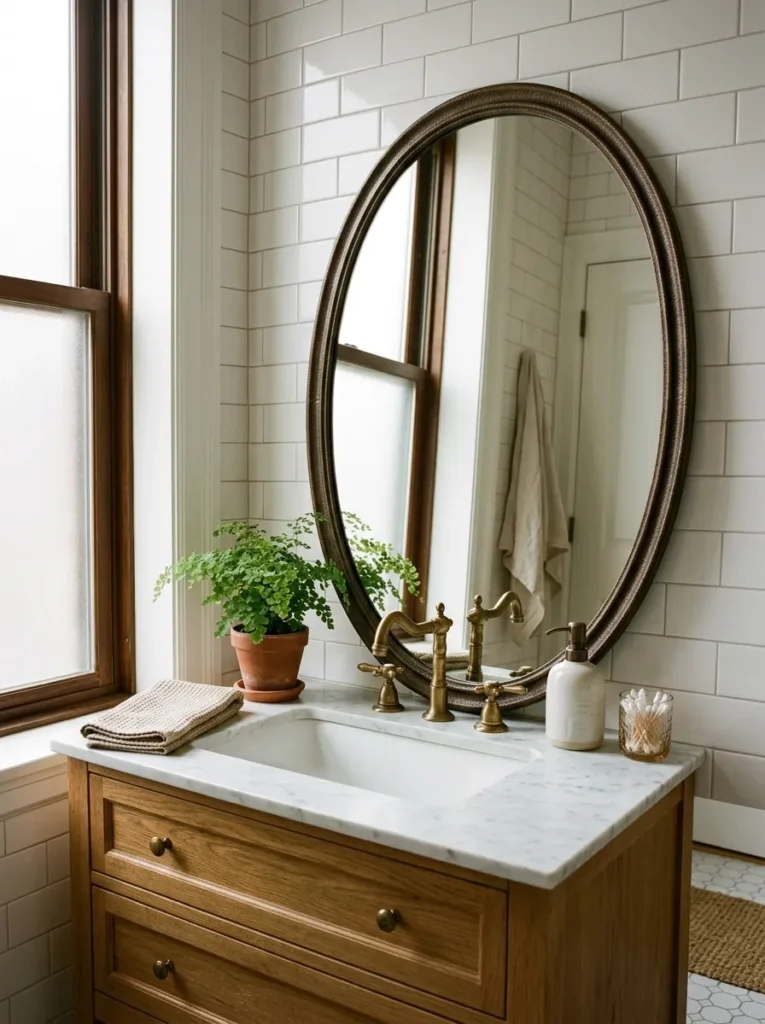
The plain rectangular mirror glued directly to the wall is one of the most universal features of a rented bathroom and one of the easiest to visually override — not by removing it, but by leaning or mounting a second, more considered mirror in front of or beside it. A large arched or oval mirror leaned against the vanity wall, or a framed mirror mounted on command strips above the existing one if the positioning works, changes the vanity area more immediately than almost any other single change.
The frame style sets the room’s visual register: a thin brass or gold-tone frame reads contemporary; a heavy ornate frame reads more traditional and suits older apartment architecture; a dark wood frame suits a warmer, more eclectic approach. The leaning option requires no drilling and gives back the original mirror undamaged when you leave.
2. Swap Out the Standard Cabinet Hardware for Aged Brass or Matte Black
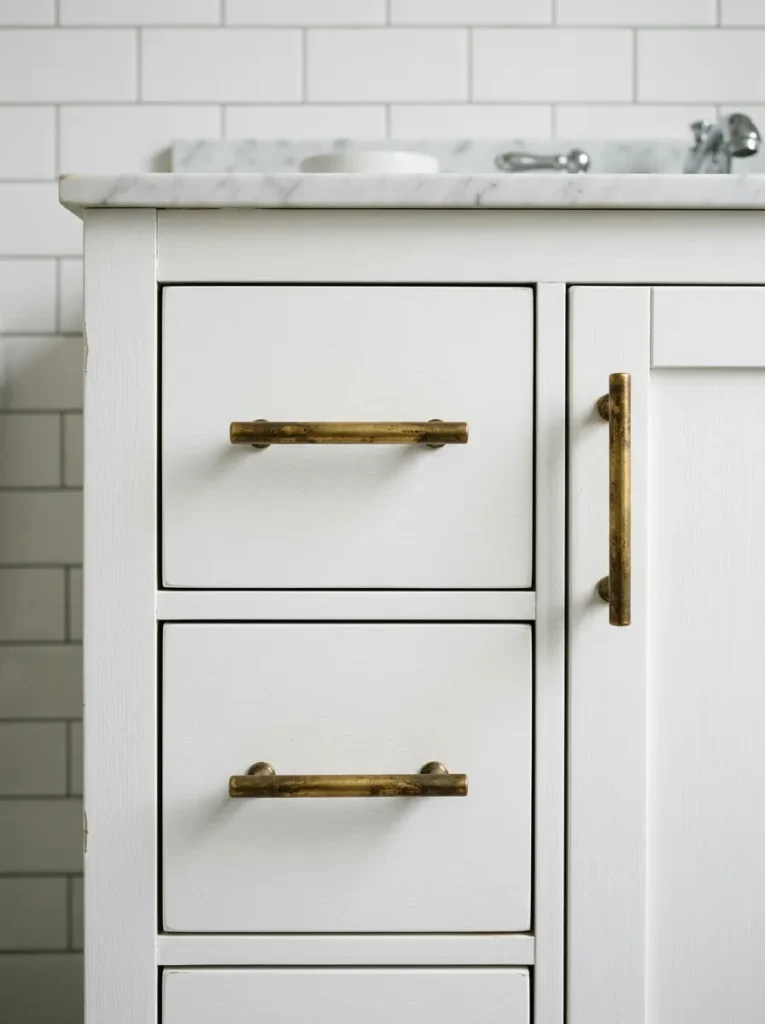
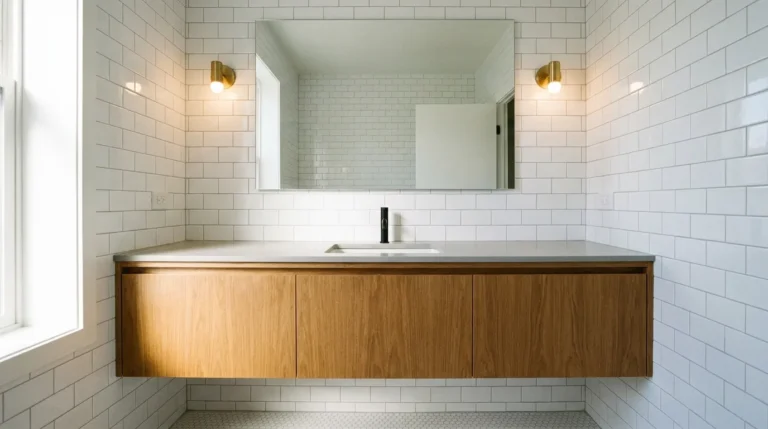
Rental bathroom vanities almost universally come with chrome or basic brushed hardware — knobs or pulls in the cheapest available finish. Changing these is a ten-minute task that requires only a screwdriver, leaves no damage (the original hardware goes back on when you leave), and shifts the vanity’s visual character completely.
Aged brass or unlacquered brass reads warm and considered. Matte black reads clean and contemporary. Dark bronze sits between the two and suits a wider range of tile and vanity colours. The new hardware should be consistent in finish across all visible fittings on the vanity. Mixing aged brass knobs with chrome towel bars in the same sightline breaks the material language; changing both at the same time produces a cohesive result.
3. Add Vertical Storage With a Freestanding Ladder Shelf
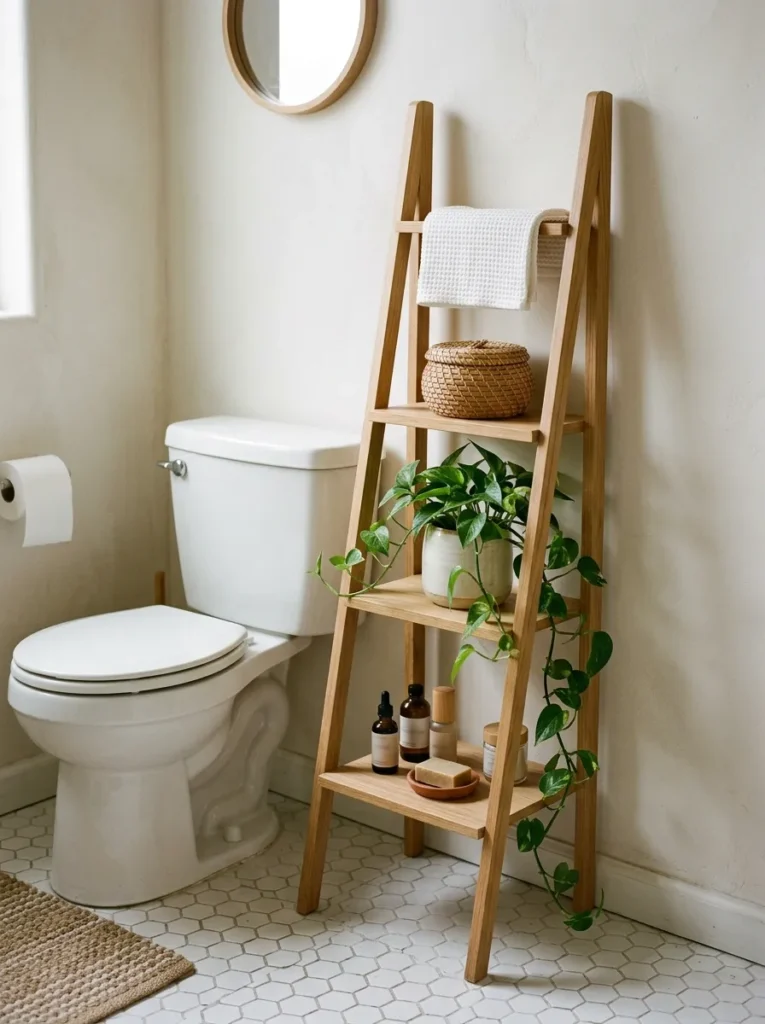
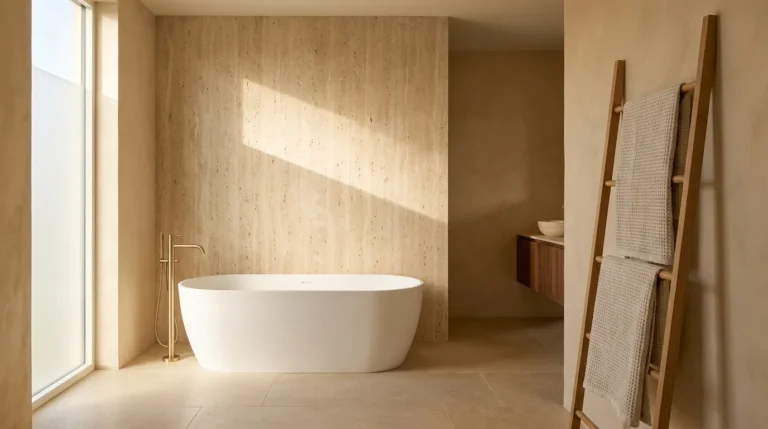
Floor space in an apartment bathroom is almost always at a premium, which means storage has to go upward rather than outward. A slim ladder shelf — 30–40cm deep maximum — takes minimal floor footprint and provides three or four tiers for towels, baskets, and small objects. It requires no drilling, can be moved easily, and adds both storage and a visual vertical element that makes a small bathroom feel taller.
Style the shelves with discipline: one folded white towel per tier rather than a stack of mixed colours, a small ceramic vessel or plant, and one labelled basket for items you don’t want visible. Open shelving in a bathroom reads as organised storage or clutter depending entirely on how it’s maintained — the discipline of limited objects per shelf is more important than the shelf itself.
4. Use Peel-and-Stick Tile Over Existing Tile or a Backsplash Area
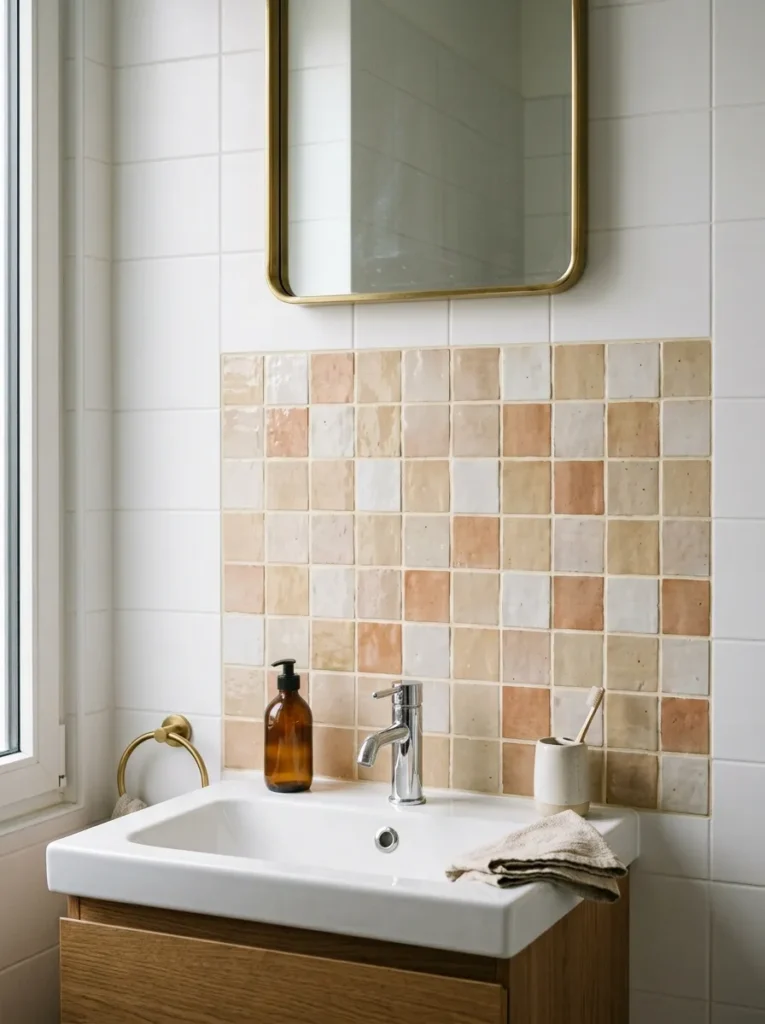
Peel-and-stick tile has improved significantly over the past several years, and the current generation of self-adhesive vinyl tile — in marble effect, terracotta, zellige-style, or geometric patterns — can be applied over existing tile or flat painted surfaces and removed without damaging the original surface beneath. On a bathroom backsplash or the area immediately behind the basin, it changes the room’s character entirely.
The critical detail is surface preparation: the existing surface must be completely clean and dry for the adhesive to bond properly. Apply with care to ensure even grout line alignment — misaligned tiles read immediately as a DIY project rather than a design decision. Most quality peel-and-stick tile is not suitable for direct shower spray areas; behind the basin, above the bath, or on an accent wall are the right applications.
5. Mount a Backlit Mirror Above the Vanity for Better Lighting and Visual Depth
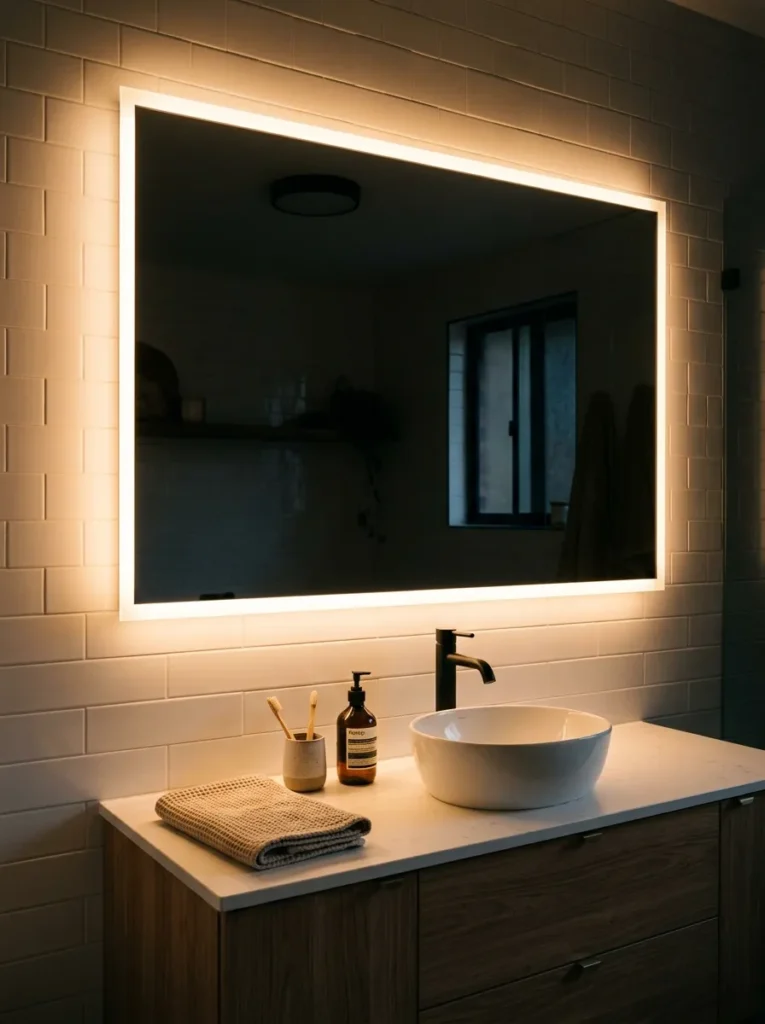
The standard overhead ceiling fixture in an apartment bathroom typically casts unflattering downward light that doesn’t illuminate the vanity area usefully for grooming tasks. A backlit or edge-lit LED mirror — available in plug-in versions that don’t require hardwiring — addresses both the functional and visual problem simultaneously: it provides even face-level light for daily use and casts a warm glow that makes the bathroom read as considerably more considered.
Position the backlit mirror so the light source sits between the eye level of a standing adult and approximately 10–15cm above. The warm LED setting (2700–3000K) suits bathroom use better than cool white, which can make the room feel clinical. The plug-in cord can be fed along the wall to the nearest outlet and managed with a cord clip rather than left to drape freely.
6. Install a Tension Pole Shelf in the Corner or Over the Toilet
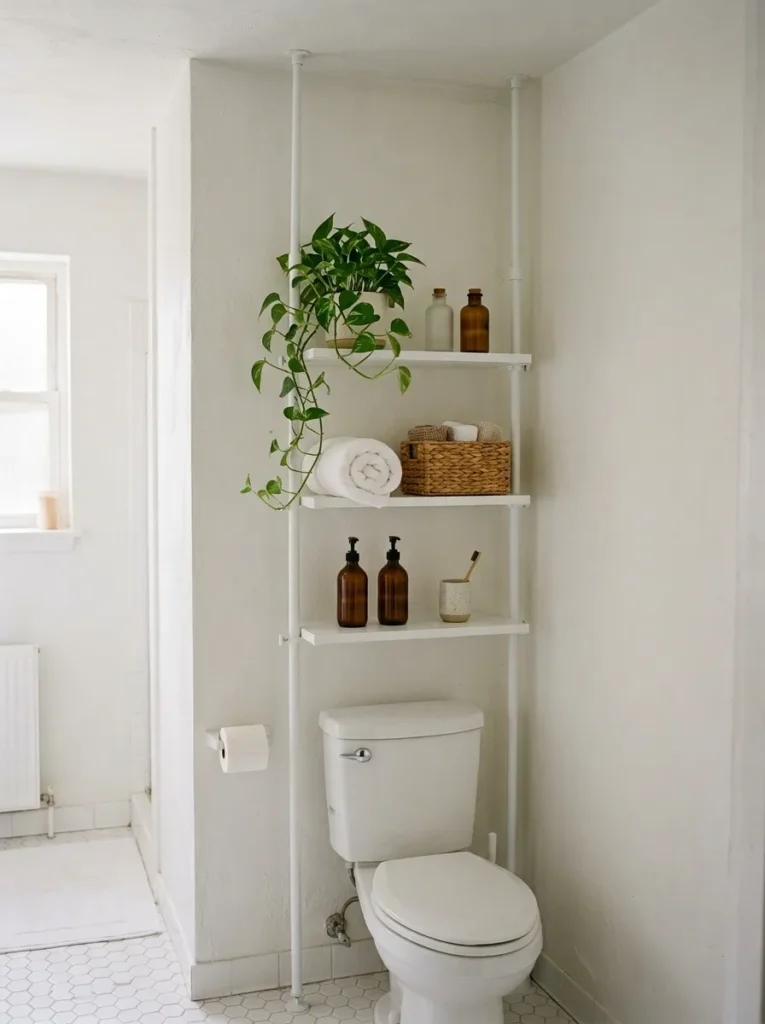
A tension pole — a floor-to-ceiling adjustable pole fitted using spring tension between the floor and ceiling without drilling — is one of the most useful storage additions for a small apartment bathroom. Fitted in a corner or over the toilet, it provides multiple shelf levels for toiletries, baskets, or plants within a very small floor footprint.
The pole height needs to be accurately matched to the floor-to-ceiling dimension to provide adequate tension without damaging the ceiling surface. Avoid overloading a tension pole with heavy items — it’s best suited for lightweight storage: small bottles, folded cloths, a trailing plant. In a bathroom with high humidity, check that the tension mechanism doesn’t slip over time and recheck the fit periodically.
7. Add a Wooden Bath Tray for a Styled Bathtub Moment
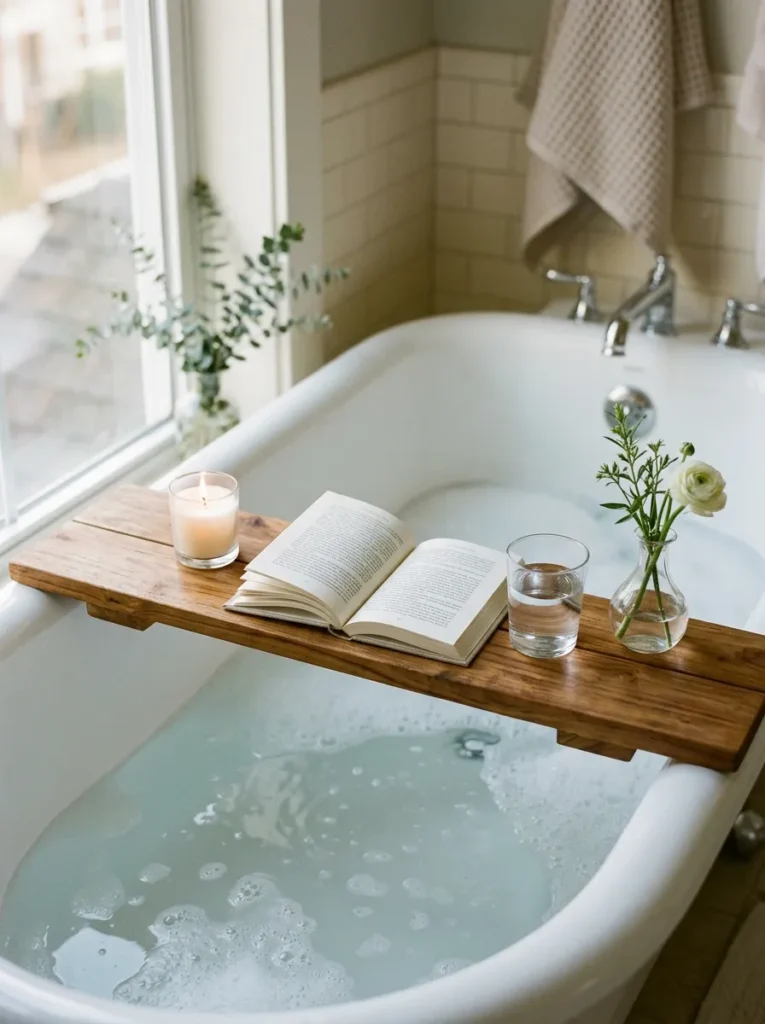
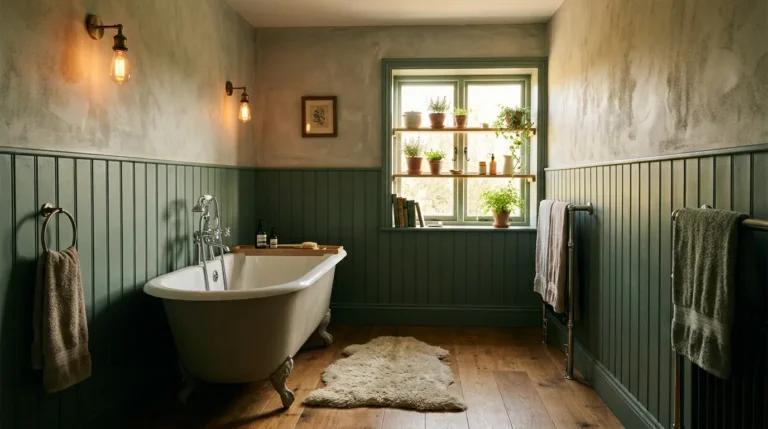
A bath tray — a slim wooden or bamboo bridge that rests across the width of the bathtub — costs next to nothing relative to its visual effect. It’s the detail that distinguishes a bathtub used functionally from one that reads as a considered space. A candle, a small book, a plant cutting in a glass, and a soap dish on the tray create a composition at bath level that photographs well and makes the bathtub feel worth using.
Teak and bamboo both withstand moisture better than untreated softwood. The tray should extend a few centimetres past the bath edge on each side to rest securely without rocking. Avoid overcrowding the tray — three or four objects at most. A tray crammed with bottles of shampoo defeats the point of the exercise.
8. Hang a Shower Curtain That Reaches the Full Ceiling Height
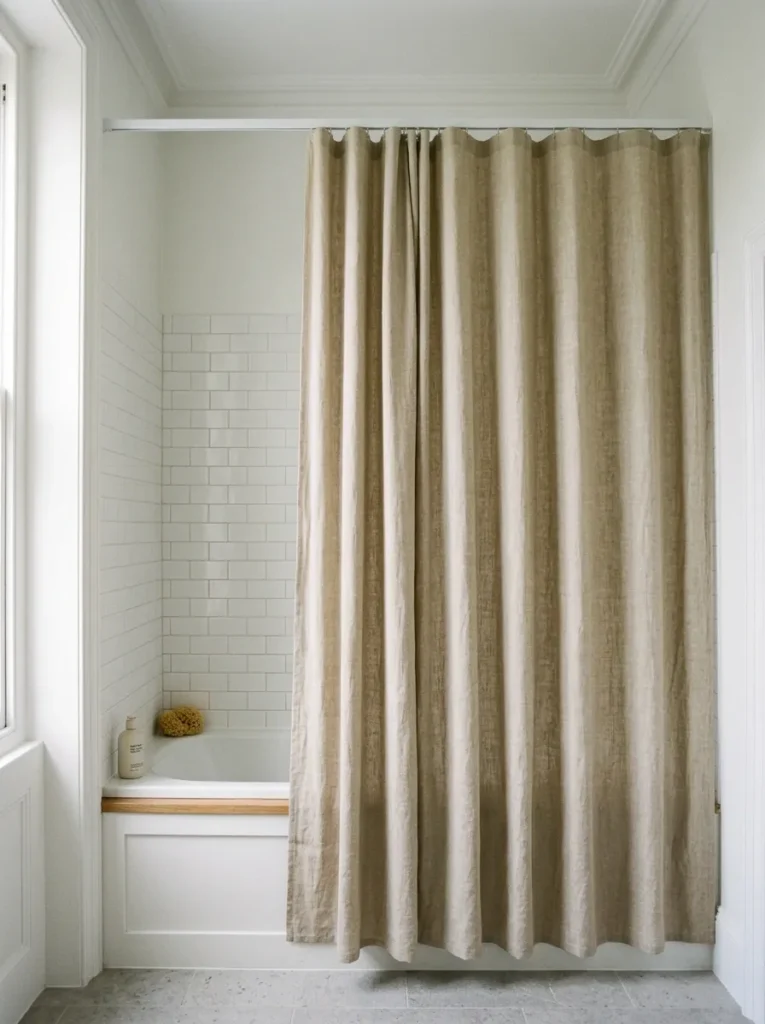
Standard shower curtains hang at a fixed height that often leaves a significant gap between curtain and ceiling. Replacing the existing curtain (and rod if necessary) with a longer version that extends close to the ceiling height makes the bathroom feel taller, makes the shower area feel more enclosed and hotel-like, and entirely changes the character of the standard shower-over-bath setup that most apartment bathrooms have.
The curtain rod needs to be at the right height for this to work — either the existing rod is repositionable, or a new tension rod can be fitted higher. In terms of fabric, a linen or cotton curtain in a neutral or muted tone reads far better than a patterned polyester option, and holds its shape more convincingly at height.
9. Replace the Toilet Seat With a Quality Wooden or Slow-Close Version
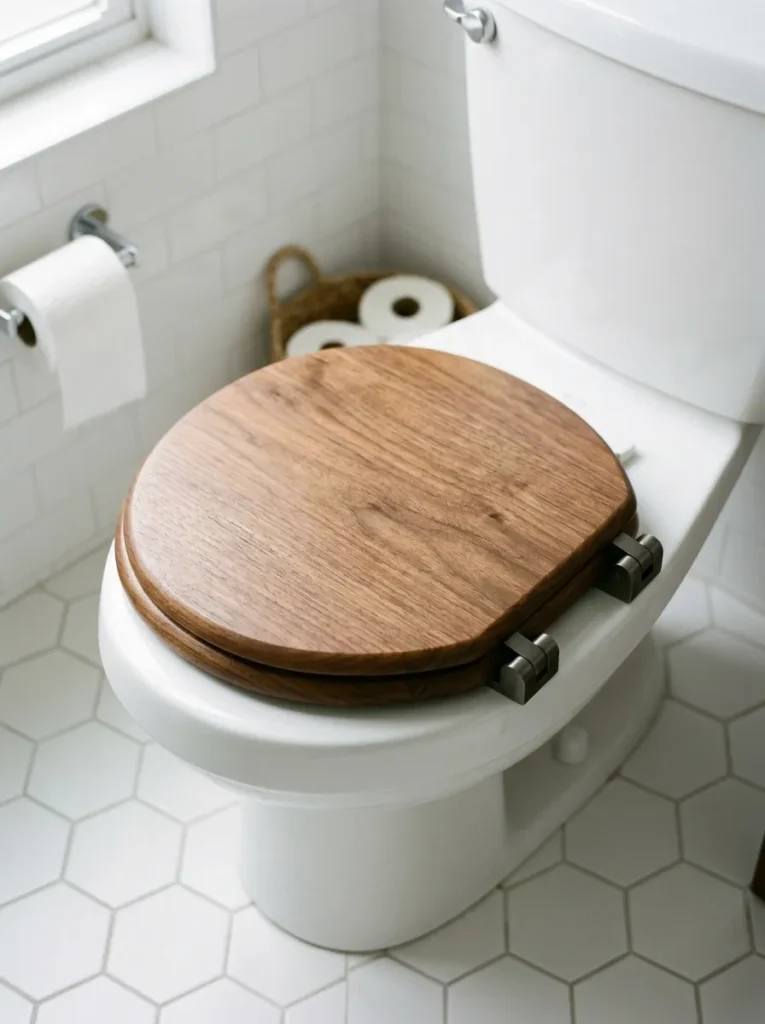
The toilet seat is the one fixture in an apartment bathroom that can be changed without landlord concern and without plumbing knowledge — most seats attach with two bolts and can be swapped in under fifteen minutes. A wooden toilet seat in a warm oak or walnut tone reads as a considered material choice in a way that a standard white plastic seat simply doesn’t. A soft-close mechanism is a non-negotiable practical upgrade: the quiet close is one of those improvements that makes a daily object feel significantly more considered.
Keep the original seat to reinstall when you leave. The new seat should ideally match any new hardware finishes in the bathroom — a warm wood seat sits better alongside aged brass than alongside chrome or matte black.
10. Introduce Warm Artificial Lighting With a Plug-In Wall Light
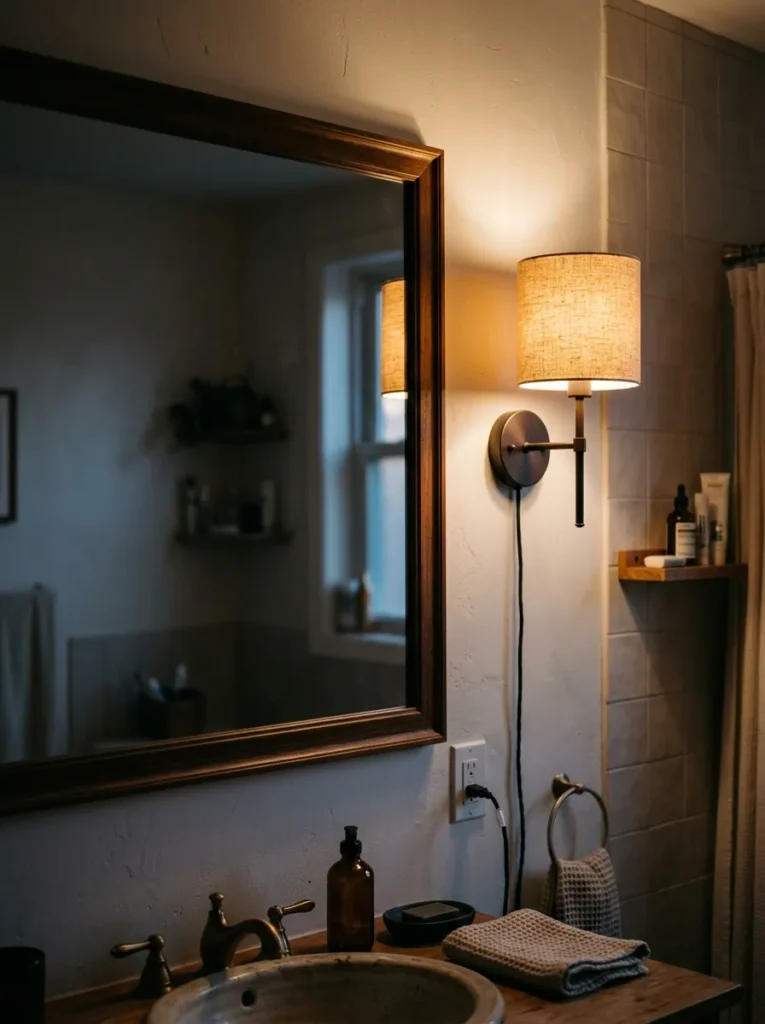
Apartment bathroom lighting is almost always a ceiling-mounted overhead fixture at a fixed point — installed for function rather than atmosphere. A plug-in wall sconce or lamp, positioned beside or above the mirror rather than hardwired, provides a second, lower light source that shifts the room’s quality in the evening. The floor between outlet and fixture needs to be managed (a thin cord cover or adhesive clip), but no drilling or rewiring is required.
A warm-tone bulb (2700K) at a lower height than the ceiling fixture fundamentally changes how the space feels after dark. In a bathroom used for both functional morning tasks and a relaxed evening bath, this is the single change that makes the most qualitative difference to how the room feels to be in.
11. Decant Toiletries Into Matching Ceramic or Glass Containers
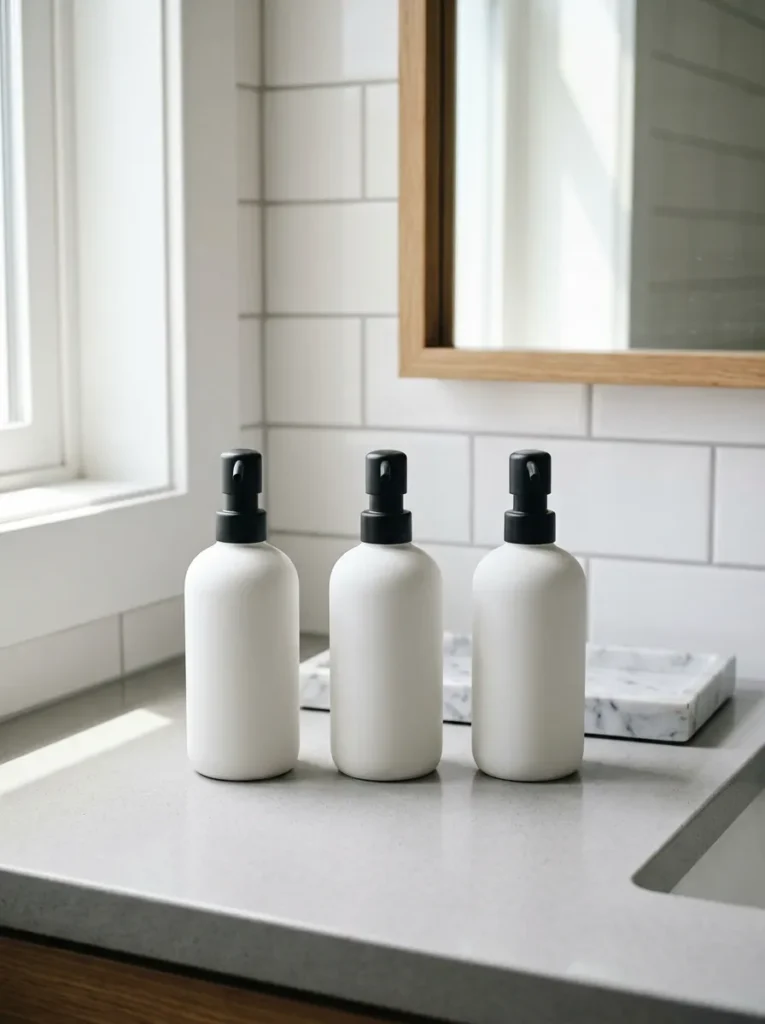
Countertop toiletries in their original packaging — product bottles in mismatched sizes, colours, and branding — create visual noise that no mirror, shelf, or curtain can overcome. Decanting daily-use products into matching ceramic or glass dispensers (one for soap, one for hand wash, one for cotton wool) removes the branding and creates a coherent surface composition that reads as genuinely designed rather than functional.
Pump dispensers in a material that matches the bathroom’s hardware — matte black ceramic, brushed brass glass, white ceramic — are the most versatile choice and available widely at modest cost. Refill them from the original product bottles kept under the sink, which also keeps the countertop clear of any product that doesn’t need to be visible.
12. Use Removable Wallpaper on One Accent Wall
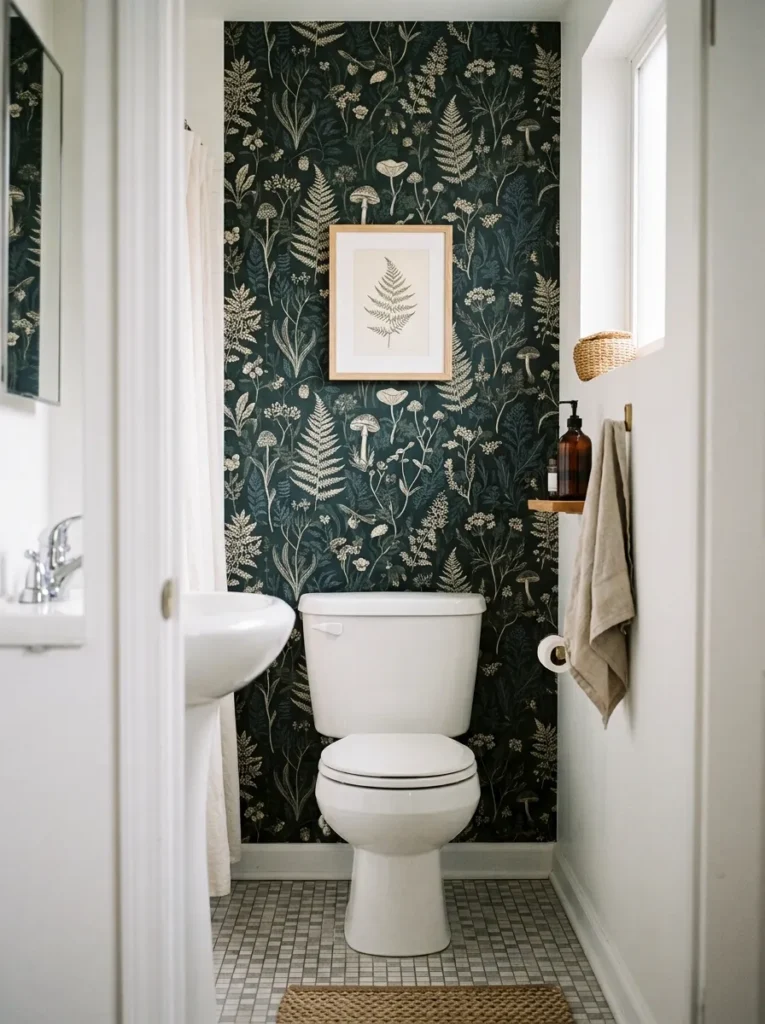
A single wall of removable wallpaper — typically the wall behind the toilet, an alcove wall, or the wall at the far end of a narrow bathroom — adds pattern, colour, and depth to an apartment bathroom without any permanent change. Peel-and-stick wallpaper designed for bathroom use includes moisture-resistant options, though direct shower splash areas remain unsuitable.
The scale of the pattern matters in a small space: very small repeating prints can read busy rather than considered; a large-scale botanical, abstract, or geometric pattern in a restrained colourway reads better in the typically compact apartment bathroom. One papered wall with plain paint on the remaining three reads more intentional than papering all four walls, which in a small bathroom can feel overwhelming.
13. Invest in Quality Towels in a Consistent Colour Story
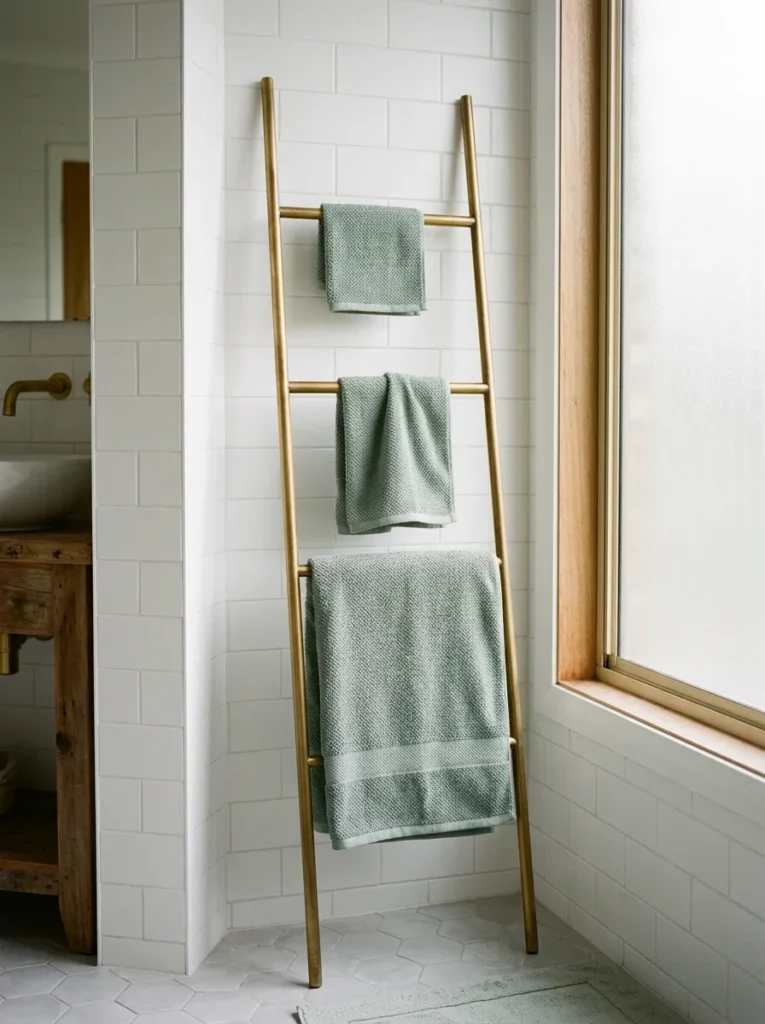
Towels are the bedroom throw-pillow equivalent for bathrooms: the most visible textile, changed most easily, with the most direct impact on the room’s overall colour story. A set of matching bath towels, hand towels, and a bath mat in the same tone or in tones from the same family — warm white, oatmeal, sage, dusty pink — produces a far more considered result than a collection of different colours accumulated over time.
Quality matters more here than in most bathroom accessories because towels are used and seen daily. A thicker cotton or bamboo towel in a neutral colour holds its appearance considerably longer than a cheaper alternative in a bolder colour that fades unevenly. Two or three colour tones maximum across all bathroom textiles is the practical limit before the room starts to read as visually busy.
14. Hang a Towel Rail or Ring at the Right Height for Your Space
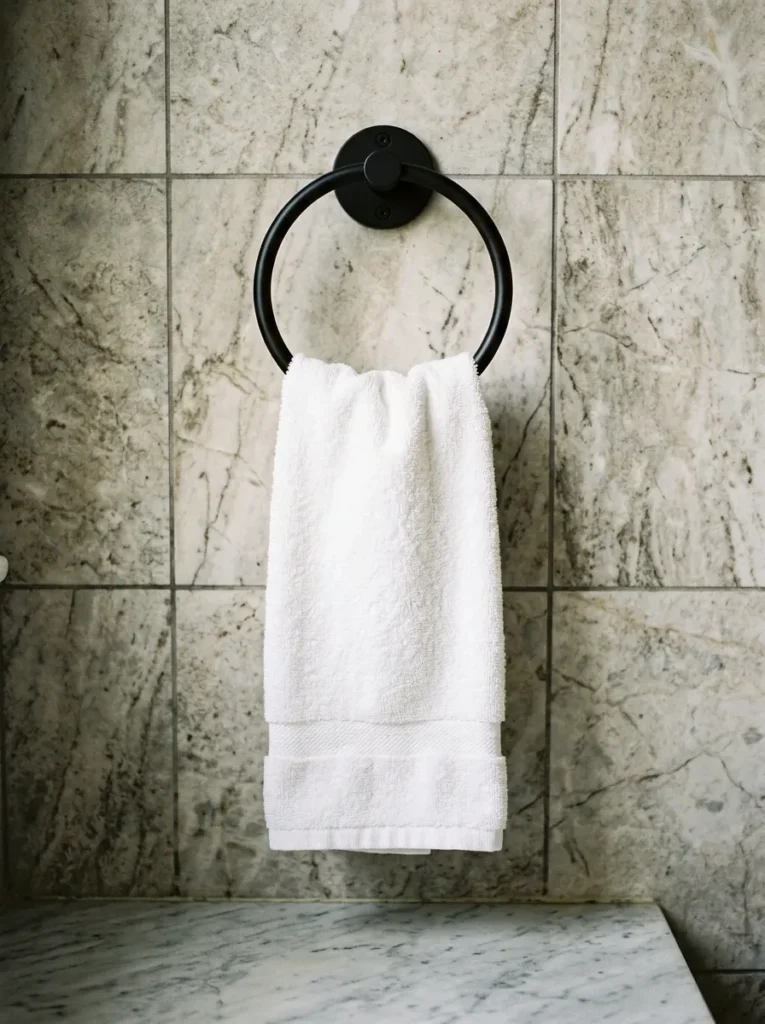
A freestanding towel rail or an adhesive towel ring (using strong adhesive mounting hardware rather than drilling) is the change that solves the towel-on-the-bathroom-floor problem permanently and adds a styled detail to the wall at the same time. The height for a towel rail should allow the towel to hang without touching the floor — a rail too low makes the towel pile up at the bottom; one too high makes it awkward to reach.
Command-type adhesive towel rings hold considerably more weight than they appear to and are genuinely suitable for damp bathroom environments if the surface is properly prepared and the weight limit is not exceeded. Matte black or brushed brass rings in a bathroom with matching hardware read as an intentional choice rather than an afterthought.
15. Place a Small Trailing Plant Where It Gets Adequate Light
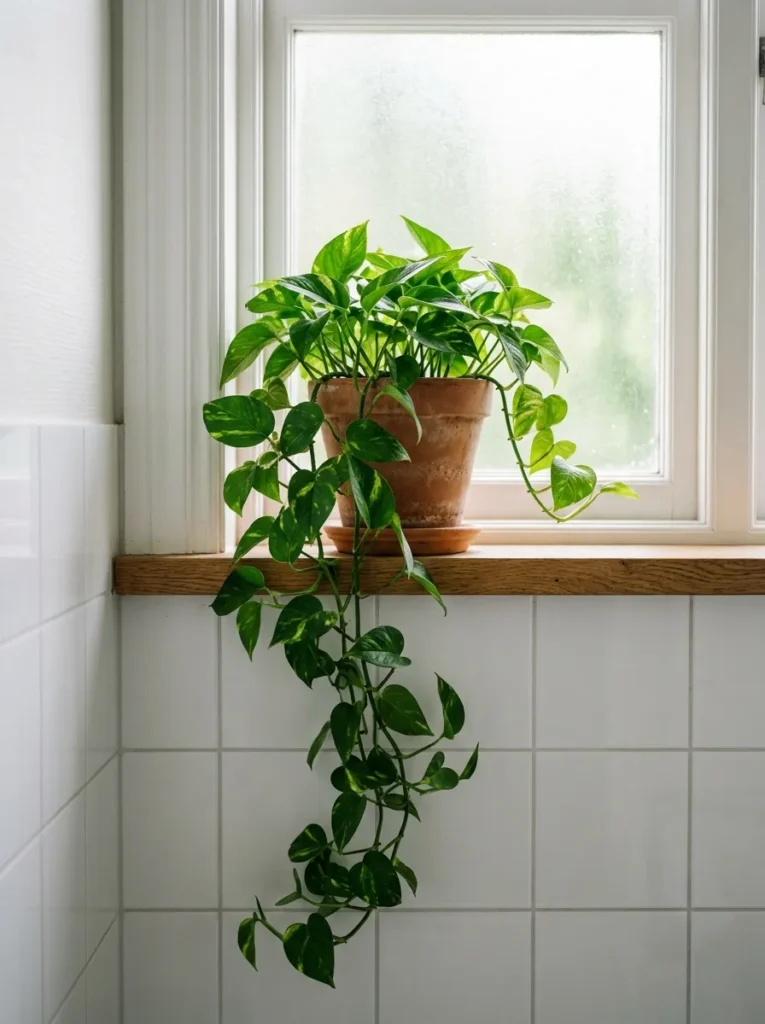
A plant in a bathroom works when the species genuinely suits the conditions: high humidity, indirect light, and often low or variable temperature between morning and evening. Pothos, spider plant, peace lily, and various ivy varieties all tolerate these conditions well. A plant that struggles in the actual bathroom environment — stems yellowing, leaves drooping — reads worse than no plant at all.
Position the plant where it gets the most available light, even if that’s a shelf adjacent to the window rather than the counter. A single well-placed plant in a good pot has more visual impact than several small plants scattered across the room. The pot material should sit within the bathroom’s palette: a terracotta pot suits warm, earthy palettes; a concrete or ceramic vessel suits more contemporary schemes.
16. Create a Dedicated Spot for Each Surface Object
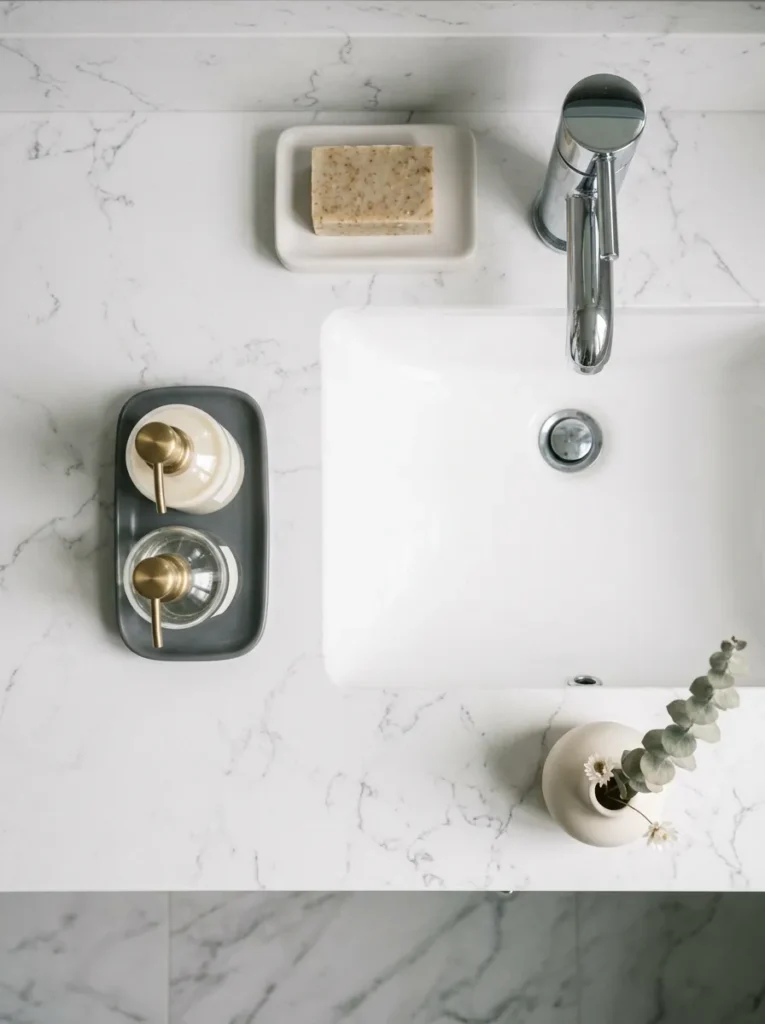
The visual quality of a well-styled apartment bathroom is almost entirely a function of whether each object on each surface has a deliberate position rather than a location it ended up in. A soap dish in one specific spot, a tray in another, a plant in one specific corner — objects placed intentionally read differently from the same objects arranged habitually.
Trays, small dishes, and shallow vessels provide surface boundaries that help maintain this discipline. A tray for the soap and hand wash defines a zone at the sink; a small dish for rings and accessories defines another. When each zone is clear, the bathroom countertop reads as organised. When zones are absent, the same objects appear cluttered even if they’re fewer in number.
17. Hang Artwork or a Print in a Waterproof Frame
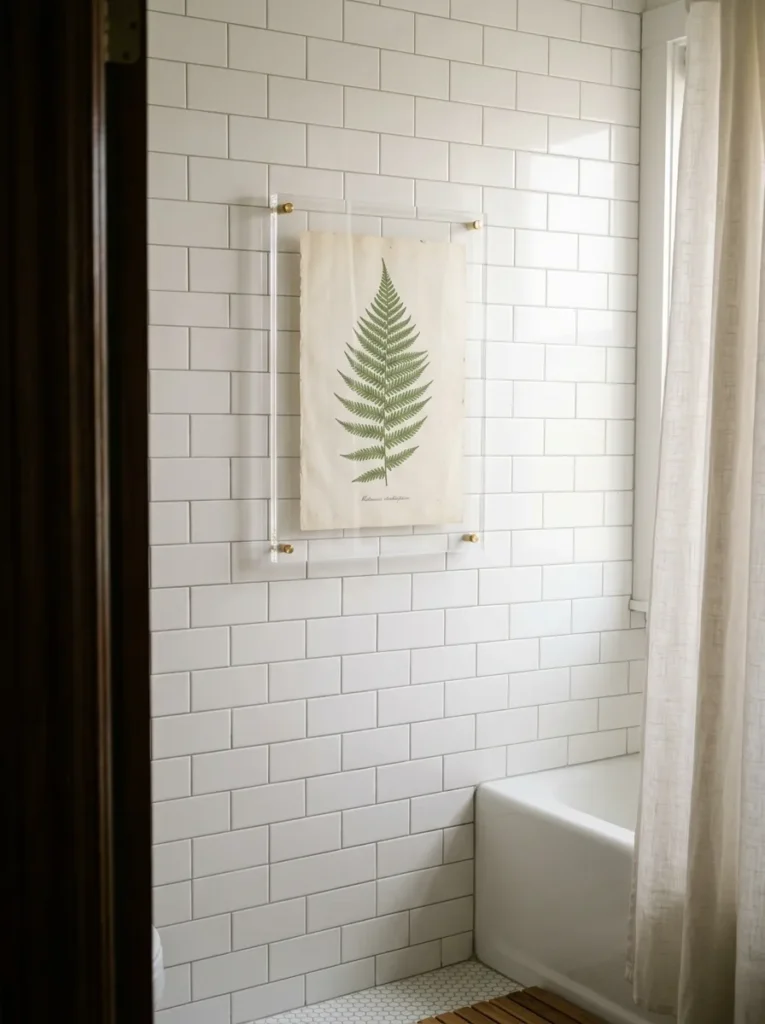
Artwork in a bathroom is a detail that reads as unconventional in the best way — it signals that the bathroom has been thought about as a room rather than as a utility space. A single framed print in a position that’s visible from the doorway or from the bath — not tucked into a corner at floor level — gives the eye something considered to land on.
The print content can be anything that suits the bathroom’s visual direction: botanical, abstract, a simple typographic piece in a restrained tone. The frame should be waterproof or at minimum water-resistant — artwork in a standard frame directly adjacent to a shower can warp over time even without direct contact. Acrylic frames or prints with a protective coating are the most durable option in high-humidity conditions.
18. Fit a Shower Niche Caddy That Attaches Without Drilling
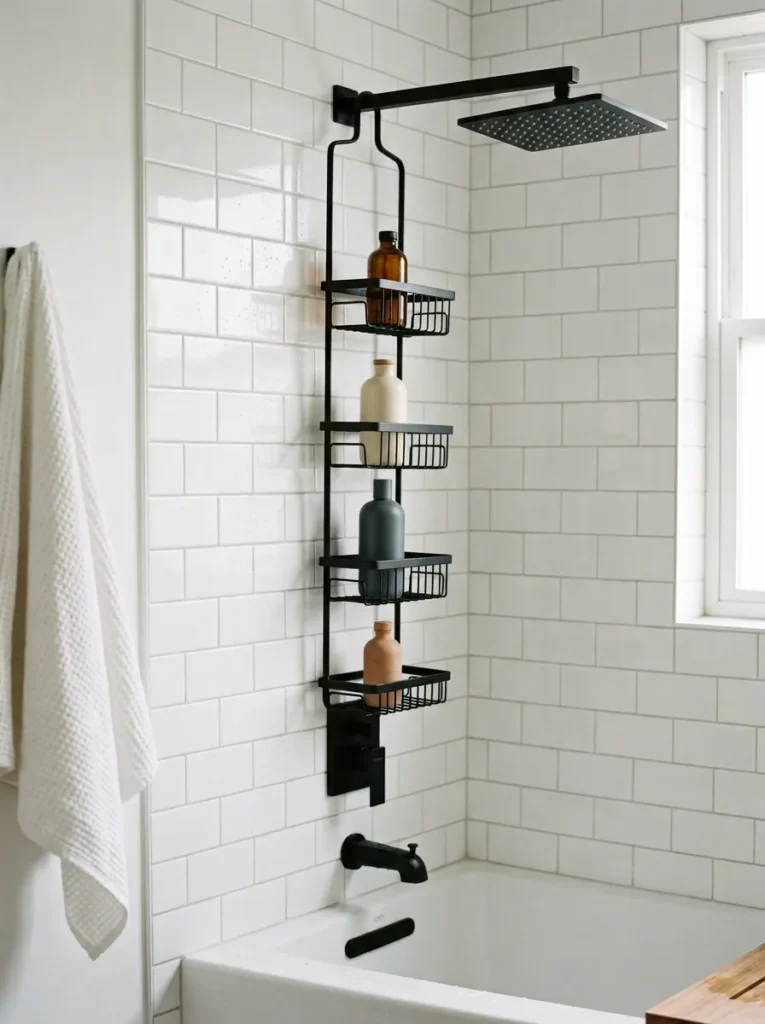
A shower caddy that hangs over the showerhead or attaches to the wall with suction cups solves the shampoo-on-the-floor-of-the-bathtub problem that nearly every apartment bathroom has. Over-the-showerhead caddies are the most stable option since they use the showerhead’s own fixing as an anchor point. Suction-cup caddies on tile are less reliable over time, particularly in showers where the water temperature and humidity fluctuate.
The caddy should hold what’s actually used in the shower rather than everything that’s been accumulated. Four or five product slots at most — shampoo, conditioner, body wash, a razor holder, and one other item — keep the caddy from reading as overflow storage. A caddy in a consistent finish with the rest of the bathroom hardware (brass, matte black, chrome) reads as a design decision rather than a practical necessity.
19. Use a Woven Basket Under the Sink for Concealed Storage
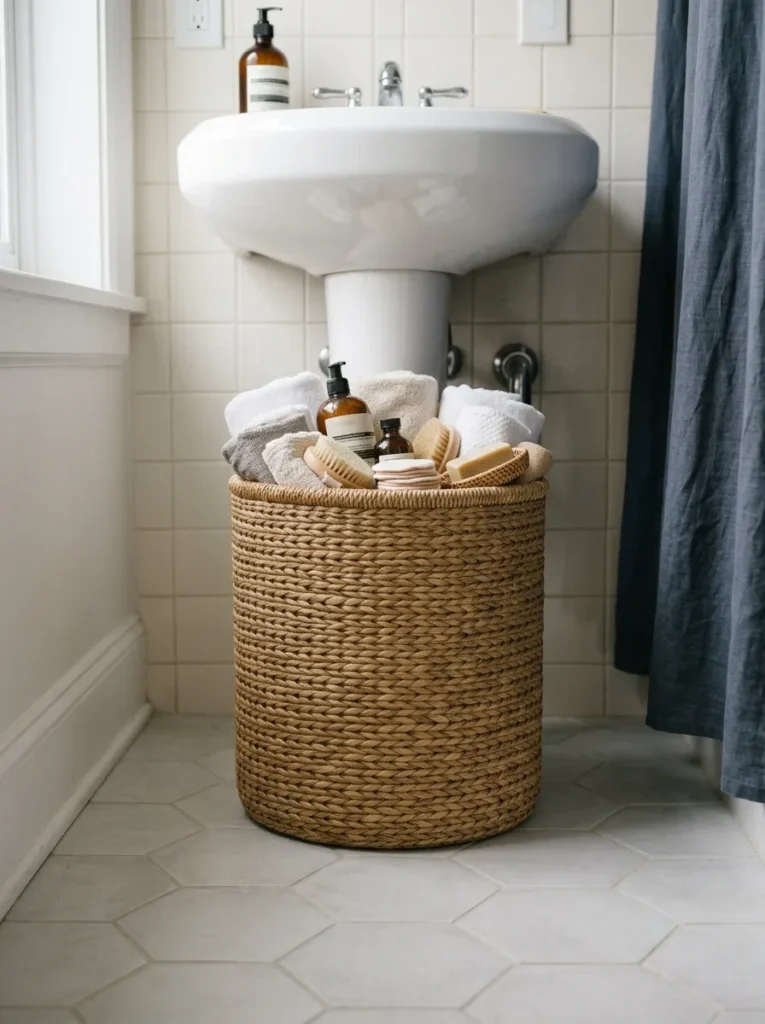
A woven basket positioned under a pedestal basin or inside a vanity unit that lacks a door holds cleaning products, spare toilet rolls, and backup supplies out of sight. In a bathroom where the under-sink area is visible — particularly with a pedestal sink that leaves plumbing pipes exposed — a basket is the most accessible way to add storage while covering the functional reality underneath.
The basket size should match the available space precisely — a basket that’s too small leaves gaps where the contents become visible again; one that’s too large won’t fit cleanly under the basin. Seagrass and woven water hyacinth both withstand bathroom humidity well. A basket with a lid keeps contents more concealed and reads slightly neater than an open-top version.
20. Hang a Full-Length Mirror on the Back of the Bathroom Door
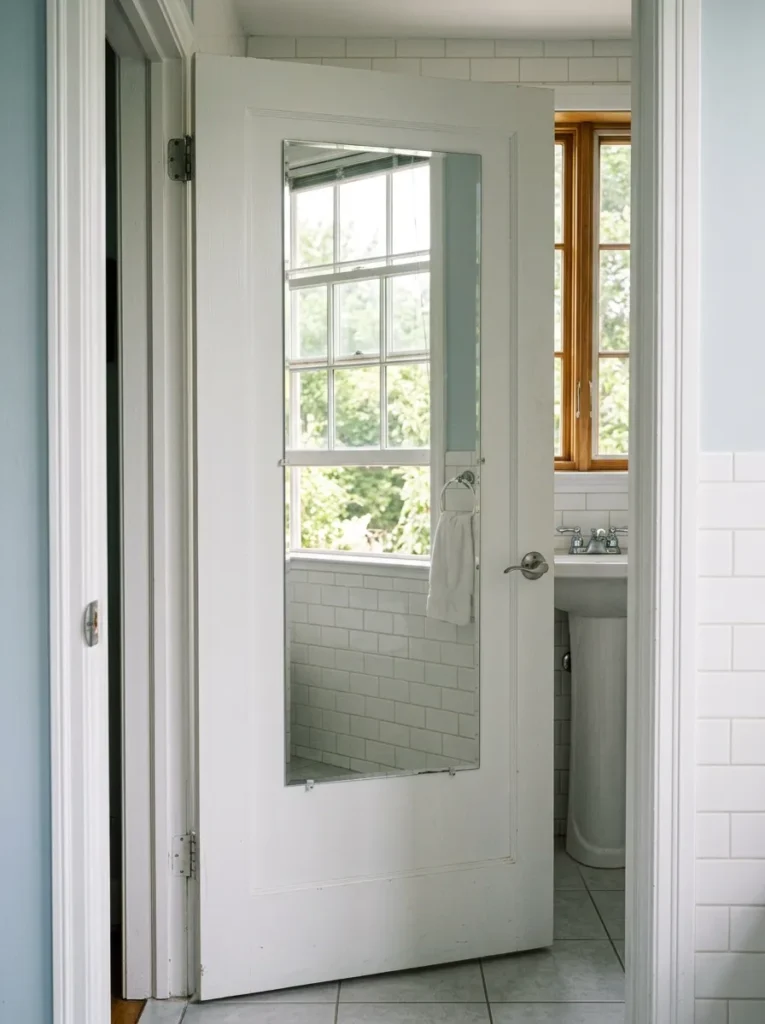
The back of the bathroom door is one of the most underused surfaces in a small apartment, and a full-length mirror hung there — using over-door hooks or adhesive mirror tape — solves two problems simultaneously: it provides a full-length view without requiring floor space for a leaning mirror, and it bounces light from the window or overhead fixture back across the room, which can make a narrow bathroom feel noticeably wider.
The mirror’s lower edge should sit low enough for a practical full-length reflection — generally 20–30cm from the floor when the door is closed. A frameless mirror reads cleaner in a small space than a heavy frame, which can look oversized on the back of a door. Confirm that the door opens sufficiently with the mirror in place before committing to a permanent adhesive option.
21. Change the Shower Curtain Rod to a Curved Model
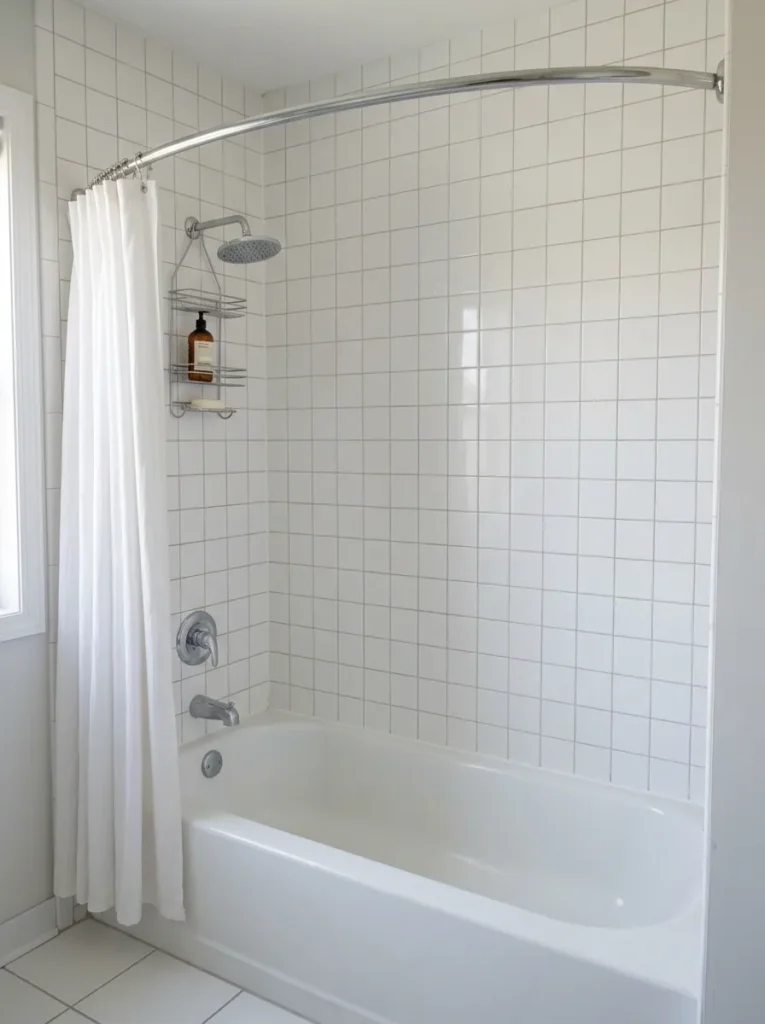
A straight shower curtain rod runs parallel to the bath edge and limits the usable shower space to the width of the bath. A curved rod — bowed outward by about 15–20cm at its midpoint — gives the same linear shower space approximately 30–40% more room inside the shower curtain, which makes an enormous practical difference in the confined space of a standard apartment bathroom. The rod uses the same tension or fixed wall bracket fittings as a standard rod and requires no plumbing change.
In terms of visual effect, the curved rod allows the curtain to hang with more fullness rather than pressed against the bath edge, which also reads better than a flat curtain plastered against the side of the tub.
22. Edit the Countertop Down to What’s Actually Used Daily
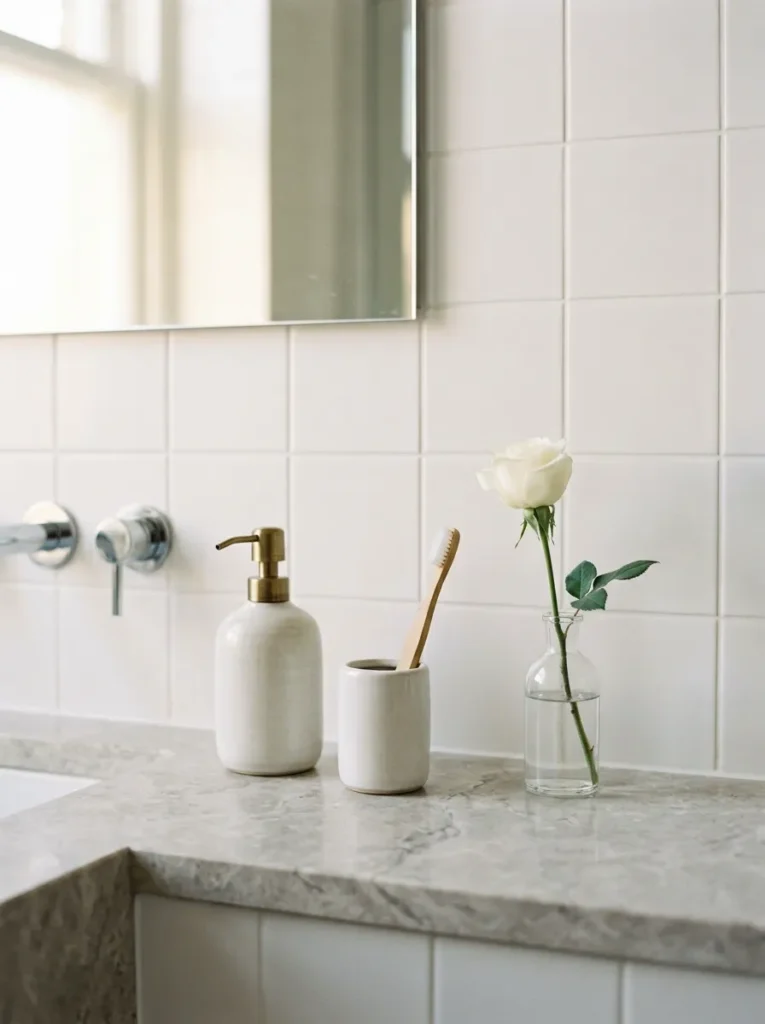
The last idea is also the governing one, and it costs nothing. Most apartment bathroom countertops hold far more than is used daily — products saved for occasional use, empties not yet disposed of, packaging not yet recycled. Reducing the countertop to only daily-use items, properly arranged, makes every other change in this list work better. The quality mirror, the decanted dispensers, the matching hardware — all of these read as considered when the surface around them is clear and purposeless objects are removed.
The products used less frequently than daily can live in a cabinet, a basket under the sink, or a dedicated shelf. The countertop should be the room’s equivalent of a desk surface: clear enough to work at, with only the tools currently in use visible.
What to Prioritise in a Rental Bathroom
Working with an existing rental bathroom rather than renovating from scratch means sequencing matters more than it would with a blank slate.
Start with what’s visible at eye level. The mirror and lighting have the widest visual impact from the doorway and are often the two easiest changes to make without any permanent alteration. These two changes alone shift the bathroom’s character before anything else is addressed.
Then address storage. A bathroom that looks good but has no usable surface or shelving will immediately revert to looking cluttered. The ladder shelf, tension pole, and under-sink basket all need to be in place before the styling decisions mean anything.
Hardware and toilet seat next. Both are reversible, both are low cost, and both shift the material register of the fixed elements in the room.
Textiles and finishing details last. Towels, the bath tray, the shower curtain, and the countertop edit are the final layer — the choices that read as styling rather than infrastructure.
Final Thoughts
Apartment bathroom ideas that actually work within rental constraints are a smaller set than the wider bathroom inspiration world might suggest, but they’re more impactful than they first appear. A mirror swap, a hardware change, one good shelf, warm lighting, and a restrained countertop edit can shift a standard rental bathroom from its factory default to somewhere that feels genuinely yours without a single permanent alteration.
Not every idea in this guide belongs in the same bathroom — a small apartment bathroom with no countertop space doesn’t need a tray and a bath tray and a ladder shelf and a tension pole all competing for the same limited real estate. Choose the ideas that solve your specific problem, apply them in the sequence outlined, and save the rest for a different space.
Come back to this guide when you’ve moved and are starting the process again — the same approach applies to any apartment bathroom, regardless of its size or layout.