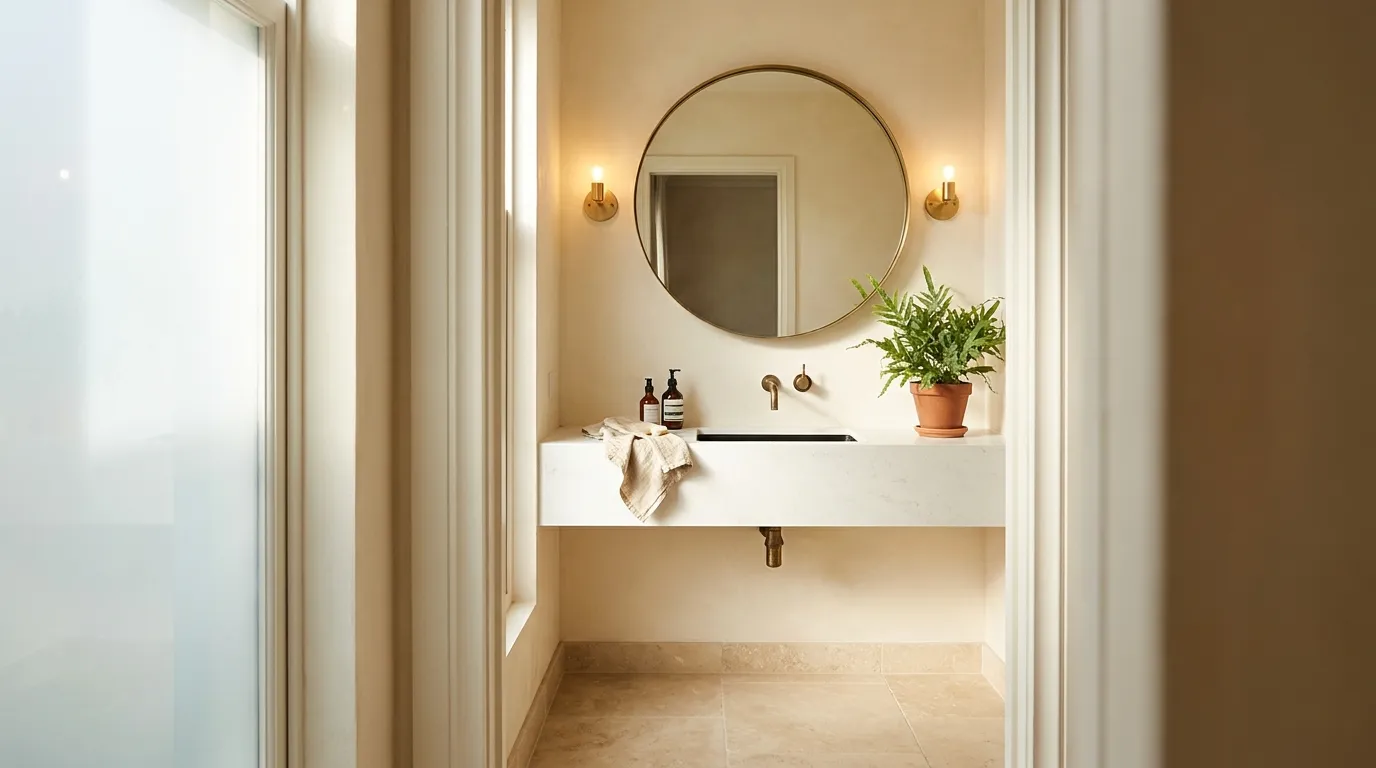
21 Bathroom Mirror Ideas That Elevate Every Vanity
The mirror is the one piece in a bathroom that touches everything — scale, light, style, and the first impression of the whole room. Yet it’s often chosen last, treated like a formality after the vanity, tile, and fixtures are already set. That’s backwards. The right mirror can visually anchor a plain vanity, correct a proportionally awkward wall, amplify natural light from a nearby window, and carry the decorative weight of a room that has no room for much else.
This guide goes past the standard round-or-rectangle debate. These 21 ideas cover genuinely different mirror types, configurations, and approaches — with enough detail on sizing, placement, lighting, and frame choice to help you figure out not just which mirror looks good, but which one actually makes sense for your bathroom.
1. The Unlighted Arch Over a Pedestal Sink
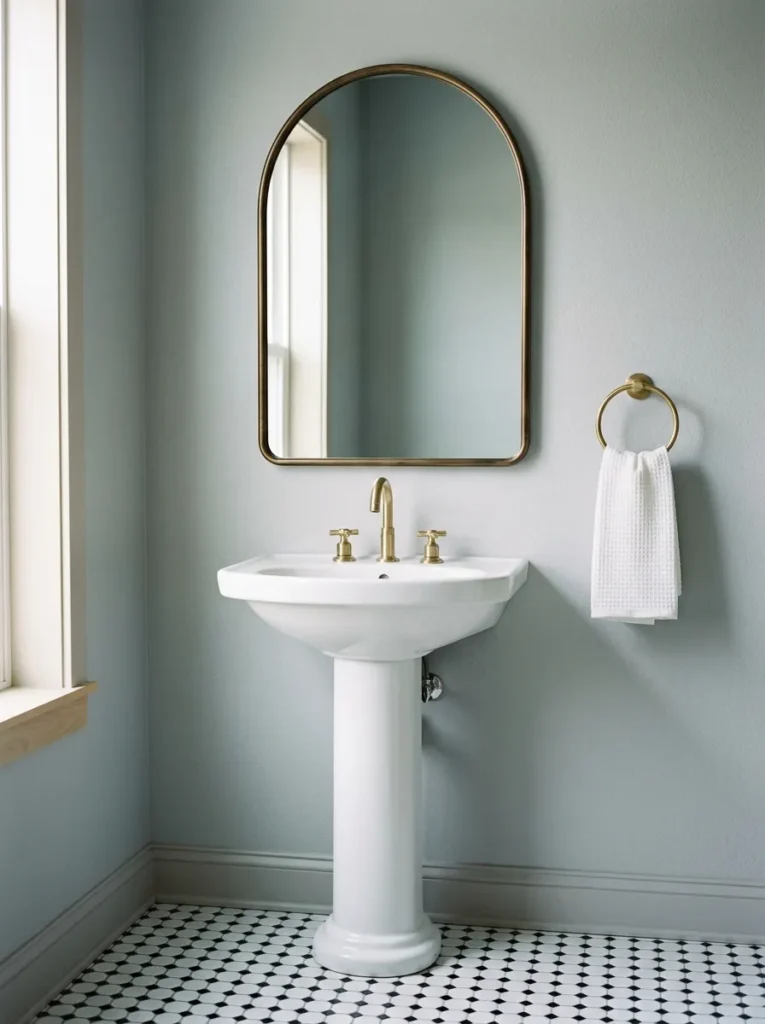
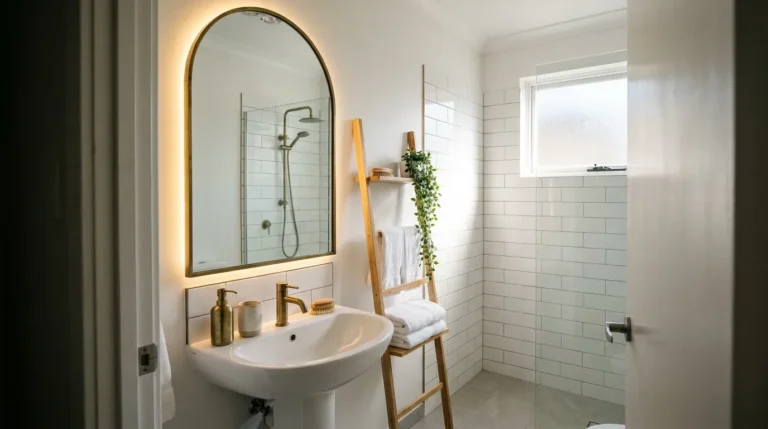
Arched mirrors have saturated the market, but most are paired with floating vanities where the shape reads predictably. Over a pedestal sink — especially a column-style or tulip pedestal — the arch does something different. It echoes the soft verticality of the pedestal base and turns a traditionally awkward wall setup (no vanity counter to anchor to) into something considered.
For this to work, the mirror’s widest point should roughly match the sink basin width, not exceed it. A mirror dramatically wider than the sink creates visual imbalance without a counter to ground it. Aim for a 20–24 inch width over a standard pedestal. Warm brass or aged bronze frames read better against period-appropriate pedestal styles; chrome frames suit more architectural, modern pedestals. Mount the bottom edge no lower than 40 inches from the floor so the mirror doesn’t visually chop the wall in half.
2. A Full-Height Leaner Against a Tiled Feature Wall
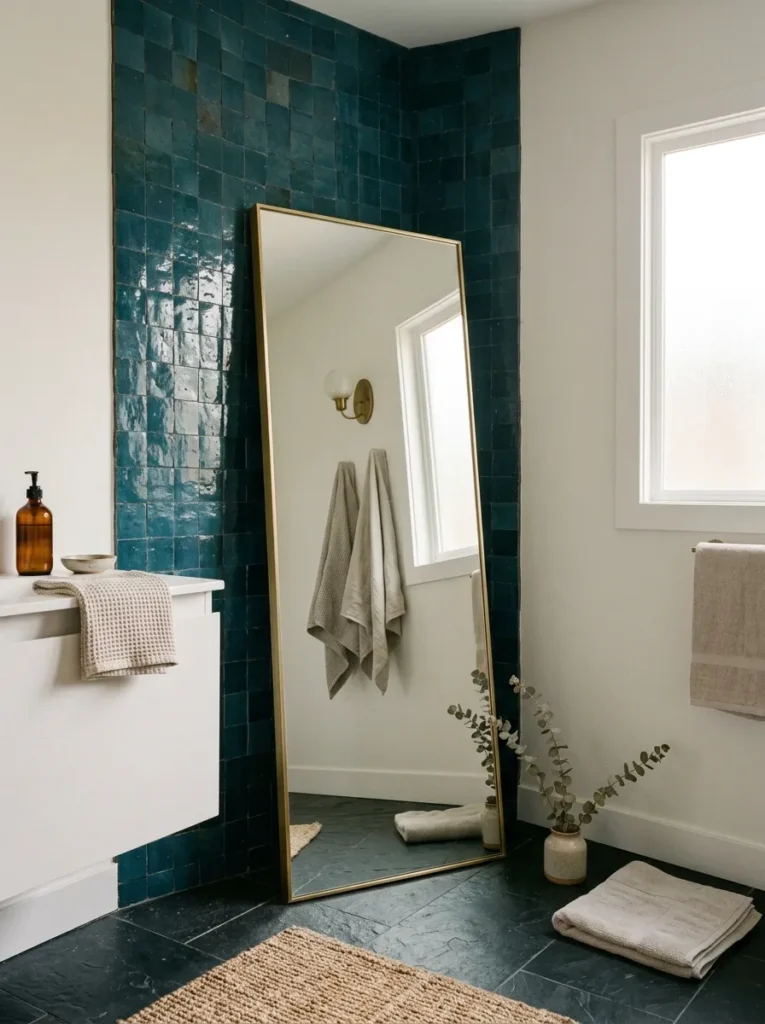
This works only if you have the floor space and a wall worth reflecting — which is exactly the point. A full-length leaner propped at a slight angle against a zellige, fluted tile, or handmade ceramic wall reflects that tile pattern back at a different angle, effectively doubling its visual presence without additional tile cost.
The leaner itself doesn’t need a decorative frame. A simple thin brass or matte black strip frame keeps the mirror from competing with the tile. The practical constraint: you need at least 10–12 inches of floor depth for the leaner to sit safely, and it should rest against a wall where it can’t tip toward a toilet or bathtub. This suits larger bathrooms or those with an intentional spa-area corner. It’s not renter-hostile — no installation required.
3. Two Narrow Rectangular Mirrors Instead of One Wide One
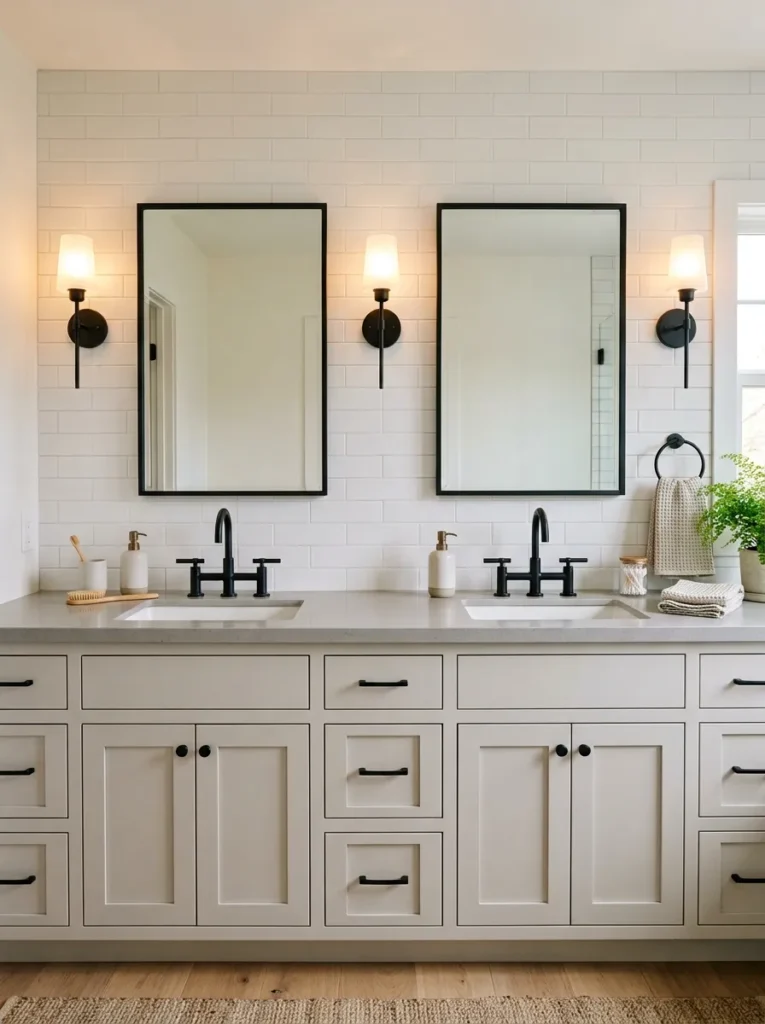
Over a double vanity, the obvious choice is a single large horizontal mirror. The problem is that a single wide mirror can flatten the wall and make two sinks feel like one undifferentiated surface. Two narrower mirrors — one centered over each sink — creates a clear zone for each user and reads more like intentional furniture than a utility installation.
The proportions matter significantly. Each mirror should be slightly narrower than the sink below it, not equal to it. If your sinks are 24 inches wide, a mirror 18–20 inches wide creates appropriate visual breathing room. Leave 4–6 inches between the two mirrors so the gap reads as deliberate rather than awkward. Matching frames are the safe choice; deliberately mismatched frames (same finish, different profile) can work in an eclectic bathroom but requires confidence in execution.
4. A Venetian Mirror in a Utilitarian Bathroom
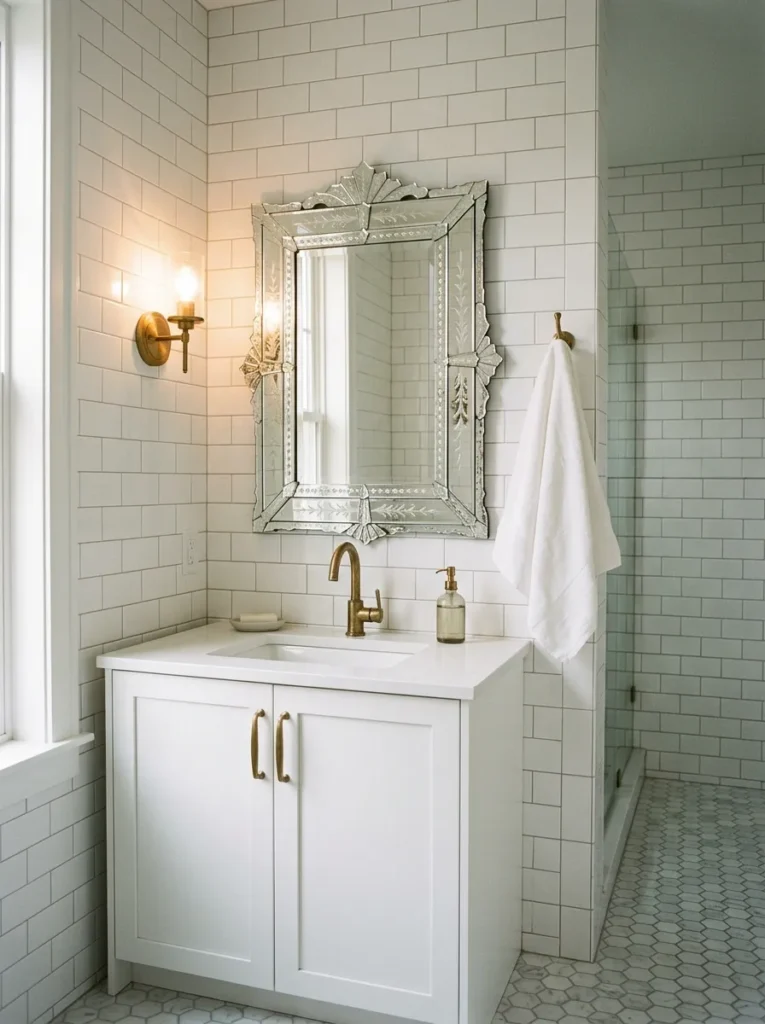
Most Venetian mirrors end up in living rooms or dining rooms where they disappear into gallery walls. In a bathroom — particularly a plain white or grey tile bathroom with no architectural character — a Venetian mirror with etched glass detailing or a beveled starburst border becomes the entire decorative statement. You don’t need anything else on the walls.
The key is restraint elsewhere. Venetian mirrors want simple surroundings: plain white subway tile, a simple white or stone vanity, unlacquered brass or chrome fixtures that don’t compete. They also want appropriately sized placement. A Venetian mirror that is too small looks like a leftover decorative piece rather than an intentional choice. For a single vanity, 24–30 inches diameter or width gives it enough presence. These are not budget-friendly as a category, but they hold their visual value in a way that standard mirrors rarely do.
5. Mirror Integrated Into a Recessed Niche
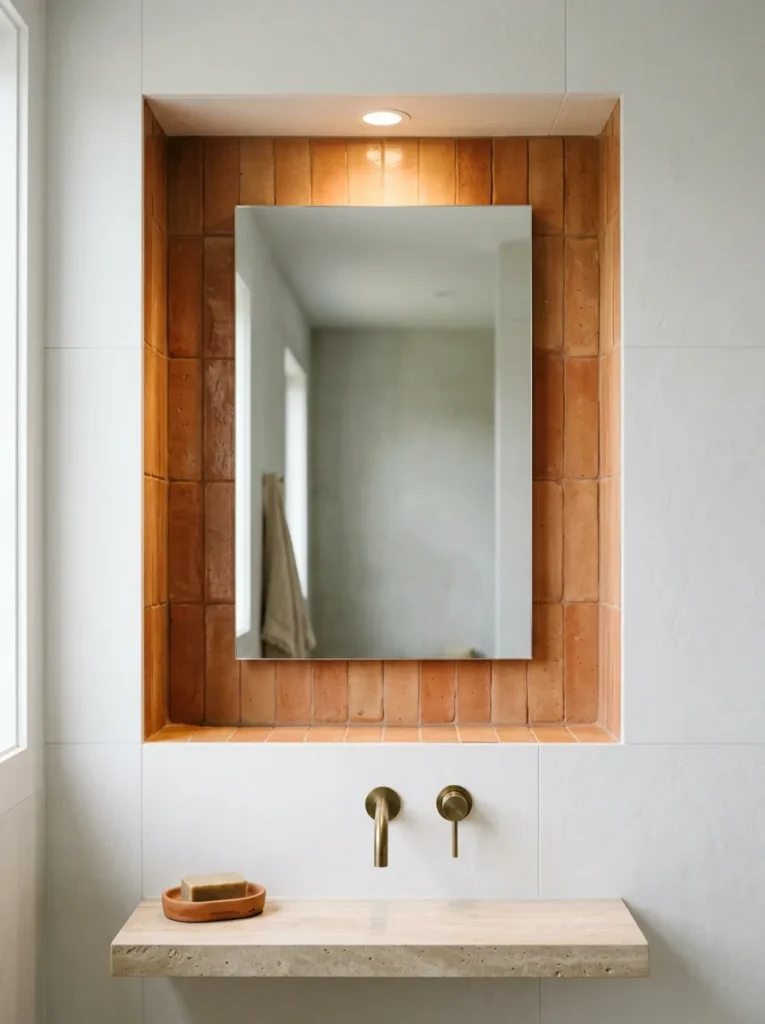
Instead of hanging a mirror on a flat wall, some bathrooms benefit from a mirror installed flush within a shallow recessed niche — a wall cavity typically 3–4 inches deep with finished drywall or tile sides. The mirror sits within this frame of material, and the niche itself becomes the decorative border.
This approach removes the question of frame choice entirely while creating an architectural detail that looks built-in and intentional. It suits new builds and renovations where the wall framing is accessible, and it’s particularly effective when the niche interior is tiled in a contrasting material from the surrounding wall — a fluted ceramic interior against flat subway tile, for instance. The limitation is obvious: this isn’t possible in most existing bathrooms without significant construction. But for anyone doing a gut renovation, it’s worth planning for early since it affects framing decisions.
6. A Pivot Mirror on a Wall-Mounted Arm
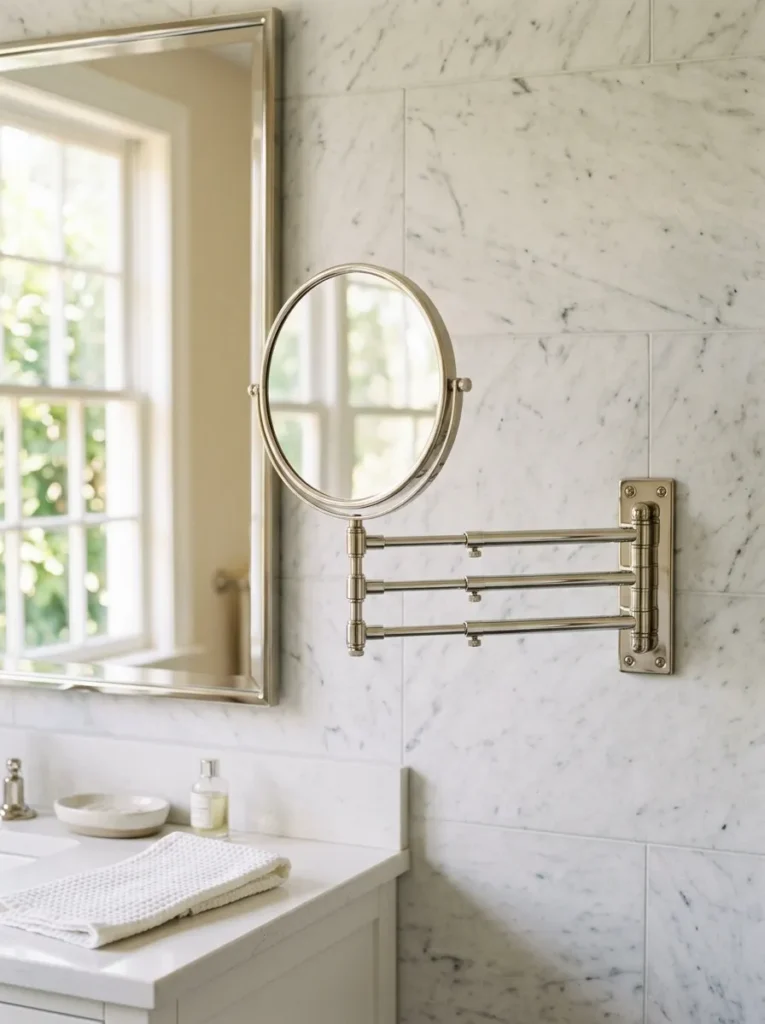
A pivot or swing-arm mirror functions differently from a fixed wall mirror — it extends out from the wall on a hinged or telescoping arm, allowing the user to angle it for close tasks. The overlooked design opportunity is that these mirrors, when paired with a fixed primary mirror, create a bathroom that works harder without looking clinical.
The swing-arm mirror is not a replacement for a main vanity mirror. It’s a secondary mirror positioned 6–8 inches to the side of the primary, typically at face height, that pulls out when needed and folds flat otherwise. In a smaller bathroom, this setup avoids the dedicated space demand of a separate magnifying mirror on a pedestal stand. The arm finish should match or complement the faucet hardware. Polished nickel, brushed gold, and matte black are the most common options and each reads differently against tile and vanity finishes.
7. Backlit LED Mirror With a Diffused Edge Glow
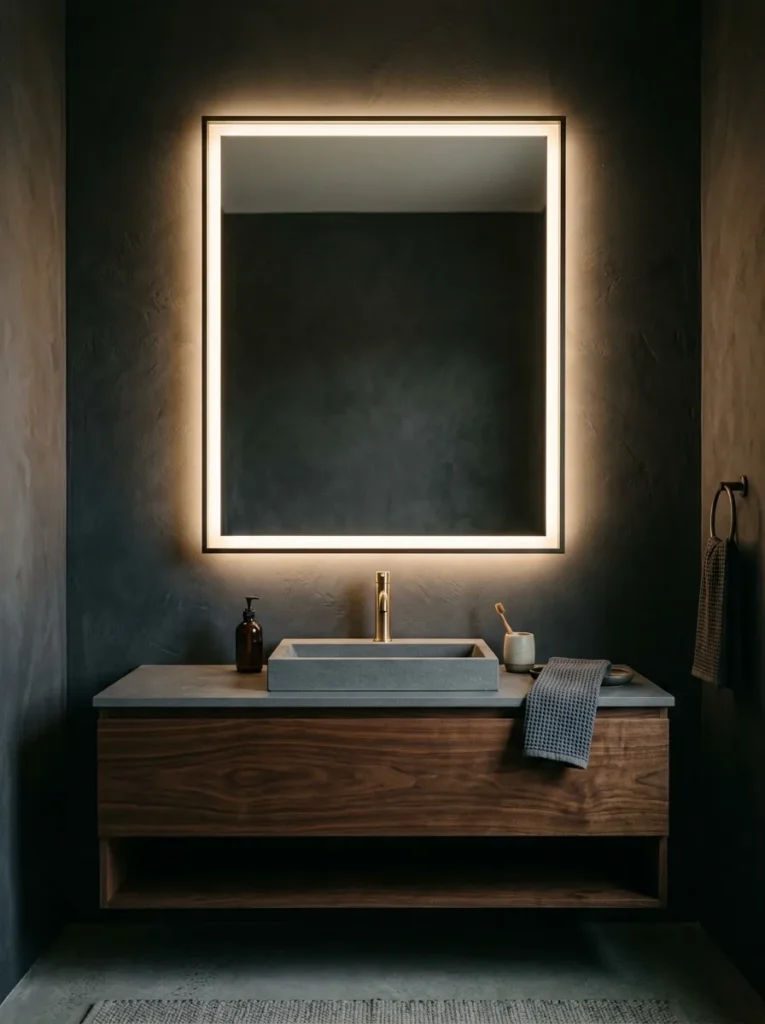
Backlit mirrors — where the light source is hidden behind the mirror and glows softly around the perimeter — have largely replaced Hollywood-style bulb-surround mirrors in contemporary bathrooms. The reason they work better than overhead lighting alone is functional: the light source is at face level, which eliminates the downward shadows that make task lighting for grooming difficult.
The critical specification is color temperature. Backlit mirrors are available in warm (2700K–3000K), neutral (3500K–4000K), and cool (5000K–6500K) color temperatures. For accurate grooming and makeup application, neutral to slightly cool (3500K–4000K) is generally more useful than the warmer temperatures that create flattering light but distort color perception. Many current models include a color temperature adjustment feature. Dimming capability is worth the price premium if the bathroom doubles as a relaxation space. These mirrors require an electrical connection behind the wall — factor this into budget if the bathroom isn’t already wired for it.
8. Antiqued or Mercury Glass Mirror
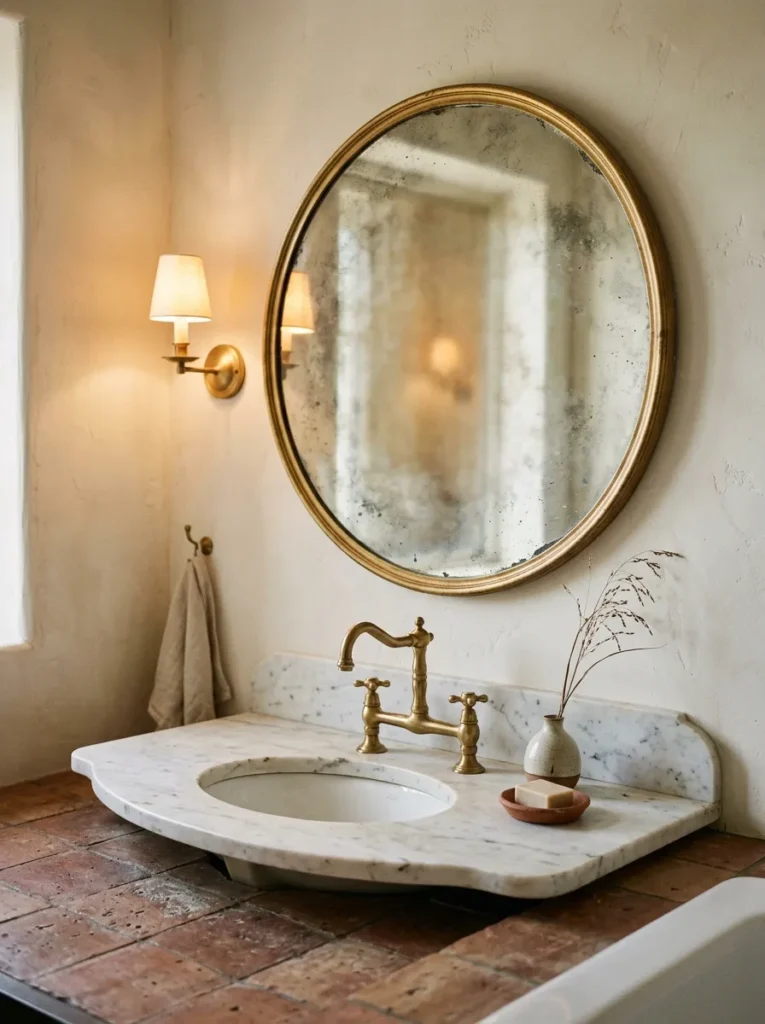
There’s a difference between an aged mirror and a distressed-looking one. A properly antiqued mirror has a slight cloudiness, subtle spotting, or a darkened edge that reads as genuinely old rather than artificially distressed. Mercury glass mirrors — made with a traditional silvering technique that produces a softer, slightly hazy reflection — have this quality without looking like they’ve been mistreated.
In a bathroom, an antiqued mirror does something that a crisp modern mirror cannot: it softens the clinical edge of hard tile surfaces and bright fixtures. It pairs naturally with unlacquered brass, brushed bronze, or warm wood vanity materials. It’s a poor choice for a bathroom that depends on precise grooming visibility, since the reflection quality is deliberately imperfect. But for a guest bathroom or powder room where atmosphere matters more than function, an antiqued mirror adds a quality that is genuinely difficult to achieve with new materials.
9. Slim Vertical Mirror Flanking Each Side of the Vanity
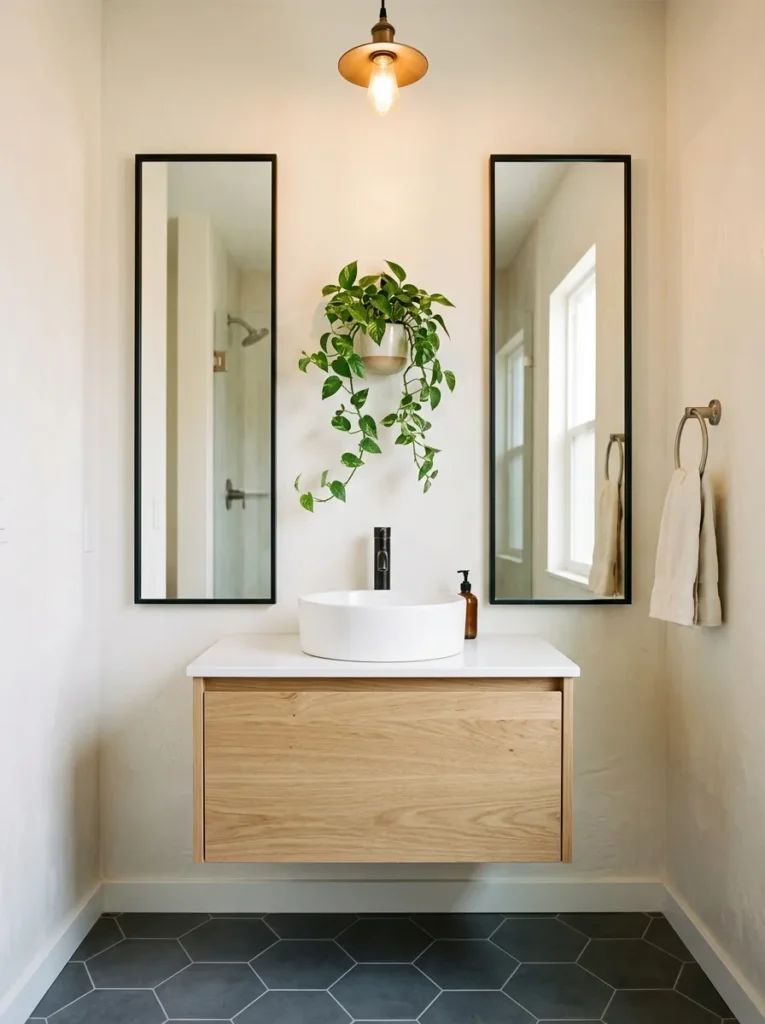
This is one of the least-used configurations and one of the most useful for narrow or architecturally awkward bathrooms. Instead of a single mirror centered above the sink, two tall, narrow mirrors — 8–12 inches wide and 30–40 inches tall — flank the sides of the vanity, mounted at eye level.
The effect is column-like: it draws the eye upward, makes the ceiling feel higher, and avoids the visual bulkiness of a wide mirror in a narrow space. It also solves a layout problem common in small bathrooms where the vanity sits between two walls with little horizontal clearance, making a wide centered mirror read as cramped. The mirrors can be frameless for a minimal look, or use thin brass or iron frames for definition. The space directly above the faucet can then hold a small piece of art, a plant shelf, or simply remain open — which in a tight bathroom is often the better choice.
10. An Oversized Round Mirror That Extends Beyond the Vanity Width
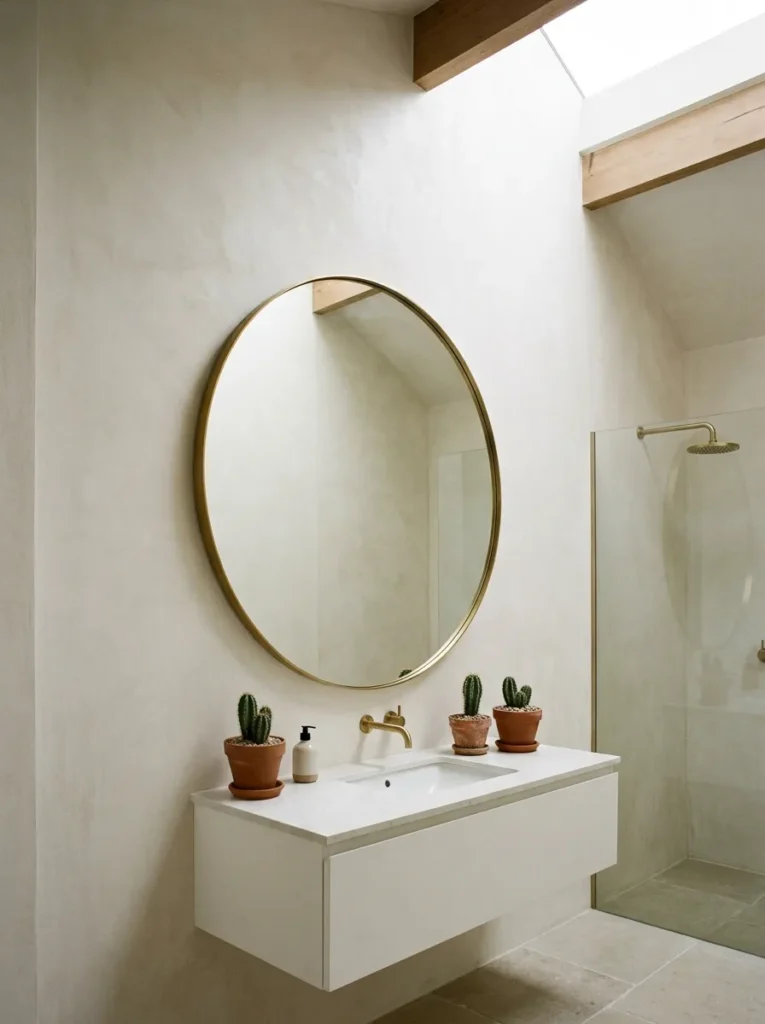
The conventional advice is to size a mirror to match or slightly exceed the vanity width. Breaking that rule deliberately — mounting a large round mirror whose diameter significantly exceeds the vanity below it — creates a different spatial effect. The mirror becomes a room feature rather than a vanity accessory, and the visual weight shifts upward.
This works best in bathrooms with high ceilings and a relatively simple vanity, where the large mirror won’t visually compete with elaborate cabinetry below. The round shape softens what could otherwise read as an imposing scale. A 36–40 inch diameter circle over a 24–30 inch vanity creates this expansive effect without requiring an enormous room. The frame choice becomes important at this scale: a thin, simple frame (particularly in brushed brass or matte black) keeps the mirror from feeling heavy. A thick ornate frame at oversized scale can feel overwhelming.
11. Cabinet Mirror With Inset Adjustable Shelving
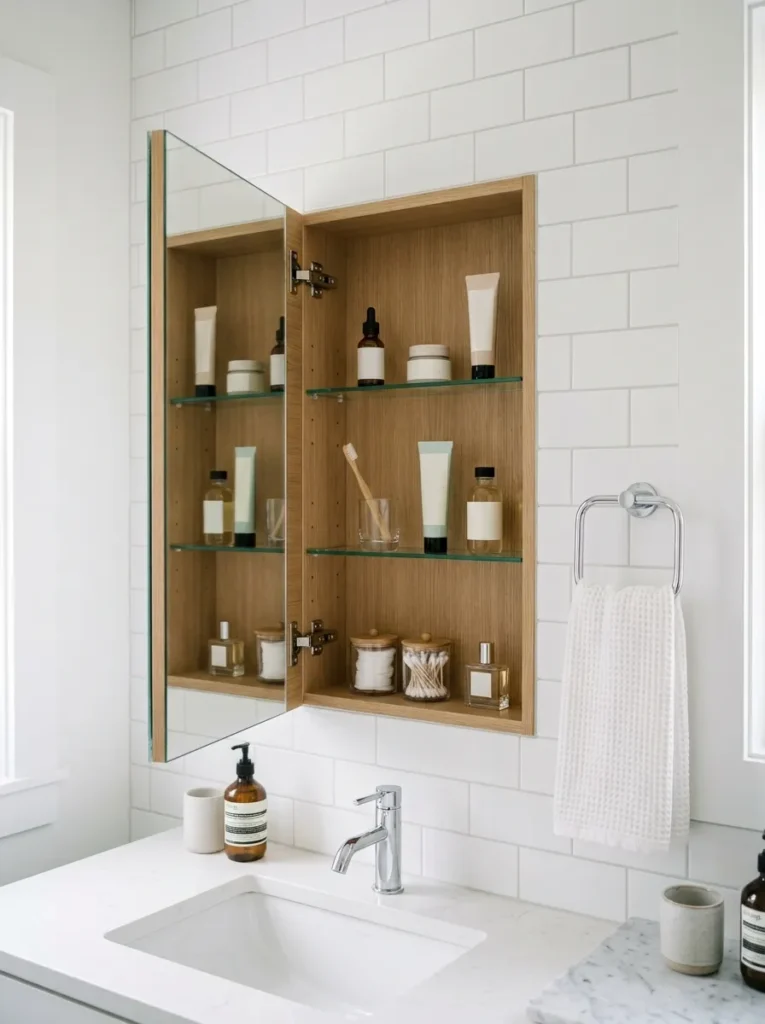
A medicine cabinet mirror is a practical decision that many people dismiss for aesthetic reasons — and usually regret when they run out of counter space. The current generation of recessed mirror cabinets has moved well past the chrome-box look of older models. Flush-mount versions with frameless faces, adjustable glass shelving, and soft-close hinges read as built-in cabinetry, not utility afterthoughts.
The recessed version (set into the wall cavity) is visually cleaner than a surface-mount cabinet, which protrudes into the room. Recessed installation requires opening the wall to work between studs — standard 14.5-inch-wide cavities between studs can accommodate a single small cabinet, but larger double-door cabinet mirrors require custom or structural planning. Surface-mount remains the easier option for existing bathrooms. If concealing the cabinet look matters, a door with a mirror on each side allows the exterior to read as a simple decorative mirror when closed.
12. A Mirror With a Built-In Teak or Walnut Wood Frame Shelf
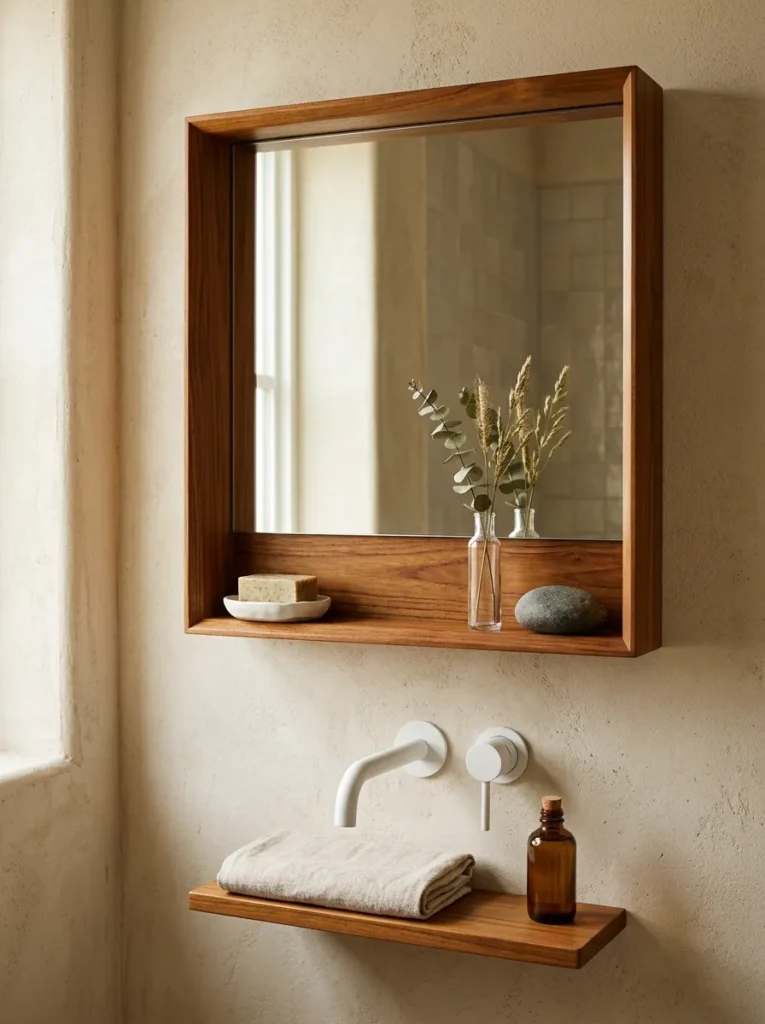
A mirror with a narrow integrated shelf along its bottom edge solves a specific problem: the no-counter bathroom, or the bathroom where counter space is occupied but the user needs a surface for one or two frequently used items. The shelf is typically 3–5 inches deep — enough for a small plant, a soap dish, or a candle, but not a full skincare collection.
Teak frames are particularly practical because teak’s natural oils make it genuinely moisture-resistant without additional sealing — relevant in a steam-heavy bathroom. Walnut is warmer and more decorative but requires proper sealing in humid environments. The shelf-mirror combination reads well in Japanese-influenced, Scandinavian, or earthy organic bathroom styles. In a heavily styled traditional or glam bathroom, it can feel too utilitarian. Scale the shelf depth honestly: a 3-inch shelf is a styling surface, not a functional storage solution.
13. Frameless Floor-to-Ceiling Mirror Panel
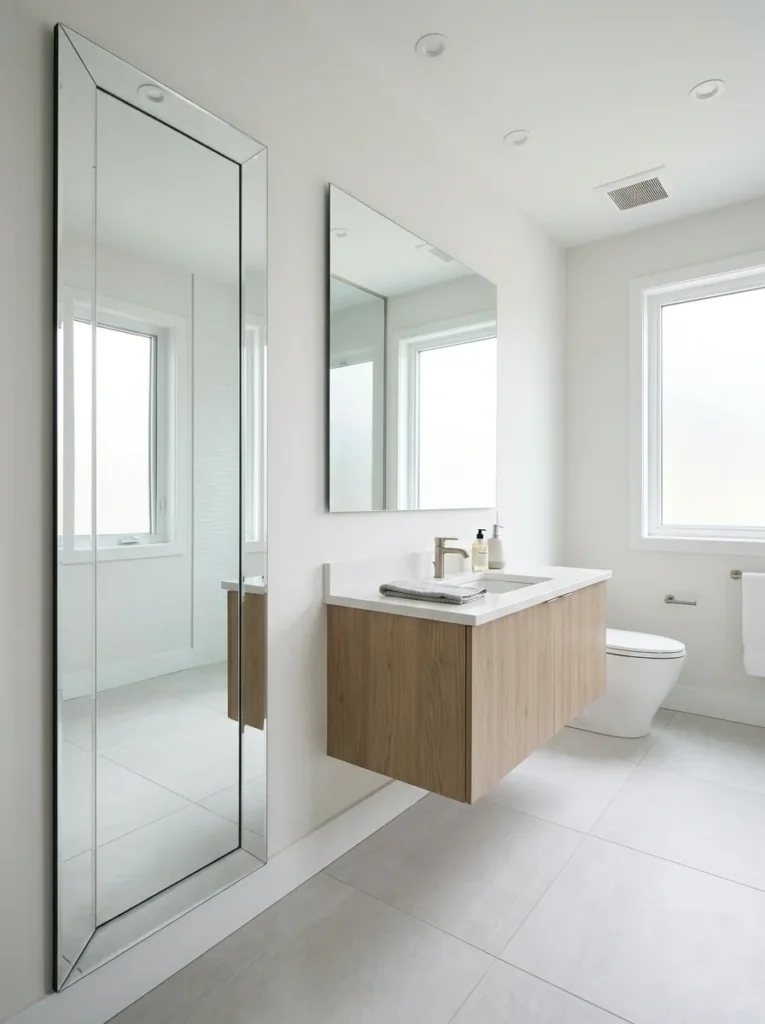
Where a single vanity mirror implies “bathroom,” a full floor-to-ceiling mirror panel implies something closer to a dressing room or spa. This is a specific architectural choice that works in bathrooms with a defined vanity wall where no windows interrupt the vertical run.
The mirror is typically 12–24 inches wide — not a full wall of mirror but a tall vertical strip. It reflects the opposite wall or window light, significantly brightening the bathroom without adding a light fixture. The frameless edge (polished or beveled) keeps it from reading as cabinetry. The installation concern is practical: large mirror panels require professional installation, appropriate mirror mastic adhesive, and often mechanical clips or backing support. In a rental situation, this isn’t realistic. But in an owned home with a dated bathroom, it’s a higher-return investment than most decorative changes.
14. Grouped Mismatched Vintage Mirrors in a Powder Room
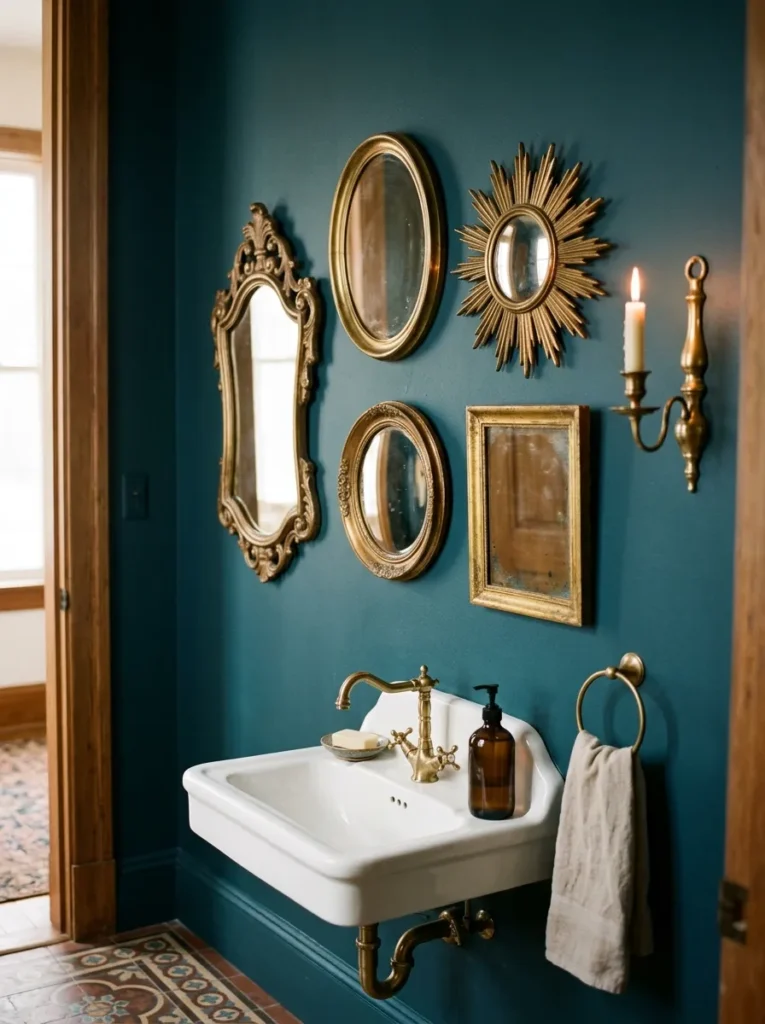
A powder room — small, visited briefly, not used for daily grooming — is the correct room for an arrangement of three to five mismatched vintage mirrors. The approach is the bathroom equivalent of a gallery wall, but with reflective surfaces that amplify the room’s candlelight or sconce glow.
The discipline required is in the unifying element. Mismatched frames need one thread of commonality: all brass-toned finishes even if the frame profiles differ, all similar vintages with patina, or all similar shapes with different sizes. Complete randomness reads as a thrift store wall. The mirrors don’t all need to be functional as vanity mirrors — some can hang too high for direct use, functioning purely as decorative reflective surfaces. Avoid this approach in a primary bathroom where a single functional mirror serves a daily purpose; the arrangement makes practical grooming awkward.
15. A Copper or Warm Brass Mirror in an All-White Bathroom
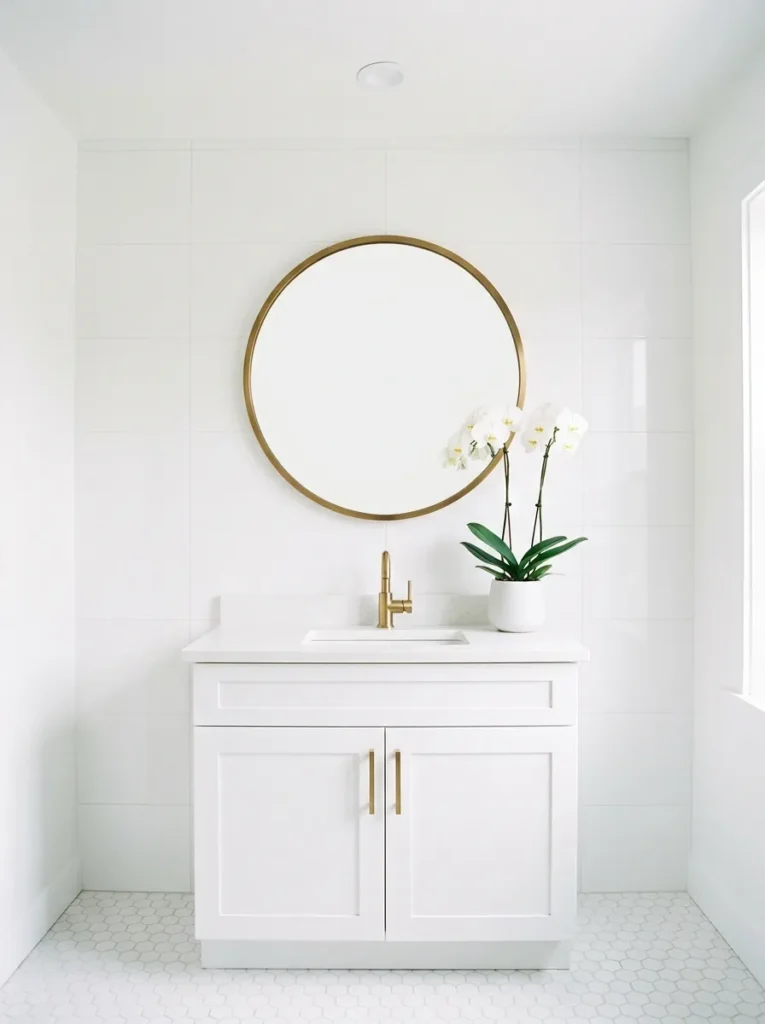
White bathrooms are common. White bathrooms with warm metal accents are considerably less flat. A copper or warm brass mirror — the mirror glass itself has a subtle warm tint to the frame, not a tinted reflective surface — does two things simultaneously: it introduces the warmth that pure white tile and white vanities suppress, and it creates a natural anchor for matching fixture hardware without requiring additional decorative layers.
The key distinction is finish quality. Lacquered brass retains its shine but can look too polished and eventually chips. Unlacquered brass develops a natural patina over time — some find this appealing, others find it maintenance-intensive. Brushed brass falls between both: it doesn’t show fingerprints as visibly and has a quieter warmth. For a bathroom where the mirror is the primary warm element, brushed brass is the most forgiving choice.
16. A Mirror With Integrated Sconces — But Mounted at the Right Height
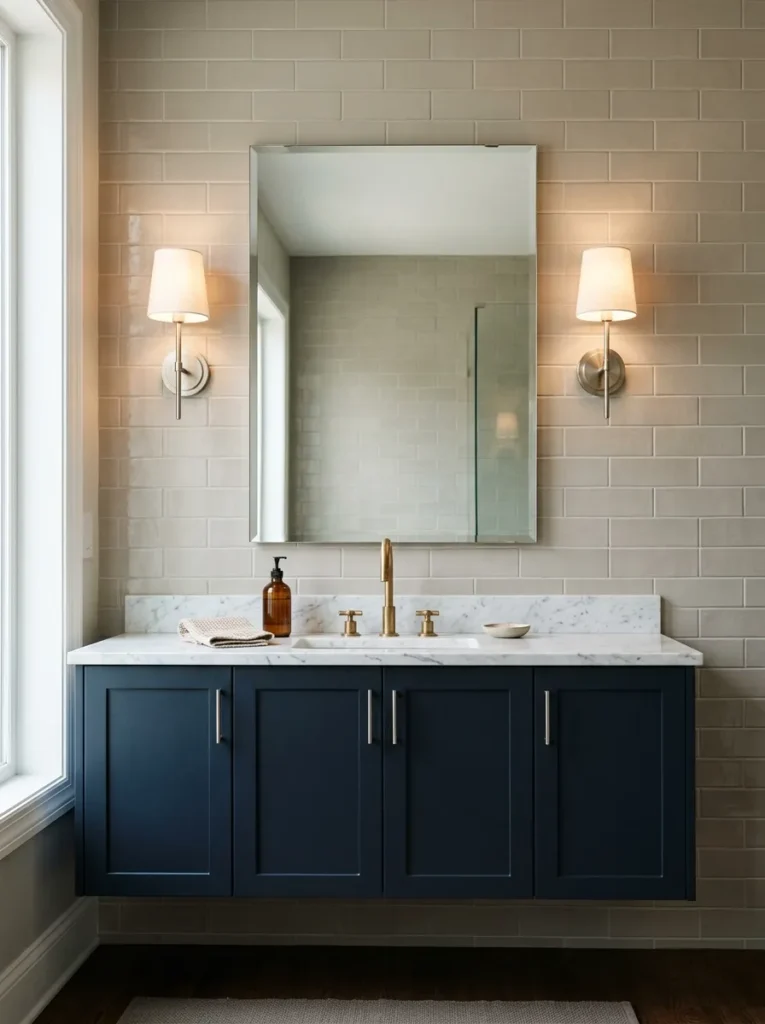
Most vanity mirrors with integrated side sconces are mounted at the manufacturer’s standard position, which suits an average user height but fails anyone significantly taller or shorter. The more useful approach is to separate the sconce placement from the mirror placement — treating them as coordinated rather than integrated elements.
The principle that makes side sconces superior to overhead lighting remains important: light at face level on both sides eliminates the shadows that make grooming genuinely difficult. But placement should put the center of the sconce light source at approximately eye level for the primary user, typically 60–65 inches from the floor. The mirror itself hangs independently, with the sconces flanking it at the appropriate height. This requires planning the wall outlet positions before drywalling — another early-stage decision that’s difficult to fix later.
17. A Smoked or Bronze-Tinted Mirror Glass
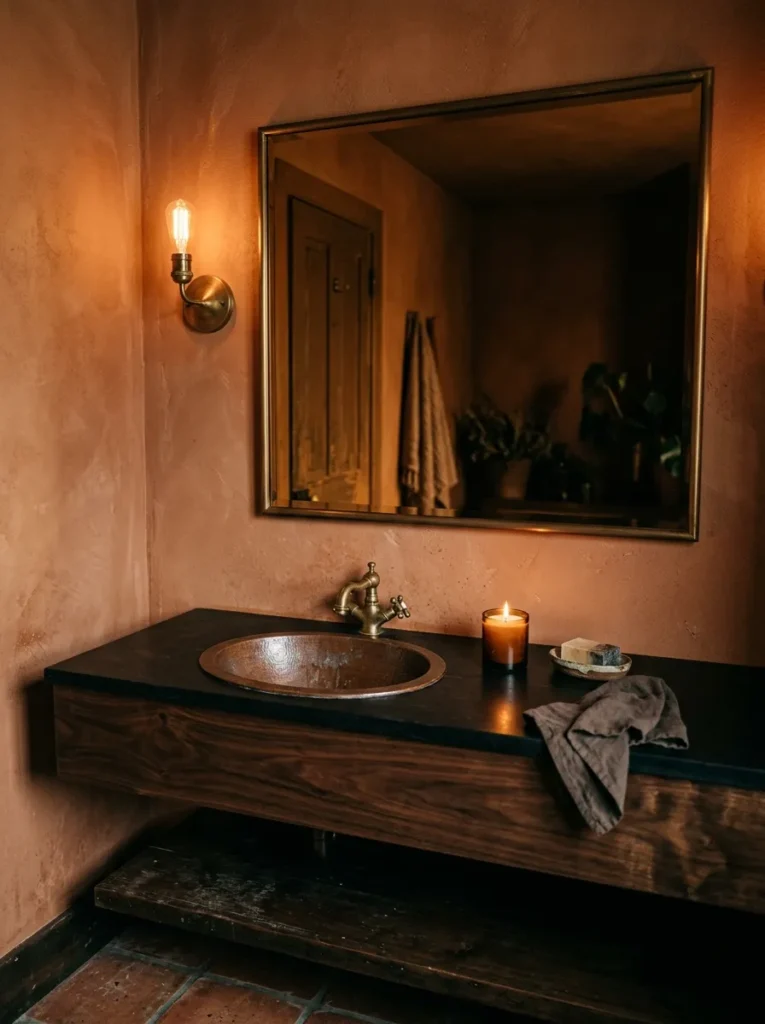
A tinted mirror — where the reflective surface itself has a warm bronze, smoky grey, or green-grey cast — is often dismissed as too dark for a practical bathroom. That dismissal is partially right and partially wrong. A smoked mirror works poorly when it’s the sole light source for the face. It works genuinely well in bathrooms with strong natural light or well-designed artificial task lighting, where the darkened tone reduces glare, creates depth, and gives the room a moody, atmospheric quality that a clear mirror cannot achieve.
In powder rooms and guest bathrooms where function is secondary to atmosphere, smoked glass mirrors are one of the most effective ways to make a small space feel deliberately designed. The bronze tint particularly suits warm wood vanities, terracotta or warm stone tile, and aged brass fixtures. The grey-green tint suits cooler palettes with sage, slate, or linen tones. Avoid smoked mirrors in bathrooms where makeup application is a daily task.
18. A Frameless Pill-Shaped Mirror
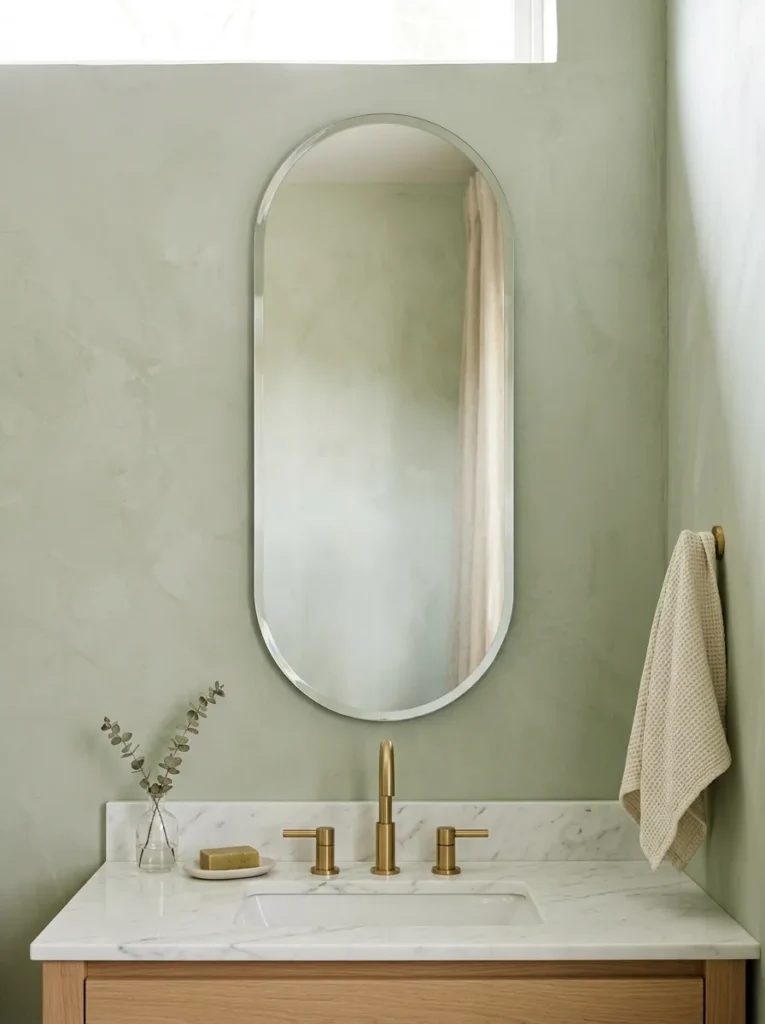
The pill shape — a rectangle with two semicircular ends — occupies an interesting position between the arch and the rectangle. It’s softer than a rectangle but more unusual than a simple arch, and it scales in ways that circles and arches don’t. A tall, narrow pill mirror reads as distinctly vertical; a wide, short pill mirror reads as almost oval-adjacent.
For a bathroom, the tall narrow version (roughly 14–18 inches wide, 30–42 inches tall) suits single-sink vanities where vertical space is available and horizontal width is limited. The frameless version keeps it contemporary and avoids the visual complication of choosing a frame that complements an unusual shape. The wide version suits double vanities where the user wants one mirror but not the flat horizontal strip that standard rectangular mirrors can produce. This shape has grown in popularity recently but hasn’t yet reached the oversaturation point of the basic arch.
19. A Mirror With a Hidden Storage Compartment Behind the Glass
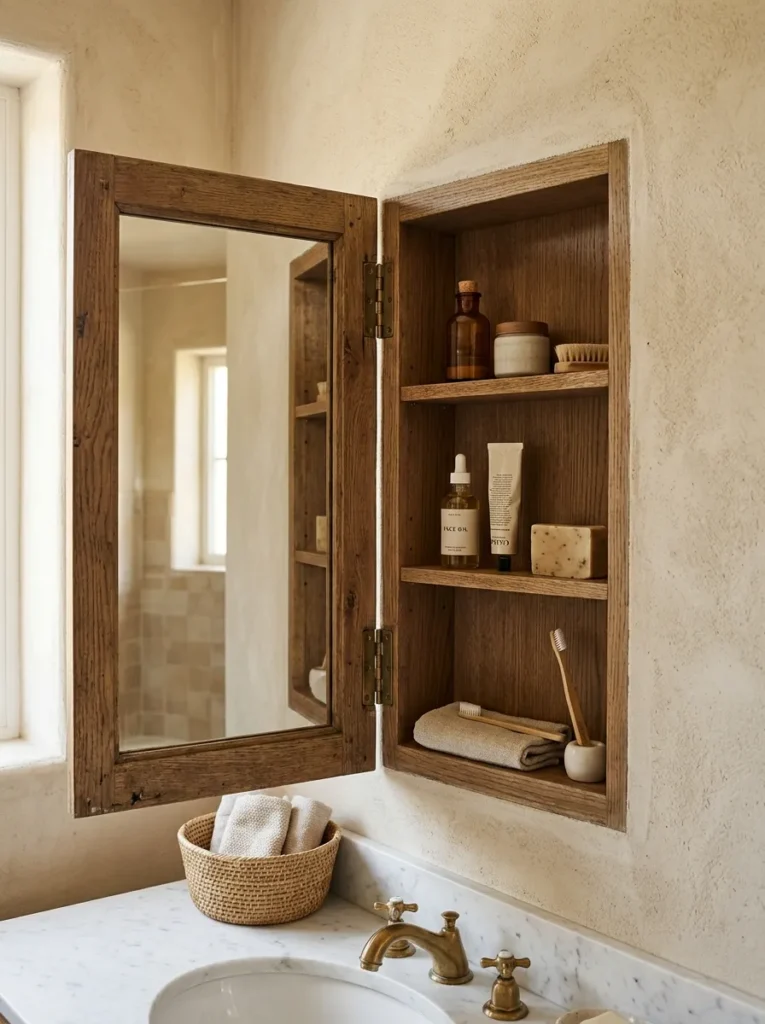
Different from a standard medicine cabinet, a mirror with a hidden compartment is flush-mounted with no visible cabinet framing — it swings open on a concealed hinge rather than a visible door edge. From the front, it appears to be a standard decorative wall mirror. The storage behind it is shallow (typically 3–4 inches) but sufficient for everyday items.
The practical advantage over a standard medicine cabinet is purely aesthetic: nothing about the exterior reveals its function. This suits bathrooms where the owner wants clean, uninterrupted walls without sacrificing storage. The mirror frames available in this configuration have expanded significantly — they’re no longer limited to chrome or white. Aged oak surround mirrors with concealed storage compartments exist and pair well with earthy bathroom aesthetics. The limitation worth knowing: the concealed hinge requires more precise installation than a standard wall mirror, and the mirror should be mounted on a solid wall or into a stud for the weight of the door swing.
20. A Triptych Mirror — Three Panels, One Cohesive Statement
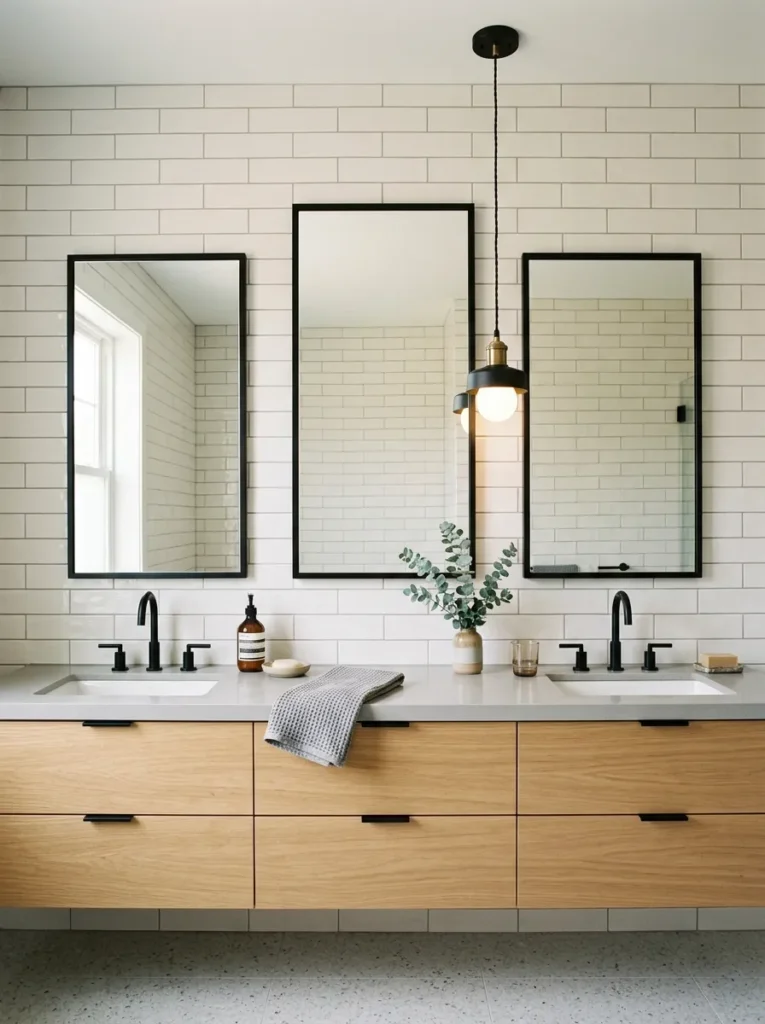
A triptych configuration — three mirrors mounted in a row, often with the center panel slightly larger than the two flanking panels — creates a visual effect that reads somewhere between a gallery arrangement and a single large mirror. The advantage over one wide mirror is that the seams between panels break the reflection slightly, reducing the visual weight while maintaining coverage.
This suits wide double vanities where a single large mirror can feel monolithic. The panel arrangement also allows for angling the outer two mirrors very slightly inward — not dramatically, but enough to improve sightlines from the outer sink positions. This requires mirrors with non-recessed frames that can be independently adjusted. The finish and profile across all three should match exactly; slight variations in finish will read as errors rather than intentional contrast at close viewing range.
21. A Single Sculptural Mirror as Pure Art Object
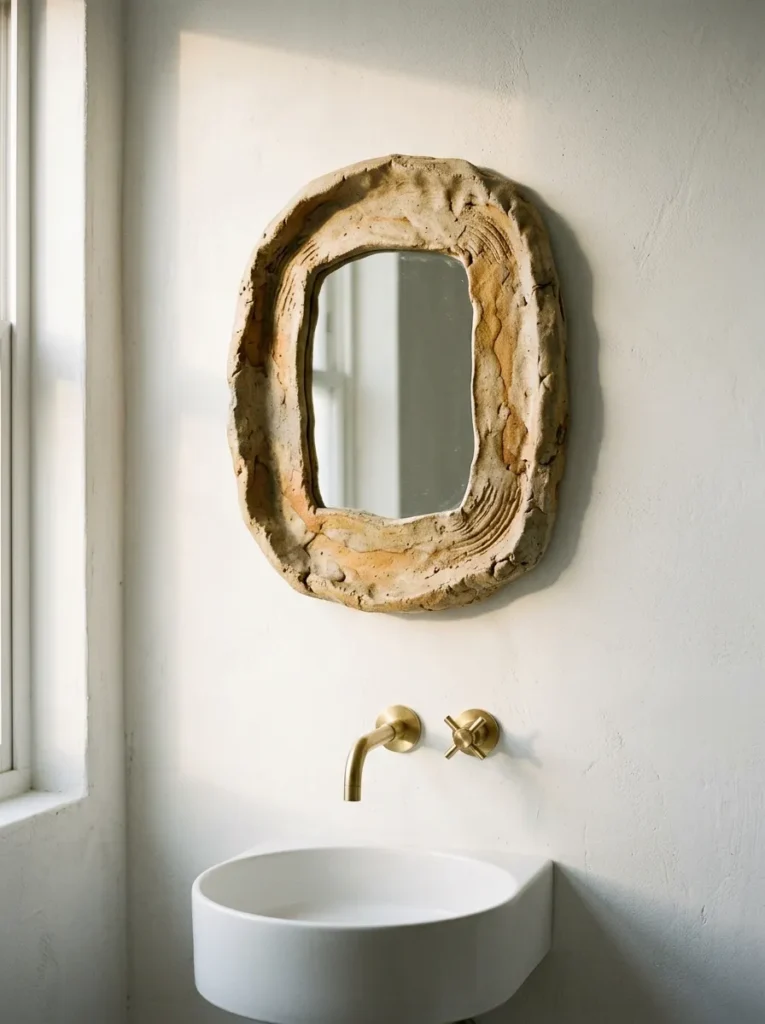
Not every bathroom needs a mirror that primarily serves the vanity. In a bathroom with a separate dedicated vanity area — or a powder room with a wall-mounted soap dispenser and minimal counter — the mirror above the sink can function as a sculptural object that happens to reflect.
This means mirrors with irregular cast-metal frames, hand-formed ceramic borders, driftwood surrounds, or twisted iron silhouettes. The reflection is secondary to the object itself. What makes this work rather than feel pretentious is that the rest of the bathroom must be visually quiet — simple tile, no competing decorative elements, a single material finish repeated throughout the hardware. A sculptural mirror in a maximally decorated bathroom becomes noise. In a restrained bathroom, it becomes the entire point of the room.
How to Choose the Right Mirror for Your Bathroom
Start with function, then add personality. The most common mistake is selecting a mirror entirely based on aesthetics, then discovering it’s the wrong size, too dark to groom by, or awkwardly scaled for the wall.
On sizing: The general principle is that a single mirror should be equal to or slightly narrower than the vanity below it — stopping about 2 inches short of the vanity edge on each side. Going wider creates a floating effect that can work intentionally (Idea 10) but often reads as mismatched rather than intentional. Height is more flexible: somewhere between 24 and 36 inches tall is typical for most vanity heights.
On placement height: The standard recommendation is to center the mirror at eye level for the primary user, or to mount the bottom edge 5–10 inches above the faucet — whichever puts the center closer to actual eye level. In households with significant height variation between users, err toward the taller user’s eye level. A mirror hung too low is less useful and harder to correct than one hung slightly high.
On lighting interaction: If you rely entirely on overhead lighting, any vanity mirror will perform poorly for grooming. The mirror choice should be made alongside the lighting decision, not after it. Backlit mirrors (Idea 7) or side sconces (Idea 16) are the most effective lighting solutions — the mirror type influences which makes more sense for the space.
On renters: Ideas 2 (leaner), 6 (swing-arm, though this requires installation), 14 (if adhesive strips can manage the weight), and sculptural mirrors on single anchor points are the most realistic no-drill or low-drill approaches. Heavy tile drilling for large mirrors should not be attempted without permission and professional help.
Final Thoughts
The bathroom mirror is a decision that compounds. Get it right and it reinforces everything else in the room — the vanity, the tile, the fixtures, the light. Get it wrong and it’s one of those things you notice every morning without quite knowing why.
Of the 21 ideas here, the ones that consistently work across the widest range of bathrooms are the oversized round (Idea 10) for its forgiving versatility, the backlit LED mirror (Idea 7) for genuine functional improvement, and the two-mirror configuration over double vanities (Idea 3) for the clarity it brings to shared spaces. The sculptural and Venetian options are harder to execute but more distinctive when they land.
Choose one idea that solves your biggest current problem — whether that’s awkward scale, poor lighting, or no storage — and let the rest remain inspiration for later. Save the ideas that speak to where you want the bathroom to go, and come back to this guide when the next update makes sense.