
23 Beige Bathroom Ideas That Look Calm, Warm, and Genuinely Elegant
Beige is not a compromise. In a bathroom, it’s one of the most intelligent choices you can make — warm enough to feel welcoming, neutral enough to work with almost any material, and timeless enough that it will never need justifying in five years. The challenge is not whether to use beige, but how to use it well.
A badly executed beige bathroom feels flat and a little tired. A well-executed one feels like a hotel spa in the best possible way — that specific quality of calm that comes from a space where everything is in agreement with itself. The difference lies in understanding that beige is not a single color but a direction. It can pull warm and golden, cool and greige, sandy and dry, or creamy and lush. Each of those directions calls for a different set of supporting choices.
These 23 beige bathroom ideas cover the full range — from full travertine renovations and Japandi-inspired minimal setups to renter-friendly updates that change the mood of an existing bathroom without touching a single tile. Each idea explains what makes it work, what it pairs well with, and what to avoid so you can apply it accurately in your own space.
Before you begin: always test beige paint or tile swatches in your bathroom’s specific light before committing. Beige reads differently under north-facing natural light than it does under warm incandescent bulbs. The shade that looks perfect in a showroom can read as muddy, pink, or grey-toned in your actual room. This single step eliminates the most common mistake people make with beige.
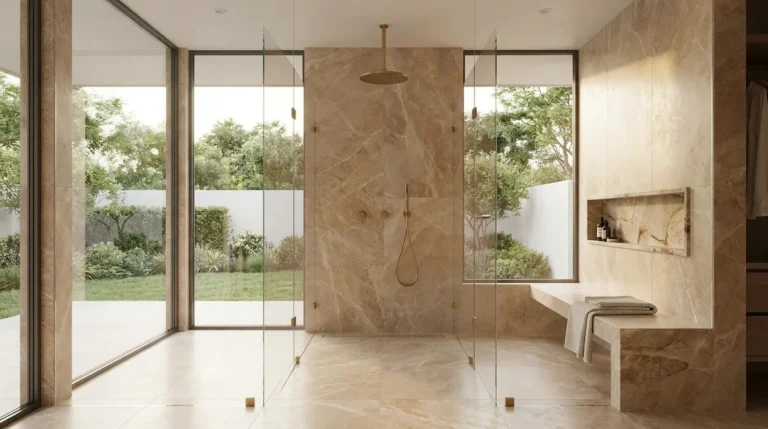
1. Full Travertine Bathroom for Maximum Warmth

Travertine is the natural material most closely aligned with the ideal of a beige bathroom. Its warm ivory and tan tones, the characteristic small voids in its surface, and the way it absorbs and softens light rather than reflecting it give a bathroom a quality that no manufactured surface fully replicates. When used on both floors and walls, travertine creates a continuity that makes the entire room feel carved from a single material rather than assembled from components.
Honed travertine is the practical finish for a bathroom — it’s matte, slip-resistant underfoot, and shows water spots and soap residue far less readily than polished surfaces do. Filled travertine is preferable to unfilled for floors and wet areas, as it doesn’t trap moisture in the natural voids.
Pair full travertine with simple white fixtures, minimal hardware in an unlacquered brass or matte finish, and a wood vanity in a tone that echoes the travertine’s warm undertone. Let the stone do the work — resist the temptation to add pattern or visual complexity when the material itself is already doing everything necessary.
2. Travertine-Effect Porcelain for All the Look With Less Maintenance

Not every bathroom renovation budget or lifestyle accommodates natural stone, and travertine-effect porcelain tiles have become genuinely convincing — particularly in large formats where the grout lines are minimal and the surface reads as continuous stone. The practical advantages are real: porcelain requires no sealing, resists staining more readily than natural stone, and handles the temperature and moisture fluctuations of a bathroom without concern.
The key to making porcelain read as convincingly as possible is choosing a format that natural stone would actually come in. Very large slabs of 48 by 48 inches or even larger, or elongated planks in proportions that reference actual stone cutting, read more authentically than small, obviously uniform tiles. Avoid versions where the repeat pattern is obvious at arm’s length — the best travertine-effect porcelain has enough variation in the print that no two tiles look identical.
This is also the more sustainable choice if the installation is managed correctly, as porcelain tiles have a significantly longer lifespan than many other finish materials.
3. Beige and White Bathroom With Tonal Layering
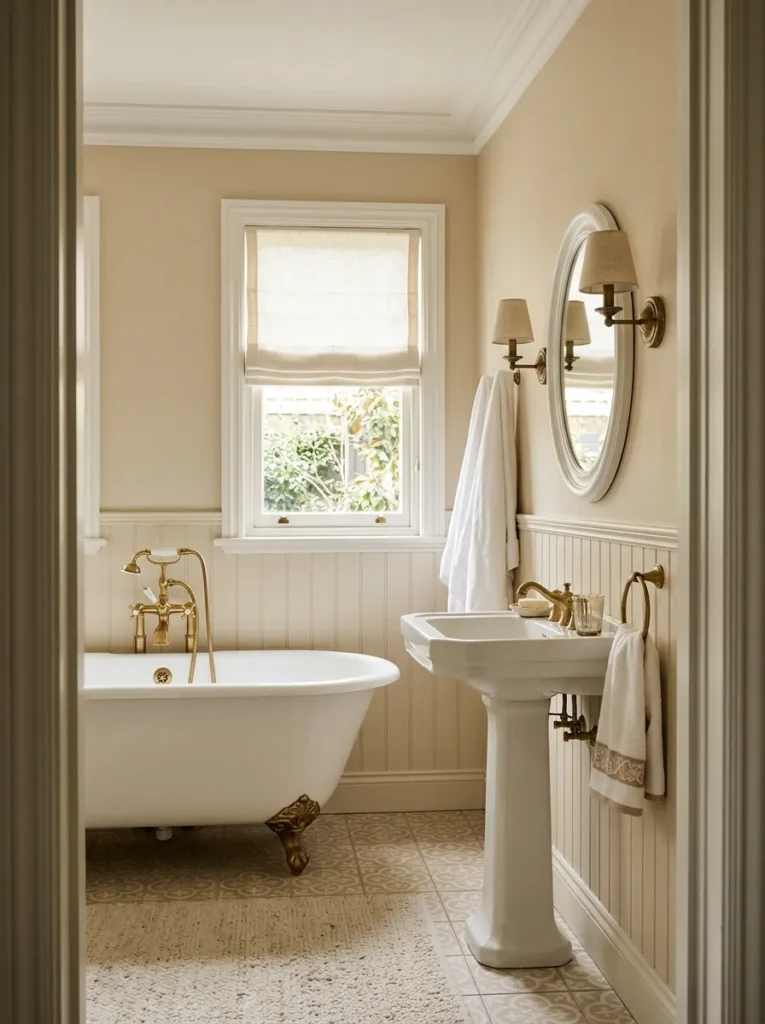
One of the most reliably beautiful approaches to a beige bathroom pairs beige with white in layers rather than as a binary contrast. The idea is to use both colors throughout the room — beige walls and a white freestanding tub, a cream tile floor and white-painted trim, a warm ivory backsplash and a white vanity — so the two tones converse across the whole space rather than simply sitting next to each other in one place.
This layering approach reads as European in the best sense: collected rather than designed, calm rather than clinical. It suits traditional bathrooms with molding, wainscoting, and period fixtures, and it also works in contemporary rooms with clean lines provided the beige chosen is genuinely warm rather than greige.
The practical caution here is undertone alignment. Beige has an undertone — yellow, pink, or taupe — and the whites in the room need to harmonize with that undertone rather than fight it. A warm cream-white reads beautifully beside a golden beige; a cool blue-white can make the same beige look dingy by contrast.
4. Beige Paint on Walls With Existing White Tile
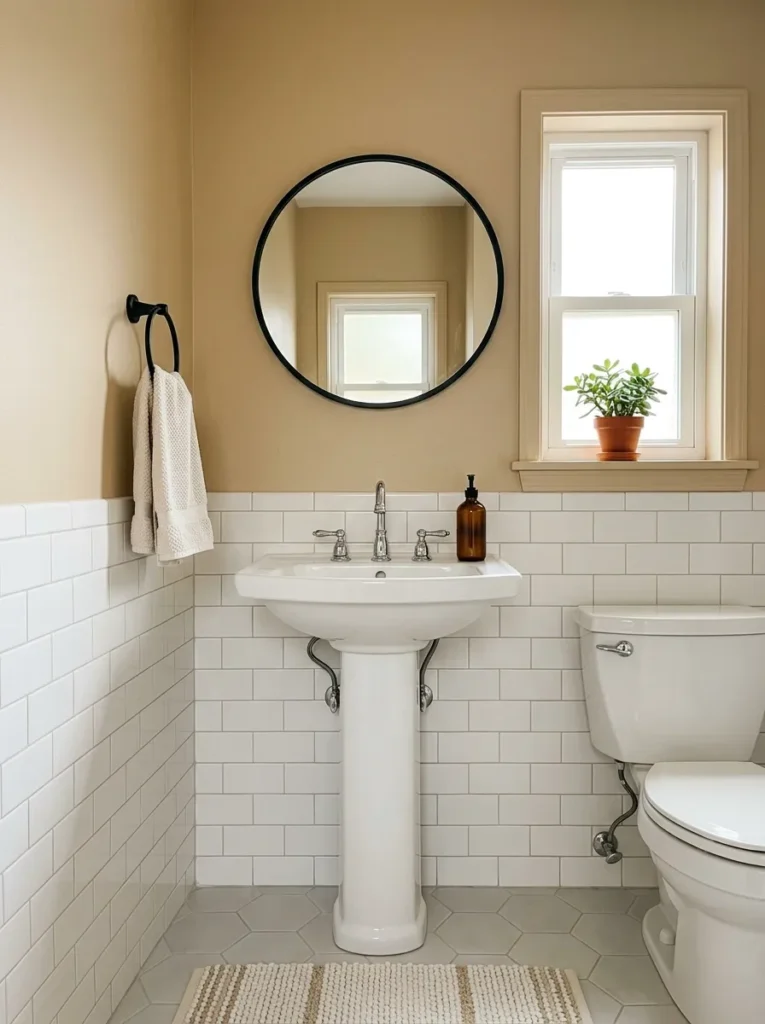
This is the most budget-accessible beige bathroom transformation, and it’s frequently underestimated. Painting bathroom walls a warm beige while keeping existing white tile in place changes the entire temperature of the room without touching the plumbing, the fixtures, or the floor. The white tile that previously sat against a white or cool-toned wall now reads as crisp and intentional beside a warm neutral background.
The paint shades that perform best in bathrooms are those with warm undertones and a mid-range light reflectance value — not so light that they read as off-white in the room’s conditions, and not so deep that a small bathroom with limited natural light feels closed in. A warm greige or a soft honey-beige rather than a yellow-leaning tan tends to hold up well across different lighting conditions.
Always use a bathroom-rated paint with a mold-inhibiting formulation and a satin or eggshell finish that wipes clean without losing its surface texture. Flat paint has no place in a bathroom.
5. Large-Format Beige Tile for a Seamless, Spa-Like Feel

Large-format tiles — anything from 24 by 24 inches upward — do something that smaller tiles cannot: they minimize the number of grout lines visible across a surface, which allows the eye to read the tile as a continuous plane rather than a grid. In a beige bathroom, this creates a quiet, uninterrupted quality that brings the room measurably closer to the spa aesthetic most people are reaching for.
Porcelain, stone, and engineered stone all come in large formats. Matching the floor and wall tile, or using the same tile in a slightly different finish — honed on the wall, lightly textured for slip resistance on the floor — creates the ultimate sense of continuity that high-end resort bathrooms use almost universally.
Large tiles in small bathrooms are a legitimate design choice, not an error. The common advice that large tiles make small rooms feel smaller is simply incorrect when the color is light and warm. Large beige tiles in a compact bathroom make the space read as larger, not smaller, because the eye has fewer interruptions.
6. Zellige Tile Bathroom in Cream and Sand Tones

Zellige is a hand-made glazed Moroccan tile with an irregular surface and a slightly imperfect, reflective glaze that catches light at multiple angles simultaneously. In cream, sand, warm ivory, and ochre tones, it creates a beige bathroom wall that seems to glow — not with the flatness of painted drywall, but with the dimensional movement of a surface that shifts as you move through the room.
The charm of zellige lies precisely in its imperfection. No two tiles are identical in glaze tone or surface texture, which means a zellige wall has a depth and visual interest that a perfectly uniform manufactured tile never achieves. It reads as artisanal in a way that few other tile choices do at a comparable price point.
Zellige pairs beautifully with simple wood vanity cabinets, unlacquered brass fixtures that develop their own patina over time, and natural stone flooring in a complementary warm tone. Keep everything else in the room deliberately simple — the tile carries the visual weight and doesn’t need competition.
7. Warm Wood Vanity in a Beige Bathroom

A wood vanity cabinet — whether in natural oak, walnut, or a warm-stained pine — is one of the most effective ways to bring depth and genuine warmth to a beige bathroom. Wood is the one material that reads as both natural and crafted simultaneously, and its grain texture provides a contrast to tile and stone surfaces that no paint color can replicate.
Light oak in particular has become a defining material of contemporary bathroom design because it sits so naturally in the warm neutral palette without pushing the room toward any specific period style. It suits minimal bathrooms, traditional ones, and everything in between.
Sealing the vanity cabinet correctly is non-negotiable in a bathroom environment. A properly sealed wood cabinet handles normal humidity without warping or delaminating. Avoid wood veneer on the interior of lower cabinets that sit close to the plumbing — solid wood or high-quality plywood with sealed edges is more reliable in areas with potential moisture exposure.
8. Beige Subway Tile With Dark Grout
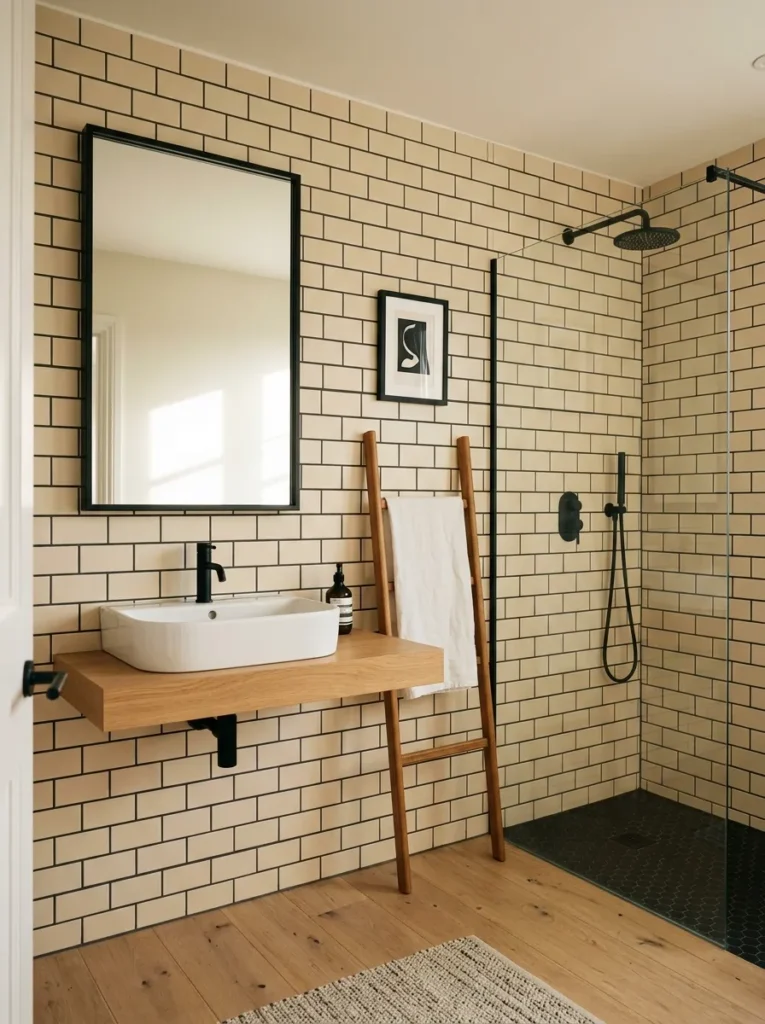
Subway tiles in cream or warm beige become a completely different object depending on the grout color paired with them. White or pale grout makes a subway tile wall read as one continuous surface; a warm charcoal, deep brown, or even black grout defines each tile individually and gives the same familiar format a graphic quality it doesn’t otherwise have.
This combination works because it introduces contrast in the one element — grout color — that requires no additional materials, no change in tile budget, and no structural decisions. It suits modern traditional kitchens and bathrooms that want to feel updated without departing from the clean familiarity of the subway format.
One consideration: darker grout shows soap residue and hard water deposits more than pale grout does. An epoxy grout — which is non-porous and significantly more stain-resistant than cement-based grout — is the practical choice when installing any dark grout in a wet area.
9. Brass Fixtures in a Beige Bathroom

Brass — whether in a warm unlacquered finish that develops a patina over time, or a more stable brushed or satin version — suits a beige bathroom in a way that chrome and nickel simply don’t. Chrome is cool-toned; beige is warm-toned. Brass sits squarely in the warm part of the metal spectrum and extends the palette rather than interrupting it.
Unlacquered brass is the choice for those who want the fixture to develop character over time — the way antique hardware in older homes looks as though it belongs to the building rather than having been installed recently. It requires a little tolerance for the darkening and variation that comes with natural patination.
Brushed brass or satin brass is the more stable alternative, holding its tone longer with less variation. Either works in a beige bathroom — the decision is primarily one of how much living quality you want the fixtures to carry.
10. Floating Beige Vanity for a Modern and Airy Feel

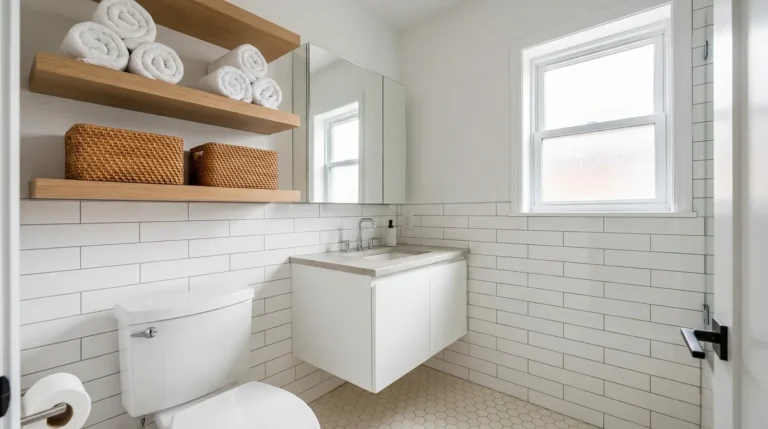
A floating vanity — wall-mounted with clear floor space beneath — is one of the most space-expanding choices in a bathroom of any size. The visible floor plane running continuously under the vanity reads as additional square footage in a way that a floor-standing cabinet does not. In a beige bathroom with a warm tile floor, a floating vanity in a coordinating tone or natural wood creates a genuinely seamless, well-considered look.
The aesthetic value is real, but so is the practical consideration: wall-mounted vanities require the wall framing to be prepared for the load, and the plumbing supply lines and drain need to be in-wall rather than exposed or within a vanity cabinet. In a new build or gut renovation this is straightforward; retrofitting into an existing bathroom requires a plumber and possibly a contractor.
A floating vanity makes the cleaning of bathroom floors considerably easier — no cabinet base to clean around, no gap between cabinet and floor to collect debris — which is a genuine quality-of-life improvement that matters more over years of use than it sounds in advance.
11. Beige Bathroom With Black Accents

The combination of warm beige and matte black is one of the most current and most effective in contemporary bathroom design. Black accents — in the form of fixtures, mirror frames, towel bars, and hardware — give a beige bathroom the definition and sharpness it needs to read as intentional rather than simply neutral.
Without any contrasting element, a completely beige bathroom can feel slightly indistinct. A black anchor — even something as small as a black-framed mirror or a matte black faucet — immediately pulls the room into focus. It works because the contrast is maximum without being busy, and because black in a small quantity reads as an accent rather than a color.
Keep the black elements consistent in their finish — all matte or all gloss — to maintain the room’s quiet character. Mixing matte and gloss black in the same bathroom creates a slight visual discord that undermines the room’s coherence without being obviously identifiable as the source of the discomfort.
12. Cream and Beige Checkerboard Floor

A checkerboard floor in two tones of beige — cream and warm sand, or ivory and taupe — takes one of the most traditional floor patterns and reinterprets it completely by removing the contrast. Standard black and white checkerboard is graphic and energetic; a tonal beige version creates the same sense of pattern without the visual weight, resulting in a floor with interest that doesn’t compete with anything above it.
This is an excellent choice for bathrooms that have a lot happening in the room — a patterned vanity, a statement mirror, or detailed tile work on the walls — because it adds texture at floor level without adding visual complexity. It’s also one of the more versatile pattern choices, reading as traditionally appropriate in a period bathroom and as understated and contemporary in a more minimal space.
Ceramic or porcelain in matte finishes work best for this pattern in a bathroom context — a glossy checkerboard floor shows every footprint and water mark.
13. Beige Roman Shade and Linen Textiles
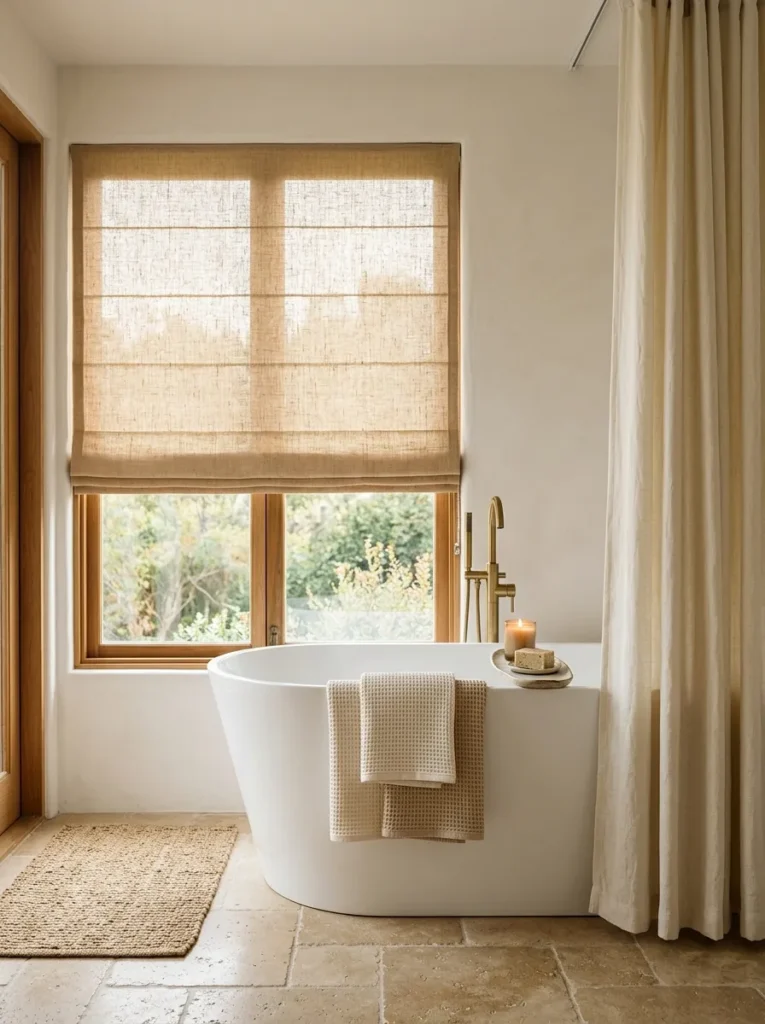
In a bathroom with a window, a Roman shade in natural linen, cream cotton, or a woven seagrass fabric does two things at once: it filters the light to a warm and diffused quality that enhances the beige palette throughout the room, and it introduces a soft textile element that most bathrooms lack.
Linen in particular suits beige bathrooms because its texture is visible and tactile — the weave of the fabric reads across a room and adds a dimension that painted walls and tile surfaces don’t provide. It also ages gracefully, softening without losing its quality in the way that synthetic fabrics do.
Layer the window treatment with coordinating textiles across the room — beige or cream Turkish cotton towels, a woven bath mat in a natural jute or cotton, a linen shower curtain if the bathroom has a tub rather than an enclosed shower. The accumulation of warm textile references creates the bathroom’s overall character more than any single element does.
14. Stone Accent Wall Behind the Bathtub

A natural stone feature wall — travertine, limestone, or a stacked stone veneer in warm beige tones — behind a freestanding tub creates the single strongest focal point available in a bathroom at a price significantly lower than tiling the whole room in the same material. The wall needs to be only one surface, and because it’s behind rather than inside the tub, it doesn’t face the same wet-area demands as a shower surround.
This is one of the most photographed and pinned beige bathroom ideas for good reason: a freestanding tub in white against a warm stone wall with soft ambient light from either side is a genuinely beautiful composition that photographs as well as it looks in person.
Keep the stone surface unfussy — use mortar-set natural stone or a quality panel system without visible brackets. The grout or joint lines should be as tight and minimal as possible to let the stone read as a continuous surface rather than an assembled panel.
15. Venetian Plaster Walls for Textured Elegance

Venetian plaster — a lime-based plaster applied in thin layers and burnished to a smooth, slightly reflective finish — creates a wall surface that no tile or paint achieves. It has depth in the literal sense: the multiple transparent layers create a quality of looking into the surface rather than at it, and the burnished finish catches directional light in a way that moves as you move through the room.
In warm beige, ivory, or warm sand tones, Venetian plaster gives a bathroom a quality that people instinctively describe as spa-like without being able to articulate why. The answer is the light quality: a room with Venetian plaster walls has warmer, more dimensional surfaces that reflect light differently at every hour of the day.
This is not a DIY application. Venetian plaster applied poorly looks streaky, uneven, and obviously unfinished. Applied by someone skilled in the technique, it looks like the most intentional and considered surface in the room.
16. Beige Limewash Paint for a Soft, Organic Wall
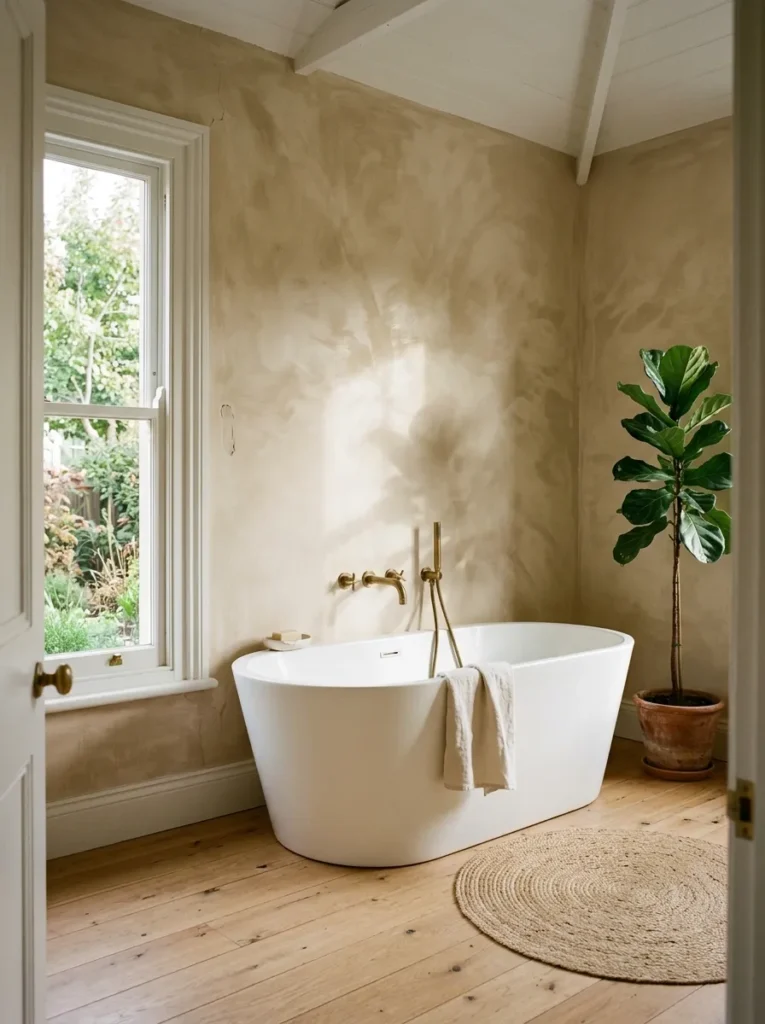
Limewash paint creates a wall finish that has the quality of aged plaster — slightly uneven, slightly translucent, with visible depth and movement across the surface. In warm beige tones, it gives a bathroom the kind of organic warmth that suggests the room has always looked this way, which is a quality that perfectly uniform painted walls rarely achieve.
Unlike Venetian plaster, limewash is an application that many homeowners can manage themselves, particularly with practice on a small section first. It’s applied with a large brush in overlapping strokes, and the technique rewards an imperfect hand — variation is the point rather than something to correct.
Limewash is a particularly strong choice for bathroom walls that have minor surface imperfections — plaster cracks, texture variations, previous patching — because the finish reads those irregularities as character rather than flaws.
17. Spa-Inspired Beige Bathroom With Warm Lighting

Lighting changes a beige bathroom more dramatically than it changes any other bathroom palette. Beige tones are naturally warm and they amplify warm light — a bathroom lit with warm white bulbs in the 2700K range feels genuinely luxurious, close to the quality of candlelight but at full functional brightness. The same bathroom with cool-white or daylight bulbs at 4000K or above reads as clinical and loses most of its warmth.
Layer the lighting rather than relying on a single overhead fixture. Wall-mounted sconces on either side of the mirror at eye level provide the most flattering and functional light for the tasks of the vanity area. A dimmable overhead fixture allows the room to transition between functional brightness for morning routines and lower, atmospheric light for an evening bath.
Under-counter lighting on a floating vanity, or a warm-lit niche in the shower, extends the lighting into areas that overhead fixtures can’t reach and creates the layered quality that distinguishes a considered bathroom from one that was simply lit to the building code minimum.
18. Beige Bathroom With Natural Rattan and Woven Accessories
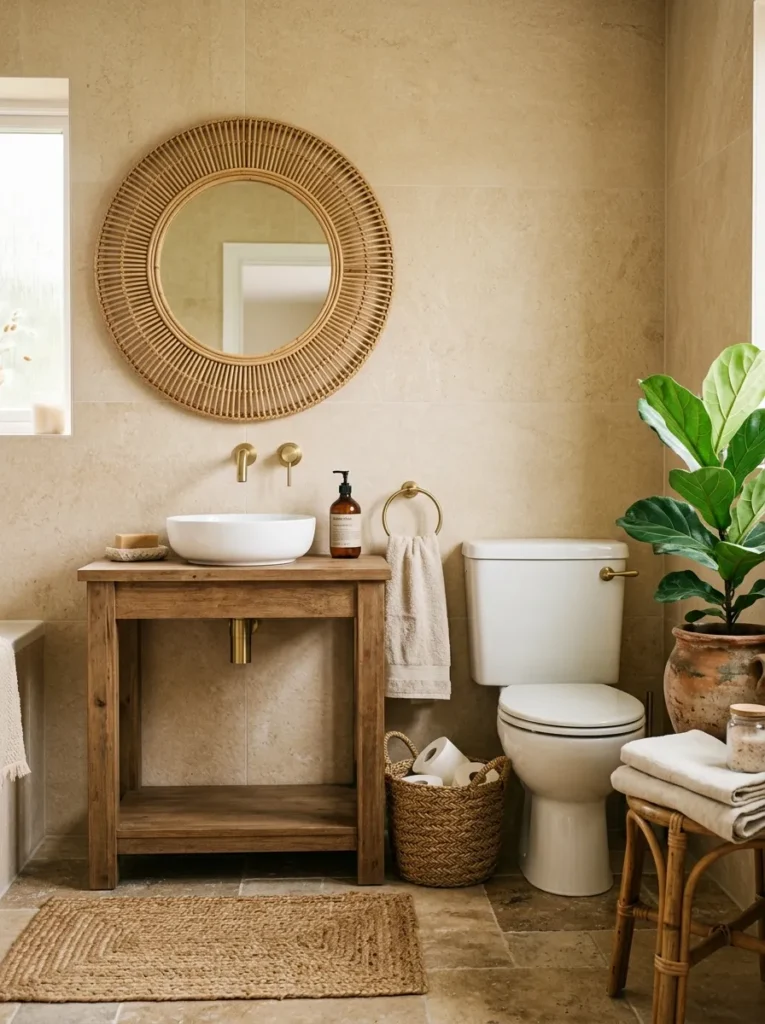
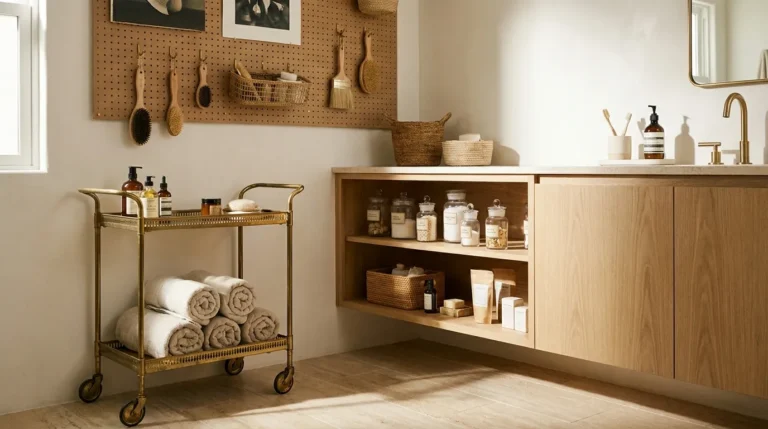
Rattan, seagrass, jute, and other woven natural materials suit a beige bathroom because they occupy the same warm, earthy part of the palette without adding color or pattern. A rattan mirror frame, a woven laundry basket, a jute bath mat, a seagrass shelf basket — each of these adds material texture that the tile and plumbing surfaces don’t provide, and they do it without introducing any competing visual direction.
This is also one of the most accessible ways to update an existing beige bathroom without renovation. Replace chrome or plastic accessories with natural material equivalents, add a woven stool or small ladder shelf in natural wood, change the bath mat to a natural cotton or jute weave, and the room’s entire character shifts toward the warm, organic quality that makes a beige bathroom feel like somewhere worth spending time.
Natural materials in a bathroom require some care — rattan and seagrass should not sit in standing water, and natural fiber mats need to dry out between uses. With reasonable care, they hold up well in a bathroom environment.
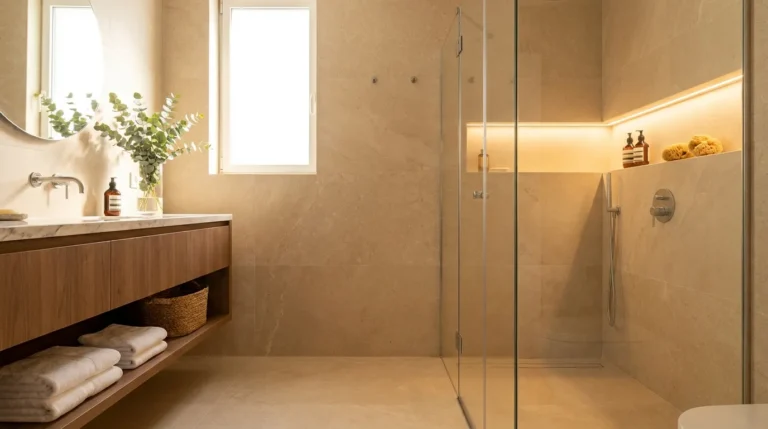
19. Small Beige Bathroom With a Walk-In Shower

A small bathroom doesn’t need to feel small. Beige is one of the most effective colors for expanding the perceived dimensions of a compact bathroom, because its warmth reads as light without the clinical sharpness of white. When the tile runs continuously from the floor into the walk-in shower without a color change or a material break, the eye reads the shower as part of the room rather than as a separate enclosed zone, and the whole space reads as larger.
Frameless glass on the shower enclosure is the structural choice that maintains this continuity. A framed shower or a shower curtain creates a visual boundary that makes the room feel smaller rather than helping it read as open.
Keep fixtures minimal and wall-mounted where possible. A recessed niche in the shower wall eliminates the visual noise of product bottles on a caddy. A wall-mounted toilet frees up floor space and removes visual weight from the lower half of the room. Each of these decisions compounds — the result is a small bathroom that functions and looks like something considerably larger.
20. Japandi Beige Bathroom for Minimal Warmth

Japandi — the design approach that combines Japanese spatial simplicity with Scandinavian warmth and natural material preference — produces beige bathrooms of a particularly considered quality. The palette is warm but restrained: light ash or white oak, warm beige tile in a large format or a simple horizontal brick pattern, matte fixtures, and natural accessories in linen or ceramic. Nothing is decorative for decoration’s sake.
The light in a Japandi bathroom is warm and indirect — no overhead glare, just wall-mounted sconces or recessed lighting set to a low angle that creates gentle shadows. The result is a bathroom that feels like a meditation rather than a room, which is an odd way to describe a practical space but an accurate one.
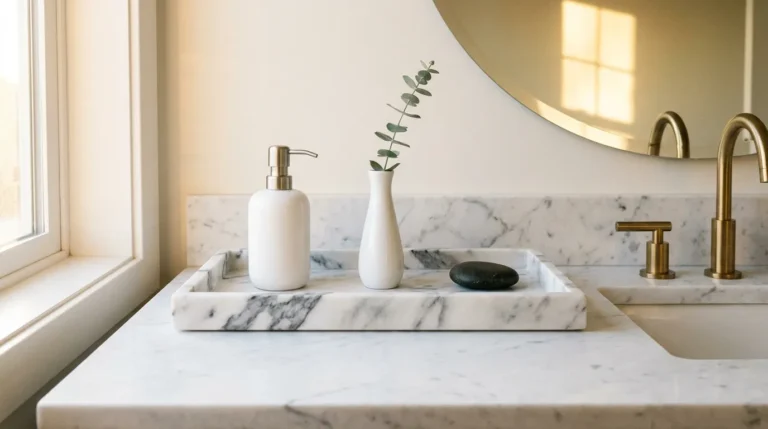
If you’re drawn to this approach, the most important decision is editing. Japandi bathrooms carry nothing that isn’t in active daily use. Products are stored out of sight. The countertop is clear except for one or two objects chosen for both function and form. The discipline of that restraint is where the aesthetic lives.
21. Wabi-Sabi Beige Bathroom With Imperfect Materials

Wabi-sabi — the Japanese aesthetic philosophy that finds beauty in imperfection, impermanence, and natural aging — produces beige bathrooms that feel completely different from the polished, spa-perfect version of the same palette. Materials are chosen for their texture and character rather than their uniformity: handmade ceramic basins with slightly uneven rims, zellige tiles with tonal variation across the wall, raw-edge stone on the vanity top, a linen curtain with an artisanal weave that shows its hand-loomed origins.
Nothing in a wabi-sabi beige bathroom is trying to look new or perfect. That’s its specific appeal — and it creates spaces that feel genuinely lived-in and human in a way that showroom-perfect renovations rarely do.
This is one of the few bathroom aesthetics that actually improves with age. An unlacquered brass faucet that develops a patina, a travertine floor that picks up a subtle sheen from foot traffic, linen that softens and wrinkles with washing — these changes are features, not flaws.
22. Greige Bathroom for a Cooler Take on Beige

Greige — the hybrid of grey and beige — suits bathrooms that want warmth without any yellow or golden undertone. It reads as cooler and more contemporary than a straightforward warm beige, and it pairs naturally with concrete, polished plaster, white oak, and brushed nickel or matte black fixtures rather than the brass and warm wood pairings that suit warmer beige tones.
Greige works exceptionally well in bathrooms with limited natural light, where a strongly warm beige can tip into mustard or tan. A cooler greige maintains its neutral quality under artificial light and reads as sophisticated rather than muddy.
The distinction between a good greige and a dated grey is the warmth in the undertone. A greige that has no warmth at all simply becomes grey — and grey bathrooms, for all their earlier popularity, lack the inviting quality that makes a beige or greige bathroom somewhere people genuinely want to spend time.
23. Beige Bathroom With Indoor Plants and Organic Decor

Plants are one of the most effective additions to a beige bathroom because they provide the one element that beige can’t supply on its own: organic color. A single large tropical plant — a monstera, a bird of paradise, a potted fig — in a natural terracotta or woven basket pot introduces a green that reads as entirely natural rather than as a deliberate color decision, and it makes the beige around it feel considered and alive rather than simply neutral.
Plants also improve the air quality of a bathroom environment, which matters in a room with humidity and limited ventilation. Varieties that tolerate low light and higher humidity — Boston fern, pothos, peace lily, bamboo palm — perform reliably in most bathroom conditions.
The arrangement of the accessory layer — plants, ceramics, a single art print in warm tones, a glass apothecary jar on the vanity — is what separates a beige bathroom that looks styled from one that looks incomplete. You don’t need many objects; you need the right ones in the right positions.
How to Design Your Beige Bathroom Successfully
Before committing to materials, a few decisions will anchor every choice that follows.
Which direction does your beige lean? Beige with golden or yellow undertones suits bathrooms with good natural light and pairs best with warm brass, warm oak, and warm whites. Beige with pink or taupe undertones is softer and suits north-facing rooms or bathrooms with warmer artificial light. Greige suits contemporary spaces, cooler light, and fixtures in brushed nickel or matte black. Identify the undertone before choosing paint, tile, or any fixture.
What is the light source? Natural light reveals a tile or paint’s true undertone; artificial light shifts it. Test every material sample in your bathroom’s actual lighting conditions, not in a showroom or a photograph. The 10 minutes this takes eliminates the most expensive decorating mistakes.
How much texture does the room need? A bathroom with beige paint walls, beige tile, and a beige vanity in the same tone needs significant material variation — different finishes, natural wood, textiles, plants — to prevent the room from reading as flat. A bathroom with travertine walls and floors, a wood vanity, and mixed materials already has the texture built in and needs less supplementary accessory work.
What size fixtures suit the space? In a small bathroom, a pedestal sink or compact floating vanity preserves floor area and visual space. In a larger bathroom, a double vanity or furniture-style freestanding cabinet suits the proportions. Oversized fixtures in small rooms make the room feel smaller; undersized fixtures in large rooms look provisional.
What metal finish connects everything? Consistency in metal finish — all brass, all matte black, all brushed nickel — is the single most effective quality signal in a bathroom. Mixing three different metal finishes because each seemed right individually produces a bathroom that feels assembled rather than designed.
Final Thoughts
A well-executed beige bathroom is one of the most durable decorating decisions you can make. It doesn’t chase a trend, it doesn’t compete with itself, and it creates a room that functions equally well for quick morning routines and long, unhurried evenings. The warmth that beige brings to a bathroom is something that grey, white, and most other neutral palettes genuinely cannot replicate.
These 23 ideas represent genuinely different approaches — from the material richness of full travertine to the accessible warmth of beige paint over existing tile, from the artisanal character of zellige to the considered simplicity of a Japandi setup. Find the version that fits your bathroom’s size, your light conditions, your budget, and how you actually want the room to feel every morning. That match, more than any single material choice, is what makes a beige bathroom genuinely work.