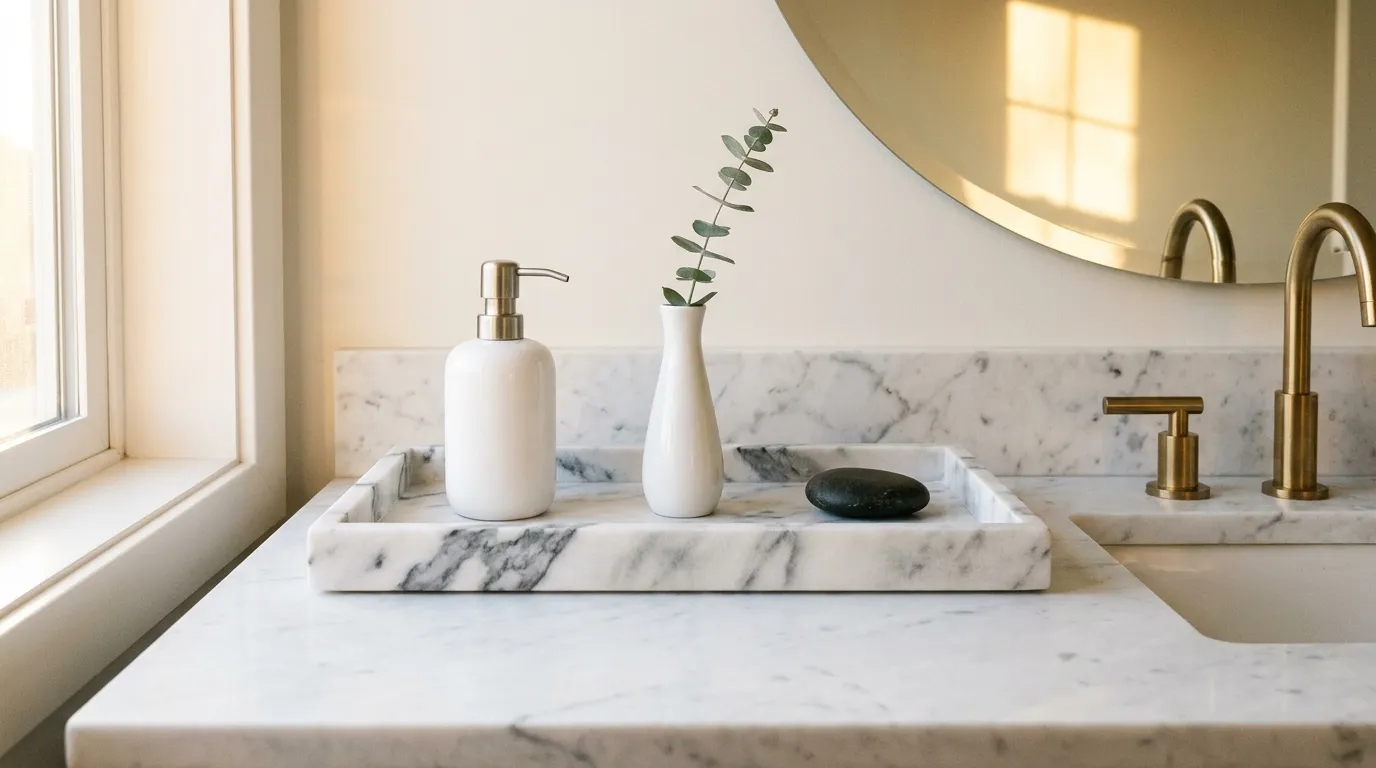
18 Bathroom Tray Styling Ideas That Feel Hotel Inspired
The bathroom tray is one of the smallest and most impactful styling decisions in the home. A well-chosen tray with three or four deliberate objects on it transforms a bathroom countertop from a surface where things accumulate into a surface that looks edited and intentional. It’s the difference between a bathroom that reads as used and one that reads as considered.
The hotel bathroom quality that most people are trying to recreate isn’t about expensive products or renovated fixtures. It’s about containment and curation: everything visible on the counter has been chosen, and nothing visible on the counter is there by accident. The tray is the mechanism that creates this impression — it defines a boundary between the styled zone and the functional zone, and it gives the objects within it a reason to be there together.
These 18 bathroom tray styling ideas cover the full range: vanity trays, bathtub caddies, toilet tank trays, floating shelf arrangements, and guest bathroom setups. Each idea addresses a specific styling direction, tray material, object selection, and the practical reality of maintaining a styled tray in a room where daily use is constant.
The goal isn’t a bathroom that looks staged for photographs. It’s one that holds its styling through real daily use — where the tray earns its place by making the bathroom better to be in, not just better to look at.
1. A White Ceramic Tray with Matching Soap and Lotion Dispensers

The most direct version of the hotel bathroom look is a white ceramic tray holding a matched set of ceramic soap and lotion dispensers in the same glaze, plus one small additional object — a bud vase with a single stem, a smooth stone, or a small candle — that prevents the arrangement from reading as purely functional.
The matching dispensers are the key decision. Hotel bathrooms achieve their look partly through uniformity: all bottles in the same format, same color, same label direction. In a home bathroom, decanting liquid soap, hand lotion, and perhaps a facial toner or tonic into matching ceramic pumps removes the visual noise of multiple different-branded bottles and creates a surface that reads as curated rather than commercial.
The ceramic tray material requires some humidity awareness: glazed ceramic is fully waterproof and wipes clean, but unglazed ceramic or ceramic with a matte finish can absorb water and stain over time on a wet countertop. A fully glazed ceramic tray — rather than a raw or unfinished one — is the more practical choice for daily bathroom use.
2. A Marble Tray as the Bathroom’s Material Anchor

A marble tray — whether in classic white Carrara with grey veining, in warm travertine, or in dramatic black marble — reads as a material upgrade to the bathroom regardless of what’s placed on it. The stone brings a luxury reference that no other tray material exactly replicates, and the veining provides visual interest that keeps the tray legible even when it’s relatively minimal in its styling.
The styling on a marble tray should be lighter rather than heavier — the marble itself is already visually active. Two or three objects maximum: a ceramic soap pump, a small plant or bud vase, and perhaps one additional element. Overcrowding a marble tray with objects buries the material that makes the tray worth using.
The practical caveat: marble is porous and susceptible to etching from acidic substances including many common bathroom products (facial acids, perfumes, some hand soaps). A marble tray used in active daily contact with toiletries benefits from a sealer applied periodically, or from being used as a display tray for objects rather than a direct-contact surface for liquids.
3. A Brass or Gold Tray for Warm Metallic Presence

A tray in brass, aged gold, or brushed gold reads as a deliberate material decision that participates in the bathroom’s hardware and fixture story. In a bathroom with unlacquered brass faucets and towel rings, a brass tray on the vanity creates a material echo that makes the room feel composed rather than assembled from separate purchases.
The brass tray works best when it’s the only — or at minimum the primary — metallic surface at counter level. A bathroom where the tray is brass, the soap dispenser is chrome, the toothbrush holder is stainless steel, and the mirror frame is gold reads as a collection of separate metal decisions. The brass tray in a bathroom where all counter-level objects share the same warm metal register reads as orchestrated.
Objects on a brass tray should be in materials that suit the warmth of the metal: white or cream ceramics, natural stone accessories, a candle in beeswax or warm ivory, dried botanical stems. Cool-toned objects (grey concrete, cool white, chrome accessories) create a material conflict with the warm gold tray rather than a conversation.
4. A Tray Organized by Product Category
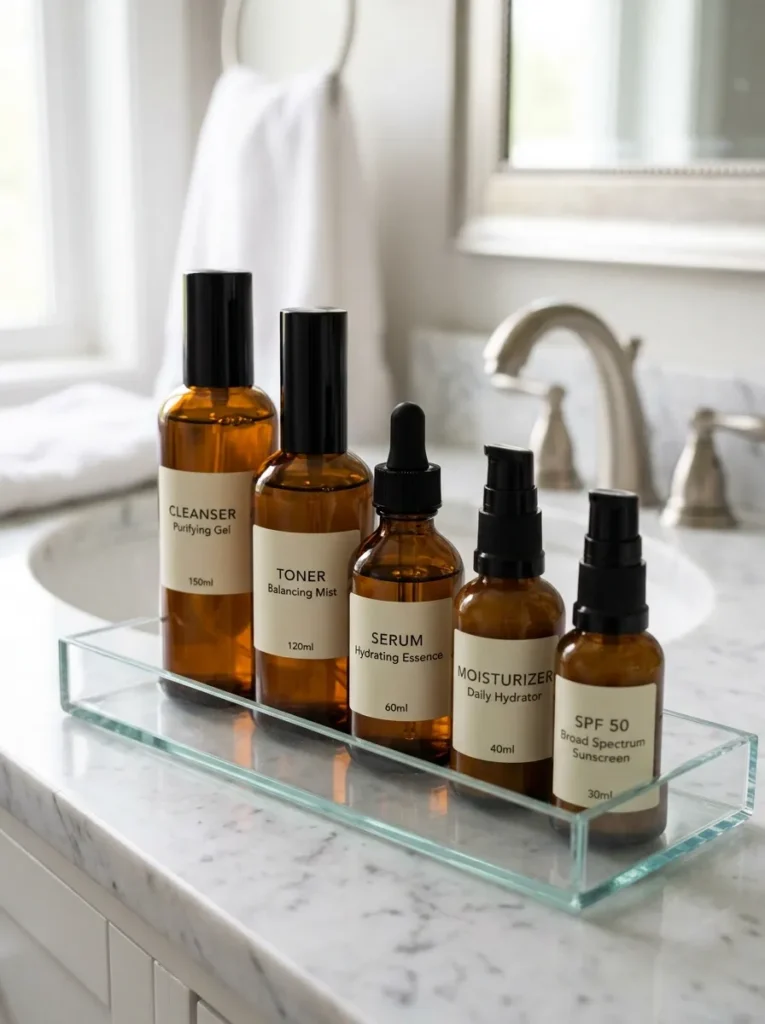
Rather than styling a tray for visual impression alone, organizing it around a specific product category — skincare, oral care, perfume, or a morning routine — creates a functional tray that’s also visually resolved because everything within it has a shared purpose.
A skincare tray holds the products used in sequence during a specific routine: cleanser, toner, serum, moisturizer, and SPF — decanted or purchased in bottles that share a color palette or material register. Because the products are organized by use-order, the tray becomes a prompt as well as a surface — it tells the user what comes next.
The visual coherence of a category tray depends on decanting or choosing products whose packaging suits the tray’s aesthetic. A skincare tray where every bottle is in a different brand’s packaging, different color, and different size reads as a product collection. The same products decanted into matching amber or frosted glass bottles with simple labels reads as a curated ritual.
5. A Perfume Collection Display Tray

A tray used exclusively to display a perfume collection — three to seven bottles of varying heights, shapes, and colors — creates a vanity moment that’s inherently beautiful because perfume bottles are designed as objects. The tray contains the collection visually and prevents the perfumes from drifting across the counter into a scattered arrangement.
The tray for a perfume collection should be relatively shallow so the bottles read above its edges rather than disappearing into a deep-sided vessel. A flat mirrored tray is the traditional choice because it reflects the bottles from below, which emphasizes the glass and liquid colors. A matte lacquered tray or a stone tray work equally well if the reflection effect isn’t the goal.
Height variation between the bottles is what makes a perfume collection arrangement interesting. Position the tallest bottle toward the back of the tray, shorter bottles at the middle level, and the smallest bottle or a decorative stopper at the front. This height hierarchy creates depth when viewed from across the bathroom.
6. A Minimal Three-Object Tray with Maximum Restraint
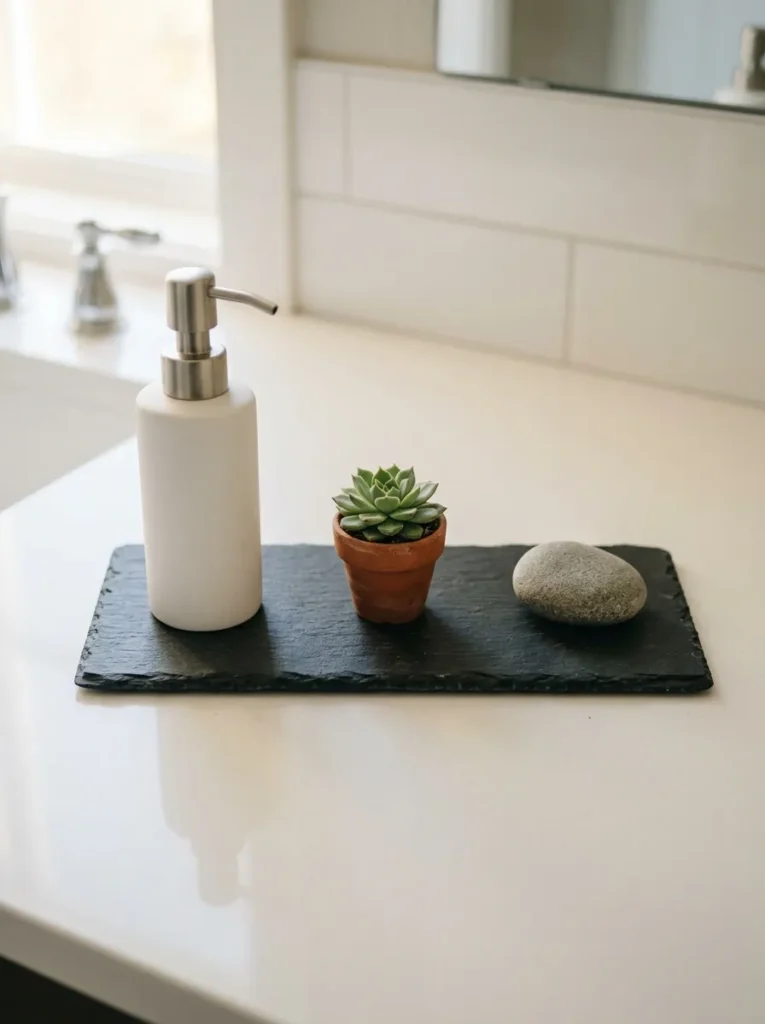
The hotel bathroom tray at its most refined is often its most minimal: a small tray holding three carefully chosen objects with generous space between them. A ceramic soap pump on the left, a bud vase with one stem in the center, and a single smooth stone on the right. The space between the objects — the empty tray surface visible between each piece — is as important as the objects themselves.
This minimal approach is also the most practical for daily use. Three objects are easy to move when the counter needs cleaning, easy to replace if one becomes damaged, and easy to maintain in the correct position. The visual logic is simple enough that it resets correctly after every cleaning.
The objects’ material relationship is the decision that makes this work. All three objects should feel as though they were chosen for each other: the pump, the vase, and the stone in the same tonal family (all warm, all cool, all natural), so the space between them reads as a pause rather than a gap.
7. A Rattan or Woven Tray for a Spa-Inspired Aesthetic

A rattan or woven seagrass tray brings a natural, tactile quality to the bathroom that no ceramic or stone tray replicates. It reads as warmer and more organic — closer to the spa and retreat aesthetic than the hotel luxury aesthetic — and suits bathrooms decorated with wood accents, linen towels, ceramic accessories, and other natural materials.
The objects on a rattan tray should be in the same material register: a ceramic soap dispenser in a matte cream or terracotta glaze, a small glass bottle with a bamboo cap, a eucalyptus bundle, or a beeswax candle. Highly polished or metallic objects on a rattan tray create a material conflict that undermines the organic quality the rattan is intended to provide.
One practical consideration: rattan and woven seagrass are not waterproof. A tray in natural fiber that sits on a wet countertop will eventually absorb moisture and can develop mold in the woven structure. Placing a thin layer of waterproof liner inside the tray base, or positioning the tray away from the direct splash zone of the sink, extends its lifespan considerably.
8. A Wooden Tray with Warm Grain for Natural Character

A wooden tray — in solid oak, walnut, teak, or bamboo — brings warmth and material character to the bathroom countertop in a way that ceramic and metal trays don’t. The wood grain creates visual movement across the tray surface even when the tray is sparsely styled, so the arrangement can be minimal without looking empty.
Teak and bamboo are the most humidity-resistant wood options for bathroom use — teak’s natural oils make it resistant to water damage, and bamboo’s density prevents warping from moisture exposure. Untreated oak or walnut on a wet bathroom countertop will eventually absorb water and can warp, split, or develop mildew. A wood tray intended for bathroom use should be sealed with an oil finish or a marine varnish before installation.
The objects on a wooden tray should relate to its warmth: a ceramic piece in a warm glaze, a small plant in a terracotta pot, a glass bottle with warm-toned liquid, a stone with earthy tones. Cool, clinical objects (all-white ceramics, chrome accessories, clear glass) can work but need enough warmth elsewhere in the tray to balance the wood’s natural tone.
9. A Guest Bathroom Tray as a Hospitality Gesture
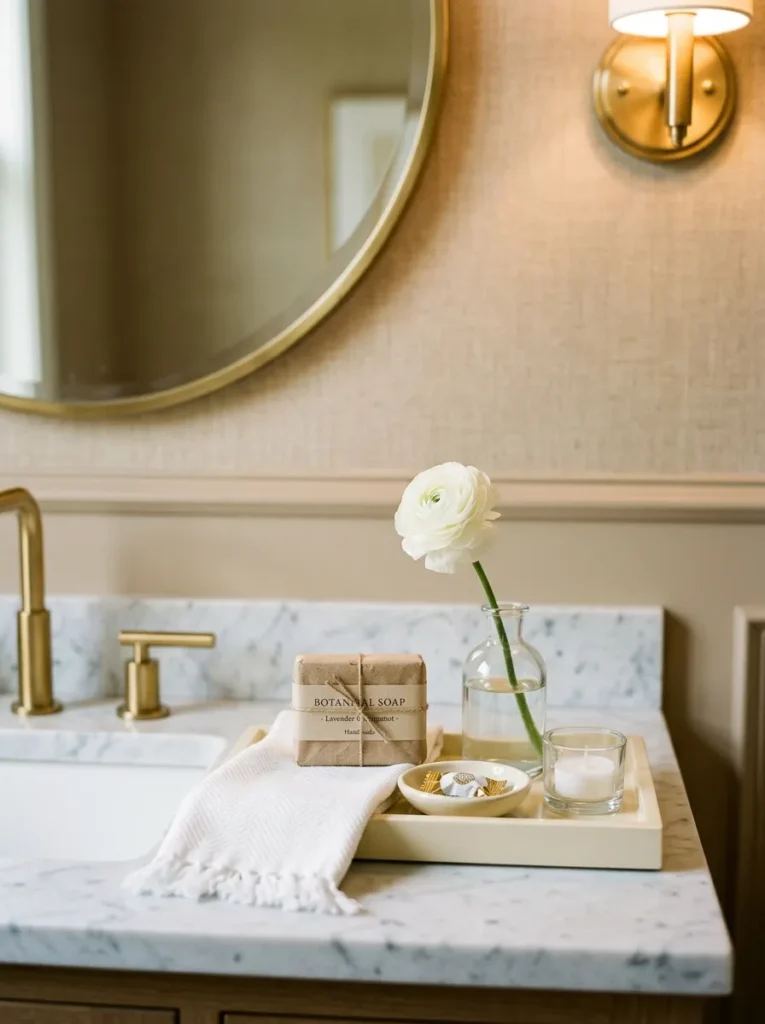
A bathroom tray in a guest bathroom or powder room is a hospitality gesture — a way of communicating that the guest’s visit was anticipated and prepared for. The tray holds items specifically for guest use: a small folded hand towel, a travel-sized lotion, a wrapped soap bar, a small candle, and perhaps a fresh flower or a sprig of greenery in a bud vase.
The guest bathroom tray works best when it’s clearly designated for the guest — positioned front and center on the counter, with items that are new or unused, in quantities suited to a visit rather than daily household stocking. A half-empty lotion bottle and a previously used soap bar undermine the hospitality intention regardless of how well the tray is styled.
The tray itself should be distinctive — slightly more formal or considered than the main bathroom’s tray, since it’s presented rather than simply used. A small lacquered tray, a ceramic tray with a decorative element, or a marble tray in a size suited to the powder room counter makes the gesture more intentional than a utilitarian basket or organizer.
10. A Bathtub Caddy with a Book and a Candle

A bathtub caddy — a tray that spans the width of the tub on its rim — transforms a bath from a functional activity into a genuine ritual. The caddy holds everything needed for an extended bath: a book or magazine propped in a reading stand, a candle in a small ceramic or glass holder, a soap bar in a small dish, and perhaps a small glass of water or wine within reach.
The caddy’s material should be water-resistant. Bamboo and teak caddies are the most practical choices for a bathtub position because they resist moisture without requiring special care. A wooden caddy without protective treatment will deteriorate quickly in sustained bath-steam contact.
The objects on a bathtub caddy should be specifically suited to bath use: nothing fragile that a water drop would damage, nothing that couldn’t survive being accidentally splashed. A small water-resistant candle holder, a soap dish rather than a pump dispenser, and a book stand that keeps the pages from getting wet are the functional choices that also read as considered.
11. A Bathtub Caddy Styled for Atmosphere, Not Function

Different from the reading-and-bath-products caddy, a purely atmospheric bathtub caddy — one that holds only scent, light, and beauty without functional products — creates a different kind of bathtub moment. Three small pillar candles in varying heights, a few rose petals or dried lavender florets, and a small ceramic dish with a bath bomb or a single crystal: these have no utility beyond making the bath feel genuinely luxurious.
The atmospheric caddy is the specific type of bathtub styling that photographs and saves most on Pinterest — it’s the image that makes someone want to recreate the experience in their own bathroom. In daily use, it’s less practical than a caddy with actual bath products, but for weekend baths or occasions where the ritual quality of the bath is the point, it’s the right approach.
The candle safety consideration: candles on a bathtub caddy are positioned near water and should be in stable holders that cannot tip into the bath. A low, heavy ceramic holder with a flat base is significantly safer than a tall, thin candlestick on a slippery caddy surface.
12. A Floating Shelf Styled as an Extended Tray Moment

A floating shelf positioned above the bathtub — at a height where items on the shelf are visible from the bath — creates an extended version of the bathtub caddy concept. The shelf holds objects that create atmosphere from above: a trailing plant, a few small ceramic bottles, a candle or two, a small piece of art leaned against the wall. The objects aren’t on the caddy or in the bath; they’re part of the architectural zone around it.
The shelf height above the tub determines what it can hold and how it reads. Too high (above 60 inches from the tub floor) and the shelf reads as a wall shelf that happens to be near the tub rather than an intentional bathing zone element. At 42 to 50 inches above the tub floor — roughly at shoulder height when seated — the shelf creates an immersive effect where the objects are within the visual and scent radius of the bath.
Humidity is the critical practical consideration for any shelf in the bathtub zone. The shelf material should be sealed and moisture-resistant; objects made of paper, unsealed wood, or unglazed ceramic will deteriorate in sustained exposure to bath steam.
13. A Candlelight Tray for Evening Bathroom Rituals

A tray positioned specifically for evening bathroom rituals — a small tray with two or three candles at different heights, a small spray of dried lavender or eucalyptus, and perhaps a crystal or smooth stone — creates a nightly ritual object that changes the bathroom’s atmosphere when lit.
The candle tray works on the bathroom vanity, on the side of the bathtub, or on a floating shelf beside the mirror. Its position should suit the evening activity it supports: beside the tub for bath rituals, beside the sink for skincare routines done in candlelight, or centered on the counter for a general atmospheric intention.
The candle heights within the tray create the composition’s visual interest. A tall pillar candle at the back, a medium pillar in the middle, and a low glass votive at the front creates depth and a natural height gradient. All three candles at the same height read as a row rather than an arrangement. The tray material should be heat-resistant or have a non-flammable surface — stone and ceramic are the safest choices for a tray holding multiple lit candles.
14. A Scent-Focused Tray with a Reed Diffuser and Botanicals

A tray organized around scent — a reed diffuser as the primary element, with dried botanicals, a scented candle, and perhaps a small sachet beside it — creates a bathroom surface moment that engages the nose as well as the eye. The tray communicates that the bathroom’s atmosphere was considered beyond what’s visible.
The reed diffuser is the functional center: it continuously releases fragrance. The botanical elements (a bundle of dried lavender tied with twine, a few dried rose petals in a small dish, a sprig of dried eucalyptus in a slim vase) reinforce the scent theme visually while adding organic texture to the tray arrangement.
The scent theme should be consistent within the tray. A eucalyptus diffuser beside lavender botanicals beside a rose-scented candle creates a competing fragrance environment. A single scent family — all eucalyptus and green, all lavender and floral, all citrus and clean — reads as more resolved and creates a more coherent sensory experience in the room.
15. A Small Tray Maximizing a Tiny Bathroom Counter

In bathrooms with very limited counter space — small vanities, pedestal sinks with a side shelf, or powder rooms with a narrow counter — a small tray (6 by 9 inches or 8 by 8 inches square) performs the same organizational function as a larger tray at a reduced scale. The tray creates a defined styling zone without consuming the counter’s limited usable area.
The objects on a small tray must be proportionate: a soap dispenser that’s too large for the tray’s footprint, or objects so small they look lost inside a tray that’s already small, undermines the contained quality the tray is supposed to create. A tray that’s 8 by 8 inches suits a small soap pump, one slim bud vase, and one small stone — three objects that fill the tray without overcrowding it.
This is also the most renter-appropriate and budget-friendly bathroom styling approach: a small tray and two or three carefully chosen objects from a home goods store can transform a powder room counter for under thirty dollars.
16. A Toilet Tank Tray as a Styling Opportunity
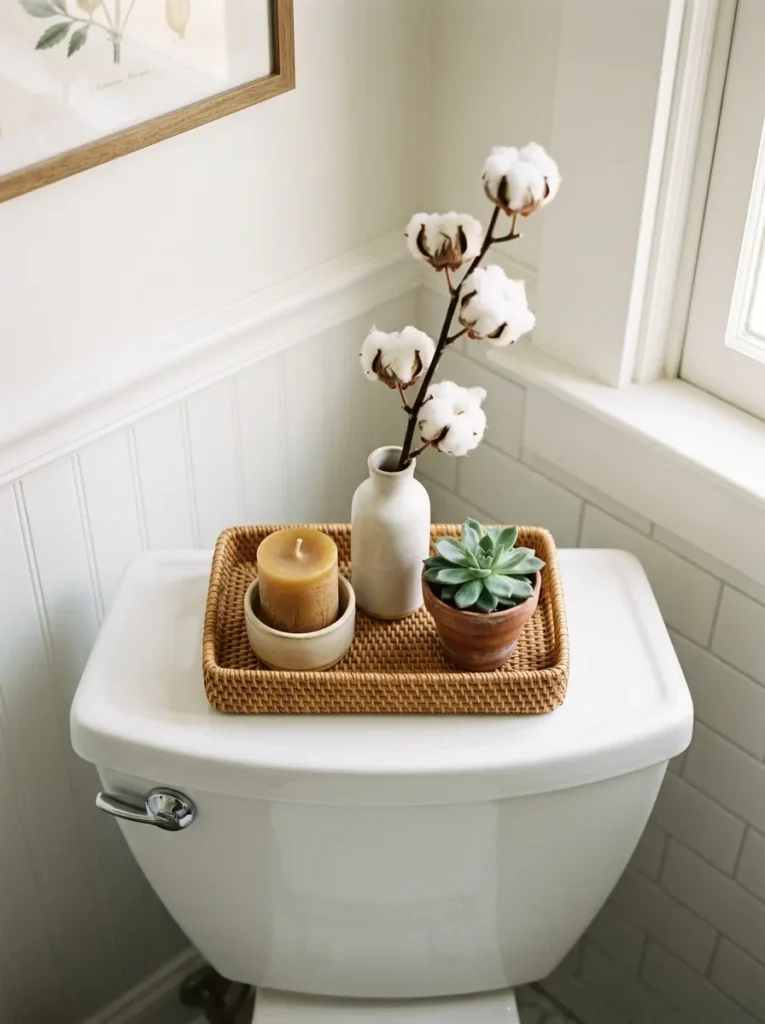
The top of a toilet tank is often treated as a surface for whatever needs a temporary home — a spare roll of toilet paper, cleaning products, items that didn’t find another place. Styled intentionally with a small tray, it becomes one of the bathroom’s secondary styling moments.
A toilet tank tray should be small (the tank top is typically 6 to 8 inches deep and 12 to 18 inches wide), waterproof, and lightweight so it doesn’t interfere with the tank lid’s removal for maintenance. A small rattan tray, a low ceramic tray, or a slim wood tray with sealed finish suits the scale.
The objects should be specifically suited to the toilet zone’s visibility — items that read as bathroom decor rather than overflow storage. A small candle, a slim bud vase with a dried stem, and a small plant in a ceramic pot are the strongest choices because they’re genuinely decorative and have no utility at that location that would cause them to be moved.
17. A Matching Tray and Canister Set for a Cohesive Counter

A tray paired with matching canisters — a coordinated set where the tray, a cotton ball jar, a cotton swab holder, and a small lidded container are all in the same material and finish — creates the most unified bathroom counter styling possible. The set reads as designed as a single element rather than individual pieces placed together.
The cohesion of a matched set does much of the visual work that individual object selection has to do when pieces are mixed. A marble tray with marble canisters and a marble soap dish reads as a surface treatment rather than a collection of objects. A ceramic set in matte white reads similarly. Both communicate a level of intention that mix-and-match pieces require more styling skill to achieve.
The limitation: matched sets can read as slightly sterile if the objects within the set are too uniform in height. Adding one element that’s outside the set — a plant, a fresh flower, a single object in a contrasting material — introduces the organic variation that prevents the cohesive counter from reading as a showroom display.
18. A Seasonal Bathroom Tray That Rotates with the Year
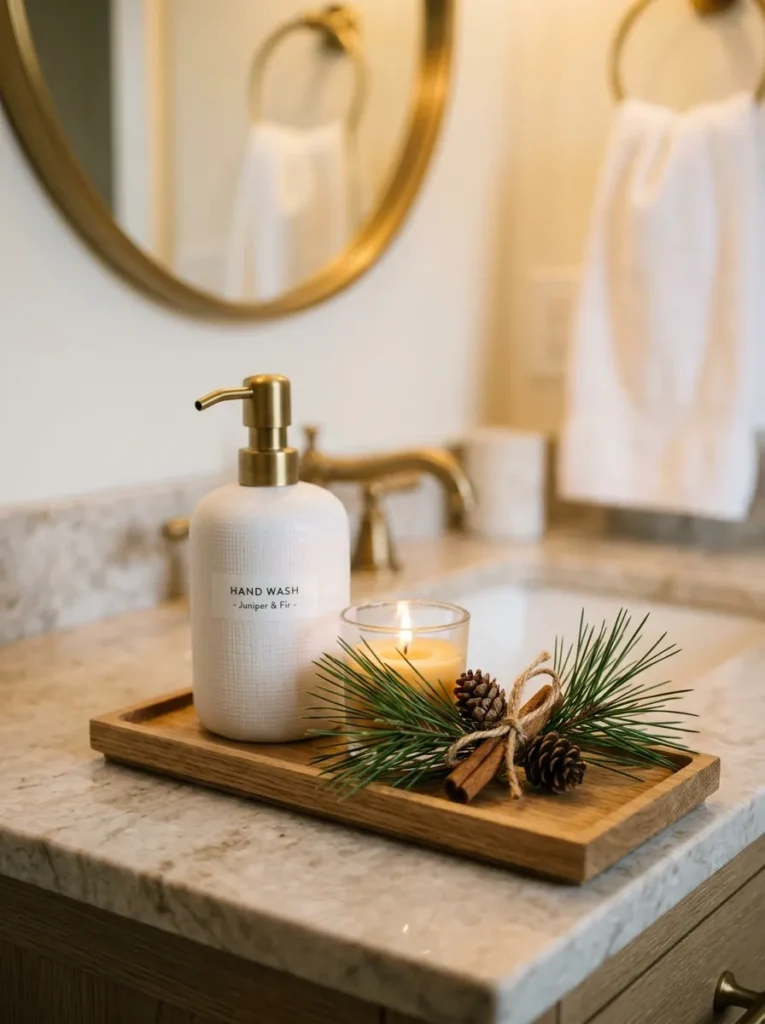
A bathroom tray that changes with the season is one of the lowest-effort ways to keep the bathroom feeling fresh without any permanent modification. The tray and its core objects (a soap dispenser, a candle holder) stay constant; one or two seasonal elements rotate in and out: a small succulent for spring, a seashell and a sun cream miniature for summer, a miniature pumpkin or a few dried autumn leaves for fall, a sprig of evergreen or a cinnamon stick for winter.
The seasonal element should be small enough that it doesn’t upset the tray’s visual balance — it’s a rotation, not a theme change. The tray’s primary objects remain recognizable as the tray’s identity; the seasonal piece is a detail that makes the tray’s observer notice that the bathroom has been attended to.
This approach also manages the psychological maintenance of keeping a styled tray looking fresh: rather than the pressure of maintaining the same arrangement indefinitely, a planned seasonal rotation creates a natural refresh schedule that keeps the styling feeling alive rather than static.
The Four Rules That Make Any Bathroom Tray Look Hotel-Worthy
Regardless of which tray material, which objects, or which bathroom zone, four principles apply to every tray arrangement that reads as genuinely considered.
Rule one: fewer objects than feels comfortable. The instinct when styling a tray is to fill it. The hotel-inspired look requires resisting that instinct. The tray should have empty surface visible — the objects should not touch each other or fill the tray’s full interior. If the tray feels sparse, it’s probably right.
Rule two: height variation between every object. A row of same-height objects on a tray reads as a lineup rather than an arrangement. Every tray needs at least one tall element, one mid-height element, and one low element — and these should be placed so the height variation is visible from the primary viewing angle (which in a bathroom is typically from the doorway or from in front of the mirror).
Rule three: material coherence across all objects. The objects on a tray don’t need to match, but they need to share a material register — all warm, all cool, all natural, all matte, all shiny. One object that’s materially unrelated to everything else reads as something that was placed there and not yet moved rather than a piece chosen for the arrangement.
Rule four: the tray must be genuinely wipeable. A styled bathroom tray that can’t be cleaned quickly and completely will deteriorate over time as product residue, water marks, and dust accumulate around the objects. Choose a tray material that wipes clean in one motion, and choose objects without intricate bases or grooves that trap residue.
Final Thoughts
The bathroom tray earns its place not by making the bathroom look like a photograph but by making the bathroom easier to maintain in a styled state. A tray that contains the daily-use objects, defines the styling zone, and clears in one motion for cleaning is more valuable than a beautiful arrangement that’s in constant conflict with how the bathroom is actually used.
If you’re starting with no tray and an unclear direction, Ideas 1, 6, and 8 — the white ceramic tray with matching dispensers, the minimal three-object arrangement, and the wooden tray with warm grain — are the three most universally applicable starting points. All three work in any bathroom size, any design direction, and any budget range.
For bathrooms with specific styling ambitions — the spa atmosphere of Idea 7, the perfume collection of Idea 5, the bathtub ritual of Ideas 10 and 11 — the specific tray type, material, and object selection matter more than they do in a functional everyday arrangement.
Save the ideas that suit your bathroom’s size and aesthetic, and return to the four rules section before finalizing any arrangement. The rules are the foundation; the ideas are the expression.