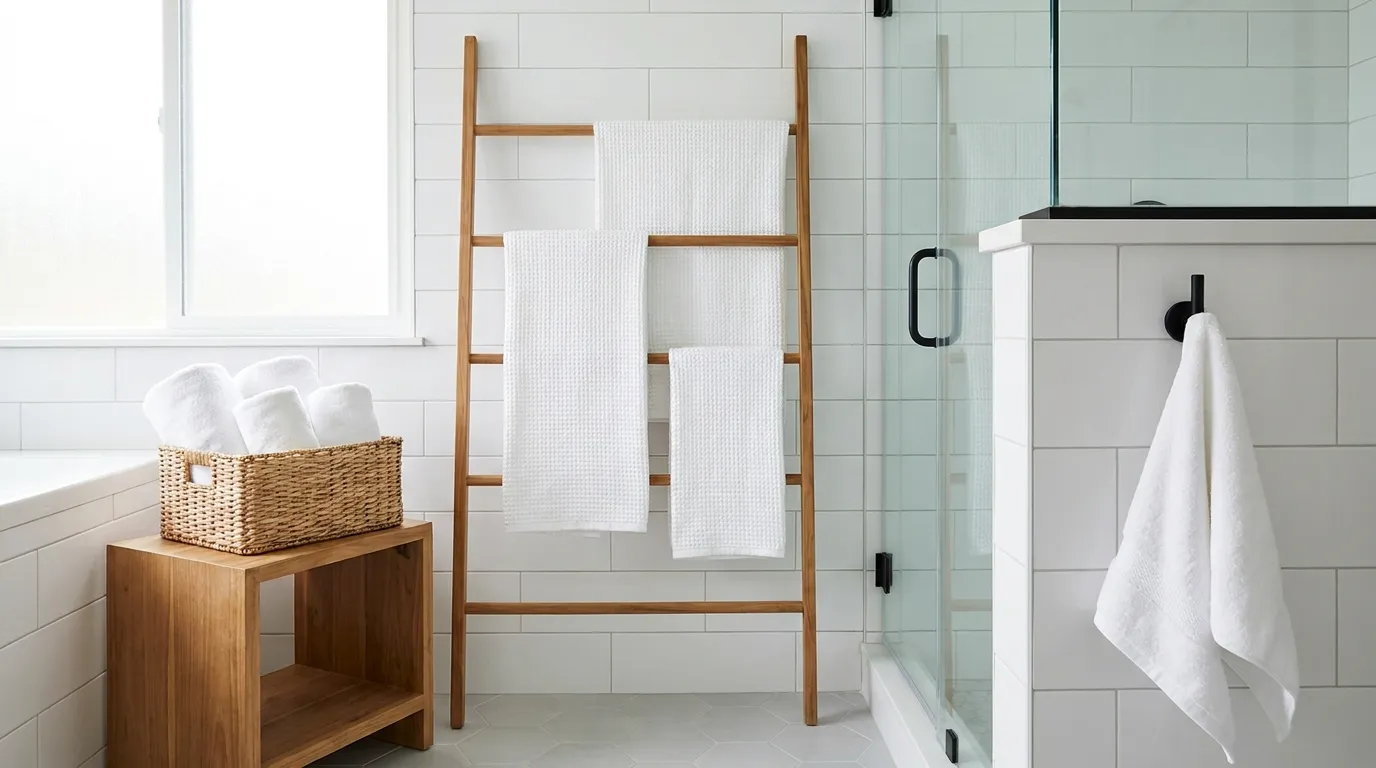
18 Bathroom Towel Storage Ideas That Save Space
Towel storage is one of those bathroom problems that sounds simple until you actually try to solve it. There’s rarely enough wall space, the obvious spots are already taken by other fixtures, and anything that looks good in a product photo tends to look cluttered or undersized once towels are actually hanging on it. Renters have the added constraint of not being able to drill, which rules out the most obvious solutions immediately.
The ideas here cover the full range — from permanent built-in solutions worth planning into a renovation to genuinely renter-friendly options that require nothing more than an afternoon and a tension rod. The emphasis throughout is on solutions that actually work in real bathrooms: ones that hold enough towels for daily use, don’t make the room feel smaller than it is, and look intentional rather than improvised. Whether the bathroom is a compact powder room or a full primary bath, at least a few of these will fit.
1. Mount a Towel Ladder Against One Wall for Generous Capacity
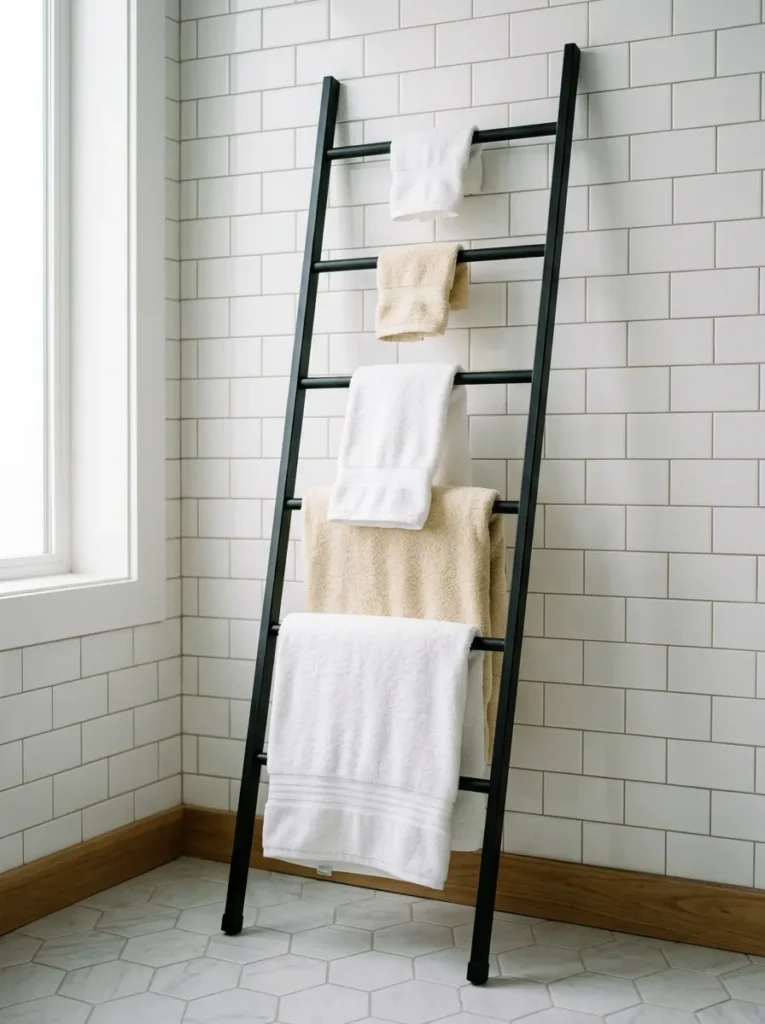
A towel ladder — a freestanding or wall-leaned wooden or metal ladder used as a towel rack — solves the capacity problem that single towel bars can’t. Multiple rungs at different heights hold bath towels, hand towels, and washcloths simultaneously without stacking them on top of each other, which would prevent proper drying.
Wall-leaned ladders require no hardware and no drilling, making them fully renter-friendly. The main practical consideration is stability: a leaned ladder with wet, heavy towels can shift or tip if it’s not touching the wall at the correct angle. The base should sit far enough from the wall (roughly 12–15 inches) that the top rests securely against it. In a bathroom with limited floor space, a slim metal ladder in a compact frame takes up less footprint than a wooden one while offering the same multi-rung capacity. Teak and bamboo options are worth considering in humid bathrooms because they resist moisture damage better than raw untreated wood.
2. Install a Long Double Towel Bar to Double the Hanging Capacity
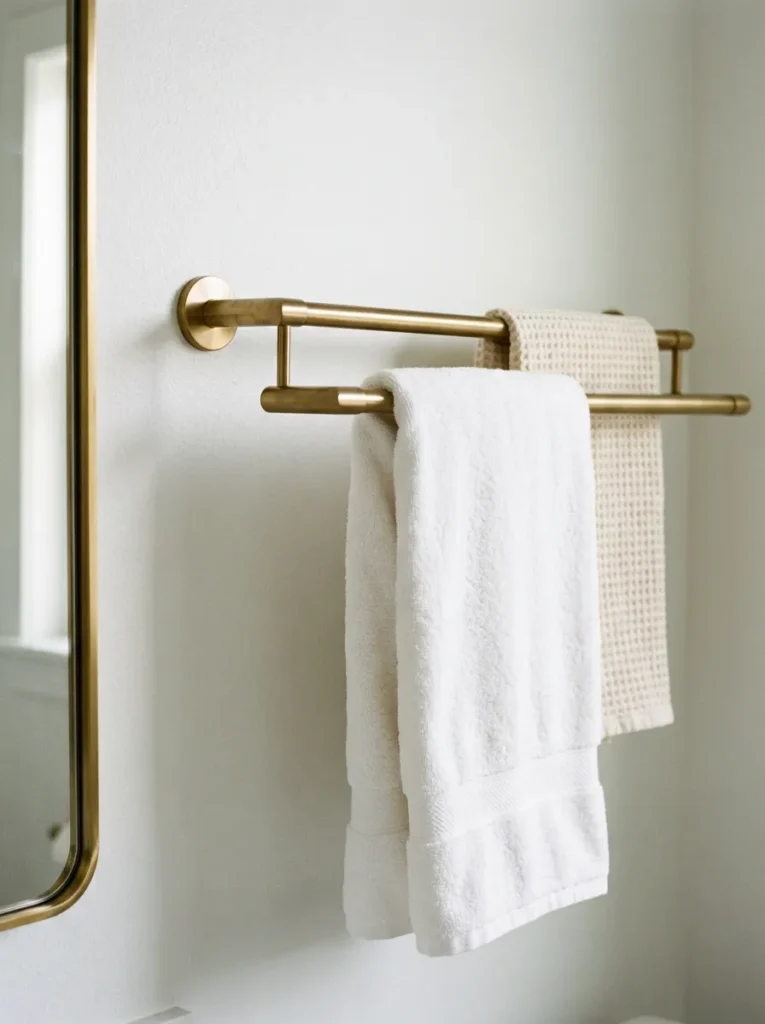
A standard single towel bar handles one or two bath towels — barely enough for two people sharing a bathroom. A double towel bar (two parallel bars on the same bracket set, one mounted approximately 4–6 inches in front of the other) doubles that capacity within the same wall footprint. The front bar is most useful for the towel in active daily use; the rear bar holds the backup or guest towel.
Double towel bars are a sensible upgrade for any primary bathroom where wall space exists but is being underutilized by a single bar. They mount the same way as standard single bars and are available across a wide range of finishes — matte black, brushed nickel, unlacquered brass, chrome — which makes matching existing bathroom hardware straightforward. The installation requires drilling, so this is a homeowner solution rather than a rental one. Worth doing once and doing well, since a properly mounted double bar handles the towel capacity of most two-person bathrooms without any additional wall fixtures.
3. Use Over-the-Door Hooks for Towels Without a Single Drill Hole
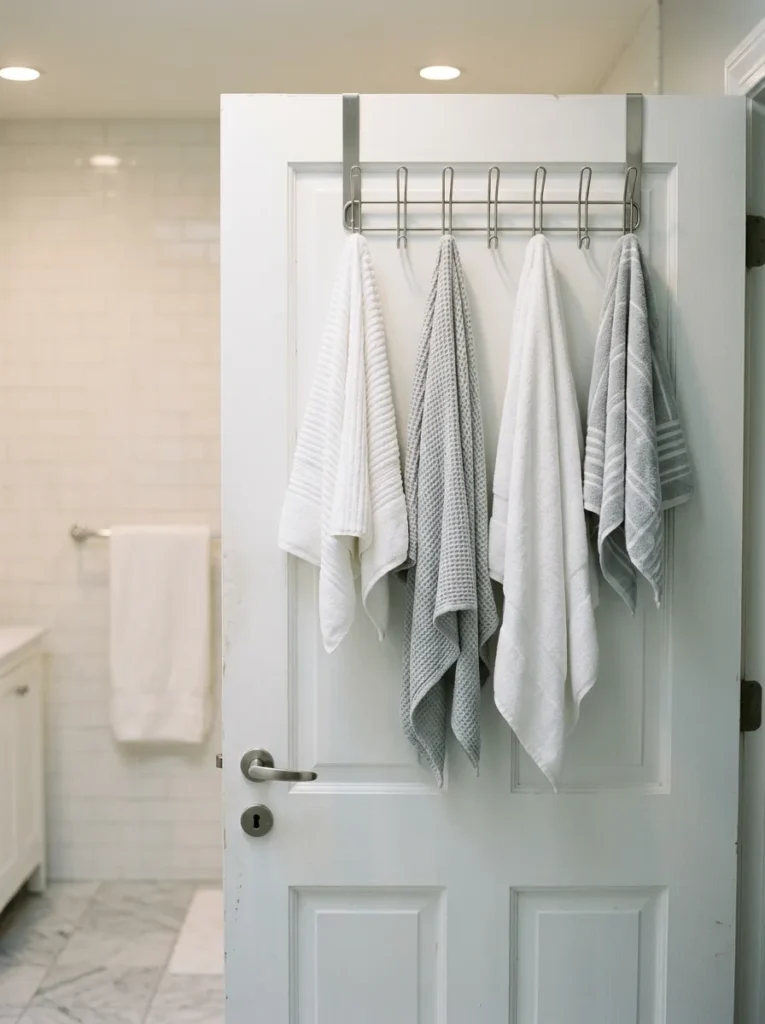
Over-the-door hook systems are the most immediately accessible renter solution for bathroom towel storage. A multi-hook over-door rack hangs on the top edge of the door frame and typically holds four to six towels — more than most wall-mounted bars — using zero wall hardware. The towels hang on the back of the bathroom door, which is typically the largest unused vertical surface in the room.
The functional consideration worth knowing: towels hanging on the back of a frequently used door need adequate clearance so they don’t drag on the floor when the door swings and don’t catch on the toilet or vanity. In very small bathrooms, this clearance may not exist. The hook rack thickness also matters — cheaper versions extend several inches from the door and can prevent the door from closing fully if the bathroom is tight. Low-profile versions designed for interior use solve this.
4. Add a Row of Individual Hooks Instead of a Towel Bar
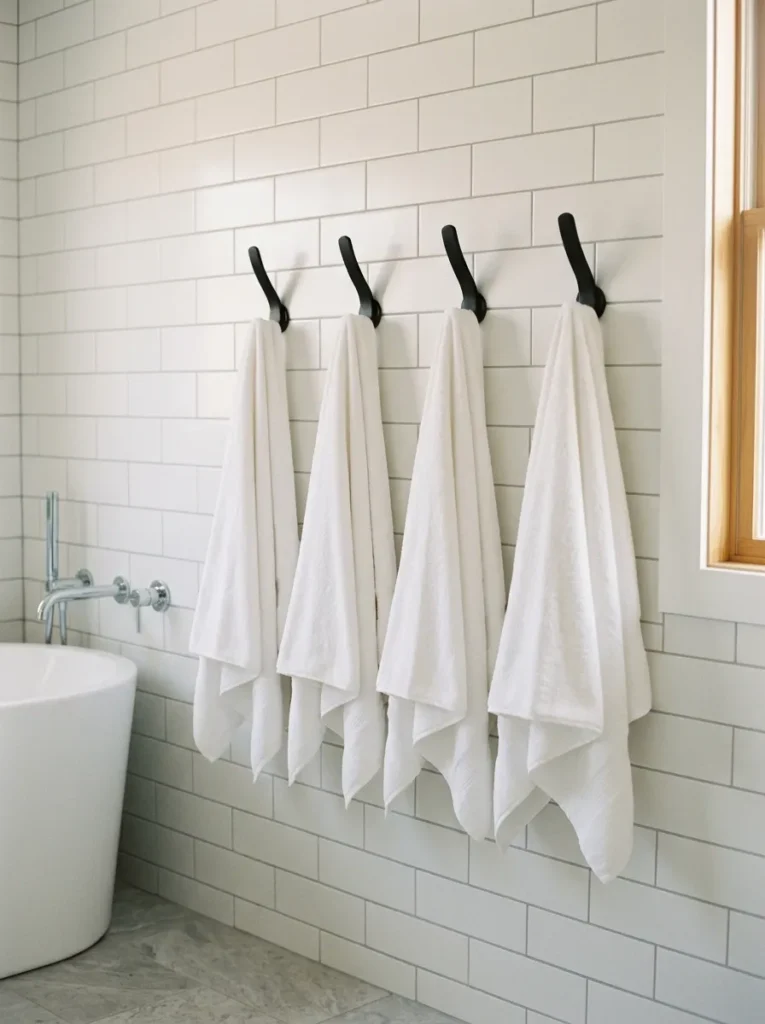
Individual wall hooks for towels — a row of three or four hooks mounted at consistent spacing — offer practical advantages over a standard towel bar that are easy to underestimate. Each towel hangs separately and fully open rather than folded over a bar, which means it dries faster because more surface area is exposed to air. Each hook also holds one clearly owned towel, which reduces the household negotiation over whose towel is whose.
For styling purposes, hooks also allow for more deliberate folding choices: a towel folded in thirds and hung on a hook looks more intentional than a towel draped carelessly over a bar. A row of matte black hooks on a white tile wall, evenly spaced at roughly 6–8 inches apart, is one of the cleanest and most functional bathroom wall solutions available. This requires drilling, but the hardware investment is minimal and the installation is simple.
5. Mount a Heated Towel Rail for Storage and Dry Towels Simultaneously
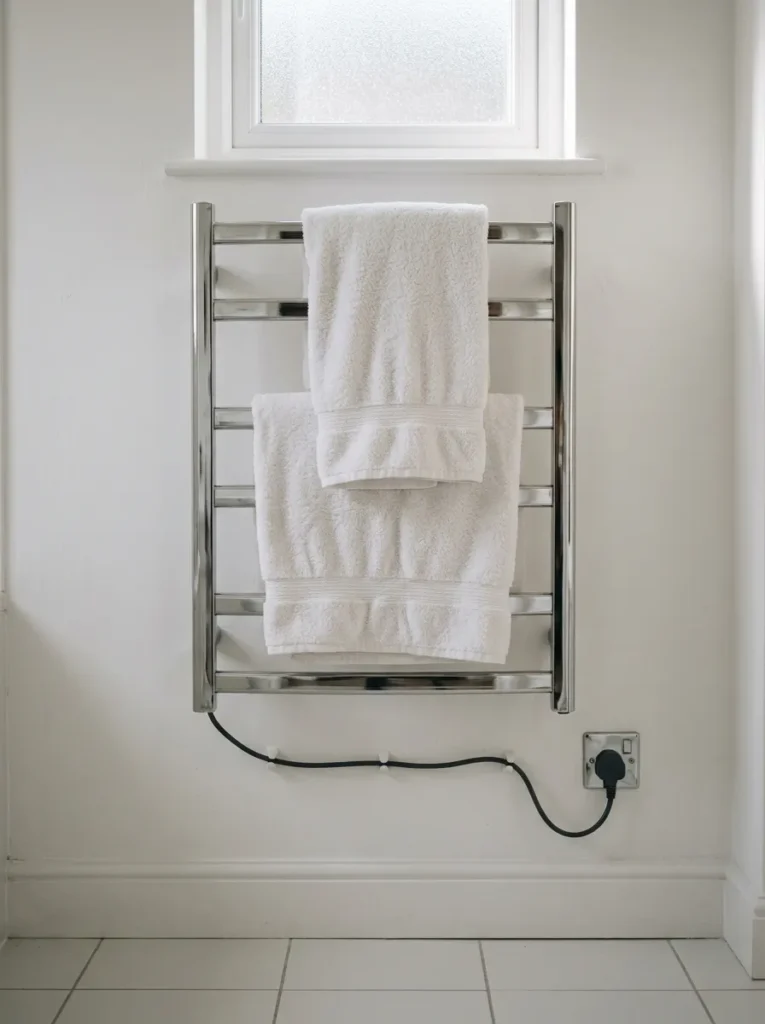
A heated towel rail is the towel storage solution that also solves the damp-towel problem. In bathrooms where towels don’t dry fully between uses — common in rooms without strong ventilation or natural light — a hardwired or plug-in electric towel rail keeps towels warm and dry and eliminates the slightly musty smell that accumulates in poorly ventilated bathrooms.
Hardwired versions require an electrician and are a permanent fixture decision. Plug-in versions are significantly more flexible — they mount to the wall like a standard towel rail but draw power from an outlet rather than a dedicated circuit. The towel capacity is typically equivalent to a standard double bar, so a heated rail is most useful as a primary towel drying solution rather than a high-volume storage system. It suits primary bathrooms or compact en suites where one or two daily-use towels are the main storage need.
6. Use a Freestanding Towel Stand for Zero-Commitment Storage
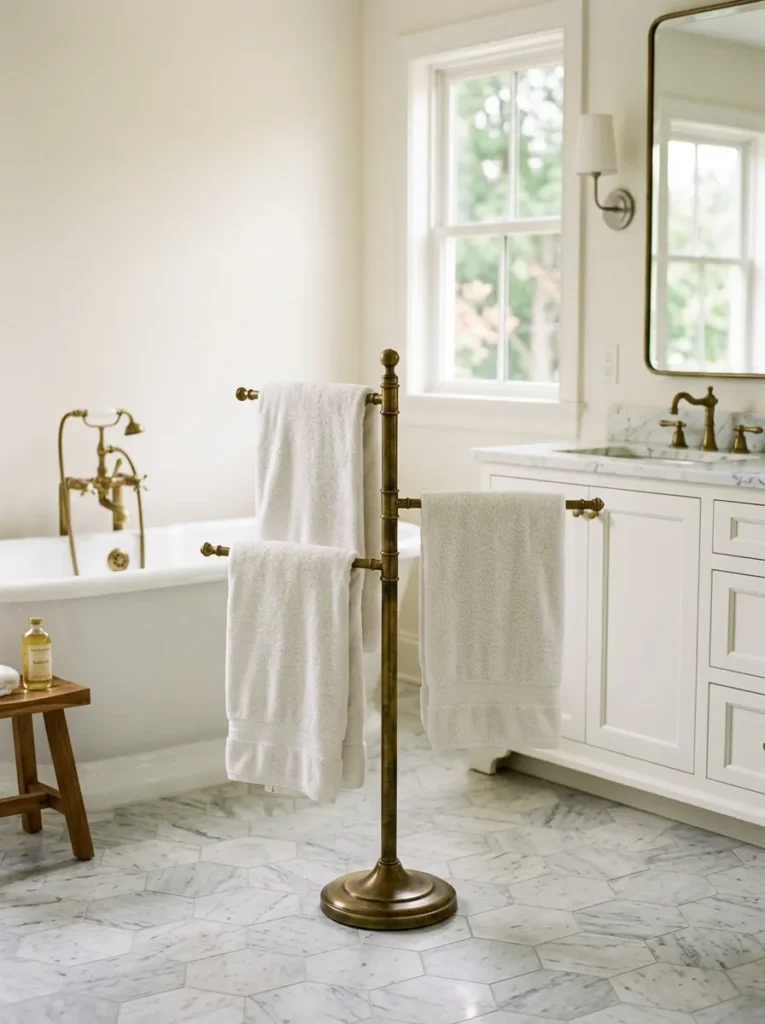
A freestanding towel stand — a floor-standing rack on feet, available in round tiered designs, T-bar configurations, or multi-arm spreaders — stores towels without any wall attachment and can be moved or repositioned as needed. This is useful both for renters and for homeowners who haven’t committed to a permanent layout yet, or who want towel storage in a specific floor location that doesn’t have adjacent wall space.
The practical limitation is footprint. Freestanding stands that hold a meaningful number of towels (three or more bath towels) typically occupy more floor space than a wall-mounted equivalent. In small bathrooms, the floor space cost may not be worth it. In larger bathrooms or primary suites with open floor area beside the tub or between the vanity and the shower, a freestanding stand suits the space well and adds a visual element that reads more like furniture than a utilitarian fixture.
7. Install Open Shelving for Folded Towels as Display Storage
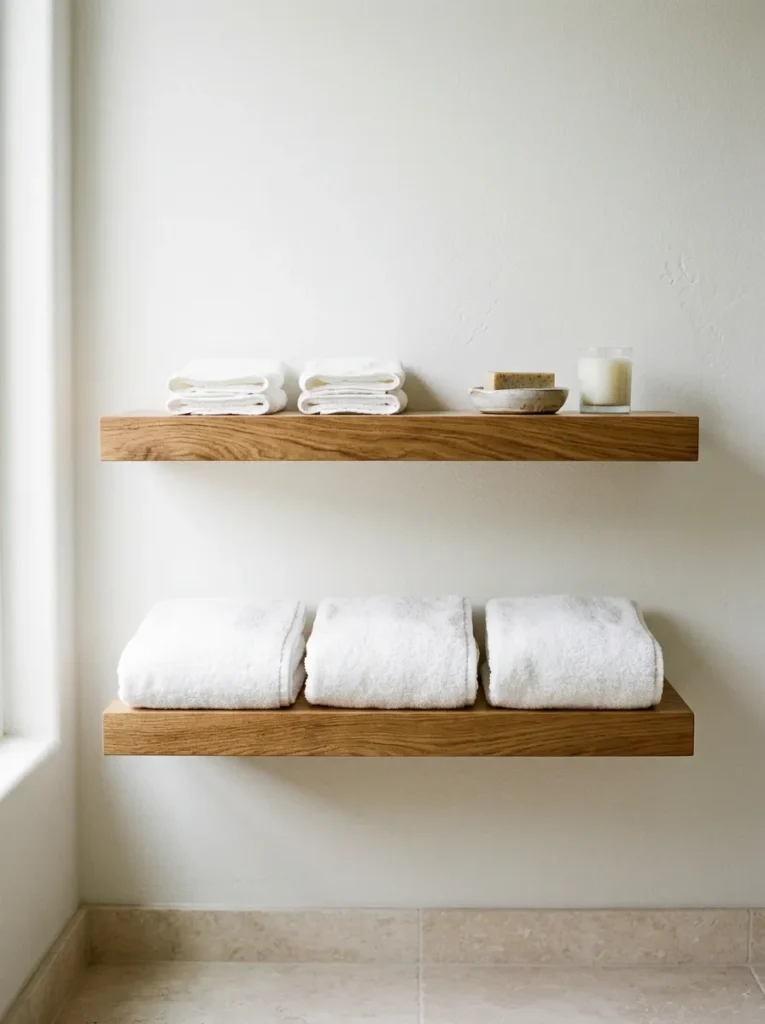
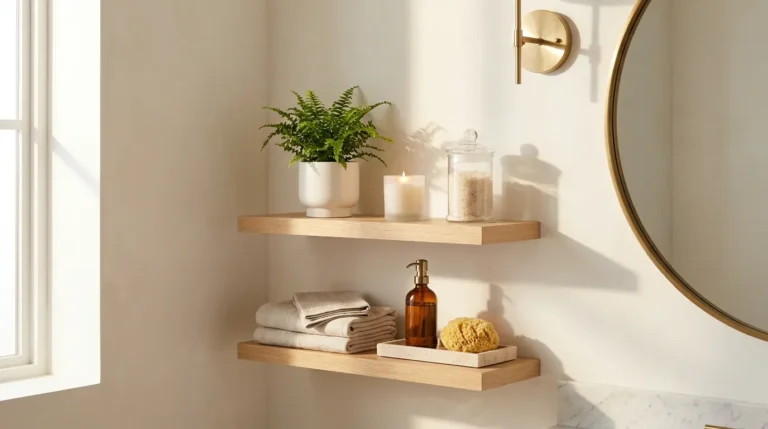
Open shelves in a bathroom are a legitimate towel storage option when the towels are folded neatly enough to display. The shelf approach is most effective in bathrooms with adequate ventilation — towels folded and stored on open shelves in a poorly ventilated bathroom can stay damp, which is both a hygiene issue and a source of musty odor over time.
When the ventilation is adequate, a shelf of neatly folded towels in a coordinated color palette reads as one of the most composed storage moments a bathroom can have. The practical setup: shelf depth of at least 12 inches to accommodate a full-size bath towel folded in thirds, shelf spacing of at least 10–12 inches between levels, and a limit of two to three folded towels per shelf level before the arrangement starts to look overstuffed. Rolling towels and standing them upright in a basket or bin on the shelf is an alternative folding method that displays well and makes individual towels accessible without disturbing the rest.
8. Hang a Towel Ring for Single-Towel Convenience Near the Sink
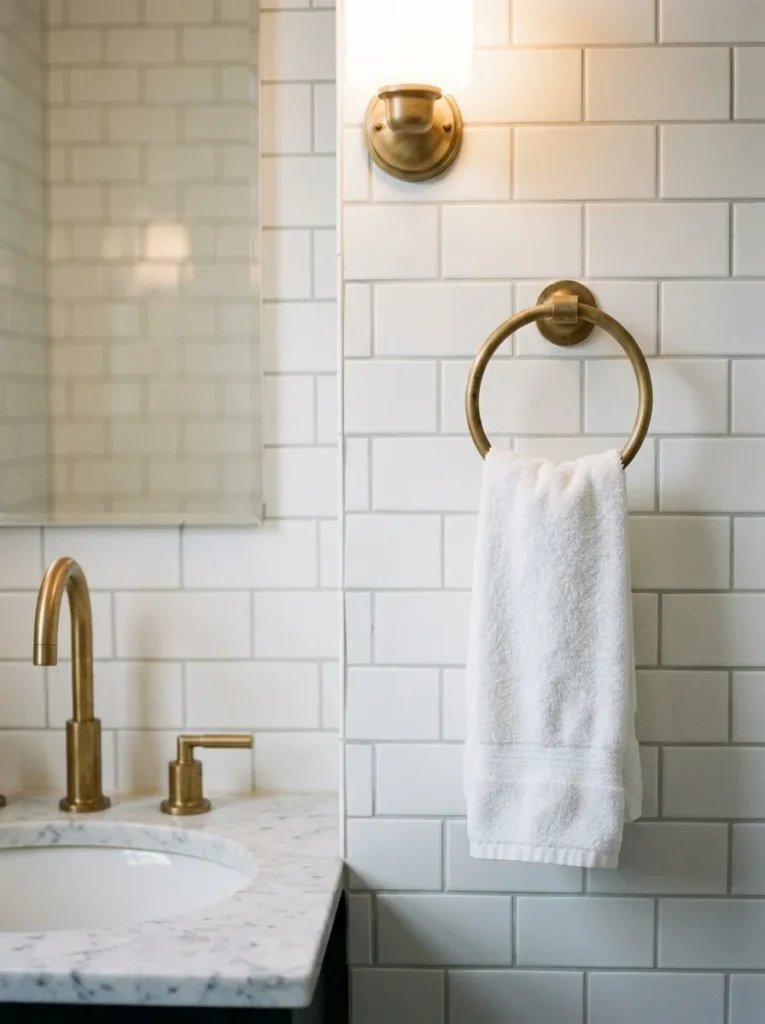
A towel ring is the most space-efficient wall-mounted option for a hand towel near the sink — it projects less from the wall than a bar, installs in a smaller wall footprint, and keeps a hand towel accessible without requiring the extra width a bar demands. In a powder room or compact guest bathroom where hand towels are the primary need, a ring is often a better choice than a bar.
The functional detail worth knowing: a towel ring holds one folded hand towel most effectively. Draping a bath towel over a ring results in uneven hanging and incomplete drying. For bathrooms where bath towels and hand towels are both needed at the sink, a ring for the hand towel combined with a separate hook or bar for the bath towel is the most practical combination. Finish matters in a small bathroom where the ring is prominently visible — brushed brass and matte black are currently the most versatile options across contemporary and transitional styles.
9. Use a Rolling Cart for Movable Towel and Product Storage
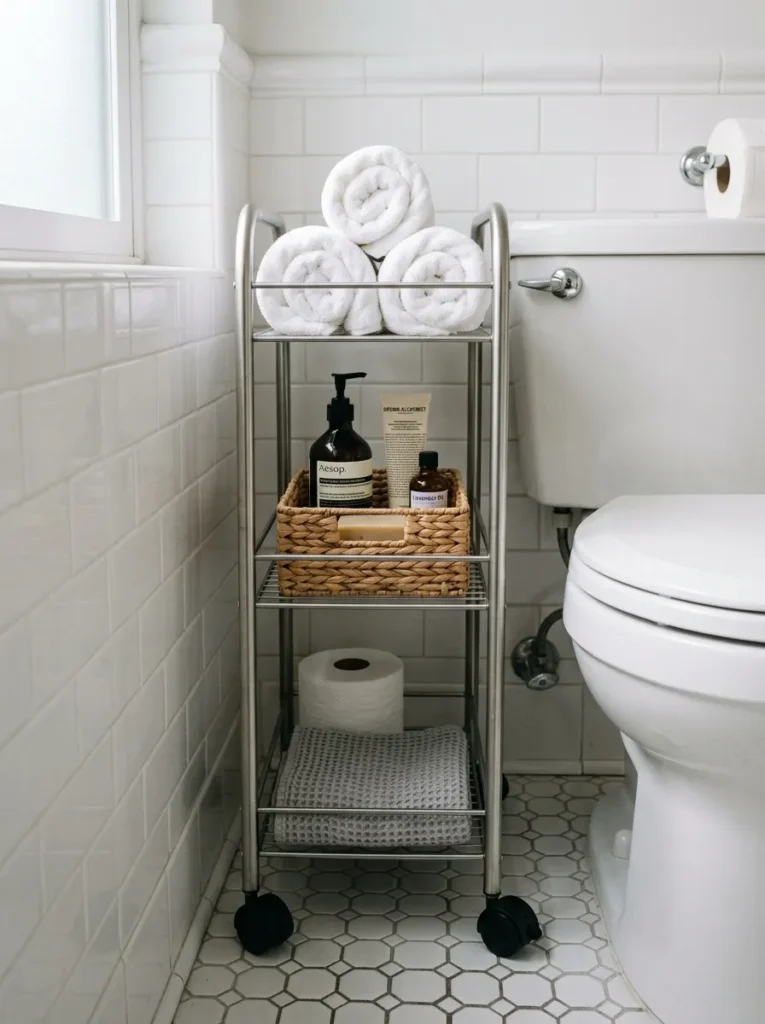
A slim rolling cart — the kind typically associated with kitchen use — is a genuinely useful bathroom towel storage tool when floor space is limited but not zero. The cart stores folded towels on one or two shelves, rolls out when needed, and can be pushed against a wall or into a corner when not in use. In a bathroom where the vanity cabinet can’t be modified and the walls are fully committed to existing fixtures, a rolling cart offers storage capacity without any permanent commitment.
Stainless steel or powder-coated metal carts are the most moisture-resistant choice for a bathroom environment; particle board or untreated wood carts will deteriorate with humidity over time. A cart with solid shelves rather than wire shelving suits folded towels better, since folded fabric can bunch through wire grids. Position it beside the toilet, between the vanity and wall, or at the foot of the tub — wherever a 12–15 inch wide gap exists.
10. Try a Tension Rod Between Two Walls for a No-Drill Storage Spot
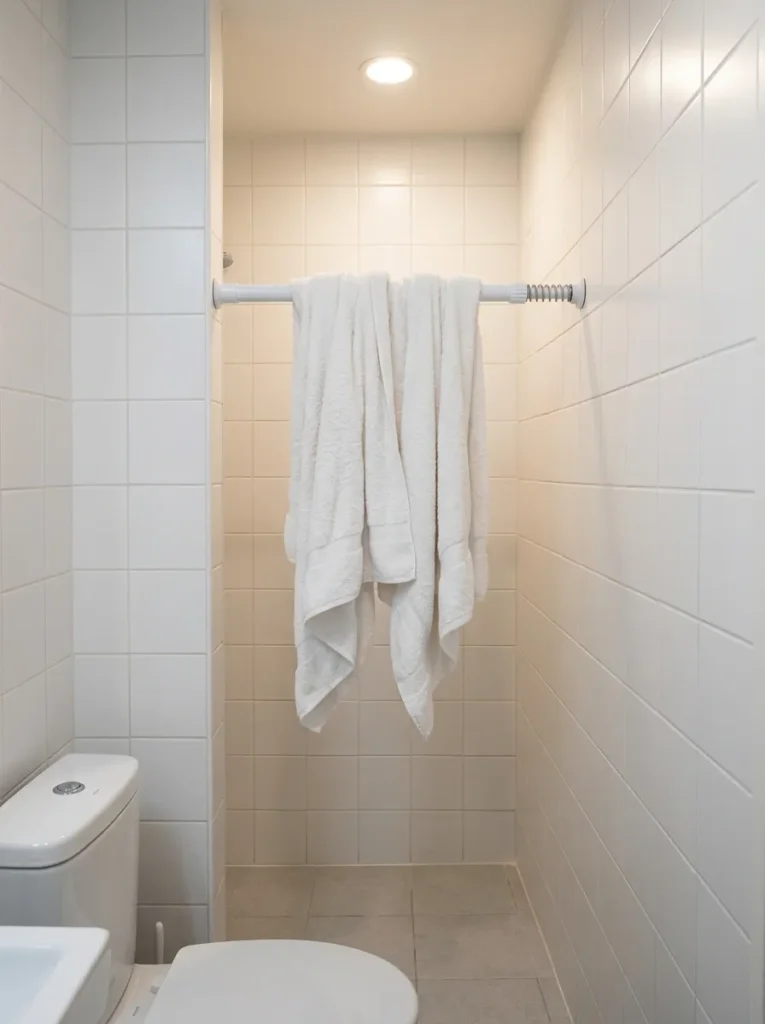
A tension rod fitted between two parallel walls — in a recessed alcove, inside a closet, or between the toilet and the adjacent wall — creates a towel hanging point with no drilling and no permanent hardware. This is one of the most genuinely useful tricks for small or awkward bathrooms where standard wall space is occupied and drilling isn’t an option.
The limitation is structural: tension rods work only where two parallel surfaces exist at the right distance apart and where the surfaces are solid enough to hold the rod under the weight of wet towels. They fail on surfaces that flex, on distances too wide for the rod’s tension spring, and under very heavy loads. A single tension rod holds one to two bath towels comfortably; two rods positioned at different heights double the capacity. In a recessed shower niche or alcove beside the toilet, this solution can be nearly invisible and surprisingly effective.
11. Build a Recessed Towel Niche Into the Shower or Bath Surround
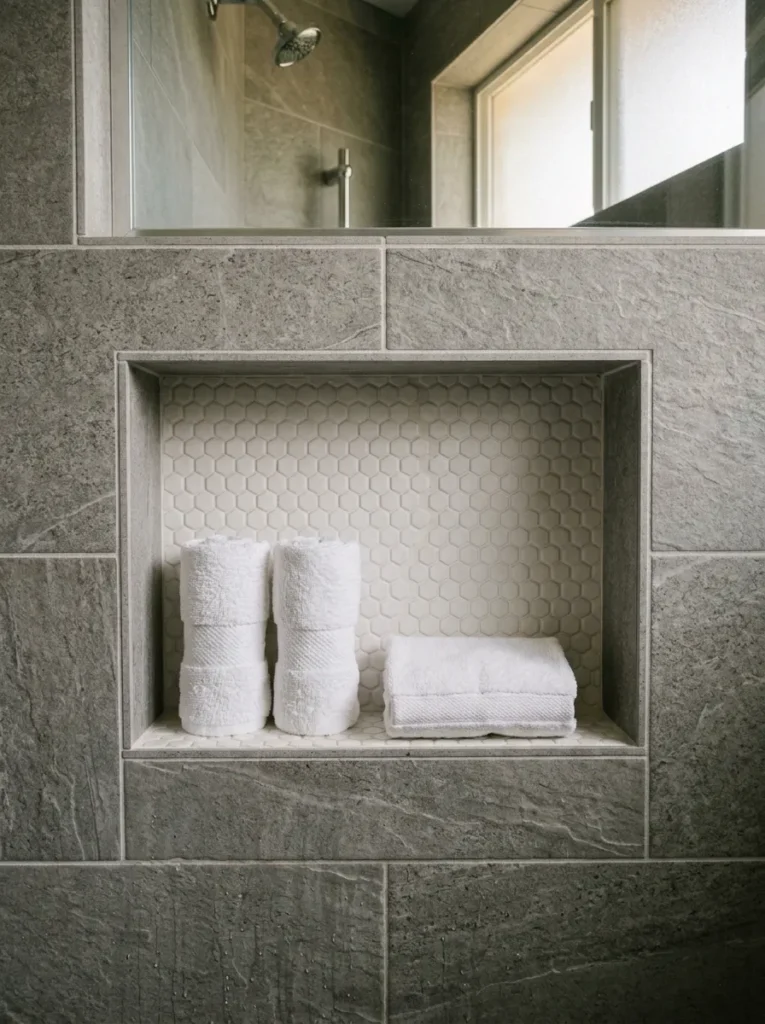
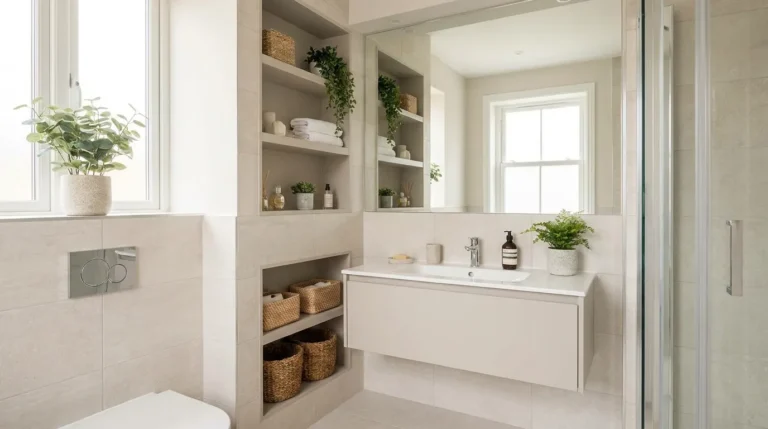
A recessed niche built into the shower wall — typically between two studs, creating a shallow inset shelf — is the most space-efficient permanent storage solution in a bathroom because it occupies zero floor space and zero projecting wall space. Towels and washcloths stored in a shower niche are available exactly where they’re needed and don’t require a trip across the bathroom after bathing.
This is a renovation-level decision that needs to happen during tile installation or a wall rebuild, not as a retrofit. The niche depth is limited by the stud spacing (typically 3.5 inches between studs in standard framing), which fits washcloths, small folded hand towels, and rolled towels but not full-size bath towels stored flat. Tile the interior of the niche in a contrasting tile for visual definition — a mosaic, a different tile orientation, or a colored grout — and it becomes a design moment rather than purely a functional addition.
12. Add a Built-In Linen Cabinet If the Bathroom Layout Allows
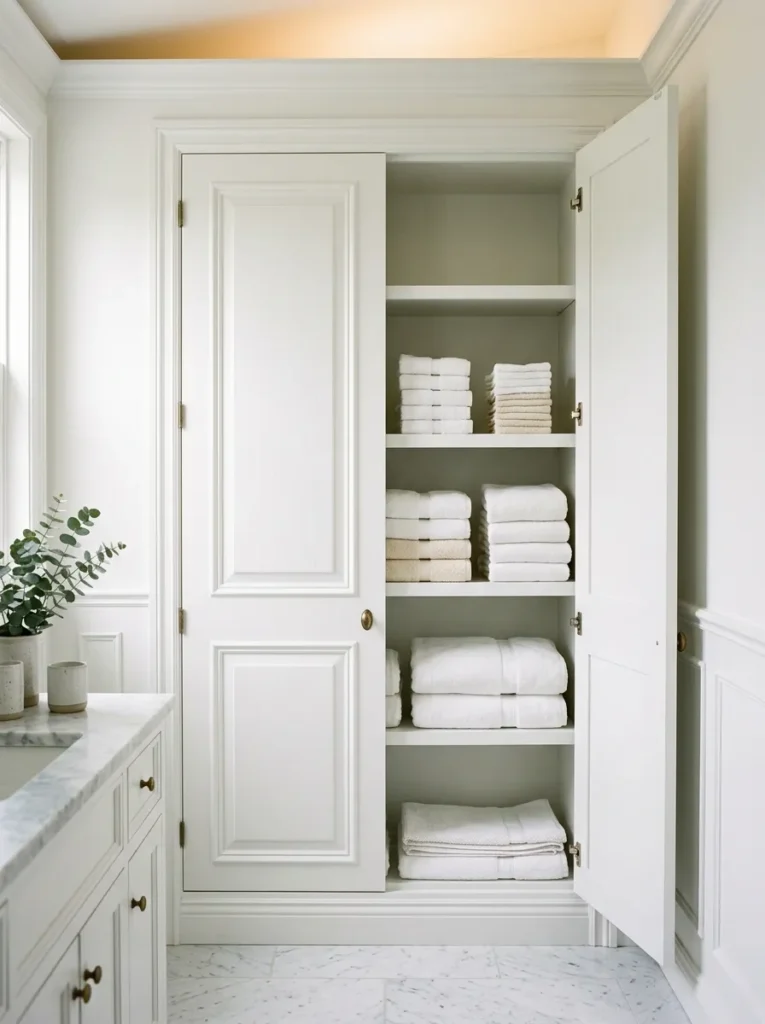
A built-in linen cabinet — whether a floor-to-ceiling closet integrated into the bathroom walls or a recessed cabinet between studs — provides the highest towel storage capacity of any bathroom solution and keeps everything concealed behind doors. In primary bathrooms with enough square footage, this is the most resolved long-term answer to towel storage because it handles bath towels, hand towels, washcloths, and backup supplies in a single organized unit.
The width constraint is the limiting factor in most bathrooms: a built-in linen cabinet needs at least 12–15 inches of wall depth and 18–24 inches of width to be genuinely useful for towel storage. In bathrooms that lack this, a surface-mounted cabinet with doors provides enclosed storage without the construction requirement of a recessed build, though it projects into the room rather than sitting flush. Semi-recessed versions that sit partially into the wall split the difference where wall thickness allows.
13. Use a Vintage Dresser or Cabinet as a Freestanding Linen Storage Piece
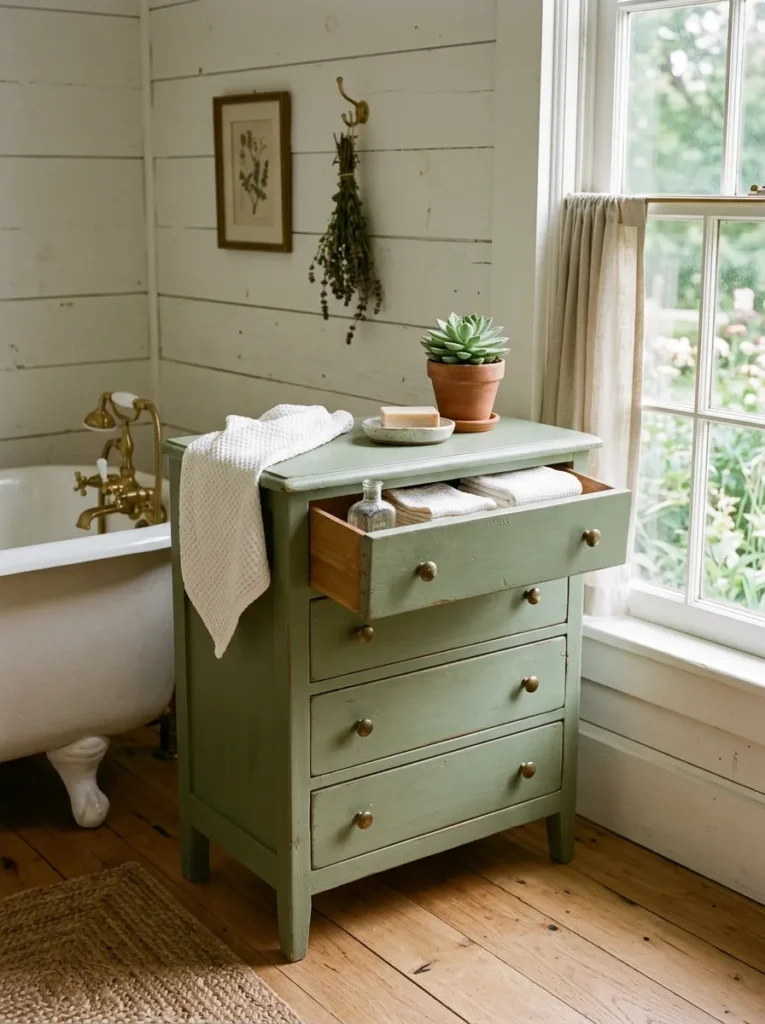
A small dresser or cabinet placed in a bathroom with adequate floor space provides towel storage that looks like furniture rather than bathroom hardware. This approach is most common in larger primary bathrooms and farmhouse-style spaces where the design intent is to make the bathroom feel more like a room than a utilitarian fixture installation. Drawers hold folded towels neatly and concealed; a cabinet with doors achieves the same with a simpler interior.
The material consideration is real: standard wood furniture placed in a high-humidity bathroom will swell, warp, and deteriorate unless the bathroom has excellent ventilation. Solid hardwood fares better than MDF or particleboard. A piece with a painted or sealed finish is more resistant than raw or lightly oiled wood. Alternatively, pieces specifically designed for bathroom use in moisture-resistant materials are available in furniture-style designs that achieve the same aesthetic without the humidity vulnerability.
14. Install a Towel Bar on the Side of the Vanity Cabinet
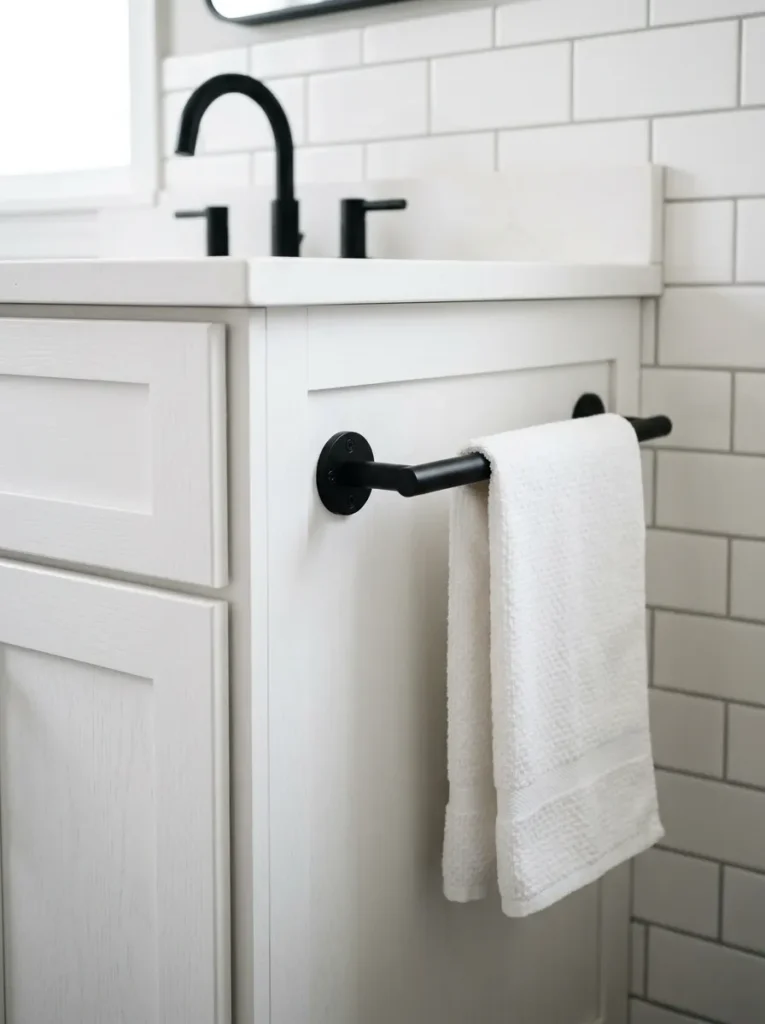
The side panel of a vanity cabinet — the narrow vertical face between the cabinet door and the wall — is consistently overlooked as a towel bar mounting location. In bathrooms where the wall beside the sink is occupied by a mirror, outlet, or other fixture, the vanity side panel offers a clean, accessible surface for a short towel bar or a pair of hooks without touching the wall at all.
The installation requires screwing into the cabinet carcass rather than the wall, which is reversible in most cases (the screw holes can be filled and repainted when moving). This position also puts the towel exactly where it’s needed — immediately beside the sink for hand drying — which is the practical justification beyond just saving wall space. A 12–18 inch bar on a vanity side panel holds one hand towel and one washcloth without crowding.
15. Roll Towels Into a Basket or Tray for Accessible Display Storage
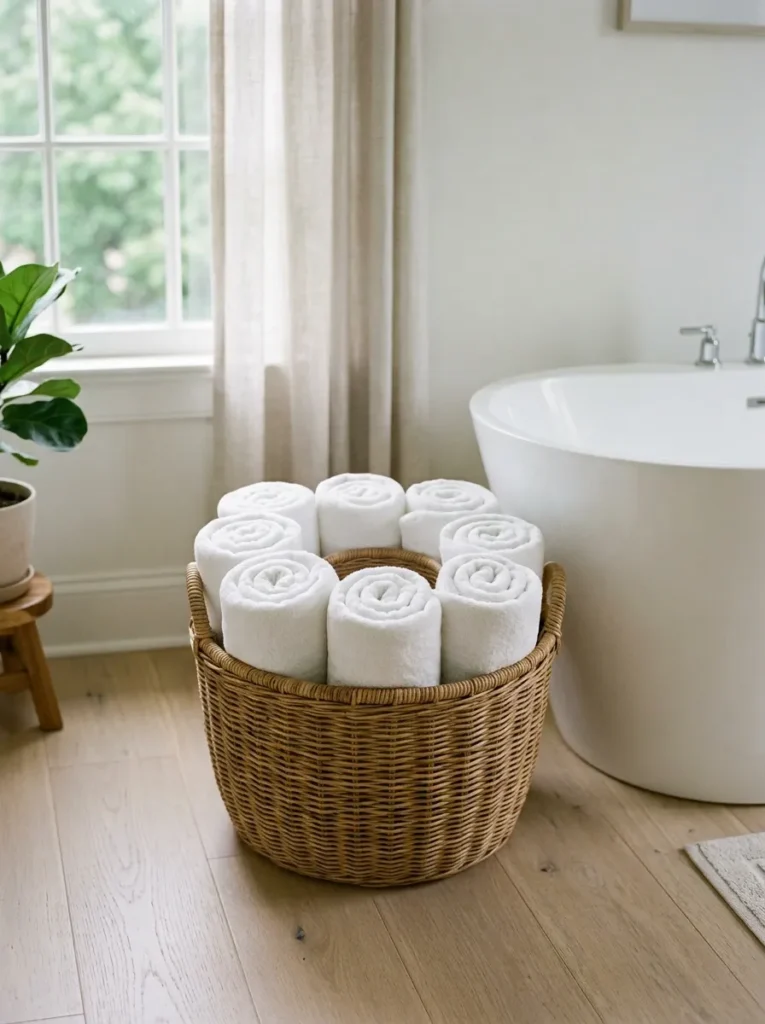
Rolling bath towels and standing them upright in a basket, crate, or deep tray is one of the easiest ways to store multiple towels in a visible, accessible arrangement without any wall hardware. A basket on the bathroom floor, a shallow tray on the vanity counter, or a decorative crate on a shelf all work as containers — the rolling method makes each towel individually accessible without disturbing the others, and the upright arrangement shows the towel ends in a clean visual line.
The styling consideration: towels in a coordinated color palette (all white, or matching neutrals) roll and display more cleanly than mixed colors. A wicker basket, a concrete planter repurposed as a towel holder, or a simple wooden crate each bring different material character to the bathroom. This works best for guest or display towels rather than the primary bath towels in heavy daily rotation — a basket on the floor is practical but less hygienic than a hanging solution for towels that need to dry fully between uses.
16. Use a Magnetic or Suction-Cup Towel Bar for Damage-Free Walls
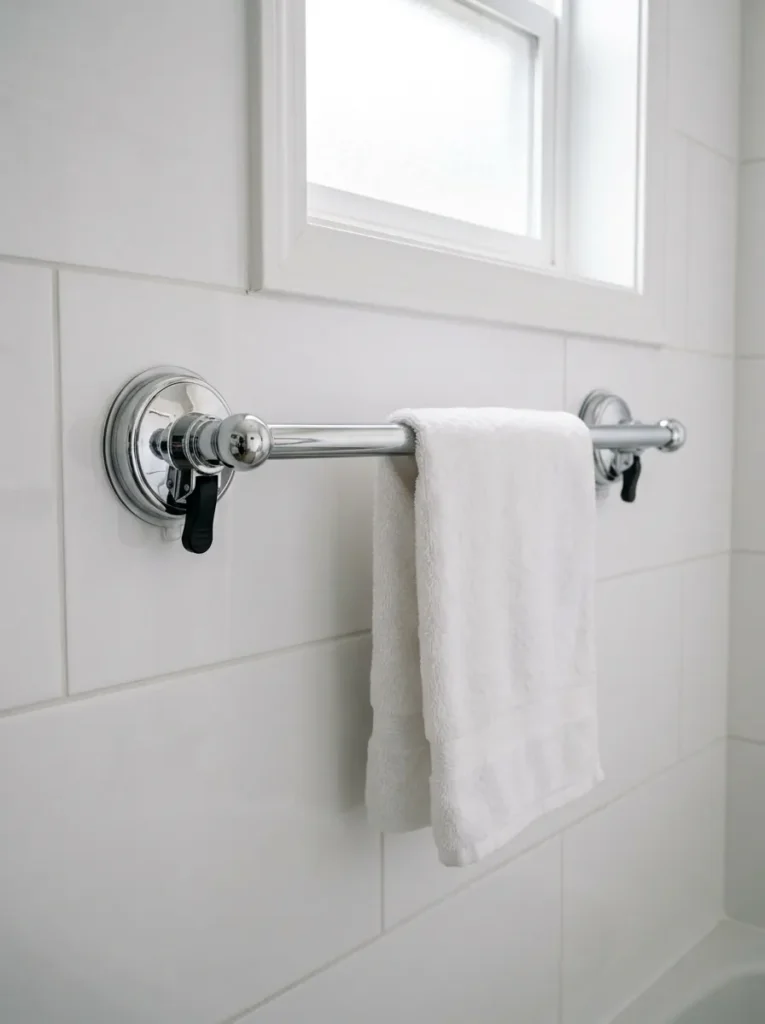
For renters or anyone unwilling to drill into tile, suction-cup towel bars and holders provide a wall-mounting experience without permanent hardware. Modern suction-cup bathroom fixtures have improved substantially in holding strength over cheap versions — models with locking lever mechanisms hold several pounds of load reliably on smooth, non-porous tile or glass surfaces.
The limitations are important to understand before committing: suction cups fail on textured tile, painted drywall, or any surface that isn’t perfectly smooth and non-porous. They also require periodic re-suction as the seal gradually loosens, and they’re not suitable for heavy daily loads of multiple wet bath towels. Command strips are the complementary option for surfaces where suction cups don’t adhere — they hold on painted drywall and some tile surfaces and can be removed without damage if used correctly within their rated weight limits. Neither solution is as permanent or reliable as drilled hardware, but both are genuinely useful in the right application.
17. Style Towels as a Color or Texture Moment in the Bathroom
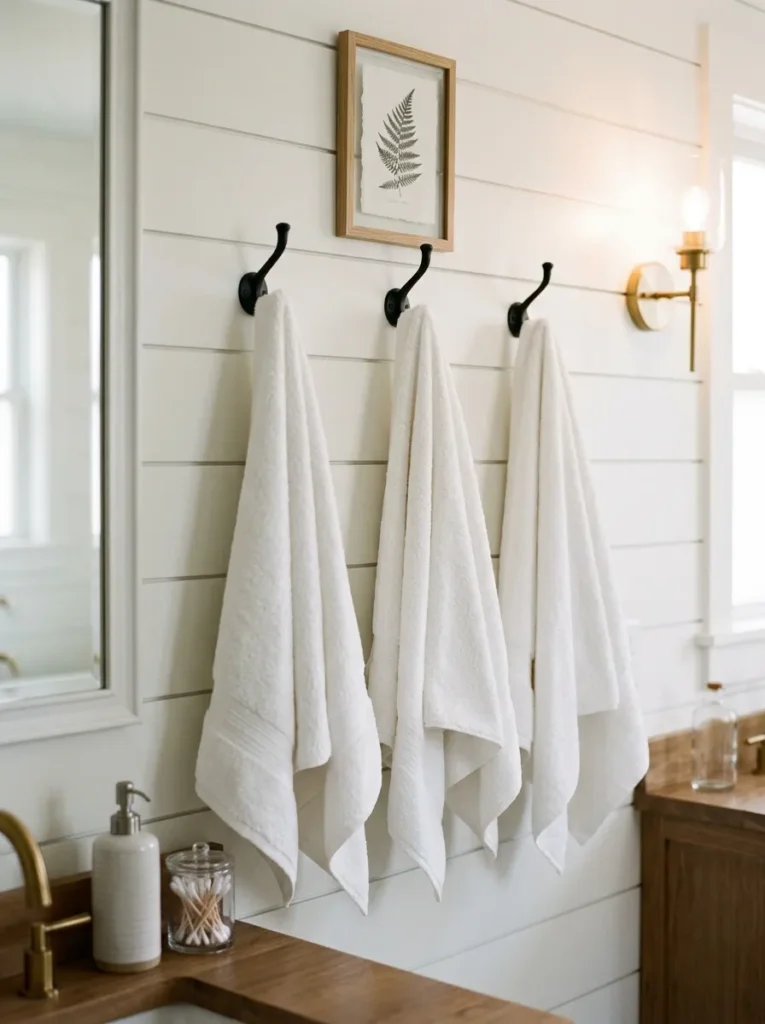
Towels that are stored visibly — on hooks, ladders, open shelves, or ladders — are part of the bathroom’s visual composition whether they’re treated that way or not. A bathroom with mismatched towels in random colors reads as disorganized even when technically tidy. Switching to a coordinated towel palette — all white, all one neutral, or all one accent color — makes any storage solution read as more intentional.
White towels are the most flexible choice because they coordinate with any bathroom palette, launder with bleach for brightness, and are available at every price point. A set of slightly heavier-weight white towels with a waffle or dobby border texture adds visual interest at the fold without introducing color. For bathrooms with a defined color palette, matching the towel color to one wall accent or the tile grout tone creates a composed, edited look. The key practical point: this requires replacing towels as a set and replacing them together when worn, which is a household habit worth building.
18. Create a Spa-Style Towel Display With Folding and Stacking Techniques
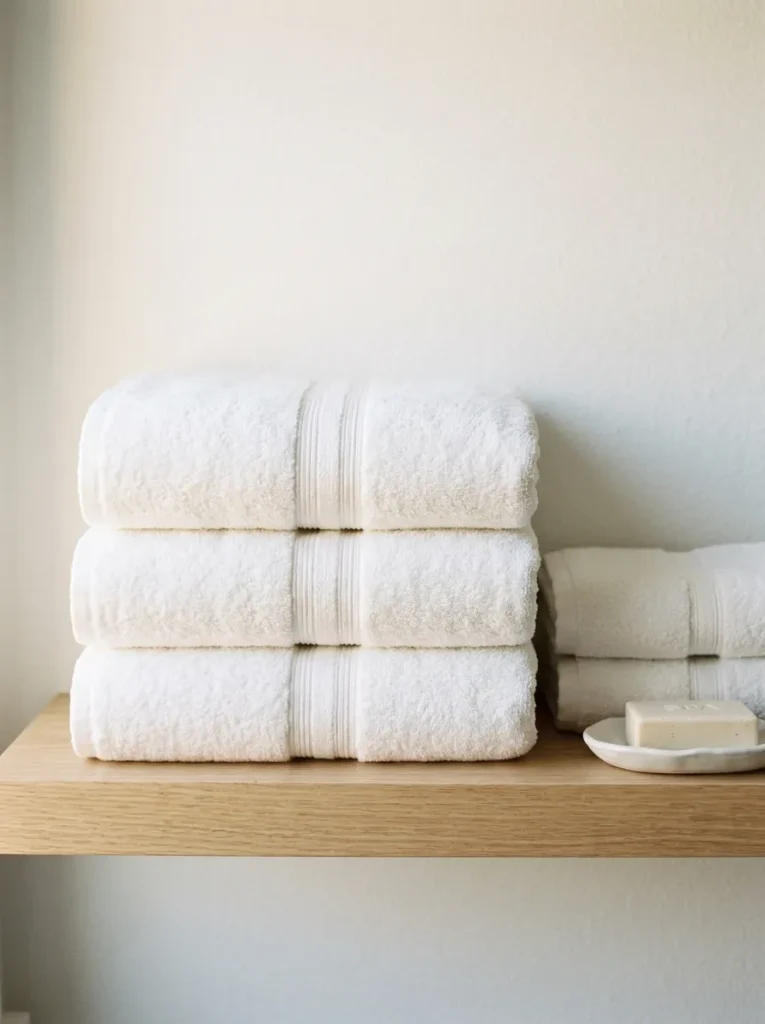
Hotel and spa towel presentations — tightly rolled towels stacked in a tiered arrangement, tri-folded towels with a crisp edge forward, or folded towels fanned on a shelf with ends aligned — are achievable at home with the same towels and same shelves, the only difference being the folding technique. The consistent, tight folding is what makes the arrangement look considered.
For a shelf display: fold each bath towel in thirds lengthwise, then in thirds again to create a neat rectangle, and stack with the folded edge facing outward. For a rolled display in a basket: roll tightly from the short end, stand upright with the spiral visible. These folding methods take approximately the same time as any other folding once they become habit, and the visual difference on an open shelf is substantial. This works best as the styling layer on top of a functional storage system rather than as the primary storage solution — a supply of everyday towels stored in a cabinet, with a curated display of fresh towels visible on the shelf.
Choosing the Right Towel Storage for Your Bathroom
Assess the humidity first. A solution that works beautifully in a well-ventilated bathroom can be a hygiene problem in one with poor airflow. Open shelving, basket storage, and folded displays require that towels dry between uses — which means air circulation around the towels. Hooks and bars that allow towels to hang fully open are the more reliable choice in bathrooms with limited ventilation.
Separate active use from reserve storage. The towels in daily use need to hang and dry after use — a hook, bar, or rail. Reserve towels (backups, guest towels, washcloths) can live in a basket, on a shelf, or in a cabinet. Trying to store both types of towels in the same hanging system results in overcrowding that prevents proper drying.
Count your towels honestly. Most towel storage advice assumes a minimal towel inventory. In households with four people, multiple sets of towels, and guest linens, the storage requirement is substantially different from a single-person bathroom. Calculate how many towels need to be accessible (not in a closet) and choose a system with realistic capacity for that number.
Renter priority checklist: Over-door hooks → tension rods → freestanding ladders and stands → rolling carts → suction-cup or Command strip bars. All of these solutions leave the bathroom unchanged when you move.
Final Thoughts
The best bathroom towel storage is the one that holds enough towels, lets them dry properly between uses, and doesn’t make the bathroom feel more crowded than it already is. Those three requirements eliminate a surprising number of the options that look good in product photos but fail in daily use.
Start with the constraint that matters most for your bathroom — drilling vs. no drilling, floor space vs. wall space, concealed vs. displayed — and work from there. Most bathrooms need a combination of solutions: one hanging system for daily-use towels and one storage location for reserves. Getting both right is what separates a bathroom that functions well from one that always feels slightly behind.
Save the ideas that fit your actual bathroom’s architecture, and come back to this guide when you’re ready to put a plan together.