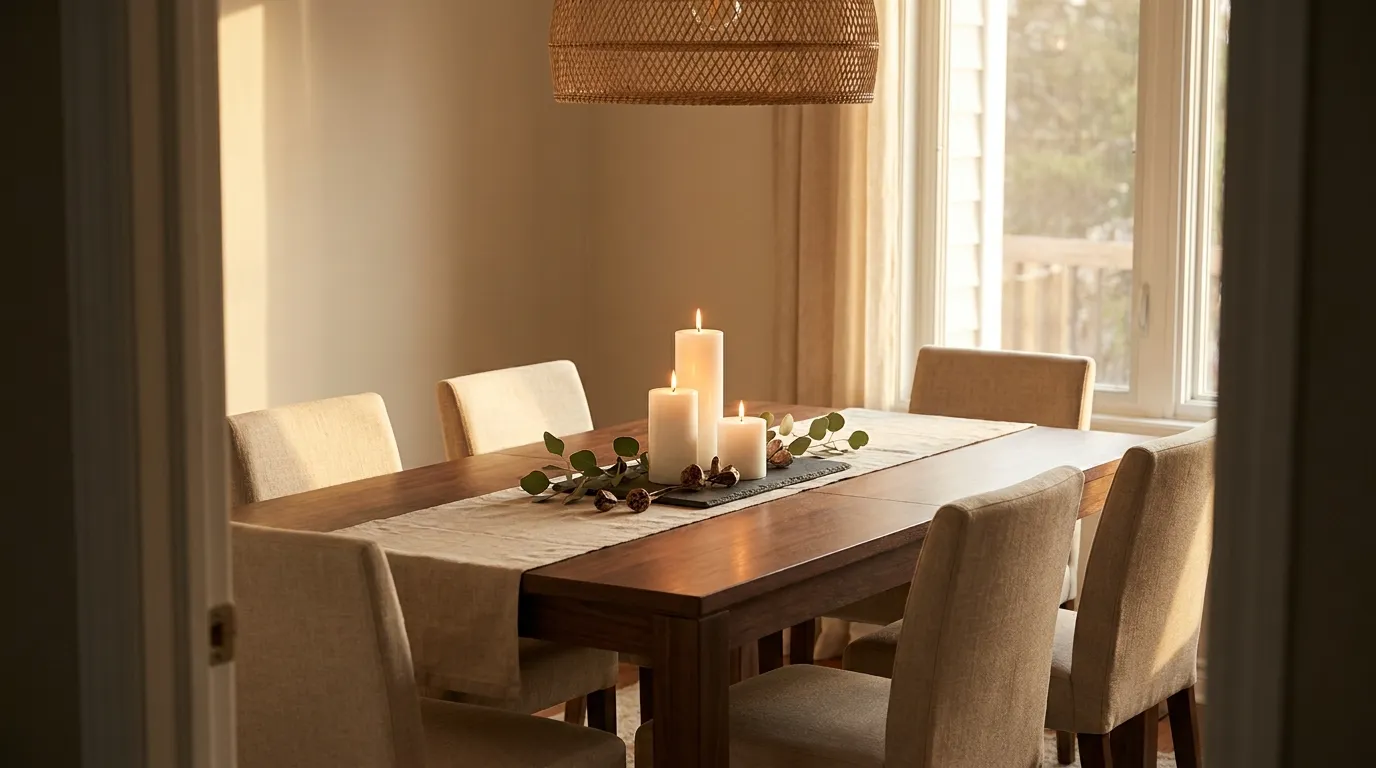
18 Dining Table Centerpiece Ideas That Feel Elegant
A dining table centerpiece is the element that gets the most attention when it’s wrong and the most credit when it’s right. Too tall and it blocks the view across the table. Too wide and it crowds the place settings. Too elaborate and it reads as trying too hard. Too minimal and it disappears entirely.
What separates a centerpiece that feels elegant from one that feels merely decorative is restraint — the deliberate limitation of materials, heights, and competing visual elements. The most considered centerpieces almost always involve fewer choices, not more. A single beautiful vase holds its own more convincingly than four mismatched pieces. A cluster of pillar candles at three different heights reads more refined than a complex combination of flowers, fruit, and candles assembled together.
These 18 dining table centerpiece ideas move from foundational decisions through specific approaches for everyday styling, seasonal adaptation, and special occasions. Starting with the principles in the first two ideas will make every other idea you apply afterward read more intentionally.
1. Understand the Height Rule Before Choosing Any Centerpiece
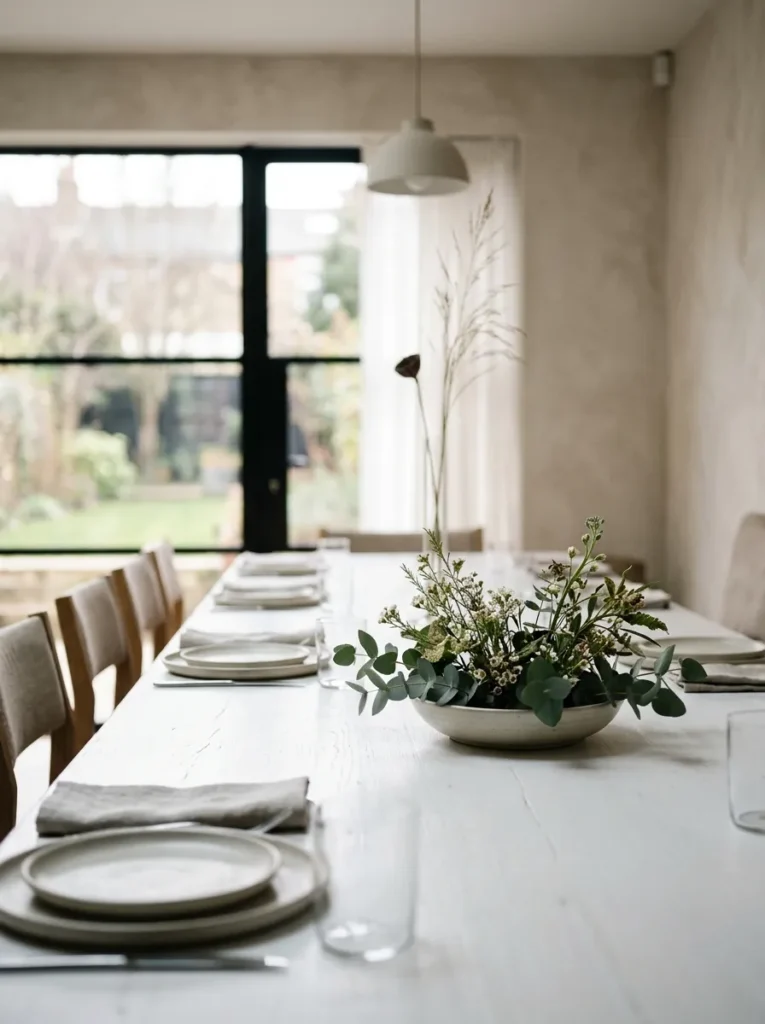
The most practical design principle for dining table centerpieces, and the one almost never fully explained in inspiration articles: a centerpiece should be either below 12 inches tall — low enough for seated diners to see clearly over and around it — or above 24 inches, rising above eye level so it doesn’t create a visual barrier. Everything in between sits directly in the sightline zone for most seated adults and creates the experience of leaning around your own table decoration to make eye contact with the person across from you.
Most commonly available floral arrangements and grocery store bundles in standard vases land exactly in this problem zone. The simplest fix for an existing arrangement: transfer it to a lower, wider vessel — a shallow bowl or a wide cylinder at 8 to 10 inches — to drop below the sightline. Alternatively, choose a slender single-stem arrangement in a tall, narrow vase that rises clearly above 24 inches, where it functions as background architecture rather than a visual barrier. Keep this rule in mind as you work through every idea that follows.
2. Use a Table Runner as the Anchoring Base Layer
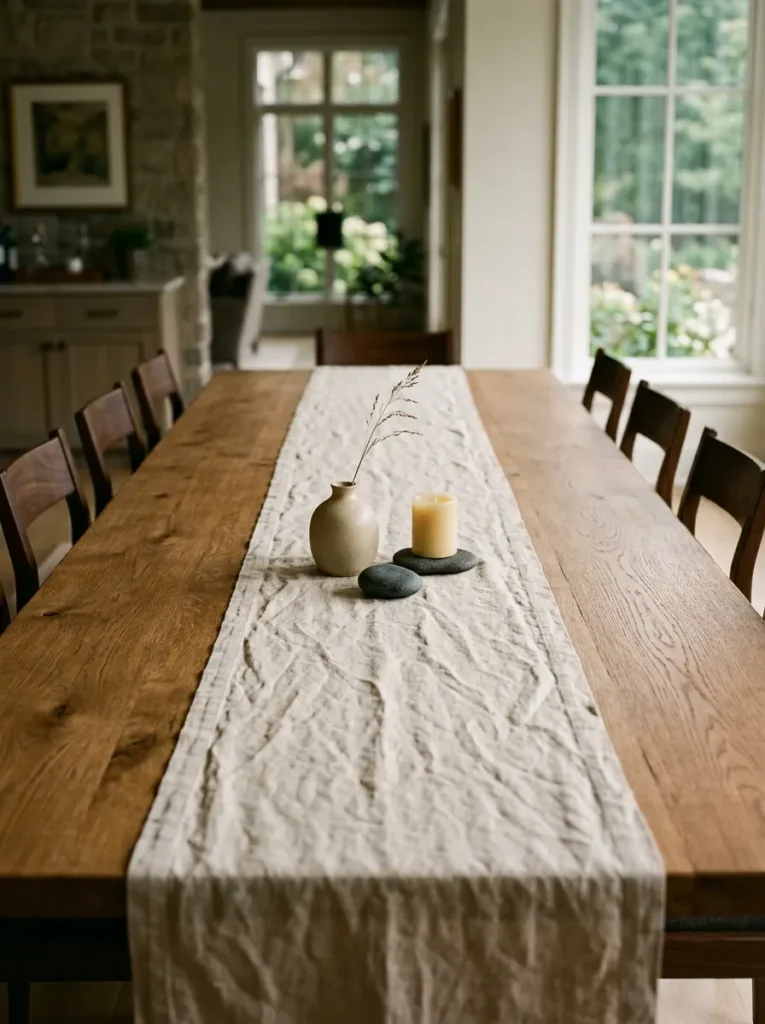
A runner beneath a centerpiece does more visual work than the centerpiece itself in one specific way: it defines the arrangement’s zone. Objects placed on a bare table look as if they were set down and not yet put away. The same objects on a runner read immediately as a composed arrangement — the runner signals that the table has been thought about.
The runner should extend 6 to 12 inches beyond the centerpiece arrangement on each end, which typically means the runner stops 12 to 18 inches from the table’s edges. Material should contrast subtly with the table surface: a natural linen runner on a dark walnut table, a dark linen runner on a lighter oak surface, or a textured cotton runner on a white marble table. The contrast doesn’t need to be dramatic — it’s the edge of the runner that defines the zone, not the color difference. Simple is better; a runner with an elaborate pattern competes with whatever is arranged above it rather than supporting it.
3. Cluster Pillar Candles at Three Different Heights
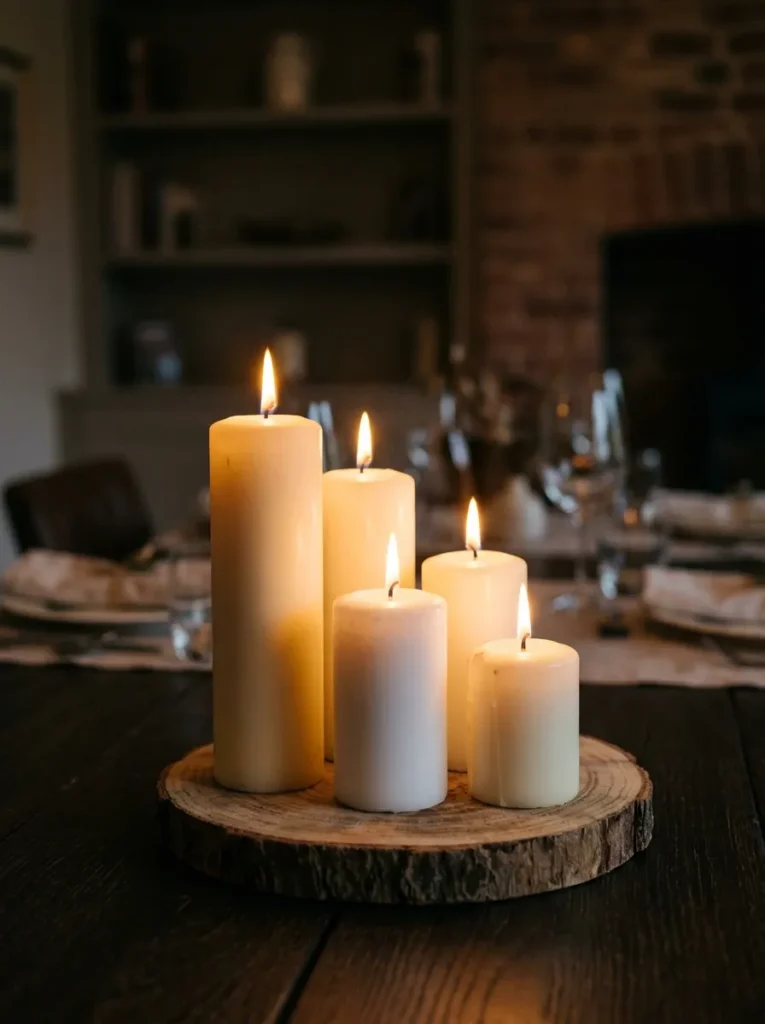
Of all the centerpiece approaches available for a dining table, a grouping of pillar candles at varied heights delivers the highest ratio of elegance to effort. Three to five pillar candles in the same color family — white, ivory, and warm cream grouped together, or a single monochromatic tone — placed closely in the center of the table creates a warm, gathered quality that works for everyday dining and dinner parties equally well.
The three-height principle is what makes this work. A tall pillar at 9 to 12 inches, a medium one at 5 to 7 inches, and a low wide one at 3 to 4 inches create a natural rise and fall that the eye reads as intentional. All the same height reads as institutional. Random heights read as random. Use an odd number of candles — three or five — for a more organic grouping than an even number produces. Place them on a wood slice, a ceramic tray, or a flat stone to protect the table surface and create an implied boundary for the arrangement.
4. Arrange a Low Bowl with Floating Flowers and Cut Greenery
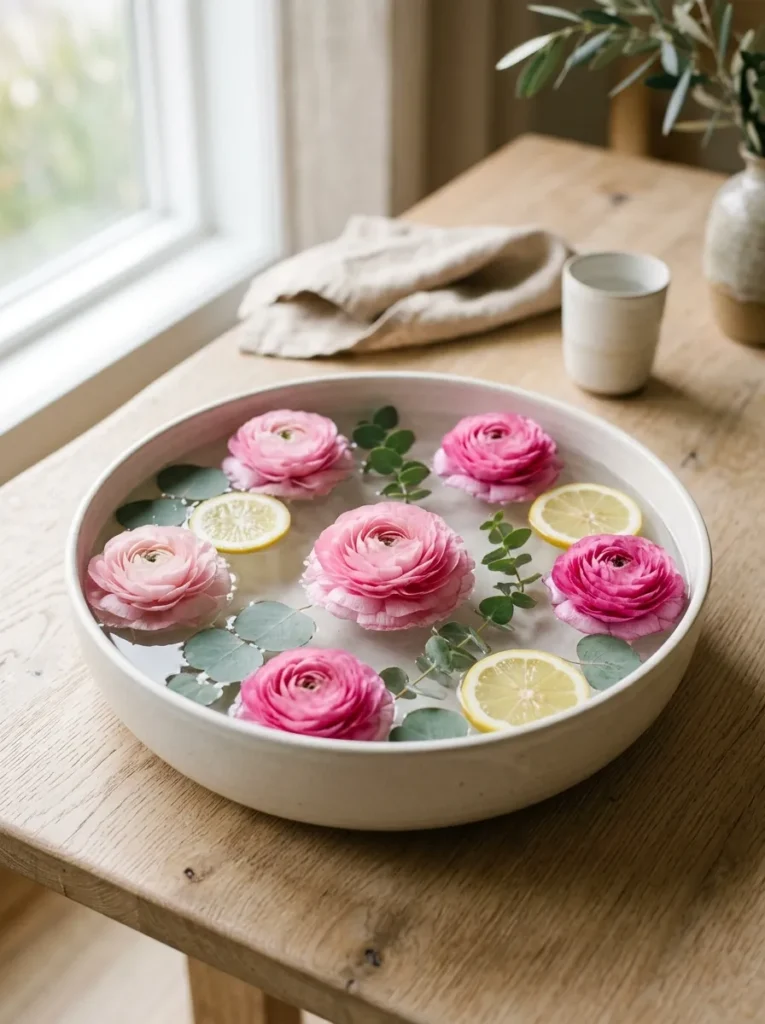
A shallow bowl with 3 to 4 inches of water, floating flower heads, and scattered greenery is one of the most elegant, low-effort centerpiece approaches available — and one of the most overlooked in favor of the standard vase arrangement. Because it sits at or below 8 inches from the table surface, it falls cleanly below the sightline zone regardless of what’s floating in it. Because the flowers lie flat on the water surface, even a modest quantity looks abundant — six to eight floating heads and a handful of scattered leaves fill a 12-inch bowl convincingly.
Flowers that float well: gardenias, ranunculus, peonies, and fully open roses. For everyday use, floating greenery alone — sliced citrus wheels with eucalyptus leaves — works without requiring fresh flowers and stays composed for several days. The vessel choice matters substantially: a simple white ceramic bowl, a shallow terracotta dish, or a wide-mouth glass vessel reads more elegant than a novelty or decorative container of the same dimensions. The simplicity of the vessel lets the water and floating elements remain the visual subject.
5. Use Tapered Candles in Mismatched Simple Holders
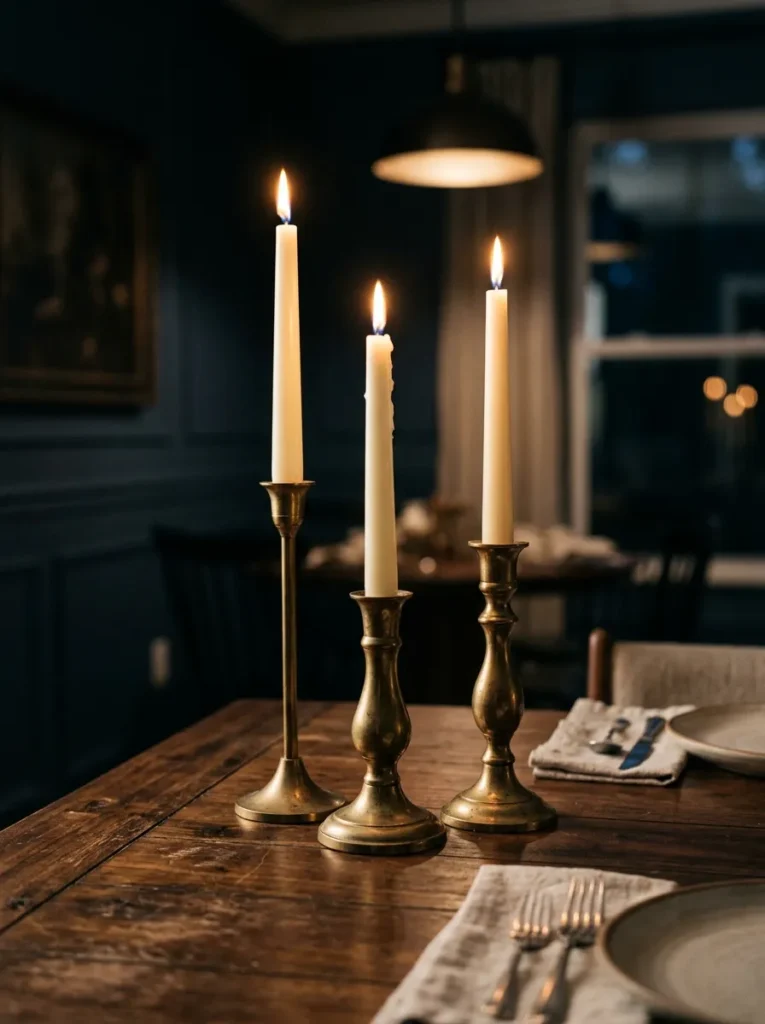
Tapered candles in candlestick holders carry an inherent elegance that has nothing to do with expense — the form is genuinely archaic in the best sense, associated with considered dining rooms across centuries. The styling decision that keeps them from reading as overly formal or thematic: use holders that share a material but not an identical form. Three candlesticks in aged brass — each a slightly different height and profile — read as collected and curated over time. Three matching candlesticks bought as a set read as deployed, which registers differently.
The practical detail: tapered candles in a dining context should be at minimum 10 inches tall before lighting so they rise above most place settings. Once lit, they need to be clear of overhead fabric, pendants, and anything flammable within 12 inches horizontally. Tapered candles also need to be seated securely — a slightly undersized candle in an oversized holder creates a safety and visual problem simultaneously. The warm, directional light tapered candles cast across a table at dinner is genuinely different from any alternative and closer than most home dining rooms come to restaurant candlelight.
6. Style a Single Branch or Sculptural Stem in a Weighted Vase
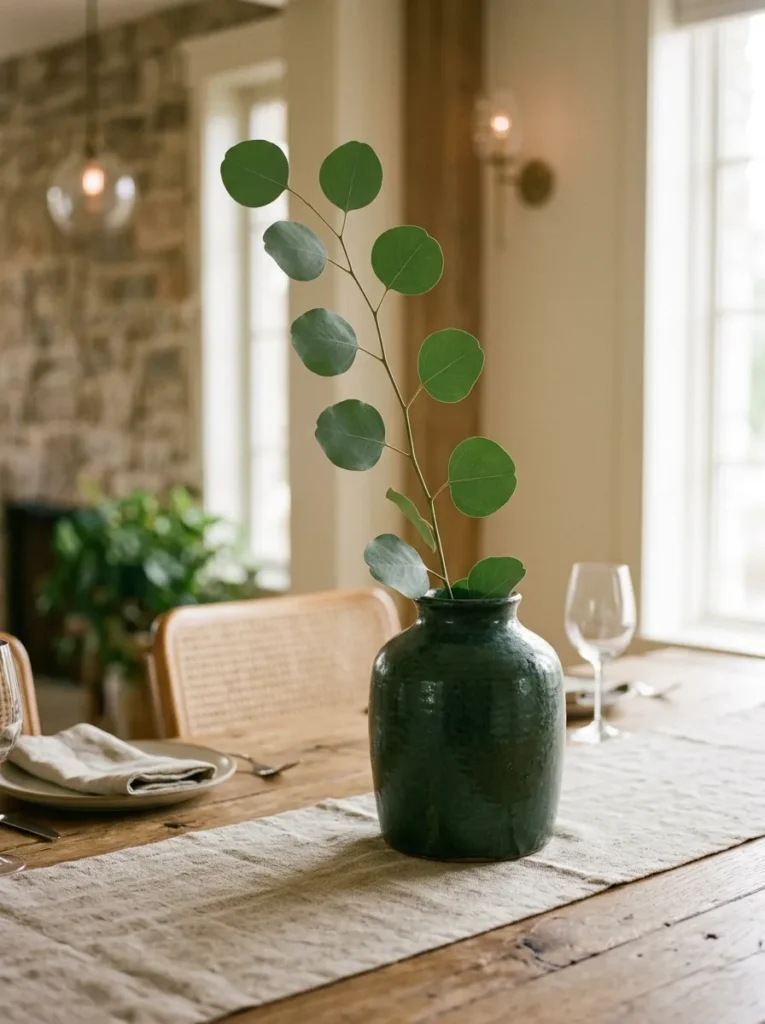
The instinct with a floral centerpiece is to add: more blooms, more filler, more greenery. A more counterintuitive approach — placing a single branch or sculptural stem in a substantial vase — often reads more elegantly precisely because it doesn’t compete with itself. The eye has one clear thing to look at and reads it as deliberate.
Branches and stems that work for this purpose: a eucalyptus branch with leaves intact, a magnolia branch, dried pampas grass at its natural plume height, a single orchid stem in a slim tube vase, or a bare branch in late winter when the skeletal form is its own visual subject. The vase must be proportionally substantial — heavy ceramic, a clear glass cylinder with genuine weight, a terracotta piece with character — so the arrangement doesn’t read as a stem placed in whatever was available. Height works here: a branch rising 28 to 36 inches above the table clears the sightline zone and becomes presence rather than barrier.
7. Group Ceramic Vessels of Varying Heights as a Year-Round Arrangement
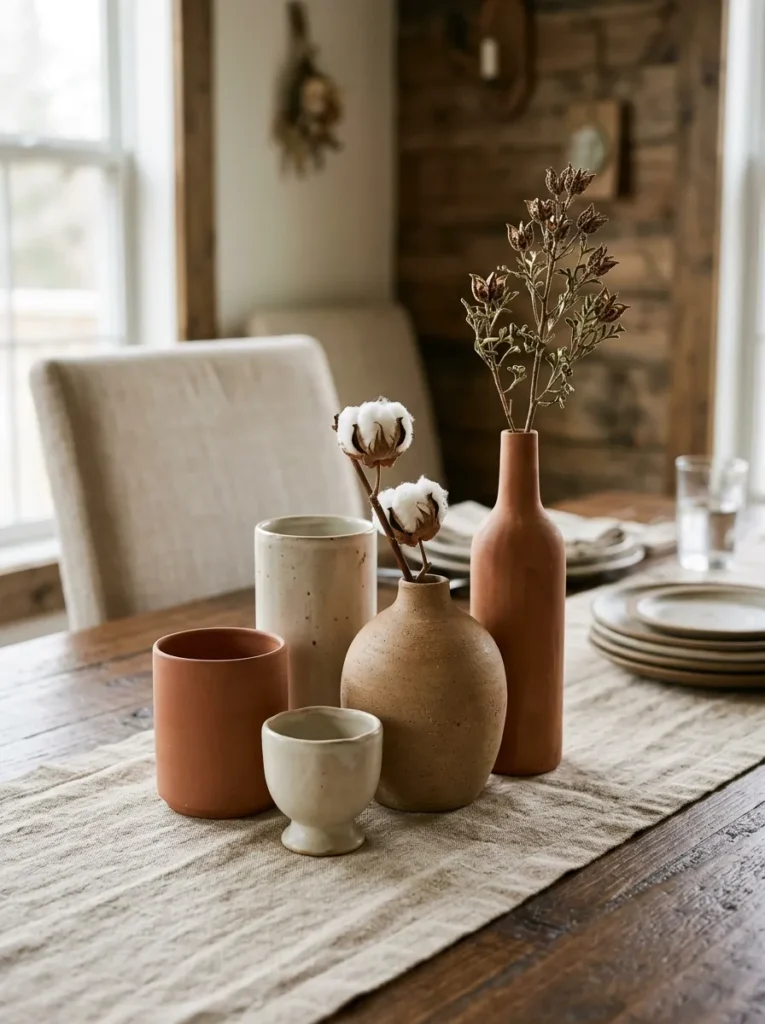
A grouping of ceramic vases and objects — some holding dried stems, some left deliberately empty — is the centerpiece equivalent of a styled shelf: an object-based arrangement that reads as curated without requiring frequent maintenance or replacement. Unlike cut florals that need replacing every few days, a considered grouping of quality ceramics can remain in place for months.
The selection principle: choose three to five pieces in the same broad color family — all warm whites and creams, all warm earthy tones together, all deep charcoal and slate — and vary the form significantly within that color story. A short wide cylinder, a medium rounded belly vase, a tall narrow bottle form, and a small footed piece create variety within restraint. Add dried stems to a select few — dried cotton bolls, seed pods, a sprig of preserved eucalyptus — and leave others empty. The empty vessels read as considered negative space rather than unfilled containers when they’re surrounded by pieces that have enough character to hold the arrangement.
8. Use Fresh Fruit as the Centerpiece’s Primary Element
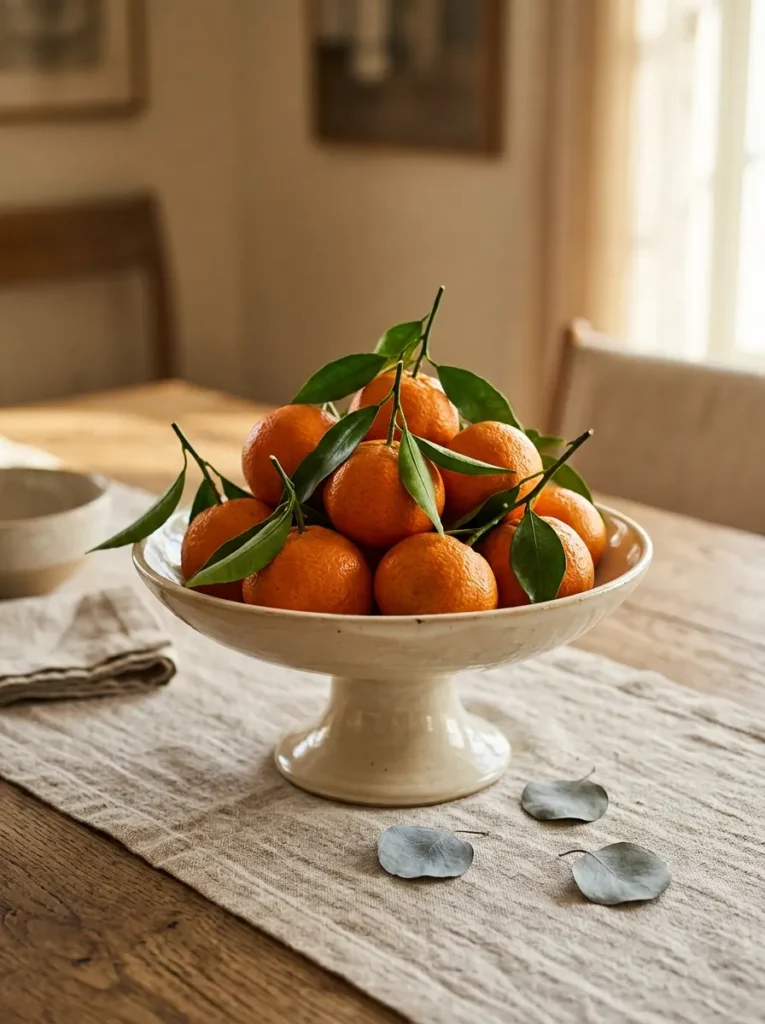
Fruit as a dining table centerpiece is common in food editorial photography and almost entirely absent from typical home decor advice — which is exactly where the opportunity lies. A low wooden bowl, a ceramic compote, or a footed tray filled with seasonal fruit reads as both visually composed and genuinely hospitable: the centerpiece is also part of the table’s offering.
The approach that reads as elegant rather than merely practical: choose one or two fruit varieties rather than a mixed bowl of everything available. Deep purple figs with a few dried leaves placed at the base in late summer. A compote of clementines with stems and leaves still attached in winter — the attached leaves are the detail that shifts fruit from grocery storage to composed arrangement. A cluster of seven green pears with stems intact. The single variety and the odd number create the visual cohesion that makes fruit read as centerpiece rather than a bowl of food. The odd number principle applies for the same reason it works in object styling: even numbers read as pairs, odd numbers read as compositions.
9. Build a Foraged or Garden-Clipped Botanical Arrangement
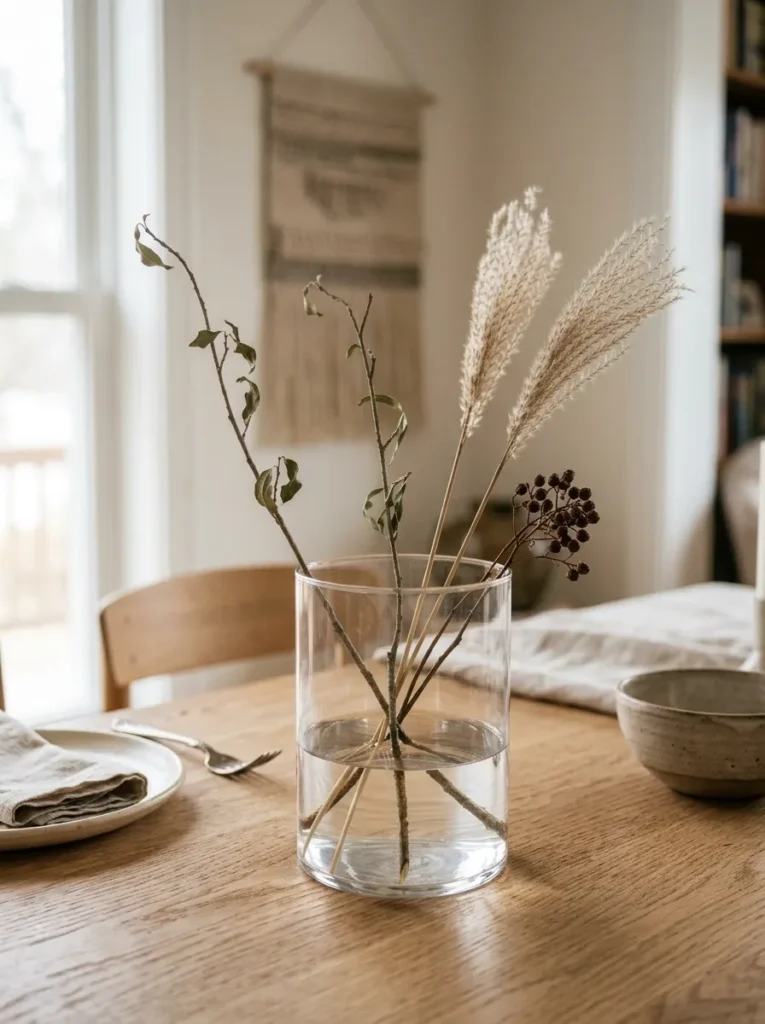
Some of the most considered dining table centerpieces appear in published interiors and are made from materials gathered rather than purchased: branches clipped from a yard, stems cut from a garden, seed pods from a walk, dried grasses from a roadside field. The organic irregularity of foraged materials — the slight imperfection of a branch, the natural lean of a dried grass stem — produces a visual quality that purchased arrangements can struggle to replicate.
The practical approach: clip branches at varying lengths, strip unnecessary leaves to reveal the stem structure, and arrange them loosely in a wide-mouth vase or clear glass cylinder. The arrangement should be loose enough that individual stems are visible rather than packed together into a dense mass. A mix of two or three distinct botanicals — something structural like a branch, something feathery like a dried grass, something solid like a leaf or berry cluster — creates enough internal variety that the arrangement reads as considered rather than simply collected. The imperfection is a feature, not a flaw, as long as the composition has a clear internal logic of height and direction.
10. Place a Living Herb or Small Potted Plant as an Everyday Centerpiece
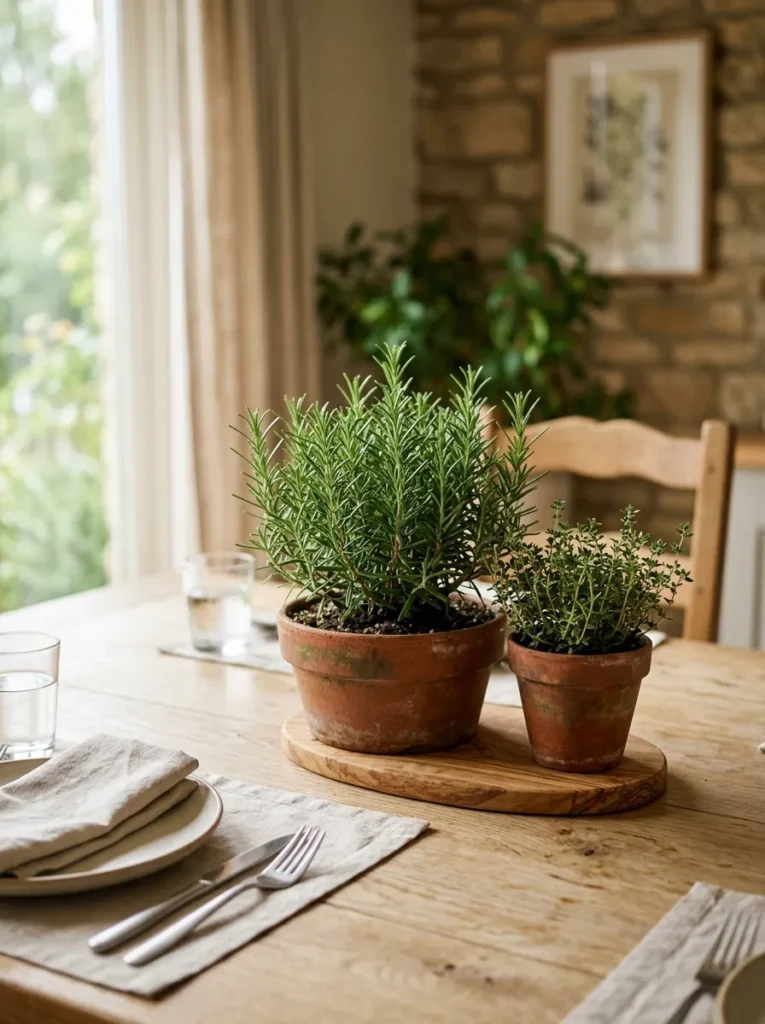
A living plant on a dining table solves the replacement problem that cut floral arrangements create: it doesn’t wilt after three days, doesn’t need fresh water each morning, and generally improves with attention rather than requiring its own scheduled upkeep. For a dining table specifically — where the centerpiece must clear sightlines and be removable for meals — the most practical living options grow low and wide rather than upright.
Fresh herbs in clay pots work particularly well: rosemary, thyme, or a compact lavender plant stays reliably below 10 inches, adds a pleasant subtle fragrance at mealtimes without competing with the food’s aroma, and can be harvested for cooking when needed. A shallow tray of small succulents in matching ceramic pots creates a very low arrangement with almost no maintenance. If the dining room receives meaningful natural light, a trailing ivy or a wide-leafed plant in a beautiful ceramic pot positioned low beside the runner adds a living quality that no arrangement of cut or dried materials can replicate over time.
11. Create a Candlelit Runner with Votives at Measured Intervals
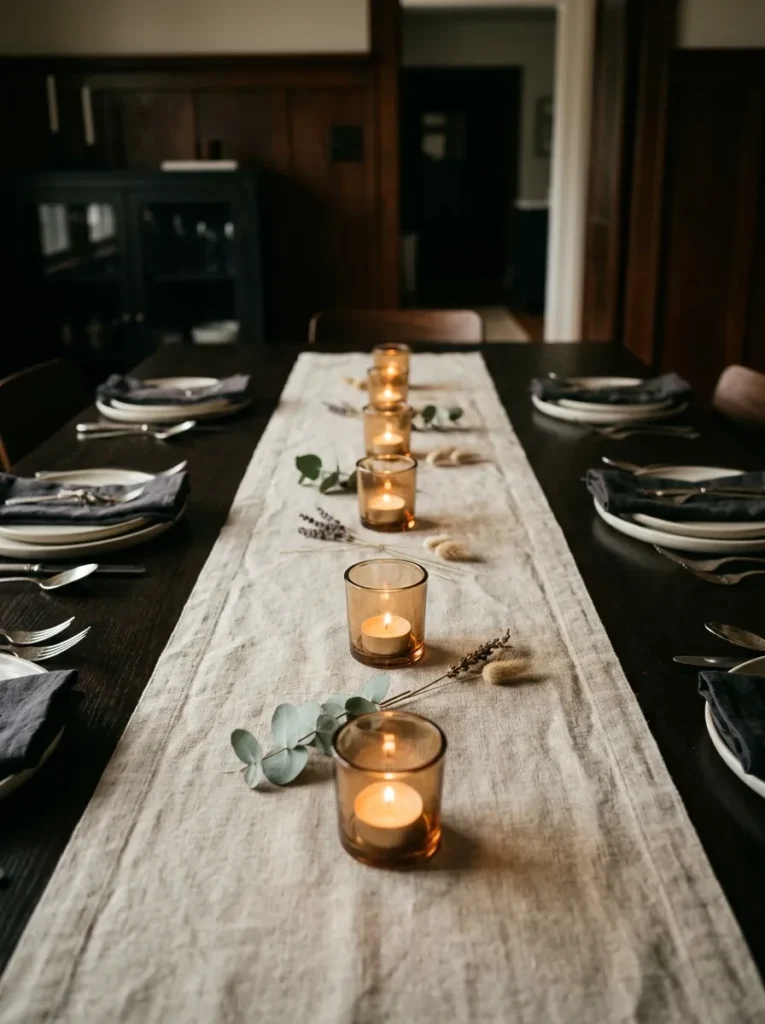
A single arrangement at the center of the table is the standard approach. An alternative that reads as more deliberate — particularly for longer rectangular tables and dinner parties — is distributing warmth along the full table length through a votive runner: small glass or ceramic votive holders placed at equal, measured intervals down the center axis, each with a tealight inside.
Five to seven votives spaced 8 to 10 inches apart on a linen runner create a line of warm light that makes the entire table feel inhabited and composed rather than lit only at its center. The key addition: scatter small botanical elements between the votives — a few eucalyptus leaves, a small dried stem, a loose cluster of berries — to prevent the arrangement from reading as a functional row of tea lights. The botanical punctuation at regular intervals gives the runner a natural quality while the consistent votive spacing gives it deliberate structure. The combined effect of warm candlelight and organic botanical material along the full table length is one of the simplest and most effective dinner party table treatments available.
12. Arrange One Tall, Slim Vase with a Single Stem for Formal Evenings
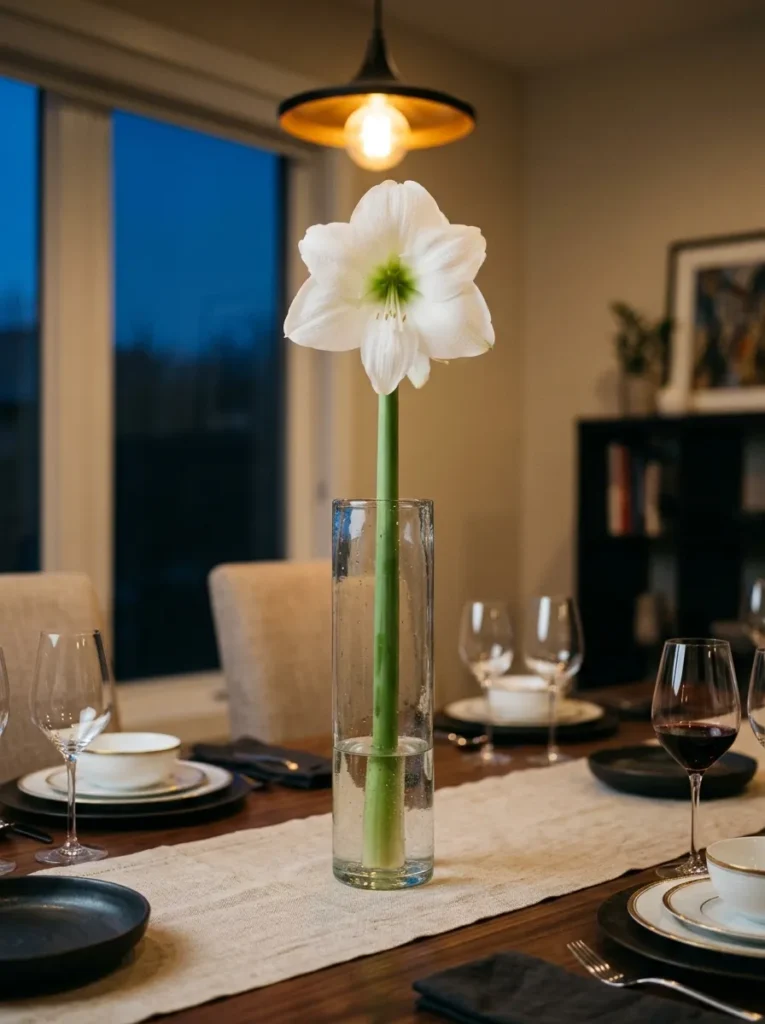
The single stem in a tall, narrow vase is the most confident centerpiece statement available for a formal dining occasion, and it works precisely because confidence is what makes restraint read as elegance rather than insufficiency. One excellent stem — an amaryllis, a tall orchid spike, a branch of white blossom, a long-stemmed garden rose at full open — in a vase rising 16 to 24 inches above the table surface clears the sightline zone entirely and becomes a sculptural presence.
The vase is as important as the stem. A handblown glass cylinder with visible irregularities, a glazed ceramic tube in a deep color, or a terracotta vessel with a narrow opening each provide the visual weight that makes a single-stem arrangement read as a deliberate decision rather than a half-finished idea. A thin or flimsy vase with a single stem reads exactly as insufficient. The right vessel makes the restraint look intentional — and that distinction is the entire difference between a confident centerpiece and an empty table.
13. Use a Wooden or Ceramic Tray to Contain Multiple Elements
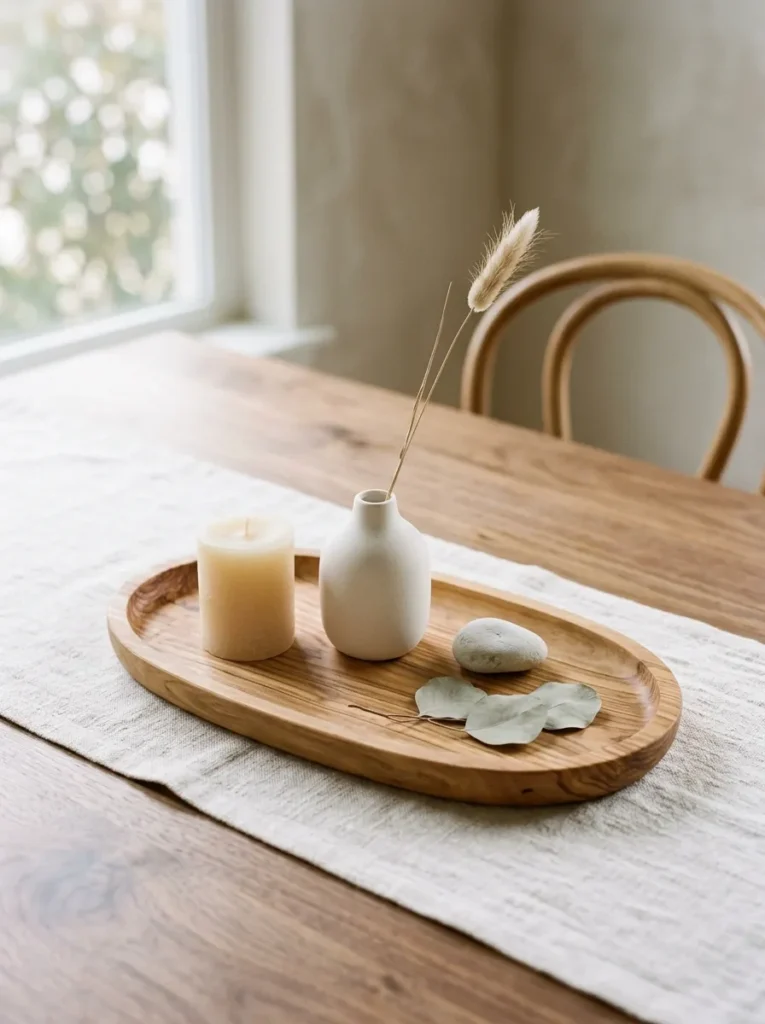
The tray technique — familiar from nightstand and coffee table styling — applies equally well to a dining table centerpiece. A wooden, ceramic, or slate tray placed along the table’s center axis provides a physical boundary that contains the elements within a defined zone, making the arrangement read as intentional rather than scattered. Objects placed inside a tray read as composed; the same objects without the tray read as not yet put away.
Within the tray: a short candle, a slim bud vase with a single stem, one small decorative object (a smooth stone, a small ceramic piece, a pine cone), and one or two loose botanical elements laid flat. Keep the total height of everything inside the tray below 12 inches for everyday use — the tray itself signals the centerpiece zone, so the elements within it don’t need to rise above the sightline zone to read as a composed arrangement. A practical benefit: the tray makes the entire centerpiece moveable as a unit — slide it to the sideboard when the table is needed for a meal, return it afterward without losing or rearranging anything.
14. Layer Candles, Loose Botanicals, and Organic Objects for Special Occasions
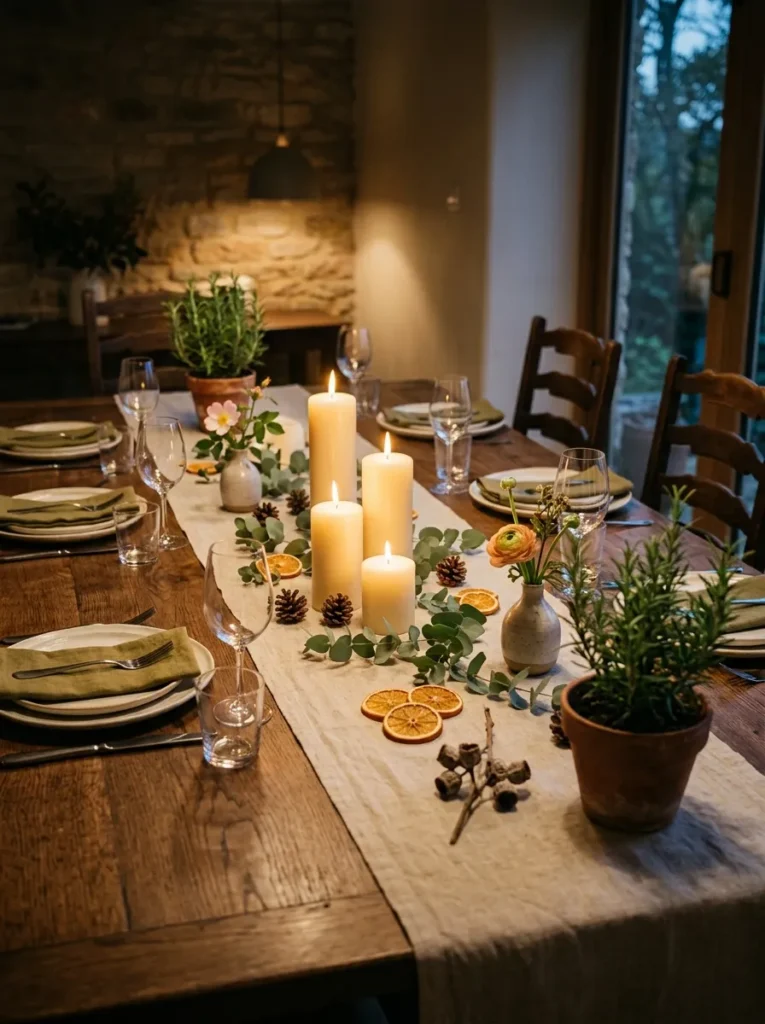
Special-occasion centerpieces — a holiday dinner, a significant birthday, a gathering with a longer table and more guests — can be more elaborate than everyday styling allows, but the restraint principles still apply within a larger footprint. More elements, but all within the same color story and material language. Organized abundance rather than complex arrangements.
A practical occasion centerpiece: a linen runner as the base layer, pillar candles at three different heights at the center, and loose botanicals scattered organically around the candles — eucalyptus sprigs, dried orange slices, small pine cones, or seed pods depending on the season. One or two small bud vases with single fresh stems placed slightly off-center to each side. A natural seasonal element anchoring each end of the runner: a small pumpkin in fall, a cluster of clementines with leaves in winter, a pot of garden herbs in spring, a piece of driftwood or a stone in summer. The arrangement spans the full center of the table but stays below 10 inches everywhere except the tallest candle, maintaining sightlines throughout.
15. Style a Low Wide Bowl with Seasonal Content That Changes Throughout the Year
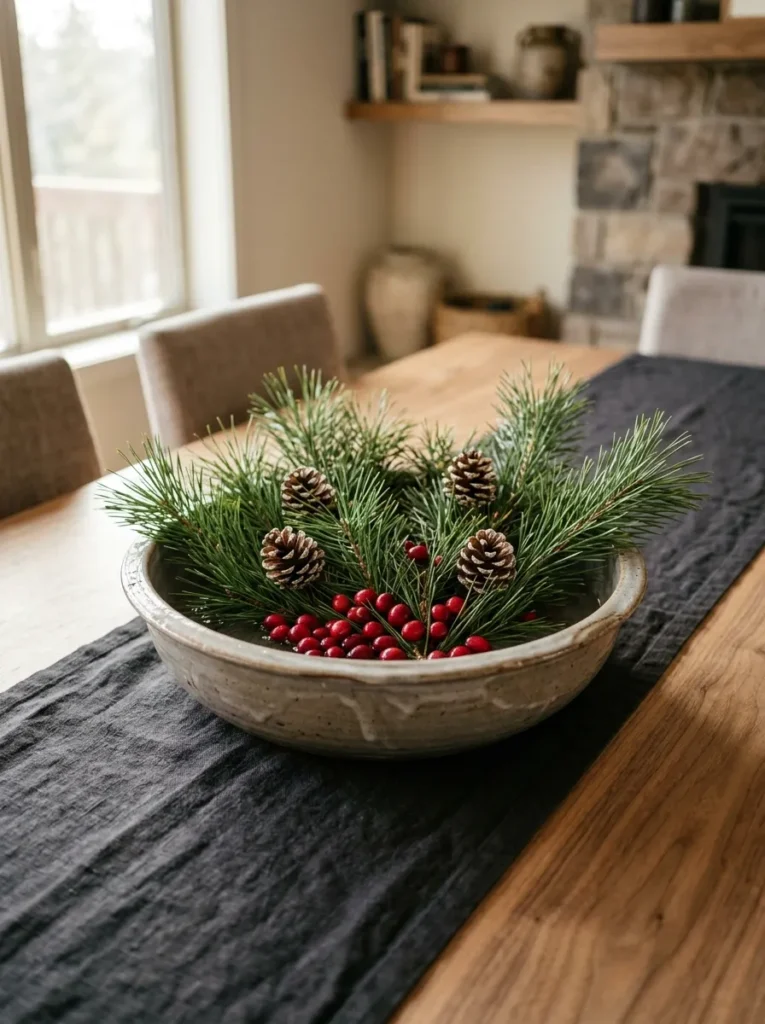
A single low, wide bowl — ceramic, glass, terracotta, or stone — is the most versatile centerpiece vessel available for a home where the table is used daily and elaborate maintenance isn’t realistic. The bowl stays on the table year-round as a constant; only its contents change with the seasons.
In late spring: floating ranunculus or open rose heads in clean water. In summer: sliced lemon and lime wheels with eucalyptus leaves floating — no flowers required. In early fall: dried wheat stalks and small dried seed pods arranged loosely in the dry bowl. In winter: fresh pine clippings, a few cranberries, and one small pinecone cluster. The bowl itself should be of genuine quality — handmade with visible marks, an interesting glaze or natural grain, a material that improves with age. An investment in a single beautiful vessel that remains in place and changes only its contents represents one of the most sustainable and practical centerpiece decisions for a busy household.
16. Choose One Statement Object in Place of Any Arrangement
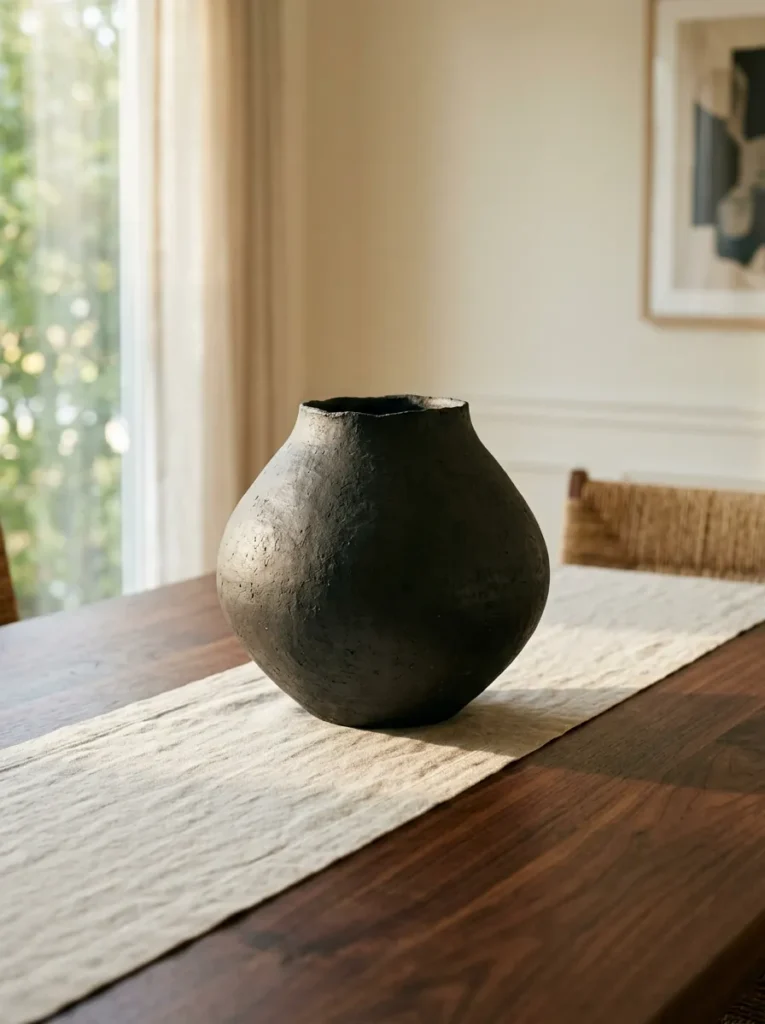
The most unexpected approach to an elegant dining table centerpiece is sometimes not a plant or candle at all — it’s a single object: a substantial ceramic sculpture placed at the table’s center, an antique turned wooden bowl, a smooth stone of meaningful size, a hand-thrown vessel that reads as art rather than container. Object-as-centerpiece works when the object is genuinely excellent — unusual in form, interesting in material, or possessed of a quality that rewards looking at it across a dining table during a meal.
The distinction that determines whether this approach works: does the object have a quality that makes you want to look at it, pick it up, or ask about it? If yes, it functions as a centerpiece. If it’s merely decorative without being genuinely interesting, it reads as an empty table with something placed in the middle. One beautiful, strange, or perfectly made object is more effective than a careful arrangement of ordinary ones. The confidence of the single-object centerpiece is, again, precisely what makes it read as elegant rather than unfinished.
17. Stack Books Below a Vase or Object to Create Deliberate Height
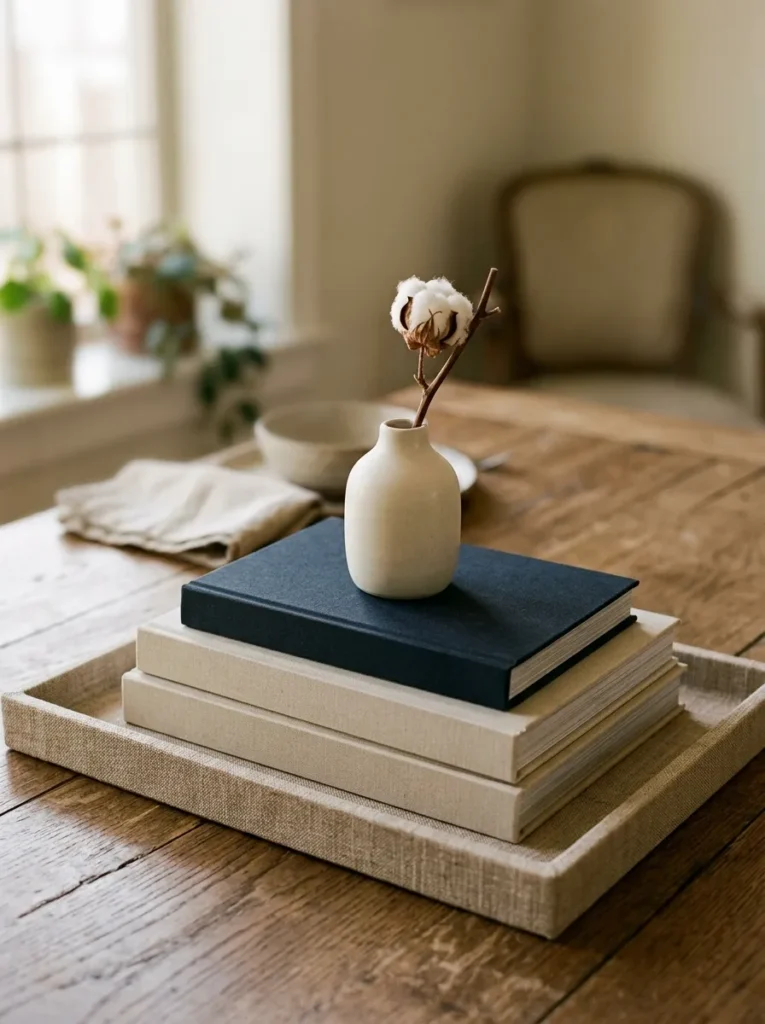
Books as a styling element appear most often on coffee tables and shelves but work equally well as part of a dining table centerpiece — specifically as a platform to create height variation without requiring additional vessels or risers. Two or three books stacked closely in the center of a tray, with a small bud vase or ceramic object placed on top, create a height difference that reads as intentional.
The book choice matters more in a dining context than in shelf styling, where books are partially covered by other objects. On a dining table centerpiece, the book spines are clearly visible to everyone seated nearby. Books with plain spines in linen, leather, or a single solid color read as considered design objects. Books with busy commercial covers or bright dust jackets read as books that haven’t been shelved. Removing the dust jacket from any hardcover with a busy design almost always improves it — the plain cloth or paper cover underneath is nearly always more elegant than what it was hiding.
18. Build a Seasonal Tray Centerpiece with Permanent and Variable Elements
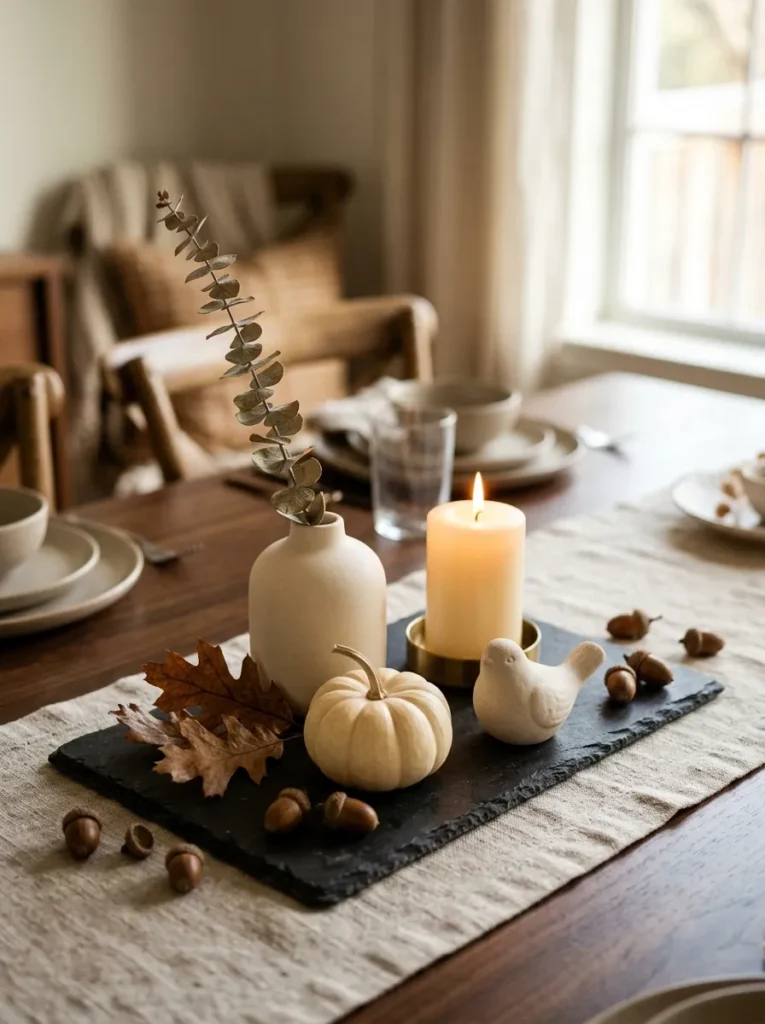
The most practical elegant centerpiece solution for a home where the dining table is used daily: a shallow tray that holds a consistent structure of permanent elements — two or three pieces that stay in place year-round — with one or two seasonal variables that change with the months. The permanent structure maintains the tray’s composed appearance even when the seasonal elements are mid-transition or temporarily removed.
The permanent elements might be: a short ceramic bud vase, a pillar candle on a small tray insert, and one flat sculptural object like a polished stone or a small ceramic bird. The seasonal variables fill the remaining space: a small pumpkin or cluster of dried oak leaves in fall, a few clementines with stems still attached and a fresh pine sprig in winter, a small pot of fresh garden herbs in spring, a linen-wrapped jar of dried lavender or a handful of dried grasses in summer. The permanent anchors give the tray its stability as a composed arrangement; the seasonal variables give it its relevance and its reason to be noticed again.
Common Mistakes to Avoid
Landing in the sightline zone. A centerpiece between 12 and 24 inches tall will block eye contact for most seated adults. The solution is simple: go lower or go higher. Most everyday centerpieces should stay below 12 inches. Taller arrangements belong on occasions where a slim, sculptural element rises clearly above the 24-inch mark.
Using too many competing materials. An elegant centerpiece typically involves one primary material and one or two secondary ones. Combining candles, flowers, fruit, books, and objects in a single arrangement rarely reads as abundant — it reads as busy. Choose one material to lead and let the others support it.
Making the centerpiece too wide for the table. A centerpiece wider than one-third of the table’s length crowds the place settings and makes the table look like a display surface rather than a dining surface. Leave at least 12 inches of clear space on each side for place settings and natural arm movement.
Choosing fragrant flowers. For dining table use specifically, highly scented flowers — gardenias, certain lilies, hyacinths — can compete with or overwhelm the aroma of food. When fresh flowers are part of the centerpiece during a meal, choose low-scent varieties: ranunculus, peonies, open roses, or branches with greenery. Reserve strongly scented stems for when the table isn’t being used for eating.
Treating the centerpiece as permanent. The best everyday dining table centerpieces are ones that can be moved aside for a meal and returned afterward without losing the arrangement. If your centerpiece is too complex or too fragile to move in a single action, it will gradually become an obstacle. The tray technique in Idea 13 and the permanent-and-variable structure in Idea 18 both address this specific problem.
Final Thoughts
The elegance of a dining table centerpiece comes from constraint — what you decide to leave out as much as what you include. Start with the height rule. Choose your base: a runner, a tray, or both. Select one primary element and let it lead the arrangement. Add supporting elements only when they genuinely contribute rather than fill space.
The best everyday centerpieces are easy to live with: simple enough to move when the table is needed for a meal, straightforward enough to maintain without daily attention, and flexible enough to change with the seasons without requiring a complete rebuild. A group of ceramic vessels with one dried stem. A low bowl that changes its content each month. A cluster of pillar candles on a slate tray. The occasion versions can be more elaborate — but they should still follow the same restraint principles, applied to more elements within the same color and material language.
Save the ideas here that match your table’s proportions and your household’s rhythm, and use the height rule as the one principle you always come back to.