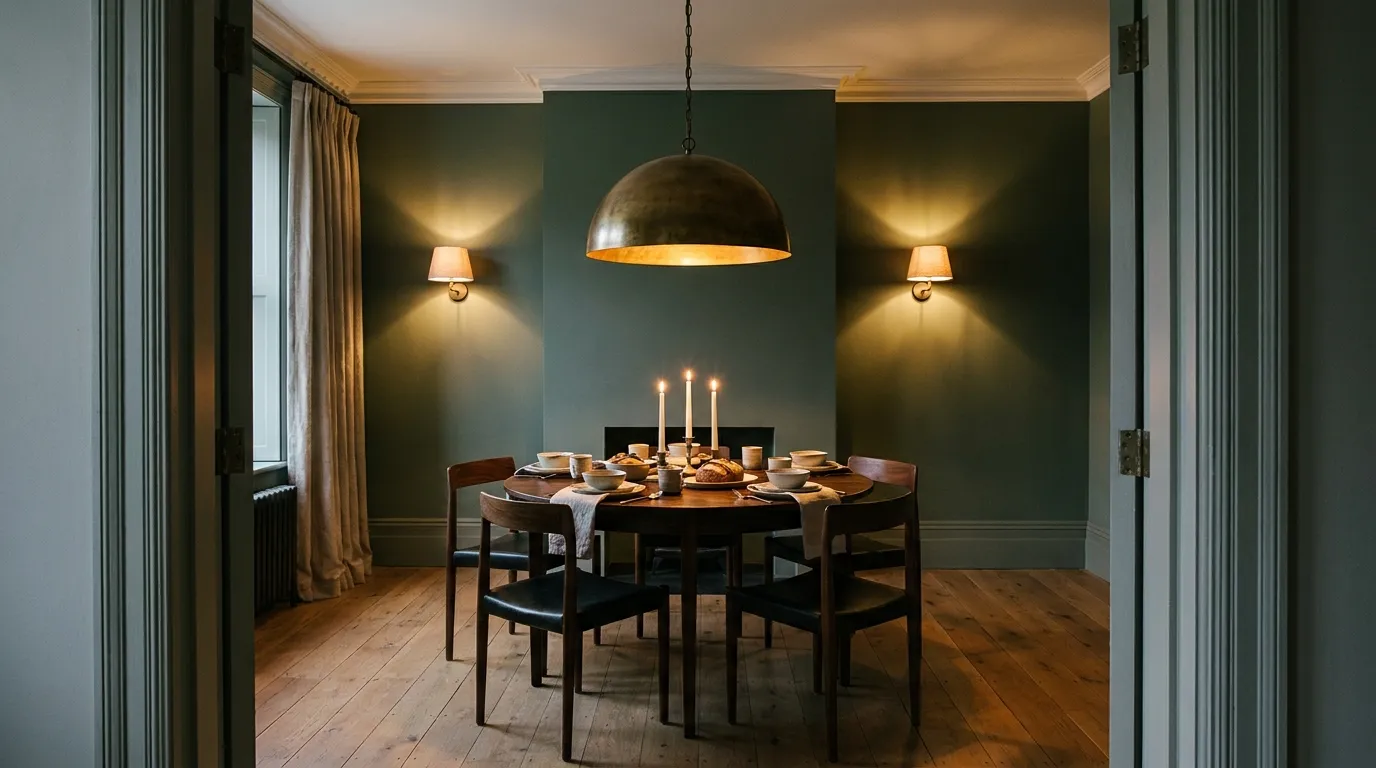
22 Dining Room Lighting Ideas That Create a Cozy Atmosphere
Dining room lighting is the decision most people make last and regret first. The fixture goes in after the table and chairs are chosen, gets hung at whatever height the electrician suggests, and then sits forever doing slightly the wrong job — too high, too bright, the wrong colour temperature, or simply not interesting enough to justify its position as the room’s visual centrepiece.
Good dining room lighting is simultaneously the most functional and most atmospheric decision in the room. The right fixture at the right height with warm bulbs on a dimmer can make a plain table feel like a restaurant booth. The wrong configuration in an otherwise well-designed room creates a quality of light that works against every other decision made around it. These dining room lighting ideas cover the full range — from statement pendants and chandeliers to sconces, recessed circuits, and the layered approaches that make a room work at multiple occasions.
1. Hang a Statement Pendant 70–80cm Above the Table Surface
The pendant over the dining table is the room’s most visible fixture — and its hanging height determines whether it illuminates the table usefully or simply floats overhead as a decorative element at ceiling distance. The standard recommendation of 70–80cm above the table surface is not arbitrary: at this height the light falls directly on food and faces without casting unflattering downward shadows from above, and the fixture sits close enough to the table to read as part of the dining composition rather than a ceiling feature.
Above 85–90cm, a pendant effectively disconnects from the table and reads as a room fixture. Below 65cm, it sits in the eyeline of seated guests and becomes an obstruction. The ceiling height affects this range only slightly — the relationship between fixture and table matters more than the relationship between fixture and ceiling.
2. Choose a Chandelier With Visual Presence Proportional to the Table
A chandelier above a dining table needs to be large enough to hold its own over the table without the eye having to search for it. The diameter of the fixture in centimetres should be broadly similar to the shorter dimension of the table — for a 90cm wide table, a chandelier 70–90cm across reads proportionately. A fixture significantly smaller than this looks provisional rather than considered at the scale of most dining tables and rooms.
For round tables, this proportion logic is even more direct: the chandelier should span roughly two-thirds to three-quarters of the table diameter. For oval or long rectangular tables, a grouping of pendants rather than a single chandelier often reads better, since a single fixture tends to illuminate one section well and leave the ends in relative shadow.
3. Group Three Pendants in a Row Over a Long Rectangular Table
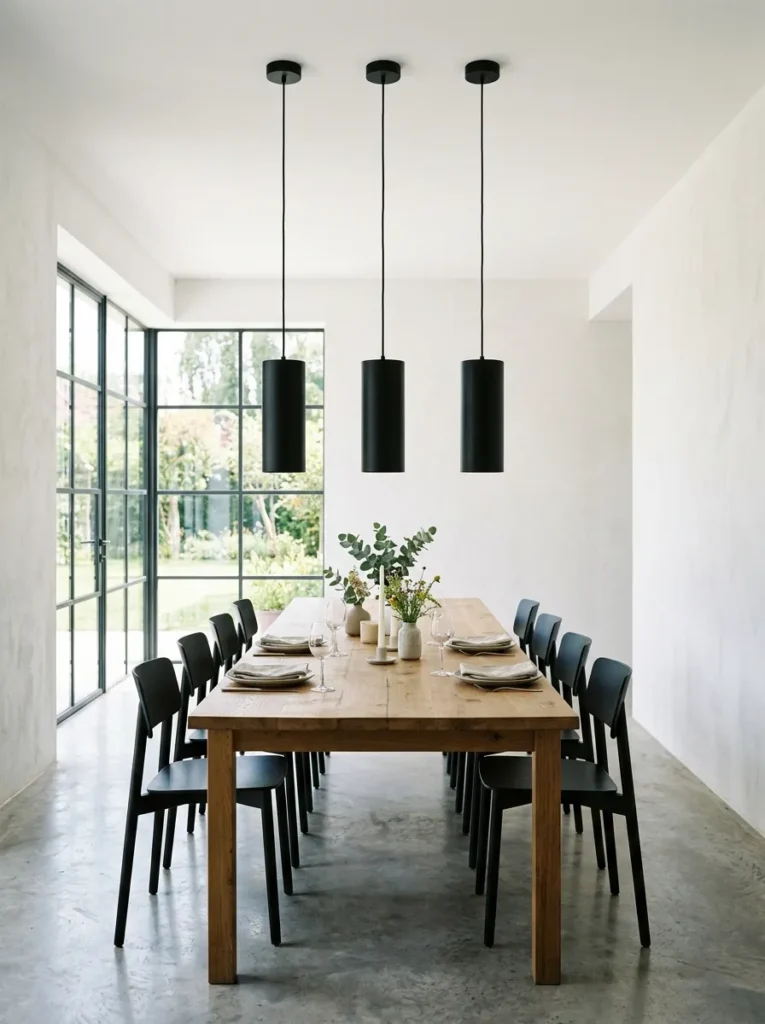
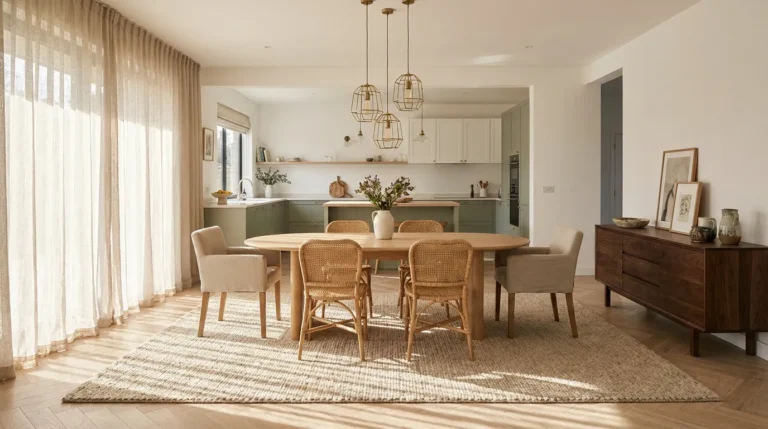
Three pendants in a line over a rectangular dining table distribute light evenly across the whole surface and avoid the problem of a single overhead fixture that illuminates the centre well but leaves the ends dim. Spacing them evenly across the table’s length — roughly a third of the table length between each — creates a visual rhythm that reads as deliberate rather than arbitrary.
The three pendants don’t need to match exactly, but they should share a material language. Three pendants in the same form but different sizes can work (smallest at the ends, largest at the centre). Three entirely different fixtures in one line read as eclectic rather than considered. The hanging height of each should be the same: pendants at different heights in a row look like an installation error rather than an intentional choice.
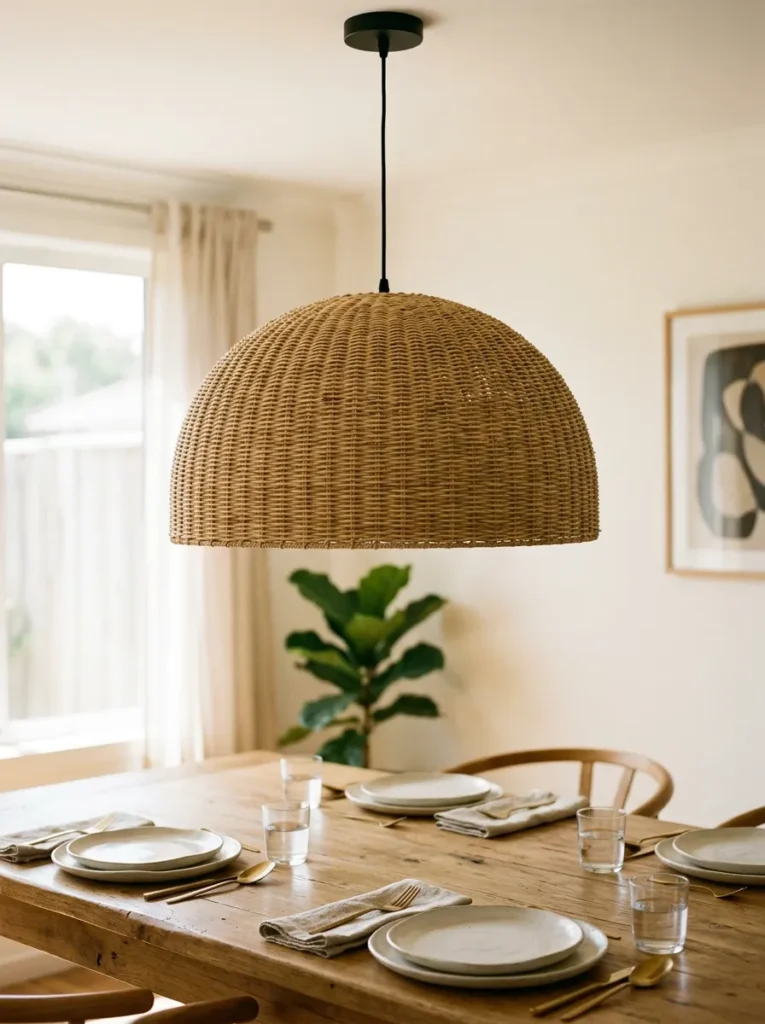
4. Install a Large Rattan or Woven Pendant for Warm Texture
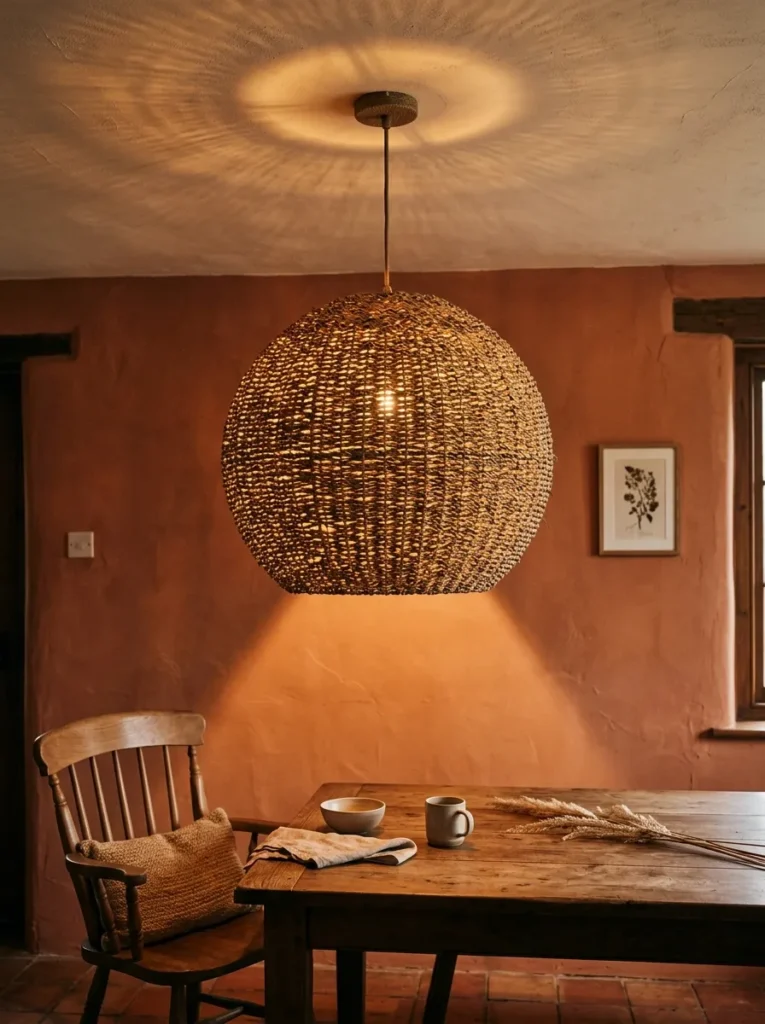
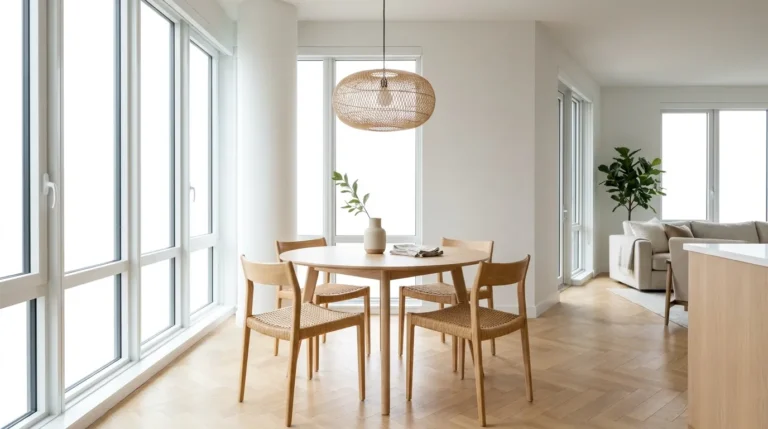
A woven rattan or seagrass pendant does something other pendant materials can’t: it scatters light through its woven surface rather than directing it downward as a beam, which produces a diffuse, organic glow on the ceiling and walls around it rather than a concentrated pool at the table. In a dining room that’s used for evening entertaining, this quality of ambient light is considerably more atmospheric than a metal or glass pendant pointing straight down.
Rattan and natural fibre pendants suit warm material palettes — oak furniture, linen, terracotta, natural stone — much better than rooms with cool, contemporary finishes where the organic texture can look out of register. They’re also among the most accessible pendant types by cost, which makes them worth considering before committing to something more elaborate.
5. Use a Long Linear Suspension Over an Island or Narrow Table
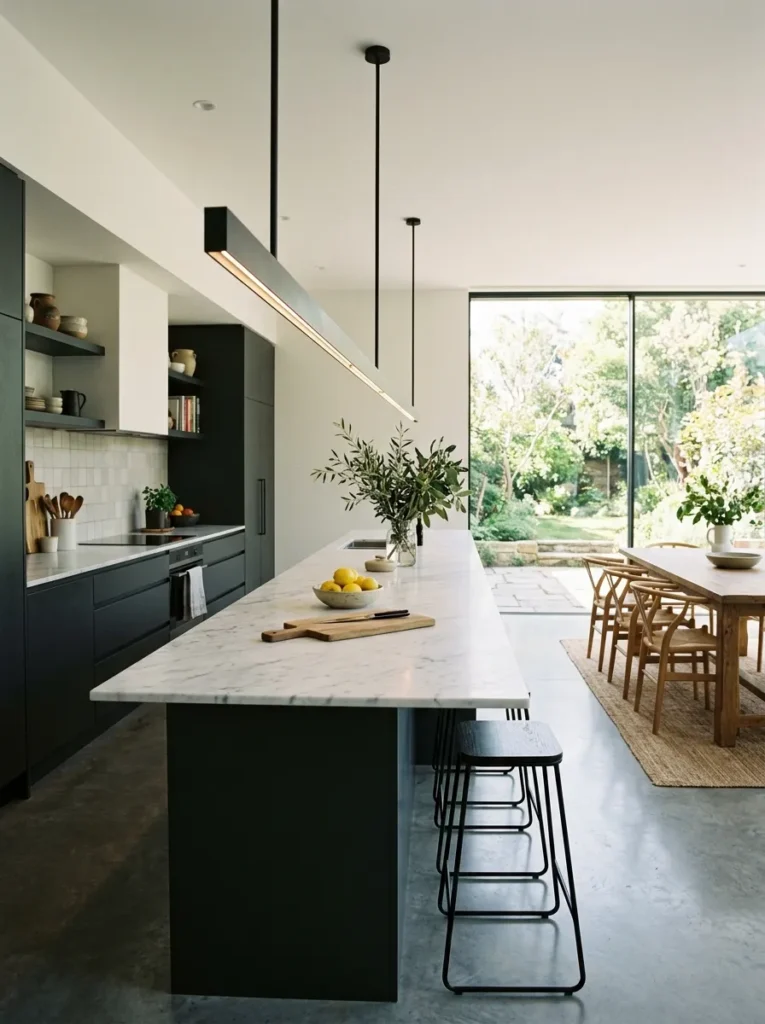
A linear suspension fixture — a single long bar or panel of light, often 60–120cm in length — suits narrow dining tables and kitchen islands better than a cluster of pendants, because the elongated form reads proportionately with a narrow or elongated table surface. Three pendant clusters over a 70cm wide kitchen table can look overly clustered; a 90cm linear bar resolves the same space much more cleanly.
Industrial linear fixtures in blackened steel or matte black suit contemporary and transitional rooms particularly well. Warm-toned linear fixtures in brass or antique bronze suit more traditional dining settings. The dimmability of a linear fixture varies by the LED driver used — it’s worth confirming this with the supplier before purchasing, since non-dimmable LED units cannot be retrofitted.
6. Add Wall Sconces for Atmospheric Evening Light
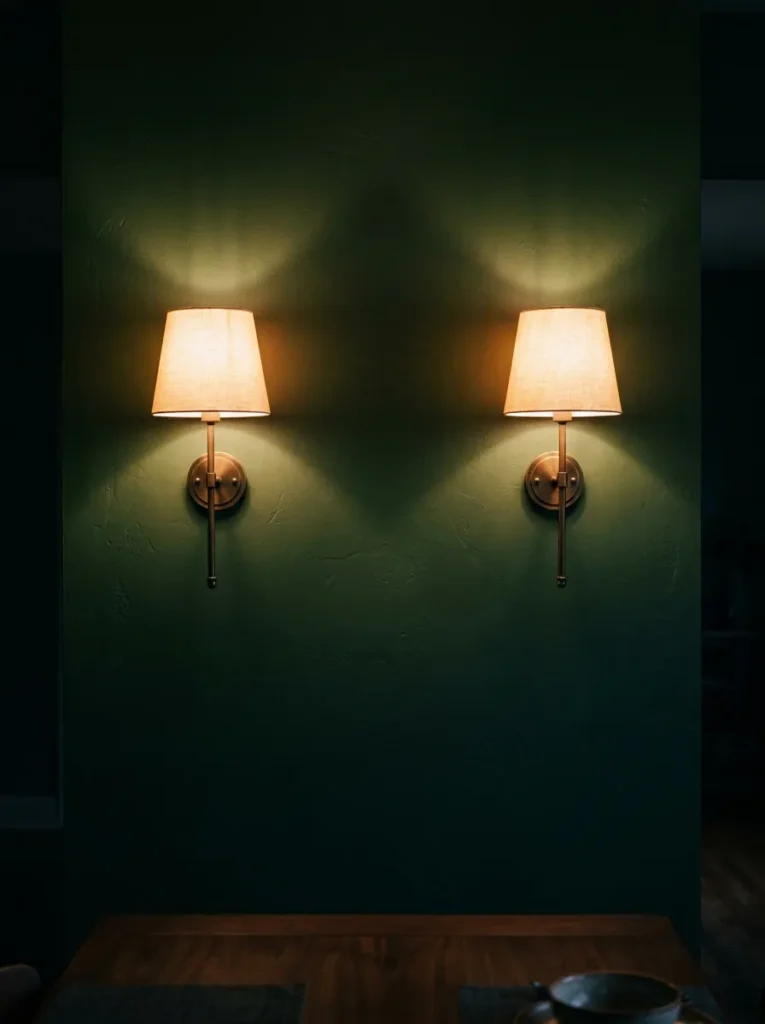
Wall sconces positioned at seated eye level — roughly 140–165cm from the floor — provide light from a direction and height that ceiling fixtures alone cannot. In a dining room, sconces serve the evening function that the overhead pendant handles during the day: they shift the room’s light source from above the head to beside it, which is inherently more flattering and less clinical.
Plug-in wall sconces are a viable option for rental properties where hardwiring isn’t possible — the cord can be run tidily up the wall behind a chair and concealed with a cable clip or a thin cable channel. Fabric-shade sconces cast a diffuse, warm light; open-back sconces in metal or ceramic produce a more directional uplight that suits alcoves and accent positions rather than general dining illumination.
7. Fit a Dimmable Circuit to Every Light Source in the Room
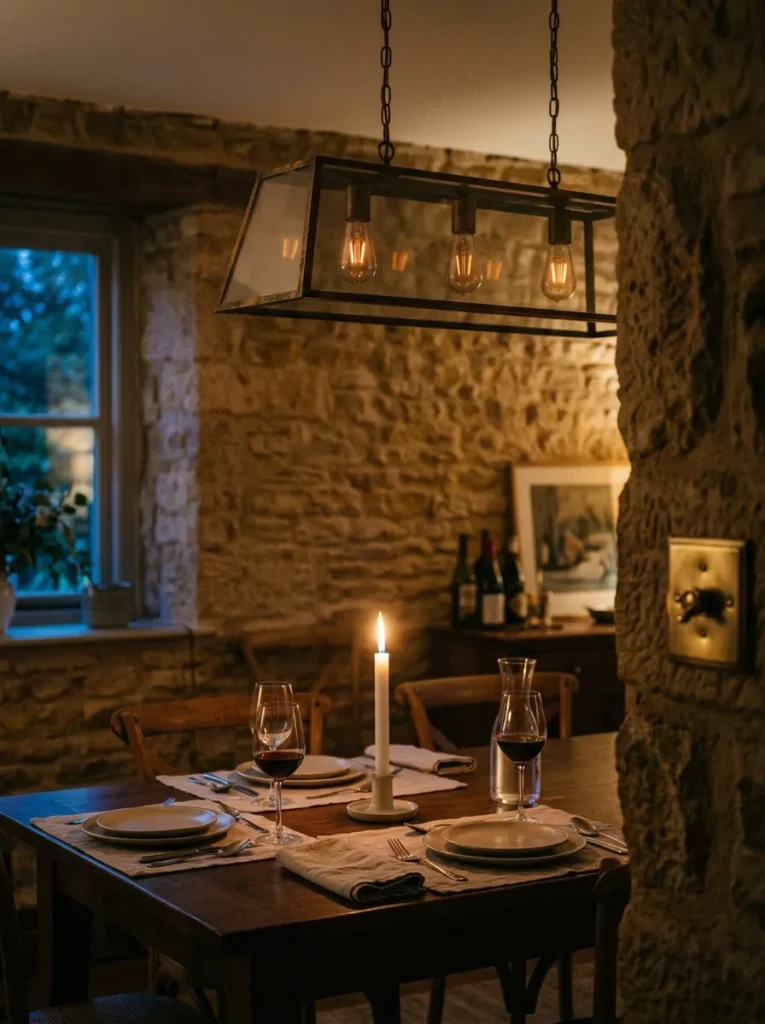
A dining room with only full-brightness lighting cannot adapt to different occasions. Dinner for six guests requires a different light quality than lunch on a weekday morning; candlelit evenings call for a different register than a bright Sunday brunch. A dimmer on the pendant or chandelier circuit is the single change with the widest impact on how a dining room functions across its different uses.
LED bulbs and dimmer compatibility require specific attention: not all LED bulbs dim smoothly, and some produce a flicker or hum at low settings that defeats the purpose. Trailing-edge (or leading-edge) LED-compatible dimmers eliminate most of these issues and are available at no significant price premium over standard dimmers. Specify the dimmer and the bulb together rather than adding a dimmer to existing bulbs, which can cause compatibility problems.
8. Specify Warm-White Bulbs Consistently Across All Sources
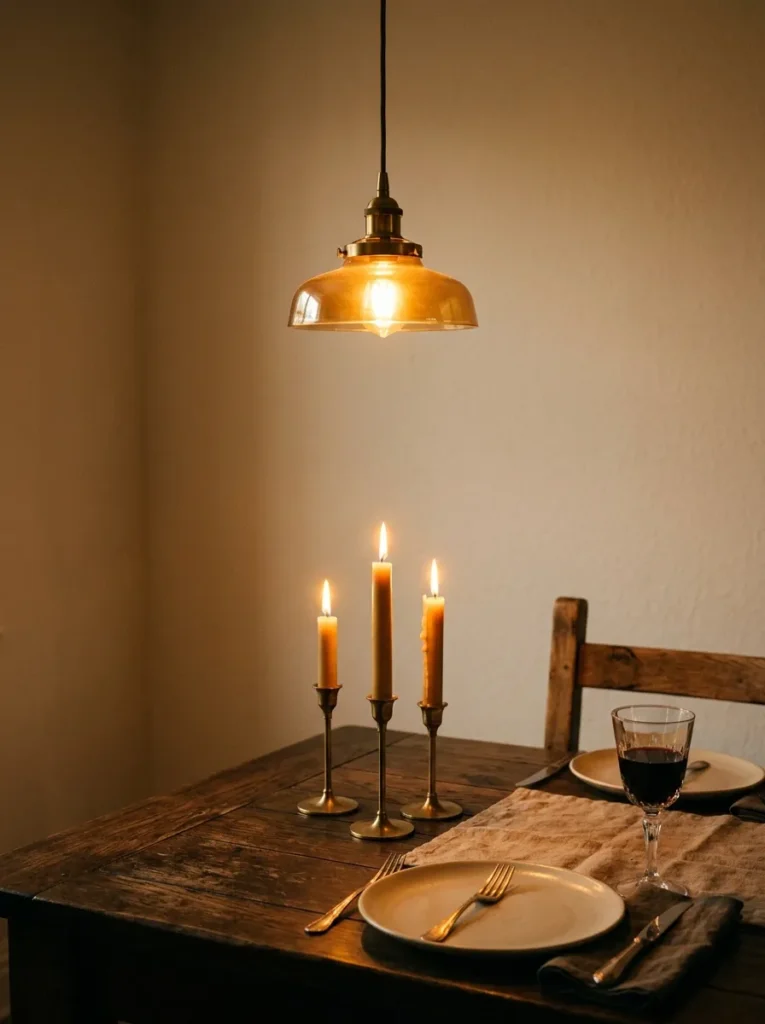
The colour temperature of the bulbs in a dining room determines whether the room reads as warm and welcoming or cool and clinical. Bulbs at 2700K (warm white) enhance the colour of food, skin tones, and most interior materials — wood looks richer, textiles read warmer, and plaster walls glow. At 3000K (white), the same room reads slightly cooler and more contemporary. Above 3000K, the room starts to feel like a kitchen or an office rather than a dining space.
The common mistake is mixing bulb colour temperatures across different light sources in the same room — a 2700K pendant with 3000K recessed spotlights produces a quality of light that reads as discordant and slightly off without the reason being immediately obvious. Use the same colour temperature consistently across all fixtures in the room.
9. Install Recessed Spotlights on a Separate Dimmer Circuit as a Functional Layer
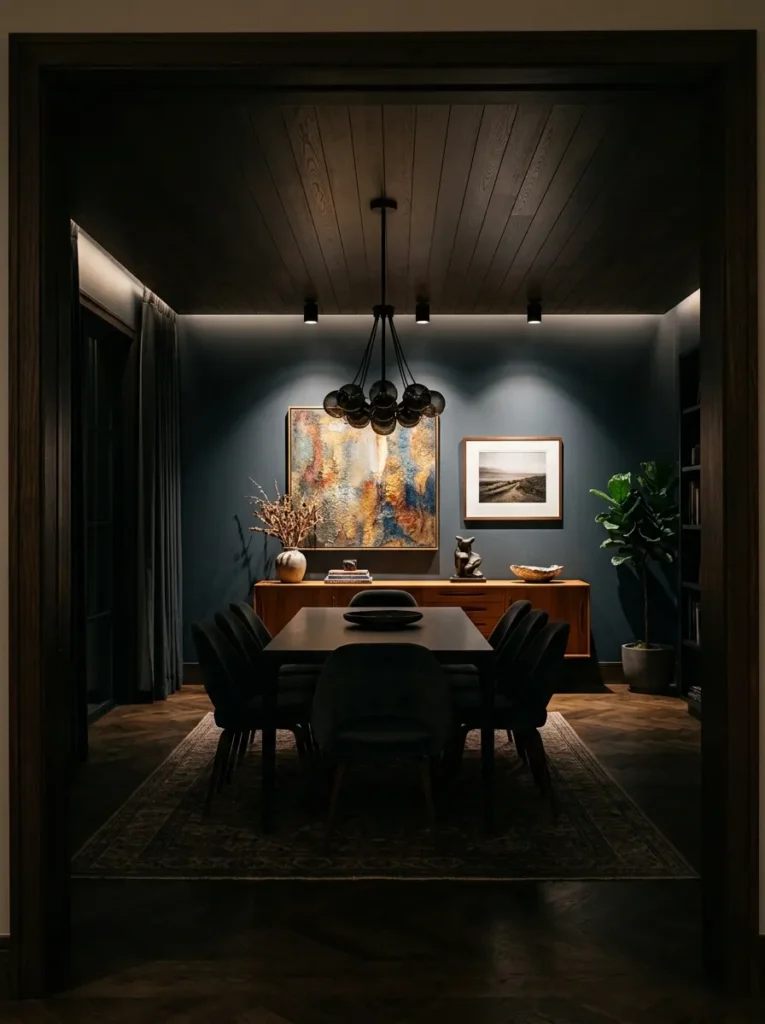
Recessed spotlights provide a practical overhead layer that pendants and chandeliers — which direct most of their light downward onto the table — don’t cover. Wall art, a sideboard, and the room’s perimeter generally fall outside the cone of table-focused pendant light, which means the room can look pooled and patchy in the evening without a supplementary source.
A circuit of recessed spots on a separate dimmer allows the perimeter of the room to be illuminated independently of the dining table fixture. At full brightness they make the room functional for clearing up; at 15–20% they add a subtle ambience wash that supplements the pendant without competing with it. Position them to illuminate the walls and sideboard rather than pointing directly at the table, which would create competing sources.
10. Consider a Flush-Mount Fixture in a Room With Low Ceilings
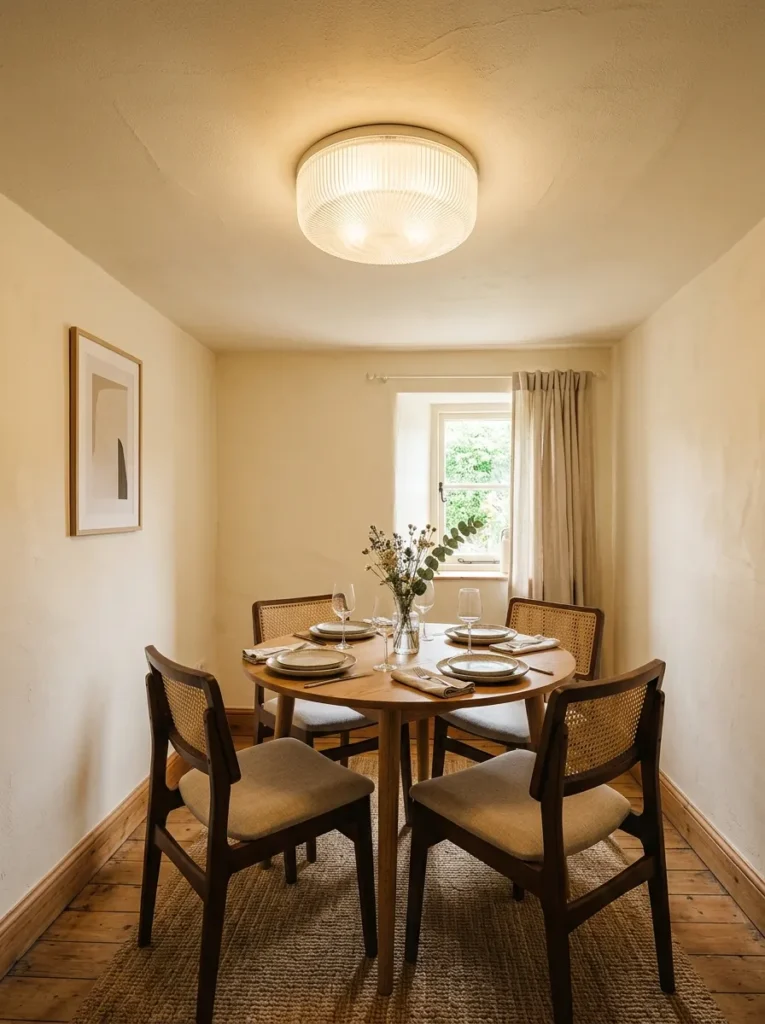
A pendant or chandelier with a drop below 30cm in a room with less than 2.4 metres of ceiling height can feel uncomfortably close to the heads of seated guests when they stand. Flush-mount ceiling fixtures sit directly against the ceiling surface with no drop, which preserves headroom and still provides the visual presence of a designed fitting rather than a plain ceiling rose.
Contemporary flush-mount designs in ribbed glass, aged brass, and matte black finish have significantly improved over the past decade — the category no longer means a flat dome pressed against a white ceiling. A flush-mount with a quality fitting can read as a deliberate design choice in a low-ceilinged room where a pendant would feel cramped.
11. Use a Lantern-Style Pendant for a Traditional or Transitional Room
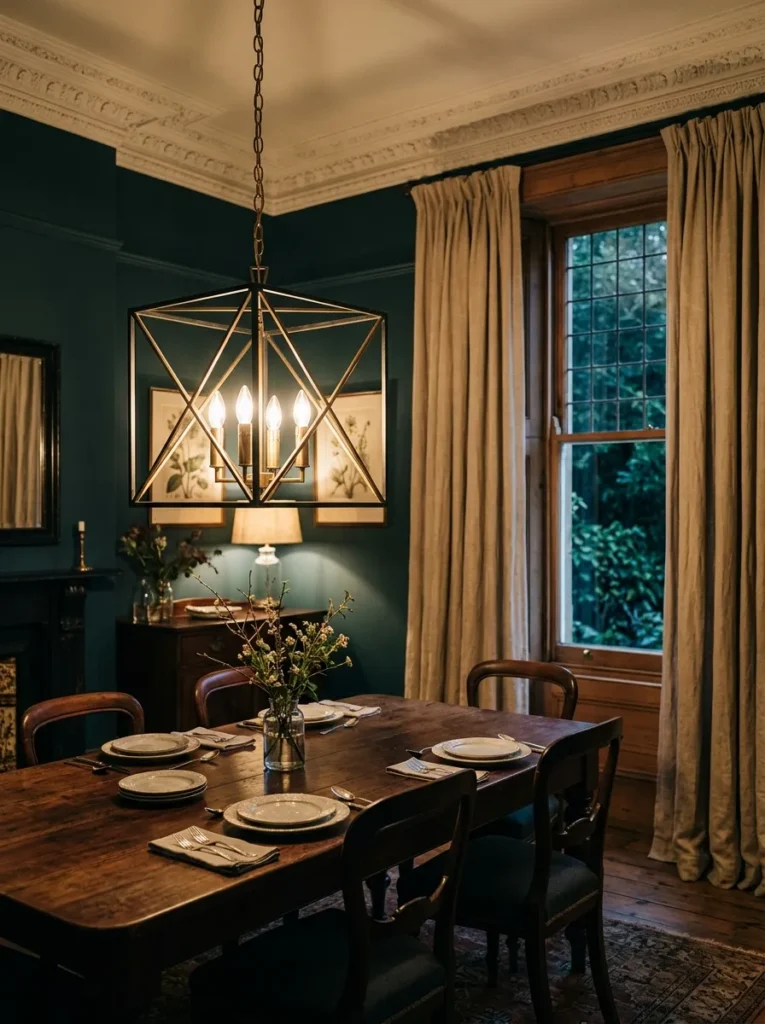
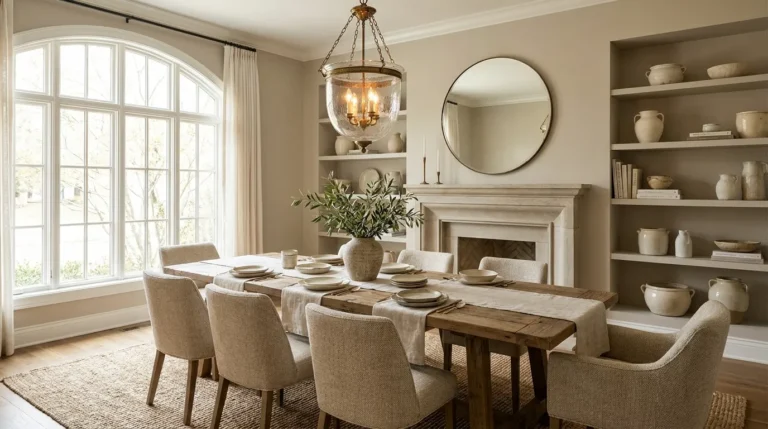
A lantern pendant — a hanging fixture with a cage or frame structure enclosing the light source, typically in metal — reads as a more traditional or transitional choice than a standard drum shade or globe pendant, and suits dining rooms in period properties, farmhouse interiors, or classically styled homes. The open frame allows the light source to be partially visible, which produces a different visual effect than an opaque shade: more sparkle, more reference to candlelight.
Lanterns work well at both the single-statement scale and in grouped pairs or trios. In a high-ceilinged room with a long table, two matching lanterns hung in parallel over the table’s length read as architectural rather than decorative — the framed structure becomes part of the room’s composition.
12. Try a Sculptural Ceramic or Papier-Mâché Pendant as a Statement Piece
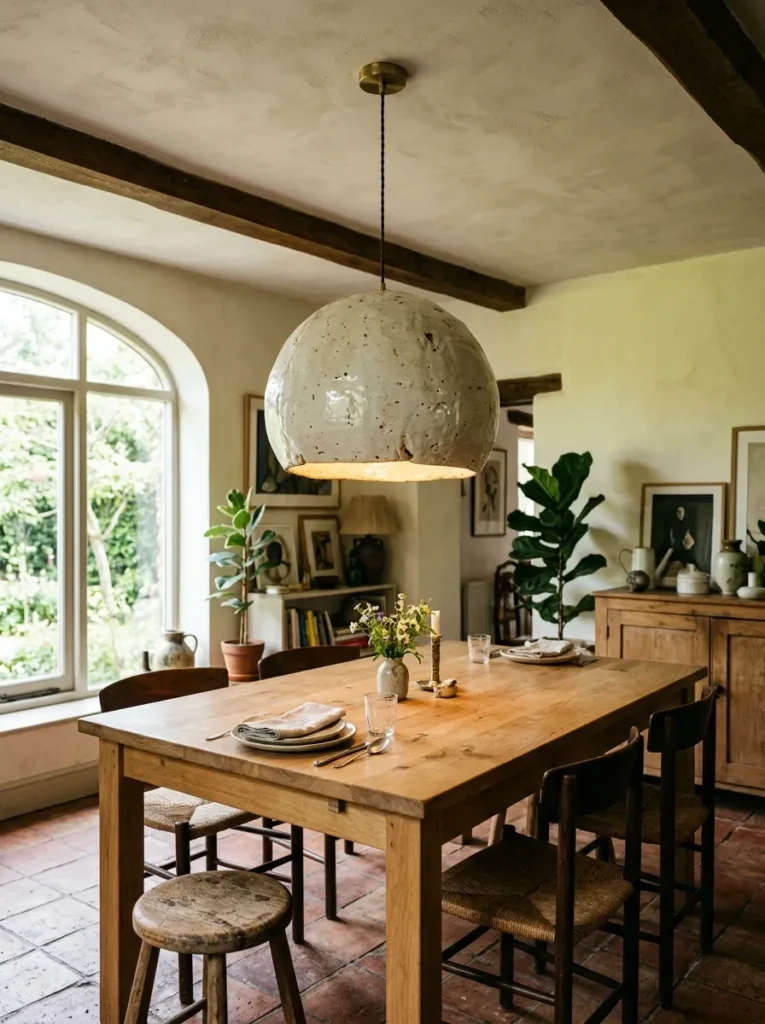
Lighting fixtures made from ceramic, papier-mâché, or hand-formed materials occupy a distinct territory between functional object and art piece — they’re visible in a room when switched off as well as on, which means they contribute to the daytime visual of the space in a way that most standard pendants don’t. A large, irregular ceramic pendant in a warm earthy glaze or a sculptural papier-mâché form in a pale tone can be the room’s most distinctive detail without requiring architectural change.
These fixtures tend to suit dining rooms with a considered, eclectic, or artisan aesthetic better than highly formal or contemporary settings where precision and consistency are the visual logic. They’re available across a wide price range and some of the most characterful examples come from independent makers and small-batch production rather than large lighting retailers.
13. Light the Sideboard With Picture Lights or a Table Lamp
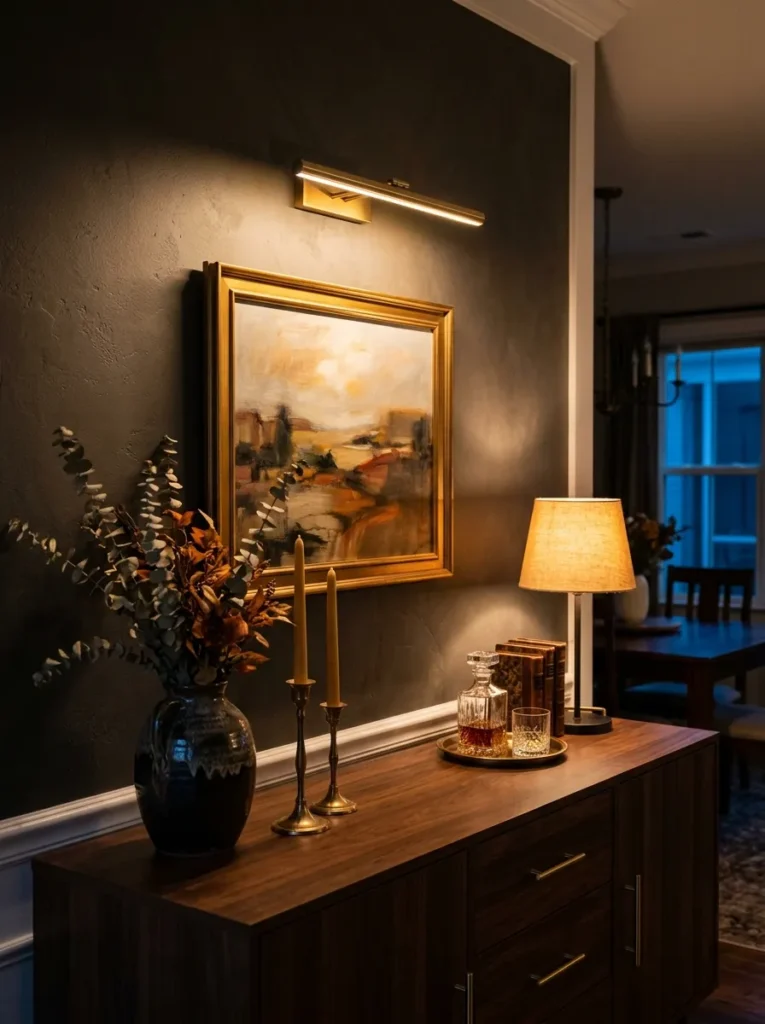
A well-styled sideboard in a dark dining room disappears without its own light source. The table lamp approach — a medium-height lamp at one end of the sideboard surface, switched independently from the overhead circuit — gives the sideboard its own zone of warm light that contributes to the room’s overall layered quality in the evening. It’s also practical: a lamp at sideboard height provides useful light for serving without needing to turn on the full overhead circuit.
Picture lights mounted directly above framed artwork on the sideboard wall direct a thin beam of warm light downward across the frame and surface below. At low cost and with a plug-in option for rental situations, a picture light above a sideboard artwork is the kind of detail that reads as deliberate without requiring any structural work.
14. Use a Dome or Bell-Shaped Shade for Concentrated Table Illumination
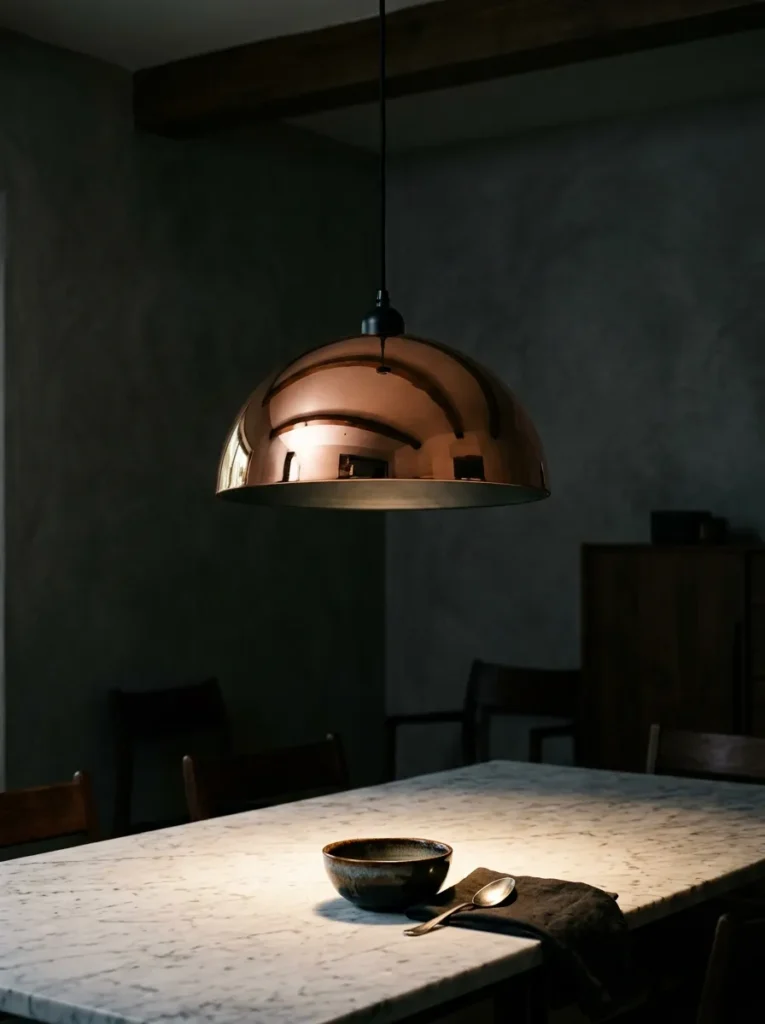
A dome or bell-shaped shade directs all its light downward in a concentrated cone, which is the most efficient form for table illumination — the light goes precisely where it’s needed rather than spreading to the ceiling and walls. This is the shade shape most closely associated with traditional dining rooms and restaurant lighting for exactly that reason: it produces the most intimate, focused quality of light above the table surface.
Dark-interior shades (black or dark metal interiors) concentrate the downward beam more intensely and produce sharper contrast between the lit table and the dimmer room surroundings — an atmospheric effect that suits evening entertaining in a dark-toned room. Light-interior shades (cream, white) spread light more diffusely. The difference is visible enough to be worth considering at the specification stage rather than after installation.
15. Hang an Oversized Globe Pendant for a Modern Minimal Look
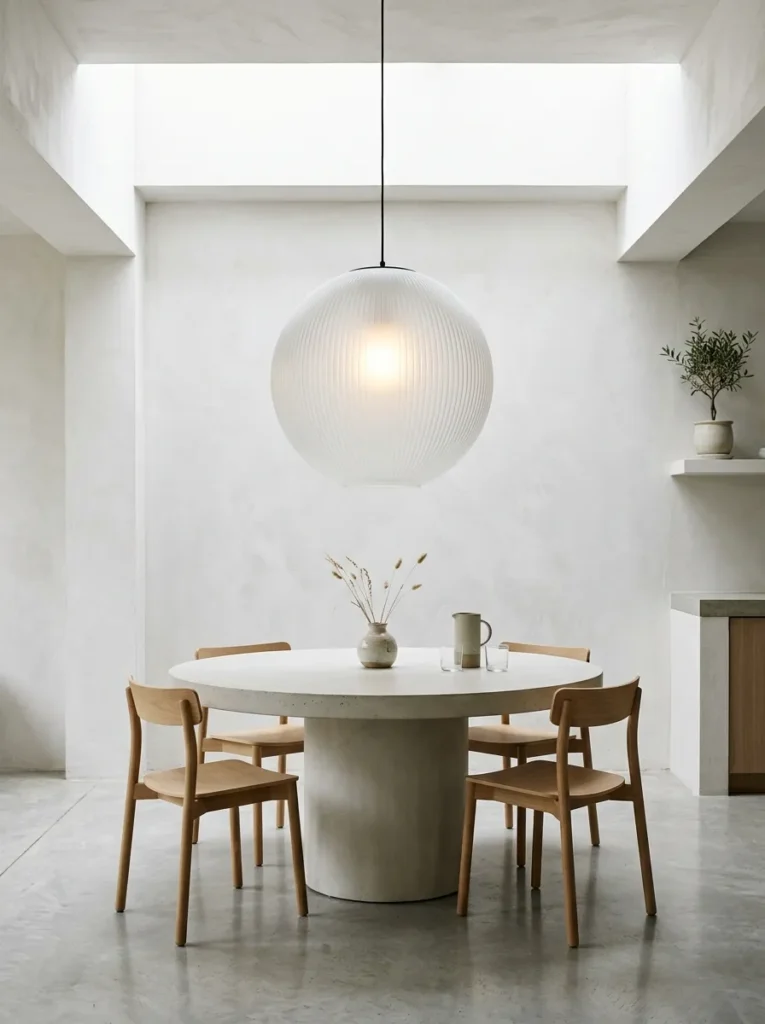
A large glass globe pendant — 40–50cm or more in diameter — makes a strong visual statement as a solo fixture over a round or square dining table. The scale of the globe reads as proportionate to the table below and, when in mouth-blown or ribbed glass rather than plain clear glass, the globe itself becomes an interesting object in the room’s composition.
Smoked glass globes suit darker, more atmospheric dining rooms and produce a warm amber glow rather than a bright diffuse light. Opal glass globes read softer and suit a wider range of palettes. Ribbed or reeded glass diffuses the internal bulb while adding surface texture visible from across the room. A globe pendant at this scale generally reads best as a single fixture above a single round table rather than in multiples, where the repetition can feel heavy.
16. Frame the Dining Zone in an Open-Plan Space With Pendant Position
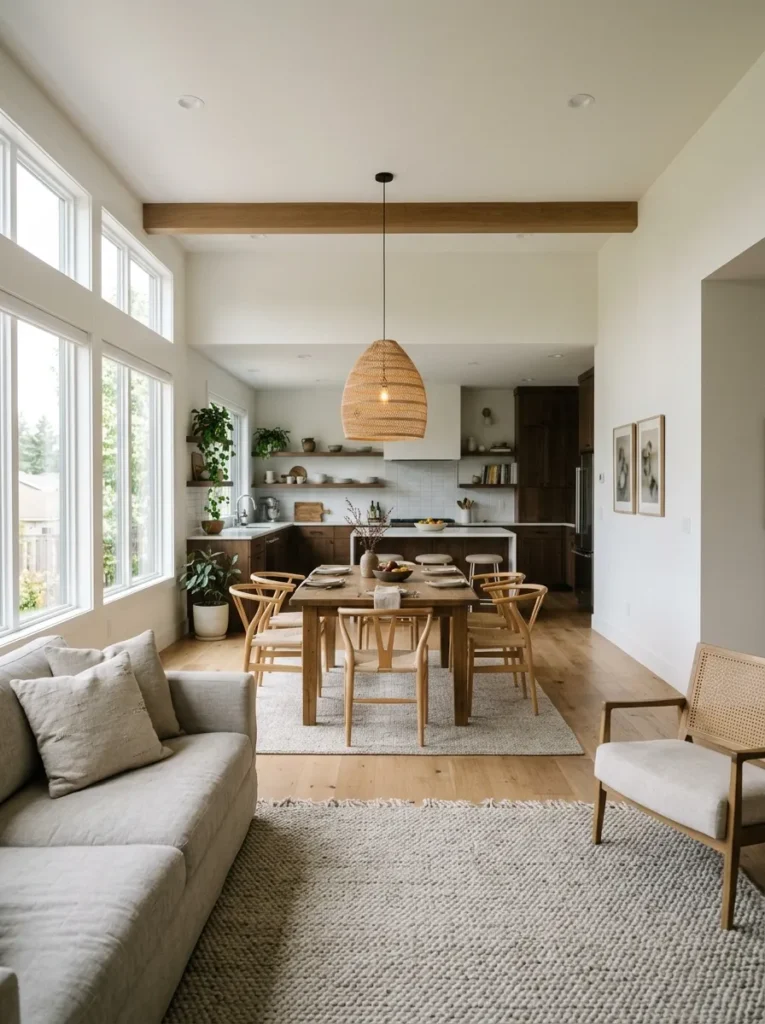
In an open-plan kitchen-dining room, the pendant or chandelier position is more than an aesthetic choice — it defines the dining zone visually within the larger space. A pendant positioned exactly over the dining table (rather than between the kitchen and dining area, or off-centre relative to the table) anchors the table as its own destination within the room and prevents the dining area from reading as simply the part of the open plan where the table happens to be.
The fixture’s positioning matters in relation to the kitchen ceiling — make sure the drop from a taller ceiling zone doesn’t create a height mismatch if the kitchen has a lowered ceiling section nearby. The pendant should relate to the table, not to the room’s overall ceiling geometry.
17. Choose a Brass or Warm Metal Finish for a Timeless Quality
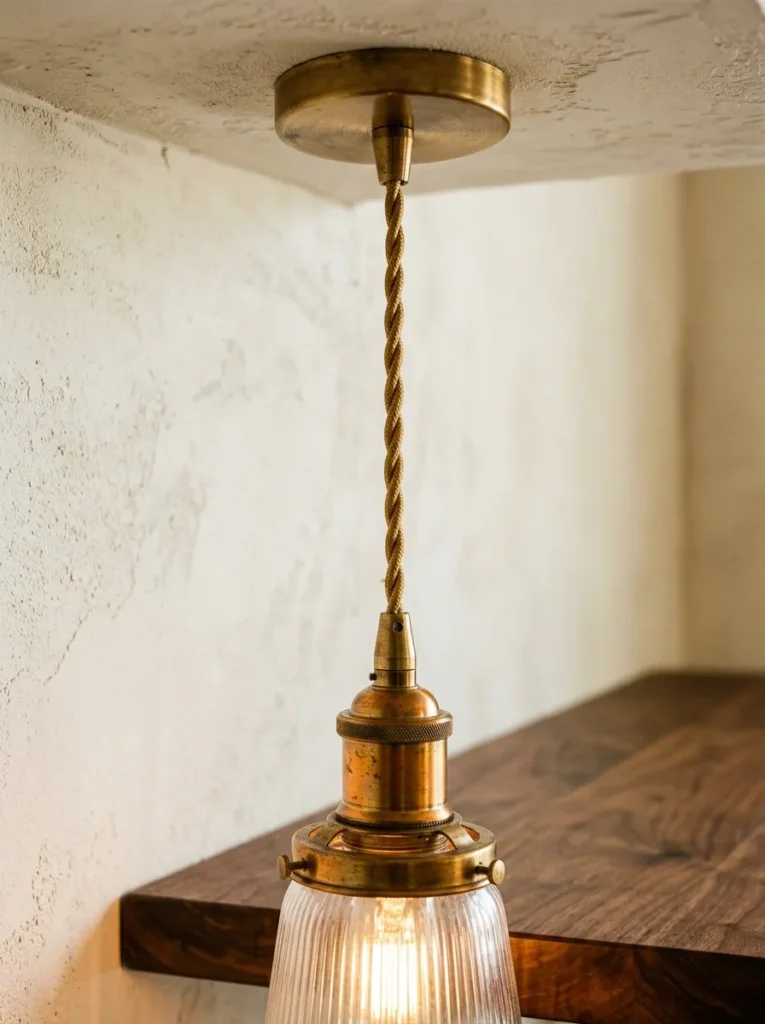
The metal finish on a dining room pendant, chandelier, or sconce affects the colour of the light it reflects back into the room. Aged brass and antique bronze both carry warm-toned reflections that read with warm-white bulbs and enhance the quality of evening light in the room. Chrome and brushed nickel carry cooler reflections that produce a slightly different light quality in the same conditions.
Warm metal finishes suit dining rooms aiming for an inviting, settled evening quality more consistently than cool finishes, which suit a more contemporary, crisper aesthetic. The finish should ideally relate to other metal elements in the room — drawer handles on the sideboard, curtain hardware, the dining chair legs — to produce a coherent material language rather than a collection of separate decisions.
18. Combine Candlelight With Electric Lighting for Evening Atmosphere
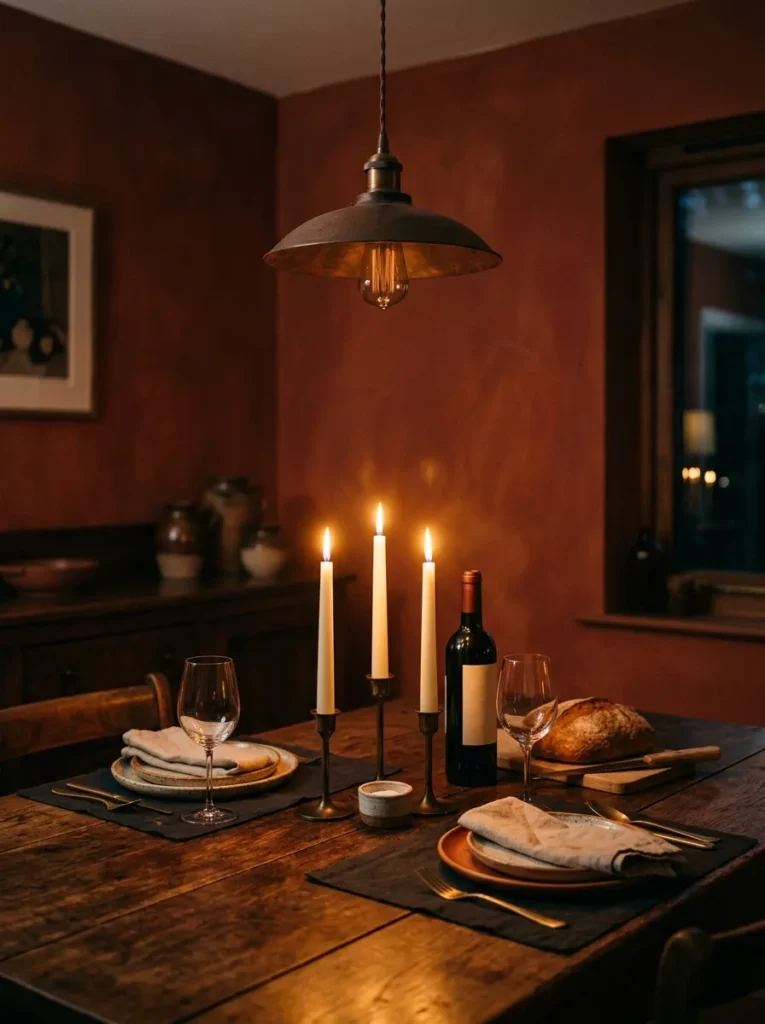
The quality of candlelight in a dining room cannot be replicated by electric light at any price point — the movement, the colour temperature (candlelight sits at approximately 1800–2000K, warmer than any standard LED bulb), and the intimacy of an open flame at table height all produce a different experience than any fixed source. Combining candlelight on the table with a dimmed overhead fixture is the most accessible and effective way to create genuine atmosphere in a dining room for evening entertaining.
Two or three tapers in simple holders are more atmospheric than a mass of candles, which creates more light management than it does atmosphere. Pillar candles in a cluster on a tray at the table centre provide ambient warmth at exactly the right height. Both approaches require trivially little investment and make a significant difference to the quality of the room in the evening.
19. Use a Pendant With a Contrasting Interior Shade Colour
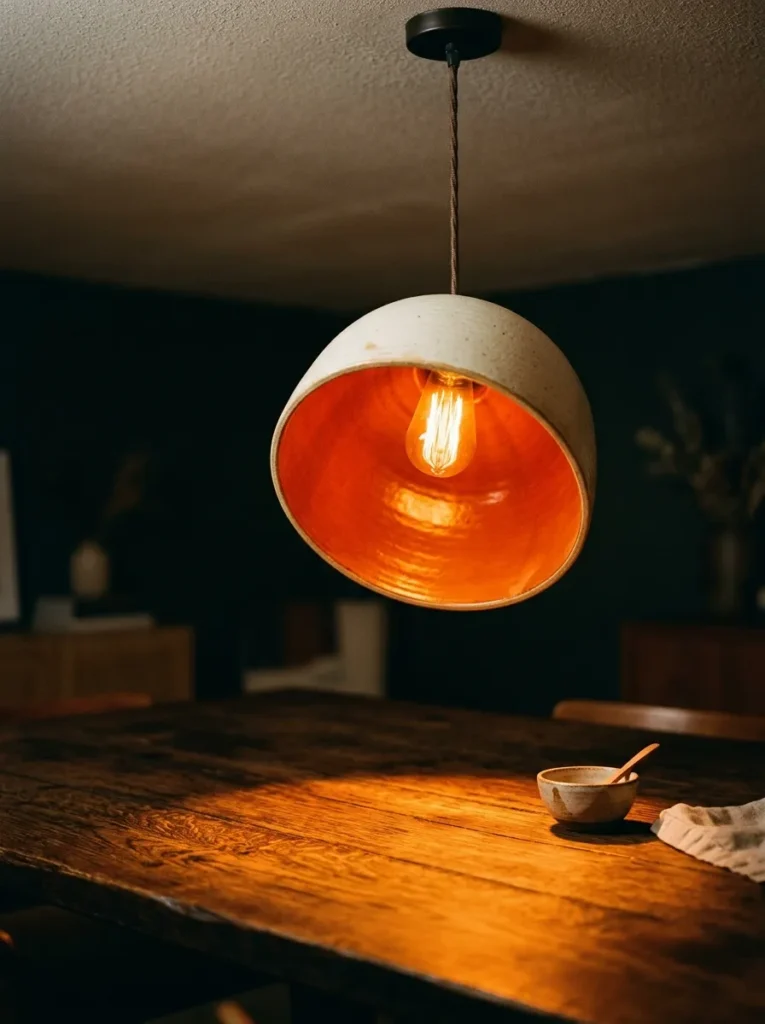
Most pendant shades are white, cream, or neutral on the inside, which produces a diffuse, neutral-coloured light. A pendant with a coloured or metallic interior — deep navy, terracotta, dark green, or gold — reflects that tone back into the pool of light below, adding a specific warmth or richness to the table surface that a white interior doesn’t. A gold-interior shade in a cream pendant produces a warmer, richer light than the same pendant with a white interior. A terracotta interior adds an earthy warmth to the table.
This is a detail most people don’t look for but notice immediately in a room where it’s been applied. It’s also most effective in the evening under low light rather than in daylight, where the effect is less visible.
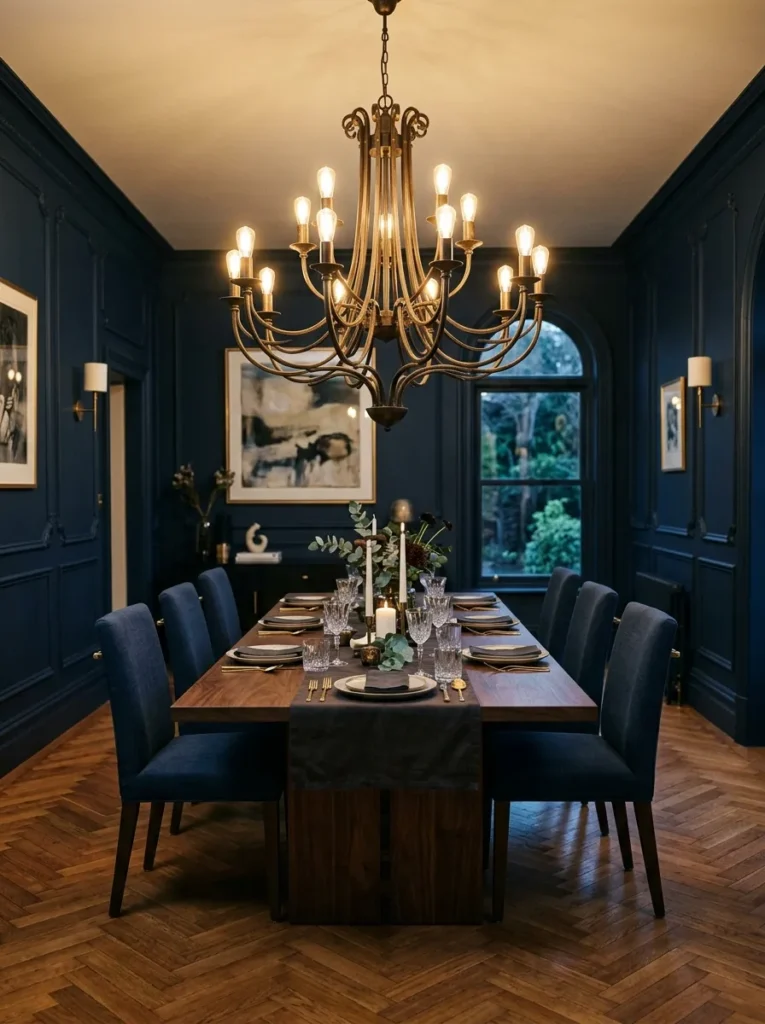
20. Hang a Chandelier With Candelabra-Style Arms for Formal Occasions
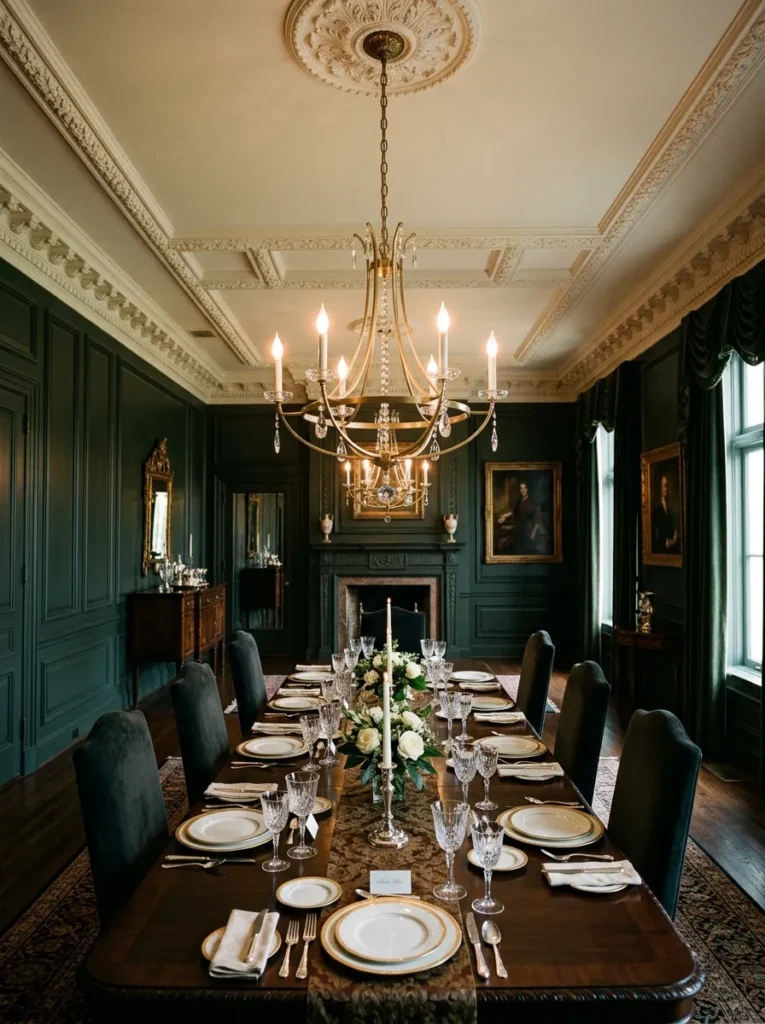
A candelabra chandelier — arms extending from a central column, each holding a small exposed bulb — reads as the most formal and traditionally referential fixture in this guide. It suits period properties, formal dining rooms, and dining spaces where a sense of occasion is the deliberate intention. In a contemporary or casual dining room, the same fixture can read as anachronistic rather than considered.
The scale of candelabra chandeliers needs careful management in lower-ceilinged rooms — the drop of arm-and-column configurations can be longer than a single pendant of equivalent visual size. Confirm the total drop from ceiling to lowest point before ordering, and allow at minimum 200cm from the floor to the base of the chandelier in a room where guests move around beneath it.
21. Position Directional Spotlights to Illuminate Art, Not the Table
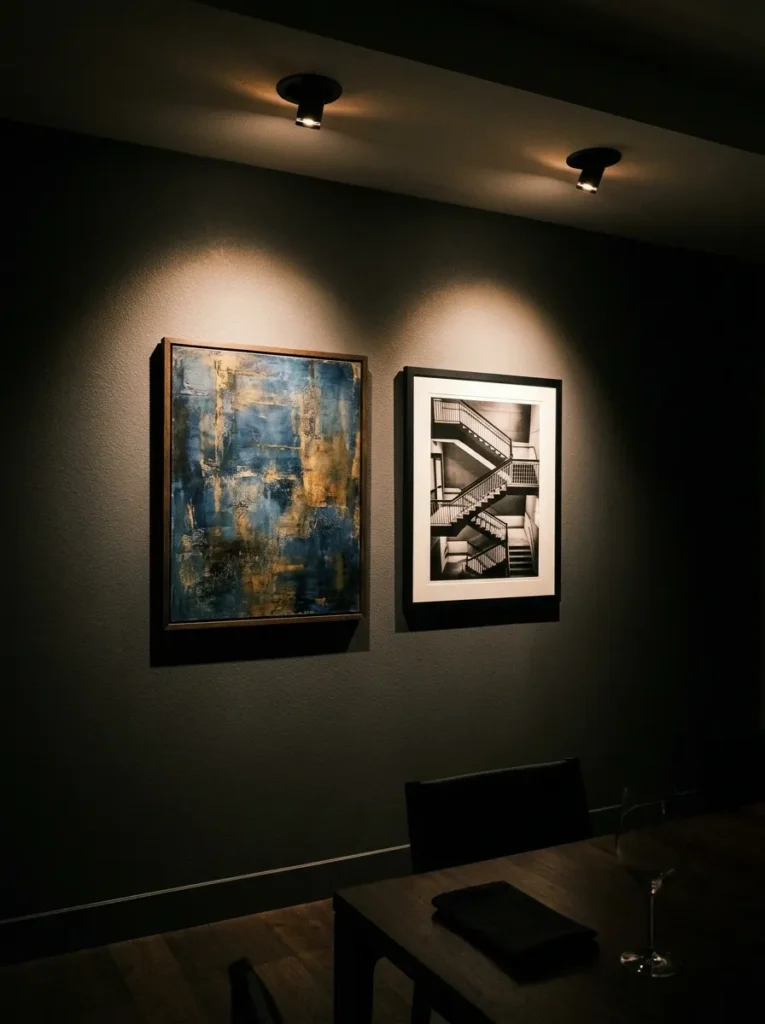
Adjustable spotlights — whether track-mounted or recessed with an adjustable head — in a dining room serve a specific supplementary function when directed at artwork or architectural features on the dining room walls rather than at the table itself. Artwork illuminated from the ceiling creates depth and a gallery-like quality in the room’s perimeter, which the overhead dining table fixture doesn’t address.
Track lighting in a contemporary dining room can accommodate both table and wall positions on the same circuit, with some heads pointing toward the dining zone and others aimed at the walls. This requires planning before the track is installed, since repositioning a fixed track after the fact is a structural job. Adjustable recessed heads allow some repositioning after installation but have a limited range of movement.
22. Leave the Ceiling Plain and Focus Everything at Table and Wall Level
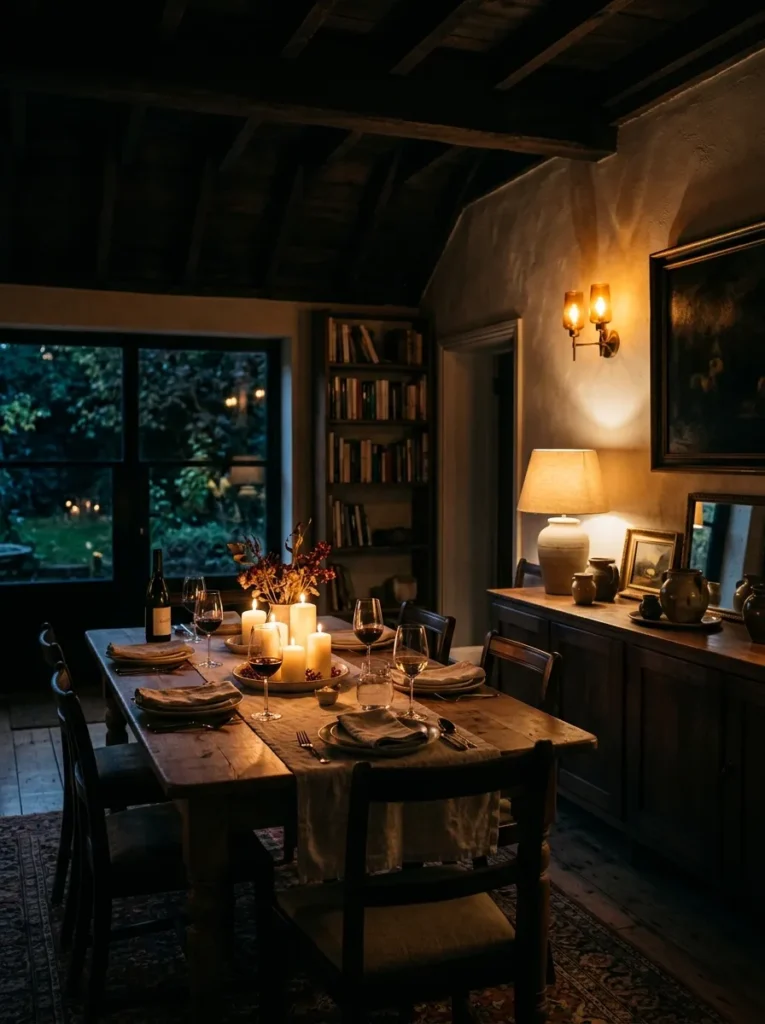
The most unconventional idea in this list is not about what fixture to hang from the ceiling but about choosing not to make the ceiling the primary light source at all. A dining room lit entirely from table level (a large table lamp at one end of a long table, clusters of candles at the other), wall level (sconces either side of the room), and a sideboard lamp in the corner produces a genuinely restaurant-quality atmosphere without a ceiling fixture at all.
This approach requires more light sources to maintain the same total lux — useful context is that this approach suits evening entertaining rooms rather than rooms that also need to function as a bright family dining space in daylight. It’s also more practical in rental properties where hardwired ceiling fixtures are fixed and unreplaceable — all the actual atmosphere work happens below ceiling height on plug-in sources.
Common Mistakes That Undermine Dining Room Lighting
Hanging the pendant too high. Above 85cm from the table surface, most fixtures effectively disconnect from the dining composition and read as room lighting rather than table lighting. The 70–80cm range is the zone where most rooms and fixture types work best.
Using cool-white bulbs. Bulbs above 3000K make food less appetising and the room less welcoming in the evening. Replace cool bulbs first — it’s the cheapest lighting upgrade available.
Installing a single light source on a fixed switch. No dimmer means no ability to adjust the room’s atmosphere across different uses. If hardwiring a new dimmer isn’t feasible, a plug-in lamp on a separate circuit achieves the layering that a single overhead source can’t.
Choosing a fixture too small for the table. A pendant or chandelier that’s visually insufficient for the table below it reads as an afterthought rather than a considered choice. Scale the fixture to the table, not to some abstract standard of restraint.
Mixing metal finishes carelessly. A brass pendant with chrome chair legs and a nickel sideboard handle doesn’t constitute intentional material variety — it reads as a room where separate decisions were made in isolation. Identifying one or two metal finishes and applying them consistently produces a more resolved result.
Final Thoughts
Dining room lighting ideas span everything from the practical (height and scale) to the atmospheric (colour temperature and layering) to the purely visual (fixture shape and finish). The most useful starting point for most rooms isn’t choosing a fixture style — it’s auditing what the existing lighting actually does wrong. Too high, too bright, wrong colour temperature, only one source: those are the four most common problems, and each has a solution that doesn’t necessarily require new hardwiring.
Once the functional baseline is right, the fixture becomes a design decision rather than a technical one. Save the ideas in this guide that address the specific gap in your room — whether that’s the table fixture scale, the evening layering, or the perimeter wall lighting — and come back when you’re ready to specify.