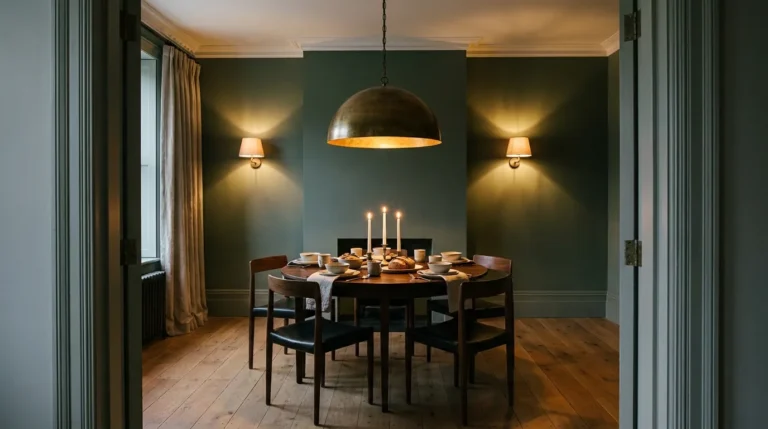
20 Scandinavian Dining Room Ideas That Feel Bright and Airy
Most articles about Scandinavian dining rooms hand you the same checklist: white walls, a light wood table, a pendant light, and a single dried pampas stem. That version is not wrong, exactly, but it has become shorthand for a style that, at its best, is far more considered than a shopping list suggests. A genuine Scandinavian dining room earns its quietness. It is not minimalist by accident or by budget — it is restrained by conviction, layered with texture, and lit with an almost obsessive attention to warmth. The twenty ideas here are about understanding the principles that make this aesthetic work, so what you build feels lived-in rather than assembled.
1. Start with a Table That Has Real Weight
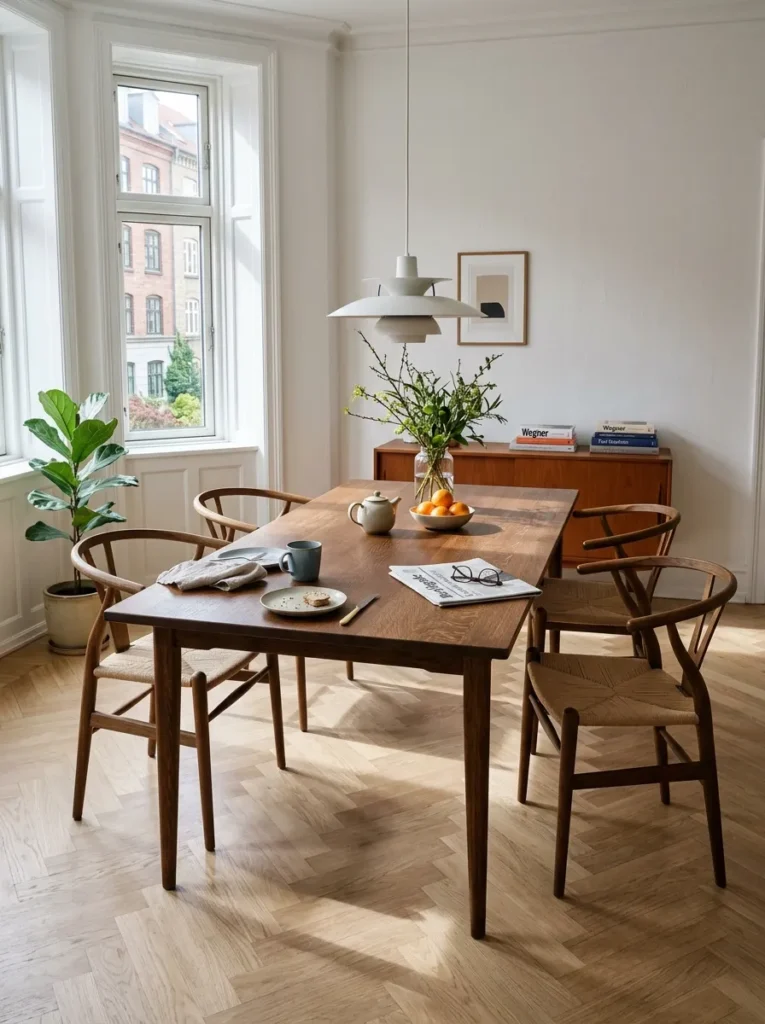
The table is where every decision in this room either comes together or quietly falls apart. In a Nordic dining space, the temptation is to reach for something pale and slim-legged, and while that can work, the rooms that photograph best — and feel best to eat in — tend to anchor the space with a table that has genuine visual weight. A solid smoked oak table with a matte finish, for instance, grounds the room without darkening it. The grain becomes part of the texture story.
Avoid tables with too much visual busyness in the base. Turned legs, ornate stretchers, anything that competes with the silence above it — these work against the whole approach. A simple trestle base or a four-leg construction with a slight taper at the foot is almost always the better decision.
2. Use Linen Chairs Instead of a Matching Dining Set
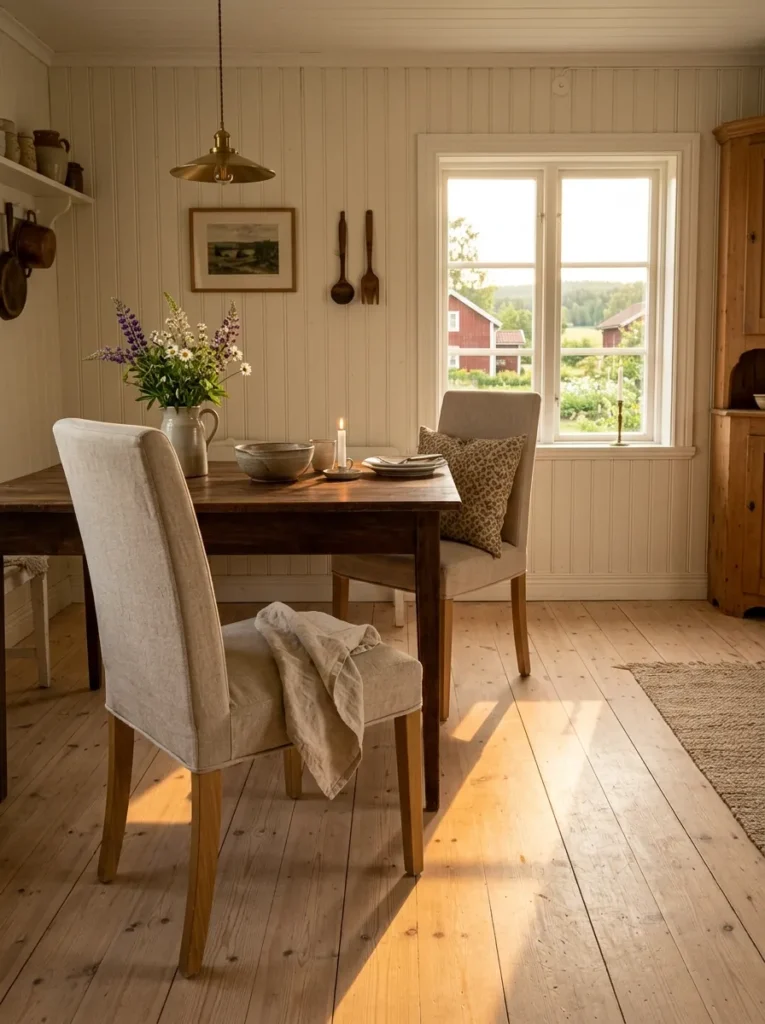
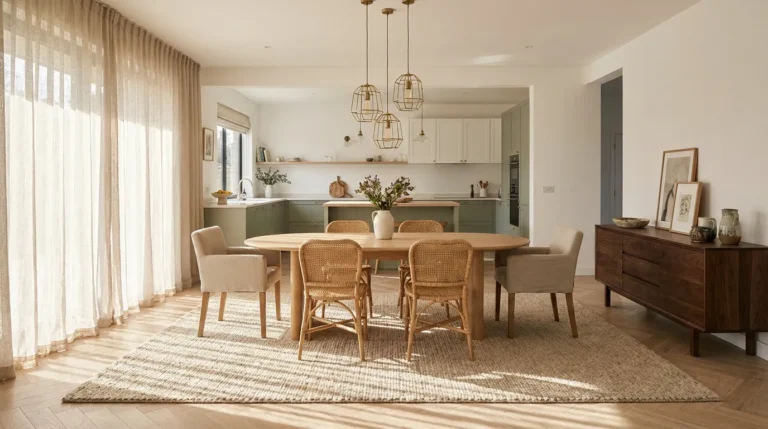
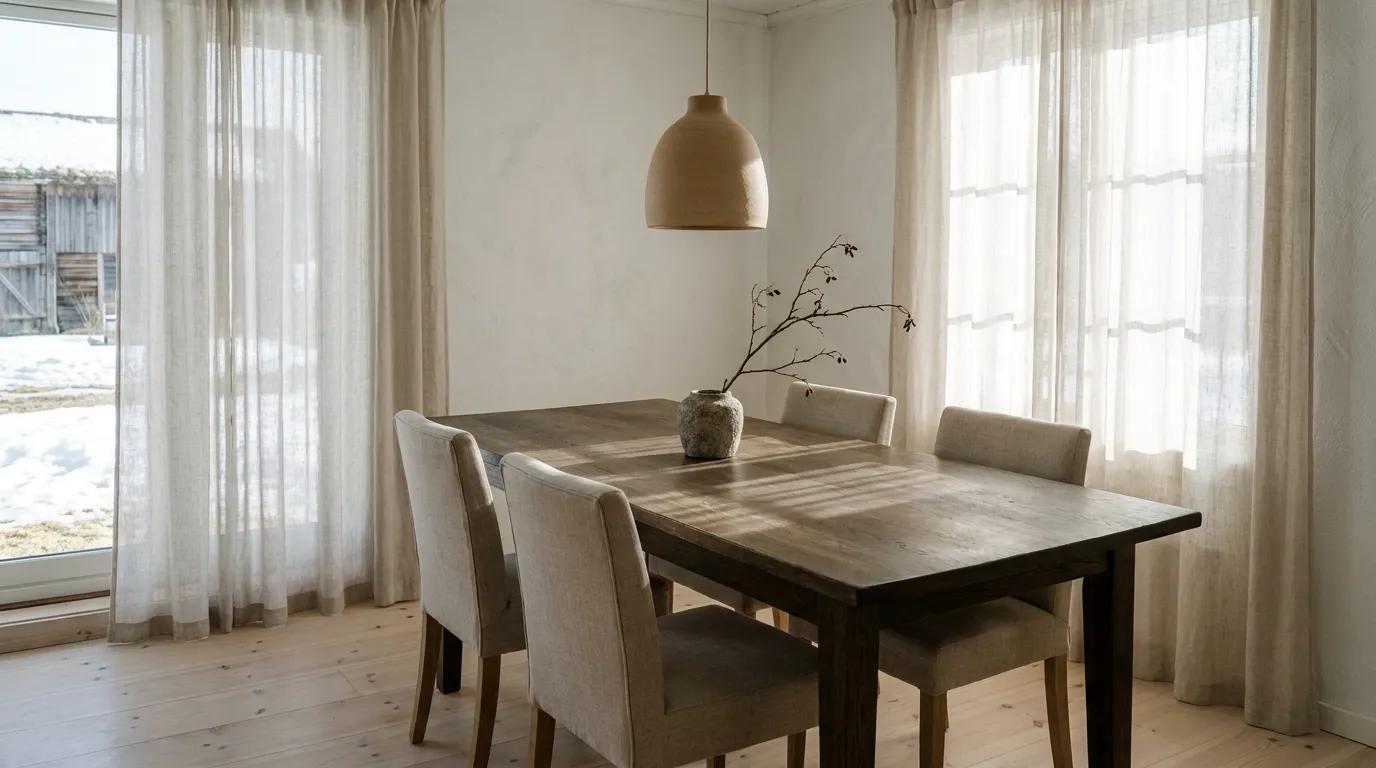
The matching dining set is the safer choice and almost never the better one. When every chair matches the table and every cushion matches the chair, you end up with a room that looks like a furniture showroom floor. Nordic interiors have long understood that a table in one material and chairs in another — linen upholstery, for instance, against a smoked oak surface — creates a conversation between elements that makes the room feel curated rather than purchased.
Natural, undyed linen is the fabric that ages the best in a dining room context. It softens with use, develops a slight texture over time, and photographs in that particular muted, slightly warm way that performs well on Pinterest. If you go this route, skip the piped edges and the button-tufting. Flat, clean upholstery with a barely-there welt seam is the detail that separates the considered choice from the generic one.
3. Hang the Pendant Light Lower Than Feels Comfortable
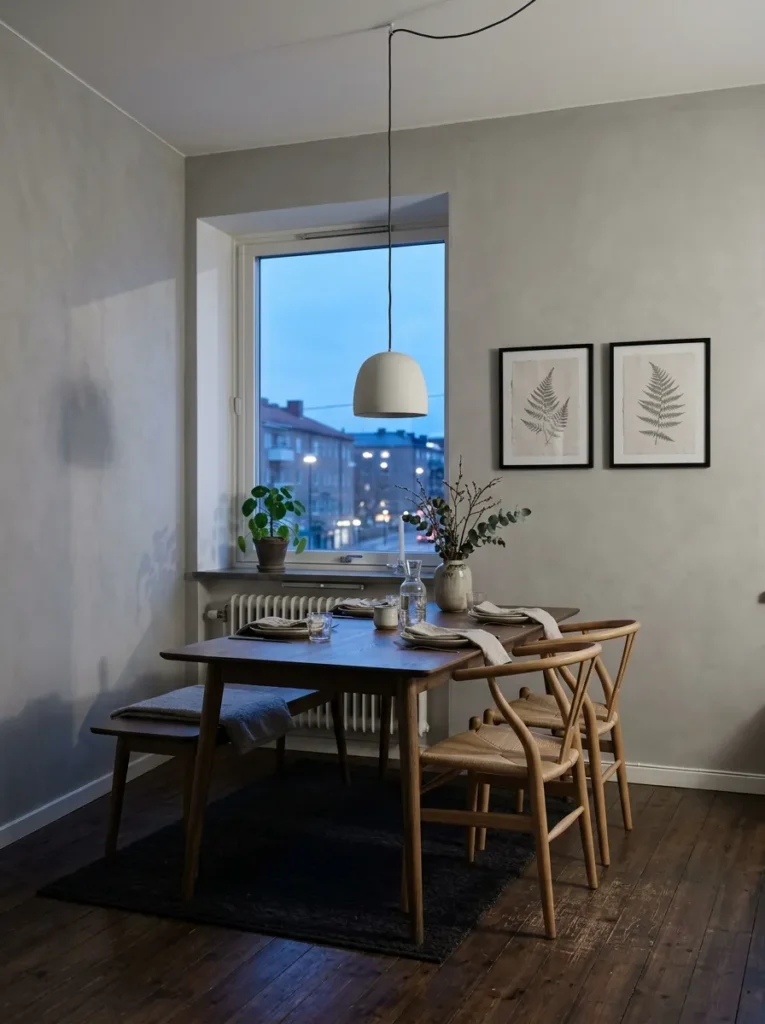
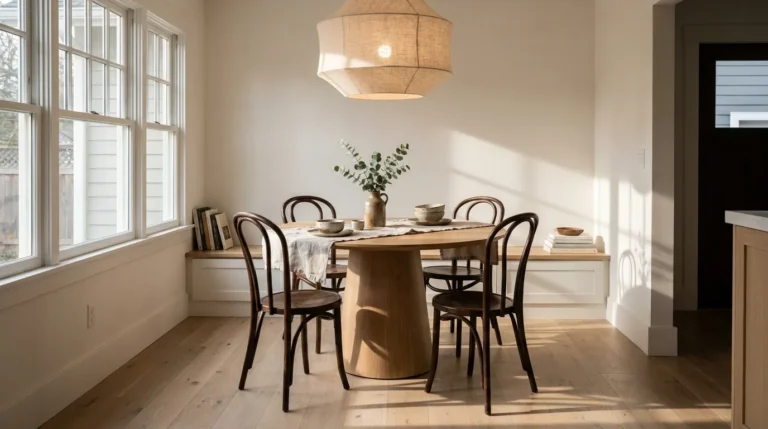
Most pendant lights in dining rooms hang too high. The standard advice is to leave enough clearance so guests can see each other across the table, which results in a light source that does almost nothing for the room — it illuminates the ceiling more than the table, and the room feels like a canteen. The correct position for a pendant above a dining table is 70 to 80 centimetres from the table surface. That feels low the first time you stand next to it. It is correct.
At that height, the light spills onto the table surface in a way that is genuinely warm and intimate, the shade becomes part of the room’s visual hierarchy rather than a fixture you forget about, and the whole room divides horizontally — below the pendant it is warm and human-scaled, above it the ceiling recedes. In a Scandinavian dining setting, a hand-thrown ceramic or woven rattan shade at that height turns the pendant into the room’s primary piece of character.
4. Build the Neutral Palette Around Two Whites, Not One
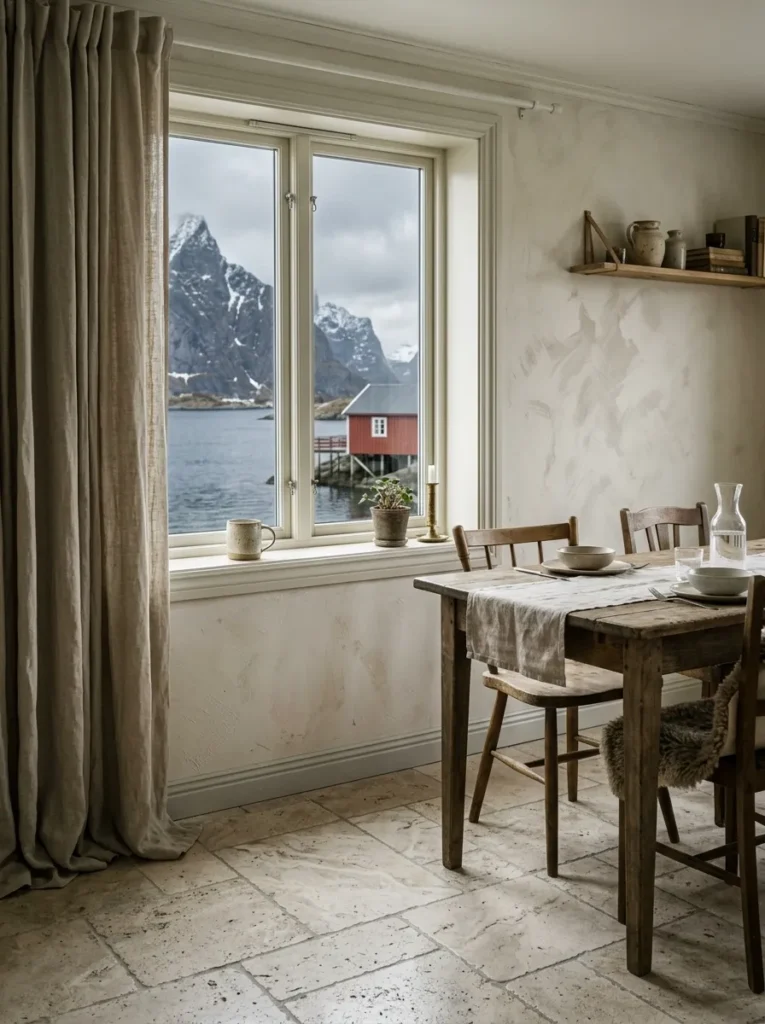
The assumption that a Scandinavian palette means white is half-right. The rooms that actually feel Nordic use at least two different whites — one for walls and one for trim, or one for walls and one for textiles — and the difference between them is what creates depth. A slightly warm white on the walls (something in the off-white or chalk family) reads completely differently against a cooler, cleaner white on painted cabinetry or skirting. The contrast is subtle enough that it does not read as intentional to most visitors, but remove it and the room flattens.
The textile white matters just as much. Warm linen, undyed cotton, and oat-coloured wool all read as white in photographs but add a warmth to the room that a crisp optical white never does. This is the decision that changes everything in a Nordic dining space — not the furniture, not the pendant, but the temperature of the neutrals.
5. Add a Scandinavian Dining Room Gallery Wall with Restraint
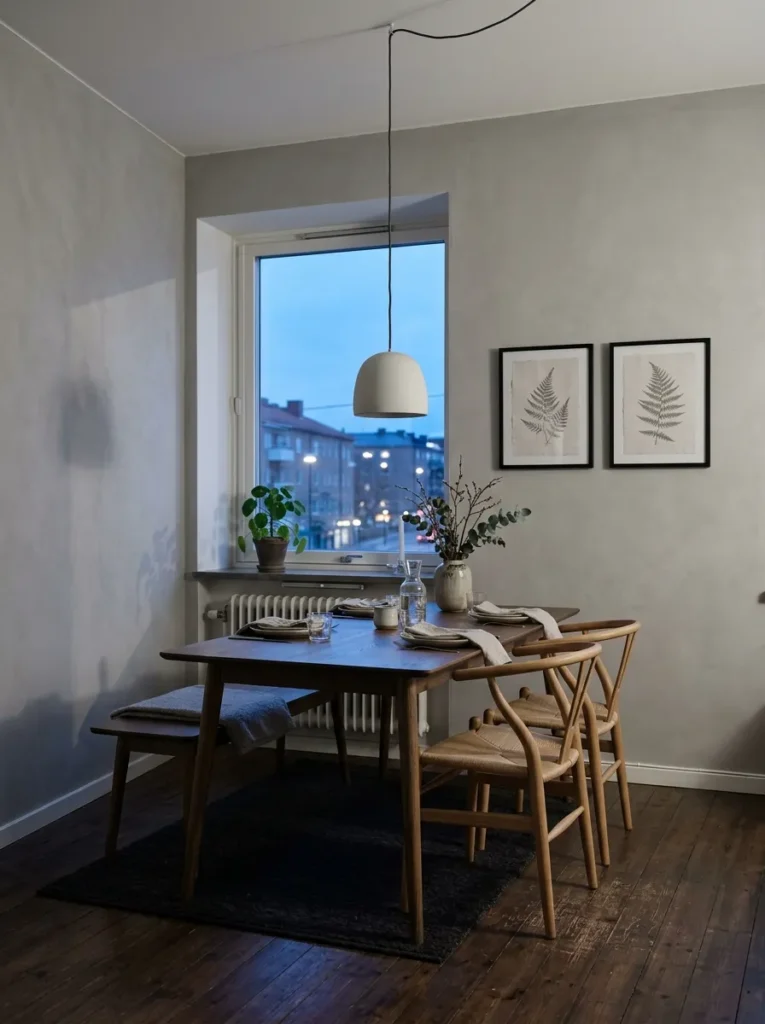
Gallery walls in Nordic spaces are not the maximalist grid of frames that covers every wall in a Victorian townhouse. They are typically two or three pieces, grouped tightly rather than spread across the wall, and the content is almost always botanical, topographic, or abstract in a way that references the natural world without depicting it literally. The frames are thin, often in black or pale ash, and they share a similar scale.
The restraint is the point. A gallery wall in a Nordic-influenced dining room serves as punctuation — it marks one wall as the considered wall without turning it into a statement. Leave the other walls clear. The empty space around the grouping is as important as the pieces themselves.
6. Choose Tableware That Earns Its Place on the Table
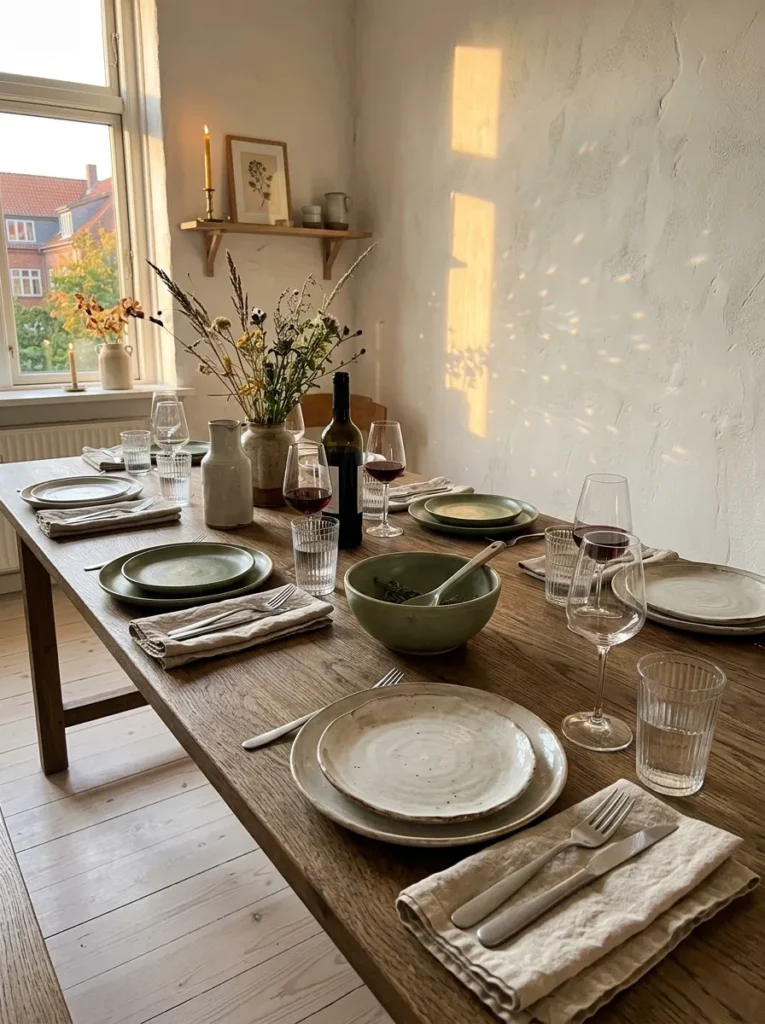
In Nordic homes, the table setting is never an afterthought. Hand-thrown stoneware in soft, uneven glazes — the kind where no two pieces are exactly the same shade of sage or bone — brings more texture to a Scandinavian dining table than almost any other single choice. This is not about expensive tableware for the sake of it. It is about the fact that when plates have visual weight and character, the table looks set even when it is empty.
Paired with unbleached linen napkins folded simply (never origami, never the fan), and simple fluted glassware, this approach turns the table surface itself into a composition. Most people underestimate how much the everyday objects on a table contribute to the room’s feeling. In a Nordic dining room, they are not accessories — they are part of the architecture.
7. Bring in Natural Materials at Every Scale
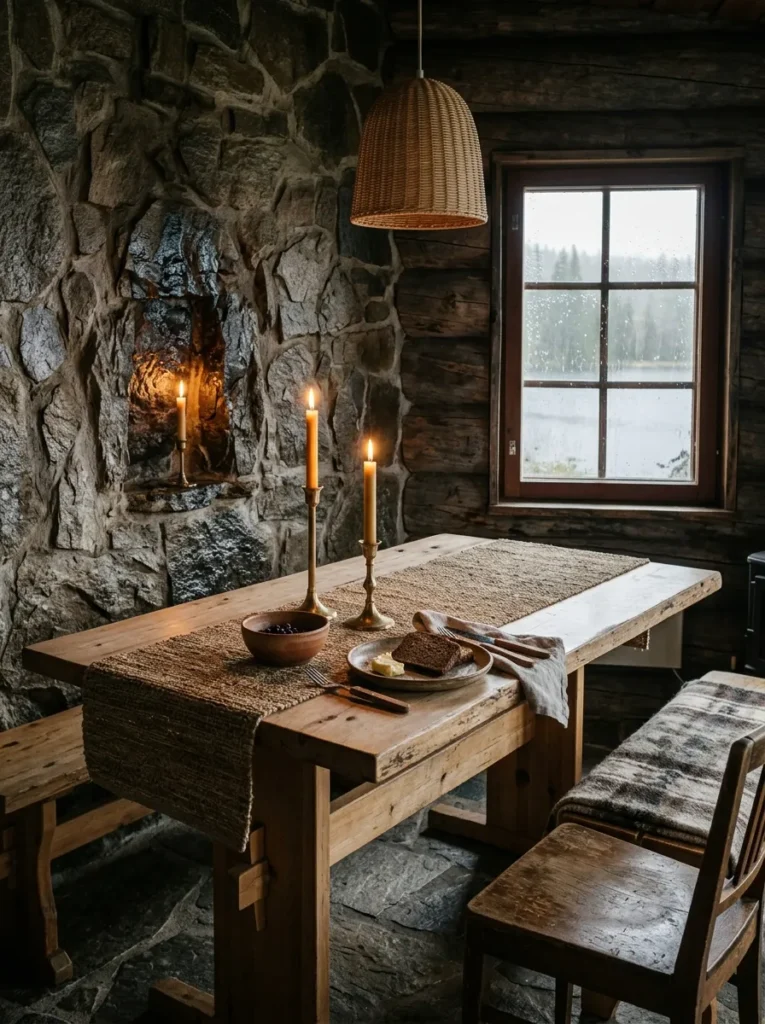
A Scandinavian dining room that relies on a single natural material — say, a wood table alone — misses the depth that makes the style feel genuinely warm rather than sterile. The approach that works is to layer natural materials at every scale: a large stone or wood surface, mid-scale rattan or woven grass in a pendant or tray, and small-scale details in ceramic, linen, or dried botanicals. Each material catches light differently and adds a layer of texture that no paint colour or fabric pattern can replicate.
The specific materials that work hardest in this context are smoked oak, raw linen, hand-thrown clay, unlacquered brass in very small doses, and any stone with visible veining or texture. Polished, sealed, or lacquered versions of these materials tend to flatten the effect. The slight imperfection is the point.
8. Use a Single Oversized Plant Instead of Multiple Small Ones
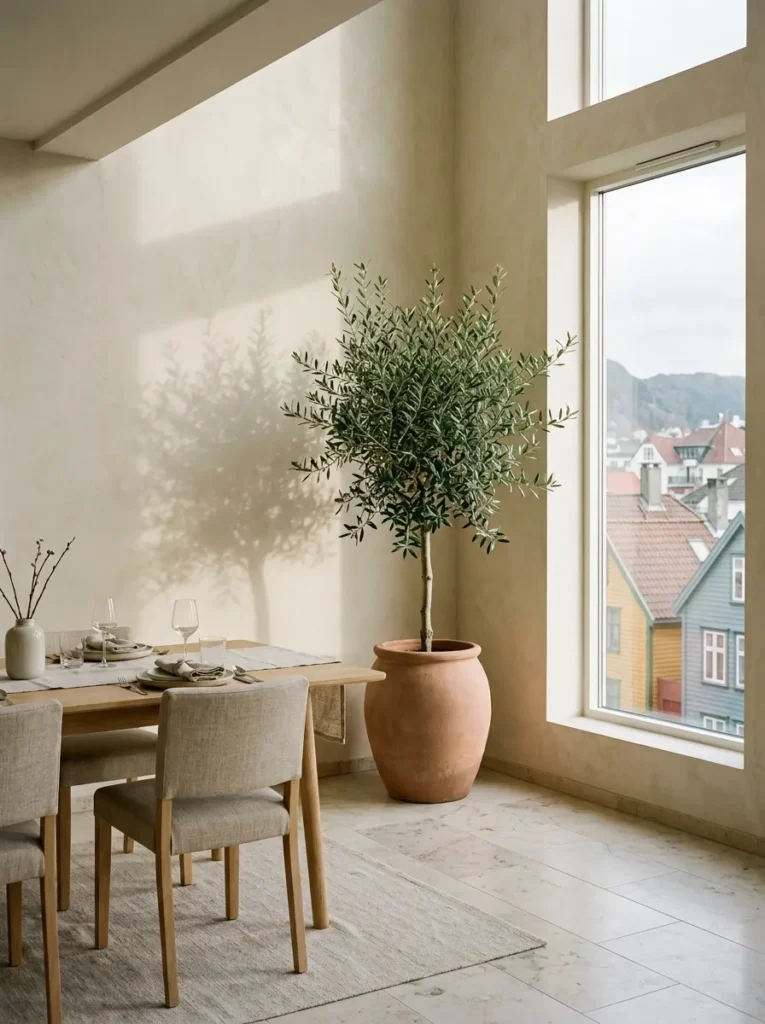
The shelf lined with small succulents, the sill crowded with trailing pothos — these read as busy in a Nordic space, which is the opposite of what the aesthetic requires. A single large-scale plant in a generous matte pot does far more. A fiddle leaf fig, an olive tree, or a large eucalyptus in a corner of the dining room creates a vertical element that the eye reads as deliberate, not decorative.
The pot matters as much as the plant. A hand-thrown terracotta pot or a matte cement vessel in a warm grey reads correctly in this context. A shiny ceramic pot, regardless of colour, tends to pull the room back toward something more conventional. One plant, properly positioned and properly potted, changes the scale of the room in a way that a collection of smaller plants never does.
9. Let the Floor Do More Work Than the Walls
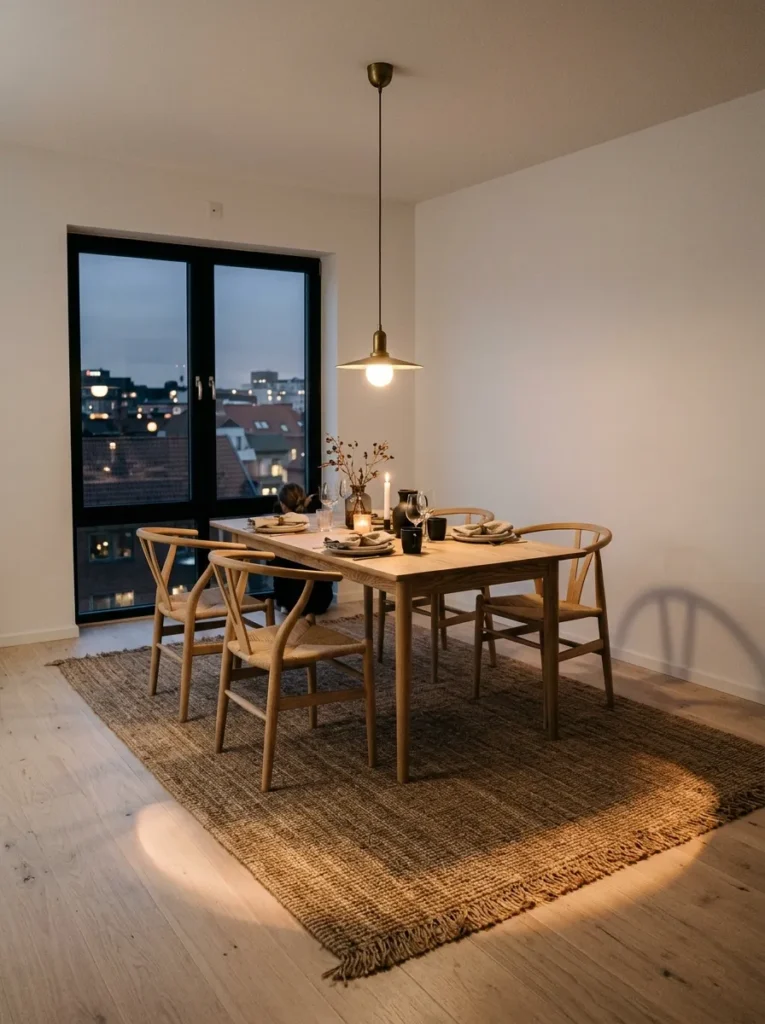
In most dining rooms, the walls get all the attention. In a Nordic interior, the floor is treated as a primary material — because it covers the largest uninterrupted surface in the room and the eye sees it constantly, often before it consciously registers the walls. Wide-plank pale oak flooring, laid in a simple linear run rather than herringbone, has a horizontal quality that makes any room feel wider and calmer. The key is to leave it unsealed or very lightly oiled — a high-gloss urethane finish kills the warmth that makes light wood work.
If you are working with a fixed floor material that is not ideal, a large jute or wool rug in a flatweave or low-loop pile can do the same job. The rug should extend well beyond the table and chairs — at least 60 to 80 centimetres on each side when the chairs are pulled out. A rug that the chairs barely sit on looks like an afterthought.
10. Consider Open Shelving Instead of a Sideboard
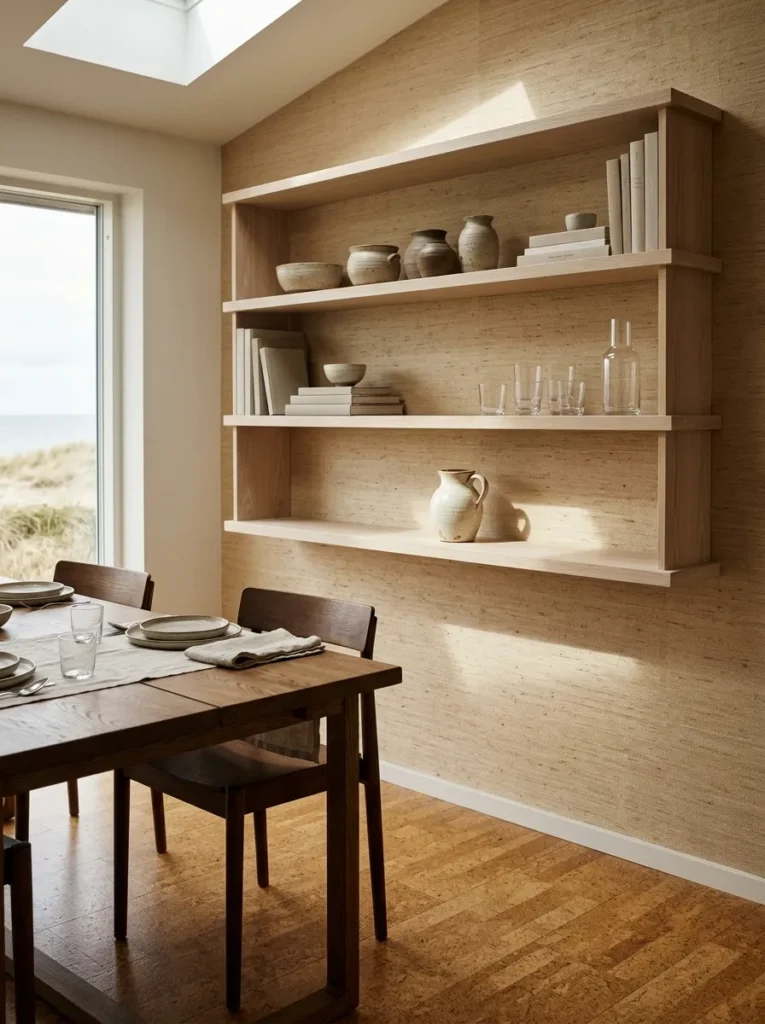
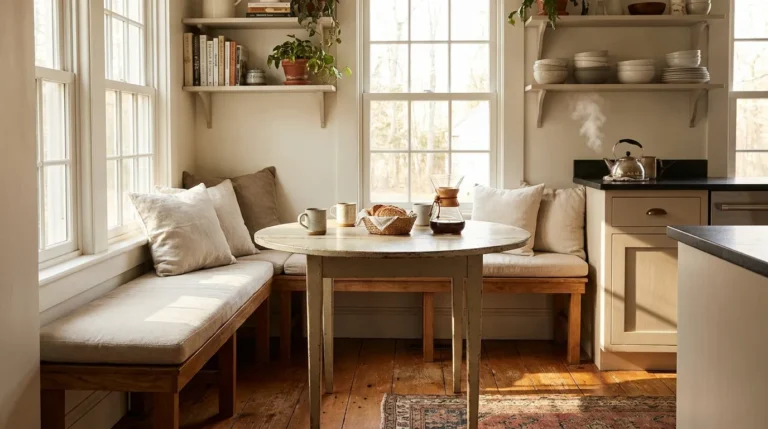
The sideboard is the default storage solution in a dining room, and it is not wrong — but a set of open shelves in pale painted or natural wood, styled with the same care as a gallery wall, does something a sideboard cannot: it makes the storage part of the room’s visual interest rather than a piece of furniture to tolerate. In a Scandinavian dining room context, open shelves displayed with edited groupings of ceramics, glassware, and a few books create a warmth that closed-door furniture simply does not.
The discipline this requires is real. Open shelves only work if you are genuinely prepared to keep them considered. The shelf that becomes a dumping ground for mail and random objects is a liability in a room that depends on calm. If that level of editing does not suit the way you actually live, the sideboard is the better answer.
11. Install Dimmer Switches Before Anything Else
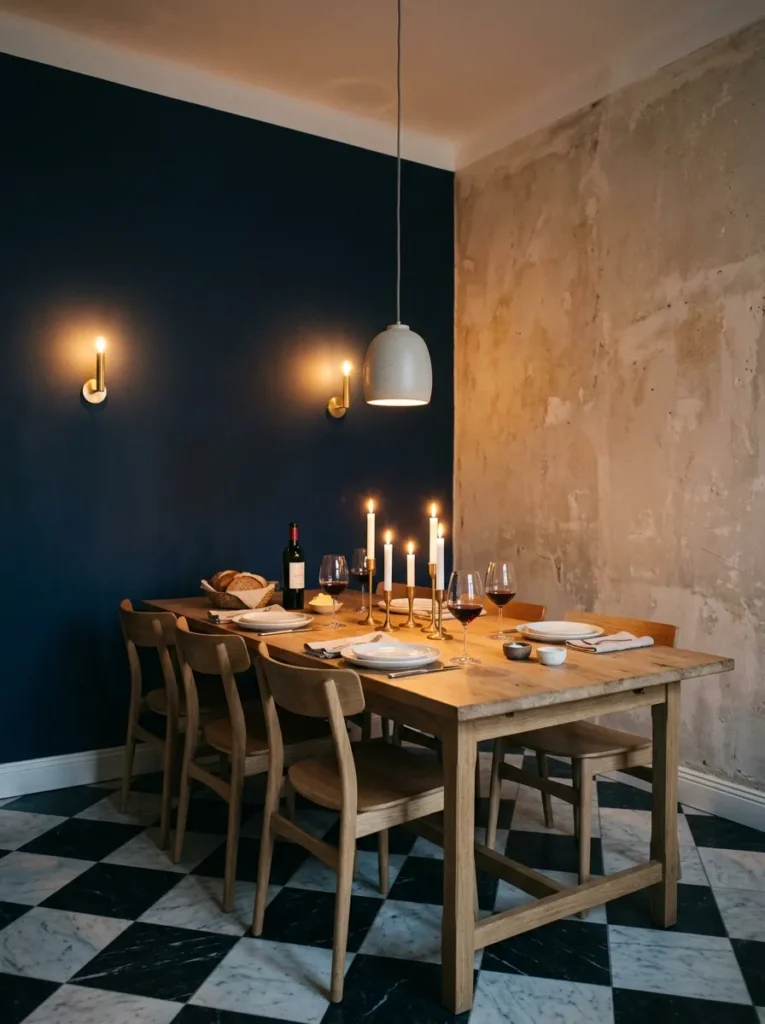
This sounds like advice for an electrician, not an interior designer, but it is the most practical single change anyone can make to a dining room regardless of style. A Nordic dining space depends on the ability to shift from the clear, even daylight quality that makes it feel fresh at breakfast to something intimate and warm for an evening meal. Without dimmer switches, you are locked into one level of light, and that level is almost never right for both.
The specific combination that works best is a pendant on one dimmer and a pair of wall sconces or a secondary table lamp on another, so the two circuits can be balanced independently. In the evening, the pendant drops to 30 to 40 percent and the secondary light carries the room. That layering of sources at different heights is what creates the evening atmosphere that Nordic interiors are famous for — and it costs less than a new chair.
12. Use Curtains That Pool Slightly on the Floor
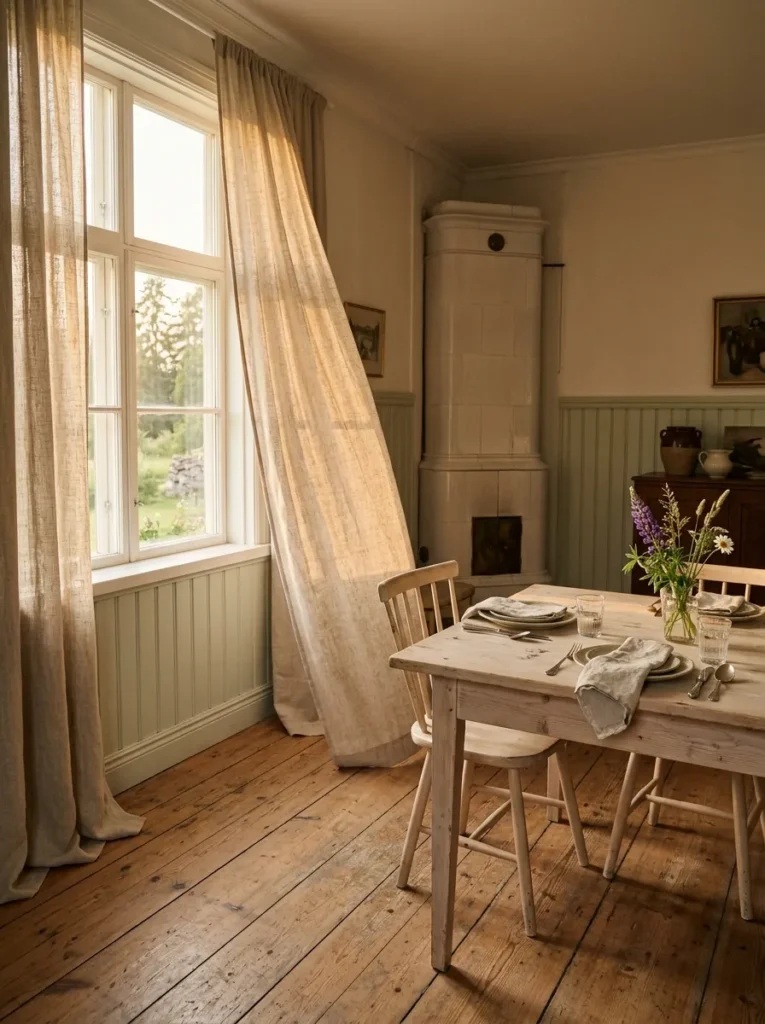
In a bright Nordic dining room, the instinct is often to go curtain-free — all that glass, all that light, why cover it? But curtains serve a second function beyond light management: they add vertical height, soften the transition between wall and floor, and introduce a fabric element that is impossible to achieve any other way. Linen curtains in a natural or warm off-white, hung from ceiling height, make a room with standard 2.4-metre ceilings feel significantly taller.
The detail that moves this from correct to considered is the floor length. Curtains that hover just above the floor look finished but slightly timid. Curtains that break at the floor — or pool very slightly, perhaps 3 to 5 centimetres of fabric relaxing onto the floor — have an ease that reads as the opposite of fussy. In a dining room, they will never get in the way. They will just look right.
13. Choose a Scandinavian Dining Room Palette with One Unexpected Colour
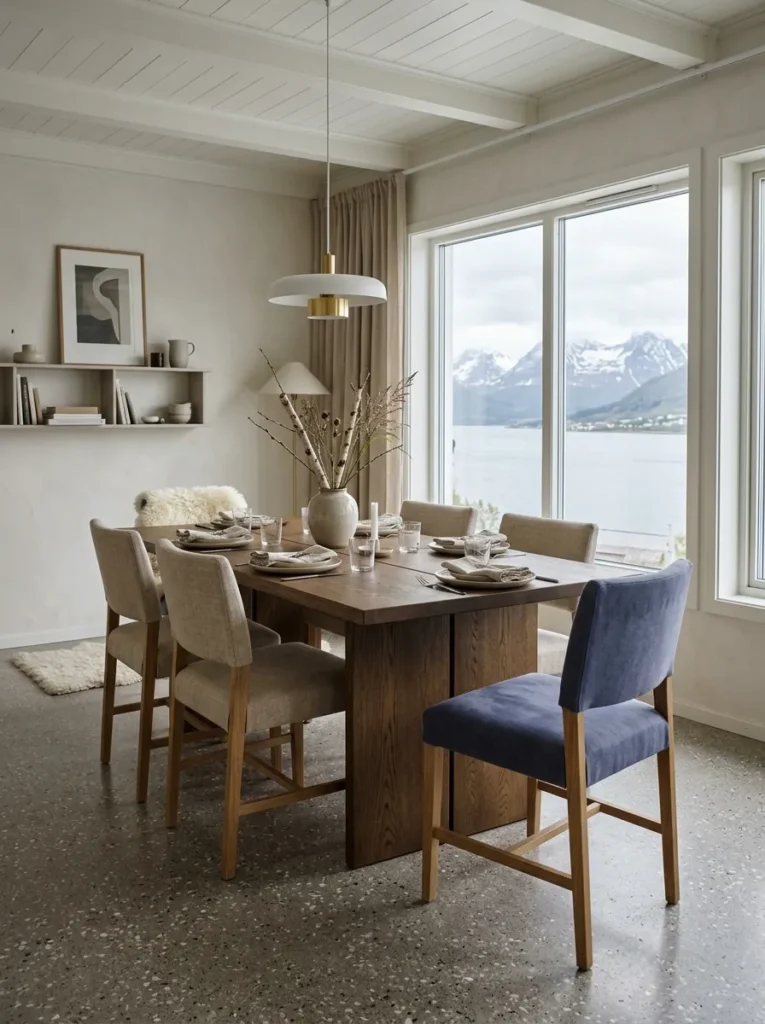
The all-neutral Nordic interior has been photographed to death, and the all-neutral version is the safe version. The rooms that actually stop you while scrolling are the ones that introduce a single unexpected colour note — a dusty sage, a deep clay, a faded indigo — against the neutral ground. The key word is single. One colour introduced with discipline reads as intention. Two colours introduced together starts to feel like a trend board.
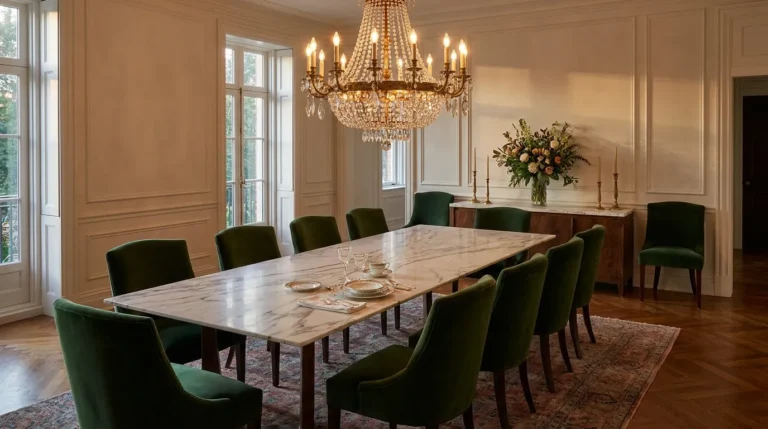
The most effective way to bring this in is through a piece of furniture rather than paint — a single upholstered chair in a dusty blue or a sideboard in a deep muted green. The surrounding neutrals do not change, but the room shifts from an exercise in restraint to something with genuine personality. That one piece becomes the answer to “what’s the point of view in this room?” which every room needs, even — especially — the quiet ones.
14. Keep the Table Surface Visible
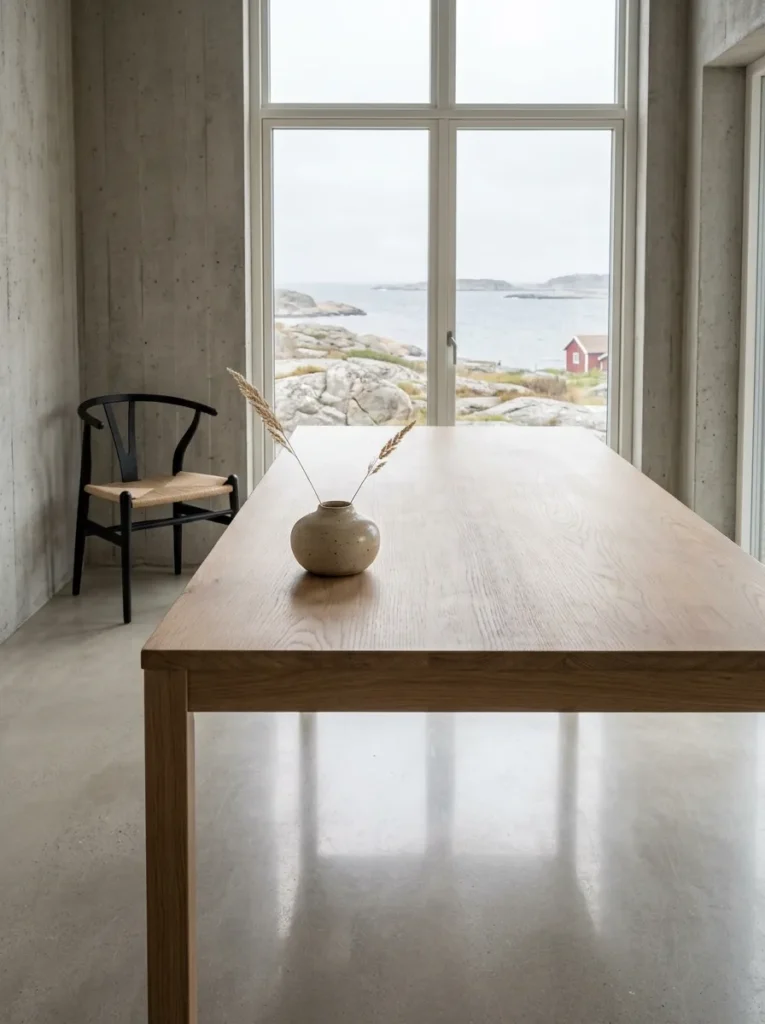
The Nordic dining table should never be fully dressed at all times. In rooms where the table is treated as a display surface — a permanent centrepiece, stacked books, a collection of objects in the middle — the table loses its function as the thing around which people actually gather. The Scandinavian approach is to leave the table largely clear and let a single object — a simple ceramic vase with two or three stems, or a low candle in an honest holder — do the work.
This matters photographically too. A clear table surface reflects light, especially from a window, and that reflection is what gives Nordic dining rooms their characteristic brightness. Cover the surface and you lose the bounce. It is one of those cases where the restraint is also the practical decision.
15. Source Second-Hand for the One Piece That Makes the Room
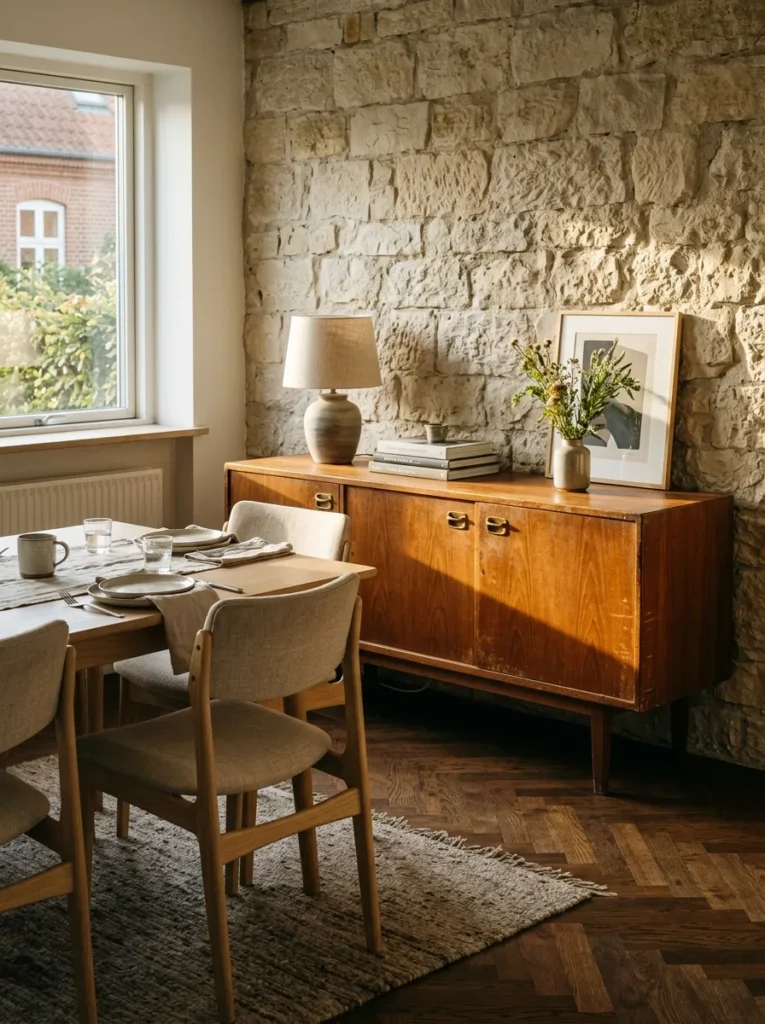
Every room in this aesthetic needs one piece that cannot be bought from a contemporary retail catalogue — something with a history, a slight imperfection, a material that has been worn in by use. In a Scandinavian dining room, this is usually a vintage piece: a 1960s teak sideboard, a set of Hans Wegner-adjacent chairs found at a market, a ceramic lamp base that clearly predates the internet. That one piece does more for the room’s authenticity than any number of correct contemporary choices.
The reason is that the Nordic aesthetic, at its origin, was never about buying a look. It came from the idea that good design should be owned and used for a long time — that a well-made object improves with age rather than dates. A second-hand piece carries that principle in its grain and its patina in a way that a new piece, however well chosen, simply cannot replicate.
16. Consider a Bench on One Side of the Table
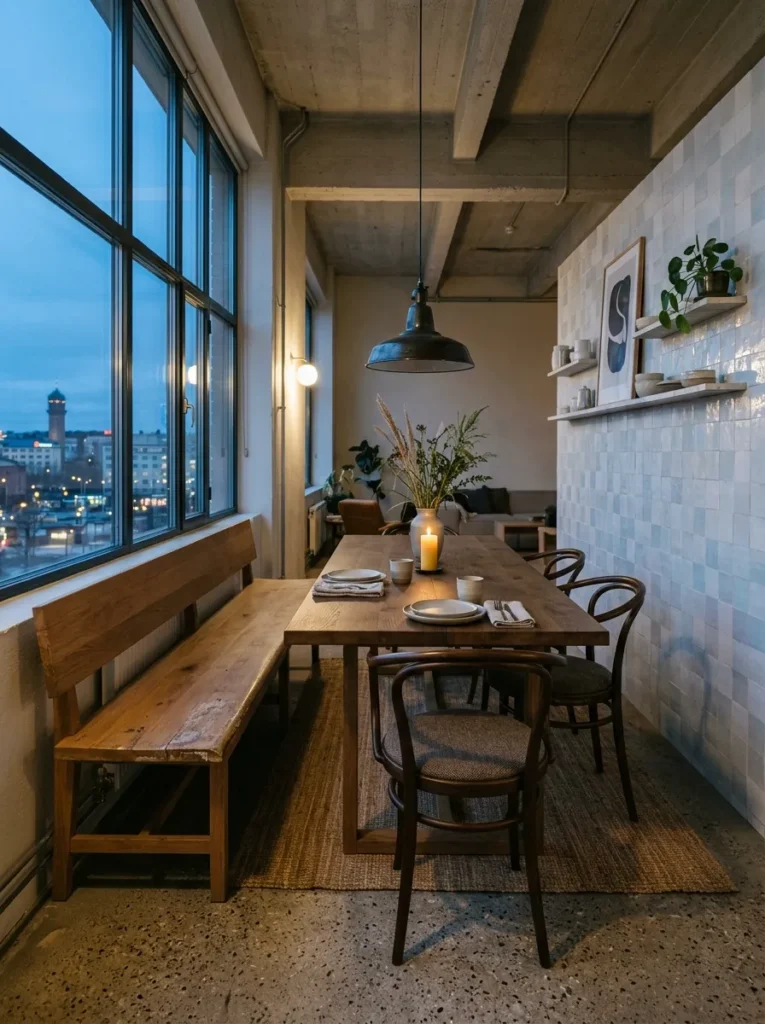
Most dining rooms use chairs on all four sides, which is the symmetrical answer and not always the most interesting one. A long bench along one side of the dining table — in solid oak or upholstered in a flat linen — changes the visual proportion of the table in a way that is immediately distinct. It also, practically, seats more people for the same footprint, which is not a small consideration.
The bench works best when the chairs on the opposite side are more considered — something with a gentle back curve or a slight arm, to provide a visual contrast with the simplicity of the bench. The asymmetry is the interest. It says something about how the room is actually used, which is more honest and more Nordic in spirit than the matched set of six.
17. Treat Candlelight as a Design Element
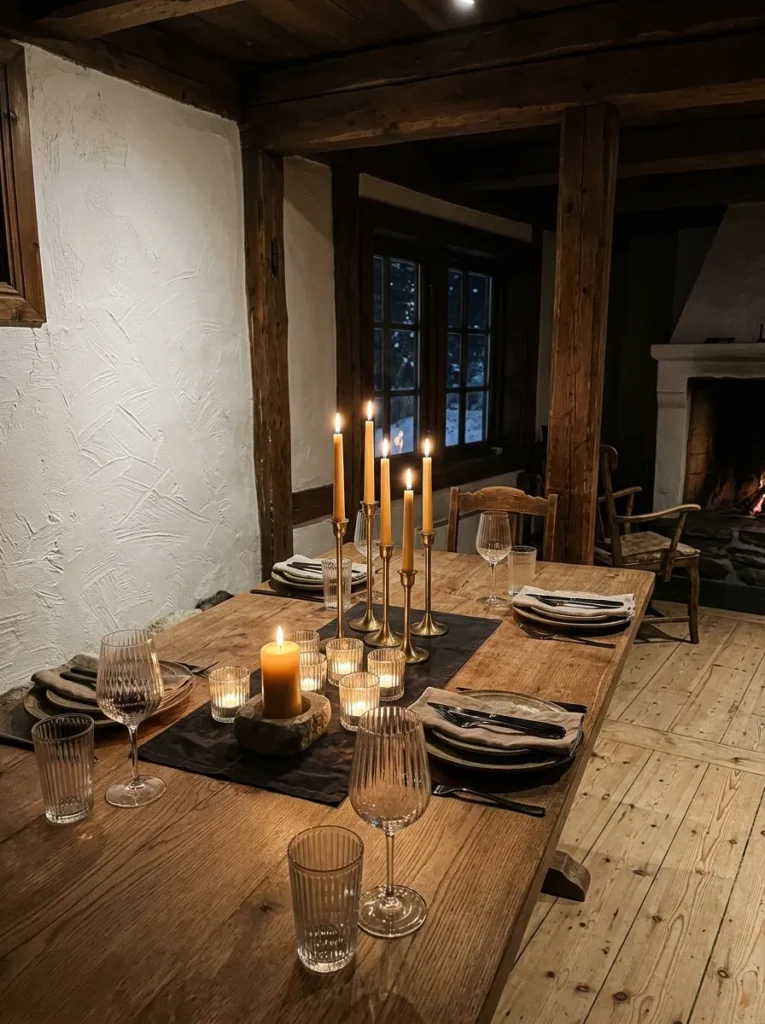
Nordic culture has an almost ritualistic relationship with candles, and this is not merely atmospheric preference — it is a design response to latitude. In Scandinavia, the sun sets early for months of the year, and candles become a primary light source in the daily life of the home. In a dining room designed in this spirit, candles are not a romantic gesture reserved for special occasions. They are part of the room’s everyday lighting language.
This means having proper candle holders — not decorative ones that hold a single taper but a mix of heights and materials: a low beeswax pillar in a stone holder, taper candles in simple unlacquered brass sticks at different heights, a cluster of votives for evenings when the pendant barely needs to be on. The way candlelight catches in glassware, reflects off a stone surface, and pools around the base of a ceramic vase is something no electric fixture can imitate.
18. Edit the Room to Half of What You Think It Needs
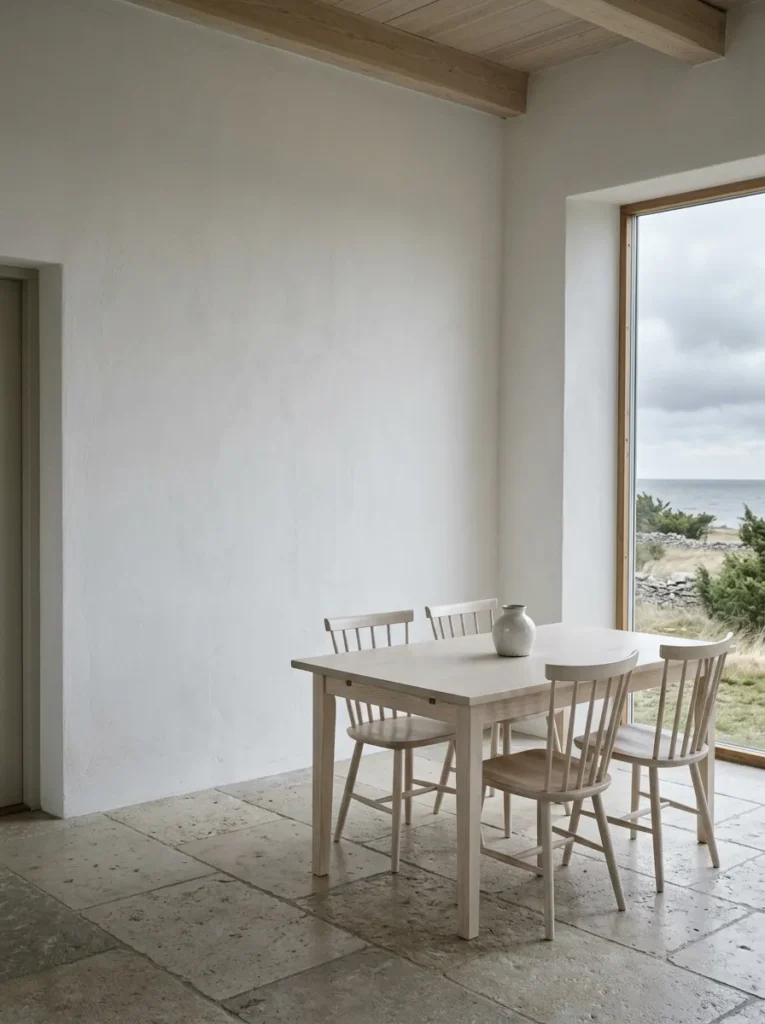
This is the piece of advice that most people read, agree with intellectually, and then fail to apply. Nordic interiors look calm because they are genuinely edited — not because the designer ran out of objects or budget, but because the deliberate choice to leave space around things is treated as a design decision as important as the things themselves. Empty space in a Nordic dining room is not a gap to be filled. It is the breathing room that makes everything else visible.
The practical application: once the room is arranged in what feels like its final form, remove one object. Look at it again. In the majority of cases, the room improves. Then consider removing another. The Nordic aesthetic is almost never improved by addition.
19. Use Texture to Replace Pattern
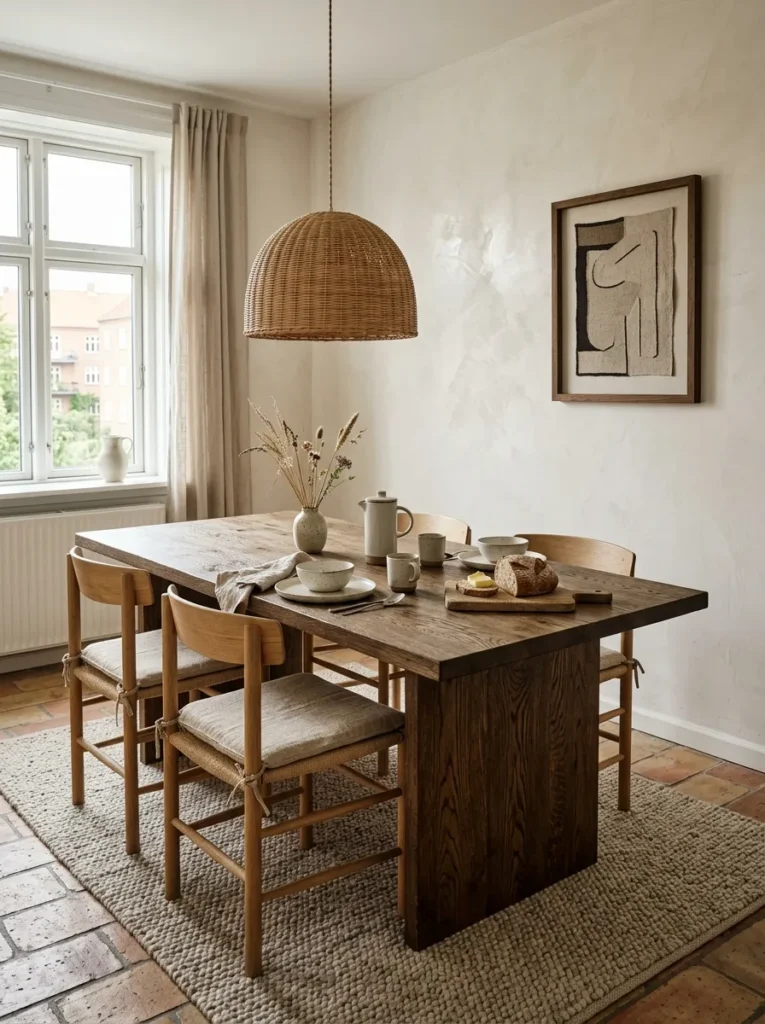
Pattern — geometric, floral, graphic — is nearly absent from a genuine Nordic dining room. What replaces it is texture, and texture is doing all the visual work that pattern does in other aesthetic traditions. The grain of a wood table, the weave of a linen seat cover, the rough surface of a hand-thrown bowl, the pile of a flatweave rug — these are all forms of visual information that the eye reads as interest without the room feeling busy.
The discipline here is to think of texture as pattern and apply the same editing rules. If the table grain is pronounced, the rug should be flatter. If the linen curtains have visible weave texture, the chair seats should be smoother. The textures should have variation in their scale but not compete for attention simultaneously. Most people get this wrong by adding one more textured layer when the room already has enough.
20. Resist the Last Accessory
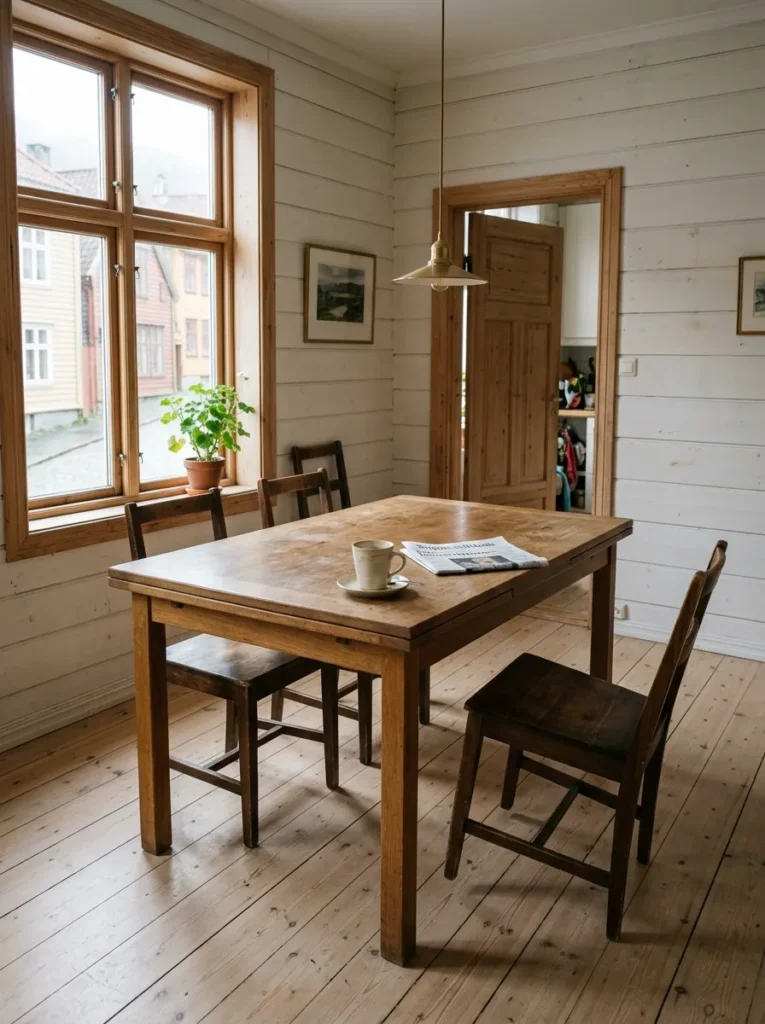
The final and most contrarian idea: when the room is finished, do not style it for the photograph. The Scandinavian dining room at its most honest is not the version staged for a magazine shoot — three books stacked at a precise angle, a single stem in a perfect vessel, a napkin folded with intention. It is the version where someone just had breakfast and the coffee cup is still on the table and the chair is pulled out slightly and the light is doing what it does at that particular hour.
Accessorising a Nordic space into perfection is the thing that makes it look like an imitation of itself rather than the real thing. The last throw pillow, the additional candle, the decorative tray arranged just so — these are the details that tell the room it has been overthought. The rooms that feel most genuinely Nordic are the ones that look as though no one planned them, even when every single choice was made with complete deliberation. That tension — between intention and ease — is the whole point.
Final Thoughts
A Scandinavian dining room is not a style you purchase — it is a position you take on what a room is actually for. The ideas here are most useful not as a checklist but as a set of principles: prioritise warmth over perfection, texture over pattern, restraint over abundance. Start with the table and the light above it, because those two elements establish the room’s character before anything else arrives. From there, add slowly. The temptation to finish a room in a single session produces rooms that look finished in the wrong sense — complete and airless rather than calm and inhabited. The Nordic dining spaces that genuinely stop people while scrolling are the ones where the editing was taken as seriously as the selecting. One more thing worth saying plainly: the most common mistake is using this aesthetic as a reason to buy new things. The piece that makes the room is almost always the old one.
Save these Scandinavian dining room ideas for your next home refresh project.