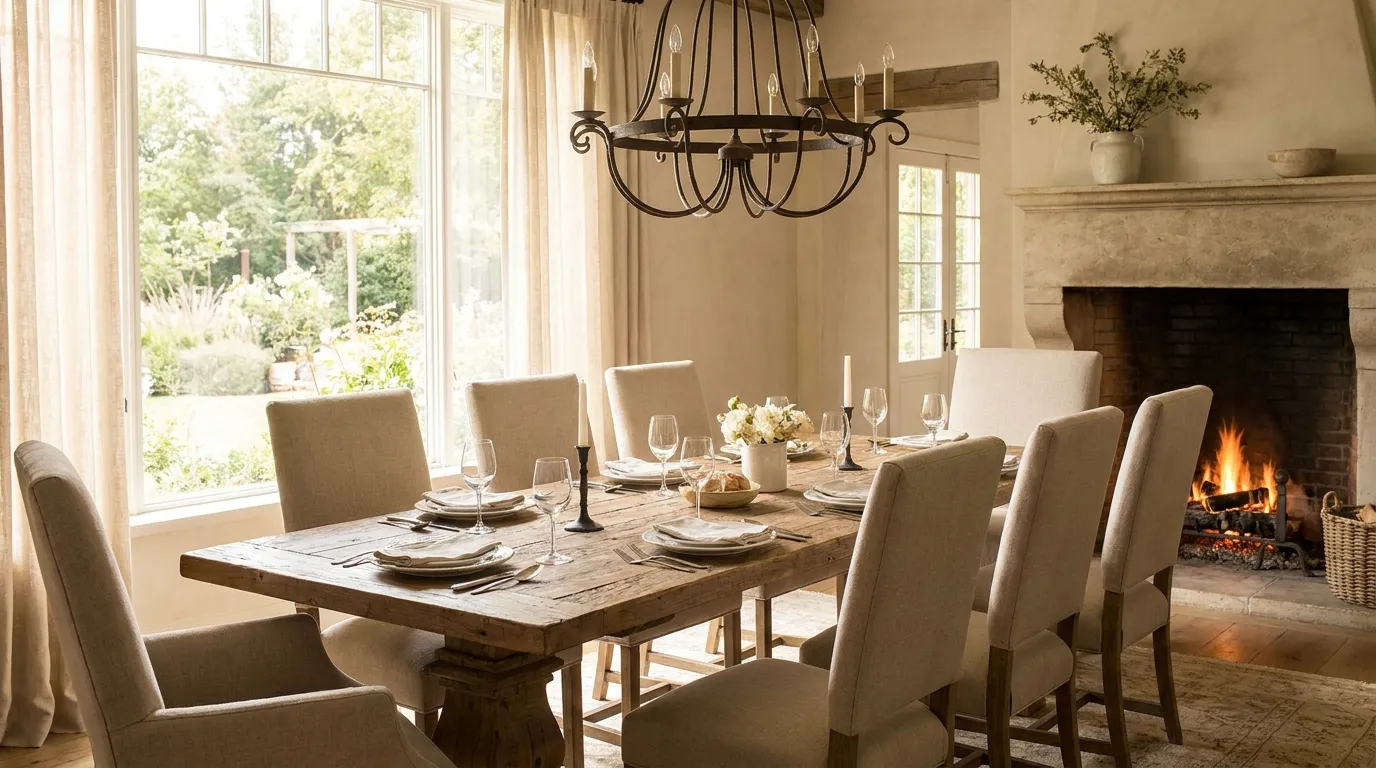
18 Farmhouse Dining Room Ideas That Feel Timeless and Cozy
The farmhouse look has been flattened into a formula — shiplap, a chunky table, a single sign with a cursive word on it — and most farmhouse dining room ideas online simply repeat that formula back at you. That is not what this article does. The dining rooms that actually feel timeless are built from specific, often overlooked decisions: the way a table ages, the exact height a chandelier hangs at, the chairs that don’t match on purpose. What follows are eighteen ideas grounded in those specifics, not the version of farmhouse style that already looks dated the year it was photographed.
1. Choose a Table With Visible Saw Marks or Plank Seams
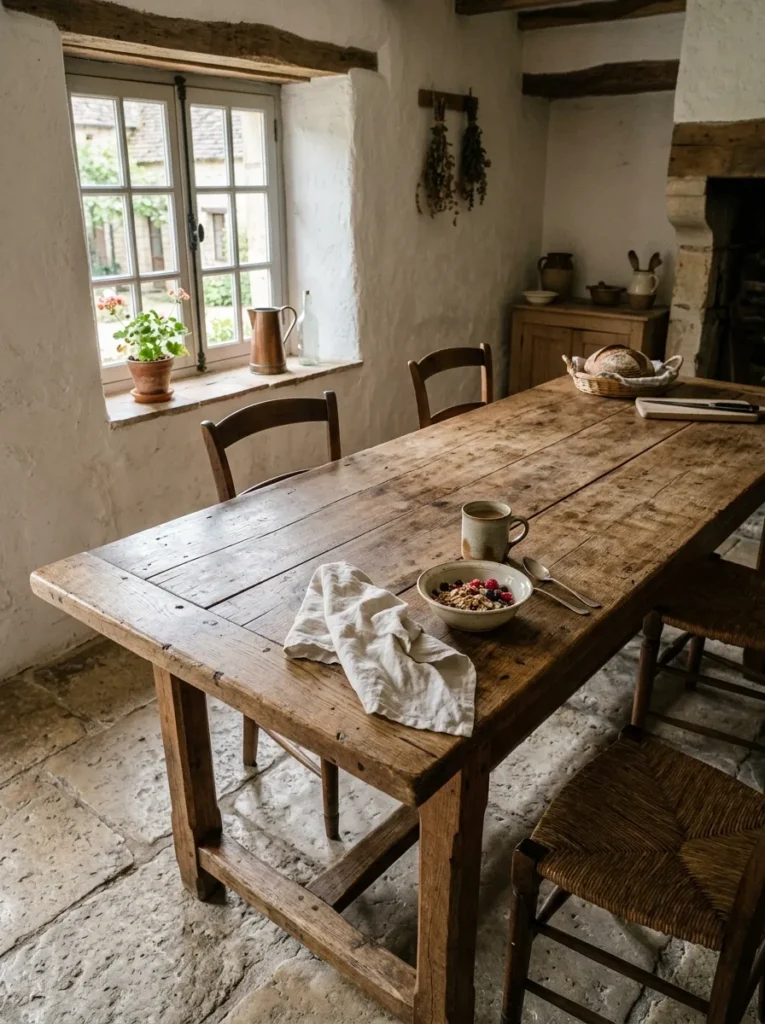
A farmhouse table that looks machine-perfect has missed the point entirely. The tables that read as genuinely old — or convincingly new in the old style — show their construction: visible plank seams running the length of the top, slightly uneven saw marks left deliberately unsanded, pegged joinery at the legs rather than hidden screws. Reclaimed pine or oak works best because it already carries decades of wear, but even a new table built from rough-sawn timber and finished with a matte oil will develop the right character within a year of family dinners. The smooth, perfectly level farmhouse table you see in big-box stores is a contradiction in terms.
2. Hang a Wrought Iron Chandelier 85 to 95 Centimetres Above the Table
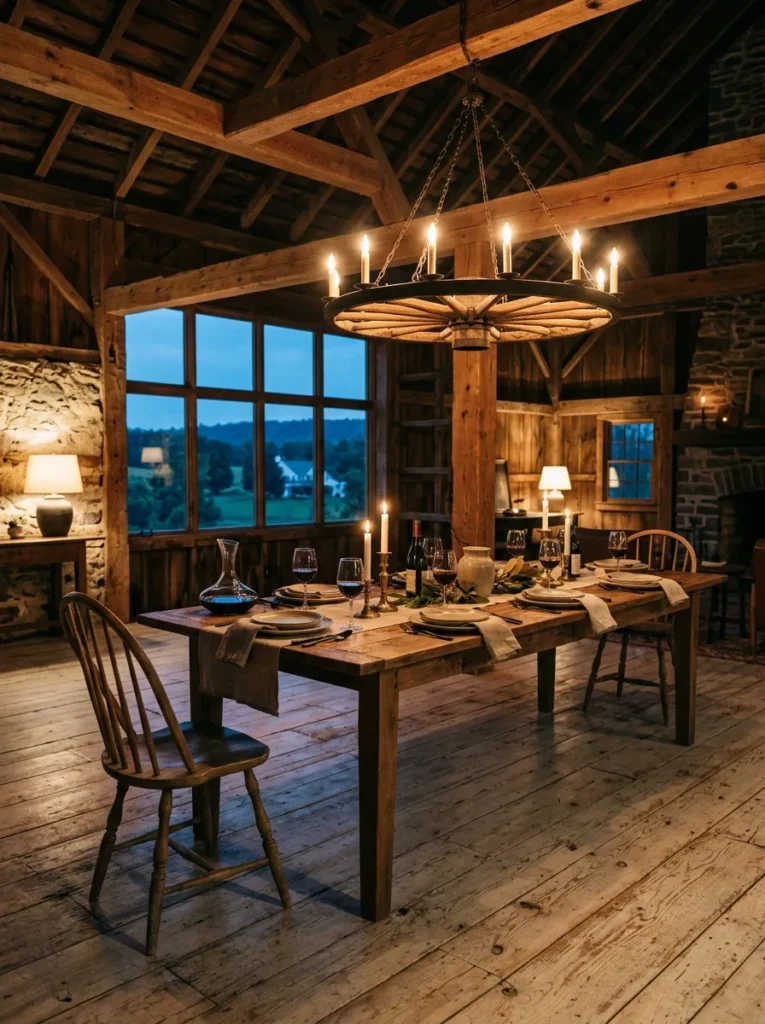
Most people hang dining chandeliers too high out of fear of bumping someone’s head, and the result is a fixture that lights the ceiling more than the table. For a farmhouse dining room, a wrought iron or wagon-wheel style chandelier should hang 85 to 95 centimetres above the table surface — low enough that the light pools where people actually sit. This is the decision that changes everything about how the room photographs in the evening. Choose candle-style bulbs at warm 2200K to 2700K rather than clear or bright white ones; the slightly flickering, uneven quality of candle-style light is what makes wrought iron fixtures feel authentic rather than decorative.
3. Mix Mismatched Chairs Around a Single Table
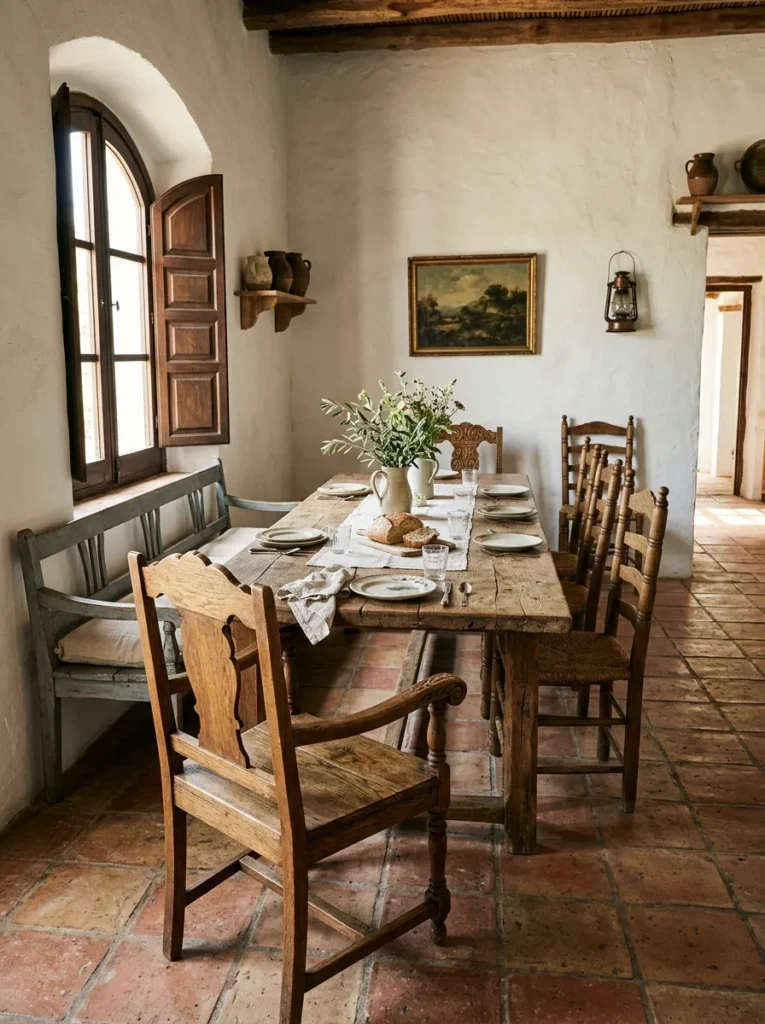
A full matching dining set is the safer choice and almost never the better one. Farmhouse dining rooms get their lived-in warmth from chairs that were clearly acquired over time rather than ordered in one box — a few ladder-back chairs in weathered oak, a bench on one side, perhaps two armchairs at either end that don’t match the rest at all. The unifying element should be tone rather than style: keep the wood finishes within the same warm family even as the silhouettes vary. This takes more effort to source than clicking “add six to cart,” but the visual payoff is a table that looks collected rather than purchased.
4. Add a Long Bench on One Side Instead of Chairs
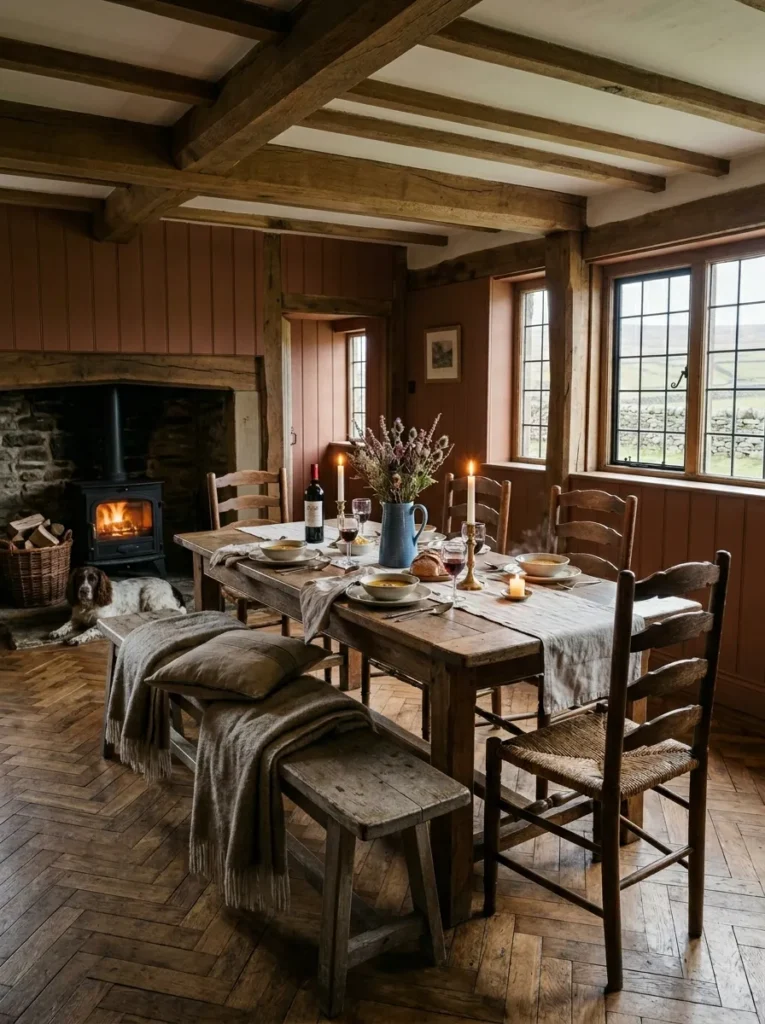
A wooden bench running the length of one side of the table does something chairs cannot: it removes the rigid, evenly-spaced formality of a chair-only setup and replaces it with something that can shift to fit however many people actually show up. Reclaimed oak or pine, ideally with a visible patina or a slightly uneven surface, works best. Benches also solve a practical problem nobody mentions enough — they tuck fully under the table when not in use, opening up the room. For a farmhouse dining space specifically, the bench reads as something pulled from a barn or a church hall, which is exactly the unpretentious quality the style is supposed to have.
5. Use a Runner Instead of a Full Tablecloth
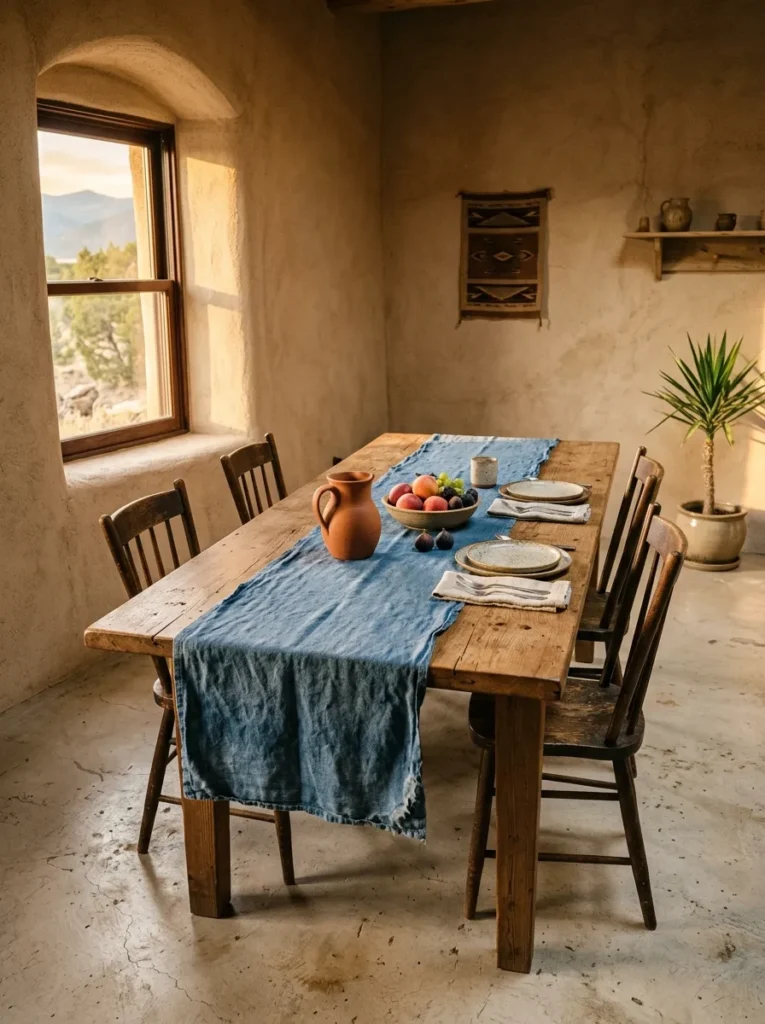
A floor-length tablecloth covers the table you worked to find character in. A linen table runner — roughly 35 to 40 centimetres wide, running the length of the table with overhang at each end — lets the wood show on either side while adding texture and a clear visual anchor down the centre. Choose a natural, slightly textured linen in oatmeal, faded indigo, or rust rather than anything bright white or heavily printed. The runner should look like it’s been through the wash more than once. That’s the whole point: a farmhouse table dressed too perfectly stops looking like a farmhouse table.
6. Install Board and Batten on the Lower Half of the Walls
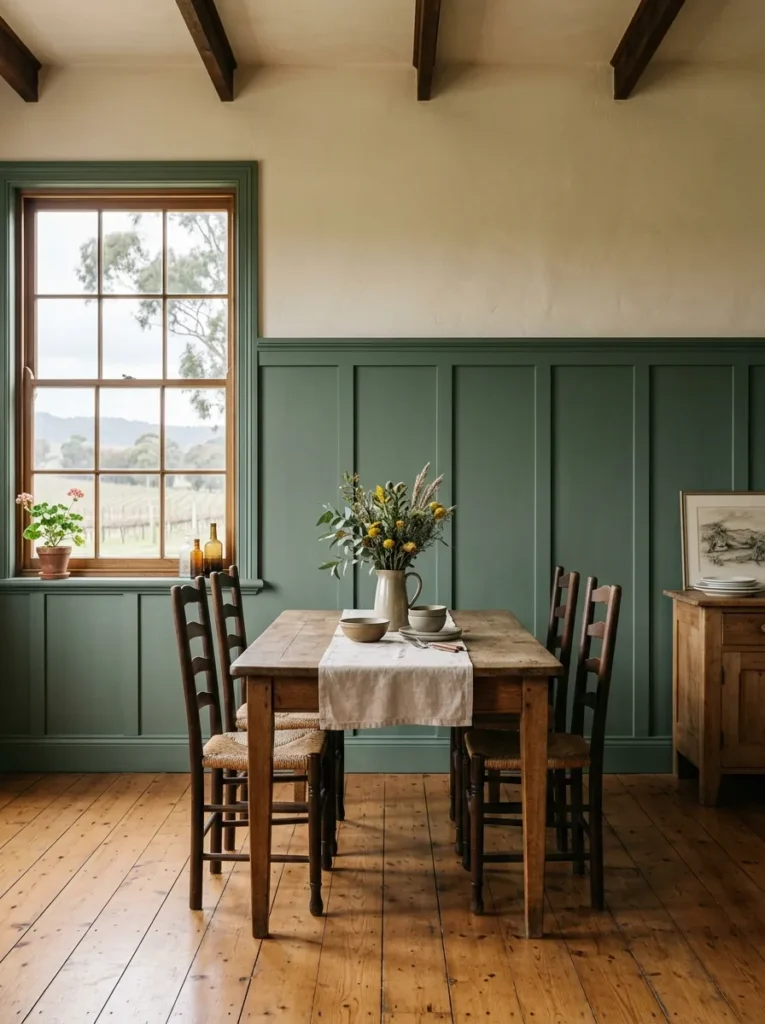
Shiplap became the default farmhouse wall treatment because one television show made it ubiquitous, and now most farmhouse dining rooms look identical because of it. Board and batten — vertical strips of wood applied over a painted or plastered lower wall, typically to about 105 to 120 centimetres high — gives the same architectural texture without the visual sameness. Paint it a warm off-white or a deep, muted colour like clay or sage rather than stark white. The horizontal shadow line where the board and batten ends and the wall colour continues above adds a sense of proportion to the room that a flat wall simply does not have.
7. Choose a Rug That’s Slightly Too Big for the Table
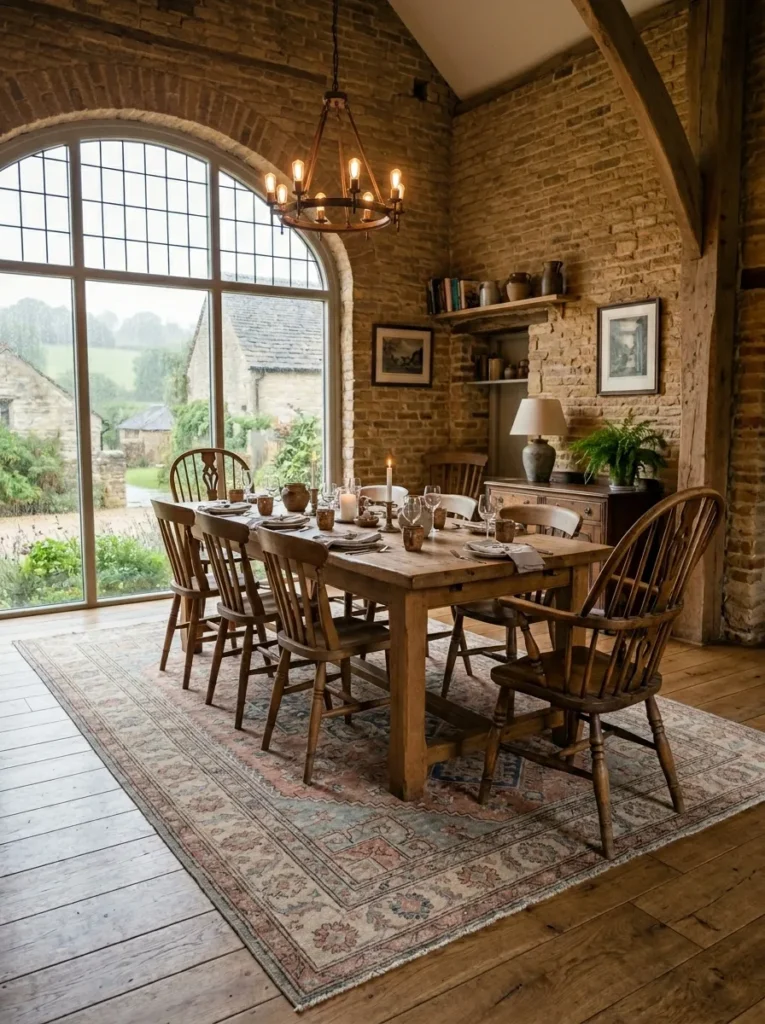
The most common dining room rug mistake is sizing it to the table rather than to the chairs pulled out from it. A rug should extend at least 60 centimetres beyond the table’s edge on every side, so that when chairs are pulled back to sit down, all four legs stay on the rug rather than catching on the transition to bare floor. For a farmhouse dining room, a flat-weave jute or a faded vintage-style wool rug in a muted geometric pattern works better than anything plush — it should look like it could have been there for twenty years. Undersized rugs are the fastest way to make an otherwise well-designed room feel like it was put together in a hurry.
8. Display Ironstone or Stoneware on Open Shelving, Not in a China Cabinet
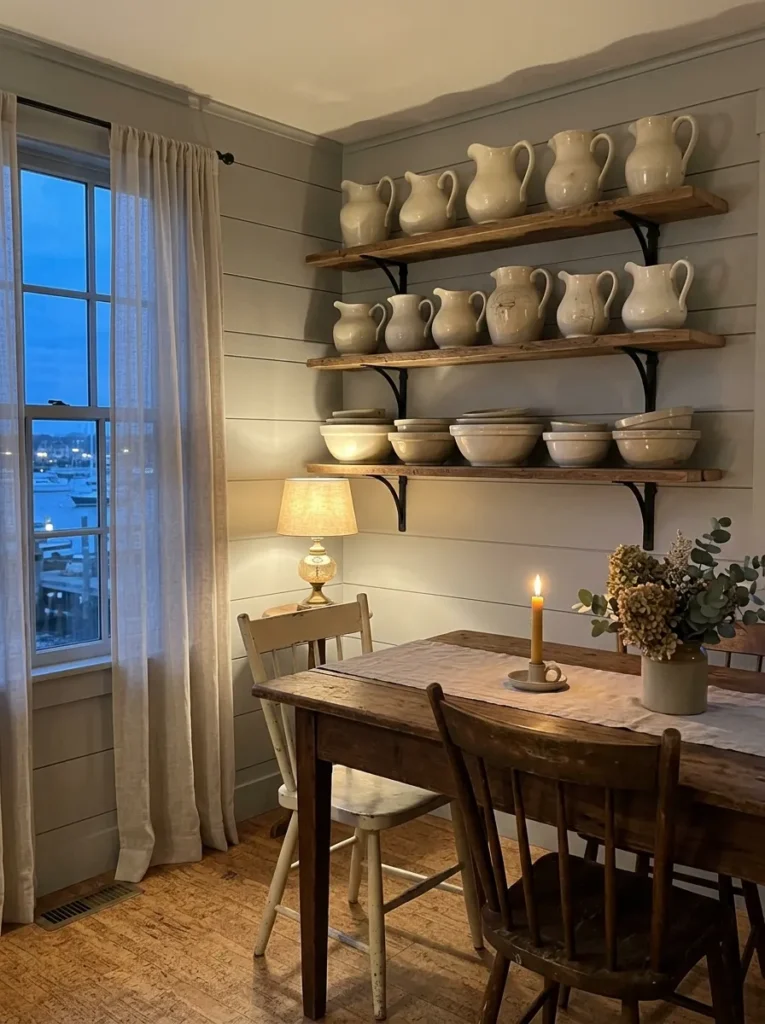
A glass-fronted china cabinet keeps dishware behind a barrier, which is exactly the opposite of the farmhouse instinct. Open shelving — simple reclaimed wood boards on iron brackets — displaying a collection of ironstone pitchers, stoneware bowls, or mismatched vintage plates creates texture and a sense of daily use that a closed cabinet never will. Group pieces by colour rather than by set; a shelf of cream and white ironstone in varying shapes reads as curated even when none of the pieces match. This is also the single most Pinterest-friendly detail in a farmhouse dining room, because it photographs as both functional and beautiful at once.
9. Use a Vintage Ladder as a Linen or Blanket Display
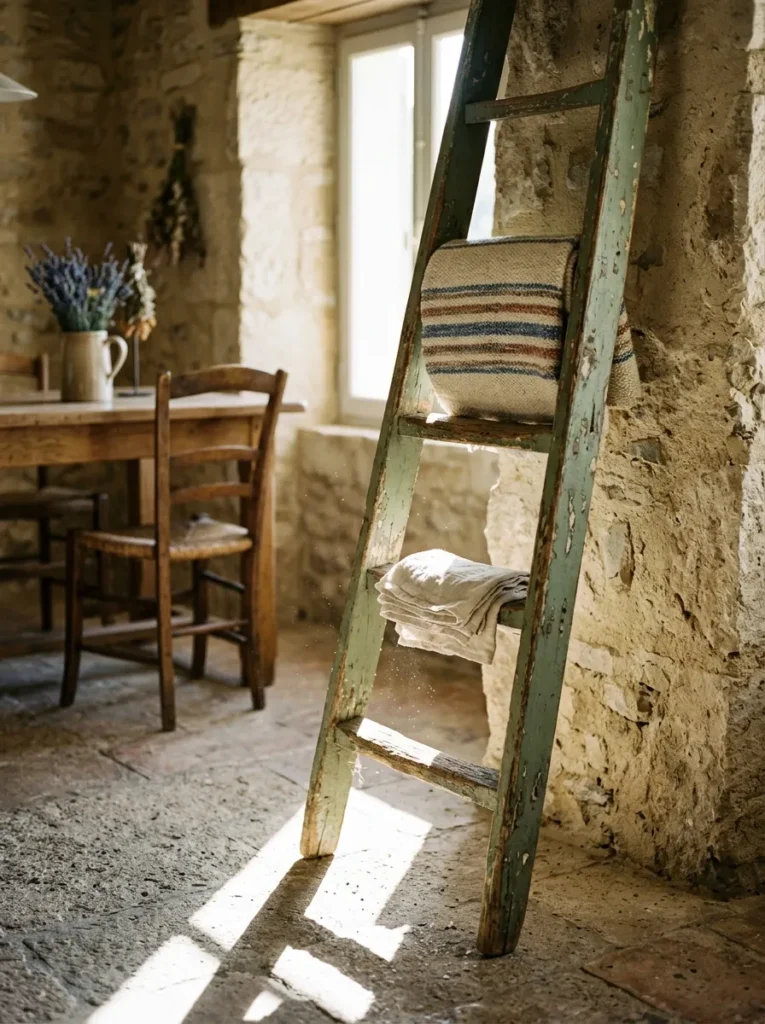
An old wooden ladder leaned against the wall near the dining table — holding a folded quilt, a stack of linen napkins, or a woven throw — is a detail most modern dining rooms have no equivalent for, which is exactly why it stands out. Look for a ladder with genuine wear: chipped paint, a slightly uneven rung, the kind of object that clearly had a working life before it became decoration. It adds height and texture to a corner that would otherwise sit empty, and it gives guests somewhere to look that isn’t the table itself. Few single objects do as much visual work for so little cost.
10. Hang Curtains in a Heavy, Slightly Imperfect Linen
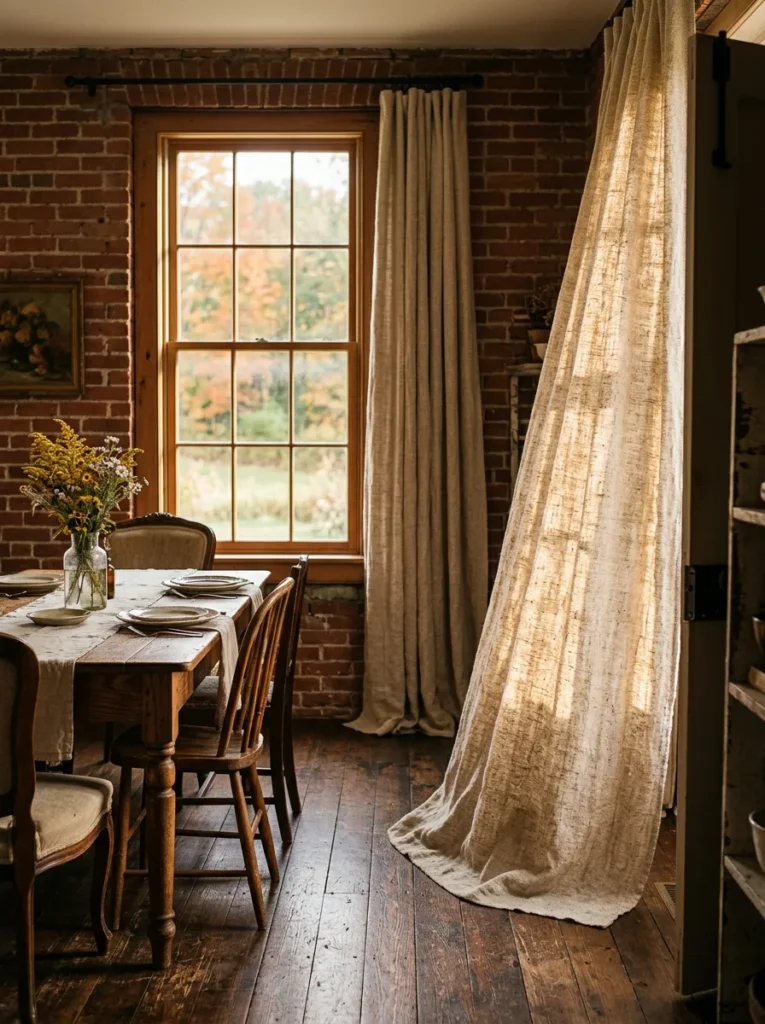
Farmhouse dining rooms call for fabric that looks like it has weight and history, not crisp synthetic blends that hang too perfectly. A heavy linen curtain in a slightly uneven weave — natural, oatmeal, or a faded blue — pools slightly at the floor rather than hovering precisely above it. Hang the rod close to the ceiling regardless of the actual window height; this is the trick that makes farmhouse windows look taller and the room feel more generous than it is. The fabric should move slightly when a door opens elsewhere in the house. That motion is part of what makes the room feel alive rather than staged.
11. Choose Cozy Farmhouse Dining Lighting With Visible Filament Bulbs
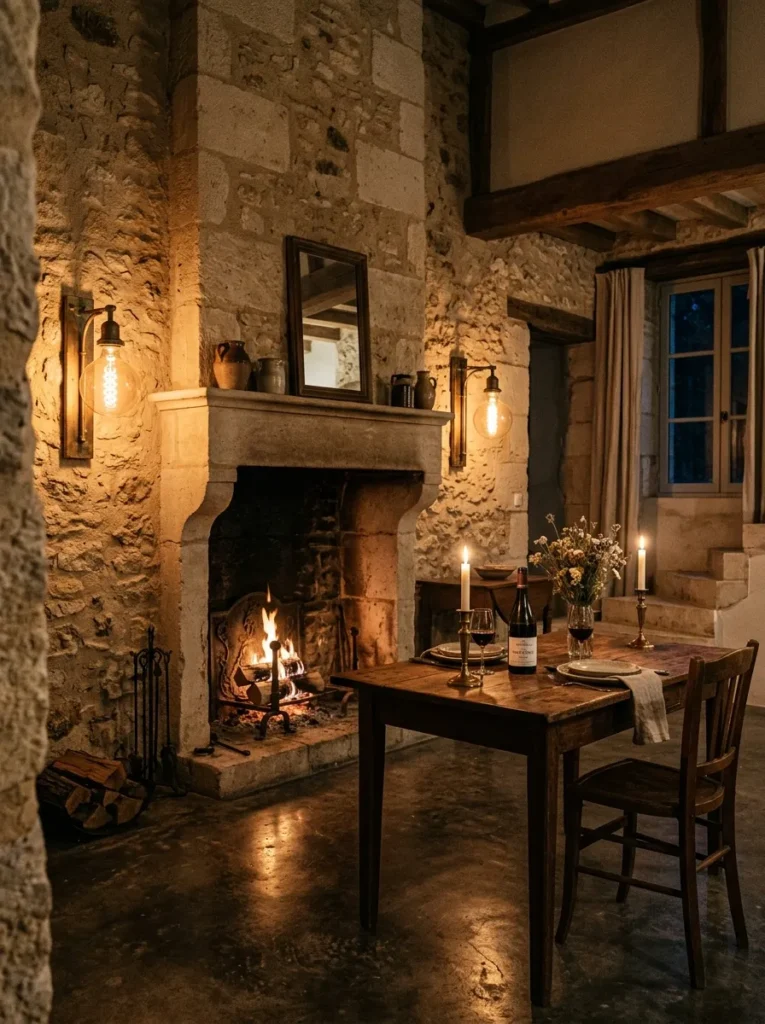
Beyond the chandelier, secondary lighting matters more than most people account for. Wall sconces or a smaller secondary pendant fitted with exposed filament Edison-style bulbs add warm, low-level light that fills in the shadows a single overhead fixture leaves behind. The visible filament itself is part of the farmhouse aesthetic — it reads as honest rather than concealed, which is the same principle behind exposed beams and visible joinery elsewhere in the style. Dim them low for everyday dinners and let them run brighter only when the room needs to do double duty as a workspace. Cozy farmhouse dining spaces are rarely lit by a single bright source; they’re built from several smaller, warmer ones.
12. Add a Dough Bowl or Wooden Trencher as a Centrepiece
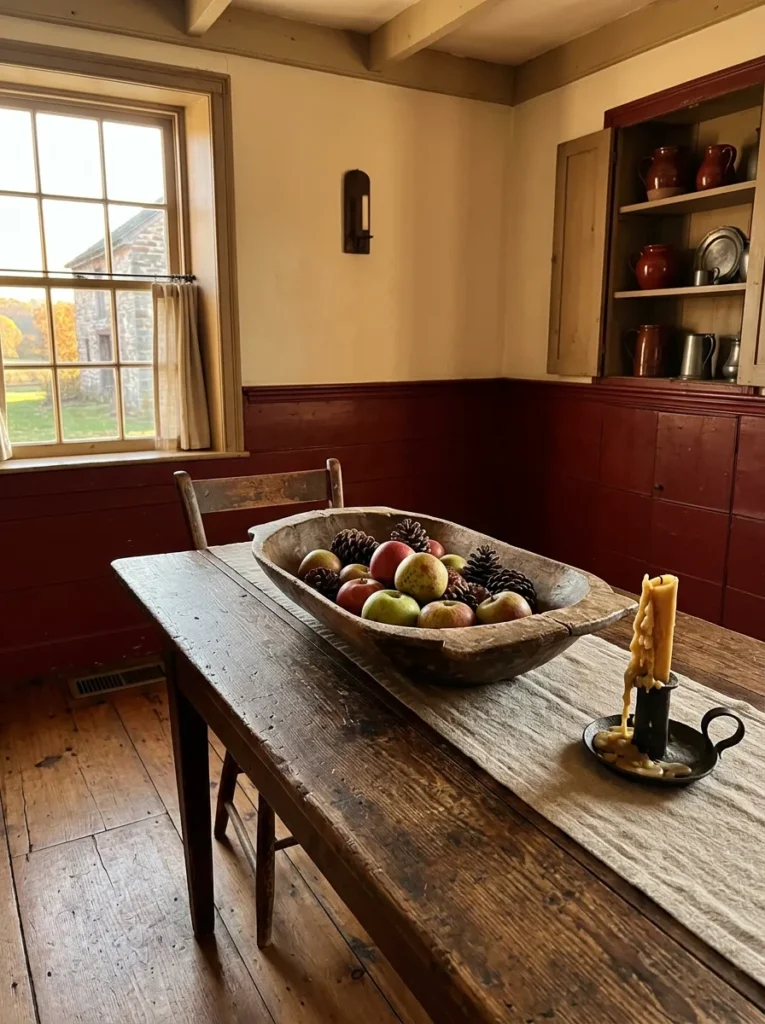
A glass vase of flowers is the default centrepiece, and it is also the least interesting option available for a farmhouse table. An antique dough bowl or wooden trencher — the shallow, hand-carved bowls originally used for kneading bread — filled with seasonal fruit, pinecones, or a cluster of candles, gives the table a centrepiece with actual history behind its shape. The wood should show genuine age: cracks, an uneven patina, perhaps a slightly warped rim. These bowls are widely available secondhand for the simple reason that almost nobody uses them for bread anymore, which makes them an easy and inexpensive way to add a piece with real provenance to the table.
13. Paint the Ceiling a Warm, Muted Tone Instead of Leaving It White
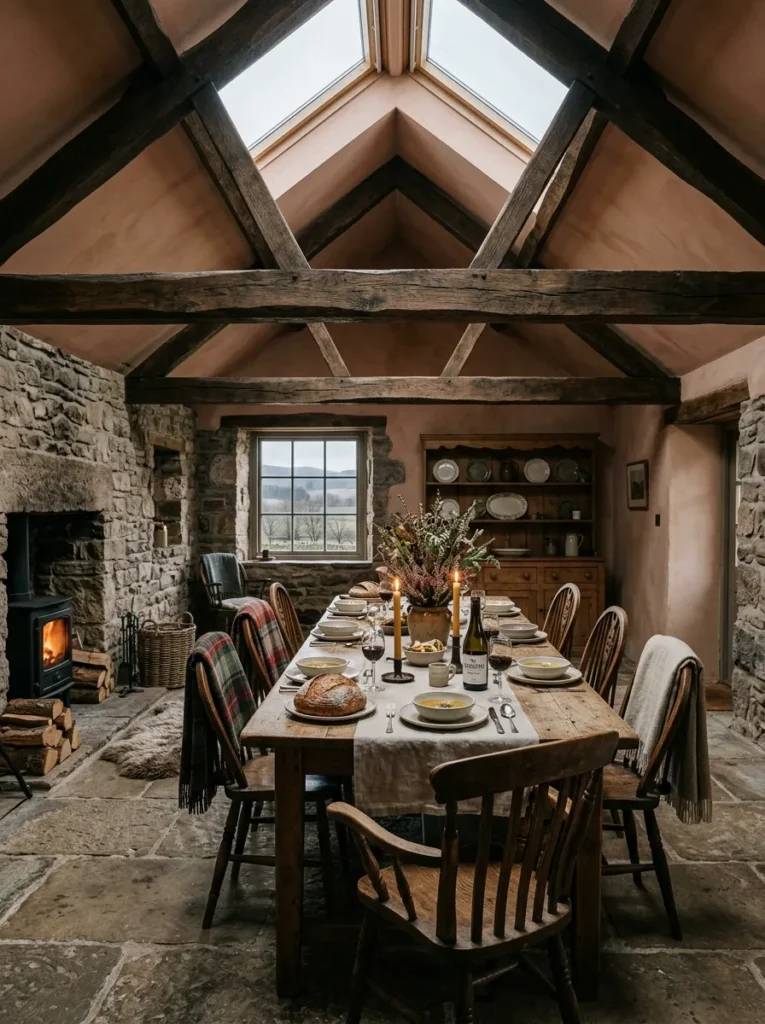
White ceilings are the unquestioned default, which is exactly why painting one changes a room more than people expect. A warm, muted ceiling colour — a soft clay, a faded sage, a dusty cream slightly warmer than the walls — pulls the eye upward and makes the whole room feel enclosed and intentional rather than left unfinished above eye level. This works particularly well in farmhouse dining rooms with exposed beams, where the colour change emphasises the architecture rather than competing with it. Most people get this wrong by assuming a coloured ceiling will make the room feel smaller. In practice, it usually makes a room feel more deliberately designed, not smaller.
14. Use a Wood-Burning or Faux Wood-Burning Stove as a Focal Point
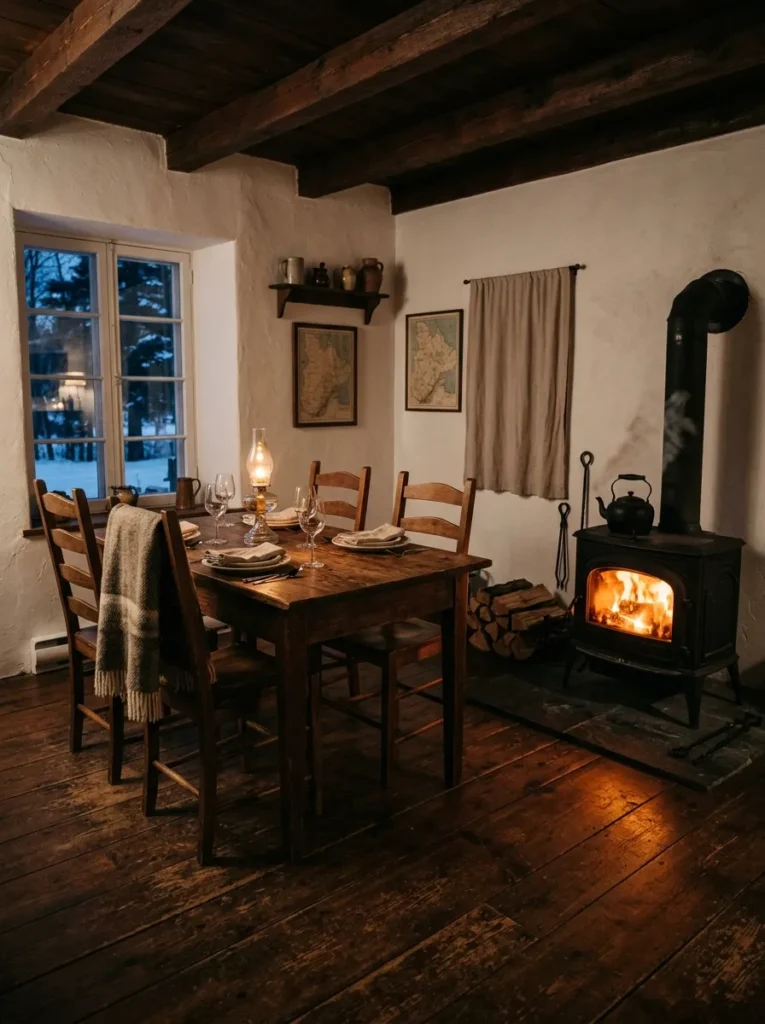
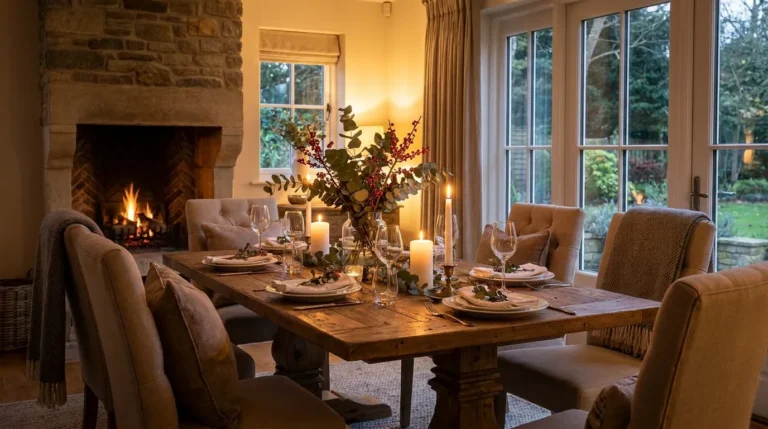
If the dining room has space along one wall, a small wood-burning stove or a well-made faux version with a realistic flame effect gives the room a literal source of warmth and an architectural anchor that a sideboard alone cannot provide. Position the dining table close enough that the stove is visible from every seat, not tucked into a corner where only half the table can see it. The cast iron finish should be left matte rather than polished. A dining room with a working or convincing stove changes character entirely once the seasons turn — it stops being a room you eat in and becomes a room you want to stay in after the plates are cleared.
15. Choose Open Wooden Beams Over a Flat Ceiling Where Structurally Possible
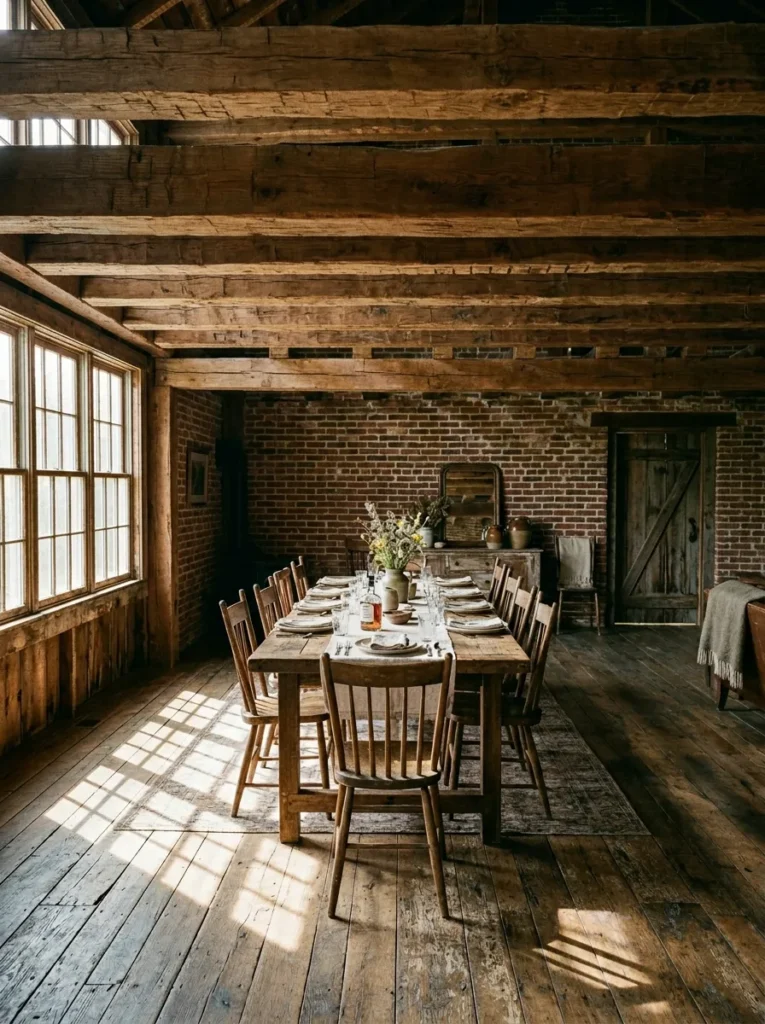
Exposed beams are one of the most recognisable elements of farmhouse architecture, and where the structure of the house allows it, exposing or adding decorative beams to a flat ceiling adds depth and texture that no amount of furniture or styling can replicate from below. Reclaimed timber beams with visible saw marks and uneven colouring work better than uniform, factory-milled versions. The beams should run perpendicular to the longest wall of the room wherever possible, which visually widens the space rather than narrowing it. This is a bigger undertaking than most ideas on this list, and not one to take on lightly, but in older farmhouse properties it is often the single change that makes a dining room feel original to the house rather than added to it.
16. Layer a Vintage Quilt Over the Back of One Chair
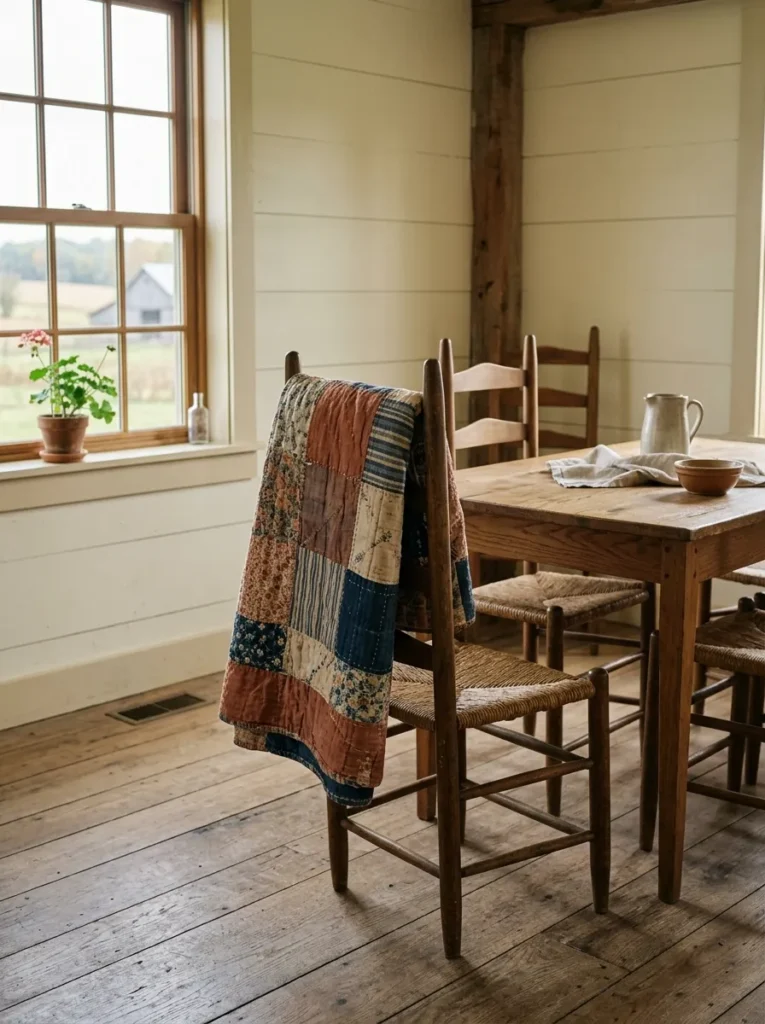
A single folded or draped quilt over the back of one dining chair — not all of them, just one — adds colour, pattern, and the suggestion that the room is used for more than formal meals. Choose a genuinely vintage or vintage-style quilt with a faded, slightly mismatched pattern rather than a new one with crisp, even colour. It should look like it was grabbed off a guest bed rather than purchased to match the room. This is a small, low-cost detail, and it is disproportionately effective in photographs because it introduces pattern and softness into a room that is otherwise dominated by wood and metal.
17. Choose a Farmhouse Dining Room Layout That Leaves Room to Walk Around the Table
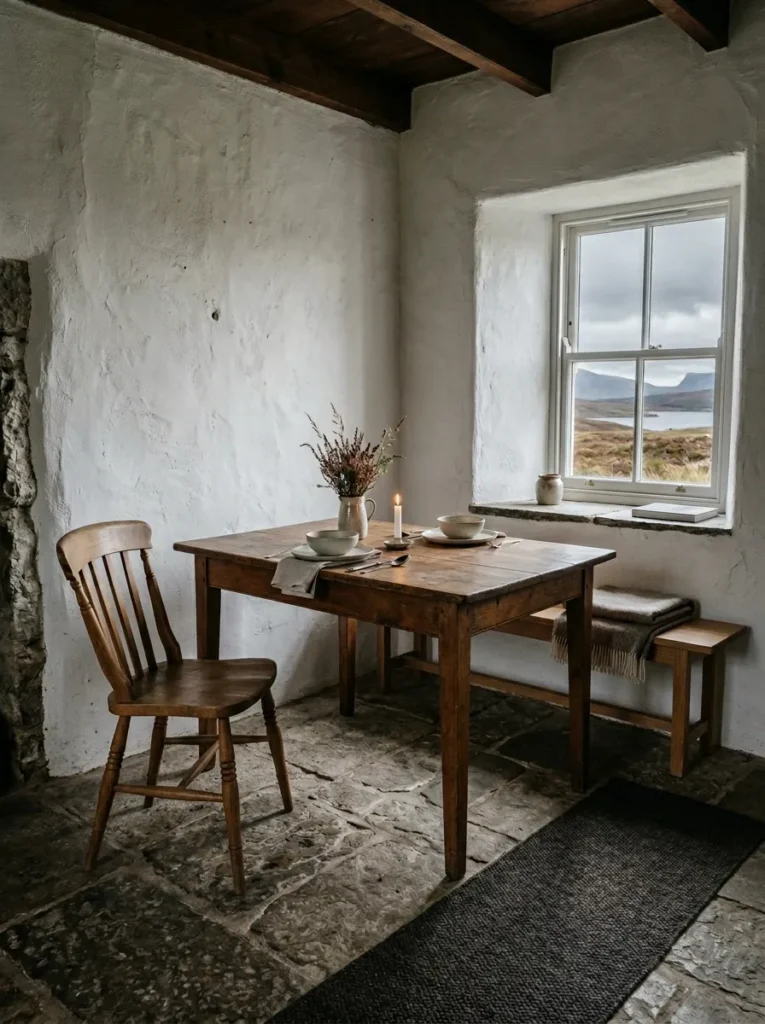
A common mistake in smaller farmhouse dining rooms is fitting the largest table the room can technically hold, leaving no more than the bare minimum clearance to pull out a chair. Leave at least 90 centimetres of clearance on all sides where possible, and prioritise a slightly smaller table with more breathing room over a larger one that makes the whole room feel like an obstacle course. A farmhouse dining room is meant to feel generous and unhurried, and a table that crowds the walls undercuts that feeling regardless of how beautifully it’s styled. If the room genuinely cannot fit a table with proper clearance, a bench on the tightest side solves more of the problem than people expect.
18. Leave One Wall Completely Bare
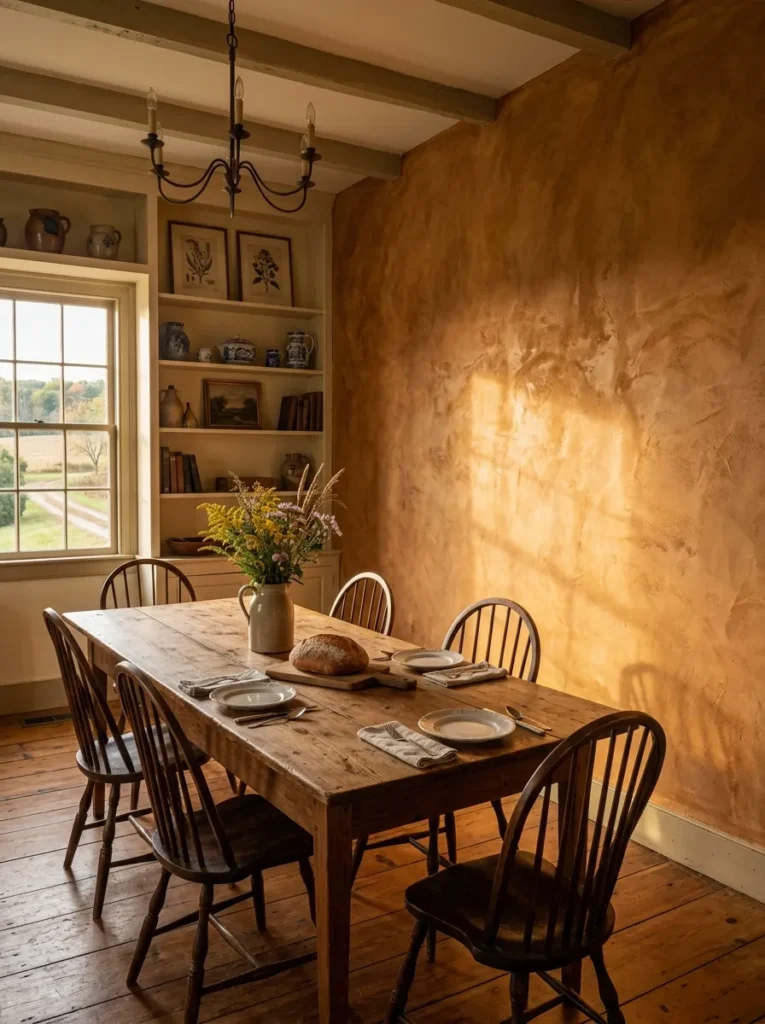
Every other idea in this article adds something. This one removes. The instinct in a farmhouse dining room is to fill every surface — a gallery wall here, a shelf there, a sign somewhere — until the room has no visual rest at all. Leaving one wall entirely bare, with nothing but its texture and colour doing the work, gives the eye somewhere to land between all the collected objects elsewhere in the room. It is the single hardest piece of advice in this list to follow, because empty space feels like an unfinished job rather than a deliberate one. It isn’t. The bare wall is what makes everything else in the room look intentional rather than accumulated.
Final Thoughts
The most convincing farmhouse dining rooms are never built from a single trip to one store. They accumulate — a table found secondhand, a bench added a year later, a ladder picked up at a market because it was the right kind of worn. If you’re starting from nothing, begin with the table and the lighting; everything else in this list is easier to layer in once those two anchors are right. These farmhouse dining room ideas work because they prioritise honesty of material and a degree of imperfection over a polished, matching look that photographs well for a week and then feels generic for years. Don’t aim to finish the room. Aim to leave it somewhere it can keep changing.
Save these farmhouse dining room ideas for your next renovation or table refresh.