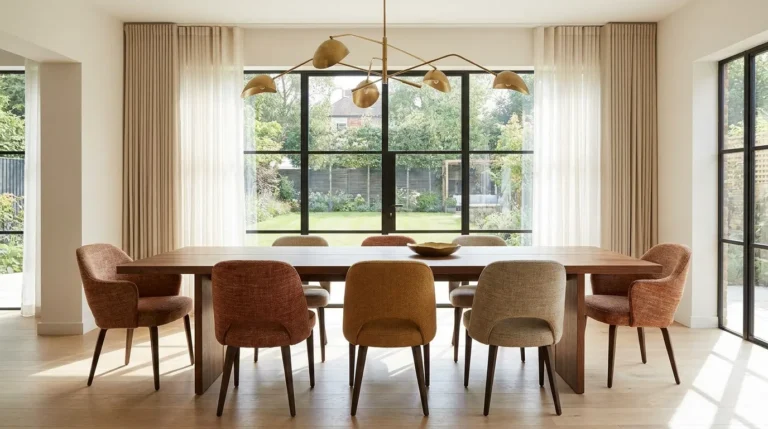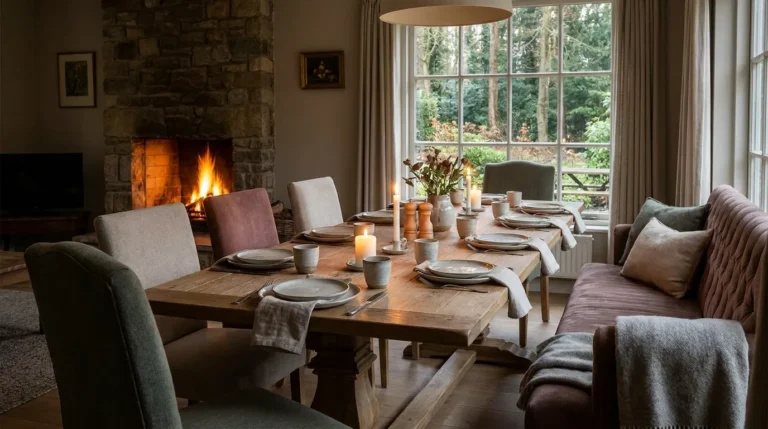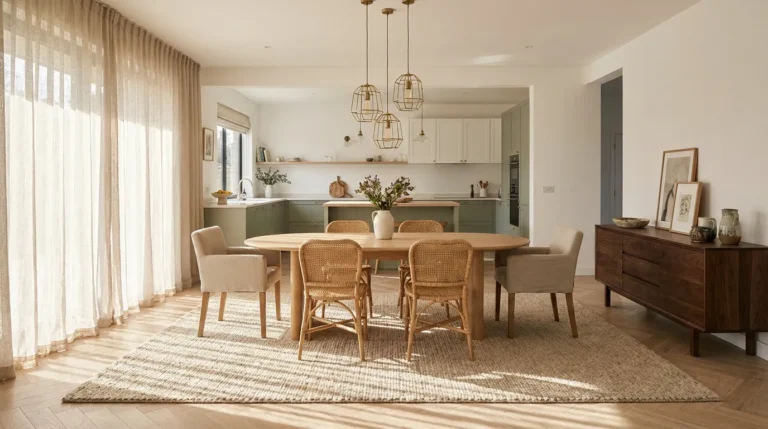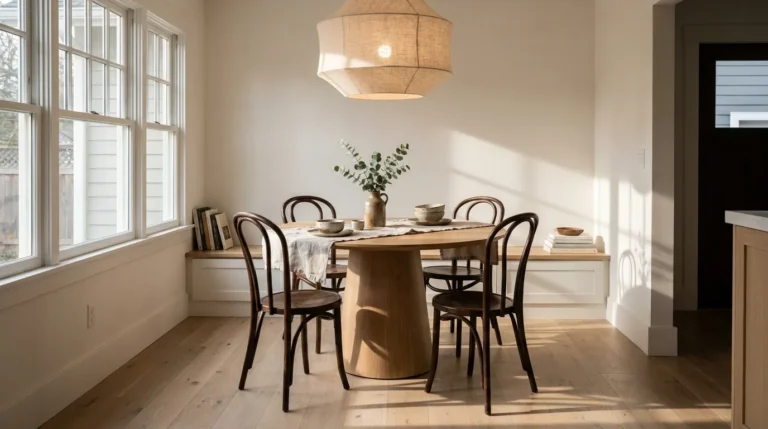
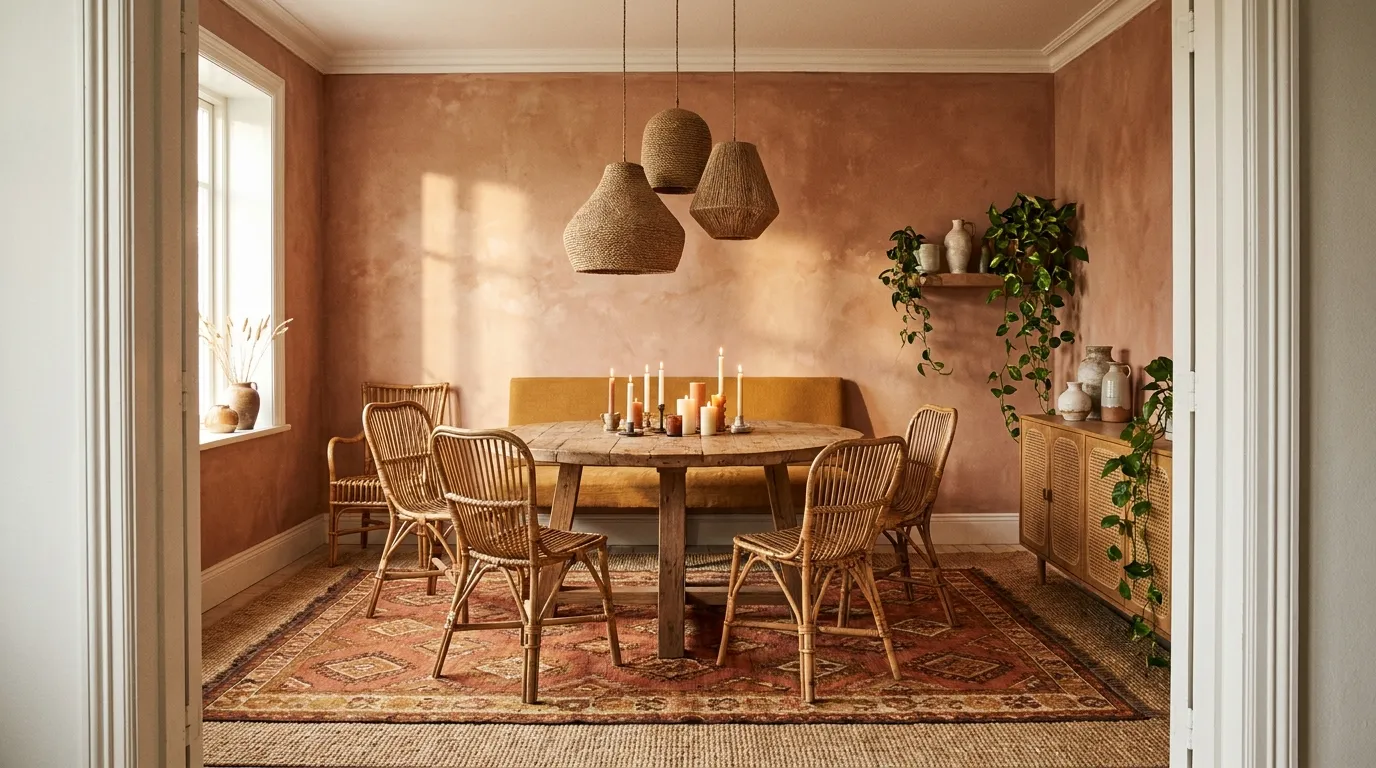
25 Boho Dining Room Ideas to Create a Cozy and Stylish Space
Bohemian dining rooms are one of those styles that look effortless in photographs and surprisingly easy to get wrong in real life. The difference between a room that feels genuinely gathered and layered versus one that looks like a jumble sale usually comes down to a few intentional decisions about anchoring, restraint, and material cohesion.
These 25 boho dining room ideas cover the full range — from the furniture and lighting decisions that shape the room’s character to the smaller choices around textiles, display, and table styling that pull everything into focus. Some ideas suit renters working without permanent changes; others are more committed. Some work best in larger dining rooms with breathing room; others are specifically designed for compact spaces where every choice needs to earn its place.
The goal isn’t to use all 25. It’s to find the ideas that suit your room, your habits, and what you find genuinely worth living with.
1. A Round Dining Table as the Room’s Anchor
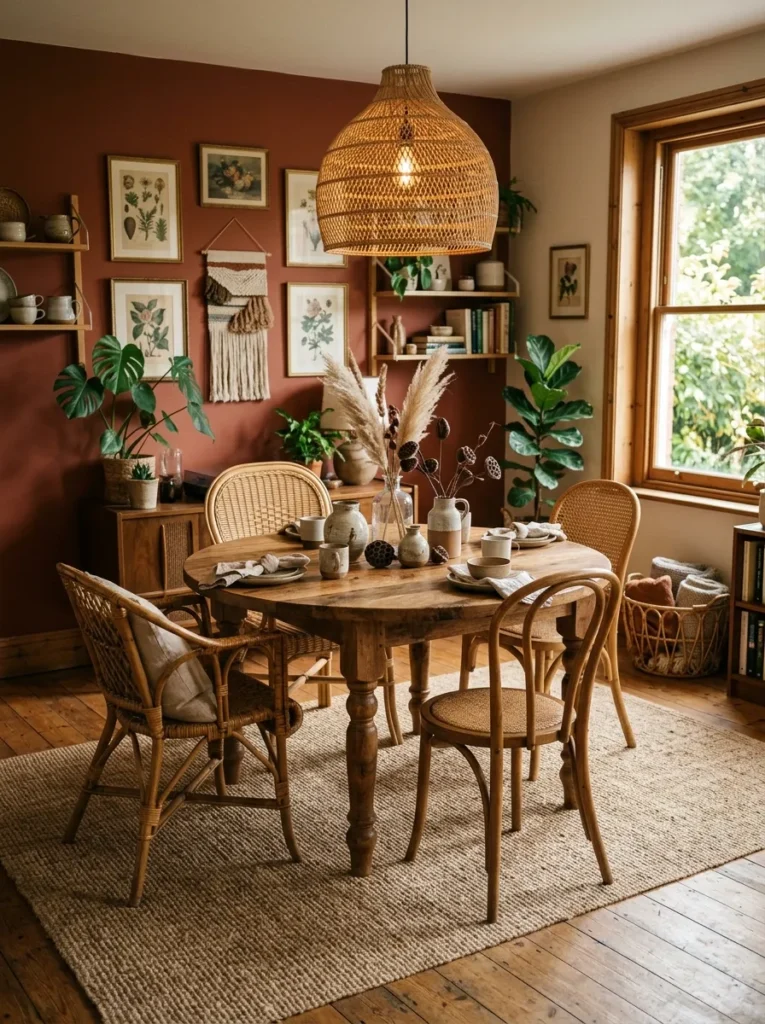
In a boho dining room, the table choice matters more than almost any other furniture decision because the bohemian style draws heavily from curved, organic shapes. A round table — particularly in natural wood, rattan-wrapped, or with a live-edge top — resists the grid-like formality that rectangular tables impose and creates a more naturally social dining arrangement.
Round tables also work better in smaller dining rooms than people expect. Without corners, they require less circulation clearance, and the eye moves around the perimeter rather than tracking a long axis. For a room up to roughly 3 x 3.5 metres, a table between 100–120cm in diameter typically leaves enough space for chairs without the room feeling squeezed.
The material matters for the boho reading. A chunky turned-leg table in raw oak or mango wood sits naturally in this style; a glass top does not.
2. Rattan Dining Chairs Mixed with an Upholstered Bench
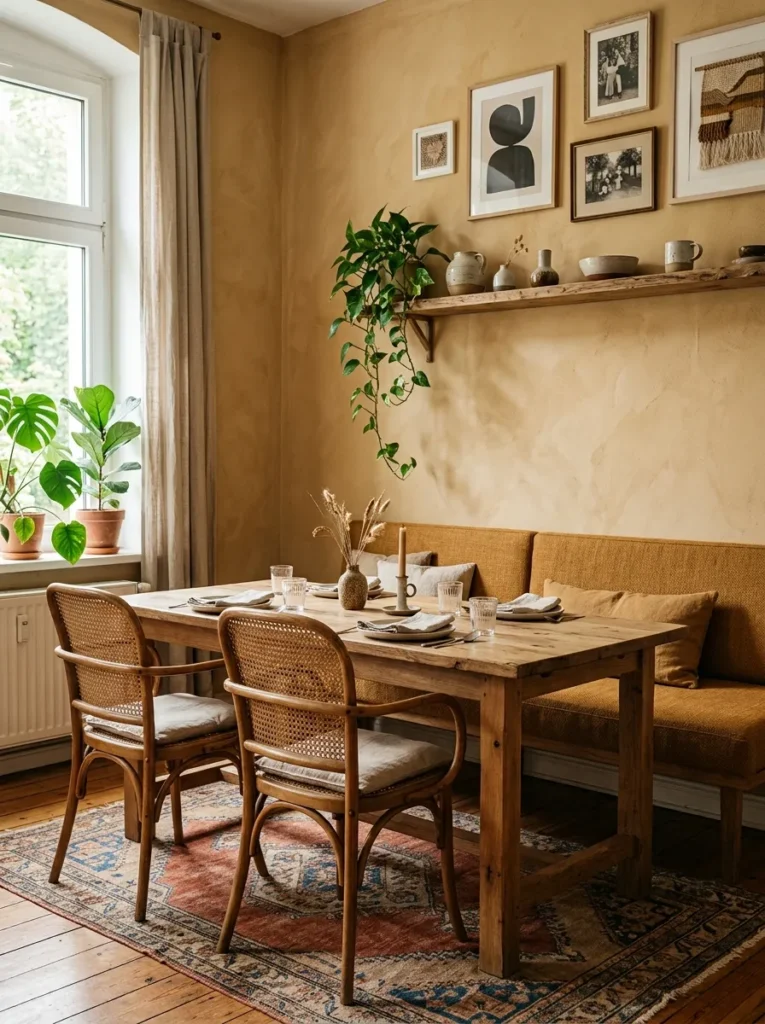
A uniform set of matching dining chairs looks deliberate — sometimes too deliberate for a style that values accumulated, eclectic feeling. Mixing rattan or cane dining chairs on three sides of the table with an upholstered bench on the fourth creates visual variety without full mismatching, which can read as unresolved.
The bench works particularly well against a wall, where it can sit under a gallery arrangement or below a floating shelf. In terms of textile choice for the bench, a textured woven fabric in warm ochre, terracotta, or faded green reads as more authentically boho than a plain velvet, which tips the room toward maximalist rather than bohemian.
The height relationship between the bench seat and the table apron matters practically: aim for roughly 25–30cm of clearance between the seat surface and the underside of the table for comfortable seated posture.
3. A Cluster of Pendant Lights at Varying Heights
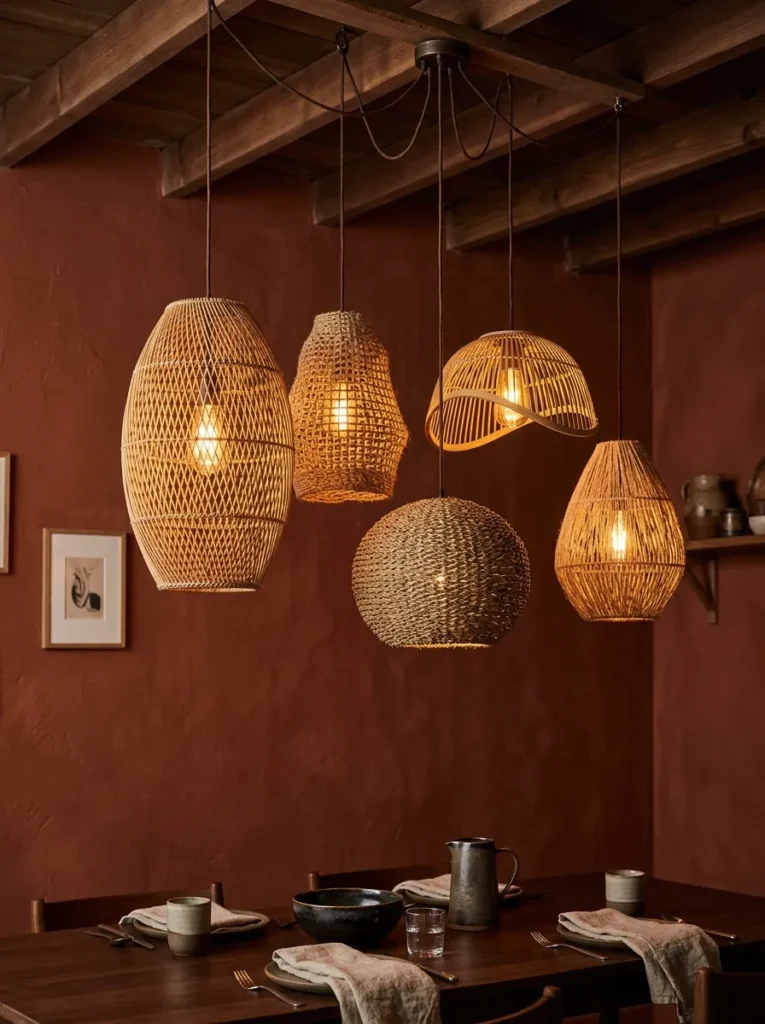
Single pendant lighting over a dining table is conventional. A cluster of three or five pendants — hung at slightly different cord lengths to create a staggered arrangement — immediately reads as bohemian without requiring any other changes to the room.
The pendant type matters. Woven jute or seagrass pendants in organic irregular shapes work well. Terracotta, blown glass in amber or rust tones, and hammered brass also sit naturally in the palette. What doesn’t work: very modern geometric pendants in polished metal, or glass globes in cool tones, which pull the room in a different direction.
Practical note: a cluster of five pendants on a single ceiling rose needs a junction box rated for the combined weight and wattage. If you’re adding a cluster to an existing single-pendant point, have an electrician verify the ceiling fixing before installation.
4. Limewash or Terracotta Walls as the Room’s Colour Foundation
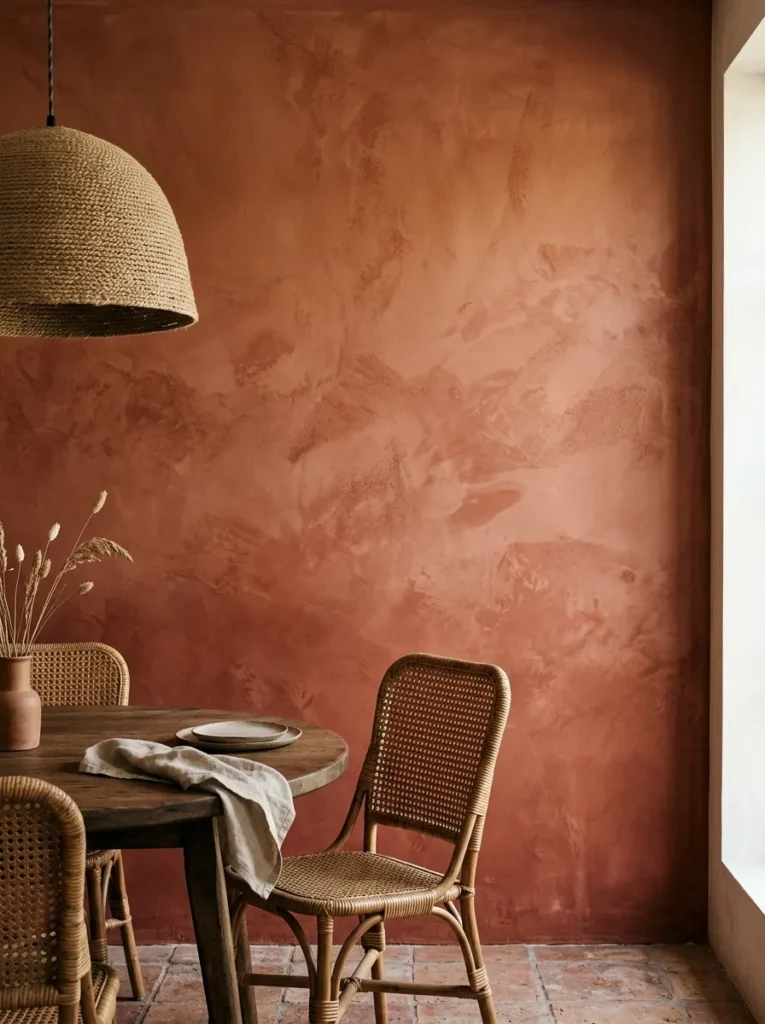
The wall colour in a boho dining room sets the entire material register of the space. Flat-painted walls in white or pale grey read as Scandinavian or minimalist, which undermines the layered warmth bohemian style depends on. Limewash paint — or a terracotta, warm rust, or clay tone — shifts the room immediately.
Limewash works because its natural tonal variation (slightly lighter in some areas, deeper in others) reads as the visual equivalent of aged plaster, which suits the gathered-over-time quality bohemian rooms project. Terracotta as a full wall colour is more committed but creates a rich, evening-lit quality that photographs beautifully.
If a full wall commitment feels too much, applying limewash to one wall only — typically the wall behind the table — still shifts the room’s character considerably.
5. An Oversized Jute or Kilim Rug Under the Table
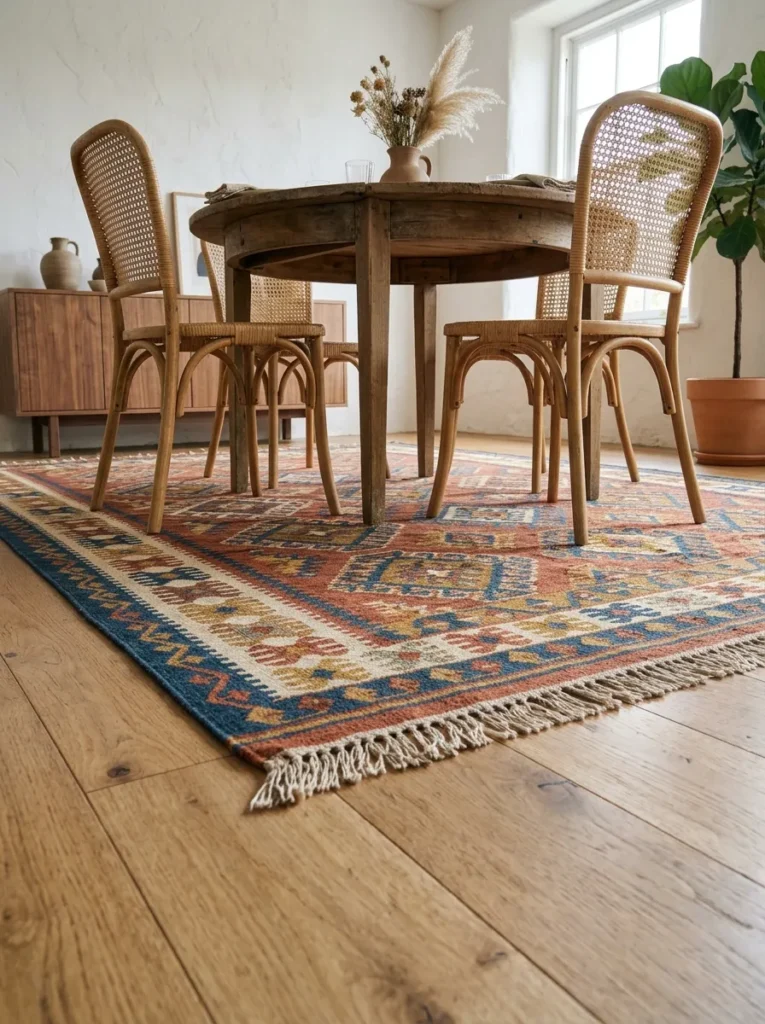
Dining room rugs are often sized too small, which makes the chairs slide off the edge every time someone pulls back from the table. In a boho dining room, an undersized rug also breaks the visual intention of the space — the rug should read as a foundation the room sits on, not a mat placed under the table legs.
The general principle: the rug should extend at least 60cm beyond the table edge on all sides so that chairs remain on the rug when pulled out. For a 120cm round table, that means a rug of at least 240cm diameter, or a rectangular equivalent.
In the boho context, a flat-woven kilim (with its geometric tribal patterns and warm earthy tones) or a natural jute rug (for a more neutral, textural base) are the strongest choices. A shag or high-pile rug, while cozy, catches chair legs and food debris in a way that becomes genuinely annoying in a dining context.
6. Open Wooden Shelving for Curated Display
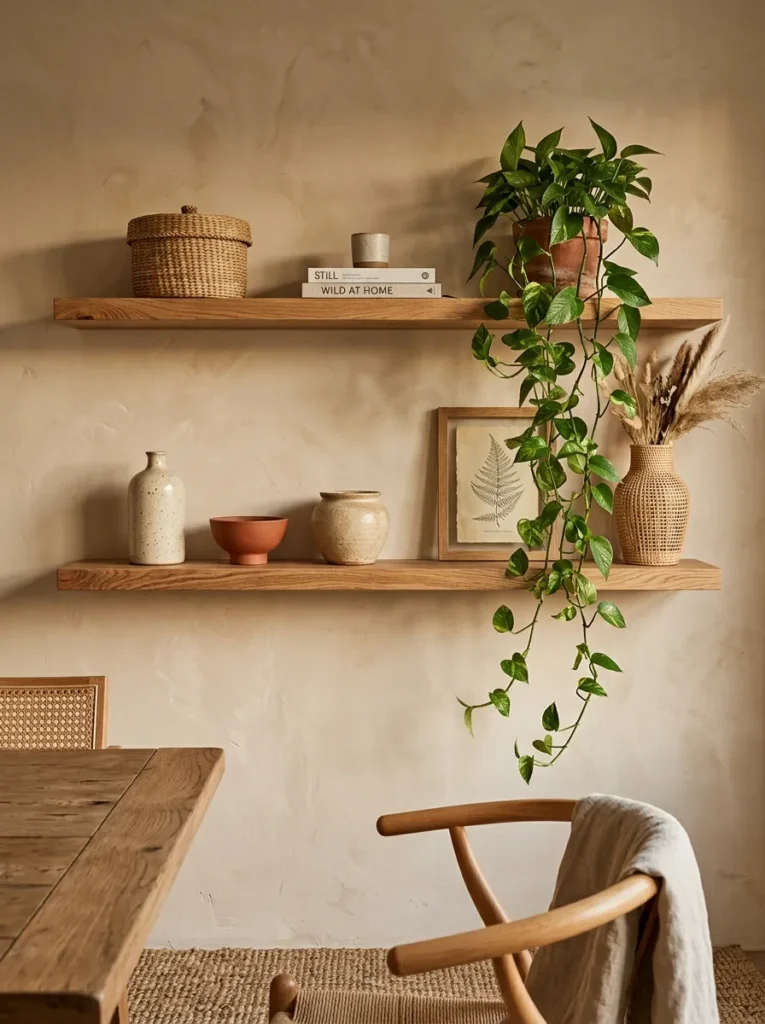
Open shelving in a dining room serves a different purpose than in a kitchen. Rather than accessible storage, it functions as a backdrop — a place to display the ceramics, carafes, baskets, and found objects that communicate a point of view without requiring a gallery wall.
For a boho dining room, the shelving material itself should be warm: solid oak, walnut, or reclaimed timber with visible grain rather than painted MDF. The display works best when it follows a loose coherence — earthy tones throughout, or a deliberate mix of natural materials — rather than either matching everything or placing items without any visual connection.
A common mistake is overcrowding. Three well-chosen items per shelf read as a point of view; six items read as overflow. In a rental, floating shelves can be secured using appropriate wall anchors for the wall type without requiring major modification.
7. Macramé Wall Hanging as a Textural Focal Point
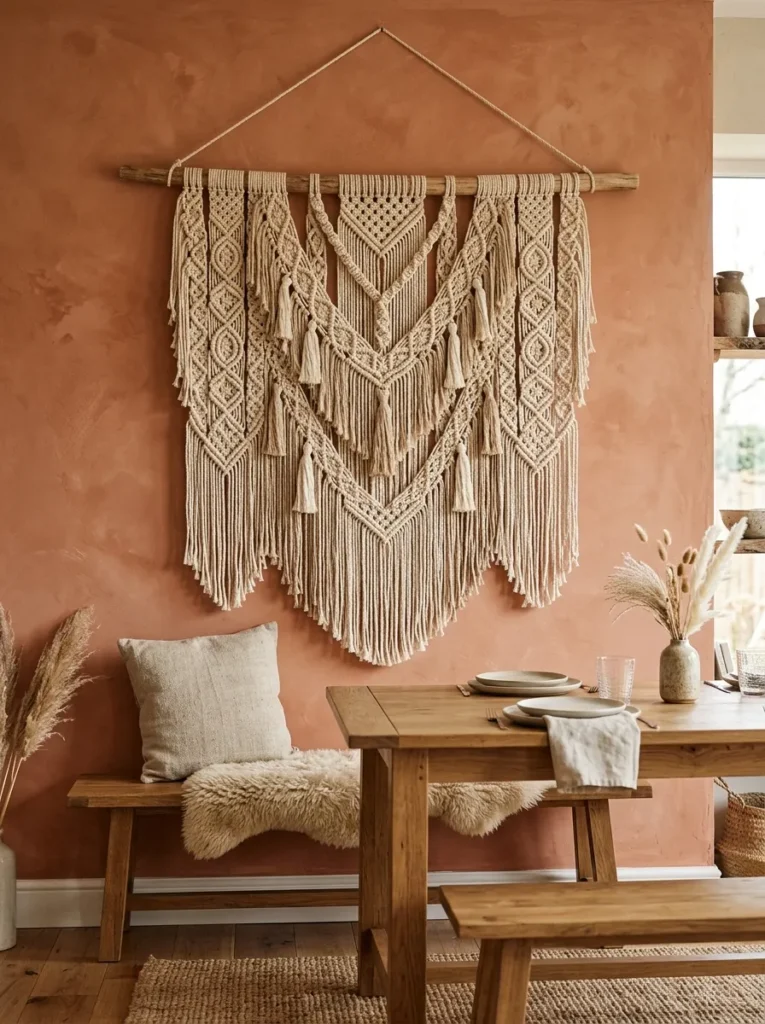
In a boho dining room, macramé functions differently than it does in a bedroom. In a dining context, the hanging typically sits on the wall behind the head of the table or behind a bench seat, acting as a soft headboard-like element that adds scale and tactile interest to the wall without the rigidity of framed art.
The scale needs to suit the wall. A hanging that’s too narrow for the wall behind the table reads as a small accessory rather than a considered decision. Roughly matching the hanging’s width to the table length (or at least two-thirds of it) creates a more resolved visual relationship.
Cotton cord macramé in natural, undyed tones is the cleanest option for rooms that already have active colour in the walls, rug, or textiles. Dyed pieces in terracotta or rust can work, but add another colour note to manage.
8. Vintage or Mismatched Ceramics as a Table Centrepiece
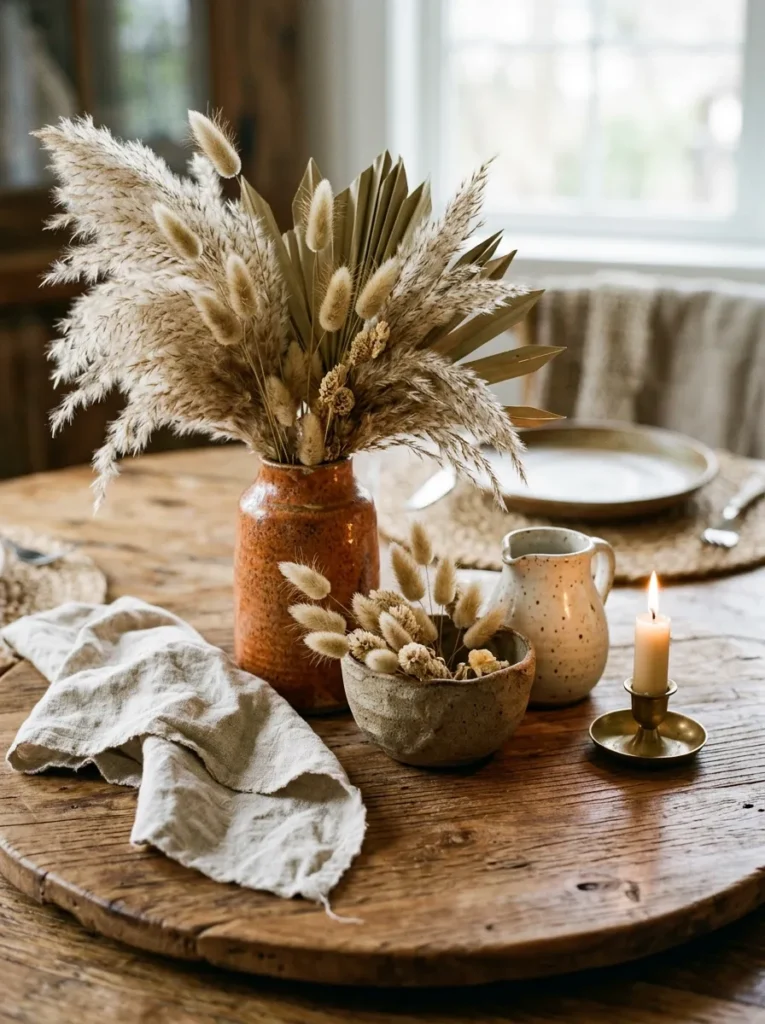
The table styling in a boho dining room doesn’t centre on a single hero vase or a composed floral arrangement. It tends to work through accumulation: a grouping of mismatched vessels at different heights — a tall ceramic vase, a low stoneware bowl, a small handthrown jug — with dried botanicals, pampas stems, or branches rather than fresh flowers.
Dried botanicals suit the boho palette particularly well because they share its earthy, undyed quality. Pampas grass, dried bunny tail grass, bleached palm spears, and banksia pods all work without looking precious.
The arrangement doesn’t need a strict centre. An off-centre cluster reads as more naturalistic than a symmetrical composition, which is exactly the quality a bohemian table benefits from.
9. A Statement Chandelier in Woven Natural Fibre
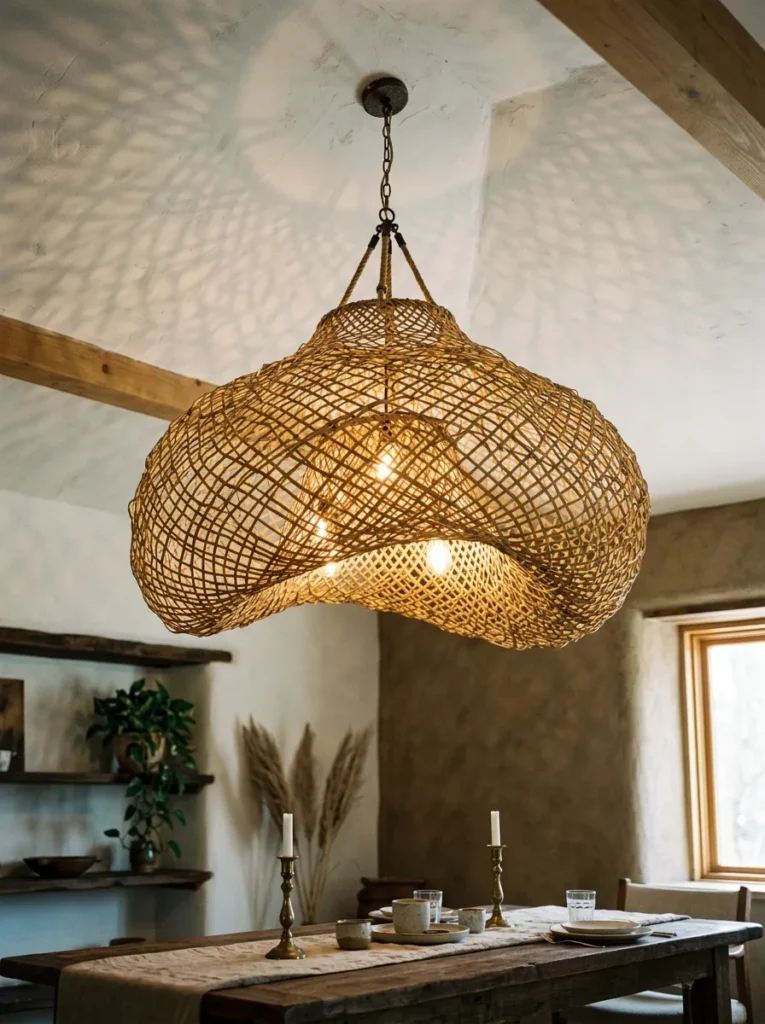
Where the cluster of pendants idea (Idea 3) creates an eclectic, gathered feel, a single large woven chandelier — an overscaled natural fibre or bamboo piece with an irregular, organic silhouette — makes a more deliberate statement. It works best in dining rooms with higher ceilings (2.7m or above) where the scale of the fitting doesn’t feel oppressive.
The advantage of a single statement chandelier over a cluster is that it requires only one ceiling point and is visually calmer. The disadvantage is that it commits the room more firmly to a specific look — it’s harder to change later without the swap being obvious.
Height placement: the bottom of the fitting should hang approximately 75–85cm above the table surface for a standard 75cm dining table height. In rooms with ceilings above 3m, the pendant can sit slightly higher without losing the sense of connection to the table below.
10. An Arched Window or Doorway Framed with Flowing Curtains
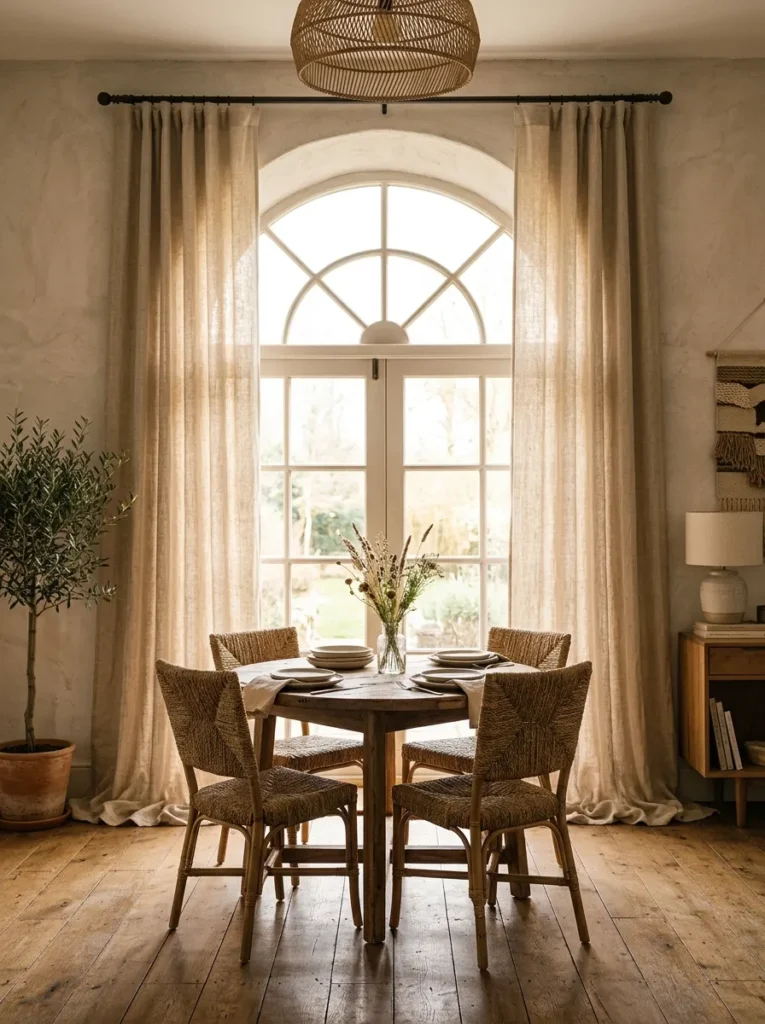
An arch is an architectural gift in a boho dining room. The curved geometry echoes the organic forms the style favours — round tables, irregular ceramics, woven baskets — and creates a natural focal point that doesn’t require any decorating. If the room has one, letting it breathe rather than covering it with a curtain or blind is usually the better decision.
Where curtains are needed at a window or doorway in the same room, floor-length panels in unlined linen, cotton gauze, or a loose woven fabric suit the bohemian register far better than structured, interlined curtains. The fabric should drape with some movement and pool very slightly on the floor — roughly 3–5cm of excess — which signals relaxed rather than careless.
For renters without the option of fitting new curtain poles, tension rods and clip rings allow floor-length curtains without wall drilling.
11. A Reclaimed Wood Dining Table with Visible Grain and Imperfections
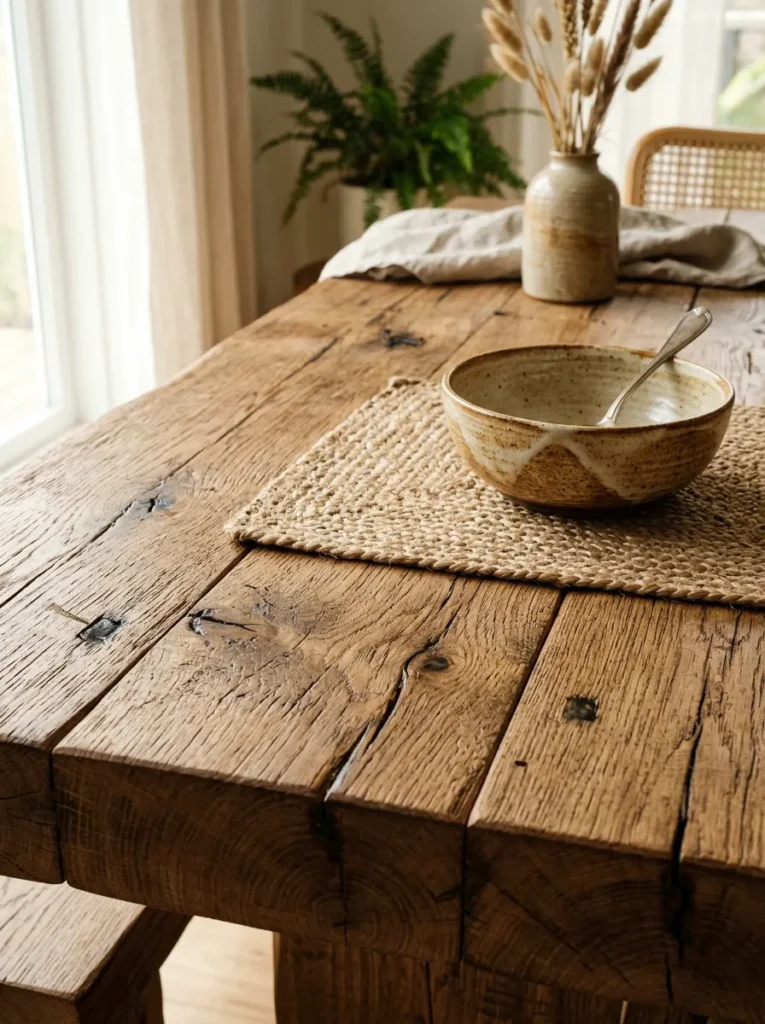
New furniture made to look old rarely convinces. Genuinely reclaimed or antique dining tables — with saw marks, patina, and repaired joints — bring exactly the accumulated history that a bohemian room needs. The imperfections are the point: they signal that the room wasn’t designed from scratch on a mood board.
If genuine reclaimed timber is outside the budget, newly made furniture in solid mango, acacia, or sheesham wood (all fast-growing, sustainably managed woods with naturally dramatic grain) can achieve a similar visual weight and warmth at a lower price point.
What to avoid: tables with a heavy lacquered finish, which seals the grain behind a glossy layer. Oiled or wax-finished wood reads as more honest to the material and suits the boho palette considerably better.
12. Candles at Multiple Heights Instead of a Central Overhead Focus
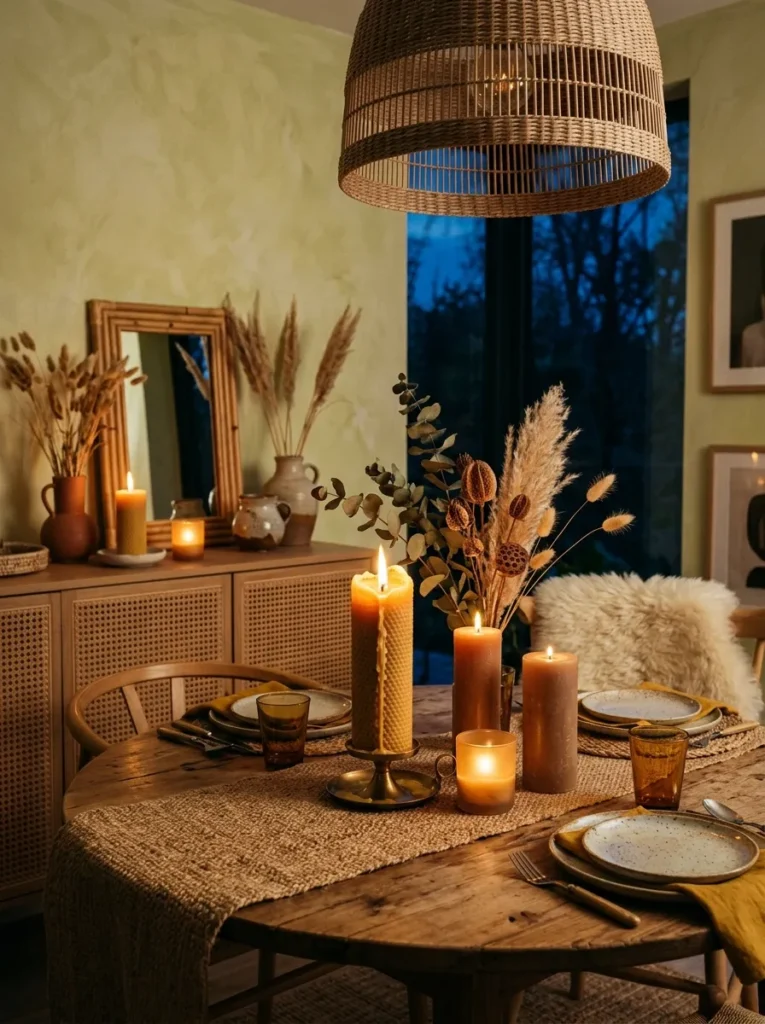
Many boho dining rooms photograph beautifully but feel flat in the evening because the only light source is an overhead pendant. Introducing candles — at three or four different heights across the table and a sideboard or shelf — creates the layered, intimate quality that defines the boho dining experience at its best.
The visual effect depends on grouping rather than scattering: a cluster of three candles of different heights at one end of the table, a pair on the sideboard, a single taller pillar on the shelf. Beeswax candles in natural undyed tones or in terracotta and deep rust suit the palette; white candles can work but lose the warmth.
In rental spaces or around children, LED candles in realistic wax forms have improved considerably and can replicate this effect without fire risk.
13. A Gallery Wall of Botanical and Ethnographic Prints
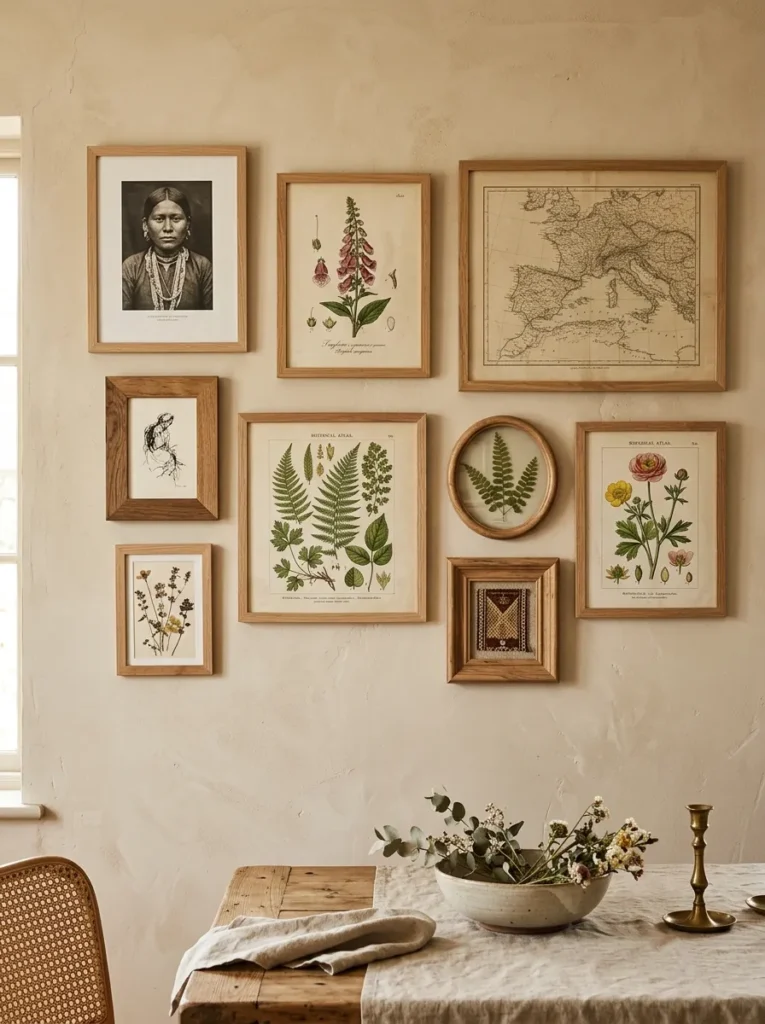
A gallery wall in a boho dining room is most effective when it reads as a collected archive rather than a commissioned set. The strongest combinations mix: unframed or loosely framed botanical illustrations, pages from antique maps or atlases, pressed plant specimens behind glass, and woven or textile fragments mounted in simple frames.
The frame variety should be consistent in one dimension while varying in another. All gallery wall in different shapes (round, square, rectangular) creates coherence without matching. All the same frame with different internal artwork works similarly. Mixing both variables — every frame different, every piece different — often reads as chaotic rather than curated.
Wall colour matters here: against a pale wall, dark frames hold the composition; against a terracotta or limewash wall, lighter natural wood frames sit more gently.
14. Woven Placemats and Linen Napkins as the Table’s Textile Layer
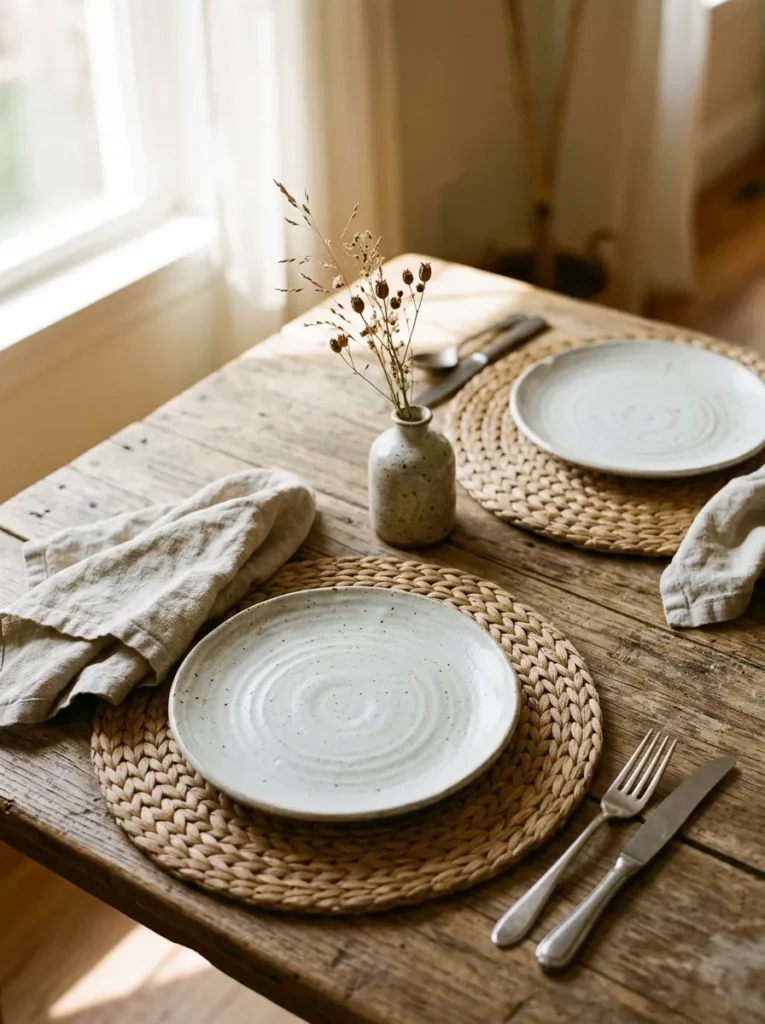
The table surface itself is often neglected in boho dining room styling. A bare wooden table looks clean but slightly stark; a full tablecloth in the wrong fabric can look formal. Woven placemats — seagrass, water hyacinth, or hand-woven cotton in natural or earthy tones — sit naturally in the boho palette and protect the table without requiring a full covering.
Pairing them with softly crumpled linen napkins (rather than neatly folded or pressed ones) reinforces the relaxed quality the style depends on. A linen napkin that’s been washed many times and air-dried develops exactly the kind of textural softness that suits a boho table setting.
For daily use, undyed or stone-washed linen is more practical than natural-dyed versions, which can fade or bleed in the wash.
15. Trailing Plants on a High Shelf or Plant Hanger
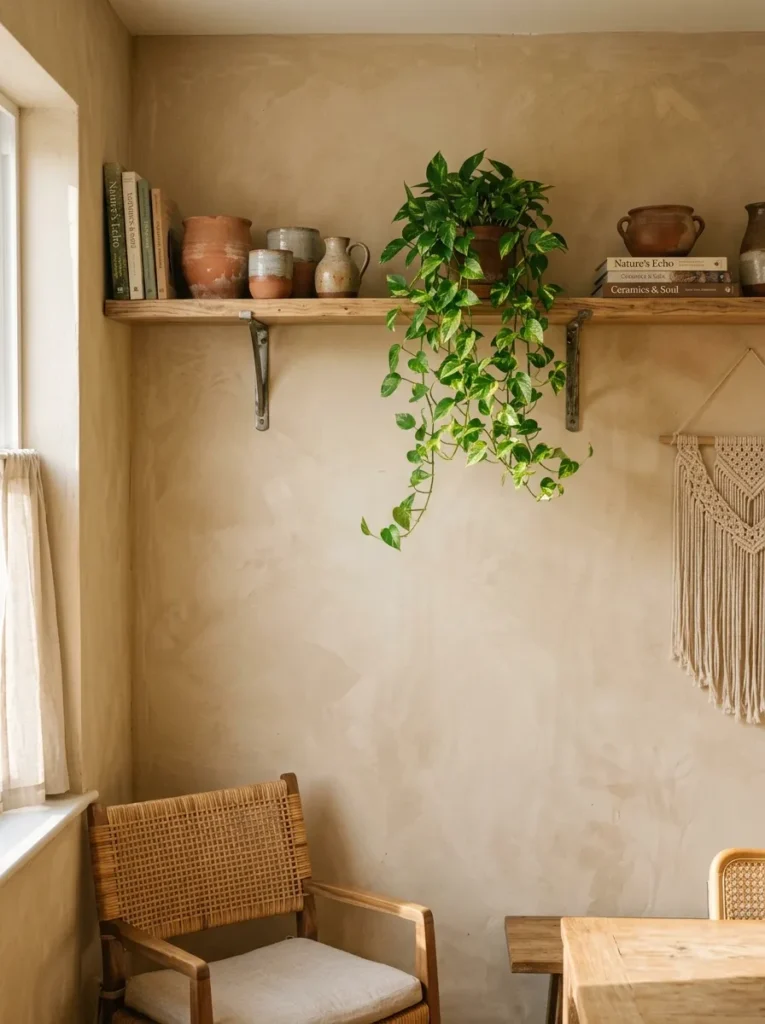
A dining room with no greenery at all can feel slightly static, particularly in a style that references global, organic, and nature-adjacent influences. But the placement of plants matters more than the choice of plant.
In a boho dining room, trailing plants — pothos, string of pearls, or ivy — work better than upright specimens because they add softness to vertical space without taking up table or floor area. A trailing plant on a high shelf, spilling downward over ceramics and books, creates exactly the kind of organic overflow that characterises a genuinely lived-in boho room.
Hanging planters in macramé or woven cotton can hold trailing specimens at mid-height, typically in a corner or near a window where light is adequate. Direct bright light suits most trailing varieties; low-light rooms are better served by pothos or heartleaf philodendron.
16. A Sideboard in Rattan, Cane, or Painted Vintage Wood
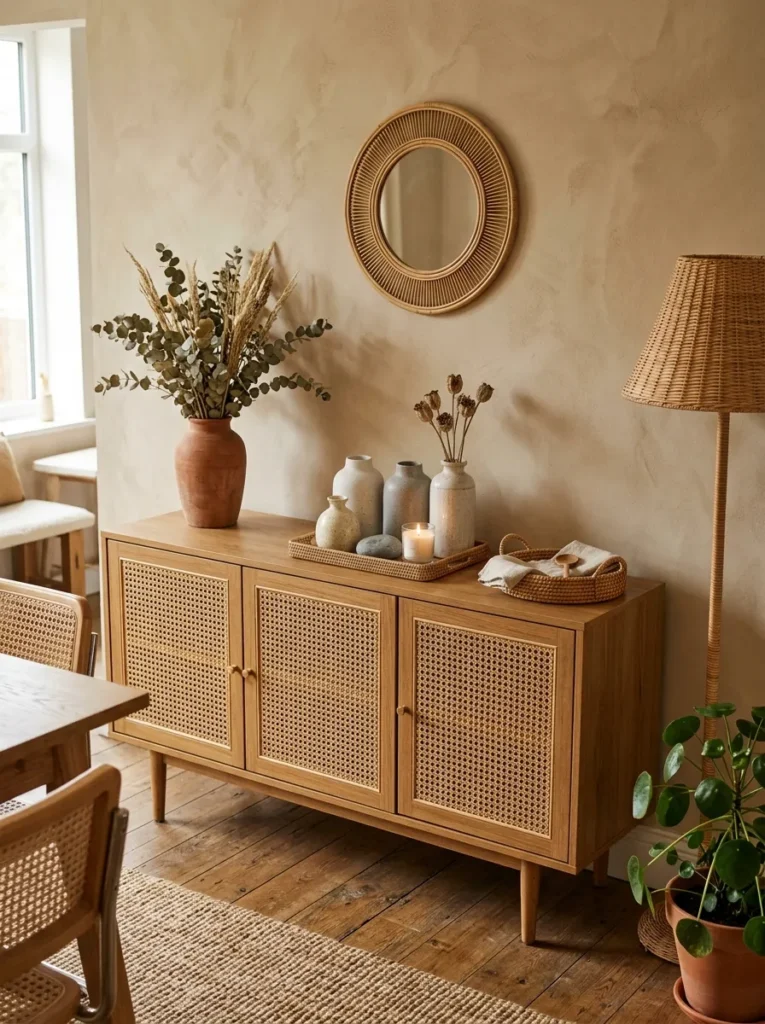
Every dining room benefits from a sideboard or credenza for serving, storing, and displaying — but in the boho context, the sideboard also carries some of the room’s visual character. A rattan-fronted cabinet, a cane-panel piece, or a vintage painted sideboard with worn corners contributes differently than a modern flat-pack unit.
Rattan and cane-fronted sideboards bring texture to a large flat surface that could otherwise look blank. Painted vintage pieces — particularly in faded sage, chalky blue, or dusty rose — introduce colour at furniture level rather than wall level, which is easier to change later.
One practical note: avoid placing a rattan or cane-fronted sideboard against an exterior wall in a damp climate, as sustained moisture can cause the cane to sag or mould. A well-ventilated interior wall is a better position.
17. Exposed Brick or Rough Plaster as a Feature Wall
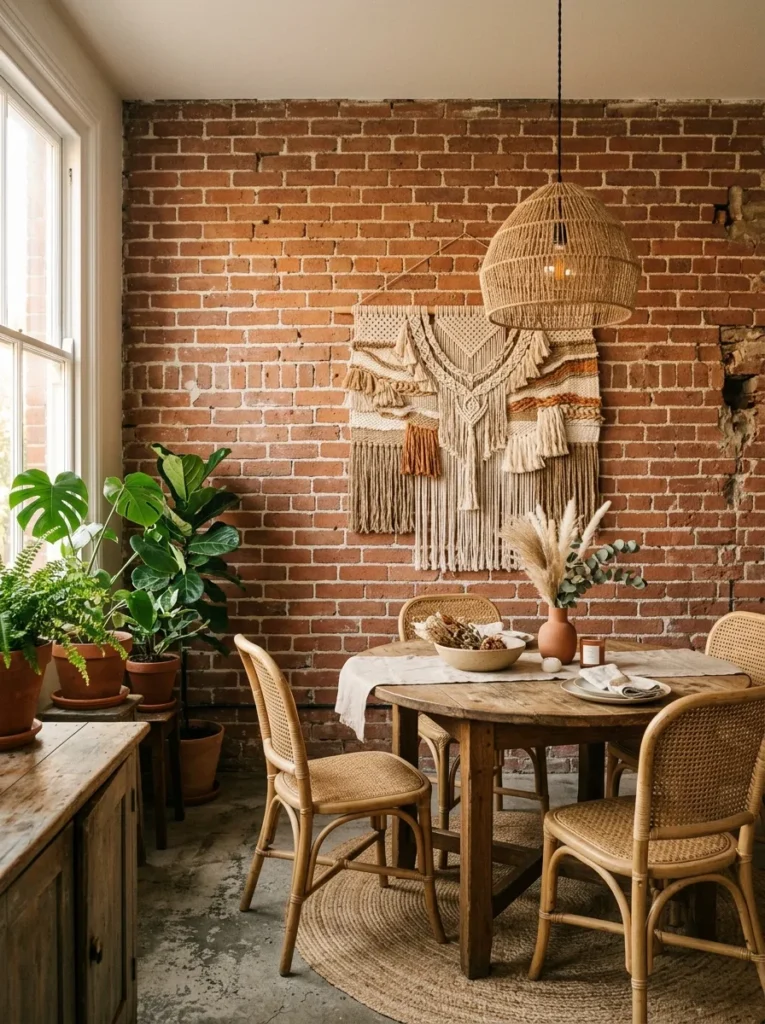
Where the room’s architecture allows it, an exposed brick section or a deliberately rough-finished plaster wall provides a textural backdrop that no paint finish entirely replicates. Both materials have the aged, material-honest quality that suits the boho aesthetic without requiring any decor to complete them.
Exposed brick in a dining room works best when the brick is warm in tone — aged red, amber, or sandstone rather than cold grey engineering brick. If the brick is too light or too cool, a limewash applied over it (which allows some of the brick texture to show through) can adjust both the tone and the finish simultaneously.
Raw plaster walls — sometimes called Venetian plaster or Roman clay — have a similar quality to limewash but with greater depth and a slight sheen. Both require professional application for best results.
18. A Boho Bar Cart with Rattan Tray and Natural Decanters
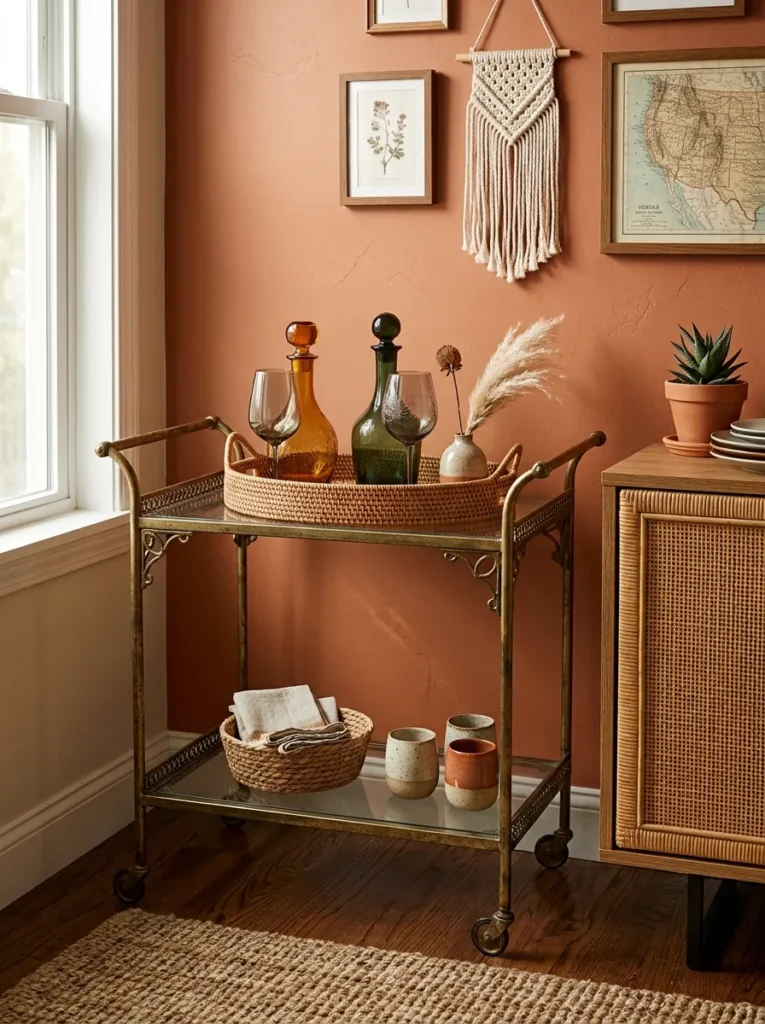
A bar cart in a boho dining room is less about convenience and more about adding another surface for intentional display. The cart itself should be in a warm metal — aged brass, antique gold, or brushed copper — rather than a chrome or polished steel finish, which conflicts with the palette.
The styling matters: a rattan tray on the top shelf holding glass or ceramic decanters in warm amber and green, a small plant or dried botanical stem in a bud vase, and a few mismatched glasses rather than a matching set. The assembled effect should read as personal rather than hotel minibar.
A bar cart also offers flexibility for renters and those not ready to commit to permanent furniture — it can be moved, repurposed, and restyled without difficulty.
19. Low Ambient Lighting with a Dimmer Switch
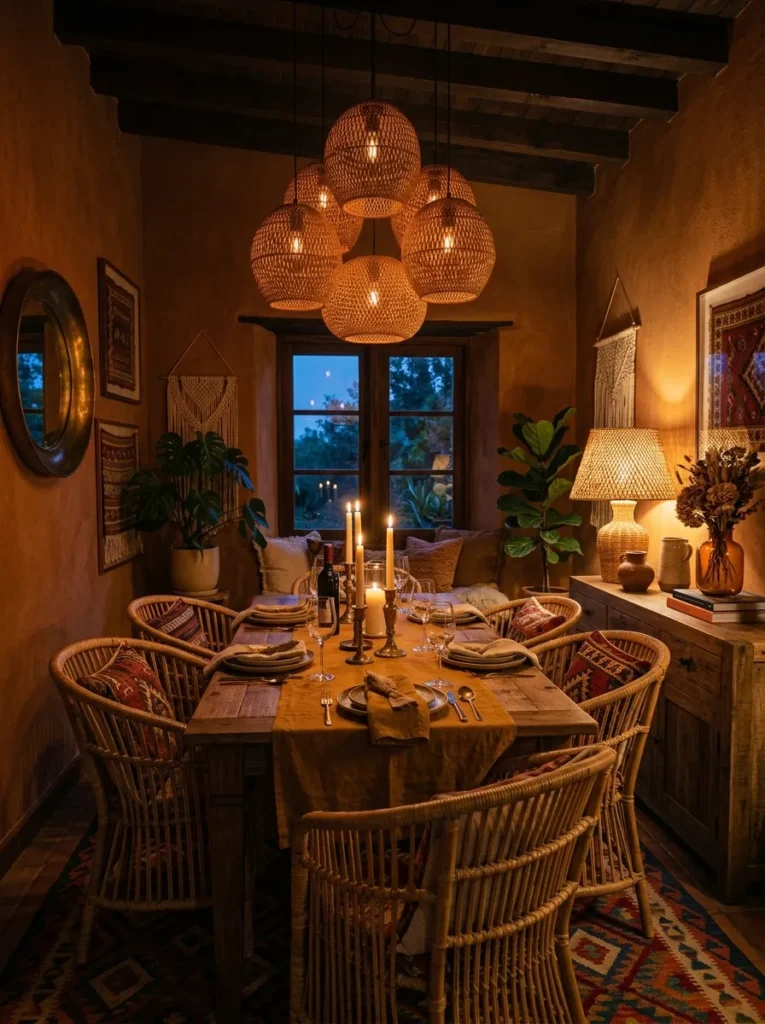
The relationship between lighting and mood in a boho dining room is more important than most decorating decisions. The high-wattage, flat ceiling light that makes a kitchen functional ruins the layered, intimate atmosphere a bohemian dining room aims for. Connecting the main pendant or chandelier to a dimmer switch is one of the most impactful and low-cost changes possible.
In the evening, a dimmed overhead light combined with candles (from Idea 12) and a table lamp on the sideboard creates three distinct layers of light at different heights, which reads as genuinely atmospheric rather than merely dark. The overhead drops to mood level; the candles provide focal warmth; the sideboard lamp adds depth.
Dimmer switches are straightforward to install for any LED or traditional filament bulb — verify that the specific bulb type is dimmable, as not all LEDs are.
20. Wicker or Bamboo Lamp on a Dining Room Sideboard
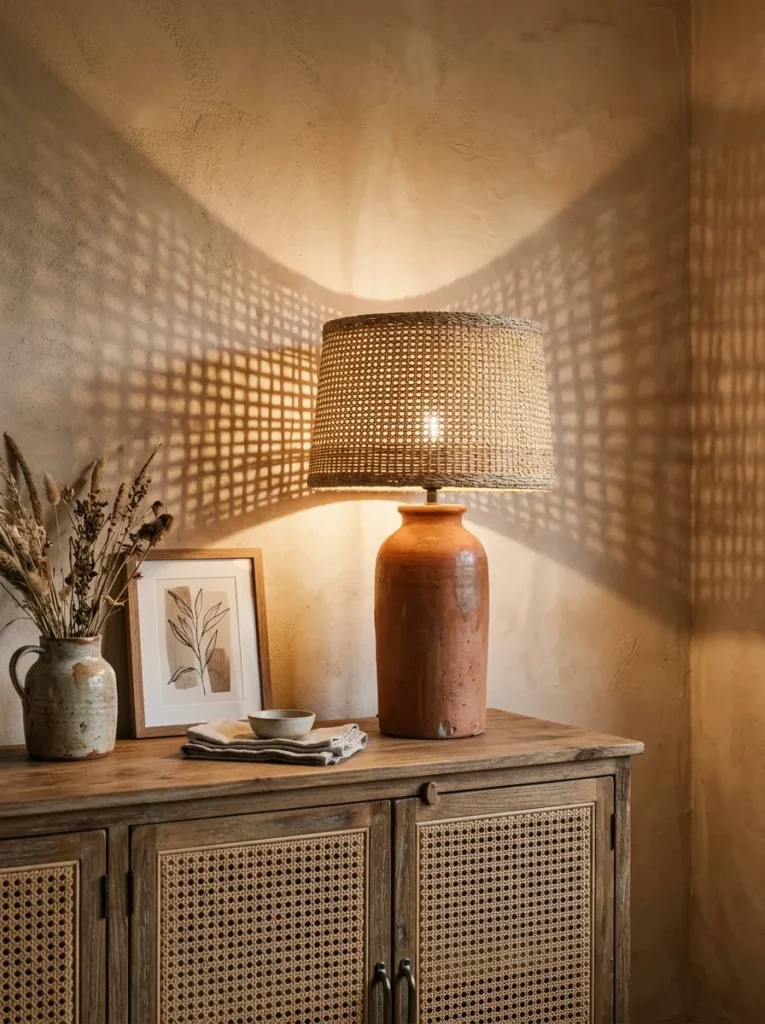
A table or floor lamp positioned on the sideboard adds the third layer of lighting mentioned in Idea 19, but it also addresses a specific visual problem in dining rooms: the wall behind the sideboard often reads as blank and unresolved. A lamp at that height — particularly one with a woven or bamboo shade that casts dappled light patterns on the wall — animates the surface without requiring artwork.
The shade material is the detail that matters in the boho context. A woven natural fibre shade casts warm latticed shadows; a paper shade diffuses the light evenly. Both work; the woven version is more distinctly boho. A ceramic or terracotta base in an earthy tone completes the material story.
The lamp doesn’t need to be on the same circuit as the dining light — a simple plug-in floor or table lamp near the sideboard achieves the same effect.
21. A Beaded or Shell Curtain in a Doorway
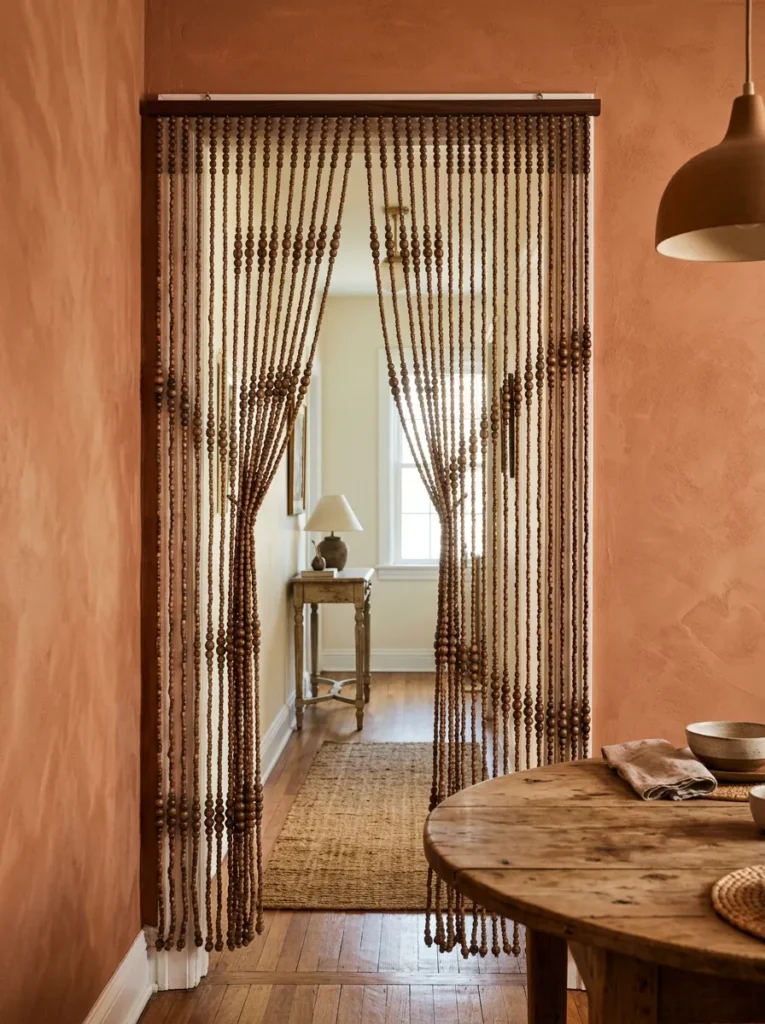
In a dining room that opens onto a hallway, kitchen, or living area through an open doorway, a beaded curtain — in natural wood beads, bamboo, or shell — marks the threshold without enclosing the space. The movement of the curtain (it shifts slightly in air currents and when people pass through) adds kinetic life to a room.
This works best when the doorway is used frequently enough that the curtain is always in motion, and less well in a rarely-used formal dining room where it simply hangs static. Natural wood or bamboo bead curtains suit the boho palette; plastic or acrylic versions do not.
It’s worth noting that beaded curtains produce noise when disturbed, which can be disruptive if the dining room is adjacent to a space where quiet is needed. For a casual, frequently-used dining room, this is rarely an issue.
22. Layered Rugs for Warmth and Pattern Depth
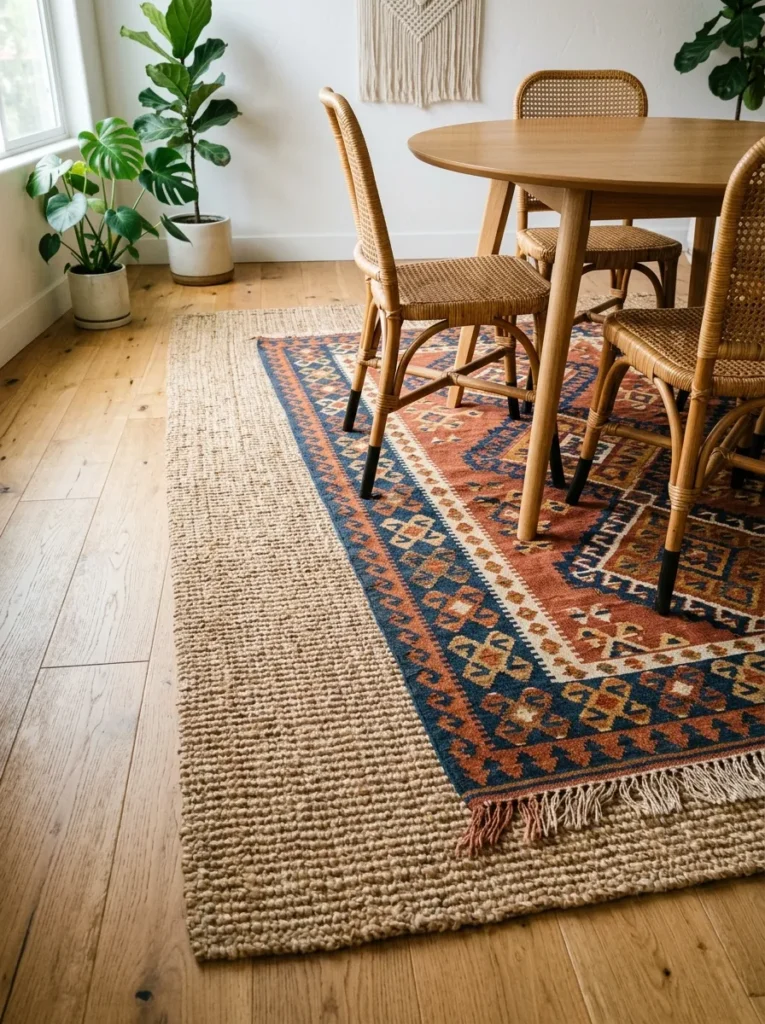
Where Idea 5 addressed rug sizing and type, this idea is specifically about layering two rugs to create more visual depth than either could achieve alone. The technique involves placing a smaller, more decorative rug — typically a kilim or printed cotton rug — on top of a larger, more neutral base rug (jute or sisal), offset slightly so both edges are visible.
The layered approach solves a specific problem: a jute rug alone can feel too plain, while a small kilim alone looks incorrectly sized. Together, the jute provides the foundation coverage (extending beyond the table as noted in Idea 5) while the kilim introduces pattern and colour at the centre.
The two rugs should share at least one colour from the room’s palette. A kilim with terracotta, ochre, and deep blue on a natural jute base reads as intentional; a random colour combination reads as two rugs that happened to be placed together.
23. Dried Botanical Wreath or Wall-Mounted Branch
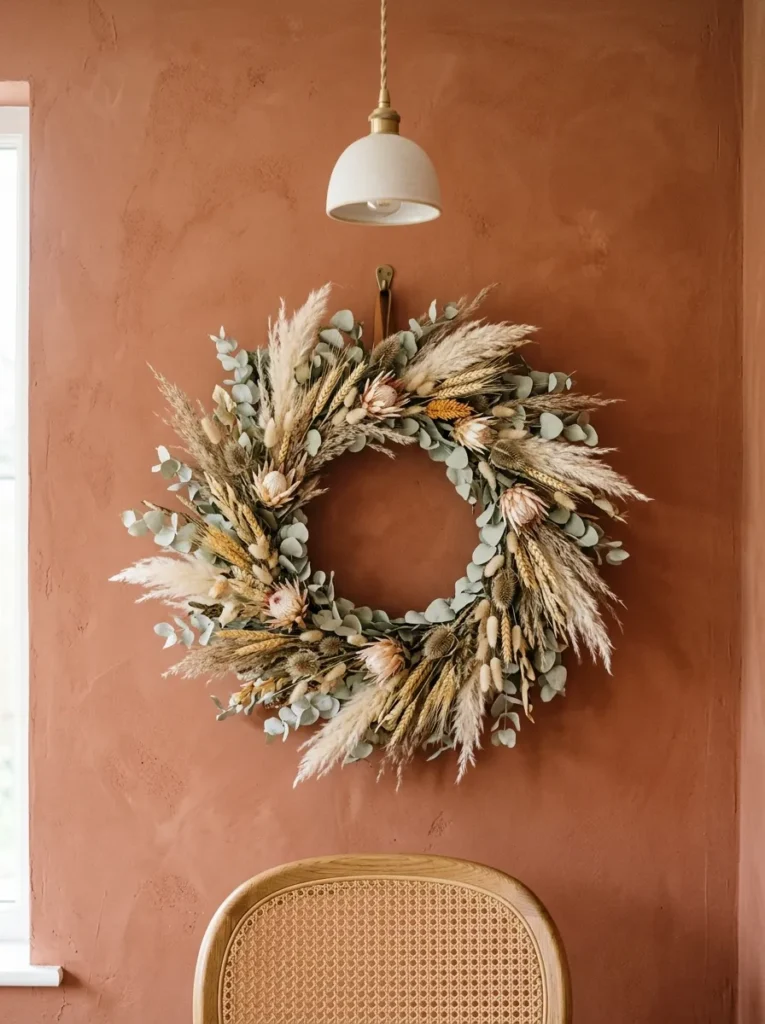
A large dried botanical wreath — eucalyptus, pampas, wheat, or a mixed dried herb blend — hung on the dining room wall addresses a specific scale problem: the space needs something on the wall, but a framed print or gallery arrangement isn’t the right tone for that wall.
Wreaths work particularly well on terracotta or limewash walls because the dried material tones match and complement each other. They also suit exposed brick or plaster. On a plain white wall they can look more decorative than purposeful.
Alternatively, a large, interesting branch — found in nature and dried — mounted horizontally on a wall bracket and used as a hanging display (for small objects, ribbons, or additional dried stems) creates a more architectural version of the same idea and is entirely free if you find the right branch.
24. Patterned Wallpaper on One Dining Room Wall
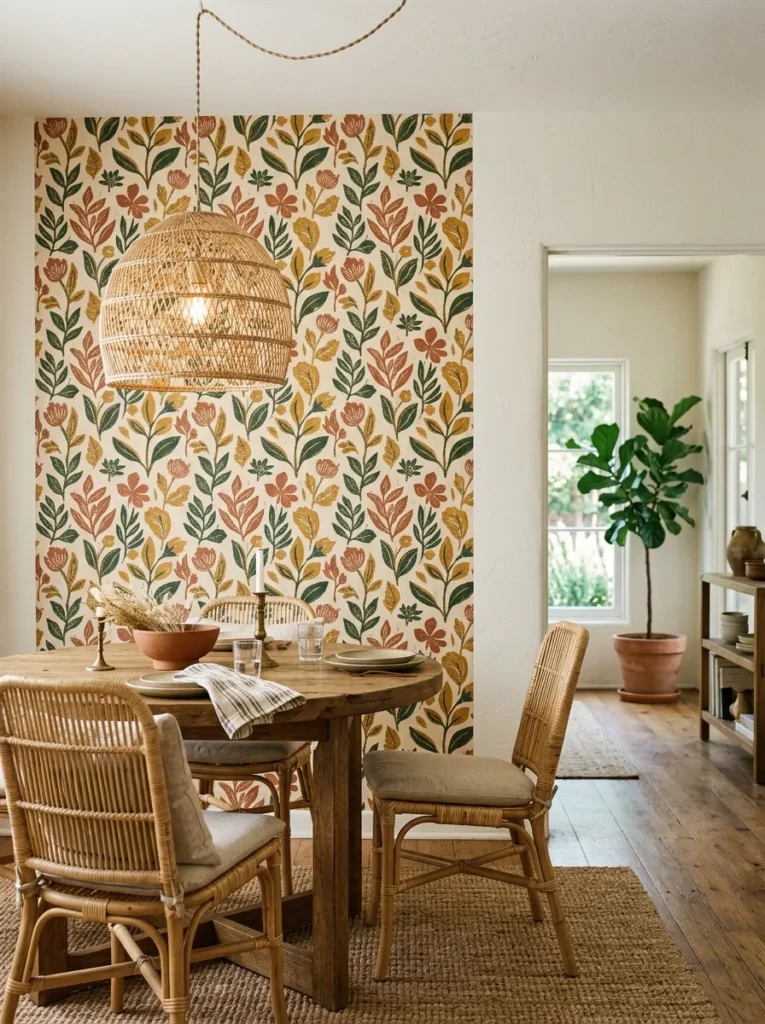
Botanical, block-print, or globally inspired patterns in earthy tones — terracotta, ochre, forest green, indigo — are the strongest wallpaper directions for a boho dining room. The pattern should have an organic, slightly imperfect quality rather than the precision of a geometric repeat.
The one-wall approach is generally the right call for pattern-heavy designs. The wall behind the dining table (or the wall the table is pushed against, in a smaller room) is the natural position — it’s what diners face, and it functions as a permanent backdrop to every meal.
One practical note: very dense, dark wallpaper on the only window-bearing wall reduces natural light considerably. In smaller dining rooms with limited daylight, keeping pattern on a non-window wall preserves more of the room’s brightness.
25. A Hammock Chair or Swing Seat in a Corner
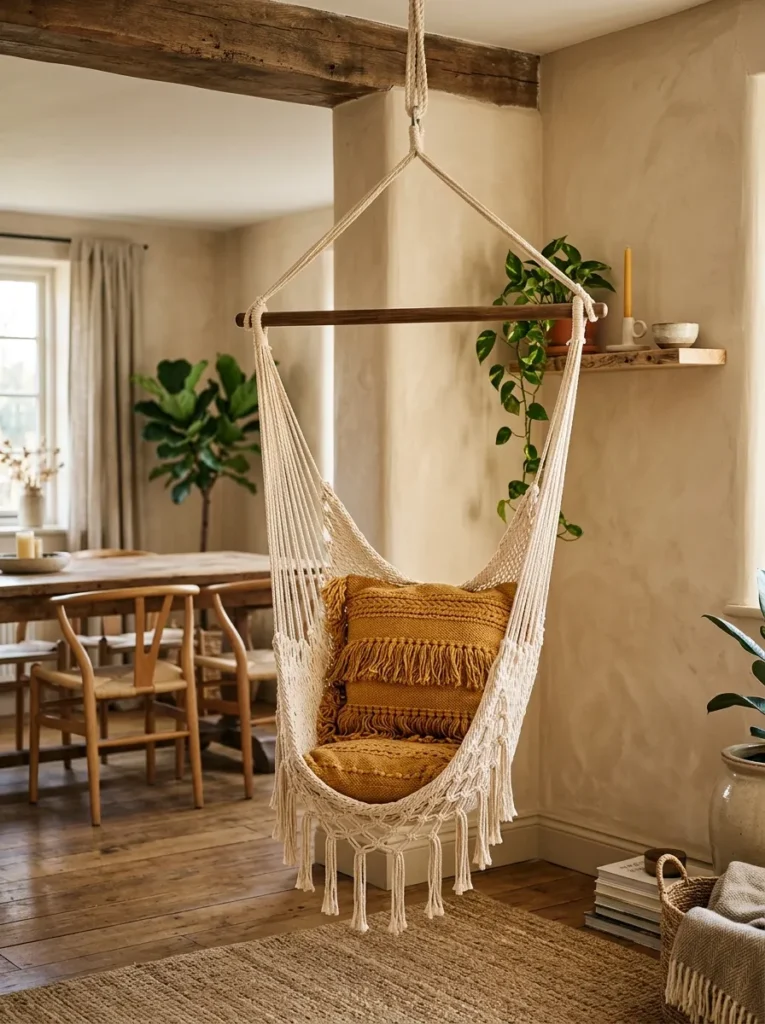
A hammock chair or hanging rope swing suspended from a ceiling joist in a dining room corner is the kind of idea that either fits perfectly or doesn’t fit at all — there’s little middle ground. In a larger dining room with a corner that otherwise goes unused, it creates a secondary informal seating zone for after-dinner sitting, which suits the unhurried, gathering-focused quality of bohemian dining at its best.
It requires a structural ceiling point — the chair needs to be fixed directly to a ceiling joist or beam rated for dynamic load, not simply screwed into plasterboard. This should be assessed and installed by someone confident with the structural requirements.
In rooms where the ceiling allows it and the space exists, few single additions shift the room’s character as dramatically. It’s immediately photographable and immediately signals a room designed for lingering rather than efficiency.
How to Combine Boho Dining Room Ideas Without Overdoing It
The bohemian style is more forgiving than minimalism, but it still has a tipping point — the moment when layering tips from richness into noise. A few principles help:
Anchor the room in three materials. A strong boho dining room typically has a primary material (natural wood or rattan furniture), a secondary material (textiles in linen, jute, or woven cotton), and a tertiary accent (ceramics, brass, or dried botanicals). Additional materials can appear, but these three should dominate.
Limit active pattern to two surfaces. If the rug has a kilim pattern and the wallpaper has a botanical print, the curtains and upholstery should be plain. Pattern on three or more surfaces simultaneously rarely resolves well unless the patterns are tightly related in colour and scale.
Earn the eclecticism. Mismatched furniture and mismatched ceramics work when each piece has a reason to be there — found, inherited, chosen with care. The same items sourced from a single retailer’s boho collection often look coordinated rather than genuinely eclectic, which slightly misses the point of the style.
Leave some surfaces empty. The most common mistake in boho rooms is filling every available surface. A few deliberately empty spaces — a bare section of wall, a sideboard surface with one object rather than seven — let the eye rest and make the styled areas feel more intentional.
Final Thoughts
The best boho dining rooms feel as though they arrived gradually — one piece at a time, over many meals and many evenings. That’s worth keeping in mind when approaching it from the other direction: starting from scratch rather than accumulating.
If you’re beginning, the table shape and the wall colour are the two decisions that shape everything else. A round wood table and a warm wall (limewash, terracotta, or a deep earthy tone) give you a foundation that most of the other 23 ideas sit naturally against.
From there, add slowly. The lighting, the rug, the textiles, and the open shelf can each come in turn. A room that adds one good thing every few months almost always looks better than one that was styled all at once and never revisited.
Save the ideas that suit your room and your life, and come back to this guide when you’re ready for the next layer.