17 Cozy Bathroom Ideas That Feel Warm and Relaxing
Most bathrooms are designed to be functional. Very few are designed to feel good. There’s a difference — and it shows up the moment you walk in on a cold morning and feel either the snap of cold tile and fluorescent light, or the particular warmth of a room that was built with comfort as the priority. These 17 cozy bathroom ideas aren’t about adding a candle and calling it a day. They’re about material choices, lighting decisions, and design logic that collectively make a bathroom feel like the warmest room in the house. Some of the ideas here are free. Some require a Saturday afternoon. A few are longer investments — but the kind that change how your home feels every single day. Whether you’re renting, renovating, or simply tired of a bathroom that feels cold and characterless, there’s something in this list worth saving. Start with the idea that would change your daily experience most immediately. Then come back for the rest.
Idea 1: Tongue-and-Groove Panelling Painted in a Deep, Warm Tone
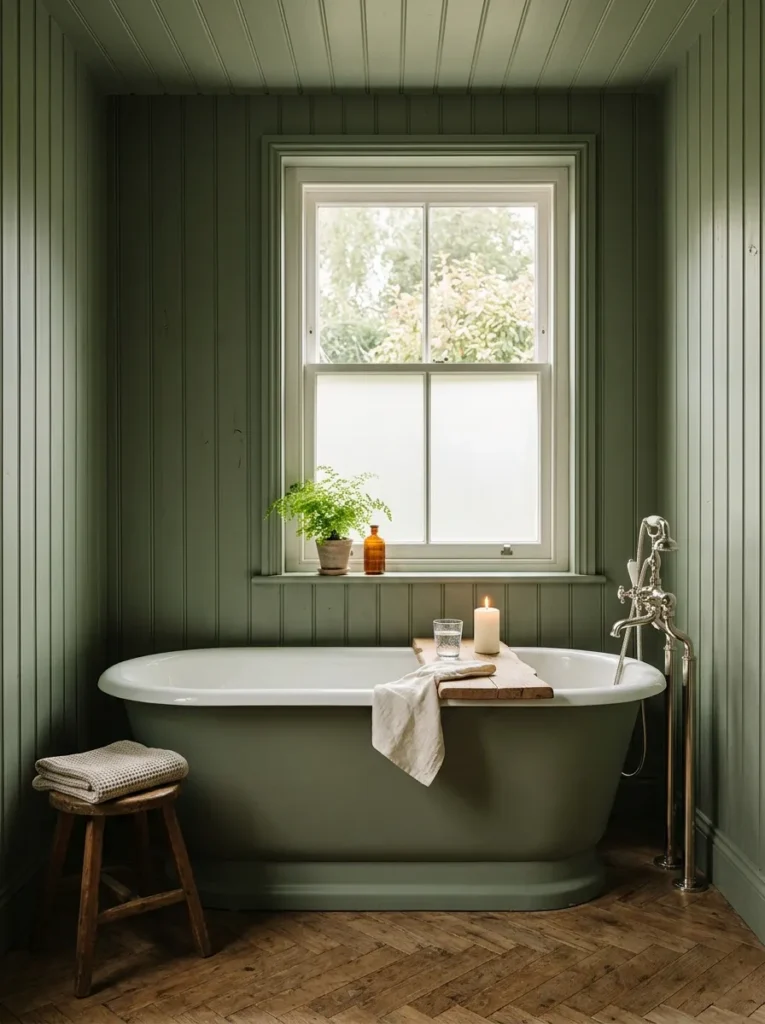
Tongue-and-groove wall panelling is the most efficient way to add architectural warmth to a bathroom that currently feels like a box. The vertical lines it introduces create the visual impression of greater ceiling height, the textural relief of the grooves catches light differently across the day, and — critically — painted wood reads as warm in a way that painted plaster walls simply do not. The deep sage green colour choice is doing heavy lifting: it reads as simultaneously nature-referencing and sophisticated, absorbing light rather than bouncing it, which creates an enclosed, enveloping quality that cooler or lighter colours can’t achieve. Tongue-and-groove panelling is bathroom-appropriate when sealed with an eggshell or satin finish that resists moisture; it can be taken from floor to ceiling or used as a half-height dado treatment depending on room proportions. The roll-top bath in the centre of the room anchors the cosy quality — there’s nowhere for the eye to rush.
Idea 2: A Wood-Burning Stove or Compact Electric Log Burner
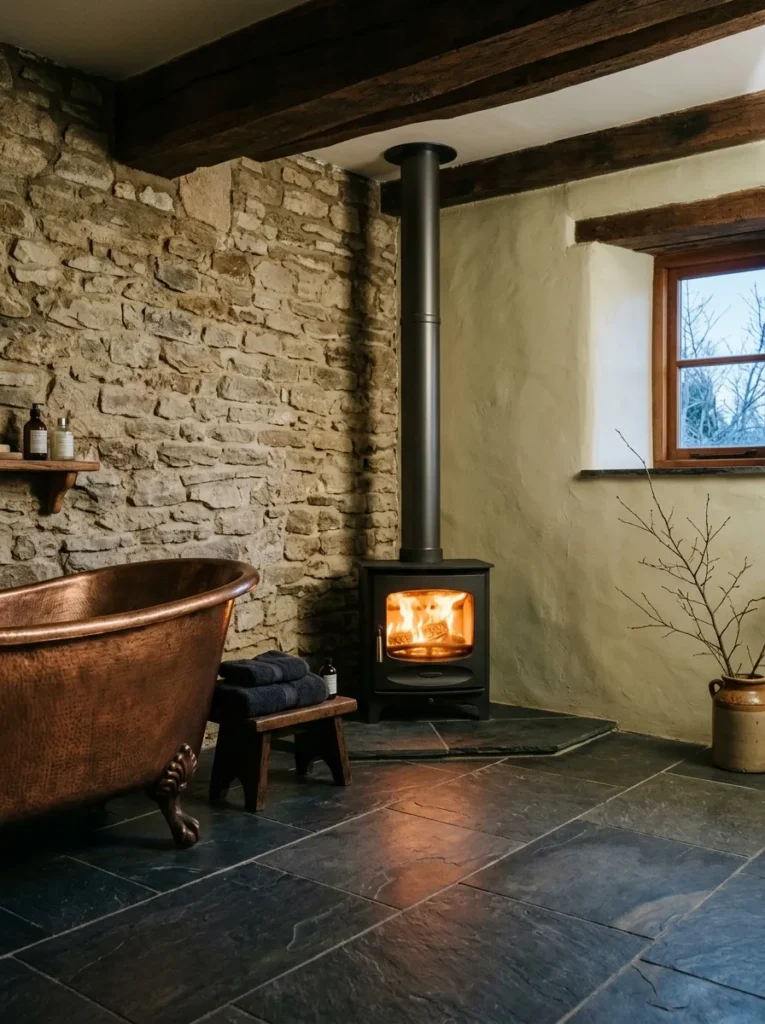
A wood-burning stove in a bathroom is not a common choice — which is exactly what makes it memorable and genuinely transformative when it appears. In practice, it requires adequate ventilation (a flue to the outside), a non-combustible hearth surface, and a room large enough to maintain safe clearance distances — typically available in older farmhouses, converted outbuildings, or ground-floor extension bathrooms. Where full installation isn’t possible, high-quality electric log-effect stoves with realistic flame simulation achieve a remarkable approximation of the visual and atmospheric warmth, require no flue, and need only a standard electrical socket. The psychological effect of a fire in a bathroom is disproportionate to its practical heating contribution: it creates a room that is, fundamentally, a destination rather than a utility space. The copper bathtub nearby is not incidental — the two warm-metal, warm-light elements reinforce each other.
Idea 3: Heated Towel Rails Styled as Warm Radiator Focal Points
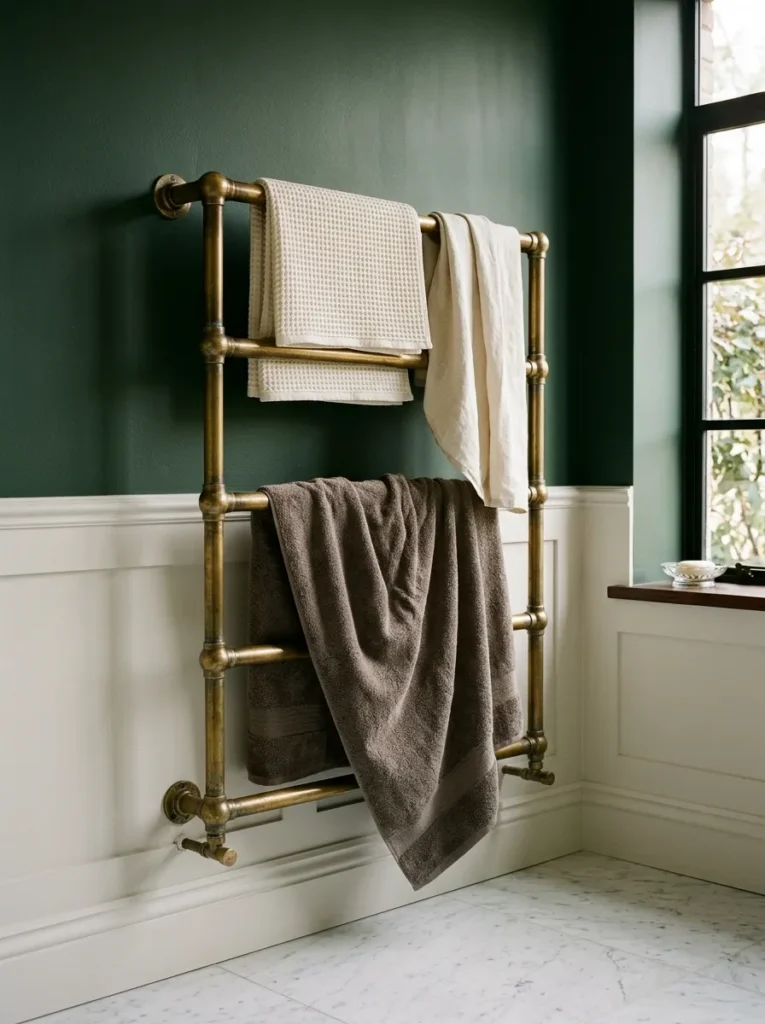
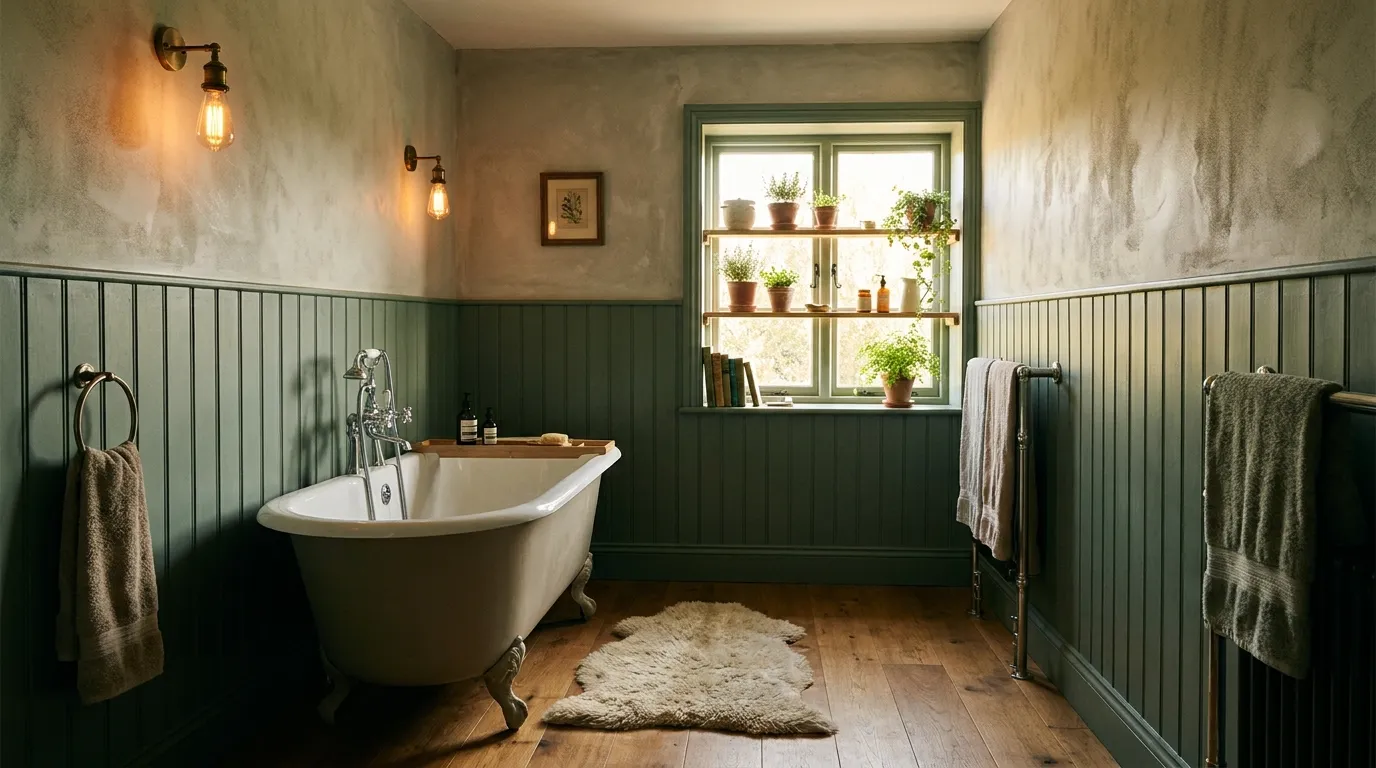
The standard heated towel rail is a utilitarian object in most bathrooms — a chrome ladder that holds one damp towel and contributes nothing to the room aesthetically. The designer version — an oversized column radiator in an aged or antique brass finish — does three things simultaneously: it heats the room, it keeps towels warm and dry, and it functions as a styled vertical element that draws the eye in the same way a piece of furniture does. The layered towel styling is essential to the cosy effect: waffle cotton, heavyweight linen, and an oversized bath sheet draped at different heights creates a textile-rich composition that reads as considered rather than dumped. The antique brass finish is the pivot choice — it introduces warmth into a room that might otherwise read cold (especially against dark walls), and the slightly aged patina avoids the clinical brightness of polished chrome.
Idea 4: Warm Amber Edison Bulb Lighting on a Dimmer Circuit
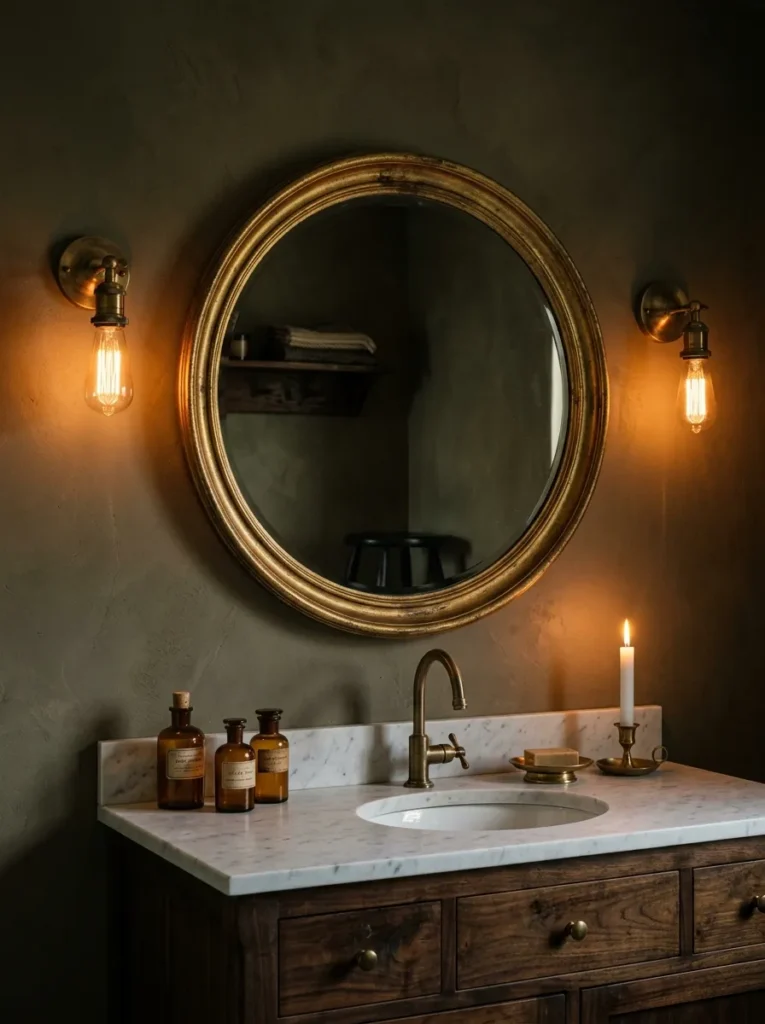
The difference between a bathroom that feels cold and one that feels cosy is, more often than not, the colour temperature of the light. Standard LED bulbs run at 4000–6500K — a cool, blue-white light that is forensically unflattering and antithetical to relaxation. Warm Edison-style bulbs at 2200–2400K produce an amber glow that mimics candlelight, fires, and evening sunlight — exactly the light conditions under which the human nervous system moves from alert to relaxed. The dimmer circuit is non-negotiable: the ability to reduce the brightness as well as the colour temperature turns the bathroom from a functional morning space into an evening retreat at the turn of a switch. Installing this requires replacing the switch with a compatible dimmer and using dimmable bulbs — a two-hour project with a basic knowledge of electrics, or a short call to an electrician. The return in daily atmosphere quality is immediate and lasting.
Idea 5: A Sheepskin Bath Mat Instead of Synthetic Pile
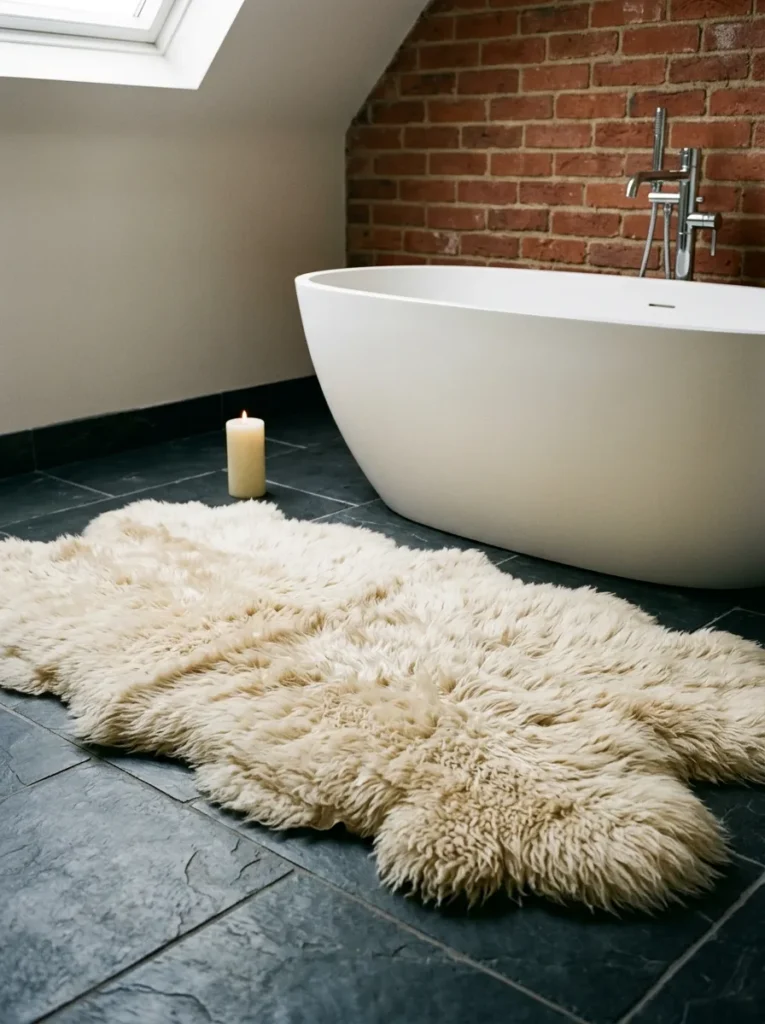
The bath mat is the most frequently overlooked sensory element in a bathroom — and since your first physical contact with the floor every morning is through it, the material choice has an outsized impact on how you experience the room. A sheepskin bath mat rather than a standard synthetic pile represents a significant sensory upgrade: the long natural fleece is warm against bare feet in a way that pile carpet never achieves, and the natural variation in tone and texture reads as organic and considered rather than mass-produced. Sheepskin dries well if properly aired after use (hang it or lay it fleece-side up); it doesn’t harbour mould the way synthetic mats can when left damp on the floor. A single generous sheepskin — large enough to stand on fully — beside the tub or shower changes the morning exit experience from cold tile shock to something noticeably better. Real sheepskin is recommended over synthetic alternatives because the fleece depth and movement are simply not replicable.
Idea 6: Exposed Wooden Ceiling Beams in a Bathroom
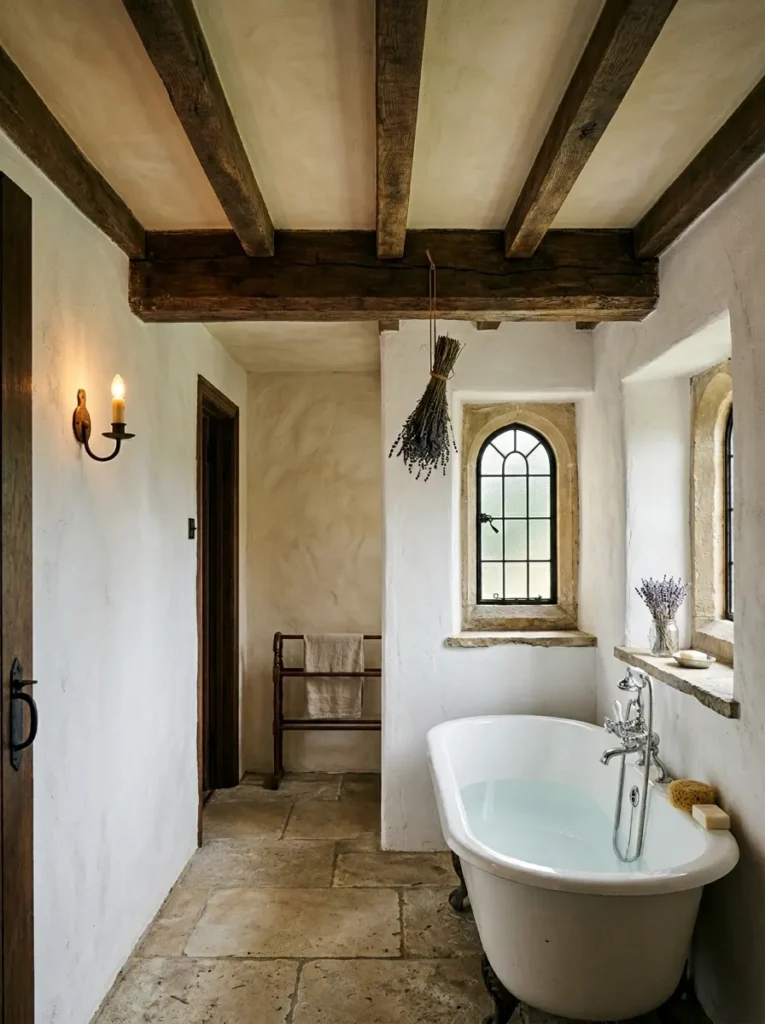
Exposed wooden ceiling beams are an architectural detail that many period homes carry and many homeowners promptly paint over or plasterboard across — a decision that trades authentic warmth for a cleaner look at significant loss to the room’s character. In a bathroom, original beams create a cosy, low-feeling enclosure that is quite different from the expansive openness most modern bathrooms aim for — and the difference is that enclosure feels sheltered and intimate rather than exposed. If your home doesn’t have original beams, decorative oak or pine beam casings can be box-fixed to a flat ceiling for a convincing effect at relatively low cost. The dark stained oak finish is the right choice for warmth: lighter painted beams read more Scandinavian farmhouse, which is a different register. Hanging a bundle of dried herbs or botanicals from a beam is the oldest form of decorative bathroom styling, and it still works.
Idea 7: Layered Rugs on a Bathroom Floor for Textile Depth
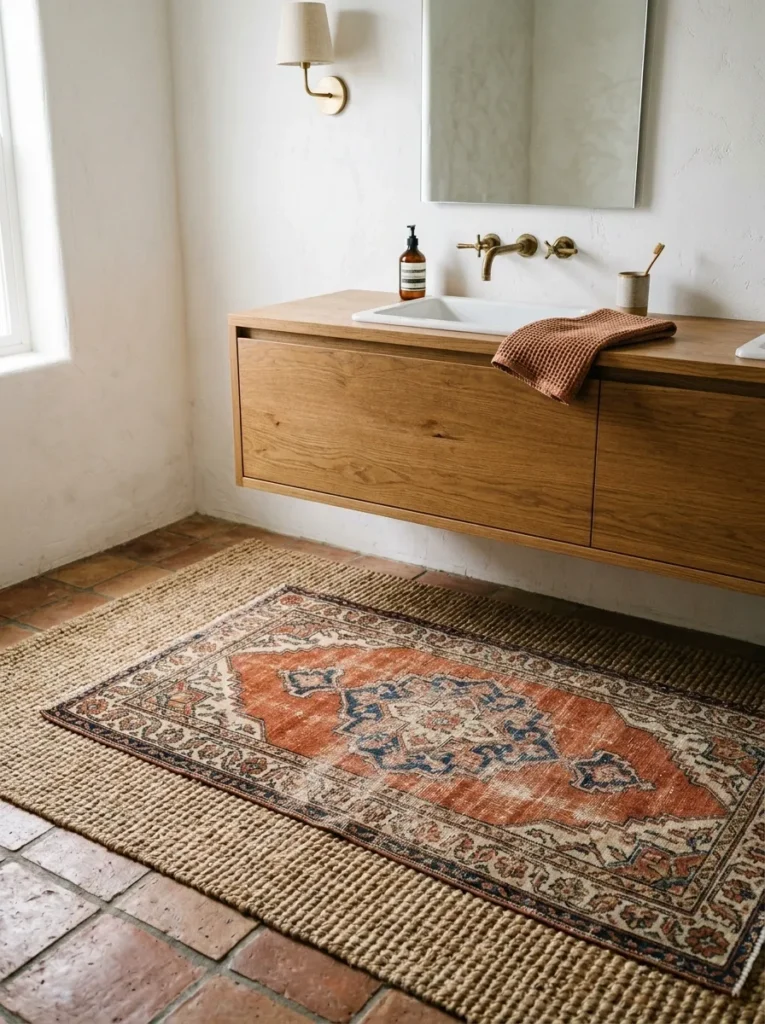
Layering rugs in a bathroom is a move borrowed from how rugs are used in living rooms and bedrooms — and it works in a bathroom for the same reasons: it adds textile depth, pattern, and visual warmth that a single flat-surface floor cannot provide. The key to making it work in a bathroom environment is material selection. The base rug should be flat-weave natural jute or cotton (both dry quickly and resist humidity-related decay better than wool pile). The top rug can be a small vintage-style rug in wool — vintage pieces are pre-washed and less prone to running if they get damp, and their worn quality reads as appropriately relaxed in a bathroom context rather than precious. The pattern and colour of the top rug is what brings the room’s personality: a faded Persian or Oushak rug in terracotta and ivory instantly signals that this bathroom belongs to someone with a considered aesthetic rather than a default one.
Idea 8: A Curtained Shower Instead of a Glass Enclosure
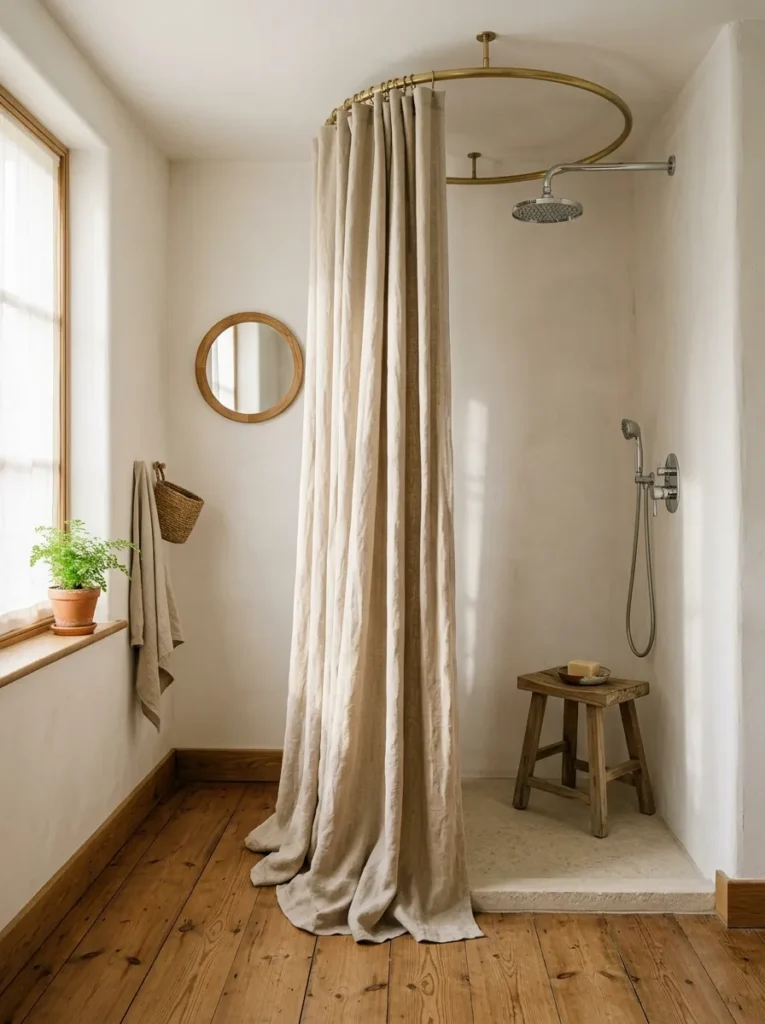
A glass shower enclosure is the contemporary default — it keeps water contained and makes small bathrooms feel larger by preserving sight lines. But it is also one of the coldest-feeling elements in a bathroom: transparent, hard-edged, and clinical in a way that runs counter to warmth. A linen shower curtain on a ceiling-mounted ring rail is the cosy alternative — the full-height curtain softens every edge it introduces into the room, the natural fabric creates a drapery softness that glass cannot replicate, and — critically — linen dries faster than standard polyester shower curtains, which means it doesn’t harbour mildew the way shower curtains have a reputation for doing. A ceiling-mounted circular rail (rather than a standard straight rail) defines a generous shower space without interrupting the room’s ceiling plane. The curtain’s natural drape, when drawn across the shower, creates a room-within-a-room quality that is fundamentally cosy.
Idea 9: Warm Wood Shiplap Accent Wall Behind the Bathtub
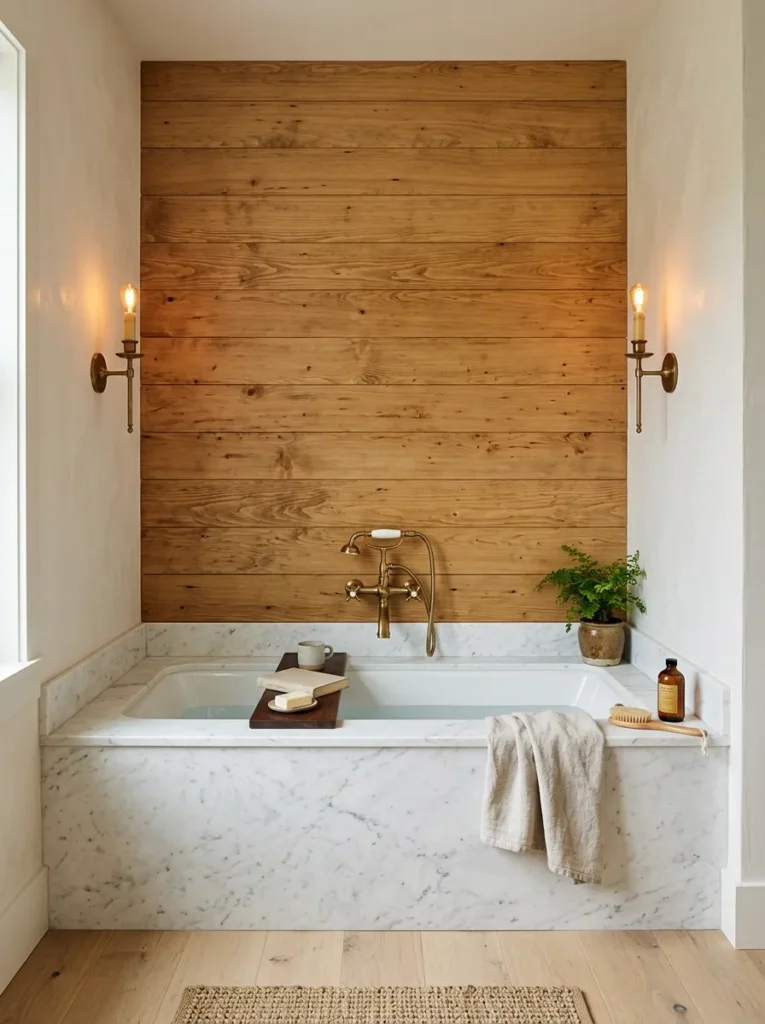
The bathtub accent wall in wood shiplap achieves something that tile accent walls cannot: it introduces a living material behind the point in the room where relaxation is intended to occur. Wood grain is warm in the literal sense — it absorbs heat from the surrounding air rather than conducting cold, so standing or sitting near it never creates the slight chill that ceramic or stone surfaces can. The horizontal shiplap orientation specifically creates a low, wide visual movement that anchors the bath toward the floor rather than pushing the eye upward — a cosy, grounded effect rather than the lofty height-emphasising quality of vertical panelling. Natural oiled pine or lightly finished oak are the right species for warmth; painted shiplap works but loses the grain-warmth quality. Water protection for the section directly above the tub deck requires appropriate sealant — a marine-grade oil applied annually is adequate for the splash zone on a tub that doesn’t have a shower overhead.
Idea 10: A Velvet or Boucle Stool Beside the Bathtub
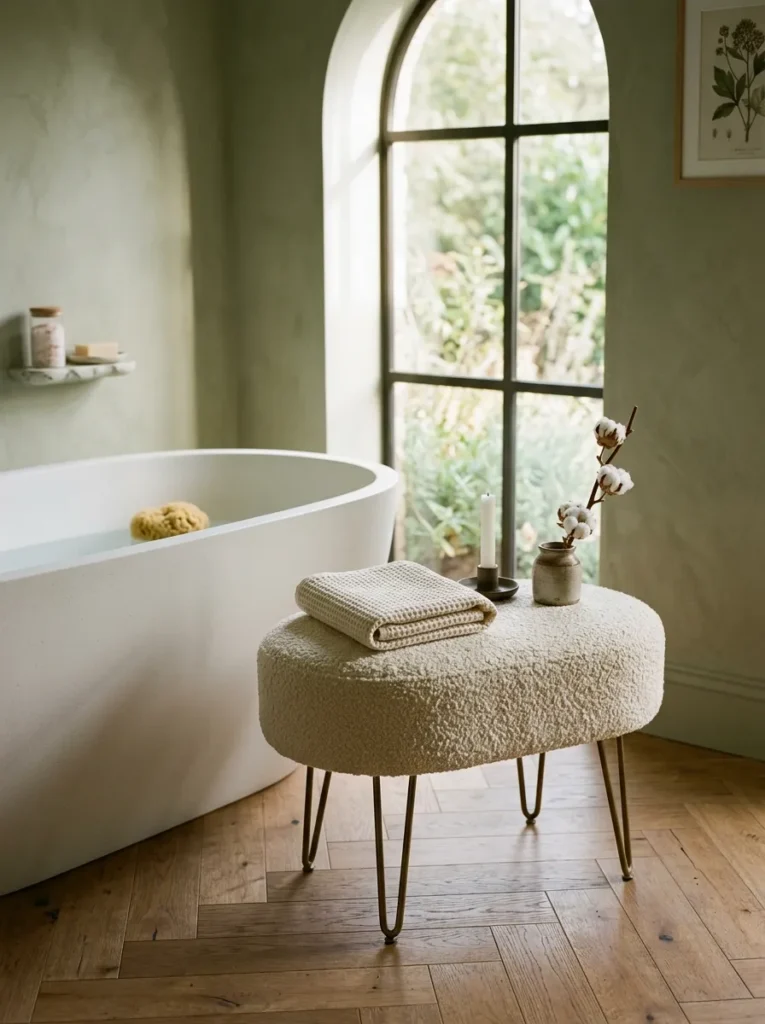
The bathroom stool is an often-overlooked furniture piece — most people have a teak shower stool or nothing at all. A proper upholstered stool in boucle or velvet fabric elevates the experience meaningfully: it is somewhere to sit while drying your feet, a surface to rest a towel and products within reach of the bath, and — most importantly in the context of cosy bathrooms — a piece of fabric-upholstered furniture in a room that otherwise contains no upholstery whatsoever. The contrast between fabric and the hard surfaces of tile, stone, and ceramic is what registers as warmth. Boucle specifically (the looped, slightly nubbed wool-effect fabric) has a tactile quality that reads as extraordinarily soft even from a distance — and it reads soft in photographs, which is why it performs well for Pinterest. Slim brass hairpin legs keep the stool visually light so it doesn’t clutter the floor plane.
Idea 11: Wainscotting in a Rich Warm Colour Below a Contrasting Upper Wall
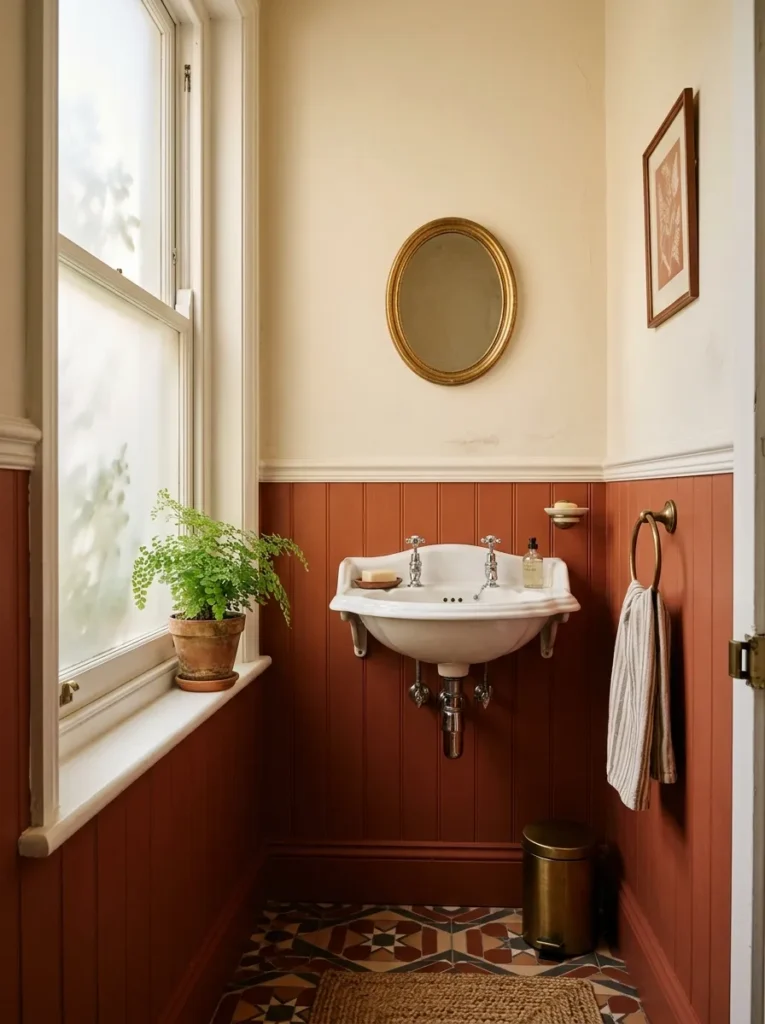
The two-tone wainscotting treatment — a deeper, richer colour on the lower wall section with a lighter or contrasting upper — is a decorating technique borrowed from Victorian and Edwardian interior practice, where it served to visually anchor a room and protect the lower portion of walls from daily scuffs. In the context of a cosy bathroom, it does something more subtle: it creates a visual horizon line in the room that stops the eye at approximately seated or lower-standing height, which makes the room feel lower and more enclosed in a way that reads as sheltered rather than cramped. The terracotta choice is the warmest available option in this treatment: earthy, ancient, and compatible with both modern and traditional bathroom furniture styles. The key to making wainscotting look deliberate rather than landlord-grade is the chair rail detail — even a simple 40mm MDF panel moulding between the two colour zones transforms the treatment from painted wall to genuine architectural feature.
Idea 12: Candlelight as the Primary Evening Lighting Strategy
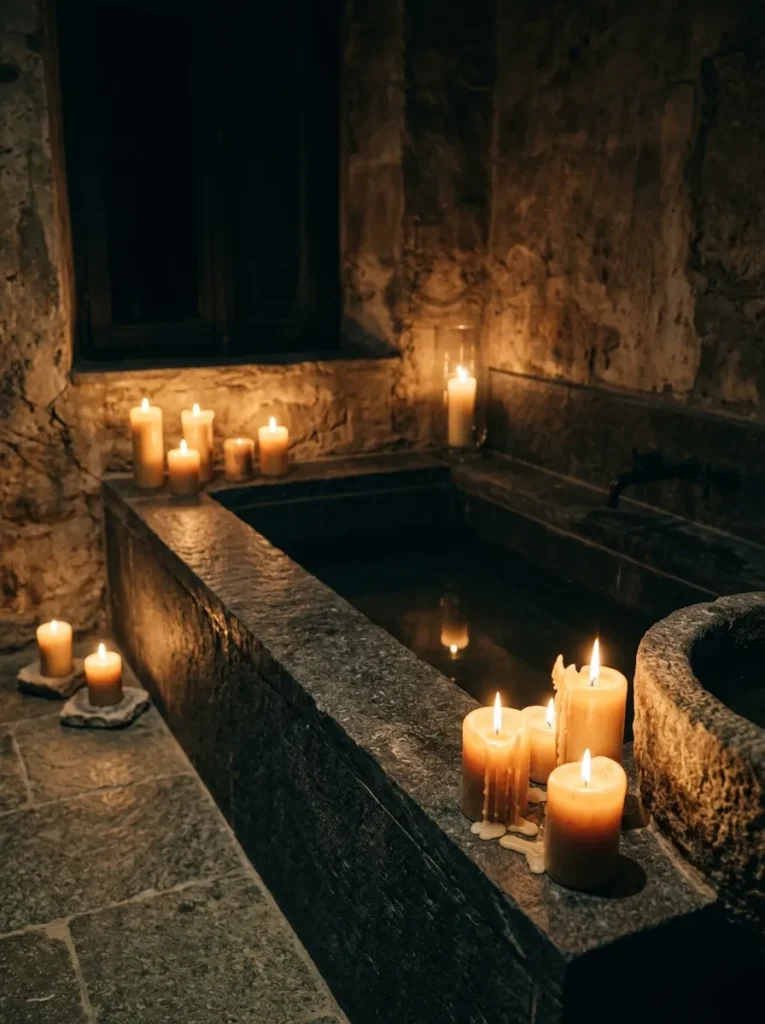
Candlelight in a bathroom isn’t styling — it’s a nervous-system intervention. The specific quality of flame light, at approximately 1800–2000K, is the warmest light source available, and unlike a dimmer switch it flickers, which means the eye registers it as organic and alive rather than artificial. The practical approach: establish a fixed candlelight arrangement rather than randomly placing candles. Group pillar candles at three heights (floor level, tub surround, and an elevated ledge) so the room is lit from multiple vertical levels simultaneously — the effect is immersive rather than accidental. Stone or ceramic candle holders on the floor rather than wax directly on a surface prevent mess. Hurricane glass holders prevent draughts from extinguishing the candles mid-bath. A lighter kept in the same place every time is the operational detail that makes this a sustainable habit rather than a special occasion.
Idea 13: A Wicker Armchair in a Corner Reading Nook
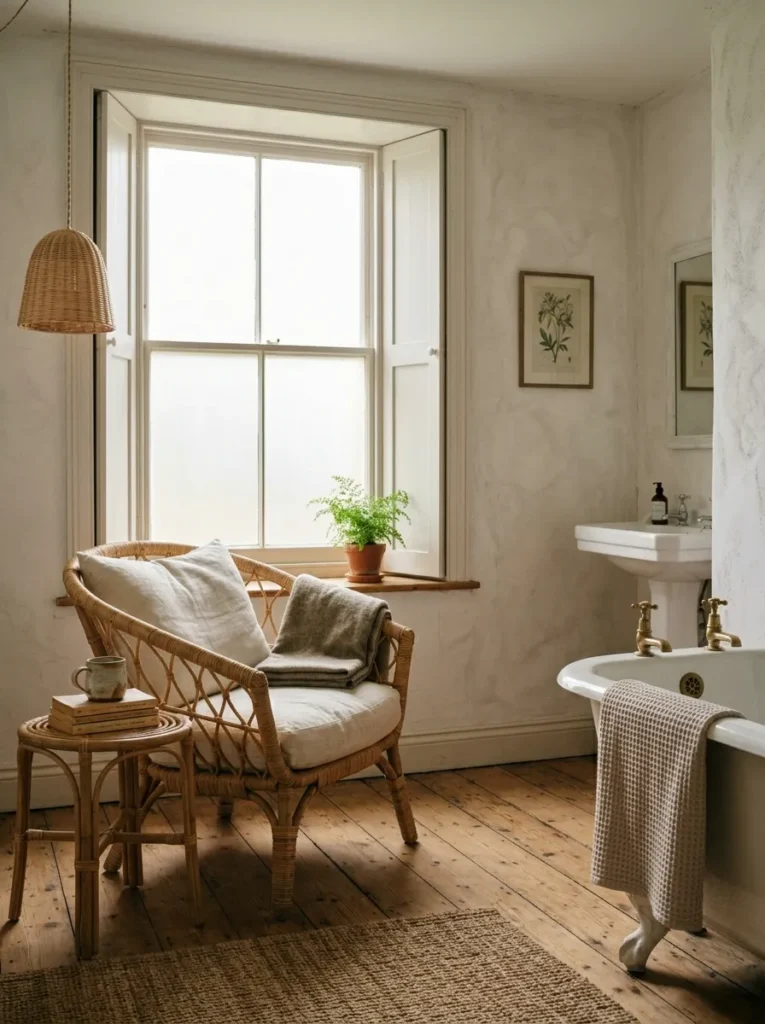
A bathroom large enough for a chair — and “large enough” is often simply a matter of taking the decision to prioritise it — becomes a room rather than a utility. The armchair in the corner of a bathroom is the signal that this space is for dwelling, not just processing. The chair doesn’t need to be large: a compact tub chair or a rattan armchair, which has the additional advantage of being inherently humidity-tolerant, can occupy a 70x70cm floor footprint. The reading nook function is entirely practical: if you have a bathroom with natural light and a chair, you have a room you will voluntarily spend time in outside of its utilitarian function — and that investment in unhurried time is the source of what people describe as a “cosy” room. The pendant lamp above is the functional lighting that makes the reading nook viable in the evening.
Idea 14: Cotton Waffle and Linen Textiles in Warm Neutral Tones
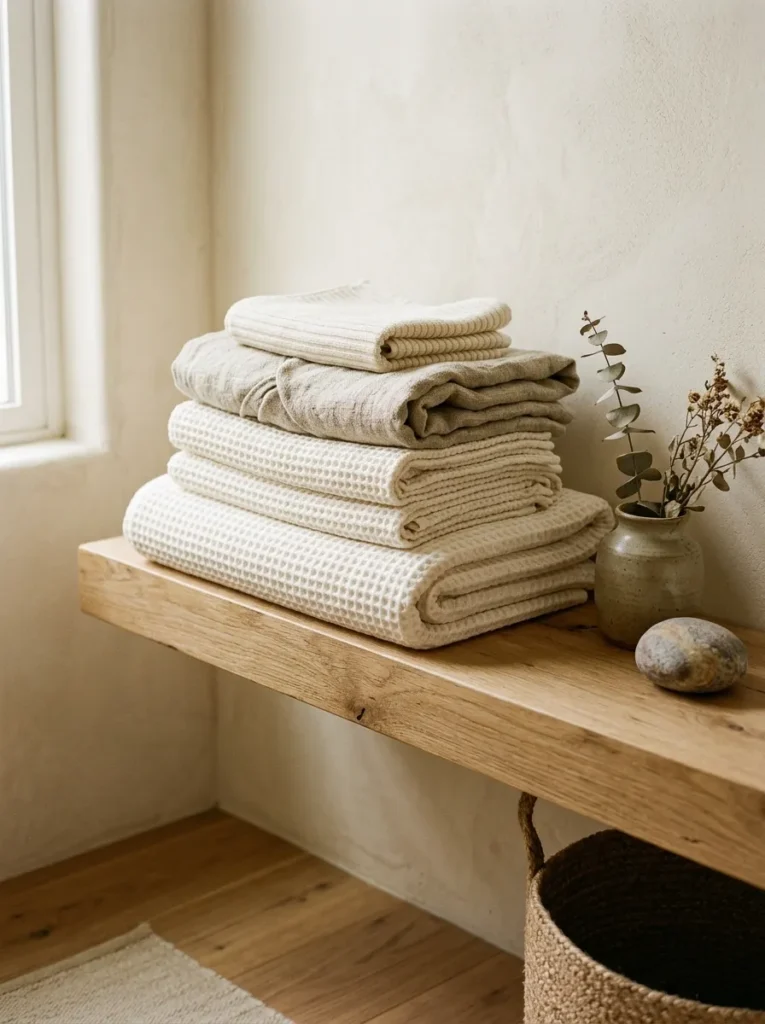
Bathroom towels are textiles, and textiles are the fastest way to change how a bathroom feels without touching a single fixed surface. The specific combination of cotton waffle and natural linen in warm ivory tones — rather than bright white or the now-ubiquitous sage green — creates a palette of warmth that reads more like a quality guesthouse than a clinical spa. The towels are doing two jobs simultaneously: they provide practical function and they style the shelf they live on. Waffle cotton is worth the upgrade from standard terry cloth because the cellular weave structure both looks more textured and interesting in a room, and dries faster between uses. Linen towels feel slightly rougher initially but become softer with each wash and last considerably longer than cotton terry. A single consistent palette — ivory, undyed linen, cream — rather than a mixed assortment transforms a bathroom shelf from accumulated objects to a styled collection.
Idea 15: A Natural Beeswax or Soy Candle Collection on a Wooden Board
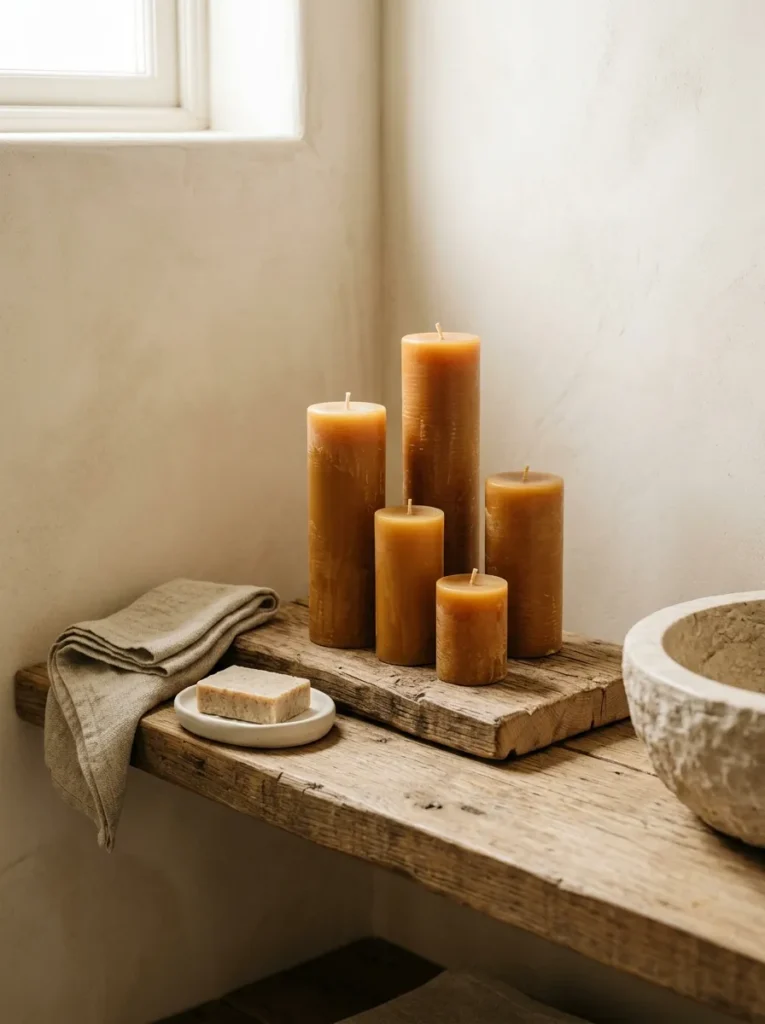
Candles in a bathroom are common; a considered candle collection on a dedicated board is something else. The distinction between a single candle placed on a surface and a curated grouping arranged on a material base is the difference between decorating and designing — the board defines the collection as intentional rather than accumulated. Natural beeswax specifically is worth seeking out: the honey-amber colour is inherently warm and organic-looking in a way that white paraffin candles are not, and when lit, beeswax emits a clean honey scent without any added fragrance. Grouping candles in odd numbers at varied heights (three, five, or seven) creates a composition that the eye reads as balanced without being symmetrical — the slightly irregular arrangement signals handmade and organic rather than retail display. The reclaimed wooden board beneath the collection grounds the arrangement and protects the shelf surface from wax.
Idea 16: Roman Blinds in a Textural Fabric to Soften Bathroom Windows
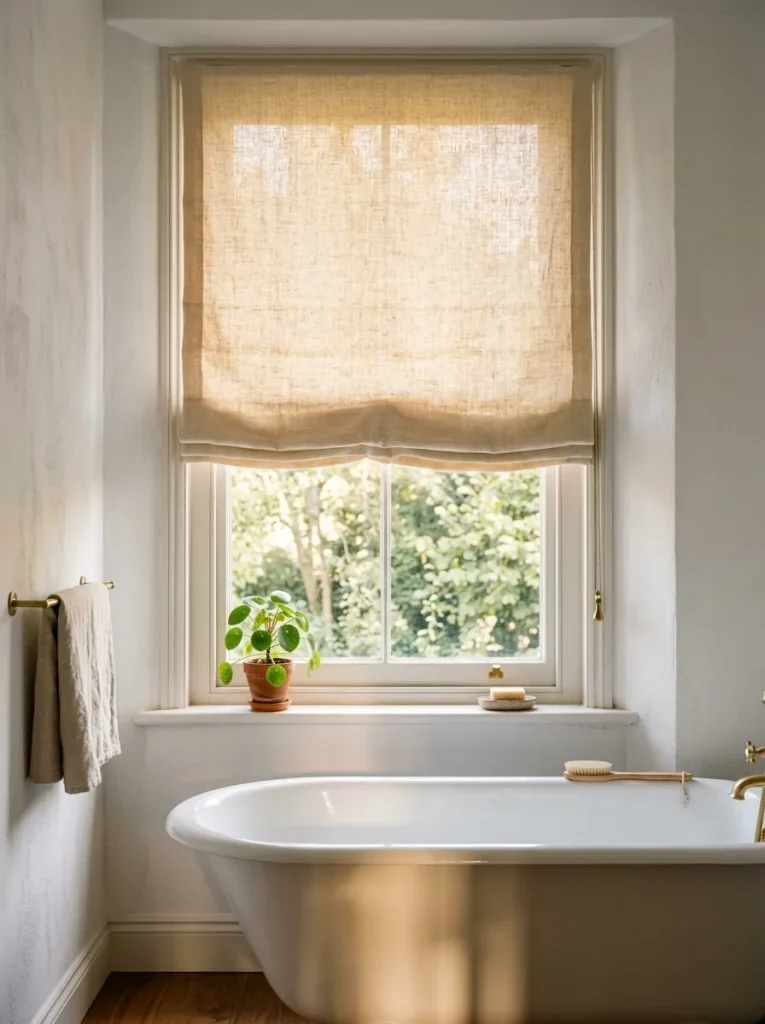
Bathroom windows are usually dressed in one of three ways: not at all, with a frosted glass film, or with a plastic roller blind. None of these is warm. A roman blind in a heavy, textural fabric — natural linen, cotton canvas, or a woven cotton blend — introduces the same drapery softness that curtains provide in a living room, without consuming the floor space that curtains require in a bathroom. The roman blind’s flat fold structure keeps it compact when raised; when partially lowered it creates a warm filtered light that transforms the quality of sunlight from sharp and directional to soft and diffused. The fabric choice is the critical decision: a sheer linen lets light through while providing privacy from outside, which is ideal for daytime bathing. The fabric texture also performs differently from a smooth roller blind — where a roller blind reads as functional, a linen roman blind reads as chosen, and that distinction is what communicates warmth.
Idea 17: A Small Herb or Plant Shelf Bringing Life to the Bathroom
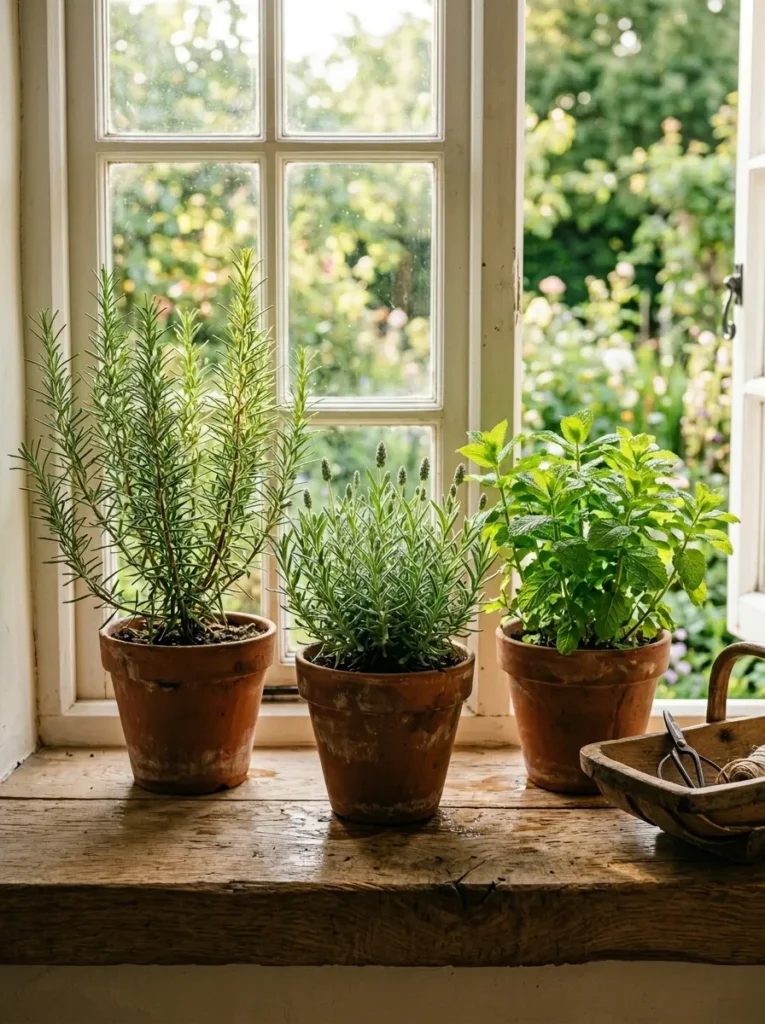
Living plants in a bathroom are standard advice — and most of the plants recommended are interesting but passive: a trailing pothos or a peace lily exists in your bathroom the way a painting does. Herbs are different. They’re fragrant — rosemary, lavender, and mint all release scent when brushed or when warm steam from a bath activates the volatile oils in the leaves. They’re usable — a sprig of rosemary in the bath is a genuine aromatherapy intervention, not just a decorative one. And they bring the particular kind of warmth that only living, growing things introduce: the sense that a room is being tended rather than simply maintained. A bathroom windowsill with adequate natural light is the ideal growing position for herbs. Terracotta pots are the right material choice — their porosity helps regulate soil moisture in the high-humidity bathroom environment, and their earthy colour reads warm against any background.
Conclusion
A cosy bathroom is not a category of product — it’s the result of specific decisions made about light, material, texture, and the things you choose to bring into the room. The ideas in this list work because they understand that warmth is sensory before it’s visual: the feel of a sheepskin underfoot, the flicker of a candle flame, the smell of herbs warming in bath steam. You don’t need all seventeen. You need the two or three that address the specific coldness your bathroom currently has — too much hard surface, too much bright light, too little textile, too much clinical white. Address those, specifically, and the room changes. That is what cozy bathroom design actually is: a series of deliberate choices made in the right direction.