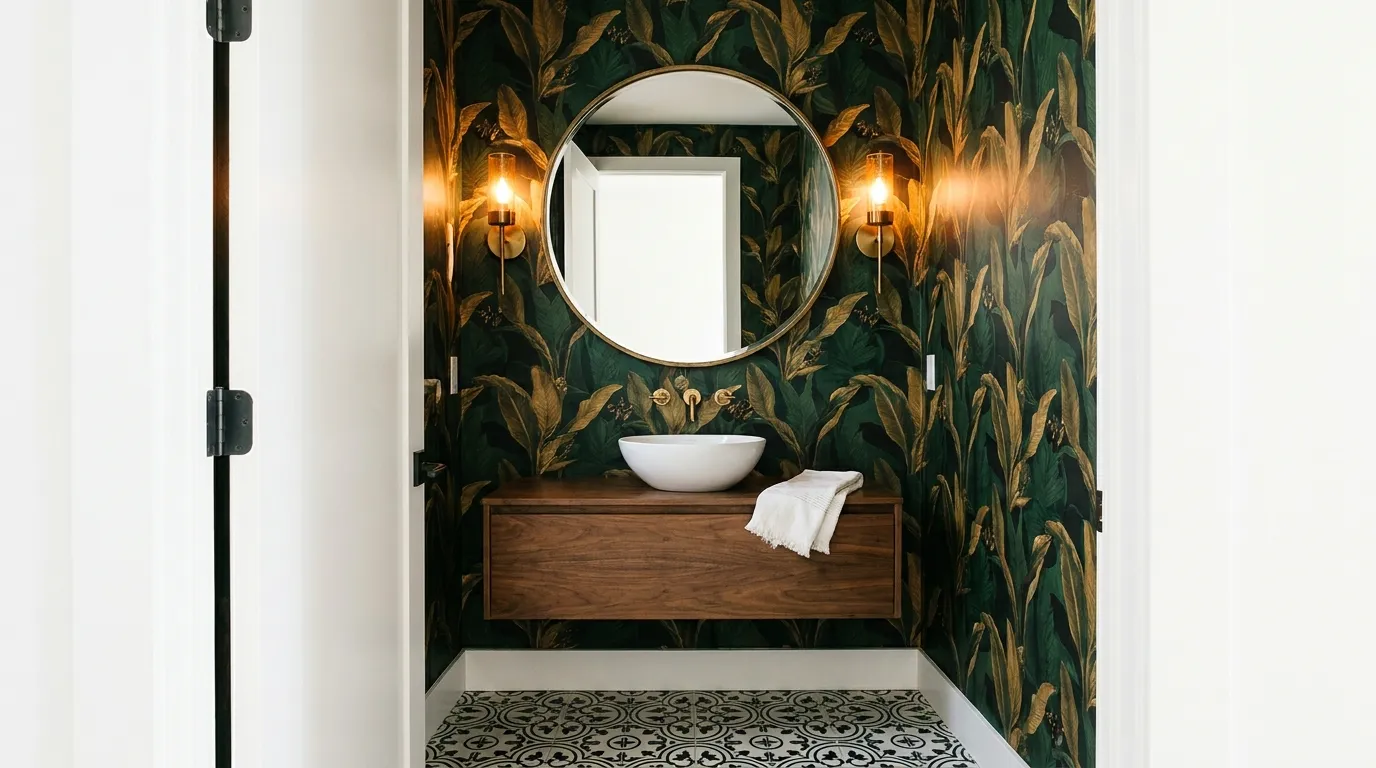
22 Powder Room Ideas That Impress Every Guest
The powder room is the one room in your home where guests spend time alone, without you. They notice everything — the faucet finish, the hand towel quality, whether the mirror is interesting or an afterthought, whether the room feels like someone made a decision or just installed the minimum required fixtures. In no other room does the gap between a considered design and a generic one show more clearly.
It’s also the room most people under-invest in, because its small size makes it feel like a lower priority. The opposite is true. A powder room’s compact footprint is precisely what makes bold decisions work — the drama that would overwhelm a full bathroom reads as confident and considered in a space this size. Dark wallpaper, a statement mirror, an unexpected vanity, a sculptural light fixture: all of them land differently in 25 square feet than they would in a larger room.
These 22 powder room ideas range from complete room directions to specific detail decisions. Some require renovation; others require only a weekend and a few purchases. Each one includes enough practical context to help you understand not just what the idea looks like but whether it suits your specific room, budget, and situation.
The powder room is worth the attention. Here’s how to give it some.
1. Dramatic Wallpaper on All Four Walls
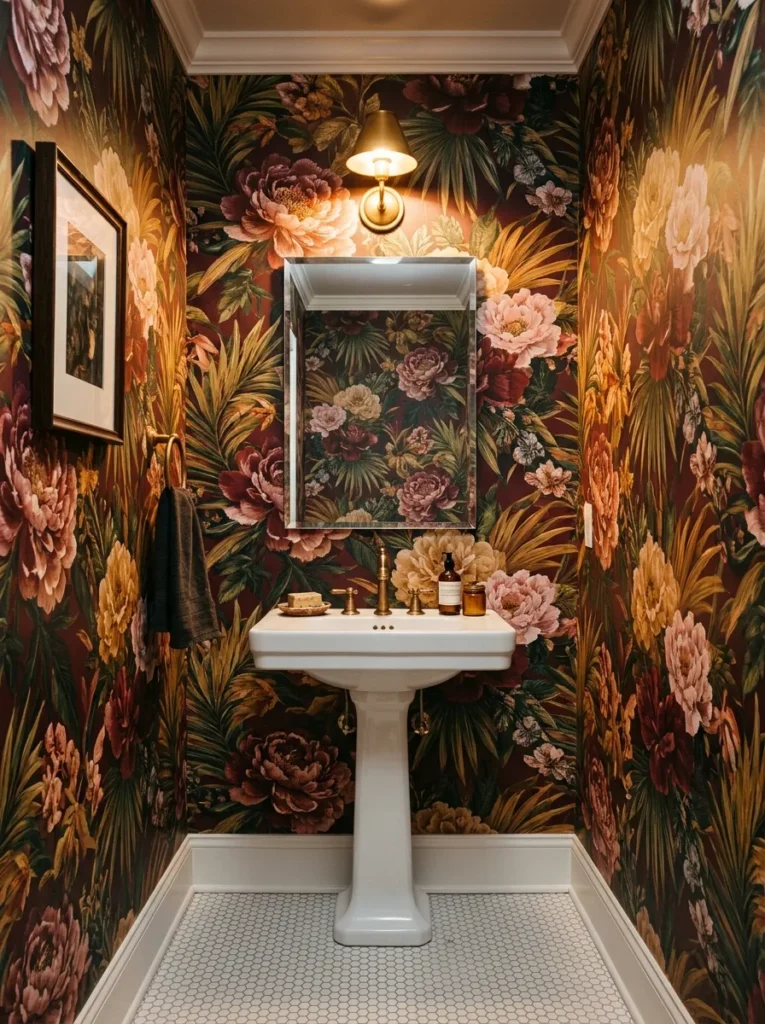
The powder room is the best room in the house for committing to a pattern that would feel overwhelming elsewhere. Because the room is used briefly and in isolation, visual intensity reads as an experience rather than an assault. Dark botanical, maximalist geometric, hand-painted chinoiserie, deep floral — patterns that would exhaust a bedroom in three days are perfectly suited to a room guests spend three minutes in.
The all-four-walls approach is what makes this work. Wallpapering only one wall in a small powder room often looks hesitant; the pattern needs to wrap to create the immersive quality that makes the room memorable. A room where the pattern continues behind the mirror, above the wainscoting, and around the door frame reads as architecturally committed in a way that a single accent wall doesn’t.
For renters, high-quality peel-and-stick wallpaper in a powder room — where there’s no shower steam to loosen adhesive — performs considerably better than in a full bathroom. Premium peel-and-stick in a powder room can last years without peeling at the seams.
2. A Mural Wallpaper That Tells a Story
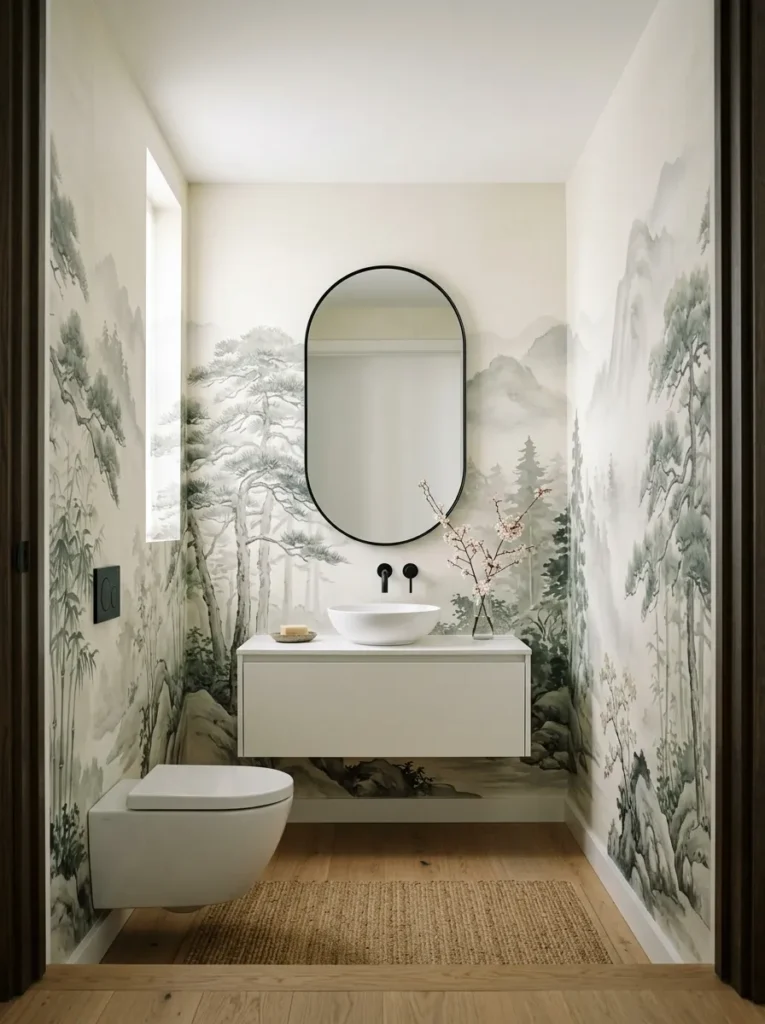
Where a repeating wallpaper pattern creates immersive texture, a mural wallpaper creates a specific world. A panoramic scene — a misty forest, a Japanese landscape, a vintage topographical map, an abstract painterly wash — wraps around the room’s walls as a single continuous image rather than a repeating tile.
Mural wallpapers work particularly well in powder rooms because the room’s compact size means you’re always close to the image, which rewards detail and quality. A low-resolution mural that looks fine in a large dining room reads as pixelated from two feet away in a small powder room. Panel widths need to be calibrated to the room’s wall sections — most mural wallpapers allow customization to specific room dimensions.
The surrounding design choices should be quiet. A mural this specific and atmospheric is the room’s entire design concept; the vanity, mirror, and fixtures should recede and support rather than compete with it.
3. Dark, Saturated Paint in a Dead Flat Finish
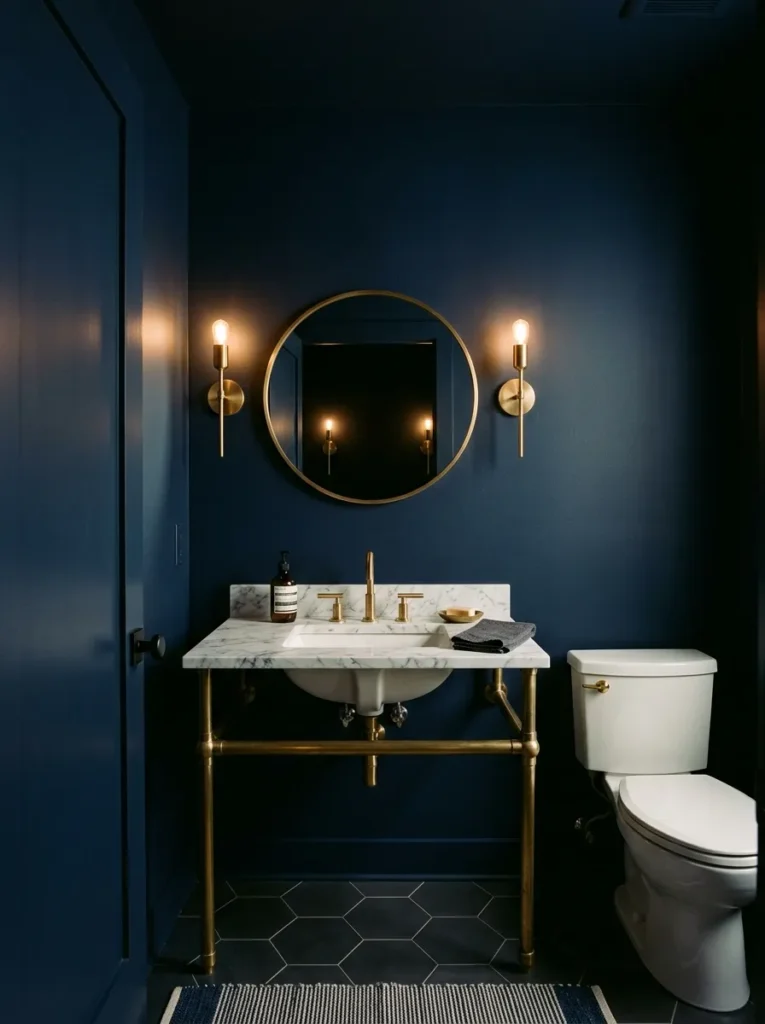
For a powder room that won’t be wallpapered, a single deeply saturated paint color in a dead flat or matte finish is the most dramatic paint approach available. Midnight navy, forest green, near-black charcoal, deep plum, rich burgundy — colors that read as heavy in a bedroom or living room reach a different quality in a small powder room: they create a depth and enclosure that feels intentional and atmospheric.
The dead flat finish is the specific detail that makes dark paint work in a small room. Flat paint absorbs light rather than reflecting it, which prevents the color from looking harsh or artificial in close quarters. A satin or eggshell dark color in a small room reflects the walls back at each other and can feel clinical despite the saturation.
Dark powder rooms photograph beautifully because the walls recede and the light fixtures, mirror, and hardware read as jewel-like against the depth. Instagram and Pinterest have driven a significant surge in dark powder room interest, and for good reason — the results consistently exceed expectations.
4. Limewash Paint for an Organic, Textured Atmosphere
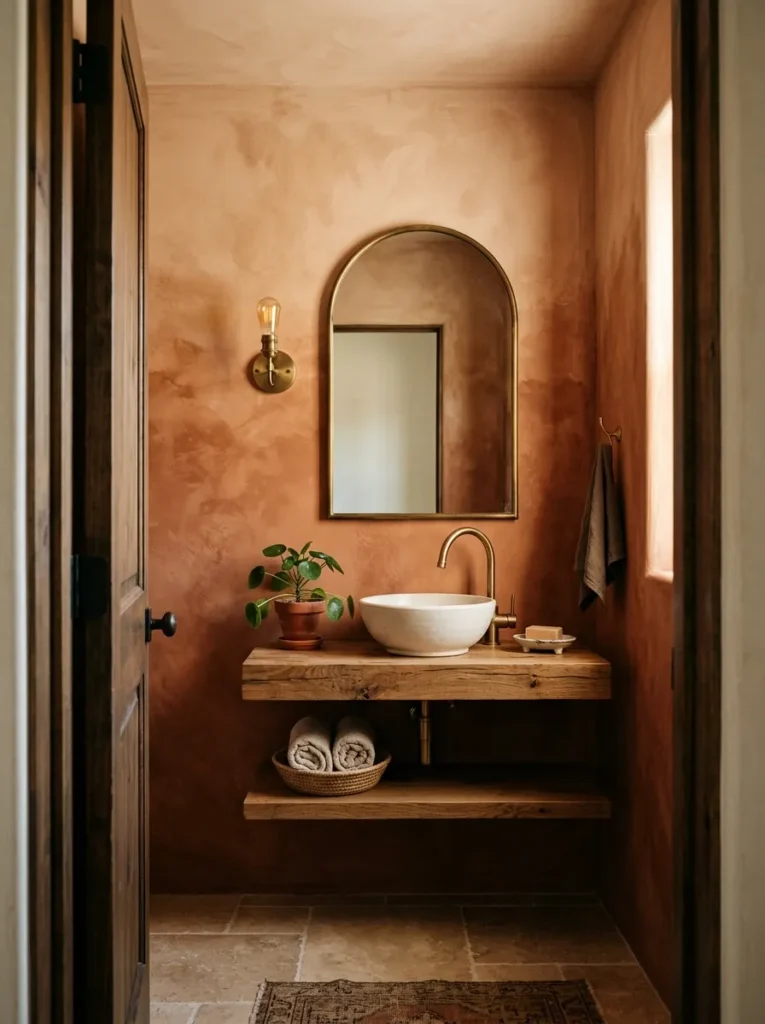
Where dark flat paint creates depth through saturation, limewash creates depth through surface variation. The naturally uneven, slightly mottled quality of limewash paint gives a powder room walls a lived-in, old-world quality that reads as authentic rather than applied — like the room has been there for decades rather than decorated last year.
In a powder room without a shower, the humidity concern that affects limewash in full bathrooms is significantly reduced. Most modern limewash formulations perform well in powder rooms with standard ventilation. The walls should still be properly primed and the limewash applied in thin cross-hatching layers rather than rolled on like standard paint — the technique is what creates the characteristic surface movement.
Color choice matters considerably. Limewash in warm terracotta, dusty clay, aged ivory, or sage creates warmth and depth. Limewash in a very light, cool tone can look like an unfinished wall rather than a considered finish, particularly in a small room where the subtlety of the effect may not register clearly.
5. Moody Sage or Earthy Green Throughout
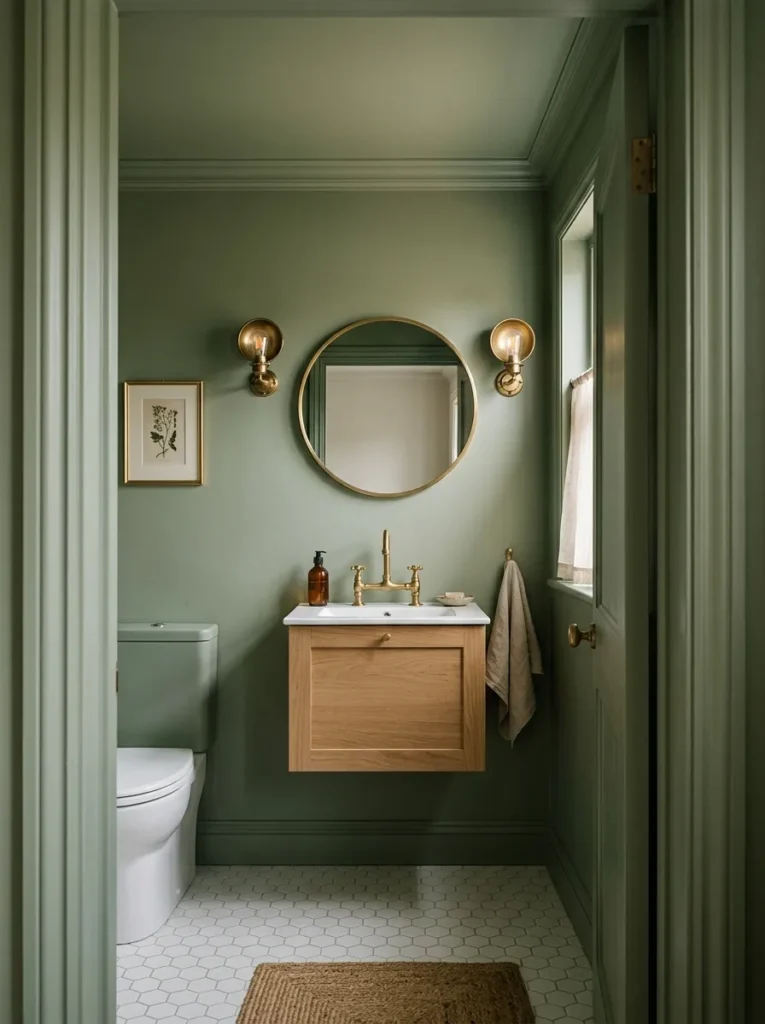
Sage green as a powder room color occupies a specific position in the palette: warm enough to feel welcoming, muted enough to feel sophisticated, and distinct enough to feel considered without being aggressive. Unlike navy or charcoal, which create genuine drama, sage green creates a quieter, more botanical atmosphere — organic, slightly European, the color of aged shutters and old kitchen cabinets.
Applied throughout a powder room — walls, ceiling, and trim all in the same or closely related sage tones — sage green creates a color-drenching effect that’s visually resolved rather than random. A powder room where the walls are sage and the ceiling stays white reads as incompletely committed; one where the color continues over the ceiling feels like a deliberate design concept.
The hardware and fixture finish matters more than in other color contexts. Against sage, unlacquered brass reads as warm and complementary. Polished chrome can look cold. Matte black creates a more contemporary contrast. All three work — the choice should reflect the overall style direction of the home.
6. A Pedestal Sink Instead of a Vanity
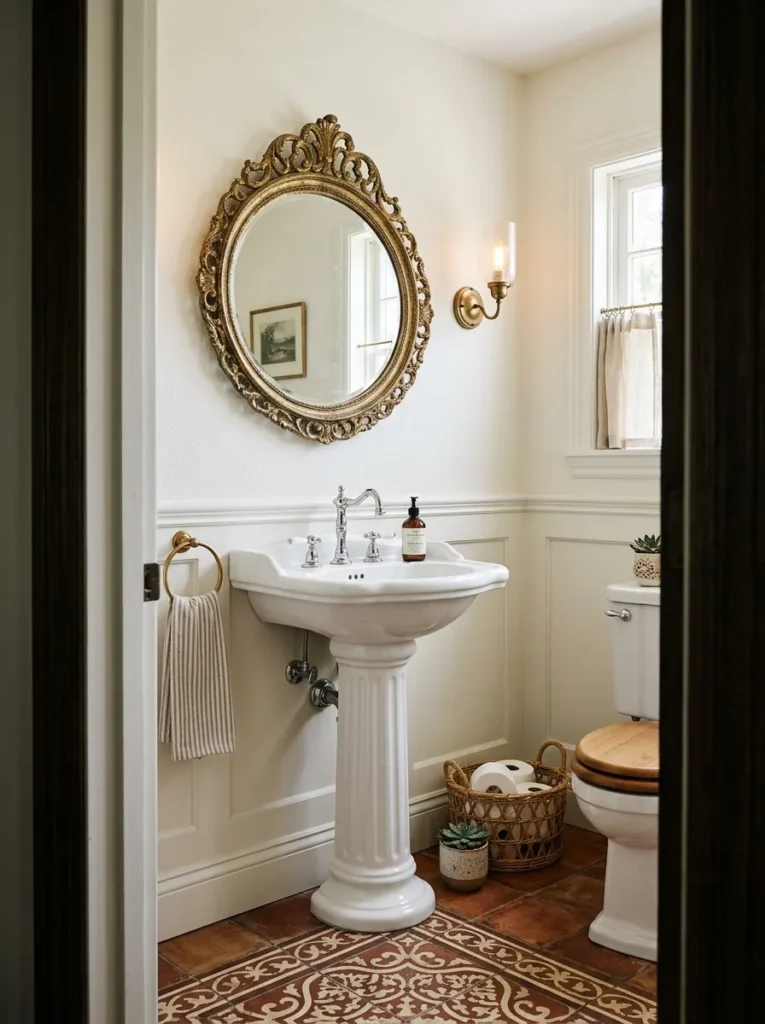
In the smallest powder rooms — those under roughly 20 square feet — a pedestal sink frees floor space and visual weight in a way that a vanity cabinet cannot. The exposed floor below a pedestal reads as more spacious than the enclosed base of a vanity, even when the overall room dimensions are identical.
The pedestal style sets a significant portion of the room’s character. A classic white porcelain column pedestal suits traditional, vintage, or transitional rooms. A more architectural pedestal in a tapered or geometric form suits contemporary spaces. A vessel sink on a narrow wall-mounted shelf or bracket is a pedestal-adjacent option that adds a more modern sensibility with similarly minimal floor footprint.
The practical trade-off is storage. A powder room with a pedestal sink has no cabinet for cleaning supplies, extra toilet paper, or anything else. A small wicker basket on the floor beside the toilet or a floating shelf above it addresses the storage need without restoring the visual weight of a full vanity.
7. A Floating Vanity to Create Floor Visibility
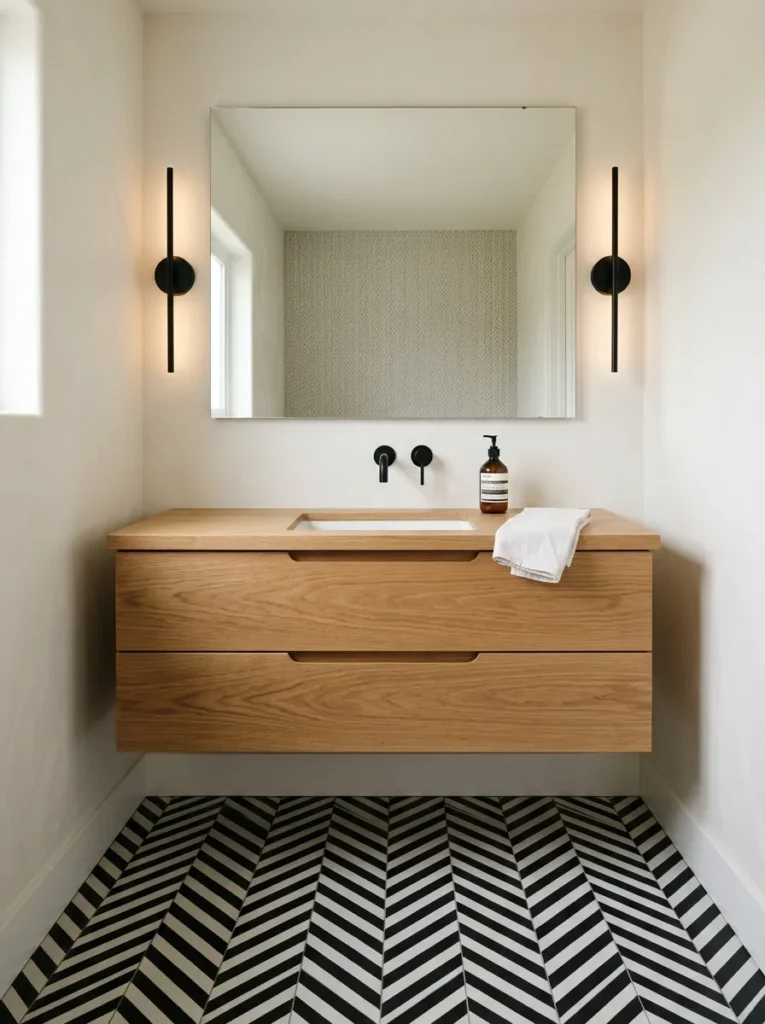
In a powder room with enough wall space for a vanity, a floating version — wall-mounted with no legs, the floor visible beneath it — provides the visual openness of a pedestal sink with the storage of a cabinet. The uninterrupted floor line beneath the vanity makes the room read as larger than the same room with a floor-standing vanity.
The floating vanity’s finish carries the room’s furniture-level character. A floating vanity in white lacquer suits minimal and contemporary spaces. One in natural oak or walnut suits warm, organic, or transitional rooms. A vintage-style floating vanity with a marble top and unlacquered brass hardware reads as classic and considered.
The mounting height is a detail worth getting right: standard vanity height is 32 to 36 inches, but in a powder room used primarily by adults, going slightly higher — 36 inches — is ergonomically comfortable and reads as deliberate rather than builder-grade standard.
8. A Concrete or Stone Vessel Sink as a Focal Object
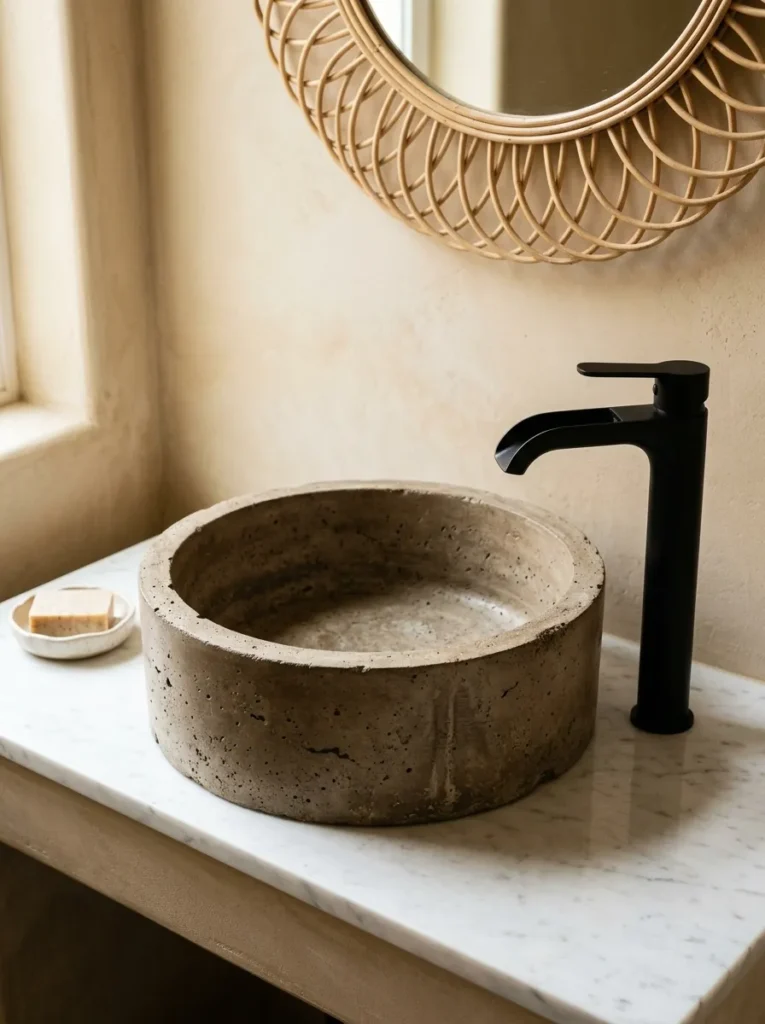
A vessel sink — a bowl that sits on top of the counter or wall shelf rather than dropping into it — draws immediate attention in a powder room because it’s visible from a distance in a way that an undermount or drop-in sink is not. In a room this small, the sink is always in the frame, which means it can carry decorative as well as functional weight.
Concrete, stone, and handmade ceramic vessel sinks are the materials most likely to read as considered design choices rather than standard fixtures. A raw concrete vessel in a matte grey-brown reads as architectural. A handmade ceramic bowl in a pale celadon or warm cream glaze reads as craft-object. A carved stone basin in travertine or marble reads as genuinely luxurious at a scale that’s manageable in a powder room.
The faucet pairing matters as much as the vessel itself. A vessel sink requires a taller faucet than an undermount — typically a tall waterfall or gooseneck style — and the faucet finish should relate to the mirror, hardware, and light fixture finish throughout the room.
9. A Narrow Console Vanity with Exposed Legs
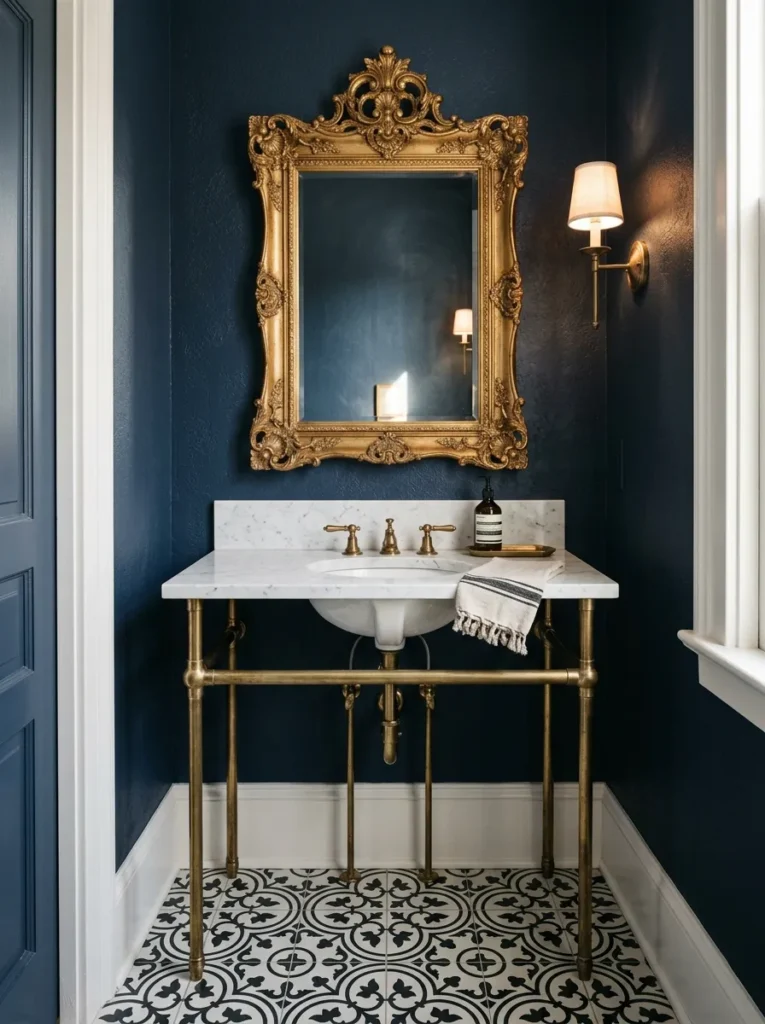
A console-style vanity — essentially a sink mounted on a narrow table-like frame with four legs — suits powder rooms that want the warmth and furniture quality of a vanity without the visual weight of a full cabinet. The exposed legs read as furniture rather than built-in millwork, which gives the room a more relaxed, gathered quality.
This works particularly well in powder rooms with interesting flooring — patterned cement tile, herringbone wood, or large-format stone — because the exposed legs allow the floor to continue visually rather than hiding it behind a cabinet base. The floor becomes part of the room’s visual composition rather than a surface only visible in open areas.
Vintage or antique dressing tables converted into powder room vanities — with a vessel sink added and a drain cut through — are the most individual version of this idea. No two are identical, which gives the room an authentic one-of-a-kind quality that new furniture rarely provides.
10. An Antique or Vintage Vanity Conversion
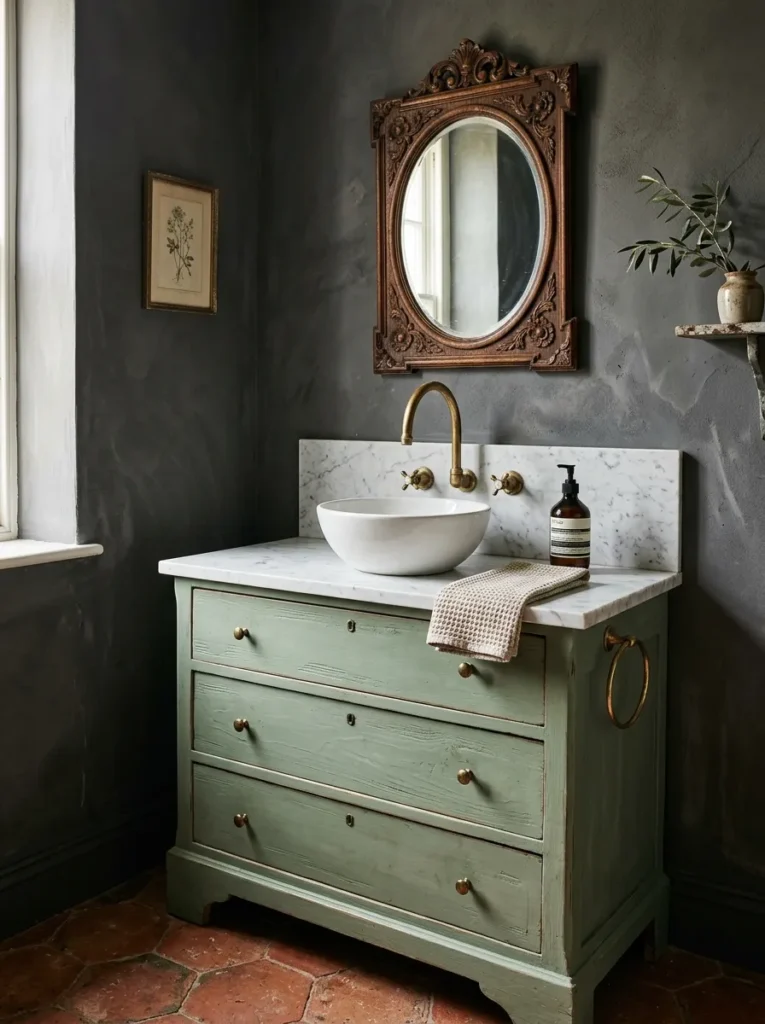
Converting a piece of antique furniture — a small dresser, a writing desk, a sideboard section — into a powder room vanity is the design decision that makes a powder room feel most genuinely personal. Unlike any catalog or showroom purchase, an antique conversion is specific to the piece found and the room it goes into.
The practical requirements: the piece needs to be deep enough to accommodate a sink bowl or undermount (typically 18 to 21 inches), the top needs to be waterproofed or replaced with stone, and a plumber needs to run the supply and drain lines to the new location. None of these are extraordinary complications, but they do require professional involvement beyond a simple fixture swap.
The visual result — a room where the vanity looks like it was placed there over time rather than selected from a bathroom collection — is worth the effort. Paint color, hardware, and mirror choices can follow the piece’s existing character rather than imposing a bathroom aesthetic onto it.
11. A Round Mirror with an Ornate or Sculptural Frame
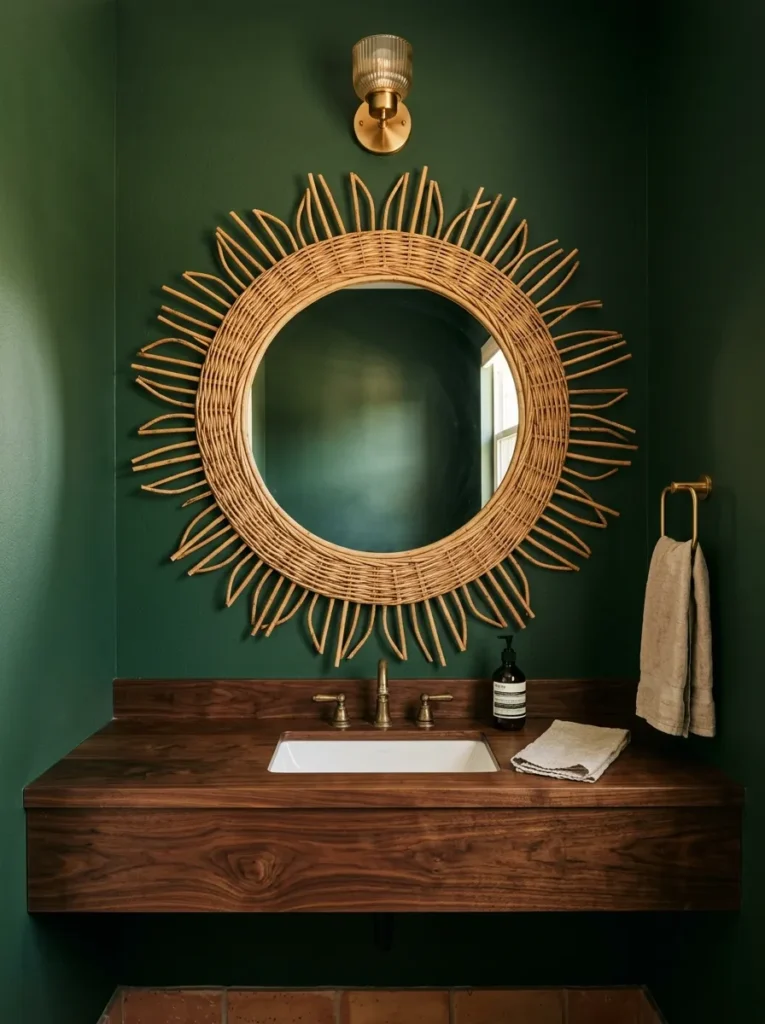
In a powder room where the walls are already making a statement — with wallpaper, dark paint, or limewash — the mirror needs to be decorative enough to hold its own without fighting with the background. A round mirror with an ornate plaster frame, a rattan sunburst surround, a hand-carved wood border, or a sculptural cast iron edge reads as a considered object rather than a standard reflective fixture.
The frame detail is what makes the mirror legible against a busy background. A simple thin-frame mirror disappears against bold wallpaper. A mirror with a sculptural frame reads as a distinct layer — the background behind it, the frame in front of it, the reflection within it — which creates visual depth in a room that otherwise has only two dimensions.
Scale: a round mirror in a small powder room reads best at 20 to 28 inches in diameter. Larger than that and the fixture competes with the sink proportionally; smaller and the detail of the frame is too fine to register from across the small room.
12. A Full-Length or Oversized Mirror to Expand the Space
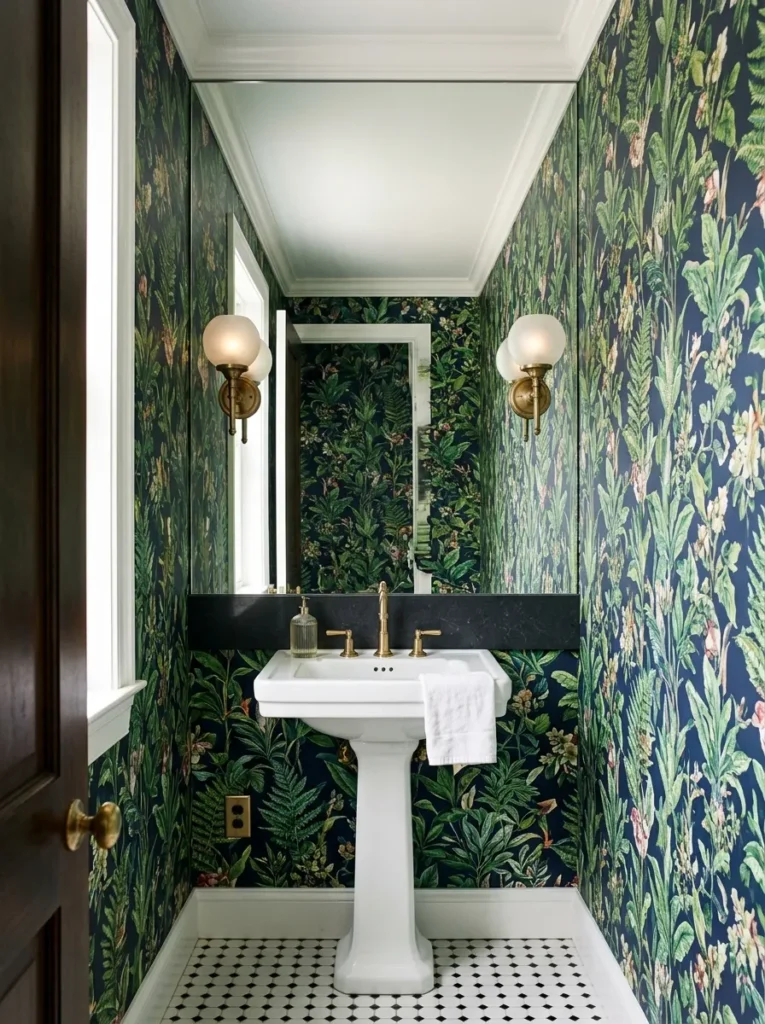
Counterintuitively, a mirror that’s larger than standard for the powder room vanity — one that takes up a significant portion of the wall above the sink — makes the room read as more resolved rather than more crowded. The reflection doubles the perceived depth of the room and makes the opposite wall’s decor visible from an additional angle.
The most effective oversized mirror for a powder room is one that fits between the ceiling and the back of the sink with only a few inches of wall showing above and below — essentially filling the available vertical wall space. Frameless or very thin-framed versions in this format read as architectural rather than decorative.
The common mistake is choosing a mirror that’s correctly sized for the vanity but too small for the wall — a 24-inch mirror on a 48-inch wall section leaves too much bare wall on either side and reads as undersized. The mirror should relate to the wall’s full width, not just the vanity’s footprint.
13. An Unexpected Mirror Shape: Arch, Diamond, or Irregular
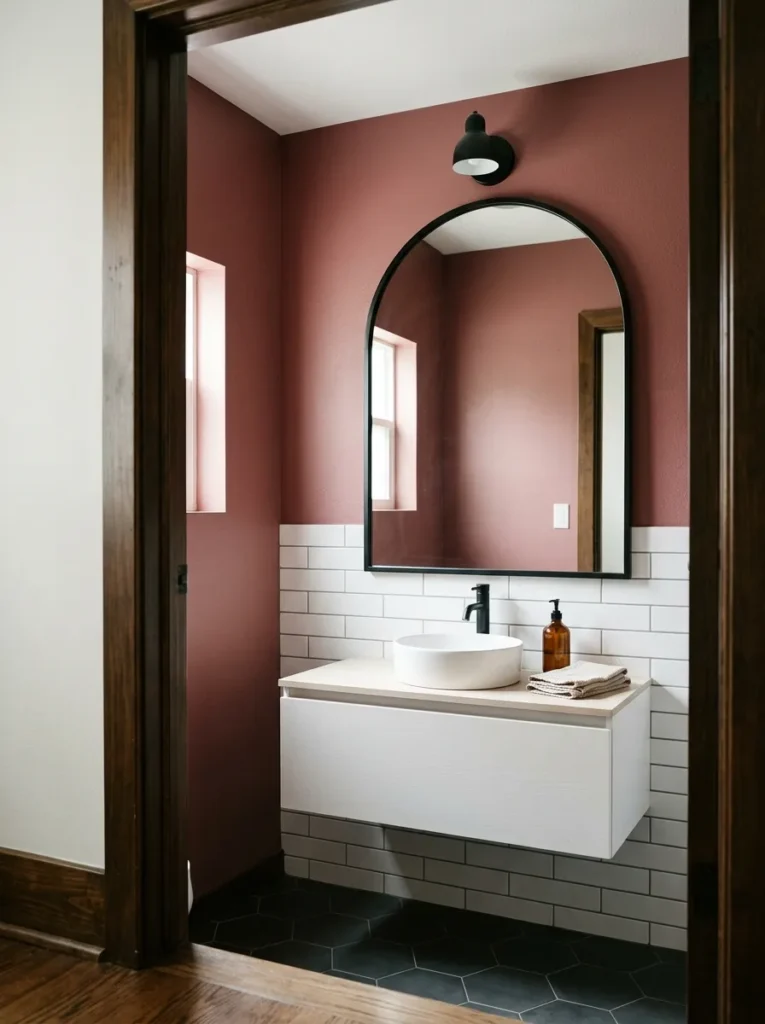
Beyond round and rectangular, mirror shapes in a powder room can extend to arches, ovals, diamonds, irregular organic forms, and geometric polygons. In a room this small, the mirror is always visible and always significant — its shape makes a statement that a mirror in a larger bathroom would never get the opportunity to make.
An arch-top mirror adds vertical movement and a softly classical quality. An asymmetric irregular mirror reads as more contemporary and art-adjacent. A diamond or hexagonal mirror reads as graphic and deliberate. The shape should have some relationship to other design decisions in the room — a geometric mirror suits a geometric tile floor; an organic mirror suits a wallpaper with flowing botanical motifs.
Whatever the shape, the mirror needs to be large enough that the shape reads clearly from the doorway. An interesting mirror that’s too small to appreciate from across a small room is a missed opportunity.
14. A Dramatic Pendant Light Instead of a Vanity Bar
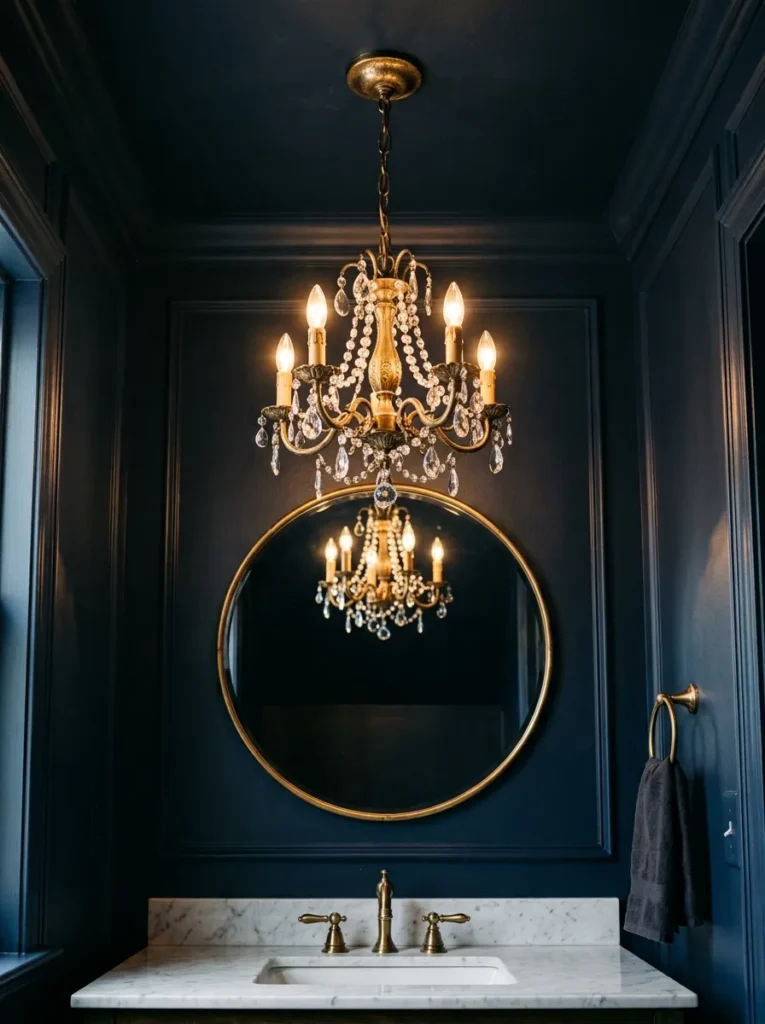
Most powder rooms are lit by a standard vanity bar — a horizontal fixture mounted above the mirror that provides adequate but entirely unremarkable light. Replacing it with a single pendant light, a small chandelier, or a sculptural ceiling fixture transforms the room’s atmosphere and makes the lighting itself a design element rather than a functional afterthought.
A small pendant centered above the sink (rather than mounted to the wall above the mirror) provides light from a different angle — from above rather than from the front — which creates shadow and warmth rather than the flat even light of a vanity bar. The fixture’s visual presence fills the ceiling zone of the room, which is often ignored and which benefits significantly from a considered element.
The fixture scale should suit the ceiling height. In a powder room with standard 8-foot ceilings, a pendant hanging 12 to 18 inches below the ceiling leaves adequate clearance while creating enough visual presence. A mini chandelier in crystal, aged brass, or black iron reads as a specific style statement; a simple ceramic or woven pendant reads as more versatile.
15. Wall Sconces Flanking the Mirror for Flattering Light
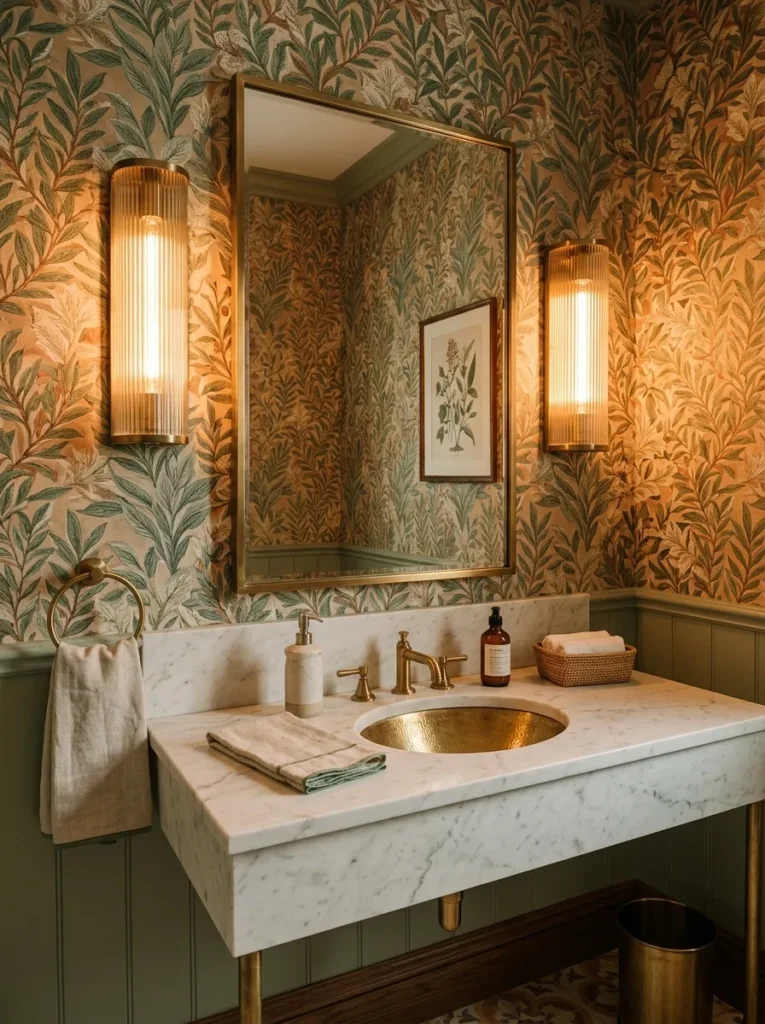
Where a pendant provides atmosphere, flanking sconces provide function and symmetry simultaneously. Two wall sconces mounted at eye height on either side of the mirror — rather than above it — light the face from both sides without the downward shadow that an overhead-only fixture creates.
The sconce mounting height matters practically: center of the fixture at approximately 60 to 65 inches from the floor suits most adults, lights the face correctly, and avoids the awkward positioning of fixtures that are either too high (above the mirror) or too low (below sightline). In a powder room with a shorter mirror, the sconces can sit on the wall beside the mirror at eye height rather than flanking it.
Sconce style is the design decision that most clearly expresses the room’s personality. A pair of slim aged brass cylinders suits warm, traditional, or transitional spaces. Matte black wall-mounted fixtures suit contemporary or industrial rooms. Fluted glass with an exposed Edison bulb suits vintage or eclectic aesthetics.
16. Bold Patterned Floor Tile as a Ground-Level Statement
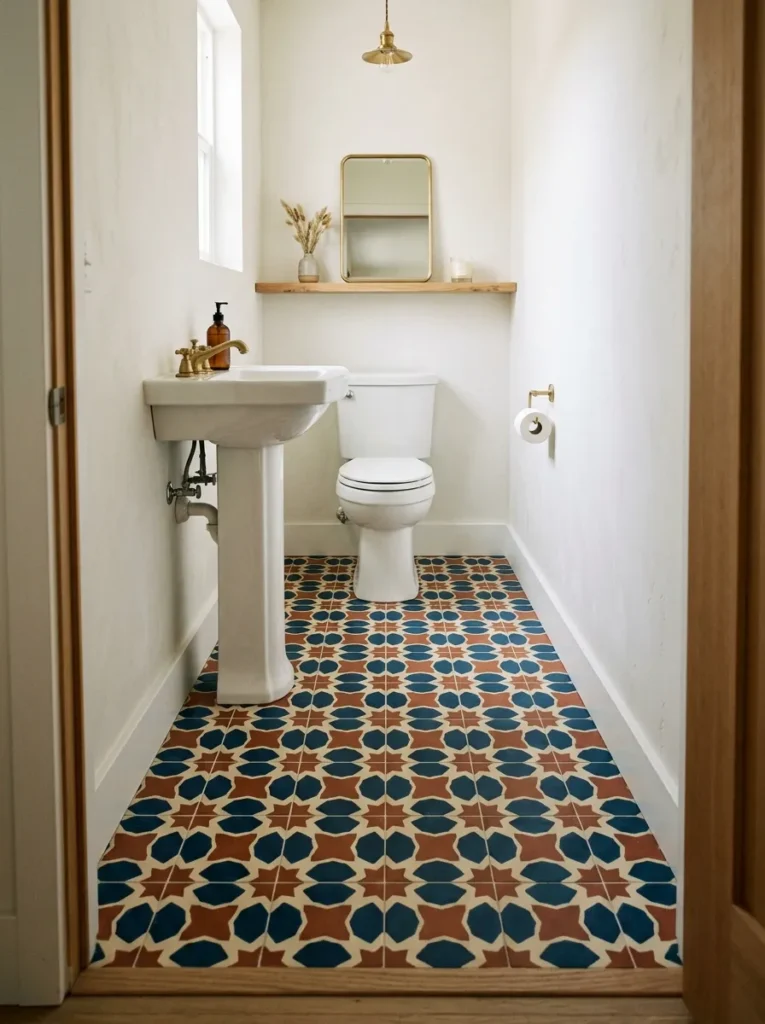
A powder room floor is one of the most visible surfaces in the room — it’s in the line of sight from the doorway and remains visible throughout the room’s use. Bold patterned tile on the floor, with the walls in a quieter complementary treatment, creates a strong ground-level statement that makes the room feel designed from the bottom up.
Encaustic cement tiles in geometric patterns, Moroccan-inspired zellige in varied tones, Victorian-style black and white encaustic mosaic, and hand-painted Portuguese azulejo tile all suit the powder room’s small scale well. Because the floor area is modest, even an expensive tile choice is cost-manageable — a bold tile that would cost thousands to install in a kitchen reads as an achievable splurge in a 25-square-foot floor.
The wall treatment should be calibrated to the floor’s visual intensity. A very busy floor needs quiet walls — a single color, a very subtle texture, or a simple wainscoting. A floor with a strong color but a simple pattern can sustain a complementary wallpaper if the colors relate rather than compete.
17. A Tile Accent Wall Behind the Sink
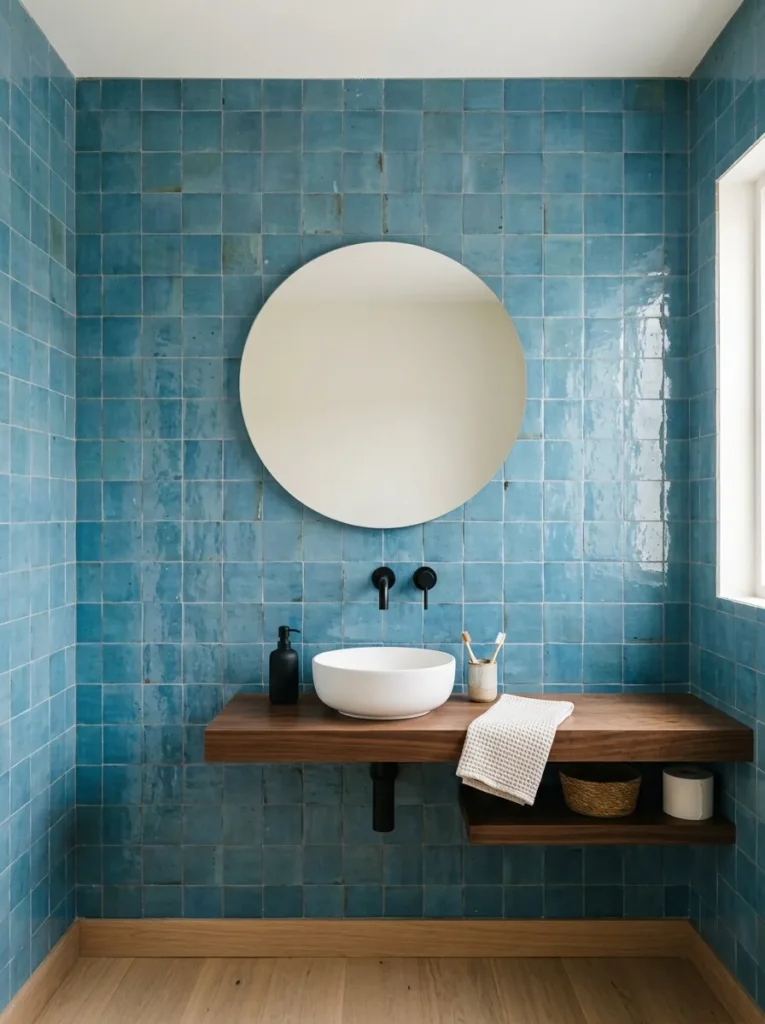
Rather than tiling the floor, a single tile accent wall — typically the wall behind the sink and mirror — brings material interest to the room’s primary focal wall. Hand-glazed zellige tile in a warm terracotta or ocean blue, subway tile in an unexpected color laid in a herringbone pattern, or large-format marble tile with dramatic veining all make the sink wall read as genuinely architectural rather than just functional.
The tile needs to extend beyond the mirror and vanity’s footprint to be effective — a tile section exactly the same width as the vanity reads as a backsplash rather than a feature wall. Running it from floor to ceiling and from one corner to another (or from floor to ceiling across the full sink wall) gives the material treatment the scale it needs to register as intentional.
The mirror choice is critical in this context: a frameless or very thin-framed mirror lets the tile continue visually behind the glass; a heavy-framed mirror creates a competing layer that can look crowded in the small space.
18. Black Fixtures and Hardware Throughout
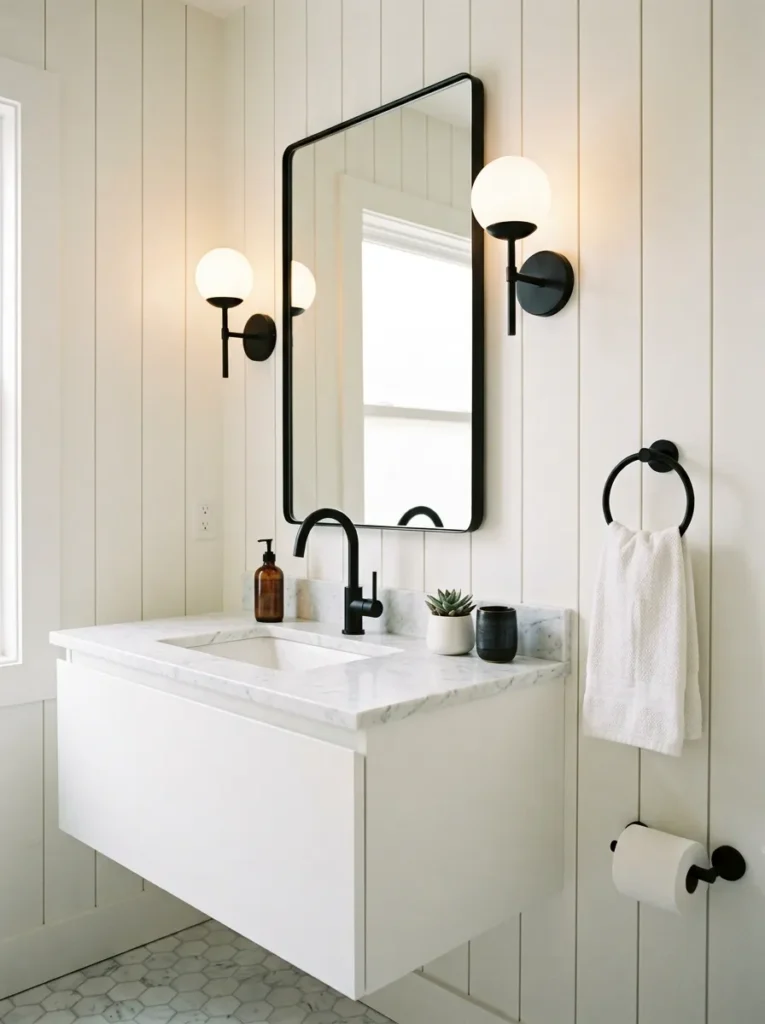
A powder room where every metal element — faucet, drain cover, toilet paper holder, towel ring, robe hook, light fixture — is in a consistent matte black finish reads as more designed than the same room with mixed or chrome finishes. The consistency does something that individual good-looking pieces can’t: it creates the impression that the room was conceived as a whole rather than assembled from unrelated choices.
Matte black hardware suits contemporary, industrial, and transitional powder rooms. It pairs particularly well with white or very light fixtures (sink, toilet) where the contrast is sharp, and with natural materials (wood vanity, stone countertop) where the black reads as grounding rather than harsh.
The one consideration: very cheap matte black finishes chip and wear unevenly over time, revealing a silver or brass base. In a room used regularly by guests, fixture quality is more visible than in a private bathroom. Mid-range to higher-quality matte black hardware holds its finish considerably longer than entry-level options.
19. A Woven Basket or Ceramic Jar for Storage and Texture
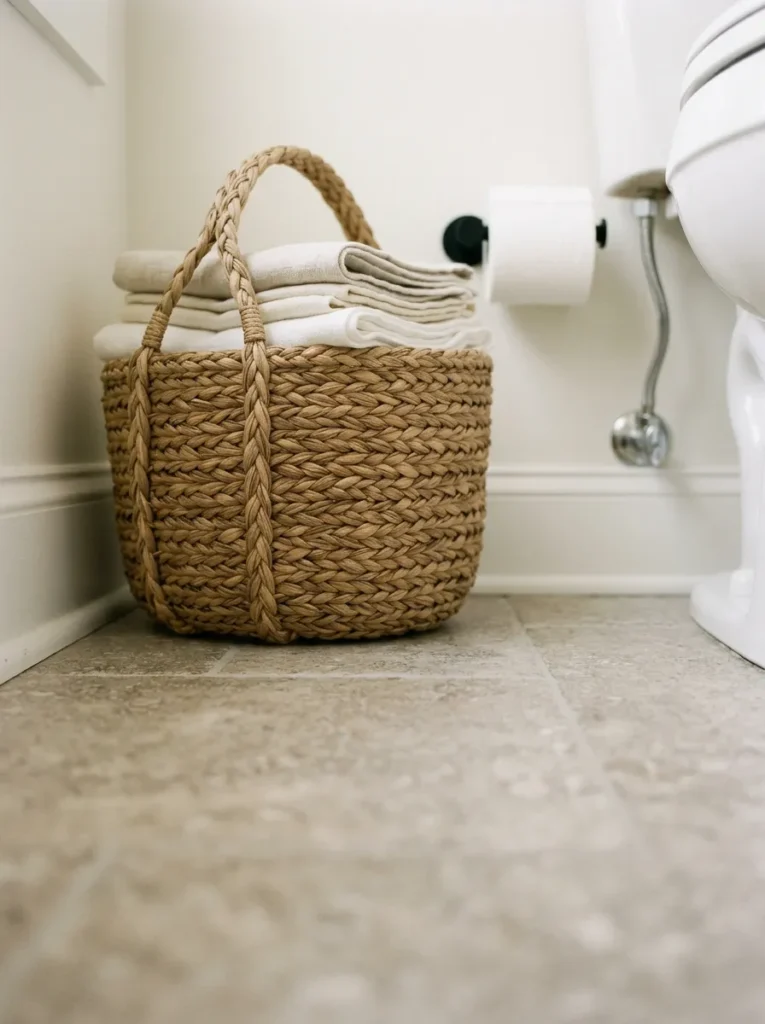
A powder room that has no storage options — no vanity cabinet, no shelf — creates practical problems: where do extra hand towels, the toilet brush, and backup supplies go? A woven basket on the floor beside the toilet, a ceramic lidded jar on a small shelf, or a small rattan tray on the back of the toilet tank addresses these needs while adding organic texture that softens the room’s harder surfaces.
The woven basket works as a texture element specifically because it’s the room’s only soft material — surrounded by tile, porcelain, and painted walls, the natural fiber reads as warmth rather than clutter. The basket or jar should be sized proportionately to the room: a very large basket in a tiny powder room consumes floor space and reads as storage overflow; a well-proportioned one reads as a considered accessory.
This is also one of the few powder room ideas on this list that requires no installation, no professional involvement, and minimal cost — making it the right starting point for anyone working within tight constraints.
20. A Small Piece of Original Art or a Found Object
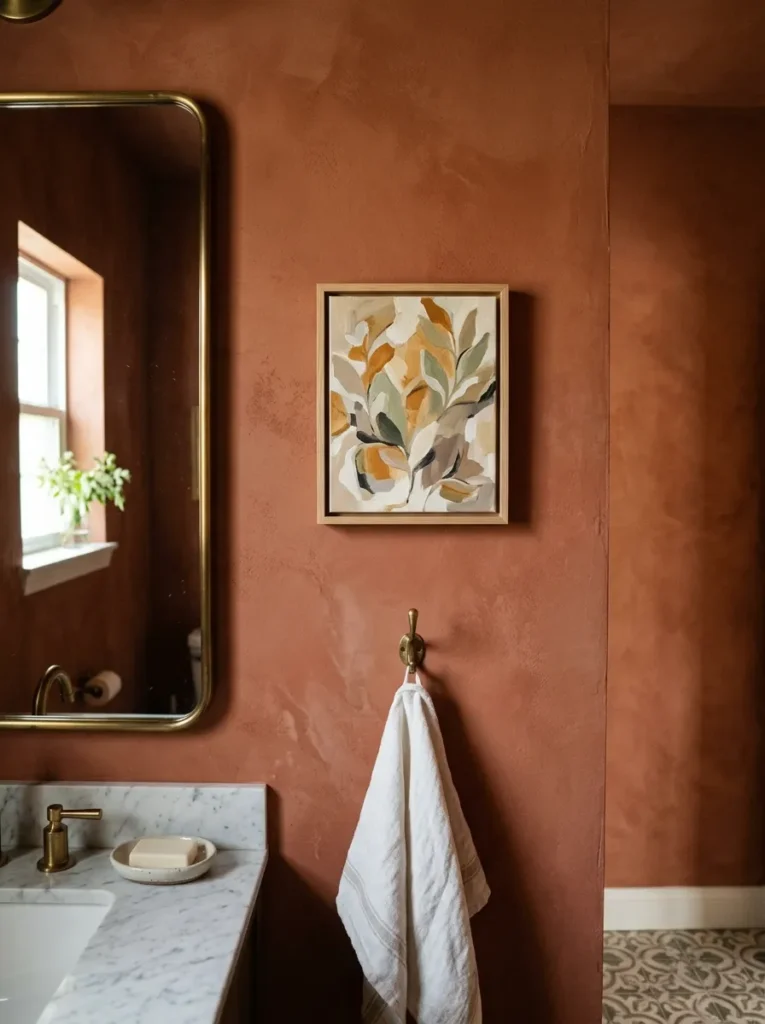
A powder room that has one genuinely interesting, specific object — a small original painting, a sculptural ceramic piece mounted on the wall, a framed antique map, a collection of pressed specimens under glass — gives guests something to look at and think about. This is different from art-as-wallpaper; it’s a single deliberate choice that communicates something about the person who lives there.
The object can be small because the viewing distance in a powder room is short. A piece that would be lost on a living room wall reads clearly from two feet away. The mounting position should be at comfortable eye height — roughly 57 to 60 inches from the floor to the center of the piece — and on a wall that doesn’t compete with the mirror or the patterned wallpaper for visual attention.
The rest of the room should be quiet enough that this piece can be found and appreciated. A powder room where every surface is already busy doesn’t need another object; one where the walls are a single color and the fixtures are simple benefits considerably from one specific, meaningful thing on the wall.
21. Wainscoting with Bold Paint or Wallpaper Above
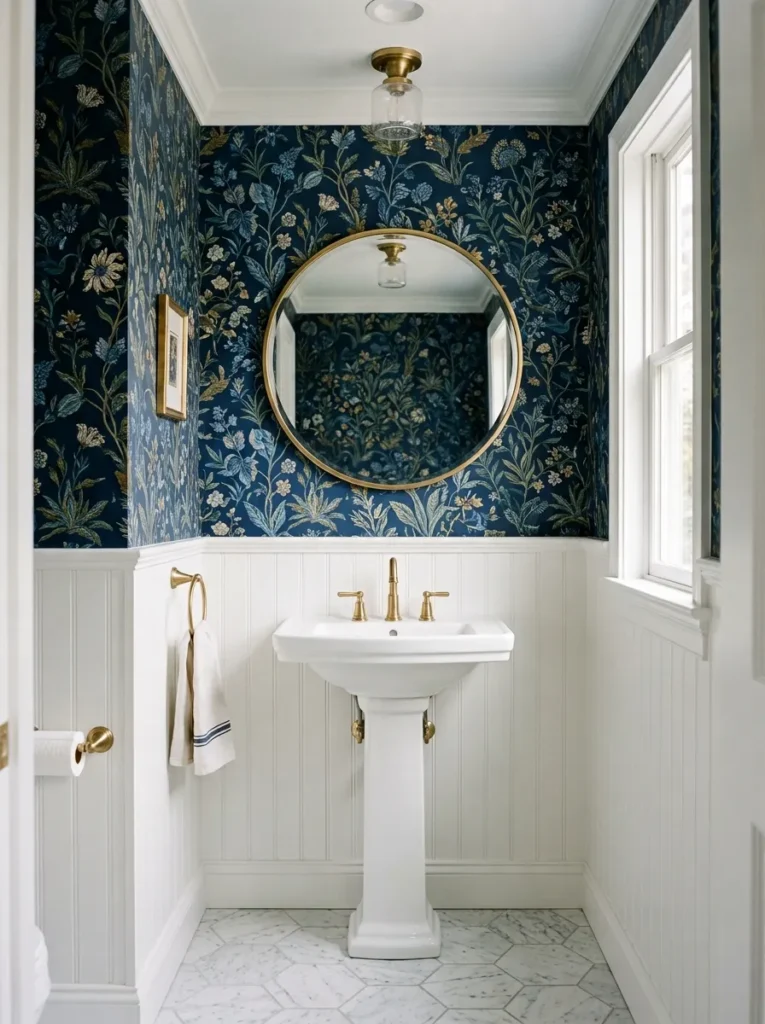
Dividing the powder room wall horizontally — paneling or beadboard on the lower half, paint or wallpaper on the upper half — creates architectural detail and a design structure that the room can build around. The wainscoting provides protection and texture in the lower zone where walls are most contacted, while the upper wall gets the treatment that most expresses the room’s personality.
The division reads best when the lower paneling is in a semi-gloss or satin finish (more durable and easier to clean) and the upper wall is in a contrasting treatment — a deep wallpaper above white wainscoting, or a dark paint above a natural wood wainscoting. The chair rail at the transition point is the element that holds the two zones together; it should be in a finish that relates to both rather than matching only one.
In a small powder room, keeping the wainscoting at roughly one-third of the wall height (around 32 to 36 inches) preserves enough upper wall surface for the more expressive treatment to read clearly. Wainscoting that goes too high limits the space available for the wallpaper or paint that’s supposed to be the room’s visual interest.
22. Scented Candles and Hand Soap as Part of the Design
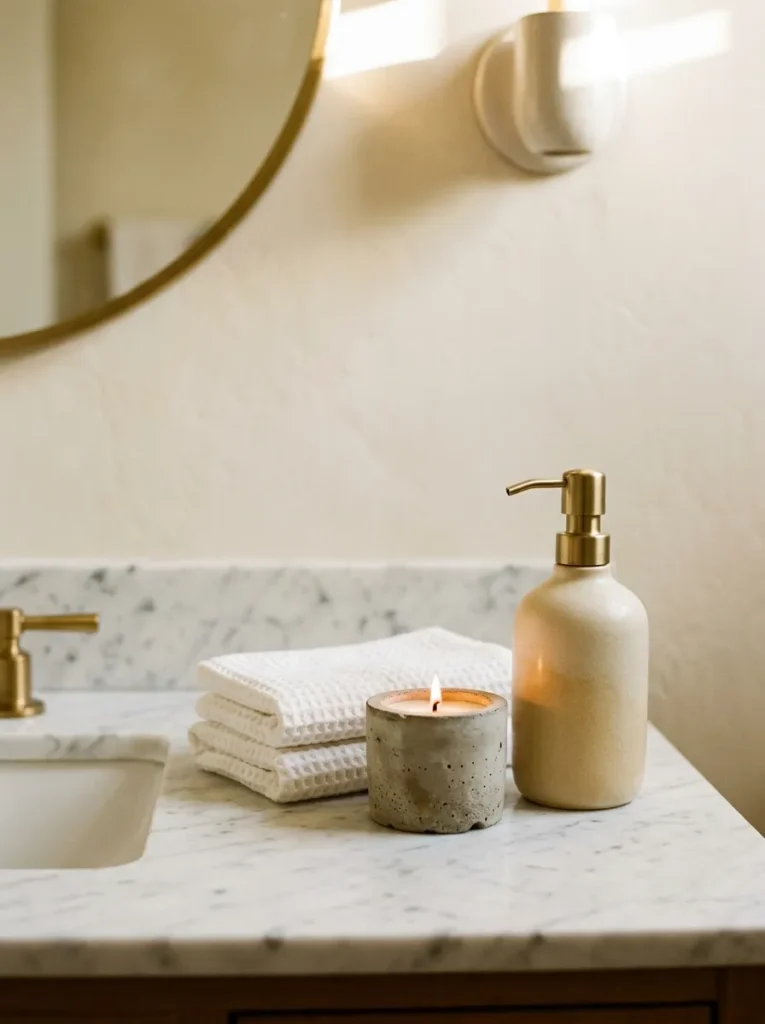
A powder room that smells considered makes as much of an impression as one that looks considered. A high-quality hand soap in a ceramic or glass pump dispenser, a small scented candle beside the sink, and a stack of neatly folded linen or waffle-knit hand towels positioned clearly on the counter or a small shelf communicate care and attention in the most direct way possible.
These objects also perform a design function. A ceramic soap dispenser in a color that relates to the room’s palette, a candle in a vessel that suits the room’s aesthetic (a concrete vessel for a contemporary room, a ceramic crock for a more organic one), and hand towels in a natural linen or textured cotton add the finishing layer that photography rarely captures but guests always notice.
This is the easiest idea on the list to implement — it costs almost nothing relative to the impression it creates, requires no tools or professional involvement, and can be changed whenever the room’s direction evolves. It’s also the most frequently overlooked, because it’s not strictly decor. That’s exactly why it matters.
What to Prioritize in Your Powder Room
With 22 ideas spanning wallpaper, fixtures, tile, lighting, and accessories, the question of where to start is genuinely useful.
If you own and are renovating: Prioritize in this order — the vanity and sink, the lighting, the mirror, the walls. Fixture choices set the material register of the room and constrain everything that follows. Getting the vanity and lighting right before choosing wallpaper or paint ensures the wall treatment supports the room rather than conflicting with it.
If you’re working with existing fixtures: The wall treatment is the highest-impact change available. Wallpapering all four walls or committing to a dark, saturated paint color transforms the room’s character more than any accessory addition. Do that first, then calibrate the mirror, hardware, and accessories to what the room becomes.
If you’re renting: Peel-and-stick wallpaper, a decorative mirror (hung on existing hardware), upgraded hand soap and towels, a woven basket, and a small piece of art are all achievable without landlord permission. Together, they represent a meaningful transformation with zero permanent modification.
The one decision that matters most in any powder room: the mirror. It’s the room’s focal point, it’s functional, and its scale, shape, and frame set the visual tone for every other element. If only one upgrade is possible, make it the mirror.
Final Thoughts
The powder room rewards commitment in a way that larger rooms rarely do. A bold choice — dramatic wallpaper, a dark saturated wall, an unexpected vanity, a sculptural mirror — works here because the room is small enough to sustain it and brief enough that guests experience it as a moment rather than an environment they have to live in.
The ideas here span the full range from a complete renovation to an afternoon’s worth of changes. Most powder rooms benefit most from a strong foundational decision — the wall treatment and the mirror — and a few well-chosen supporting details. Resist the instinct to add more once those foundations are in place. The most impressive powder rooms are usually the most edited ones: one strong idea executed with care, and everything else chosen to support it quietly.
Save the ideas that fit your room and your situation, and come back to this guide when you’re ready to make the space work as hard as the guests who use it deserve.