
18 Dining Room Plate Wall Ideas That Make a Statement
A plate wall does something that framed art rarely achieves: it makes a dining room feel like it belongs to someone. The specific plates chosen — inherited china, market finds, handmade ceramics picked up from a potter’s studio, a collection built over years of travel — carry a personal history that no purchased print can replicate. Arranged well on a dining room wall, they become the room’s most distinctive element and the conversation starter that guests return to repeatedly over the course of a meal.
The challenge is the arrangement. A beautiful collection of plates displayed poorly — too tight, too random, without visual structure — reads as clutter rather than collection. And the execution details that most people discover after the first nail is in the wall — how much space between plates, whether the hanger will show, how to plan the layout before committing — can make or break a result that requires real wall repair to undo.
These 18 ideas address the full picture: the style and palette decisions that give a plate wall its character, the arrangement principles that make it read as curated rather than accumulated, and the practical details that prevent the project from becoming a wall of regret.
1. Build the Arrangement Around One Large Anchor Plate

The plate wall that looks accidentally assembled usually shares one characteristic: there’s no hierarchy within the arrangement. Every plate is treated as equally important, which means none of them commands attention, and the viewer’s eye drifts rather than settling. The straightforward fix is beginning with one large anchor plate — the most visually striking piece in the collection — and building the arrangement outward from that center point.
The anchor plate should be the widest piece available, ideally 10 to 14 inches in diameter, and placed at the visual center of the arrangement rather than at the literal center of the wall. Other plates are then positioned around it in descending size, with the largest pieces closest to the center and the smallest at the outer edges. This creates a natural taper — wider and heavier at the center, lighter at the perimeter — that reads as composed and intentional even when the individual plates are varied in style, color, and origin.
2. Use a Blue and White Palette for Classic Dining Room Elegance

Blue-and-white plate collections have appeared in formal dining rooms for centuries, from Delftware in Dutch interiors to chinoiserie in English country houses to transferware in American farmhouses. The specific appeal in a dining room context is the combination of clear visual cohesion — every plate belongs to the same palette — and endless variation within that palette: cobalt botanical patterns, navy geometric borders, soft blue floral motifs, indigo landscape scenes. The arrangement reads as unified without looking like it was purchased as a set.
The depth of blue that unifies the collection should guide the wall color choice. A collection dominated by darker cobalt reads well against warm cream or soft white walls; a collection of pale blue transferware reads well against both white and warm greige. Mixing different blue tones within the collection — navy beside sky blue beside soft periwinkle — creates the visual richness that a single tone cannot, provided the arrangement gives each plate enough breathing room that adjacent tones don’t fight each other.
3. Collect Vintage and Antique Plates for a Collected, Personal Feel

Plates are surprisingly versatile as wall decor, and mixing antique finds with newer pieces, playing with color, or sticking to a simple theme results in something that always feels intentional and unique — there’s no wrong combination; it all just works. The specificity comes from the collecting process itself: a plate bought at an estate sale, one inherited from a grandmother, one found at a Paris flea market, and one commissioned from a local potter creates an arrangement that no styling guide could prescribe because it’s genuinely personal.
The key to making a mixed-vintage collection read as cohesive rather than random is establishing one consistent thread — a color family, a period style (all Victorian, all mid-century), or a decorative motif (all botanical, all landscape) — that connects disparate pieces visually even when they share no other relationship. Within that thread, variations in size, rim style, pattern scale, and plate depth create the visual complexity that makes the arrangement worth sustained attention.
4. Arrange Plates in a Symmetrical Grid for Contemporary Order

A symmetrical grid arrangement — plates organized in equal rows and columns at consistent spacing — is the most formally resolved plate wall format and the one that reads most clearly as a deliberate design decision rather than a casual display. When plates of identical or near-identical size are arranged in a 3×3, 4×3, or 4×4 grid with consistent spacing between them, the arrangement has the visual authority of an art installation rather than a collection.
Arranging plates in rows and columns creates a visual rhythm that feels polished and refined. This design style works best if the plates are the same size or, for a smaller display, can be balanced evenly. Mixing and matching colors or patterns adds visual interest to the arrangement while still embracing symmetry. The spacing between plates matters as much as the plates themselves — too tight and the grid reads as dense; too spread and the connection between plates dissolves. A consistent gap of 3 to 4 inches between plate edges at standard dining room scale produces the tightest coherent arrangement.
5. Create an Organic Cluster That Radiates From the Center
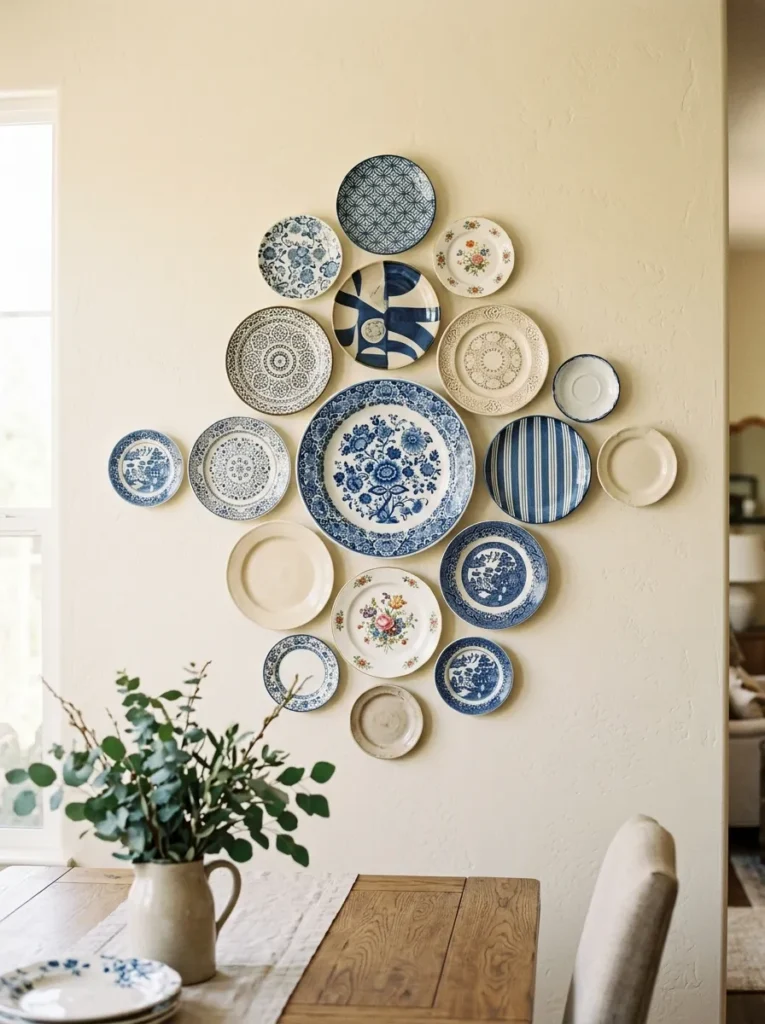
In contrast to the grid, an organic cluster arrangement uses no rigid structure — plates are positioned as overlapping circles in a loosely radiating arrangement that expands outward from the center without following rows or columns. The organic quality is what makes this arrangement suit collected, vintage, and mixed-style plate sets where perfect symmetry would look forced.
The practical principle for achieving an organic cluster that reads as designed rather than random: map the arrangement on the floor first. Lay the plates in the rough positions you’re planning, step back and photograph the arrangement from above, and edit until the overall shape is roughly circular or oval with a clear center of gravity. The tightest spacing should be at the center, expanding slightly toward the edges. Once the floor arrangement reads well, transfer it to the wall using paper templates to mark positions before any hanging hardware touches the plates.
6. Go Monochromatic With White or Cream Plates for a Refined Minimal Look

A plate wall composed entirely of white, cream, and off-white plates — varied only in form, surface texture, and decorative relief pattern — creates a refined, sculptural effect that works in dining rooms where other color choices are already bold. The absence of color means the visual interest comes from three-dimensional form: a deeply embossed floral border beside a smooth flat rim beside a scalloped edge beside a raised geometric center pattern.
The wall behind a white plate arrangement carries significant visual weight since it shows through and around every plate. A warm, deep wall color — charcoal, navy, forest green, or terracotta — makes white plates read as sculpture against a deliberate backdrop. A pale wall makes the white arrangement nearly disappear into the wall surface, which works only if the plates have enough three-dimensional relief to cast visible shadows that separate them from the background.
7. Mix Plates of Different Diameters in a Graduated Arrangement
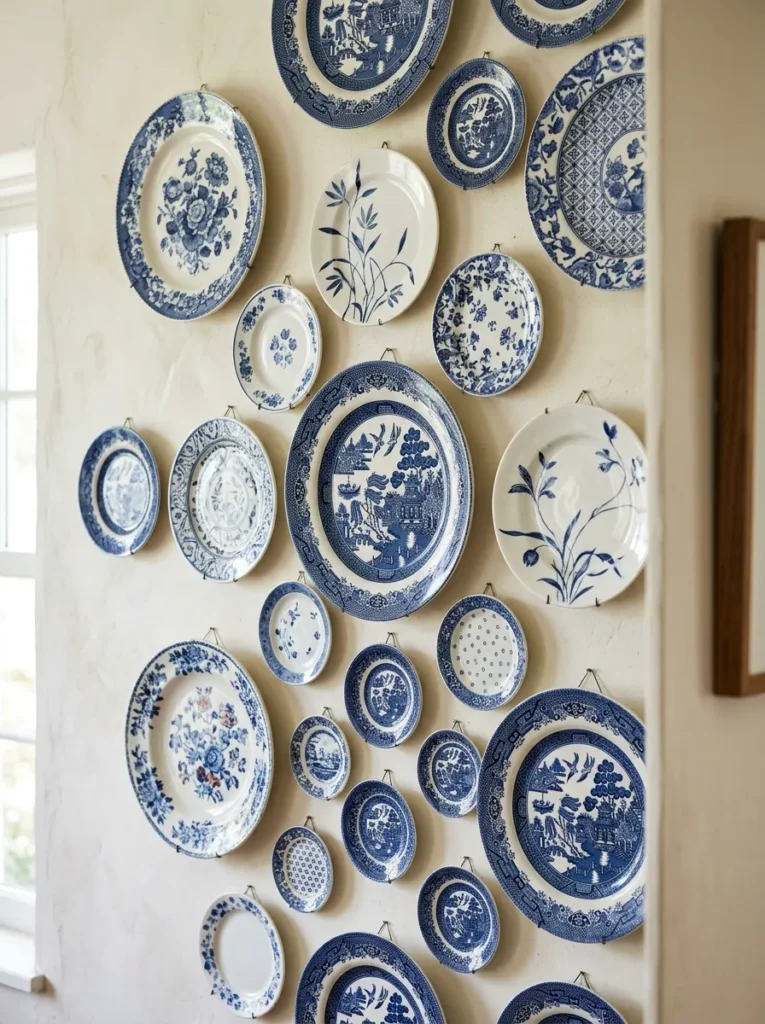
Rather than restricting a plate wall to one plate size, a graduated arrangement uses plates of deliberately different diameters — dinner plates at 10 to 12 inches, salad plates at 8 inches, dessert plates at 6 to 7 inches, and small accent plates at 4 to 5 inches — in a composition where the size differences create visual rhythm and movement. The larger plates provide visual weight; the smaller ones fill gaps and provide fine detail.
The graduated sizes allow the arrangement to fit into wall spaces of irregular dimensions more naturally than a grid of identical plates. A wall with a door or window interrupting one side, or a chimney breast that changes the available width, accommodates a graduated arrangement more gracefully than a symmetrical grid that was designed for a clear rectangular wall. The smallest plates should not be so small that they read as incidental ornaments rather than plate wall elements — at minimum 5 inches in diameter to hold their presence in the arrangement.
8. Create a Gallery Wall by Mixing Plates With Framed Art

Plates are art, so pairing them with framed prints, mirrors, or small sculptures is a natural way to create more complex wall arrangements. In a dining room context, the combination works particularly well when the framed elements relate to the plate collection’s subject matter: botanical prints beside botanical plates, portrait paintings beside china with portrait medallions, vintage maps beside transferware with architectural prints. The shared subject creates cohesion between the mixed media.
The hanging principle for a mixed plate-and-art arrangement: the plates provide the three-dimensional elements and the framed art provides the flat background rhythm. Plates should project forward from the wall and art should remain flat — this difference in depth creates the visual layering that makes the combination look more considered than a pure plate wall or a pure gallery wall separately. The arrangement should have a defined outer boundary — a clear shape that the viewer reads as the extent of the composition — rather than trailing off in any direction.
9. Display Chinoiserie or Talavera Plates for Vivid Pattern and Color

A mixed collection of blue-and-white Talavera and Fajalauza pottery arranged around an arched window, with each plate different, can aim for what one designer calls “symmetrical chaos” — balanced but never too planned. Chinoiserie plates — with their blue garden scenes, pagodas, willow trees, and birds on cream grounds — and Talavera plates, with their vivid Mexican folk painting patterns in cobalt, terracotta, and yellow, both have enough internal pattern complexity that the wall arrangement benefits from letting each plate read individually rather than grouping them too tightly.
In a dining room, these highly patterned plates suit walls that are otherwise relatively simple — a single wall color without competing patterns or textures. The plates themselves provide all the pattern the room needs. Framing them with a simple wide spacing — 4 to 6 inches between plate edges — gives each piece enough breathing room that its individual pattern can be appreciated from the dining table rather than blurring into a collective mass of pattern at viewing distance.
10. Choose All Handmade Ceramic Plates for an Artisanal, Contemporary Feel

A plate wall composed entirely of handmade ceramics — plates where the irregular glaze, finger-thrown rim variation, and imperfect roundness are visible as evidence of the maker’s hand — creates a contemporary, artisanal arrangement that positions the dining room as a curated gallery space rather than a decorated room. The plates need not be old or collected over years; a single day at a ceramics market, a set purchased from one or two studio potters, or a combination of handmade pieces from different makers in related glaze tones can create a cohesive wall.
The glaze palette unifies the arrangement when the plates vary in form and size: a collection of handmade pieces in warm terracotta, sandy cream, and earthy olive reads as a composed whole because the colors share an organic, earth-derived quality. The slight imperfections in the rims and surfaces are not flaws in this context — they’re the quality that distinguishes the arrangement from a conventional plate display and give the wall its character.
11. Embrace Grandmillennial Style With Ornate Floral China

When grandmacore stormed the internet, it cast minimalist aspirations aside in favor of a little curated maximalism — and the plate wall is one of its most charming expressions. Grandmillennial plate walls in dining rooms use the most decorative pieces in the china cabinet: heavily gilded borders, dense floral patterns in pink and gold, hand-painted landscapes, portrait medallions, and botanical transfer prints in colors that Victorian dining rooms made standard. The combination of pieces that might seem individually fussy resolves into an arrangement with genuine period charm. walmart
The key to a grandmillennial plate wall that reads as charming rather than cluttered is the wall behind it. A rich, dark wall color — a deep sage green, a warm burgundy, or an inky navy — makes even the most ornate plate collection read as curated and composed. On a plain white wall, ornate patterned plates can overwhelm the surface; against a strong background color, they become art against a ground.
12. Wrap a Plate Wall Around a Corner for Maximum Impact
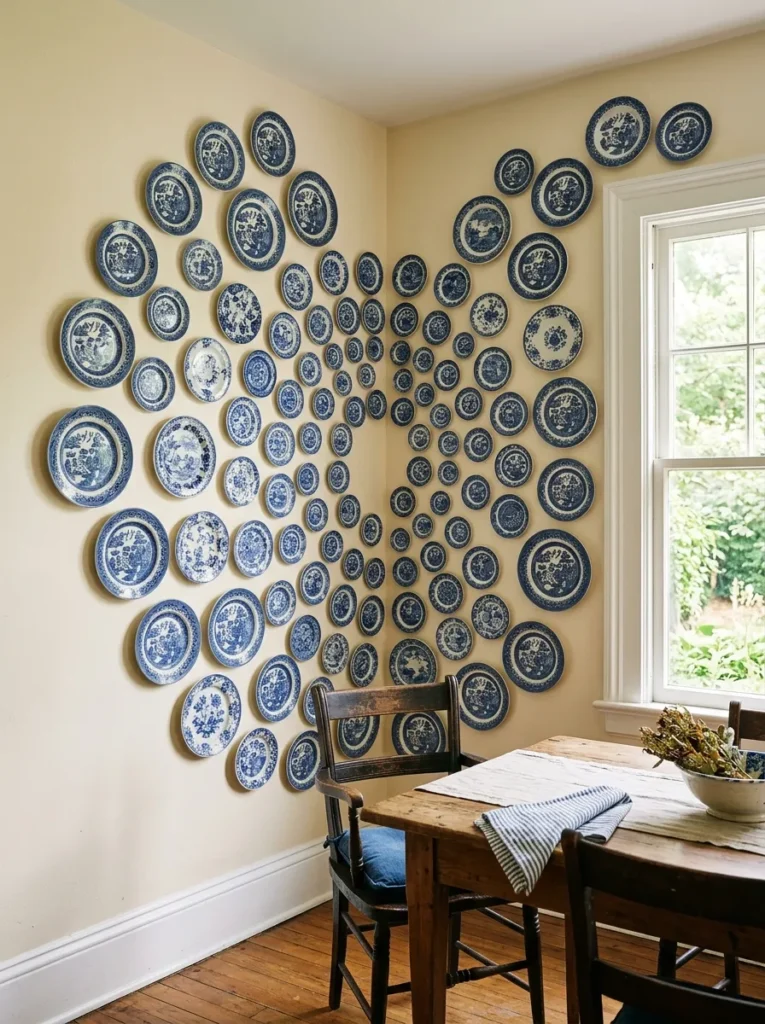
Most plate walls are confined to a flat surface between two architectural boundaries. Wrapping the arrangement around a corner — continuing the plate cluster from one wall onto the adjacent one — creates one of the most spatially interesting plate wall effects available and transforms a corner that would otherwise be decoratively challenging into the dining room’s most dynamic feature.
The corner itself becomes a visual axis around which the arrangement rotates. The plates closest to the corner on each wall should be the smaller accent pieces; the larger anchor plates sit further out on each wall where they have space to read. The arrangement on each wall should be independently coherent as a plate grouping while connecting to the neighboring wall through proximity and shared palette. This format suits dining rooms where the corner receives the most sustained attention from the primary seating position.
13. Add a Large Mirror to the Center of a Plate Arrangement

A large mirror positioned within a plate arrangement — typically at its center, surrounded by plates rather than having plates beneath or above it — creates a compositional focal point that the plates orbit and that simultaneously reflects the dining room back into itself, doubling the sense of light and space at the wall. The mirror’s reflective surface also makes the plates visible from angles where they wouldn’t normally be seen, which adds complexity to the wall composition.
The mirror frame should relate to the plate collection’s aesthetic: an ornate gilt frame suits a collection of decorative china; a simple natural wood or thin iron frame suits a collection of handmade ceramics or contemporary pieces. The mirror diameter should be substantial — at least 18 to 24 inches — to read as a genuine compositional anchor rather than a small object that gets lost among the plates surrounding it.
14. Create a Modern Plate Wall With Dark Matte Ceramics

A plate wall composed of dark matte ceramics — charcoal, black, deep terracotta, slate — on a light wall creates the visual inversion of the conventional plate wall. Where traditional plate walls typically use light or patterned plates against light or mid-toned walls, a dark matte arrangement against a pale wall reads as a graphic, sculptural installation.
By selecting plates with sharp geometric lines, solid matte finishes, or abstract monochrome patterns, you create a sophisticated art installation. This approach depends heavily on negative space, so allowing plenty of room between each plate lets the individual shapes stand out — the high contrast of dark ceramic against a light wall adds architectural depth and a clean, organized feel. The three-dimensional quality of the plates — the rim depth, the slight convexity of the surface — casts visible shadows on the pale wall behind, which is what gives the arrangement its sculptural quality.
15. Use a Single Row of Plates as a Horizontal Band Above a Sideboard

Rather than a clustered or radial arrangement, a single horizontal row of plates — typically five to nine plates of similar or graduated sizes positioned in a clean line at a consistent height — creates a restrained, architectural plate wall approach that suits contemporary and transitional dining rooms where a traditional clustered arrangement would feel excessive. The row reads as a designed horizontal element in the room rather than as a collection displayed on the wall.
The horizontal row works best mounted directly above a sideboard or console table, at approximately 6 to 8 inches above the surface, so the plates and the furniture below read as one composed element. The row’s length should correspond to the width of the sideboard — extending the same distance, or slightly shorter, so the row is visually supported by the furniture beneath it. Plates in similar sizes spaced consistently (3 to 4 inches apart) create a clean linear arrangement; alternating larger and smaller plates creates a subtle rhythm.
16. Mix Plates With Woven Baskets for Texture and Dimension

Combining traditional porcelain plates with hand-woven baskets introduces multiple layers of texture and visual interest — the smooth ceramic surface contrasted with the organic woven fiber creates a tactile quality that hard surfaces alone don’t provide. In a dining room, the basket-and-plate combination suits the same setting as a conventional plate wall while expanding the material palette and creating an arrangement that reads as more contemporary and less traditionally formal. Driven by Decor
The baskets should be mounted flat against the wall (hanging face-forward) rather than projecting outward, so they read as circular decorative elements at the same depth plane as the plates. Woven seagrass and rattan baskets in natural honey and warm brown tones work well alongside plates in warm neutrals and earthy tones; baskets with painted or geometric patterns work alongside more graphic or patterned plate collections. The proportion of plates to baskets should favor plates — a ratio of roughly two plates to one basket maintains the arrangement’s identity as a plate wall.
17. Plan the Layout on the Floor First — Every Time

This isn’t a style idea but the single most important process decision in any plate wall project. The most common plate wall regret — an arrangement with awkward gaps, an off-center focal point, plates positioned too close or too far from each other — results from planning on the wall with nails rather than planning on the floor with the actual pieces.
Lay the plates on the floor in the general area, step back and assess the arrangement from standing height, and photograph it. Edit the positions — the floor gives you the freedom to move anything without consequence — until the arrangement reads well from at least four feet away. Then trace each plate onto paper, cut out the templates, tape them to the wall at the planned positions, and live with the paper arrangement for a day before driving any nails. The paper template stage reveals spatial issues (a template too close to a doorframe, an awkward gap near the ceiling) that aren’t obvious from the floor.
18. Use Spring-Wire Plate Hangers for a Nearly Invisible Mounting System
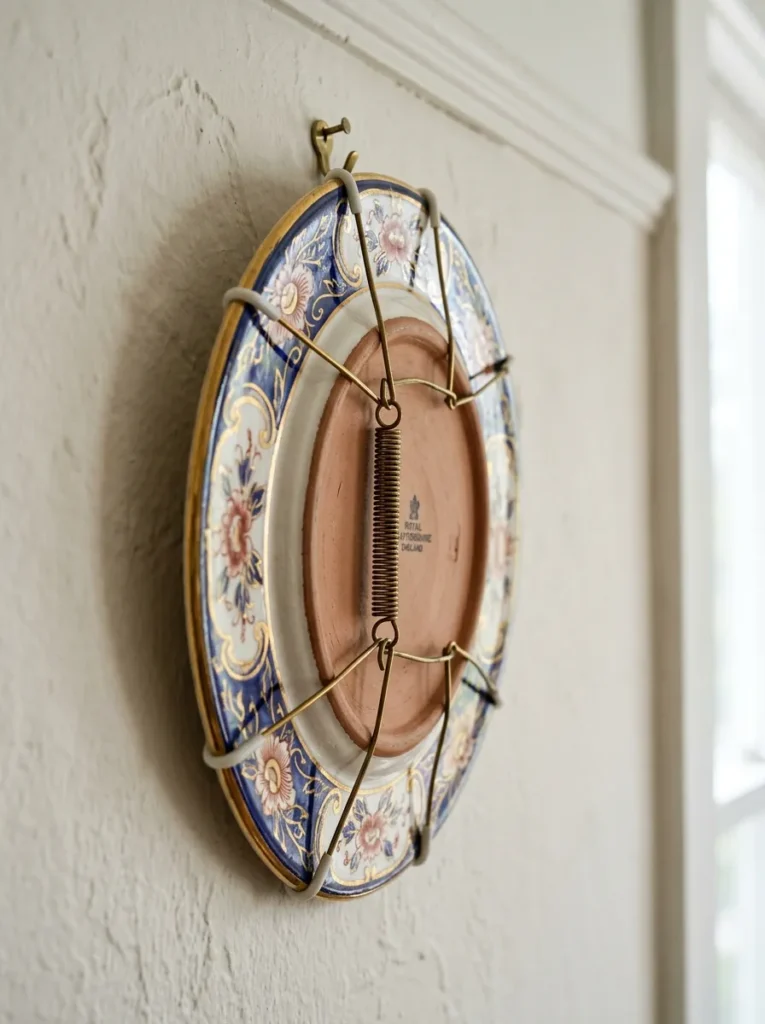
The hanging system determines whether a plate wall looks professional or assembled. Visible wire or plastic rings at the plate edge, sawtooth hooks attached to the back of the plate rim, and command-strip adhesives all have their place, but the system that reads most cleanly from a viewing distance is the spring-wire plate hanger — a set of wire arms that wrap around the plate’s front rim and hold it from behind, leaving the face of the plate almost entirely unobstructed.
Spring-wire hangers are sized by plate diameter and should be matched to the plate’s actual measurement rather than purchased as one-size-fits-most. A hanger that’s too large will allow the plate to wobble and potentially fall; one that’s too small will grip too tightly and potentially crack a delicate rim. For plates being hung in a dining room where they’ll remain for years, checking the hanger’s fit before installation and using an appropriate wall anchor (not just a nail, particularly for heavier ceramic pieces) is the difference between a plate wall that stays up and one that eventually needs to be repaired.
Planning a Plate Wall: The Decisions That Matter Most
Before purchasing plates, hardware, or committing to a wall location, three decisions shape the project’s outcome more than any individual plate choice:
Wall position. The wall opposite primary seating receives the most sustained attention during meals and is the most impactful position for a plate wall. A side wall or the wall behind the primary seating are secondary positions — still appropriate, but seen less continuously during a meal.
Arrangement style relative to wall size. A large plate cluster on a small wall section reads as crowded. A small plate cluster on a large wall reads as insufficient. The arrangement should fill roughly 60 to 70 percent of the wall area it occupies, with deliberate negative space around the perimeter.
Starting with more plates than needed. Begin with more plates than the final arrangement will require. Editing down from too many is much easier than discovering mid-installation that the collection is too small for the wall. Five to seven extra plates that don’t make the final arrangement is a much more comfortable position than running short of pieces.
Final Thoughts
A dining room plate wall is one of the most rewarding decorating projects available because it combines personal history with visual impact in a way that store-bought art doesn’t easily replicate. The plates don’t need to be expensive or perfectly matched — they need to be assembled with enough visual intention that the arrangement reads as considered rather than accumulated.
Start with the anchor piece and work outward. Plan the layout on the floor before touching the wall. Choose a hanging system that respects both the plate and the wall surface. And give the arrangement enough breathing room between plates that each piece can be appreciated individually as well as as part of the whole.
Save the ideas here that match your plate collection, your dining room’s wall dimensions, and the visual character you’re after — whether that’s classic blue-and-white elegance, grandmillennial maximalism, or contemporary dark ceramics on a pale ground.