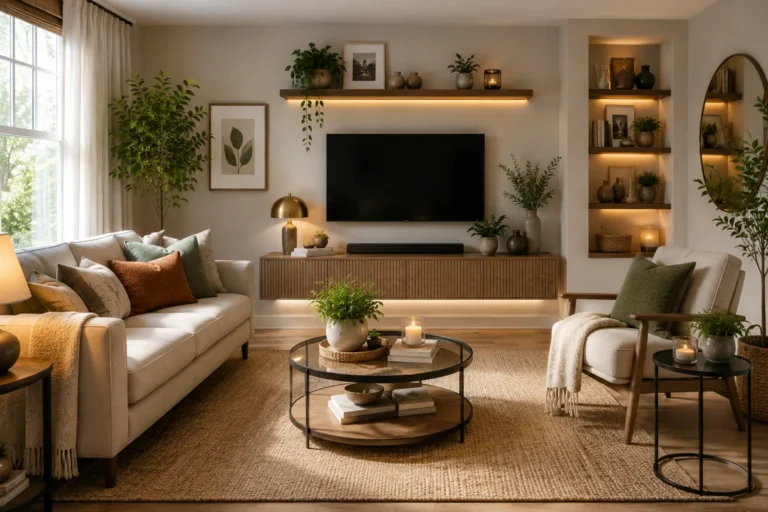
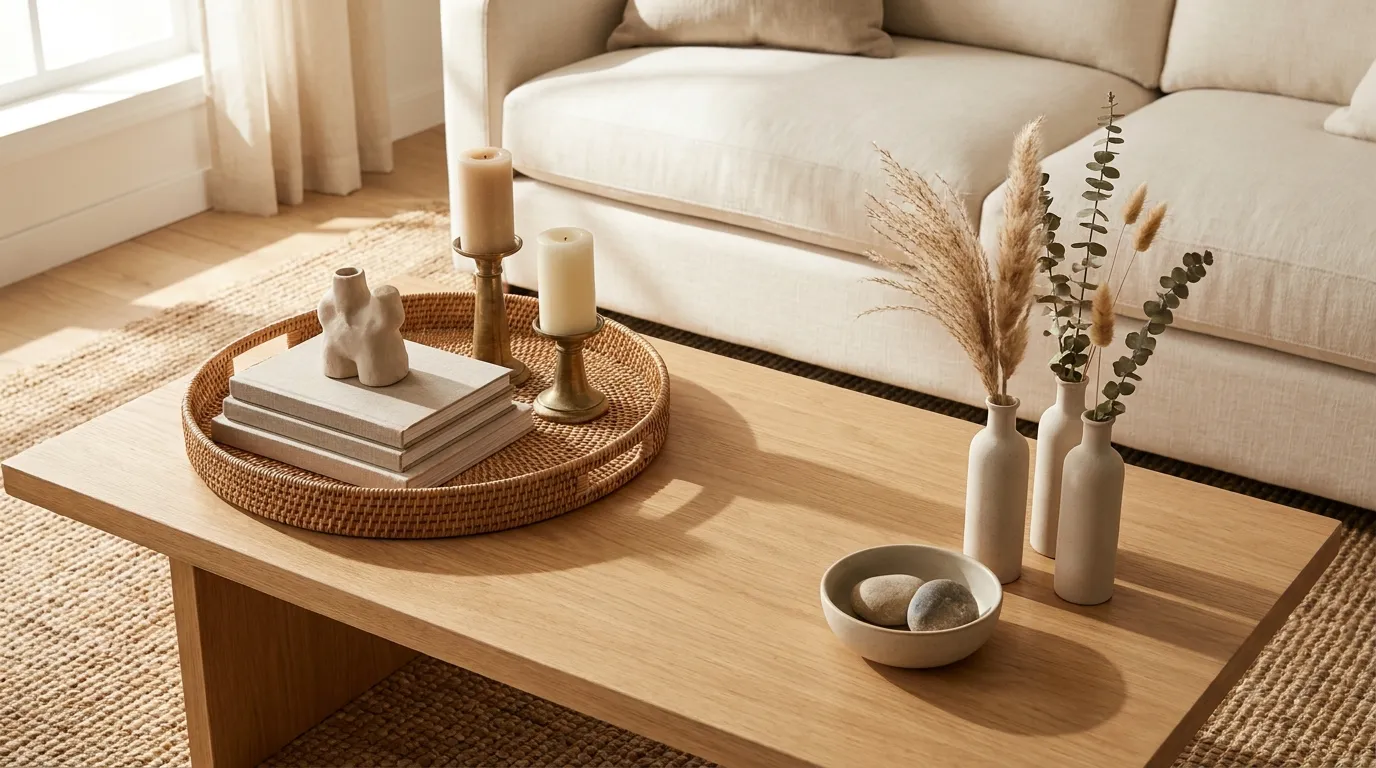
23 Coffee Table Decor Ideas That Feel Effortlessly Styled
A coffee table that looks genuinely styled rather than decorated is one of those things that’s harder to achieve than it appears. The difference between a table that reads as considered and one that reads as a collection of objects placed there by accident usually comes down to a few decisions about grouping, height variation, and restraint — not the objects themselves.
These 23 coffee table decor ideas cover the full range: from the foundational principles that make any arrangement work, to specific styling directions for different room aesthetics, table shapes, and budgets. Some ideas are about what to add; others are about what to remove, or how to edit what’s already there. A few address the specific problems that come up most often — the table that’s too small to style without looking crowded, the large ottoman that needs a completely different approach, the all-white living room where every object choice matters more than it would elsewhere.
The goal isn’t a perfectly photographed surface you can’t actually use. It’s a table that looks intentional and lives comfortably alongside real daily life.
1. Start with a Height Hierarchy, Not a Collection of Objects
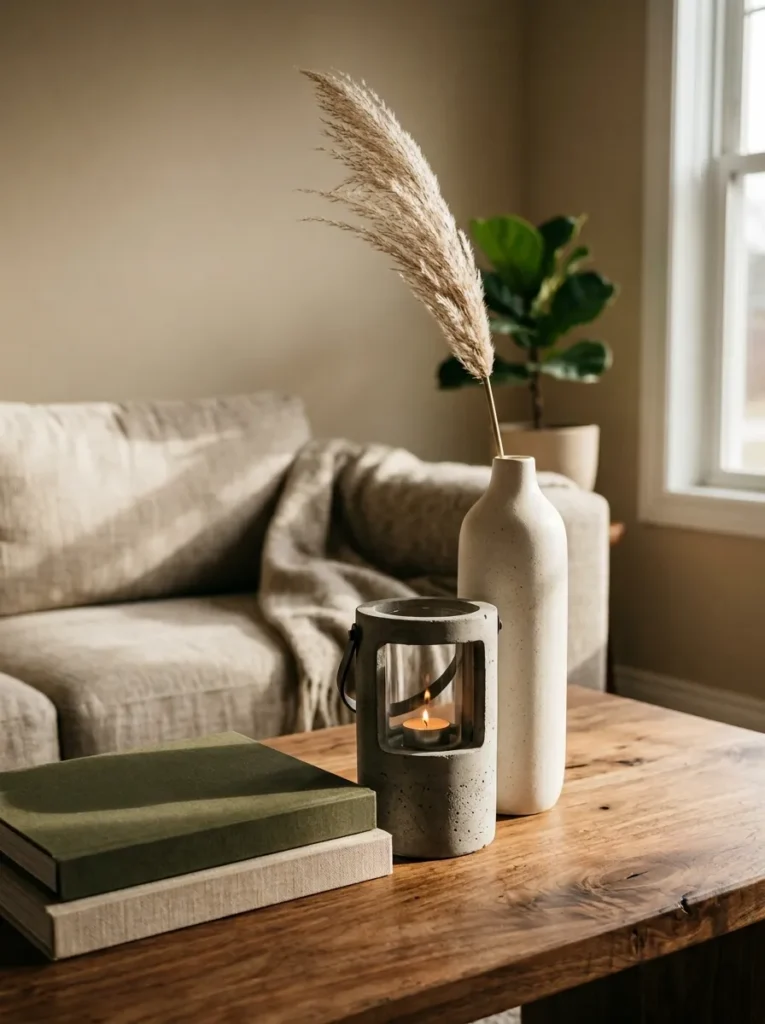
Before choosing any specific object, think about height variation first. The most common reason a coffee table arrangement looks flat or random is that every object sits at the same level — a candle, a bowl, a stack of books, all roughly the same height, none of them creating visual movement across the table’s surface.
An arrangement with a clear height hierarchy — something tall, something mid-height, something low — reads as composed even when the individual objects are simple. A tall candlestick or a vase with a long stem sits at the top. A medium object (a small sculpture, a plant in a ceramic pot, a lantern) occupies the middle level. A flat element — a stack of books, a tray, a low bowl — anchors the base.
This principle applies regardless of table size, shape, or style. It’s the foundation that makes every other idea on this list work better.
2. Stack Coffee Table Books as a Styled Base Layer
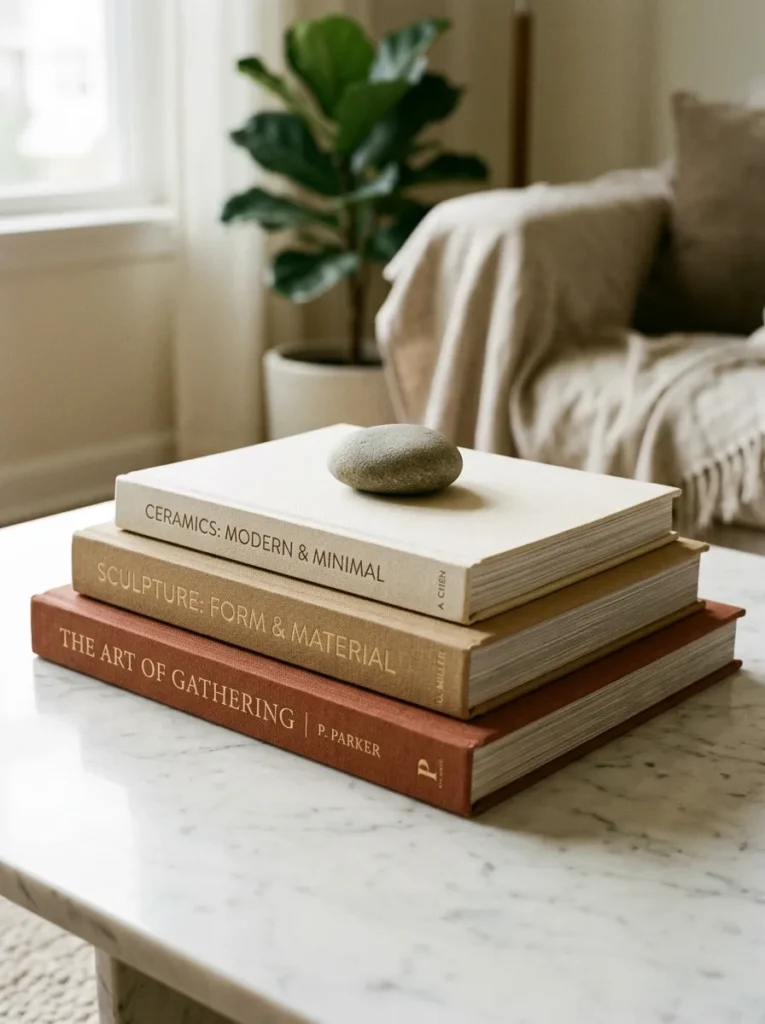
Coffee table books do more work in a styled arrangement than almost any other object, because they perform two functions simultaneously: they add height and visual weight at the base of the arrangement, and they communicate a point of view — the reader’s interests, travels, or aesthetic — in a way that a purely decorative object can’t.
Two or three books stacked horizontally creates a platform that other objects can sit on top of, which immediately solves the problem of a low decorative object getting visually lost on a large table surface. The spines should face the same direction (or be turned inward with covers showing) for a more cohesive look.
The number matters. One book can look sparse. Four or five stacked books start to look like a storage solution. Two to three, in varying sizes with the largest at the bottom, is the sweet spot for most tables.
3. Use the Rule of Odd Numbers for Object Groupings
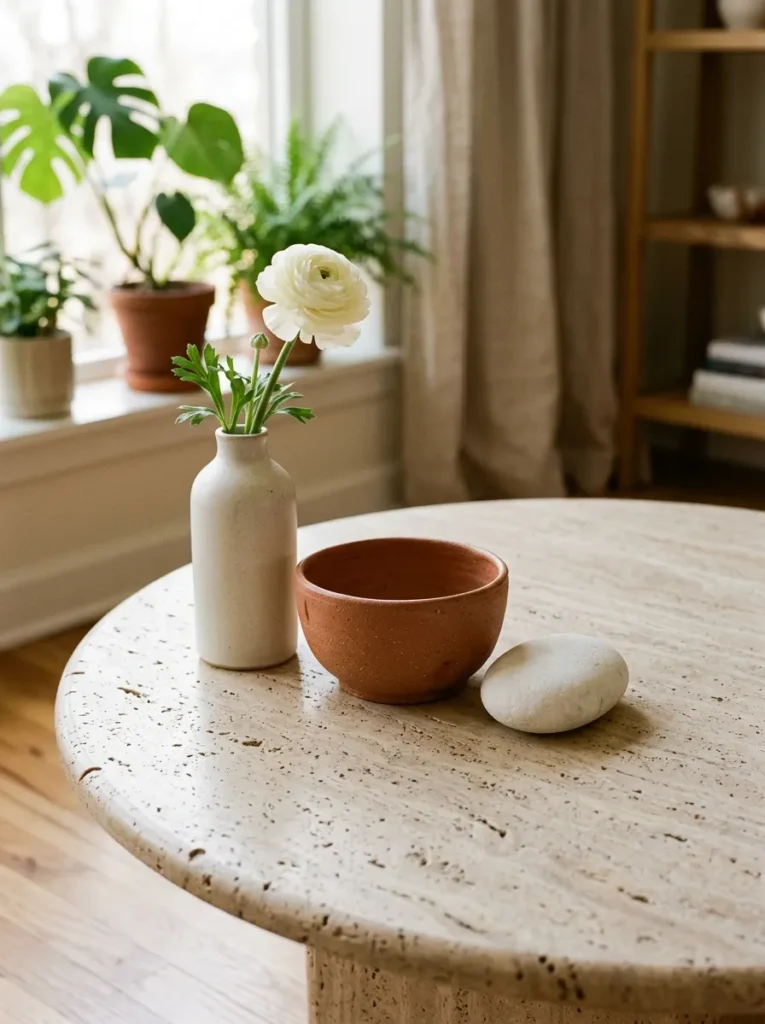
Odd-numbered groupings — three objects, five objects — read as more naturalistic than even-numbered pairs, which can feel symmetrical and rigid on a casual living room surface. This isn’t a hard rule, but it’s a useful default when building an arrangement from scratch.
A grouping of three works like this: one taller object (vase, candle), one mid-height object (small sculpture, plant), one low object (a small bowl, a smooth stone, a single folded napkin). The three sit close enough to read as a cluster, not spread evenly across the table as isolated items.
On a larger coffee table, two separate groupings of three — one on each half of the table — often reads better than one central cluster, because it gives the eye two resting points and leaves functional surface space between them.
4. Anchor an Arrangement with a Tray
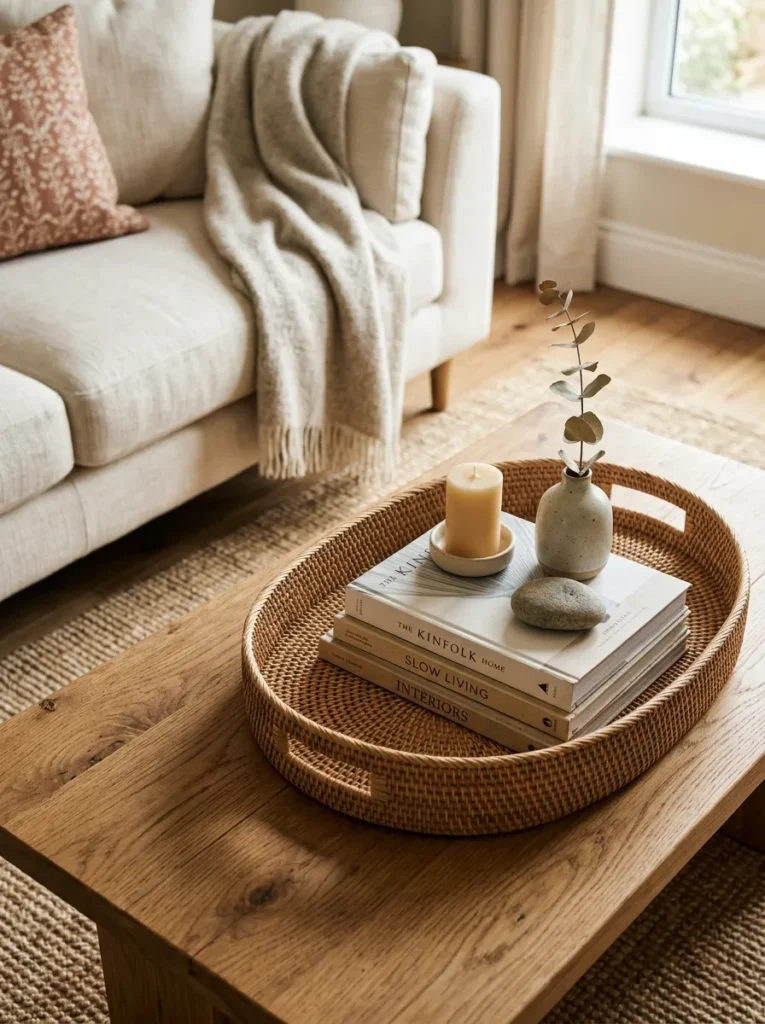
A tray transforms a group of objects from a collection into a vignette. It creates a visual border that tells the eye where the arrangement begins and ends, which is especially useful on large or borderless coffee tables where objects can drift and look unmoored.
The tray also solves a practical problem: it makes the arrangement portable. When the table needs to be cleared for guests or for using the space, everything lifts off in one move rather than requiring individual repositioning.
Tray material shapes the arrangement’s tone. A woven rattan tray suits natural, boho, or earthy rooms. A lacquered tray in black, white, or a deep jewel tone suits more contemporary or maximalist spaces. A raw wooden tray with visible grain suits rustic or organic interiors. The tray shouldn’t fight the table surface beneath it — on a natural wood table, a wood tray in a contrasting tone usually works better than one in the same finish.
5. Layer Books with a Small Object on Top
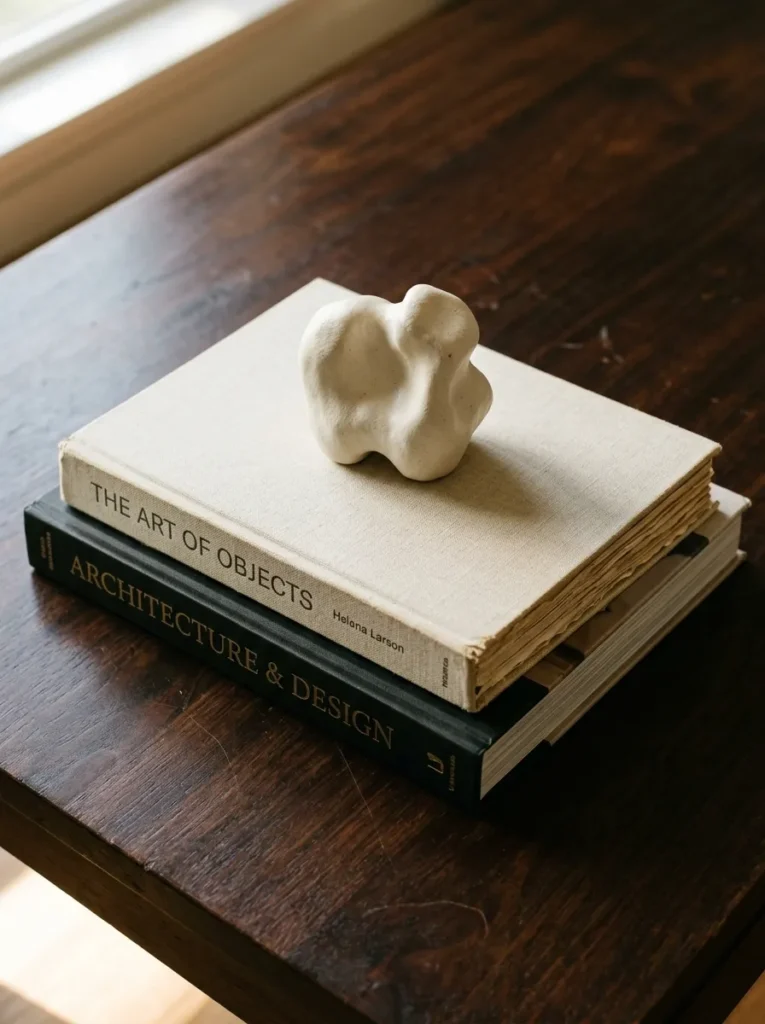
A stack of books with a small object resting on top — a small sculptural piece, a smooth river stone, a tiny ceramic vessel — is the simplest two-element arrangement that reads as styled. The object on top gives the stack a reason to be there beyond storage; it signals that the placement was deliberate.
The object should be proportionally modest. A small item on a tall stack looks precarious and draws attention to itself. Something that sits comfortably on the top cover — roughly the size of a paperback or smaller — completes the stack without competing with it.
This is also the most accessible starting point for someone who hasn’t styled a coffee table before. Two or three interesting books and one meaningful small object is enough to create an arrangement that reads as considered, especially on a smaller table.
6. Keep It Simple on a Small Coffee Table
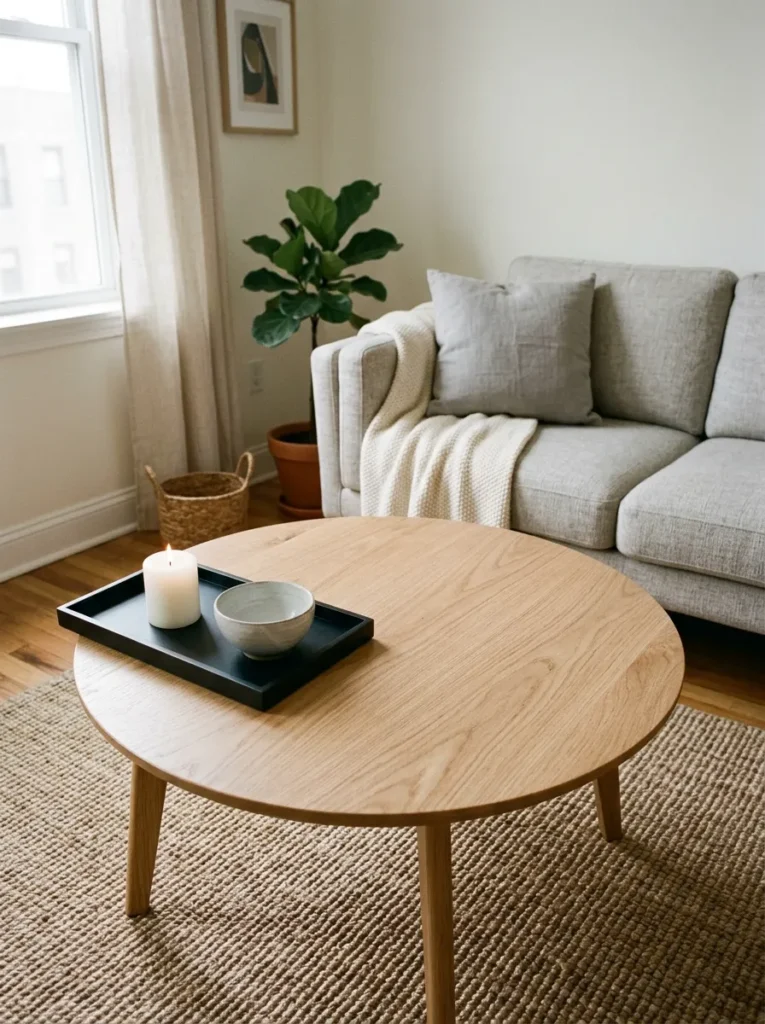
Small coffee tables — anything under roughly 24 inches in the narrower dimension — have almost no margin for overcrowding. Every object is immediately visible from every angle, and the surface area that remains functional after styling drops quickly.
The most effective approach for a small table is to commit to one focal arrangement and leave the rest of the surface deliberately clear. A small tray with two or three objects inside it (so the tray defines the arrangement’s boundary) lets the table read as styled without consuming its entire usable surface.
Avoid the instinct to fill the whole table. A small, intentional arrangement on one half of a small coffee table reads as more sophisticated than objects covering every available inch. The empty space is part of the styling.
7. Use a Single Large Object as a Centerpiece
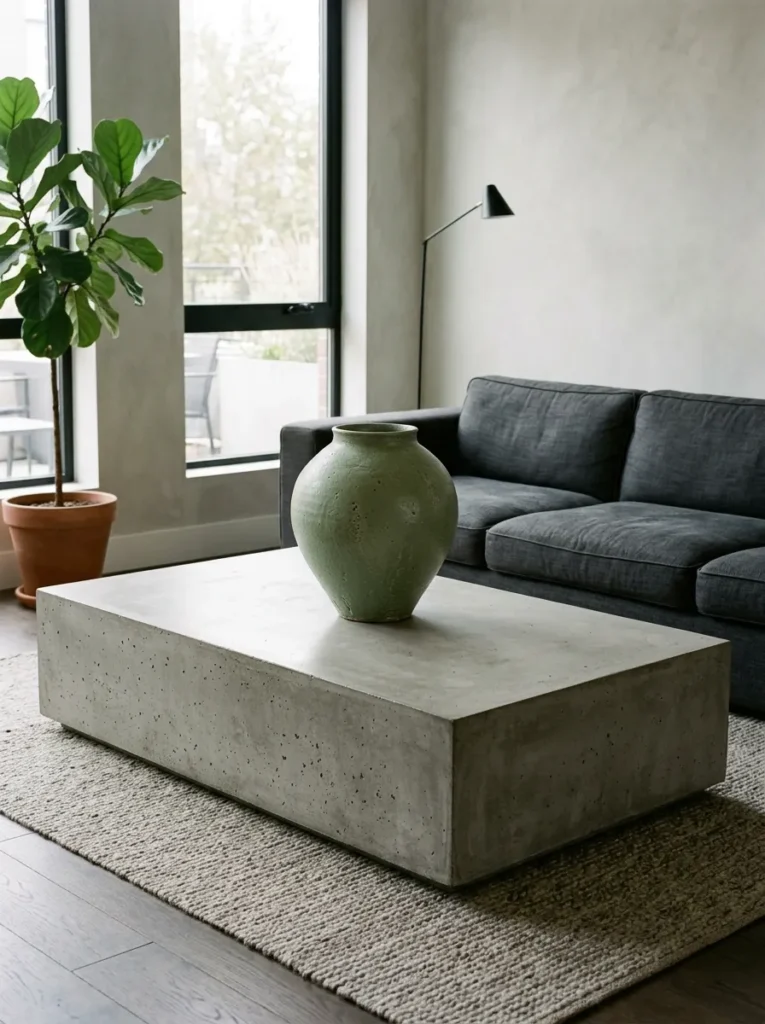
On a large coffee table, especially one in a room with strong architectural features or bold furniture, a single large object — an oversized ceramic bowl, a sculptural vase, a large piece of driftwood, a statement candle — can carry the full visual weight of the arrangement without any supporting objects.
This minimalist approach works specifically because large objects have enough presence to fill the visual field without needing backup. A small object alone on a large table looks forgotten; a large one looks deliberate.
The object should be interesting from multiple angles, since a centered coffee table is viewed from the sofa, from the adjacent chairs, and from across the room. Objects that look identical from every direction (a plain sphere, a symmetrical vase) work well here; anything with a distinct front and back should be positioned with its best angle facing the primary seating.
8. Incorporate a Small Living Plant
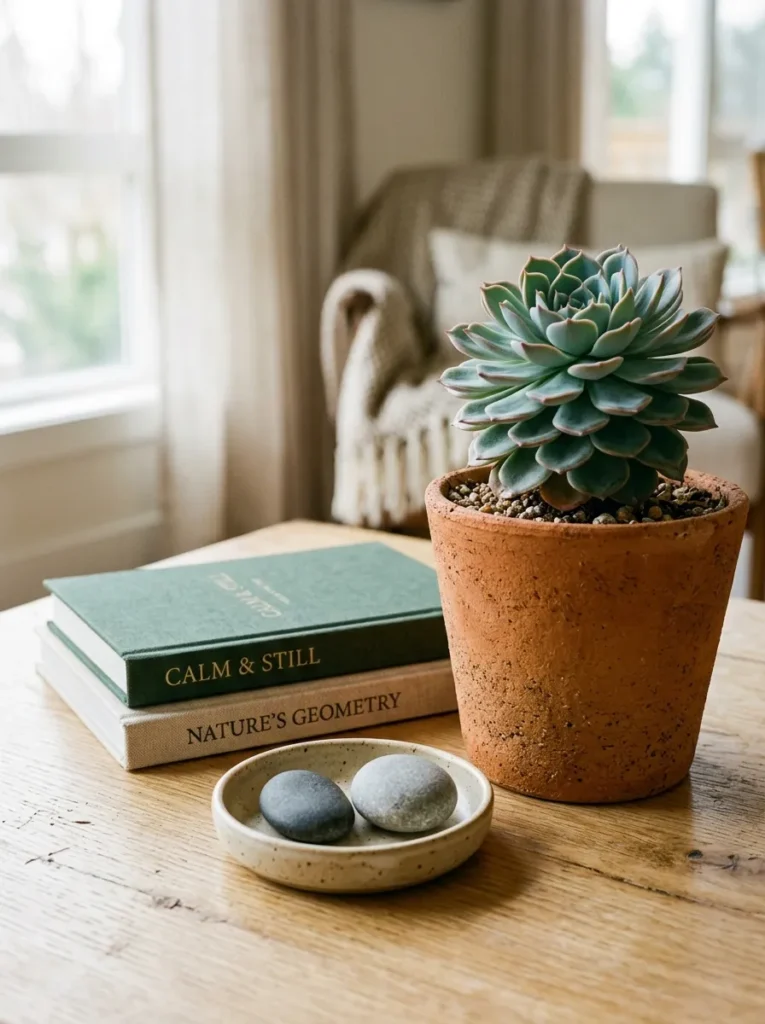
A small plant on the coffee table introduces the one quality that no decorative object can replicate: genuine life and organic irregularity. The plant looks different depending on the day, the light, and the season, which means the arrangement shifts slightly without any effort.
The plant type and vessel matter for the arrangement’s overall tone. A small succulent in a raw ceramic pot suits earthy, natural, or boho tables. A trailing pothos cutting in water in a clear glass vessel suits a more contemporary or eclectic arrangement. A single stem of eucalyptus or a small olive branch in a bud vase suits a cleaner, more Scandinavian-influenced surface.
Scale matters practically: the plant should be proportionate to the table and the arrangement. A plant that extends taller than the surrounding objects takes over the height hierarchy. One that sits below the other objects at every level reads as an afterthought rather than a considered element.
9. Build a Seasonal Centerpiece Around What You Already Own

Seasonal coffee table styling doesn’t require buying new objects for every season. It means rearranging, swapping, and adding to what already exists. In fall, a low wooden bowl filled with small gourds, pinecones, or dried leaves alongside the usual candles reads as seasonal without requiring a full overhaul. In winter, the same bowl holds smooth white stones or a cluster of small pillar candles. In spring, a bud vase with a few tulips or cherry blossom stems.
This approach keeps the table feeling current without the expense or storage burden of seasonal decor collections. The anchor objects — the books, the tray, the sculptural piece — stay consistent. Only one or two elements rotate with the season.
The test is whether the seasonal addition reads as intentional or as a holiday prop. Simple natural elements (seasonal flowers, botanical branches, natural textures) age more gracefully than themed decorations.
10. Style with a Bud Vase Cluster Instead of One Large Arrangement
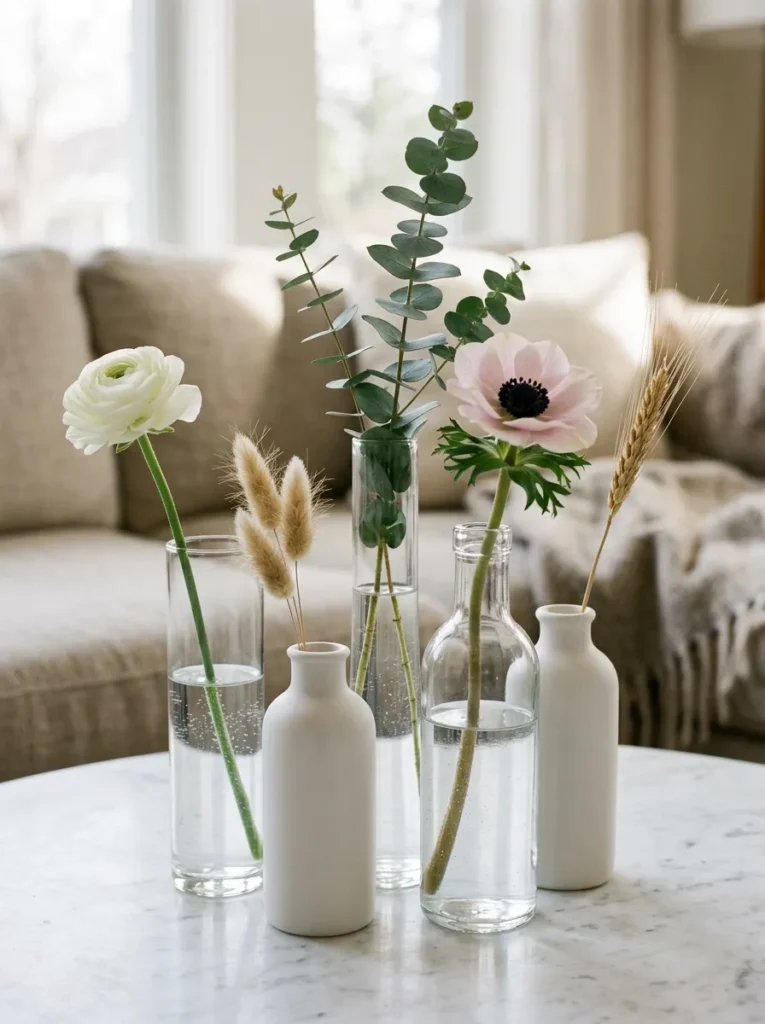
Three or five slim bud vases of varying heights — each holding a single stem or small cutting — create a more casual, collected look than one formal floral arrangement. The cluster reads as gathered over time rather than composed, which suits living rooms that lean toward relaxed rather than formal.
The vases should share something — either the same material (all clear glass, all ceramic in similar tones) or a similar silhouette — while varying in height and width. The stems can match (three stems of the same flower in three different vases) or vary naturally (whatever’s in season, each different).
This is also a more practical choice than a large arrangement for a functional coffee table: the small scale of individual vases means they’re less likely to obstruct sightlines across the seating area and easier to move when the table surface is needed.
11. Use Dried Botanicals for a Low-Maintenance Alternative
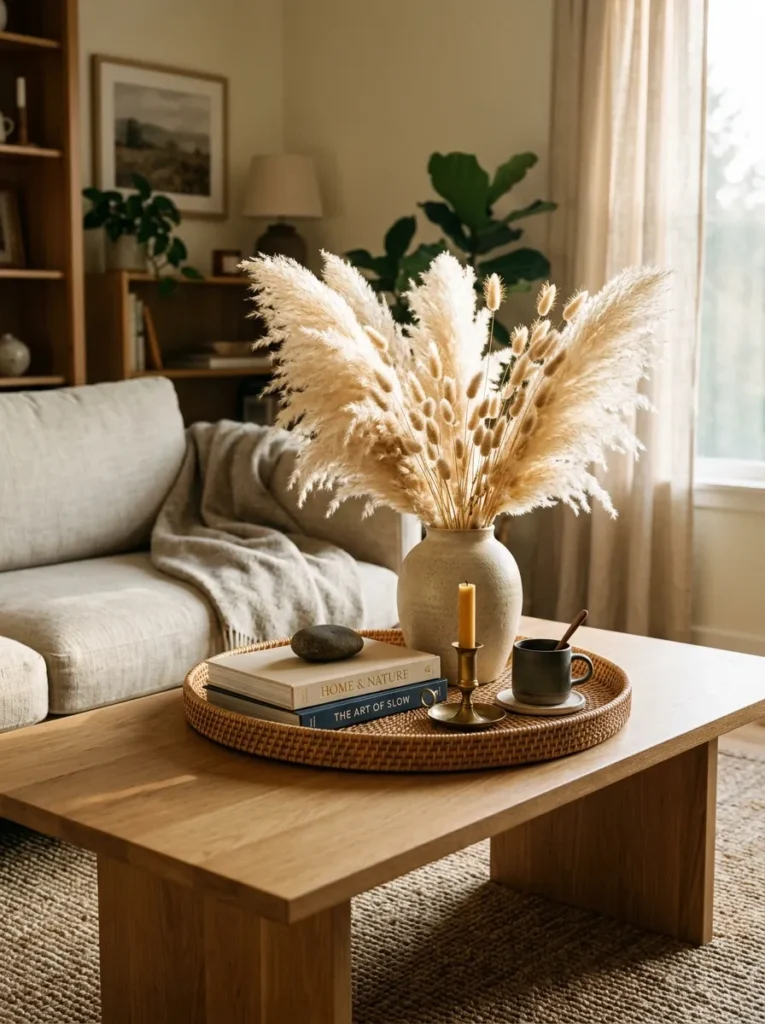
Dried botanicals — pampas grass, bunny tail grass, dried eucalyptus, banksia pods, wheat stems — stay in place indefinitely without water, without wilting, and without replacing. They suit coffee table arrangements where the natural quality of fresh flowers is wanted but the maintenance isn’t practical.
Dried stems in a ceramic or rattan vase at the tall end of the height hierarchy read as earthy and considered. They work particularly well in rooms with a lot of natural material — linen sofas, jute rugs, wood tables — where the dried botanical adds to the material story rather than contrasting with it.
One limitation worth knowing: dried pampas and similar feathery grasses shed slightly over time, particularly if disturbed. Positioning them in the arrangement where they won’t be bumped — at the back of a tray, or on a side of the table with less traffic — reduces this.
12. Keep It Monochromatic for a Modern, Edited Look
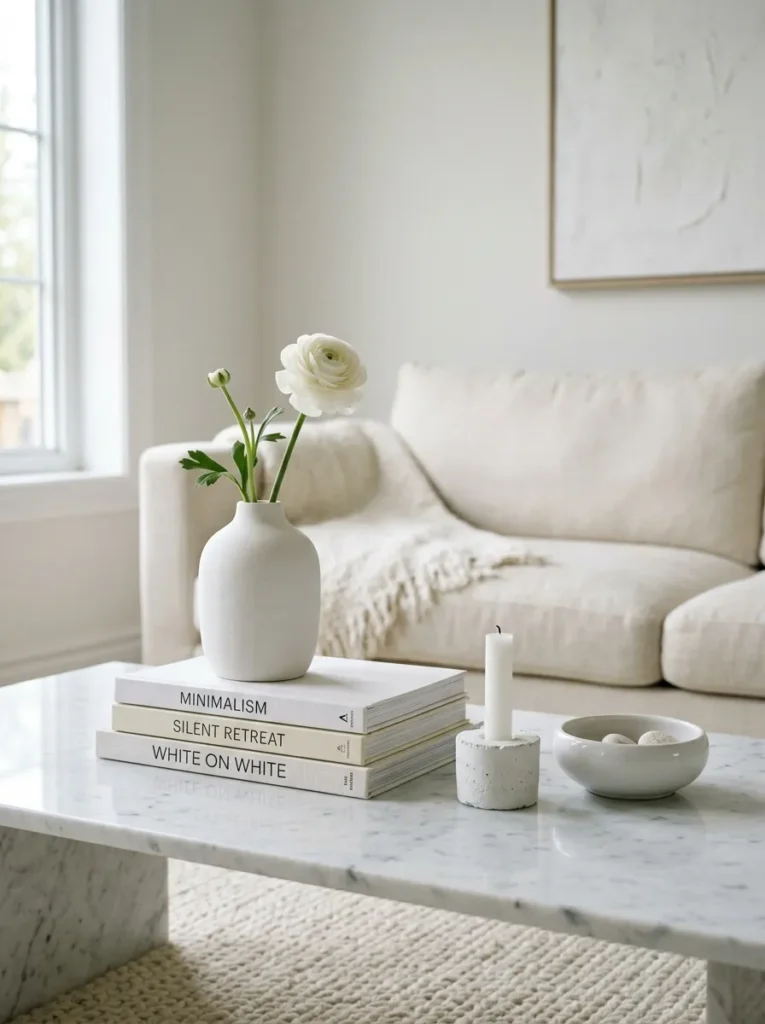
A monochromatic coffee table arrangement — all objects in tones from the same colour family — reads as intentional even when the objects themselves are simple. An all-white arrangement (white ceramic bowl, white candle, white flowers in a white vase, stack of books with light covers) has a clean, gallery-like quality. An all-neutral arrangement in tones of sand, oat, and pale terracotta feels warmer but equally resolved.
The variation within the colour family is what makes the arrangement interesting rather than flat. Different finishes — matte, slightly glossy, textured — at similar tones create depth through surface quality rather than colour contrast.
This approach is particularly effective in rooms with a bold sofa colour or strong artwork, where the coffee table needs to be a quiet supporting element rather than another visual statement.
13. Add a Sculptural Object as a Conversation Piece
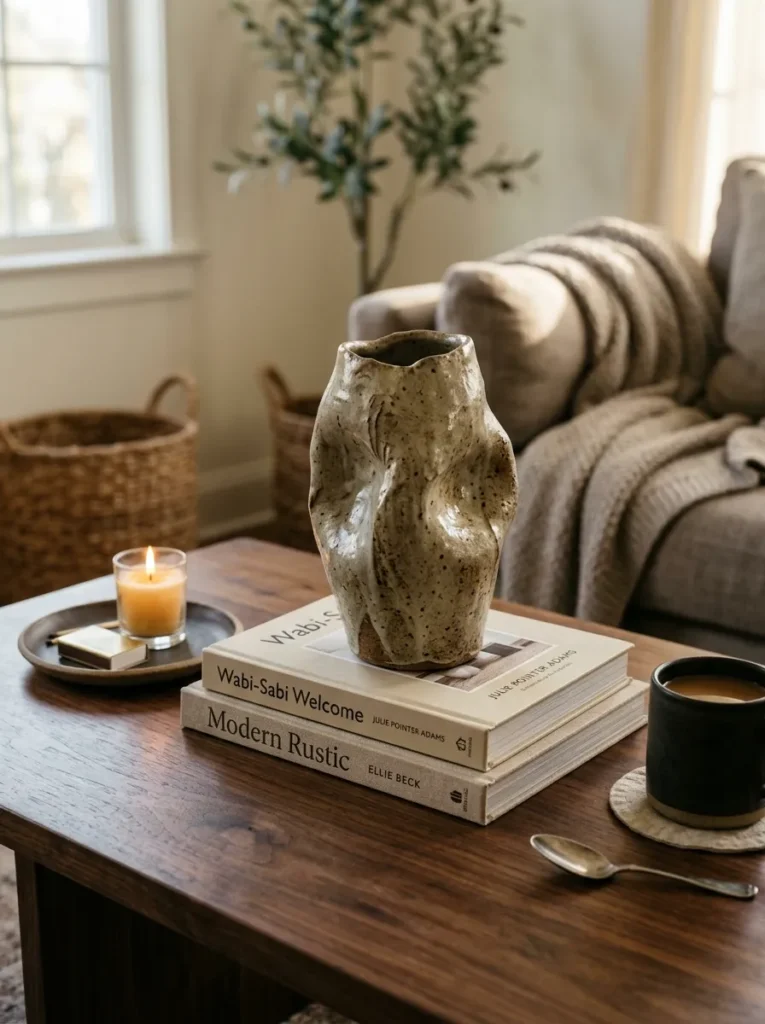
A single sculptural object — a piece of handmade pottery, a found rock with an unusual form, a small carved wooden piece, an abstract ceramic — gives a coffee table an editorial quality that purely functional objects can’t provide. It’s the element that makes guests lean in and ask about it, which is the exact quality that distinguishes a styled table from a decorated one.
The sculptural object works best as the arrangement’s focal point rather than one of several competing items. Position it at the mid- or high-height point of the arrangement and keep surrounding objects quieter. A book stack beneath it, a low bowl beside it, and the sculpture itself as the eye-catcher — that’s the arrangement.
When choosing, look for objects with interesting negative space (holes, irregular edges), unexpected material combinations, or a form that reads differently from different angles. Smooth, symmetrical objects with no visual complexity tend to disappear at coffee table scale.
14. Create a Nature-Inspired Arrangement with Stones and Wood
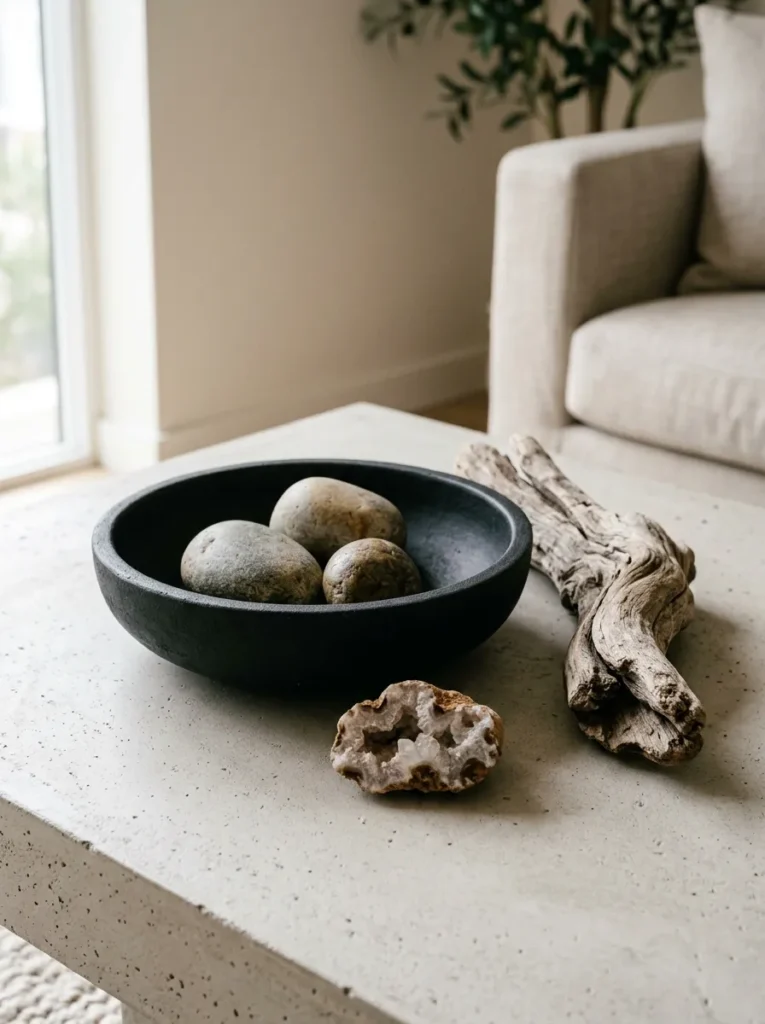
A coffee table arrangement built from natural objects — smooth river stones in a low ceramic bowl, a piece of polished driftwood, a small wooden sphere, a branch with interesting geometry — grounds a room in material honesty in a way that manufactured decorative objects rarely achieve.
The arrangement works best when the objects have genuine presence: not tiny pebbles in a bowl (which reads as a children’s craft project at living room scale) but substantial stones with interesting form, or a section of wood with real visual weight. The objects should be large enough to read from across the room.
This is also one of the most cost-effective approaches — natural objects found outdoors or purchased inexpensively from garden or home stores carry the same visual weight as expensive decorative pieces when chosen with care.
15. Go Layered and Eclectic for a Boho Coffee Table
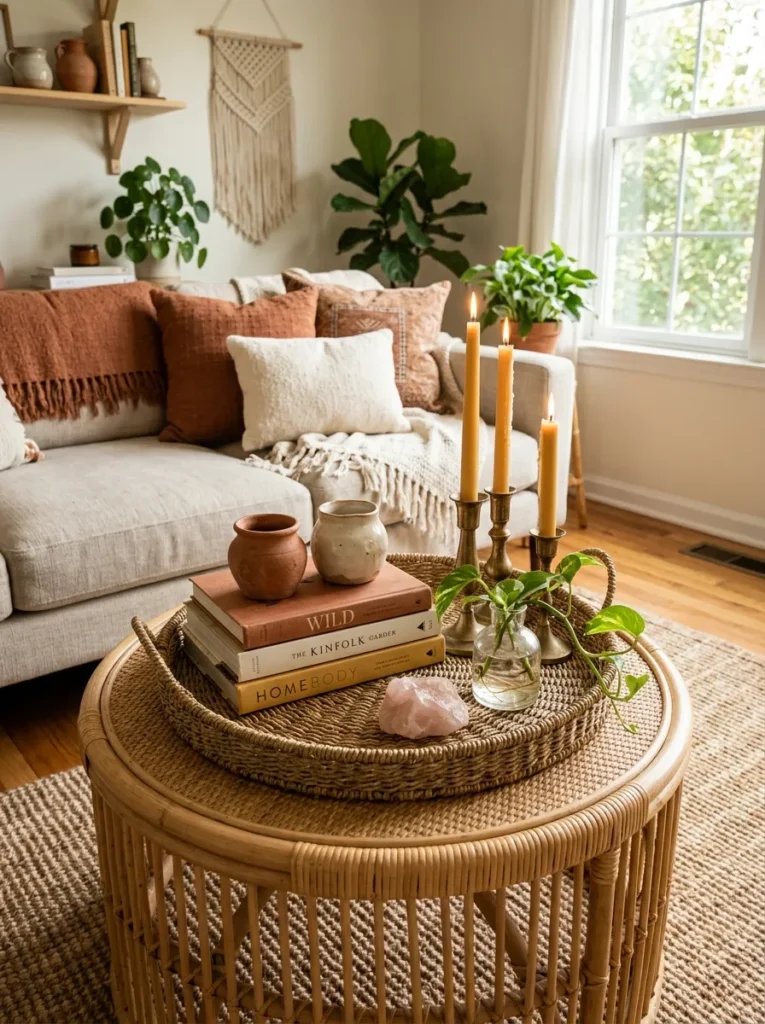
A boho-influenced coffee table is the one arrangement style where more is genuinely more — provided the materials have coherence. Layering a woven rattan tray with a stack of warm-toned books, a few small mismatched ceramics in earthy tones, a cluster of candles at different heights, a trailing plant cutting, and a small crystal or stone creates a rich, gathered quality that suits rooms decorated in natural textures and warm, earthy palettes.
The material coherence is what prevents the layered look from becoming clutter. Keeping all objects in the same tonal family — warm terracotta, oatmeal, natural wood, aged brass — lets different forms coexist without competing. Introducing a single object in a completely different tone (a cool grey stone, a bright coloured ceramic) breaks the coherence and pulls the eye away from the arrangement as a whole.
The test: if you remove any single object and the arrangement still reads as complete, that object isn’t necessary.
16. Style a Round Coffee Table with a Central Cluster
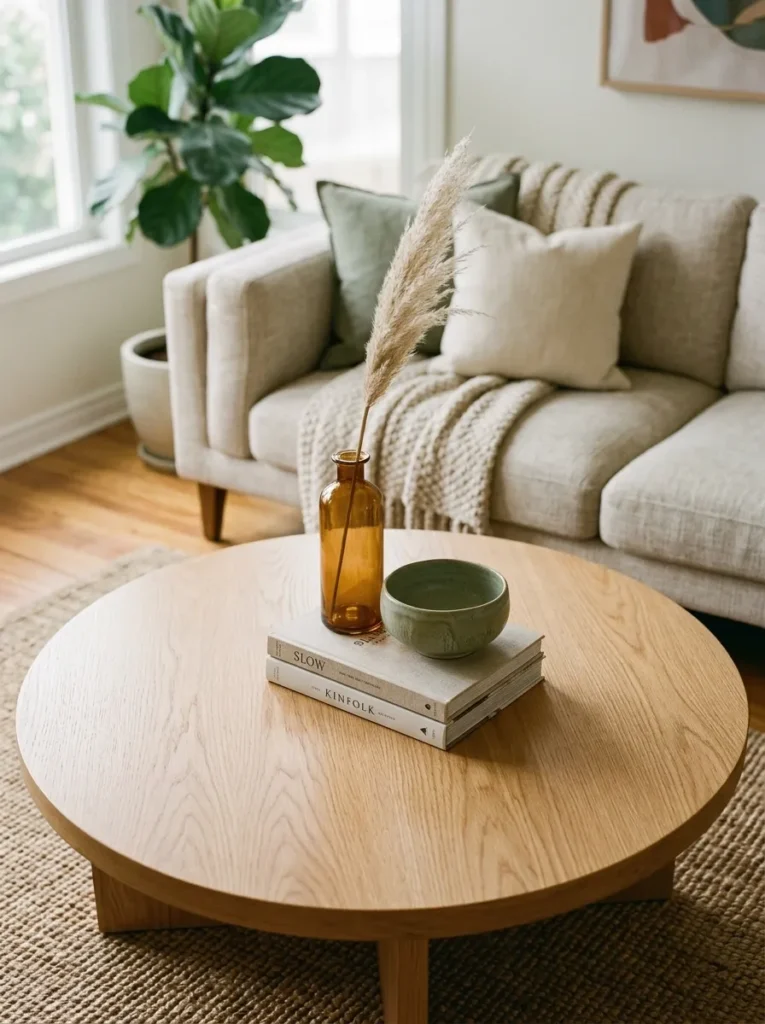
Round coffee tables require a different arrangement logic than rectangular ones. Without long edges to anchor objects at the ends, a round table reads best with one central cluster that has clear height variation rather than objects positioned around the perimeter — which creates a wreath-like visual pattern that draws attention to the emptiness in the middle.
The central cluster should have a clear top (the tallest element), middle, and base, all positioned close enough to read as a single composition. Leave a generous ring of clear surface around the arrangement — the open circle of table beyond the cluster is part of the aesthetic.
A low tray on a round table can help — it creates a defined zone for the cluster while making the outer ring of the table feel intentionally clear rather than unused.
17. Use Candles in Groups for Warmth and Ambiance
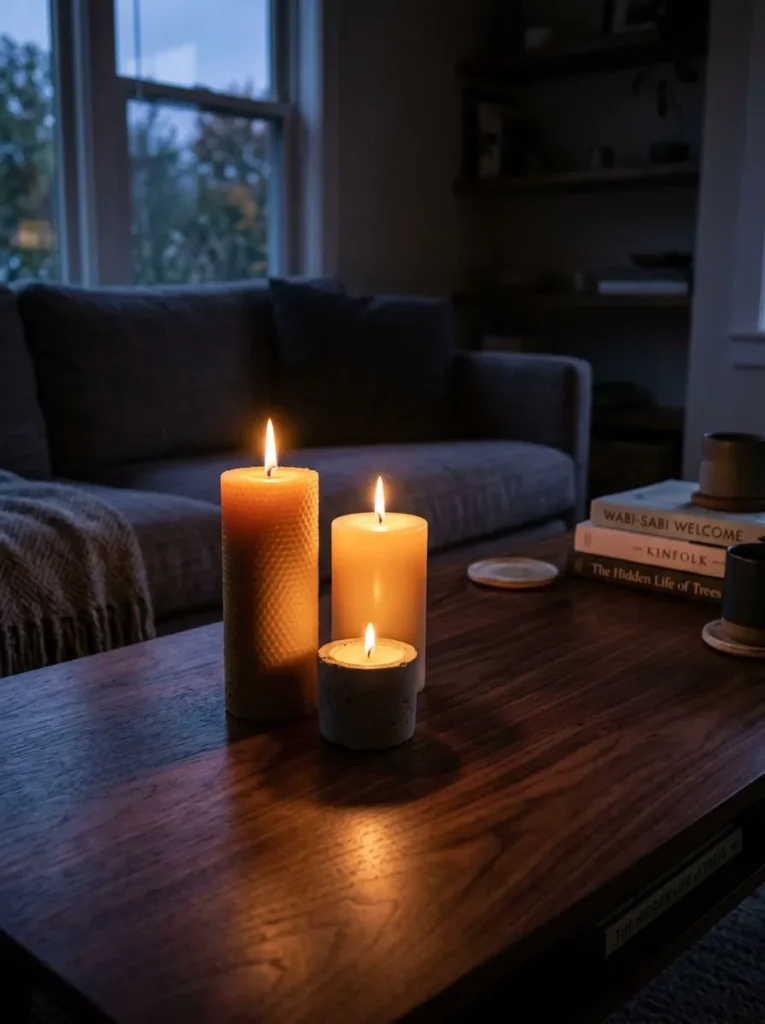
Three candles at slightly different heights — a tall pillar, a medium pillar, a votive — grouped together on one side of the coffee table arrangement create warmth and shifting light that no other decorative object provides. In the evening, with the main room lights dimmed, three lit candles on the coffee table become the room’s focal point in a way that no daytime arrangement achieves.
The candle grouping works best when it’s coherent in colour: all in the same tone (undyed beeswax, warm white, deep terracotta) rather than a mix of different coloured candles, which reads as random. The holders can vary — a brass candlestick, a concrete votive holder, a simple glass — as long as the candles themselves are consistent.
One practical note: if the coffee table is regularly used as a surface for drinks, food, or remote controls, position the candle grouping at one end rather than centrally. A lit candle arrangement in the middle of an actively used table creates genuine logistical problems.
18. Place a Lantern on the Floor Beside the Table
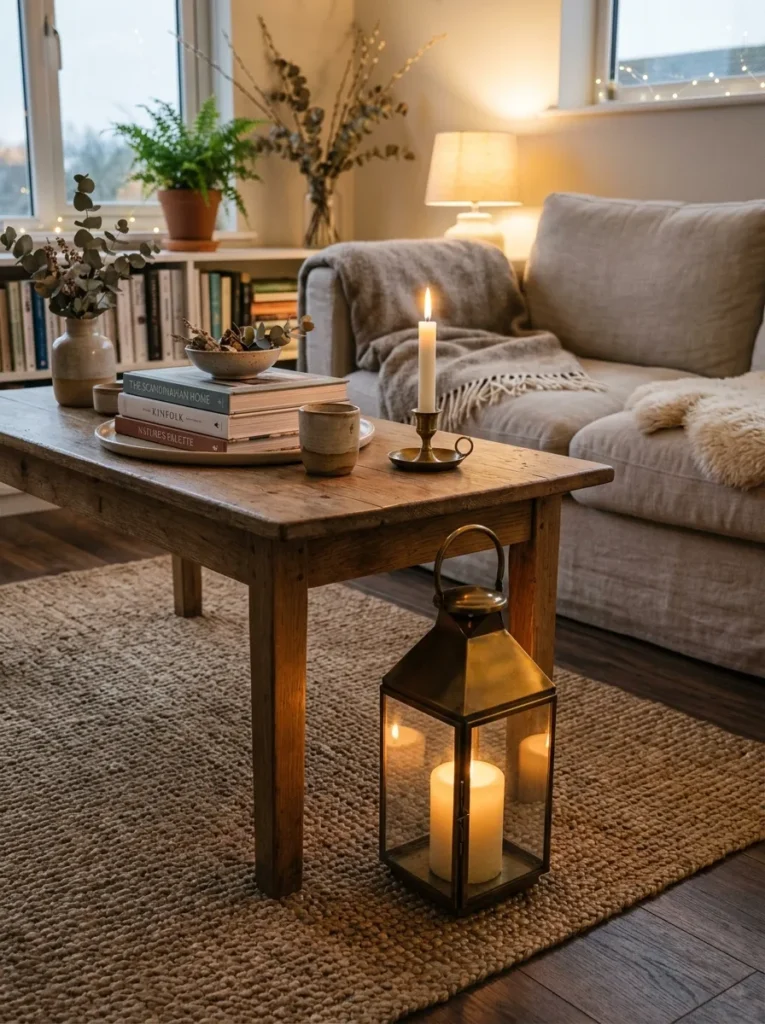
Rather than placing everything on the table surface, a lantern or a cluster of candles positioned on the floor directly beside the coffee table extends the arrangement into the vertical space around the table. This creates a sense of the styling spilling beyond the table’s edges, which reads as more lived-in and relaxed than a purely surface-based arrangement.
A floor lantern with a pillar candle inside, sitting at table-leg height beside the corner of the coffee table, reads as part of the overall vignette when it’s in the same material or colour family as the objects above. A brass lantern on the floor relates naturally to a brass candle holder on the table; a rattan lantern relates to a woven tray above.
This works particularly well in rooms where the coffee table itself is lower — the visual zone around a low coffee table extends more naturally to the floor than it does around a standard-height table.
19. Adapt the Styling for an Oversized Ottoman
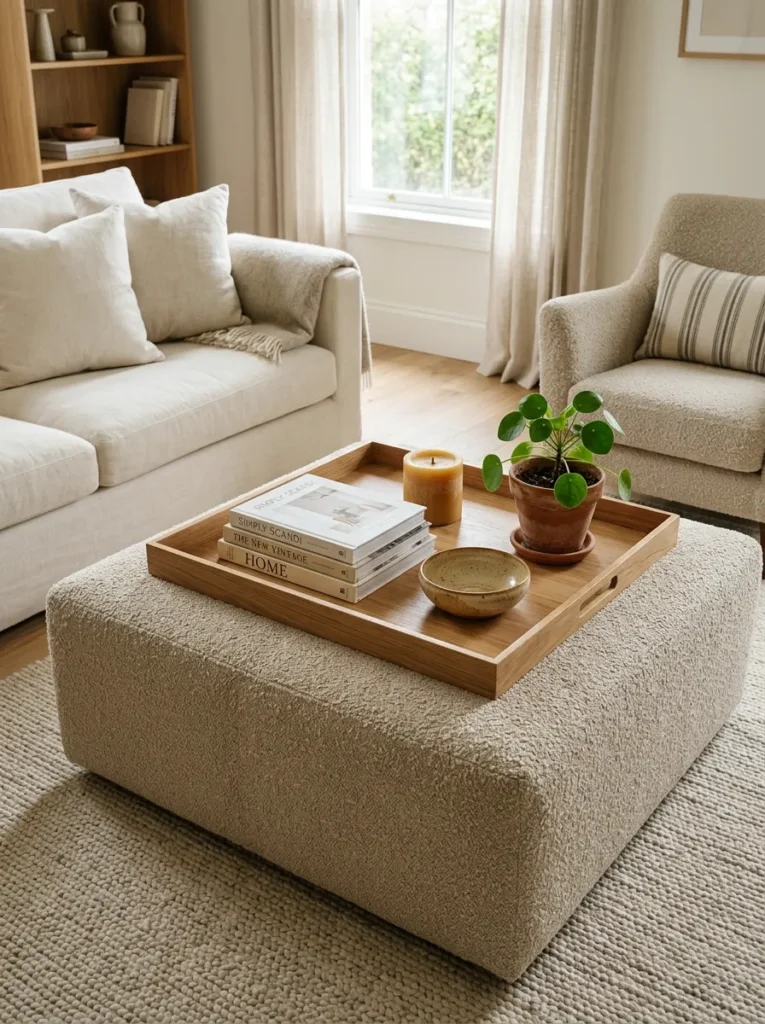
An oversized upholstered ottoman used as a coffee table needs a different approach than a hard-surface table, because the soft surface changes what’s practical and stable. Objects placed directly on fabric tend to shift, tip, and sink slightly — which means the arrangement needs to be anchored.
A large, sturdy tray on the ottoman surface is non-negotiable. It creates a stable, flat base for all the objects above it and defines the styled zone clearly against the soft fabric surface. The tray should be large relative to the ottoman — at least half the ottoman’s width — so it reads as a surface rather than an accessory.
Keep the arrangement lighter and lower than you would on a hard table. Tall, top-heavy objects on a tray on an ottoman are vulnerable to tipping when someone sits on the adjacent sofa and shifts the cushions. Lower, more stable objects — a flat book stack, low candles, a heavy ceramic bowl — suit the ottoman’s practical reality better.
20. Choose Objects That Reflect the Room’s Material Palette
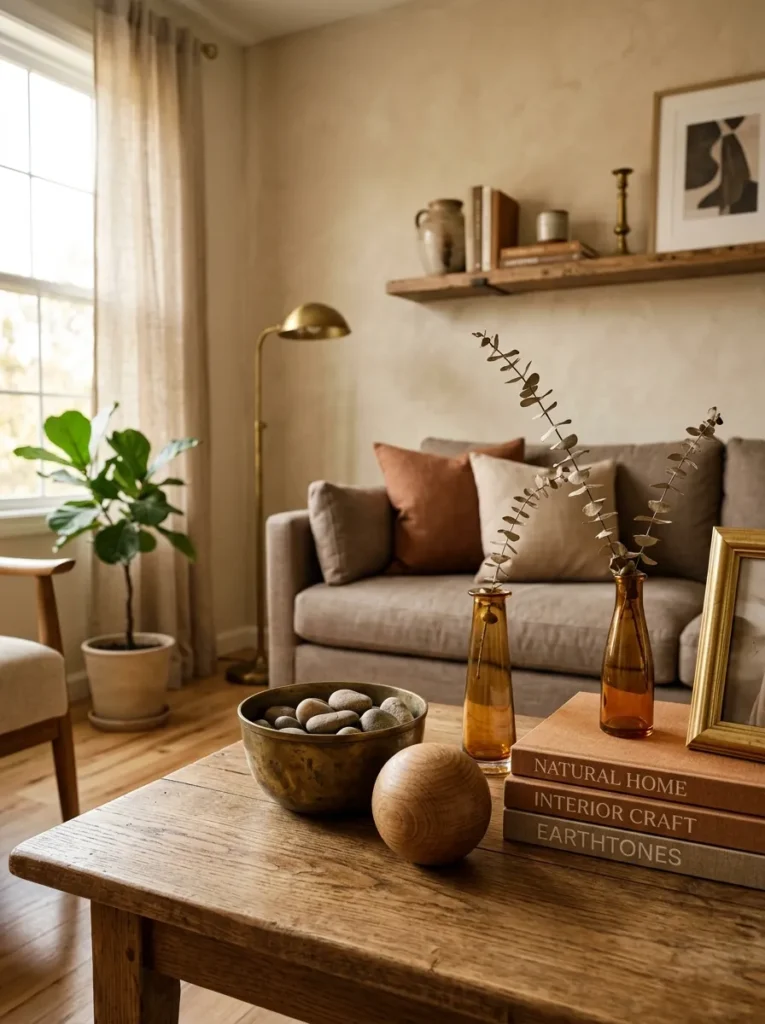
The most reliable shortcut to a coffee table arrangement that looks like it belongs in the room is choosing objects that echo the room’s existing materials. If the room has a lot of natural wood, choose objects with wood accents — a wooden sphere, a carved figure, a tray with wood handles. If the room has warm metallics (brass, gold), add a brass candleholder or a small gilded bowl. If the room is full of linen and woven textures, add a rattan tray and a ceramic piece in a muted, earthy glaze.
The echo doesn’t need to be literal matching. It’s a tonal and material conversation — objects that speak the same language as the room without being identical to the existing pieces.
The mistake is bringing objects from a completely different material world onto the coffee table. A highly polished acrylic object on a table in a room full of raw, natural materials; a rustic driftwood piece in a sleek contemporary room with chrome and glass. The coffee table object sees the whole room, and the whole room sees it.
21. Leave Functional Items in the Arrangement
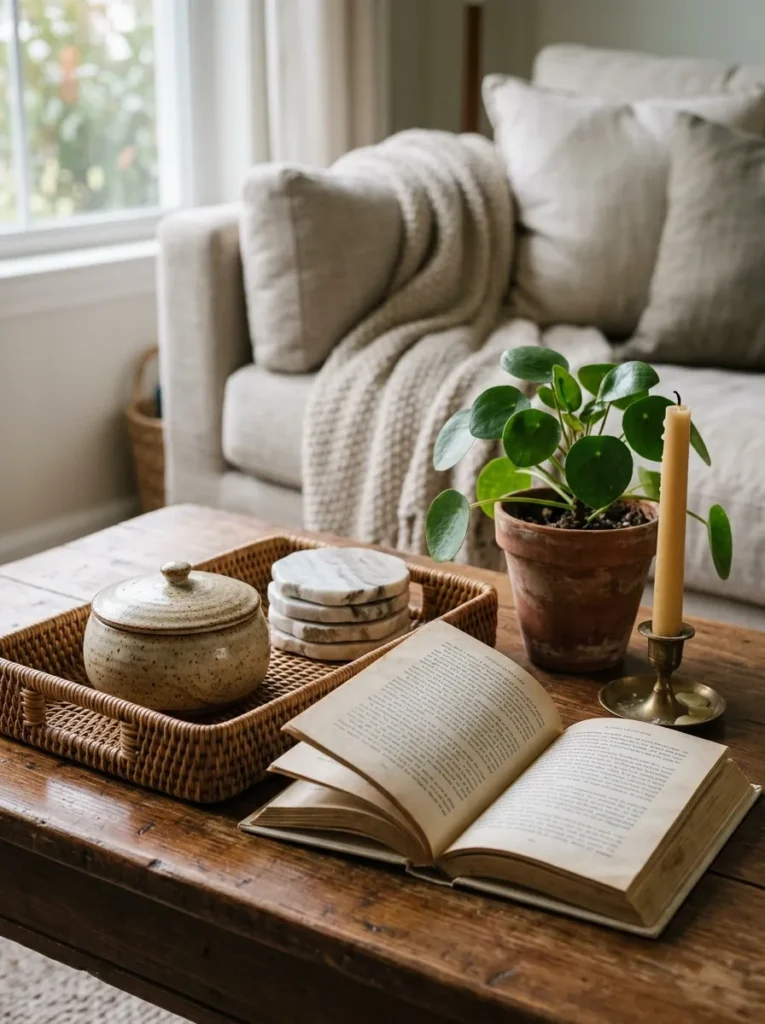
A styled coffee table that removes every functional object — the remote controls, the coasters, the book currently being read — requires resetting every time the table is used. Most people won’t maintain this, which means the arrangement degrades quickly and the styling becomes a source of low-level friction rather than enjoyment.
A better approach integrates the functional items into the arrangement. A small decorative box or lidded container on the tray holds the remote controls out of sight but within reach. A stack of coasters in a natural material (marble, cork, leather) reads as a decorative element rather than a functional afterthought when they’re stacked and positioned deliberately. The book being read sits naturally on top of the coffee table books stack.
The result is an arrangement that’s styled and actually lived-in simultaneously — which is what most people actually need from their living room.
22. Use Color Intentionally to Connect the Table to the Room
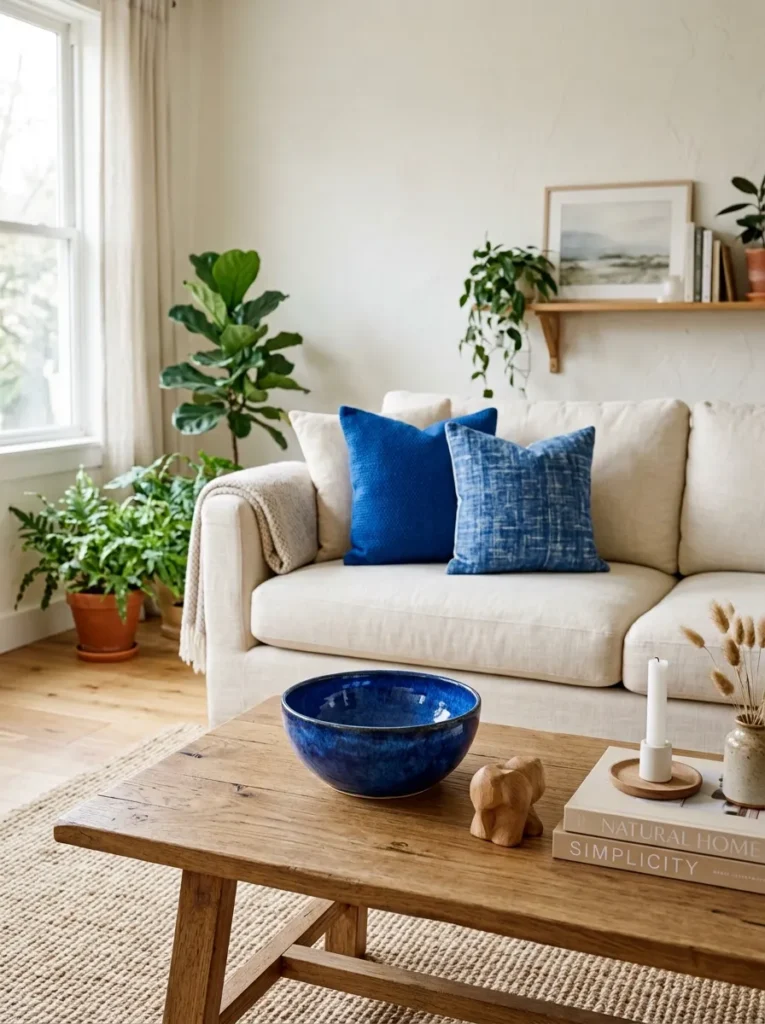
The coffee table arrangement is one of the few places in a living room where introducing a deliberate colour note — a small pop of a colour found elsewhere in the room — creates visual coherence between surfaces. A blue ceramic bowl on the coffee table that echoes the blue in the sofa cushions or the art on the wall creates a connection that the eye reads as intentional, even if it’s subtle.
This is different from making the coffee table a bold colour statement on its own. An accent colour works best in a small dose on the table — one coloured object rather than several — while the rest of the arrangement stays in the room’s neutral register.
One approach: pull the room’s accent colour into a single small vessel or bowl on the coffee table, and keep everything else in natural, neutral tones. The coloured piece reads as a deliberate decision that ties the table’s arrangement into the broader room composition.
23. Edit Down Until the Arrangement Is Almost Too Minimal
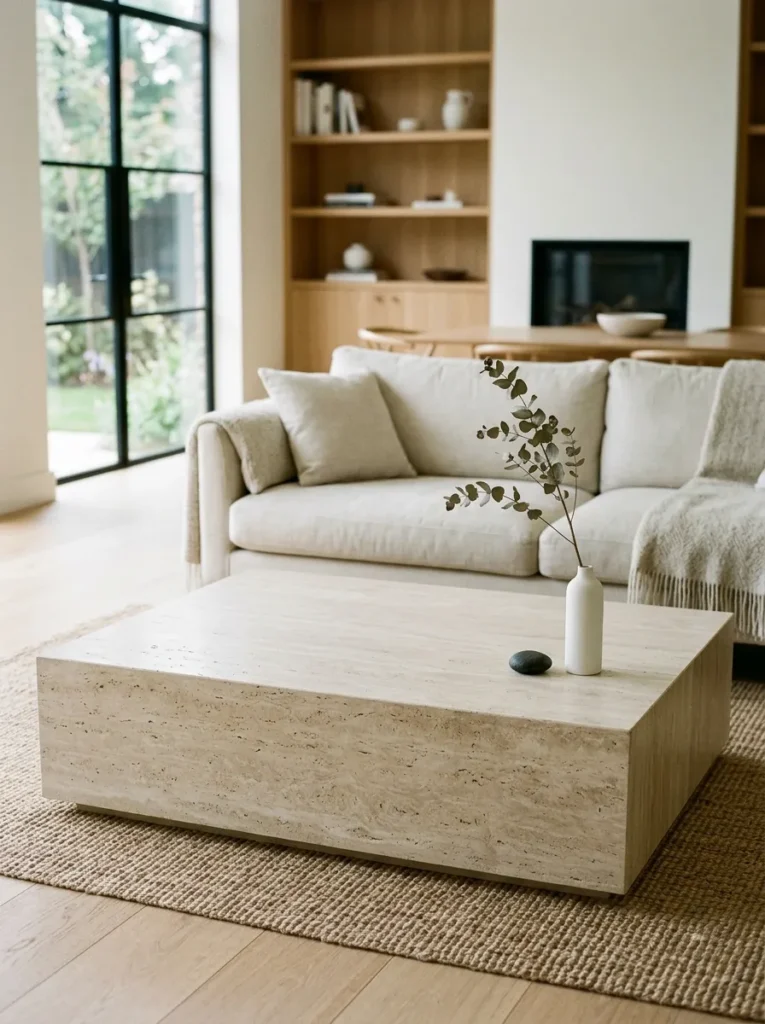
The final and often most useful step in styling a coffee table is removing objects until the arrangement feels slightly sparse — and then stopping there, rather than adding things back in. Most styled coffee tables are over-decorated rather than under-decorated, which makes the individual objects less visible and the arrangement as a whole less legible.
The editing test: stand at the doorway of the room and look at the table. Each object in the arrangement should be visible and readable from that distance. If the surface looks like a collection of indistinct shapes rather than specific chosen objects, there are too many of them.
A well-edited coffee table arrangement — three to five objects with clear height variation, sitting in visual conversation with each other — almost always reads as more sophisticated than a fully covered surface. The empty space on the table isn’t a problem to solve. It’s part of the composition.
How to Style a Coffee Table: The Underlying Principles
Beyond the specific ideas, a few principles apply to almost every coffee table, regardless of size, shape, or room style.
Three is usually the right number of distinct elements. A tall element, a mid-height element, and a base element (tray, books, or a flat bowl) are enough to create visual interest. Everything beyond those three should have a specific reason to be there.
Group objects rather than spreading them evenly. Objects positioned at even intervals across a coffee table look like a buffet display. Objects clustered together, with deliberate empty space elsewhere, look styled.
The table surface is a functional object first. No arrangement works if it makes the table unusable. Styling should enhance the table, not colonize it.
Change something every few months. A static arrangement becomes invisible over time — the eye stops registering it. Rotating one object, swapping the seasonal element, or moving the arrangement from one half of the table to the other refreshes the space without requiring a complete overhaul.
Final Thoughts
Coffee table styling is one of the lowest-stakes, highest-impact changes you can make to a living room — and it costs almost nothing if you’re working with what you already own.
If you’re starting from scratch, begin with Idea 1 (height hierarchy) and Idea 3 (odd-numbered groupings). Those two principles alone will transform a random collection of objects into something that reads as deliberate. Add a tray from Idea 4, and you’ve covered the foundational logic that makes every other idea work.
From there, choose the specific direction that suits your room’s aesthetic — layered and natural, minimal and monochromatic, boho and gathered, or clean and modern. The ideas here aren’t meant to be combined wholesale. Pick two or three that resonate with your space and your style, and let the rest inform your editing decisions rather than your shopping list.
Save the ideas worth revisiting, and come back when you’re ready to refresh what’s on the table.