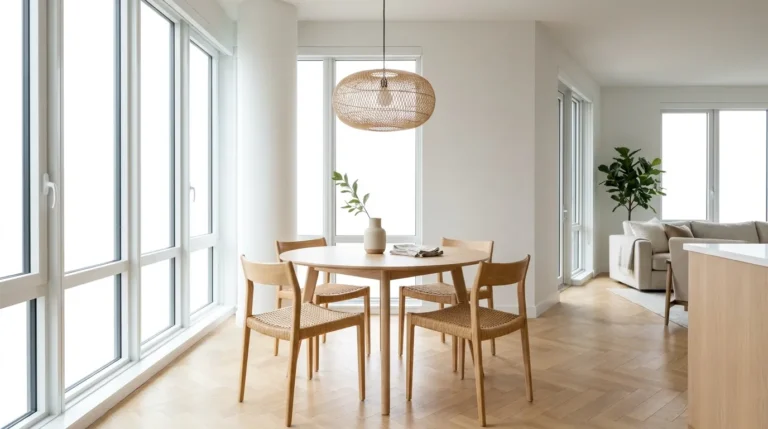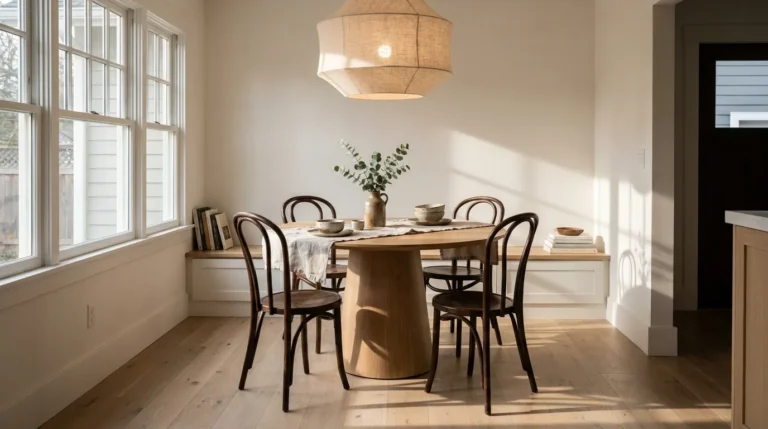

22 Dining Room Chandelier Ideas That Make Every Meal Feel Special
The chandelier is the one fixture in your home that nobody ignores. Every guest glances up. Every photograph captures it. Every dinner is lit by it. And yet it’s often chosen last — after the table, the chairs, the rug — when it should probably be chosen first.
Getting your dining room chandelier right changes the feel of the entire room. It pulls the furniture together, sets the mood before anyone sits down, and gives the space a visual anchor it might otherwise lack. Getting it wrong is surprisingly common, and the mistakes are usually the same: too small, hung too high, or picked in a style that doesn’t match anything else in the room.
These 22 dining room chandelier ideas cover the full range — from bold crystal statements to low-key rattan pendants, from open-plan lofts to compact apartments with eight-foot ceilings. Each one is practical, achievable, and chosen because it works in a real home, not just a showroom photograph.
Before you browse, one number to remember: hang the bottom of your chandelier 30 to 36 inches above the tabletop for a standard eight-foot ceiling. Add three inches for every additional foot of ceiling height. That single measurement solves most of the common problems people encounter after the fixture arrives.
1. Classic Crystal Chandelier With a Modern Twist

A crystal chandelier in a dining room never looks dated when it’s chosen with intention. The key difference between one that reads as timeless and one that reads as outdated is the frame. Traditional tiered crystal with ornate brass arms can feel heavy in a contemporary home — but the same crystal drops suspended from a cleaner geometric frame, or a single ring of polished nickel, become something entirely fresh.
Crystal catches and scatters light in a way no other material does. For a dinner table, that quality is genuinely useful: soft, moving light flatters faces in a way that bare Edison bulbs or recessed cans simply cannot. If your dining room has a formal quality — tall chairs, a substantial table, a patterned rug — a crystal chandelier earns its place without apology.
Pair it with warm white bulbs (2700K to 3000K) to keep the tone of the light golden, not cool and clinical.
2. Sleek Geometric Chandelier for Modern Dining Rooms

Geometric chandeliers — angular frames in matte black, brushed nickel, or antique brass — suit modern dining rooms because they add structure without heaviness. A hexagon, an open cube, or a series of intersecting rings reads as sculptural rather than decorative, which is exactly what a spare, contemporary space needs overhead.
This style works especially well when the rest of the room keeps things minimal: simple chairs, a clean-lined table, neutral walls. The chandelier becomes the intentional detail that says the design was considered rather than assembled.
One practical note: wire frames and exposed bulbs collect dust more visibly than enclosed shades do. If your home skews low-maintenance, look for a version with fewer horizontal surfaces.
3. Linear Chandelier for Rectangular Tables

A round chandelier above a long rectangular table creates an immediate visual mismatch — the shapes fight each other, and the light rarely covers the full table evenly. A linear chandelier solves both problems at once.
Linear fixtures run the length of the table, distributing light from end to end and reinforcing the table’s shape rather than competing with it. They’re particularly well suited to open-plan dining areas where the chandelier also needs to define the dining zone within a larger room.
For sizing, aim for a linear chandelier that spans roughly two-thirds to three-quarters of the table’s length. A fixture that runs edge to edge often looks overwrought; one that’s too short looks like an afterthought.
4. Double Chandelier Setup for Long Dining Tables

When your table exceeds eight feet, one chandelier often isn’t enough — either the fixture becomes awkwardly oversized, or it leaves the ends of the table in relative shadow. Two matching chandeliers, spaced evenly along the table’s length, handle the proportions gracefully.
They don’t need to be identical, but they should share a key material or finish to read as intentional rather than mismatched. Two pendants in aged brass, for example, or two drum shades in the same fabric but slightly different diameters. If you go this route, hang both at exactly the same height and center each one over its half of the table.
5. Oversized Statement Chandelier for High Ceilings

Rooms with ceilings above ten feet can absorb a chandelier that would overwhelm a standard space — and often benefit from one. A fixture that fills vertical space proportionally keeps a tall room from feeling top-heavy or empty. The problem with high-ceiling dining rooms is frequently the opposite of what you’d expect: not too much fixture, but too little.
If you’re working with a ten or twelve-foot ceiling, choose a chandelier with meaningful visual height — multiple tiers, a long cascading drop, or vertical candle arms — rather than a flat, wide fixture that gets visually lost. Hang it so the bottom sits 36 to 42 inches above the table, which gives it the height it needs to breathe while still lighting the table well.
6. Farmhouse Chandelier With Wrought Iron and Wood

The best farmhouse chandelier doesn’t try very hard. It looks like something that belongs in the room rather than something placed there to make a point. Wrought iron frames, sometimes with candle-style sockets, work because they’re honest about their materials — no pretense of shine or glamour, just solid, utilitarian form.
Adding a wood element — whether that’s a wooden hoop frame, wooden bead accents, or a complementary wood beam above — grounds the fixture further and connects it to the warmth of the furniture below. This style suits dining rooms with exposed wood, shiplap, natural stone, or brick, and pairs naturally with linen, cotton, and other textured textiles.
For bulbs, Edison-style filaments in warm amber bring the right quality of light: soft, slightly industrial, and easy on the eyes.
7. Antique Brass Chandelier for a Warm, Transitional Look
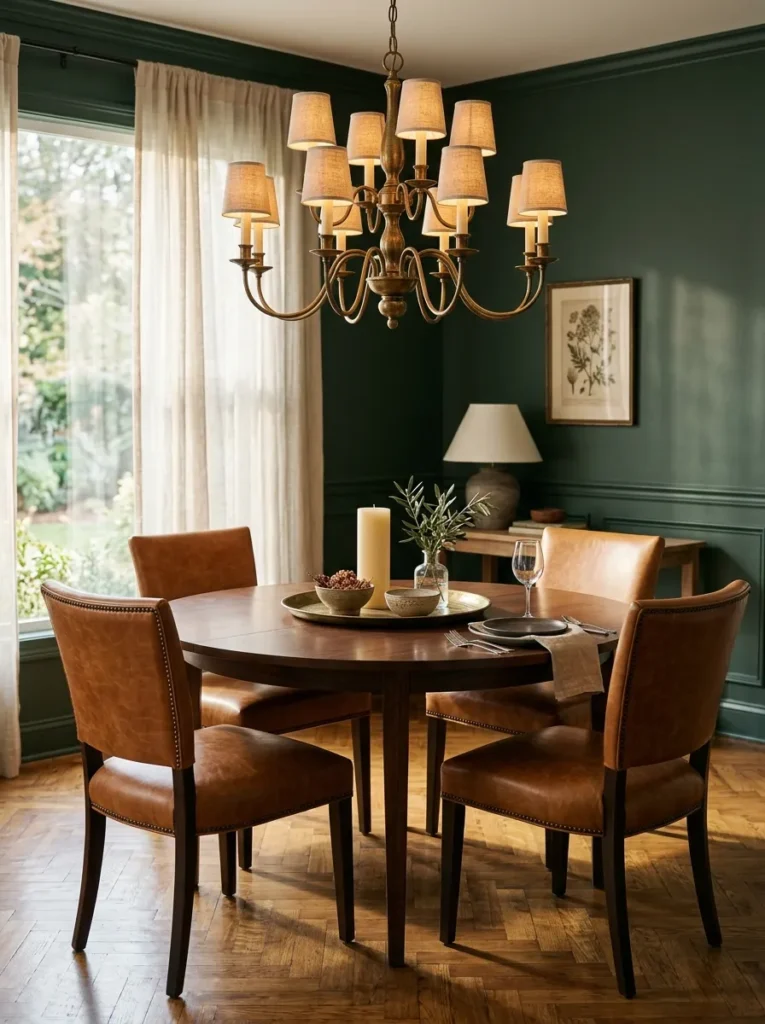
Antique and satin brass finishes have spent the last few years climbing back into favor, and in the dining room they make a strong case for staying. Brass reads warm — warmer than chrome, warmer than matte black — and that warmth translates directly into how the light feels at the table.
What makes brass work in a transitional or slightly eclectic dining room is its flexibility. It doesn’t demand a fully traditional setting the way gold or gilded fixtures do, but it’s richer than the purely industrial options. Pair antique brass with cream or linen shades, dark walnut or white oak furniture, and deep-toned walls (navy, forest green, warm charcoal) for a room that feels settled and considered.
Satin brass is slightly more contemporary than antique brass, with less of a patina quality. Either works; the distinction is mainly about how much warmth you want the finish to carry.
8. Drum Shade Chandelier for a Soft, Tailored Look

A drum shade chandelier — a wide cylindrical fabric shade around the light source — is one of the easiest ways to add polish to a dining room without committing to a heavy or elaborate fixture. The shade diffuses light beautifully, creating an even, flattering glow rather than the harsher directional light of exposed bulbs.
Linen and cotton shades in natural, white, or cream tones work in almost any dining room. Patterned shades — a subtle stripe, a small geometric — add personality without demanding attention. For a room that already has a lot happening (patterned wallpaper, a large rug, bold chairs), a plain drum shade keeps the ceiling calm.
Sizing matters more than usual here: a drum shade that’s too narrow for the table below looks almost comically inadequate. Aim for a diameter at least half the width of the table.
9. Matte Black Chandelier for Contrast and Drama

A matte black chandelier reads differently depending on the room it’s in. In a white or light-walled dining room, it provides the contrast that gives the whole space definition. In a darker, moodier room, it blends into the drama without adding more weight. Either way, black metal doesn’t compete — it frames.
This finish pairs well with almost every wood tone, from pale ash to deep walnut, and holds its own against both warm and cool palettes. Where it particularly excels is in dining rooms that lean modern or industrial: bare concrete walls, open ceilings, exposed hardware, unpretentious furniture.
One thing to watch: matte black fixtures in warm-toned, traditional rooms can feel abrupt. The disconnect between a rustic-warm dining space and a starkly modern black fixture is real. In those settings, an oil-rubbed bronze or aged iron is usually the better version of the same idea.
10. Globe Chandelier for a Mid-Century Modern Vibe

Globe chandeliers — clusters of spherical glass or opal shades arranged at different heights — have a playfulness that most chandelier styles don’t. They suit dining rooms with a mid-century modern orientation: clean-legged furniture, tapered table bases, Danish-inspired chairs, warm wood tones.
The appeal is partly in the light quality. Opal glass diffuses light softly and evenly, and when multiple globes are clustered at varying lengths, the light reaches the table from several angles simultaneously. This minimizes harsh shadows and creates a naturally flattering effect.
If you’re choosing a globe chandelier, look for one where the cord or rod lengths are adjustable. Standard height settings rarely account for the ceiling heights of older homes, and this style looks best when the cluster has a bit of movement rather than sitting flat.
11. Sculptural Modern Chandelier as Focal Point

Some chandeliers aren’t really lighting fixtures so much as sculptures that happen to produce light. Branching forms, asymmetric arms, cloud-like clusters of glass — these are pieces you notice before the table, before the chairs, before the art on the wall.
If you want your dining room to have a strong design identity, this is the most direct way to create one. A sculptural chandelier sets a standard for everything below it: the furniture, the textiles, the table setting all have to be considered with the same intention.
The practical trade-off is flexibility. A deeply specific sculptural piece is committed — it doesn’t adapt to different furniture arrangements or evolve with the room the way a simpler fixture does. Choose it when you’re confident in the broader direction of the space, not as a starting point.
12. Candlestick Chandelier for Traditional Dining Rooms

The candlestick chandelier — upward-facing sockets on curved or straight arms, designed to evoke an actual candelabra — is the most historically rooted of all dining room styles. In a formal dining room with traditional furniture, chair rail molding, wainscoting, or a sideboard with classical lines, it belongs completely.
What keeps this style current is restraint in the frame. A wrought iron candlestick chandelier with simple curved arms reads as updated traditional rather than museum antique. Add candelabra-base bulbs with a visible warm-white filament to reinforce the candle reference without losing functional light output.
This style pairs naturally with linen or cotton shades over each candle socket, which reduces the visual busyness of multiple exposed bulbs and softens the overall effect considerably.
13. Rattan Chandelier for Relaxed, Organic Warmth

Rattan and woven natural materials belong in dining rooms that feel intentionally relaxed — rooms where the goal is warmth over formality, texture over gloss, and lived-in comfort over polished perfection. A rattan chandelier introduces natural material overhead, which is rare and genuinely distinctive.
The light that passes through woven rattan creates a soft, dappled pattern on the ceiling and upper walls, particularly noticeable in evenings. It’s a quality of light closer to lamplight than overhead lighting — warm, scattered, and unfailingly flattering.
This fixture style suits coastal, bohemian, Japandi-leaning, and organic modern dining rooms particularly well. It doesn’t suit formal or highly polished spaces — the material reads as casual by nature, and forcing it into an elegant setting creates an unresolved tension.
14. Woven Seagrass or Jute Chandelier for Boho Dining

Related to rattan but with a softer, more textile quality, seagrass and jute woven chandeliers suit dining rooms that layer materials — linen curtains, a jute rug, cane-back chairs, raw wood table. The woven fixture becomes the overhead continuation of a ground-level material story.
These shades often produce an especially warm, amber-toned light quality because the natural fibers filter and color the light slightly as it passes through. For evening meals, this creates something close to the quality of candlelight — intimate and flattering.
This is a style that’s difficult to photograph badly, which makes it exceptionally strong on Pinterest. It also tends to be lighter and less expensive than metal chandeliers of comparable size.
15. Two-Tier Tiered Chandelier for Grand Proportions

A tiered chandelier — two or three concentric rings descending from a shared canopy, each holding its own light sockets — has an inherent grandeur that works beautifully in larger dining rooms. The layered rings add visual height to the fixture without requiring the same physical mass as a single large shade.
Tiered designs work particularly well above large round tables, where the circular geometry of both the fixture and the table creates a satisfying visual relationship. For rectangular tables, a tiered chandelier needs to be sizable enough not to look like a small round fixture hovering over a much wider table.
16. Japandi Chandelier for Calm, Minimalist Dining Rooms

Japandi — the intersection of Japanese and Scandinavian design principles — asks for restraint from every element in the room, including the lighting. A Japandi chandelier typically uses natural materials (bamboo, washi paper, matte ceramic) with minimal hardware visible, producing a soft, diffused light rather than a dramatic one.
The mood these fixtures create is genuinely different: quiet, unhurried, and conducive to conversation without theatrical effect. For a dining room that functions as a daily gathering place rather than an occasional formal setting, this approach to lighting is often more livable than something more assertive.
Pair with warm-white bulbs (2700K), light wood furniture, linen textiles, and a neutral palette. Avoid mixing with chrome, high-gloss surfaces, or very ornate furniture.
17. Industrial Pipe and Edison Bulb Chandelier

Industrial chandeliers — visible pipe, conduit, or cage-style frames paired with Edison filament bulbs — suit dining rooms in converted spaces: lofts, warehouse apartments, open-plan homes with high ceilings and exposed structural elements. In those environments, the style feels honest and architectural.
In a more conventional home, the same fixture can read as affected — an aesthetic applied rather than one that grew from the architecture. The key question is whether the industrial look has anything in the room to talk to. Exposed ceiling beams, concrete floors, brick walls, or steel window frames all give it something to connect with.
Edison bulbs run warm and amber but produce less raw light than modern LED alternatives. For a dining table where people actually need to see their food and their guests, a dimmable fixture with a combination of visible and hidden bulbs often works better than relying entirely on decorative filaments.
18. Coastal Chandelier With Driftwood and Shell Accents
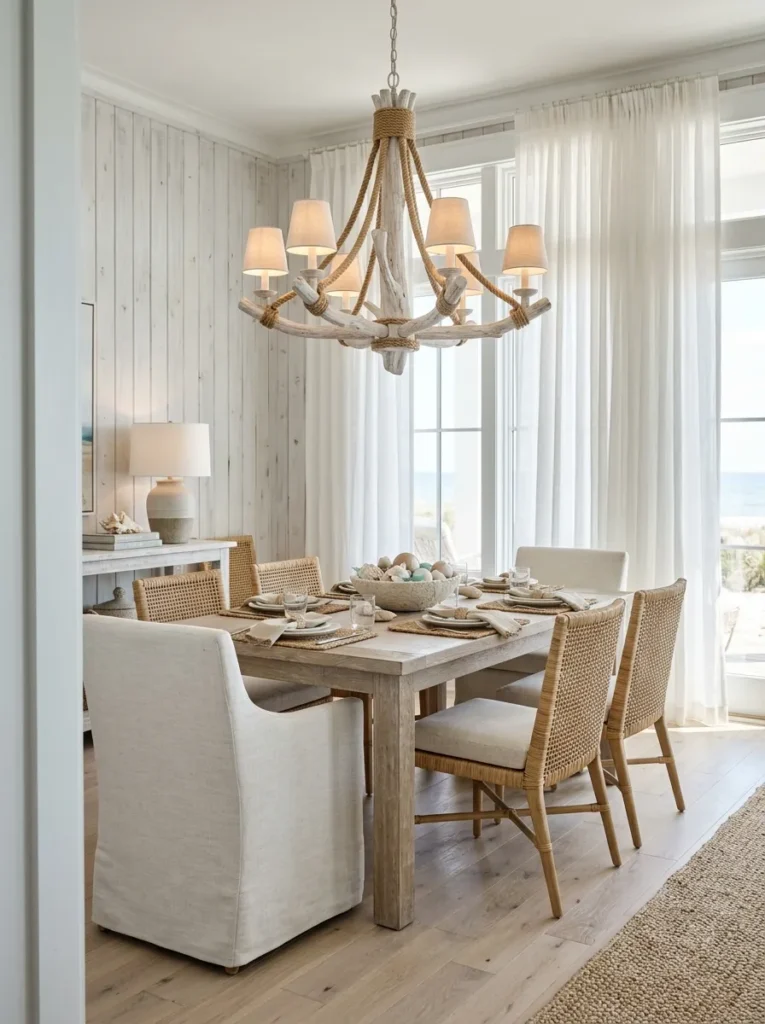
Coastal doesn’t have to mean obvious. A well-executed coastal dining room chandelier leans toward natural materials — bleached wood, rope, whitewashed metal, seeded glass — rather than anchors and fish. The suggestion of the coast is in texture and palette, not in literal motifs.
A chandelier with driftwood arms and wrapped rope, or a whitewashed iron ring with linen shades, brings the coastal mood without the themed-restaurant quality that heavy-handed coastal decor can suggest. Natural light matters here too: coastal rooms typically have good window access, so a chandelier that works in conjunction with daylight rather than trying to compete with it is the right frame of mind.
19. Capiz Shell Chandelier for a Glamorous Coastal Look
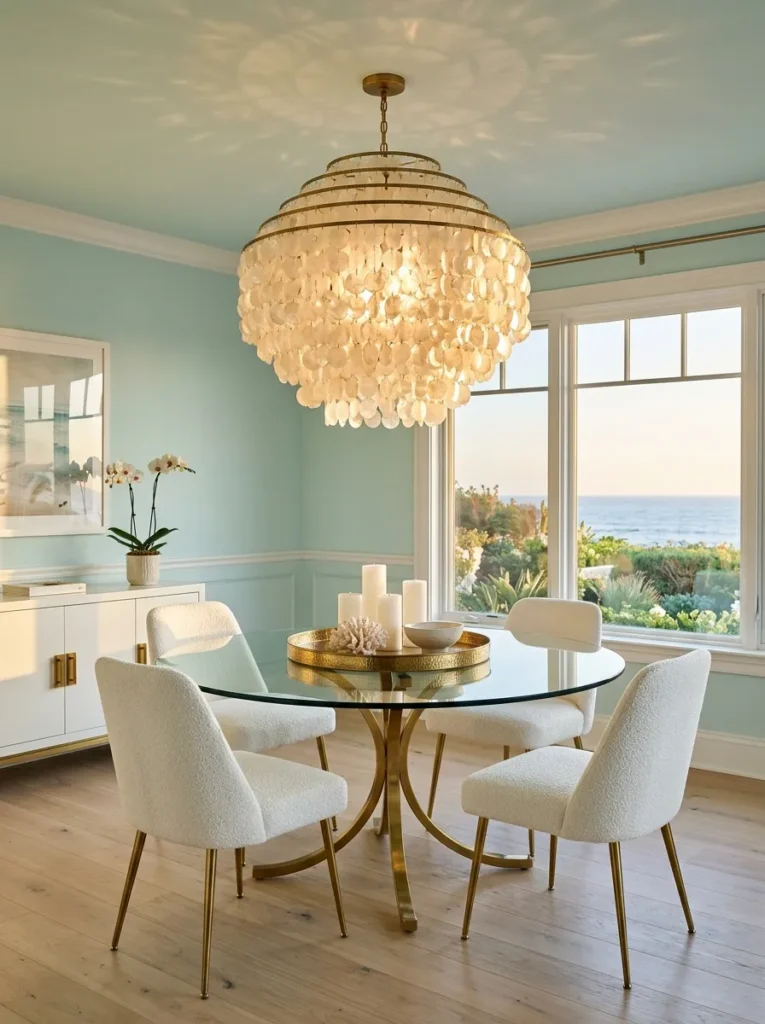
Where seagrass and rope read as relaxed, capiz shell reads as glamorous. The translucent, iridescent quality of capiz shell clusters or panels creates a fixture that catches light in a shifting, almost moving way — closer to crystal than to natural fiber in terms of visual effect, but warmer and more organic.
This is a strong choice for dining rooms that want a statement without the weight of metal and crystal — the capiz shell fixture achieves the shimmering effect through natural material, which keeps the overall mood lighter and more approachable. It suits transitional, eclectic, and coastal-glam dining rooms particularly well.
20. Canopy Cluster Pendant Chandelier

A cluster chandelier — multiple pendants of varying lengths descending from a shared ceiling canopy — creates visual depth through the difference in cord lengths. Some globes sit close to the canopy; others drop significantly lower. The result has a three-dimensional quality that a standard chandelier doesn’t.
This style suits dining rooms with higher ceilings where the chandelier has vertical space to work with. In a low-ceiling room, a cluster of pendants that descend to different heights risks looking cluttered rather than dimensional. The lowest pendant in the cluster should still hang at or above the standard 30-to-36-inch clearance above the table.
21. Mixed Metals Chandelier for an Eclectic Dining Room

A chandelier that combines two metal finishes — brushed brass and matte black, antique bronze and polished nickel — works well in dining rooms that don’t commit fully to one aesthetic direction. The mixed-metal fixture isn’t trying to be consistent; it’s acknowledging that the room itself has layers.
The strategy works when the chandelier echoes the mixed metals already present in the room: brass cabinet hardware alongside matte black chair legs, for example, or a warm bronze sconce beside a chrome faucet in an adjacent kitchen. The chandelier shouldn’t introduce the first mixed metal into the space — it should resolve a mixing pattern that already exists.
22. Mini Chandelier for Small Dining Rooms and Low Ceilings

A small dining room with an eight-foot ceiling doesn’t have to sacrifice the character that a chandelier provides. Mini chandeliers — fixtures with a diameter of 16 to 24 inches — offer the same design intention as a full-scale fixture without overwhelming a compact space.
The common mistake in small dining rooms is choosing a flush-mount or semi-flush fixture simply because the ceiling is low — this often removes the chandelier quality entirely. A petite chandelier, hung at the standard 30-inch clearance, reads correctly in a small room in a way that a flat, ceiling-hugging fixture never does.
For rooms under 100 square feet, stay at or below 20 inches in diameter. For rooms between 100 and 150 square feet, 20 to 24 inches typically proportions well to the space.
How to Choose the Right Chandelier for Your Dining Room
Before you commit to a style, a few practical questions narrow the field considerably.
What shape is your table? Round chandeliers belong above round or square tables. Linear chandeliers belong above rectangular ones. Mismatching shapes isn’t impossible, but it requires other strong design choices to make it work.
How high is your ceiling? Standard eight-foot ceilings suit most chandeliers in the 18-to-24-inch diameter range, hung so the bottom clears 30 to 36 inches above the table. Taller ceilings can carry larger fixtures, hung proportionally higher — add three inches of clearance for every additional foot of ceiling height.
What size should the fixture be? For the diameter, use half to two-thirds of the table’s width as your starting range. A 36-inch-wide table calls for a chandelier roughly 18 to 24 inches in diameter. For the room overall, add the room’s length and width in feet, then convert that number to inches for a rough guide to diameter.
What bulb temperature suits you? Dining rooms generally benefit from warm white light in the 2700K to 3000K range. It’s flattering, it makes food look appealing, and it creates the kind of ambiance that cool-toned bulbs at 4000K or above simply don’t produce. Always choose a dimmable fixture if at all possible — the difference between full brightness for a casual lunch and lowered light for an evening dinner party is significant.
Final Thoughts
A dining room chandelier does something no other piece of furniture or decor can do: it sets the entire mood from above. The right fixture brings focus and warmth to a space that might otherwise feel scattered or unresolved. The wrong one doesn’t ruin the room, but it does mean the room never quite arrives.
The 22 dining room chandelier ideas here represent genuinely different directions — not slight variations on the same look. Whether you’re working with a formal traditional space, a relaxed boho-leaning room, a high-ceiling loft, or a compact apartment dining area, there’s a fixture approach that suits your specific situation.
Start with the practical measurements, then let the style follow from the room you’ve already built.