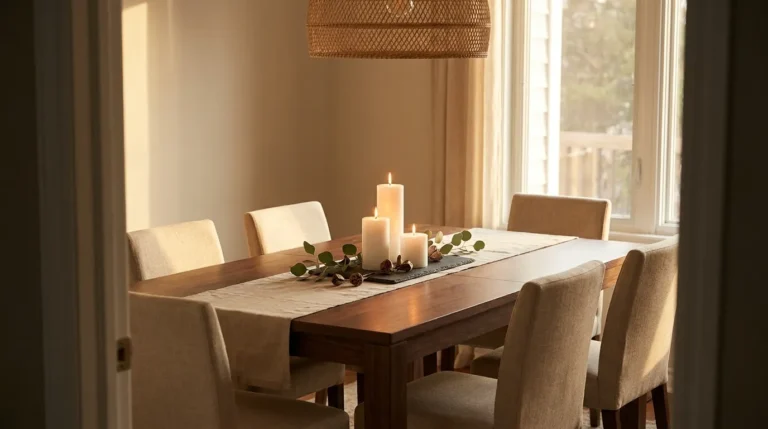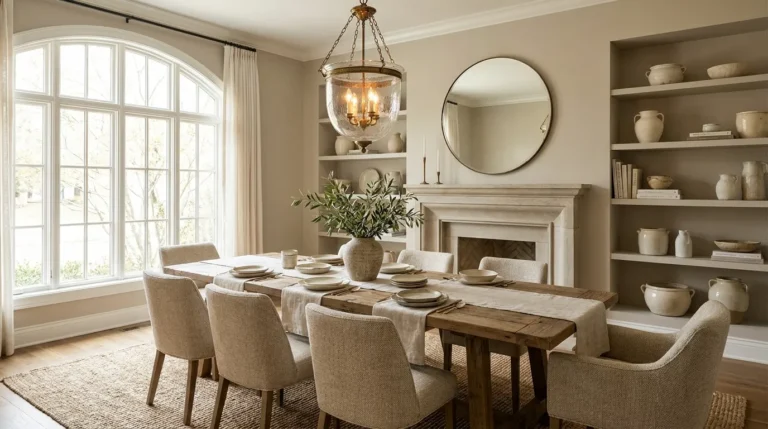

21 Dining Bench Ideas That Save Space Beautifully
A dining bench does something a set of chairs never quite manages: it invites people to slide together, to make room for one more, to stay longer. There’s an inherent ease to bench seating that individual chairs resist — you’re not assigned a fixed spot, you’re part of a continuous surface that shapes itself around however many people show up.
That social quality is one reason dining benches have moved well beyond farmhouse kitchens and breakfast nooks into contemporary, transitional, and even formal dining rooms. But the practical case is equally strong. A bench on one or both sides of the table saves money compared to an equivalent number of chairs, takes up less visual floor space when pushed under the table, and — in small or awkward dining rooms — can be positioned flush against a wall in a way that individual chairs cannot.
These 21 dining bench ideas cover the full range: from raw wood farmhouse benches to fully upholstered banquettes, from storage benches that solve the small-space problem twice to bench-and-chair combinations that balance formality with ease. Each idea includes practical guidance on sizing, materials, comfort considerations, and which configurations suit which rooms — because a dining bench that looks right but sits poorly gets replaced, and one that’s comfortable but visually wrong undermines the room it’s supposed to improve.
1. A Simple Solid Wood Bench for a Farmhouse Table

A solid wood bench in the same or complementary species as the dining table is the most direct and honest version of the dining bench idea. There are no upholstery decisions, no cushion maintenance, no material conflicts — just wood on wood, the bench as a natural extension of the table’s material character.
The fit between bench and table is the detail that determines whether this reads as composed or accidental. The bench should be 2 to 4 inches shorter than the table on each side, so the ends of the bench sit slightly inside the table’s footprint. A bench that extends past the table ends reads as mismatched rather than intentionally paired. The bench seat height should leave 10 to 12 inches of clearance below the table apron for comfortable seated posture — the same clearance principle that governs dining chair selection.
In a kitchen-adjacent dining room or a casual family dining space, a plain solid wood bench with no cushion is the most practical choice: wipe-clean, durable, and genuinely improved by age and use marks rather than diminished by them.
2. A Painted Wood Bench as a Color Accent

A wood bench painted in a color that contrasts with the dining table introduces a palette decision at furniture level — one that’s lower commitment than painted walls and easier to change than upholstered dining chairs. A natural oak table paired with a bench in dusty sage green reads differently from the same table with a bench in deep navy or warm terracotta, but all three work by the same principle: the painted bench creates a color relationship between the furniture and the room’s other color elements.
The paint finish on a dining bench must be durable. A matte or chalk finish looks beautiful but shows marks and scuffs at the seat edge and on the legs more visibly than a semi-gloss or hard lacquer finish. For a bench in daily use, a semi-gloss finish or a properly sealed chalk paint (with a hard wax topcoat) handles the physical realities of dining room use better than an unsealed matte.
This is also one of the most achievable DIY dining bench ideas: a simple solid wood bench in any finish can be painted in an afternoon, and the color can be changed as the room evolves.
3. A Fully Upholstered Bench in a Neutral Fabric

A fully upholstered dining bench — no exposed wood frame, the legs and apron all wrapped in fabric or at minimum in a coordinating paint — reads more like furniture than a utilitarian bench. It’s comfortable for extended meals, adds visual warmth and softness to the dining room’s harder surfaces, and suits rooms where the dining table is in a more formal register.
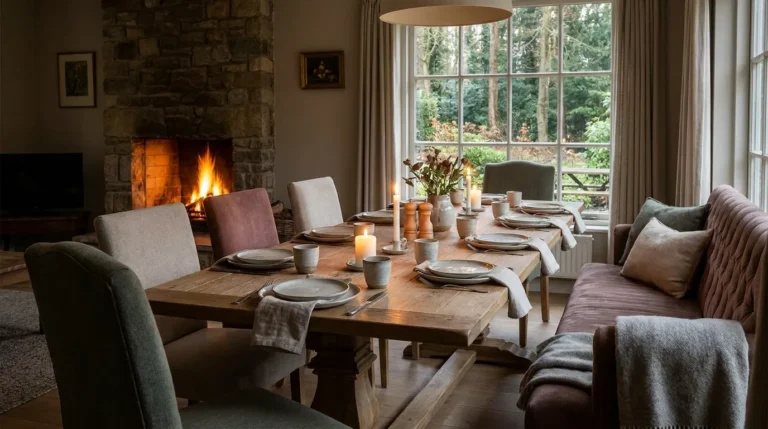
The fabric choice is the primary practical decision. A dining bench seat sees more contact than almost any other upholstered surface in the home — repeated sitting, sliding, occasional spills, the friction of denim and other heavy fabrics against the upholstery. A tightly woven performance fabric in linen-look, outdoor-grade textile, or a stain-treated weave handles this considerably better than a delicate or open-weave fabric.
In terms of proportion, a fully upholstered bench without visible legs can read as heavy in a small room. Slim tapered legs in a wood or metal finish break up the mass and let the eye travel under the bench, which reduces visual weight without reducing the seating surface.
4. A Velvet Upholstered Bench for an Evening Dining Room
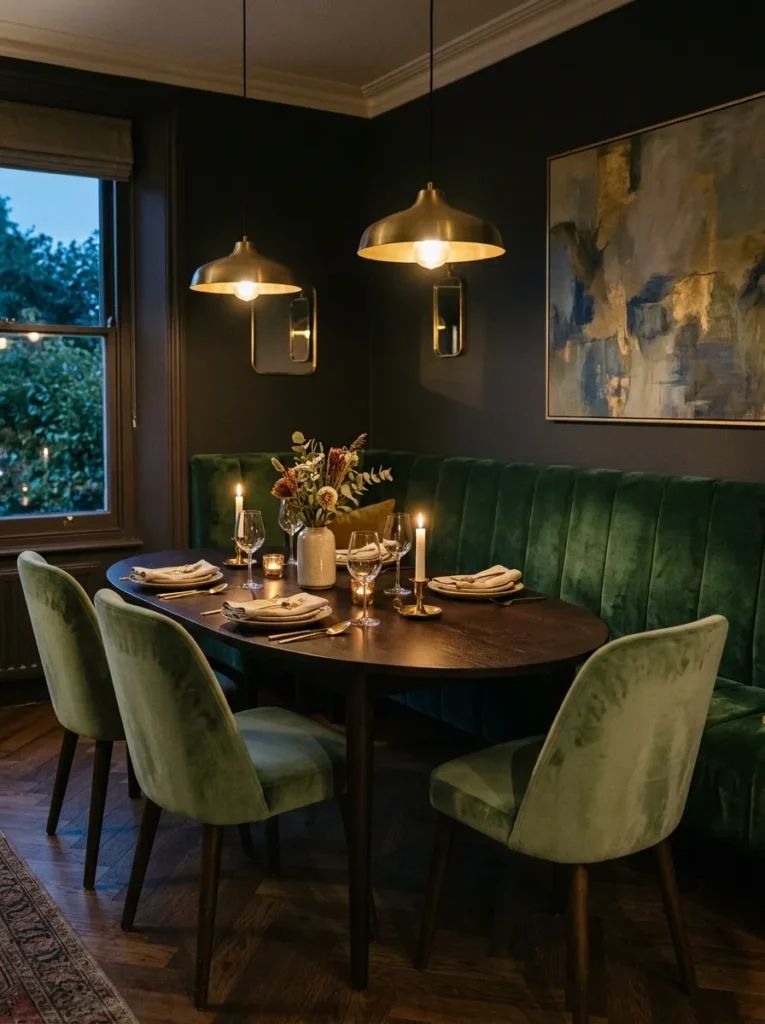
Velvet on a dining bench bench creates the same atmospheric quality as velvet dining chairs — the fabric deepens under warm light, develops a richness in the evening that daytime photos rarely capture, and communicates a level of intention that plain fabric can’t. For a dining room used primarily for dinner parties and evening gatherings, a velvet bench is a considered choice rather than an impractical one.
The practical concerns are real but manageable. Velvet shows compression marks where people sit repeatedly — the pile flattens in a pattern that becomes visible as the fabric ages. A shorter pile (performance velvet rather than traditional cut velvet) is more resistant to this. Brushing the nap back periodically with a soft cloth or velvet brush restores the surface temporarily.
Color choice is the most important aesthetic decision. Deep jewel tones — forest green, sapphire, aubergine, warm copper — develop the most visual depth under artificial light and age most gracefully on a dining bench used over years. Lighter velvets (blush, pale grey, sage) can work but require more careful maintenance to keep the nap clean and even.
5. A Linen Bench with a Loose Fitted Cover

Rather than permanently upholstering a dining bench, a removable fitted slipcover in a natural linen or linen-cotton blend allows the cover to be washed, replaced seasonally, or changed when the room’s direction evolves. The loose, slightly relaxed quality of a linen slipcover suits casual and eclectic dining rooms where a tight, tailored upholstery would look overwrought.
The slipcover reads best when it fits the bench’s dimensions well enough that it doesn’t bunch or slip during use, but loosely enough that the fabric drapes naturally at the corners and edges rather than pulling tight. A slipcover that’s too fitted reads as an imperfect upholstery job; one cut with appropriate ease reads as a deliberate, relaxed aesthetic choice.
This is one of the most renter-friendly dining bench ideas: buy or find a plain bench in any condition, make or purchase a fitted linen cover, and you have a dining bench that reads as intentional and can be changed without touching the bench itself.
6. A Built-In Corner Banquette

A built-in corner banquette — L-shaped bench seating fixed to two walls at a corner — is the dining configuration that maximizes seating in minimum floor space more effectively than any other format. Pushed into a corner with a table positioned at the bench’s interior, a corner banquette can seat six to eight people in a footprint that freestanding chairs would struggle to accommodate four.
The built-in nature is both the strength and the limitation. A corner banquette requires construction (building the seat base, either as framed carpentry or as a modified storage box) and installation — it’s a permanent modification that can’t be moved when the room’s needs change. For renters, a corner banquette is typically not an option without landlord involvement.
The seat cushion is the variable that most affects long-term comfort. A thin cushion looks elegant but becomes uncomfortable after 30 to 40 minutes of continuous seating. A minimum of 3 to 4 inches of foam density equivalent to medium-firm upholstery foam makes a built-in banquette comfortable for extended meals. Cushions should be covered in a fabric that can be dry-cleaned or removed for cleaning — built-in banquettes are not easy to re-upholster in place.
7. A Freestanding Banquette Bench with a High Back

A freestanding bench with a high upholstered back — reaching to 36 or 40 inches above the seat — creates a banquette-like enclosure without requiring built-in construction. Positioned against a wall with the table in front, it reads from across the room as a built-in, while remaining a piece of furniture that can be moved when needed.
The high back is the feature that transforms a standard bench into something that reads as more considered. It frames the dining experience visually — guests seated on the high-back bench face the room rather than a wall, and those opposite them see a composed, upholstered backdrop rather than bare wall. It also provides genuine back support, which most standard dining benches without backs don’t.
The back height relative to the table matters: the bench back should not be so tall that it creates a visual barrier blocking sightlines across the table. A back that reaches 14 to 16 inches above the seat height (to approximately 32 to 34 inches from the floor) provides support without obstructing the dining environment.
8. A Narrow Bench for a Small Dining Nook

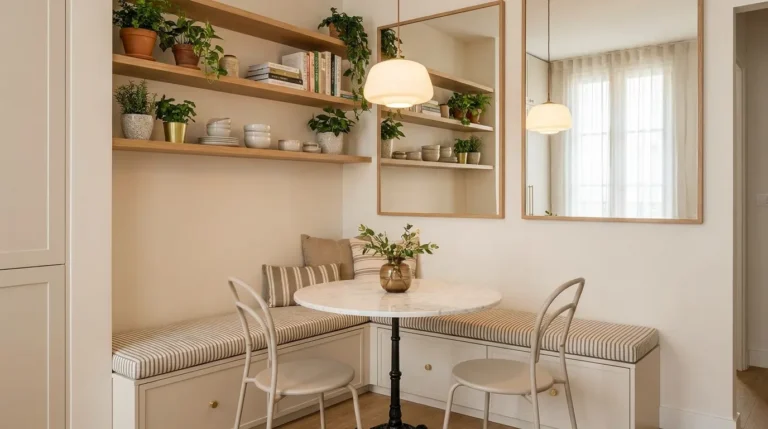
In a small dining nook — a compact dedicated corner with just enough space for a table for two to four — a narrow bench (12 to 14 inches deep rather than a standard 15 to 18 inches) pushed against the wall allows the table to sit closer to the seating while leaving circulation room in front of the table. The narrower depth makes the nook more usable rather than less.
The proportional relationship between the bench, the table, and the wall behind creates a composition that reads well or badly depending on the detail. A bench that extends the full length of the wall (rather than stopping at the table’s width) gives the nook a more architectural quality. A wall treatment immediately above the bench — a shelf, a gallery arrangement, a run of wainscoting with paint or wallpaper above — completes the nook as a composed space rather than a bench pushed against a wall.
For renters, a freestanding narrow bench and a small table against a wall creates an effective dining nook without permanent modification.
9. A Bench with Under-Seat Storage

A dining bench with storage — either with hinged lid access to a hollow interior, or with drawers in the bench base — solves two problems simultaneously: it provides dining seating and it provides a storage location for items that commonly lack a good home in a dining room (extra linens, seasonal tableware, candles, placemats).
The storage access method matters for daily practicality. A hinged lid requires clearing the bench seat before opening, which means people need to stand up and the cushion needs to be removed if it’s attached to the lid. Pull-out drawers or a lift-lid with gas struts (which hold the lid open without requiring a hand) are more functional for regularly accessed storage.
The bench’s visual character should not be dominated by the storage mechanism. A bench where the hinge line is the most visible design element reads as utilitarian. A bench where the storage is accessed from below or through a front drawer while the top reads as a clean upholstered surface reads as intentional furniture.
10. A Window Seat Bench as a Dining Bench Alternative

In dining rooms adjacent to or incorporating a window bay, building or placing a bench along the window wall creates a window seat that doubles as dining seating when the table is positioned in front of it. The view becomes part of the dining experience — which is one of the most underexplored pleasures in home dining.
The window seat works architecturally when the seat depth matches the window sill depth or when the sill is extended to create a continuous bench plane. Standard window sill depth is 6 to 12 inches — too shallow for comfortable seating. A bench seat built out from the wall to 18 inches deep, at seat height (17 to 18 inches), creates a genuine seating surface that relates to the window rather than simply occupying the space in front of it.
Seat cushions for window bench seating should be attached or weighted to prevent them from slipping when the window is opened or when the table is moved. A box cushion with ties or a cushion cut to the bench dimensions without overhang is the most stable option.
11. A Bench with a Low Ladder Back
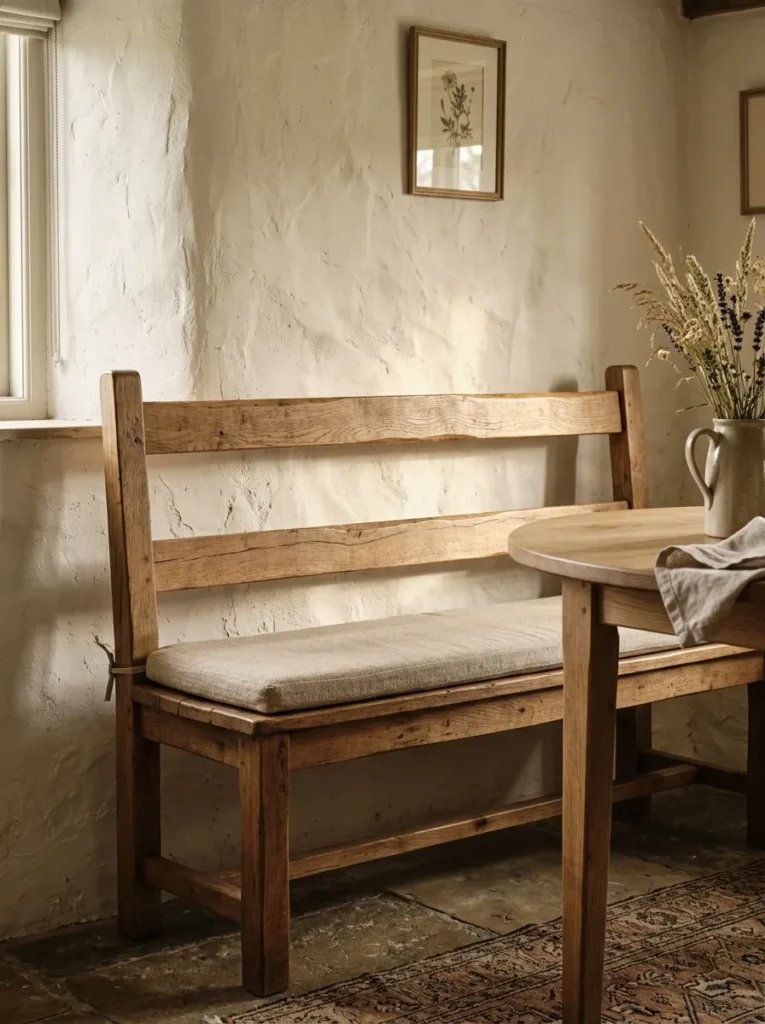
A bench with an integrated back in a simple ladder or spindle format — rails running horizontally or vertically between two upright posts at the bench ends — provides back support without the visual weight of a fully upholstered high back. The open back structure allows the wall behind to remain visible, which reads as lighter and more casual than a solid upholstered back.
The ladder back is particularly effective in rooms where the wall behind the bench has a feature worth seeing — a tile pattern, a limewash finish, a gallery arrangement — because the open structure frames that wall rather than blocking it. The back also adds structural rigidity to a long bench, which can flex and bounce without it.
The back height in this format should sit at approximately 14 to 16 inches above the seat — enough to support the mid-back comfortably without the back rail interfering with the table’s use. A ladder back that’s too low provides no real support; one that’s too high catches against the table edge when the bench is pushed in.
12. A Rattan or Cane Back Bench for Organic Texture

A bench with a woven rattan or cane panel in the back — or a fully rattan-wrapped construction including the back frame — brings natural fiber texture to the dining room at a larger scale than rattan chairs typically achieve. The visual effect is both lighter and warmer than an upholstered back, and it photographs beautifully in natural light where the weave creates visible shadow patterns.
The rattan back panel suits rooms decorated in natural materials — linen, jute, wood, ceramics — where the fiber texture extends the room’s material story rather than introducing a competing element. In a dining room with chrome hardware and glass surfaces, a rattan back bench can feel like a piece brought from a different room.
Maintenance: rattan and cane require periodic cleaning with a damp cloth and should not be exposed to sustained direct moisture. In a dining room where spilled drinks occasionally splash toward the bench back, a cane panel that’s easily detached for cleaning is more practical than one that’s permanently integrated into the structure.
13. A Raw Oak or Ash Bench with Hairpin Legs

A bench with a solid oak or ash seat slab — unfinished or lightly oiled — on hairpin metal legs is a mid-century-adjacent design that suits contemporary, industrial, and eclectic dining rooms. The material contrast between the warm wood seat and the thin metal legs creates visual lightness: the heavy organic mass of solid wood appears to float on almost-invisible metal legs.
The hairpin leg finish is the decision that most affects the bench’s tonal register. Matte black hairpin legs suit contemporary and industrial rooms and pair naturally with dark table finishes. Brass or copper hairpin legs suit warmer, more eclectic rooms and read as less industrial. Brushed steel reads as neutral and suits almost every room direction.
The seat thickness is a visual quality decision as well as a structural one. A seat slab at 1.5 to 2 inches reads as furniture-quality. A seat at 3 inches or more reads as architectural and slightly rough-hewn. Thinner seats below 1 inch can flex under load and read as lightweight rather than considered.
14. A Bench and Chair Combination at the Same Table

Pairing a bench on one side of the dining table with chairs on the remaining sides creates a configuration that balances informality with structure — the bench side reads as relaxed and sociable, the chair sides read as more defined. The resulting arrangement suits family dining rooms where adults and children share the same table and the bench side accommodates the children’s varied positioning and movement more easily than fixed chairs.
The visual coherence between the bench and the chairs is the deciding factor in whether this reads as considered or mismatched. The bench should share at least one material or finish element with the chairs: a wood bench with oak chairs in the same stain, or an upholstered bench in the same fabric as the chair seats. Matching perfectly (the bench is simply the chair without a back) reads as designed; sharing only a color or tonal register reads as eclectic but intentional.
The bench’s seat height must match the chairs’ seat height. A mismatch of more than an inch creates a visible step between the bench level and the chair level at the table, which reads as a purchasing error rather than a design choice.
15. A Bench with Individual Seat Cushions Instead of One Long Cushion

Rather than a single bench cushion running the full length of the seat, individual seat-pad cushions — one per implied seating position — create a different visual rhythm on the bench surface. Three individual square cushions on a 60-inch bench reads more like a furniture moment than a single cushion of the same total length.
Individual cushions also offer a practical advantage: when one cushion wears, stains, or needs replacing, only that cushion needs attention rather than the full bench length. The cushions can also be mixed — different but related patterns or a gradient of tonal variation across the three seats — in a way that a single long cushion can’t accommodate.
The cushion proportions should be calibrated to the bench’s seating positions. An individual cushion that’s 16 to 18 inches square suits a standard dining table seating position where each person occupies roughly 24 inches of bench width. A cushion wider than the implied seating position reads as oversized; one narrower than the position reads as decorative rather than functional.
16. A Bench Cushion in a Bold Print or Pattern

Where a plain bench cushion reads as neutral and supportive of the room’s other elements, a bold printed cushion — in a geometric pattern, a botanical print, a stripe, or an ethnic weave — introduces pattern at furniture level. It’s one of the lowest-commitment ways to add pattern to a dining room because the cushion can be replaced without touching the bench, the table, or the room’s architecture.
The print scale should suit the bench length. A very small-repeat pattern on a 60-inch bench reads as texture rather than pattern from across the room, which defeats the purpose. A larger repeat — a botanical at 8 to 10 inches per motif, or a wide stripe — reads clearly at the dining room’s viewing distance.
The cushion pattern should relate to the room’s existing palette: one color in the pattern echoing the dining chairs, another echoing the rug or the curtains. A cushion pattern that introduces colors with no relationship to any other element in the room reads as an isolated decision rather than a considered one.
17. A Reclaimed Wood Bench with Visible Imperfections

A bench made from reclaimed or salvaged wood — with visible saw marks, old nail holes, patched joints, and color variation between planks — brings a material honesty to the dining room that new wood or painted furniture can’t replicate. The imperfections are the point: they signal that the material came from somewhere and has a history before the dining room.
Reclaimed wood benches pair naturally with farmhouse tables, raw-edge wood tables, and dining rooms decorated in natural, unrefined materials. They create a visual and material tension in highly polished, contemporary rooms that can read as intentional eclecticism or as visual conflict depending on the room’s other decisions.
Weight and stability are practical considerations with reclaimed wood furniture. Old wood can be denser and heavier than new lumber, and structural joints in reclaimed pieces should be assessed and reinforced if needed before use as dining furniture. A beautiful reclaimed wood bench that wobbles or flexes significantly under load needs professional joinery attention before it’s furniture rather than a display piece.
18. A Bench Built Into an Alcove or Bay

In dining rooms with an existing alcove — a recessed section of wall created by a chimney breast, a structural column, or an architectural offset — building a bench into that recess creates a seating solution that reads as architecturally resolved rather than furniture placed in front of a problem. The bench fits the space precisely, the alcove becomes the dining nook, and the room feels as though it was designed around this configuration.
The construction is simpler than a full corner banquette: a plywood box at seat height, finished in paint or upholstery, anchored to the alcove walls, with a cushion on top. A shelf or artwork in the alcove above the bench back completes the composition.
If the alcove is narrow — under 20 inches deep — the bench will have limited depth and should be cushioned adequately to compensate for the shallower seat. Seat cushions with a back bolster or a loose lumbar cushion against the alcove’s rear wall improve comfort in deeper alcoves where the back isn’t close to the wall.
19. A Bench with Legs That Match the Table’s Hardware Finish

A bench whose leg finish directly matches or deliberately complements the table’s hardware, the room’s light fixtures, or the dining chairs’ metal elements creates a visual coherence across the dining room’s furniture that reads as orchestrated. A bench with aged brass hairpin legs beside a table with brass hardware and a pendant light in the same finish creates the impression that the room was considered as a complete composition rather than assembled from separate purchases.
This is one of the simplest techniques for elevating a dining room arrangement: it doesn’t require spending more money, finding unusual furniture, or making architectural changes. It requires only identifying the room’s existing metal finish family and choosing a bench whose legs participate in that family.
The finish match doesn’t need to be exact — aged brass and unlacquered brass, or matte black and dark oil-rubbed bronze, read as related rather than mismatched. What reads as poorly considered is a warm gold bench leg beside cool brushed nickel table hardware with a black pendant — three unrelated metal finishes on the same table read as accidental rather than intentional.
20. A Long Bench That Doubles as Entry Hall Seating

A dining bench that’s long enough and positioned close enough to the front or rear entry to serve double duty — dining seating when the table is in use, entry hall bench when the dining table is pushed aside or the entry space is in use — solves two furniture needs with one piece. This is particularly valuable in small apartments and open-plan spaces where every piece of furniture needs to earn its place.
The bench’s positioning and scale need to support both functions. As a dining bench, it should be proportionate to the table and positioned at the correct height relative to the table surface. As an entry bench, it should be accessible without moving the dining table and at a height that makes putting on shoes comfortable (16 to 18 inches from the floor is standard for an entry bench).
In open-plan spaces where the dining and entry zones are adjacent but visually continuous, a bench that bridges both communicates considered planning. Adding hooks above the bench on the entry-adjacent wall completes the entry zone without duplicating furniture.
21. An Outdoor-Style Bench Brought Inside

A bench designed for outdoor or semi-outdoor use — in teak, powder-coated aluminum, or weather-resistant concrete — brought into the dining room creates a material unexpected contrast that reads as deliberately unconventional. The outdoor bench in an interior setting communicates confidence: the person who lives there knows the rules well enough to break them purposefully.
Teak outdoor benches are among the most successful indoor crossovers because teak’s natural oil content, beautiful grain, and warm grey-silver aging quality reads as genuinely furniture-quality rather than casual patio furniture. A teak bench at a natural oak dining table reads as a studied material pairing rather than a practical shortcut.
Weather-resistant powder-coated aluminum or steel benches — particularly in matte black or warm graphite — suit industrial and contemporary dining rooms and add a structural quality that wood benches don’t provide. The metal surface is cold to the touch, which recommends adding a cushion for extended dining use.
Getting the Sizing Right Before Buying
The most common dining bench mistake isn’t choosing the wrong material or style — it’s choosing the wrong size for the table, the room, and the number of people the bench needs to seat.
Bench length relative to the table. The bench should be 2 to 6 inches shorter than the table on each side it occupies — the bench ends sit inside the table’s footprint. A bench that extends past the table ends creates a tripping hazard and looks proportionally off. For a 72-inch table with benches on both long sides, each bench should be 60 to 68 inches long.
Seating capacity. Each person needs 18 to 24 inches of bench width for comfortable dining seating. A 60-inch bench accommodates three people comfortably or four in a pinch. Plan for three people per 60 inches of bench rather than four, unless the dining setting is deliberately informal and space-efficient.
Bench height relative to the table. Bench seat height should leave 10 to 12 inches between the seat surface and the underside of the table apron. Measure the apron height before purchasing — a deep apron on a farmhouse table or a thick slab table can reduce clearance below the functional minimum, making bench seating uncomfortable regardless of the bench height.
Depth and comfort. A bench seat depth of 15 to 18 inches suits most dining use. Shallower than 15 inches feels cramped; deeper than 18 inches requires a back support (a back rail, a bolster cushion, or proximity to a wall) to be comfortable for extended seating.
Final Thoughts
The dining bench earns its place in a room not just by saving space — though it does that genuinely, particularly when pushed under the table — but by changing the character of meals. A table where one side is a bench rather than chairs is a more flexible, more sociable, and often more comfortable place to eat.
If you’re starting with a specific problem — a small dining room, a corner that doesn’t fit chairs, a family with children who slide rather than sit — Ideas 1, 6, 8, and 9 address those constraints directly. If you’re choosing for atmosphere and aesthetic impact, Ideas 4, 7, and 17 create the most distinctive and photographable results.
The one decision to get right before everything else is the sizing: bench length relative to the table, seat height relative to the apron, depth relative to the available space. A bench that’s exactly right in those dimensions will almost certainly look and function well regardless of the material or style direction it represents.
Save the ideas that suit your table and your room, and return to the sizing section before making the final decision.