
19 Shower Shelf Styling Ideas That Look Luxurious
The shower shelf is the one bathroom surface that most people style accidentally rather than intentionally. Shampoo, conditioner, body wash, a razor, a loofah, a half-used bar of soap — all placed wherever they fit, in whatever packaging they came in, with no consideration for how the arrangement reads visually. The result is a shower that looks like a drugstore display rather than a considered space.
The gap between a shower that looks luxurious and one that looks cluttered is surprisingly small. It comes down to a few specific decisions: the container types that hold products, the number of items visible on the shelf, the material of the shelf itself, and the arrangement logic that makes the visible objects read as placed rather than accumulated. None of these require significant renovation. Most can be addressed with an afternoon of editing and a modest investment in better containers.
These 19 shower shelf styling ideas cover every level of commitment — from decanting products into matching bottles to installing a recessed niche, adding a teak shelf, or pairing a floating stone ledge with curated objects. Each idea includes practical guidance on what materials survive long-term in a wet shower environment, which products are worth displaying versus hiding, and how to maintain a styled shower shelf through daily use.
The hotel shower quality isn’t a renovation — it’s a set of decisions applied consistently.
1. A Recessed Niche Styled with Matching Bottles and One Object

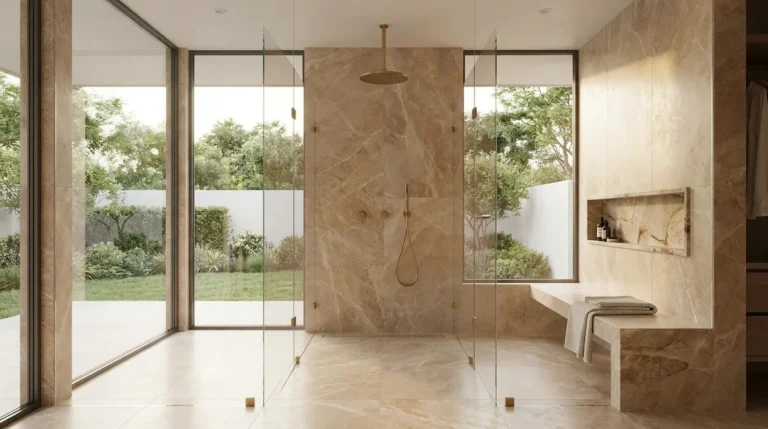
A shower niche — a recessed rectangular pocket built into the shower wall, typically during tile installation — is the most architecturally resolved shower storage solution because it uses the wall thickness rather than projecting into the shower space. When styled with matching bottles, it reads as a composed installation rather than a shelf with products on it.
The niche styling follows the same principle as any bathroom shelf: fewer objects, height variation, consistent material register. In a standard niche (typically 12 to 24 inches wide and 12 to 18 inches tall), three to four matching dispensers in a matte or frosted finish, one natural soap bar on a small stone or ceramic dish, and one small sculptural object (a smooth river stone, a small ceramic piece) creates a complete arrangement that reads as considered.
The niche interior can be tiled differently from the surrounding shower wall — a contrasting accent tile, a herringbone pattern, or a zellige interior — which makes the niche read as a designed feature rather than a gap in the tile. The tile choice inside the niche elevates its visual presence even before the products are placed.
2. A Double Niche for Separated Product Categories

A double-height or side-by-side niche configuration — two separate recessed pockets, either stacked vertically or positioned side by side at different heights — allows products to be organized by category or by user. In a shared shower, the separation provides each person’s products a defined zone; in a solo shower, the separation allows hair products on one shelf and body products on the other.
The visual advantage of the double niche is that each niche can be styled as a distinct composition rather than a single long shelf that’s easy to overcrowd. Two separate framed pockets — even with the same products — read as more organized than the same products spread across one long shelf.
The height difference between the two niches prevents the arrangement from reading as symmetrical. A niche positioned at eye height and a second niche positioned at chest height creates a relationship between the two that the eye reads as dynamic rather than static.
3. A Stone or Marble Niche Interior for Material Luxury

The material used to line the niche interior changes the niche’s character dramatically. A niche tiled in the same material as the surrounding shower wall reads as a practical storage pocket. The same niche lined in honed marble, travertine, or a contrasting stone tile reads as a designed feature — the material signals that the niche was thought about.
Honed stone in a niche interior is more forgiving than polished: the matte surface doesn’t show water marks or soap residue the way polished stone does, and it’s typically more slip-resistant if the niche floor receives product drips. A sealed honed marble or limestone tile in the niche interior requires periodic resealing but provides the most visually distinctive niche available.
The stone tone should relate to the shower’s overall palette. A white marble niche interior in a grey tile shower reads as a considered accent. The same marble in a warm stone tile shower reads as a continuation of the material story. A dramatically contrasting stone (black marble in a white tile shower) reads as a bold design decision that requires commitment from every other element in the shower.
4. A Built-In Stone Ledge as a Visual and Functional Feature

A built-in stone ledge — a horizontal projection from the shower wall, formed from the same stone as the shower surround or from a complementary stone — creates a shelf that reads as part of the shower’s architecture rather than added storage. It’s the shower equivalent of a window sill: a surface that belongs to the structure rather than sitting on top of it.
The ledge depth (front to back) determines its function. A ledge at 4 to 5 inches depth holds a soap bar and perhaps one container; a ledge at 8 to 10 inches is genuinely useful for bottles, a razor, and a shaving brush. The ledge thickness (top to bottom) affects its visual weight: a thin ledge at 1.5 to 2 inches reads as elegant and architectural; a thick ledge at 3 to 4 inches reads as more rustic.
The ledge position at knee or thigh height — rather than the standard shower niche position at chest height — creates an unexpected and considered architectural moment. It’s also more ergonomically practical for shaving: a lower ledge means a foot can rest on it for reach, rather than requiring awkward stretching for a knee-height razor.
5. Matching Decanted Bottles in a Matte or Frosted Finish

The single most impactful shower shelf styling decision is decanting products from their original branded packaging into matching, unbranded containers. Original product packaging — every color, shape, and graphic design representing a different brand — creates visual noise even when each bottle individually is inoffensive. Matching decanted bottles in the same finish (all matte white, all frosted glass, all amber glass) create visual calm because the eye registers one material family rather than ten competing designs.
The container format should suit the product type. A pump dispenser suits liquid shampoo, conditioner, and body wash — the pump allows single-handed dispensing under running water without having to remove a lid. A flip-top or press-top container suits conditioner or thick treatments. A small ceramic dish suits bar soap. A tall slim dispenser suits body oil.
The labeling of decanted containers is the practical detail most people overlook until they’re in the shower unable to distinguish shampoo from conditioner. Small waterproof labels — either printed or handwritten with a paint marker on a waterproof label — on the base or back of each bottle keep the product identification without disrupting the visual uniformity of the front.
6. Amber Glass Bottles for a Warm, Apothecary Aesthetic
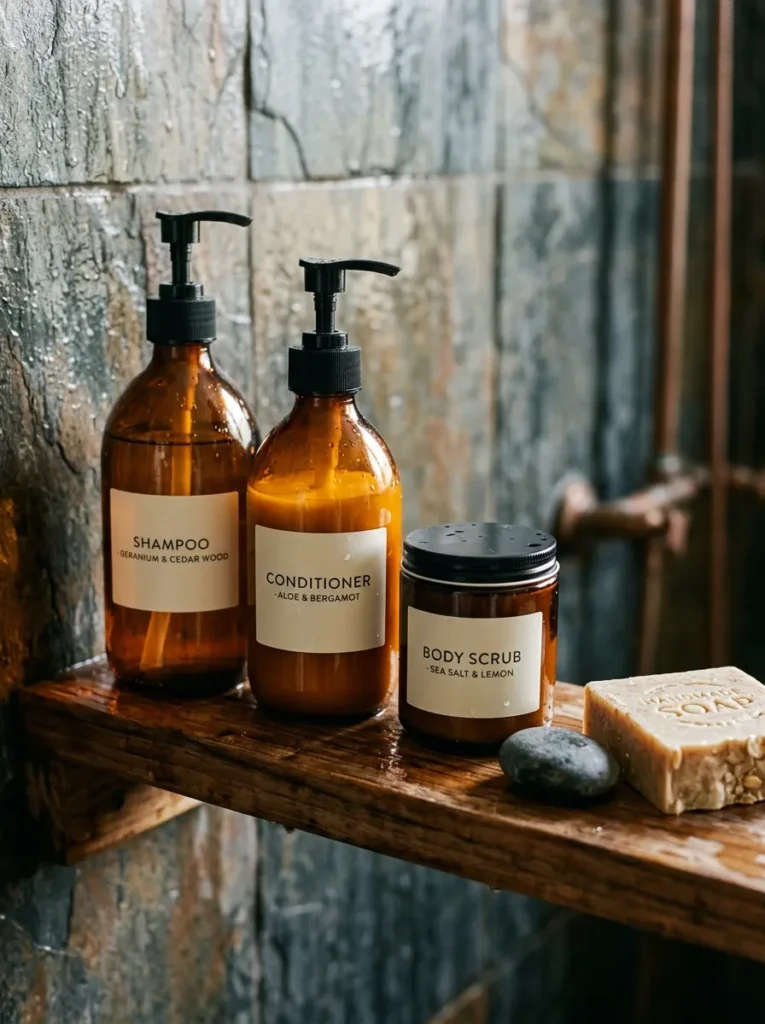
Amber glass bottles — in the same form factor as the matching decanted bottles concept, but specifically in warm amber-tinted glass — create a shower shelf with an apothecary or botanical aesthetic. The amber glass has a specific warmth that white or frosted containers don’t provide: it reads as natural and slightly vintage, and it relates naturally to the warm material palette (teak, stone, unlacquered brass) that most spa-inspired showers use.
The amber bottles work best when the shower has warm-toned tiles or fixtures — a beige stone shower, a warm terracotta tile, or a shower with aged brass or copper fixtures. Against cool grey tile or cool-toned stone, amber glass can read as mismatched rather than considered.
The bottle shapes within the amber collection should vary slightly in height and form to create visual interest: a taller thinner pump dispenser beside a wider shorter pump, and a flat-bottomed jar for the conditioner treatment. Identical bottles in the same size read as a uniform set; bottles in the same material but different proportions read as a curated collection.
7. Frosted White or Translucent Bottles for a Minimal, Clean Look

Frosted or milky-white dispensers — in a matte or slightly translucent finish — create a shower shelf with the cleanest, most minimal visual character available. The frosted white reads as spa-neutral: it suits any shower palette, any tile color, any fixture finish, and any design direction. It’s the most versatile decanting format and the most universally applicable starting point.
The minimalist approach with frosted bottles works best when the bottles are genuinely minimal in form — no visible branding, no decorative detail, no colored labels on the front. The cleanest versions have a simple pump mechanism in a matching matte finish (white pump on a white bottle) and no external ornamentation.
These bottles should be arranged with generous space between them. Three frosted pump dispensers on a wide shower niche, each 4 to 5 inches apart, reads as edited and intentional. Six frosted bottles touching each other fills the niche and reads as storage rather than styling, even in a uniform material.
8. A Single Bar Soap on a Drainage-Friendly Soap Dish

A single well-chosen bar soap on a proper soap dish — one designed for drainage rather than accumulation — elevates the shower shelf considerably relative to a liquid soap pump, because a beautiful bar of natural soap is inherently more visually interesting than any bottle. Hand-pressed soaps with visible botanical inclusions, natural goat milk soaps in cream tones, or dark charcoal soaps read as objects with visual character in their own right.
The soap dish material is the critical decision for shower use. A ceramic soap dish in a shower accumulates standing water and soap scum in the dish’s base unless it has drainage holes or a raised drainage design. A slatted wooden soap holder (in teak or bamboo) drains naturally between the slats; a stone soap dish with a raised ridge allows water to run off the sides; a wall-mounted magnet soap holder (the soap has an embedded magnet that attaches to a wall-mounted pin) eliminates the soap dish entirely and leaves the bar floating against the wall.
The magnetic soap holder is the most functionally elegant shower soap solution because it requires no dish to collect water and leaves the bar completely exposed to air between uses, extending the soap’s life considerably.
9. A Minimalist Two-Product Shelf: One Shampoo, One Body Wash

The most honest luxury shower shelf follows the hotel bathroom principle: only what’s needed for this shower, in this position, is visible. A hotel shower typically has two to three products — a shampoo, a conditioner, and a body wash — in matching containers at the shower position. Nothing else is on the shelf.
Applying this principle at home requires acknowledging that most people use more products in the shower than they need to display. Specialty treatments, face washes, shaving products, and body scrubs that are used occasionally can be stored elsewhere (in a cabinet drawer, in a hanging caddy that’s removed between uses) and brought into the shower only when needed. The permanent shelf holds only the daily-use products.
The visual result of this editing — a shelf with two or three matching products and nothing else — reads as more luxurious than a shelf crowded with everything available, because restraint is the visual signal of luxury. What’s removed from the shelf is as important as what’s placed on it.
10. A Teak Shower Caddy for Warmth and Natural Character

A teak shower caddy — either hanging from the showerhead arm or freestanding on the shower floor beside the fixtures — brings the warmth of natural wood into the shower in a material that’s genuinely suited to wet conditions. Teak’s natural oil content makes it resistant to water damage, mold, and the deterioration that untreated wood would experience in a shower environment.
The teak caddy’s warm honey-brown tone reads as one of the most genuinely spa-like materials in a shower context — it references the wooden elements of Japanese onsen bathing, Scandinavian sauna culture, and high-end boutique hotel bathrooms where natural materials are used without apology in wet zones.
The caddy should be allowed to dry fully between uses. A hanging teak caddy that’s in the shower spray path but has adequate drainage between the slats will last years with minimal maintenance. Occasional sanding (once a year) and oiling with teak oil restores the surface and extends the material’s life. Untreated teak will grey over time — a natural aging process that some people find more beautiful than the original honey tone.
11. A Corner Teak Shelf for an Unused Shower Corner

A freestanding or tension-mounted corner shower shelf in teak — a triangular shelf that sits in the shower corner — occupies the least-used shower space (the corners) while providing organized storage without requiring any drilling or permanent installation. The tension-mounted version uses pressure between the shower floor and ceiling to stay in place, making it renter-friendly.
The teak corner shelf’s triangular footprint gives it a different visual relationship to the shower space than a rectangular shelf — it reads as fitted to the corner rather than placed in front of it. In a tile shower where the corner is already a strong geometric feature, the triangular teak shelf emphasizes the corner as a designed zone.
The styling of a teak corner shelf should follow the same editing principles as any shower shelf: two to three bottles maximum per shelf tier, one soap dish, and nothing else. The teak’s material warmth does most of the visual work — products placed on it need only be consistent in material and minimal in number.
12. A Marble Shelf Ledge in a White or Grey Tile Shower

A marble shelf — a slab of honed marble cut to the shelf dimensions and either built into the wall during tiling or mounted to the finished tile surface with appropriate adhesive — provides the most material-rich shower shelf option available as an add-on rather than a built-in. The marble’s veining creates visual interest at the shelf level that a plain tile shelf or a glass shelf doesn’t provide.
The marble should be honed rather than polished for shower use. Polished marble is slippery when wet (a safety concern for a shelf surface where heavy bottles might slide), and it shows every water mark and soap residue more clearly than a honed finish. Honed marble has a matte, slightly more porous surface that reads as warmer and is more practical in continuous water contact.
The shelf’s width should suit the product arrangement intended for it: a shelf narrower than 6 inches limits product size; a shelf wider than 16 inches requires more products to fill the visible surface area. For a minimal two-product arrangement, 8 to 12 inches of shelf width reads as correctly sized.
13. A Floating Glass Shelf for a Light, Contemporary Look

A tempered glass shelf — mounted to the shower wall on stainless steel or chrome brackets — creates a shower shelf with complete visual transparency. The products on the shelf appear to float in the shower space, and the shelf itself contributes no visual mass or color to the shower’s appearance. In a contemporary shower with strong tile work, a glass shelf preserves the tile’s full visibility beneath and behind the shelf.
The glass must be tempered (safety glass) for any shower application — untempered glass in a shower is a safety hazard if it breaks. A minimum thickness of 6mm for a shower shelf is standard; 8 to 10mm provides more visual presence and greater rigidity for heavier products.
The bracket style is the design decision that determines the glass shelf’s overall character. Slim round chrome or stainless steel brackets read as minimally contemporary. Heavier black iron brackets read as more industrial. Aged brass brackets read as warmer. The bracket finish should relate to the shower’s other fixtures and hardware.
14. Eucalyptus or Fresh Botanicals on the Shower Shelf

A small bundle of fresh eucalyptus — tied with natural twine and hung from the showerhead, or placed in a small waterproof vessel on the shower shelf — is the single most photographed shower styling element for good reason: the steam from the shower activates the eucalyptus essential oils, creating a botanical scent that makes the shower feel significantly more spa-like.
The eucalyptus placement matters for both the scent effect and the visual result. Hung from the showerhead arm, a eucalyptus bundle hangs in the steam path and releases oils most effectively. Placed on a shelf away from the direct water spray, the eucalyptus contributes visual character but receives less scent-activating steam.
Fresh eucalyptus lasts approximately two to three weeks in a shower before drying out. Dried eucalyptus doesn’t release the same scent intensity but lasts longer and can remain on the shelf indefinitely. Replacing a fresh bundle every few weeks is a low-cost maintenance ritual that keeps the botanical element alive rather than becoming a dry, dusty decoration.
15. A Razor Holder That’s Part of the Display

A razor stored on a shower shelf without a holder reads as a functional object placed wherever it fits. A razor displayed in a dedicated holder — a magnetic wall-mounted razor holder, a small ceramic cradle on the shelf surface, or a leather strop-style wall mount — becomes a considered accessory rather than a necessity awkwardly present on the shelf.
The razor holder’s material should suit the shelf’s overall material palette. A matte black magnetic razor holder suits a contemporary shower with matte black fixtures. An aged brass razor stand suits a warm, apothecary-styled shower shelf. A small ceramic cradle suits a shelf styled with ceramic dispensers. The razor holder becomes part of the composition rather than breaking it.
For safety razors specifically — which have a heavier, more beautiful form than disposable or cartridge razors — displaying the razor on a stand rather than storing it horizontally is both more practical (the blade stays dryer and sharper) and more visually considered.
16. A Small Ceramic or Stone Object as an Anchor

Beyond the functional products, one small decorative object on a shower shelf — a smooth river stone, a small tumbled crystal, a tiny ceramic piece, or a pebble from a significant place — creates a visual anchor that signals the shelf was styled rather than simply loaded. The object doesn’t need to be expensive or sourced specially; it needs to be intentional.
The object’s material must genuinely suit the shower environment. Porous stones and untreated ceramics absorb water and can develop mildew in a sustained wet environment. Sealed stones, tumbled minerals (which have a naturally dense surface), glazed ceramics, and smooth glass objects all tolerate shower conditions without deterioration.
Positioning the decorative object at the end of the shelf arrangement — rather than in the middle where it competes with the products — gives it the role of a visual punctuation mark. It says the shelf is finished, and that everything to the left of it was chosen rather than placed.
17. A Shower Shelf Styled for a Specific Hair Type or Routine

Rather than styling the shower shelf around visual impression alone, organizing it around the actual hair routine in use sequence — shampoo first, conditioner second, treatment third — creates a shelf that functions as a visual protocol as well as storage. In matching containers labeled in the correct sequence, the shelf reads as a personal apothecary rather than a generic bathroom.
This approach is particularly useful in households where the shower is shared. Each person’s products can occupy a defined shelf zone — top niche for one person, bottom niche for another — in matching containers for each zone. The visual uniformity across both zones creates the impression of a styled unified system.
The products included should be genuinely limited to what’s used in every shower. A clarifying shampoo used once a week, a protein treatment used monthly, and a scalp scrub used occasionally don’t belong on the permanent display shelf. Only the products touched in every shower occupy the visible styling zone.
18. A Shower Shelf Paired with a Coordinating Shower Mat
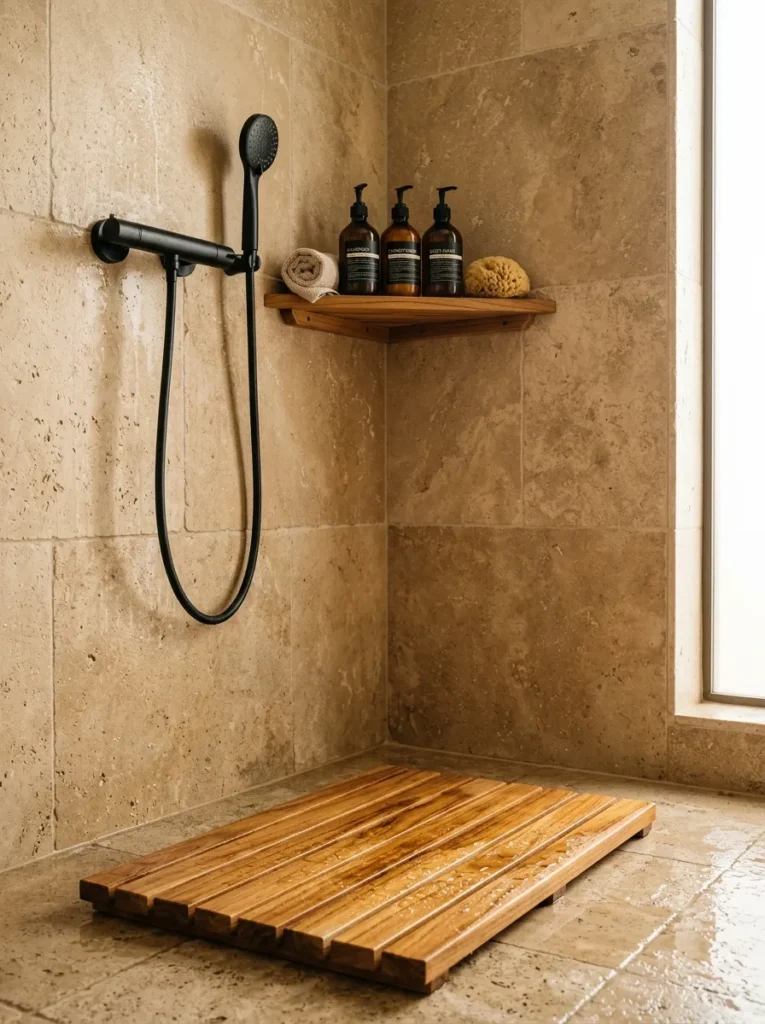
The shower floor mat — whether a teak slat mat outside the shower, a stone pebble mat inside the shower, or a natural fiber mat at the shower entrance — doesn’t sit on the shelf but relates to the shelf’s material palette in a way that makes the shower’s overall aesthetic read as considered from floor to shelf level.
A teak slat bath mat outside the shower relates naturally to a teak shelf or teak caddy inside the shower: the same material at different heights creates a vertical material narrative. A river pebble mat inside the shower floor relates to smooth stones as decorative objects on the shelf above: the same textural register expressed at different scales.
This pairing is the kind of detail that makes a bathroom read as designed rather than decorated. The individual elements are unremarkable; their material relationship is what elevates the overall impression.
19. A Rotating Shower Shelf Organization for Different Days

The most practically sustainable shower shelf is one that acknowledges the reality of shower routines: not every product is used every day. A two-tier organizational approach — a permanent visible tier on the shelf for daily-use products, and a secondary caddy or drawer outside the shower for products used two to three times per week — keeps the shelf consistently minimal without requiring unrealistic product editing.
The rotating approach means the permanent shelf holds three to five products maximum: the daily shampoo, conditioner, and body wash. The rotation items (deep conditioner, body scrub, shaving products, facial wash) live in a waterproof caddy in the bathroom cabinet and are brought into the shower when the routine calls for them.
The visual result is a shelf that always reads as edited — because it always is. The products that appear on the shelf are there because they’re needed today, not because they’ve accumulated over the course of many showers. This is the specific quality that hotel shower shelves have: they contain exactly what this shower, on this day, requires.
The Four Principles Behind Every Luxurious Shower Shelf
Before the specific ideas, four underlying principles explain why some shower shelves read as luxurious and others read as cluttered, regardless of the products they hold.
Restraint is the primary signal of luxury. A shelf with three products reads as chosen; a shelf with twelve reads as accumulated. Every product on the shower shelf should be examined individually: does this need to be visible, or can it be stored and retrieved when needed? The answer to that question, applied consistently, creates a shelf that reads as edited.
Material consistency across all objects. Products in the same container material — all amber glass, all matte white, all frosted — read as a collection. Products in varied original packaging read as a drugstore shelf. The container choice matters more than the product choice for the shelf’s visual impression.
The shelf material itself is part of the styling. A teak shelf, a marble ledge, and a glass shelf each communicate a different aesthetic. The shelf’s material should be chosen as deliberately as the products placed on it.
Water management determines longevity. A shower shelf that looks luxurious on day one but accumulates soap scum, mold, and mineral deposits by day thirty has failed at the most practical level. Every material on the shelf — the shelf itself, the containers, the soap dish, the decorative object — must be genuinely suited to the wet shower environment. Beauty in a shower context requires genuine material durability.
Final Thoughts
A shower shelf that reads as luxurious isn’t the product of an expensive renovation or a specific brand of products. It’s the product of consistent editing decisions: fewer objects, matching containers, the right shelf material for the environment, and one or two specific touches — a eucalyptus bundle, a beautifully weighted bar of soap on a drainage dish, a smooth stone at the end of the arrangement — that signal the shelf was considered rather than loaded.
If you’re starting from scratch with the simplest approach, Ideas 5 and 9 — decanting into matching bottles and editing down to only the daily-use products — deliver the most dramatic improvement for the least investment. The same shampoo, conditioner, and body wash, in matching frosted pumps with two products visible rather than eight, creates a shower that reads as genuinely different.
For showers with the budget for a material upgrade, Ideas 1, 3, and 12 — the styled recessed niche, the stone niche interior, and the marble shelf ledge — create the architectural foundation that makes any product arrangement above it look considered.
Save the ideas that suit your shower’s architecture and your daily routine, and return to the four principles before finalizing any arrangement. The principles are more durable than any specific product recommendation.