
21 Afrohemian Living Room Ideas to Try in 2026
Afrohemian design has been described as Pinterest’s defining home trend for 2026, and the description captures something real: this is a design sensibility whose time has arrived not because a forecasting algorithm decided it, but because it reflects a growing cultural confidence among homeowners who want their living rooms to tell a genuine story. The style merges African design aesthetics — the bold geometry of Kente cloth, the sculptural quality of hand-carved wood, the earthy depth of mudcloth, the architecture of woven basketry — with the layered, curated, pattern-embracing freedom of Bohemian interior design.
What makes Afrohemian distinctive from either of its source aesthetics is what happens at their intersection. African craft traditions bring cultural depth, intentional geometry, and material quality that pure Bohemian styling sometimes lacks. Bohemian’s layering philosophy and relaxed, collected quality give African design elements room to breathe in a Western living room without the formality of a museum or the decorative distance of a themed room. The result, when it works, is a living room that reads as genuinely personal: rich with texture and pattern, grounded in earthiness, and deeply expressive without being consciously designed.
These 21 ideas move through the full scope of Afrohemian living room design — palette, furniture, textiles, art, lighting, and plants — with enough specificity about which African design traditions, which material choices, and which compositional decisions produce the most authentic and livable result.
1. Build the Palette From Earth and Clay Tones as the Foundation

An Afrohemian color palette is generally focused on rich, natural hues inspired by global landscapes. The specific tones that anchor an Afrohemian living room most effectively are those pulled directly from the earth: terracotta and warm clay, deep sienna and rust, sandy ocher, warm chocolate brown, and the muted warm blacks of natural charcoal. These are not colors that reference nature abstractly — they are the colors of the actual materials (fired clay, red laterite soil, sun-dried mud brick, smoked wood) that appear in the African design traditions the style draws from.
The palette reads most resolved when it operates as a tonal family rather than a strict color matching exercise. Terracotta walls, a rust-toned rug, sienna throw pillows, and a warm chocolate leather sofa all belong to the same warm-red earth family and create visual coherence even though no two items are the same color. Adding cooler tones — a deep teal, a dusty sage, or a muted cobalt — provides the contrast that prevents the warm palette from feeling monotonous without departing from the earthy register.
2. Anchor the Room With a Statement Sofa in Warm Neutral Upholstery

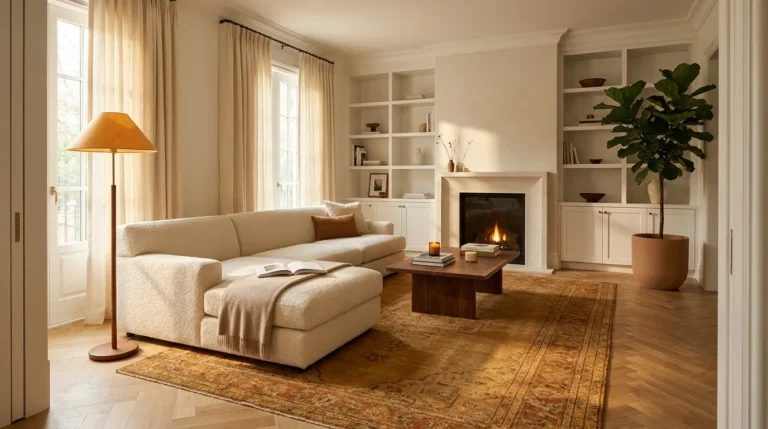
When thoughtfully positioned against textured white walls and paired with natural elements like rattan pendant lights and a handcrafted wooden coffee table, these stunning mid-century modern apartment ideas interior designers love create a space that balances bold cultural expression with everyday livability. The sofa in an Afrohemian living room is almost always a neutral foundation — warm cream, sandy linen, deep chocolate, or warm taupe — rather than a patterned or brightly colored piece, because the statement-making in this style comes from the layered textiles, art, and objects around the sofa rather than from the sofa itself.
A low-profile sofa with clean lines that references mid-century African modernism suits the style particularly well: the architectural simplicity of the sofa allows the surrounding richness to read clearly without visual competition. Upholstery in a woven linen texture, bouclé, or heavyweight cotton adds material quality to the neutral tone and relates to the handmade textile traditions the style celebrates.
3. Choose a Rich Earth-Toned Accent Wall to Ground the Space

An accent wall in a deep, rich earth tone — terracotta, warm rust, burnt sienna, or a deep earthy teal — serves as the Afrohemian living room’s primary color commitment and creates the grounded backdrop against which everything else in the room can be seen clearly. Where a neutral white wall makes African art and textile patterns float without context, a rich earthy backdrop gives them the warm ground they were often designed against in their original contexts.
The wall behind the sofa or the fireplace wall are the natural candidates. Limewash or a slightly textured finish on this wall produces a surface that shifts tonally with the light — richer in shadow, warmer in direct light — which relates to the craft-made quality that Afrohemian design values. Against this backdrop, natural wood, handwoven textiles, and African art objects all read with greater clarity and warmth than they do against a bright white or cool grey wall.
4. Layer Multiple Patterned Rugs for Depth and Warmth

One rug is good. Two rugs? Better. Start with a neutral base rug. Layer a bold patterned rug on top for contrast. It adds depth and visual interest instantly. The layered rug is one of the most distinctively Afrohemian elements in a living room because it directly references both the textile-rich layering tradition of Bohemian design and the pattern boldness of African textile traditions. A large neutral jute or sisal base rug establishes the floor’s material register; a smaller, bolder patterned rug — one that references African geometric traditions in its design — sits on top, centered on the seating arrangement.
The patterned rug doesn’t need to be an exact reproduction of a specific textile tradition to carry the Afrohemian spirit: abstracted geometric patterns in deep terracotta, black, and cream, or bold chevron and diamond patterns in warm earthy tones, all reference the visual vocabulary of African weaving without the specificity of a museum piece. The overlap between the two rugs should feel deliberate — the upper rug centered on the sitting area with its border clearly within the base rug’s field.
5. Incorporate a Hand-Carved Wooden Coffee Table as the Room’s Material Anchor

The mix of natural materials like rattan, handwoven baskets, and clay pottery creates a warm, tactile environment that connects you to craftsmanship traditions while serving practical storage and display functions. A carved wooden coffee table — one where the craftsmanship is visible in the joinery, the surface texture, or the sculptural quality of the legs — brings the material depth and handmade character that mass-produced furniture can’t replicate and that is central to the Afrohemian aesthetic.
African woodworking traditions produce forms that are both functional and sculptural: tables with carved animal motifs, geometric relief patterns in the surface, or legs that reference architectural forms. In a living room context, even a simpler piece — a solid dark wood table with visible hand-finishing or an organic form that references a natural object — carries this quality. The coffee table’s scale should be generous: in a style where the floor level is important (poufs, floor cushions, low seating all feature prominently), a coffee table that’s too small reads as a detail rather than an anchor.
6. Use Rattan, Wicker, and Cane Furniture for Organic Structure

You will also want to look for patterns and textiles that add depth to the space while incorporating natural elements like wood, rattan, bamboo, jute, sisal, and clay. Rattan and wicker furniture in an Afrohemian living room provide the organic structure — chairs, side tables, pendant lights, storage baskets — that bridges the African and Bohemian traditions. Both aesthetics have deep historical relationships with woven natural fiber furniture; West African craft traditions include highly refined basketry and woven furniture forms, and Bohemian design has long celebrated the natural, handmade quality of rattan. Remodel Or Move
A rattan accent chair with a loose cushion in a bold patterned fabric — Kente-inspired stripes, a mudcloth geometric, or a tribal diamond pattern — exemplifies the Afrohemian combination at its most direct: the material tradition of African basketry meets the pattern tradition of African textiles in a single piece that reads as relaxed and collected rather than formally styled.
7. Create a Gallery Wall That Combines African Art, Textiles, and Photography

The gallery wall in an Afrohemian living room is its most personal and most distinct feature. Where a conventional gallery wall uses framed prints in coordinated finishes, the Afrohemian gallery mixes dimensional objects — a hand-carved mask, a small woven basket panel, a piece of textile art — with framed photography, abstract art in earthy tones, and perhaps a small mirror in a natural wood frame.
The cohesion in this mixed arrangement comes from palette and scale rather than format. All elements should share the warm earthy color register — even photography should be chosen for its tonal warmth. The arrangement should have a clear center of gravity — a larger anchor piece from which smaller elements radiate — and a defined boundary that prevents the gallery from dissolving into the surrounding wall. Behind a dark or earthy-toned wall, the gallery’s dimensional objects create visible shadow that adds depth at the wall level.
8. Layer Mudcloth Textiles Throughout the Room

Mudcloth — known as bògòlanfini in the Bambara language of Mali — is one of the most widely recognized African textiles in contemporary Western design, and for good reasons that go beyond its visual appeal. The geometric patterns on authentic mudcloth are narrative and communicative: they reference cosmological and historical meanings specific to the communities where the fabric is produced. The natural fermented mud dyeing process on handspun cotton creates a surface that varies slightly from piece to piece, so each cloth is unique.
In a living room, mudcloth appears most naturally as throw pillows, a draped throw across the sofa back, or a framed textile mounted on the wall. Its characteristic black-and-white or dark-brown-and-cream geometric patterns provide the bold pattern presence that Afrohemian spaces need while remaining visually restrained compared to more colorful African textile patterns. Mudcloth pairs particularly naturally with warm rust, terracotta, and sienna tones — the earth palette that the mudcloth dyeing process itself references.
9. Bring in Kente Cloth or Kente-Inspired Pattern as an Accent

Kente — the brilliantly colored woven silk and cotton cloth produced by the Ashanti people of Ghana — is one of the most complex weaving traditions in the world, using a strip-weaving loom to create narrow bands of intricate pattern that are then sewn together into larger cloths. In a living room, authentic Kente cloth or Kente-inspired textiles with their characteristic horizontal and vertical stripe geometry and vivid color combinations — gold, green, red, black, royal blue — provide the living room’s strongest color moment.
The approach that works best in an Afrohemian living room: use Kente or Kente-inspired fabric in one or two deliberate positions — a set of throw pillows on the sofa, a framed section of cloth on the gallery wall, or a stool cushion — rather than distributing it throughout the room. The cloth’s inherent visual power means a small amount goes a long way; multiple competing Kente elements reduce the impact rather than multiplying it.
10. Introduce Poufs and Floor Cushions for Communal, Low Seating

Low seating instantly makes a room feel relaxed and communal. It encourages conversation and creates a cozy, grounded feel. Floor cushions and poufs are perfect here. The inclusion of floor-level seating in an Afrohemian living room references both the communal seating traditions of many African interior spaces — where floor seating around a central point is the norm rather than an accommodation — and the Bohemian preference for relaxed, informal gathering arrangements that don’t require all guests to occupy a sofa.
Leather poufs in warm cognac or dark tan, handwoven cotton floor cushions in earthy geometric patterns, and natural rattan ottomans with loose cushions all suit the Afrohemian context. The flexibility of floor seating also suits the practical reality of a living room that functions for multiple purposes — the poufs tuck under the coffee table when not in use, the floor cushions stack in a corner, and the room’s footprint remains clear when maximum floor space is needed.
11. Hang Woven Baskets on the Wall as Three-Dimensional Art

Basket-weaving traditions across the African continent produce some of the world’s most sophisticated woven objects: the coiled sweetgrass baskets of West Africa, the geometric palm-leaf baskets of East Africa, the bold graphic pattern of Ghanaian woven baskets, and the colorful raffia work of Central Africa all represent refined craft traditions with centuries of development. Hanging these baskets face-forward on a wall — as circular or oval three-dimensional objects that project from the wall surface — creates a gallery of material craft that no framed print can replicate.
A wall of baskets in graduated sizes, hung in an organic cluster, creates a textural and tonal composition where the different weave patterns and natural color variations of the plant fiber provide visual interest at close range while the circular forms create a simple geometric rhythm readable from across the room. The arrangement should mix basket scales — a few large baskets (18 to 24 inches diameter) with medium and smaller pieces — and allow the wall color to read between them.
12. Display African Sculpture and Figurative Art With Intention

This is where authenticity matters. Choose pieces that reflect real craftsmanship. Hand-carved masks, woven textiles, or pottery add depth you can’t fake. Figurative African sculpture — whether a carved wooden figure, a ceremonial mask displayed as art, or a cast bronze piece — carries a cultural weight that requires thoughtful display rather than casual decoration. These objects were created within specific cultural and spiritual contexts, and the decision to display them in a Western living room should be made with awareness of their origins and with respect for the traditions that produced them.
Display choices that honor the work: positioning sculpture at eye level or above, never on the floor; giving each significant piece enough space to be viewed without visual competition; choosing display surfaces (a carved wooden plinth, a natural stone base) that relate to the piece’s material context. A single significant sculpture, positioned deliberately and lit with directional light that reveals its three-dimensional form, communicates more than a collection of smaller pieces arranged as surface decoration.
13. Use Terracotta Ceramics and Clay Vessels Throughout

Terracotta — fired clay in its most elemental form — appears in the domestic material culture of virtually every African country in forms shaped by thousands of years of craft development. The water vessels, cooking pots, storage containers, and ceremonial objects produced in terracotta across West, East, and North Africa all share a material quality that no other ceramic reproduces: the warm red-orange of the fired clay, the slight porosity of the unglazed surface, and the hand-formed irregularities that distinguish each piece.
In a living room, terracotta ceramics appear most naturally as vessels — a large water pot converted to a plant holder, a cluster of smaller pots on a shelf or coffee table, a pair of large cylindrical vessels flanking the fireplace. The unglazed surfaces should be allowed to show the natural variation of the clay rather than being obscured with paint or a glaze, since the material quality of the terracotta is precisely what connects the object to the African craft tradition the style references.
14. Layer Plants With Sculptural and Lush Qualities Together

Plants = instant life. They soften bold decor and reinforce the nature-first aesthetic. The plant selection in an Afrohemian living room leans toward two complementary categories: architecturally sculptural species that relate to the geometric, structural quality of African design (snake plants, ZZ plants, large-leafed ficus varieties, monstera) and lush, full plants that reinforce the tropical-abundance quality of bohemian layering (trailing pothos, full Boston ferns, dense calatheas with their patterned leaves).
The combination of both types creates a plant arrangement where each species contributes a different quality: the sculptural plants provide the vertical geometric element, the lush plants provide organic fullness and movement. Large plants in terracotta pots placed at floor level, smaller plants in natural fiber hanging baskets, and medium plants on natural wood shelves or carved wooden stools create a layered, abundant quality that suits the Afrohemian aesthetic’s preference for visual richness over restraint.
15. Install Warm, Layered Lighting With Low-Hanging Pendants

Harsh overhead lighting works against every quality that Afrohemian design values: the rich warmth of earth tones, the depth of carved wood surfaces, the shadow play in woven textiles, and the intimate quality of a living room designed for gathering and conversation. The lighting approach that most supports the aesthetic uses multiple warm light sources at lower heights — pendant lights, table lamps, and floor lamps — rather than relying on a single overhead fixture.
A natural rattan or woven fiber pendant hung low over the coffee table provides focused warm light at the room’s social center. Two table lamps in ceramic or carved wood bases on either side of the sofa provide the mid-height ambient light that makes the room feel inhabited. A floor lamp beside a reading chair completes the layered arrangement. The bulbs throughout should be warm-white (2700 to 3000 Kelvin) to maintain the earthy warmth of the palette under artificial light — cooler bulbs flatten the terracotta and rust tones that anchor the room.
16. Mix African Textile Patterns Without Visual Chaos

Afrohemian style loves patterns. And yes, you can mix them without visual chaos. The trick is balance. Choose one dominant pattern and let others support it. Pattern mixing is one of the most characteristic qualities of Afrohemian design — and one of the most intimidating for people new to the style. The approach that produces a cohesive rather than chaotic result establishes a clear pattern hierarchy: one bold large-scale pattern that anchors the room (a patterned rug, a large mudcloth textile, a bold sofa cushion in a prominent fabric), one medium-scale pattern that relates to the dominant (a smaller pillow pattern that shares the first’s color family), and one subtle texture or very small pattern that provides depth without competing.
The color discipline that makes this work: keep all patterns within the same earthy palette family. Bold patterns in terracotta, black, and cream mix without conflict because they share the same color temperature. Introducing a pattern with significantly different colors — a bright yellow or cool blue pattern beside warm-toned patterns — breaks the palette coherence that holds the other patterns together.
17. Use a Statement Accent Chair in African-Inspired Upholstery

A statement accent chair with vibrant African-inspired upholstery and carved wooden legs instantly becomes the focal point in an Afrohemian living room, injecting personality while providing a dedicated spot for reading or conversation. The accent chair in an Afrohemian living room is the piece most directly expressive of the style’s African heritage — it can carry a pattern, a material quality, or a silhouette that references African design traditions in ways that the neutral sofa deliberately doesn’t. Trendsoraa
A velvet chair in a deep forest green with carved wooden legs, a rattan barrel chair with a mudcloth cushion, or a wingback upholstered in a Kente-inspired stripe all create the statement accent that pulls the room’s design identity together at a single functional piece. The chair should be sized and positioned to create a conversation grouping with the sofa rather than sitting isolated in a corner — Afrohemian design values communal gathering, and the furniture arrangement should reflect that.
18. Create a Dedicated Shelf or Vignette for Collected Objects

The collecting dimension is fundamental to both the African and Bohemian traditions that Afrohemian merges. Many of the objects that appear in the style’s most authentic expressions are genuinely collected — brought back from travel, inherited, found at a market, or commissioned from a specific maker — rather than purchased as a coordinated set. A shelf or surface dedicated to a curated collection of objects with genuine provenance creates one of the most personally meaningful features in an Afrohemian living room.
The vignette might include: a piece of naturally shaped driftwood, a small bronze casting, a hand-painted ceramic from a specific country, a section of antique textile mounted as a small frame, and a living plant in a terracotta pot. The objects don’t need to be African in origin to belong — the Bohemian dimension of the style embraces global collecting — but they should share the warm, earthen material quality that unifies the room’s overall palette.
19. Add a Tribal-Inspired Geometric Rug as the Room’s Pattern Foundation

Where the layered rug approach in idea 4 uses a patterned piece on top of a neutral base, an alternative that suits rooms where floor-level simplicity is preferred is using a single large rug with a strong tribal-geometric pattern as the room’s primary pattern foundation. Diamond patterns, chevron arrangements, stepped pyramid designs, and radiating geometric motifs all appear in African weaving traditions and in the Western interpretations of those traditions that make the style accessible to contemporary American living rooms.
The rug’s palette should anchor the room’s color choices rather than following from them. Choosing the rug first — typically the largest single pattern element in any room — and building the upholstery, wall color, and textiles around it produces a more cohesive result than choosing the furniture and trying to find a rug that matches everything already in the room. A rug in deep terracotta, black, and cream with a bold geometric pattern gives the room a clear color and pattern language from which every subsequent decision can draw.
20. Paint or Limewash the Walls in a Warm Plaster White as a Neutral Ground

Not every Afrohemian living room needs a dark or deeply colored accent wall. A warm plaster white — not the cool, stark white of a minimalist interior but a white with a visible cream or sandy undertone that relates to the earthy palette — provides a neutral ground that allows the room’s objects, textiles, and art to read clearly without a competing background color.
The limewash or venetian plaster technique is particularly effective here because the surface’s natural tonal variation — slightly warmer in shadow areas, slightly lighter where light rakes across the surface — creates the organic, hand-made quality that relates to the craft traditions the style celebrates. Against this warm plaster ground, the terracotta ceramics, carved wood, woven baskets, and bold textiles read as a curated collection against a gallery wall rather than a decorated room.
21. Let the Room Feel Lived-In Rather Than Styled to Perfection

The quality that ultimately distinguishes an Afrohemian living room that works from one that reads as a decorated theme room is the sense that the space has been assembled over time by someone with genuine connection to the objects and traditions it references. A room where everything was purchased simultaneously from a single retailer, where every object is uniformly new, and where the pattern mixing is too precise reads as a curated reproduction of the aesthetic rather than an expression of it.
The lived-in quality comes from allowing imperfection: a rug that doesn’t lie perfectly flat, a collection of candles in various stages of burning, a stack of books beside the sofa that actually gets read, a plant that’s in the slightly awkward stage between sizes. These are not failures of styling — they are evidence that the room is used and loved, which is precisely the quality that both African domestic design traditions and Bohemian philosophy celebrate. An Afrohemian living room should feel like the most comfortable, expressive version of home for the specific person who lives in it.
Building an Afrohemian Living Room With Intention and Respect
Afrohemian design draws from cultural traditions with deep histories and specific meanings. The approach most likely to produce a living room that’s genuinely respectful of those traditions — rather than superficially decorative — emphasizes authentic craftsmanship over mass-produced pattern reproduction, learning about the specific traditions being referenced rather than treating African design as a single undifferentiated aesthetic, and centering objects and textiles that were made by makers within the traditions being celebrated.
This doesn’t mean every object in the room needs to be purchased directly from an African artisan or sourced from a specific country of origin. It means being intentional: understanding that mudcloth from Mali carries a different meaning than a mudcloth-pattern print on polyester, knowing that a genuinely hand-carved mask is a different object from a factory-produced decorative carving. The investment in authentic craftsmanship — even when it costs more — is what gives the aesthetic its depth and what makes the room feel genuinely rich rather than decoratively themed.
Final Thoughts
Afrohemian design is among the most personally expressive and visually rewarding interior styles available to living rooms in 2026 precisely because it has no rigid rules. Its flexibility comes from the richness of the African design traditions it draws from and from the collecting, layering philosophy of the Bohemian sensibility it combines them with. There’s room within the style for the minimal and the maximalist, for the globally collected and the locally sourced, for the apartment dweller working with a few key pieces and the homeowner building a fully committed interior.
Start with the palette — the warm earthy tones are the foundation everything else rests on. Then choose the most significant object in the room: a statement rug, a carved coffee table, or a gallery wall that means something. Build outward from there, one layer at a time, with the patience to add things gradually rather than all at once.
Save the ideas here that resonate with your personal aesthetic and your existing space, and return to this guide as the collection grows.