
22 Small Guest Bedroom Ideas That Feel Cozy and Functional
The small guest bedroom faces a design challenge unique to every other room in the house: it needs to feel comfortable, welcoming, and thoughtfully equipped — but only for guests, only occasionally, and within a floor plan that may leave very little room to achieve any of those things. The instinct is to prioritize practicality at the expense of warmth, or to prioritize aesthetics at the expense of usability. A room full of storage that feels clinical. A beautifully styled room with no space for a guest to set down their bag.
These 22 ideas show how cozy and functional are not opposite objectives in a small guest bedroom. They are the same objective, achieved through specific furniture choices, space strategies, layering decisions, and the hospitality details that make a guest feel genuinely welcomed rather than simply accommodated.
1. Choose a Bed With Built-In Storage to Eliminate the Need for a Separate Dresser

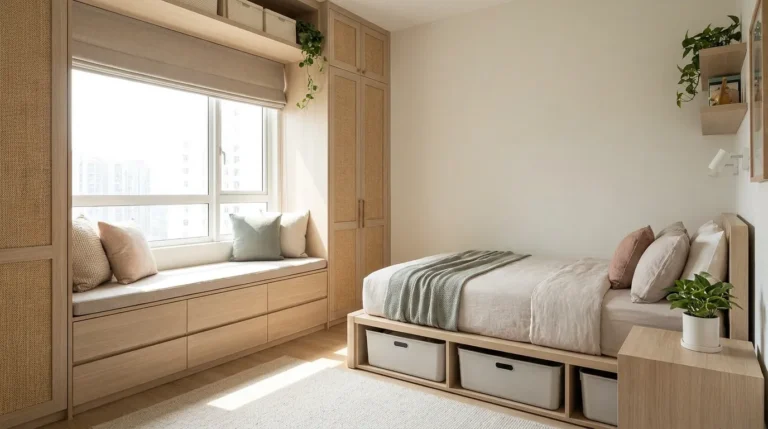
In a small guest bedroom, every piece of furniture carries two costs: the footprint it takes on the floor and the visual weight it adds to the room. A storage bed — one with drawers built into the base, accessible from the side or foot — resolves both costs simultaneously. The bed provides the sleeping surface and removes the need for a separate dresser, chest of drawers, or storage chest, freeing the room’s remaining floor space for circulation and any additional furniture the room can actually accommodate.
The drawers should hold enough for the guest bedroom’s full linen supply: extra blankets, a spare pillow, folded towels, and the items a guest may need to retrieve during a stay without asking. A platform storage bed with flat drawers on both sides of the base provides the most accessible storage while maintaining a low, clean silhouette that reads as intentional rather than a space-constrained compromise.
2. Use a Daybed for a Room That Serves Double Duty Year-Round

A daybed reads as a sofa during the day and a comfortable sleeping surface when guests arrive — which makes it the most versatile furniture choice for a small guest bedroom that needs to function usefully when not hosting. Positioned against a wall with several throw pillows leaning against the back, the daybed reads as a sitting piece. Made up with sleeping linens and a single head pillow, it clearly reads as a bed.
This dual function makes the room feel intentional year-round: it serves as a reading room, a quiet sitting area, or a home office perch for most of the year, and transitions smoothly into a guest sleeping space when needed. A twin-size daybed at 38 to 39 inches wide provides comfortable sleeping for one adult. A full-size daybed at 54 inches accommodates guests who prefer more sleeping room and still functions as a generous sitting piece during non-guest periods.
3. Install a Murphy Bed and Style the Surrounding Wall as a Design Feature

A Murphy bed — a bed that folds into a wall cabinet when not in use — restores the room’s entire floor area when guests aren’t staying. But the wall cabinet the bed folds into is the Murphy bed’s most overlooked design element: it occupies the room’s primary wall and reads as the room’s dominant visual statement whether the bed is deployed or stored.
The Murphy bed surround — the cabinet panels, integrated shelving on either side, the finish material — should be treated as a built-in design feature rather than a concealment mechanism. A Murphy bed cabinet in warm oak with flanking open shelves styled with books and ceramics reads as an architectural wall installation. A symmetrical surround at the same depth and finish on both sides creates a composed built-in that functions as the room’s primary decor even when the bed is invisible. The wall above and beside the bed becomes as important as the bed itself.
4. Position the Bed Against One Full Wall to Maximize Open Floor Area

The bed’s position within a small guest bedroom determines the floor plan more than any other single furniture decision. A bed centered in the room — requiring clear circulation on both sides — consumes significantly more floor area than the same bed positioned flush against one wall and accessible from one side only.
Moving the bed to one full wall maximizes open floor space in a single step: the floor that would have been the unused second side of the bed becomes usable circulation, seating, or storage space. Guests access the bed from one side comfortably, and the freed floor area can hold a small chair, a low dresser, or simply open floor that makes the room feel measurably less constrained. A wall-mounted reading sconce replaces the bedside table that can no longer fit against the wall.
5. Choose a Low-Profile Platform Bed to Make Ceiling Height Feel More Generous

The ceiling height of a small room is fixed — but its perceived height changes based on the furniture within it. A tall bed frame, an elevated mattress on a box spring, and a thick mattress stacked above all of it can consume 24 to 28 inches of vertical space and make the ceiling feel close regardless of its actual measurement.
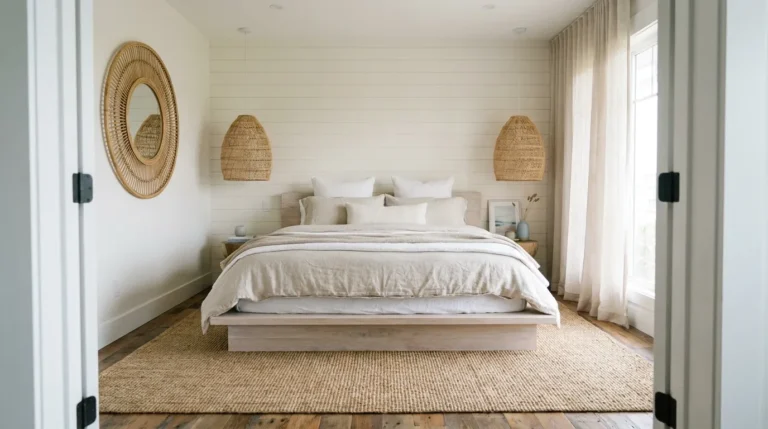
A low-profile platform bed — a frame with minimal base height, no box spring, and a low or slim headboard — creates a longer visual distance between the bed surface and the ceiling. This additional perceived vertical space makes the room read as more open and less confined. In a small guest bedroom with a standard 8-foot ceiling, a platform bed at 12 to 18 inches total height reads as significantly more spacious than a standard bed at 24 to 26 inches. The ceiling appears higher; the room breathes more.
6. Hang Floor-to-Ceiling Curtains to Add Vertical Height and Warmth

Curtains installed at ceiling height — with the rod mounted at or very near the ceiling line and the panels falling to the floor — do two things simultaneously in a small guest bedroom. They exaggerate the room’s apparent vertical dimension by drawing the eye upward in one continuous movement from floor to ceiling. And they create the enclosed, enveloped feeling that makes small rooms feel cozy rather than simply compact.
The rod should be mounted as close to the ceiling as the room’s architectural detail allows — 2 to 4 inches below the ceiling line achieves the full-height effect without requiring custom lengths. The panels should be slightly generous in width: 1.5 to 2 times the window measurement so they have visible fullness when closed and frame the window generously when open. A heavier linen or velvet panel in a warm neutral delivers the maximum sense of enclosure, warmth, and considered design.
7. Use a Large Mirror to Create Visual Depth and Double the Room’s Light

A large mirror in a small guest bedroom accomplishes two things that paint and furniture cannot: it creates the visual impression of depth by reflecting the room behind the mirror’s plane, and it multiplies the room’s effective natural light by bouncing window light to the walls and ceiling it faces.
Position matters more than size. Placed directly opposite the room’s primary window, a large mirror reflects the full window opening and the natural light entering through it — doubling the reach of that light into the room’s darker zones. Placed on the wall beside the bed, a tall mirror creates a vertical focal point and reflects the room’s best styling angle. A leaned floor-length mirror reflects both ceiling and floor simultaneously, making both feel further apart. This is also the hospitality function most guest rooms neglect: guests need a mirror for their morning routine, and a large one earns its floor space many times over.
8. Paint the Walls and Ceiling the Same Color for a Cozy, Enveloped Feel

The standard advice for small rooms — paint them white — produces bright, neutral spaces that don’t necessarily feel warm or inviting. Painting the walls and ceiling the same color achieves both spatial and atmospheric goals simultaneously and is among the most impactful single decisions available in a small guest bedroom.
When walls and ceiling share one tone, the room’s interior reads as a continuous envelope. The eye doesn’t stop at the ceiling line the way it does when two different colors meet there. This visual continuity makes the room feel more immersive and more intentional — more like a private, deliberate space and less like a small, plain room. A warm sage, a soft clay, a muted warm greige, or a deep but approachable tone creates a guest room that feels genuinely cozy. The enveloped quality is the quality guests most often describe when they say a small room felt surprisingly comfortable.
9. Choose Bedding in One Dominant Tone for Visual Calm and Containment

In a small guest bedroom, the bed is typically the largest object in the room. How the bedding is composed has a proportional effect on how the room reads from the doorway: a bed made up in four competing colors and mismatched patterns reads as visually large and dominant — filling the room’s visual field. A bed made up in one dominant tone — all warm white, all sage, all cream, all soft linen — reads as contained, purposeful, and lighter within the small room.
The single-tone bed does not require a sparse or minimal look. Within the dominant tone, textures can vary: a linen duvet, a woven cotton blanket folded at the foot, a subtly striped pillowcase. The tonal continuity is the organizing principle — not uniformity of material. The bed reads as one composed element rather than competing parts, which gives the room visual breathing room on all sides of it.
10. Replace the Traditional Nightstand With a Wall-Mounted Shelf

A conventional nightstand in a small guest bedroom consumes 4 to 5 square feet of floor space beside the bed. A wall-mounted shelf at nightstand height replaces every function of that nightstand — surface for the lamp, a glass of water, a book, a phone — without any floor footprint at all.
The shelf should be installed at approximately the same height as a standard nightstand surface: between 24 and 28 inches from the floor, or roughly level with the top of the mattress. In the same wood tone as the bed frame, it creates visual continuity; in a contrasting material — marble, raw oak, painted white — it adds a deliberate design note. A wall-mounted sconce installed immediately above the shelf completes the bedside composition without requiring a table lamp. The wall-mounted shelf is the single swap that most consistently frees meaningful floor space in a small guest bedroom.
11. Add a Fold-Down Wall Desk to Create a Dual-Purpose Guest Room and Workspace

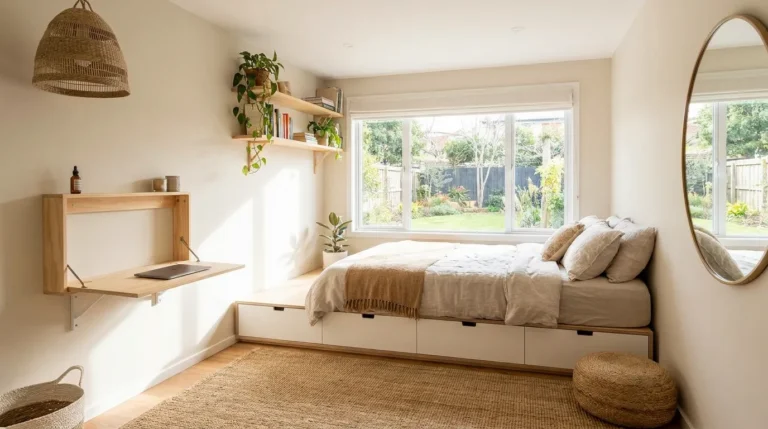
A fold-down wall desk — a work surface that mounts to the wall and folds completely flat against it when closed — creates a working desk that disappears entirely when guests don’t need it. When open, it provides a full surface for a laptop, a journal, or reading material. When closed, it is a flat panel on the wall — flush, minimal, and adding no visual bulk to the small room.
The fold-down desk works best positioned opposite or beside the bed, accessible from a lightweight stool that tucks neatly below it when not in use. The desk’s exterior face — the surface visible when closed — should coordinate with the room’s wall color or shelving so it reads as a considered design detail rather than an attached utility item. The room transitions from a home office to a guest bedroom without any furniture moving or storage required.
12. Use Every Inch of Under-Bed Space for Hidden Storage

The space beneath the bed is the most consistently available and most consistently underused storage area in a small guest bedroom. A bed with 8 to 12 inches of clearance beneath its base provides substantial hidden capacity for items that don’t need to be visible or accessed daily: extra blankets, seasonal pillows, spare linens, and flat-folded items a guest may need during their stay.
Flat rolling bins or shallow fabric storage boxes sized precisely to the under-bed clearance bring organization to this space without wasted height. Cedar-lined fabric bins are a specific hospitality detail worth noting: they protect stored blankets from moisture and leave a light cedar scent on the linens — an unobtrusive freshness a guest notices when they retrieve an extra blanket in the night. This is the kind of small detail that distinguishes a thoughtfully prepared guest room from one that is simply furnished.
13. Install a Hook Row Inside the Closet Door for Instant Guest Organization

A small guest bedroom closet rarely has space for both the guest’s hanging items and the homeowner’s overflow that may already occupy it. A row of four to six hooks installed inside the closet door — at coat-hanging height — provides immediate hanging storage for a guest’s jacket, tomorrow’s outfit, and carry bags without requiring a single additional inch of closet rod space.
Install the hooks between 60 and 66 inches from the floor — accessible to standing adults of varying heights. Matching hooks in brass, matte black, or natural walnut read as a purposeful installation rather than improvised hardware. A small full-length or half-length mirror mounted on the back face of the closet door completes the composition: the guest has a dressing mirror for the morning routine without consuming any floor space in the room itself.
14. Layer the Bed With Multiple Textile Textures for Genuine Warmth

The warmth and visual depth that make a guest bedroom feel genuinely inviting come from layering different textile textures on the bed — not from a single duvet and a matching pillowcase set. A linen duvet, a woven cotton throw folded at the foot, a lightweight knit blanket layered between, a pillow in velvet or boucle beside the standard sleeping pillows: each material adds a tactile dimension that the room reads as warmly layered and considered.
The layering principle: each textile should sit within the same tonal range — all warm whites, all sage greens, all warm neutrals — but in a different material. The variety within a tonal family creates depth and warmth without visual chaos. The layers also serve a practical hospitality purpose: a guest too warm can remove the throw; one too cold has an extra blanket immediately within reach. The layered bed is the guest room’s primary hospitality gesture — visible from the door, functional throughout the night.
15. Add a Dedicated Bedside Reading Lamp for the Guest’s Use

A small guest bedroom without a dedicated bedside reading light fails one of the most basic hospitality needs: the ability to read after dark without turning on the overhead fixture. A ceiling light provides general illumination — flat, bright, and impersonal. It is not a reading light, and it is not controllable without getting out of bed.
A wall-mounted sconce directly above the bedside position, a small table lamp on the wall shelf at nightstand height, or a clip-on reading light attached to the headboard provides focused, guest-controlled light at exactly the right height and angle. The bulb should be warm in tone — 2700K to 3000K — and dimmable if the room’s wiring allows. A guest who can control their own light, read in bed, and turn it off without leaving the mattress is a guest who feels genuinely at home. This single electrical detail makes the difference between a room that accommodates a guest and one that hosts them.
16. Create a Welcome Tray as the Room’s Hospitality Gesture

A welcome tray — a small curated selection of useful items arranged intentionally on a tray on the dresser, wall shelf, or bedside surface — is the small guest bedroom’s equivalent of the hotel room’s thoughtful setup. It signals that the room was prepared specifically for the arriving person rather than simply made available.
The tray might hold: a small glass carafe of water and a clean glass beside it, a travel-size hand lotion, a folded notecard with the wifi password and any household notes, a small stem in a bud vase, a tiny bowl for jewelry or keys. Every item should be useful to an arriving guest rather than purely decorative. The tray does not need to be elaborate — it needs to be deliberately composed and clearly placed for the guest’s benefit. This is the detail guests mention most consistently when describing a guest bedroom that felt genuinely welcoming. The welcome tray requires no budget, no renovation, and no square footage.
17. Add a Soft Rug at the Foot of the Bed for Bare-Foot Warmth

The floor of a small guest bedroom — particularly one with hardwood, tile, or laminate — is the first surface a guest contacts with bare feet when rising in the morning or during the night. A cold, hard floor in a dark room is a jarring sensory experience that undermines the room’s visual warmth immediately.
A rug at the foot of the bed — a runner or accent rug that covers the most-traveled path from the bed to the door — provides a warm, soft landing surface at exactly the point where it matters most. A rug extending at least 18 inches beyond the accessible side of the bed frame gives the guest’s feet a soft surface from the first step out of bed. Wool or cotton pile feels noticeably softer underfoot than flat-woven or jute alternatives. The rug’s tonal range should coordinate with the bedding so the floor element reads as part of the room’s designed palette.
18. Place a Small Chair or Ottoman at the Foot of the Bed

A small chair or upholstered ottoman at the foot of the guest bed provides a surface that most small guest rooms neglect: somewhere to sit that is not the bed, a place to lay tomorrow’s outfit, a surface to set luggage without bending to the floor, a perch for putting on shoes. These are basic physical needs in a room being actively used by a guest, and a room without any seat except the bed addresses none of them.
The piece should be proportionally compact — a slipper chair, an armless accent chair, or a square upholstered ottoman — sized to fit at the bed’s foot end without blocking the door or narrowing the room’s primary walkway. A lightweight chair that can be moved easily doubles as a desk chair if the room has a fold-down desk. Upholstered in a material that coordinates with the room’s bedding palette, it reads as part of the room’s design rather than furniture that was left over from somewhere else.
19. Add Warm Ambient Lighting at Low Height for Evening Atmosphere

The overhead ceiling fixture most small guest bedrooms rely on provides bright, flat light adequate for getting dressed and navigating the room — and completely wrong for the warm, restful atmosphere a cozy guest bedroom should have after dark. An overhead-only room after 9 p.m. feels like a utility space rather than a retreat.
A secondary light source at low height — a table lamp on the dresser, a small plug-in sconce beside the bed, a string of warm white lights along a shelf edge — changes the room’s entire evening character. The warm light at lower heights creates the layered, intimate quality that hotel rooms and genuinely cozy bedrooms share. The bulbs should be warm — 2700K or lower — and the shade or diffuser should soften the light rather than expose the bulb directly. One additional warm lamp at low height is the single most impactful atmospheric upgrade available in a small guest bedroom.
20. Style the Window Corner as a Reading Nook

In a small guest bedroom, the area beside or below the window is the room’s most naturally pleasant position for a seated activity: it has the best natural light, the room’s primary outdoor view, and a built-in sense of enclosure created by the window frame and adjacent wall. A small chair positioned here — with a floor lamp beside it for evening reading and a small table within reach — creates a reading nook that makes the room feel like a complete, livable space rather than a bedroom with nothing to do except lie down.
The chair should be sized appropriately for the space: a slipper chair, a narrow armchair, or a compact reading chair that fits without blocking window light for the rest of the room. During the day, it is the room’s most luminous seating position. After dark with the floor lamp beside it, it becomes a warm private spot that a guest on a multi-day stay may return to repeatedly — the detail that makes a guest bedroom feel like a room rather than just a bed.
21. Design the View From the Doorway — Style What a Guest Sees First

The moment a guest opens the door to the guest bedroom is the room’s most important moment. What they see in the first two seconds determines whether the room reads as prepared and welcoming or simply available. The first view from the doorway sets the emotional register of the entire stay — before the guest has touched the bedding, sat on the chair, or noticed the welcome tray.
Style specifically for this view: stand at the doorway with fresh eyes and evaluate what reads as the primary visual subject. In most small guest rooms, it is the bed and the wall directly behind it. The bed should be impeccably made. The wall behind it should have a single clear focal point — a piece of framed art, a leaned mirror, a simple floating shelf with one considered object. The lamp should be on, casting warm light. The rug should be straight. This sixty-second preparation changes the first impression more than any design decision made inside the room itself.
22. Add One Personal Detail That Says the Room Was Prepared for Someone Specific

Every other idea in this article addresses furniture decisions, spatial strategies, and aesthetic composition. This final idea addresses the quality that makes a guest bedroom feel genuinely welcoming rather than simply well-appointed: one personal detail that communicates the room was prepared for a specific person rather than made ready for anyone.
A handwritten note left on the bedside shelf. A small vase with a single fresh stem placed on the dresser. A book selected specifically for the guest’s known interests set beside the reading lamp. A seasonal candle with a scent connected to the time of year. A small ceramic bowl beside the welcome tray for jewelry or a phone. Any one of these details — modest, inexpensive, and personal — communicates that the room’s preparation included thought about the specific person arriving. That is the detail guests remember longest after every other element of their visit has faded.
Common Mistakes to Avoid
Using furniture that is proportionally too large for the room. The most consistent small guest bedroom error. A queen bed that leaves 18 inches of clearance on each side, a dresser that crowds the closet door, a nightstand that sits flush against the adjacent wall — each produces a room that reads as a storage problem rather than a guest room. Confirm every furniture dimension against the room’s actual floor plan before purchasing anything.
Neglecting dedicated guest lighting. A single ceiling fixture is not sufficient lighting for a guest bedroom. At minimum, add one bedside reading source that a guest can control independently and one warm ambient source at low height for evening atmosphere. A bright overhead light in an otherwise dark room communicates that the room was not prepared with a guest’s actual experience in mind.
Filling all available storage with the homeowner’s belongings. If the closet, the under-bed storage, and every shelf in the guest room hold the homeowner’s seasonal overflow, the guest has no place to put their belongings. Reserve at least half of any storage in the guest room for the guest’s use — this is the most basic and most frequently neglected functional requirement of the space.
Styling the room for the photograph rather than for the guest. Six decorative pillows that need to be removed and stored every night, a throw too delicate to use, a bedside surface too small to hold a lamp and a water glass — these are choices that prioritize the room’s visual appearance over the guest’s actual comfort during their stay. A guest bedroom should look beautiful and function well simultaneously.
No mirror accessible for the morning routine. A guest needs to see themselves before leaving the room. A small decorative mirror mounted high on a wall does not serve this function. A full-length or half-length mirror at a height accessible for dressing is a basic guest amenity — as fundamental as clean bedding and adequate lighting.
Final Thoughts
A small guest bedroom that feels cozy and functional is never the result of fitting as much furniture as possible into a limited footprint. It is the result of choosing each piece with clarity about its purpose, giving every square foot of floor a considered use, and adding the hospitality details that tell a guest — in a language more direct than words — that the room was prepared for them.
The most memorable guest bedrooms are rarely the largest. They are the ones where every decision — from the layered bedding to the welcome tray to the reading lamp that works — was made with the arriving guest in mind. Start with that person. The room follows.