22 Bedroom Accent Wall Ideas That Transform Your Space
A bedroom accent wall does something that full-room decorating rarely achieves: it creates a visual anchor without requiring every surface to carry the decision. Done well, it frames the bed, establishes the room’s character, and gives the eye somewhere specific to land. Done poorly — wrong wall, wrong scale, wrong relationship to the furniture — it competes rather than resolves.
These 22 bedroom accent wall ideas span a wide range of approaches, from paint and wallpaper to paneling, plaster, and fabric. Some are permanent and architectural; others are removable and renter-friendly. Some cost almost nothing; others require professional installation. Each idea includes enough practical context to help you decide whether it suits your specific room — not just whether it looks good in a photograph.
The wall behind the bed is almost always the right choice for an accent. It’s the wall you face from the doorway, it frames the headboard naturally, and it’s the least disrupted by furniture placement. A few ideas here work better on a side wall or ceiling — those are noted where relevant.
1. Limewash Paint for a Layered, Organic Finish
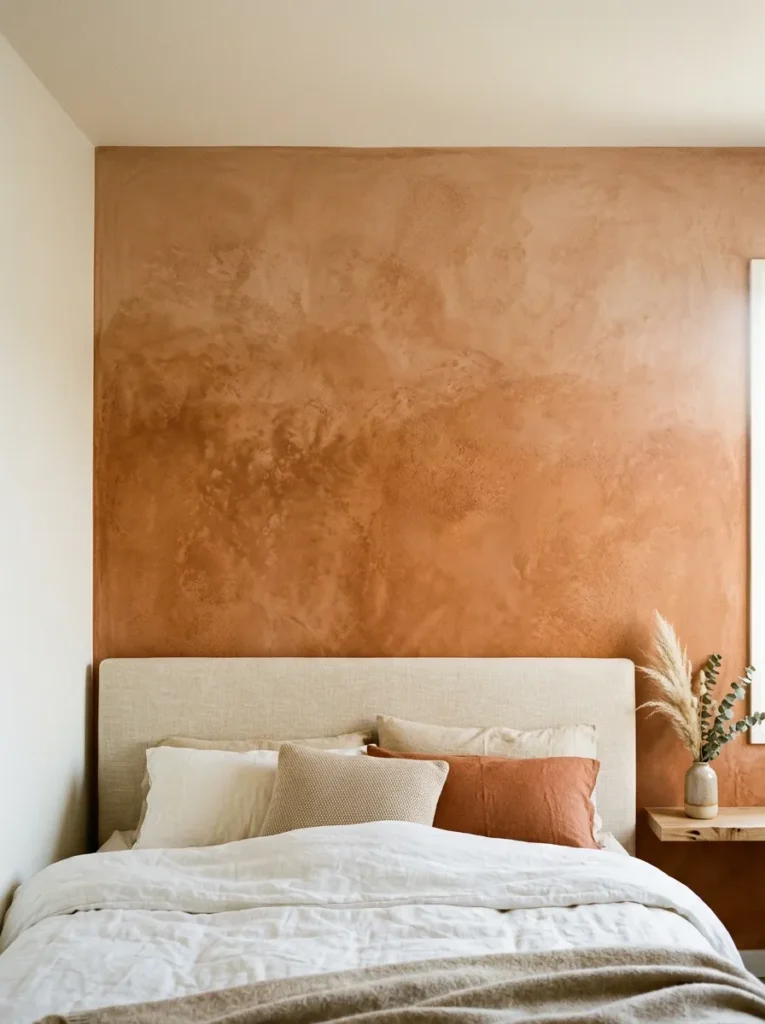
Limewash is the accent wall approach that looks most like it was always part of the room. Unlike flat paint, which sits on the surface, limewash soaks into the wall and creates natural tonal variation — slightly lighter near the top, richer and more saturated where the brush moved more slowly. The result reads as aged plaster rather than applied finish.
For bedrooms, limewash works especially well in warm earth tones: clay, ochre, terracotta, dusty rose, sage. The surface movement it creates gives the wall visual depth that a solid paint colour can’t replicate. It also photographs well at any time of day because the tonal variation shifts with light direction.
Application is more involved than standard paint — it typically requires a primed wall and multiple thin coats applied with a broad brush in cross-hatching strokes — but most modern limewash formulations from paint brands are far more forgiving than traditional lime plaster. It’s a DIY-achievable project for someone comfortable with painting.
2. Dramatic Wallpaper as a Single-Wall Statement
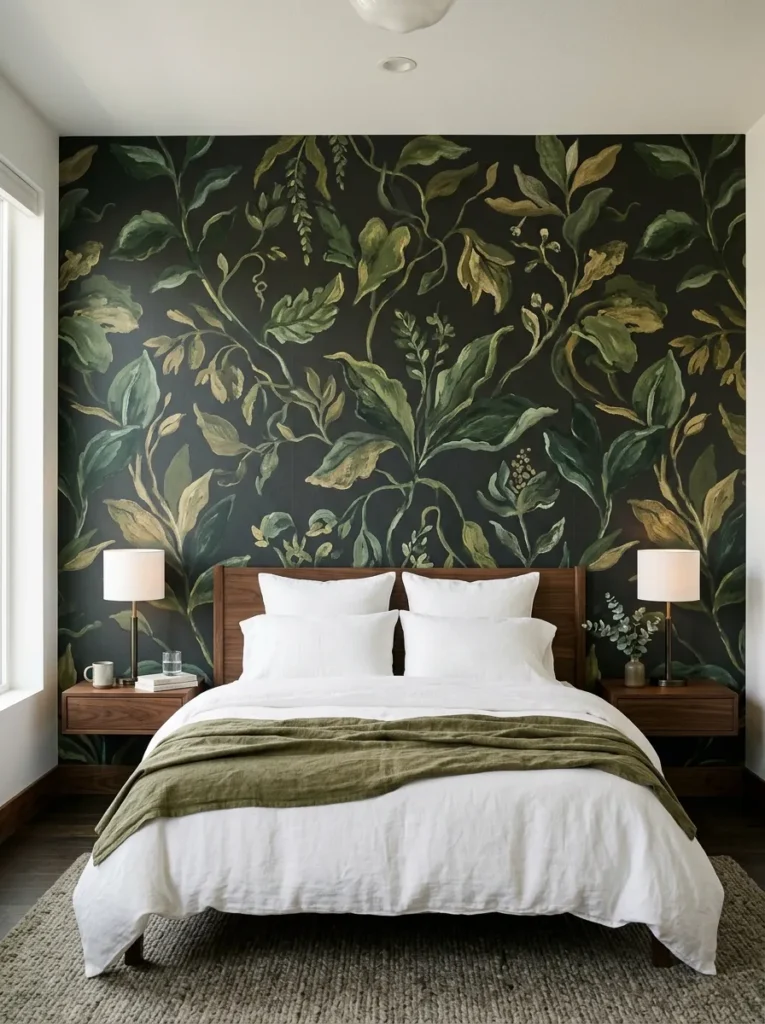
A wallpaper pattern that would overwhelm a full room often works perfectly on the wall behind the bed, where it functions as a large-scale headboard backdrop rather than a room-defining choice. The key is scale: patterns with large repeats (botanicals, abstract painterly prints, oversized geometrics) tend to read better at a distance than small repeating motifs, which can look busy at bedroom scale.
One practical decision upfront: peel-and-stick wallpaper versus traditional paste wallpaper. Peel-and-stick is significantly more forgiving for renters and first-time installers, and the quality of premium versions has improved considerably. It’s worth noting that it works best on smooth walls — textured or orange-peel surfaces cause adhesion problems and visible air pockets.
Traditional paste wallpaper produces a more finished result and is less likely to lift at seams, but it’s permanent and requires more skill to hang correctly, particularly around window recesses and electrical outlets.
3. A Floor-to-Ceiling Mural Behind the Bed
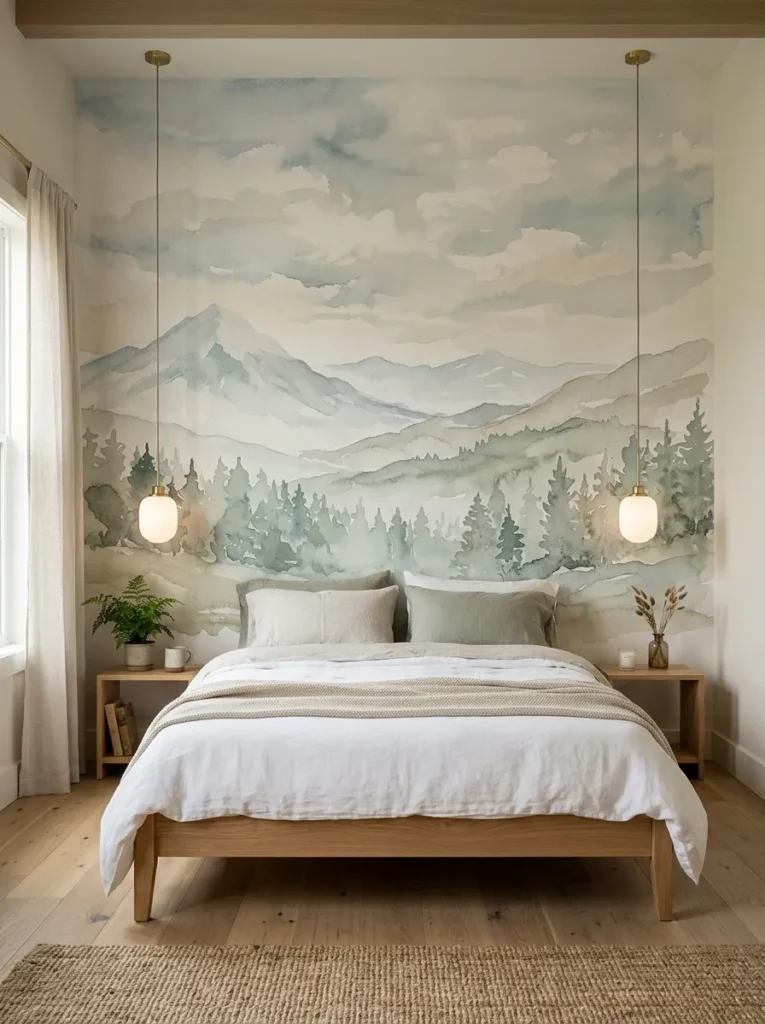
A full-wall mural — whether professionally painted, printed on panels, or applied as a mural-format wallpaper — makes the bedroom’s headboard wall into something closer to a painting than a surface treatment. This is the most committed of the visual approaches: it’s specific, difficult to change, and entirely defines the room’s mood.
Mural wallpaper panels (printed on non-woven paper and hung like standard wallpaper) are the most accessible version. They’re available in nature-inspired panoramic scenes, abstract washes of colour, architectural trompe l’oeil, and graphic designs. Because the mural is the room’s primary statement, everything else — bedding, lighting, furniture finish — should be quiet and supportive rather than competing.
The most common mistake is choosing a mural that’s too busy in detail or too saturated in colour. Murals in soft, muted palettes — watercolour botanicals, tonal abstract washes, bleached landscape imagery — tend to hold a bedroom space more comfortably than high-contrast graphic pieces.
4. Board and Batten Paneling for Architectural Texture
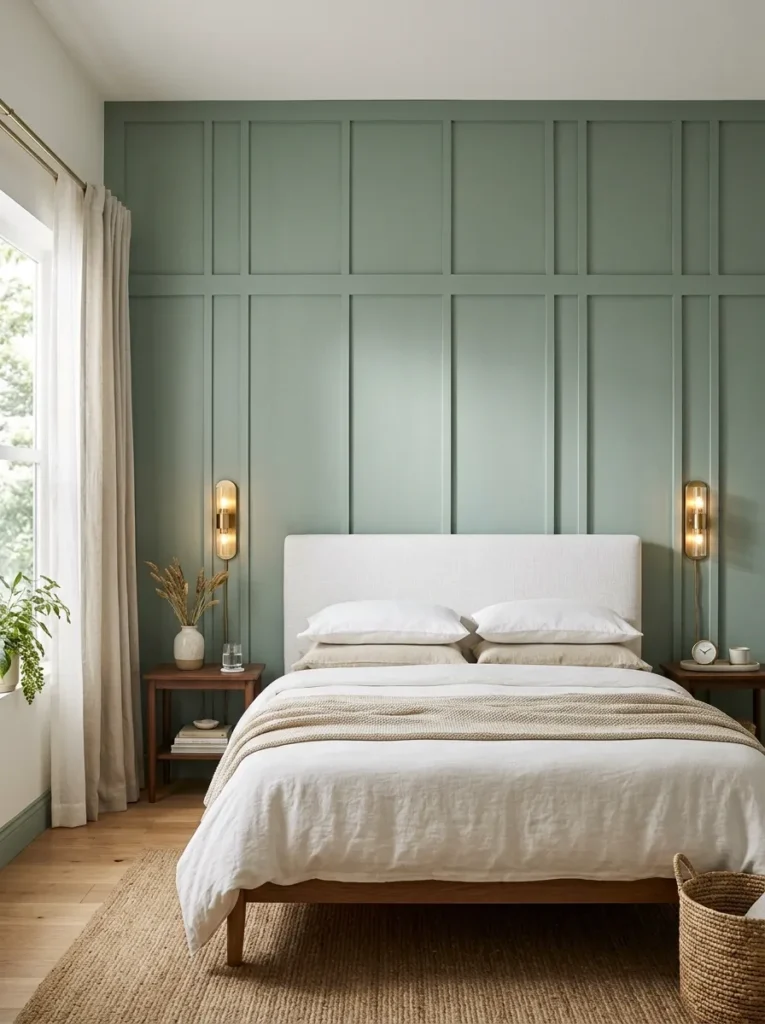
Board and batten is one of the most versatile accent wall treatments for bedrooms because it adds dimensional interest without introducing colour contrast — the panels and battens are typically painted in the same tone as the rest of the wall, or in a single matte paint colour that reads as monochromatic. The visual interest comes from shadow rather than hue.
The proportions of the panels matter more than most guides acknowledge. Very wide battens spaced far apart read as traditional; narrow battens at closer intervals read as more refined and contemporary. The bottom of the paneling should typically align with the top of the baseboard; the top can sit at chair-rail height, two-thirds up the wall, or extend to the ceiling depending on the wall height and the effect you’re after.
This is a genuine DIY project — MDF boards, a nail gun, a miter saw, and a few weekends. The finished result, once primed and painted, looks considerably more expensive than it costs.
5. Grasscloth or Natural Woven Wallpaper
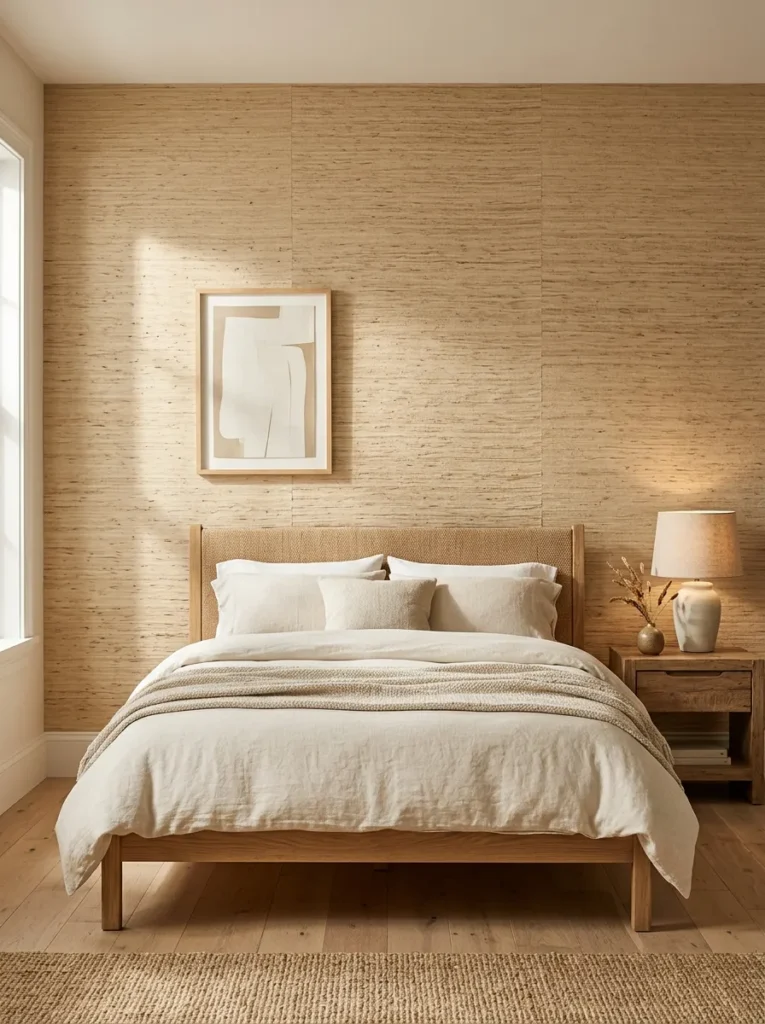
Grasscloth wallpaper — woven from natural fibres (jute, seagrass, sisal, or abaca) backed on paper — brings texture to a bedroom wall in a way that no paint finish can match. It’s specifically a tactile accent: the wall looks different depending on where you’re standing and how the light hits the fibres.
In a bedroom context, grasscloth reads as refined rather than rustic, particularly in neutral tones — warm oat, pale sand, greige. It suits spaces that are already using natural materials (linen bedding, oak furniture, woven rugs) because the surface feels consistent with that material story rather than contradicting it.
Two practical considerations: grasscloth shows seams more visibly than printed wallpaper, so installation quality matters. And because it’s a natural material, it’s not washable — any moisture near the wall (a leaking window, a humidifier positioned too close) can cause staining or fibre damage. It’s best used on interior walls away from potential moisture sources.
6. Vertical Stripe Wallpaper to Raise the Ceiling Visually
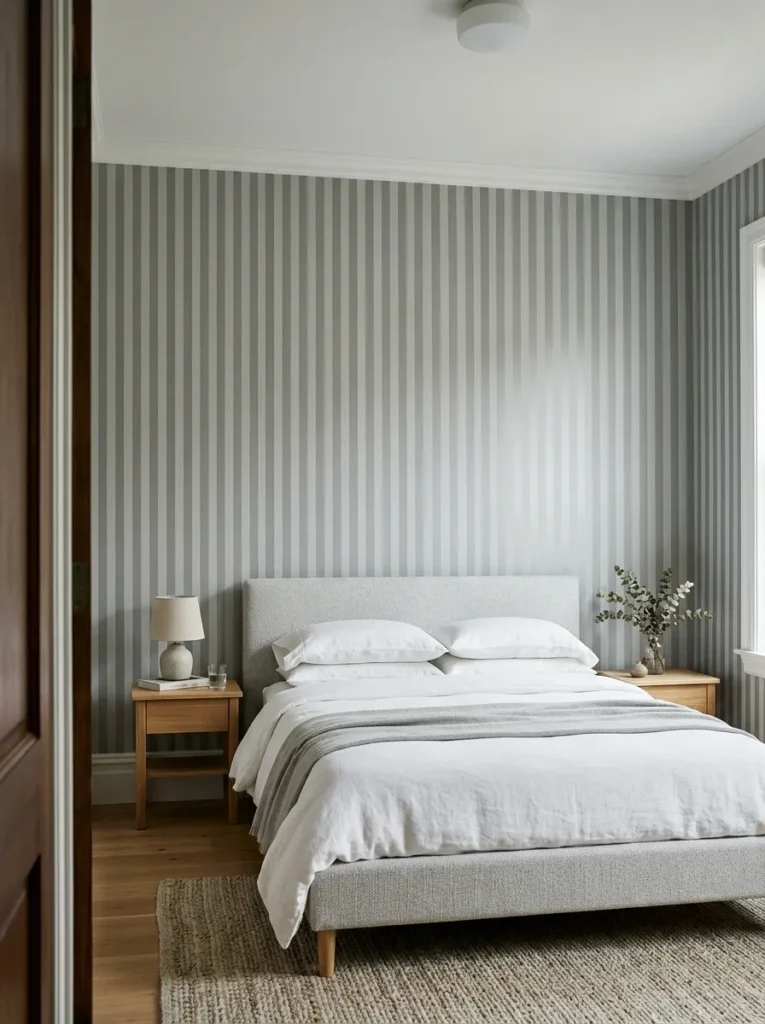
In bedrooms with lower ceilings — typically anything under 8 feet — a vertical stripe wallpaper on the headboard wall creates an upward visual pull that makes the ceiling feel higher than it is. The stripe doesn’t need to be bold or contrasting; a tone-on-tone stripe (slightly sheen against matte, or two very close colours) creates the elongating effect without the graphic energy of a high-contrast stripe.
The stripe width matters for this effect. Very narrow stripes (under an inch) read as texture from a distance rather than pattern, which can look busy. Wider stripes (2–4 inches) read clearly as vertical lines and create the directional pull the idea depends on.
This is also one of the easiest low-commitment versions to execute: peel-and-stick stripe wallpaper is widely available, and the vertical orientation makes it more forgiving to hang than a pattern requiring horizontal repeat matching.
7. Shiplap Paneling for a Relaxed, Textural Quality
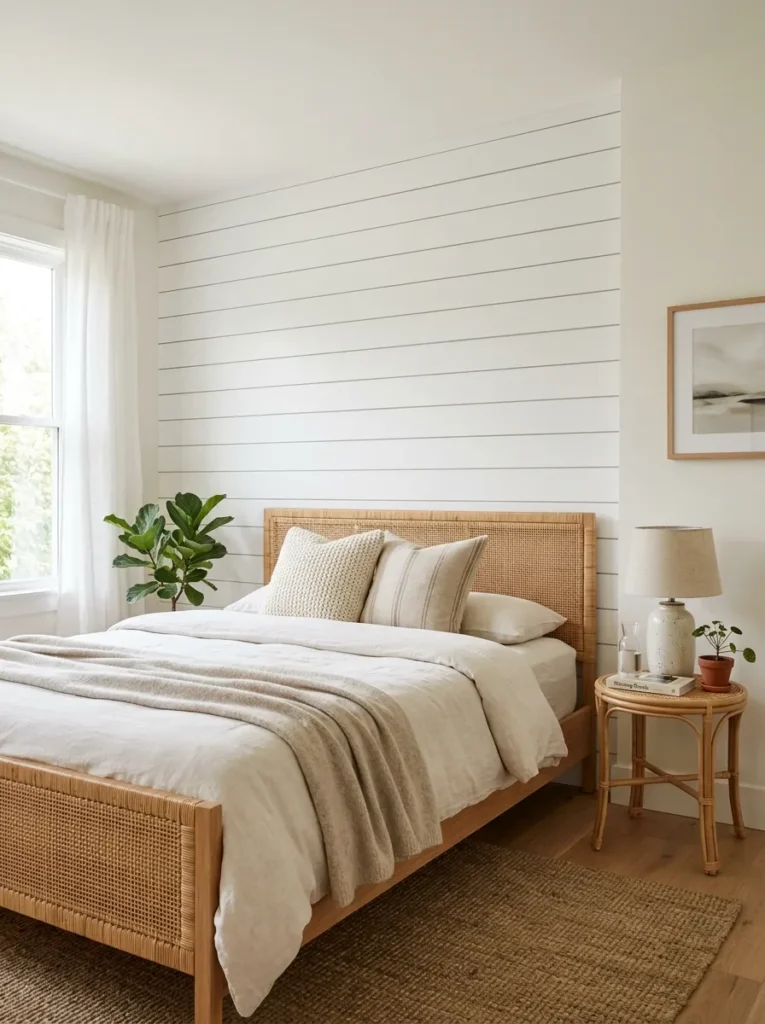
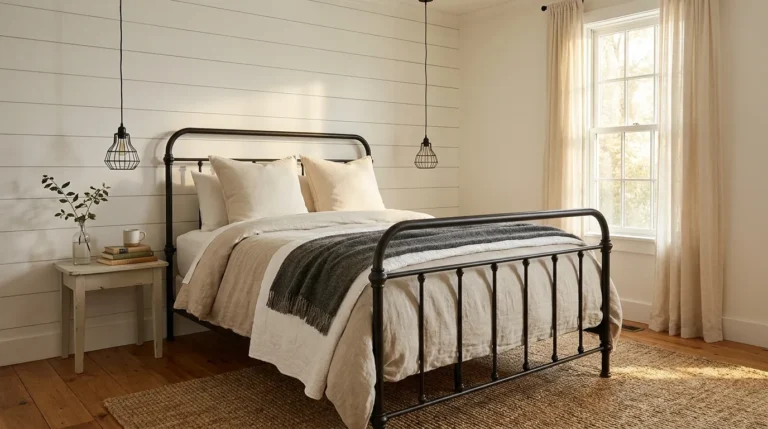
Shiplap — horizontal planks with a reveal gap between each board — originated as an exterior cladding material and has moved firmly into interior accent wall territory. In a bedroom, it brings a casual, slightly coastal quality that suits relaxed, nature-adjacent spaces more than formal ones.
Painted white or in a soft off-white, shiplap reads as clean and airy. In a weathered grey or natural wood stain, it shifts toward a more rustic or Scandinavian mood. The horizontal direction of the planks has the opposite visual effect of vertical stripe wallpaper — it emphasises the room’s width rather than its height, which suits lower-ceilinged bedrooms where you want the room to feel expansive rather than taller.
For most DIY installations, MDF shiplap boards or pre-primed pine are the most practical choice. Actual reclaimed wood is more authentic but heavier, more expensive, and requires more preparation to achieve a flat installation.
8. Venetian Plaster for a High-End Textural Finish
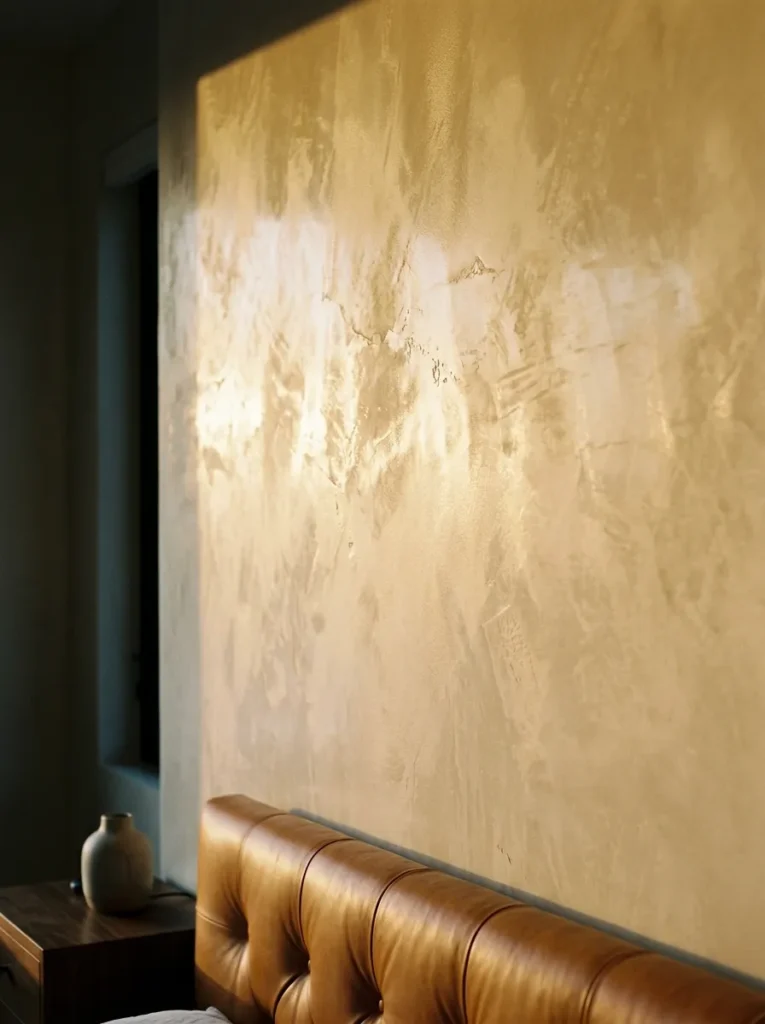
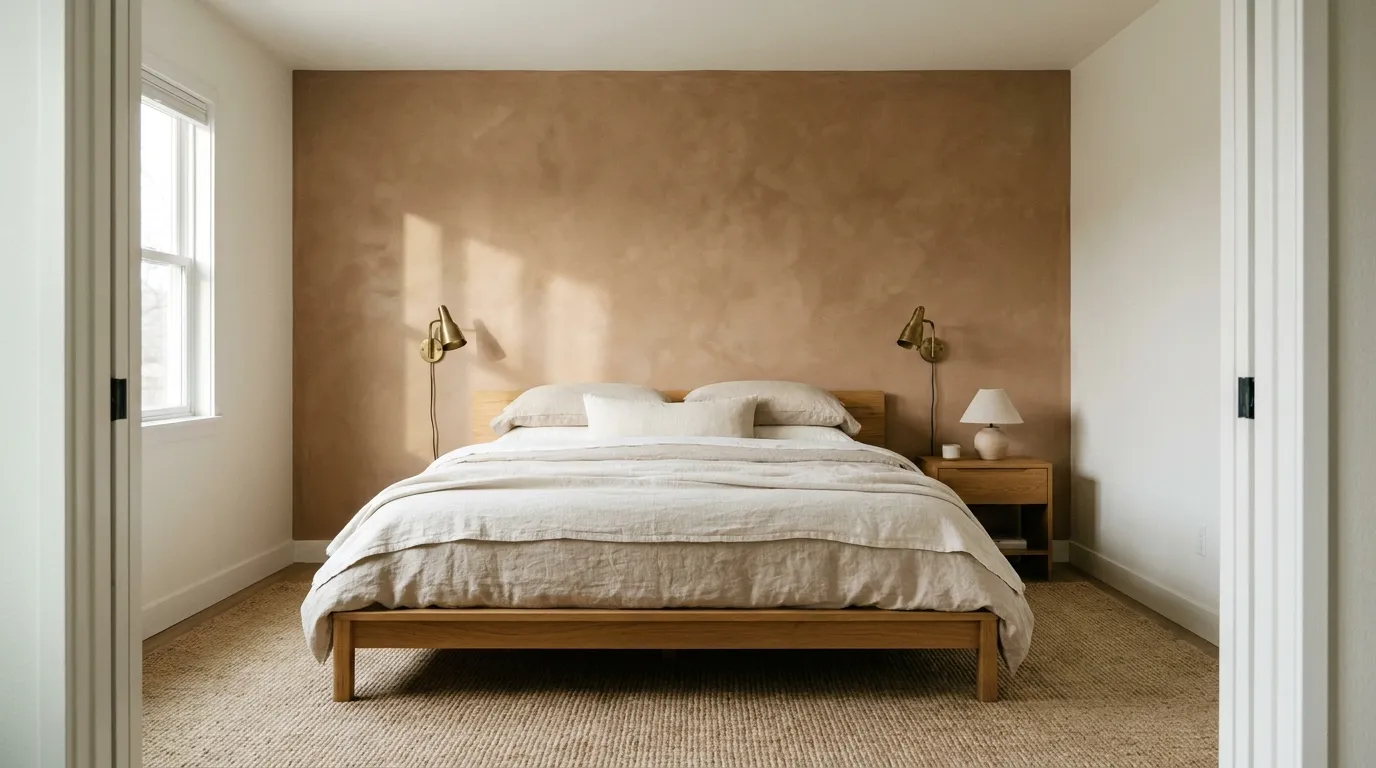
Venetian plaster is a lime-based finish applied in thin layers and burnished to a smooth, slightly lustrous surface. The result has a depth and luminosity that no paint finish replicates — the surface appears almost internally lit when light catches it at an angle. It’s the high-end version of the textured wall approach, and the cost reflects that.
For a bedroom accent wall, Venetian plaster works best in tones that shift with the light: warm ivory, pale gold, greige, dusty rose, soft sage. The burnished surface creates visual movement without pattern, which suits bedrooms well — it’s active enough to read as a considered choice without being distracting.
This is not a DIY project for most people. The technique requires specific tools (a Venetian trowel), multiple coats, and the skill to burnish without leaving visible trowel marks. Professional application is the realistic option, which means the cost is significantly higher than paint or even premium wallpaper.
9. Fabric Panels as a Renter-Friendly Textural Wall
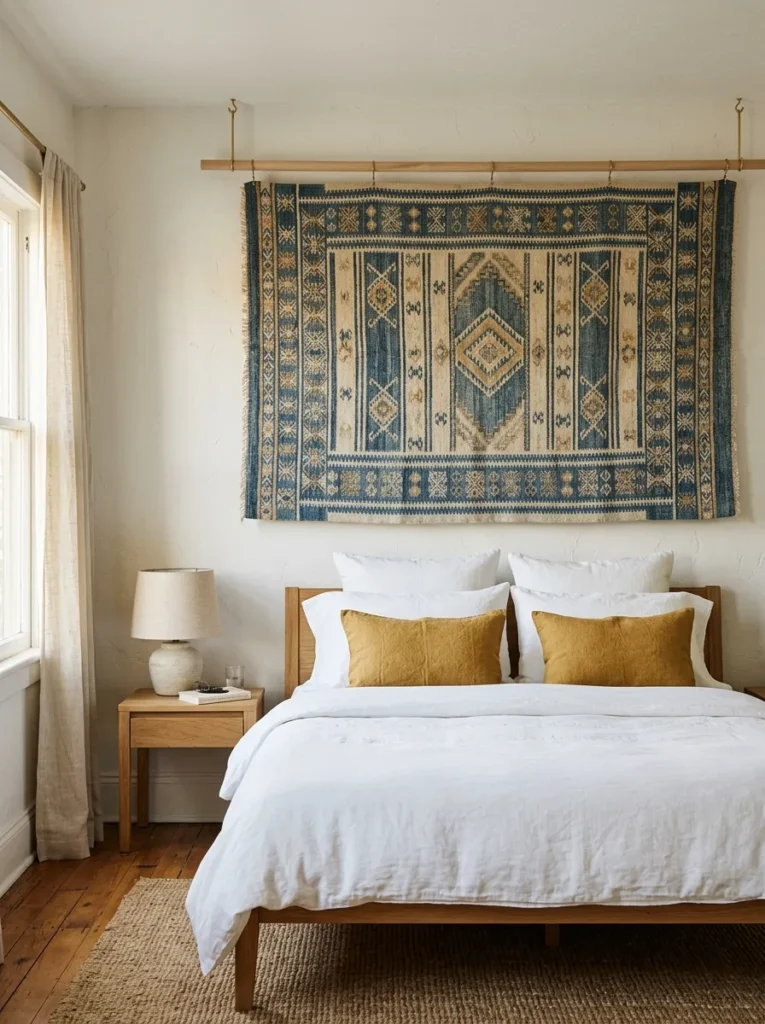
A large piece of fabric — an oversized vintage textile, a flat-woven kilim, a section of linen in a muted print — hung on the wall behind the bed functions as a soft, textile version of wallpaper. It’s the most genuinely renter-friendly accent wall option because it requires only two or three wall hooks or a curtain rod, leaves no permanent marks, and can be changed or taken when you move.
The fabric needs to be substantial enough to hang without wrinkling badly. Heavier woven textiles — tapestry weaves, flat-woven cotton, canvas — work better than lightweight fabrics, which drape rather than lying flat. The size should be close to the full width of the headboard wall; a small fabric piece on a large wall reads as an oversized piece of art rather than an accent wall treatment.
A hanging rod (dowel with rope loops, or a curtain rod mounted close to the ceiling) gives the installation a more finished look than clips or tacks alone.
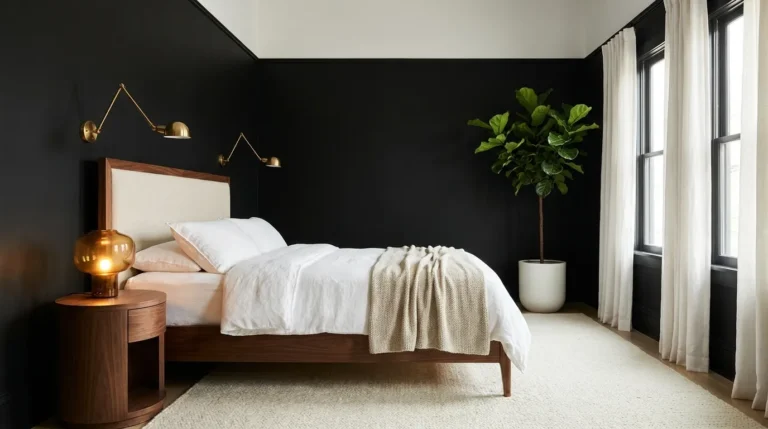
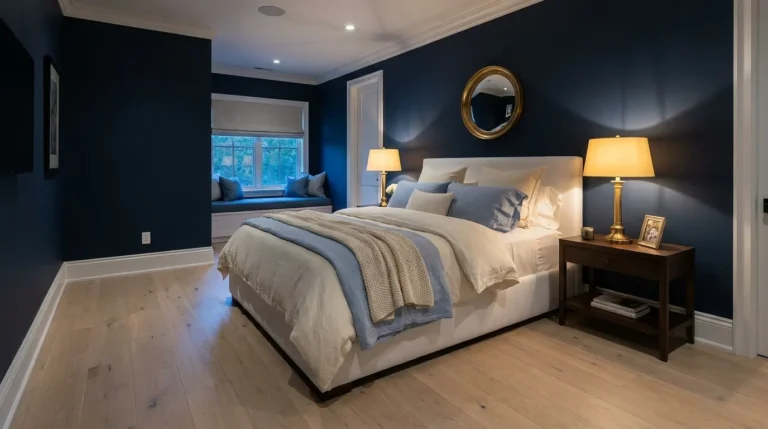
10. Deep, Dark Paint in a Matte Finish
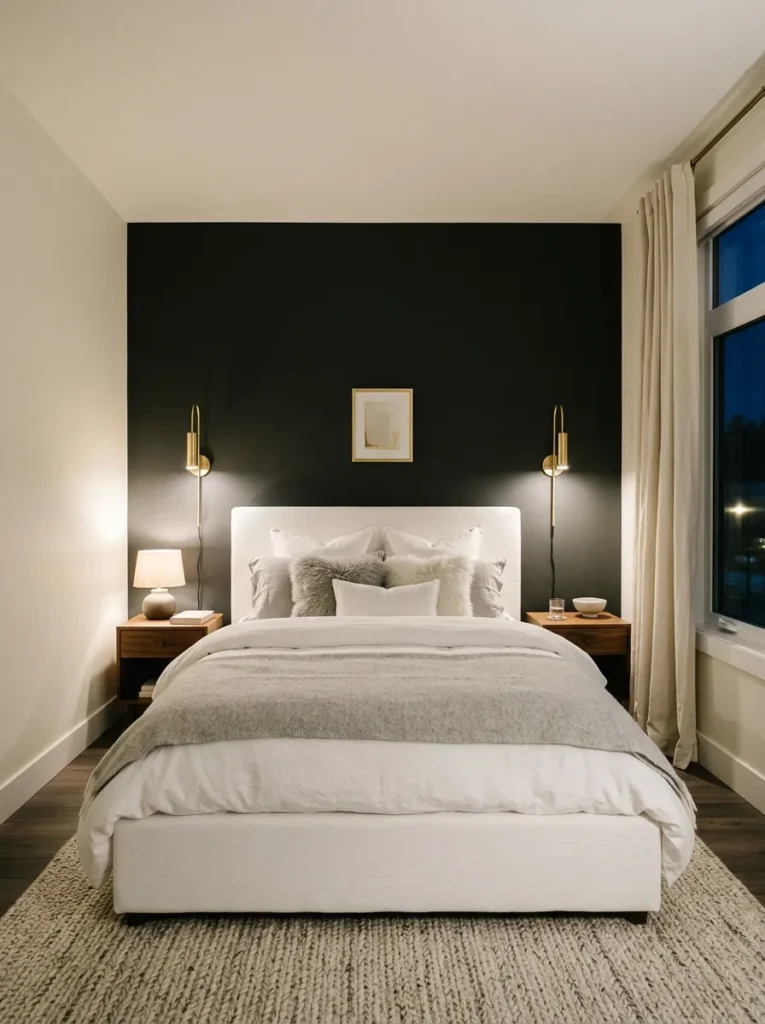
A dark accent wall — navy, forest green, charcoal, near-black, deep plum — reads very differently in a bedroom than in a living room or kitchen. In a space designed for sleep and rest, darkness on the headboard wall creates a sense of enclosure that many people find more comfortable than expected: the room feels contained and cocoon-like rather than gloomy, particularly when complemented by warm-toned lighting.
The finish matters as much as the colour. A matte or flat finish absorbs light and reads as softer; an eggshell or satin sheen reflects it and can look slightly harsh. For a dark bedroom accent wall, dead flat or matte is almost always the better choice.
One practical note: very dark paint on a single wall while the remaining walls stay white or pale creates a high-contrast look that suits modern and dramatic spaces. If you want a more integrated effect — the dark wall feeling like part of the room rather than a feature imposed on it — paint the ceiling and trim in a slightly lighter tone from the same colour family rather than pure white.
11. Terracotta or Warm Earth Tones as a Paint Accent
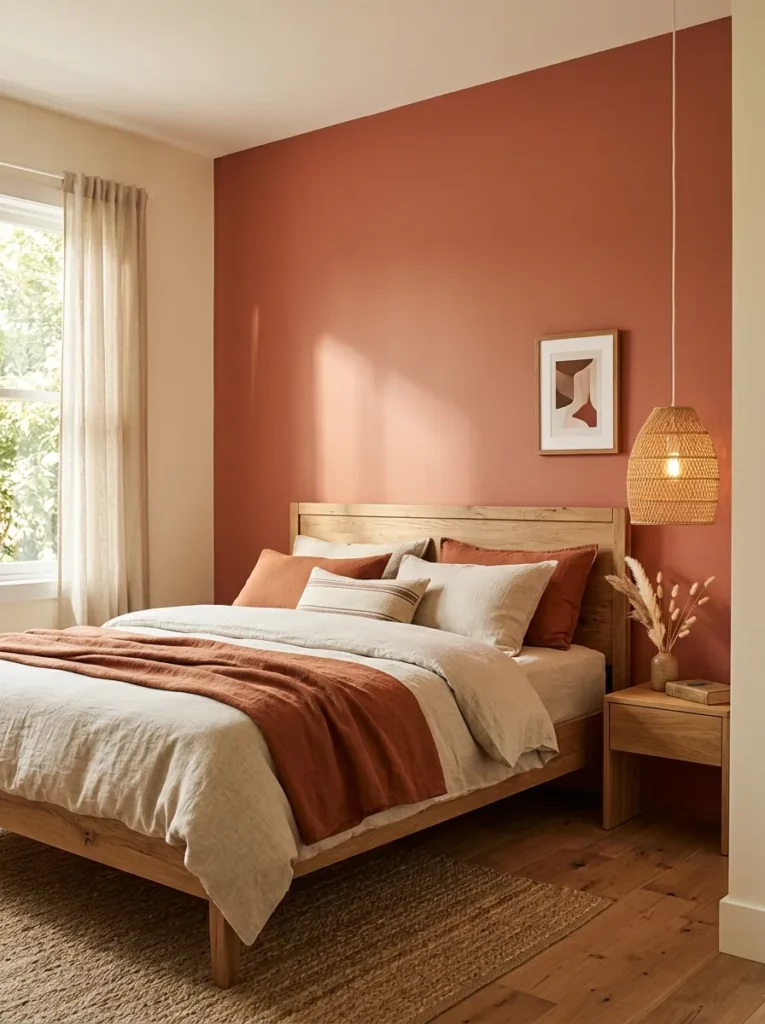
Where dark accent walls (from Idea 10) create drama, terracotta and warm earth tones create warmth without high contrast. A wall in terracotta, burnt sienna, warm ochre, or clay sits in the mid-tone range — deep enough to read as an accent against lighter walls, but warm enough to feel welcoming rather than moody.
Earth-toned accent walls suit bedrooms decorated in natural materials: linen bedding, wood furniture, rattan, ceramics. The wall colour and the material palette reinforce each other — the terracotta reads as an extension of the natural tones in the room rather than a contrast to them.
The undertone is the detail worth getting right. Terracotta paints range from orange-leaning to red-leaning to brown-leaning, and the undertone interacts with the room’s light. In a room with warm natural light, an orange-leaning terracotta can feel vibrant; in a cool north-facing room, the same paint can look muddy. Testing in the actual room’s light before committing to a full wall is genuinely necessary with earth tones.
12. A Reclaimed Wood or Live-Edge Wood Panel Wall
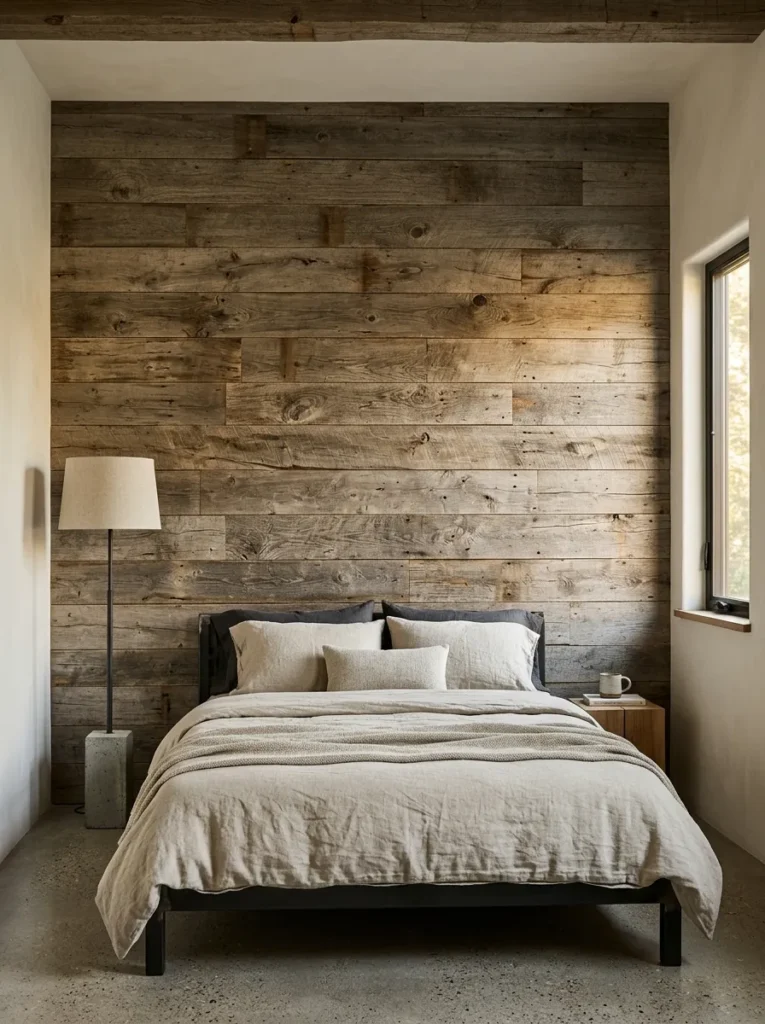
A full wall of reclaimed wood planks — or a large live-edge wood slab mounted as a single architectural panel — brings the most tactile, material-honest quality of any accent wall approach. The wood’s natural imperfections (knots, grain variation, colour differences between planks) are the visual interest, not a flaw.
Reclaimed wood walls work best in bedrooms that commit fully to the natural material story: raw linen bedding, minimal metal, leather or wood furniture, woven textiles. A reclaimed wood wall behind a sleek, lacquered bed frame with chrome hardware creates a jarring material conflict.
Weight is the main practical consideration. A full wood plank wall is heavy and requires proper fixing to studs. Thinner wood veneer sheets or engineered wood panels (which look similar but weigh significantly less) are a more practical alternative for most installations, particularly in apartments where structural modification is limited.
13. Painted Geometric Shapes Directly on the Wall
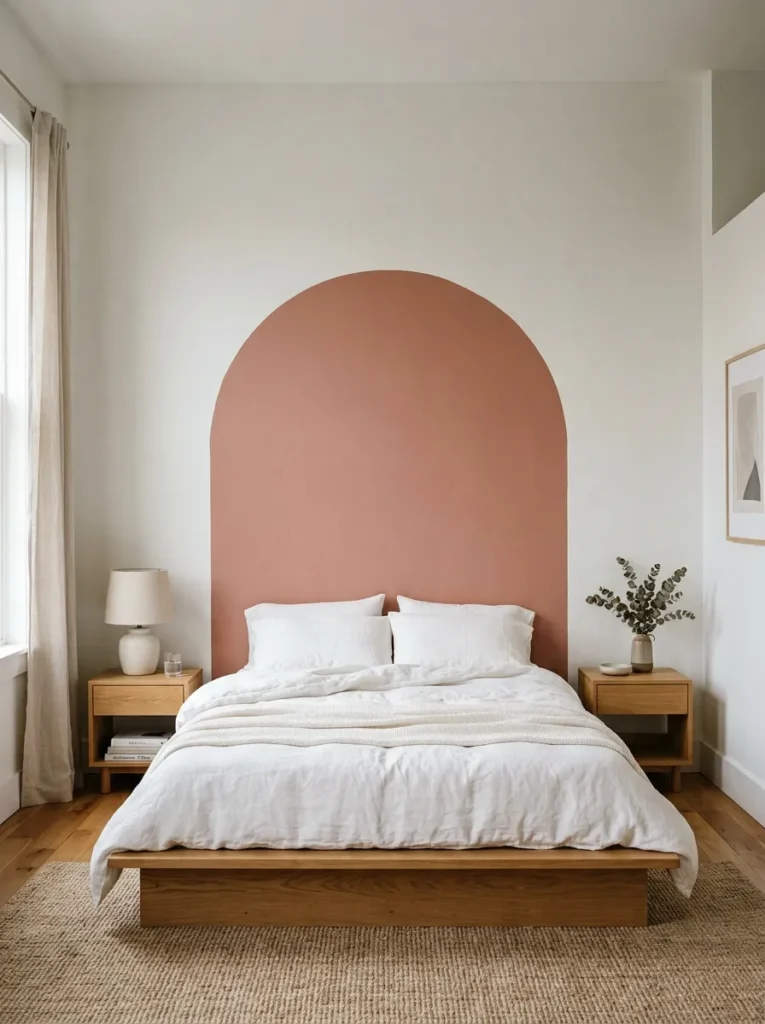
Rather than applying a material to the wall, painted geometric shapes — half-wall color blocks, painted arches, diamond or triangle patterns, colour-blocked sections — use the wall surface itself as a canvas. The result is more art-directed than a standard paint accent and can be achieved with painter’s tape, a level, and standard wall paint.
A painted arch is the most currently popular version: a semicircle or full arch shape painted in a contrasting or complementary tone, typically centered behind the bed and scaled to span from roughly mattress height to the ceiling. It functions as a painted headboard frame and works particularly well in bedrooms where an actual upholstered headboard isn’t present.
The arch doesn’t require precision beyond what a pencil, string, and tack can achieve for drawing the curve. The painted edge is what commits it — crisp, clean painter’s tape lines make the difference between an amateur and a considered result.
14. Peel-and-Stick Tile or Brick-Effect Panels
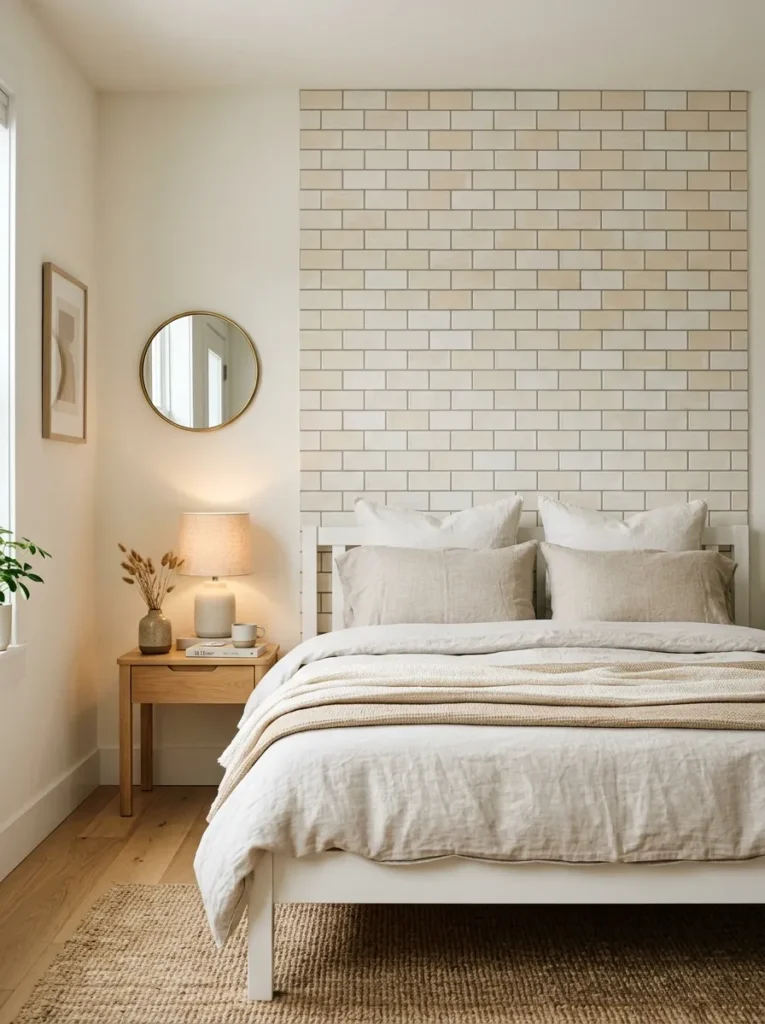
For renters who want more than paint but can’t commit to permanent installation, peel-and-stick tile panels — either in a subway tile format, a brick effect, or a geometric tile pattern — provide a surface treatment that reads as more substantial than wallpaper. The adhesive backing is designed to remove cleanly from smooth painted walls.
The visual result depends almost entirely on the installation quality. Tiles that aren’t level or that have inconsistent spacing read as DIY in a way that undermines the effect. Using a spirit level throughout the installation (rather than eyeballing it) is the single most important factor.
The limitation: peel-and-stick tiles are generally not convincing at close range on a bedroom wall, which is examined closely every day. This approach works better in lower-traffic rooms or as a backdrop element (behind a media wall, inside a niche) than as the primary accent wall in a bedroom.
15. A Gallery Wall as a Collected Accent
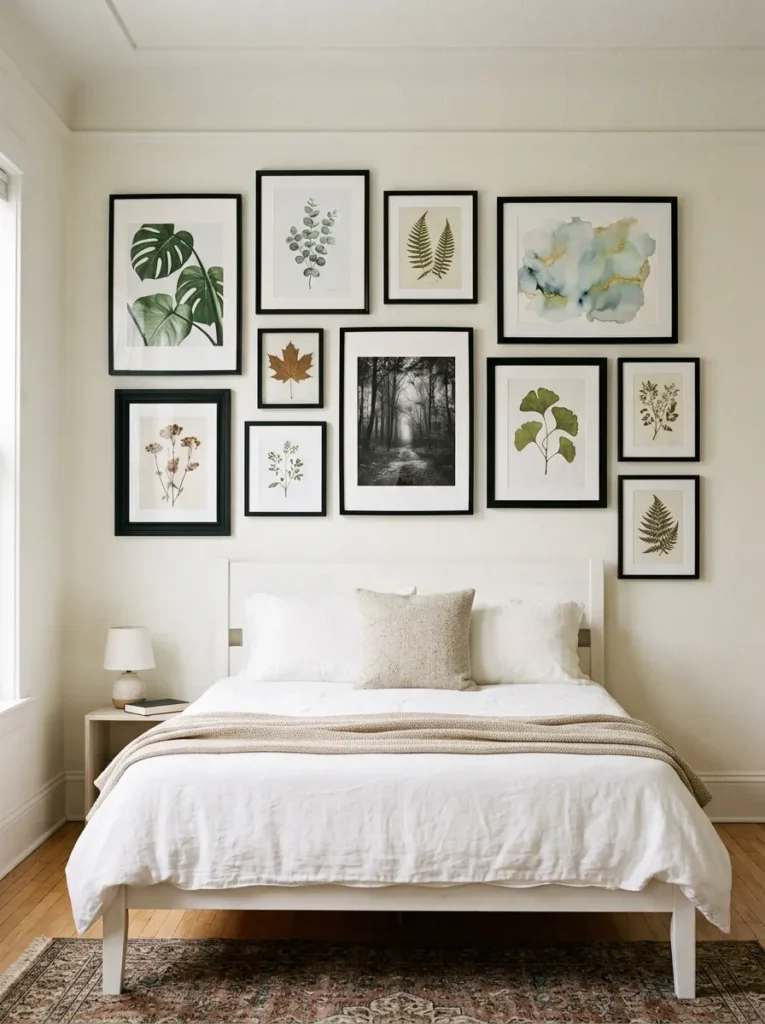
A gallery wall behind the bed functions as a soft, flexible alternative to the fixed surface treatments on this list. Instead of changing the wall’s surface, it changes the wall’s character through what’s hung on it — a process that can evolve over time as the collection grows or changes.
The arrangement matters more than the individual pieces. A gallery wall works best when it follows a few structural rules: a consistent colour family running through the frames (all black, all natural wood, all white, or a deliberate mix), a consistent inner mat colour if frames are framed, and a rough boundary that aligns with the bed width and spans from headboard height to the ceiling.
Common mistake: too many small pieces that lose legibility from the doorway. In a bedroom, the gallery wall is read from a distance; pieces smaller than roughly 8×10 inches tend to disappear individually and read as a texture rather than a composition.
16. Wallpaper Wainscoting for a Two-Tone Approach
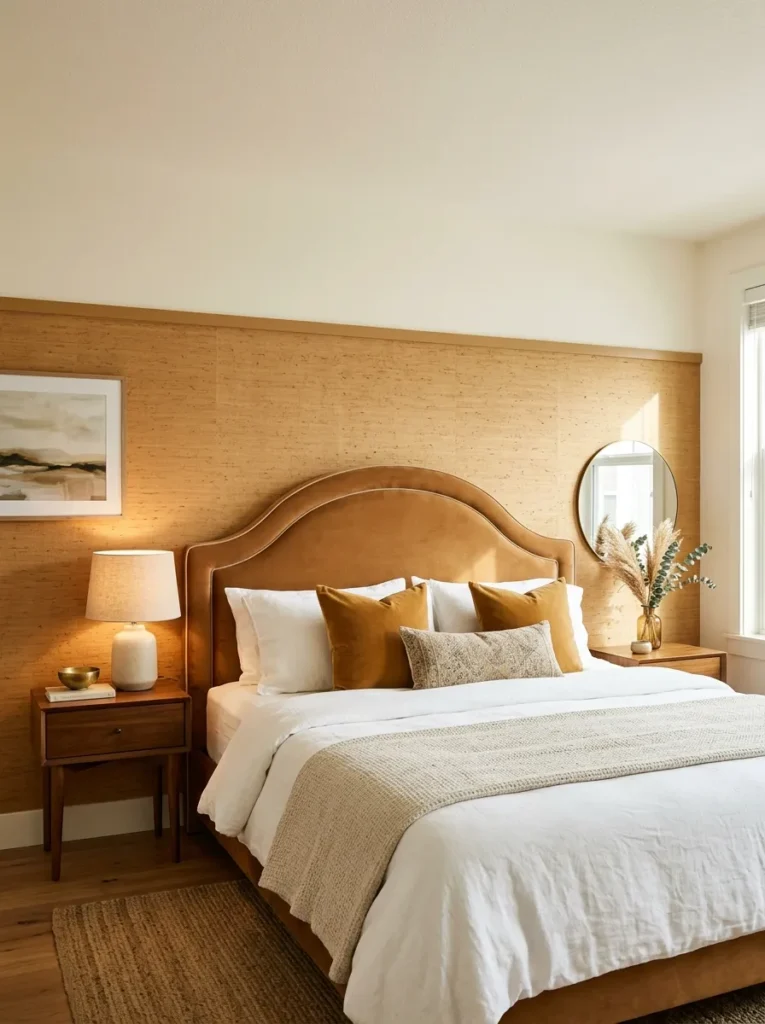
Rather than wallpapering the full accent wall, applying wallpaper only to the lower half — below a painted chair rail or a simple MDF batten — creates a two-tone treatment that suits bedrooms with high ceilings or rooms where a full wallpaper wall would feel too active.
The division line between wallpaper and paint sits most naturally at one-third or two-thirds of the wall height, not at the midpoint. A division exactly at the halfway point reads as arbitrary; two-thirds up reads as considered and relates to standard chair rail proportions.
The wallpaper below should be textural or patterned in a way that reads as grounding — grasscloth, a small-repeat pattern, a dark or rich tone — while the painted section above stays quiet. Reversing this (busy pattern above, plain below) rarely works as well in a bedroom.
17. Microcement or Concrete-Effect Wall Finish
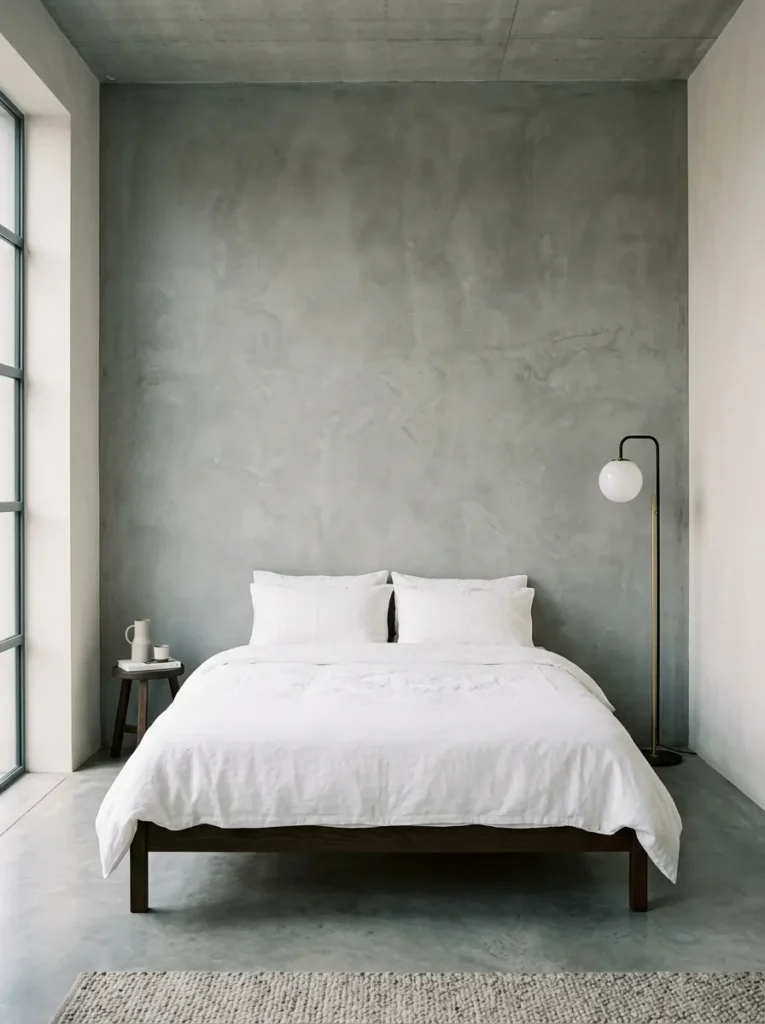
A concrete or microcement accent wall brings an industrial, architectural quality to a bedroom that sits in clear contrast to softer approaches like limewash or fabric. It’s specifically a material for contemporary, minimalist, or urban-loft bedroom aesthetics — it conflicts with traditional or romantic styles.
Microcement is applied in thin layers over the existing wall surface and requires no demolition or structural change. Once sealed, it’s wipeable and durable. The finish can range from a smooth polished surface to a slightly rough, aggregate texture depending on the application technique.
Professional application is strongly recommended — microcement is unforgiving of bubbles, inconsistent thickness, and poor surface preparation. Unprofessionally applied microcement can look like a failed concrete pour rather than an architectural finish. The material cost is moderate, but the labour pushes the total cost toward the higher end of accent wall treatments.
18. A Stenciled Pattern for a Budget-Conscious Alternative to Wallpaper
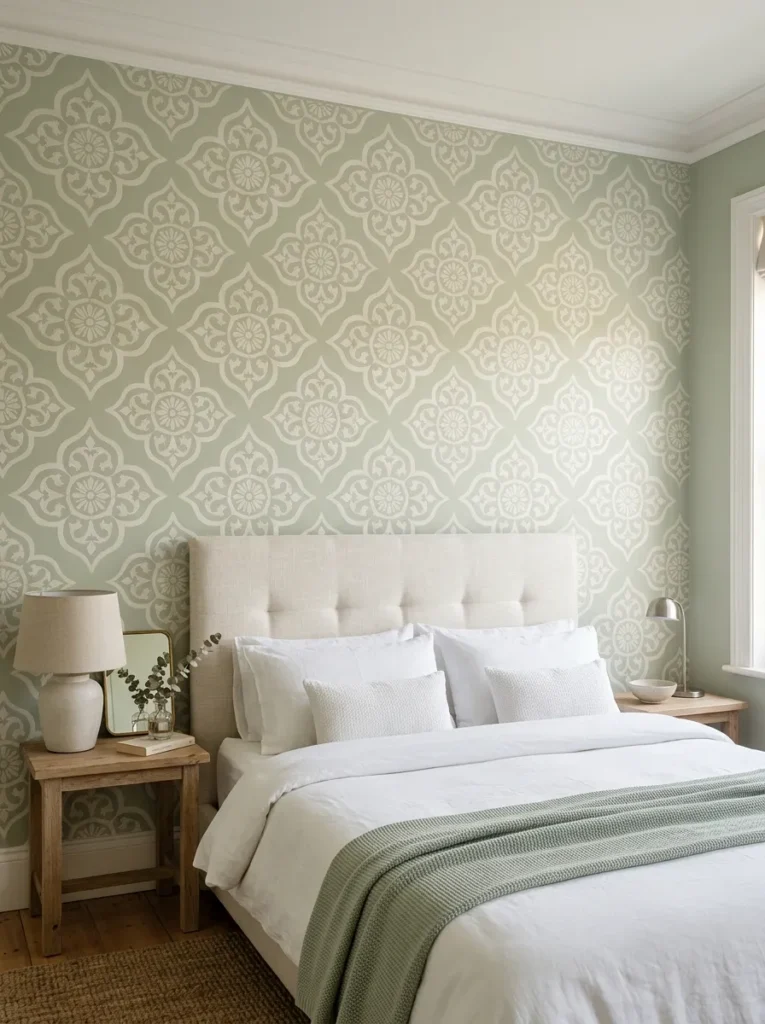
Wall stenciling — applying a repeating pattern directly to the painted wall using a stencil and a sponge or roller — achieves a wallpaper-like visual effect at a fraction of the cost. The pattern is genuine and tactile (slightly raised from the paint application) in a way that printed wallpaper isn’t.
The technique is accessible: stencils are widely available, and the materials (stencil, chalk paint or wall paint in a contrasting tone, a dense foam roller or sponge brush) are inexpensive. The time commitment is substantial — stenciling a full wall takes significantly longer than rolling on paint — but the cost is low.
The most common mistake is choosing too small a stencil repeat for a bedroom wall. A stencil with a 4-inch repeat looks appropriate up close but reads as texture rather than pattern from across the room. Stencils with repeats of 10 inches or more make a stronger visual statement at bedroom scale.
19. Beadboard Paneling on the Lower Half of the Wall
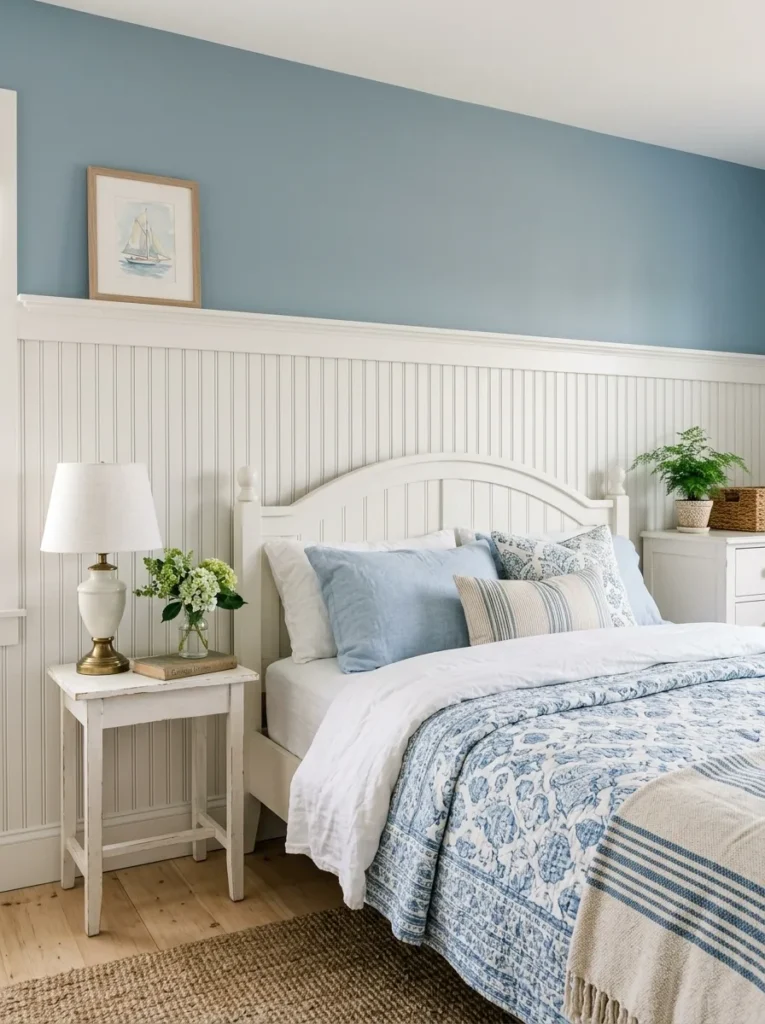
Beadboard — vertical panels with narrow ridged grooves — is traditionally a bathroom or kitchen material, but it works well in bedrooms when used on the lower half of the headboard wall (below chair-rail height) in combination with a complementary paint colour above.
Painted in a white, cream, or soft tone, beadboard brings a light, almost cottage-like texture to the lower wall. It suits bedrooms decorated in soft neutrals, dusty pinks, sage green, and country or coastal styles — less suited to contemporary or urban bedroom aesthetics where the traditional associations of the material create a stylistic conflict.
This is a DIY-achievable project. Beadboard panels are sold in large sheets that can be cut to size and installed with construction adhesive and finishing nails. The top edge is finished with a thin strip of quarter-round or a painted batten that becomes the visual chair rail.
20. A Painted Ceiling Extension for a Canopy Effect
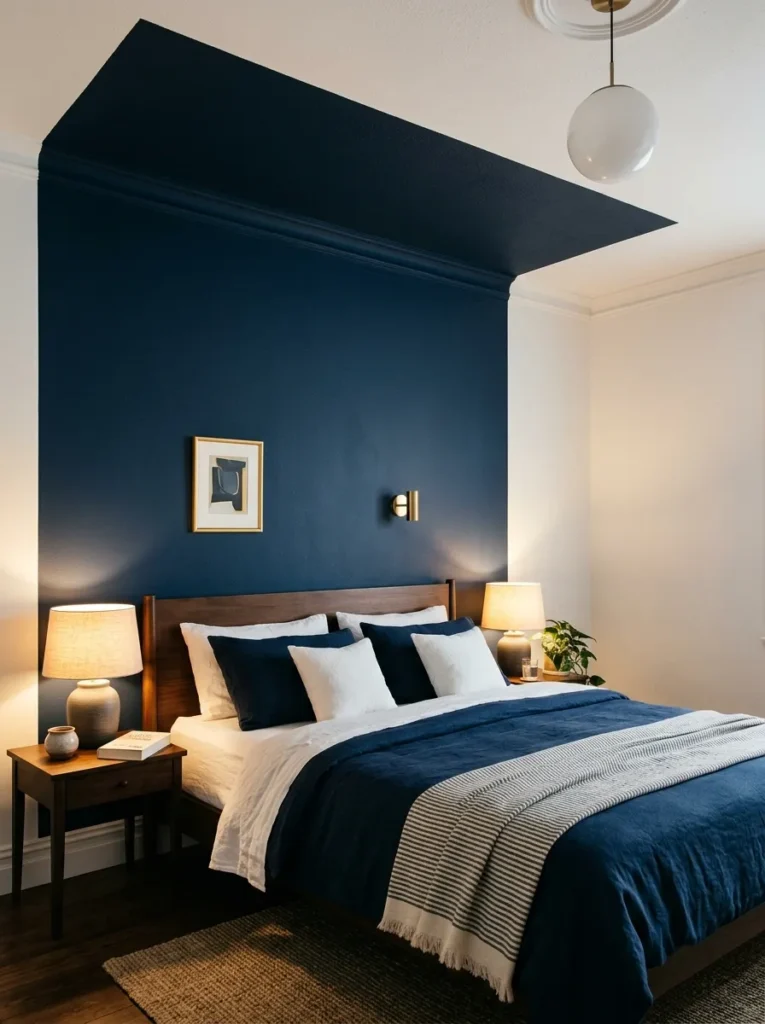
Rather than confining the accent wall to the vertical surface, extending the paint or wallpaper from the headboard wall onto a section of the ceiling — roughly the depth of the bed — creates a canopy-like enclosure over the sleeping area that reads as more considered than a single accent wall.
This works particularly well with dark paint (from Idea 10): a deep navy or forest green running from the wall onto 3–4 feet of ceiling creates a sense of being beneath a sky or under a canopy that most people find deeply comfortable in a sleep space. With a bold wallpaper, the effect is more dramatic and maximalist.
The transition from ceiling to the adjacent plain ceiling reads most cleanly when it runs along a straight line rather than attempting to follow any architectural detail. If the room has crown molding, the extension can follow it naturally; if not, a clean painted line or a thin batten strip defines the boundary.
21. Upholstered Wall Panels for a Hotel-Style Headboard Wall
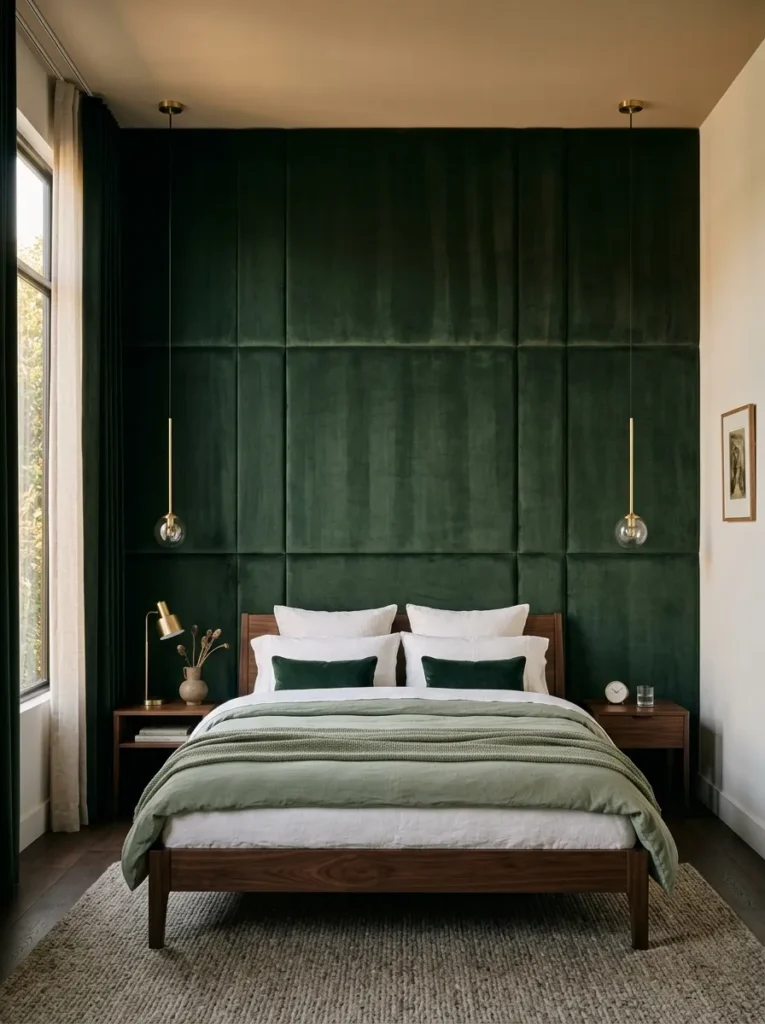
Fabric-upholstered panels mounted directly to the headboard wall create a soft, padded surface that reads as an architectural headboard spanning the full wall width. This is the approach used most commonly in boutique hotels, where it provides both visual impact and acoustic softness.
The panels are typically made from a plywood or MDF substrate wrapped in foam batting and then in fabric, and mounted flush to the wall using a French cleat system or direct screwing. The fabric should be a heavier upholstery-weight textile — linen, velvet, boucle — rather than a lightweight curtain fabric, which won’t stretch evenly over the foam without puckering.
Colour and texture are the primary visual decisions. A wall of deep velvet in forest green, dusty rose, or slate blue reads as richly textured; a wall of oatmeal bouclé reads as softer and more neutral. The panel seams between individual panels should be minimised or concealed with piping or a deliberate shadow gap.
22. Architectural Niche or Recessed Shelf Wall as an Accent
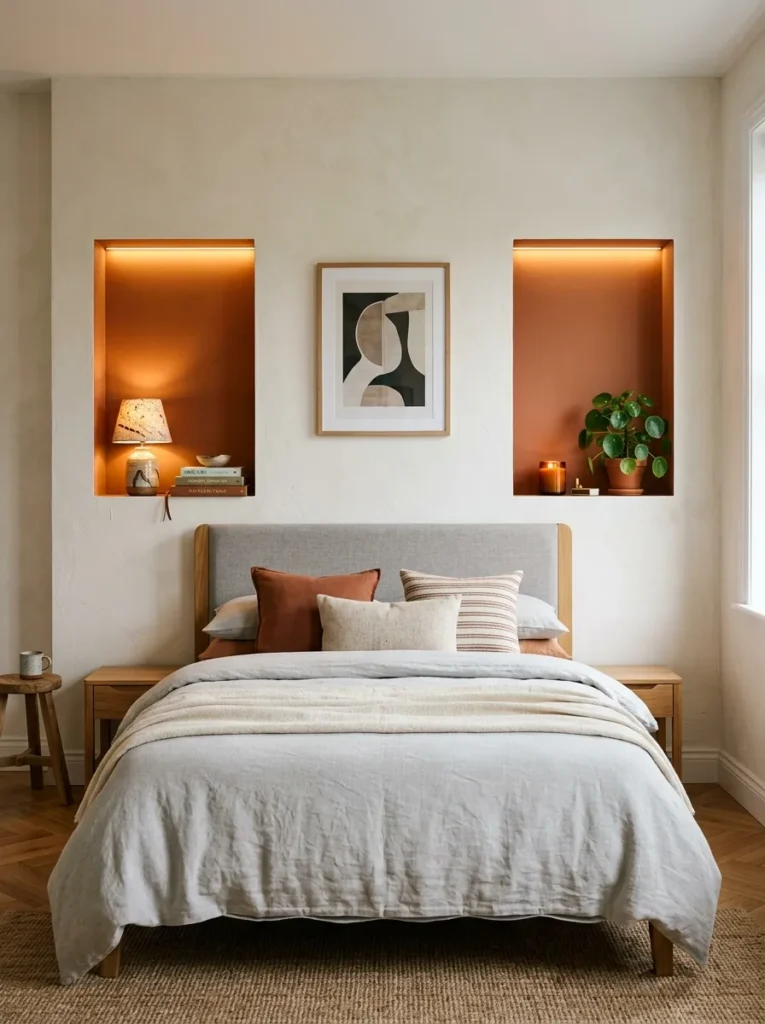
A recessed niche or a series of shallow recessed shelves built into the headboard wall creates a functional accent — the wall itself becomes storage and display space rather than a purely decorative surface. In bedrooms where nightstand space is limited, recessed niches flanking the bed head provide a place for reading materials, a lamp, and personal objects without floor footprint.
This is the most structurally committed idea on the list. It requires opening the wall (or building a false wall that projects forward to create the illusion of recessed depth), which means a higher budget and professional involvement in most cases. The result, however, is a wall treatment that serves two functions simultaneously — accent and storage — and that reads as genuinely architectural rather than decorative.
The niche interior can be painted in a contrasting tone, finished in tile, or lined with the same wallpaper used elsewhere in the room. LED strip lighting within the niche (running from the back edge or top edge) gives the display inside a gallery quality that no surface-mounted shelf can replicate.
How to Choose the Right Accent Wall for Your Bedroom
With 22 options, the decision can feel more complicated than it needs to be. A few filters simplify it considerably:
Start with your constraints. Renters should focus on Ideas 2 (peel-and-stick wallpaper), 6 (vertical stripe), 9 (fabric panel), 14 (peel-and-stick tile with caution), and 15 (gallery wall). All five are removable without significant damage to the wall surface.
Budget shapes the shortlist. Stenciling (18), DIY paint approaches (1, 10, 11, 13, 20), and board and batten (4) are the most cost-effective. Venetian plaster (8), microcement (17), and architectural niches (22) sit at the higher end.
The bedroom’s existing style should guide the material choice. A bedroom with linen bedding, wood furniture, and woven textiles suits limewash (1), grasscloth (5), reclaimed wood (12), or earth-tone paint (11). A bedroom with a more contemporary or minimalist direction suits microcement (17), board and batten (4), or dark paint (10). Romantic or maximalist spaces suit dramatic wallpaper (2), upholstered panels (21), or a full mural (3).
The wall behind the bed is almost always the right choice. The exceptions are rooms where the bed is on a side wall or where the headboard wall has windows. In those cases, a full-length side wall or the wall directly opposite the bed are the next best options.
Final Thoughts
The best bedroom accent wall is usually the one that does the most with the fewest decisions. A single strong choice — whether that’s a limewash colour, a panel treatment, or a bold wallpaper — tends to be more resolved than a wall that tries to combine multiple approaches.
If you’re starting fresh, paint-based ideas (Ideas 1, 10, 11, 13) are the lowest commitment and highest reversibility. They’re the right place to start if you’re uncertain about the direction. Wallpaper and paneling follow once the colour and tone of the space are established.
Among all the options here, the ideas that consistently photograph best, age most gracefully, and add genuine resale value are board and batten (4), limewash (1), and upholstered panels (21) — all three work across multiple bedroom styles and feel considered rather than trend-dependent.
Save the ideas worth revisiting, and come back to the practical section when you’re ready to narrow down. The right accent wall for your bedroom already exists in this list — it just needs to match your space, not someone else’s.