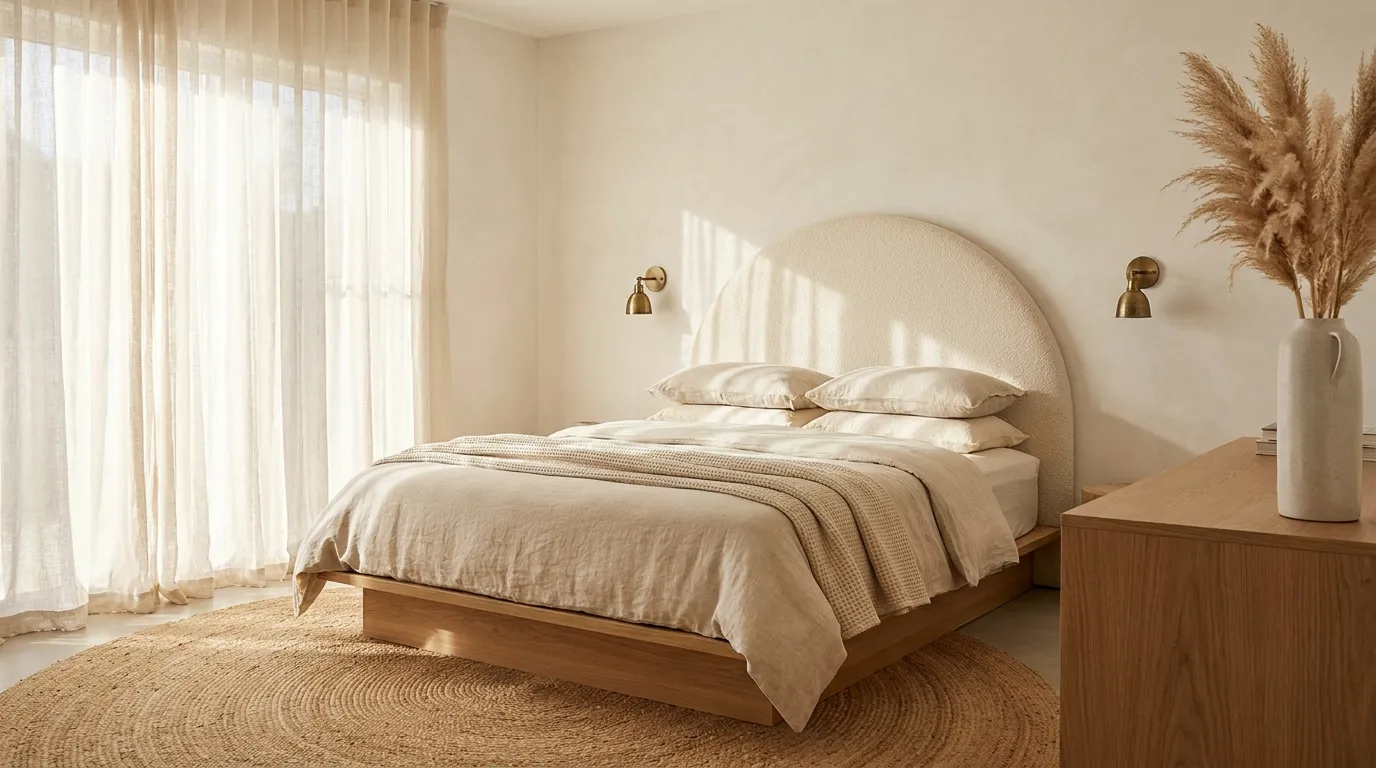
19 White Bedroom Ideas That Feel Bright, Layered, and Genuinely Elegant
A white bedroom is one of those ideas that looks effortless in photographs and feels surprisingly difficult to execute in real rooms. The problem is rarely the color itself — it’s everything around it. Too little contrast and the room reads flat. Too much and white stops being the point. The wrong undertone and suddenly your serene retreat feels like a dentist’s waiting room.
Done well, a white bedroom offers something few other palettes can: a genuine sense of quiet. Not emptiness — quiet. The kind that comes from restraint applied with intention. The ideas here range from architectural decisions you make once to small styling choices you can shift seasonally, and most work across room sizes and rental situations. The through-line is that white rooms require more visual thought than most, not less.
1. Start With the Right White — Undertone Matters More Than Shade
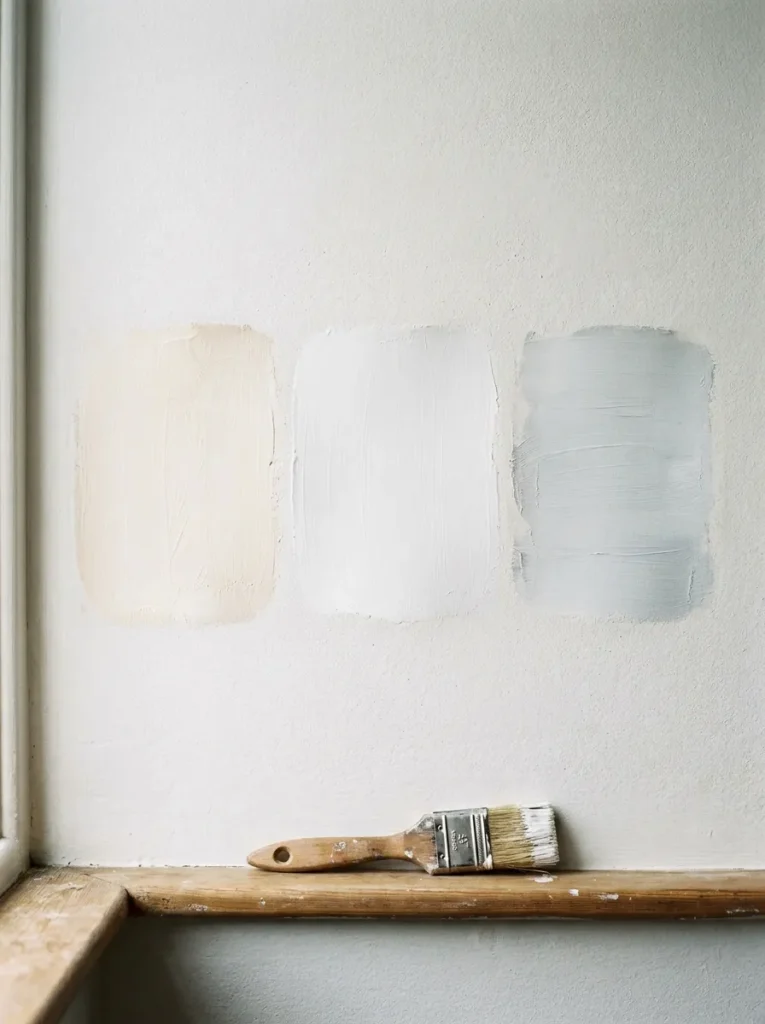
Before furniture, bedding, or curtains, the paint decision shapes everything. White is not a neutral in the way people assume — every white paint has an undertone that becomes more visible as it fills a room. Cool whites with blue or grey undertones can read clinical in north-facing rooms with limited natural light. Warm whites with yellow, pink, or green casts can feel dingy against bright white trim or crisp linen.
The most practical approach: test at least three samples directly on your wall, observe them at different times of day, and check them against your floor and trim rather than against each other. In rooms with warm wood floors or natural linen bedding, a warm white with a slight yellow or pink lean (like aged milk rather than bright snow) tends to integrate more naturally. In rooms with cool-toned stone or grey floors, a white with a soft grey undertone reads crisper without feeling cold.
2. Use Linen Bedding as the Room’s Primary Texture Layer

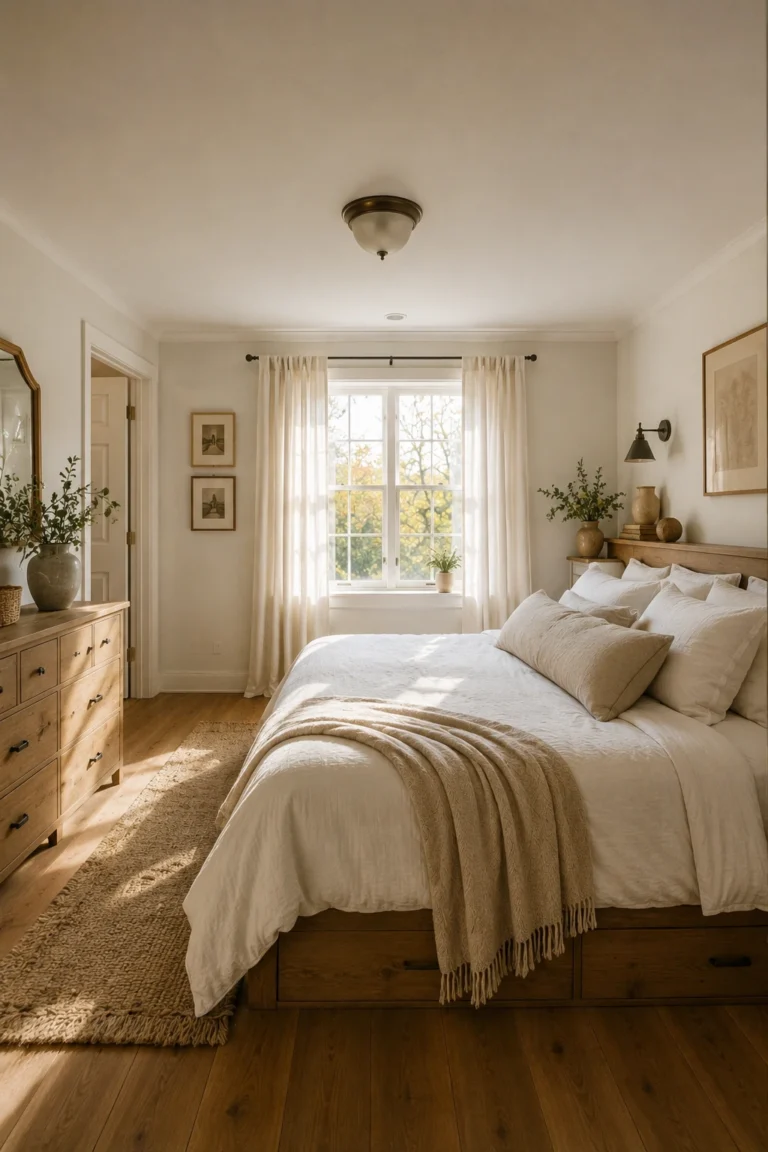
White linen bedding does something that cotton or polyester blends can’t replicate at the same visual depth: it holds shadows. The natural slubs and drape create soft variation in tone even within a single color, which is exactly what a white bedroom needs to avoid looking flat. You don’t need a perfectly made bed — linen is one of the few fabrics where slight rumpling reads as intentional rather than untidy.
For the most useful layering, combine a washed linen duvet cover with a textured waffle-knit blanket folded at the foot of the bed. The contrast between the loose weave of the linen and the geometric pattern of the waffle knit adds visual complexity without introducing color. Standard shams can be swapped for euro shams in a slightly heavier linen weight, which gives the headboard area more visual substance when the pillows are stacked.
3. Introduce Wood Tones to Prevent the Room from Feeling Cold
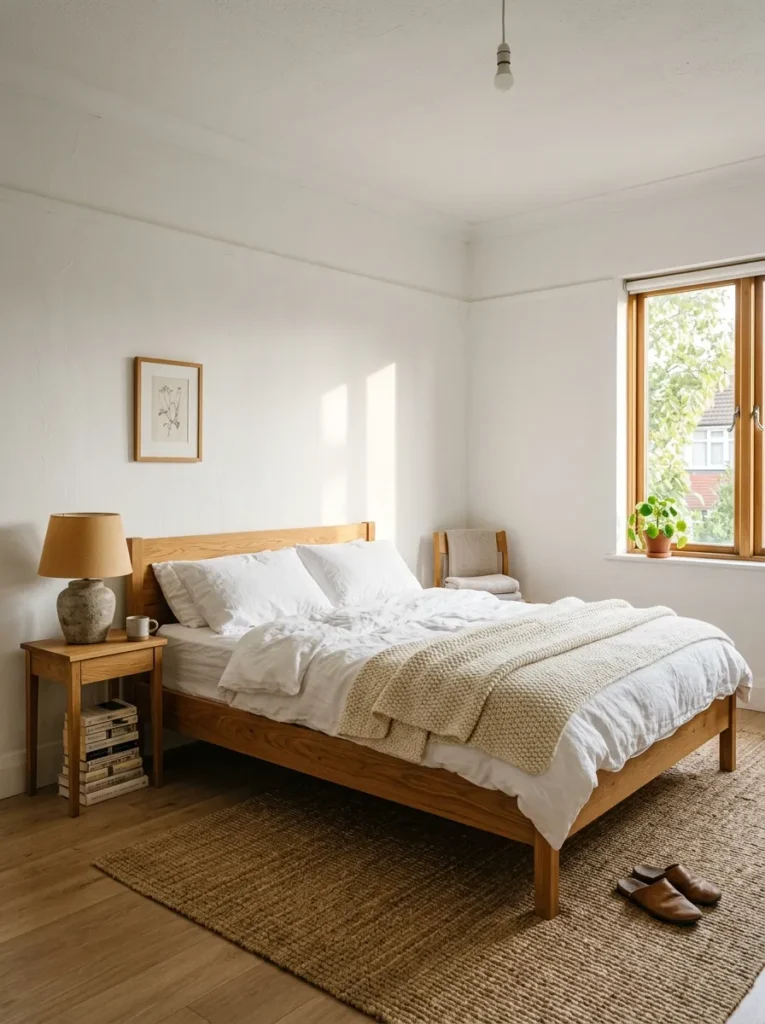
A room composed entirely of white, chrome, and hard surfaces will feel sterile regardless of how carefully styled it is. Wood is the most reliable counterweight — it introduces warmth, organic variation, and a lived-in quality that white alone cannot manufacture.
The best application depends on room size. In larger bedrooms, a substantial piece like a solid oak bed frame or a walnut dresser can serve as the primary warm anchor. In smaller rooms, the wood presence can come from smaller sources: a slim bedside table, a wooden lamp base, picture frames, or open shelving. Medium-toned woods (honey oak, ash, light walnut) integrate most naturally with warm whites. Very dark woods like ebony or mahogany can work beautifully but require deliberate contrast planning — they tend to dominate a white room rather than soften it.
Avoid mixing multiple conflicting wood tones unless at least one is very minor (a small accessory rather than a furniture piece). In a white bedroom, tonal inconsistency becomes more visible than it would in a richer color scheme.
4. Layer Curtains From Ceiling to Floor to Expand the Room Vertically
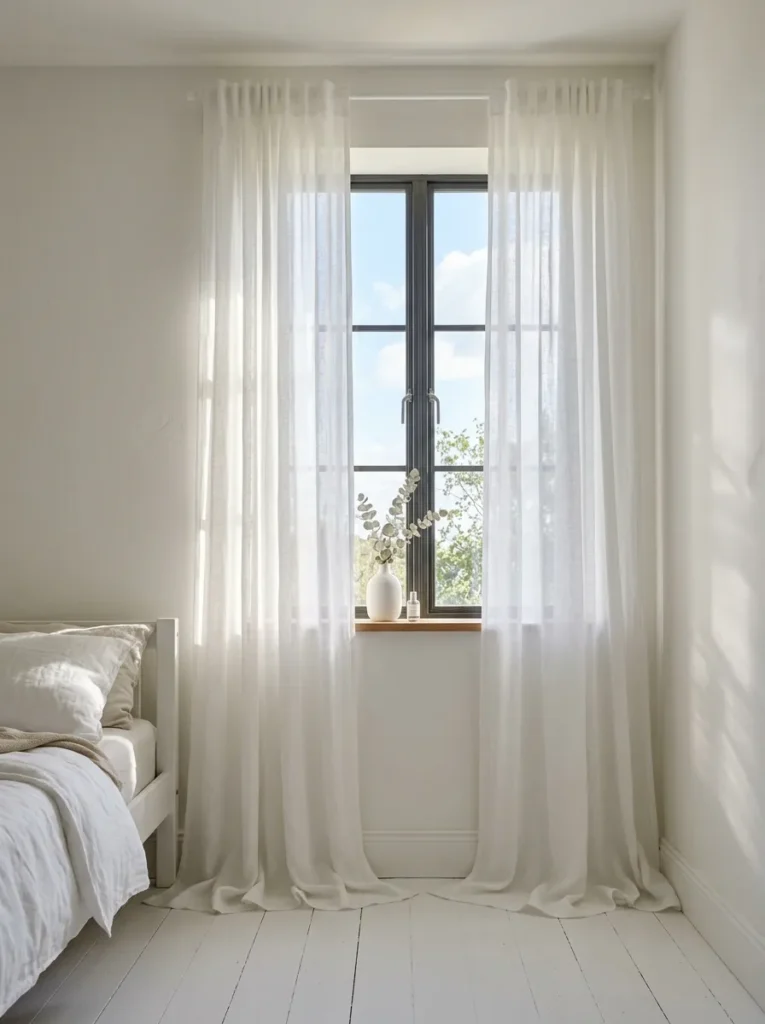
Curtains that start just above the window frame and end at the sill are one of the most common small bedroom mistakes. They compress the visual height of the room and make the window look smaller than it is. In a white bedroom where height and light are part of the appeal, the curtain placement matters as much as the fabric itself.
Mounting the curtain rod 10–15 cm below the ceiling line (or as close as your architecture allows) and letting the panels fall to just above the floor creates a significantly taller-feeling room. In white bedrooms, sheer white linen or cotton voile panels are the most useful choice — they diffuse light beautifully, maintain the pale palette, and move softly in any air current. Heavier white curtains in a dupioni or cotton canvas work for rooms where privacy and light-blocking matter more than airiness.
One useful detail: width matters as much as drop. Each panel should be wide enough to stack almost entirely off the glass when open. Narrow panels bunched across the window look skimped and block the light that makes a white room worth having.
5. Use a Textured White Wall Treatment Instead of Flat Paint
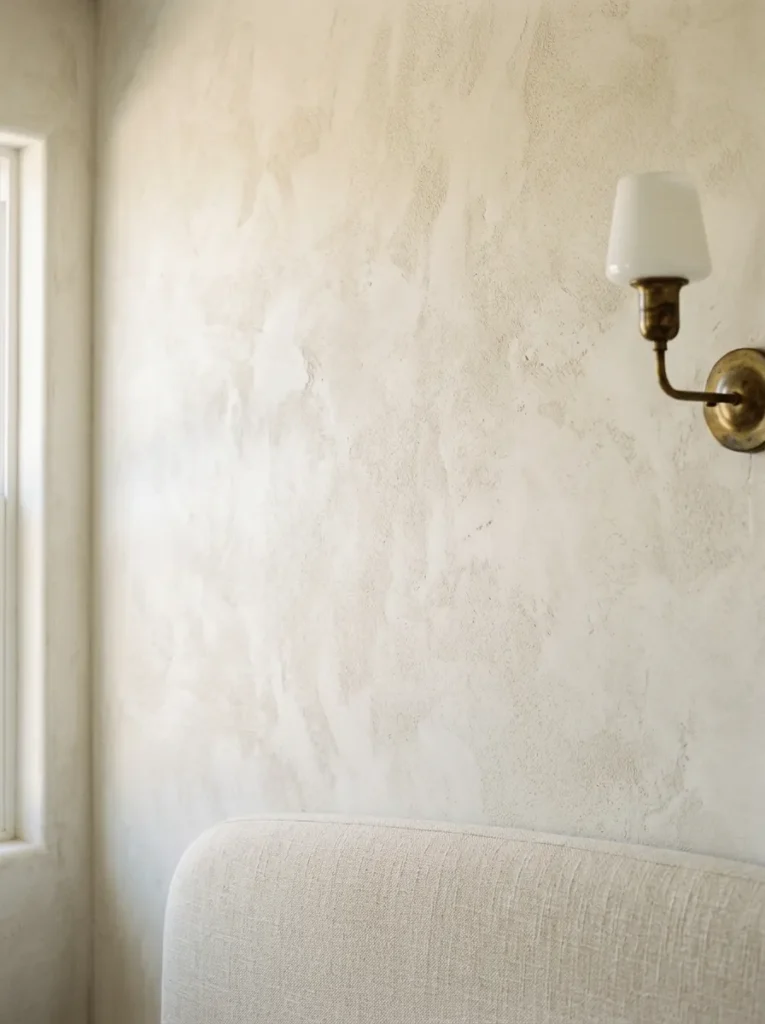
Flat white paint on large walls is the most common way a white bedroom ends up looking clinical. The solution isn’t necessarily to introduce color — it’s to introduce surface depth. A textured wall finish creates the subtle shadow variation that makes white walls interesting across different light conditions.
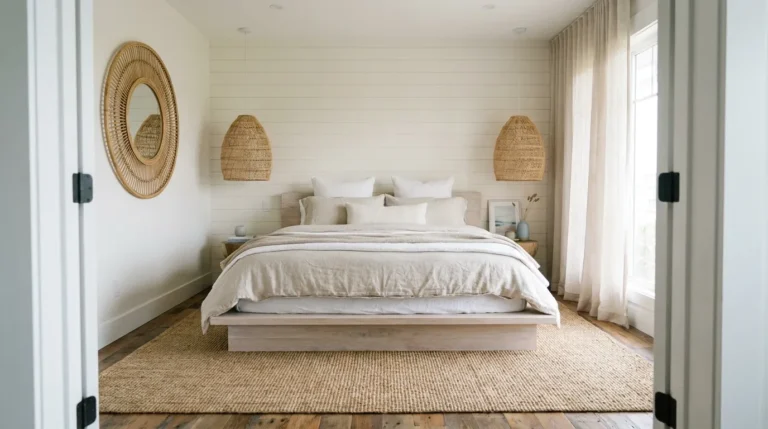
Limewash paint is the most discussed option currently, and with good reason: it creates a softly mottled, aged-plaster effect that reads beautifully in white bedrooms and photographs distinctively for Pinterest. Venetian plaster is richer and more labor-intensive but produces a polished depth that’s genuinely different from any paint effect. For a simpler approach, a wall paneling treatment — shiplap, beadboard, or simple board-and-batten — creates structured texture that photographs strongly and suits both traditional and contemporary rooms.
In rental situations where wall treatments aren’t feasible, a large-format textured wallpaper in an off-white or subtle raised pattern achieves a comparable visual effect.
6. Choose a Statement Headboard as the Room’s Primary Focal Point
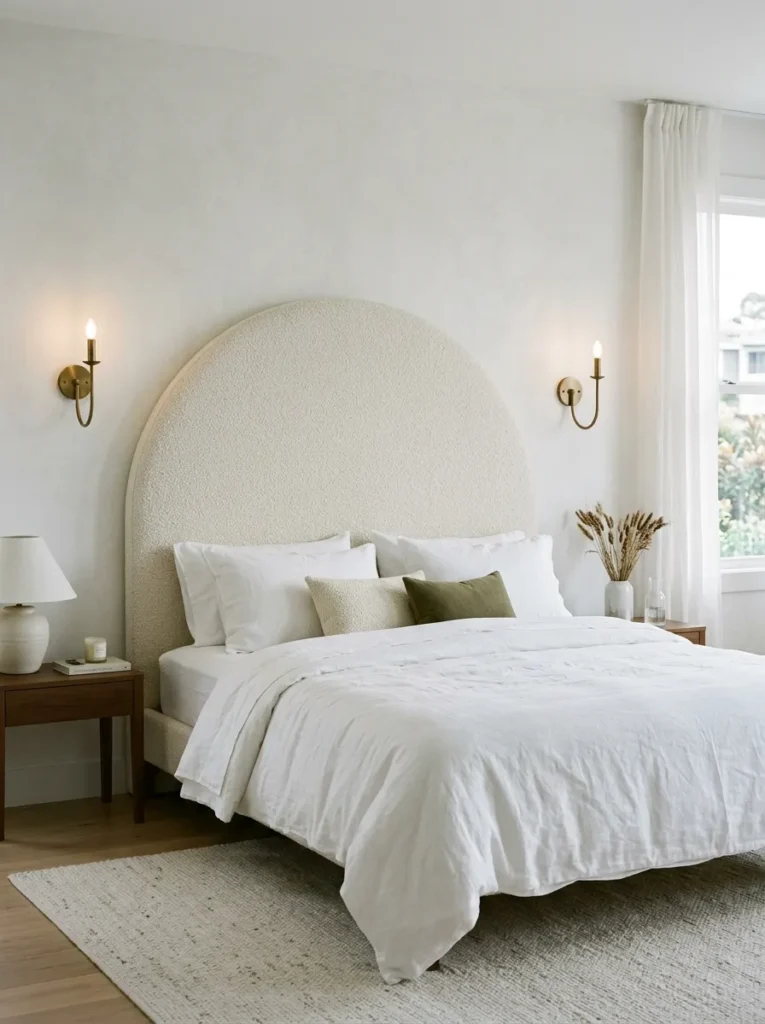
In a white bedroom, the headboard is frequently the one object that most defines the room’s character — because color isn’t doing that work. An upholstered headboard in white boucle, ivory linen, or creamy cotton velvet provides height, softness, and visual substance without disrupting the pale palette. A tall arched headboard reads particularly well in rooms with high ceilings because it reinforces the vertical emphasis.
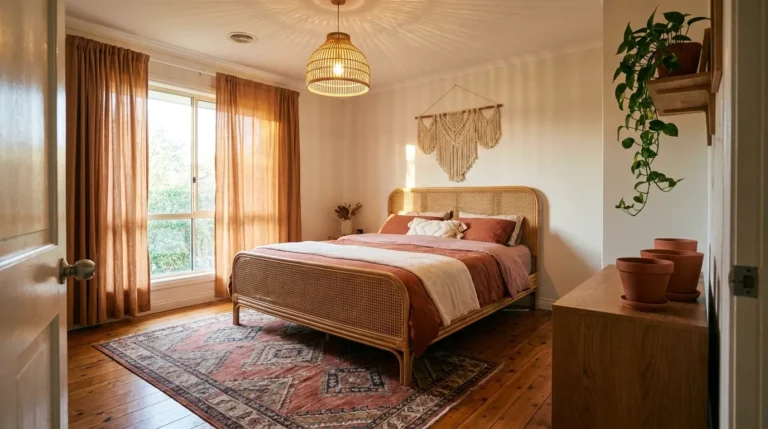
For rooms where a fabric headboard feels too soft or expected, a sculptural rattan headboard or a low slatted wooden frame creates a very different mood while still sitting comfortably within a white room. The main practical consideration is scale: the headboard should be roughly as wide as the mattress (for platform or floating-style beds) or slightly wider (for a more dramatic statement). A headboard that’s clearly narrower than the bed looks like an afterthought.
7. Build a Monochromatic White Palette With Tonal Variation
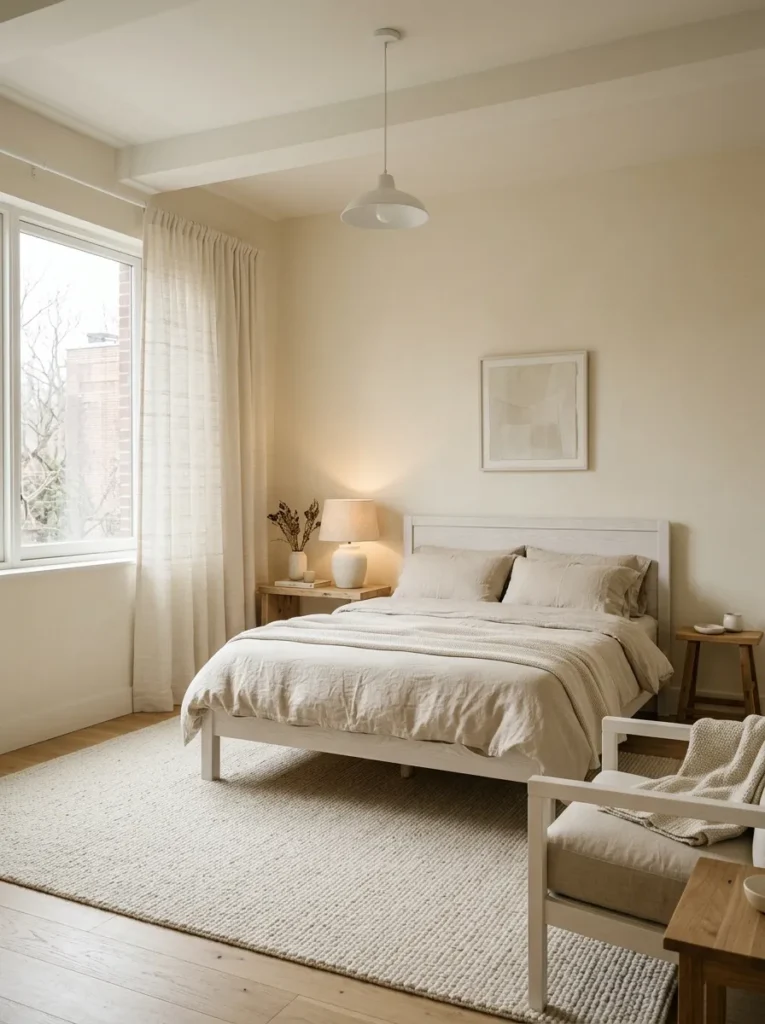
A genuinely interesting white bedroom doesn’t require a single accent color. It requires tonal variation — multiple whites and near-whites at slightly different temperatures, depths, and finishes. Think: warm ivory walls, natural linen bedding, a stone-white painted nightstand, cream-toned wool throw, and bleached cotton curtains. None of these are the same white, but they all belong to the same family.
The key is that finishes must vary as much as tones. Matte against gloss. Rough-woven against smooth. Painted wood against raw-edged textile. Without finish variation, even a carefully curated tonal palette can feel visually flat. This approach works particularly well in smaller bedrooms where introducing a strong accent color would feel busy — the restraint feels intentional rather than limited.
8. Use Black as a Graphic Accent to Sharpen the Room
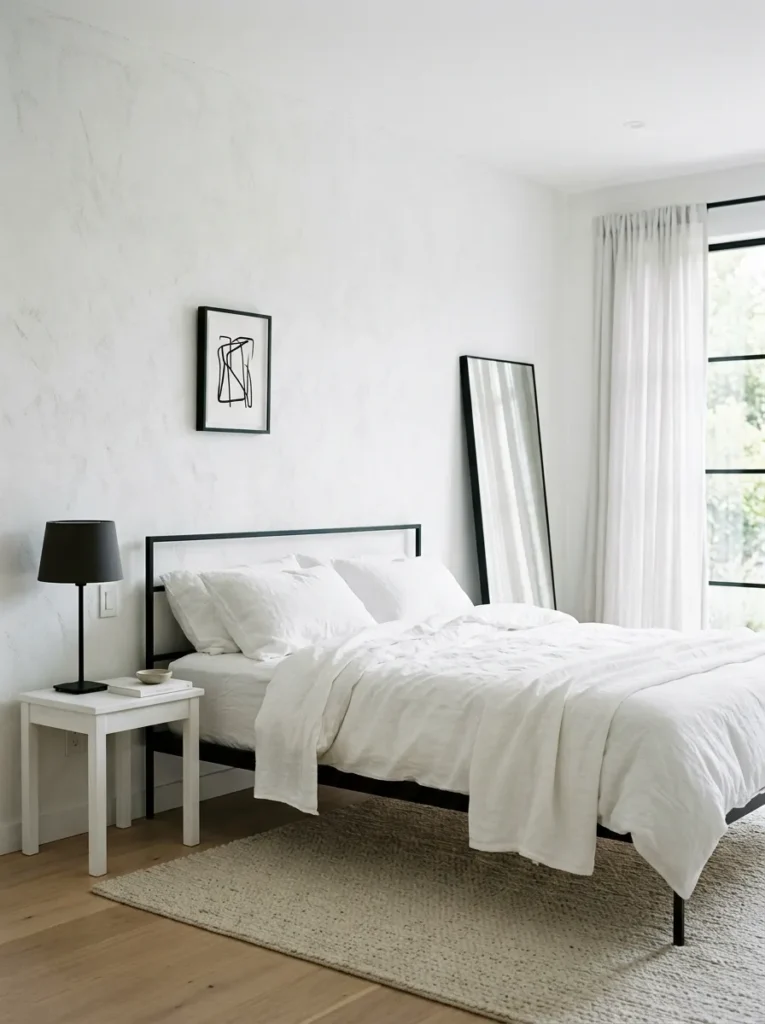
A small amount of black in a white bedroom has a very specific visual effect: it makes the white brighter by contrast and gives the room a sense of deliberate composition rather than accidental minimalism. The quantity matters. Too much black and the room stops being a white bedroom. Too little and the black elements look randomly placed rather than considered.
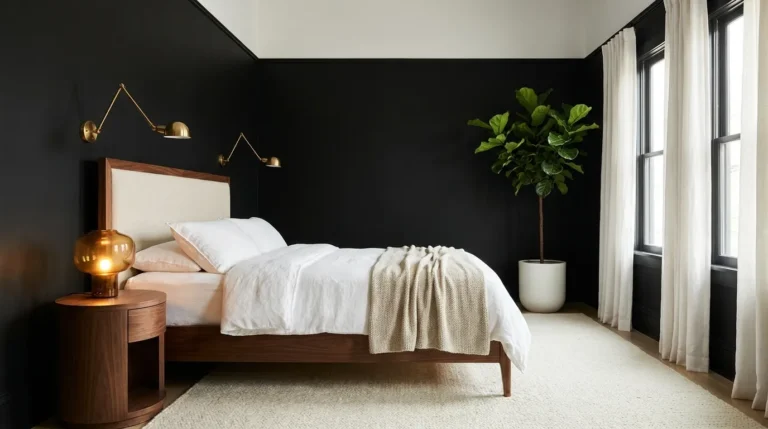
The most effective applications tend to be architectural or functional: black metal window frames if you have the option, black hardware on painted furniture, a thin black-framed mirror, or black sconce fixtures. A single black pendant or a dark-framed art print can anchor a wall that would otherwise float without definition. In rooms with white walls and white bedding, even a black lamp base reads as a deliberate choice.
Avoid distributing black randomly — two or three well-placed black elements will read more intentional than seven scattered ones.
9. Install Wall Sconces Instead of Table Lamps to Free Up Surface Space
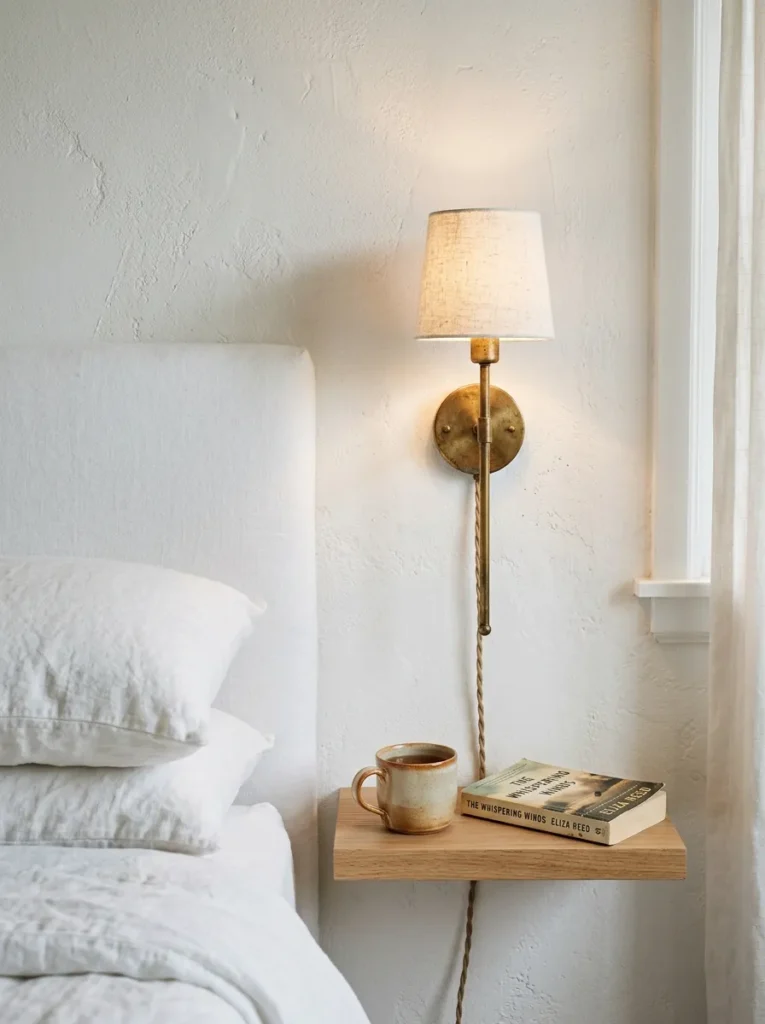
Bedside tables in smaller white bedrooms often end up visually crowded once a lamp, phone, glass of water, and current book compete for space. Wall-mounted sconces solve this practically and aesthetically — they elevate the light source to a more flattering level for reading, free the surface entirely, and look intentional in a way that table lamps on compact nightstands sometimes don’t.
In a white bedroom, brass sconces with a warm-toned bulb are a consistently strong choice: the metal adds warmth, the light quality is flattering, and the silhouette reads well against pale walls. Plug-in sconces are available if hardwiring isn’t feasible — the cord can be routed inside cable management channels or behind a slim panel for a cleaner look. Mount them roughly at shoulder height when sitting upright in bed, positioned so the shade centers above the nightstand if one is present.
10. Add a Natural Fiber Rug to Ground the Space and Absorb Sound
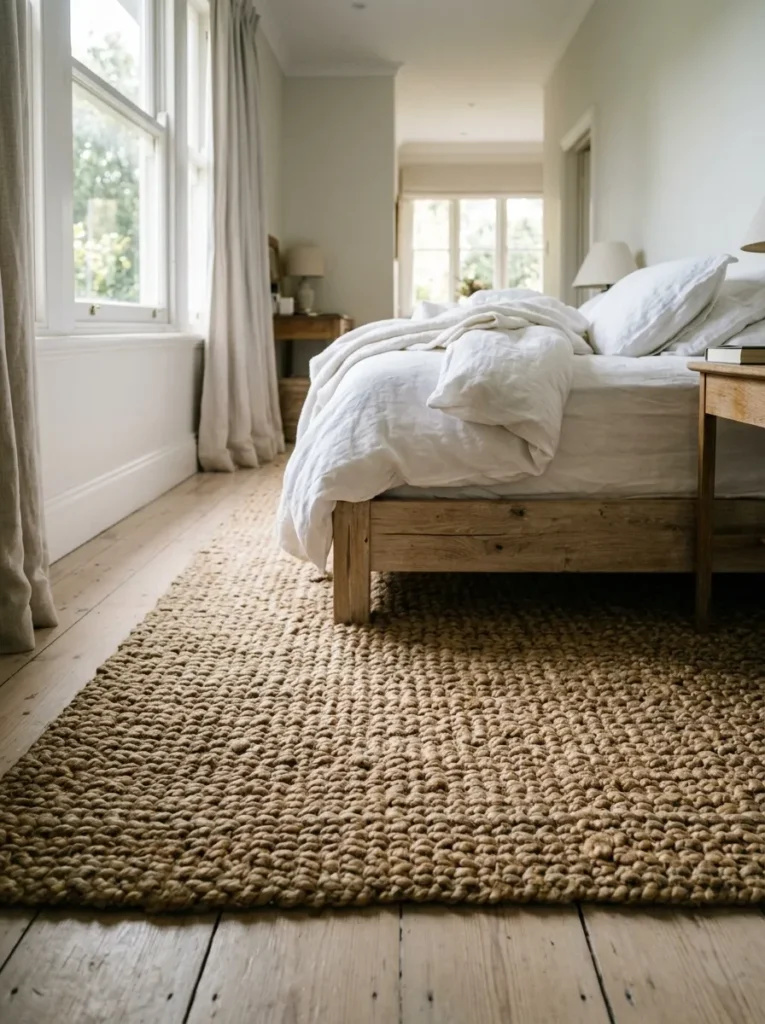
White rooms without a rug can feel acoustically sparse as well as visually unanchored. A large natural fiber rug — jute, sisal, seagrass, or a chunky cotton braid — introduces texture and warm tone at floor level, which is exactly where a white room needs it most. These materials also photograph with strong visual interest because of their irregular weave structure.
Rug size matters substantially. In a bedroom, the rug should extend at least 60 cm beyond each side of the bed frame so there’s a textured landing for your feet when getting up. A rug that only sits under the bed frame (or only partially emerges from under it) looks undersized. If budget constrains the rug size, layering a smaller jute or wool rug over a flat natural fiber base is a practical workaround that also adds depth.
For rooms with very light wood or white-painted floors, a natural fiber rug provides the tonal contrast that makes the floor register as a deliberate element. For darker floors, a pale wool or cotton rug diffuses the contrast more gently.
11. Use Open Shelving With Restrained Styling for Function and Visual Interest

A white bedroom with nothing on the walls can feel empty rather than calm. Open shelving — particularly a slim floating shelf or a pair of staggered wall shelves — provides a practical solution for bedside storage while creating a surface for intentional styling. In a white room, the shelf itself should generally be white, natural wood, or the same material as other furniture in the room. A dark or brightly colored shelf tends to pull focus in a way that disrupts the palette.
The styling on the shelf is where most people go wrong: too many objects and the shelf looks cluttered; too few and it looks forgotten. A useful approach is to keep one layer functional (books, glasses, a small lamp) and add one or two objects purely for visual interest — a small ceramic vessel, a single dried stem, a candle. That’s usually enough.
12. Paint or Limewash the Ceiling to Complete the Enveloping Effect
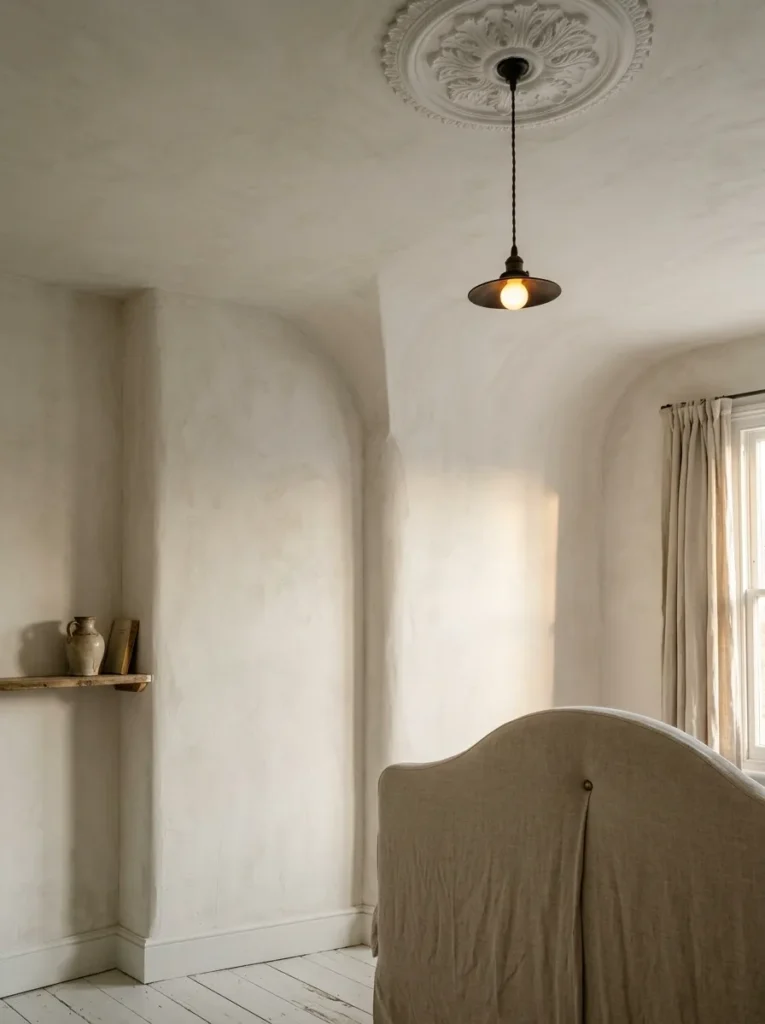
Leaving the ceiling brilliant white while the walls are a warm or tinted white can create a jarring visual divide — especially in rooms with lower ceilings where the contrast is unavoidable. Painting the ceiling in the same tone as the walls (or one shade lighter) produces a more cohesive, enveloping effect that makes the room feel like a unified whole rather than four walls with a lid.
For rooms with architectural ceiling details — exposed beams, coffered panels, or decorative plasterwork — painting the ceiling white to contrast with natural wood beams or coloured walls is an entirely different visual strategy and makes sense on its own terms. The question is whether the ceiling contrast is intentional and structural, or accidental and distracting.
In smaller rooms with low ceilings, keeping the ceiling slightly lighter than the walls preserves the sense of height. The paint doesn’t need to be pure brilliant white — a muted off-white that shares the wall’s undertone reads softer without making the ceiling feel lower.
13. Create a Reading Nook or Window Seat Within the White Palette
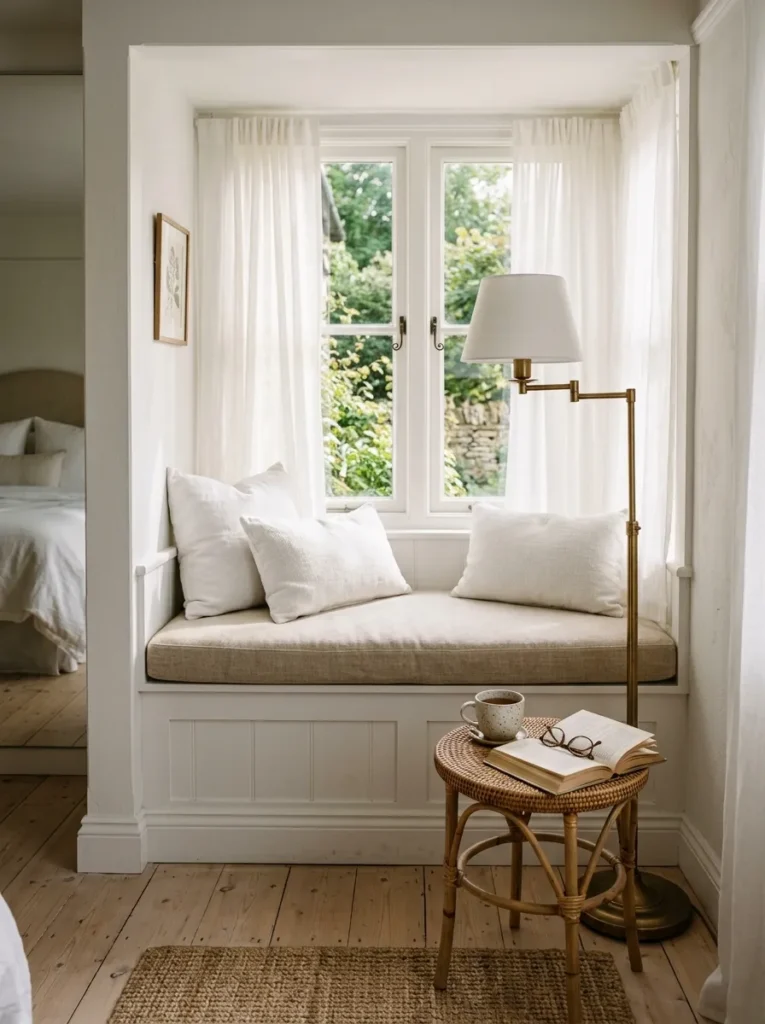
A corner with a white linen cushion on a window bench, a stack of books on a low shelf, and a floor lamp positioned for actual reading use represents both a genuinely useful space and a strong Pinterest visual — because it’s a complete, self-contained scene rather than just a wall or a bed.
If the architecture doesn’t include a window bay, a similar effect is achievable with a low armchair in a room corner (white bouclé or natural linen works best within the palette), a small round side table, and angled lighting. The corner creates a defined zone within the bedroom that makes the room feel larger and more considered — like it has more than one purpose. For renters or those with smaller rooms, even a chair positioned near a window with a floor lamp creates the same visual narrative without any fixed construction.
14. Use Mirror Placement to Reflect Light, Not Clutter
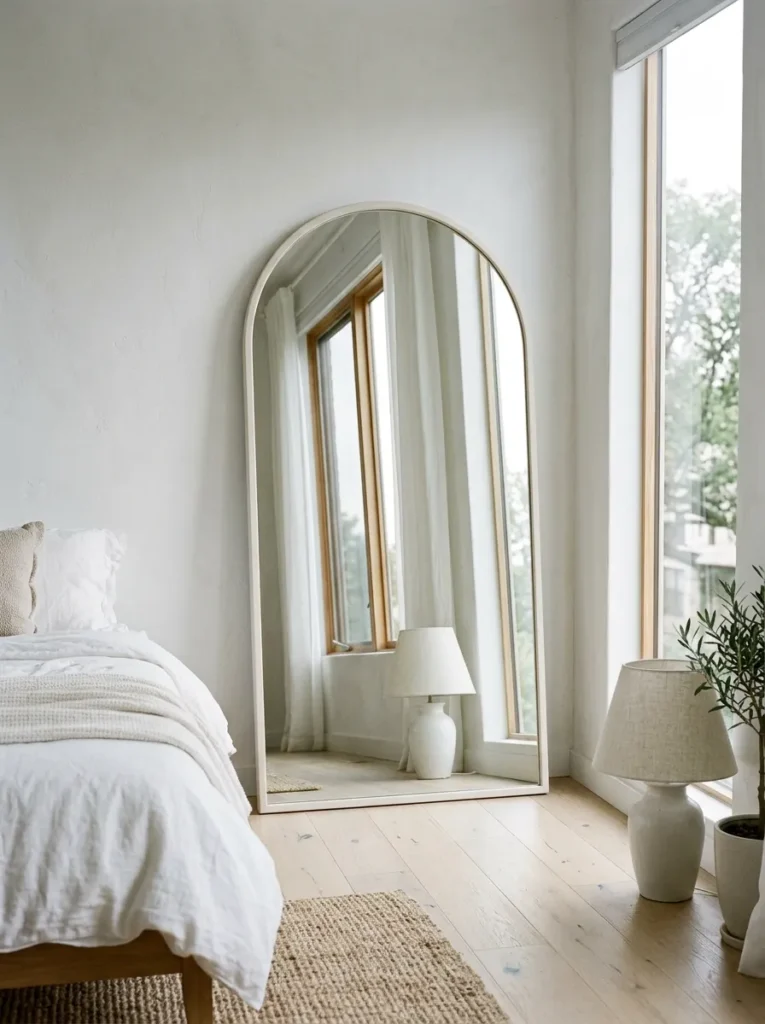
A large mirror in a white bedroom is useful for several reasons, but placement determines whether it adds to the room’s brightness or simply reflects whatever happens to be across from it. A mirror positioned to reflect the window doubles the apparent light source, which is the most effective use in a room relying on pale surfaces. A mirror reflecting a blank wall or a messy closet adds neither light nor visual interest.
For a white bedroom, a full-length leaning mirror in a thin natural wood or aged metal frame reads as a functional but considered choice. An arched mirror with a white plaster or plinth-style base adds sculptural quality without competing with the room’s palette. Avoid positioning a large mirror directly opposite the bed in rooms where you’re sensitive to reflective movement — it’s a personal preference but worth thinking through before committing to a wall mounting.
15. Layer Lighting Across Three Sources for Warmth and Flexibility
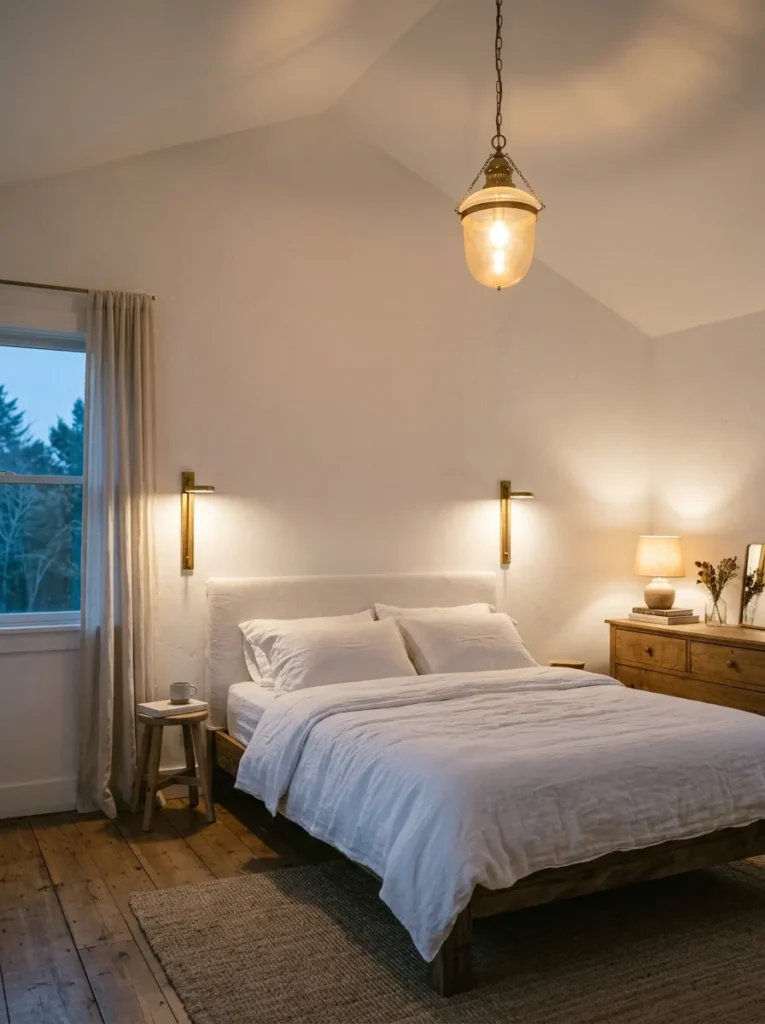
A white bedroom lit only by a ceiling fixture will look clinical regardless of how carefully everything else is styled. White surfaces reflect light directly, which means unflattering overhead lighting shows up more visibly than in rooms with absorbing colors and materials. Effective lighting in a white room requires multiple sources at different heights.
The three-layer approach: ambient light from a ceiling fixture (ideally a dimmable fixture with a warm-toned bulb), task light from bedside sconces or lamps, and accent light from a source like a small table lamp on a dresser or a picture light above art. This spreads the light around the room at different levels and creates depth that a single overhead source cannot. Warm-toned bulbs (2700K–3000K) read better in white rooms than daylight-balanced bulbs, which can reinforce any cool undertone in the paint.
16. Choose a Low Platform Bed to Emphasize Horizontal Calm
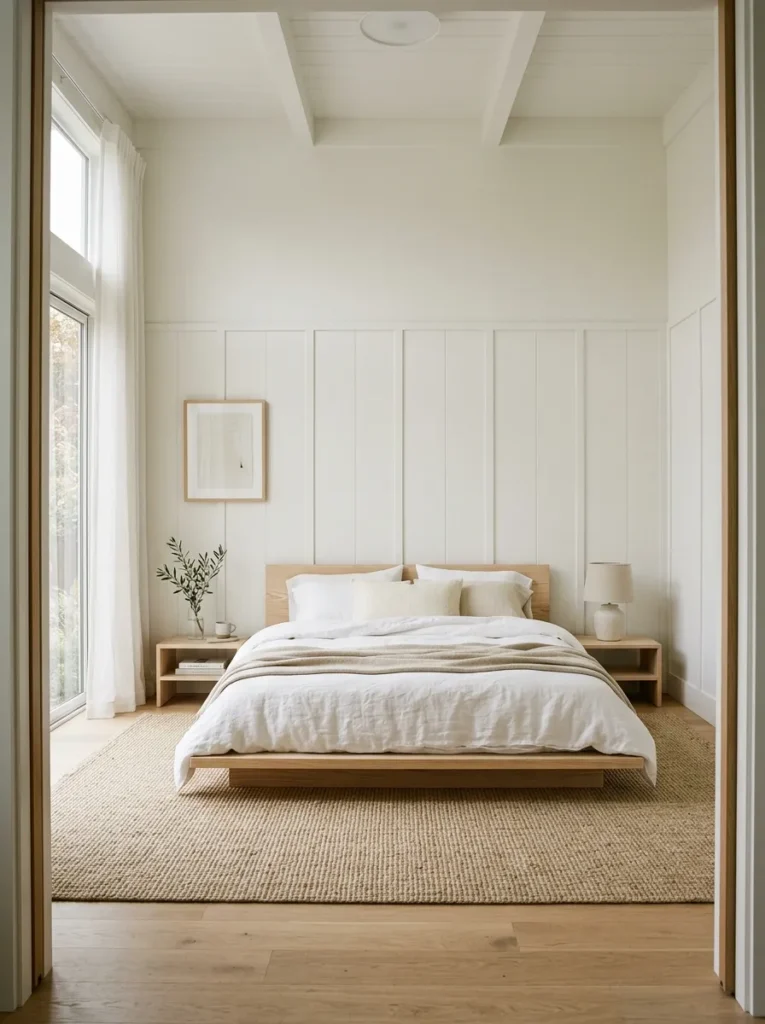
Room height has a strong influence on how a white bedroom feels. In rooms with lower or average ceilings, a tall bed frame with a high headboard can make the space feel top-heavy. A low platform bed shifts the visual weight toward the floor and creates a horizontal emphasis that reads as deliberately contemporary and calm — the Japanese-influenced bedroom aesthetic that photographs with strong negative space above the bed.
Platform beds work particularly well in rooms where the architectural interest is in the walls or windows rather than in the furniture height. The tradeoff is practical: getting in and out of a very low bed is less comfortable for some people, particularly those with mobility considerations. The rug sizing also matters more with a low bed — because the frame is close to the floor, the rug needs to be large enough to make an impression at that height.
17. Use Curtain Fabric Weight to Control the Quality of Light
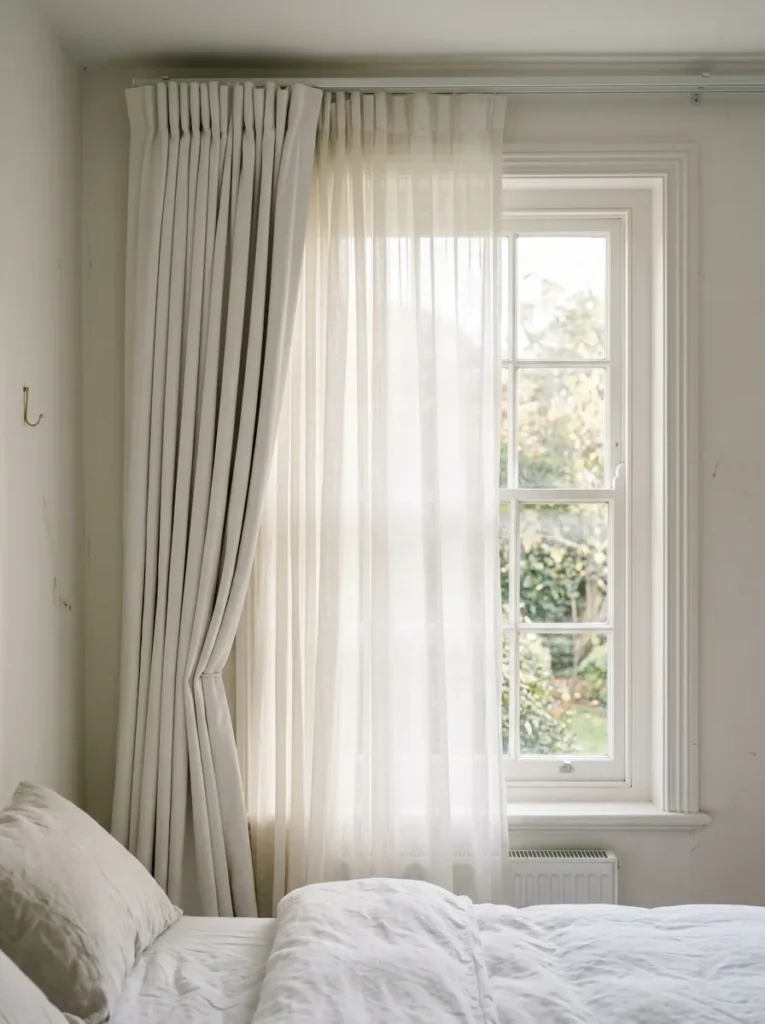
Not all white curtains are equal. A sheer cotton voile diffuses bright light into soft glow and moves with any air in the room — useful for rooms with strong morning sun where you want light without harshness. A heavier white cotton canvas or twill blocks more light and creates more structural folds, which is the better choice for rooms where privacy or afternoon sleep matters.
A double curtain layer — a sheer behind a heavier panel on the same track — gives full control across different times of day and weather conditions. In white bedrooms, this layered approach also adds visual depth to the window area, which is otherwise one of the flattest-looking surfaces in the room.
The most common mistake is choosing curtains solely by color and ignoring weight. In a white bedroom where the curtains are likely to be white or near-white, texture and weight are the variables that make them interesting or forgettable.
18. Bring in Dried Botanicals for Organic Texture Without Maintenance

Fresh flowers in a white bedroom photograph beautifully but require constant replacement. Dried botanicals — pampas grass, dried seed heads, bleached palm leaves, or a simple arrangement of dried eucalyptus — provide a similar organic quality with no ongoing maintenance and a more muted, dusty palette that suits white rooms particularly well.
The visual logic: dried plants in a white room introduce soft warm tone, movement, and organic texture simultaneously. They’re lightweight enough to work in small containers that won’t dominate a narrow nightstand, and they integrate naturally with linen, rattan, and other natural materials that characterize the most considered white bedrooms. One larger dried arrangement on a dresser or a simple stem in a tall ceramic vase is usually more effective than multiple small arrangements scattered across the room.
19. Use White as the Foundation for a Seasonally Rotating Room
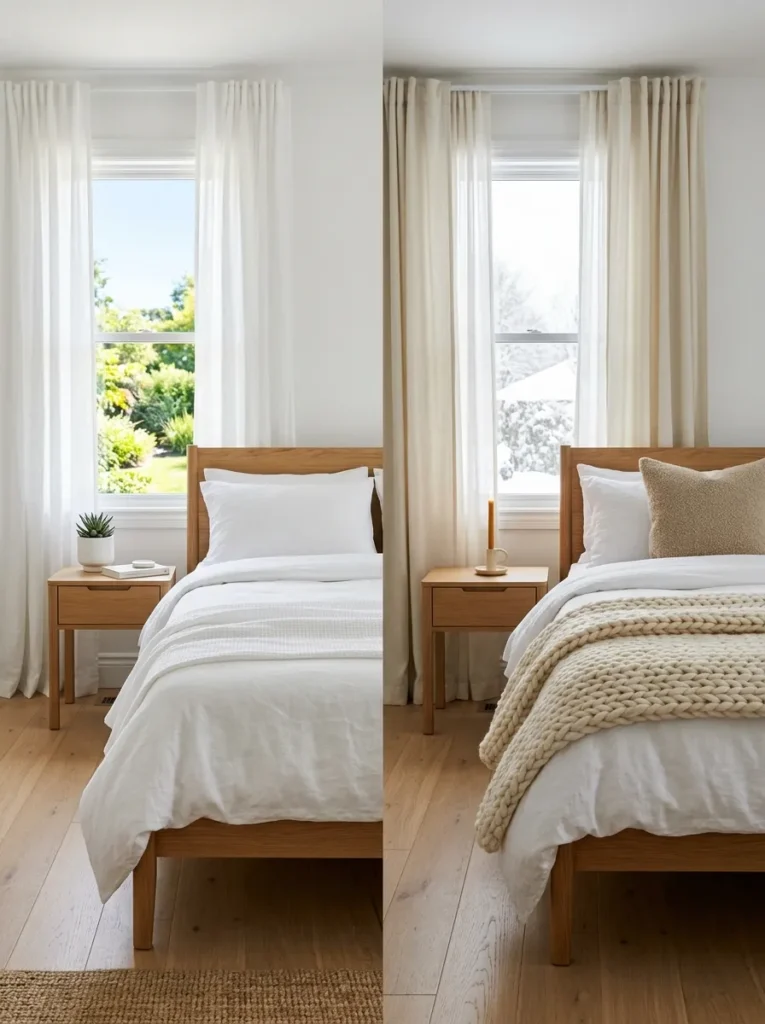
One of the most practical advantages of a white bedroom that isn’t obvious until you’ve lived in one: it’s the most flexible foundation for seasonal change. Because white doesn’t compete with much, swapping the throw blanket, pillow shams, or rug can shift the room’s mood substantially — linen and cotton in summer, heavier knits and wool in winter — without requiring any furniture changes.
This works best when the permanent elements (walls, bedding base, furniture) are genuinely neutral and the accent pieces are the layers you can move. A white duvet cover with readily washable cotton shams is the functional core. The throw blanket, euro sham covers, the decorative cushion, the vase on the shelf — these become the changeable elements. Keeping a small rotation of these makes the room feel actively styled rather than static, which is what separates rooms that photograph well from rooms that also feel good to live in.
How to Make a White Bedroom Work: Practical Decisions Before You Buy
Start with paint, not furniture
Undertone decisions are harder to reverse than furniture choices. Get the wall color right first and bring every furniture and textile decision into that space before purchasing.
Warmth vs. brightness: pick your direction
Decide early whether you want a room that feels luminous and airy (cooler whites, sheer fabrics, minimal texture) or warm and enveloping (off-white paint, natural linen, wood accents). Mixing both directions without intention produces a room that feels neither.
Texture is the substitute for color
In a monochromatic white room, texture does the visual work that color handles in other rooms. Flat surfaces everywhere — smooth walls, cotton-polyester bedding, lacquered furniture — produce visual flatness. Each surface should have a distinct material character.
Scale still matters
A white bedroom doesn’t escape the rules of furniture scale. Oversized furniture in a small white room still overwhelms the space; undersized furniture in a large room still looks sparse. White doesn’t make these problems disappear — it often makes them more visible because nothing else is competing for attention.
Maintenance is real
White rooms show dirt, dust, and marks more visibly than rooms with color or pattern. This isn’t a reason to avoid them, but it’s worth choosing washable fabrics, wipeable surfaces where practical, and being realistic about how much upkeep the room will need.
Final Thoughts
A white bedroom succeeds when restraint is applied with purpose rather than laziness. The ideas here work best when a few are selected and executed with genuine attention to detail — not when every technique is layered into the same room at once. If you’re starting from scratch, the sequence that matters most: paint undertone, bedding texture, and window treatment. Those three decisions establish whether the room will feel intentional or accidental before anything else enters the space.
If the room is already painted and you’re refining it, texture is usually the fastest lever. A linen duvet, a natural fiber rug, and one wooden element will do more for a flat white room than any number of decorative accessories.
Save any ideas that genuinely suit your room — not just the ones that look best in the photographs — and revisit this guide when you’re ready to layer in the finishing details.