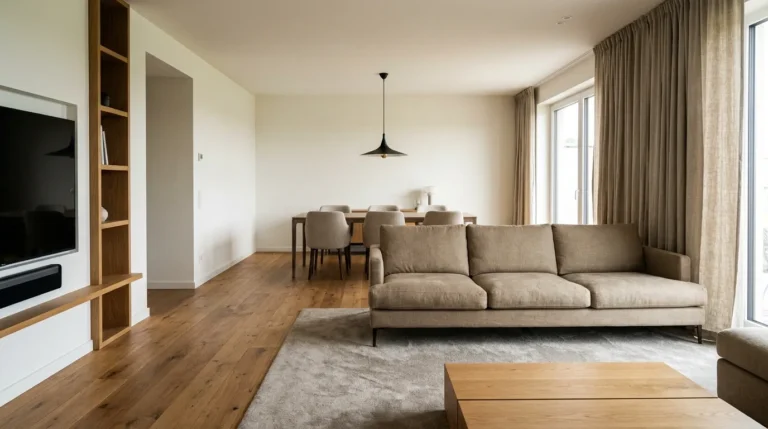
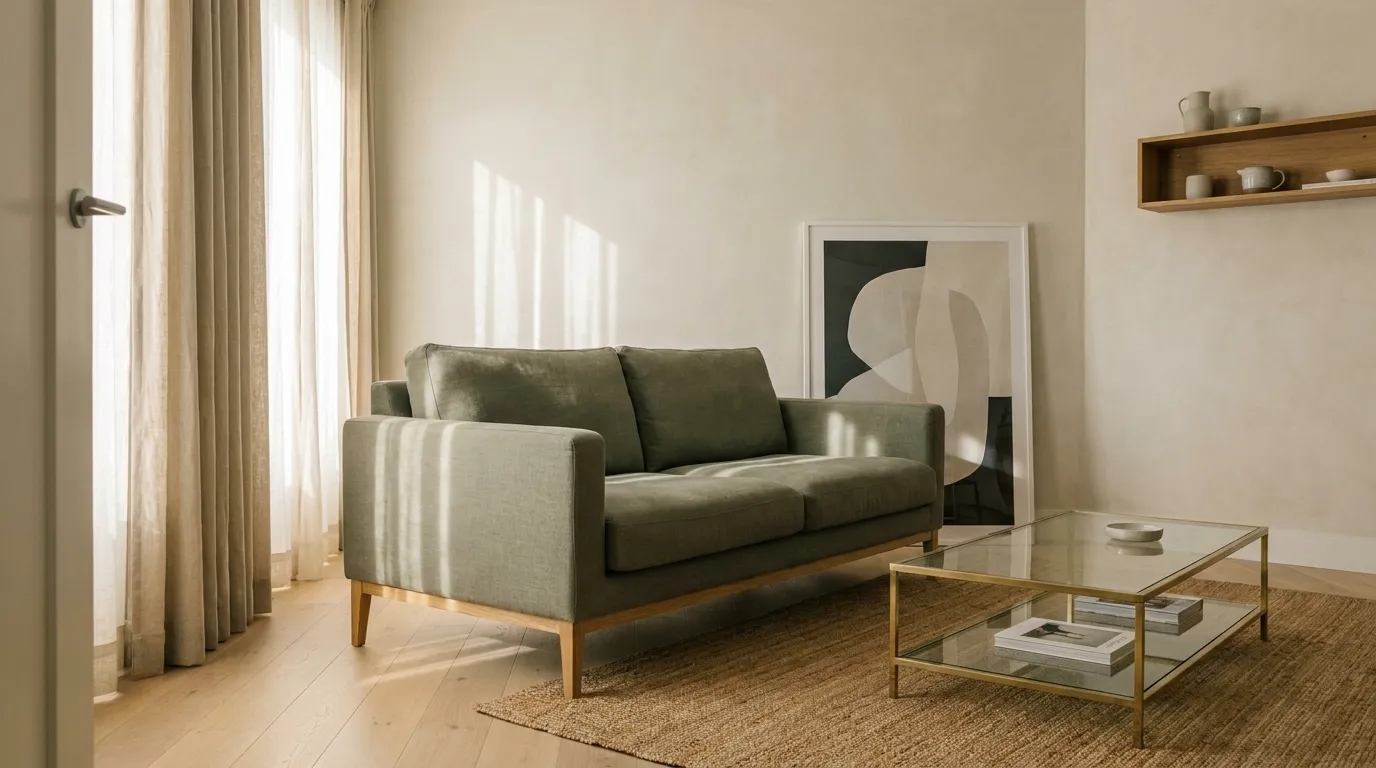
18 Small Apartment Living Room Ideas That Actually Make the Space Feel Bigger
Small apartment living rooms have a way of accumulating furniture that was individually reasonable but collectively suffocating. One sofa, a coffee table, a TV unit, a bookcase — and suddenly the room feels like a furniture showroom with no room to breathe.
The ideas here aren’t about eliminating everything you own or painting the walls white and calling it minimalism. They’re about understanding which decisions govern how a small space reads: what catches the eye first, how light moves through the room, whether furniture floats or anchors to walls, and why some storage solutions quietly shrink a space while others open it up. Whether you’re a renter working around a lease or an owner ready to invest in something more permanent, these living room ideas will give you both the visual inspiration and the practical logic to use them well.
1. Float the Sofa Away from the Wall
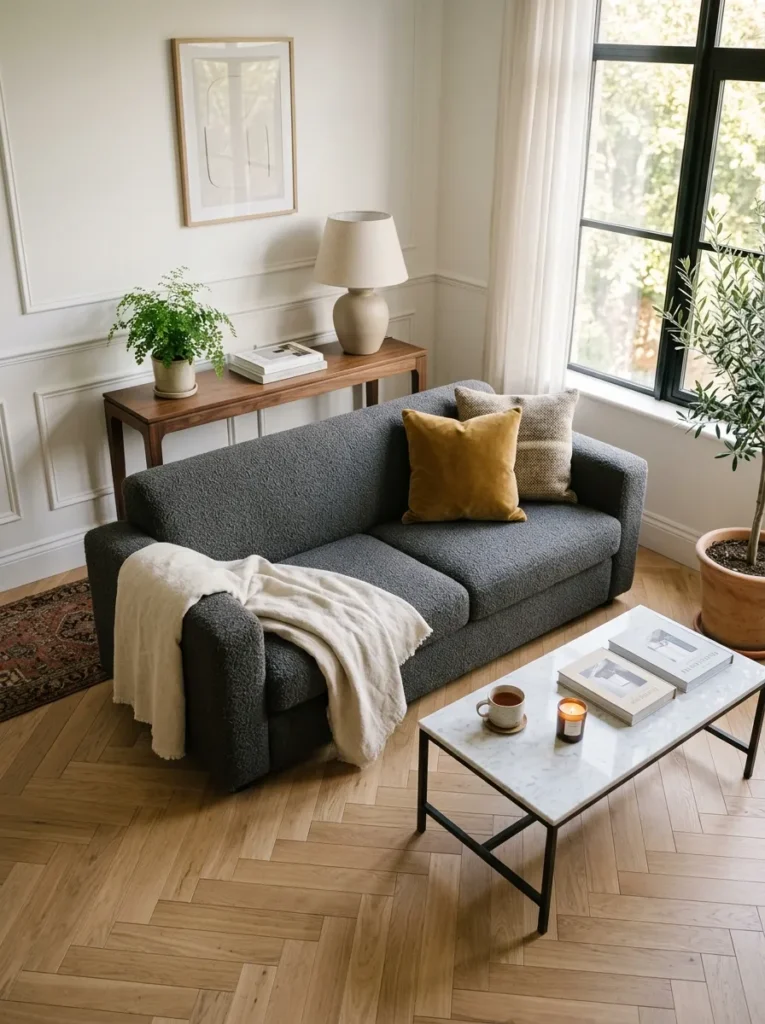
Pushing the sofa flush against the wall feels like it maximizes floor space, but it usually has the opposite visual effect. When every piece of furniture hugs the perimeter, the room reads as a series of isolated objects arranged around a void, which makes the open floor feel accidental rather than intentional.
Moving the sofa even 4–6 inches away from the wall creates a sense of depth behind the seating area. This works especially well when the sofa faces a focal point — a media console, a fireplace, an art piece — because the gap behind the sofa becomes part of the visual composition rather than dead space. In very tight rooms, a slim console table slotted behind the sofa can justify the gap while adding useful surface area for lamps or objects.
The principle: perceived spaciousness comes from deliberate arrangement, not from moving furniture to the edges.
2. Choose a Sofa with Visible Legs
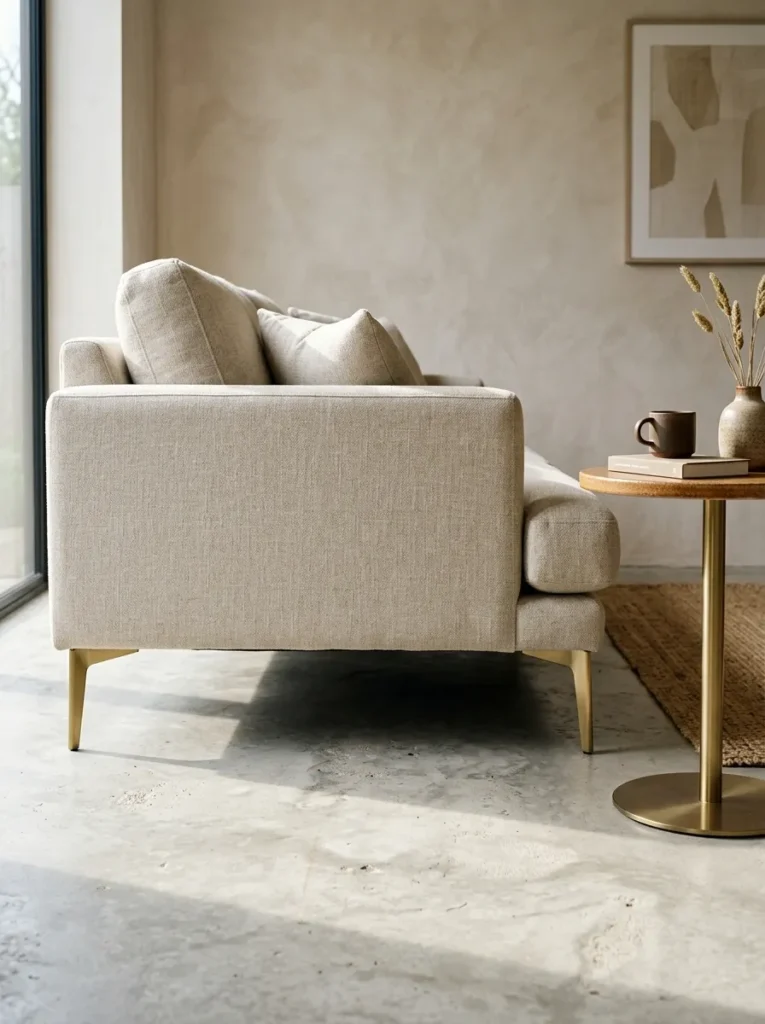
Low-slung sofas that sit flush with the floor block the eye at the lowest level of the room. Exposed legs — even short ones — allow light to travel beneath the piece, which visually lifts it and keeps the floor plane continuous.
This applies to coffee tables, armchairs, and side tables too. A room full of skirted or platform furniture tends to feel heavier than it is. Switching to pieces with slender legs in wood, powder-coated steel, or brushed brass makes the same arrangement feel noticeably lighter without reducing actual seating capacity.
One practical note: very delicate hairpin legs can look disproportionate on a deep sectional. Look for leg weight that’s proportional to the furniture mass — a modest tapered wooden leg often looks more resolved than an ultra-thin metal one on a large sofa.
3. Use a Single Large Rug Instead of Multiple Small Ones
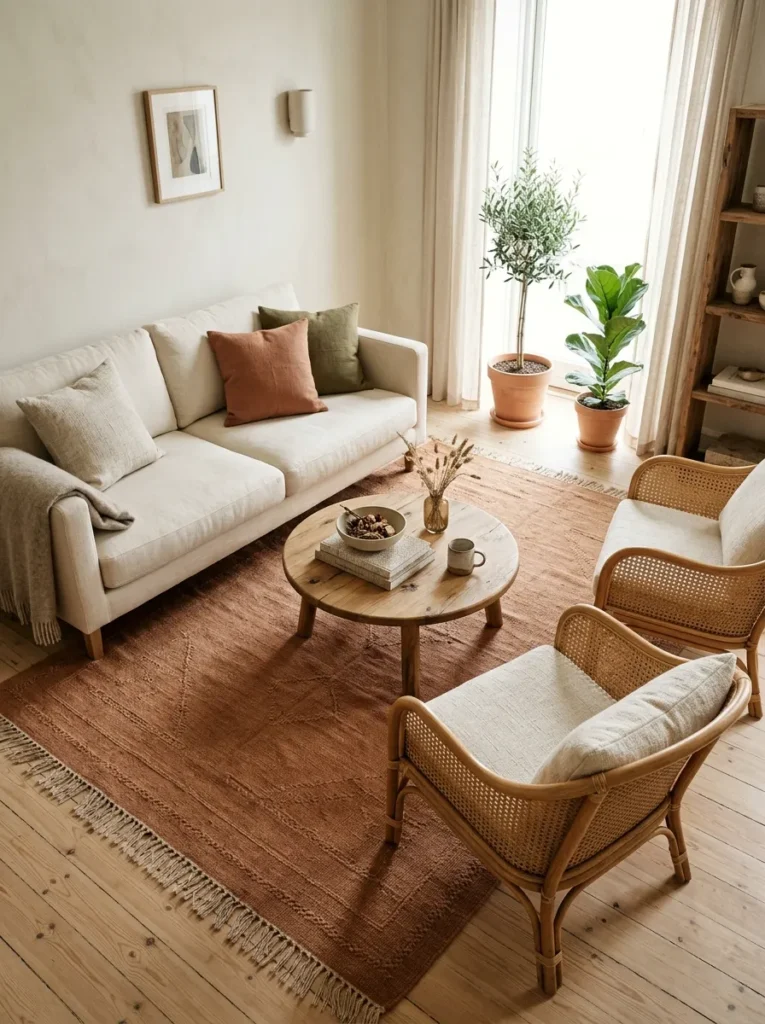
Rug size is one of the most consistently misjudged decisions in small living rooms. A rug that’s too small — particularly one where only the front legs of the sofa rest on it — visually contracts the seating zone and makes the floor feel choppy.
A rug large enough for all major seating legs to rest on it (or at least for the front legs of each piece) unifies the arrangement into a single zone. This works counterintuitively: the bigger the rug, the larger the room can feel, because the floor is read as one continuous surface rather than several competing fragments.
In a genuinely tight room, a rug in a low-contrast color relative to the floor — warm taupe over light wood, charcoal over grey stone — keeps the floor plane calm. A high-contrast rug in a small room draws the eye to its edges and makes the boundary of the space more apparent.
4. Mount the TV to Free Up Floor Space
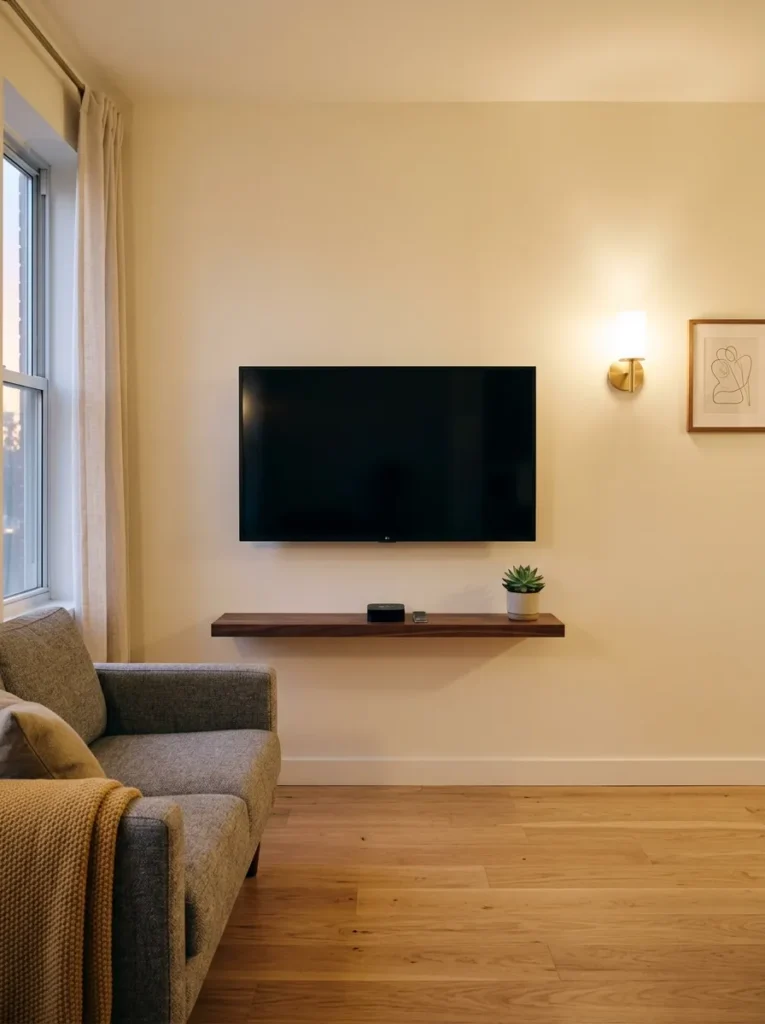
TV units and media consoles are often the largest piece of furniture in a living room aside from the sofa. In a small apartment, they consume a disproportionate amount of visual and physical floor space, and because they typically run low and wide, they anchor the eye at the heaviest point in the room.
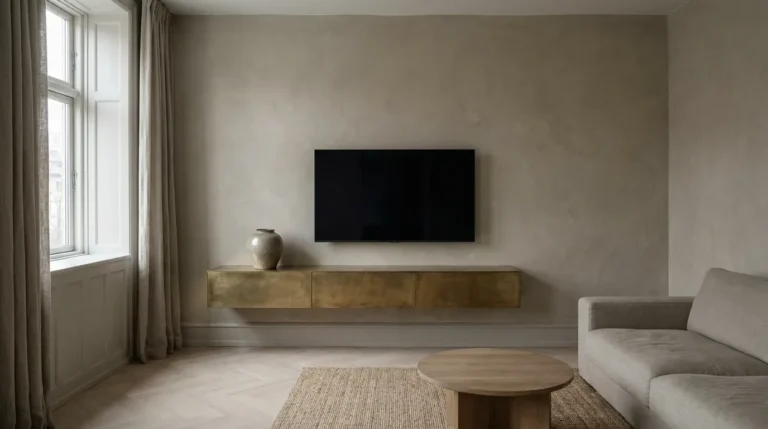
Wall-mounting the screen and replacing the media console with a smaller credenza, a floating shelf, or wall-mounted media storage eliminates that wide horizontal footprint entirely. This doesn’t require permanent wall modification if you use an articulating floor-to-ceiling tension pole mount, which is a renter-friendly alternative that leaves no holes.
The practical benefit extends beyond aesthetics: clearing that zone of floor space makes it much easier to use a smaller coffee table or even replace the table with a pair of nesting tables, which can be tucked away when the room needs to function as something else.
5. Layer Vertical Lines to Draw the Eye Upward
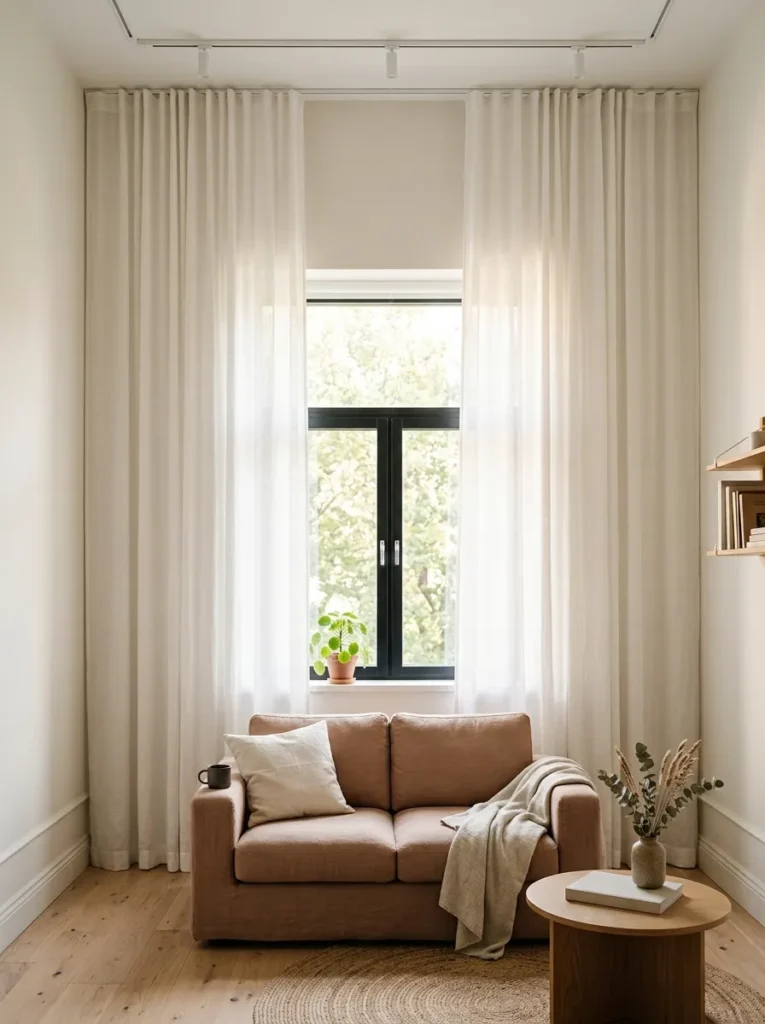
Small rooms often feel compressed not because they lack floor space but because nothing directs attention toward the ceiling. Vertical visual lines — whether from floor-to-ceiling drapery, tall shelving, a vertical gallery wall, or wall paneling — shift the perceived proportions of a room by guiding the eye up rather than around.
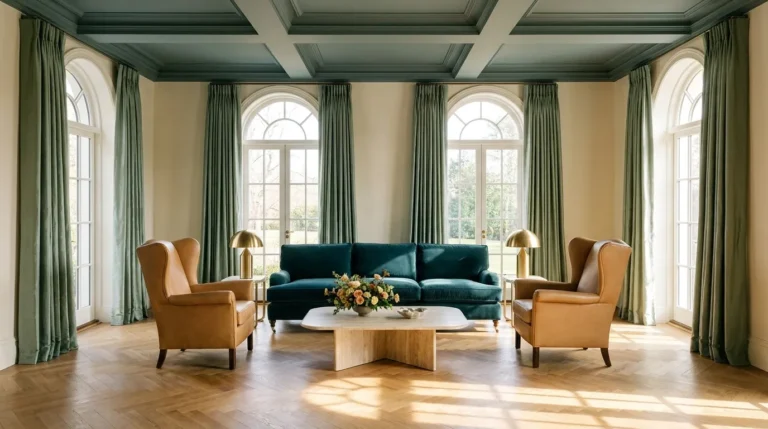
Curtains hung as close to the ceiling as possible and allowed to fall to the floor are the most immediate and lowest-commitment way to achieve this. The rod should sit 4–8 inches above the window frame, or ideally at ceiling height, and the panels should be wide enough to stack clear of the glass when open. Curtains that stop at the windowsill or hover mid-wall do the opposite: they call attention to where the room ends.
For renters, curtains with tension rod alternatives or removable ceiling-mounted hooks avoid the need for drilling, though the standard approach is more stable for heavier fabrics.
6. Choose a Loveseat or Apartment-Scale Sofa Over a Full Three-Seater
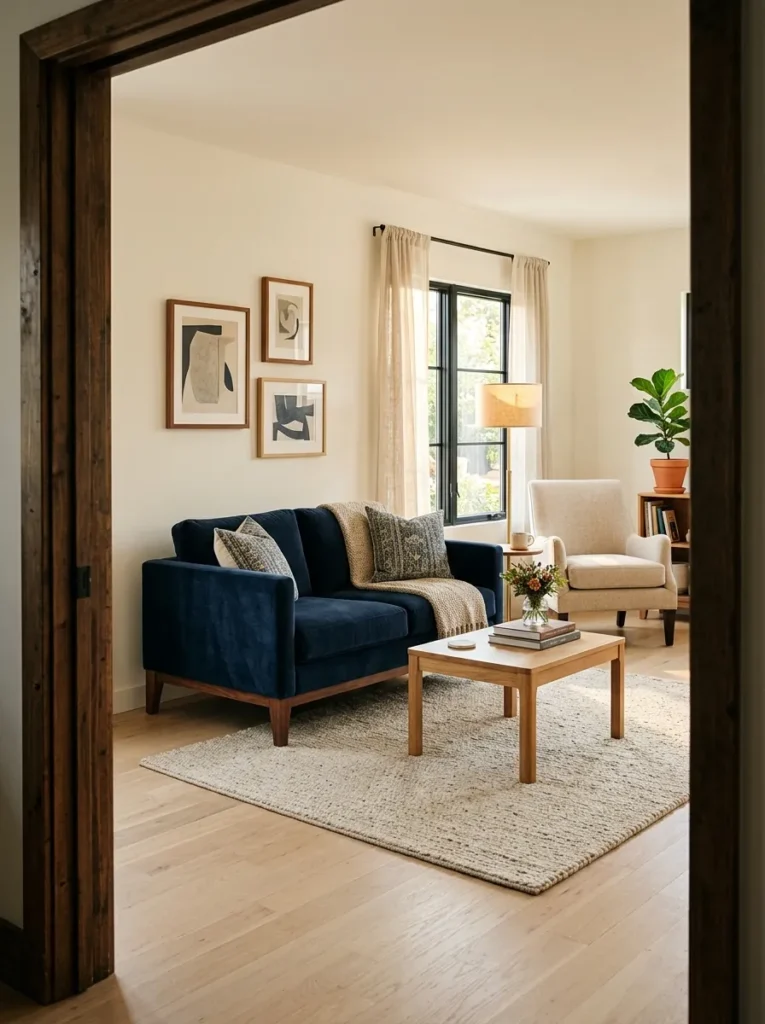
This is a decision most people resist because it feels like a compromise. But a standard three-seat sofa in a room under roughly 12 feet wide often occupies more than half the seating wall, which leaves insufficient space for traffic flow, a second seating piece, or any breathing room around the furniture.
An apartment-scale sofa — typically around 72–78 inches wide rather than a standard 84–90 inches — changes the geometry of the room. That 10–15 inch reduction opens up options: a reading chair in the corner, a floor lamp with presence, or simply a visual gap that makes the room feel less stuffed.
If actual seating capacity matters, a compact sofa paired with two armchairs often accommodates the same number of people as a large sofa plus a single chair, while distributing visual weight more evenly across the room. The arrangement also allows for more flexible reconfiguration later.
7. Use a Glass or Lucite Coffee Table
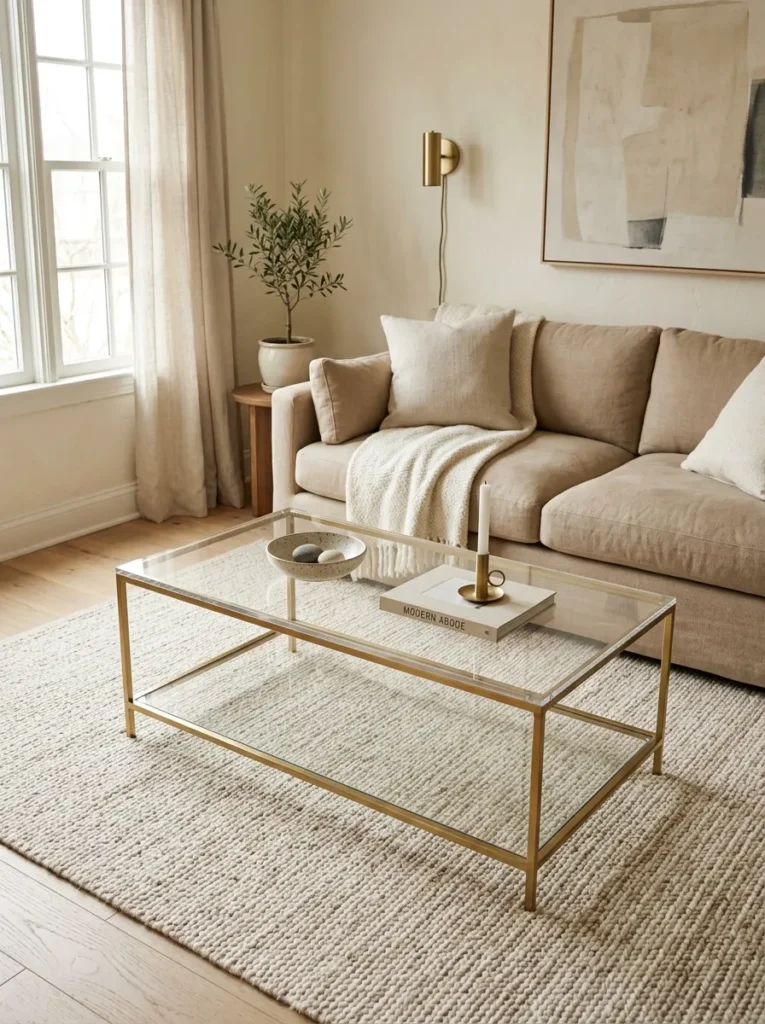
Transparency in furniture reduces visual clutter without reducing function. A glass-top or acrylic coffee table in the center of a small living room is practically invisible from most sightlines, which keeps the rug, the flooring, and the space between pieces readable.
This works best when the rest of the room has some material warmth — wood floors, a linen sofa, ceramic objects — because an all-transparent table in a cold or minimal room can veer toward clinical. The frame material matters: a slender brushed brass or matte black frame grounds the piece without adding visual mass.
One genuine limitation: glass tabletops show fingerprints and rings more readily than wood or stone. If the living room is heavily used, a smoked or tinted glass surface is more forgiving than clear.
8. Build Vertical Storage Instead of Stacking Horizontal Shelves
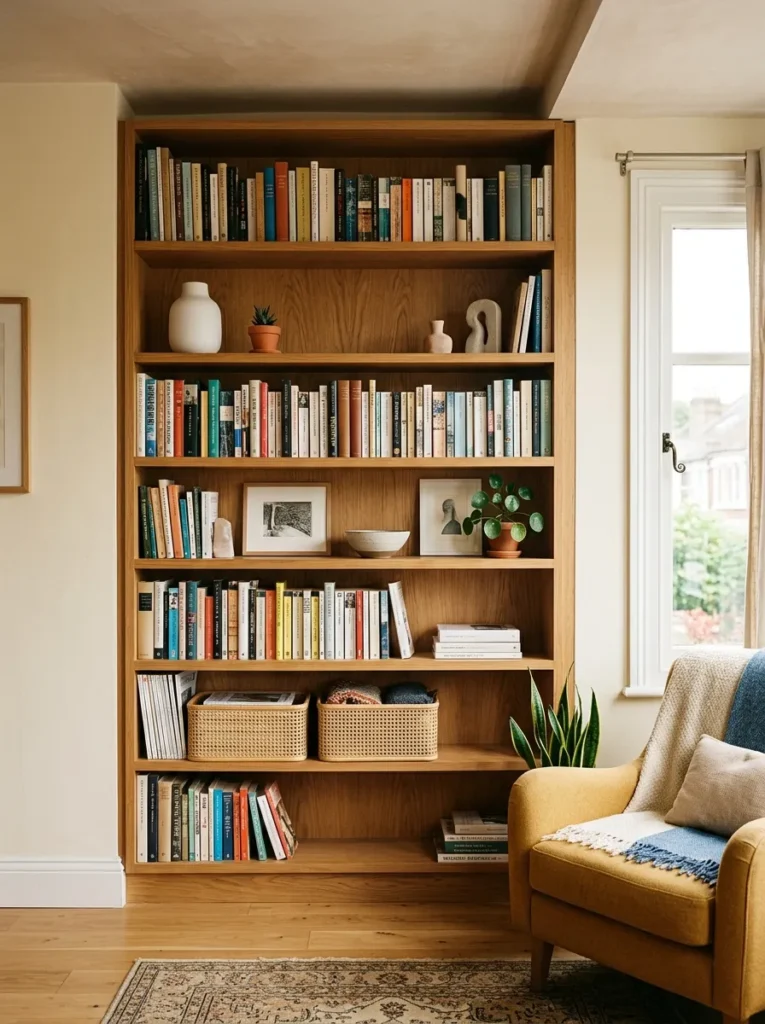
Low, wide shelving — bookshelves that run horizontally, long console tables stacked with objects, rows of baskets at floor level — reinforces the ceiling as the upper limit of the room. Tall, floor-to-ceiling shelving does the reverse: it treats the wall as vertical real estate and makes the room’s full height feel intentional rather than incidental.
A single tall bookcase (72 inches or higher) on a shorter wall tends to make the room feel more spacious than two shorter units placed side by side, even at the same total volume. The key is keeping the upper shelves relatively uncluttered — heavy object placement at the top of a case makes it feel top-heavy rather than expansive.
Built-in shelving flanking a TV or fireplace is the most architectural version of this approach, but freestanding bookcases that reach close to the ceiling achieve a similar effect with far less commitment.
9. Pick a Wall Color That Matches the Ceiling
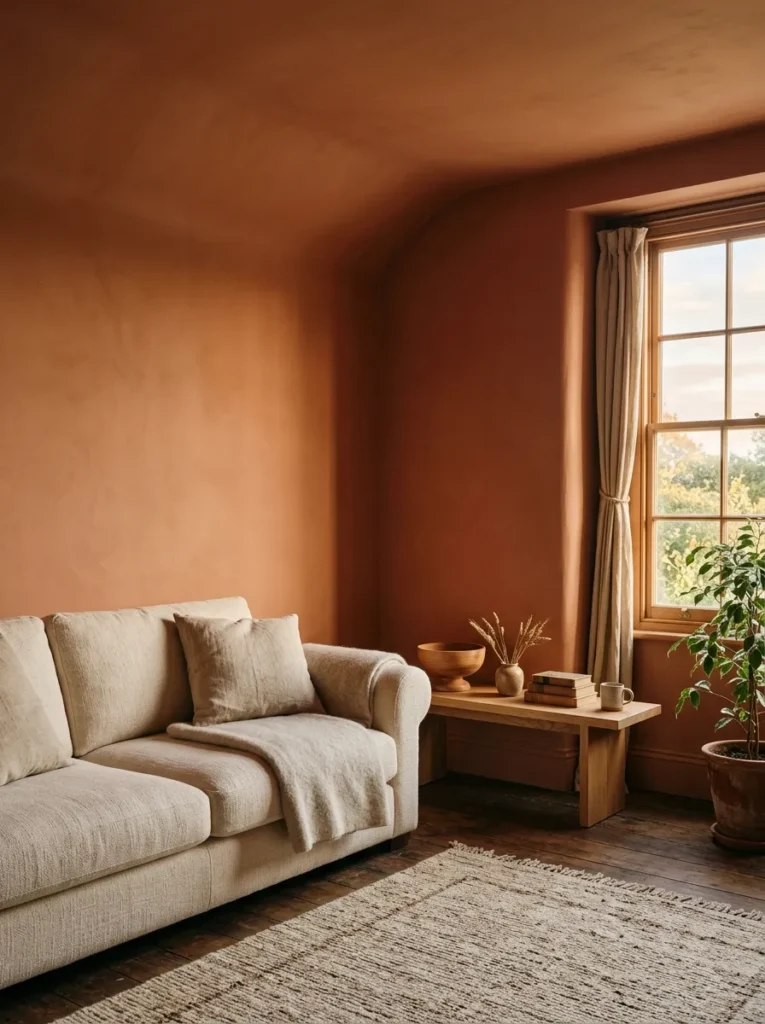
One of the more counterintuitive ideas for small rooms: painting the ceiling the same color as the walls removes the hard visual boundary where the room ends. Instead of reading as a box with a distinct top, the space feels enveloped — which, in a deliberately chosen warm or deep color, reads as intimate rather than cramped.
This works particularly well in rooms with lower ceilings (8 feet or under) where a stark white ceiling would otherwise pull attention to how close it is. A warm putty, a soft clay, a dusty sage, or a deeper terracotta used on all surfaces creates a cohesive envelope that emphasizes the curated objects and furniture inside it rather than the room’s physical edges.
The practical condition: the furniture and textiles need to contrast with the wall color clearly enough to remain distinct. A pale sofa against a deep wall works. A mid-tone sofa against a mid-tone wall tends to disappear.
10. Use a Daybed or Sleeper Sofa if the Room Doubles as a Guest Space
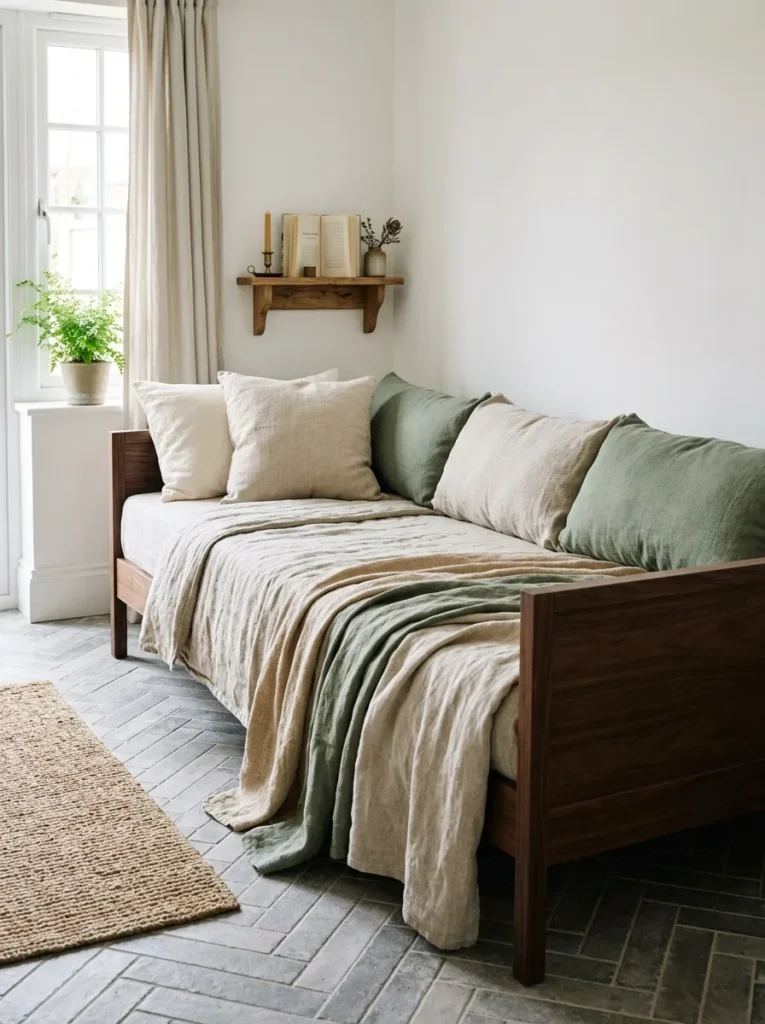
One of the more honest decisions in a small apartment is acknowledging that the living room will sometimes need to function as something else. A standard sofa plus a separate air mattress pulled out of a closet solves the sleeping problem but doubles the furniture density temporarily.
A well-designed sleeper sofa or daybed maintains the seating function while the guest capability remains invisible until needed. Modern sleeper sofas have improved significantly in both mattress quality and visual profile — the inflatable-mattress version that raises the seat cushions is largely avoidable now in favor of models with pull-out inner frames or fold-flat designs.
A daybed positioned against a wall — particularly styled with a row of cushions along the back — reads as a sofa during the day and requires no rearrangement to function as a bed. It suits rooms that can’t afford two separate pieces but need both functions.
11. Lean Large Artwork Rather Than Hanging Many Small Pieces
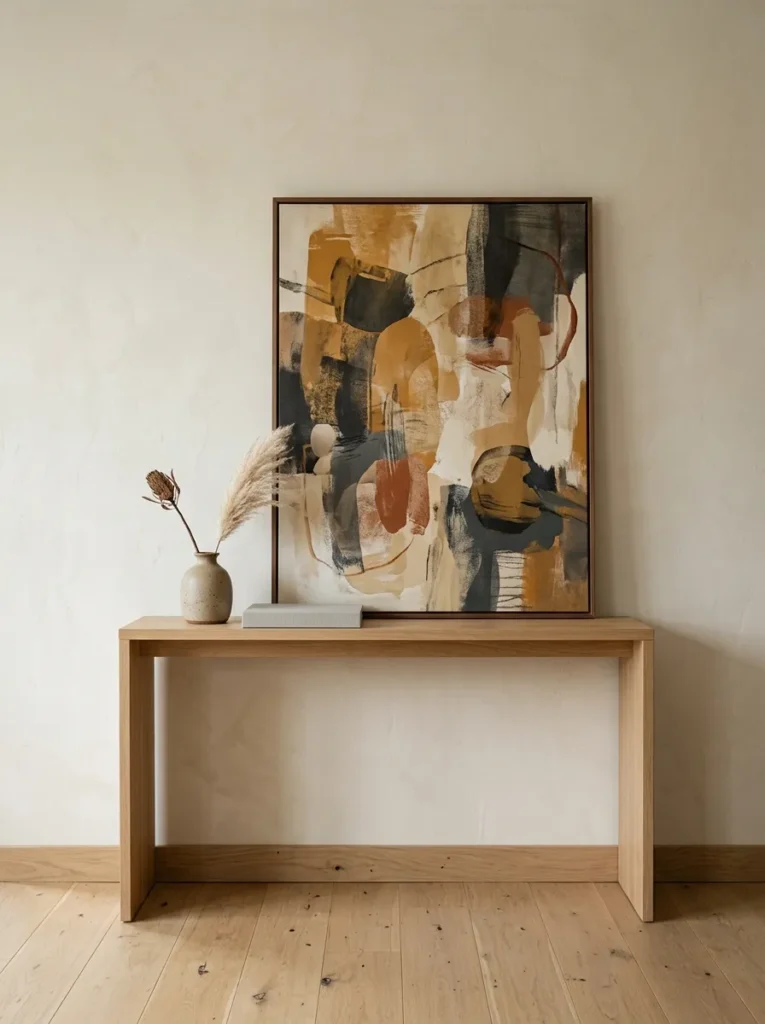
Gallery walls work well in generous rooms where the wall space reads as an expanse worth filling. In a small apartment living room, multiple small pieces in different frames create visual noise that makes the walls feel busier and the room smaller.
A single large-format print or painting — leaned against the wall rather than hung — makes a more considered visual statement and leaves the surrounding wall calm. Leaning also avoids the commitment of holes and allows for easy repositioning.
Scale matters: a print that feels “large” in a shop often looks modest against an actual wall. The artwork’s longest dimension should be meaningful relative to the furniture it sits behind — ideally at least two-thirds the width of the sofa or console below it.
For renters who prefer to avoid hooks entirely, picture ledges are a renter-friendlier alternative that allows stacking and swapping without patching walls repeatedly.
12. Replace One Solid Armchair with a Woven or Open-Frame Chair
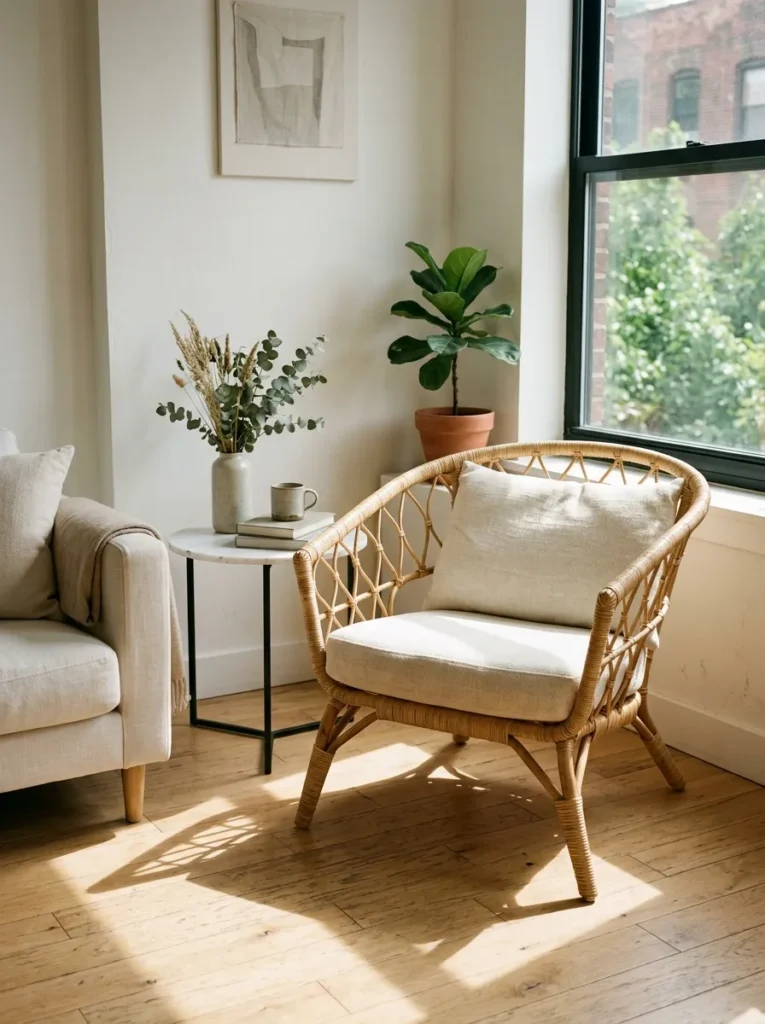
Solid upholstered armchairs, particularly tight-back models with wide arms and a skirted base, occupy both physical and visual space. In a small room, two solid upholstered pieces — a sofa and a matching armchair — tend to make the seating area feel blocked.
An open-frame chair — rattan, woven cane, bent steel, or an acrylic shell — occupies the same footprint but allows light and sightlines to pass through it. This keeps one corner of the room visually permeable. A bent rattan chair with a loose cushion reads as lighter than its size; a bouclé armchair of equivalent dimensions reads heavier than its size.
This trade-off becomes especially useful if the chair is positioned near a window, where natural light can pass through the frame and emphasize its openness.
13. Use Mirrors to Reflect a Specific, Worthwhile View
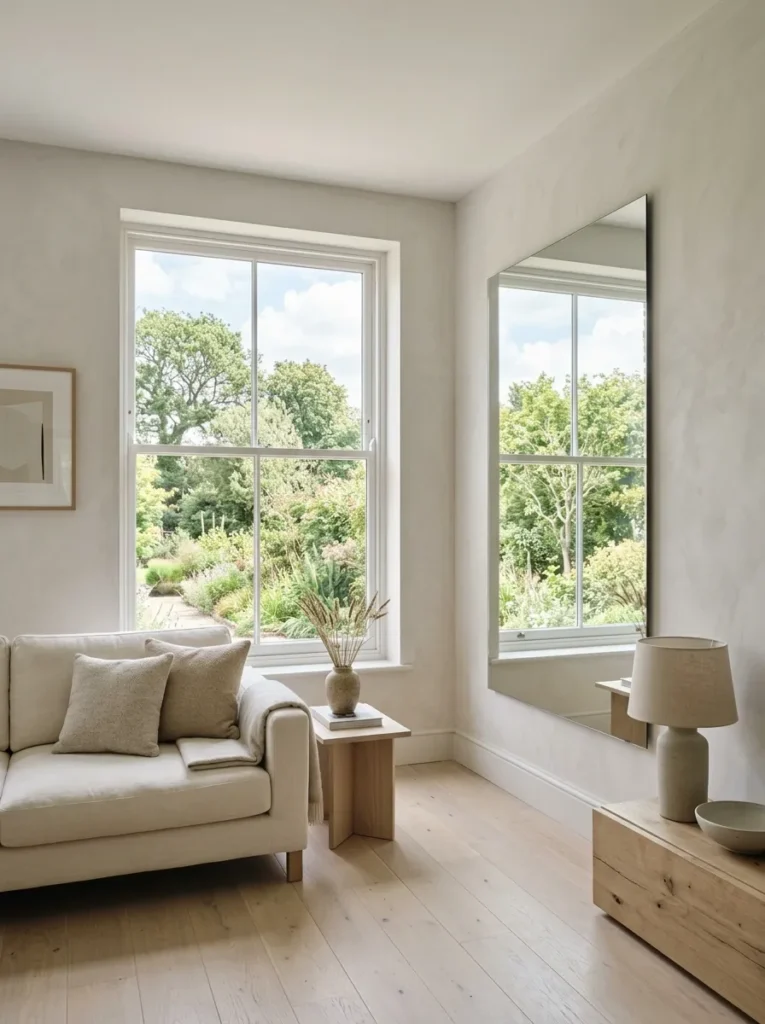
Mirrors increase perceived depth only when they reflect something worth doubling. A mirror facing a blank wall reflects the blank wall. A mirror facing a window reflects natural light and the exterior view. A mirror reflecting a well-styled shelf or a lit corner creates a sense of depth in that direction.
Placement matters more than size. A large mirror hung on the wall opposite a window is the highest-impact placement for a small living room because it doubles the apparent light and opens the room visually toward the exterior. A mirror on a wall adjacent to the window creates interesting lateral light but doesn’t increase perceived depth in the same way.
Frame style affects tone significantly: an ornate gilded frame reads traditional, a frameless or thin-framed rectangular mirror reads contemporary, a curved or irregular form reads more sculptural. In a small room, one strong mirror usually outperforms several small ones scattered across walls.
14. Commit to a Cohesive Palette of Three Materials
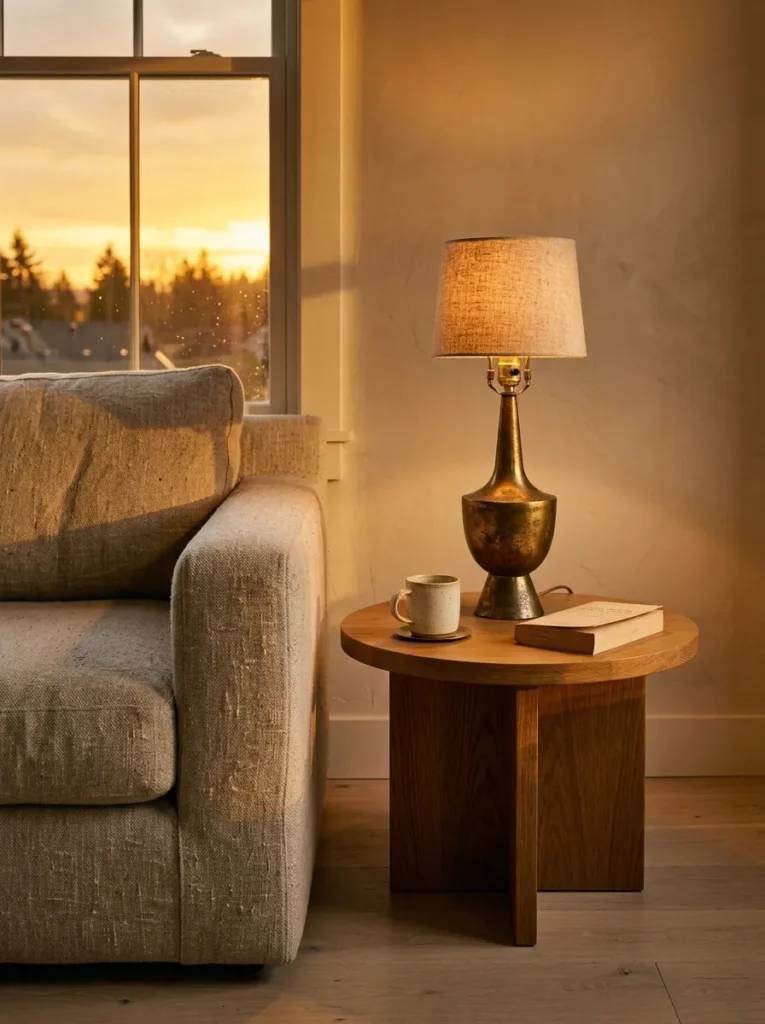
Small spaces become cluttered partly because of material variety. Every different material finish — chrome hardware, pine wood, velvet upholstery, a ceramic lamp, a rattan basket, a marble tray, a lacquered surface — requires the eye to process a separate visual language. In a large room, material variety reads as richness. In a tight room, it reads as mess.
Anchoring the room to three primary materials — one dominant (say, warm oak), one secondary (say, linen or boucle), one accent (say, aged brass or black steel) — creates a room that reads as intentional rather than assembled. Items that fall outside these three don’t need to be eliminated, but they should be minor rather than starring pieces.
The restraint isn’t about being boring. It’s about choosing which materials deserve visual authority and letting them carry the room, rather than dividing attention across six competing finishes that individually might be lovely but collectively are exhausting.
15. Install a Swing-Arm or Wall-Mounted Reading Lamp
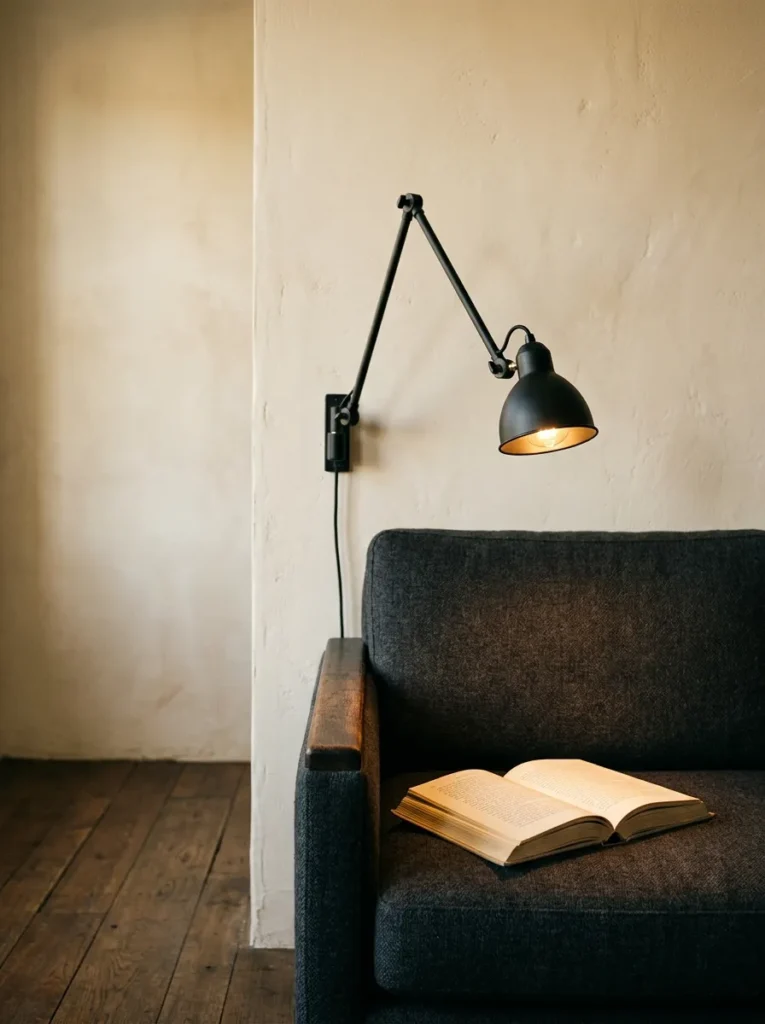
Floor lamps are space-efficient in that they deliver light without consuming table space, but in a tight apartment living room, a floor lamp near a sofa adds another object that the eye must route around. Wall-mounted swing-arm sconces deliver the same reading light directly beside or above the seating area while keeping the floor entirely clear.
The installation commitment depends on the apartment. In rentals, many swing-arm sconces can be hard-wired into an existing outlet using a cord that runs along the baseboard or is hidden in a cord cover — a practical alternative to rewiring. Battery-operated sconces with rechargeable LED sources have also become genuinely useful for renters, eliminating cord management entirely.
Removing the floor lamp and replacing it with a wall-mounted source frees up a roughly 18-inch diameter floor zone beside the sofa — in a narrow room, that’s a meaningful gain.
16. Use a Lift-Top or Storage Coffee Table Instead of an Open Ottoman
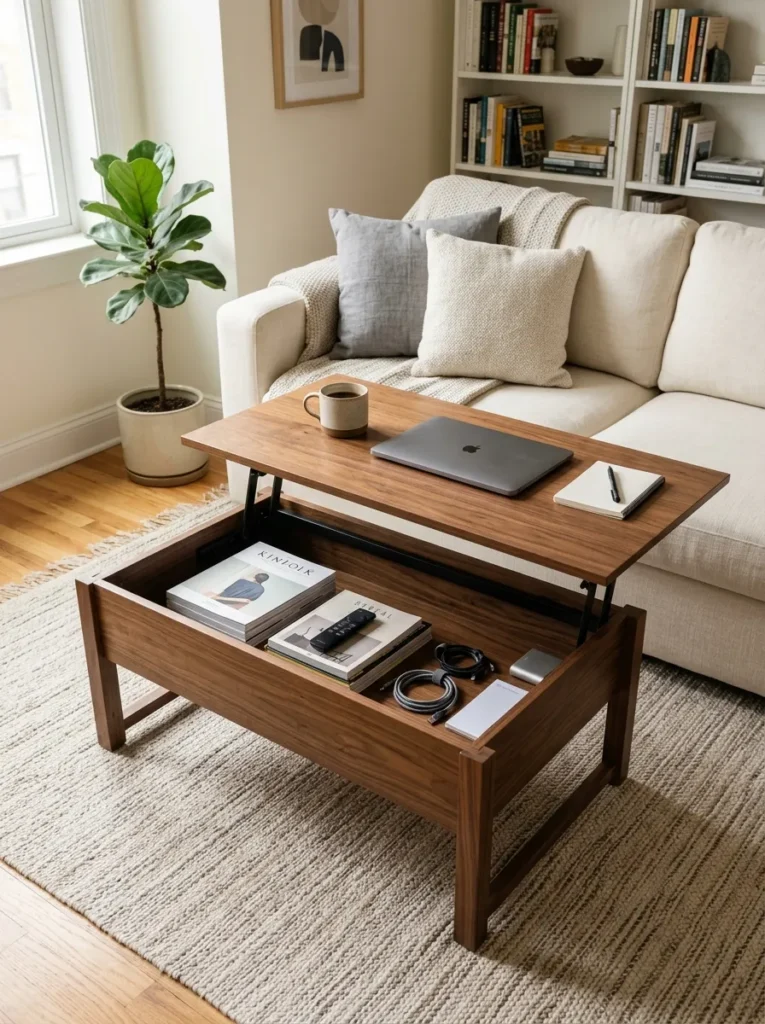
The center of the living room is the most trafficked zone and the most likely accumulation point for remotes, magazines, chargers, and objects that don’t belong there. An open coffee table offers no containment; everything on its surface is permanently visible.
A lift-top coffee table conceals interior storage while functioning as a standard table surface. A storage ottoman does the same with a softer, more textile-oriented look that also doubles as additional seating. Both solve the clutter visibility problem that makes small living rooms feel messy and therefore feel smaller.
The lift-top table has one practical advantage: the raised surface functions as a temporary work surface if the apartment has no separate desk space — a relevant consideration for people working from home in small apartments where the living room is the de facto workspace.
17. Define Zones with Lighting Rather Than Physical Dividers
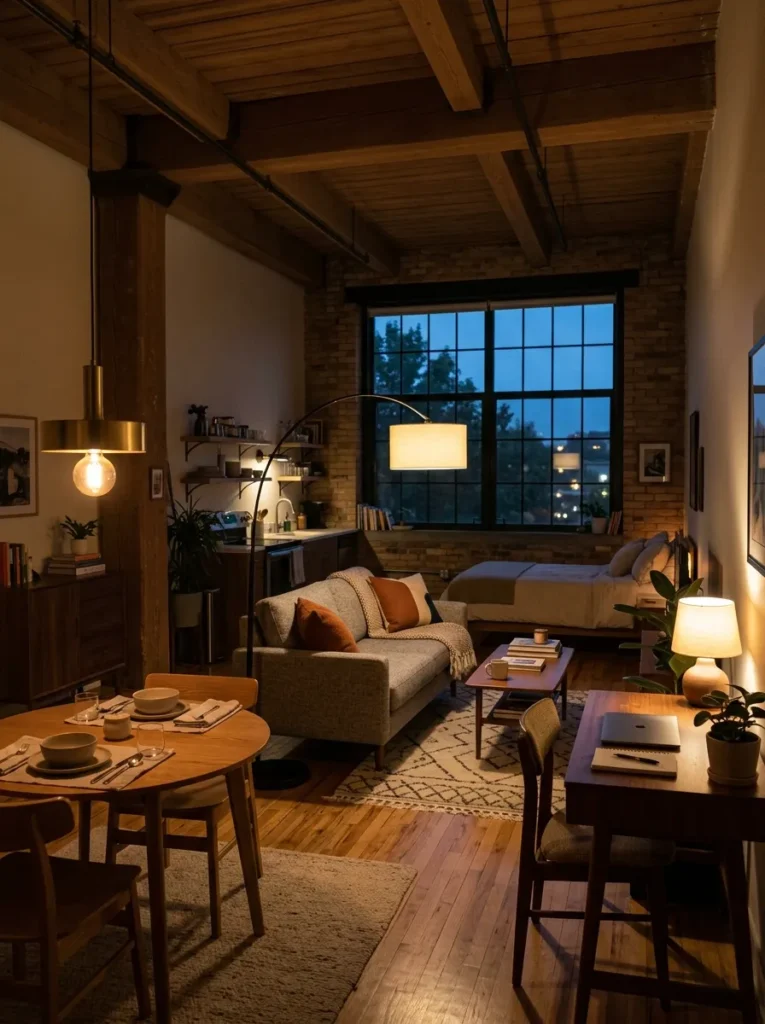
In studio apartments or open-plan spaces, the temptation to use furniture or room dividers to define the living area from the dining or sleeping zones often makes every zone feel smaller. The divider consumes floor space and blocks light without adding meaningful privacy.
Lighting does this more efficiently. A pendant or chandelier above the dining zone, a floor lamp and task lighting in the reading corner, and ambient lighting in the central seating area establish three distinct zones without any physical boundary. The eye understands the zones because the light pool changes, not because there’s an object in the way.
This approach also makes the overall space feel larger because sightlines are unobstructed from zone to zone. The light becomes the architecture.
18. Prioritize One Statement Piece and Let Everything Else Recede
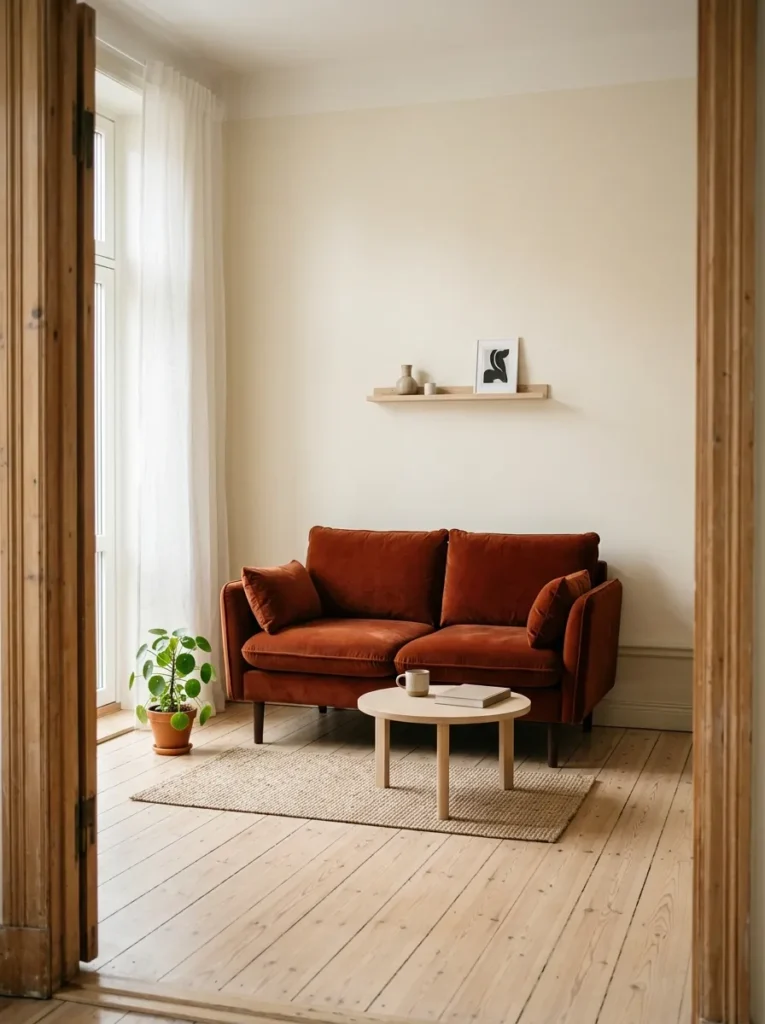
Small apartment living rooms decorated with multiple statement pieces — a bold sofa, a patterned rug, an oversized light fixture, a heavily framed gallery wall — tend to feel more chaotic than those with a single standout item supported by quieter surroundings.
Deciding what the room’s one focal point should be — whether that’s the sofa in a distinctive color, a sculptural pendant, an architectural shelving wall, or a large-format artwork — gives the room a clear hierarchy. Everything else can be more neutral: simple legs, calm textiles, muted tones, clean surfaces.
This doesn’t require expensive investment. A $60 throw in an unexpected rust or forest green on an otherwise grey sofa can serve as the room’s moment of intention. The point is that restraint elsewhere makes one deliberate choice land with more visual authority than five competing choices that cancel each other out.
PRACTICAL SECTION: What to Decide Before You Buy Anything
Small apartment living rooms fail most often not from bad taste but from decisions made in the wrong order. Here’s what to settle first.
Measure the traffic paths. Before placing any furniture, mark the main walkways: from the door to the sofa, from the sofa to the TV, from the seating area to the kitchen or hallway. Standard clearance is around 30–36 inches for primary paths, 24 inches for secondary. If furniture placement blocks these paths, the room will feel more cramped than the square footage suggests.
Choose the focal point before buying a sofa. The sofa should face the room’s visual anchor — typically the TV, a fireplace, or a window with a worthwhile view. Arranging furniture without a focal point often results in a sofa pushed against the longest wall, facing nothing in particular, which is usually the least satisfying layout regardless of room size.
Decide your storage strategy before choosing decorative items. If the room needs to absorb objects — books, gaming equipment, blankets, children’s items — the storage approach should be part of the furniture plan, not an afterthought. Visible clutter is the fastest way to make a small space feel chaotic; visible storage is part of the solution.
Pick your palette before buying accent pieces. Throw pillows, vases, candles, and small objects add up quickly. Deciding on the room’s accent color before shopping means these purchases reinforce each other rather than compete. Three tones in various proportions — a dominant, a secondary, and a punctuation — is usually enough.
FINAL THOUGHTS
No single idea from this list needs to be applied wholesale. The most effective small apartment living rooms usually combine a few structural decisions — furniture scale, layout, vertical storage — with one or two visual choices that give the room a clear point of view.
If you’re starting from scratch, prioritize the layout before the decor. Get the sofa in the right position, make sure the traffic paths work, and identify what the focal point is. Everything else — the mirrors, the lighting layers, the palette choices — supports that foundation rather than compensating for a layout that was never resolved.
If you’re refining a room you’ve already furnished, look at what’s creating the most visual noise first. Usually it’s either material variety, too many competing patterns, or furniture that’s slightly too large for the space. Addressing one of those three things tends to have a more immediate effect than adding new items.
Save the ideas that suit your actual constraints — your lease, your floor plan, your existing furniture — and revisit this guide when you’re ready to make the next decision.