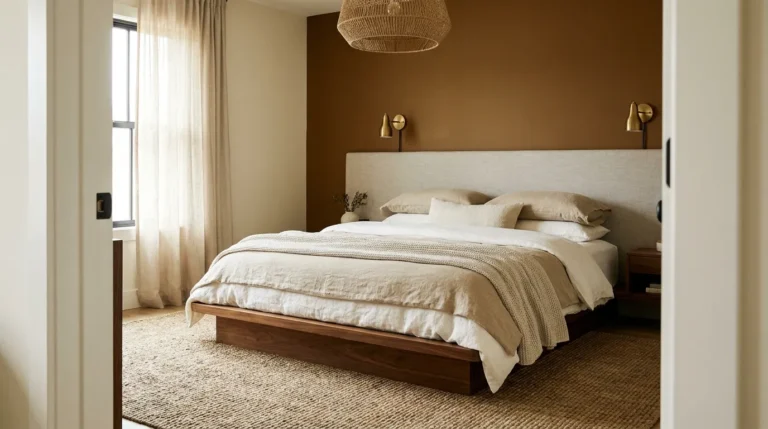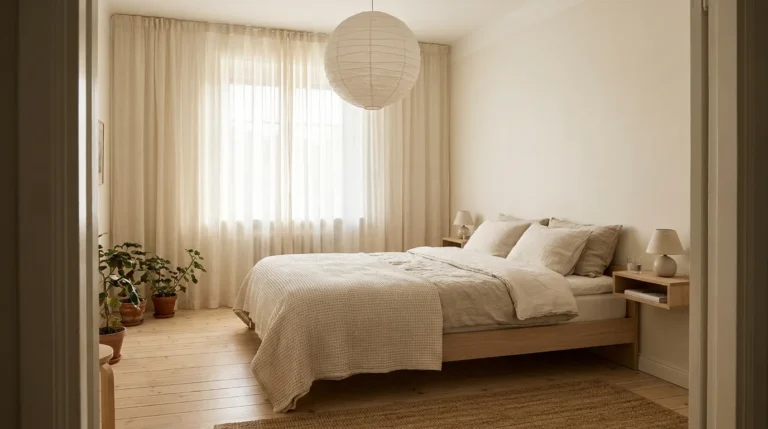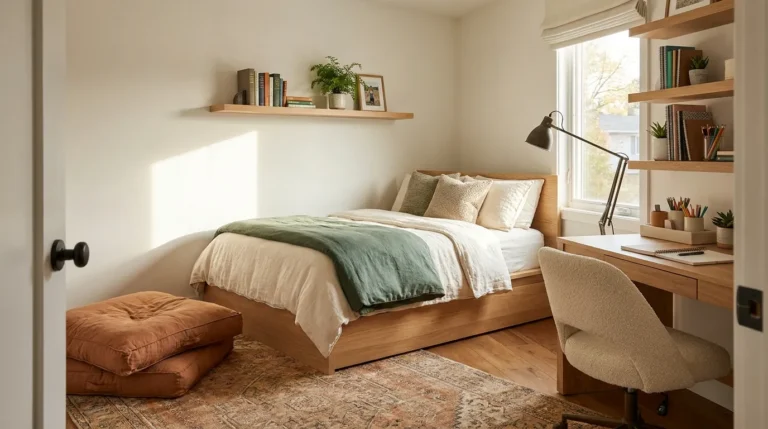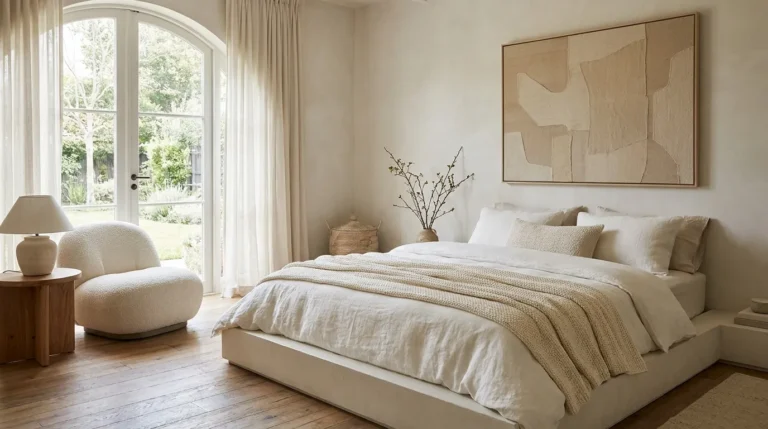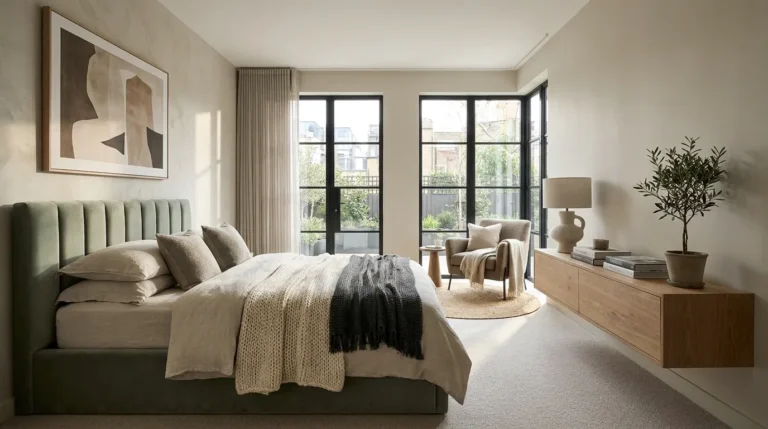
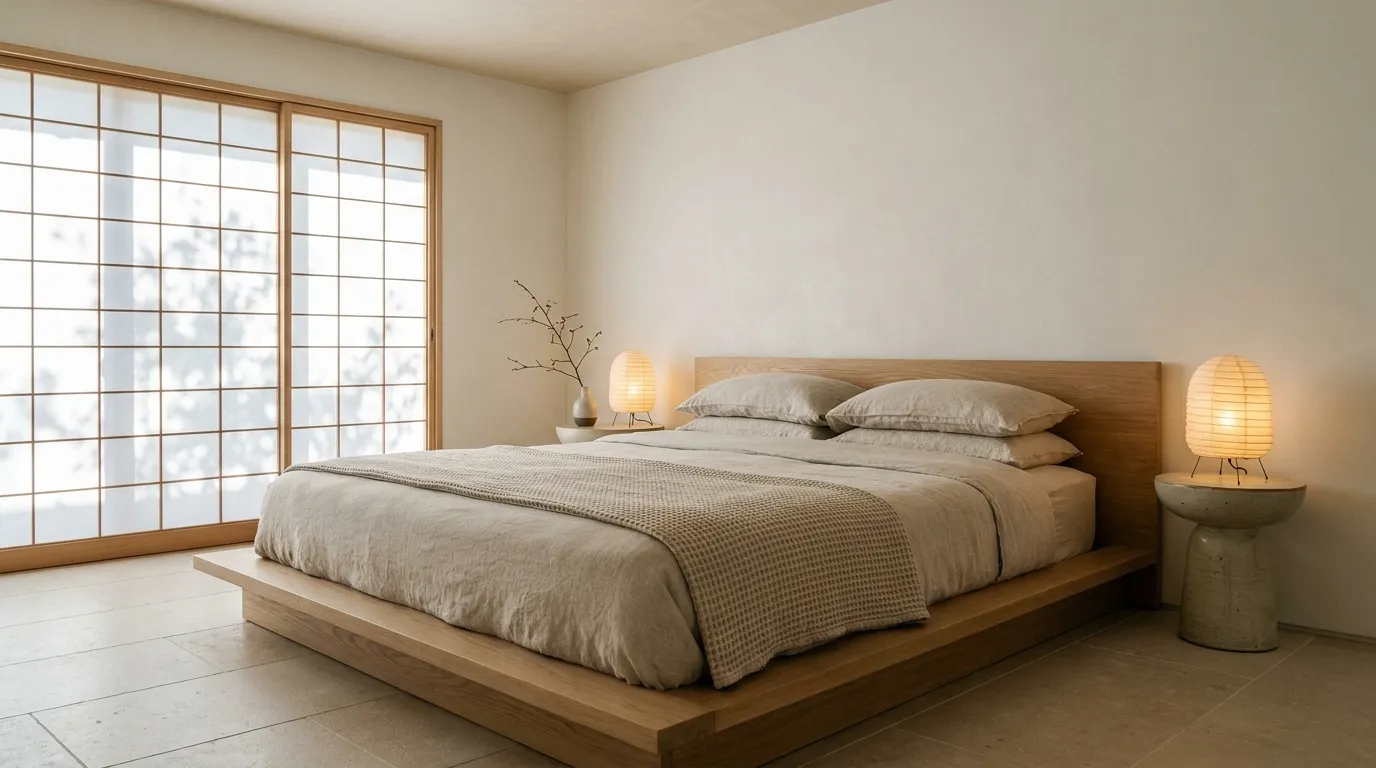
22 Calm Bedroom Ideas That Feel Peaceful and Cozy
Most bedroom makeovers are optimized for the photograph rather than the sleep. They stack statement furniture, saturate the walls with a trending color, and call it done — and the result is a room that performs beautifully in a grid and feels slightly wrong to be in every evening. Calm bedroom ideas operate on a different principle entirely: the room is designed for the person who occupies it, not for the audience who views it. That shift in priority changes almost every decision that follows.
This is not a list of things to buy. It’s a guide to the specific decisions — material, spatial, tonal, and behavioral — that make a bedroom genuinely restful rather than just visually neutral. Some of the ideas here cost nothing. Others require planning. All of them are grounded in why calm is produced rather than what calm looks like.
1. Build the Palette from One Anchoring Neutral, Not from a Mood Board
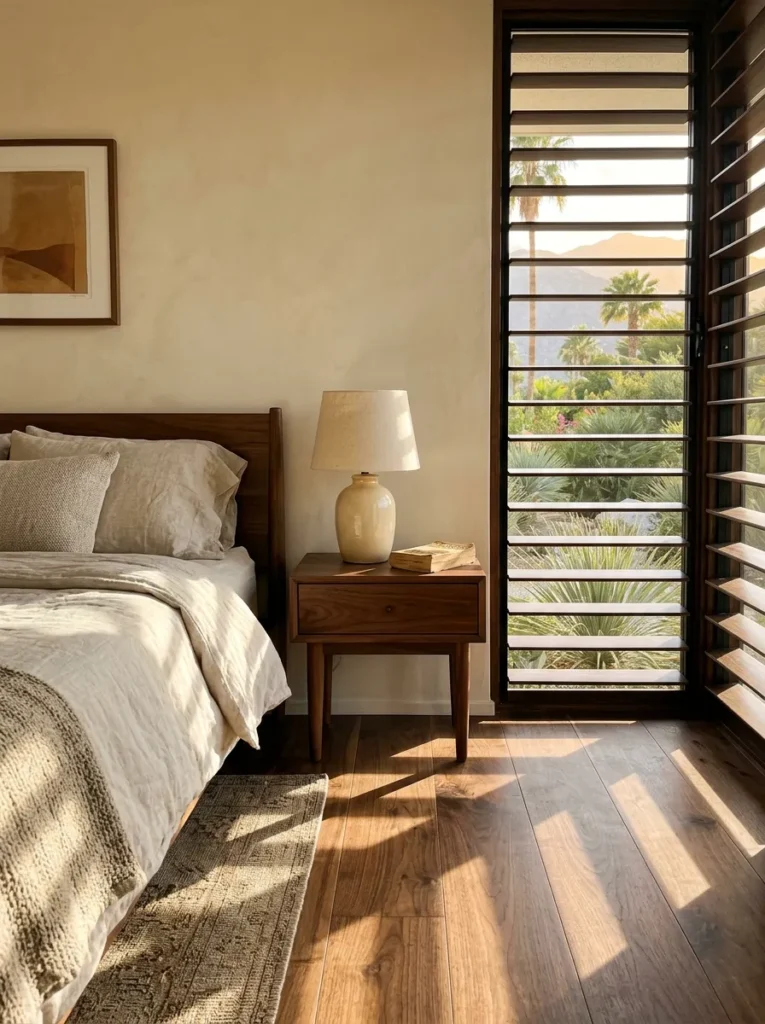
The most reliably peaceful bedrooms are built from a single material truth rather than assembled from complementary colors. Find the one element in the room that cannot change — the floor, an existing piece of furniture, a structural element — and build the palette outward from its undertone. If the floor pulls warm, the walls should pull warm. If the existing bed frame is cool gray, the bedding should cool accordingly. This sounds obvious. It almost never happens, which is why so many “calm” bedrooms feel slightly unsettled without the owner being able to identify why. The undertone mismatch is almost always the reason.
2. Choose Paint with a High Light Reflectance Value for Walls
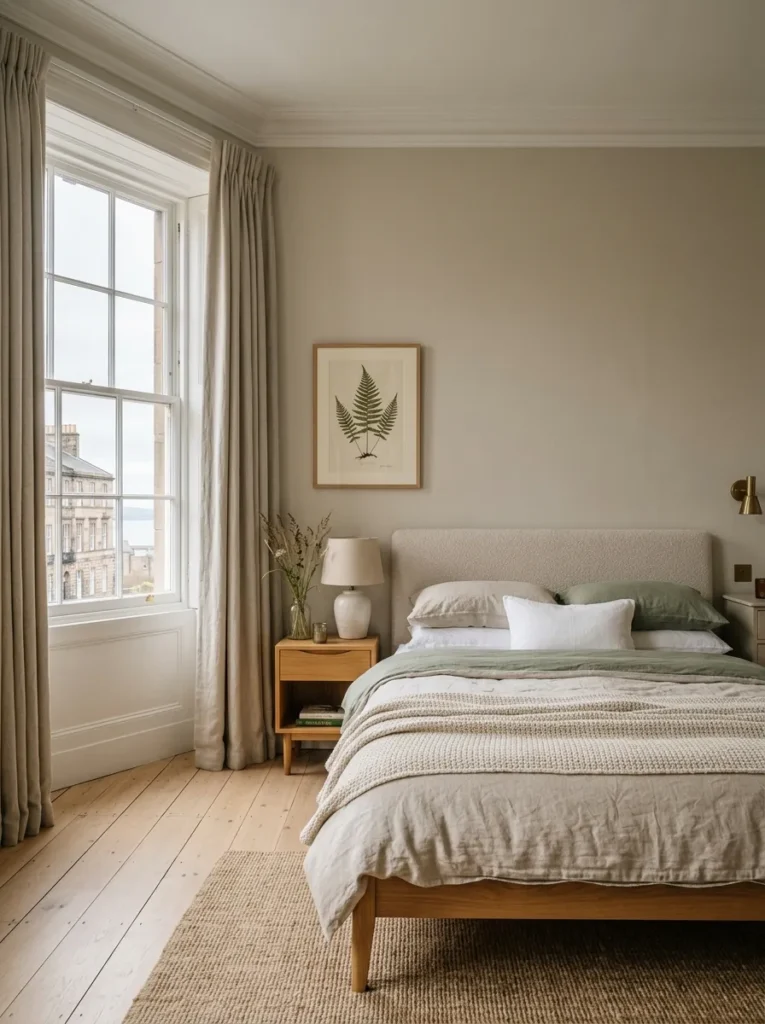
Calm bedroom paint choices should be measured, not guessed. A paint’s LRV — Light Reflectance Value — tells you how much light a color bounces back into the room on a scale of zero to one hundred. For bedrooms that need to feel restful without reading as dark, the sweet spot is between 55 and 70: light enough to feel airy in the morning, absorptive enough to feel contained at night. Most “greige” and warm whites sit in this range. Most pure whites are above it, which is why pure white bedrooms often feel clinical rather than calm. Check the LRV before you buy a sample, not after.
3. Install a Dimmer Switch on Every Bedroom Circuit Before Anything Else
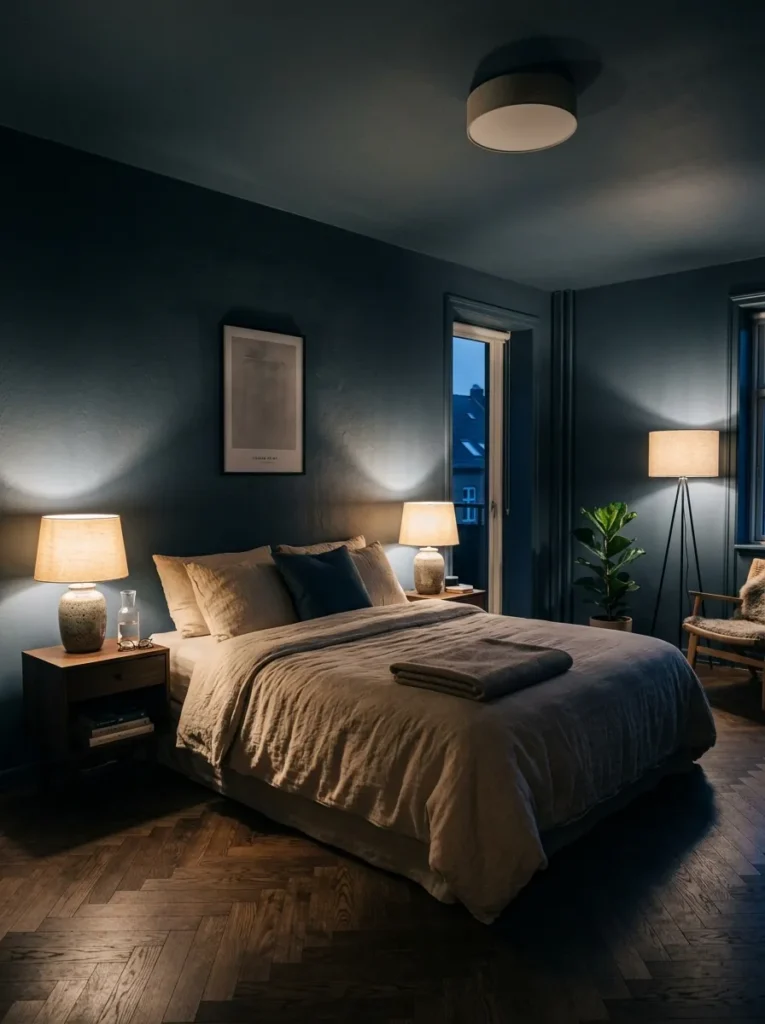
This is the decision that changes everything. A bedroom with three light sources — ceiling, bedside, ambient — and a dimmer on each circuit can transform from a bright functional space in the morning to a genuinely dim, warm, sleep-adjacent environment by ten in the evening. Without dimmers, none of that is possible. The lighting hardware can be inexpensive. The bulb temperature should be 2700K or warmer for every fixture. Most people get this wrong by installing cool white bulbs in a warm-toned room and then wondering why the space feels agitated after dark. Warm bulbs, dimmed low, are the single fastest route to a calm bedroom atmosphere.
4. Keep the Ceiling Two Shades Lighter Than the Walls
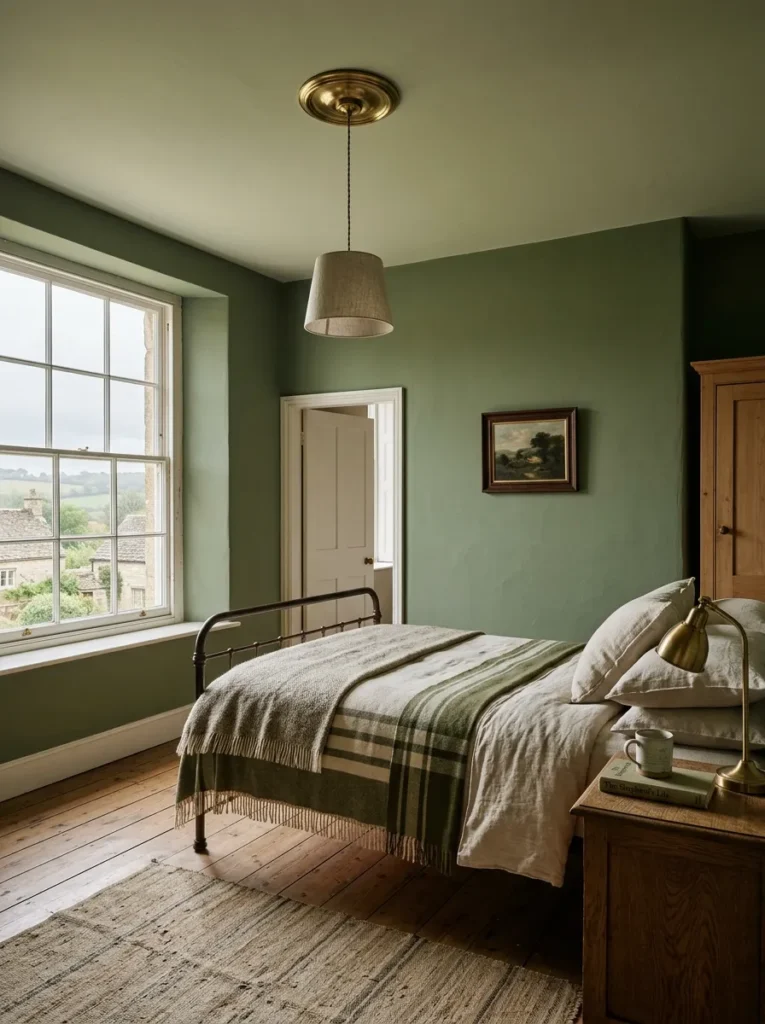
Most advice says paint the ceiling white. That advice exists because it’s safe and it’s usually correct — but in a bedroom designed specifically for calm, a ceiling that is a tonal version of the wall color rather than a stark contrast creates a cocooning effect that white cannot replicate. Take the wall color, lighten it by approximately 20 percent, and apply it to the ceiling. The result is a room that feels deliberately enclosed — in the best sense — rather than open-topped and ambient. The enclosure reads subconsciously as shelter. That’s the whole point of a bedroom.
5. Use a Linen Duvet Rather Than Polyester for Temperature Regulation

The material quality of the duvet cover affects sleep in a way that wall color genuinely doesn’t. Linen regulates temperature better than any synthetic alternative because its natural moisture-wicking properties respond dynamically to the body’s heat output rather than trapping it. A linen duvet cover also improves with washing — it softens rather than pills — which means it gets better the more it’s used. Choose undyed or naturally toned linen rather than bright-white for a bedroom palette that includes any warm tones; bright-white linen in a warm room reads as a visual intrusion rather than a calm anchor.
6. Create a Dedicated Dark Zone with Blackout Lining Behind Any Curtain
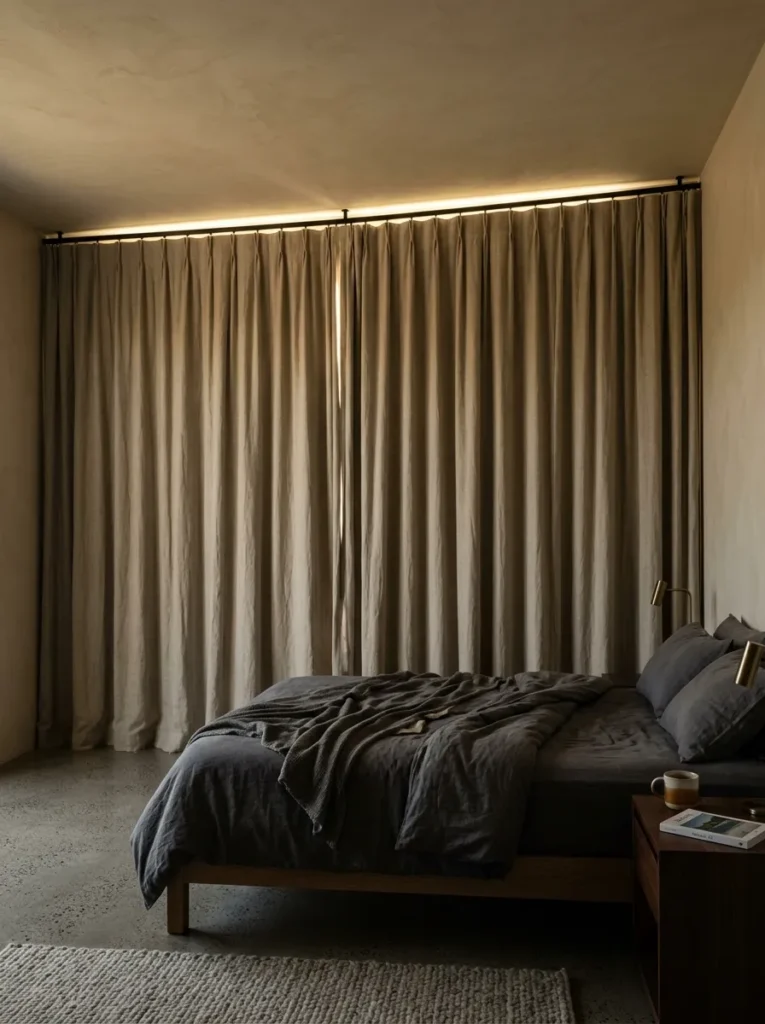
Blackout lining does not require blackout curtains. Any fabric can be made light-blocking by adding a sewn or clip-on blackout liner to the back of existing curtains — which means you don’t have to choose between the curtain material you want and the sleep environment you need. Install a double track: a blackout roller or lining as the inner layer and the decorative curtain on the outer track. The gap between curtain and wall at the sides is where most light enters, so consider a return bracket that wraps the track into the wall by 3 to 4 inches on each end. This is a practical detail almost every bedroom installation skips.
7. Choose a Bed Frame That Sits Low to the Floor
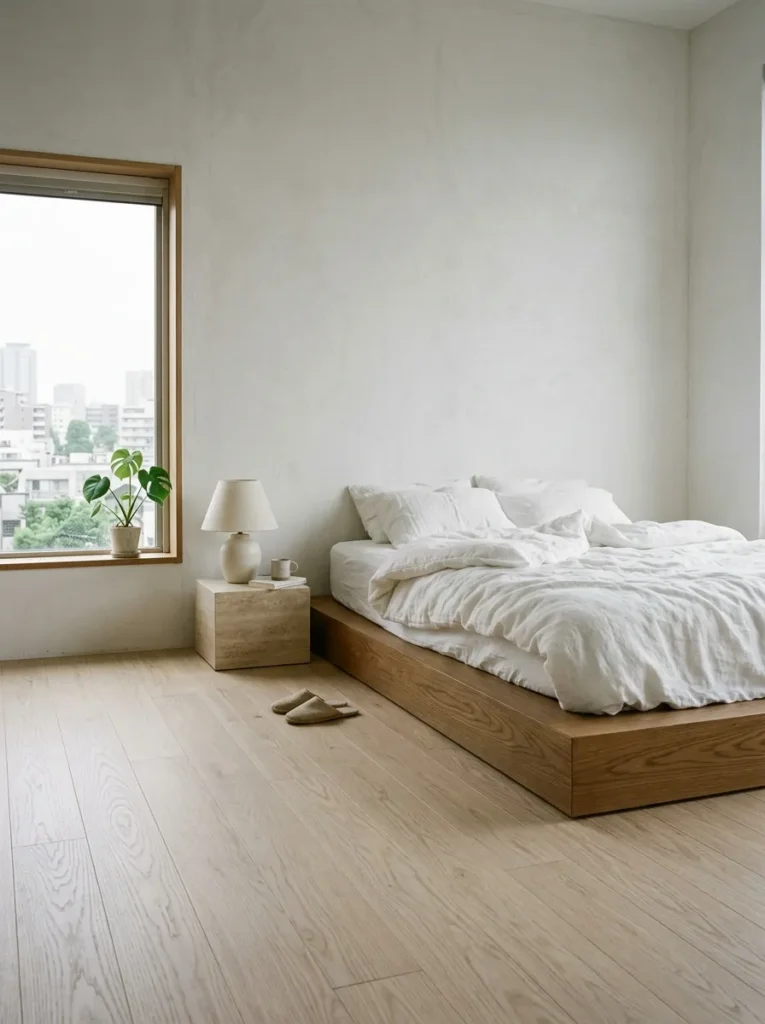
A lower bed frame — platform style, 12 to 18 inches from floor to mattress top — lowers the room’s visual center of gravity, which reads subconsciously as more grounded and less architecturally anxious than a high-set bed. This is not a function of the mattress height but of the frame beneath it. Low frames suit smaller bedrooms particularly well because they leave more visible wall above the headboard, which gives the room breathing room rather than a hemmed-in feeling. They also happen to be harder to leave in the morning, which some people consider a design flaw and others a feature.
8. Place the Bed Against the Wall That Faces the Door

A calm bedroom layout places the sleeper in what feng shui calls the command position — facing the room’s entry without being directly in line with it. The bed should be placed against the wall opposite or perpendicular to the door rather than with the foot of the bed directly facing the doorway. The practical psychology behind this is that the brain registers visual open access to exits during sleep and reduces its low-level alertness accordingly. This is not mysticism. It is a measurable change in how easily the nervous system registers the space as safe. Most people who make this layout change report better sleep quality within a week.
9. Edit the Bedroom Down to Only What Is Used Weekly
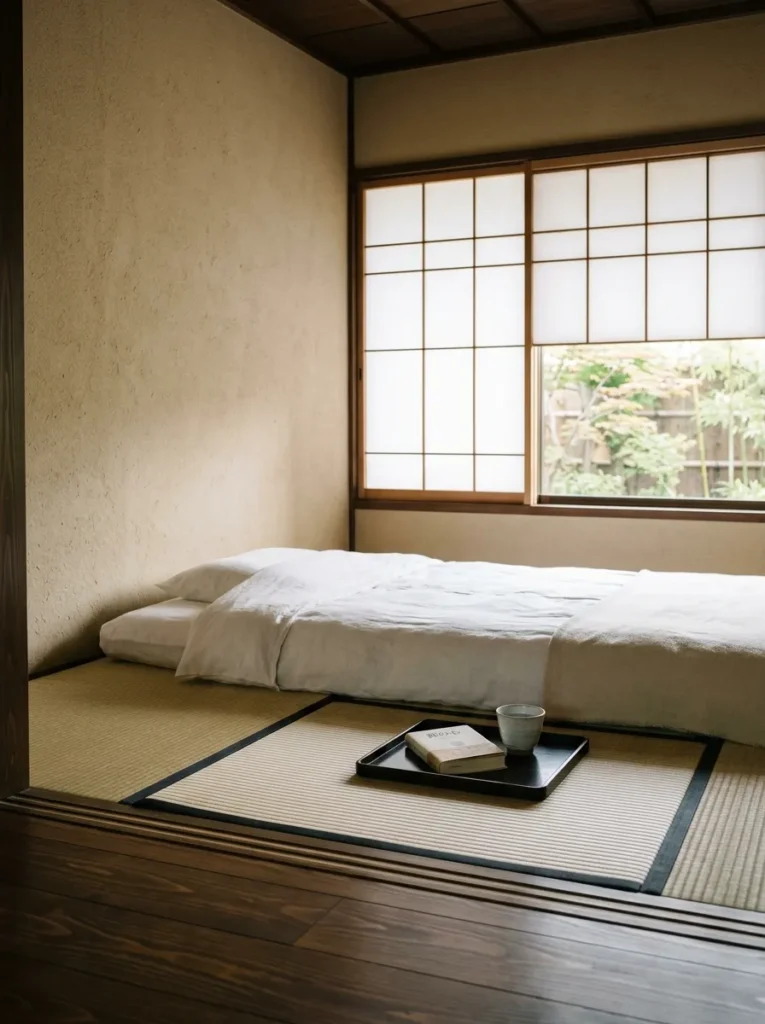
The calm bedroom is defined as much by what is not in it as by what is. A bedroom that holds a clothes chair, a charging cable tangle, a stack of books that haven’t been read in a year, and a selection of products that migrated from the bathroom counter is not a calm bedroom regardless of how well the walls are painted. The editing decision is harder than any purchase. A genuinely useful test: remove everything from every surface for one week. Return only the objects that you missed. The objects that were not missed do not live in the bedroom.
10. Use a Weighted or Layered Blanket at the Foot of the Bed

A weighted blanket or a substantial layered wool throw positioned across the lower third of the bed — rather than beneath the duvet or as an afterthought across a chair — adds functional calm to the sleep environment by providing the proprioceptive pressure that helps the nervous system downregulate. The weight range for a weighted blanket should be approximately 10 percent of bodyweight. A wool throw, while not weighted in the same clinical sense, provides substantial thermal mass and the tactile comfort of a natural fiber that breathes. Either choice signals, visually and physically, that this bed is built for actual rest.
11. Add One Tall Plant in the Quietest Corner of the Room
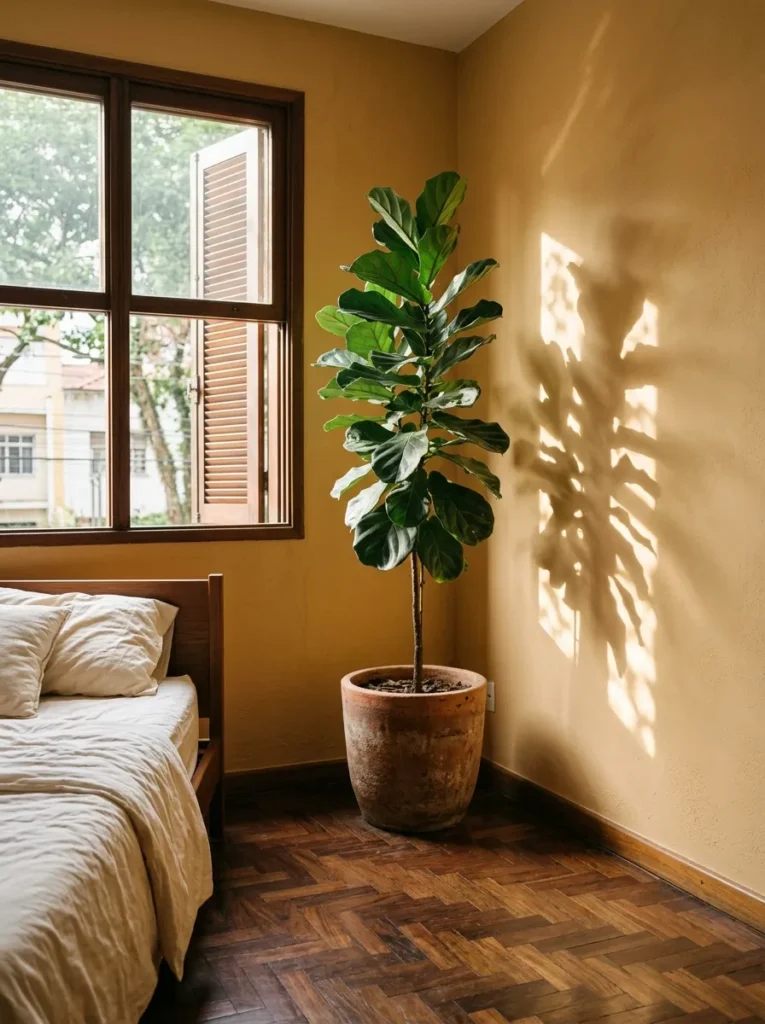
A single large plant — a fiddle-leaf fig, a monstera, an olive tree in a terracotta pot — placed in the quietest corner of the bedroom introduces the most grounding calm bedroom detail available at low cost. The reasoning is not merely aesthetic. Greenery in a bedroom reduces psychological arousal — measurably so, in studies examining cognitive load before sleep — and provides a visual resting point that is inherently non-stimulating. One tall plant reads as a design choice. Four plants read as a collection and require maintenance attention that works against the restful intention. One. The corner furthest from the door.
12. Keep the Nightstand Surface to Three Objects Maximum
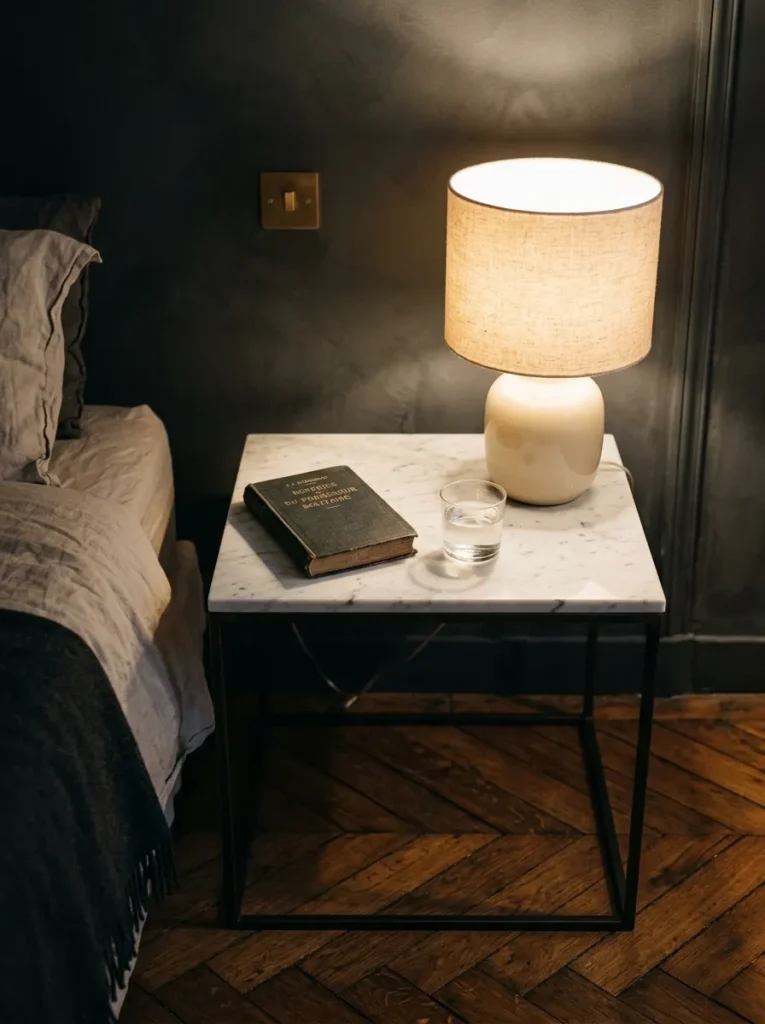
The nightstand is the last visual field registered before sleep and the first encountered upon waking. Everything on it is therefore either a contribution to or a subtraction from the bedroom’s calm. Three objects is not an arbitrary number. It accommodates the functional minimum — a lamp, a glass of water, a book — and leaves enough clear surface to prevent the accumulation that turns a nightstand into a staging area. A phone should not be one of the three. Charge it outside the bedroom or at least across the room, not beside the head. That’s an easy observation to agree with and a surprisingly difficult one to act on.
13. Choose Curtains That Pool Slightly on the Floor

Curtains that hang to the floor — and pool by an inch or two beyond it — read differently from curtains that stop at baseboard or hover just above the floor. The pooling creates a visual softness at the base of the curtain that hemmed-to-floor treatments can’t replicate, and it signals that the room was measured carefully and dressed with intention. For calm bedrooms, use a fabric that has enough weight to fall in long unbroken lines rather than short folds — linen, cotton velvet, or interlined cotton all work. The fabric’s drape is doing design work that paint and furniture can’t.
14. Use Identical Bedside Lamps to Create Symmetry
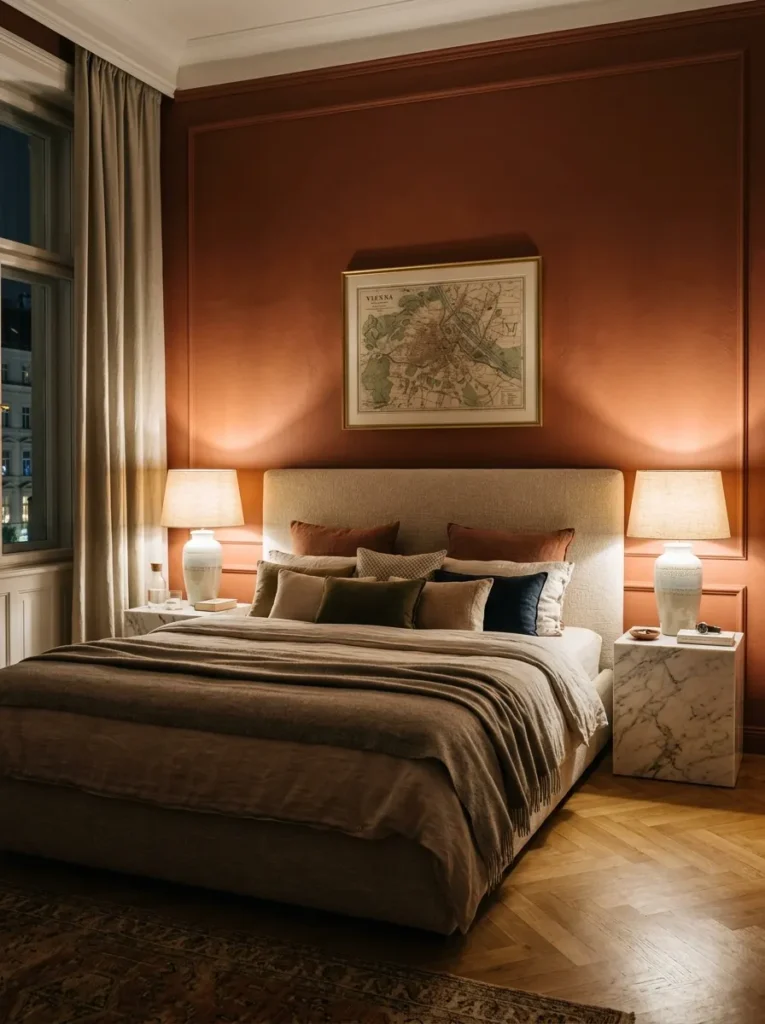
Symmetry produces calm in a way that asymmetric arrangements do not, and the bedside lamp is the most impactful place to apply it. Identical lamps on each side of the bed — in terms of height, material, and bulb temperature — create a visual equilibrium that the brain reads as resolved and complete. Mismatched bedside lamps are a small but persistent source of low-level visual agitation. The matching set is always the safer choice, and in this specific case it is also almost always the better one. Choose a lamp with a shade wide enough to project light onto the pillow at the correct reading angle: the shade bottom should sit at shoulder height when seated in bed.
15. Allow One Wall to Remain Completely Empty
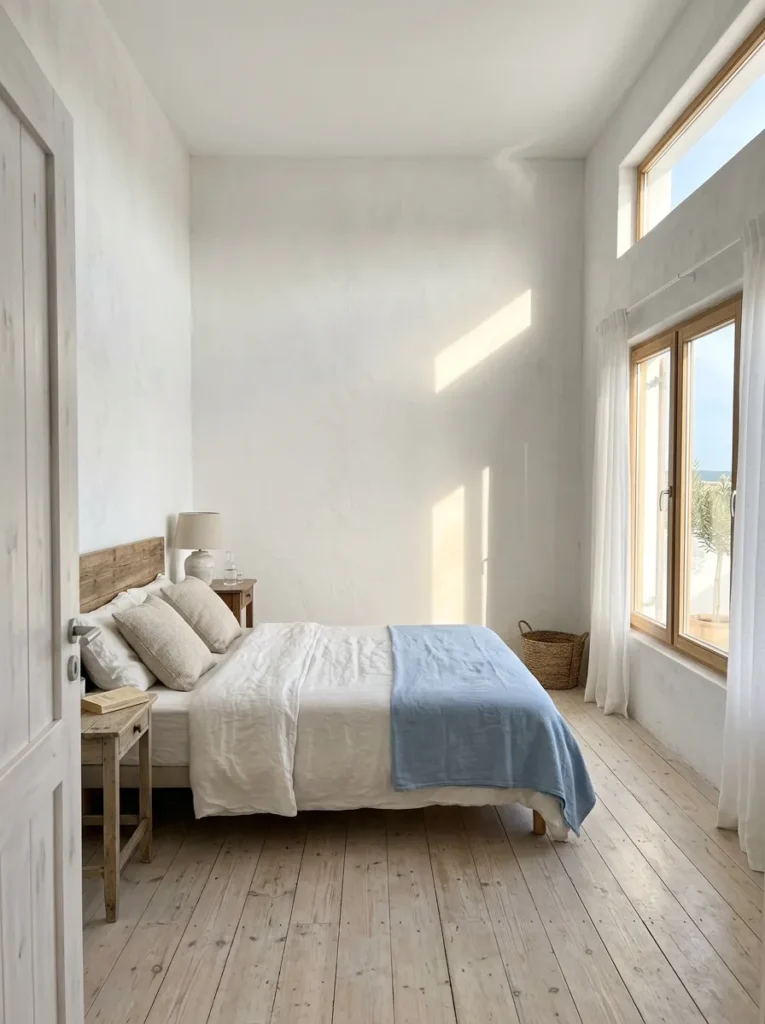
Most bedroom walls are over-worked. Artwork, mirrors, clocks, decorative hooks, floating shelves, and wall-mounted sconces compete for attention on every surface, and the result is a room that has no visual rest point — nowhere for the eye to land without encountering another object. A deliberately empty wall — usually the one least visible from the bed — gives the room its breathing room. It also makes the walls with intentional content read as more considered, because they’re not competing with every other surface for attention. The empty wall is not a failure of decoration. It is the room’s exhale.
16. Choose Bedding in Undyed or Stone-Washed Natural Tones

Bright white bedding in a bedroom with warm-toned walls, wood furniture, or natural fiber rugs creates a visual disconnect that the eye registers as unresolved, which is slightly agitating even if the cause is invisible. Undyed linen, stone-washed cotton in oatmeal or warm cream, or naturally-dyed bedding in muted terracotta or sage aligns with the surrounding palette without effort, producing a cohesion that is perceptible as calm even to people who don’t consciously identify why the room feels right. Stone-washing specifically pre-softens the fabric so the tactile quality matches the visual one from the first use.
17. Hang Curtains at Ceiling Height Regardless of Window Size

The window may be small. The curtains should reach the ceiling anyway. Installing a curtain rod at or within 2 inches of the ceiling cornice — regardless of where the window actually ends — extends the perceived window height to the full wall, makes the ceilings read as taller, and gives the room a sense of vertical spaciousness that no furniture arrangement can create on its own. This is not a trend. It is a spatial mechanics decision, and it costs nothing more than a longer drop of fabric. A small window with a ceiling-height curtain reads as an architectural feature. A small window with a correctly-sized curtain reads as a small window.
18. Add a Single Scented Candle or Reed Diffuser — and Nothing Else

Scent is the most direct sensory pathway to the nervous system’s calm response and it is the most consistently overlooked element of bedroom design. A single scented candle or reed diffuser in a restful fragrance — lavender, cedarwood, vetiver, or sandalwood — introduces an olfactory cue that the brain begins to associate with sleep after several weeks of consistent use. The association builds through repetition: the same scent, in the same location, signals the same behavioral shift each evening. One scent source. The multiplication of scent products in a space creates conflict rather than calm, for obvious reasons.
19. Use Rugs as Thermal and Acoustic Insulation, Not Just as Decor
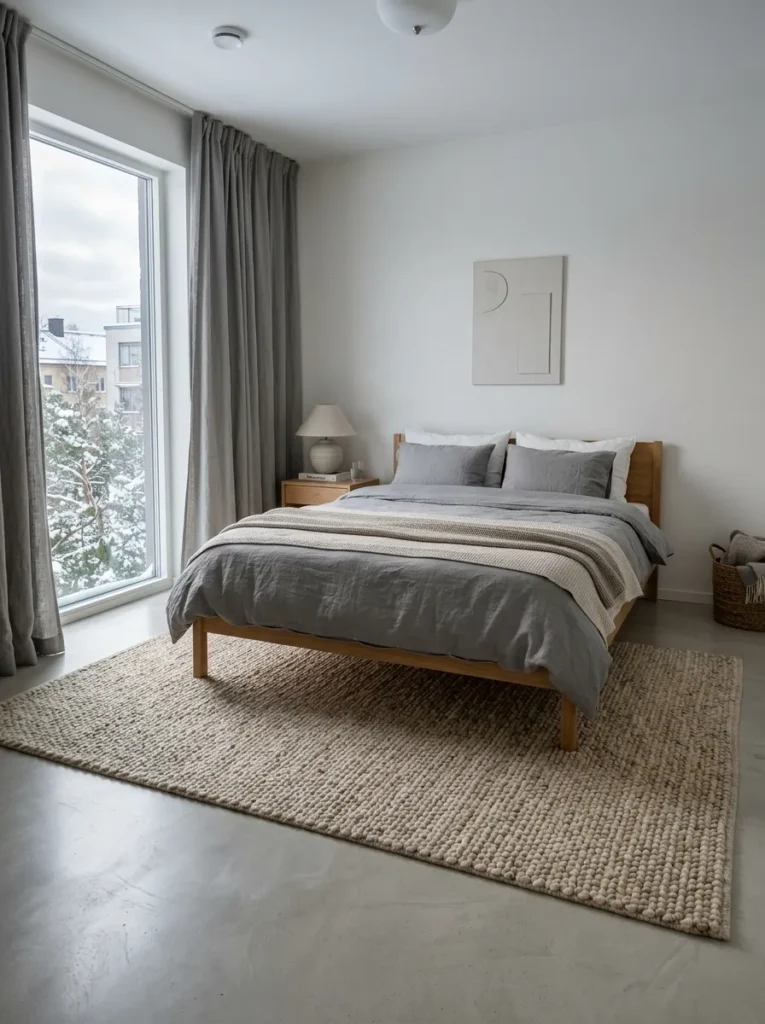
A rug in a bedroom does three things that are rarely discussed: it insulates the foot from cold flooring at the most vulnerable moment of the day (waking), it dampens room acoustics significantly by absorbing high-frequency sound reflections that hard floors amplify, and it provides a visual weight at floor level that grounds the furniture above it. For calm bedrooms, choose natural wool, undyed jute, or hand-knotted cotton rather than synthetic pile, which doesn’t provide the acoustic absorption of a natural fiber. Place it so the bed’s front legs sit on the rug and the rug extends 18 to 24 inches beyond each side of the bed — wide enough to meet bare feet without searching for it.
20. Keep Technology Invisible or Out of the Room Entirely
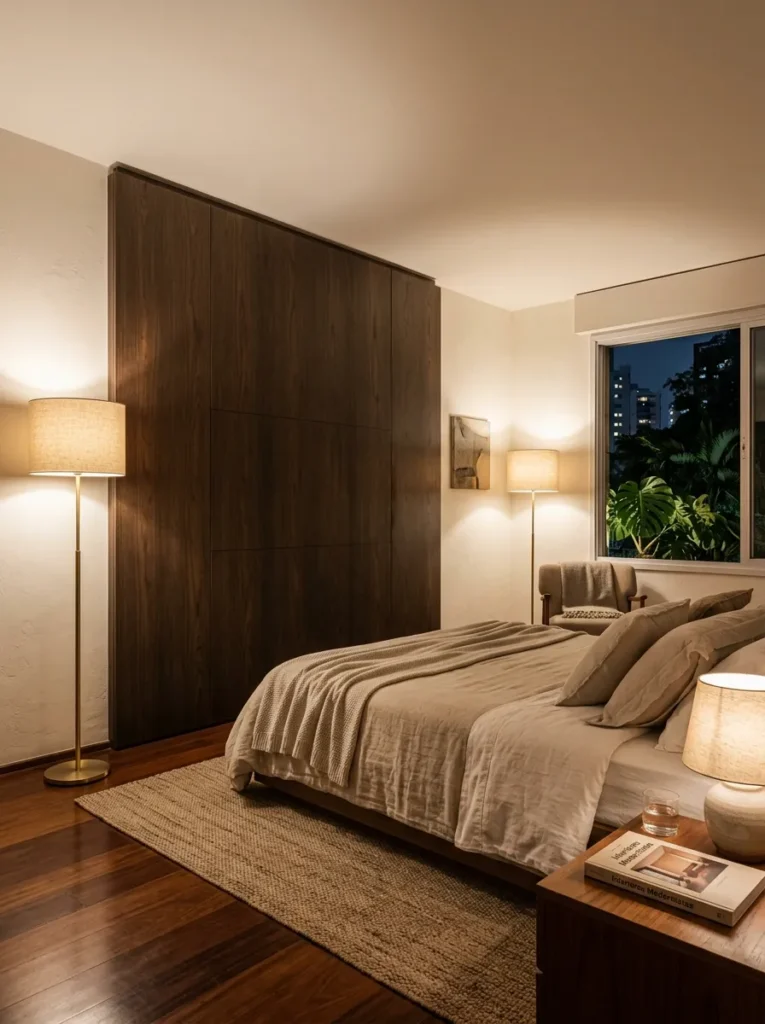
A television mounted on the bedroom wall is not a neutral object. It reflects light from windows, it creates a visual focal point that the sleeping brain cannot fully ignore, and its presence communicates that the room has two competing primary purposes — entertainment and rest. The bedroom can accommodate a TV. It should not be the room’s most visible object from the bed. A cabinet that closes over the screen, a wall-mounting position that places the screen outside the primary sightline from the pillow, or removing it entirely: all three options produce a measurably calmer room than a screen mounted directly opposite the bed at eye level. The decision about where the television lives is, in this sense, a sleep architecture decision.
21. Layer Three Textures on the Bed Rather Than Three Colors

The bed that photographs well but sleeps wrong is almost always the result of styling for visual contrast — contrasting colors, contrasting patterns — rather than for tactile layering. A bed layered in three textures within the same tonal family — waffle-weave cotton, linen, and a chunky knit throw in warm cream and oatmeal — creates the visual richness that multiple colors would provide while keeping the palette unified and the sensory experience coherent. The textures do the work the colors would otherwise do. This reframe shifts the shopping logic from “what color throw?” to “what texture is missing?” which is a more consistently productive question.
22. Remove the Overhead Light from the Room’s Evening Routine
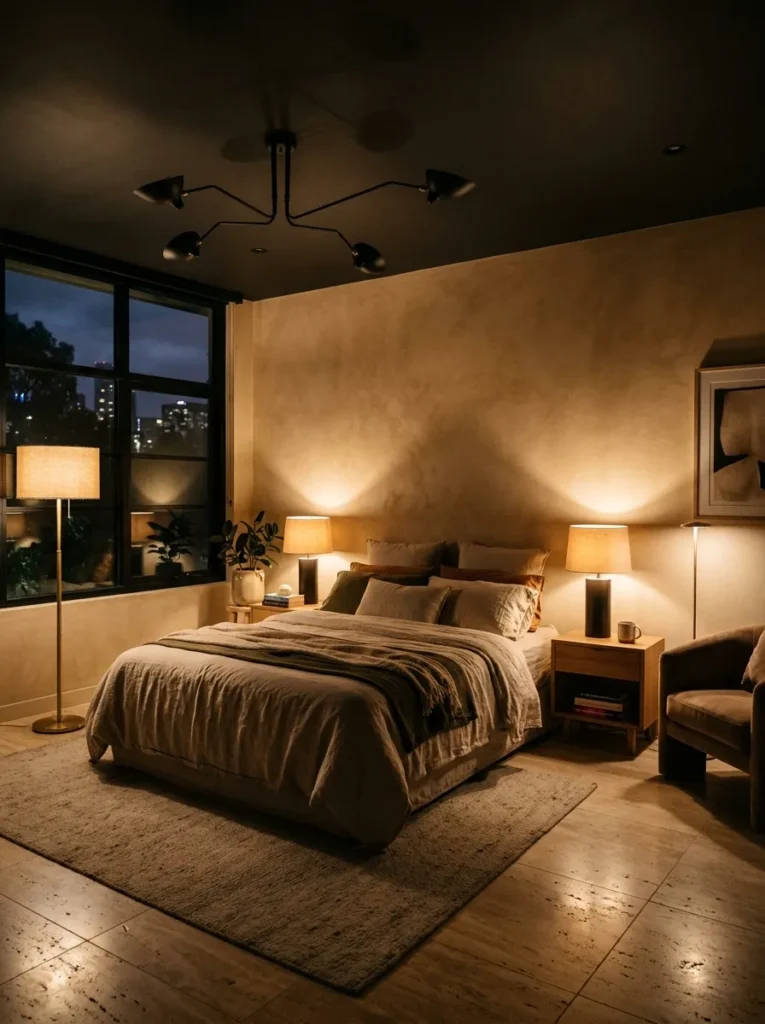
The overhead light is the single greatest enemy of a calm bedroom atmosphere, and it requires no renovation to retire. Plug in one additional floor lamp or table lamp, position it at eye level when seated, and stop using the overhead ceiling fixture after seven in the evening. The shift in light source height alone — from overhead to ambient — reduces the room’s perceived brightness without changing the actual lumen output significantly, because overhead light activates different photoreceptors than side-angled light does. Within two weeks of making this one behavioral change, the room will feel measurably calmer after dark. It costs the price of one floor lamp and the willingness to reach a different switch.
Final Thoughts
Calm bedroom ideas are not design solutions — they are environmental conditions that have to be built deliberately and then maintained. The most common mistake is treating calm as an aesthetic category rather than a functional one, which produces rooms that look peaceful in photographs and feel slightly off to inhabit. Start with light: the dimmer switches, the bulb temperature, and the decision to retire the overhead fixture after dark. Then address the material layer — bedding, floor covering, curtains — because the objects the body touches and the feet land on communicate directly to the nervous system in ways that wall color never quite reaches. The editing comes last, not first. Most people try to solve a restless bedroom by adding objects rather than removing them. Almost every genuinely calm bedroom arrives at its quality through subtraction.
Save these calm bedroom ideas for your next bedroom refresh or full room transformation.