
19 TV Unit Ideas That Blend Storage and Style
The television is the most visually dominant object in most living rooms, and the unit it sits on — or the wall it’s mounted to — is the next thing the eye lands on. When those two elements work together as a considered composition, the living room feels designed. When they don’t — when the TV floats on a bracket above an undersized console that doesn’t relate to either the screen or the room — the entire wall reads as an afterthought regardless of how carefully the rest of the room is decorated.
Getting a TV unit right requires more thought than the purchase alone suggests. The unit’s width should relate to the TV above it. The storage inside should accommodate the actual devices the household owns, with ventilation to protect them. The height — whether floor-standing or floating — affects how the room reads from the primary seating position. And the wall around the unit determines whether the TV is simply mounted or deliberately framed.
These 19 ideas address every meaningful variation — floating units and floor-standing ones, built-in solutions and modular ones, open shelving and closed storage, small-room approaches and full-wall compositions — with enough practical specificity that each idea serves your actual room.
1. Choose a Low-Profile Floor-Standing Console That Reads Horizontal

The classic TV console — a low, horizontal unit positioned directly below the television — works reliably across nearly every living room style because its horizontal emphasis grounds the wall and creates a natural relationship between the unit and the furniture in front of it. The low profile keeps the visual weight of the room concentrated below the midpoint, which makes the space feel more expansive than it is.
The console’s width relative to the television above it is the proportion that most determines whether this arrangement reads as considered or provisional. The unit should be at minimum as wide as the TV screen, and ideally slightly wider — extending an inch or two beyond the television’s outer edges on each side creates the visual relationship of the TV being held by the unit rather than balanced on top of it. A console that’s significantly narrower than the screen above it makes the television look like it might slide off; one that’s dramatically wider introduces a visual imbalance that draws attention to the mismatch.
2. Mount a Floating TV Unit for a Clean, Spacious Feel

A wall-mounted floating TV unit — where the console appears to hover above the floor with no visible legs — creates the visual impression that the floor continues uninterrupted beneath the unit, which makes any room feel more spacious than the same furniture standing on legs. In smaller living rooms especially, this floor-clearance effect is substantial: you see more floor, which makes the room read as larger.
The floating unit also provides an opportunity to set the storage height precisely, which a floor-standing unit on standard legs can’t accommodate. Positioning the top surface of the floating unit at around 16 to 18 inches from the floor — slightly lower than a standard table — places the TV center at close to the seated eye level that viewing comfort requires when the unit and television heights are combined. Cable management is critical here: a floating unit with a visible power cable trailing down the wall to a baseboard outlet reads as unfinished. Routing the cable through a wall conduit or using a recessed outlet box positioned directly behind the unit keeps the wall clean.
3. Use a Slim Floating Shelf as a Minimal TV Support in Small Rooms

For living rooms where floor space is genuinely limited — apartments, smaller homes, rooms where every inch of floor area contributes to the sense of openness — a single slim floating shelf as the TV support rather than a full console unit is the most spatially efficient approach available. The shelf holds the TV, a soundbar, and perhaps one or two small objects; everything else that would typically live in TV unit storage is relocated elsewhere.
The shelf depth should accommodate the television’s base and the soundbar comfortably — typically around 10 to 12 inches — without being so deep that it claims significant wall depth or casts a heavy shadow on the wall below. The material quality of the shelf reads very directly since it’s the only element: a shelf in genuine solid oak, a marble slab, or a quality-finished MDF in a specific color reads as a deliberate design choice. A thin plywood shelf on exposed brackets reads as functional but clearly budget-derived, which is appropriate in some rooms and conspicuous in others.
4. Select Smoked or Fumed Oak for Warmth in a Neutral Living Room

Material choice determines a TV unit’s contribution to the room’s atmosphere, and smoked or fumed oak — where the wood is treated to deepen its natural grain into rich amber-browns and near-blacks — is one of the most consistently successful materials for living room TV units. The depth of color provides genuine visual warmth that paler wood finishes and painted MDF units rarely achieve, and the visible grain texture rewards close inspection in a way that flat laminate doesn’t.
Against a warm white or warm greige wall, a smoked oak TV unit reads as organic and grounded rather than heavy. The material also ages well and develops character with use, which suits the longevity expectation of a piece as central as a TV unit. The practical trade-off worth noting: smoked oak is among the more expensive solid wood options for furniture at this scale, and quality varies significantly between genuine fumed oak and oak-look laminates — the difference is visible at close range and in the weight of the piece.
5. Incorporate Closed Lower Cabinets for Equipment and Cable Storage

The storage inside a TV unit is where function and appearance most directly interact, and closed lower cabinet doors — whether hinged or sliding — are the component that determines whether the unit reads as organized or as a collection of visible electronic equipment. Gaming consoles, streaming boxes, routers, power strips, and cable modem units are all visual clutter when exposed; behind cabinet doors, they’re simply storage.
Ventilation inside closed TV unit cabinets is a practical consideration that many buyers overlook and manufacturers frequently underengineer. Electronics generate heat, and equipment in a sealed cabinet with no airflow runs hotter than it should, which shortens lifespan and in some configurations poses a safety concern. Look for units with slatted cabinet backs, ventilation channels at the cabinet top, or purpose-designed media cabinets with managed airflow. If purchasing a unit without adequate ventilation, a small, quiet USB-powered fan inside the cabinet addressed to the back wall solves the problem without modification.
6. Add Open Shelving on Either Side of the TV for Display and Books

Flanking the television with open shelving — either as integral sections of a combined unit or as separate floating shelves positioned on either side — provides the display space that a purely functional TV unit lacks and creates a wall composition that reads as designed rather than as a television that needed somewhere to go. The shelving frames the TV and transforms the wall from an appliance zone to a considered living room feature.
The styling of the flanking shelves determines how much visual work they do. Books, ceramics in a consistent palette, plants, and a few objects of different heights create the curated arrangement that makes the composition work. Overstuffing the shelves undermines the effect; they should be filled to roughly 70 to 80 percent of capacity, with enough negative space that individual objects read as chosen rather than as fill. The shelf depth should be consistent between the TV unit and the flanking shelves so the arrangement reads as one horizontal composition rather than separate pieces placed in proximity.
7. Choose a Floating Unit With a Hairpin or Angled Leg Alternative

The visual alternative to a fully floating wall-mounted unit is a floor-standing console with legs open and minimal enough to allow the floor to be seen beneath the unit. Hairpin legs in matte black or brass, angled wood legs in a natural or stained finish, and simple tapered metal legs all achieve the visual lightness of seeing floor beneath the unit without the wall-mounting requirements of a true floating installation.
This is the most practical option for renters who cannot install wall brackets, for those who want to be able to reposition the unit without leaving wall marks, and for living rooms where the wall construction behind the TV position doesn’t support the load of a wall-mounted unit. The leg style should connect to at least one other metallic finish in the room — if the room has brass lamps and brass door hardware, brass hairpin legs on the TV unit integrate rather than introducing a competing finish.
8. Build or Commission a Full-Width Built-In for a Custom Look

A TV unit that spans the full width of the wall — from corner to corner or from one deliberate boundary to another — creates a built-in quality that positions the television as a component of the room’s architecture rather than as furniture placed in front of a wall. The visual difference between a freestanding unit and a wall-spanning built-in, in a room where the built-in is well-executed, is similar to the difference between furniture and a room.
Full-width built-ins can be achieved through carpentry or through the creative combination of modular units — IKEA hack approaches using standardized cabinet modules assembled, filled with panels between units, and painted to match or contrast with the surrounding wall have produced genuinely built-in results in many homes. The finish is what makes or breaks the built-in appearance: units painted the same color as the surrounding walls read as integrated; units in a contrasting material or color read as a designed furniture piece rather than architecture.
9. Use a Combination Unit With Drawers Below and Display Space Above

A TV unit that combines drawer storage at its lower level with open display shelving above the television creates a vertically organized composition that uses the full height of the wall above the unit rather than leaving it to be addressed with a separate piece of art or mirror. The drawers handle functional storage — remotes, cables, charging equipment, gaming accessories — while the upper shelves handle curated display.
The placement of the television within this arrangement matters: in a configuration that combines closed storage below, TV at center, and open display above, the TV position should place the screen center at or below seated eye level. In practice this often means the TV sits lower than instinct suggests — the tall upper display section can pull the eye upward and make the TV appear lower, which is a desirable effect for viewing comfort. Placing the screen center at the industry-recommended 40 to 48 inches from the floor suits most standard sofa configurations.
10. Integrate a Sideboard-Style TV Unit for Living-Dining Rooms

In open-plan living-dining spaces, the TV unit often needs to serve multiple functions simultaneously — media storage for the living room side and display or serving surface for the dining side. A sideboard-style unit — longer and lower than a standard TV console, with a mix of closed cabinet doors and open display niches — suits this dual function effectively without the visual complexity of two separate pieces positioned in the same sight line.
The sideboard format also works well for placing the television above a surface that can be styled independently of the media storage below it — plants, ceramics, books, and art objects on the sideboard surface create a visual layer between the television and the floor that makes the wall composition more interesting than a TV on a bare console. The unit’s length can extend well beyond the TV width on each side without looking disproportionate, since the sideboard format reads as furniture rather than as a TV-specific piece.
11. Add Wicker or Rattan Baskets in Lower Open Sections for Textural Storage
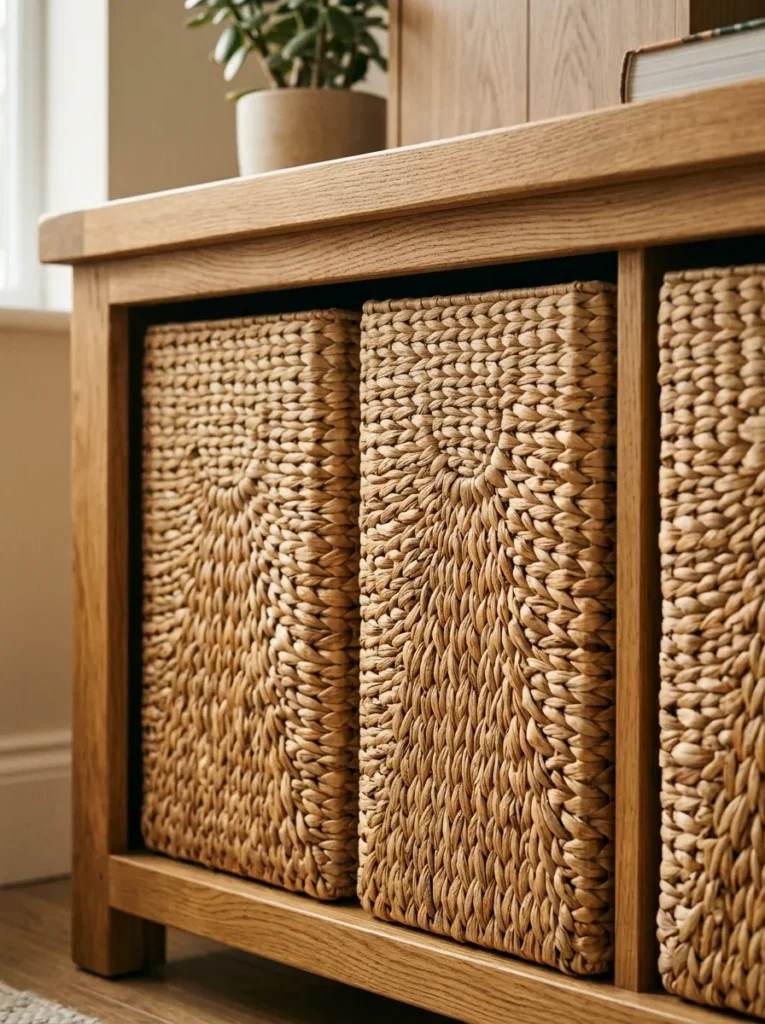
Open-fronted lower sections of a TV unit — where shelves are accessible without cabinet doors — often become the living room’s most visible storage problem: gaming controllers, cable bundles, DVD cases, and miscellaneous accessories are technically stored but constantly visible. Wicker or rattan baskets sized to fit each open shelf bay hide the functional contents while adding organic texture that suits a wide range of living room styles.
The baskets should fill each shelf bay from side to side without gaps that reveal the shelf behind them, and they should be deep enough to hold their contents without items protruding over the front edge. Natural rattan and water hyacinth read best against warm wood TV units; painted seagrass or lacquered storage boxes read more contemporary against painted or lacquered unit fronts. The basket material should connect to something else in the room — a jute rug, a woven throw, a rattan side table — for material coherence rather than appearing as a standalone addition.
12. Use a TV Unit With Fluted Wood Panels for Textural Depth

Fluted wood paneling on TV unit fronts — vertical grooves creating a ribbed surface across cabinet door faces or the unit’s side panels — adds textural depth to what would otherwise be a flat surface while remaining visually quiet enough not to compete with the television above it. The ribbed texture creates shadow lines that shift as the light angle changes throughout the day, making the unit look more considered at close range without introducing pattern or color that demands attention from across the room.
Fluted panels can be applied to the unit’s drawer fronts, cabinet doors, or side panels — or all three — creating a consistent texture across the unit’s full surface. The color of a fluted unit matters as much as the texture: in a warm natural wood finish, fluting reads organic and contemporary; in a matte painted finish (particularly a deep tone like charcoal or navy), the shadow lines between flutes create a moody, layered surface quality that suits more dramatic living rooms.
13. Mount Floating Shelves Above the TV Unit to Extend the Wall Composition

The wall above a TV unit is one of the most consistently underused surfaces in any living room. A single piece of art centered above the television, or nothing at all, leaves the wall composition ending at the top of the television screen. Floating shelves mounted above the TV — at a height that doesn’t interfere with viewing angles — extend the wall’s designed territory and create additional display and storage space that transforms the TV zone into a full-wall composition.
The shelves should be positioned high enough above the television that they don’t read as part of the viewing surface — at minimum 12 to 15 inches above the TV’s top edge — and their width should relate to either the television width or the unit below for visual alignment. A pair of shelves flanking a central art piece positioned above the TV creates a more complex and visually interesting upper wall than either shelves or art alone.
14. Choose a Two-Tone Unit With Dark Lower and Light Upper Sections

A two-tone TV unit — darker color or material on the lower section, lighter on the upper — mirrors the natural visual logic of a room where the floor anchors and the ceiling lifts. This color split also provides a practical design advantage: the lower section’s darker tone conceals the scuffs, fingerprints, and wear that base-level storage receives daily, while the lighter upper section reflects available light and keeps the upper wall from feeling heavy.
The most resolved two-tone combinations share the same material language rather than combining incompatible ones — a matte painted lower section in charcoal paired with an upper section in a lighter warm grey reads as a single piece with a color split; a wood lower section paired with a painted upper section reads as two pieces joined. Both are valid aesthetic choices; which reads better depends on whether the design goal is a unified furniture piece or a deliberately composite one.
15. Integrate an Electric Fireplace Into a TV Unit for a Dual Feature Wall

A TV unit that incorporates a built-in electric fireplace in its lower section creates a wall feature that serves the room year-round — media center when something is being watched, ambient focal point when nothing is. The fireplace-below-TV configuration is the most common premium TV unit arrangement for a reason: it addresses the question of what to fill the lower wall with when a conventional console feels insufficient.
Proportion is the critical design variable. The fireplace opening should be clearly narrower than the television screen above — roughly 60 to 70 percent of the TV width — to preserve the television’s visual dominance. A fireplace as wide as or wider than the screen inverts the hierarchy and turns the wall into a fireplace wall with a TV attached, which is a different design choice with different furniture arrangement implications. Heat clearance requirements between the fireplace top and the TV bottom vary by manufacturer and should be verified before the unit is installed, not afterward.
16. Panel the Wall Behind the Unit in a Contrasting Material

The wall surface directly behind and around the TV unit is the backdrop against which both the unit and the screen are viewed, and treating it differently from the surrounding walls — whether through paint, fluted wood paneling, stone-effect tile, limewash, or wallpaper — elevates the entire wall composition from a TV and a piece of furniture to a designed architectural feature.
The backdrop panel should extend beyond the unit’s footprint on all sides — typically six to twelve inches above the top of the TV screen and the same distance beyond the unit’s outer edges — so it reads as a frame rather than as a piece of wall that the unit happens to sit against. A dark-painted or dark-paneled backdrop makes both the TV and the unit visible as composed elements against a deliberate background; a lighter or more textural backdrop adds depth without the drama of a very dark tone.
17. Style the TV Unit Surface With Three Curated Objects

A TV unit’s top surface — the area on either side of the television, or on the console surface visible between the unit’s front edge and the wall — is the room’s most frequently viewed horizontal surface after the sofa seat. Three curated objects at different heights, chosen for material coherence, make the unit read as styled rather than as a surface things were placed on.
The three-object principle works because it produces the visual triangle — tall, medium, low — that gives any arrangement directionality and movement. A tall ceramic or a sculptural vase at one end, a medium-height plant or stack of books at center, and a low object like a tray or decorative bowl at the other end creates the arrangement most quickly. More than five objects on the unit surface starts to compete with the television; fewer than three can look like the surface has been cleared rather than considered.
18. Use a Corner TV Unit in a Compact or Awkward Room Layout

In rooms where the natural TV position falls at a corner rather than along a central wall — L-shaped rooms, square rooms with awkward window placement, open-plan spaces where the primary seating arrangement is diagonal — a corner TV unit makes the best use of what would otherwise be an underused space. Corner units position the television at a 45-degree angle to the two adjacent walls, allowing seating to be arranged in front of either wall while still maintaining a reasonable viewing angle.
Corner units work best in more casual rooms — family rooms, snugs, and media rooms — rather than in more formally arranged living rooms, where the diagonal television placement can make furniture arrangement less flexible. The unit itself should not be larger than the corner demands: an oversized corner unit blocks circulation to both adjacent walls and makes a compact room feel enclosed rather than efficiently planned.
19. Frame the TV Unit Wall as a Complete Room Feature With Art and Lighting
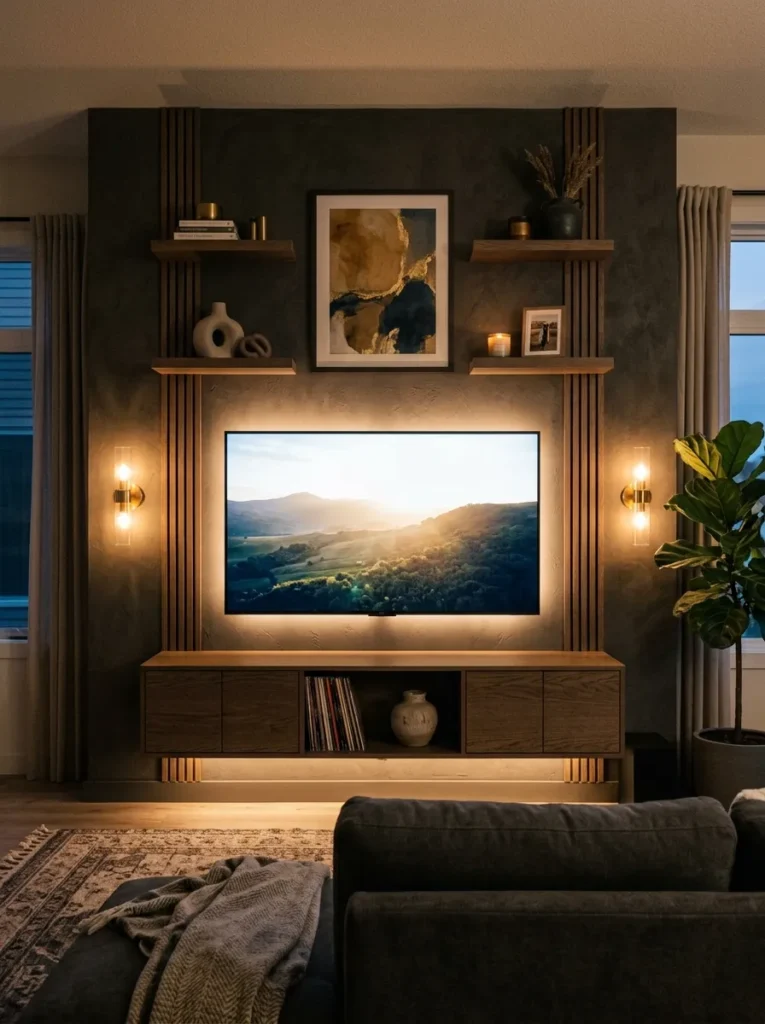
The TV unit becomes a true room feature — rather than a functional piece of furniture accommodating a screen — when the entire wall it occupies is designed as a single composition: the unit anchors the lower portion, the wall behind is treated as a backdrop, art or shelving fills the upper areas, and lighting — sconces, shelf lighting, or LED bias lighting behind the TV — activates the composition at evening.
This approach requires planning the wall as a whole before selecting any individual component. The unit, the wall treatment, the upper-wall elements, and the lighting should all be decided together because each affects the proportions and visual weight available for the others. A heavy built-in unit needs a relatively restrained upper wall; a minimal floating shelf needs more activity above to balance the wall. The lighting layer is what transforms the composition after dark: shelf accent lights, a pair of wall sconces at unit height, or bias lighting behind the TV screen creates the layered, atmospheric quality that distinguishes a designed feature wall from a television on a piece of furniture.
What to Decide Before Buying a TV Unit
Getting these decisions in the right order prevents the most common TV unit regrets.
TV size first, unit width second. Measure the TV’s width before choosing a unit. The unit should be at minimum as wide as the screen, and ideally slightly wider. Buying a unit before measuring the TV routinely produces mismatched proportions.
Screen height from the floor. The TV’s center should land at approximately seated eye level — 40 to 48 inches from the floor for most sofa heights. The unit’s height combined with the TV’s height from the unit top to the screen center determines whether the mounting position achieves this or not.
Storage inventory. List every device that will live in the unit — gaming console, streaming box, router, soundbar, cable box — and confirm the unit can hold them with adequate ventilation. Design the unit around the actual equipment, not a theoretical estimate.
Cable routing. Decide before the unit is placed where cables will run. A wall conduit, a recessed outlet, or a raceway panel painted to match the wall prevents the most common visual outcome: a beautiful unit with cables visible along the baseboard.
Rental or permanent. Wall-mounted floating units leave significant wall damage when removed. Floor-standing units with open legs provide most of the same visual lightness without wall commitment. For renters, the distinction matters before purchase rather than at the end of a tenancy.
Final Thoughts
A TV unit that blends storage and style isn’t a compromise — it’s a specific design brief that most furniture manufacturers address imperfectly and most homeowners arrive at through trial and more than one purchase. The ideas here span the full range of approaches: built-in wall compositions and minimal floating shelves, natural smoked oak and painted two-tone units, corner solutions and full-wall features.
Start with the practical decisions — TV width, seated eye level, storage inventory, cable routing — before any visual choice. The unit that looks most designer-made is almost always the one where those decisions were made first and the visual choices were made around them, not the other way around.
Save the ideas that match your room’s scale, your storage reality, and your appetite for commitment, and return to this guide when you’re ready to plan the wall as a whole.