
19 Bar Cart Ideas That Elevate Entertaining
A bar cart is one of the few pieces of furniture that earns its place in a room by being genuinely attractive rather than merely functional. When it’s styled well, it reads as a curated vignette — a composed moment that says something about the room’s personality and the home’s hospitality. When it isn’t, it reads as a cluttered shelf of bottles without a visual purpose.
The difference between the two is almost never the cart itself. It’s the decisions made about what goes on it, how those things are arranged, and how the cart relates to the room around it. These 19 ideas address each of those decisions — from the foundational choices that most articles skip entirely to the finishing details that determine how the cart reads from across the room.
Choose a Cart Whose Metal Finish Coordinates With the Room’s Hardware
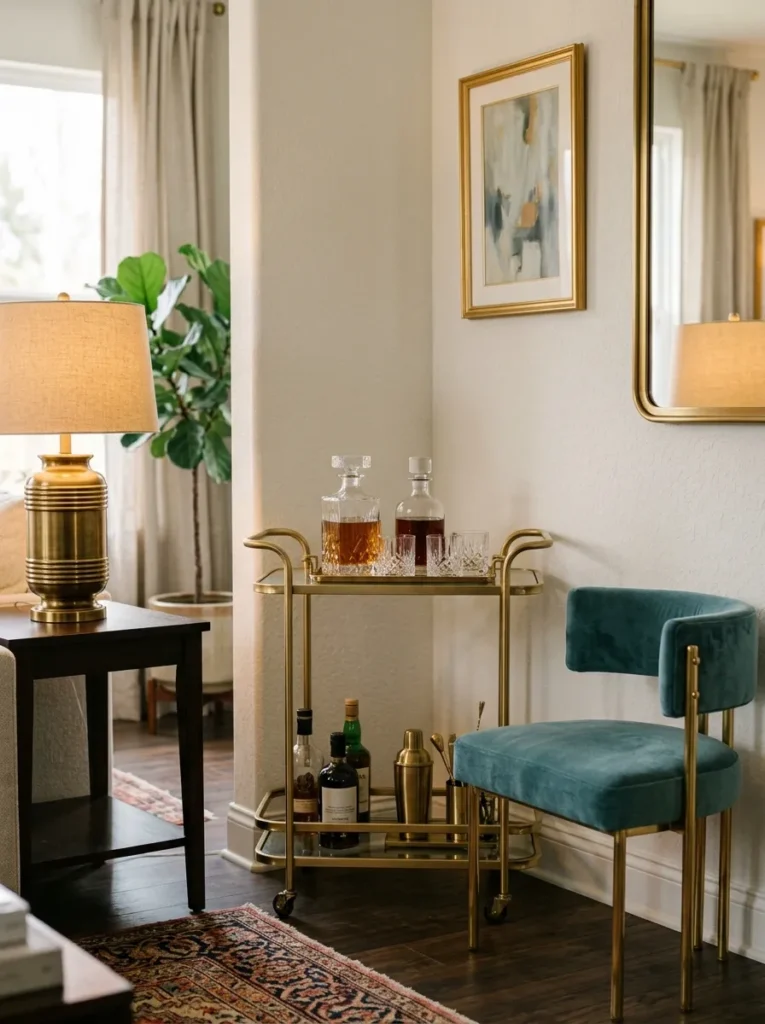
A bar cart’s frame — the metal finish of its rails, handles, wheels, and shelf trim — reads from across the room alongside every other metallic element in the space. A warm brass cart in a room where all the hardware is chrome creates a finish conflict that reads as decorative indecision rather than intentional layering.
The coordination principle: the bar cart’s dominant finish should be within one finish family of the room’s primary hardware. Brass and warm gold coordinate. Brushed nickel and polished chrome coordinate. Matte black coordinates with most finish families as a neutral. If the room has mixed finishes intentionally, the cart can introduce a third finish as long as it connects to both existing tones — antique brass between warm gold and dark bronze, for example. This one decision, made before the cart is purchased, determines how integrated the cart will feel in the room for as long as it lives there.
Position the Cart as a Room Vignette, Not Just Storage

The bar cart that reads as a designed room element — rather than a stocked shelf — is always one that’s been positioned with the room in mind. A vignette is a composed arrangement that holds together visually from across the space. It has an anchor, a mid-height element, a vertical element, and intentional empty space. A storage shelf has bottles and glasses and whatever else fits.
The positioning principle: place the cart where it’s visible from the room’s primary seating area and where it contributes to the room’s overall visual balance. A cart placed against a blank wall section and styled to fill that visual zone reads as purposeful. A cart tucked into a leftover corner as an afterthought reads as exactly that. Placement comes before styling — the room’s spatial logic determines where the cart belongs before any decisions are made about what goes on it.
Anchor the Bottom Tier with Heavy Items and Work Upward in Visual Weight

A bar cart styled without a hierarchy reads as accumulated rather than arranged. The reason is visual weight: heavy, dense items at the top of any composition make it feel unstable and top-heavy. Heavy items at the base create a grounded, intentional structure that draws the eye upward rather than pulling it down.
The hierarchy for a standard two-tier bar cart: the bottom tier holds the heaviest, most substantial items — full-sized spirit bottles, a wine bottle or two, an ice bucket, a wine cooler. The top tier holds the lighter items — glassware, decanters, smaller accessories, the botanical element, the decorative wildcard. This arrangement mimics the visual logic of every stable designed composition: heavier at the foundation, lighter toward the top. The cart arranged this way holds together at every viewing distance.
Edit the Cart to Only What You Actually Pour

The most common bar cart mistake has nothing to do with the cart itself or its arrangement. It’s stocking it with everything that could possibly be served rather than everything that’s regularly poured. A cart loaded with twelve bottles, four glassware types, a full set of mixers, multiple bar tools, garnishes, napkins, and coasters reads as a warehouse display rather than a designed room feature.
The edit rule: keep only the bottles opened regularly — two to four spirits and one or two wines or mixers — and the glassware for what you actually serve. Everything else lives in a cabinet. A bar cart with four beautiful bottles, two matching sets of glasses, one decanter, and one botanical element reads as curated. The same cart with twelve bottles reads as crowded regardless of how carefully each item has been arranged. The number of items on the cart is the first and most important styling decision.
Add One Element That Has Nothing to Do With Serving Drinks

The detail that separates a bar cart that looks styled from one that looks stocked is almost always a single element that has nothing to do with beverages: a small ceramic sculpture, a single stem in a slim bud vase, a stack of two art books on the bottom tier, a framed miniature print, a small stone or personal object.
This wildcard element communicates that the cart was arranged by someone with a design eye rather than someone who wanted to store bottles attractively. It creates visual surprise — an element the eye doesn’t expect in a bar cart context, which is exactly what makes the arrangement read as styled rather than functional. The element should be chosen for its contribution to the composition and its relationship to the room’s broader decor rather than for any bar-related logic. One unexpected item does more for the cart’s overall impression than any additional bottle or glass.
Group Glassware in Matching Sets of Two or Four
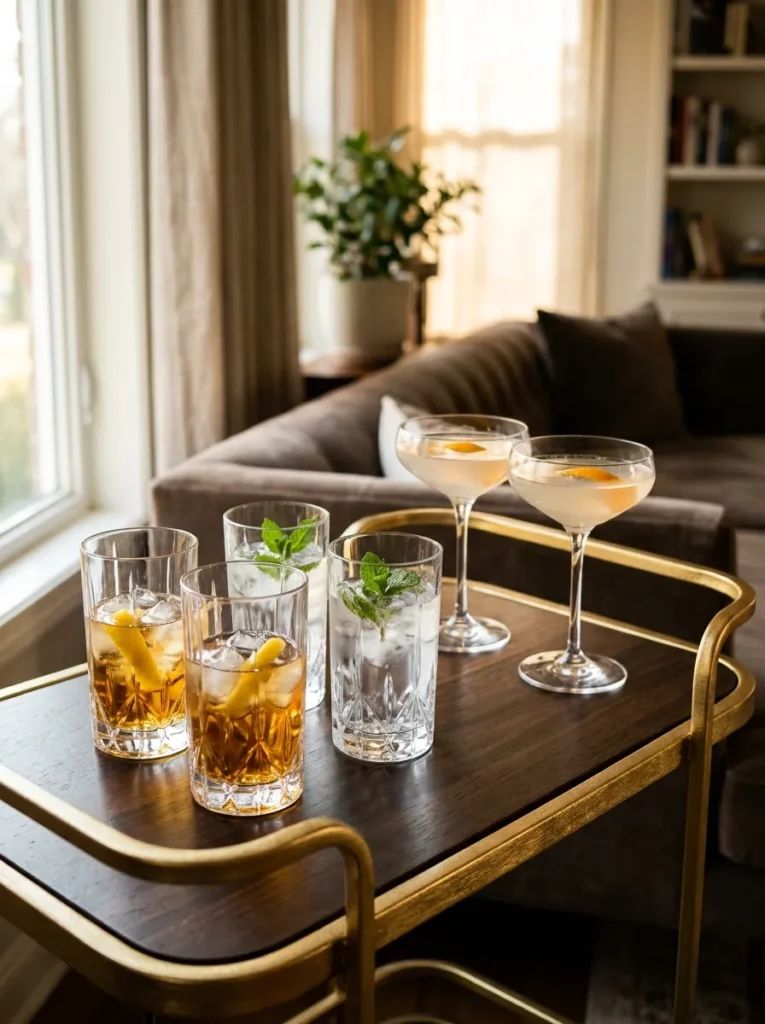
Glassware on a bar cart performs two roles simultaneously: it provides the vessels for serving, and it creates the arrangement’s most consistently clean visual element — uniform, reflective, and light-catching. Both roles are undermined when glassware is a mismatched collection of singles assembled from different sources over time.
Grouping glassware in matching sets — two identical wine glasses, four matching highball glasses, two matching coupes — creates the visual uniformity that makes even a simple glass look intentional. A pair of identical glasses reads as prepared; two glasses of different heights and profiles read as whatever was available. The matching set also sends a message to guests: the cart was assembled with company in mind. That hospitality signal, embedded in the glassware choice, is part of what makes a well-styled bar cart feel welcoming rather than decorative.
Use Decanters to Replace Original Spirit Packaging

Original spirit packaging — even from premium brands — is designed for retail shelving appeal, not for the visual composition of a curated bar cart. Different brands use different bottle profiles, cap styles, and label designs that compete visually rather than composing into a unified arrangement.
Decanting two or three regularly served spirits into a matching set of crystal or glass decanters eliminates this competition. Whether the set is faceted crystal, smooth blown glass, or geometric matte glass, the uniform decanters create a single visual identity for the cart’s most prominent elements. A bar cart with two decanters and two bottles in similar packaging reads as significantly more elevated than a cart with six bottles in original retail packaging — regardless of the brands. The decanter investment is also indefinitely reusable, which makes the cost-per-impression among the lowest of any styling choice on the cart.
Display the Bar Tool Set as Functional Sculpture
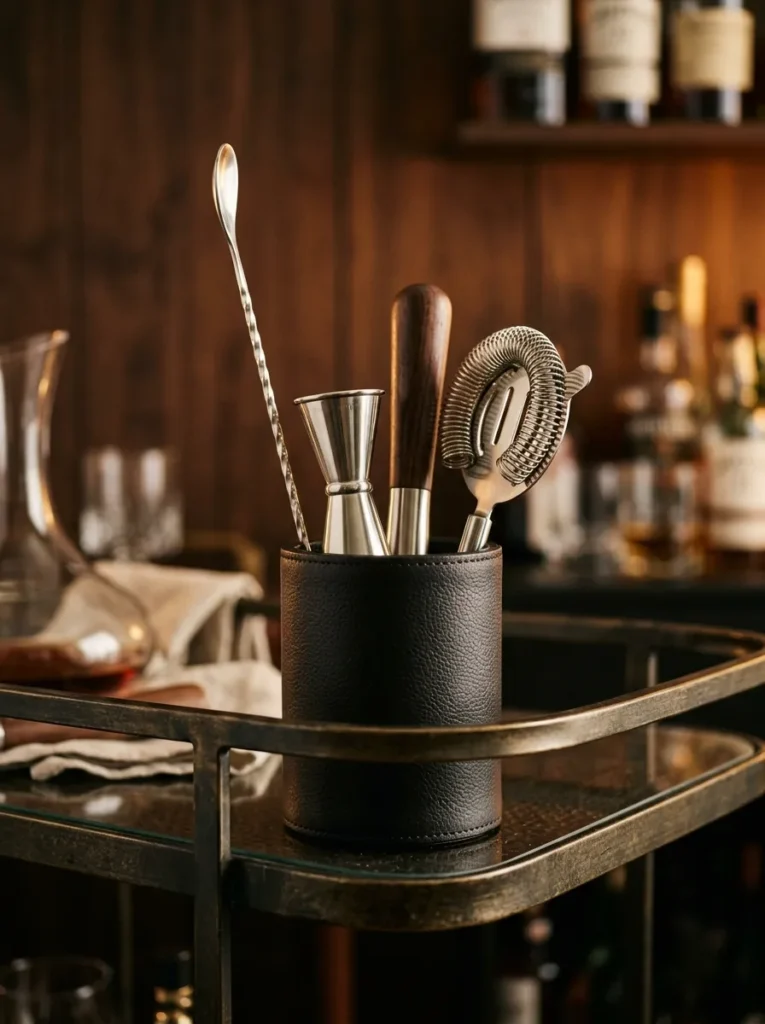
A bar tool set — jigger, bar spoon, muddler, strainer, bottle opener — has genuine sculptural potential that most bar carts waste entirely by leaving the tools in their travel case or tucking them behind the bottles. The metallic forms of a quality bar tool set, standing in a cylinder holder or arranged in a leather roll holder, create a vertical visual element with real visual appeal.
A weighted stainless or brass bar tool set in a metal or leather cylinder holder positioned at the back-center of the top tier provides the cart’s most coherent vertical element — functional, beautiful, and communicating a credibility of purpose that a purely decorative item can’t achieve. It also answers a question guests frequently have when approaching a well-styled bar cart: is this for show or does someone actually know how to use it? The bar tool set answers clearly.
Place a Drinks Tray on the Top Tier to Define the Active Zone

A drinks tray on the bar cart’s top tier does something no other accessory achieves: it defines a specific area as the active working surface — the zone where drinks are made and glasses are filled — and separates that working zone from the display zone around it. Items on the tray are functional; items outside it are styled. The distinction makes the whole arrangement read more deliberately.
The tray also creates a visual anchor for the top tier: a defined rectangle or circle of contained activity surrounded by the looser arrangement of glassware and decor. The material should coordinate with the cart’s finish — a warm brass tray on a gold cart, a marble or slate slab on a dark metal cart, a leather-wrapped tray on a mid-century wood and metal frame. Without the tray, the top tier reads as a collection of items. With it, the same items read as a composed working surface.
Use Botanicals as the Cart’s Vertical Statement Element

A bar cart without a vertical element — something that rises above the glassware and bottle level — reads as flat regardless of how well the horizontal arrangement is composed. The botanical is the most natural and most photographable way to add this vertical dimension: a eucalyptus stem in a slim brass vase, a single dark-foliaged plant in a ceramic pot, a sprig of rosemary in a bud vase that also functions as a cocktail garnish, or a small trailing plant that cascades slightly over one edge of the cart.
The botanical should be proportional to the cart: a small bud vase on a compact cart, a more substantial potted plant on a large brass or vintage cart. The scale principle: the botanical’s tallest point should not significantly exceed the cart’s own height, or it overwhelms the composition rather than completing it. The botanical’s role is to punctuate the arrangement vertically — not to become the arrangement.
Add a Single Candle as the Cart’s Ambient Element
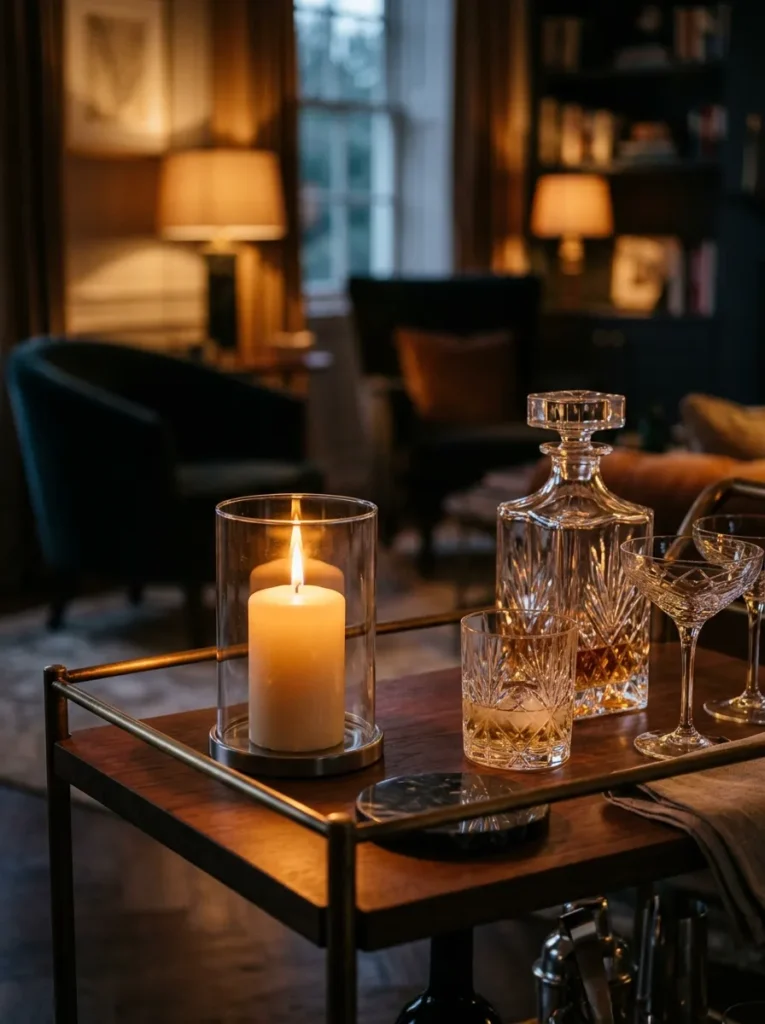
A bar cart styled for an evening gathering achieves a quality no overhead lighting can provide when it includes a single candle: light at counter height — at the level of the glassware, the decanters, the botanical — creates an immediate warm glow that makes the cart feel like a lit scene rather than a furniture piece.
One consideration that most bar cart articles miss: the candle should be unscented. A fragrant candle on a serving surface competes directly with the drink’s own aroma — an effect that’s noticeable and often unwelcome when guests are holding glasses near nose height. An unscented candle provides all the visual warmth of candlelight without the olfactory competition. A weighted glass hurricane, a small ceramic vessel, or a simple brass tealight holder each position the candle correctly — low enough to stay below the line of sight, warm enough to do its visual work.
Use a Dark or Mirrored Cart as a Contrast Piece in a Light Room
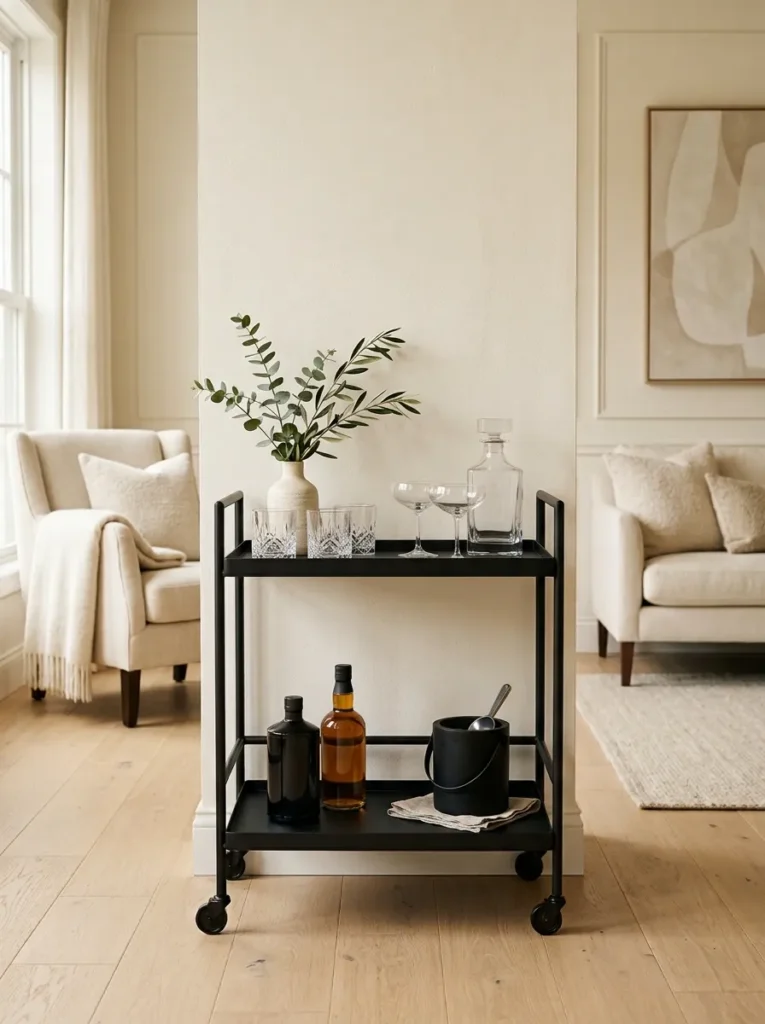
Most bar cart recommendations default to gold and brass as the universal choice, and in many rooms gold is the right choice. But in a room with warm, light-toned walls and predominantly natural materials, a dark metal or mirrored cart creates a far more interesting visual contribution.
A matte black bar cart in a cream and natural linen living room becomes the room’s most visually deliberate object — dark, composed, and distinctly modern against the warm organic background. A mirrored cart in a neutral room reflects both the room’s light and the bottles and glassware on it, creating a visual effect that a solid metal frame can’t replicate. The contrast principle: a bar cart should either coordinate closely with the room’s palette or contrast with it deliberately. The in-between position — neither clearly coordinate nor clearly contrast — is the least interesting choice available.
Create a Coffee Station on a Bar Cart in Rooms That Don’t Need a Bar
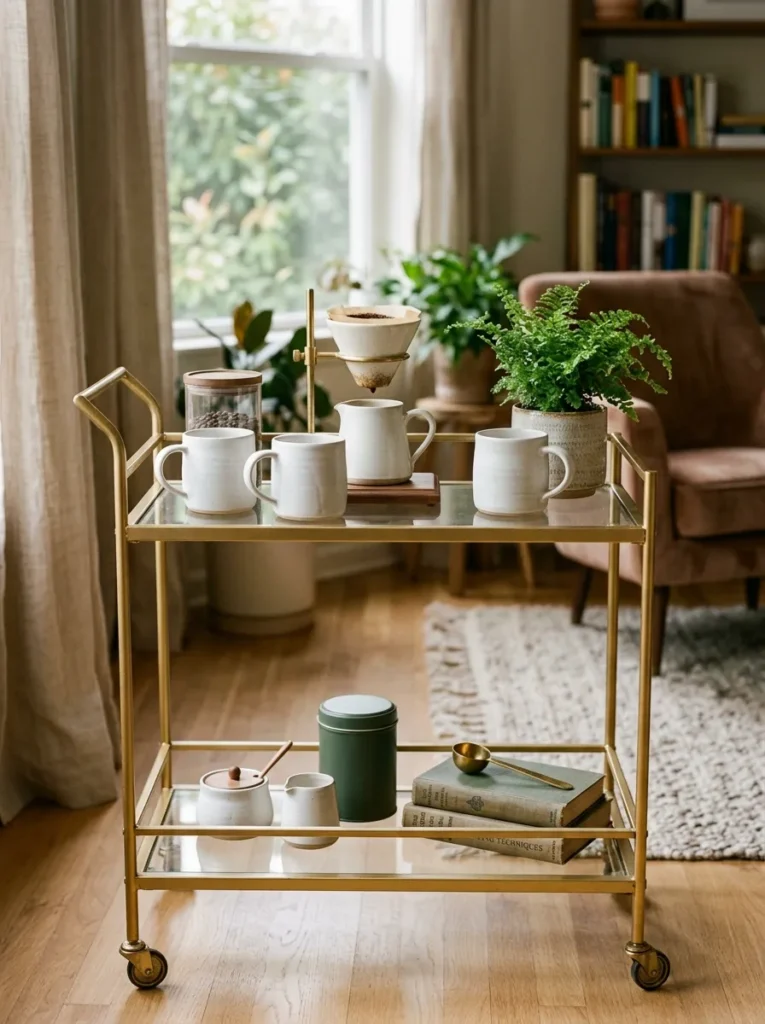
The bar cart’s most underused alternative application is the coffee or tea station — and in a living room, home office, or bedroom where a bar would be impractical, a bar cart styled as a beverage station serves the same design function (a curated beverage vignette) while being genuinely useful at every hour of the day rather than primarily during social occasions.
The coffee station setup: bottom tier holds the equipment — a small pour-over dripper or compact espresso machine, a canister of coffee in a uniform container. Top tier holds the mugs (matching, two or four), a small creamer vessel, sugar in a ceramic dish, and one botanical element. The styling hierarchy is identical to a bar cart. The visual result is equally composed and equally photograph-worthy, without requiring any alcoholic product at all.
Style the Cart Seasonally to Keep the Room Feeling Current

A bar cart is one of the few furniture pieces in a room that can be completely re-styled in under an hour — which makes it the ideal seasonal accent piece. The base structure stays consistent: the arrangement hierarchy, the glassware groupings, the bar tools. The seasonal elements rotate.
Spring and summer: light botanicals, green stems, a small bowl of citrus as both decor and garnish, lighter spirits (gin, white rum, sparkling wine) in clear decanters. Fall and winter: dried botanicals, an olive branch or pine sprig, amber-toned decanters, a candle, warm spirits (bourbon, whiskey, dark rum) at the front. The seasonal adaptation keeps the cart feeling deliberately maintained rather than abandoned between hosting occasions — and gives the room a meaningful visual update without any furniture change, any new purchase, or any significant time investment.
Position the Cart in a Corner to Anchor a Conversational Area

A bar cart placed in a room’s corner — particularly at the junction of a conversational seating arrangement — serves a dual purpose: it provides the bar function and anchors the seating grouping by giving one corner a substantial, designed object that closes the furniture arrangement.
A conversational seating area with an open corner reads as a gap in the arrangement — a space that should have something and doesn’t. A bar cart in that position creates an implied boundary for the conversational space and makes the seating feel enclosed and purposeful rather than floating. The cart should be within arm’s reach of the nearest chair when it’s in its conversational position — close enough that a guest can reach their glass without leaving their seat. This proximity is the original point of the bar cart’s mobile design.
Style the Cart for the Full-Room View, Not Just the Close-Up
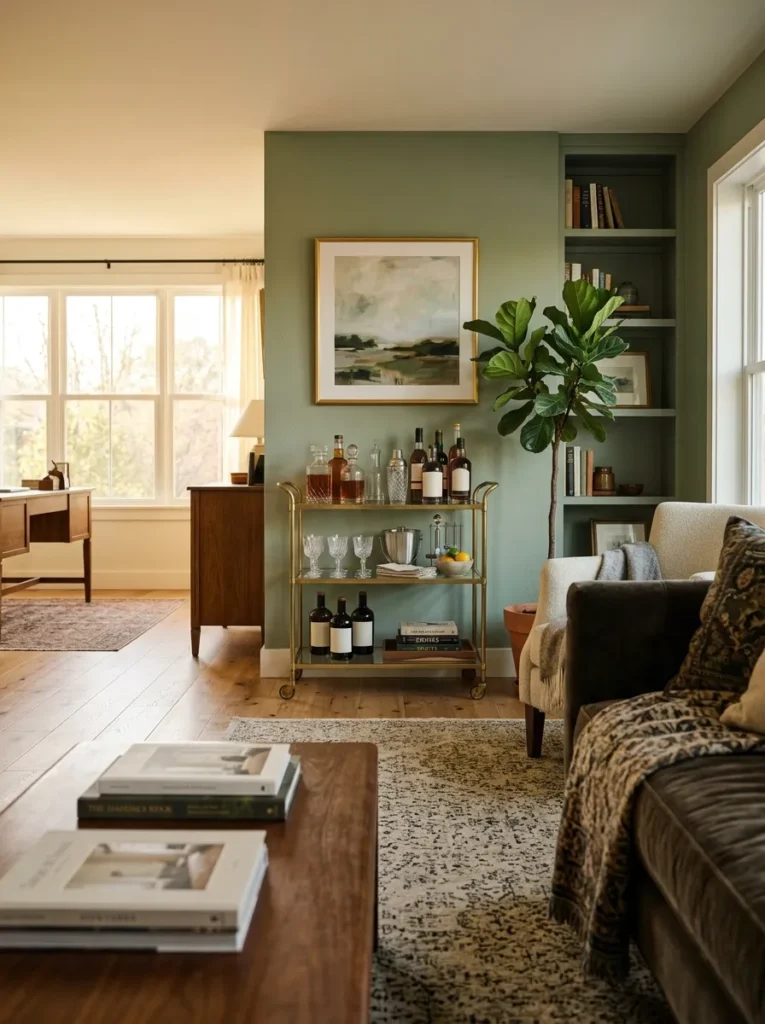
Every bar cart should be styled with two perspectives in mind: the close-up view at cart height, where the details of individual items matter, and the full-room view from across the space, where the overall silhouette and visual rhythm of the arrangement are what read.
Most bar cart styling focuses entirely on the close-up view. A cart that looks beautifully arranged up close but reads as a visual blur from across the room — because all items are the same height, or the arrangement has no vertical variation, or items are packed to the cart’s edges with no breathing room — doesn’t perform its role as a room vignette. Style the cart, then step back to the room’s primary seating position and evaluate the arrangement from that distance. The adjustment made from that perspective is usually the most significant one, and it’s the step most home styling articles never mention.
Use the Bar Cart as a Moveable Hosting Station

The bar cart’s original purpose — the feature that distinguishes it from a built-in home bar — is that it moves. A styled cart can serve as the room’s decorative vignette for day-to-day living and roll to wherever guests are when hosting begins: to the patio for summer entertaining, to the dining room during dinner service, to the living room seating area during cocktail hour.
Most bar carts are treated as stationary furniture once styled and positioned. The hosting station approach keeps the mobility intentional: the cart lives in its decorative position during daily life and moves deliberately when hosting. This requires that the styling be reasonably secure — bottles stoppered, glassware stable, nothing stacked in ways that make transport uncertain — but otherwise the mobility is the feature. The ability to bring the bar to the guests rather than asking guests to find the bar is the hospitality upgrade the cart was designed to provide.
Keep Visible Empty Space Between Groups on Both Tiers

The visual quality most styled bar cart photos share — the quality that makes the arrangement read as curated rather than loaded — is the presence of intentional empty space on the shelf surface. Items are grouped with visible tray or shelf surface visible between groups rather than packed to the cart’s edges.
Most real bar carts are over-packed: bottles touching each other, glassware filling every available inch, accessories crowded into corners. The edit rule covers what to remove; this idea addresses the arrangement principle once editing is done. After reducing to the correct quantity of items, position them with visible surface space between groups. A pair of decanters with 4 inches of visible shelf between them and the bar tool set reads as composed. The same items touching read as crowded regardless of how attractive each individual piece is.
Build the Arrangement Around Three Distinct Heights
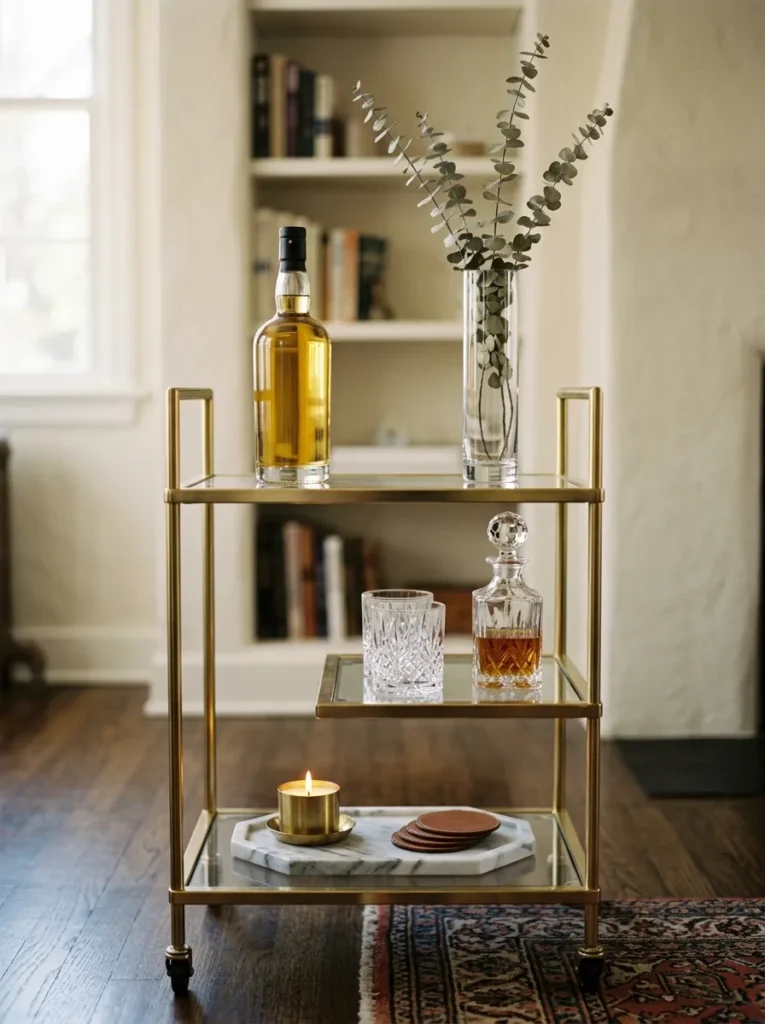
The styling principle that most reliably produces a curated result without requiring formal design training: every arrangement needs elements at three distinct height levels to create visual interest, depth, and the eye’s natural movement through the composition.
Short: items sitting close to the shelf surface — a low candle, a small coaster stack, a flat tray, a bowl of garnishes. Medium: the arrangement’s primary horizontal level — glasses, decanters, mid-height bottles. Tall: the vertical accent that anchors the composition — full-sized spirit bottles at the back, a slim botanical stem in a tall vase, the bar tool set in a cylinder holder. When all items occupy the same height, the arrangement reads as flat from across the room — visually accurate but entirely without rhythm. The three heights create the movement that makes an arrangement readable as designed rather than placed.
Pro Designer Tips
Match the cart’s finish to the room’s primary light source. In a warm-light room — incandescent or warm LED — gold and brass are amplified; the warm light makes warm metals genuinely glow. In a cool-light room or one with abundant north-facing natural light, chrome, brushed nickel, and matte black perform more predictably. Brass in a cool-light room can cast greenish-yellow; cool metals in a warm-light room read as stark. The light source is a variable most cart buyers ignore entirely and most styling guides never mention.
Use odd numbers for the most visually dynamic groupings. Three bottles read as a composed group with visual movement; two bottles read as a pair. Five bottles read as a collection; four read as a set. Odd numbers create asymmetry that keeps the eye moving through an arrangement. Even numbers create symmetry that reads as resolved — useful in specific positions, but rarely the more interesting choice.
Tall items belong at the back of the arrangement, not the front or center. A tall bottle or vase positioned at the front of a shelf blocks everything behind it and makes the composition read as a single tall item with things crowded behind it. Tall items at the back create depth: the eye travels from the front items across the middle height to the back vertical — a full-depth reading of the arrangement that makes a compact cart feel spatially larger.
Don’t stack glassware unless the styling deliberately demands it. Inverted glasses stacked rim-to-rim save space but look precarious and communicate that the cart prioritizes storage over presentation. Individual glasses, each in their position, communicate readiness and care. The only exception: coupes stacked two high by design, which reads as a classic high-style bar arrangement when done intentionally rather than for space reasons.
The first impression from the room entry is the bar cart’s most important moment. A bar cart sits at counter height — at the natural horizon of a standing eye crossing a room. It’s among the first objects a guest registers when entering. What the cart communicates in that first glance — whether it reads as styled, stocked, or cluttered — is the bar cart’s primary decorative contribution to the room.
Final Thoughts
A bar cart is genuinely one of the highest-impact styling pieces available in a room — not because of what it holds, but because of where it sits and what it communicates. A well-styled cart says something about the room, its host, and the occasion in a way no other piece of furniture at that scale manages quite as efficiently.
Start with the edit: only what you actually pour. Position the cart where it anchors the room rather than filling a gap. Apply the three-height rule to the arrangement. Add the one wildcard element that has nothing to do with serving drinks. Step back to the full-room view and make the adjustment from the primary seating position.
The result will be a bar cart that earns its place in the room every day — not just when guests arrive, but every morning when you walk past it.