
19 Bathroom Wall Decor Ideas That Feel Elegant
Bathroom walls are one of the most neglected surfaces in the home — and one of the most visible. You stand in front of them every morning, guests notice them immediately, and yet most bathrooms end up with either nothing on the walls or decor borrowed from a living room mindset that doesn’t quite translate.
The bathroom has constraints that other rooms don’t. Humidity affects what materials hold up long-term. Scale is often compressed, which means the wrong-sized mirror or art piece can throw off the entire room. Lighting is frequently poor, which changes how wall colors and finishes read. And in rental bathrooms, permanent changes usually aren’t an option.
These 19 bathroom wall decor ideas address all of that. Each one is specific enough to execute, practical enough for the conditions, and considered enough to feel genuinely elegant rather than decorative for decoration’s sake. Some are foundational — the kind of decisions that define the room’s character entirely. Others are smaller additions that shift the atmosphere without requiring a renovation. A few are specifically designed for renters or tight budgets.
The wall space in your bathroom is more valuable than most guides acknowledge. Here’s how to use it well.
1. Frame Botanical or Nature Prints in Matching Frames

The most versatile approach to bathroom wall art is also the most accessible: a collection of framed botanical prints, nature illustrations, or watercolor studies in matching or closely related frames. The content suits the bathroom’s organic, water-adjacent associations. The matching frames give the collection a cohesive quality that prevents the arrangement from looking random.
Humidity is the practical consideration most guides skip. Standard paper prints in wood frames are fine in bathrooms with good ventilation but will warp and mold in poorly ventilated spaces or directly adjacent to the shower. The fix: use prints sealed behind glass or acrylic (not open-backed frames), choose frames with a sealed finish rather than raw or painted wood, and hang art on walls that don’t receive direct splash.
A grouping of three to five prints in black frames on a white or light wall creates clean contrast. The same grouping in thin natural wood frames on a warm-toned wall reads as softer and more collected.
2. A Single Large-Scale Art Print as a Focal Point
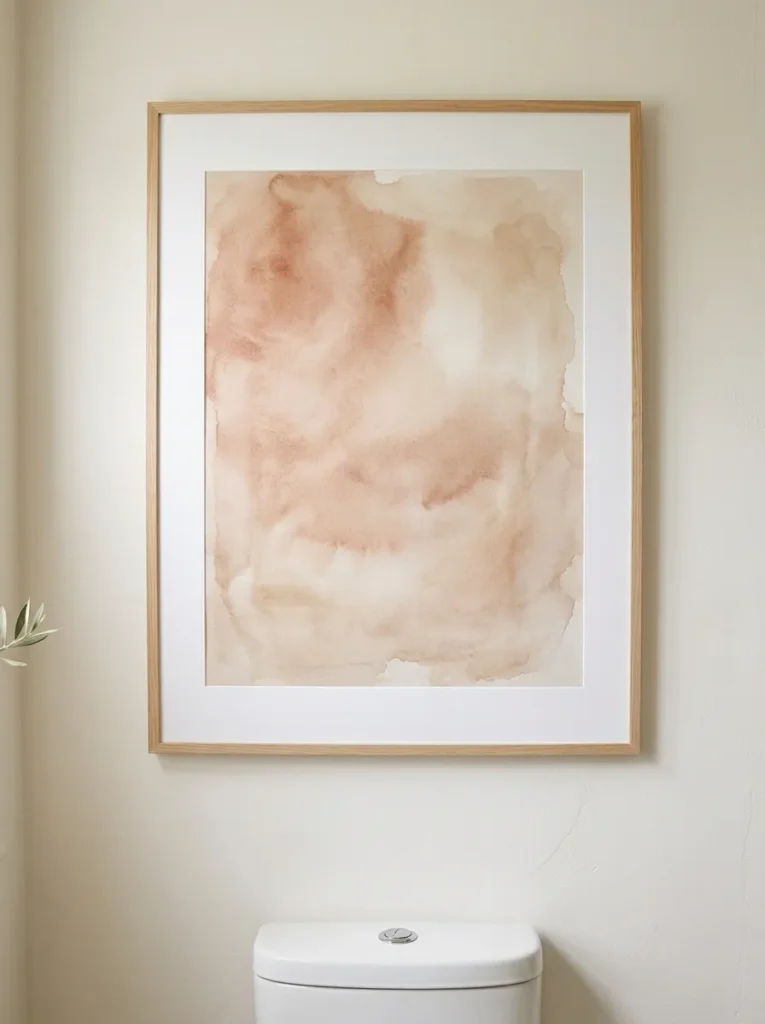
Rather than a gallery arrangement, one oversized print — something that would feel crowded in a small bedroom but reads as architecturally confident in a bathroom — can anchor the entire room. Above the toilet, on the wall facing the doorway, or on the longest uninterrupted wall are the positions where a large-format print carries most impact.
The scale needs genuine commitment. A print that’s 18×24 inches or larger reads as intentional in most bathrooms; anything smaller tends to look like it was positioned there because there was nowhere else to put it. The subject matter can be abstract, photographic, or illustrative — what matters more is that the tones relate to the room’s existing palette rather than introducing a completely unrelated color story.
For renters, large-format prints in snap frames (the kind with aluminum edge clips rather than screwed-in wall hardware) require only two small nail holes and can be changed or removed easily.
3. A Vertical Gallery of Small Prints Above the Toilet

The wall above the toilet is one of the most consistently underused surfaces in the bathroom — it’s at eye level when seated, visible from the doorway, and typically offers 18 to 24 inches of uninterrupted width. A vertical arrangement of two or three small prints stacked in a column suits this narrow format perfectly.
The prints should share a common thread — same frame style, same color family in the images, or same subject matter — to read as a composed column rather than three unrelated pieces hung close together. Two prints in matching black frames with white mats, stacked with roughly 4 inches between them, is the minimum arrangement that reads as deliberate rather than improvised.
On a painted wall with strong color, keep the frames simple and the mats white. On a white or neutral wall, the frame material can be more expressive — thin brass, dark walnut, unlacquered natural wood.
4. Wall-Mounted Sconces Instead of Overhead Lighting

Replacing or supplementing a single overhead light with wall-mounted sconces flanking the mirror transforms the room’s lighting and its visual character simultaneously. Sconces do what overhead lighting can’t: they light the face from the sides rather than casting shadows downward, which is both more flattering and more functional for a grooming space.
The sconce positioning matters for both function and proportion. Flanking the mirror at roughly eye height — approximately 60 to 65 inches from the floor to the center of the fixture — creates balanced light from both sides. Sconces mounted too high cast the same unflattering downward shadows as a ceiling light; too low reduces their functional reach.
The fixture style carries significant visual weight in a bathroom where other decorative elements are limited. A pair of slim cylindrical sconces in aged brass suits warm, traditional, or transitional bathrooms. Matte black sconces suit contemporary or industrial spaces. Unlacquered brass that will patina over time develops a material authenticity that polished finishes rarely achieve.
5. An Oversized Round Mirror as the Room’s Defining Feature
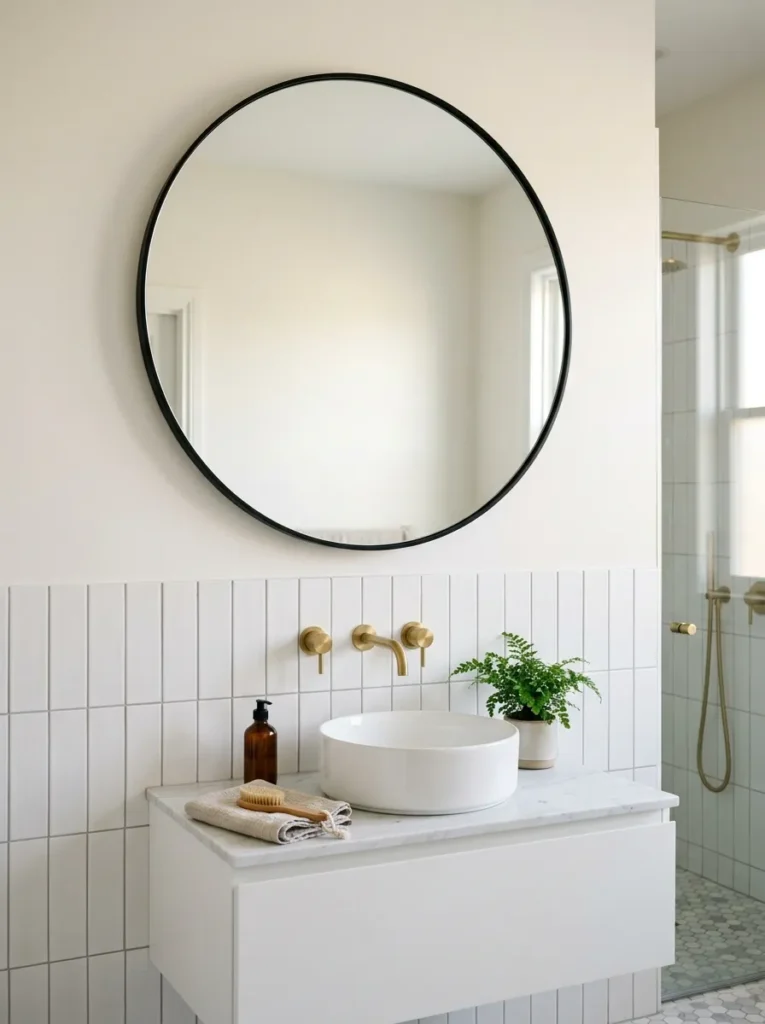
A round mirror in a bathroom full of rectangular tile, rectangular vanity, and rectangular door reads as a deliberate departure from the room’s grid — and that contrast is precisely what gives it visual presence. An oversized version, closer to 30 or 36 inches in diameter, commands the wall in a way that a standard medicine cabinet or small rectangular mirror does not.
The frame material is the decision that most affects the room’s overall tone. A thin black metal frame reads as modern and clean. A thick rattan or natural fiber frame reads as organic and warm. An unlacquered brass frame develops character over time and suits bathrooms where other warm metal accents appear in the hardware or fixtures.
One practical note on sizing: the mirror’s diameter should generally not exceed the width of the vanity below it. A mirror that extends beyond the vanity’s footprint on either side reads as proportionately mismatched rather than dramatically oversized.
6. An Arch-Top Mirror for Architectural Softness

An arch-top mirror — any mirror with a rounded or pointed top edge and a flat or angled base — introduces a curved geometry that most bathrooms completely lack. Where a round mirror provides circular contrast to the room’s rectangles, an arch-top mirror provides upward vertical movement that makes lower ceilings read as taller.
This works particularly well in small bathrooms with standard 8-foot ceilings. A tall arch mirror — 30 inches wide by 40 or more inches tall — draws the eye upward and creates the visual impression of more ceiling height without changing anything structural.
The arch doesn’t need an elaborate frame to make an impact. Some of the most effective versions are frameless or have a very thin metal perimeter — the shape itself carries the visual work. Frameless arch mirrors also avoid the maintenance question of whether the frame material will hold up to bathroom humidity.
7. Floating Shelves Styled as Wall Decor, Not Just Storage

A pair of floating shelves — or a single shelf with deliberate styling — does something that art and mirrors can’t: it creates a three-dimensional wall moment. The objects on the shelf project forward from the wall surface, catching light and creating shadow in a way that a flat frame doesn’t.
For bathroom shelving to read as elegant rather than functional, the styling needs restraint. Three objects maximum per shelf: a small plant, a ceramic vessel, and one folded linen hand towel, for example. Overcrowded shelves read as overflow storage rather than intentional display, which defeats the purpose in a room where the goal is calm and considered.
Material matters for both aesthetics and durability. Solid oak or walnut floating shelves suit warm, organic bathroom aesthetics. White painted shelves suit more minimal or contemporary spaces. Avoid particleboard shelves in bathrooms with regular moisture — they swell at the edges and deteriorate at the mounting points over time.
8. A Woven or Macramé Wall Hanging for Texture

In a bathroom that already has tile, hard stone, or glossy paint, a woven or macramé wall hanging introduces the one quality those surfaces lack: textile softness. The contrast between the hanging’s organic fiber texture and the bathroom’s harder materials creates visual warmth without any color addition.
For bathroom use, the placement has to be considered. A woven hanging directly above the toilet or on a wall adjacent to the shower is exposed to significant humidity. On the wall opposite the shower, or on a wall in a powder room with no shower at all, the humidity concern is much lower.
Cotton macramé in natural undyed tones suits bathrooms decorated in warm neutrals, earthy tones, or natural materials. A smaller piece — roughly 12 to 18 inches wide — works in a powder room or above the toilet. A larger statement piece suits a bathroom with an uninterrupted wall large enough to let it breathe.
9. A Medicine Cabinet with a Mirrored Front as a Two-in-One

A recessed or surface-mounted medicine cabinet with a mirrored door provides storage and a mirror in the footprint of one. In smaller bathrooms where wall space is at a premium, this consolidation matters more than it might seem — it frees up the remaining wall space for a single considered decorative element rather than requiring the whole wall to be functional.
The cabinet style is the variable that makes or breaks the look. A surface-mounted cabinet with a thin metal frame in a finish that matches the faucet reads as intentional. A builder-grade white plastic cabinet reads as practical but not elegant. Replacing an existing builder-grade cabinet with a better-quality version in the same rough location is a renovation that requires minimal wall work and has disproportionate visual impact.
For renters, surface-mounted medicine cabinets that hang on two wall anchors are an option that requires minimal installation and can be removed without significant wall damage.
10. Lean a Large Mirror Against the Wall

In bathrooms large enough to accommodate it — a master bath or a bathroom with a double vanity — leaning a large mirror against the wall rather than hanging it creates an unexpectedly relaxed, considered quality. The leaning position suggests the mirror was chosen with care rather than installed as a standard fixture.
This works best with a mirror that has enough visual weight to read as furniture: a thick wood frame, an ornate antique-style frame, or a heavy metal frame that looks grounded against the wall. A frameless mirror leaning against the wall reads as a construction site rather than an intentional design choice.
The practical consideration: a leaned mirror in a bathroom should be secured with a small anchor or anti-tip strap at the back, even if barely visible. A heavy mirror in a wet environment that tips is a genuine safety concern, not a hypothetical one.
11. A Vertical Tile Accent Strip as a Built-In Decorative Element

In a bathroom that’s being renovated or tiled from scratch, running a vertical strip of accent tile — a different color, finish, or material — from floor to ceiling on a single section of wall creates a permanent architectural detail that reads as more considered than a standard uniform tile installation.
The accent strip works best when it’s in a tile that’s clearly different from the surrounding tile but tonally related. A warm beige field tile with a single vertical strip of terracotta or hand-glazed ceramic in a similar warm family reads as deliberate. A white subway tile field with a strip of dark navy tile reads as graphic and contemporary. Both work; the choice depends on the room’s direction.
Width matters for this detail. A strip of one tile wide (roughly 3 to 4 inches) reads as a grout line with ambition. Three to four tiles wide reads as an intentional band. Six or more tiles wide approaches a feature section rather than an accent strip.
12. Peel-and-Stick Wallpaper on One Bathroom Wall

Peel-and-stick wallpaper in a bathroom — on the wall behind the toilet, on the wall facing the doorway, or on a single accent wall — provides pattern, color, and visual character without permanent installation. For renters, this is the single most transformative wall treatment available without landlord permission.
The bathroom caveat is humidity. Peel-and-stick wallpaper performs significantly better in powder rooms and half baths (no shower, minimal steam) than in full bathrooms where steam from a shower loosens adhesive and causes edges to peel. In a full bathroom, applying it only to walls that don’t receive direct steam — opposite the shower, above the toilet — extends its lifespan considerably.
Pattern scale should be calibrated to wall size. A large botanical or abstract pattern on a small bathroom wall can feel overwhelming when the surface area is limited. A small-repeat pattern (a delicate vine, a fine geometric) suits small walls; bolder patterns suit larger uninterrupted surfaces.
13. Traditional Wallpaper in a Powder Room for Maximum Impact
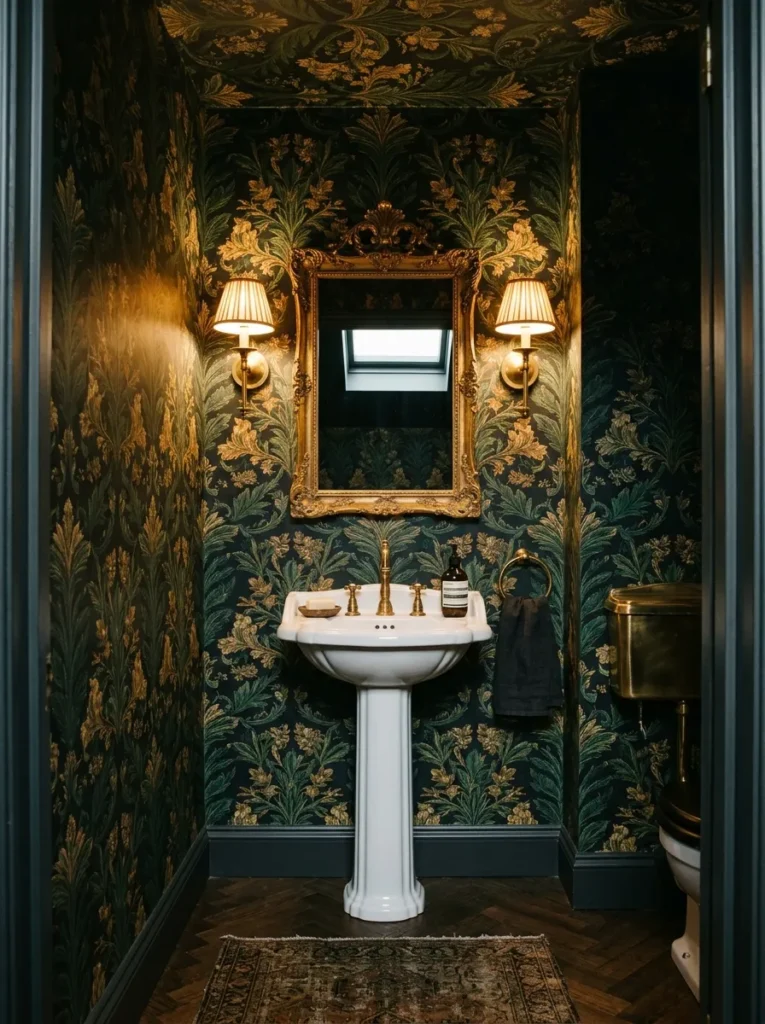
A powder room — a half bath with no shower — is the one bathroom context where fully committing to a bold, pattern-heavy wallpaper is not just acceptable but genuinely the right call. Because guests use it briefly, the room can sustain a visual intensity that would be exhausting in a full bathroom used daily.
Dark, dramatic wallpapers in deep navy, forest green, or midnight with botanical or geometric patterns read as intentional in a powder room in a way that feels slightly excessive elsewhere. The small scale of the room actually helps — the pattern wraps around all four walls and creates an immersive quality that photographs beautifully and reads as a considered design moment.
Traditional paste wallpaper in a powder room is also significantly more durable than peel-and-stick, and since there’s no shower steam, the installation holds without the humidity concerns that affect a full bathroom application.
14. Unlacquered Brass or Aged Metal Accents on the Wall

Wall-mounted hardware — towel bars, towel rings, robe hooks, toilet paper holders — is often treated as a purely functional afterthought. Upgrading these fixtures to unlacquered brass, aged bronze, or hand-forged iron shifts the wall’s character in a way that’s disproportionate to the cost and complexity of the change.
Unlacquered brass is particularly worth understanding. Unlike polished brass, which stays bright and can look dated, unlacquered brass darkens and develops a patina over time that reads as more material and authentic. In a bathroom, the combination of water exposure and air exposure accelerates the patina, which is a feature rather than a flaw if you want a warm, lived-in quality.
For a cohesive look, all wall-mounted hardware in the bathroom should share the same finish. Mixing metal finishes on the same wall — brass towel bar, chrome toilet paper holder, black robe hook — reads as unintentional regardless of how good each individual piece is.
15. Vertical Shiplap or Beadboard Paneling Below the Chair Rail

Horizontal shiplap is common in bathrooms. Vertical shiplap or beadboard paneling below a painted chair rail is less common and more architecturally interesting — the vertical lines draw the eye upward and create more visual height, which is particularly valuable in bathrooms with standard or lower ceilings.
The wainscoting approach (paneling on the lower half only, paint above) also solves a practical problem: the lower wall in a bathroom receives the most moisture, splashing, and contact, and paneling in a painted finish is more durable and easier to wipe down than flat-painted drywall in that zone.
The chair rail sits naturally at around 32 to 36 inches from the floor — roughly one-third of a standard ceiling height. The paneling below should be painted in a semi-gloss or satin finish for moisture resistance. The wall above can be in a flat or eggshell finish since it receives less direct contact and moisture.
16. A Framed Antique or Vintage Mirror Above the Vanity

An antique or vintage-style mirror — with a frame that shows age, an irregular glass with slight distortion, or a decorative form that reads as gathered rather than purchased — gives a bathroom an accumulated quality that new fixtures rarely achieve. It signals that the room was designed with intention and edited over time.
True antique mirrors need some protection from steam and direct water exposure, since old silvering can deteriorate with sustained moisture. Positioning the mirror on the wall rather than directly above a wet-use area, or choosing a well-sealed reproduction with vintage characteristics, addresses the concern without sacrificing the aesthetic.
For bathrooms with plain, modern vanity fixtures, an ornate vintage mirror is one of the most effective single additions for creating immediate character contrast — the old frame against the clean white sink reads as intentional rather than mismatched.
17. Painted Limewash or Color-Washed Walls as the Decor
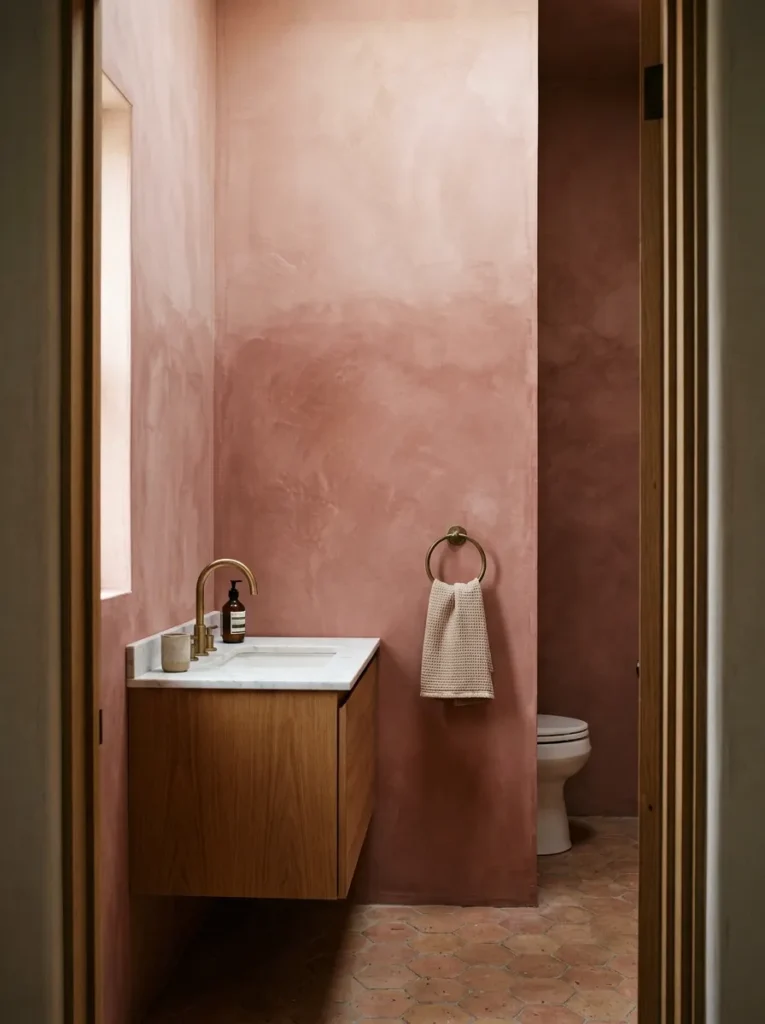
In a bathroom where the walls themselves are the decor — where the goal is atmosphere rather than objects — limewash paint or a color-wash technique creates a surface with enough visual depth and movement that no art, no shelving, and no decorative objects are required. The wall does the work entirely.
Limewash in a bathroom works best in powder rooms and well-ventilated full baths. In high-humidity environments, using a limewash formulation specifically rated for wet or high-moisture areas, or applying a clear topcoat sealer, extends the finish’s lifespan. Standard limewash in a poorly ventilated bathroom will absorb moisture and can develop mold behind the surface layer over time.
Color choices for a limewash bathroom wall reward warmth. Sage, clay, dusty rose, warm terracotta, and aged ivory all develop a quality under bathroom lighting — typically warmer and more directional than in other rooms — that cooler colors don’t achieve as naturally.
18. A Statement Mirror with a Sculptural or Decorative Frame

Beyond shape and size, the mirror frame itself can carry significant decorative weight — particularly in a bathroom where wall space for additional art is limited. A mirror with a sculptural rattan sunburst frame, a hand-carved wooden frame, a concrete surround, or an ornate plaster frame becomes the room’s primary wall decor rather than a functional fixture with a minimal edge.
The frame style should be the room’s loudest decorative decision, which means the surrounding choices — hardware finish, towel color, any accessories — need to be quieter and supportive. A mirror with an elaborate rattan frame works best when the rest of the bathroom is relatively plain; competing it against bold tile, bold wallpaper, and bold hardware creates visual overload.
Scale: the mirror frame should be generous enough that the frame detail is visible from the doorway. A small mirror with an interesting frame reads as jewelry in a museum; a large mirror with the same frame detail reads as an architectural feature.
19. Open Wall Space Left Deliberately Empty

The most counterintuitive bathroom wall decor idea is also often the right one: leaving most or all of the wall space undecorated. In a bathroom with strong tile work, an interesting mirror, or quality fixtures, additional wall decor can compete with what’s already working rather than adding to it.
A bathroom with beautiful marble tile, a considered vanity, and a well-chosen mirror doesn’t need artwork on the remaining walls. The tile is the decor. The mirror is the focal point. Adding prints or shelving or hanging objects onto the remaining surfaces risks making the room look decorated rather than designed.
The edit test: look at the bathroom from the doorway and identify the strongest visual element. If that element reads clearly and the eye rests naturally on it, the walls are likely doing their job already. Adding more should serve a specific purpose — additional storage, improved lighting, visual softening — not fill the space for its own sake.
Choosing What Your Bathroom Walls Actually Need
Before selecting any specific idea from this list, it helps to diagnose what the wall space is missing rather than what could be added.
If the bathroom feels bare and unresolved, the priority is a focal point — a statement mirror, a gallery arrangement, or a wallpaper wall creates the anchoring element the room needs before anything else is considered.
If the bathroom feels dated but structurally fine, hardware upgrades (Idea 14) and a mirror swap (Ideas 5, 6, or 18) provide the most impact for the least disruption. These two changes together often feel like a partial renovation.
If the bathroom feels too stark or clinical, texture and material additions — a woven hanging (Idea 8), limewash walls (Idea 17), or floating shelves with warm objects (Idea 7) — shift the atmosphere without changing the room’s structure.
If you’re a renter, Ideas 1, 2, 3, 8, 9, and 12 are all achievable with minimal or no permanent wall modification. The sconce upgrade (Idea 4) typically requires an electrician and landlord permission — skip it unless you have both.
If the bathroom is small, resist the instinct to fill every wall. A single strong element — one large mirror, one well-styled shelf, one vertical print column — reads more elegantly in a small bathroom than multiple competing additions.
Final Thoughts
Bathroom walls reward restraint more than almost any other surface in the home. The most elegant bathrooms tend to make one or two strong decisions — a thoughtful mirror, a considered tile detail, a limewash wall — and leave the rest alone rather than layering addition after addition until the room feels decorated rather than designed.
If you’re starting from scratch, the mirror is the decision to make first. It’s the room’s primary functional and visual element, and everything else — sconces, shelving, art, hardware — should support it rather than compete with it.
From there, add only what the room genuinely needs. A bare wall that creates calm isn’t a problem to solve. A wall that feels unresolved is — and the specific ideas here will tell you which additions actually fix that versus which ones simply fill the space.
Save the ideas worth returning to, and revisit this guide when you’re ready to make the bathroom walls work as hard as the rest of the room.