18 Dining Room Rug Ideas That Define the Space
Of all the places in a home where a rug matters, the dining room is the one where the wrong decision is most obvious. An undersized rug makes the table look like it’s floating in the middle of something that doesn’t belong to it. The wrong material turns every meal into a maintenance exercise. And a rug that looks perfect in a mood board can read completely differently once a real dining table is sitting on it.
The ideas here cover the full range of dining room rug decisions — from the foundational sizing logic that most people skip to material choices that hold up to actual use, along with pattern, color, and placement ideas that work across different room sizes and table shapes. The goal is to leave you with fewer questions than when you arrived, whether you’re choosing your first dining room rug or replacing one that never quite worked.
1. Get the Size Right Before Anything Else
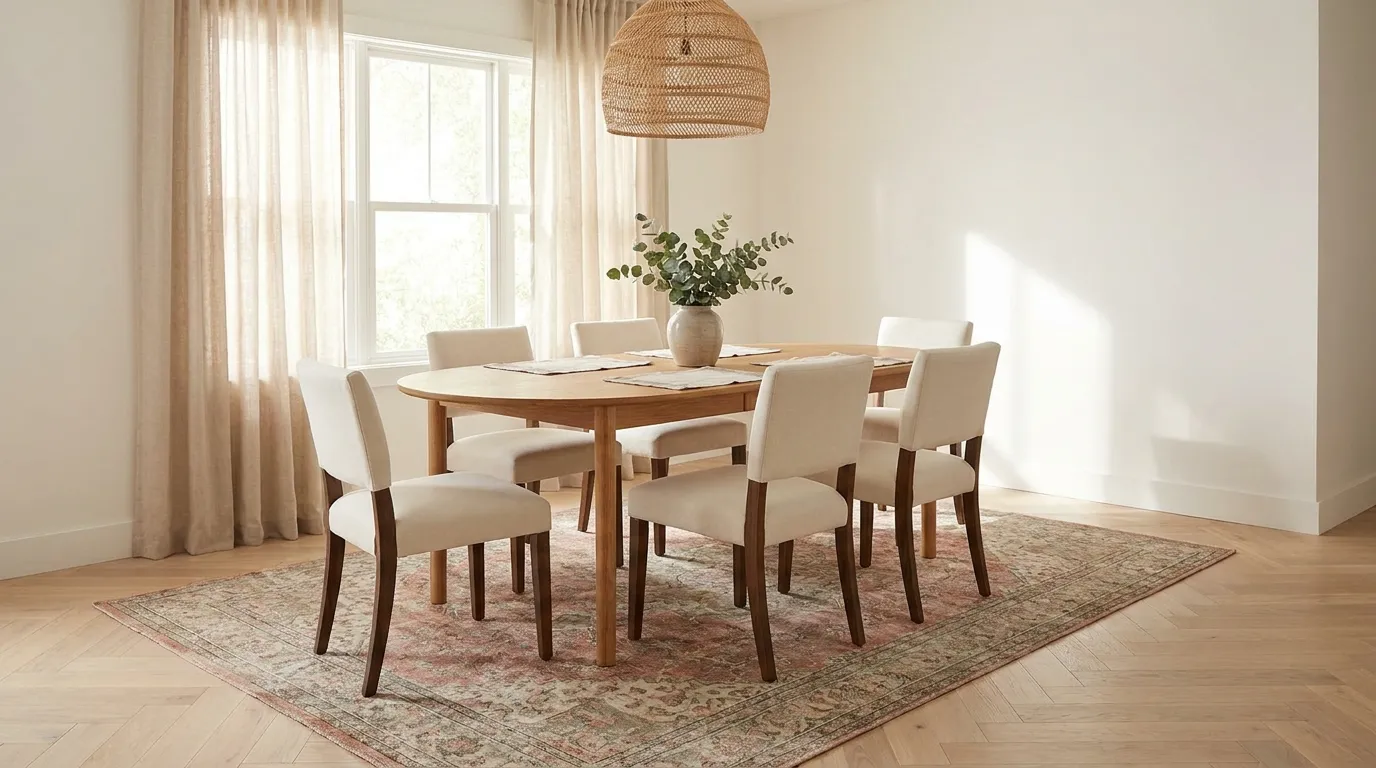
Rug sizing is the single decision with the most impact on how a dining room rug looks and functions — and the most common source of expensive mistakes. The rule that holds up in nearly every dining room: the rug should extend at least 24 inches beyond each side of the dining table. This ensures that when chairs are pulled out for seating, all four legs remain on the rug rather than straddling the edge.
A chair leg catching the rug edge is both a tripping hazard and a fast way to destroy a rug’s edge binding. For a standard 36-by-72-inch rectangular table seating six, this means a rug of at least 8-by-10 feet. For a 48-inch round table, a rug of at least 8 feet in diameter. These feel larger than most people initially choose — and that’s precisely why undersized rugs are so common. When in doubt, go up one size.
2. Match the Rug Shape to the Table Shape
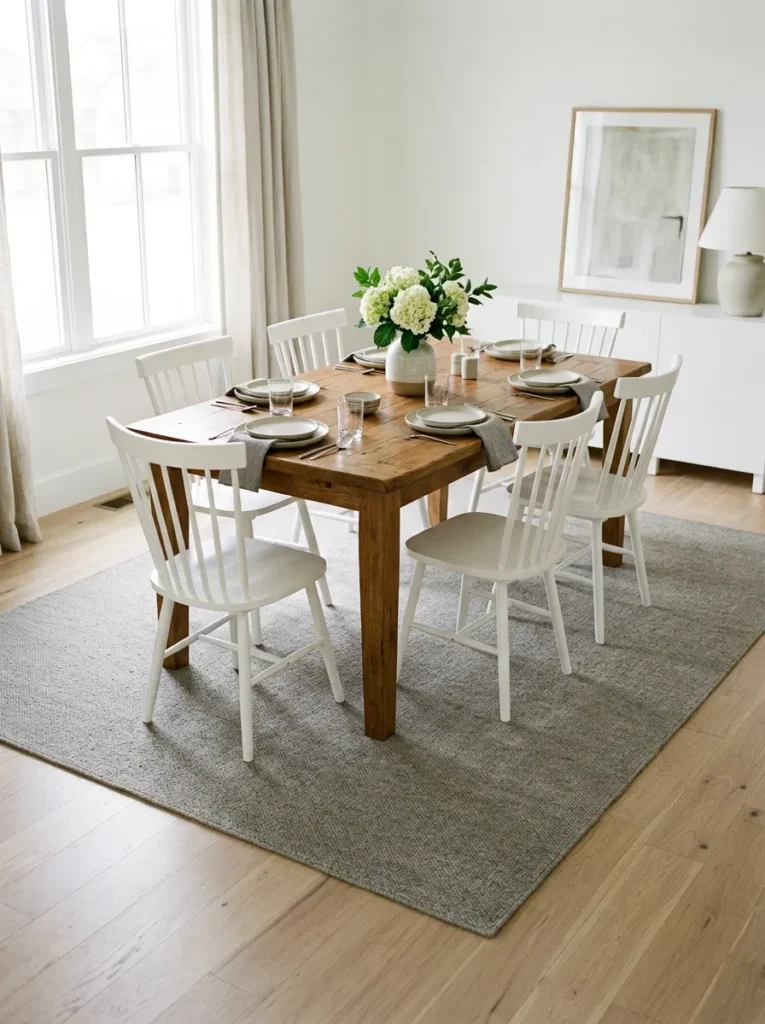
A round rug under a rectangular table and a rectangular rug under a round table both create an off-balance feeling that’s difficult to articulate but immediately visible. The rug shape and table shape read as a unit, and when they contradict each other, the eye registers the conflict.
Round tables pair most naturally with round rugs. Rectangular and oval tables suit rectangular rugs. Square tables work with either square or round rugs, depending on the room’s proportions — a square rug in a square room can feel gridded and rigid; a round rug softens the corners and suits rooms where the table is the only large geometric form. The exception worth knowing: a large round rug in a rectangular dining room with a rectangular table can work as a deliberate design choice, but it requires the room to be large enough that the rug doesn’t look like it’s the wrong shape rather than a considered one.
3. Use a Jute or Sisal Rug for Natural Warmth Without Pattern Competition
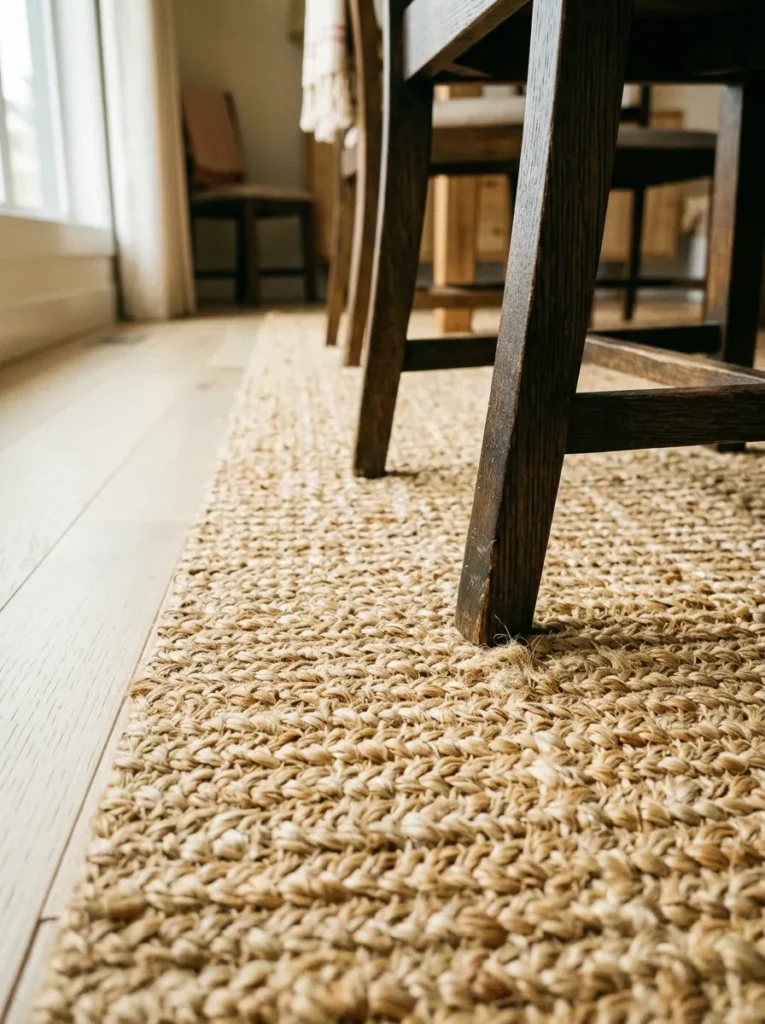
Natural fiber rugs — jute, sisal, and seagrass — are among the most practical choices for dining rooms for reasons that go beyond aesthetics. Their flat, tight weave resists crumbs lodging in the pile, their neutral earth tones hide light dust between vacuuming, and they introduce organic warmth and texture that complements almost every furniture style from farmhouse to contemporary.
Jute is softer underfoot than sisal and more forgiving on bare feet — a meaningful difference if the dining room connects to the kitchen and the rug sees barefoot traffic. Sisal is more durable and slightly coarser. Both show water marks if spills aren’t addressed quickly, which is the main practical limitation. For households with young children or frequent spills, a jute look-alike in a synthetic flat-weave alternative is worth considering — the visual effect is nearly identical but the cleanup is significantly easier.
4. Try a Washable Flat-Weave Rug for a Family Dining Room
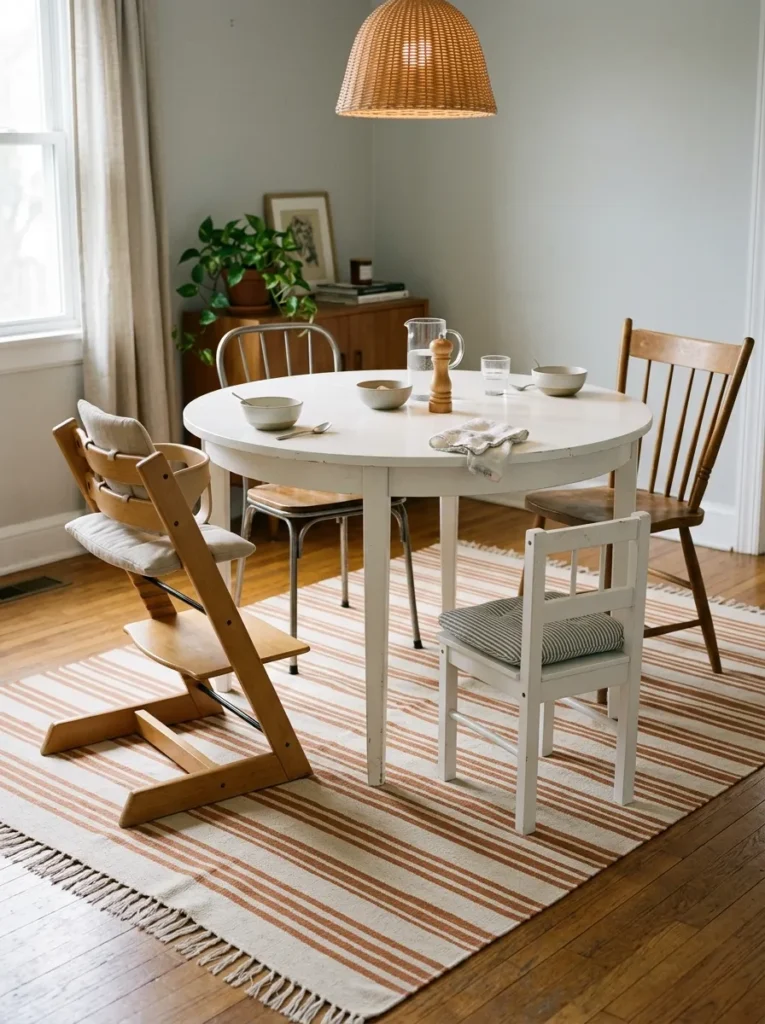
The dining room is the room in most homes where spills happen most predictably. A rug that can’t be cleaned beyond spot-treatment is a liability in that context, regardless of how beautiful it is. Washable flat-weave rugs — particularly those made from cotton, recycled materials, or low-pile synthetic blends — have improved substantially in pattern quality and visual appeal and are now available in designs that genuinely compete with traditional woven rugs.
The practical advantage is straightforward: when red wine goes on it (and in a dining room, eventually it will), the entire rug can be laundered rather than requiring a professional cleaner. Flat-weave construction also means chair legs don’t catch on pile, there’s no pile to mat under heavy chair legs over time, and the rug lays flat without a pad. For families with children, pets, or frequent entertaining, this category of rug makes the most honest sense.
5. Layer a Flat-Weave Rug Over a Natural Fiber Base for Depth
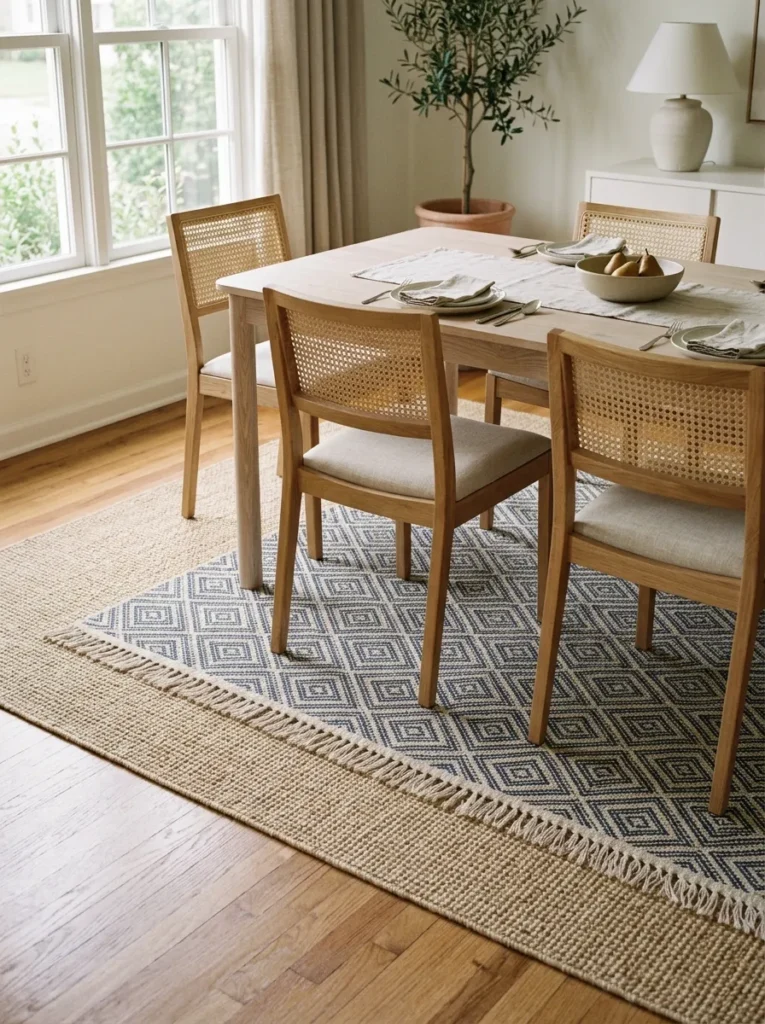
Layering rugs in a dining room is less common than in living rooms but works particularly well when the goal is texture depth without pattern complexity. A large jute or sisal rug as the base layer provides the sizing and natural warmth, while a smaller flat-weave cotton rug in a simple geometric or stripe pattern sits on top, centered under the table.
The layered approach also has a practical logic: the base layer handles the size requirement (which means paying less for a large natural fiber rug rather than a large premium patterned rug), while the top layer provides the visual character. When the top rug eventually wears or stains, only the smaller, less expensive piece needs replacing. The visual result is a composed, layered floor moment that reads as more considered than a single rug on bare floor.
6. Use a Persian or Traditional Pattern for a Grounded, Collected Look
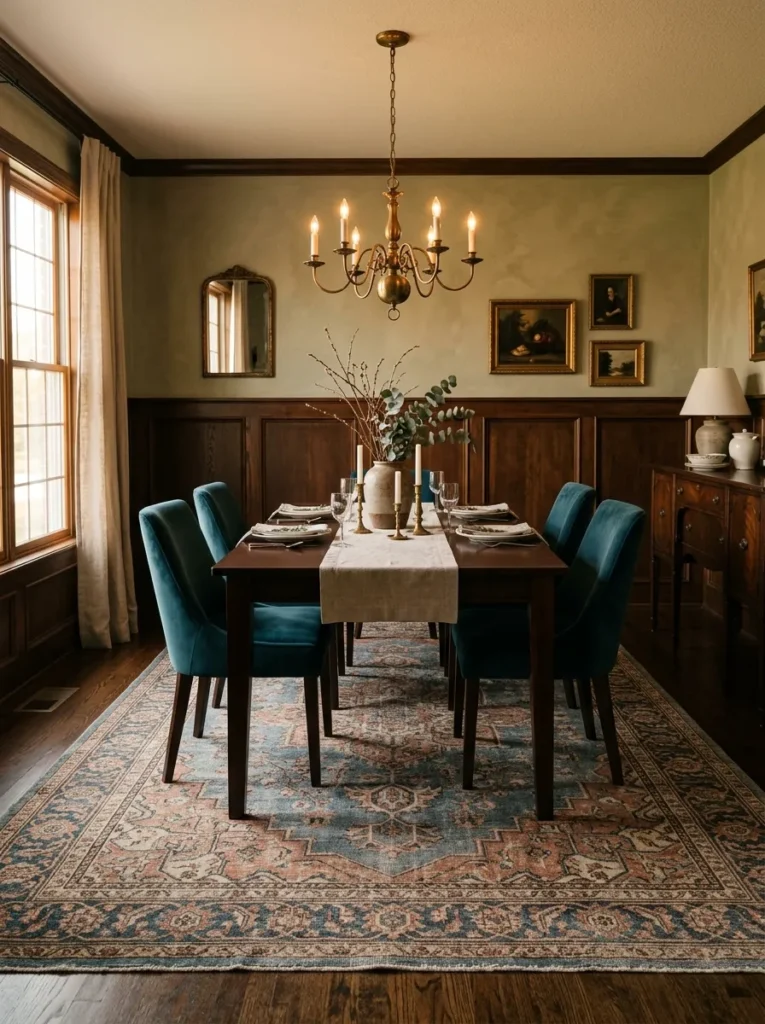
A Persian or traditional patterned rug in a dining room does something that solid or geometric rugs don’t: it anchors the space with a sense of history and permanence. The intricate pattern also has a practical advantage in a dining room — it absorbs visual evidence of crumbs, light dust, and minor marks far more effectively than a solid or lightly textured rug.
The most common mistake with traditional patterned rugs in contemporary dining rooms is choosing one with too much red or too many competing warm tones when the room’s furniture and walls are cooler. A muted or antique-washed Persian in dusty blue, sage, soft terracotta, and cream integrates naturally into a wide range of room palettes without reading as period-specific. Vintage and overdyed rugs in this style photograph with particular warmth and depth.
7. Choose a Solid Dark Rug to Ground a Light and Airy Room
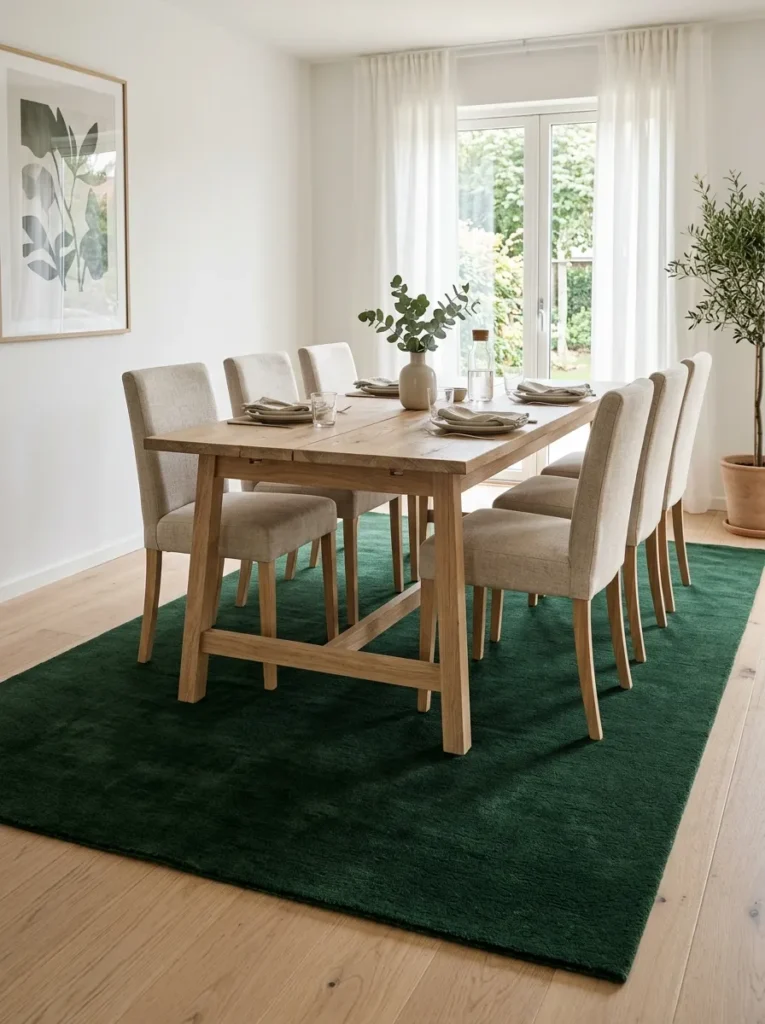
A dining room with white or pale walls, light wood furniture, and natural linen curtains can feel insubstantial without visual weight at floor level. A solid rug in a deep, saturated tone — charcoal, navy, forest green, burgundy — grounds the room decisively and gives the furniture something substantial to sit on. The contrast between pale walls and a dark floor rug creates a visual gravity that makes the room feel complete rather than floating.
The maintenance concern with dark rugs in a dining room is visible light-colored debris — crumbs, pet hair, and dust show more readily than on a mid-tone or patterned surface. A low-to-medium pile in a durable fiber (wool, polypropylene, or a wool-blend) manages this better than a plush pile that holds debris in its depth. Regular vacuuming and a lint roller for pet households are part of the honest picture with this choice.
8. Let a Geometric Rug Do the Decorating in a Simple Room
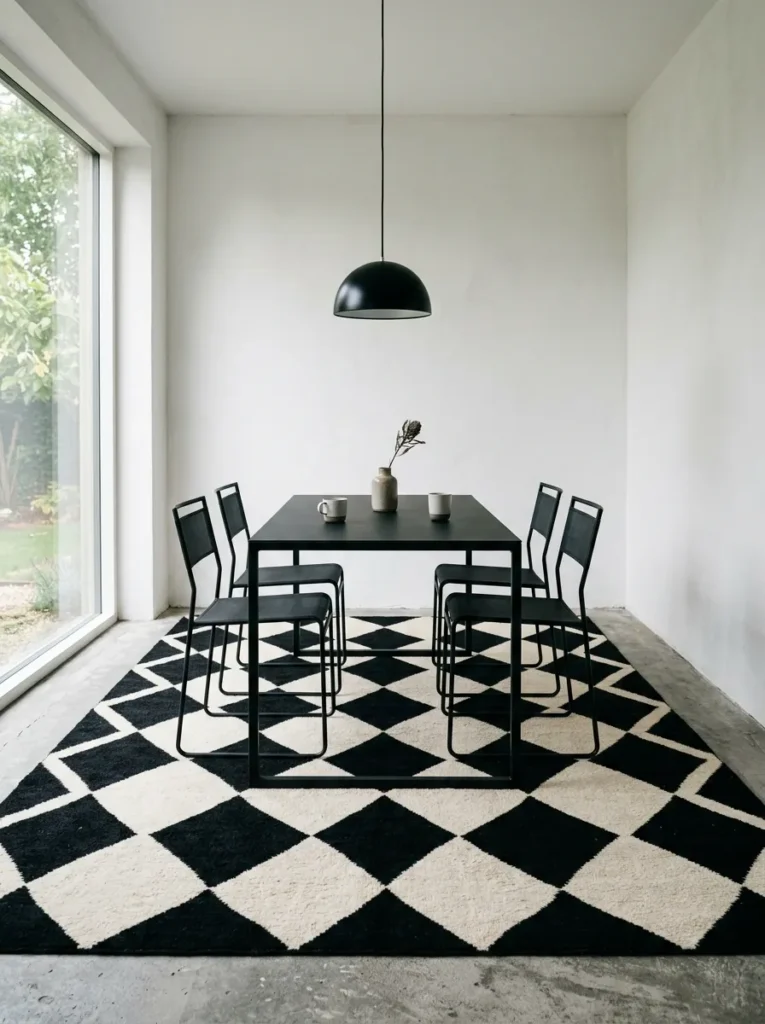
In a dining room with plain walls, simple furniture, and minimal art, a geometric rug carries the room’s visual interest from the floor up. A bold diamond grid, a high-contrast stripe, a Moroccan trellis pattern, or a graphic chevron draws the eye immediately and gives the room a defined aesthetic character without requiring additional decor decisions.
The practical consideration is that a geometric rug with high contrast (black-and-white, navy-and-cream) reads strongly from a standing or seated position and photographs dramatically, but it also demands that the furniture above it stay relatively simple. A visually complex geometric rug under an already ornate or heavily carved dining table creates a competition where neither piece wins. The simpler and cleaner the furniture silhouette, the more confidently a bold pattern can perform at floor level.
9. Use a Wool Rug for Long-Term Durability and Visual Richness
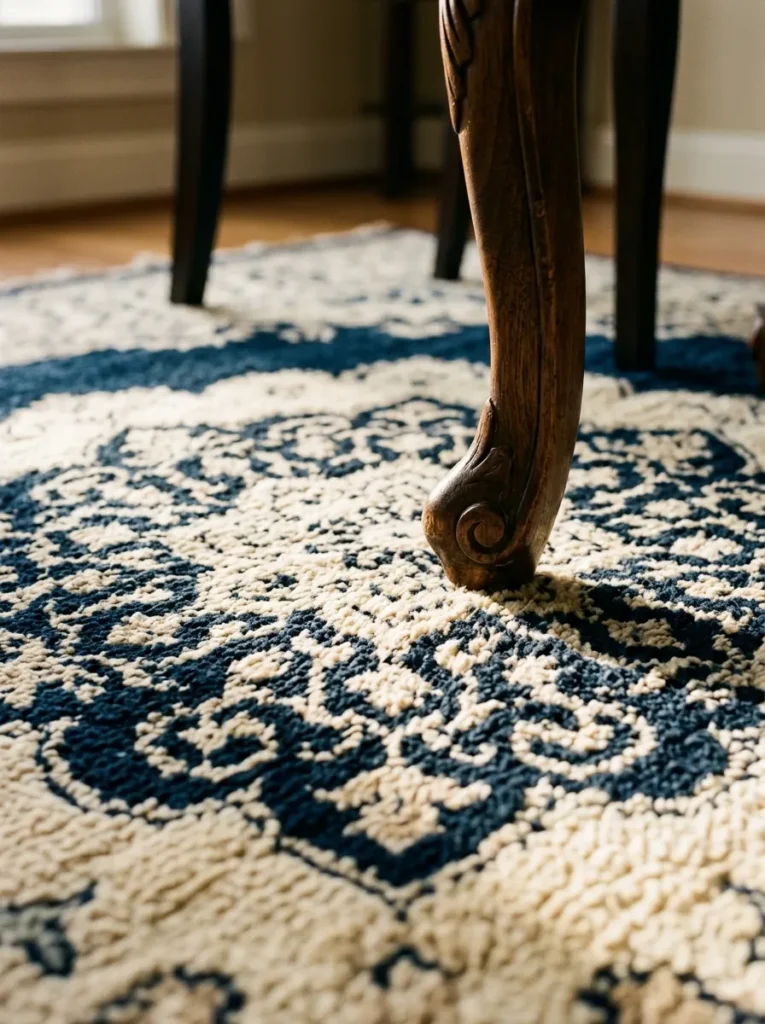
Wool is one of the most durable natural fiber options for a dining room rug — more resilient than cotton, more stain-resistant than jute (wool fibers naturally repel moisture for a short time before absorbing), and with a depth of color and pile that ages gracefully rather than looking worn. A well-made wool rug in a dining room can last fifteen to twenty years with reasonable care.
The investment reflects this: wool rugs are typically among the more expensive options per square foot. For the dining room specifically, that investment is more justified than in lower-traffic rooms because the rug is visible and functional every day. Hand-knotted wool rugs develop a patina with age; machine-woven wool rugs maintain a more consistent appearance. Both suit a dining room; the choice depends on whether you want the rug to look lived-in beautifully over time or maintain its original character.
10. Pull One Color From the Room and Anchor It in the Rug
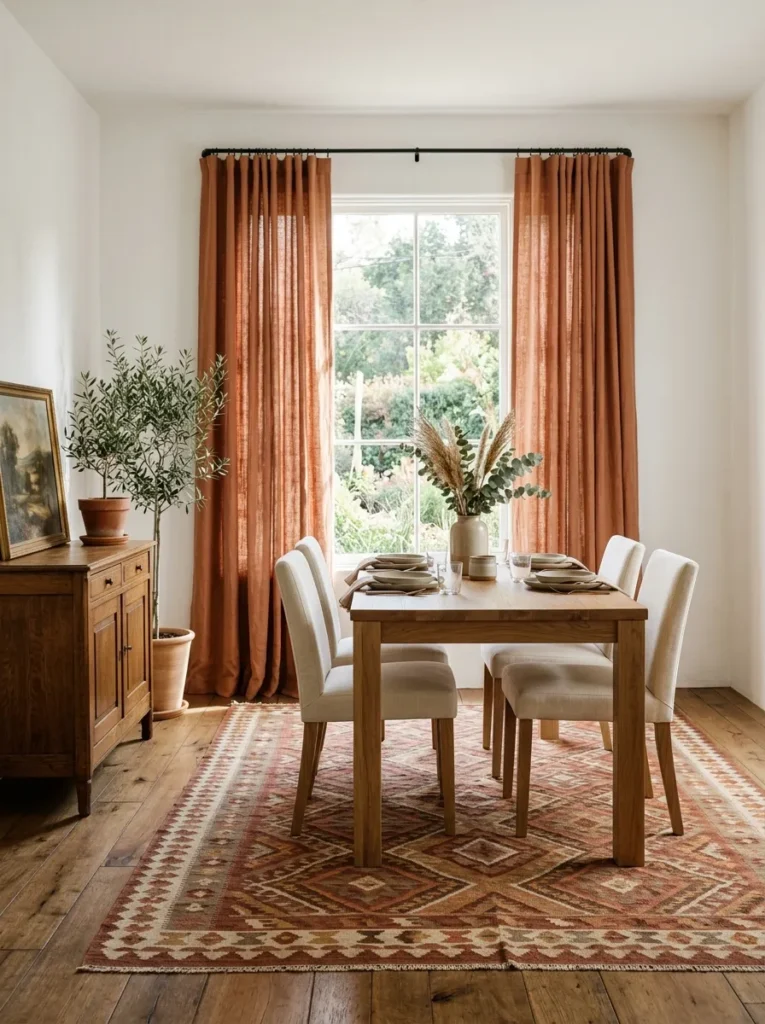
A dining room rug that introduces an entirely new color to the room’s palette creates a disconnection between the floor and everything above it. A rug that picks up one existing color from the room — a tone from the curtains, the wall paint, the seat cushions, or the art — ties the floor into the overall composition and makes the room read as designed rather than assembled.
This doesn’t mean the rug color needs to match anything exactly. A dining room with warm terracotta-toned curtains and a natural wood table is served well by a rug in a dusty rust or clay tone that references the curtains without matching them. The relationship between the colors is what matters, not the precision of the match. Bringing a fabric swatch or paint chip to a rug showroom — or ordering a rug sample before committing — makes this decision significantly easier.
11. Use a Light-Colored Rug to Amplify Natural Light
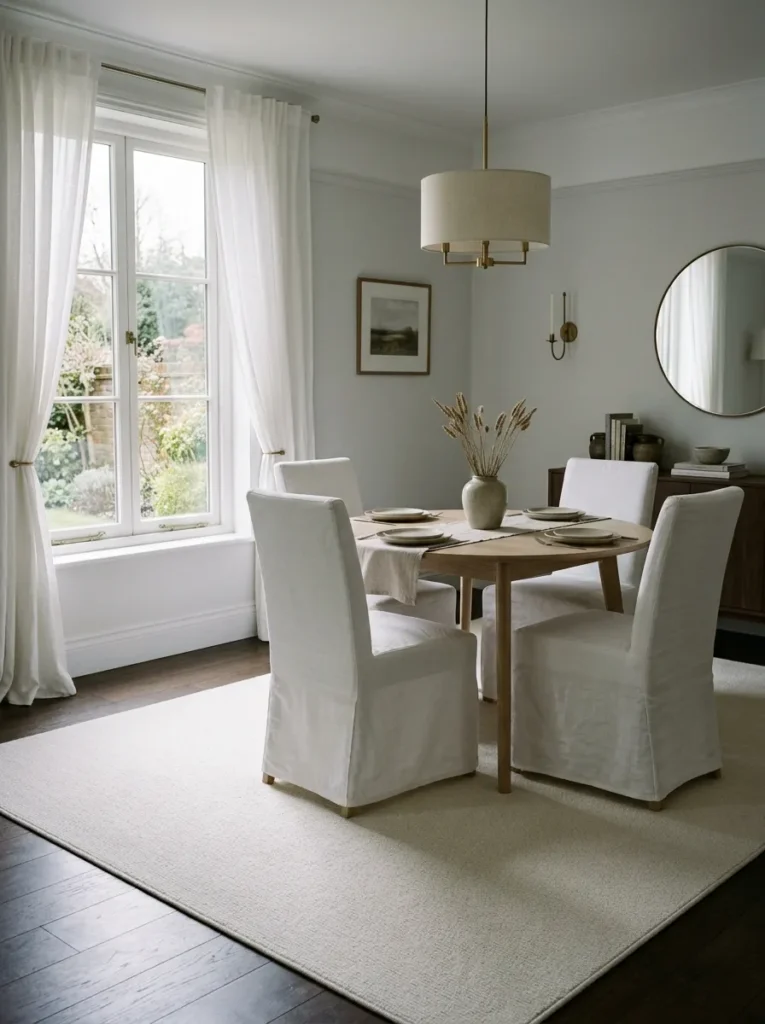
Pale rugs — cream, ivory, warm white, light sand — amplify natural light in a dining room by reflecting it upward rather than absorbing it. In north-facing dining rooms with limited natural light, this effect is measurable: a pale rug visibly brightens the room compared to a dark or heavily patterned alternative. The trade-off is maintenance — a light rug in a dining room will show marks more readily and require more frequent spot cleaning.
The most practical light-colored options for dining rooms are low-pile or flat-weave constructions in performance fibers (indoor-outdoor polypropylene, solution-dyed acrylic, or washable cotton blends) that can withstand wiping and occasional full washing. A light-colored wool rug in a dining room is a beautiful but genuinely high-maintenance choice — realistic only for households with careful eating habits or no children.
12. Try Stripes to Add Length or Width to a Narrow Dining Room
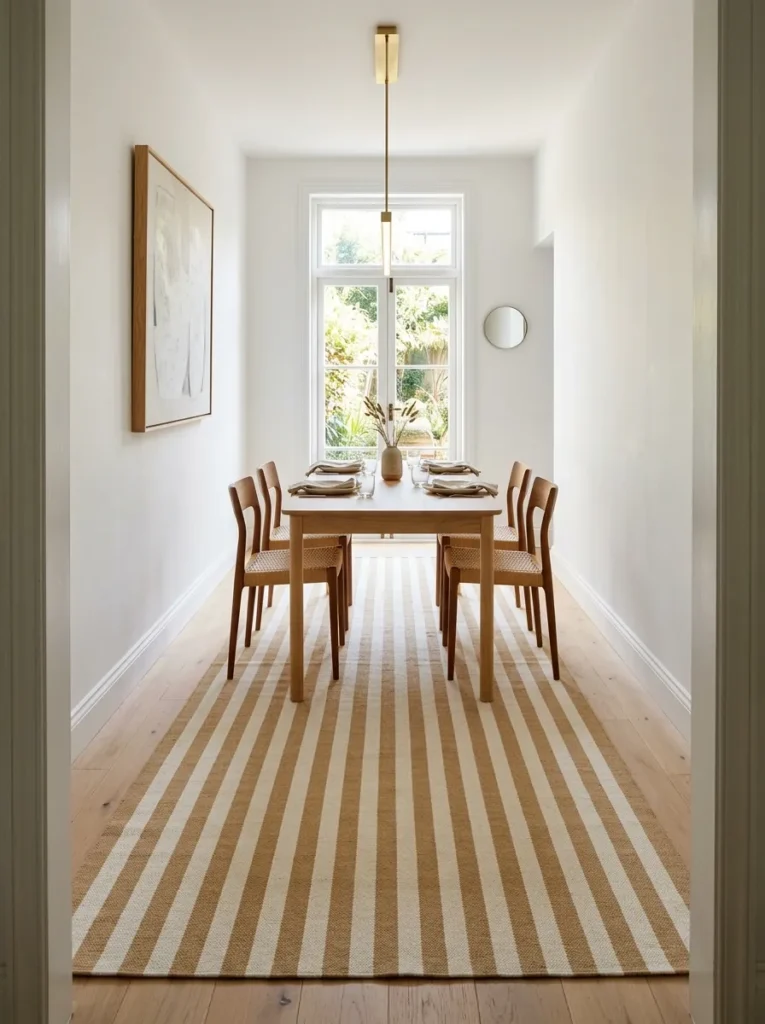
A stripe pattern on a dining room rug is one of the few rug choices that actively manipulates the perception of room proportion. Stripes running lengthwise down a narrow dining room make the space feel longer; stripes running across the width make a long, narrow room feel broader. The direction of the stripe relative to the room’s orientation matters as much as the stripe pattern itself.
Narrow stripes (under 2 inches wide) create a refined, classic effect that suits traditional and coastal dining rooms. Wide stripes (4–6 inches or more) are bolder and suit contemporary spaces. A stripe in two tones from the same color family — a cream-and-linen stripe, a navy-and-indigo stripe — is more versatile than a high-contrast multi-color stripe, which can overwhelm a dining room where the table and chairs already carry visual weight.
13. Consider an Indoor-Outdoor Rug for Practical Daily Life
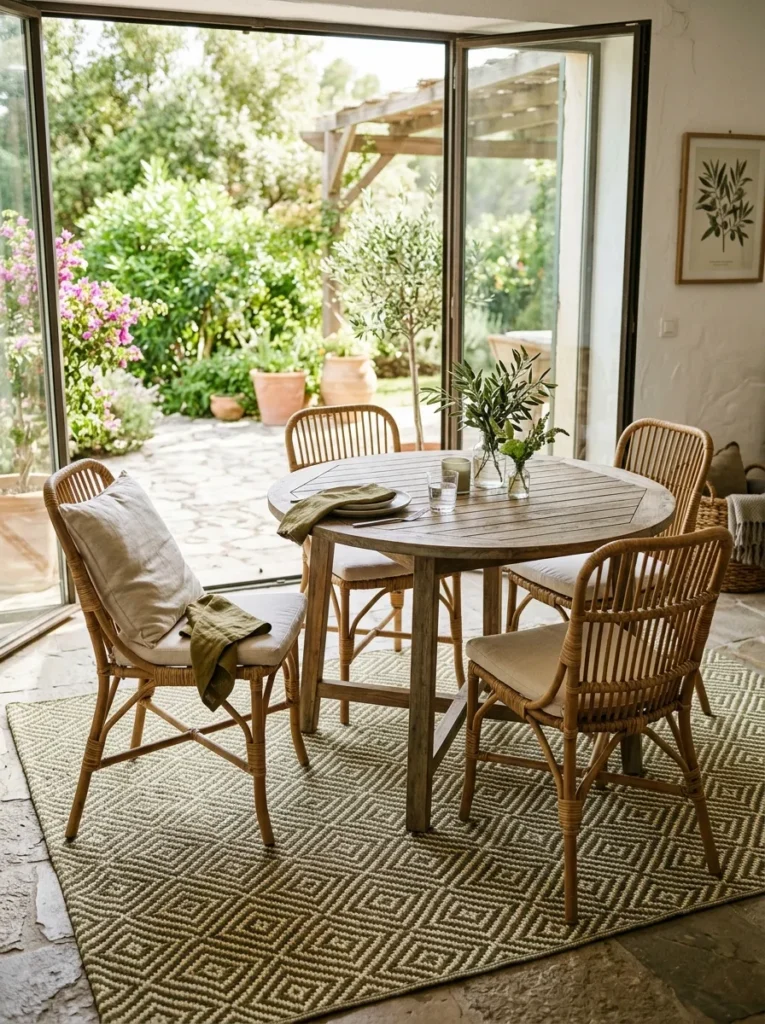
Indoor-outdoor rugs have earned a permanent place in dining rooms for straightforward reasons: they’re constructed to handle moisture, UV exposure, and heavy foot traffic, which makes them significantly more resistant to the routine stresses of a dining room than most traditional interior rugs. Modern indoor-outdoor rugs in polypropylene or recycled plastic fiber are available in genuinely attractive patterns — geometric weaves, distressed Persian-style prints, textured solid weaves — that don’t read as utilitarian.
The main visual limitation is pile depth. Indoor-outdoor rugs are typically flat or very low pile, which suits dining rooms well functionally but may feel less luxurious underfoot than a thick wool pile. For households where durability is the priority — pets, children, frequent dinner parties — the practical benefits outweigh the tactile difference, particularly since most of the time spent in a dining room is seated rather than barefoot on the rug.
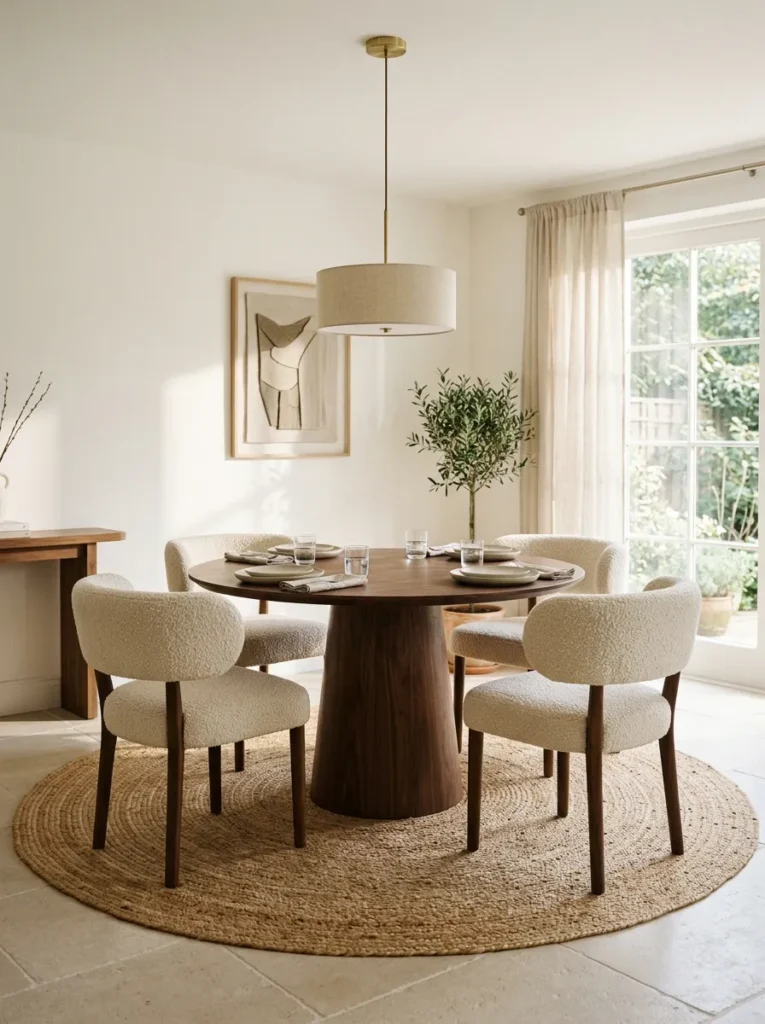
14. Use a Round Rug in an Open-Plan Space to Define the Dining Zone
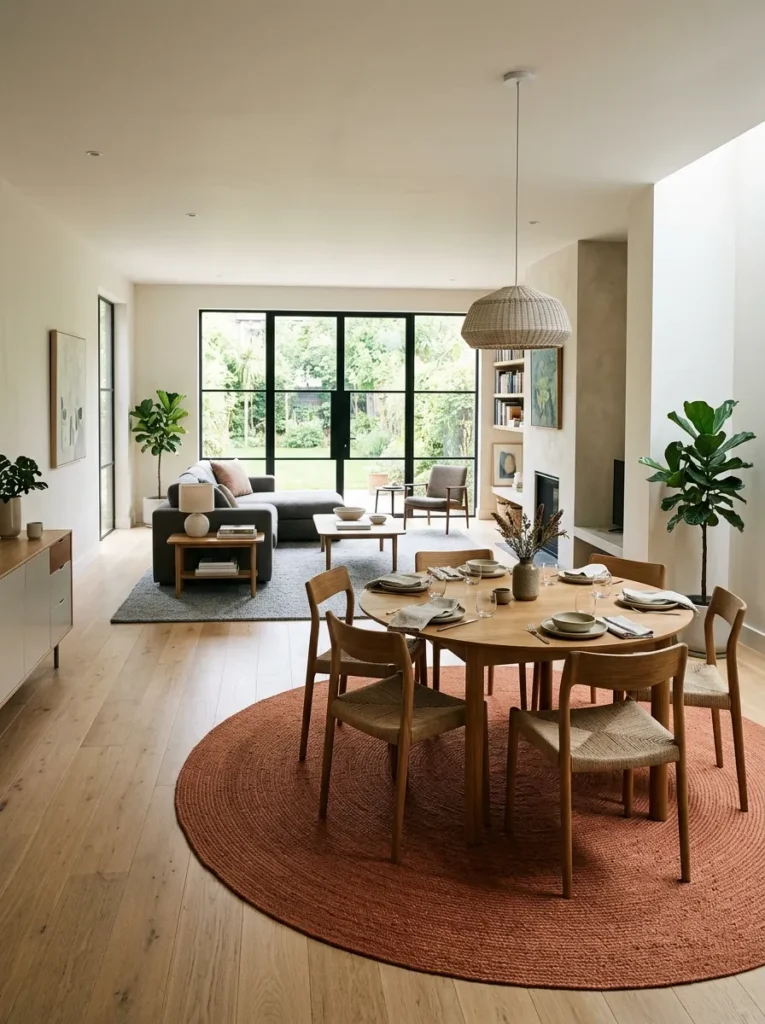
In open-plan living and dining spaces, the rug is one of the primary tools for defining where the dining zone begins and the living zone ends. A rectangular rug that runs the same direction as both the dining table and the sofa creates an ambiguous boundary between the two areas. A round rug under a round or square dining table creates a clearly distinct zone with a different geometric language from the rectangular living room rug beside it.
The round rug needs to be large enough to contain the chairs even when pulled out — this typically means a minimum of 8 feet in diameter for a table seating four to six. A round rug that’s just barely larger than the table reads visually as a table covering rather than a zone-defining floor element. The size needs to be substantial enough that it reads as a room within a room.
15. Bring Pattern Into a Neutral Dining Room With a Vintage or Distressed Rug
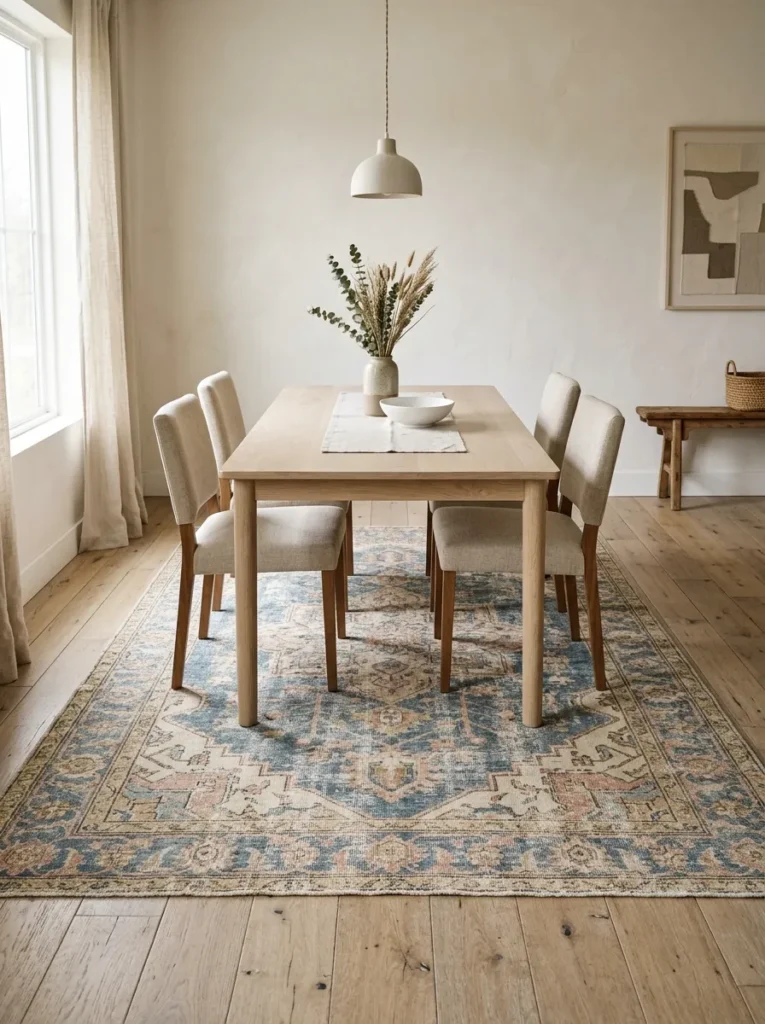
A dining room in neutral tones — warm whites, natural wood, linen upholstery — benefits from pattern at floor level to prevent the space from reading as too safe or underdeveloped. A vintage or distressed patterned rug provides this without the risk of a bold new pattern clashing with the existing palette, because the aged, faded quality of vintage rugs means their colors have already softened into each other.
Vintage rugs in faded terracotta, dusty blue, and warm ivory read particularly well in neutral dining rooms because they add historical depth without introducing a hard color. Genuine vintage rugs are available through specialist dealers and online marketplaces; vintage-inspired machine-made rugs that replicate the distressed aesthetic are available at a wider range of price points and in more predictable sizing options.
16. In a Small Dining Room, Go Larger Than Instinct Suggests
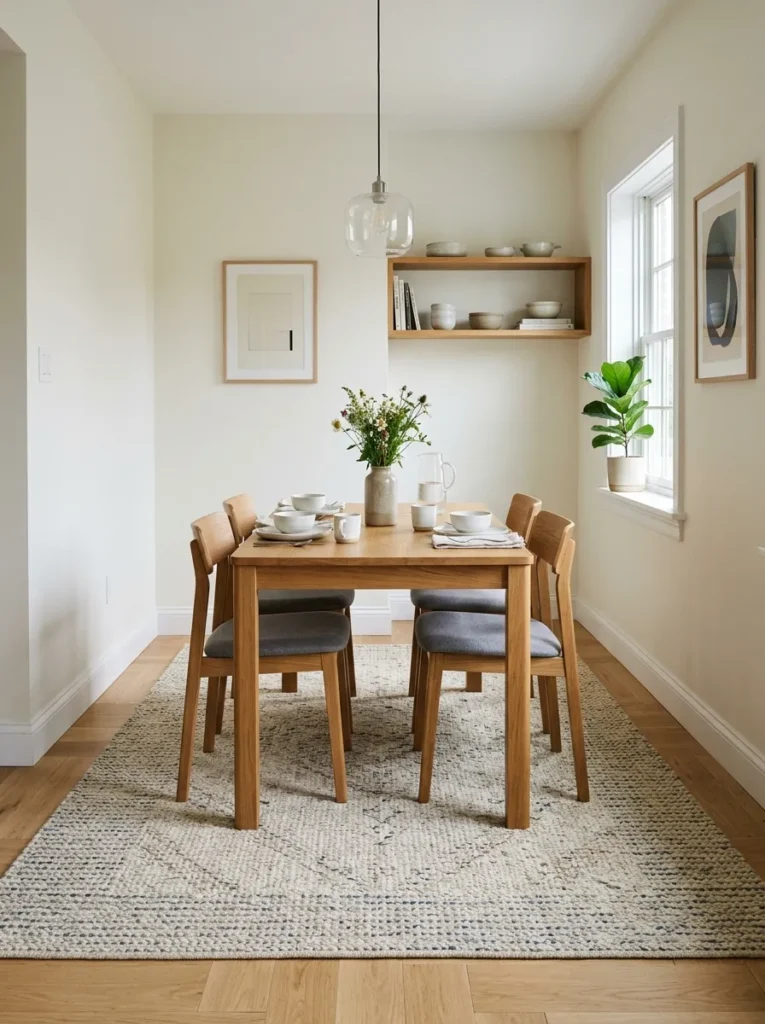
The counterintuitive truth about small dining rooms is that an appropriately sized rug — large enough to keep chair legs on it when pulled out — often looks too big before the furniture is placed but looks right once the table and chairs sit on it. A small rug in a small room doesn’t make the room feel bigger; it makes both the room and the rug look like they don’t belong to each other.
In genuinely small dining rooms (under 10 by 10 feet), the table-plus-rug combination may dominate the floor area almost entirely — and that’s correct. The rug defines the dining zone, and the dining zone is what that room is for. A rug that looks tight around the table but keeps all chair legs on the surface is better than a smaller rug with chairs perpetually straddling the edge.
17. Use a Rug to Bridge an Open-Plan Kitchen-Dining Area
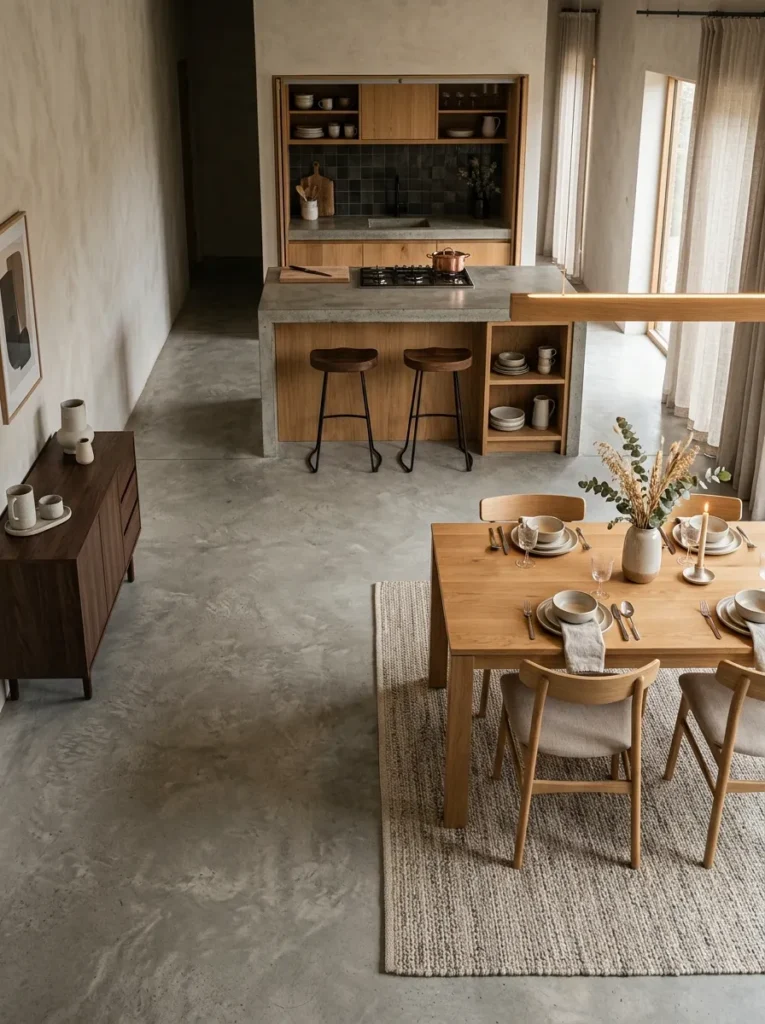
When the kitchen and dining area share a continuous open floor — common in apartment layouts and renovated open-plan homes — a well-placed dining rug creates a functional and visual transition between the two zones without any partition or furniture barrier. The rug’s edge becomes a soft boundary that signals the shift from cooking space to eating space.
For this to work, the rug should not extend into the kitchen’s working zone, and there should be enough bare floor between the kitchen counters and the rug edge that the two spaces feel distinct rather than merged. A rug that starts too close to the kitchen island or peninsula blurs the zones rather than separating them. The material choice also matters in this context: a rug near a cooking area needs to be practically manageable — flat-weave, washable, or a durable polypropylene — because it will encounter more cooking-related debris than a rug in a purely dedicated dining room.
18. Make the Rug the Room’s Bold Statement Piece
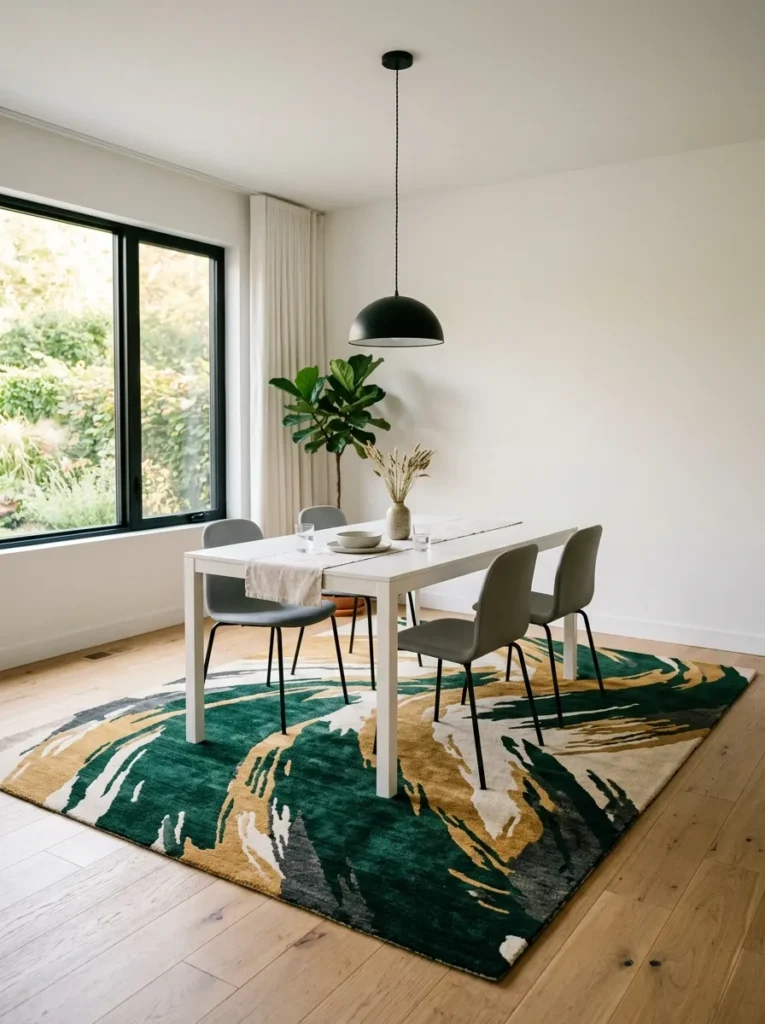
In a dining room with simple, unpatterned furniture and neutral walls, the rug can carry the room’s entire design personality — an oversized abstract print in deep emerald and warm gold, a maximalist floral in traditional style blown up to modern scale, or a high-contrast graphic print that would be too much in a living room but works precisely because the dining room has fewer competing elements.
This approach requires some confidence in the commitment. A bold rug in a dining room is more visible than a bold rug in a living room because it’s not partially concealed by a sofa — the entire surface is exposed when chairs are pushed in. That visibility is both the risk and the reward. If the rug is genuinely interesting, the room doesn’t need much else. A few simple chairs, a clean-lined table, and a plain wall let the rug perform without competition.
Dining Room Rug Sizing: The Practical Guide
This is the section that most rug inspiration articles skip entirely — and the gap in coverage that causes the most reader frustration.
The 24-inch rule: Allow at least 24 inches of rug beyond each side of the table. This keeps all chair legs on the rug when chairs are pulled out to a natural seated position. For chairs with longer legs or larger footprints, 30 inches is safer.
Standard table sizing reference:
- 6-seat rectangular table (36″ × 72″): minimum 8′ × 10′ rug
- 8-seat rectangular table (40″ × 96″): minimum 9′ × 12′ rug
- 4-seat square table (42″ × 42″): minimum 8′ × 8′ or 8′ round rug
- 4-seat round table (48″ diameter): minimum 8′ round rug
- 6-seat round table (60″ diameter): minimum 9′ round rug
Room boundary check: After confirming the rug is large enough for the table, check that it doesn’t crowd the room’s perimeter. There should be at least 12–18 inches of bare floor between the rug edge and the baseboard on each side. If that clearance isn’t achievable, the room may not accommodate a rug at the table without blocking circulation — in that case, a rug that extends from wall to wall (or close to it) is a legitimate alternative.
Rug pad: Always use a rug pad under a dining room rug. Beyond preventing slipping, a pad prevents the rug backing from scratching hardwood floors as chairs are pushed in and out repeatedly — a form of damage that accumulates over time and is entirely avoidable.
Final Thoughts
The dining room rug is one of the few decor decisions that’s both highly visible and highly functional — which is exactly why it’s worth getting right rather than defaulting to whatever size is on sale or whatever pattern looks good in a product photo.
Start with size. Get the math right for your specific table before falling in love with a particular rug. Then consider how the material will hold up to actual use in your household. Pattern, color, and style are the enjoyable decisions — they’re also the ones most easily changed. A rug that’s the right size and the right material but slightly wrong in color can be corrected over time. A rug that’s beautiful but three sizes too small will frustrate you every day.
Save the ideas that fit your room’s proportions and your household’s real life, and come back to this guide when you’re ready to make the call.