
20 Kitchen Hutch Ideas That Blend Charm and Storage
A kitchen hutch solves a problem that most kitchens eventually develop: not enough storage, not enough display space, and not enough visual character. Where a standard kitchen cabinet run reads as architecture, a hutch reads as furniture — it has a different relationship to the room, one that’s more personal, more accumulated, and considerably more interesting to look at.
The hutch’s appeal is partly nostalgic and partly functional. It provides a dedicated home for the dishes, glasses, serving pieces, linens, and pantry items that don’t have a clear place in the main cabinet run, while simultaneously creating a surface — the hutch top or its open shelves — for the ceramics, plants, and gathered objects that give a kitchen genuine character.
These 20 kitchen hutch ideas cover the full range: from traditional farmhouse china hutches and glass-front display pieces to painted buffet conversions, modern open-shelf configurations, and compact options for smaller kitchens. Each idea addresses the hutch’s visual direction, its storage capacity, and the styling approach that makes it read as a considered kitchen feature rather than a piece of furniture that ran out of space in another room.
The kitchen hutch is one of the most photographically satisfying pieces in any kitchen. Here’s how to choose one that earns that attention while doing genuine work in the room.
1. A Classic Farmhouse Hutch with Open Upper Shelves

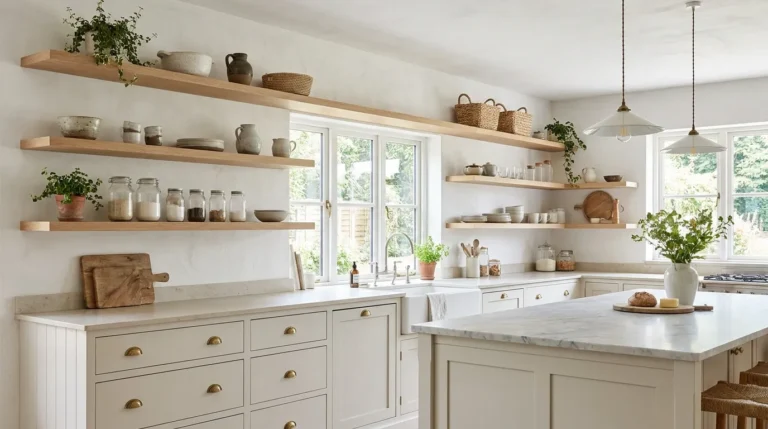
The traditional farmhouse kitchen hutch has an upper section of open shelves — three or four horizontal shelves accessible from the front — sitting above a lower buffet or cabinet base. The open shelves display dishes, glassware, and decorative pieces; the closed lower section hides pantry items, serving equipment, and anything else that benefits from concealment.
The proportions of the traditional farmhouse hutch are what make it instantly readable: the upper section is slightly narrower than the lower, creating a visual step-back that gives the piece architectural depth. The shelves are deep enough for dinner plates stacked vertically or dinner plates laid flat (typically 12 to 14 inches of shelf depth) and tall enough between shelves for standard glasses and stacked bowls.
Styling the open shelves requires genuine editing. A farmhouse hutch that holds everything available in the kitchen reads as overflow; one that holds only the best dishes, the most beautiful glasses, and a few well-chosen ceramic or wooden pieces reads as a considered display. The shelves should have breathing room — objects shouldn’t touch each other at every position.
2. A Painted Farmhouse Hutch in a Soft Muted Color

Taking the classic farmhouse hutch form and painting it in a soft, muted color — sage green, dusty blue, warm terracotta, chalky cream — transforms a straightforward piece of storage furniture into the kitchen’s most distinctive decorative element. The color creates an immediate focal point on the wall the hutch occupies, particularly against a white or neutral kitchen.
The paint finish matters as much as the color in a kitchen context. A dead matte or chalk finish looks beautiful when first applied but shows every fingerprint, drip, and cleaning mark over time — and kitchens generate all three regularly. A semi-gloss or a chalk paint sealed with a hard wax or polycrylic topcoat provides the visual softness of a matte finish with meaningful durability for kitchen conditions.
The styling inside a painted hutch should be lighter and more neutral than the hutch itself. White ceramics, clear glass, and natural wood accessories on the shelves of a sage green hutch let the color read fully rather than competing with the displayed objects. A colored hutch with heavily patterned dishes on its shelves creates too many active visual elements simultaneously.
3. A Hutch Used Entirely as a Pantry Storage Zone

A hutch configured as pure pantry storage — with no decorative objects on its shelves, all surfaces dedicated to organized food storage — solves a specific and common kitchen problem: the kitchen has no pantry, and the base cabinets can’t hold everything the household needs.
The open-shelf version of this configuration uses baskets, labeled jars, and stacked containers to organize the pantry items in a way that reads as styled rather than crammed. Uniform storage containers — matching glass jars for dry goods, matching baskets for snacks, matching canisters for flours and sugars — create visual coherence on shelves that would otherwise read as a grocery store stockroom.
The key to making a pantry hutch look considered rather than practical is the decanting habit: food that stays in its original packaging reads as storage; food decanted into matching containers reads as organized. It requires an initial time investment and a consistent replacement habit, but the visual result on an open-shelf hutch justifies both.
4. A Hutch with Built-In Wine Storage

A hutch that incorporates wine bottle storage — either in a dedicated x-shaped bottle rack built into the lower section, or in a series of horizontal cubbies that hold bottles on their sides — combines kitchen storage and the visual character of a wine rack into a single piece. The bottles themselves become part of the display: their shapes, their labels, their variety contribute to the hutch’s visual interest.
The wine storage hutch suits a kitchen adjacent to a dining area where wine is a regular part of entertaining. It’s less suited to a kitchen that rarely serves wine, where an empty rack reads as an unused feature rather than an intentional one.
The bottle capacity needs to suit realistic household use. A rack with 24 bottle positions for a household that buys wine by the bottle rather than the case reads as oversized and often partially empty. A rack with 6 to 12 positions reads as properly scaled for occasional entertaining — always sufficiently full, never awkwardly sparse.
5. A Hutch with Closed Lower Doors and Open Upper Shelves

The most versatile hutch configuration for a working kitchen is the combination of closed lower doors and open upper shelves — the lower section conceals utilitarian items (small appliances, baking equipment, pantry overflow, seldom-used serving pieces) behind doors, while the upper section displays the kitchen’s most beautiful objects on open shelves.
This configuration allows the kitchen to read as well-organized and characterful from across the room — the open upper shelves with their arranged ceramics and glasses are the visible element — while the closed lower section handles the functional reality of a kitchen that has more than display-worthy items to store.
The proportion of closed to open storage in the hutch should match the kitchen’s actual storage needs. A kitchen with adequate cabinet storage in the main run can have a hutch that’s mostly open and decorative; a kitchen with significant storage deficits needs more closed storage in the hutch’s lower section.
6. A Glass-Front China Hutch for Formal Kitchens

A china hutch with glass-panel doors on the upper section — glass that’s either clear, seeded, or gently frosted — creates a display case for fine china, crystal stemware, and heirloom serving pieces that remain visible but protected from kitchen dust and grease. The glass front gives the hutch a more formal character than open shelves and suits kitchens that are adjacent to a formal dining room or that are used for significant entertaining.
The glass panel itself is a design element. Clear glass provides maximum visibility and requires the interior to be fully styled at all times — dust and disorder are visible. Seeded glass (with small bubbles visible in the glass) diffuses the view slightly, providing a sense of what’s inside without full transparency. Frosted lower panels with clear upper panels provide privacy for the less decorative lower contents while displaying the upper china through clear glass.
Interior lighting — a small LED strip at the top of the glass-front cabinet — makes the china visible in the evening and gives the hutch a jeweler’s-case quality at night that an unlit cabinet can’t provide.
7. An Antique China Hutch Repurposed in a Modern Kitchen

A genuine antique china hutch — from an estate sale, an antique dealer, or a family inheritance — brought into a contemporary or transitional kitchen creates an immediate sense of history and accumulated character that new furniture can’t replicate. The contrast between old wood, aged glass, and original hardware against new countertops and modern appliances reads as intentional eclecticism rather than inconsistency when the scale and proportion of the antique piece suit the room.
The antique hutch typically needs some practical updating for kitchen use: a cleaning and condition of the interior, a careful repair of any structural weakness (sagging shelves, loose hinges, damaged backs), and potentially a fresh wax or oil on the exterior to protect and refresh the finish without changing its aged character.
Scale is the critical judgment. An antique hutch that’s proportionate to the wall it occupies and to the kitchen’s overall furniture read as a considered find; one that’s too large (consuming too much wall space, pressing against adjacent cabinets) or too small (lost against a large kitchen wall) reads as placed rather than fitted.
8. A Modern Hutch in a Dark or Charcoal Finish

A hutch in a deep matte charcoal, near-black, or dark navy finish in a contemporary form — clean-lined, with minimal applied ornament, on tapered legs or on a simple base — brings the hutch concept into a fully contemporary kitchen aesthetic. The dark finish makes the hutch read as a deliberate furniture piece rather than a traditional built-in, and the modern form removes the farmhouse associations that lighter, more traditional hutch formats carry.
The dark hutch suits a kitchen where the remaining palette is lighter — white or pale cabinetry, light countertops, natural wood floors — because the contrast between the dark hutch and the lighter kitchen reads as intentional. A dark hutch in a kitchen that’s already dark in cabinetry or walls can read as visually heavy without a clear material break between the hutch and the surrounding surfaces.
What’s displayed on a dark hutch should be lighter in tone to create readability. White ceramics, cream-colored textiles, clear glass, and light-colored natural objects read beautifully against a dark interior. Dark dishes on dark shelves disappear.
9. A White-Painted Hutch for a Timeless, Neutral Look

A hutch painted in white or warm white — whether a traditional form with turned legs and plate grooves on the shelves, or a cleaner contemporary form with minimal detail — is the most universally applicable hutch choice because it suits virtually every kitchen palette and every design direction without ever reading as wrong.
The challenge with a white hutch is preventing it from looking like a plain piece of storage furniture. The styling of its shelves and the objects chosen for display carry more responsibility in a white hutch than in a colored one — the neutral finish provides no visual interest of its own, so the objects on the shelves must provide it entirely.
A white hutch styled with a variety of textures — woven baskets, ceramic vessels in varying forms, wooden boards stood vertically, a small plant — reads as considered. The same white hutch with mismatched dishes, plastic containers, and random objects reads as a storage cabinet. The hutch’s finish is neutral; the styling is where the character comes from.
10. A Mid-Century Modern Hutch with Clean Lines

A mid-century modern hutch — with tapered splayed legs, a combination of open and closed sections, and a warm walnut or teak veneer finish — brings a furniture-quality aesthetic to kitchen storage that most hutch formats don’t provide. The mid-century hutch reads as a piece of design furniture rather than a storage solution, which gives the kitchen a more deliberately collected quality.
The open sections of a mid-century hutch typically have smaller proportions than a traditional farmhouse hutch — the shelves are sized more for display than for active dish storage. This suits a kitchen where the hutch’s primary role is decorative and character-building rather than supplemental dish storage.
Styling a mid-century walnut hutch: warm-toned ceramics in terracotta, amber, or cream, small sculptures, a few books, and one trailing plant create a display that suits the furniture’s design period and material character. Very contemporary or very traditional objects can feel like a material mismatch.
11. An Open Industrial Hutch in Metal and Wood

An industrial-style hutch — a shelving unit in black powder-coated metal pipe framework with solid wood shelves — brings a structured, architectural quality to kitchen storage that softer, more traditional hutch formats don’t provide. The open structure makes everything on the shelves visible at all times, which requires consistent organization but creates the most visual density of any hutch format.
The metal framework’s finish should relate to the kitchen’s other metal elements: black pipe with matte black cabinet hardware, aged steel with brushed nickel fixtures. A mismatch between the industrial hutch’s metal and the kitchen’s predominant metal finish reads as an unrelated import from a different room.
In a kitchen with strong design character — brick walls, concrete countertops, open exposed beams — an industrial metal hutch reads as fully at home. In a cottage kitchen with floral wallpaper and painted furniture, the same hutch reads as a style conflict.
12. A Hutch with Interior Lighting

A hutch with LED strip lighting on the interior — running along the front edge of each shelf, or mounted at the top of the hutch interior to illuminate the space below — creates a dramatically different visual effect at night and in lower-light conditions than an unlit hutch. The lit interior makes the hutch legible in the evening when overhead kitchen lighting is dimmed, and gives the ceramics and glass on the shelves a gallery quality.
The light color temperature should be warm — 2700K to 3000K — to avoid the clinical quality of cool white LEDs in a space where warm domesticity is the goal. The light source should be hidden from direct view: an LED strip behind a small wooden fascia at the top of the interior, or a strip at the back of the shelf bottom, casts light without exposing the strip itself.
For a glass-front hutch (Idea 6), interior lighting is particularly effective: the lit interior glows behind the glass in the evening, and the hutch reads as a lantern-like element in the kitchen at night.
13. A Hutch Used as a Coffee and Tea Station

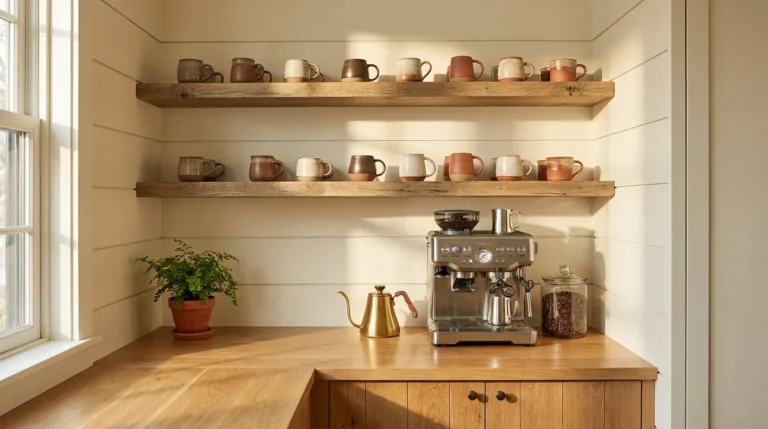
A hutch configured specifically for the household’s coffee and tea rituals — with the coffee maker, grinder, and kettle on the lower surface, the mugs on an open shelf above, the teas in organized containers on another shelf, and the whole arrangement closed behind doors when not in use — creates a self-contained beverage station that doesn’t require clearing a kitchen counter.
The hutch’s lower surface serves as the appliance garage (similar to the concept in the appliance garage article) for the coffee maker; the upper shelves hold the mug collection in a display that reads as intentional rather than storage. Mugs hung on hooks mounted to the underside of a shelf — turned upward so the handles hang forward and the mug interior faces down — create a particularly effective display that uses vertical space above the shelf rather than taking up shelf surface.
An outlet strip inside the hutch’s lower section, or accessible at the hutch’s back wall, powers the appliances without requiring visible cords running across the surface to the nearest wall outlet.
14. A Compact Corner Hutch for Small Kitchens

A corner hutch — a triangular or angled piece designed specifically to occupy the corner zone where two walls meet — takes advantage of the kitchen’s most consistently under-used space. In a small kitchen where wall space is at a premium, a corner hutch provides storage and display without consuming any linear wall space that could hold other functional elements.
The corner hutch’s interior is typically smaller than a standard-width hutch, which requires more careful editing of what’s stored there. Only the most frequently used or most visually compelling items should occupy a corner hutch’s limited shelf space — it’s the right home for the best ceramics, the everyday mugs, and the items that benefit from being displayed rather than hidden.
A pie-cut lower cabinet configuration beneath a corner hutch upper section is the most space-efficient corner storage arrangement, though pie-cut interiors are less accessible than straight-shelf cabinets. A swing-out shelf or a lazy Susan inside the pie-cut makes the corner interior genuinely functional rather than a storage zone where items are placed and forgotten.
15. A Narrow Hutch for a Galley Kitchen

A very narrow hutch — 18 to 24 inches wide rather than the standard 36 to 48 inches — suits galley kitchens where the only available wall space is a short section between doorways or windows. At this width, the hutch provides a meaningful display and storage surface without consuming the limited floor space that makes a galley kitchen functional.
The narrow hutch benefits from a taller profile to compensate for limited width: a piece that’s narrow but reaches to 72 or 78 inches tall provides more shelf area than a wider but shorter piece at the same footprint. The vertical emphasis also reads as proportionate to the galley kitchen’s elongated character.
Styling a narrow hutch: fewer, larger objects rather than many small ones. Three tall ceramic vessels on a single shelf read more strongly than eight small objects at the same shelf level. The limited width makes small-object clutter more problematic than on a wider hutch where individual items can be separated by sufficient horizontal space.
16. A Hutch Positioned in the Dining Room Adjacent to the Kitchen

A hutch placed in the dining room or in the dining zone of an open-plan space — rather than in the kitchen itself — provides kitchen-adjacent storage for entertaining essentials: serving dishes, table linens, special occasion glassware, and the items used at the table rather than during food preparation. The dining room hutch functions as a butler’s pantry equivalent in a home that doesn’t have one.
The styling of a dining room hutch is typically more formal and more display-oriented than a kitchen hutch, because the dining room context calls for the china, the crystal, and the linen that don’t appear in everyday kitchen use. A dining room hutch styled with the best china, a few silver pieces, fresh flowers, and a pair of candlesticks reads as fully appropriate to its context.
In an open-plan kitchen and dining space, the hutch’s position relative to the kitchen determines its visual role: placed at the dining zone’s perimeter, it reads as dining furniture; placed at the kitchen-dining boundary, it reads as a divider between zones as well as storage.
17. A Hutch Styled as a Bar and Entertaining Cabinet

A hutch configured as an entertaining bar — decanters and bottles on the lower surface, stemware hanging from a rack mounted to the underside of the upper shelves (or standing on the shelves between dividers), cocktail accessories organized in a lower drawer or basket — creates a kitchen hutch with a distinct social and entertaining purpose.
The styling of a bar hutch should be deliberately curated. Three decanters in warm amber glass, two types of glasses (wine and old-fashioned), one cocktail book, and a small plant or vase of dried stems creates a complete bar vignette. The same hutch stuffed with every bottle in the house, mismatched glasses, and a collection of bottle openers reads as a liquor cabinet rather than a styled bar.
A bar hutch in the dining zone or the kitchen’s perimeter suits households that entertain regularly and want the bar to be a visible, welcoming part of the room’s character rather than hidden in a closed cabinet.
18. A Hutch with Plate Rails and Display Grooves

A hutch with plate rails — a narrow horizontal groove or a small wooden rail at the back of each shelf, positioned to hold plates upright rather than flat — allows dinner plates, decorative chargers, and platters to be displayed vertically, which makes their patterns and glazes fully visible from across the room. A hutch styled with a collection of displayed plates reads as genuinely decorative rather than purely functional.
The plate display works best when the plates share something: all in the same color family, all from the same country of origin, all in the same pottery style (transferware, majolica, handpainted earthenware), or all with a consistent formal quality. A random mix of plates — some patterned, some plain, some formal, some casual — reads as the hutch’s entire contents rather than a display.
The plates on the rails can be supplemented with objects in front of them on the shelf surface: a small ceramic pot, a pair of candlesticks, a small plant. The combination of displayed plates at the back and styled objects at the shelf front creates a layered arrangement with depth.
19. A Hutch with Chicken Wire Cabinet Doors

A hutch where the upper cabinet doors replace glass panels with chicken wire or hardware cloth — the galvanized wire mesh stretched across a simple wood frame — creates a visual openness that’s between solid-door concealment and full open shelving. The wire mesh allows air circulation (which keeps linens and dish towels from developing a musty quality) while providing a visual softening of the interior contents.
The chicken wire door suits farmhouse, cottage, and country kitchen aesthetics specifically — it references the rural agricultural aesthetic that these styles draw from. In a modern or contemporary kitchen, chicken wire reads as a decorative theme rather than a natural material choice.
Painting the chicken wire door frame in the hutch’s body color — rather than leaving the frame in a contrasting natural wood — creates a more seamless visual result. The wire mesh itself is typically left in its natural galvanized grey, which reads as an honest material choice rather than a painted-over shortcut.
20. A Hutch That Doubles as a Home for Cookbooks

A hutch specifically configured for cookbook display and storage — with shelves at the right depth and height for standard cookbook formats (11 to 12 inches tall for most standard cookbooks, 14 inches for oversized formats), combined with a lower surface for stacking additional books horizontally or for displaying a tabletop recipe stand — creates a kitchen feature that references both the cooking function of the room and the design culture surrounding it.
The cookbook hutch works well when styled as part library, part kitchen: cookbooks on the shelves, with a few decorative ceramic objects between them, a small framed print leaned against the back panel at one shelf, and perhaps a trailing plant on the top shelf. The mix of books and objects prevents the hutch from reading as purely functional while maintaining the cookbook display as the primary purpose.
Organizing the cookbooks with intention — by cuisine, by chef, by spine color — creates a display that reads as curated rather than accumulated. A section of cookbooks organized by spine color (all white spines together, all dark spines together, all earthy tone spines together) reads as a thoughtful editorial decision even when the underlying reason is purely visual.
Choosing and Styling a Kitchen Hutch That Works
Three decisions determine whether a kitchen hutch succeeds in the room or simply occupies space on the wall.
The size decision. A hutch should relate to the wall it occupies: typically spanning 50 to 70 percent of the available wall width and reaching to within 12 to 18 inches of the ceiling in a standard-height kitchen. A hutch that’s too narrow for its wall reads as furniture placed in front of a wall rather than furniture suited to it. A hutch that’s too short leaves an uncomfortable gap between the top of the piece and the ceiling that reads as unfilled rather than intentional.
The storage decision. Before choosing a hutch, identify what it will actually store. A hutch chosen for its appearance and later filled with whatever doesn’t fit elsewhere in the kitchen reads as overflow storage regardless of how beautiful the piece is. A hutch chosen because its shelves are the right depth for the stack of dishes it will hold, its lower section has room for the serving pieces that currently have no home, and its surface area suits the appliances that need to come off the counter — that hutch will read as purposeful.
The styling discipline. A hutch’s shelves should contain roughly 60 to 70 percent of their capacity in displayed objects, leaving 30 to 40 percent of the shelf space as negative space. This ratio is what separates a curated hutch from a crowded one. Objects on the shelves should vary in height, material, and scale — not be uniformly sized or uniformly styled — and a few shelves should have a deliberate empty zone that reads as a visual breath within the arrangement.
Final Thoughts
A well-chosen kitchen hutch is the piece that makes a kitchen feel finished in the way that no amount of cabinet hardware or countertop material can achieve on its own. It’s furniture rather than millwork, character rather than infrastructure, and it communicates something specific about the people who live in the kitchen in a way that built-ins never quite manage.
Among the 20 ideas here, the ones that consistently deliver both storage and visual character are the painted farmhouse hutch in a muted color (Idea 2), the hutch with interior lighting (Idea 12), and the glass-front china hutch with lit interior (Ideas 6 and 12 combined). All three balance genuine functionality with the kind of visual presence that makes the hutch worth adding to the room rather than simply useful.
If you’re starting from scratch with no hutch, begin with the storage needs rather than the visual inspiration. The size, depth, and configuration should be determined by what the hutch needs to hold before the finish, the door style, and the styling direction are decided.
Save the ideas that suit your kitchen’s character and storage needs, and return to the practical section before finalizing any dimensions.