
18 Dining Room Curtain Ideas That Complete the Look
Dining room curtains have a different set of responsibilities than curtains in any other room. They need to manage light during meals that happen at different times of day — a dinner party at dusk has different needs than a Sunday morning brunch. They frame a room that guests spend extended time facing, so they read more closely and more critically than living room curtains glimpsed in passing. And they have to work alongside a dining table, chandelier, artwork, and often a sideboard without competing with any of it.
Most curtain mistakes in dining rooms are made before a single panel is hung: the rod is placed at the wrong height, the panels are too narrow to drape properly, the fabric weight doesn’t suit the room’s formality, or the length leaves an awkward gap between hem and floor. These 18 dining room curtain ideas address the full scope — from foundational decisions about rod placement and fullness to specific fabric, color, and style choices — with enough practical context to help you avoid the mistakes that make otherwise beautiful curtains look wrong.
1. Choose Linen for Warmth and Relaxed Formality

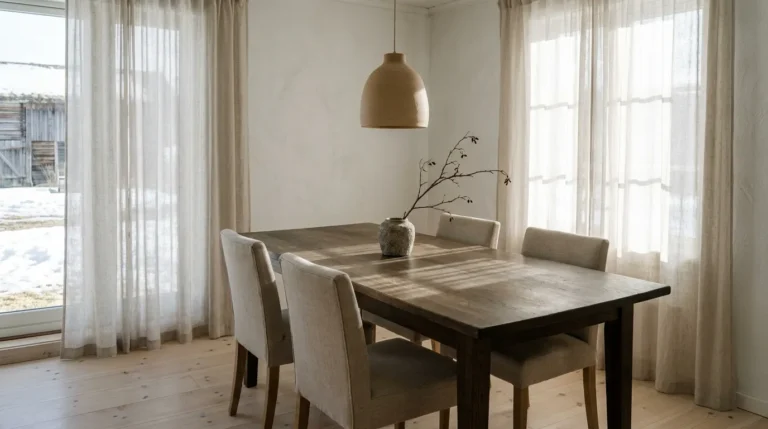
Linen is the most versatile curtain fabric for dining rooms because it occupies the middle territory between the stiffness of formal drapes and the casual feel of cotton. It has enough weight to hang in soft folds rather than flimsy panels, enough texture to look intentional at close range, and enough visual warmth to suit both a casual dining room and a more formal one when the right tone is chosen.
Natural undyed linen in an off-white or warm flax tone reads as quietly considered in rooms with wooden furniture and warm-toned walls. A darker linen — a deep clay, a dusty sage, a warm charcoal — works as a colored accent without the visual heaviness of velvet or the formality of silk. Washed linen drapes softer than unwashed and develops a slightly rumpled quality that suits informal dining rooms well; more structured linen suits rooms with cleaner furniture lines. The practical bonus: linen is one of the more durable curtain materials for rooms that see daily use, and it washes more easily than many alternatives.
2. Choose Velvet for a Formal Dining Room With Evening Ambiance

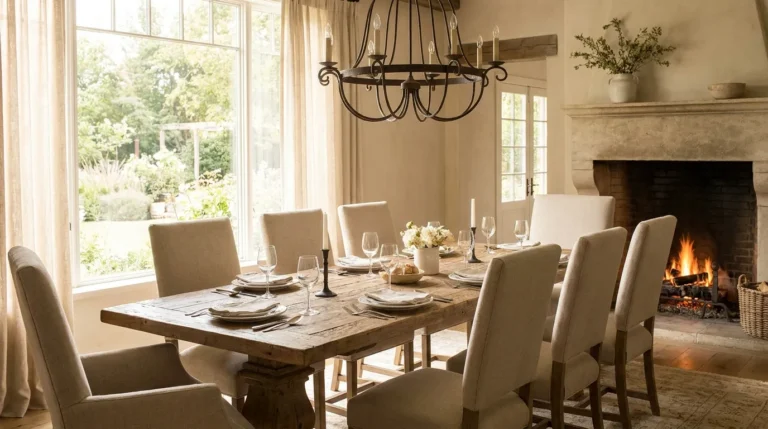
Velvet curtains earn their place in dining rooms that are used primarily for evening meals and formal occasions. The fabric’s pile absorbs sound and light in ways that make a dining room feel more intimate and acoustically contained — qualities that genuinely improve the experience of a dinner party even if they’re not explicitly noticed. Under candlelight or warm pendant light, velvet panels develop a richness that no flat fabric can replicate.
The weight consideration is real. Velvet is a heavy fabric, and full-length velvet panels require hardware — rods and brackets — rated for the load rather than standard lightweight curtain rods. A rod that sags under velvet’s weight visually undermines the entire installation. Deep jewel tones — bottle green, burgundy, sapphire, forest teal — perform particularly well in formal dining rooms because they deepen under warm artificial light in a way that reads as atmospheric rather than heavy. The same tone in a daylight room can feel overscaled, which is why velvet suits dining rooms used primarily in the evening.
3. Mount the Rod as Close to the Ceiling as the Architecture Allows

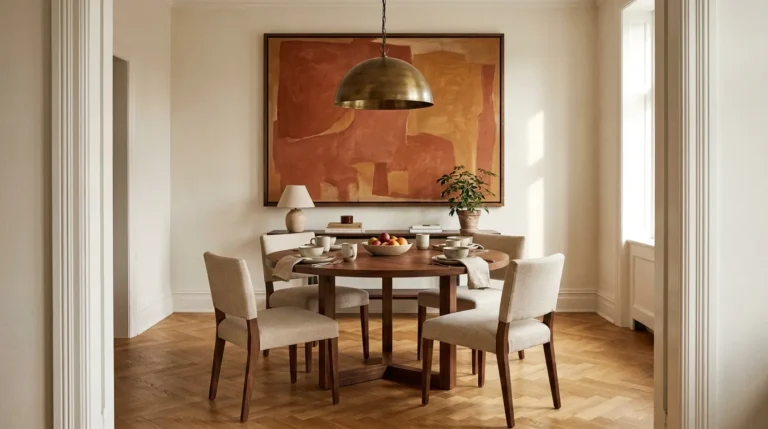
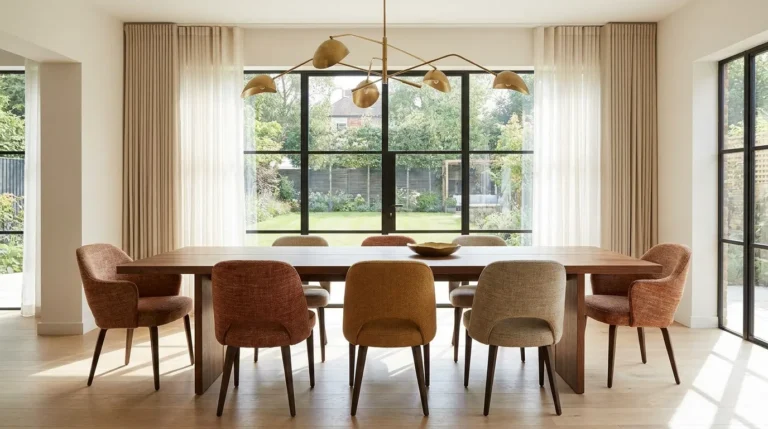
The single decision with the largest impact on how curtains read in any room is where the rod is placed, and in dining rooms the answer is almost always: higher than most people initially plan. A rod positioned just above the window frame makes the ceiling feel lower, the window look smaller, and the room more compressed. A rod positioned 4 to 6 inches below the ceiling — or as close to it as crown moulding or the wall’s upper limit allows — makes the window appear architecturally taller and the room feel proportionally larger.
This placement also means the curtain panels, when open and stacked at the sides of the window, stack onto the wall rather than in front of the glass — which preserves more of the window’s natural light and makes the window itself look wider. The panel length must correspond to the rod height: measuring from the rod to the floor, then adding the preferred hem allowance, gives the correct curtain length rather than buying a standard length and placing the rod accordingly.
4. Let Curtains Fall to the Floor Rather Than Stopping at the Sill

Short curtains in a dining room — those that stop at the windowsill or partway down the wall — consistently make the room look less finished than floor-length ones, regardless of fabric or color. The visual reason is clear: curtains that stop mid-wall create a horizontal boundary that optically lowers the room’s ceiling and draws attention to the arbitrary stopping point rather than to the window itself.
Floor-length panels have three options at the hem: the float, where the hem sits about half an inch above the floor for a clean, practical look; the break, where it touches and slightly folds at the floor in the way a well-tailored trouser would; and the puddle, where an inch or two of fabric gathers on the floor for a deliberately dramatic effect. For dining rooms, the break or a modest puddle suits the room’s formal register well. The float works for rooms that prioritize practicality — where curtains are opened and closed frequently and a hem on the floor would show wear.
5. Extend the Rod 6 to 10 Inches Beyond the Window Frame on Each Side

Panel width and rod extension are related decisions that many curtain installations get wrong in the same direction: too narrow. A rod that extends only to the window frame and panels that barely cover the glass when open create a flat, ungenerous look — the window appears smaller, the room appears more constrained, and when the curtains are drawn back they bunch directly in front of the glass rather than stacking neatly on the wall beside it.
Extending the rod 6 to 10 inches beyond the window frame on each side allows the panels to stack completely on the wall when open, exposing the full window glass and maximizing available daylight. This extension also makes the window appear wider than it is — a consistent visual benefit in dining rooms where the window may be the room’s primary source of natural light. The rod extension must be planned before purchasing hardware; brackets need to be positioned to support the rod at the extended length rather than retrofitted.
6. Layer Sheer Panels Under Heavier Drapes for Flexible Light Control

The dining room has a more varied lighting requirement than most rooms in the house. Morning light during breakfast, afternoon light during a casual lunch, controlled dim light for a dinner party — each calls for different curtain positioning. A single panel that’s either open or closed gives you two options; layered curtains give you a spectrum.
Sheer panels on a second inner rod or track allow diffused natural light to enter while providing visual privacy from the street. The heavier outer drapes can stay open for daytime dining and be closed for evening meals, at which point the sheers remain as a soft interior layer that adds depth to the window zone. The inner rod or track should be mounted at the same height as the outer one, and the sheers should be the same length as the outer panels so the layered arrangement reads as intentional rather than as mismatched curtains placed at the same window.
7. Use Sheers Alone in a Bright Dining Room That Doesn’t Need Privacy

In a dining room with excellent natural light and no direct street-level window exposure — a back of the house room, a raised first floor, a room whose windows face a garden — sheer curtains alone can be the most appropriate choice. Heavy drapes in a bright room work against the room’s natural quality, blocking light that makes the space feel open and welcoming during daytime meals.
Floor-length sheers in a white, ivory, or very pale warm tone frame the window without reducing its light and create a soft, gauzy perimeter that makes the room feel more finished than bare windows while preserving the bright quality. The fabric weight matters here: sheers meant for this use should be light enough to billow slightly when a window is open — this movement is part of the effect — but have enough substance to hang in straight panels rather than clinging to each other. Belgian linen gauze and fine cotton voile are both good choices.
8. Choose a Curtain Color That Relates to the Room’s Palette Rather Than Matching It Exactly

The most common color mistake with dining room curtains is either choosing an exact match to a dominant color in the room — creating a flat, coordinated effect — or choosing something completely unrelated that reads as a color addition the rest of the room didn’t plan for. The more sophisticated approach: a curtain color that sits within the room’s existing palette but offers slight differentiation.
If the dining room walls are a warm greige, curtains in a warm caramel linen provide tonal depth while remaining fully within the palette. If the room has walnut furniture and cream walls, a dusty sage or warm olive curtain provides a complementary addition that doesn’t disrupt the warm neutral base. The principle is visual coherence rather than color matching — the curtains should feel like they belong to the room’s color conversation rather than starting a new one.
9. Coordinate Hardware Finish With Other Metal Elements in the Room
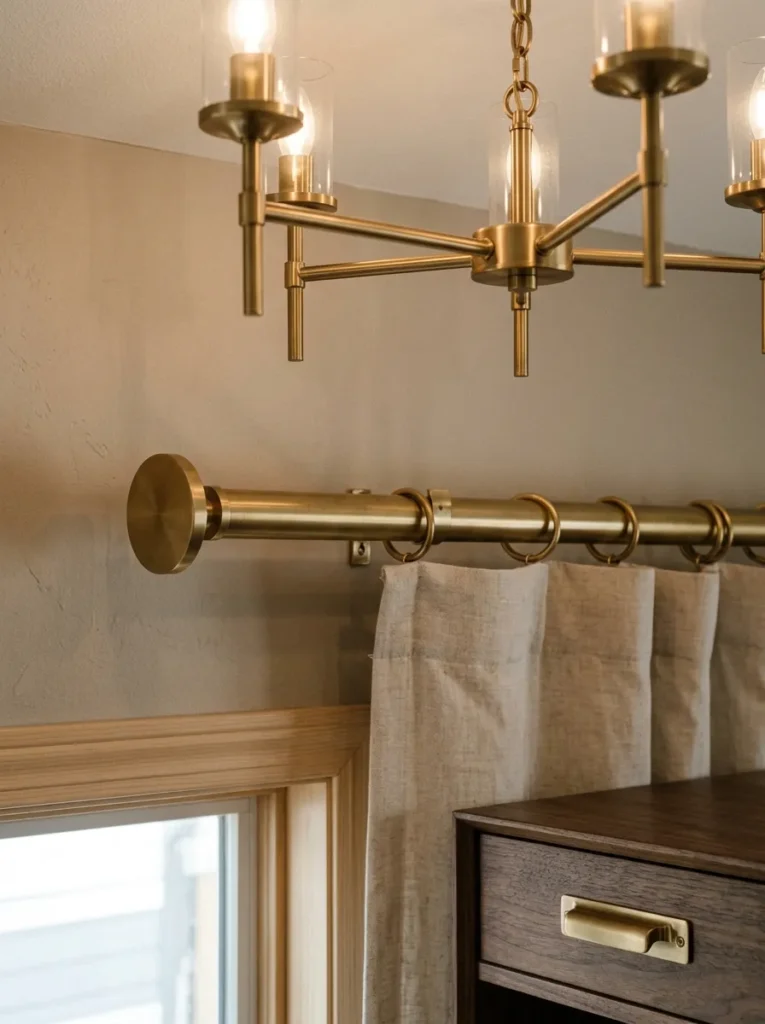
Curtain hardware — rod, brackets, rings, and finials — is visible every time anyone looks at the window, and its finish either integrates with the room’s metallic register or introduces a competing one. A brushed brass chandelier over the dining table, brass cabinet hardware on a sideboard, and chrome curtain rod creates a metallic inconsistency that registers as a room assembled from separate decisions rather than composed as a whole.
The hardware finish doesn’t have to be an exact match to every metal in the room — aged brass and unlacquered brass can coexist as variations within the same warm gold register — but it should share the warmth or coolness of the other metals present. Matte black hardware works across a wide range of room styles and reads as a deliberate choice; brushed nickel and chrome belong in cooler, more contemporary rooms. Finials are worth choosing with restraint — decorative finials work in traditional dining rooms; simple end caps or minimal disc finials suit contemporary ones.
10. Use Pinch Pleat or Goblet Pleat Headers for a Formal Dining Room

Curtain header style affects how the fabric gathers, which in turn affects how formal or casual the panels read. For a dining room designed to host formal occasions — dinner parties, holiday gatherings, family celebrations — the header style should match that register. Rod pocket panels, which gather loosely on the rod, read casually; pencil pleat and eyelet panels are mid-range in formality.
Pinch pleat headers — where the fabric is gathered into tight, evenly spaced triple pleats across the panel — produce structured, tailored folds that hang with precision and read as genuinely formal. Goblet pleat, where each pleat forms a rounded cup shape at the top, is the most architecturally formal header style and suits large windows in dining rooms with high ceilings and significant furniture. Both require adequate fabric fullness — typically 2 to 2.5 times the rod width — to produce the deep, even pleats the style depends on.
11. Use Dark Curtains on One Wall to Create an Evening-Ready Atmosphere

A dining room designed primarily for evening entertaining benefits from curtains that actively contribute to the mood lighting setup rather than simply covering the windows. Dark curtains — deep forest green velvet, inky navy linen, warm charcoal cotton velvet — absorb ambient light and, when closed for evening meals, transform the window wall into part of the room’s atmospheric backdrop rather than a glass surface reflecting the table’s candles.
The impact of this choice is different by day than by night. During the day, dark curtains pulled back reveal the window fully and keep the fabric as a framing element rather than a visual weight. In the evening, closed dark panels enclose the dining space and make the room feel more deliberately separated from the outside world — a quality that genuinely improves the character of a formal dinner. The floor length and fullness become especially important here: dark curtains that pool or break properly read as sumptuous; those that are too short read as unfortunate.
12. Consider Cotton-Velvet or Cotton-Linen Blend for Accessible Formal Texture

Pure silk has traditionally been the fabric of formal curtains, and it remains a strong choice for those with the budget and the willingness to handle its care requirements. For most residential dining rooms, cotton velvet and cotton-linen blends offer the visual effect of formal fabric at a more accessible price point and with considerably more practical durability.
Cotton velvet has the pile, the warmth, and the way of absorbing light that velvet is chosen for, without silk velvet’s sensitivity to crushing and light damage. Cotton-linen blends in heavier weights provide the structured drape of linen with the tactile softness of cotton, which makes them suitable for dining rooms that aim for a formal register without full velvet weight. Blended fabrics also tend to maintain their shape through more use cycles and, where machine washable, require significantly less maintenance than dry-clean-only alternatives.
13. Frame a Large Window With a Wide Decorative Rod as a Room Feature

In dining rooms where the primary window is generously wide — a large picture window centered on the main wall, or a bay window that defines the room’s character — the curtain rod itself can become a visible room feature rather than purely functional hardware. A substantial decorative rod in a warm metal finish, with well-chosen finials that suit the room’s design register, earns the visual attention it receives when guests are seated facing it.
A rod that’s too thin for a wide window will visibly sag in the center under the weight of full-length panels — particularly heavy ones — making the hardware the thing everyone notices first and for the wrong reason. A solid metal rod rated for the span and weight, with brackets positioned to support it without visible deflection, is a prerequisite for this approach. The rod diameter should feel visually proportional to the panel weight: heavy velvet panels need a heftier rod than sheer linen ones.
14. Install Blackout or Thermal Lining for East or West-Facing Dining Rooms
East-facing dining rooms receive strong morning sun that can make breakfast and brunch meals uncomfortably bright; west-facing rooms receive afternoon and evening sun that creates glare directly during dinner prep hours. In both cases, the decorative curtains alone rarely solve the problem — the light gets through or around the panels regardless of how full they are.
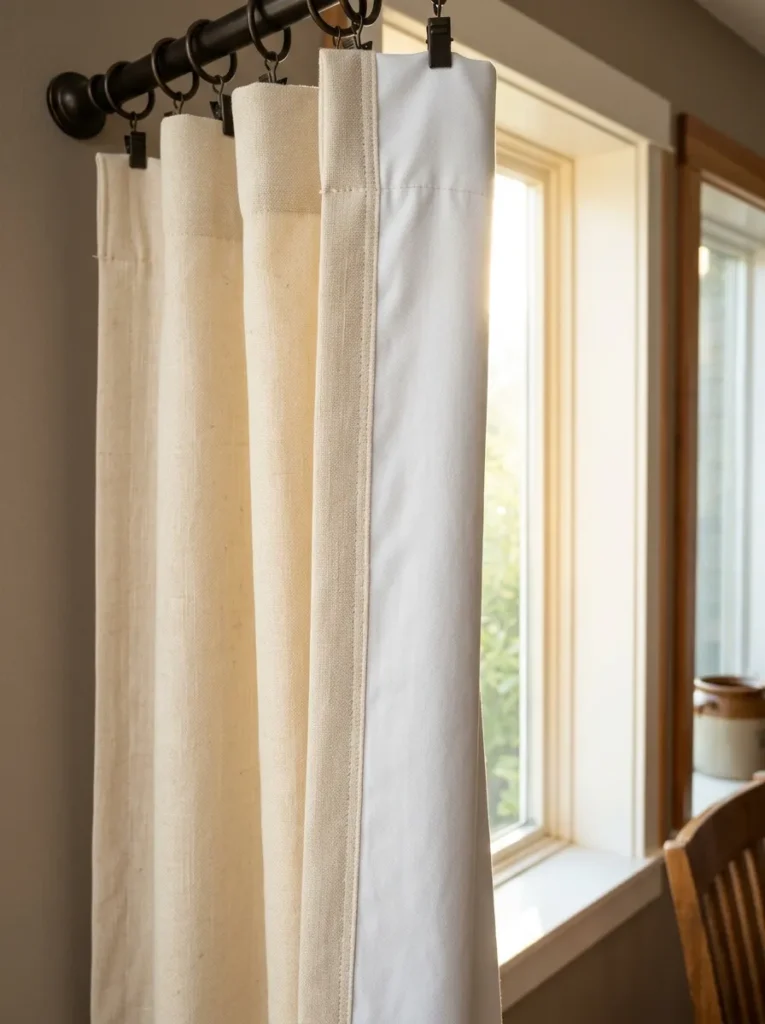
A blackout or thermal lining added behind the decorative curtain panel solves the practical problem without changing the room’s appearance when curtains are open. The lining is attached at the top of the panel and hangs inside it, invisible from the dining room and helping the outer fabric hang more smoothly. Thermal linings add the additional benefit of insulation — reducing heat loss through single-glazed windows in winter and reducing heat gain in summer — which makes the dining room more comfortable across more of the year regardless of the sun direction.
15. Keep Curtains Simple When the Dining Room Has a Strong Pattern Elsewhere

In a dining room where the dominant visual interest comes from another source — a bold wallpaper, a large patterned rug, a gallery wall, or statement upholstered dining chairs — adding a strongly patterned or dramatically colored curtain creates a competition for visual attention that makes the room feel busy rather than composed. The curtains’ job in this context is to complete the window without starting a new design conversation.
Solid-color curtains in a tone pulled from the wallpaper or rug’s secondary palette, or textured curtains in a neutral that doesn’t introduce a new color, allow the room’s existing focal point to remain primary. The practical test: stand at the dining table and look at the window. If the curtains pull your gaze away from whatever the room is using as its primary focal point, they’re competing. If they frame the room and settle into the background, they’re doing their job.
16. Handle Bay Windows With Individual Panels on Separate Rods for Each Section

Bay windows in dining rooms create an organizational challenge that a single continuous rod cannot solve: the three facets of the bay meet at angles that a straight rod can’t span without creating awkward folds at the corners. Three separate rods — one for the center section, one for each of the angled side sections — allow panels to hang cleanly from each rod independently, with the folds at the corners reading as intentional rather than forced.
Each panel section should be sized to its specific window width with the full 1.5 to 2 times fullness, rather than dividing one wide panel set across all three sections. This produces three separate, well-proportioned panel sets that each hang from the correct rod height and length. A continuous valance or cornice board above all three sections, if desired, can unite the bay visually without compromising the functional independence of the three curtain sections.
17. Consider Cafe Curtains for a Dining Nook That Needs Privacy Without Blocking Light

A dining nook — a semi-enclosed eating area set into a bay, an alcove, or a corner with lower windows — often has different window treatment needs than a full dining room. The ceiling may be lower, the windows may sit closer to eye level while seated, and privacy during meals may matter more than in a back-of-house dining room. Floor-length drapes in a tight nook can feel overwhelming and block views and light that make the nook feel welcoming.
Cafe curtains — panels that cover only the lower portion of the window, typically ending at the mid-point or two-thirds up — provide privacy at seated eye level while allowing daylight to enter from the uncovered upper section. A cafe curtain rod should be mounted at the point that provides privacy from the specific sightline that matters, rather than at a standard fixed proportion of the window height. The fabric should be lighter-weight than a floor-length drape — linen, cotton voile, or a textured cotton — since the small scale of cafe curtains is best served by fabrics that drape softly rather than imposing weight.
18. Tie the Curtains Back During Meals to Frame the Window and Maximize Light

Tiebacks are a functional element that doubles as a styling detail, and in a dining room used during the day they make the difference between curtains that help and curtains that hinder. A panel that hangs straight and closed during a daytime meal blocks light and makes the dining room feel more enclosed than it needs to be; the same panel pulled back to the side of the window frames the glass and lets the room read at its full brightness.
The tieback position affects the proportion of the fabric above and below it. A tieback positioned at roughly two-thirds of the curtain length from the top produces a classic, traditionally proportioned swag; one positioned lower creates a longer leading panel and a shorter trailing curve; one positioned higher produces a more contemporary, casual look. Brass holdbacks, fabric tiebacks in the same material as the curtain, or a simple loop of a contrasting rope or leather are all appropriate choices — the material should connect to at least one other element in the room for coherence.
Five Decisions to Make Before Buying Any Dining Room Curtains
Getting these right before purchasing saves the most common regrets.
Rod position first. Decide where the rod will be mounted — how high above the window and how far it will extend on each side — before measuring for panels. The rod position determines every curtain length.
Measure from the rod, not the window. Once the rod position is set, measure from the rod to the floor to determine the panel length needed. Standard curtain lengths rarely correspond to the actual floor distance from a ceiling-height rod.
Calculate fullness. The total width of the curtain panels should be 1.5 to 2 times the rod width. Two panels that are each equal to the window width, for example, create a curtain set with 2x fullness — the full, rich drape that distinguishes quality installation from flat panels.
Match fabric weight to the room’s formality. A formal dining room used primarily for evening entertaining suits velvet or heavyweight linen. A casual everyday dining room suits lighter linen or a cotton-linen blend. The fabric’s weight affects not just appearance but how the panels drape, how hardware must be rated, and how the room behaves in daylight.
Consider lining. An unlined curtain lets more light through and drapes more softly but provides less privacy and less sun protection. A standard lining improves drape and provides better privacy. A blackout or thermal lining solves sun direction problems and improves insulation. The lining decision is worth making before purchasing panels rather than as an afterthought.
Final Thoughts
A well-chosen set of dining room curtains is one of the most impactful changes available to the room without structural work. The curtains define the scale of the windows, frame the room’s primary light source, contribute significantly to whether the space reads as casual or formal, and affect the quality of light during every meal. The decisions made before they’re hung — rod height, panel fullness, hem length, fabric weight — matter more than the visual choices that happen afterward.
If you’re starting from scratch, resolve the rod placement and the hem length first. Get those two decisions right and the fabric and color choices fall into place more naturally. If you’re replacing curtains that already felt slightly wrong without a clear reason, check the rod height and the panel fullness before anything else — those two variables account for the majority of dining room curtain disappointments.
Browse these dining room curtain ideas for the approaches that match your room’s style and light conditions, save the ones worth revisiting, and return to this guide when you’re ready to make the final choices.