
20 Living Room Accent Chair Ideas That Add Real Personality
An accent chair is one of the most personality-driven furniture decisions a living room allows. It doesn’t carry the visual weight of the sofa or the structural responsibility of the coffee table — which means it has more freedom to be expressive. A velvet chair in a color the rest of the room doesn’t use. A vintage wingback that came from somewhere with a story. A woven rattan chair that introduces an entirely different material register than every other piece in the room. A barrel-back chair whose silhouette curves against the straight lines of everything else.
The accent chair is the place in the living room where the safe choice is the wasted opportunity. Every other furniture decision gets pulled toward practicality and longevity — the sofa needs to last a decade, the rug needs to anchor without committing too strongly. The accent chair is small enough to change, singular enough to take a risk, and expressive enough to define the room’s character on its own. These 20 ideas show how.
Choose a Velvet Accent Chair as the Room’s Color and Texture Statement
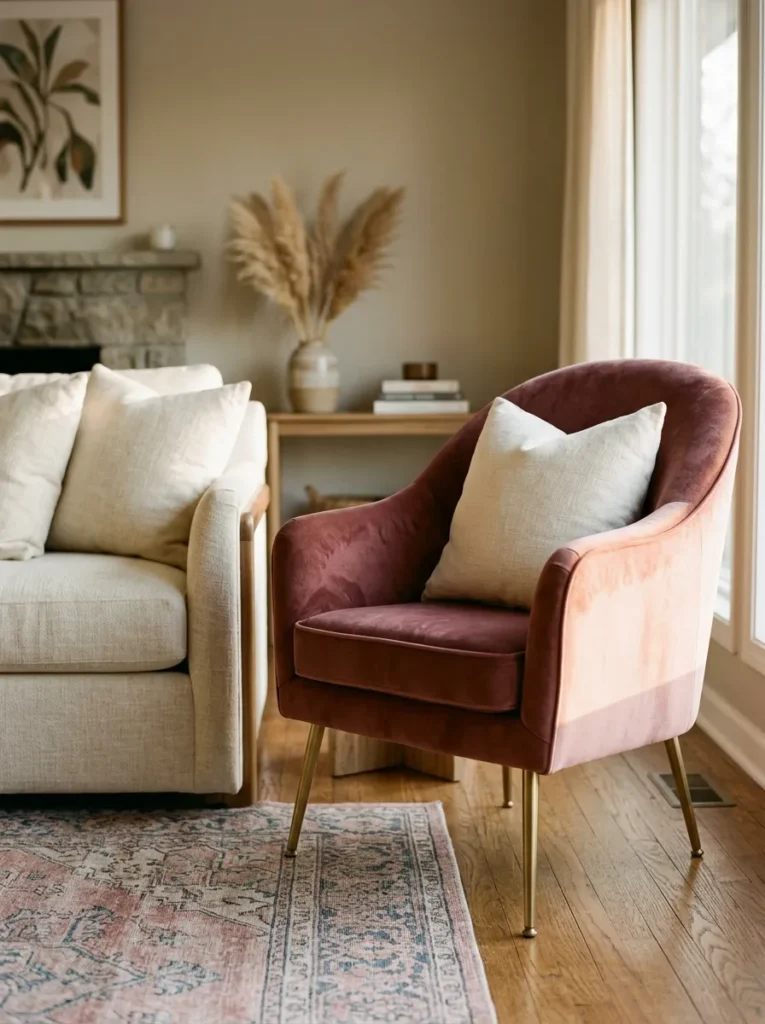
Velvet is the accent chair’s most consistently beautiful upholstery material — not because it’s fashionable, but because it does something no flat-weave or linen upholstery achieves. Velvet catches light differently at different times of day, deepening its color in shadow and brightening in direct light. It adds a richness and softness to a living room that photographs beautifully and reads even better in person.
The velvet accent chair works best when it introduces a color the room’s other upholstery doesn’t contain. A deep forest green velvet in a room with a cream linen sofa. A dusty rose velvet in a room of warm neutrals and natural materials. A midnight navy velvet in a room with sage green walls and white trim. The chair becomes the room’s single saturated color moment, and velvet’s inherent richness makes that moment read as considered rather than simply bright. One velvet chair in a strong color does more for a living room’s character than a dozen matching accessories.
Add a Rattan or Wicker Chair to Bring Organic Character Into a Modern Space
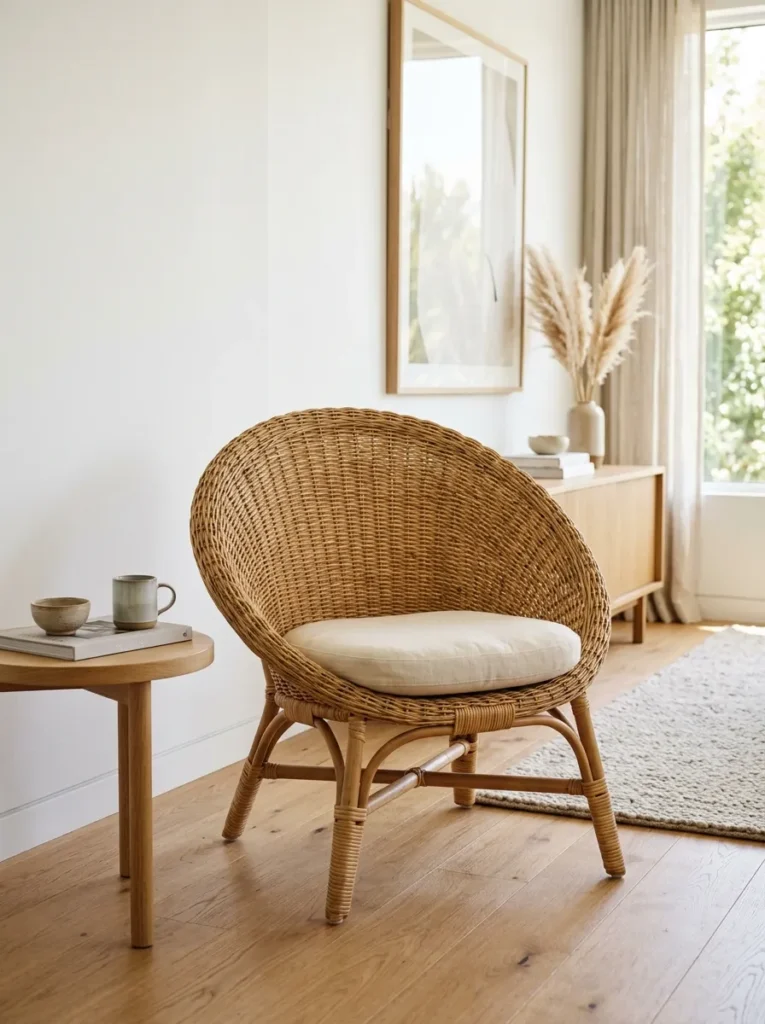
A rattan or woven wicker accent chair introduces a material category that most living rooms — especially modern and transitional ones — don’t already contain. Upholstered sofas, wooden tables, and painted walls all read as finished surfaces. Rattan is visibly woven, tactile, and organic in a way that creates material variety at a furniture scale that throw pillows or baskets can’t match.
The rattan chair works particularly well in modern or minimal living rooms where its warmth and texture provide necessary contrast to cleaner lines and smoother surfaces. A natural rattan chair with a simple cushion in linen or cotton coordinates with any neutral palette without requiring any additional coordination effort. A painted rattan chair — in white, matte black, or sage — reads as more deliberate and more graphic. Either version introduces a material conversation the room didn’t have before.
Position a Wingback Chair in a Corner to Create an Intentional Reading Nook

The wingback chair is the most architecturally distinctive accent chair silhouette: the high back and side wings create an enclosed feeling that no other form provides, and that enclosure creates a psychological sense of shelter within the room. Positioned in a corner — the corner farthest from the main seating area, or the corner defined by the junction of two walls — the wingback creates a reading nook with architectural authority.
The wingback’s presence is strongest when it’s positioned rather than simply placed: turned slightly toward the room’s conversational center rather than squared to the wall, with a floor lamp immediately beside it and a small side table within arm’s reach for a book or drink. This composition signals that the corner is a designed space with a specific purpose — reading, writing, or private sitting — rather than a leftover area that needed something in it.
Use a Bold-Pattern Chair to Introduce the Room’s Only Pattern Moment

A living room with solid-color upholstery, a plain or subtly textured rug, and neutral walls is the ideal host for a single bold-pattern accent chair — and the chair’s patterned upholstery reads most powerfully when it’s the only significant pattern in the room. One patterned chair surrounded entirely by solids is one of the clearest design statements available in a living room.
The key principle: the pattern’s colors should include at least one tone already present in the room. A geometric print that incorporates the sofa’s cream and the rug’s warm terracotta reads as composed; a pattern that introduces three entirely new colors reads as intrusive rather than intentional. The pattern’s scale also matters more on a chair than on a pillow: a large-scale print covers an entire seating surface and reads at living room distance as significantly bolder than the same pattern on a 20-inch throw pillow.
Place a Vintage or Antique Chair as the Room’s Most Personal Object
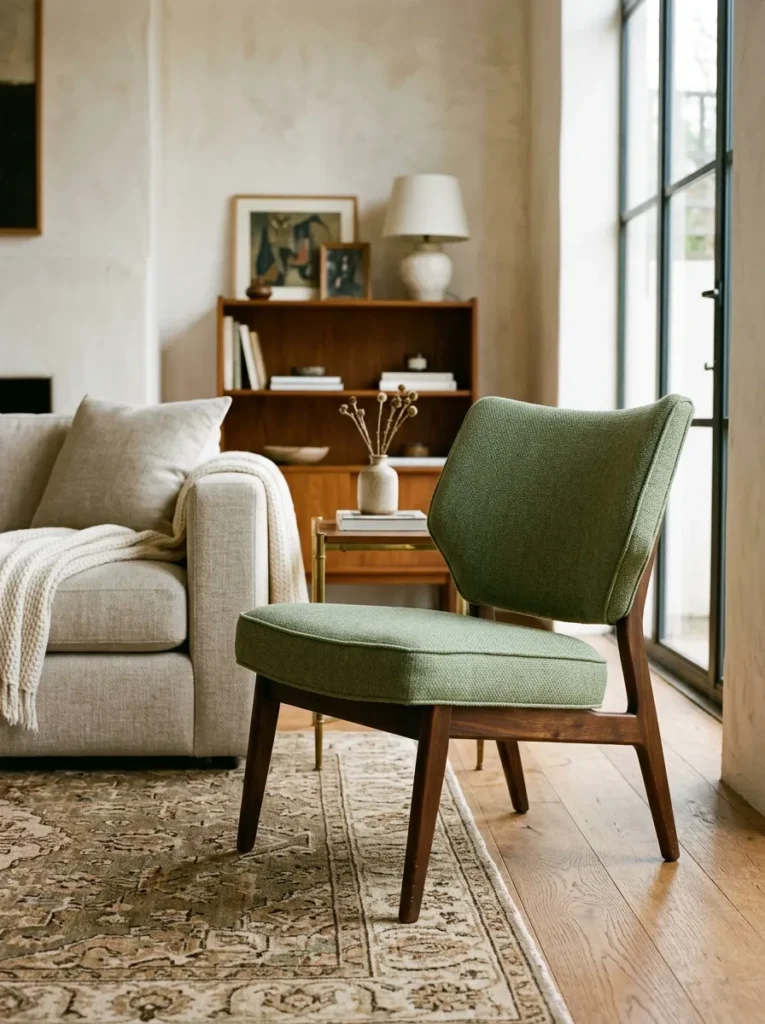
A vintage or antique accent chair does something no new furniture can replicate: it brings documented life into the room. A chair from a previous decade — perhaps reupholstered in a fabric chosen deliberately, with the marks of actual use visible in its frame — communicates that the room was assembled by someone with interests and history rather than purchased from a single source on a single afternoon.
The vintage chair doesn’t need to match the room’s other furniture in style, and in fact reads as more interesting when it doesn’t. A mid-century modern chair in a more traditionally styled room. An ornately carved frame in a minimal contemporary space. A 1970s curved slipper chair in a transitional living room. The chronological contrast is part of the personality — the chair’s provenance and its present context comment on each other in a way that draws questions, conversation, and genuine interest from every person who sits in the room.
Add a Curved or Barrel-Back Chair to Soften a Room of Straight Lines

Most living room furniture has a predominantly rectilinear profile: sofas, coffee tables, media consoles, side tables, and window frames all present straight lines and right angles as their dominant geometry. This creates visual consistency but can also create a certain rigidity that the right accent chair resolves by introducing a contrasting form.
A curved barrel-back chair, a round egg chair, or any upholstered form with a clearly arced silhouette introduces a geometry that makes the room’s overall composition feel more dynamic and less formally structured. The curved chair doesn’t need to be dramatic or oversized to achieve this — even a subtle barrel back creates sufficient geometric contrast against the right-angle furniture around it. The effect is most readable from the room entry, where the curved silhouette catches the eye precisely because nothing else in the room has that shape.
Choose a Chair With Distinctive Legs as the Room’s Fine Furniture Detail
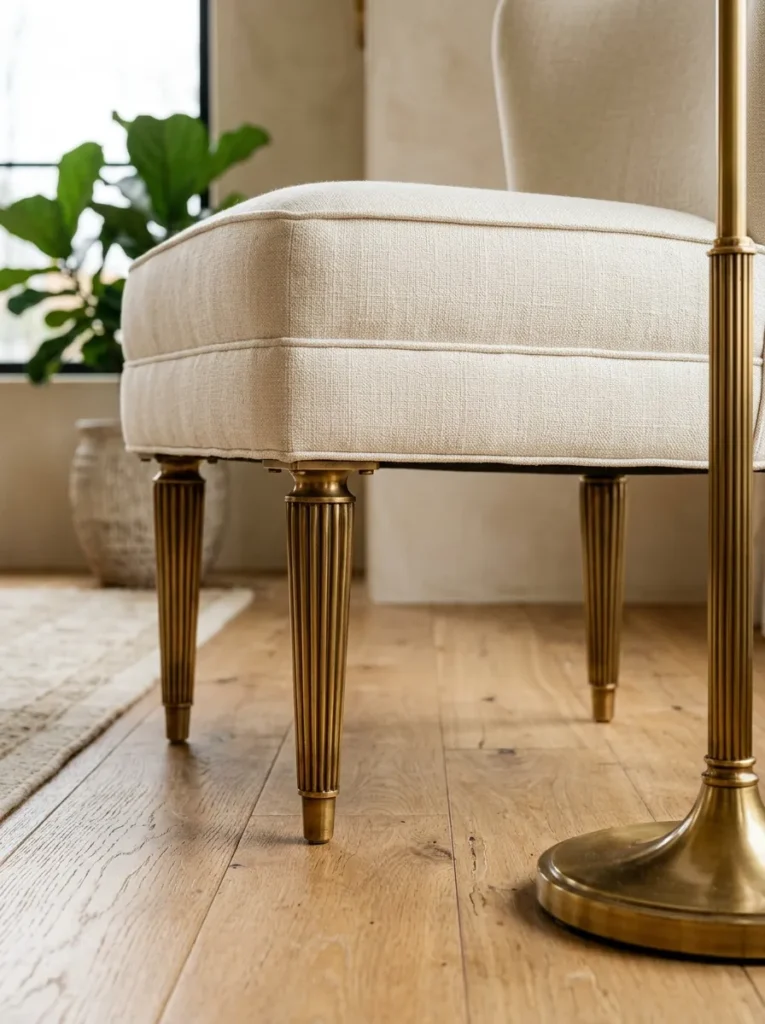
The legs of an accent chair are among the most visible details from across a living room, because the chair’s elevation off the floor — unlike a sofa’s — exposes the full leg profile from most viewing angles. A chair with distinctive legs adds a fine furniture detail at a scale that reads even from the room entry.
Brass or warm gold legs on an otherwise neutral upholstered chair. Ebonized black tapered legs that bring a graphic note to a light-colored form. Natural carved oak legs in a cross or X-brace below a velvet cushion. Each of these details adds character to the chair and can connect it to other metallic or wood elements visible in the room. The leg finish should be chosen with the room’s other hardware in mind — lamp bases, side table frames, picture frame finishes — not matching exactly but within the same finish family.
Use a Slipper Chair for Personality in a Compact Footprint
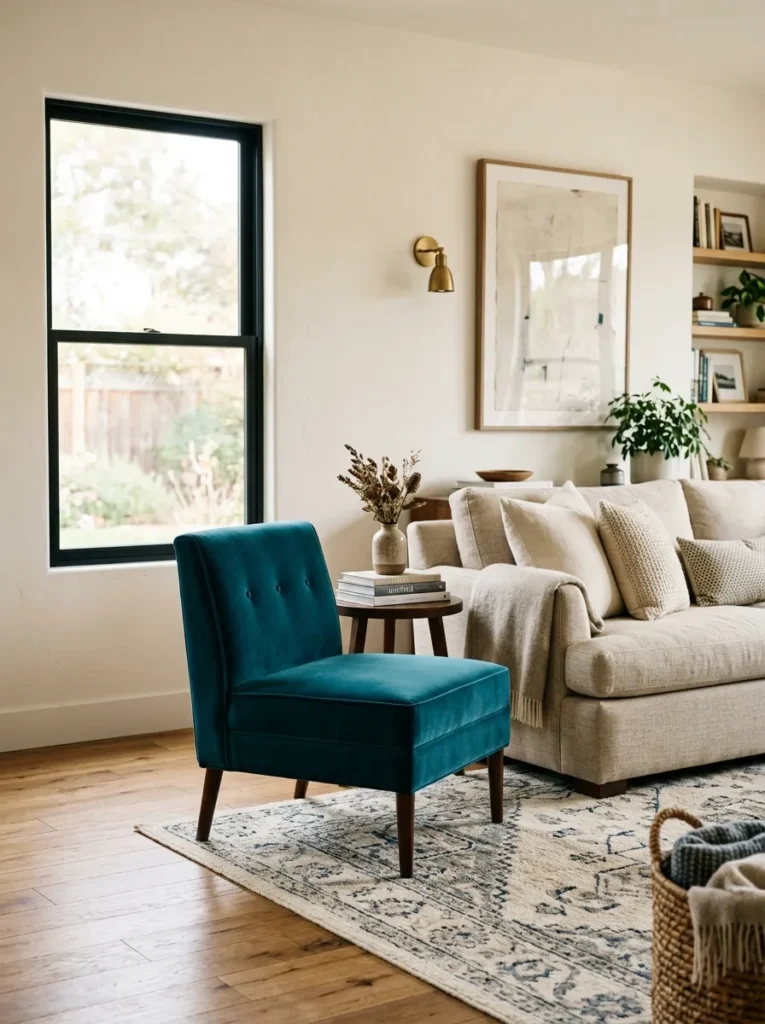
A slipper chair — armless, low, and with a footprint smaller than any other accent chair type — is among the best choices for smaller living rooms where a standard armchair would consume too much floor space or crowd the furniture arrangement. Its compact scale keeps the floor plan open while still adding a distinctive seating element.
The slipper chair’s small scale means its upholstery does more visual work: there’s less of it, so the color, pattern, or material choice reads more intensely than on a larger piece. A velvet slipper chair in a strong color reads as a bold living room accent despite its modest size. A patterned slipper chair with a small-scale geometric print provides pattern interest without overwhelming a compact room. The slipper chair makes the argument that visual presence isn’t determined by scale — it’s determined by the quality of the decision made about what it looks like.
Choose a Chair in an Unexpected Color as the Room’s One Bold Decision
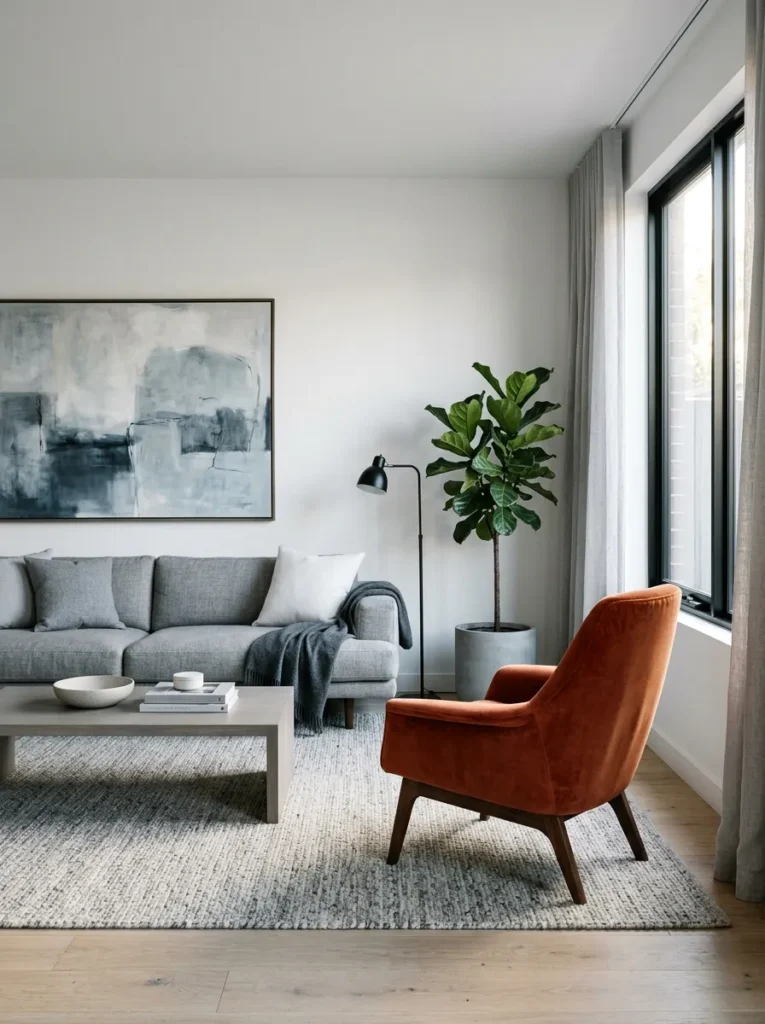
Most living room furniture arrangements build toward visual safety: a neutral sofa, a warm rug, coordinating throw pillows in two or three tones that relate carefully to each other. Into this calibrated palette, an accent chair in an unexpected color — one that the room’s existing arrangement doesn’t already contain — introduces a note of genuine surprise.
The unexpected color works best when it’s deliberate rather than random. A terracotta chair in a predominantly cool grey and white room. A chartreuse chair in a room of warm naturals and cream. An oxblood leather chair in a room of sage and raw linen. The color shouldn’t fight the room’s palette, but it should introduce a temperature, saturation, or hue the rest of the room doesn’t have. That contrast is often the chair’s entire personality — and it’s sufficient on its own. No additional styling, art, or accessory does what one chair in the right unexpected color achieves.
Add a Leather Accent Chair for a Material That Develops Character With Use
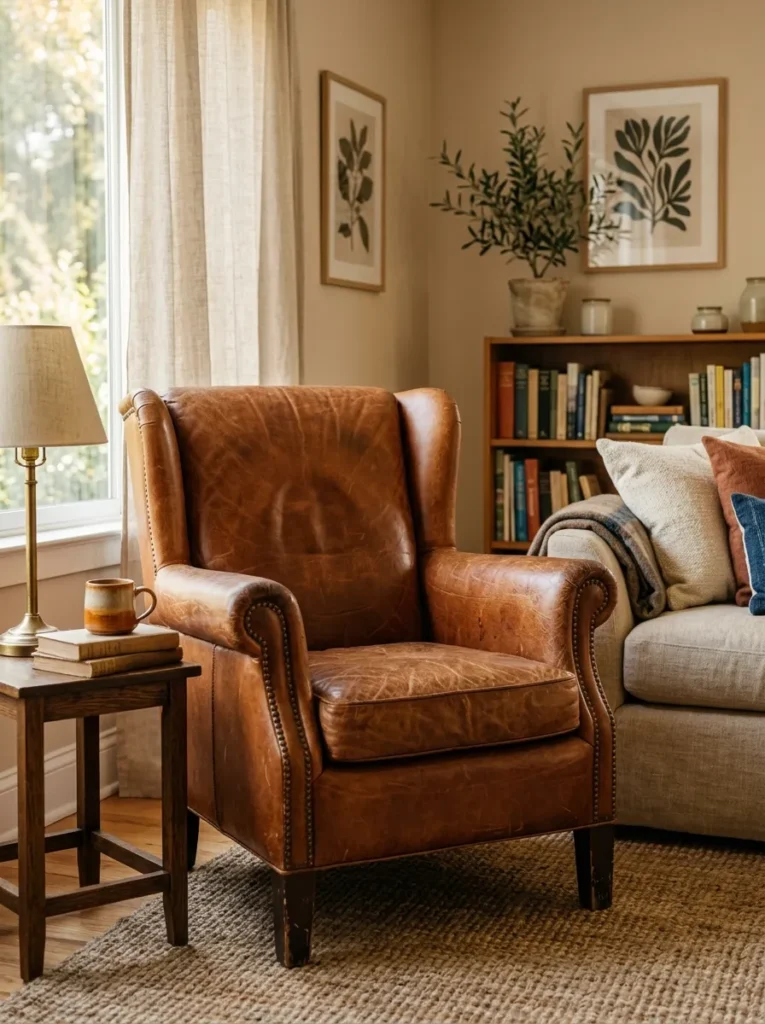
Leather in a living room accent chair serves a different aesthetic purpose than any upholstered fabric: it develops patina and character over time in a way that velvet, linen, boucle, and every other upholstery cannot replicate. A new leather chair is attractive. The same chair five years later — with the natural aging of the hide, the deepening color at areas of contact, the softened surface — is genuinely distinguished.
Full-grain leather develops patina most expressively: the color deepens where hands and arms rest, the surface softens from use, and small natural variations in the hide become more pronounced with time. A cognac or saddle-tan leather chair in a room with natural wood and warm materials reads as warm and lived-in. A dark espresso leather chair in a room of lighter tones reads as deliberately sophisticated. Both become, over time, something no new chair can replicate — which is what makes leather a personality material rather than simply a durable one.
Place Two Matching Accent Chairs Opposite the Sofa to Complete the Seating Zone
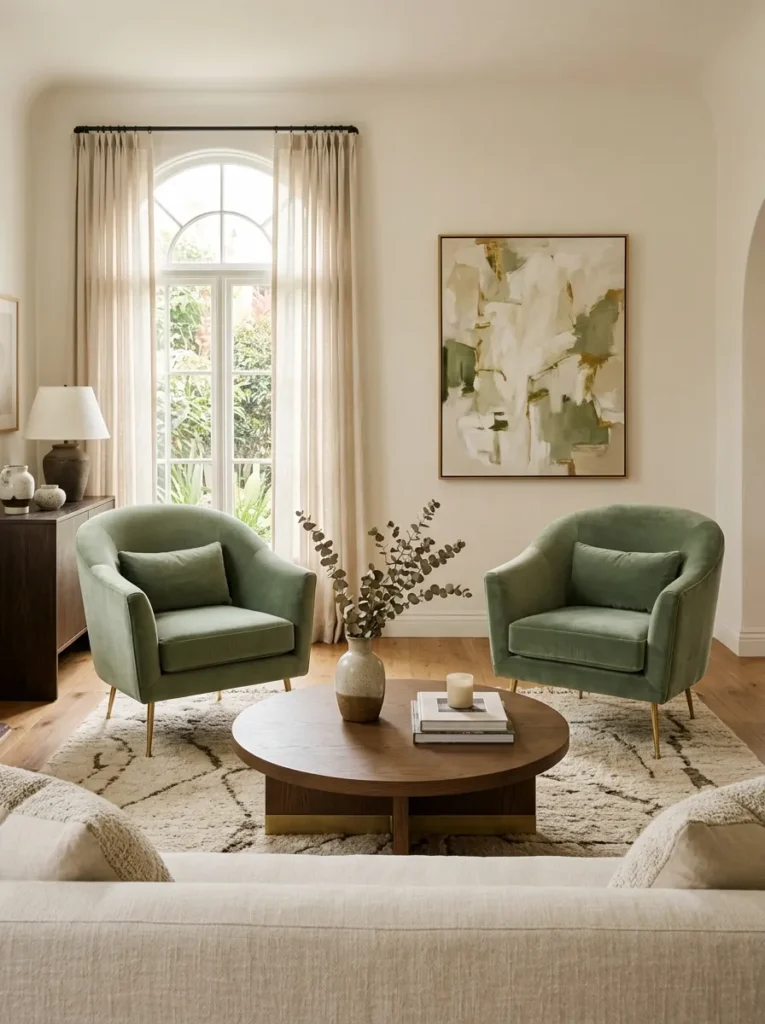
A single accent chair creates a personality moment. Two matching accent chairs placed opposite the sofa — one on either side of the coffee table — create a fully defined conversational seating zone with a symmetry and visual weight that makes the entire furniture arrangement feel purposeful and complete.
The two-chair configuration replaces the conventional loveseat or second sofa and does something neither can: it introduces a different furniture form at the seating area’s visual opposite, creating a clear distinction between the primary seating element and the secondary seating without requiring two mismatched singles that compete visually. The chairs should match each other — same style, same fabric, same finish — but don’t need to match the sofa. The material contrast between the sofa’s upholstery and the pair of chairs in a different material is part of what makes the configuration more interesting than a matching set would be.
Style the Accent Chair With One Throw and One Pillow — Not More

The accent chair styled with a throw and a pillow is the most consistently beautiful version of that chair in any living room. The over-styled version — two throws, three pillows, a blanket, and a magazine fanned on the seat — produces a chair that disappears beneath its own accessories and can’t be seen or sat in.
One throw, folded once or loosely draped over one arm. One pillow, chosen in a material or pattern that the chair’s upholstery doesn’t contain but that coordinates with it. Nothing more. The restraint is the principle: the chair’s form and upholstery should remain the dominant visual element, with the throw and pillow serving as accents that enhance rather than cover. A loosely woven throw on a velvet chair. A geometric pillow on a solid leather chair. The contrast between the styling element and the chair’s material is what makes the combination read as deliberate rather than accumulated.
Anchor the Room’s Under-Used Corner With an Accent Chair

Every living room has at least one corner that sits slightly outside the primary furniture arrangement — to the side of the sofa, between the window and a bookcase, in the far corner of the room that no furniture configuration naturally claims. These corners accumulate floor plants or decorative stools and eventually nothing, because nothing placed without intention stays there purposefully.
An accent chair in this corner, turned slightly toward the room’s center, converts leftover space into a defined zone with a clear purpose. The chair doesn’t need to be part of the primary seating arrangement to earn its position; it creates a secondary zone — a reading position, an additional seat for guests — that makes the full room plan feel thought through rather than arranged around the sofa and filled in around it. A floor lamp immediately beside the chair and a small side table at arm’s reach complete the composition.
Position the Accent Chair at the Window for the Room’s Best Natural Light
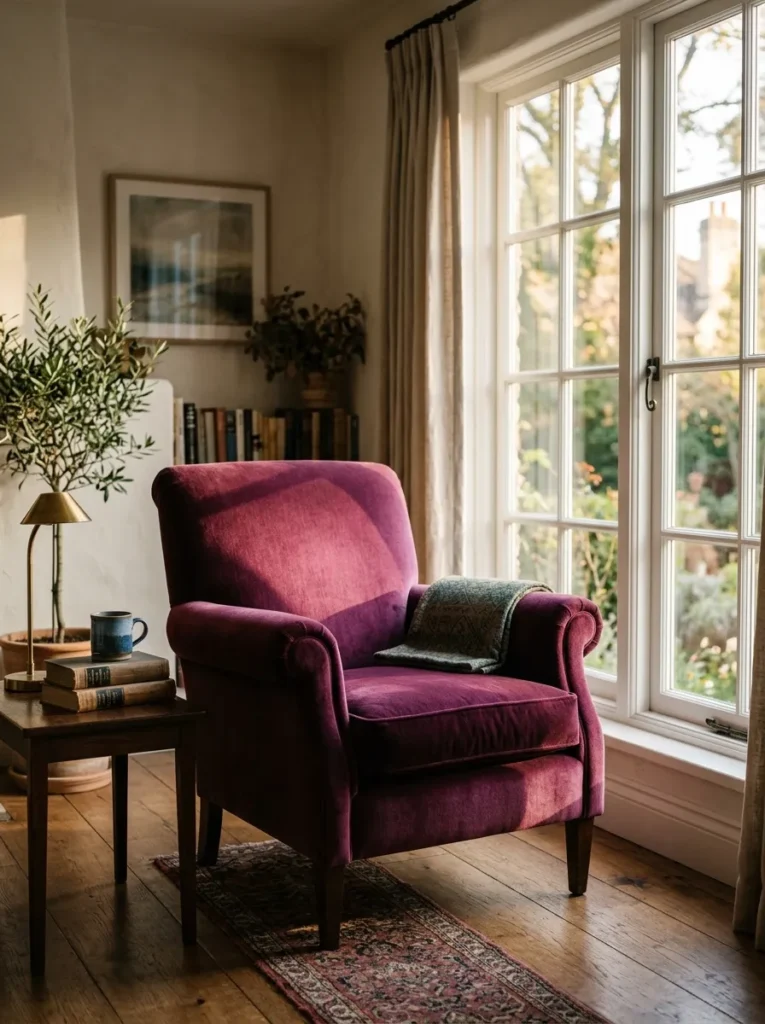
The area beside a living room window is the room’s most luminous position — which makes it the most naturally suited location for a piece of furniture that benefits from attention. An accent chair near the window becomes the most naturally illuminated seating position in the room, ideal for reading, working, or afternoon sitting, and simultaneously the most visually prominent because the light falls on it from a direction that reveals its color, texture, and form most fully.
The chair’s material reads differently at this position than it does in the room’s interior. Velvet catches window light in a way that changes the chair’s apparent color across the day. Natural rattan becomes three-dimensional in direct natural light, showing the woven texture at its most visible. Leather develops a warm surface glow in afternoon sunlight that no artificial lighting replicates. The window position is the best light the room has — place the chair that most deserves it there.
Face the Accent Chair Toward the Room Entry to Design the First Impression

A chair positioned so that it faces the room’s primary entry point designs the living room’s first impression. The entry view determines the room’s initial emotional register — whether it reads as inviting, interesting, calm, or busy — and a distinctive accent chair visible from the doorway is the most effective single furniture decision available for that first moment.
The chair facing the entry should be the room’s most distinctive piece: the boldest color, the most interesting silhouette, the chair with the most visual character. When someone enters and their eye finds the accent chair first, the chair introduces the room’s personality before anything else does. This placement is the most photographed and most memorable chair position in a living room — and it’s the one that most benefits from the boldest chair decision.
Use a Swivel Accent Chair to Serve Multiple Conversational Zones
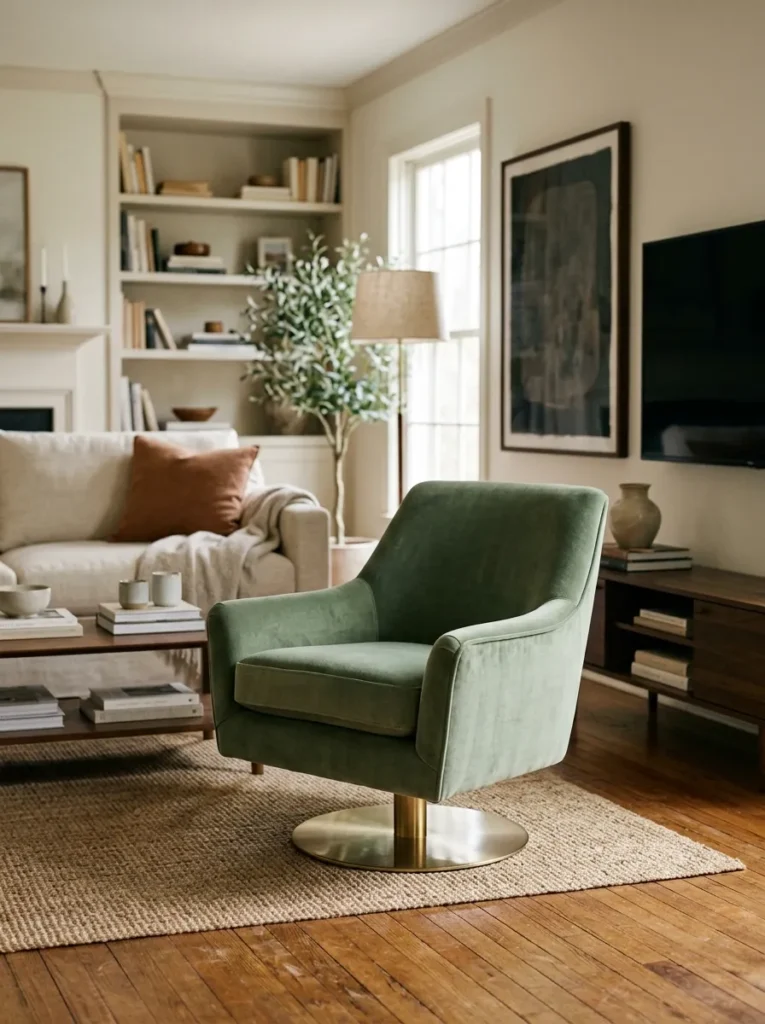
A swivel accent chair — one that rotates on its base — earns its functional differentiation in living rooms with more than one activity zone. In a room that contains both a conversational seating area and a television viewing position, a swivel chair serves both without relocating. In a room that hosts social gatherings with conversations happening in different parts of the space, a swivel chair allows full participation without the awkwardness of a fixed orientation.
The swivel mechanism should be nearly invisible in the chair’s overall design — a low-profile pedestal base or a rotating platform that doesn’t add visual bulk to the chair’s silhouette. The chair’s personality comes from its upholstery and form, not from the mechanical feature. A velvet swivel chair in a strong color performs exactly as a static velvet chair performs aesthetically, but its functional versatility at that position makes the choice of that particular spot more logical.
Choose an Upholstery Material That Contrasts With the Sofa’s
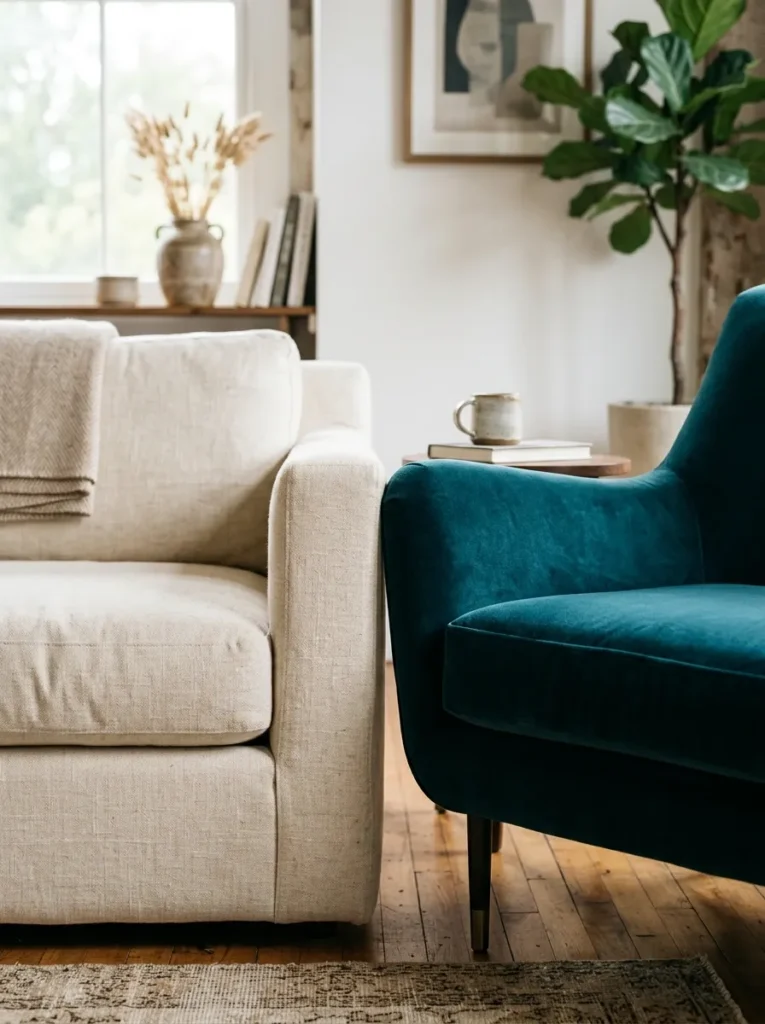
A living room’s primary upholstered piece — the sofa — has a material identity that establishes the room’s tactile register. A linen sofa establishes a casual, natural, soft presence. A leather sofa establishes a more structured and durable one. A velvet sofa establishes a rich, formal, saturated one. The accent chair that reads as most interesting in relation to the sofa is almost always the one whose upholstery material provides contrast rather than echo.
Specific pairings that work: a linen sofa paired with a velvet accent chair. A leather sofa paired with a rattan or woven accent chair. A velvet sofa paired with a leather or boucle chair. A boucle sofa paired with a patterned or leather chair. The material contrast creates visual texture at the furniture level — a clear distinction between primary and secondary seating that signals both pieces were chosen deliberately for what they contribute together, rather than purchased to match.
Scale the Chair Correctly — Before Choosing Its Style

The single most consequential accent chair decision has nothing to do with color, material, or style. It’s scale. A chair that’s proportionally too small for the room reads as a children’s furniture piece placed in an adult space; one that’s proportionally too large consumes the floor plan and crowds the arrangement regardless of how beautiful it is.
The scale test: an accent chair’s seat height should be within approximately 1 to 2 inches of the sofa’s seat height for comfortable visual balance and natural conversation. In a smaller living room, look for chairs under 28 to 30 inches wide with a slim or raised-leg profile that keeps the visual floor plan open. In a larger room, a more substantial chair — a club chair, a wingback — helps anchor the space and prevents the furniture from floating in too much open floor area. Confirm dimensions before committing to any style or material; scale is the one decision that styling cannot correct after the fact.
Use the Accent Chair to Introduce the Room’s Warmest or Coolest Tone

A living room built on cool, neutral tones — grey, white, blue-grey, or cool beige — often reads as slightly distant, particularly in rooms with north-facing exposures or limited natural light. One accent chair in a warm tone — a cognac leather, a terracotta velvet, a rust boucle, an amber linen — introduces the thermal warmth the room’s palette is missing without requiring any other change to the furniture arrangement.
The principle works in both directions. A room built on warm tones that reads as heavy or enclosed benefits from an accent chair in a cooler, lighter tone — a pale blue velvet, a cool ivory linen, a soft sage boucle — that provides visual temperature relief at the furniture level. The accent chair’s relatively small scale makes this thermal correction possible: a tone that would overwhelm a sofa reads as exactly right on a chair.
Let the Accent Chair Be the Living Room’s Bravest Furniture Decision
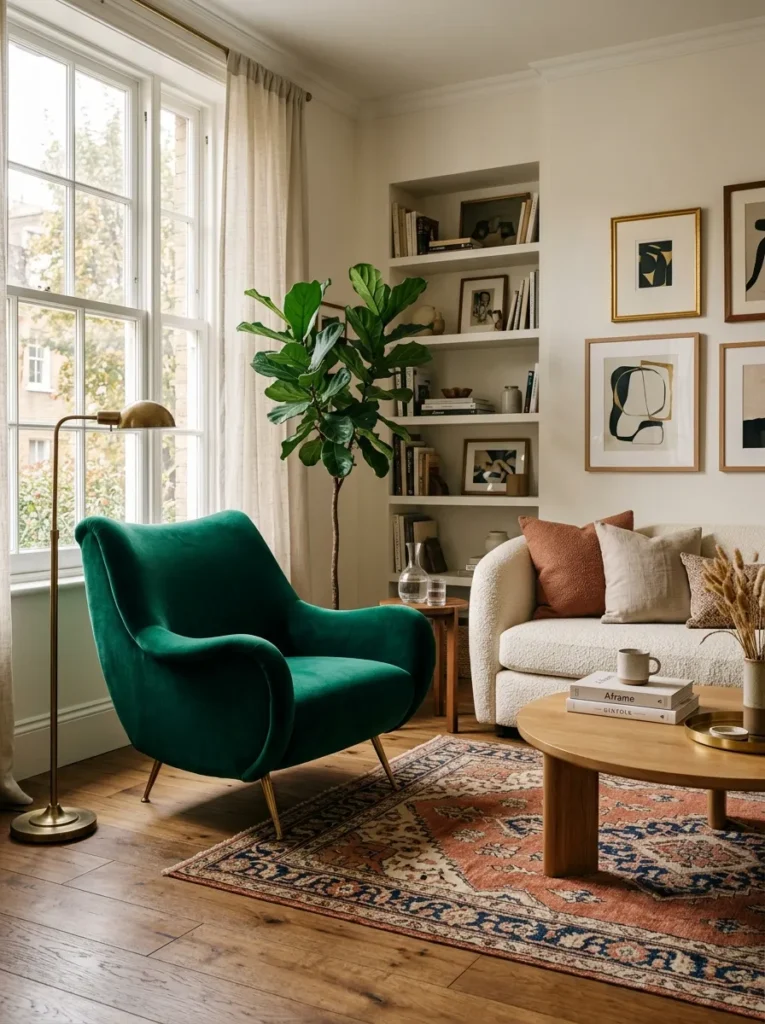
Every other furniture decision in a living room is pulled toward reasonableness: the sofa is chosen for comfort and durability across years, the rug is chosen to anchor without committing too strongly, the coffee table is chosen for function as much as form. These are legitimate decisions made by people designing a room they’ll live in.
The accent chair is the exception to all of this. It’s small enough to change if the decision turns out wrong. It’s singular enough that one bold choice doesn’t destabilize the room’s overall character. And it carries the living room’s personality — its visual distinctiveness, its sense of individual taste — in a way that no careful, neutral furniture decision can. The chairs that get talked about, that get noticed, and that make a living room feel like it belongs to someone specific are always the ones chosen with the most deliberate intention. Let the accent chair be that.
Common Mistakes to Avoid
Choosing a chair that’s too small for the room. The most common accent chair mistake. A chair that appears substantial in a showroom or product photograph can disappear in an actual living room with high ceilings and a large sofa. Verify dimensions against the room’s scale — particularly the sofa’s visual mass — before purchasing.
Matching the accent chair too closely to the sofa. An accent chair in the same material, the same color tone, and the same general style as the sofa reads as a second sofa rather than an accent. The chair’s function is to add something the sofa doesn’t provide — contrast of material, color, or silhouette is what makes it qualify as an accent at all.
Placing the chair flat against the wall at 90 degrees. A chair pushed directly against the wall reads as furniture in storage rather than furniture in use. Even floating the chair 4 to 6 inches from the wall and turning it a few degrees toward the room’s conversational center changes how it reads from across the room — from placed to positioned.
Over-styling the chair with too many accessories. Multiple throws, several pillows, and a blanket draped across the seat collectively obscure the chair’s form and prevent it from functioning as the accent it was chosen to be. One throw, one pillow.
Using a pattern that introduces new colors instead of repeating existing ones. A patterned accent chair works best when the pattern picks up at least one color already present in the room’s rug, sofa, or walls. A pattern introducing three entirely new tones reads as an addition to the room rather than an expression of it.
Ignoring the chair’s leg finish in relation to the room’s existing hardware. Visible leg finishes — brass, black, natural wood, chrome — connect to or conflict with the lamp bases, side table frames, and picture frame finishes in the room. A chair whose legs actively clash with every other metal finish in the room reads as the single unconsidered object in an otherwise composed arrangement.
Final Thoughts
An accent chair is the living room’s most under-used personality opportunity. Most rooms use it to fill a corner, to add seating, or to complete a furniture arrangement that felt incomplete. Those are legitimate functions — but they miss the chair’s real design capability.
The living room that works on every level — functionally, aesthetically, and personally — is almost always the one with one piece of furniture that could only have been chosen by the person who lives there. The accent chair is the most natural candidate for that role. It’s small enough to take the risk, expressive enough to deliver the reward, and flexible enough to change if the first choice teaches you something.
Choose accordingly.