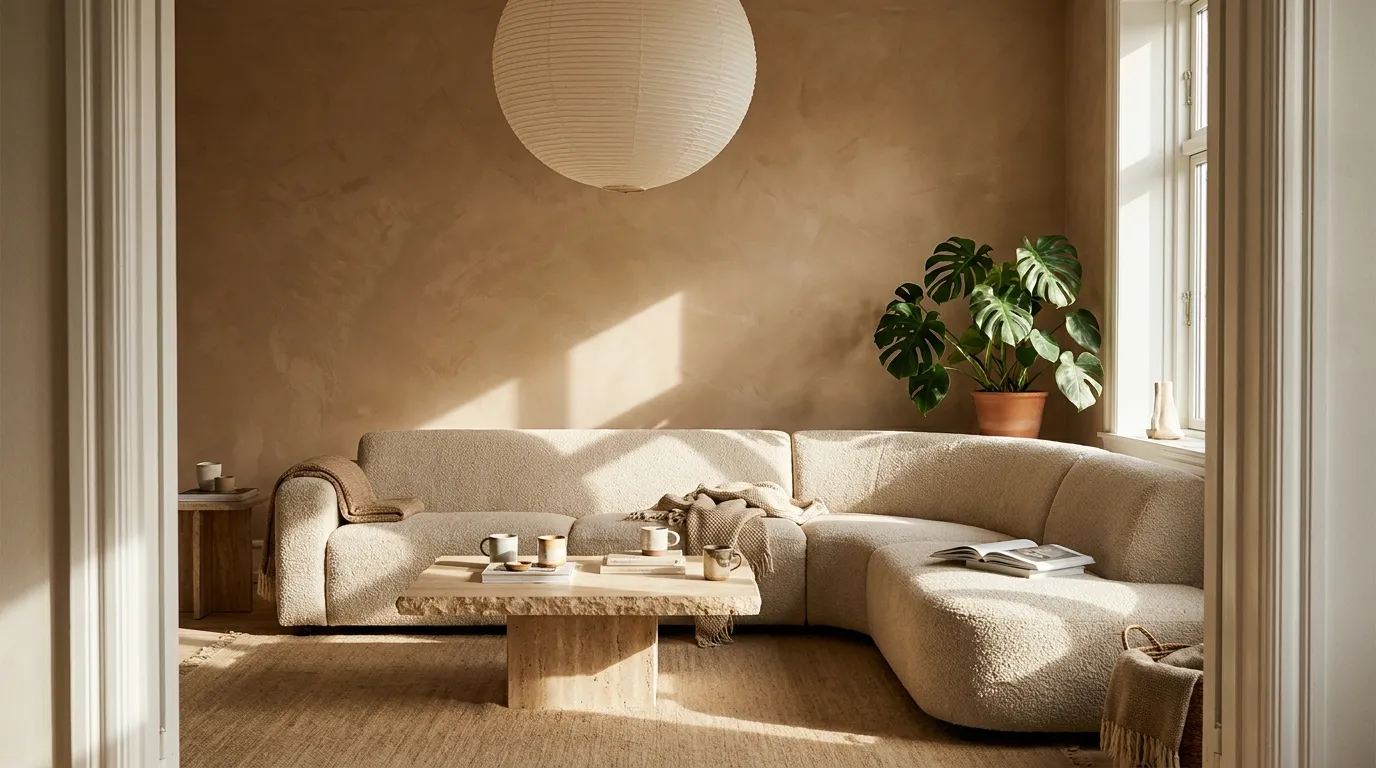
21 Organic Modern Living Room Ideas That Feel Relaxed
Organic modern is one of the more useful aesthetic terms available at the moment and also one of the more frequently misapplied. At its most resolved, it describes a living room that combines the structural clarity of contemporary design with the warmth and irregularity of natural materials — a curved sofa in a room with clean lines, a rough stone table beside a smooth plaster wall, warm wood tones against an earthy palette. At its least resolved, it describes a room full of beige objects that looks like a mood board but doesn’t quite function as a home.
These organic modern living room ideas are ordered from foundational decisions to finishing details, because the aesthetic depends more than most on the quality of its base layers. Get the materials, palette, and furniture silhouettes right, and the room’s character arrives largely from those three decisions. Get them wrong and no amount of styling will recover the room.
1. Choose a Curved Sofa as the Room’s Visual Anchor
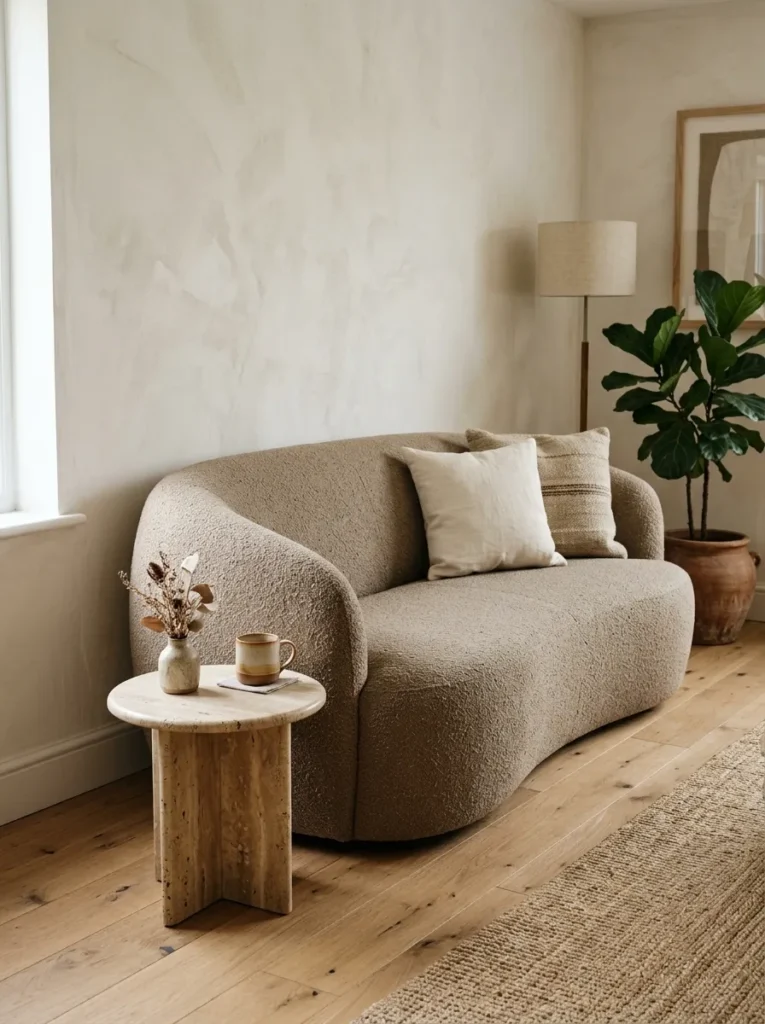
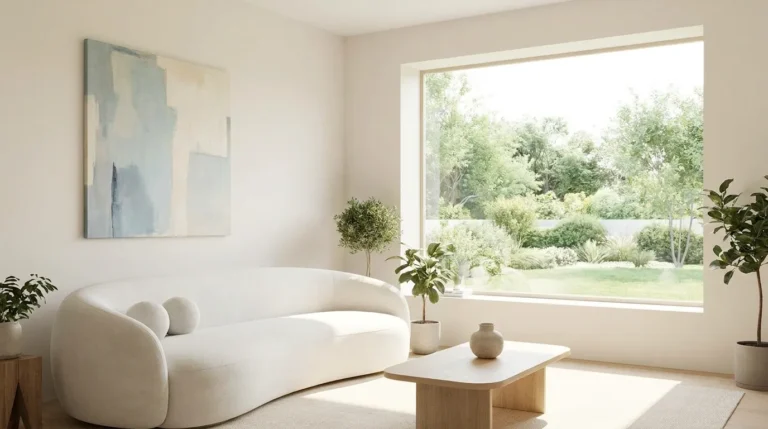
The curved sofa is probably the most distinctive furniture decision available in organic modern living room design — it introduces a softened silhouette that works against the right-angle default of most rooms and most furniture collections. A gently curved sectional or a rounded two-seater reads entirely differently from a straight-backed contemporary sofa in a room that’s otherwise working toward natural material warmth.
The fabric matters as much as the form. Bouclé, textured linen, or a nubby natural weave in an oatmeal, cream, or warm stone tone suits the palette and reinforces the organic quality of the curved form. A leather curved sofa reads contemporary rather than organic. A brightly coloured or heavily patterned curved sofa competes with the material palette the rest of the room is building.
2. Use Limewash or Plaster-Effect Paint on at Least One Wall
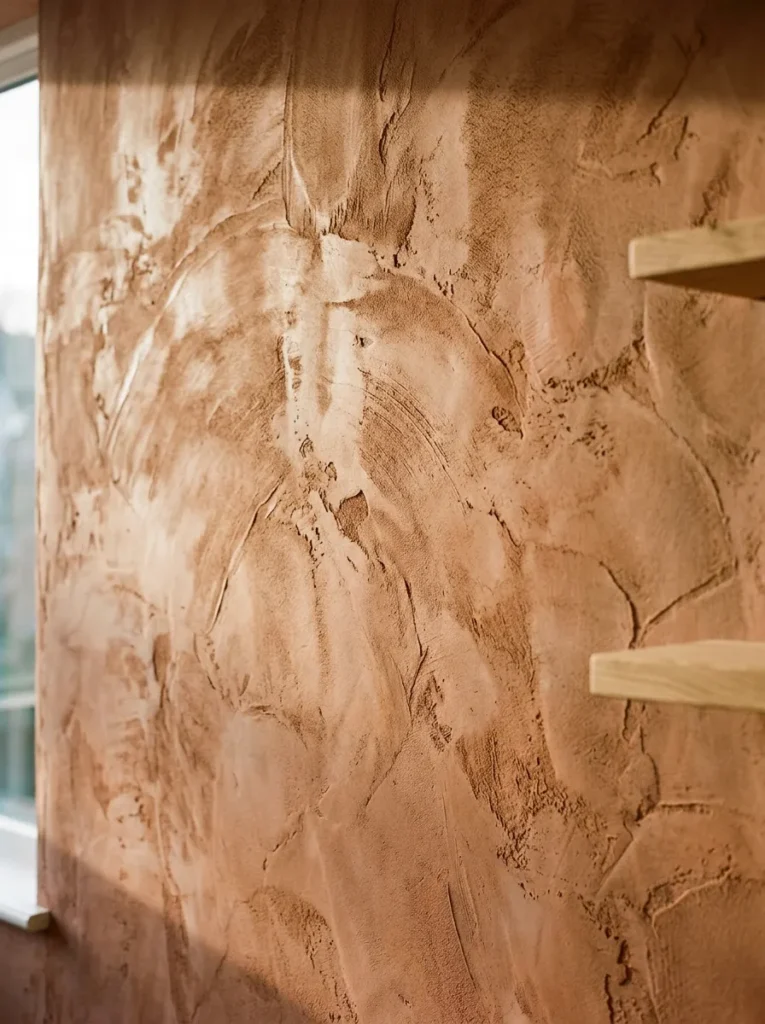
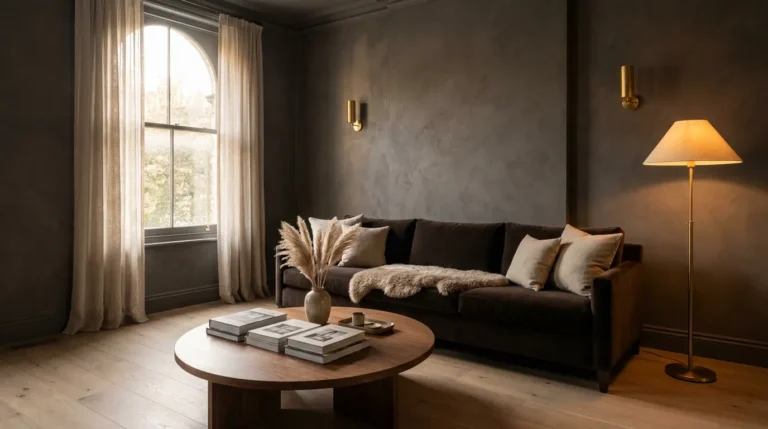
Limewash and Venetian plaster both give a wall surface a quality of material depth that flat paint can’t replicate — the finish shifts with the angle of light, reads differently in morning versus evening, and carries a subtle texture visible at close range. In a living room aiming for an organic quality, this textured wall surface does more to establish the room’s character than almost any furniture or styling decision.
The colour direction should be earthy and warm: clay, warm stone, sand, dusty sage, or a muted terracotta all suit the palette better than cool greys or stark whites. Limewash can be applied over existing painted plaster by most competent decorators. Venetian plaster requires more skill and surface preparation. Both are significantly more expensive than standard paint but more durable and considerably more characterful.
3. Ground the Room With a Large Natural Fibre or Wool Rug
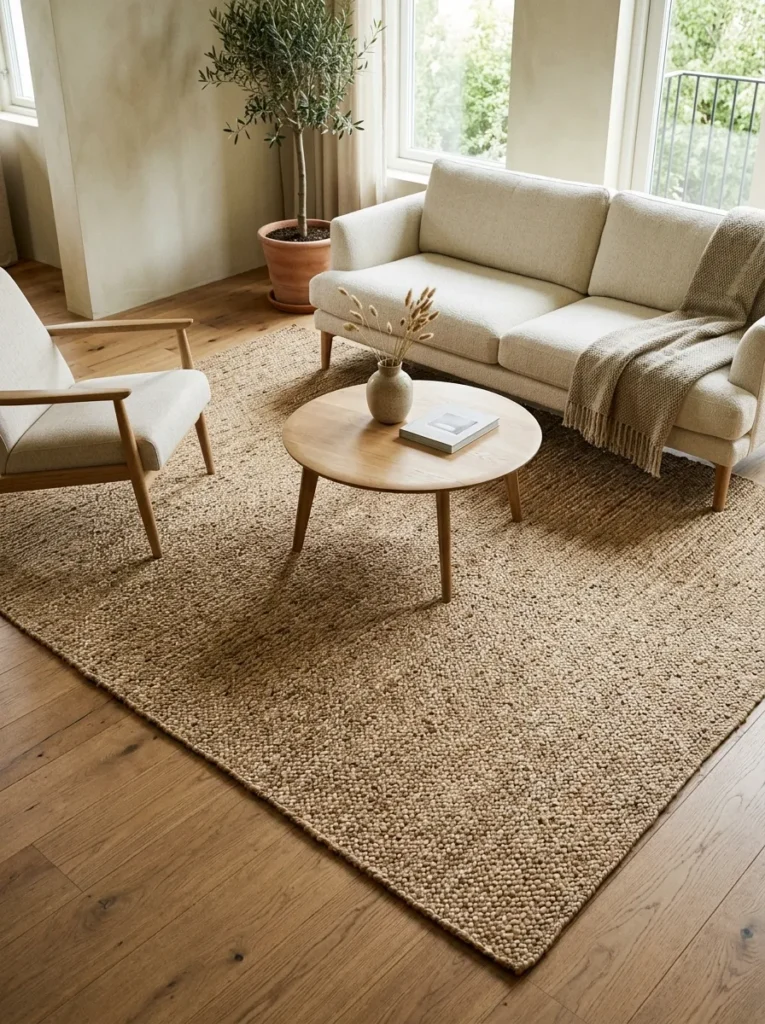
A rug in an organic modern living room needs to be both the right material and the right size. Natural jute, sisal, undyed wool, or a low-pile flatweave in a tone within the room’s palette all suit the organic quality; high-pile shag rugs read plush rather than natural, and brightly patterned rugs compete with the material palette that organic modern depends on.
Size is consistently underestimated. The rug should sit under the front legs of all seating in the living room at minimum — ideally under all four legs of the sofa and chairs — and extend beyond the furniture arrangement by 30–40cm on each visible side. A rug too small for the furniture makes the arrangement look like it was placed without a plan. The rug grounds the entire composition; the furniture sits within it rather than around it.
4. Add a Travertine, Marble, or Raw Stone Coffee Table
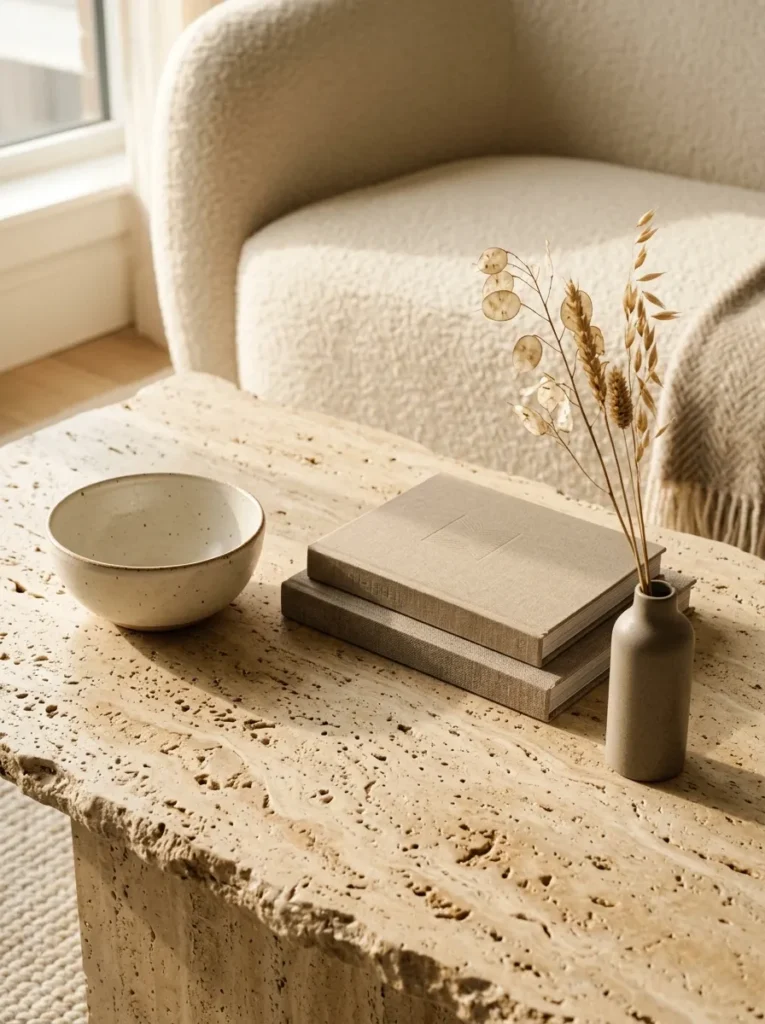
A stone coffee table introduces material weight at the room’s centre — both literally and visually. Travertine, honed marble, and raw-edge stone all carry visible natural variation that mass-produced furniture can’t replicate, and the heaviness of the material provides a visual anchor for the softer, lighter elements around it. A curved sofa alongside a rough travertine coffee table on a natural wool rug is the most characteristic three-piece arrangement in organic modern living room design.
Natural stone requires sealing and periodic maintenance — it stains more easily than ceramic or glass, and travertine in particular needs protection from acidic liquids. A high-quality organic-modern-aesthetic alternative is a large-format concrete or reconstituted stone table: it carries the material quality at lower cost and is typically more durable in daily use.
5. Build the Palette From Earthy Warm Neutrals Rather Than Greige
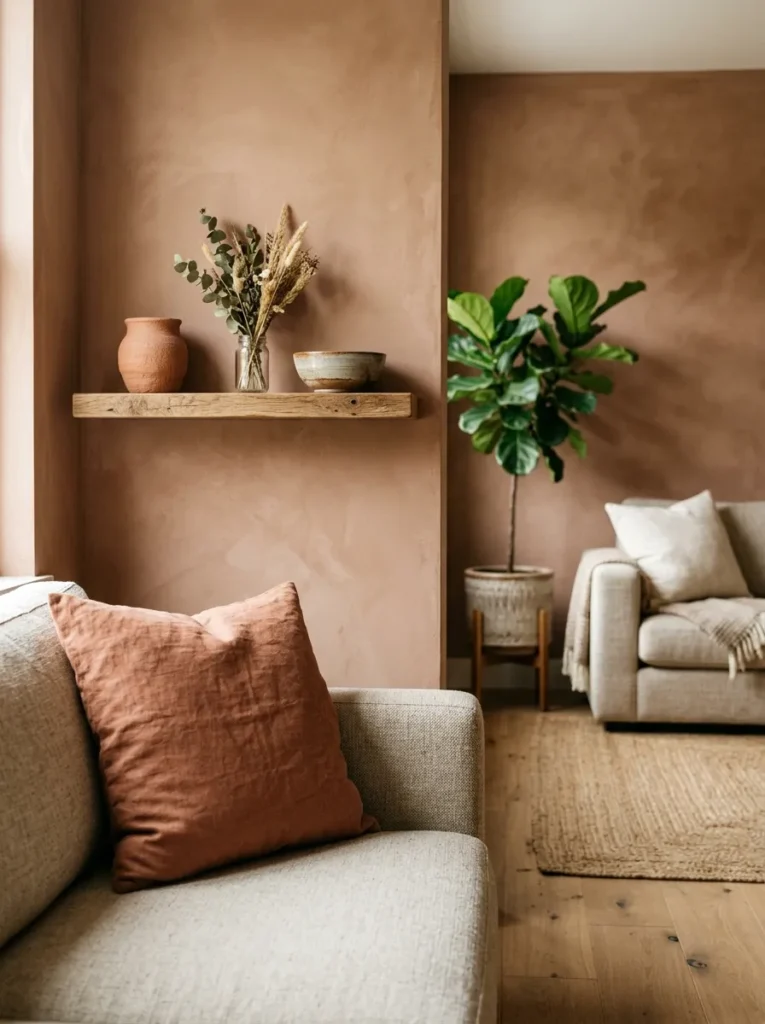
Greige — a grey-beige hybrid — is the default neutral for contemporary living rooms and produces a palette that reads as restrained but not particularly warm or grounded. Organic modern benefits from going slightly further toward earthiness: warm clay, ochre-tinged stone, dusty terracotta, natural linen, and muted olive all carry more warmth than standard greige and respond better to natural light and warm-toned artificial light in the evening.
The palette discipline is keeping all tones in the same warm family. A room with warm clay walls, a cool grey sofa, and a cool-toned rug introduces a temperature conflict that reads as slightly unresolved without the specific cause being obvious. Choose a warm undertone direction early and apply it across walls, soft furnishings, and textiles consistently.
6. Choose Furniture With Organic Form Rather Than Straight Lines
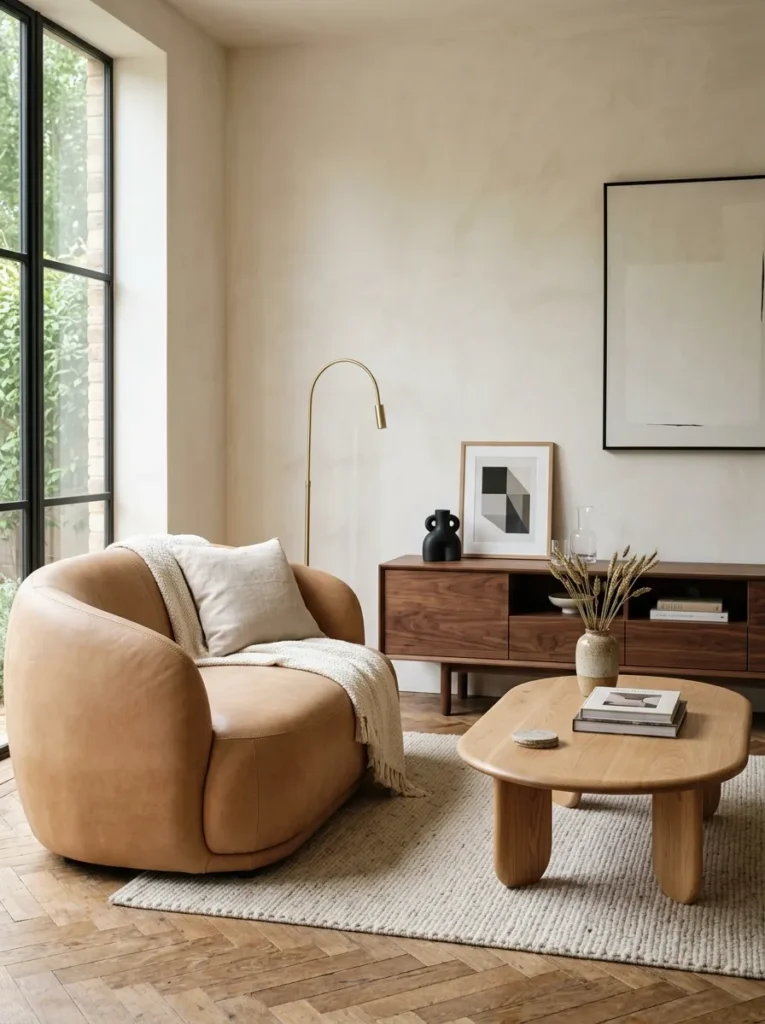
Beyond the sofa, furniture with softened or organic forms — a rounded lounge chair, a circular side table, an oval coffee table, a lamp with an irregular base — contributes to the visual language of the room in a way that right-angled furniture doesn’t. This doesn’t mean every piece needs to be curved; a mix of organic and rectilinear forms is more interesting than a room entirely composed of curved shapes.
The balance to find: one or two genuinely rounded or organic-form pieces as focal furniture, with the remaining pieces in a restrained contemporary form that provides structural contrast without competing. An entirely curved room can read as theatrical rather than relaxed, and the organic modern aesthetic at its best is characterised by ease rather than effect.
7. Layer Warm Artificial Lighting at Three Heights
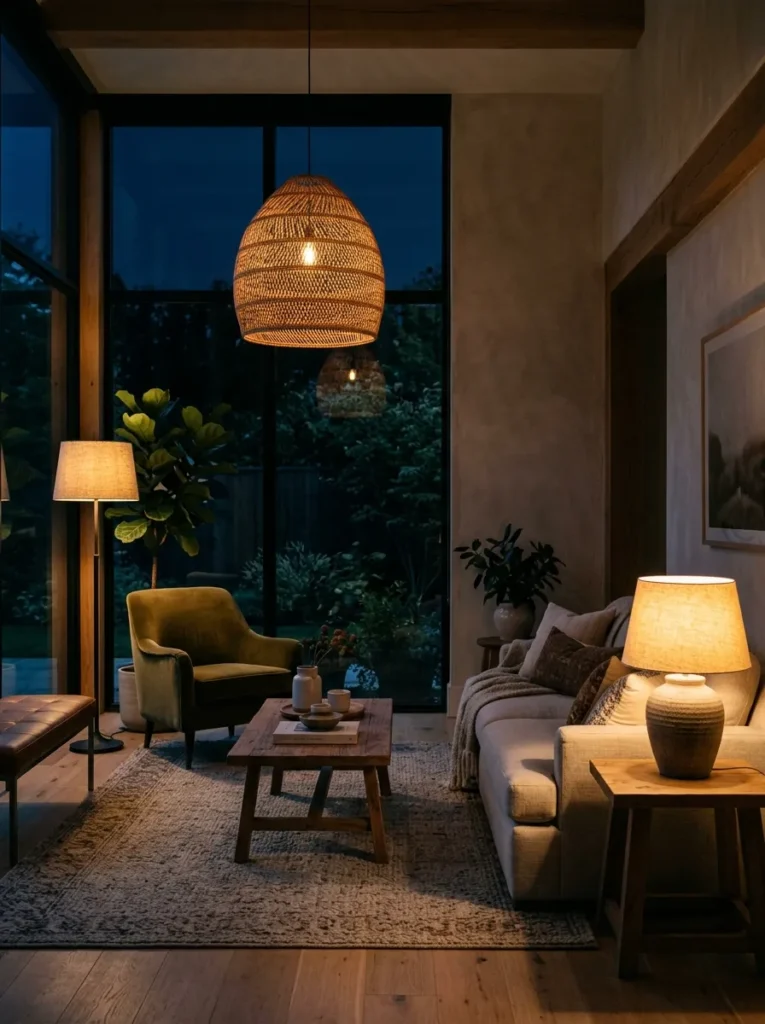
The lighting plan in an organic modern living room determines how the room reads after dark, and in a room built around natural materials and warm tones, the quality of artificial light is a foundational decision rather than a finishing one. Three lighting heights — a pendant or ceiling fitting overhead, a floor lamp in a corner or behind a chair, and table lamps at sofa arm level — produce a layered warmth that a single ceiling source cannot replicate.
All sources should use warm-white bulbs (2700K). At this colour temperature, the plaster wall’s texture deepens, the wood furniture reads richer, and the stone coffee table takes on a slightly golden quality. Cool-white bulbs in the same room would flatten all those material qualities and make the warm neutral palette look flat and slightly cold.
8. Introduce Aged or Reclaimed Wood in One Major Element
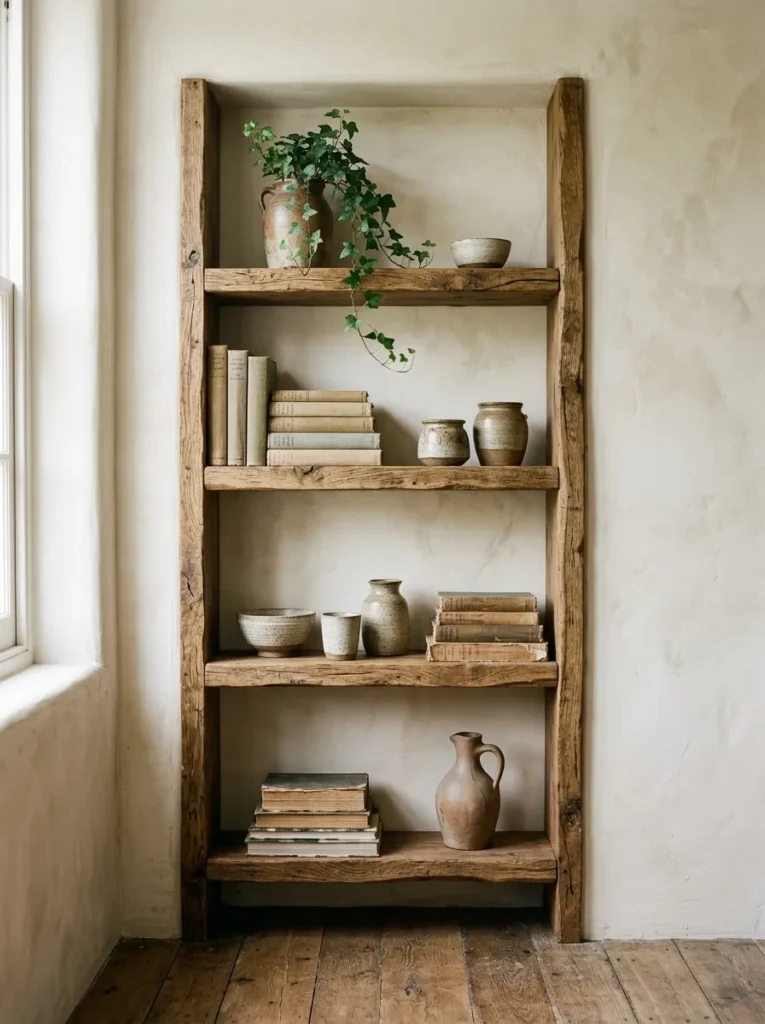
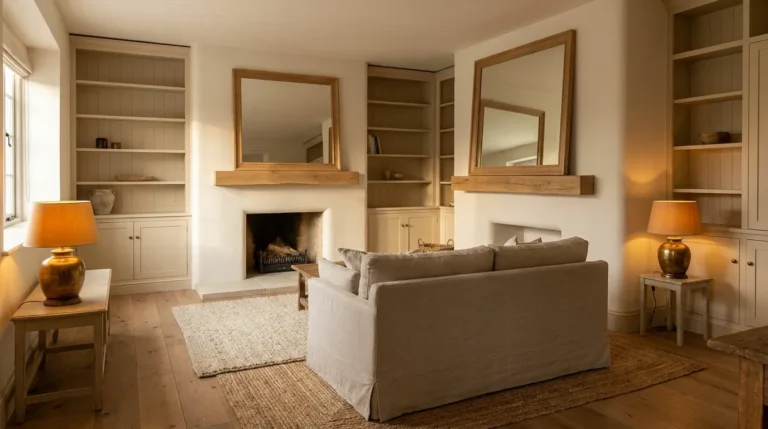
Aged or reclaimed timber carries visible history in its surface — grain patterns, colour variation, slight imperfections — that new wood in a standard contemporary finish doesn’t. In an organic modern living room, this history provides the depth and character that distinguishes the aesthetic from a merely contemporary one. A reclaimed oak media unit, an aged timber bookshelf, or a raw-edge wood console behind the sofa introduces this quality without requiring the whole room to feel rustic.
The wood tone should stay within the warm family of the room’s palette: warm honey oak, aged walnut, or a sun-bleached teak all sit within the earthy warm register. Grey-washed or heavily bleached timber reads cooler and suits a different palette direction.
9. Place a Large Architectural Indoor Tree Rather Than Multiple Small Plants
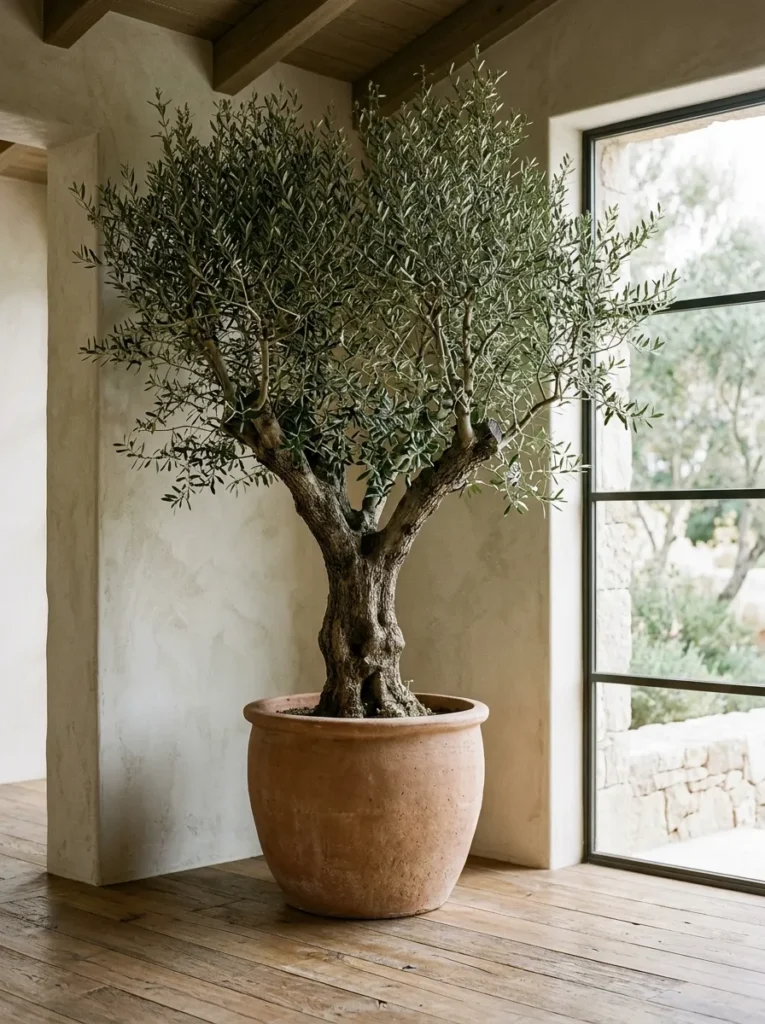
A single large plant — a fiddle-leaf fig, an olive tree in a generous container, a large monstera, or a tall olive-trunk olive — reads as an architectural element rather than decoration. In an organic modern living room, one statement plant positioned where it receives adequate light (usually near the main window) does more to establish the room’s character than a collection of small potted plants scattered across surfaces.
The container matters as much as the plant. A large textured terracotta planter, a matte ceramic vessel in an earthy tone, or a basket weave container in a natural material all suit the palette. A plastic nursery pot on display, or a container in a colour that competes with the room’s palette, undercuts the effect of an otherwise well-chosen plant.
10. Use Linen or Bouclé for Cushions Rather Than Polycotton
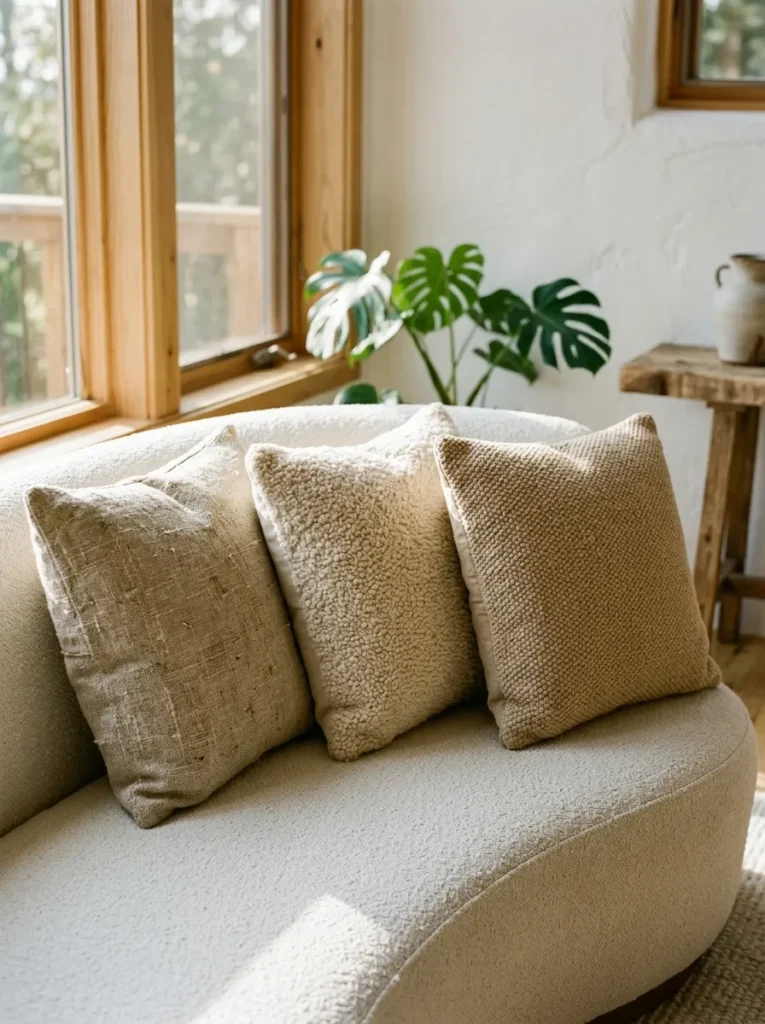
Cushion fabric in an organic modern living room should have visible texture — the kind that catches light differently depending on the angle and registers as a material rather than a colour. Linen, bouclé, nubby cotton, and natural undyed canvas all have this quality; smooth polycotton covers and synthetic velvet don’t, and they read as slightly incongruous against the organic material palette the rest of the room is working toward.
Two or three cushions in a combination of textures within the same tonal family is more considered than many cushions in competing colours. In the organic modern palette, the variation should be textural — rough linen beside coarser bouclé beside a tightly woven nubby cotton — rather than a colour contrast that introduces competing tones.
11. Leave Significant Empty Space on Every Visible Surface
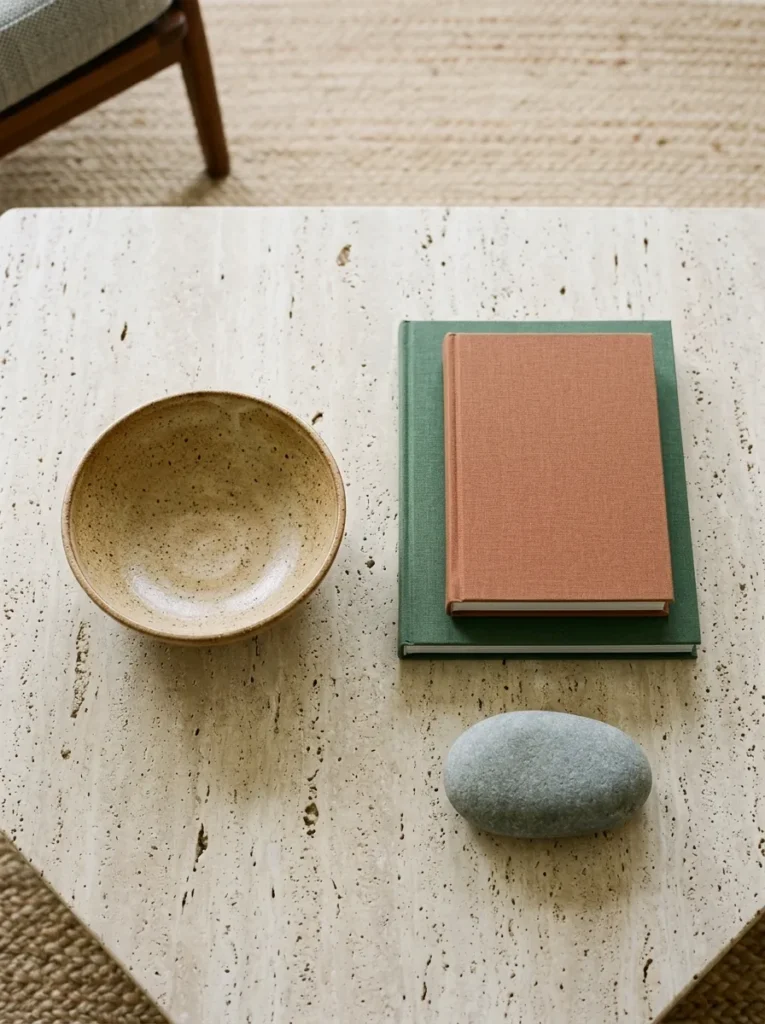
An organic modern living room with every surface fully styled reads as a showroom rather than a home. The empty space on a coffee table, beside a lamp on a console, on a shelf between two objects — this negative space is part of the room’s visual composition, not evidence of incompleteness. The objects on display should be chosen carefully enough that each one can be seen clearly rather than contributing to a general mass of things.
Three to five objects on a coffee table, arranged with some breathing room between them, reads as considered. Eight objects of equal visual weight on the same table reads as cluttered, even if each individual piece is interesting. The discipline of removing rather than adding is harder to maintain than adding, and in an organic modern room it’s the discipline that most consistently determines the result.
12. Choose a Rounded or Organic-Form Mirror for the Main Wall
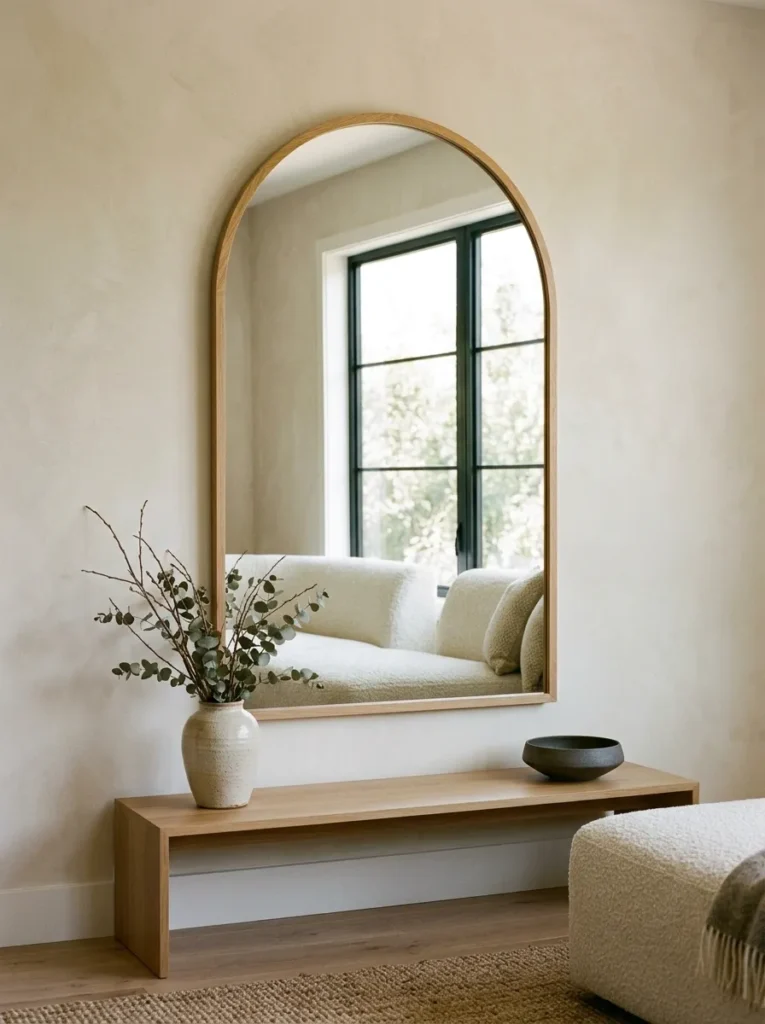
A mirror in an organic modern living room serves two purposes: it bounces light across the room (particularly useful in rooms with limited natural light) and it contributes to the aesthetic’s formal vocabulary. Circular mirrors, arch-shaped mirrors, and mirrors with an irregular or naturally edged frame all suit the organic quality; rectangular mirrors with sharp right-angle frames read as more firmly contemporary.
Position the mirror on the wall that most benefits from reflected light — typically the wall opposite the main window, where it reflects daylight back into the room during the day and reflects lamplight in the evening. A mirror reflecting interesting elements of the room (the textured wall behind it, the view through the window) is more useful than one reflecting a blank wall or the back of a sofa.
13. Incorporate Woven and Handmade Objects at Varying Scales
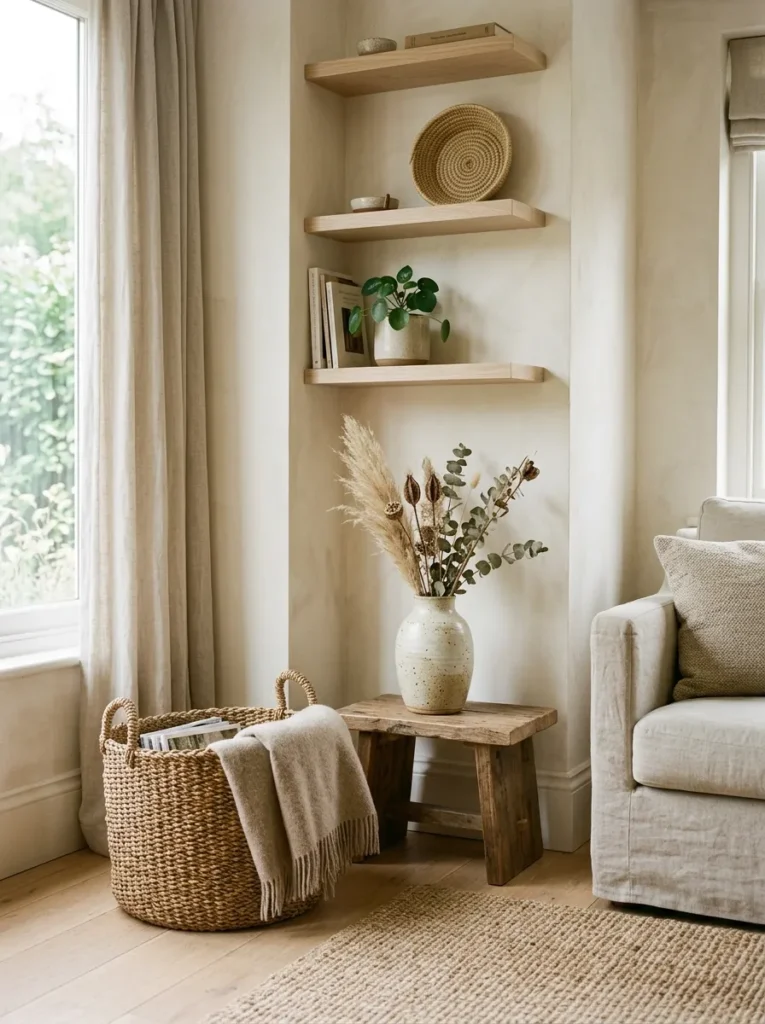
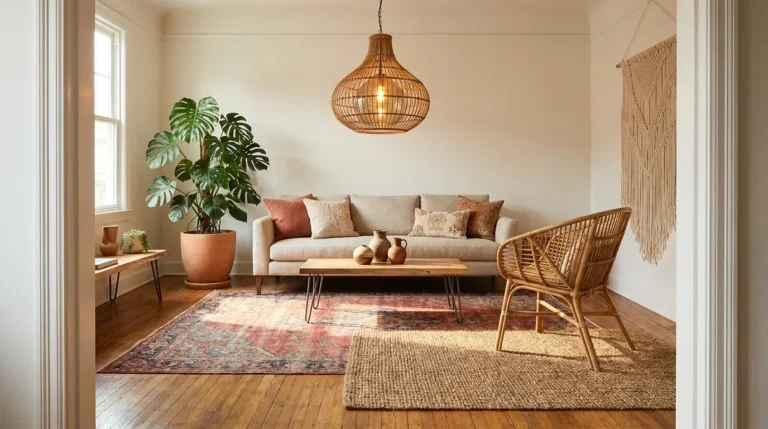
Hand-woven baskets, hand-thrown ceramics, woven wall hangings, and hand-formed objects contribute to the organic register of the room in a way that mass-produced decorative objects with perfect uniformity don’t. The slight irregularity of a hand-thrown pot, the visible weave of a basket, and the texture of a handmade textile all read as genuinely organic rather than stylistically organic.
Scale variation matters: a very large woven basket on the floor beside the sofa, a medium ceramic vessel on the coffee table, and a small woven object on a shelf provide range across the room rather than concentrating all the handmade objects at one height or in one zone. This prevents the room from reading as a single styled display and gives it a quality of distributed warmth.
14. Select Floor-to-Ceiling Curtains in a Raw or Textured Fabric
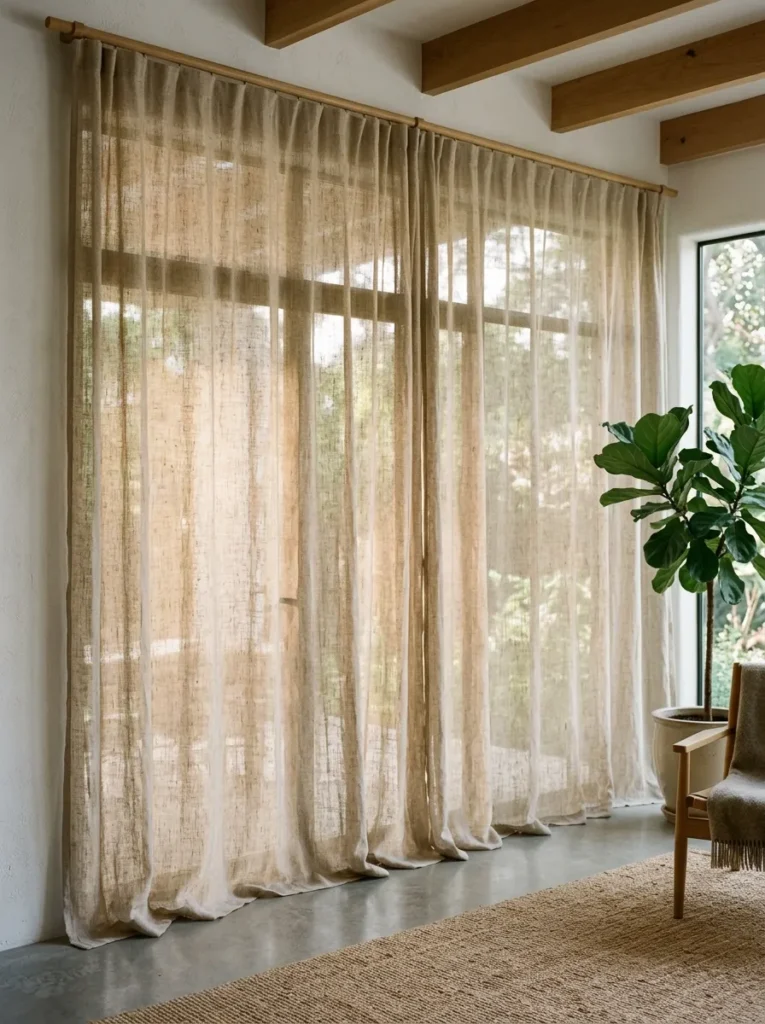
Curtains in an organic modern living room should contribute to the material palette rather than simply covering the window. Floor-to-ceiling linen, raw cotton, or a loosely woven natural fabric in a tone close to the wall colour — or slightly lighter than the wall — treats the window wall as a continuation of the room’s palette rather than an interruption of it.
Curtains installed at ceiling height rather than window height make the room read as considerably taller and the window as considerably larger without any structural change. The fabric should be heavy enough to hang with some weight rather than floating or billowing, which can look insubstantial against the material seriousness the rest of the room is working toward.
15. Create a Reading Corner With a Chair, Lamp, and Side Table
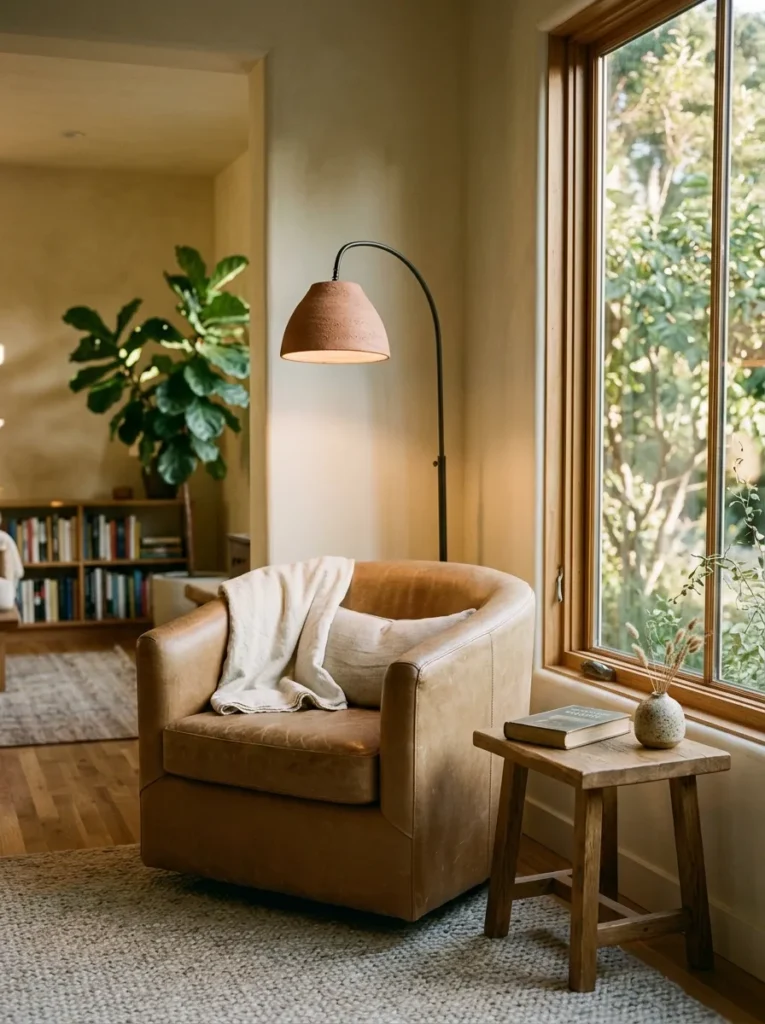
A dedicated reading corner — a lounge chair with its own floor lamp and a small side table — creates a second seating zone within the living room that makes the room feel more layered and more intentional. In an organic modern living room, this corner is also an opportunity to introduce a contrasting material or form: if the sofa is in bouclé, the reading chair can be in aged leather; if the coffee table is stone, the side table can be in weathered oak.
The corner works best adjacent to a natural light source (a window) or, in the evening, as a fully self-contained lit zone with the floor lamp providing all the light needed for reading without requiring the overhead circuit. This dual-use quality — part of the room by day, a contained lit space by evening — is the kind of functional detail that makes a living room genuinely pleasant to be in.
16. Use Wood Panelling or Textured Wall Treatment Behind the Sofa
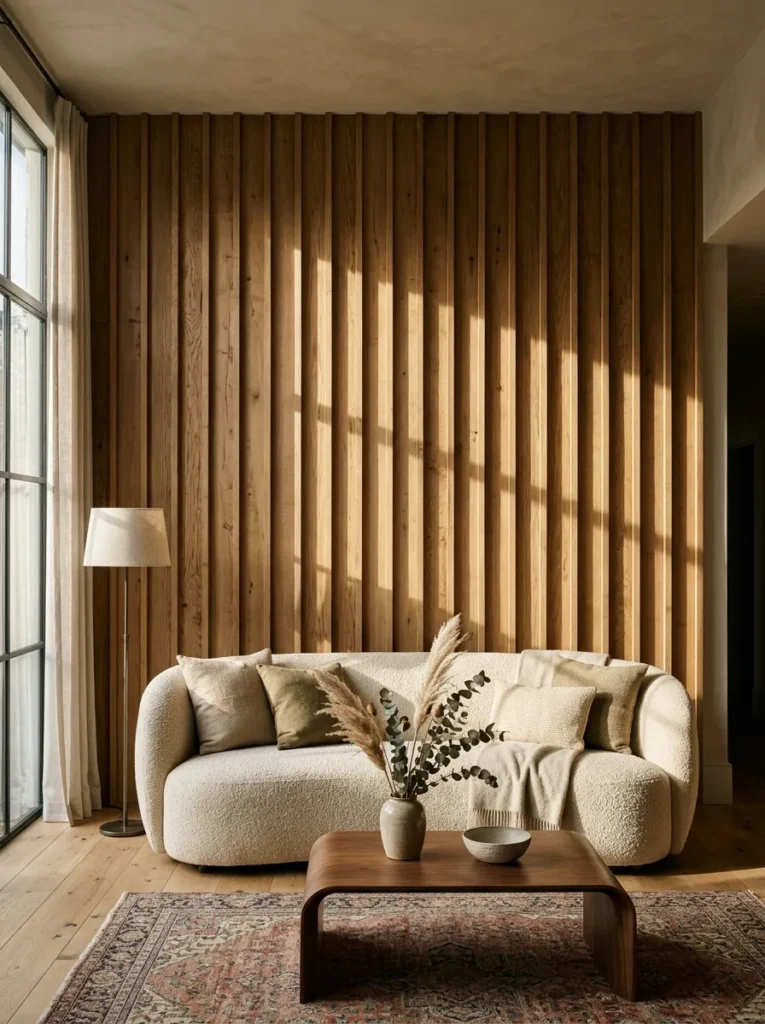
The wall behind the sofa is the room’s most photographed surface and the one most visible from the main entry point. A timber panel treatment — shiplap, vertical board-and-batten, or a more sophisticated solid oak panel — or a textured plaster finish in an earthy tone behind the sofa gives the main wall material depth that paint alone can’t provide.
This approach suits rooms where the wall is long enough to accommodate the panelling as a considered surface rather than a partial application that reads as unfinished. In a room with standard ceiling heights, ceiling-to-floor panelling behind the sofa makes the wall read as architectural. Dado-height panelling with plaster above reads more transitional and suits older properties better than contemporary ones.
17. Keep the Television Considered Rather Than Central
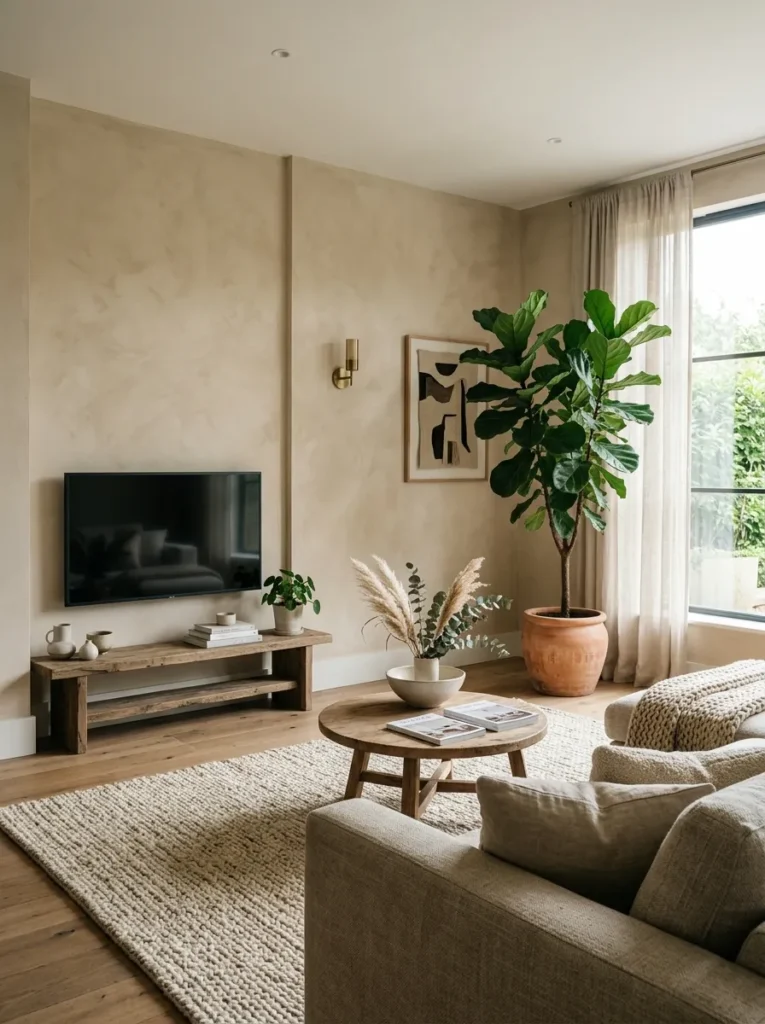
A television positioned as the primary focal point of the room — usually mounted centrally above the fireplace or on the main viewing wall — tends to work against the organic modern aesthetic, which is built around material quality and visual composition rather than screen placement. An alternative position — a slim TV on a low media unit to one side, or a recessed panel that becomes a secondary rather than primary focal point — integrates the television into the room without making it the room’s visual organiser.
If the main seating faces the television, consider whether the room can accommodate some sofa rotation so the television is viewable from a secondary position rather than the only position. A room that functions only as a TV room doesn’t benefit much from the effort put into its organic material palette.
18. Add a Low Bench or Ottoman Between the Sofa and Coffee Table
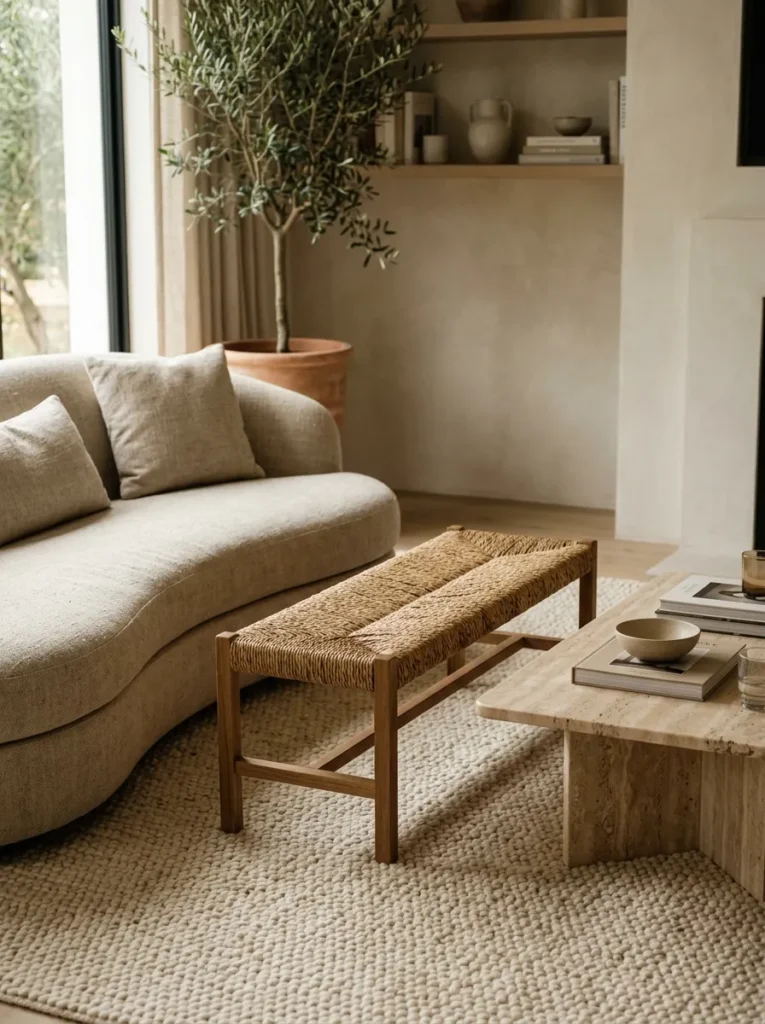
A low bench or large ottoman in the space between a curved sofa and the coffee table provides flexible seating for additional guests, a footrest for regular use, and a visual transition between the sofa’s soft form and the coffee table’s harder material. In organic modern rooms, an ottoman in a natural leather, a woven seagrass bench, or a low upholstered bench in a textured fabric contributes another material layer at floor level.
The height should sit below the seat height of the sofa — typically 35–45cm — so it reads as a lower element rather than competing with the sofa visually. A bench or ottoman significantly wider than the coffee table beside it can make the arrangement feel overcrowded; one that’s narrower reads as an additional element within the composition rather than a competing piece.
19. Choose Side Tables and Occasional Tables in Different Materials
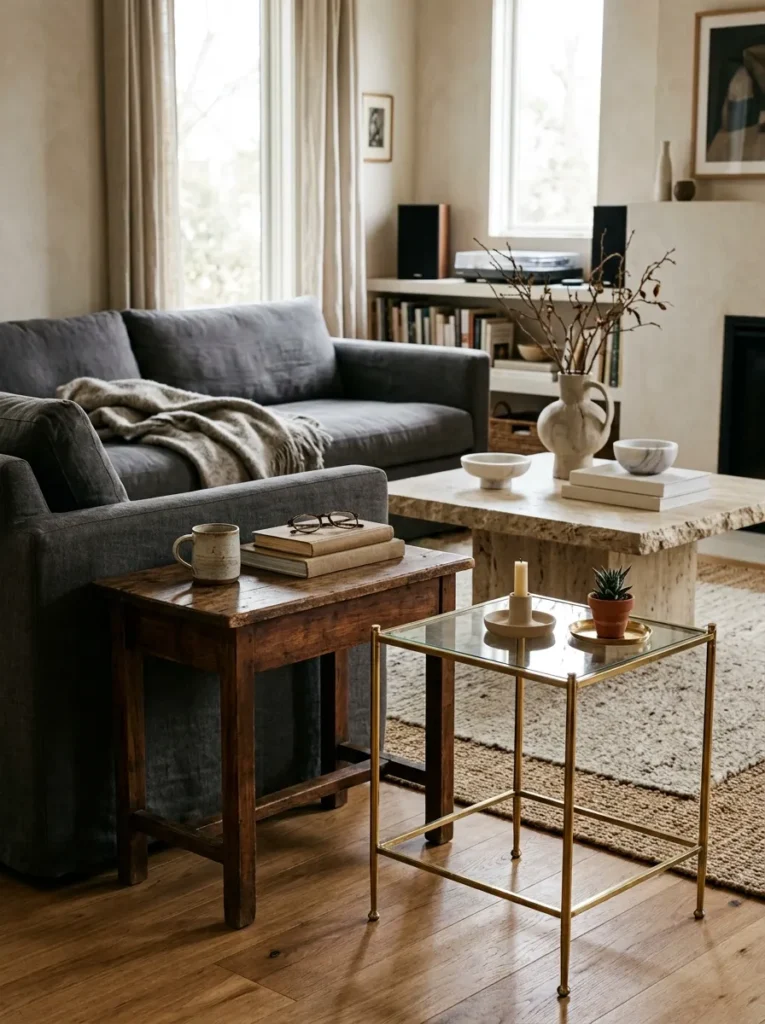
Repeating the same material in every table surface — all-stone, all-wood, all-metal — produces a room that reads as coordinated but not layered. A mix of surface materials — a stone coffee table alongside a small aged-timber side table and a slim brass-framed accent table — reflects the organic modern approach’s emphasis on material variety within a cohesive palette.
The forms can be similar while the materials differ; the materials can vary while the scale remains consistent. What undermines the room’s coherence is table forms and materials that are so different they don’t read as related — a very traditional carved wood side table beside a very contemporary glass surface, for instance, produces a visual conflict that neither piece would cause in a more matched context.
20. Use a Large Statement Light Fitting as a Design Object
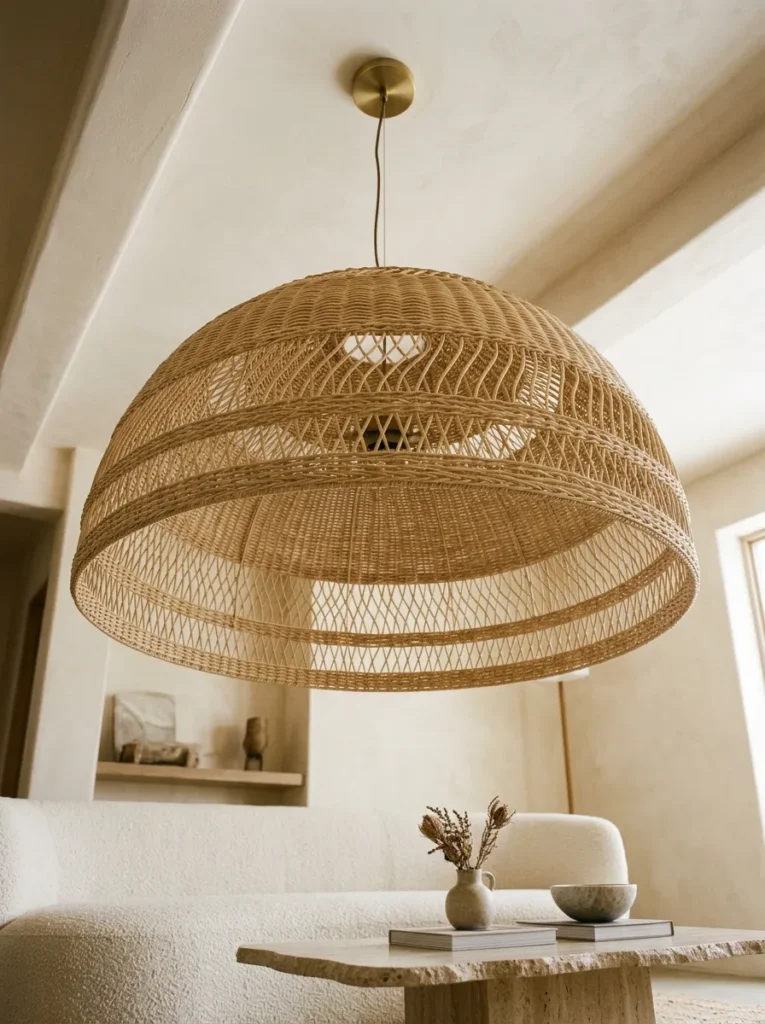
A pendant or sculptural floor lamp that reads as an object in its own right — not just as a light source — is one of the more high-impact additions available to an organic modern living room. A large paper pendant with visible fibres, a woven rattan hanging fixture, a ceramic pendant in an irregular glaze, or a floor lamp with a hand-formed base all contribute to the material register of the room and serve as one of its most visible design decisions when switched off as well as on.
The scale should be generous enough to hold its own in the room — a pendant that’s too small in a room with high ceilings and substantial furniture reads as provisional. A large pendant in a natural material at the room’s centre is one of the most immediate visual signals of the organic modern aesthetic.
21. Resist the Impulse to Add One More Thing
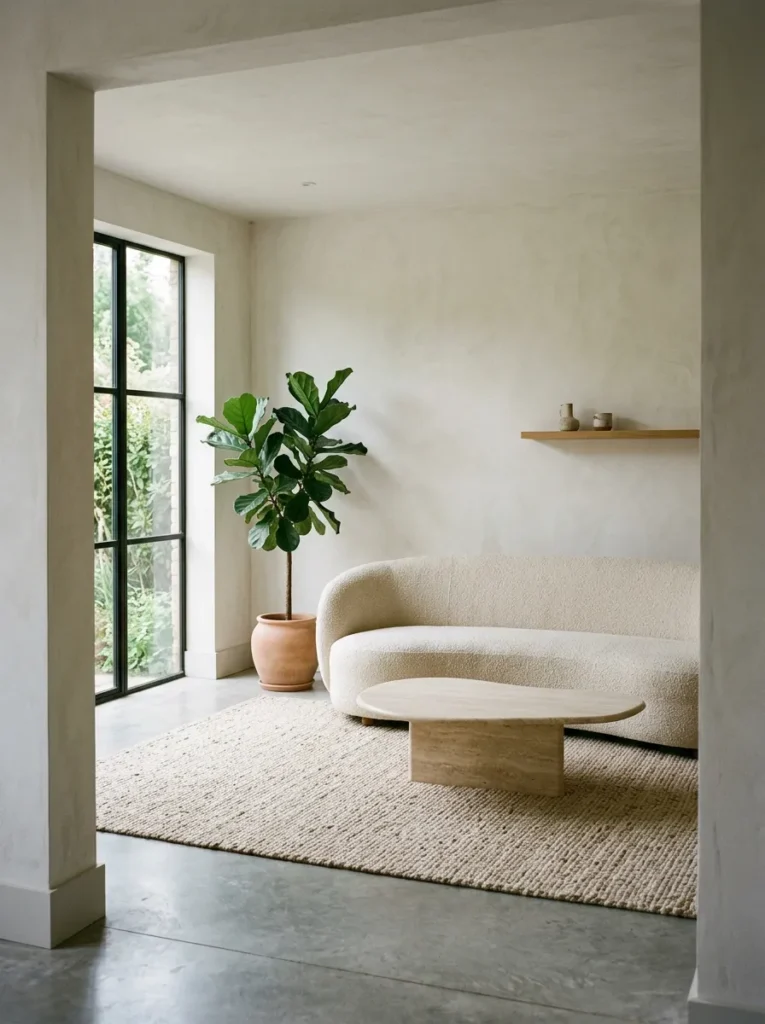
The quality that distinguishes a genuinely resolved organic modern living room from a room that’s been worked on extensively is usually subtraction rather than addition. Rooms that feel relaxed and considered typically have fewer objects on more surfaces rather than many objects everywhere. In a room where every material has been chosen carefully, each surface is visible, and each object earns its place — there’s usually a point at which adding anything more reduces the quality of the room rather than improving it.
Spend time with the room after the main decisions are made. See how it reads after a few weeks of living, when the initial instinct to style and fill has passed. The things that feel necessary after that period are the ones worth keeping; everything else is probably adding noise rather than character.
Final Thoughts
Organic modern living room ideas work best when the foundational decisions — the palette, the primary materials, the furniture silhouettes — are made deliberately before any styling begins. A curved sofa in the right fabric, a stone table, textured walls, and warm layered lighting produce a room that looks considered before a single object is placed on any surface. The styling and object choices are the finishing layer, not the load-bearing structure.
Not every idea in this guide belongs in the same room. A small living room doesn’t need a large floor plant and a reading corner and a statement pendant and a wall treatment — it needs the three or four ideas that address its specific spatial constraints most effectively. Start with the largest surface decisions: the wall treatment and the sofa. From those two choices, the palette and material direction of everything else becomes much easier to determine.
Save the ideas that apply to your room and come back when you’re ready to make the decisions that matter.