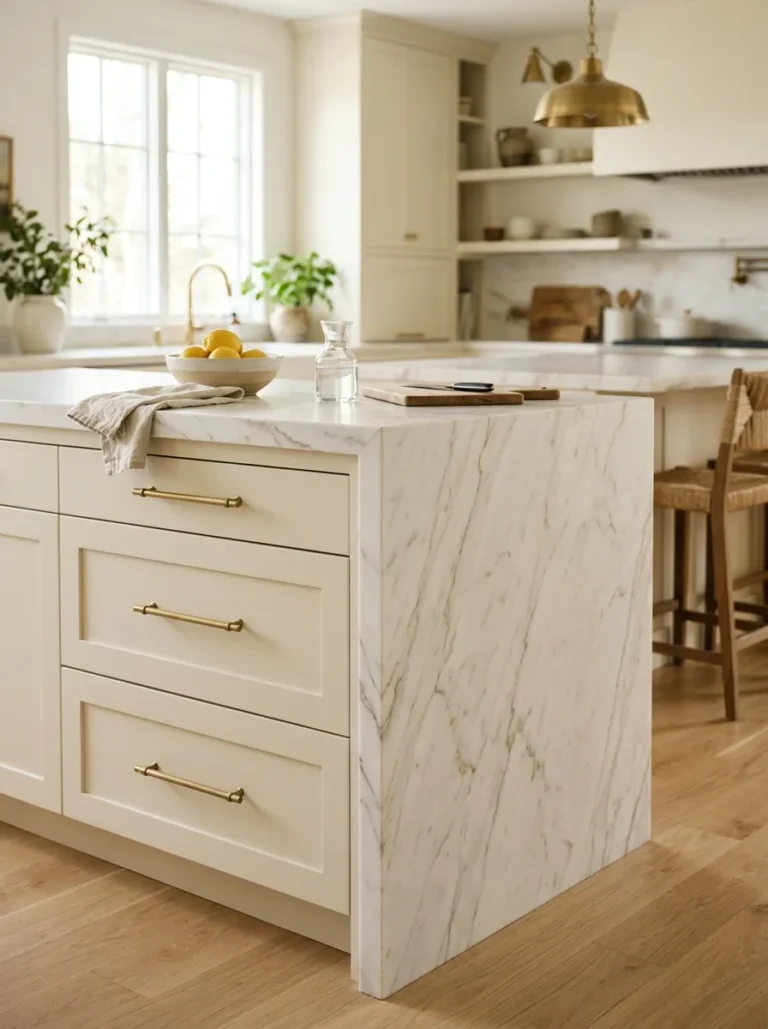
18 Farmhouse Bedroom Ideas That Feel Cozy Without Looking Dated
Farmhouse style has been one of the most searched bedroom aesthetics for years, which means there’s also a surplus of versions that feel like a checklist rather than a room — shiplap ticked, mason jar lamp ticked, barn door ticked, charm missing.
The bedroom ideas here are about getting the underlying principles right. Farmhouse at its best borrows from the unpretentious, tactile character of older rural homes: rough-hewn wood, handmade-feeling textiles, simple ironwork, faded linens, and a palette that reads as naturally faded rather than deliberately distressed. None of those qualities require a farmhouse. They require considered choices.
Some of these ideas work together. Others are better used selectively. The goal isn’t to layer every element into one room — it’s to understand which ones suit your space and how to use them without the result looking like a set piece.
1. Choose a Bed Frame That Sets the Style’s Tone
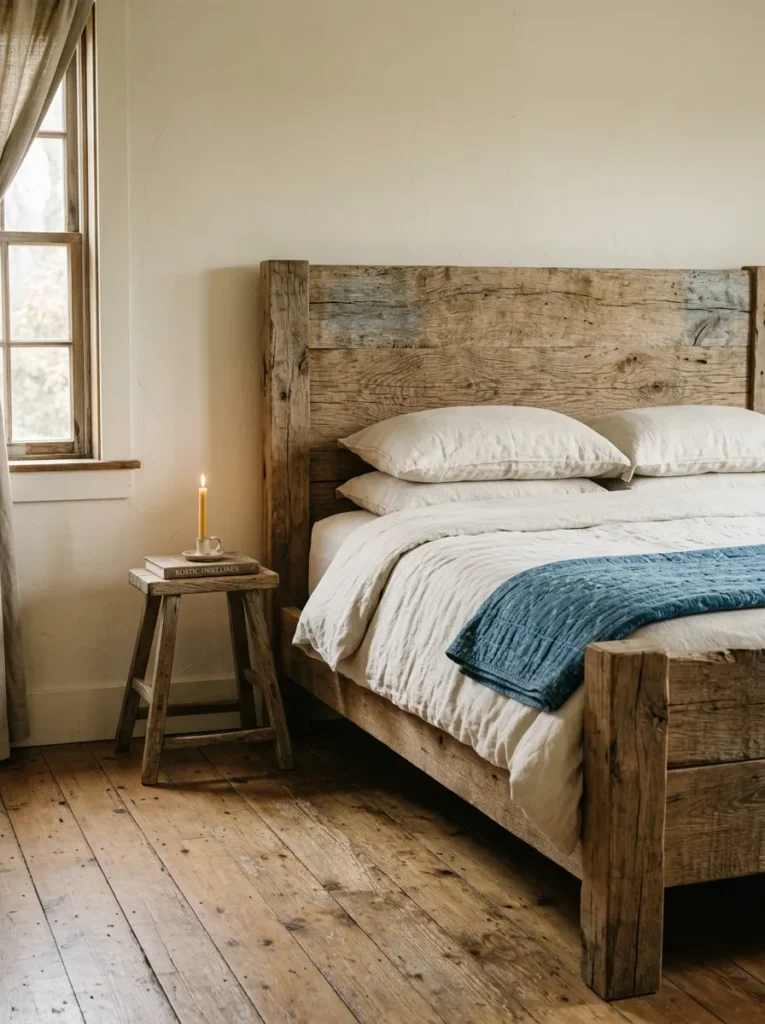
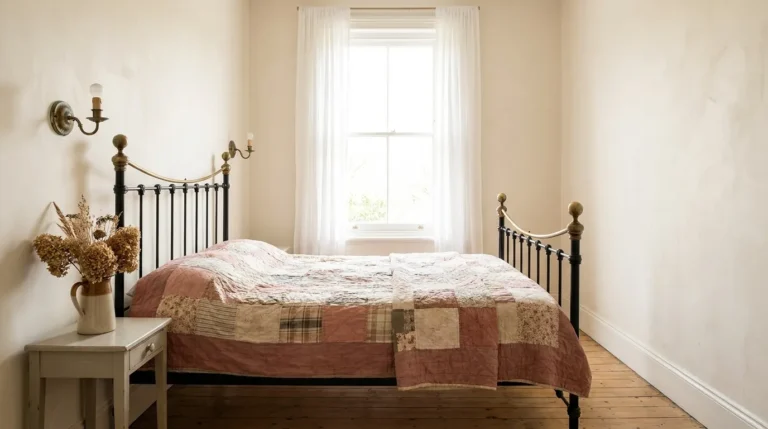
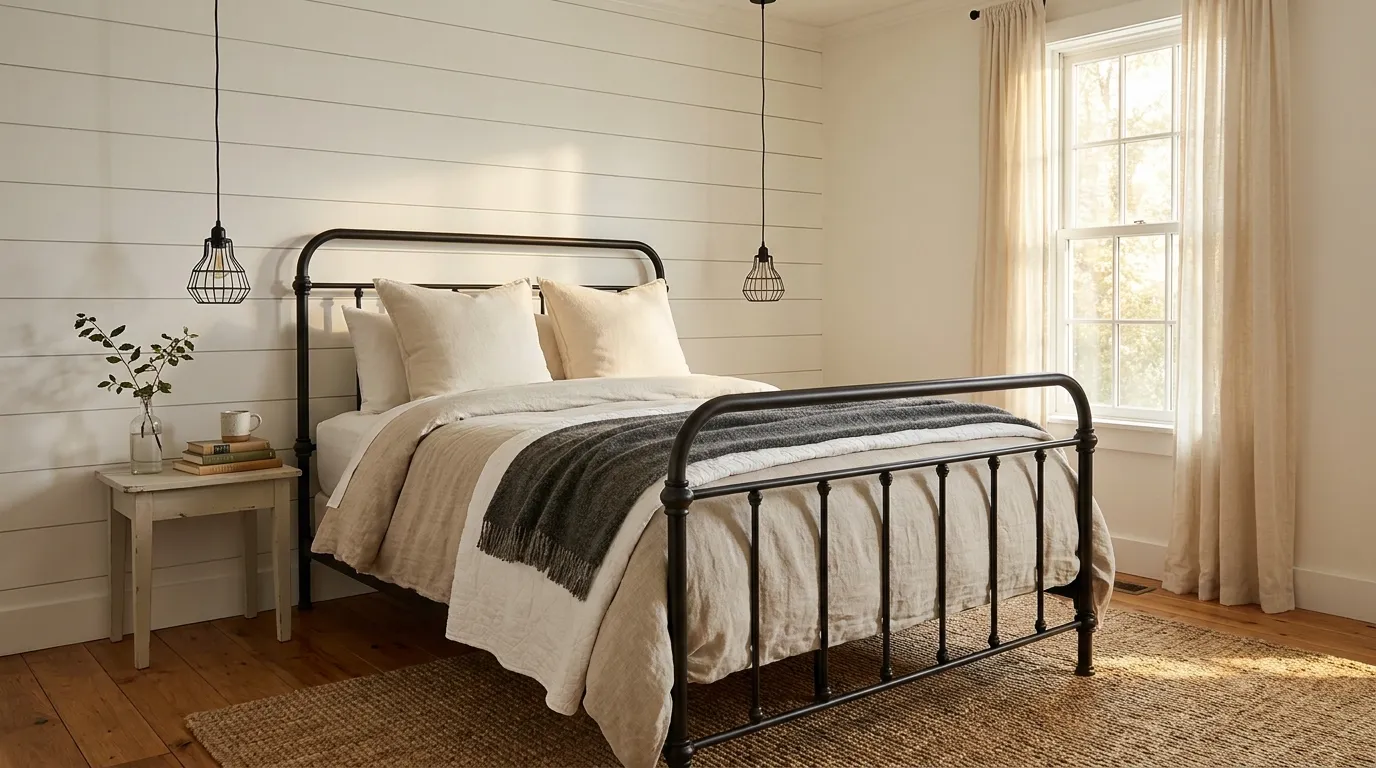
In a farmhouse bedroom, the bed frame is the single decision that most firmly establishes the aesthetic direction. An iron or steel bed with simple spindle detailing reads as classic farmhouse — understated and slightly industrial in a way that pairs with almost any other element in the style. A solid reclaimed wood headboard reads as a more organic, rougher take. A distressed white painted wood frame leans toward the softer, more washed-out end of the spectrum.
The mistake is choosing a frame that’s too ornate. Scrollwork and elaborate flourishes tip toward Victorian rather than farmhouse. Simple is the operative word: clean verticals, honest materials, and — if painted — a finish that looks like it might have been repainted once or twice over the decades.
For smaller rooms, an iron frame with visible floor clearance keeps the room from feeling heavy. In a larger room, a solid wood king-frame can anchor the space without dominating it.
2. Use Shiplap on One Wall, Not All Four
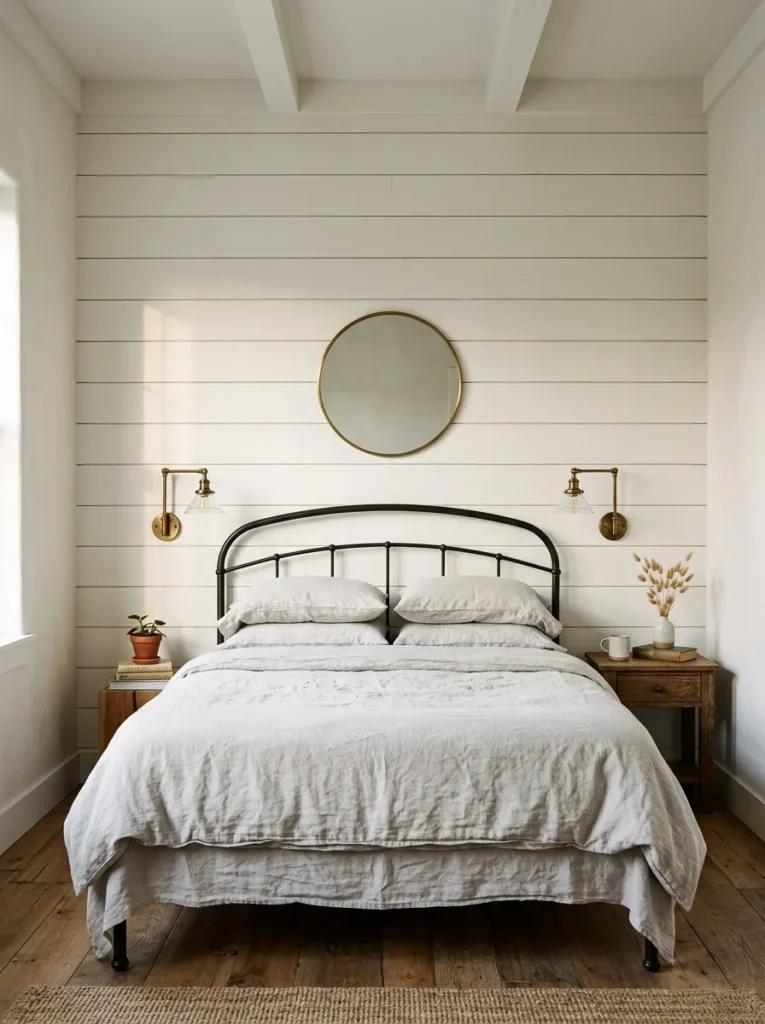
Shiplap is perhaps the most recognizable farmhouse element, and the most overused. Full-room shiplap coverage — all four walls — usually reads as a renovation statement rather than a design choice. The wood’s horizontal rhythm is compelling precisely because it contrasts with surrounding surfaces; when it’s everywhere, the contrast disappears and the texture becomes visually exhausting.
One wall behind the bed does the work reliably: it frames the headboard, creates a focal point, and introduces the raw material quality that defines the style without requiring the room to commit entirely to it. Paint it the same white as the surrounding walls if you want subtlety. Leave it natural if you want warmth.
For renters, paintable shiplap panels or peel-and-stick board-and-batten profiles offer a lower-commitment alternative. They’re not identical but serve the same structural visual purpose.
3. Layer Linen Bedding Rather Than Matching It
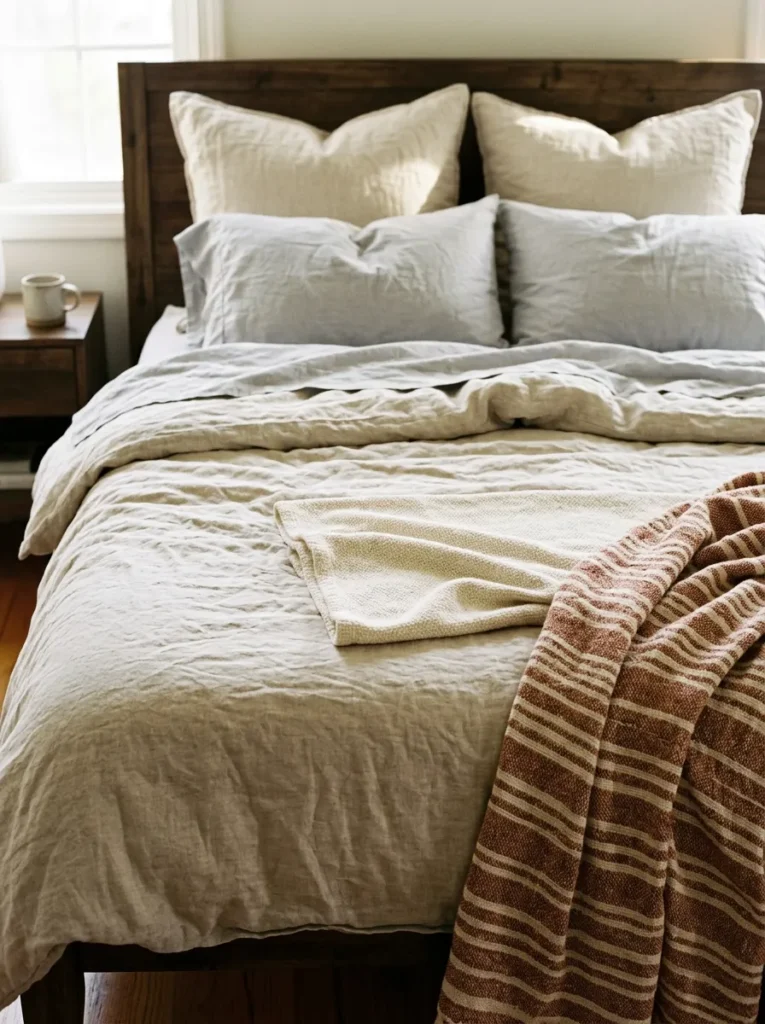
The bed in a farmhouse bedroom should look like it belongs to someone who actually sleeps in it — not a hotel turndown. That quality comes from layering rather than matching. A washed linen duvet in oatmeal or pale flax, a lighter cotton blanket folded at the foot, two euro shams in a slightly different neutral, and a quilt or woven throw in a complementary tone create the kind of comfortable, lived-in surface that defines the style.
Washed linen is the right fabric choice here: it wrinkles authentically, softens with every wash, and holds the slightly faded quality that farmhouse interiors depend on. Crisp white sateen reads as hotel; stiff polyester wrinkles badly and catches light in ways that betray the material immediately.
The practical note: linen requires accepting imperfection. If an unwrinkled bed matters to you, a cotton-linen blend gives similar texture with less daily wrinkle volume.
4. Install Exposed Wood Ceiling Beams for Architectural Depth
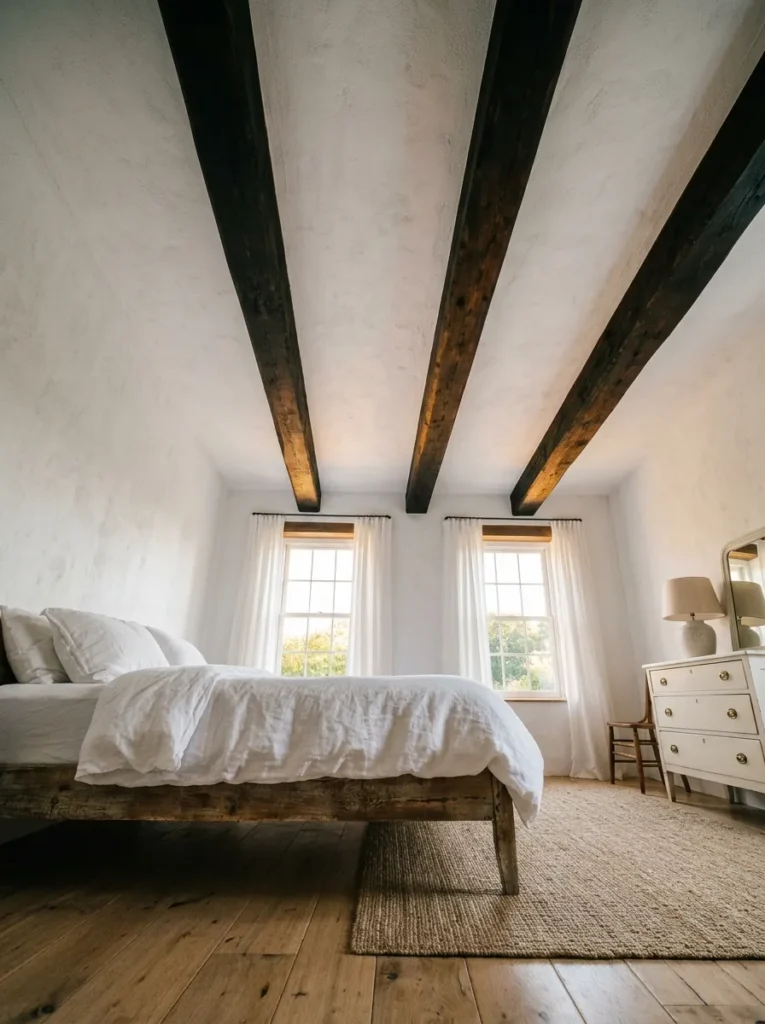
Ceiling beams — whether structural or decorative — bring the single most dramatic architectural shift available to a farmhouse bedroom. They draw the eye upward, add the kind of overhead texture that plastered ceilings lack, and signal a relationship with traditional construction that sits at the heart of the style.
The honest caveat: real reclaimed beams are heavy and installation requires professional assessment of ceiling load capacity. Faux hollow beams in stained polyurethane are considerably lighter, easier to install, and convincing at typical ceiling heights where close inspection isn’t possible. The visual effect is similar; the material isn’t. Neither is deceptive if you’re decorating rather than restoring.
For rooms with lower ceilings — under about 8 feet — beams can feel oppressive rather than characterful. They work best with ceiling heights of 9 feet or more, where the structural reading is believable and the room absorbs the added overhead weight gracefully.
5. Choose Matte Black or Aged Iron Hardware Throughout
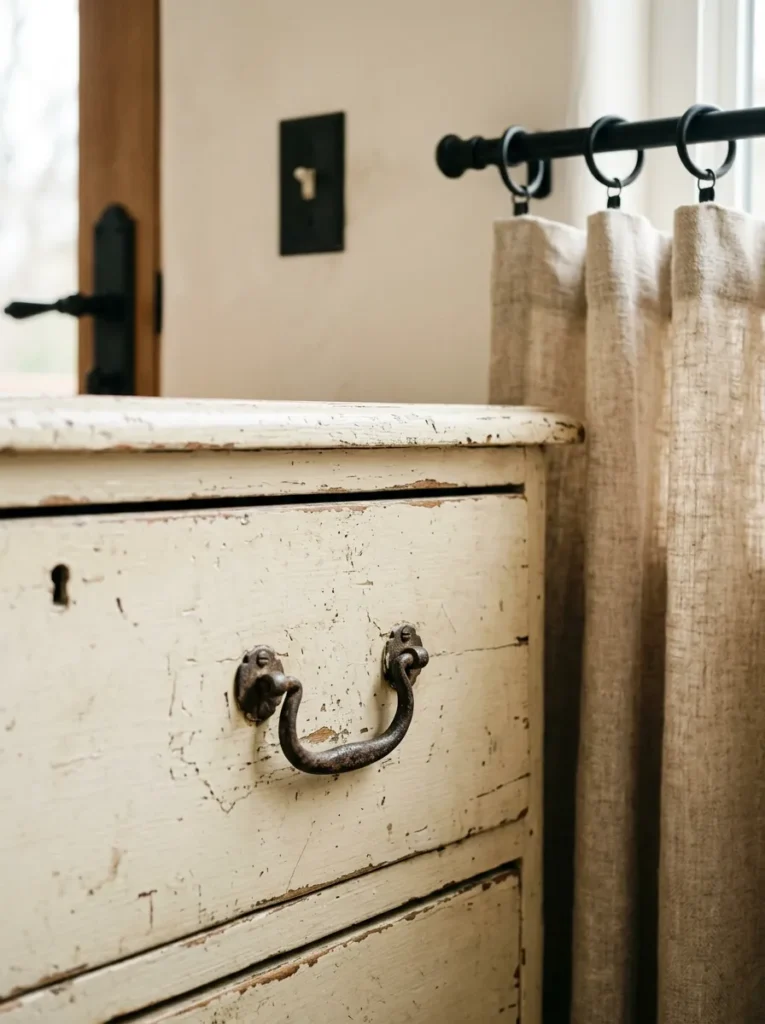
Hardware consistency across a bedroom — door handles, dresser pulls, curtain rod finials, mirror frame details, light switch plates — is a detail that rarely gets mentioned in farmhouse bedroom inspiration but makes a substantial difference in the cohesion of the finished room.
Matte black or aged iron hardware reads as authentically old-house in a way that brushed nickel or polished chrome simply doesn’t. The finish looks as though it came with the house rather than arriving from a hardware store last Thursday. Aged brass also works well, with a slightly softer reading than iron.
The practical issue: if your existing door hardware is brushed nickel (common in newer construction), replacing it is inexpensive but requires a full sweep rather than partial replacement. A room with mismatched hardware finishes rarely reads as intentional. Replacing only the visible decorative hardware — drawer pulls, curtain rods, light fixtures — while leaving nickel door hardware is a workable compromise, particularly in rental situations.
6. Bring In a Vintage or Antique Dresser
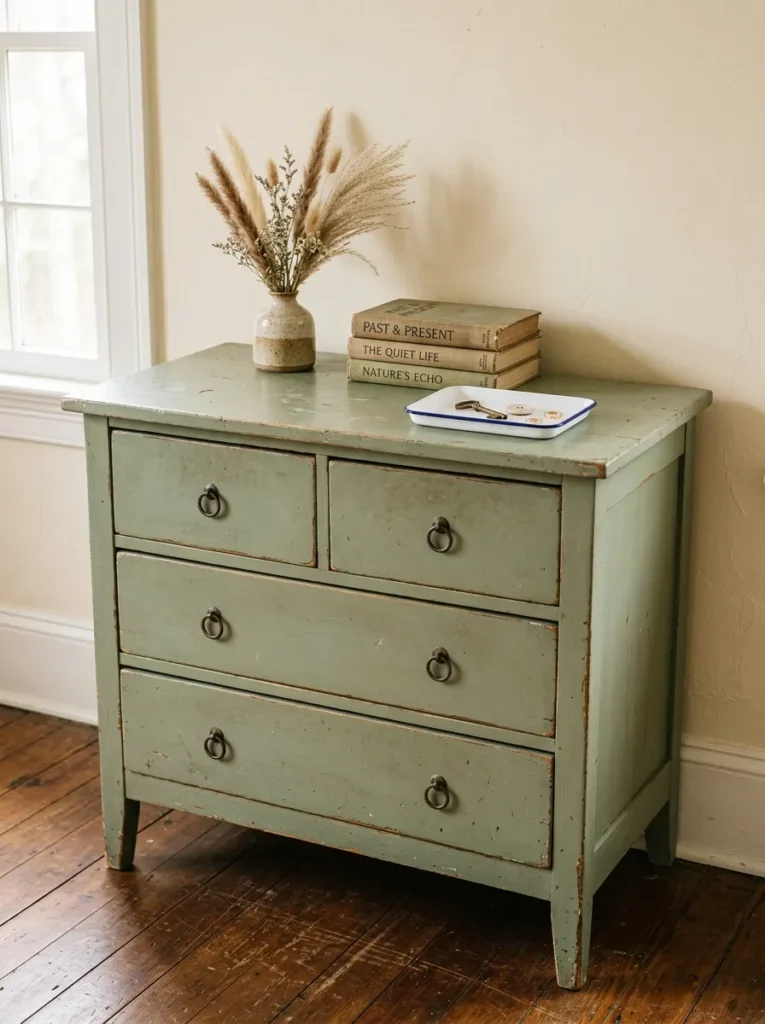
New furniture in farmhouse bedrooms often looks too perfect. The style depends on pieces that feel like they have a history, and an older dresser — genuinely vintage or convincingly distressed — serves that purpose better than any freshly manufactured alternative.
A painted dresser in chippy cream or faded sage with its original glass knobs replaced by iron pulls reads as unmistakably farmhouse. A solid walnut or oak dresser with a worn finish reads as more restrained and modern-farmhouse adjacent. The key consideration is proportion: a heavy, wide Victorian dresser overpowers a small bedroom; a narrow two- or three-drawer chest suits a compact space better without sacrificing the vintage quality.
Antique shops, estate sales, and online resale platforms consistently offer better farmhouse-relevant furniture than furniture retailers — both in character and in price. A piece that arrives pre-distressed doesn’t require distressing.
7. Use a Neutral, Nature-Derived Color Palette
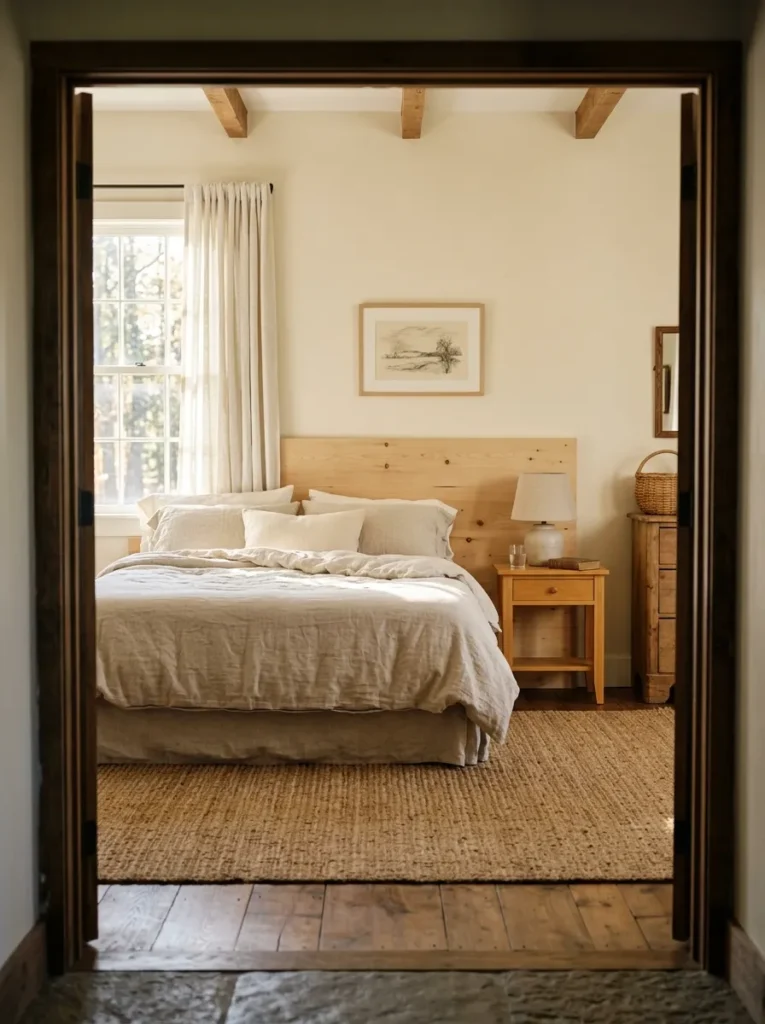
The farmhouse color vocabulary draws from aged, outdoor, and agricultural materials: chalky whites, warm creams, weathered greys, dried-herb greens, clay browns, and dusty blues. What these share is a muted quality — none of them are saturated. The palette reads as if sunlight and time have softened everything.
The wall color matters more than most other individual decisions because it sets the undertone for the whole room. A bright white with blue undertones feels more contemporary and clean; a warmer cream with slight yellow or pink undertones reads as older and more authentically farmhouse. Benjamin Moore’s White Dove and Sherwin-Williams’ Alabaster are commonly referenced in this space for good reason — they’re warm enough to read organic without feeling yellow in artificial light.
Avoid grey undertones in a farmhouse palette unless you’re deliberately steering toward a more modern interpretation. True farmhouse interiors read warm, not cool.
8. Add a Barn Door for Function and Visual Drama
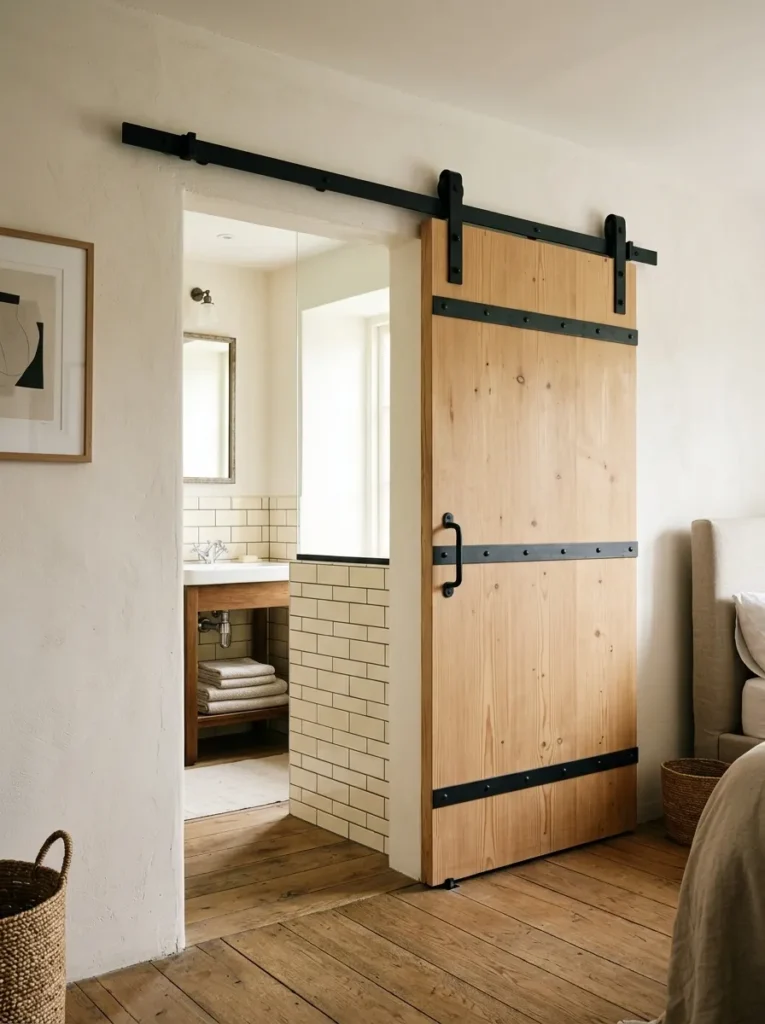
A barn door — a sliding panel on a wall-mounted track — is one of the more functionally interesting farmhouse bedroom elements because it replaces a swing-door that would otherwise require clearance arc. In a small bedroom where that swing arc cuts into useful floor space, a sliding barn door is genuinely space-efficient, not merely decorative.
The design issue is that barn doors have become so associated with a particular renovation-TV aesthetic that they require some care. A natural wood door with simple horizontal banding on a dark iron track is the most enduring version. Heavily distressed or artificially aged doors tend to look manufactured. The track hardware should be robust and smooth — flimsy hardware that rattles or snags on opening undermines the whole effect.
One practical limitation: barn doors don’t seal sound or light as fully as conventional doors, which matters in bedrooms that face morning light or shared walls.
9. Layer Rugs on Bare Wood or Stone Floors
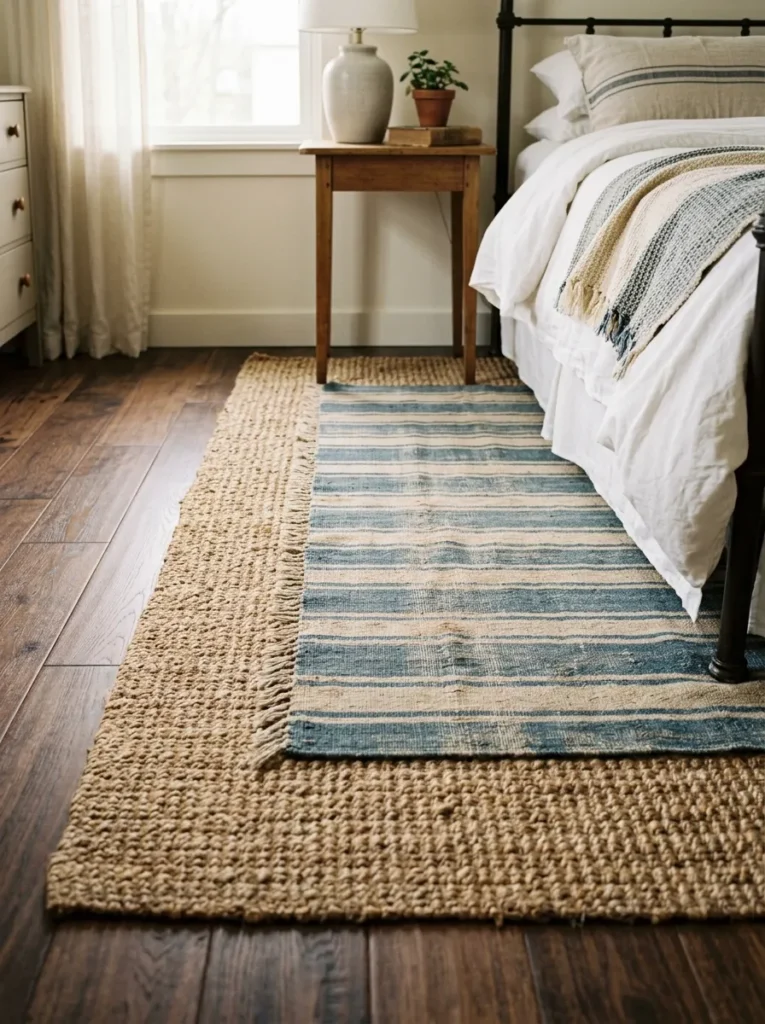
Farmhouse bedrooms almost universally feature hard flooring — original wood planks, painted boards, or stone — with rugs layered over them rather than wall-to-wall carpet. The layered rug approach has the advantage of revealing the floor material at the perimeter, which is often the most character-rich surface in the room.
For a bedroom, a jute or sisal rug as a base layer — large enough to extend significantly beyond the bed on three sides — provides a natural, slightly rough texture underfoot. A smaller woven cotton or wool rug layered on top (perhaps a vintage flatweave or a simple stripe) adds pattern and softness at the bedside where bare feet actually land in the morning.
Sizing is where this goes wrong most often. A rug that barely extends beyond the bed frame looks marooned. In a standard queen bedroom, a rug that extends at least 18–24 inches beyond the mattress on each exposed side gives the bed visual grounding and makes the room feel proportionate.
10. Hang Simple Pendant Lights Instead of a Ceiling Fan
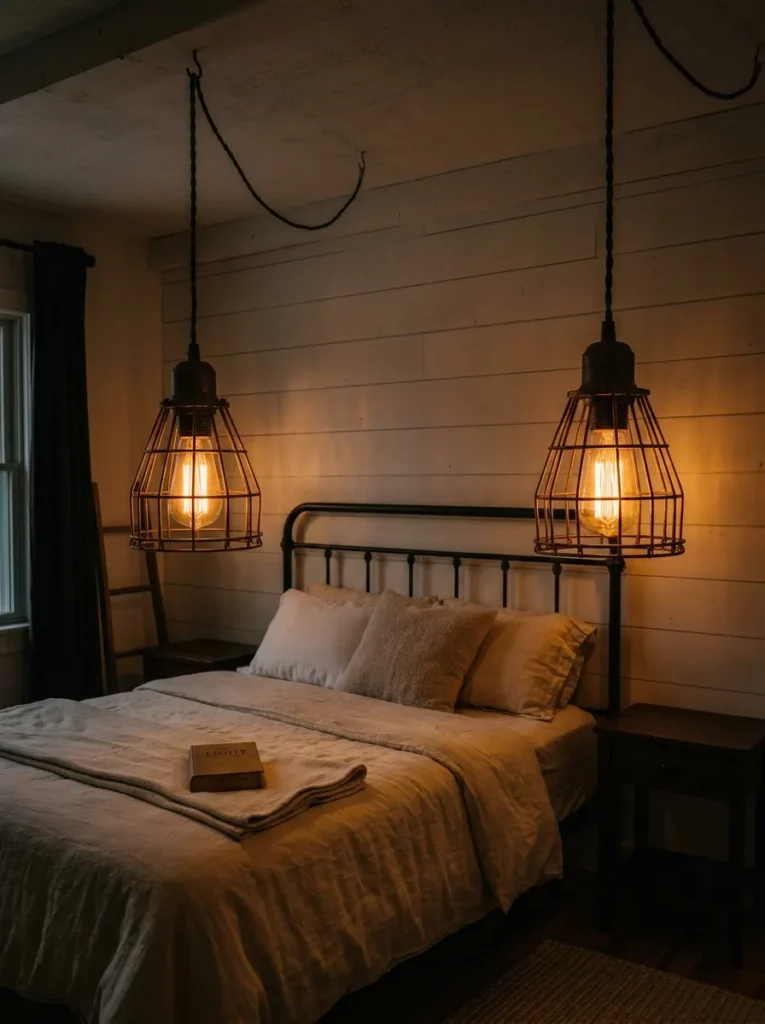
Ceiling fans are a practical reality in bedrooms with limited air conditioning, but in a farmhouse bedroom being styled deliberately, they tend to dominate in a way that competes with every other element. Where the ceiling can accommodate pendant lighting instead, the visual result is significantly cleaner.
A pair of pendant lights hung on either side of the bed — replacing bedside table lamps — is one of the most useful functional choices in a bedroom redesign: it frees the bedside surface entirely, removes the lamp shade from the lower visual field, and positions reading light at a more useful height. Cage-style pendants in aged iron, or simple hand-thrown ceramic pendants in a matte glaze, are both well-suited to a farmhouse aesthetic.
If a ceiling fan is non-negotiable, look for models with a flat wood-panel blade set and a matte black motor casing rather than the white plastic-blade fans common in builders’ standard finishes.
11. Create a Bedside Vignette With Found and Foraged Elements
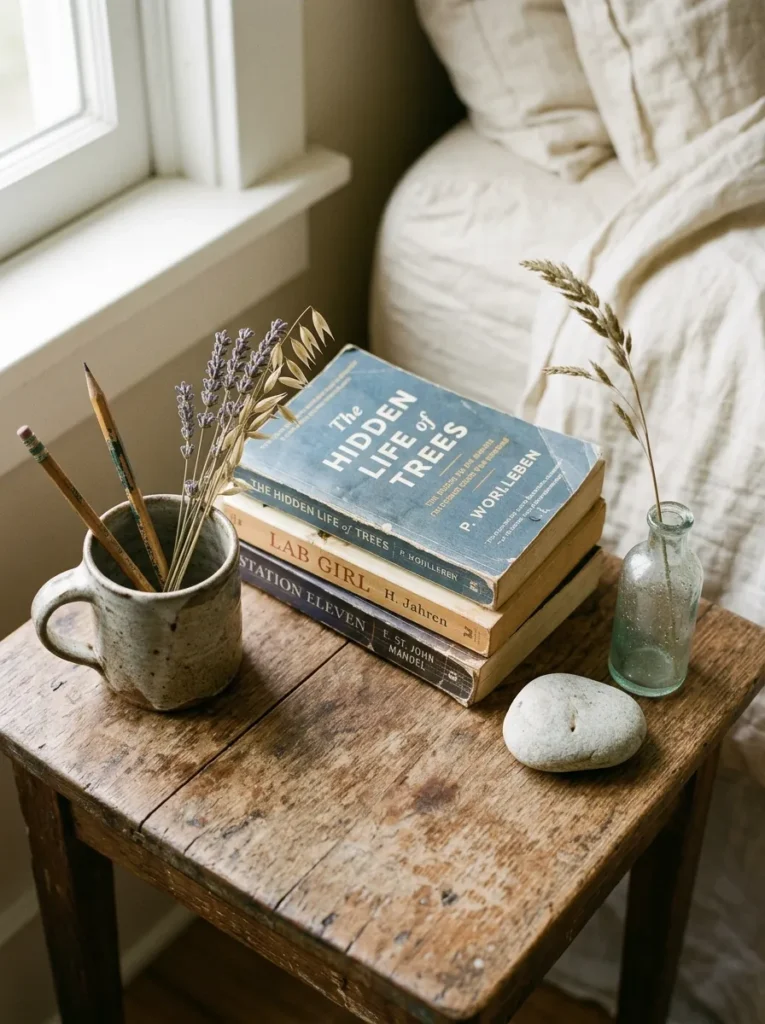
The styling on a farmhouse bedside table should look like it accumulated naturally rather than arriving as a set. A small stack of books, a ceramic mug repurposed as a pencil cup, a single stem in a narrow-necked bottle, a smooth river stone, a worn leather journal. Nothing should look newly purchased.
What holds this kind of grouping together is restraint in number and variety in material. Three to five objects of different heights, textures, and origins read as curated; more than that reads as cluttered. A single lamp or pendant providing direct light, plus a small practical item or two and one decorative element, is usually enough.
The vintage bedside table itself matters: a small painted nightstand with a single drawer, a simple wooden stool, or even a small crate used as a side surface all suit the aesthetic better than a matched bedroom set.
12. Install Board-and-Batten Wainscoting on the Lower Walls
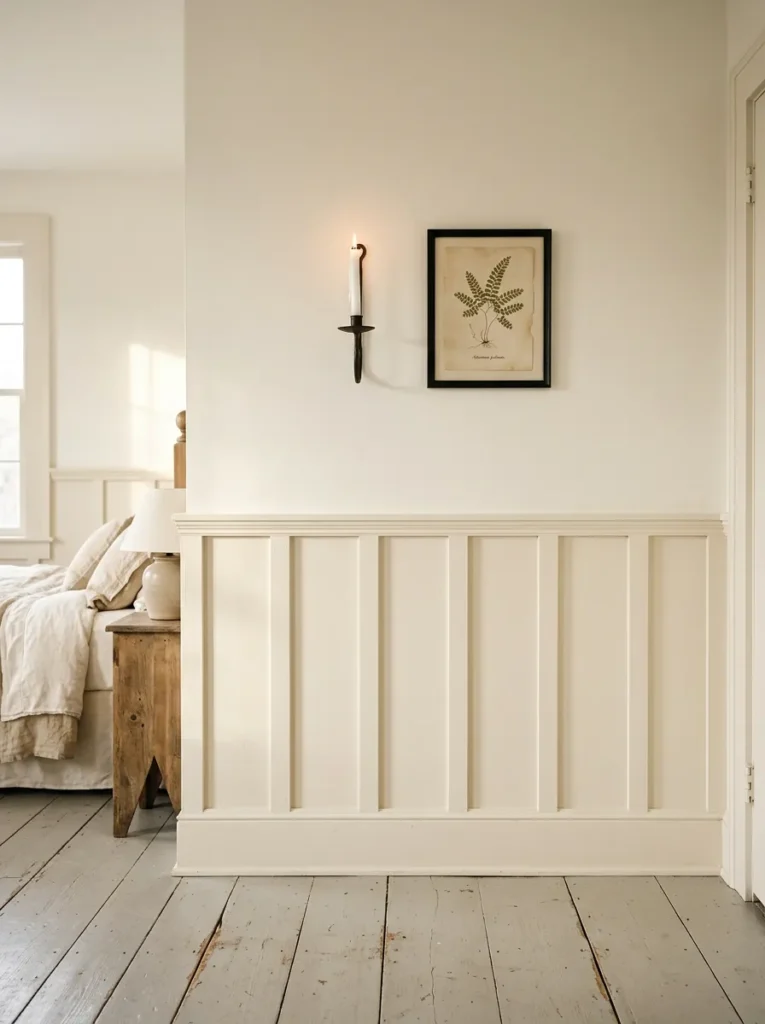
Where shiplap covers the full wall surface, board-and-batten wainscoting covers only the lower portion — typically from floor to chair rail height, which is roughly one-third of the total wall height. The upper wall remains smooth-plastered and painted, creating a two-tone horizontal division that adds structure to the room without committing the full wall to wood.
Painted the same white or cream as the upper wall, board-and-batten reads as subtle architectural detail — something that appears to have been original to the house. Painted a contrasting tone, it becomes a more deliberate design statement. Both work in farmhouse bedrooms; the choice depends on how much visual weight the room can absorb.
This is also a more realistic DIY project than full shiplap installation: the vertical battens are attached to a horizontal rail, spacing is forgiving, and the finished look depends on paint quality rather than perfect wood alignment.
13. Choose Window Treatments That Filter Rather Than Block Light
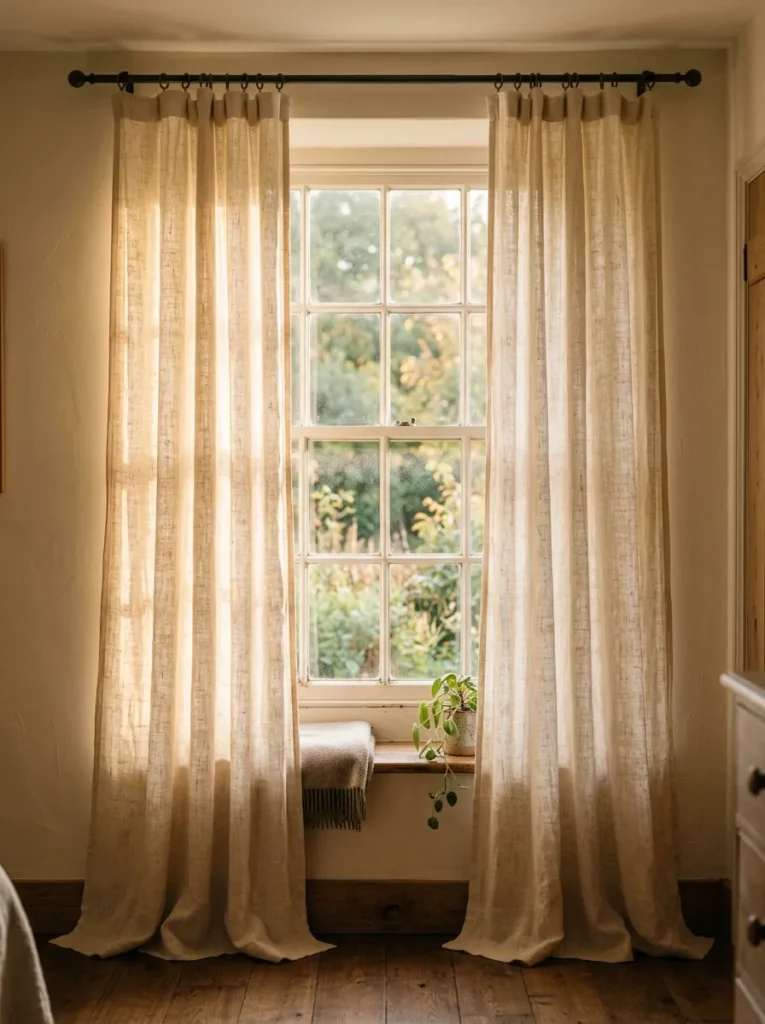
Heavy blackout curtains in a farmhouse bedroom are a functional necessity for some people but a visual contradiction for the style — farmhouse interiors read as connected to the outdoors and to natural light cycles, which dark, light-blocking curtains directly undercut.
Unlined linen curtains in cream or aged white filter light without eliminating it: they soften direct sunlight to a diffused glow that gives the room a specific quality of warmth during the day, particularly in morning-facing rooms. Hung from a simple iron rod at ceiling height (not window-frame height), they make the wall feel taller and the window feel more generous than it is.
For rooms that genuinely require light control — east-facing windows in a room used for daytime napping, for instance — a roman shade in a natural cotton or linen mounted directly to the window frame underneath the curtains handles the blackout function without sacrificing the aesthetic.
14. Use an Antique or Vintage Mirror as a Statement Piece
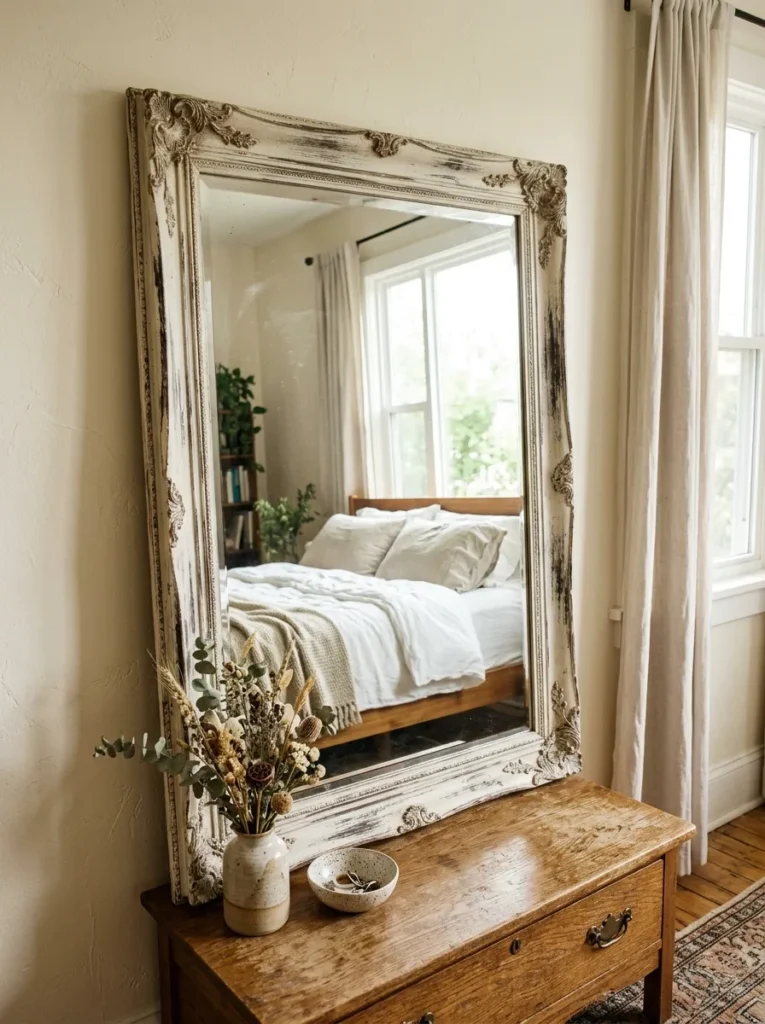
A large mirror in a farmhouse bedroom pulls dual duty: it bounces light into a room that may have small windows (common in older and cottage-style architecture), and it provides the kind of character that new furniture can’t replicate. The frame matters more than the glass.
An ornate gilded frame that has lost some of its gold — revealing the brown gesso beneath — has the quality of something genuinely old. A wide frame in distressed white paint with visible wood grain reads as early twentieth-century painted furniture. A simple flat dark wood frame in a large format (36 inches or wider) has a more restrained elegance that suits a quieter interpretation of the style.
Placement is worth considering: a mirror on a wall adjacent to the window — not directly opposite it — reflects the room and its contents rather than reflecting back the window’s direct glare, which is more visually comfortable in daily use.
15. Incorporate Natural Greenery in Unpretentious Vessels
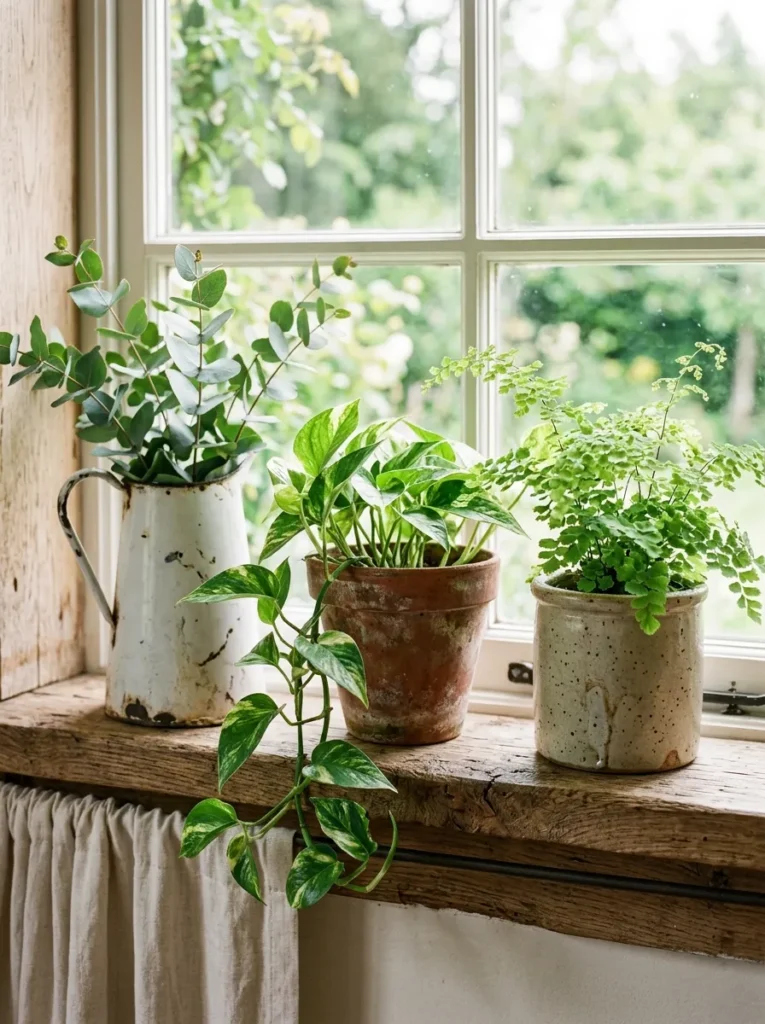
Plants in farmhouse bedrooms work when the container reads as practical and old rather than decorative and new. An enamel jug holding a branch of eucalyptus, a clay pot with a small fern, a repurposed ceramic crock planted with a trailing vine — these are appropriate. A white ceramic geometric planter from a homeware chain is not the right register, even if the plant is.
The distinction is vessel character over perfection. Chips, cracks, rust marks, and hand-applied glazes that show brush marks are all appropriate and preferable. Plants themselves should suit the bedroom environment: something with low light tolerance and modest watering needs is more realistic than a sun-hungry specimen that will struggle and die in a north-facing room.
The practical note for renters: plants with trailing habits — pothos, heartleaf philodendron — work well on high shelves and window ledges without requiring additional furniture.
16. Add a Wooden Ladder as a Textile Display
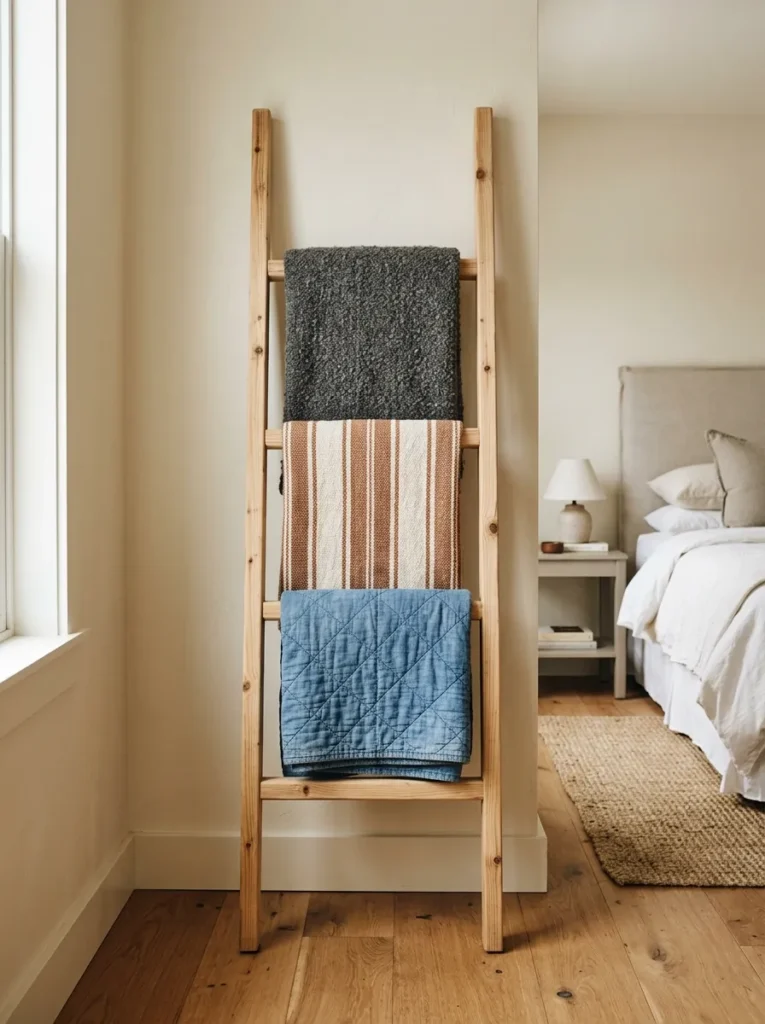
A blanket ladder — a simple wooden or painted wooden ladder leaning against a wall — is one of the more useful farmhouse bedroom accents because it solves a real storage problem: where to keep the extra blankets that linen closets can’t contain without making the room look cluttered.
A well-chosen ladder in raw wood or painted white or black, holding two or three folded throws and an extra quilt, serves as both functional storage and a vertical element that the room’s often horizontal arrangement of furniture (bed, dresser, nightstands) benefits from. The textiles themselves do design work: a nubby wool throw in charcoal, a striped woven blanket in cream and rust, and a quilted cotton piece in faded blue suggest variety in texture and season without requiring a dedicated storage piece.
Keep the ladder proportionate. A six-foot ladder in a room with 8-foot ceilings is too tall; a 60-to-72-inch ladder usually reads correctly at standard residential ceiling heights.
17. Consider Reclaimed Wood Floating Shelves Over the Dresser
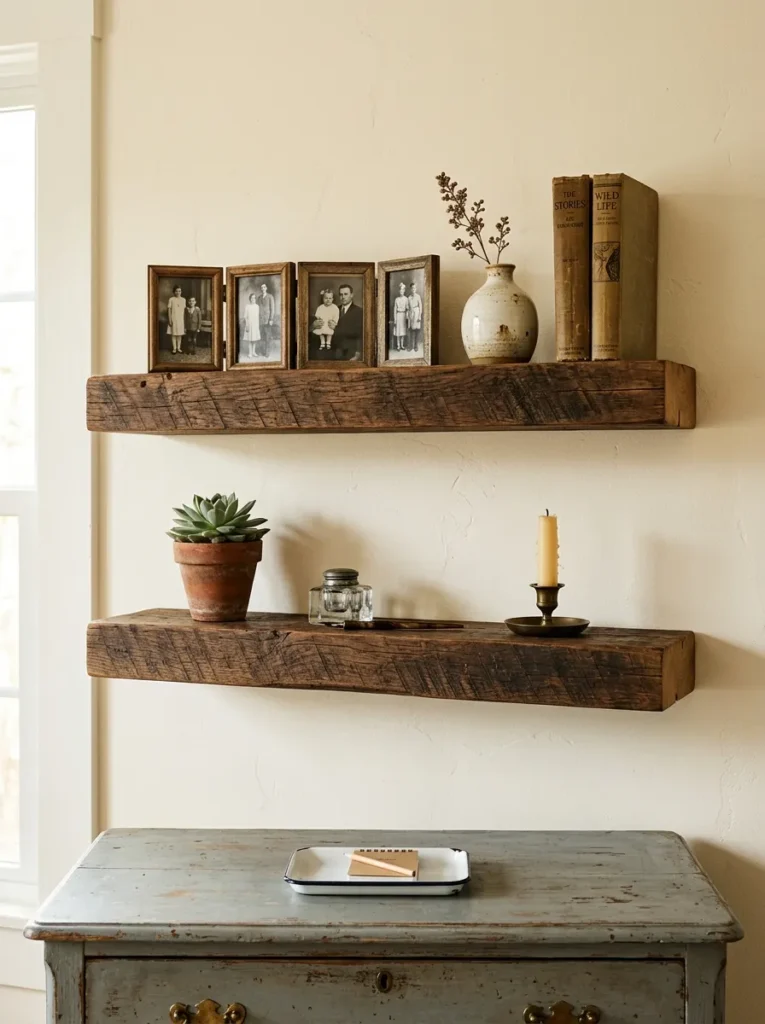
Floating shelves in reclaimed or weathered wood serve the same aesthetic function as antique furniture: they introduce material age that newer construction environments lack. Positioned above a dresser, they create a small display area for books, bottles, framed photographs, and small objects without requiring a dedicated piece of furniture.
The practical considerations are worth stating: reclaimed wood is heavy, and floating shelf brackets need to be anchored into wall studs rather than drywall alone. A shelf that pulls away from the wall is both a safety issue and a mess. If you’re not certain of stud location and depth, this is a job where a stud finder and appropriate anchors pay for themselves immediately.
Aesthetically, two shorter shelves staggered at different heights usually read better than one long shelf extending the full dresser width, which can look too symmetrical for the organic character the style is after.
18. Keep Finishing Details Imperfect on Purpose
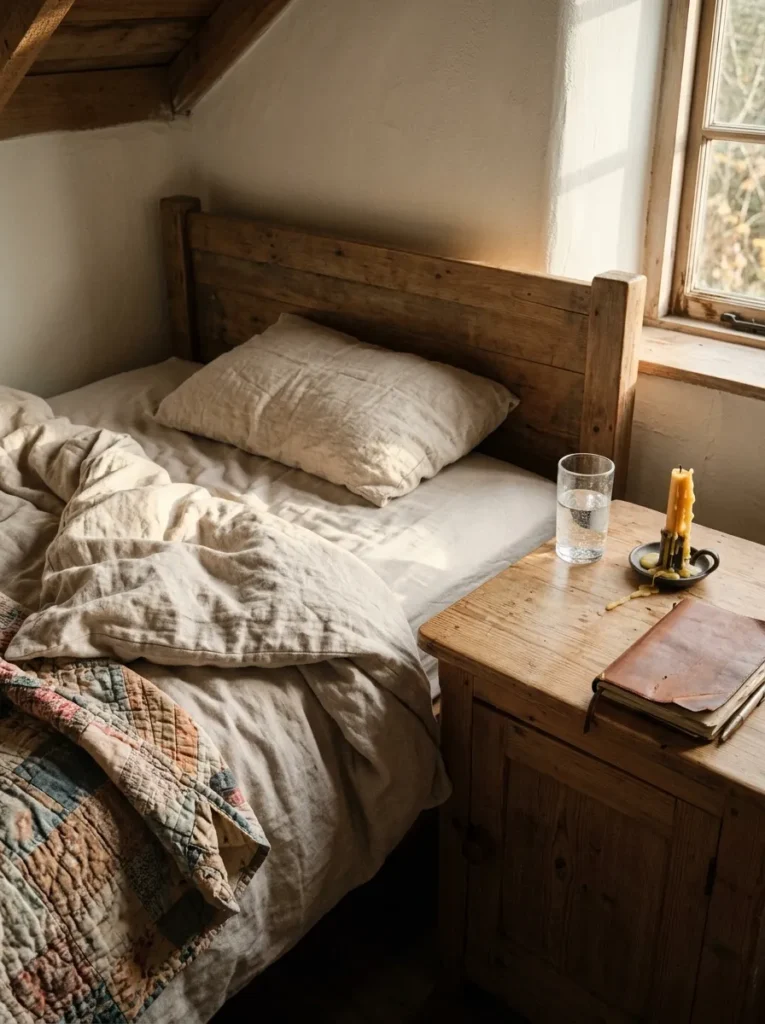
The element that separates a genuinely characterful farmhouse bedroom from a curated approximation of one is the tolerance for imperfection. A slightly uneven stitch in the quilt. A picture frame hung at a hair off-level. A candle burned down unevenly. A book left open, spine-up on the nightstand.
These details can’t be manufactured, exactly — but they can be allowed rather than corrected. The mistake many farmhouse bedroom redesigns make is over-finishing: every surface styled too deliberately, every object too perfectly centered, every textile pressed and smooth. The style’s emotional resonance comes from looking like a room that a real person lives in comfortably, not a room assembled for a photograph.
In practical terms: don’t press your linen. Let the quilt fold loosely at the foot. Stack books by size but not by spine color. Leave room on the nightstand for a glass of water rather than filling it with decor.
How to Combine These Ideas Without Overdoing the Room
Farmhouse bedrooms are easy to overload. Every element individually is right; collectively they can feel like a theme park version of a rural aesthetic rather than a home.
A reliable rule: choose two or three dominant elements and let everything else be quiet. If you install shiplap on the headboard wall, you don’t also need board-and-batten wainscoting, exposed beams, and a barn door. One strong architectural statement, supported by honest materials in furniture and textiles, is enough.
Think in layers of commitment. The biggest decisions — bed frame, wall treatment, flooring — establish the foundation. Furniture choices build on top. Textiles, lighting, and accessories are adjustable and lower-stakes. Making your biggest investment in the foundation elements means the room retains its character even as smaller details change over time.
The one element worth using consistently throughout: hardware finish. Matte black or aged iron applied to every metal detail in the room — from curtain rods to drawer pulls to light fixture casing — does more quiet work than any single decorative piece.
Final Thoughts
A farmhouse bedroom works when its materials feel honest and its styling feels un-forced. The ideas here are most effective when applied selectively rather than collectively. Start with the bed frame and the wall treatment — those two choices set the room’s tone more than anything else. From there, textiles and lighting build the warmth that makes the style function emotionally.
Not every idea here suits every room. Exposed beams need ceiling height. Barn doors need a wall with clearance. Shiplap needs a wall with enough space to read as intentional rather than token. Match the idea to the architecture rather than working against it.
If you’re gathering references for a room in progress, save the ideas that connect most directly to your space — the ones that suit your ceiling height, your window placement, and the amount of natural light the room gets. The farmhouse bedroom ideas that tend to last are the restrained ones, not the dramatic ones.
Save this guide for when you’re ready to start choosing — and revisit it after the room is mostly done, when the finishing details are the last thing left to settle.